NADA
Ó Nada, esposa do Padre Eterno
Mãe deste mundo
Segundo reza o profundo
Saber que a Bíblia impinge a este inferno
Que é a cabeça de quem quer achar
A verdade, sem nunca a encontrar.
Omnimaterno ventre (se é que mesmo
Em poesia se pode isto dizer)
(…)
DACTILOGRAFIA
DACTILOGRAFIA
Traço sozinho, no meu cubículo de engenheiro, o plano,
Firmo o projecto, aqui isolado,
Remoto até de quem eu sou.
Ao lado, acompanhamento banalmente sinistro,
O tic-tac estalado das máquinas de escrever.
Que náusea da vida!
Que abjecção esta regularidade!
Que sono este ser assim!
Outrora, quando fui outro, eram castelos e cavaleiros
(Ilustrações, talvez, de qualquer livro de infância),
Outrora, quando fui verdadeiro ao meu sonho,
Eram grandes paisagens do Norte, explícitas de neve,
Eram grandes palmares do Sul, opulentos de verdes.
Outrora.
Ao lado, acompanhamento banalmente sinistro,
O tic-tac estalado das máquinas de escrever.
Temos todos duas vidas:
A verdadeira, que é a que sonhamos na infância,
E que continuamos sonhando, adultos num substrato de névoa;
A falsa, que é a que vivemos em convivência com outros,
Que é a prática, a útil,
Aquela em que acabam por nos meter num caixão.
Na outra não há caixões, nem mortes,
Há só ilustrações de infância:
Grandes livros coloridos, para ver mas não ler;
Grandes páginas de cores para recordar mais tarde.
Na outra somos nós,
Na outra vivemos;
Nesta morremos, que é o que viver quer dizer;
Neste momento, pela náusea, vivo na outra...
Mas ao lado, acompanhamento banalmente sinistro.
Ergue a voz o tic-tac estalado das máquinas de escrever.
19/12/1933 (publicado na Presença, nº 1, 2ª série, Novembro de 1939)
16 - LULLABY
LULLABY *
My heart is full of lazy pain
And an old English lullaby
Comes out of that mist of my brain.
Upon my lap my sovereign sits
And sucks upon my breast;
Meantime his love maintains my life
And gives my sense her rest.
Sing lullaby, my little boy,
Sing lullaby, mine only joy!
I would give all my singing trade
To be the distant English child
For whom this happy song was made.
When thou hast taken thy repast,
Repose, my babe, on me;
So may thy mother and thy nurse
Thy cradle also be.
Sing lullaby, my little boy,
Sing lullably, mine only joy!
There must have been true happiness
Near where this song was sung to small
White hands clutching a mother's dress.
I grieve that duty doth not work
All that my wishing would,
Because I would not be to thee
But in the best I should.
Sing lullaby, my little boy,
Sing lullaby, mine only joy!
O what a sorrow comes to me
Knowing the bitterness I have
While that child had this lullaby!
Yet as I am, and as I may,
I must and will be thine,
Though all too little for thy self
Vouchsafing to be mine,
Sing lullaby, my little boy,
Sing lullaby, mine only joy!
My heart aches to be able to weep.
O to think of this song being sung
And the child smiling in its sleep!
Upon my lap my sovereign sits
And sucks upon my breast;
Meantime his love maintains my life
And gives my sense her rest.
Sing lullaby, my little boy,
Sing lullaby, mine only joy!
I was a child too, but would now
Be the child, and no other hearing
This song low-breathed upon its brow.
When thou hast taken thy repast,
Repose, my babe, on me,
So may thy mother and thy nurse
Thy cradle also be.
Sing lullaby, my little boy,
Sing lullaby, mine only joy!
O that I could return to that
Happy time that was never mine
And which I live but to regret!
I grieve that duty doth not work
All that my wishing would,
Because I would not be to thee
But in the best I should.
Sing lullaby, my little boy,
Sing lullaby, mine only joy!
Ay, sing on in my soul, old voice,
So motherfully laying to sleep
The babe that quietly doth rejoice.
Yet as I am, and as I may,
I must and will be thine,
Though all too little for thy self
Vouchsafing to be mine.
Sing lullaby, my little boy,
Sing lullaby, mine only joy!
Sing on and let my heart not weep
Because sometime a child could have
This song to lull him into sleep!
Yet as I am, and as I may,
I must and will be thine,
Though all too little for thy self
Vouchsafing to be mine.
Sing lullaby, my little boy,
Sing lullaby, mine only joy!
Somehow somewhere I heard this song,
I was part of the happiness
That lived its idle lines along.
Yet as I am, and as I may,
I must and will be thine,
Though all too little for thy self
Vouchsafing to be mine.
Sing lullaby, my little boy
Sing lullaby, mine only joy!
Ay, somehow, somewhere I was that
Child, and my heart lay happy asleep.
Now – oh my sad and unknown fate!
* The «Lullaby» quoted is the 134th. poem in Palgrave's Golden Treasury. It was taken by him from Martin Peerson's Private Music, a Song-Book of 1620. The «Lullaby» is here given twice over, and the last stanza twice again.
REGRET
REGRET
I would that I were again a child
And a child you sweet and pure,
That we might be free and wild
In our consciousness obscure;
That we might play fantastic games
Under trees silent and shady,
That we might have fairy-book names,
I be a lord, you a lady.
And all were a strong ignorance
And a healthy want of thought,
And many a prank, many a dance
Our unresting feet had wrought;
And I would act well a clown's part
To your childish laughter winning,
And I would call you my sweetheart
And the name would have no meaning.
Or sitting close we each other would move
With tales that now gone are sad;
We would have no sex, would feel no love,
Good without fighting the bad.
And a flower would be our life's delight
And a nutshell boat our treasure:
We would lock it in a cupboard at night
As in memory a pleasure.
We would spend hours and days like a wealth
Of goodness too great to cloy,
We would deep enjoy innocence and health
Knowing not we did enjoy...
Ah, what bitterest is is that alone
Now one feeling in me I trace –
That knowledge of what from us hath gone
And of what it left in its place.
Alexander Search
May 29th. 1907
REALIDADE
REALIDADE
Sim, passava aqui frequentemente há vinte anos...
Nada está mudado – ou, pelo menos, não dou por isso –
Nesta localidade da cidade...
Há vinte anos!...
O que eu era então! Ora, era outro...
Há vinte anos, e as casas não sabem de nada...
Vinte anos inúteis (e sei lá se o foram!
Sei eu o que é útil ou inútil?)...
Vinte anos perdidos (mas o que seria ganhá-los?)
Tento reconstruir na minha imaginação
Quem eu era e como era quando por aqui passava
Há vinte anos...
Não me lembro, não me posso lembrar.
O outro que aqui passava então,
Se existisse hoje, talvez se lembrasse...
Há tanta personagem de romance que conheço melhor por dentro
De que esse eu-mesmo que há vinte anos passava aqui!
Sim, o mistério do tempo.
Sim, o não se saber nada,
Sim, o termos todos nascido a bordo.
Sim, sim, tudo isso, ou outra forma de o dizer...
Daquela janela do segundo andar, ainda idêntica a si mesma,
Debruçava-se então uma rapariga mais velha que eu, mais lembradamente de azul.
Hoje, se calhar, está o quê?
Podemos imaginar tudo do que nada sabemos.
Estou parado física e moralmente: não quero imaginar nada...
Houve um dia que subi esta rua pensando alegremente no futuro,
Pois Deus dá licença que o que não existe seja fortemente iluminado.
Hoje, descendo esta rua, nem no passado penso alegremente.
Quando muito, nem penso...
Tenho a impressão que as duas figuras se cruzaram na rua, nem então nem agora,
Mas aqui mesmo, sem tempo a perturbar o cruzamento.
Olhámos indiferentemente um para o outro.
E eu o antigo lá subi a rua imaginando um futuro girassol.
E eu o moderno lá desci a rua não imaginando nada.
Talvez isto realmente se desse...
Verdadeiramente se desse...
Sim, carnalmente se desse...
Sim, talvez...
15/12/1932
SONNET - Could I say what I think, could I express
SONNET
Could I say what I think, could I express
My every hidden and too-silent though,
And bring my feelings, in perfection wrought,
To one unforced point of living stress.
Could I breathe forth my soul, could I confess
The inmost secrets to my nature brought;
I might be great, yet none to me hath taught
A language well to figure my distress.
Yet day and night to me new whispers bring,
And night, and day from me old whispers take...
Oh for a word, one phrase in which to fling
All that I think and feel, and so to wake
The world; but I am dumb and cannot sing,
Dumb as You clouds before the thunders break.
Alexander Search, May 1904
46 - THE ABYSS
THE ABYSS
BETWEEN me and my consciousness
Is an abyss
At whose invisible botton runs
The noise of a stream far from (...)
Whose very sound is dark and cold –
Ay, on some skin of our soul's deeming,
Cold and dark and terribly old,
Itself, and not in its told seeming.
My hewing has become my seeing
Of that placelessly sunken stream.
Its noiseless noise is ever freeing
My thought from my thught's power to dream.
Some dread reality belongs
To that stream of mute obstruct songs
That speak of no reality
But of its going to no sea.
Lo! with the eyes of my dreamed hearing
I hear the unseen river bearing
Along to where it goes not to
All things my thought is made of – Thought
Itself, and the World, and God who
On that impossible stream float.
Ay, the ideas of God, of World,
Of Myself and of Mystery,
As from some unknown rampart hurled,
Go down with that strewn to that sea
It has not and shall never reach
And belong to its night-bound motion.
Yet oh for that sun on the beach
Of that unattainable ocean!
Cada um cumpre o destino que lhe cumpre.
Cada um cumpre o destino que lhe cumpre,
E deseja o destino que deseja;
Nem cumpre o que deseja,
Nem deseja o que cumpre.
Como as pedras na orla dos canteiros
O Fado nos dispõe, e ali ficamos;
Que a Sorte nos fez postos
Onde houvemos de sê-lo.
Não tenhamos melhor conhecimento
Do que nos coube que de que nos coube.
Cumpramos o que somos.
Nada mais nos é dado.
Segundo: O DAS QUINAS
Os Deuses vendem quanto dão.
Compra-se a glória com desgraça.
Ai dos felizes, porque são
Só o que passa!
Baste a quem baste o que lhe bsta
O bastante de lhe bastar!
A vida é breve, a alma é vasta:
Ter é tardar.
Foi com desgraça e com vileza
Que Deus ao Cristo definiu:
Assim o opôs à Natureza
E Filho o ungiu.
A low, sad wind fills the lone night
A low, sad wind fills the lone night
With its one solitary sound.
I have forgotten what delight
Delight has, in the vague around
All sleep is consecrated ground.
Alas for all I ever hoped!
The sheep crop what it lies beneath.
Its grave is where the mountain sloped
When mountains were, but now the heath
Is all the life above its death.
Moan, solitary wind that wakes
When the day sleeps! Moan vague and low!
That which I never was now slakes
Its thirst where reeds cluster round lakes
Of silence, or mute rivers go.
To-morrow shall be yesterday
Lest life forget what it is ever.
I shall myself cast this away
That I am now, and myself sever
From what of me weeps by this river.
This river of the haunted night
That under stars I do not see
Has neither purpose nor delight.
Moan, solitary wind, and be
This life’s unchanging, shoreless sea!
13/3/1933
now takes
Its sleep where reeds dip into lakes

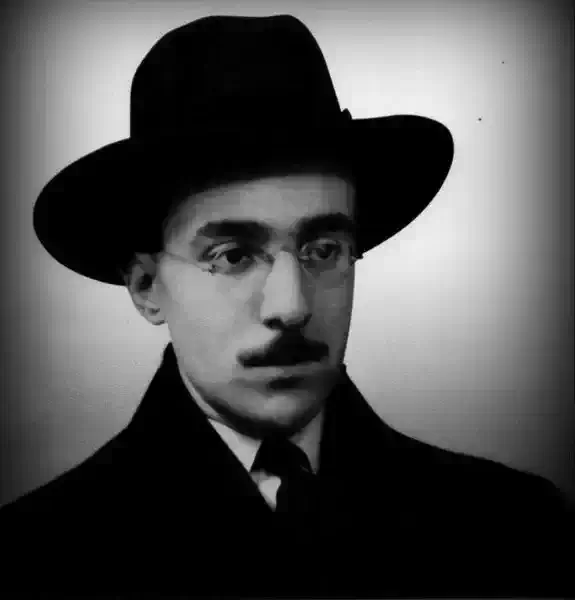

.webp)
.webp)




ignorante
pode alguem me ajudar em relacao da referencia de publicao deste livro
Sim Fernando
Amo Fernando Pessoa, e o meu preferido é AQUI NA ORLA DA PRAIA...
O Cosmos descortinado...O sonho coberto de poesias...Assim é Fernando Pessoa.
Great Man ...
Da educaçâo que me deram....
Toda a ordem errada. Aqui na orla da praia... O Poeta é um fingidor...Meta poesia, Taqbacaria... O menino da sua mâe. Nunca comheci que tivesse levado porrada... ETC O desassossego do cais!
e lindo
Tantas citações que poderiam usar, e usam logo uma que a Internet lhe tem atribuído erradamente...
alguem podia me fazer uma interpretação do poema sff?
Gostei do blog