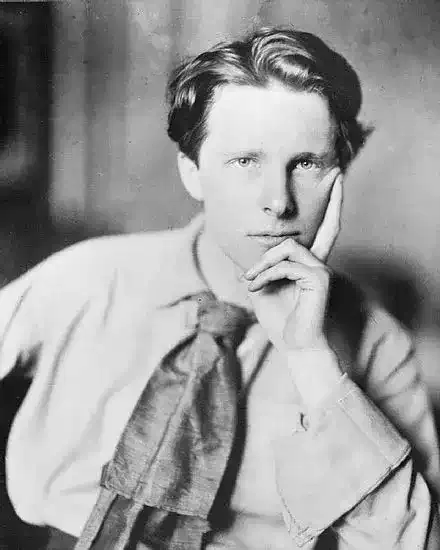
The Soldier
The Soldier
If I should die, think only this of me:
That there's some corner of a foreign field
That is for ever England. There shall be
In that rich earth a richer dust concealed;
A dust whom England bore, shaped, made aware,
Gave once her flowers to love, her ways to roam;
A body of England's, breathing English air,
Washed by the rivers, blest by suns of home.
And think, this heart, all evil shed away,
A pulse in the eternal mind, no less
Gives somewhere back the thoughts by England given;
Her sights and sounds; dreams happy as her day;
And laughter, learnt of friends; and gentleness,
In hearts at peace, under an English heaven.
The Old Vicarage, Grantchester
The Old Vicarage, Grantchester
Just now the lilac is in bloom,
All before my little room;
And in my flower-beds, I think,
Smile the carnation and the pink;
And down the borders, well I know,
The poppy and the pansy blow . . .
Oh! there the chestnuts, summer through,
Beside the river make for you
A tunnel of green gloom, and sleep
Deeply above; and green and deep
The stream mysterious glides beneath,
Green as a dream and deep as death.
-- Oh, damn! I know it! and I know
How the May fields all golden show,
And when the day is young and sweet,
Gild gloriously the bare feet
That run to bathe . . .
`Du lieber Gott!'
Here am I, sweating, sick, and hot,
And there the shadowed waters fresh
Lean up to embrace the naked flesh.
Temperamentvoll German Jews
Drink beer around; -- and THERE the dews
Are soft beneath a morn of gold.
Here tulips bloom as they are told;
Unkempt about those hedges blows
An English unofficial rose;
And there the unregulated sun
Slopes down to rest when day is done,
And wakes a vague unpunctual star,
A slippered Hesper; and there are
Meads towards Haslingfield and Coton
Where das Betreten's not verboten.
ei'qe genoi mhn . . . would I were
In Grantchester, in Grantchester! --
Some, it may be, can get in touch
With Nature there, or Earth, or such.
And clever modern men have seen
A Faun a-peeping through the green,
And felt the Classics were not dead,
To glimpse a Naiad's reedy head,
Or hear the Goat-foot piping low: . . .
But these are things I do not know.
I only know that you may lie
Day long and watch the Cambridge sky,
And, flower-lulled in sleepy grass,
Hear the cool lapse of hours pass,
Until the centuries blend and blur
In Grantchester, in Grantchester. . . .
Still in the dawnlit waters cool
�
His ghostly Lordship swims his pool,
And tries the strokes, essays the tricks,
Long learnt on Hellespont, or Styx.
Dan Chaucer hears his river still
Chatter beneath a phantom mill.
Tennyson notes, with studious eye,
How Cambridge waters hurry by . . .
And in that garden, black and white,
Creep whispers through the grass all night;
And spectral dance, before the dawn,
A hundred Vicars down the lawn;
Curates, long dust, will come and go
On lissom, clerical, printless toe;
And oft between the boughs is seen
The sly shade of a Rural Dean . . .
Till, at a shiver in the skies,
Vanishing with Satanic cries,
The prim ecclesiastic rout
Leaves but a startled sleeper-out,
Grey heavens, the first bird's drowsy calls,
The falling house that never falls.
epsilon-iota'-theta-epsilon gamma-epsilon-nu-omicron-iota -mu-eta-nu
God! I will pack, and take a train,
And get me to England once again!
For England's the one land, I know,
Where men with Splendid Hearts may go;
And Cambridgeshire, of all England,
The shire for Men who Understand;
And of THAT district I prefer
The lovely hamlet Grantchester.
For Cambridge people rarely smile,
Being urban, squat, and packed with guile;
And Royston men in the far South
Are black and fierce and strange of mouth;
At Over they fling oaths at one,
And worse than oaths at Trumpington,
And Ditton girls are mean and dirty,
And there's none in Harston under thirty,
And folks in Shelford and those parts
Have twisted lips and twisted hearts,
And Barton men make Cockney rhymes,
And Coton's full of nameless crimes,
And things are done you'd not believe
At Madingley on Christmas Eve.
Strong men have run for miles and miles,
When one from Cherry Hinton smiles;
Strong men have blanched, and shot their wives,
Rather than send them to St. Ives;
Strong men have cried like babes, bydam,
To hear what happened at Babraham.
�
But Grantchester! ah, Grantchester!
There's peace and holy quiet there,
Great clouds along pacific skies,
And men and women with straight eyes,
Lithe children lovelier than a dream,
A bosky wood, a slumbrous stream,
And little kindly winds that creep
Round twilight corners, half asleep.
In Grantchester their skins are white;
They bathe by day, they bathe by night;
The women there do all they ought;
The men observe the Rules of Thought.
They love the Good; they worship Truth;
They laugh uproariously in youth;
(And when they get to feeling old,
They up and shoot themselves, I'm told) . . .
Ah God! to see the branches stir
Across the moon at Grantchester!
To smell the thrilling-sweet and rotten
Unforgettable, unforgotten
River-smell, and hear the breeze
Sobbing in the little trees.
Say, do the elm-clumps greatly stand
Still guardians of that holy land?
The chestnuts shade, in reverend dream,
The yet unacademic stream?
Is dawn a secret shy and cold
Anadyomene, silver-gold?
And sunset still a golden sea
From Haslingfield to Madingley?
And after, ere the night is born,
Do hares come out about the corn?
Oh, is the water sweet and cool,
Gentle and brown, above the pool?
And laughs the immortal river still
Under the mill, under the mill?
Say, is there Beauty yet to find?
And Certainty? and Quiet kind?
Deep meadows yet, for to forget
The lies, and truths, and pain? . . . oh! yet
Stands the Church clock at ten to three?
And is there honey still for tea?
The Night Journey
The Night Journey
Hands and lit faces eddy to a line;
The dazed last minutes click; the clamour dies.
Beyond the great-swung arc o’ the roof, divine,
Night, smoky-scarv’d, with thousand coloured eyes
Glares the imperious mystery of the way.
Thirsty for dark, you feel the long-limbed train
Throb, stretch, thrill motion, slide, pull out and sway,
Strain for the far, pause, draw to strength again.…
As a man, caught by some great hour, will rise,
Slow-limbed, to meet the light or find his love;
And, breathing long, with staring sightless eyes,
Hands out, head back, agape and silent, move
Sure as a flood, smooth as a vast wind blowing;
And, gathering power and purpose as he goes,
Unstumbling, unreluctant, strong, unknowing,
Borne by a will not his, that lifts, that grows,
Sweep out to darkness, triumphing in his goal,
Out of the fire, out of the little room.…
—There is an end appointed, O my soul!
Crimson and green the signals burn; the gloom
Is hung with steam’s far-blowing livid streamers.
Lost into God, as lights in light, we fly,
Grown one with will, end-drunken huddled dreamers.
The white lights roar. The sounds of the world die.
And lips and laughter are forgotten things.
Speed sharpens; grows. Into the night, and on,
The strength and splendour of our purpose swings.
The lamps fade; and the stars. We are alone.
The Life Beyond
The Life Beyond
He wakes, who never thought to wake again,
Who held the end was Death. He opens eyes
Slowly, to one long livid oozing plain
Closed down by the strange eyeless heavens.
He lies;
And waits; and once in timeless sick surmise
Through the dead air heaves up an unknown hand,
Like a dry branch. No life is in that land,
Himself not lives, but is a thing that cries;
An unmeaning point upon the mud; a speck
Of moveless horror; an Immortal One
Cleansed of the world, sentient and dead; a fly
Fast-stuck in grey sweat on a corpse’s neck.
I though when love for you died, I should die.
It’s dead. Alone, most strangely, I live on.
The Hill
The Hill
Breathless, we flung us on the windy hill,
Laughed in the sun, and kissed the lovely grass.
You said, “Through glory and ecstasy we pass;
Wind, sun, and earth remain, the birds sing still,
When we are old, are old.…” “And when we die
All’s over that is ours; and life burns on
Through other lovers, other lips,” said I,
—“Heart of my heart, our heaven is now, is won!”
“We are Earth’s best, that learnt her lesson here.
Life is our cry. We have kept the faith!” we said;
“We shall go down with unreluctant tread
Rose-crowned into the darkness!”… Proud we were,
And laughed, that had such brave true things to say.
—And then you suddenly cried, and turned away.
The Goddess in the Wood
The Goddess in the Wood
In a flowered dell the Lady Venus stood,
Amazed with sorrow. Down the morning one
Far golden horn in the gold of trees and sun
Rang out; and held; and died.… She thought the wood
Grew quieter. Wing, and leaf, and pool of light
Forgot to dance. Dumb lay the unfalling stream;
Life one eternal instant rose in dream
Clear out of time, poised on a golden height.…
Till a swift terror broke the abrupt hour.
The gold waves purled amidst the green above her;
And a bird sang. With one sharp-taken breath,
By sunlit branches and unshaken flower,
The immortal limbs flashed to the human lover,
And the immortal eyes to look on death.
The Fish
The Fish
In a cool curving world he lies
And ripples with dark ecstasies.
The kind luxurious lapse and steal
Shapes all his universe to feel
And know and be; the clinging stream
Closes his memory, glooms his dream,
Who lips the roots o’ the shore, and glides
Superb on unreturning tides.
Those silent waters weave for him
A fluctuant mutable world and dim,
Where wavering masses bulge and gape
Mysterious, and shape to shape
Dies momently through whorl and hollow,
And form and line and solid follow
Solid and line and form to dream
Fantastic down the eternal stream;
An obscure world, a shifting world,
Bulbous, or pulled to thin, or curled,
Or serpentine, or driving arrows,
Or serene slidings, or March narrows.
There slipping wave and shore are one,
And weed and mud. No ray of sun,
But glow to glow fades down the deep
(As dream to unknown dream in sleep);
Shaken translucency illumes
The hyaline of drifting glooms;
The strange soft-handed depth subdues
Drowned colour there, but black to hues,
As death to living, decomposes—
Red darkness of the heart of roses,
Blue brilliant from dead starless skies,
And gold that lies behind the eyes,
The unknown unnameable sightless white
That is the essential flame of night,
Lustreless purple, hooded green,
The myriad hues that lie between
Darkness and darkness!…
And all’s one.
Gentle, embracing, quiet, dun,
The world he rests in, world he knows,
Perpetual curving. Only—grows
An eddy in that ordered falling,
A knowledge from the gloom, a calling
Weed in the wave, gleam in the mud—
The dark fire leaps along his blood;
Dateless and deathless, blind and still,
The intricate impulse works its will;
His woven world drops back; and he,
Sans providence, sans memory,
Unconscious and directly driven,
Fades to some dank sufficient heaven.
�
O world of lips, O world of laughter,
Where hope is fleet and thought flies after,
Of lights in the clear night, of cries
That drift along the wave and rise
Thin to the glittering stars above,
You know the hands, the eyes of love!
The strife of limbs, the sightless clinging,
The infinite distance, and the singing
Blown by the wind, a flame of sound,
The gleam, the flowers, and vast around
The horizon, and the heights above—
You know the sigh, the song of love!
But there the night is close, and there
Darkness is cold and strange and bare;
And the seered deeps are whisperless;
And rhythm is all deliciousness;
And joy is in the throbbing tide,
Whose intricate fingers beat and glide
In felt bewildering harmonies
Of trembling touch; and music is
The exquisite knocking of the blood.
Space is no more, under the mud;
His bliss is older than the sun.
Silent and straight the waters run.
The lights, the cries, the willows dim,
And the dark tide are one with him.
The Charm
The Charm
In darkness the loud sea makes moan;
And earth is shaken, and all evils creep
About her ways.
Oh, now to know you sleep!
Out of the whirling blinding moil, alone,
Out of the slow grim fight,
One thought to wing -- to you, asleep,
In some cool room that's open to the night
Lying half-forward, breathing quietly,
One white hand on the white
Unrumpled sheet, and the ever-moving hair
Quiet and still at length! . . .
Your magic and your beauty and your strength,
Like hills at noon or sunlight on a tree,
Sleeping prevail in earth and air.
In the sweet gloom above the brown and white
Night benedictions hover; and the winds of night
Move gently round the room, and watch you there.
And through the dreadful hours
The trees and waters and the hills have kept
The sacred vigil while you slept,
And lay a way of dew and flowers
Where your feet, your morning feet, shall tread.
And still the darkness ebbs about your bed.
Quiet, and strange, and loving-kind, you sleep.
And holy joy about the earth is shed;
And holiness upon the deep.
The Dead
The Dead
Blow out, you bugles, over the rich Dead!
There's none of these so lonely and poor of old,
But, dying, has made us rarer gifts than gold.
These laid the world away; poured out the red
Sweet wine of youth; gave up the years to be
Of work and joy, and that unhoped serene,
That men call age; and those who would have been,
Their sons, they gave, their immortality.
Blow, bugles, blow! They brought us, for our dearth,
Holiness, lacked so long, and Love, and Pain.
Honour has come back, as a king, to earth,
And paid his subjects with a royal wage;
And Nobleness walks in our ways again;
And we have come into our heritage.
The Busy Heart
The Busy Heart
Now that we’ve done our best and worst, and parted,
I would fill my mind with thoughts that will not rend.
(O heart, I do not dare go empty-hearted)
I’ll think of Love in books, Love without end;
Women with child, content; and old men sleeping;
And wet strong ploughlands, scarred for certain grain;
And babes that weep, and so forget their weeping;
And the young heavens, forgetful after rain;
And evening hush, broken by homing wings;
And Song’s nobility, and Wisdom holy,
That live, we dead. I would think of a thousand things,
Lovely and durable, and taste them slowly,
One after one, like tasting a sweet food.
I have need to busy my heart with quietude.