
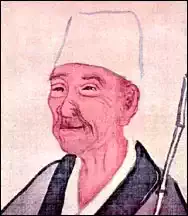
Matsuo Bashō
1644–1694
· lived 50 years
 JP
JP
JP
Matsuo Basho was a highly influential poet of the Edo period in Japan. He is considered the greatest master of haiku, a form of Japanese poetry consisting of three phrases with a 5, 7, 5 syllable structure. His work is characterized by its simplicity, depth, and profound connection to nature and the human condition. Basho's poetry often evokes a sense of melancholy, impermanence, and the beauty of the fleeting moment, deeply rooted in Zen Buddhist philosophy.
n. 1644-01-01, Bashō's birth house · m. 1694-11-28, Midōsuji
10,320
Views
Identification and basic context
Full name: Matsuo Munefusa (松尾 宗房), commonly known as Matsuo Bashō (松尾 芭蕉). Date and place of birth: 1644, Iga Province (present-day Mie Prefecture), Japan. Family background, social class, and cultural context of origin: Born into a family of modest samurai status, Bashō's early life was influenced by the feudal society of Edo period Japan. Nationality and language(s) of writing: Japanese. Historical context in which they lived: The Edo period (1603–1868) was a time of relative peace and stability in Japan, characterized by a flourishing urban culture and the development of arts and literature.Childhood and education
Family background and social environment: Bashō's father was a samurai who served a local lord. The family belonged to the lower ranks of the samurai class. Formal education and self-education: He received a basic samurai education and likely studied with local scholars. His extensive self-education through reading and travel was crucial to his development. Early influences (readings, culture, religion, politics): Influenced by classical Japanese literature, Chinese poetry, and Zen Buddhism. His early readings included works like The Tale of Genji and the poetry of Saigyō. Literary, philosophical, or artistic movements absorbed: Zen Buddhism played a significant role in shaping his worldview and poetic sensibility. He was also influenced by the aesthetic principles of wabi-sabi. Significant events in youth: His early fascination with poetry and eventual departure from a conventional samurai life marked a turning point.Literary trajectory
Beginning of writing (when and how it started): Bashō began writing poetry at a young age. He initially followed established poetic traditions. Development over time (phases, changes in style): His style evolved significantly, moving from more conventional forms to the concise and evocative haiku. His later period is characterized by profound spiritual depth and mastery of the haiku form. Chronological evolution of the work: His early works show imitations of established masters, but his travels and spiritual development led to a unique and influential style. Contributions to magazines, newspapers, and anthologies: Bashō's disciples compiled many of his works, and his influence spread through them. He also participated in renga (linked verse) sessions. Activity as a critic, translator, or editor: Bashō was primarily a poet, but his prefaces and commentary on poetry were highly influential.Works, style, and literary characteristics
Major works with dates and context of production: "The Seashell Book" (Shinsai, 1672), "The Haiku Collection" (1678), "The Year's Great Season" (1684), "A Farewell to the Road" (1688), "The Five Books of the Hermitage" (1691), "The Knapsack of Travel" (Sarashina Kikō, 1688), "The Narrow Road to the Deep North" (Oku no Hosomichi, written 1689, published 1702). Dominant themes — love, death, time, nature, identity, homeland, spirituality, etc.: Nature, impermanence, solitude, the ephemeral beauty of existence, the passage of time, human suffering, and the search for enlightenment. Form and structure — use of the sonnet, free verse, fixed forms, metrical experimentation: Master of haiku (hokku), consisting of 5-7-5 syllables. Also wrote tanka and haibun (prose interspersed with haiku). Poetic devices (metaphor, rhythm, musicality): Subtle use of juxtaposition, suggestion, and evocative imagery. Emphasis on natural rhythms and a profound sense of stillness. Tone and poetic voice — lyrical, satirical, elegiac, epic, ironic, confessional: Often contemplative, serene, melancholic, and deeply spiritual. His voice is humble and observant. Poetic voice (personal, universal, fragmented, etc.): Personal yet universal, reflecting his individual journey and experiences while touching upon common human emotions and insights. Language and style — vocabulary, imagery density, preferred rhetorical devices: Simple, direct language with profound resonance. Rich in sensory detail and evocative imagery. Master of kireji (cutting words) and kigo (seasonal words). Formal or thematic innovations introduced into literature: Elevated haiku from a light verse form to a serious literary genre capable of expressing deep philosophical and emotional content. Relationship with tradition and modernity: Bridged classical Japanese poetic traditions with new forms of expression, influencing both traditional and modern poetry. Associated literary movements (e.g., symbolism, modernism): While not strictly adhering to Western movements, his work shares affinities with Symbolism and Transcendentalism in its focus on nature and inner experience. Lesser-known or unpublished works: Many minor works and travelogues exist, often compiled by his disciples.Cultural and historical context
Relationship with historical events (wars, revolutions, regimes): Lived through the relatively stable Edo period, his work often reflecting a quiet observation of life rather than direct engagement with political events. Relationship with other writers or literary circles: Associated with a school of disciples (Bashō's school) who preserved and disseminated his teachings and poetry. He corresponded with and influenced many poets of his time. Generation or movement to which they belong: Though he transcends simple categorization, he is a central figure of Edo period poetry and the development of haiku. Political or philosophical stance: His primary stance was philosophical, influenced by Zen Buddhism, emphasizing detachment and mindfulness. Influence of society and culture on the work: The samurai ethos, Buddhist philosophy, and the aesthetics of wabi-sabi deeply shaped his work. The emphasis on nature reflects a deep cultural appreciation for the natural world. Dialogues and tensions with contemporaries: Engaged in poetic exchanges and competitions, pushing the boundaries of existing poetic forms. Critical reception during life vs. posthumous recognition: While respected during his life, his reputation grew exponentially after his death, cementing his status as Japan's greatest poet.Personal life
Significant emotional and family relationships and how they shaped the work: Little is known about his early family life. His later life was marked by intense focus on poetry and spiritual practice, often involving solitary travel. Friendships and literary rivalries: He had many disciples and friends who were poets. While not known for overt rivalries, he engaged in poetic debates. Personal experiences and crises, illnesses, or conflicts: He suffered from ill health and faced personal struggles related to his itinerant lifestyle. Parallel professions (if they did not live solely from poetry): He supported himself through teaching poetry and accepting patronage, but his life was largely dedicated to his art. Religious, spiritual, or philosophical beliefs: Deeply devoted to Zen Buddhism, which profoundly influenced his worldview and artistic expression. Political positions and civic engagement: Bashō was not politically active in the conventional sense; his focus was spiritual and artistic.Recognition and reception
Place in national and international literature: Revered as the preeminent poet in Japan and one of the most important poets in world literature. His influence on haiku globally is immeasurable. Awards, distinctions, and institutional recognition: While formal awards were not common in his era, his recognition comes from his enduring status and the vast body of critical scholarship and artistic appreciation. Popularity vs. academic recognition: His work enjoys both immense popular appeal and rigorous academic study worldwide.Influences and legacy
Authors who influenced them: Saigyō, Sōkan, Ryōkan, and Chinese poets like Li Bai and Du Fu. Poets and movements they influenced: Countless Japanese poets and the global haiku movement. His influence extends to modern poets seeking to capture the essence of experience with brevity and depth. Impact on national and world literature and on later generations of poets: Revolutionized haiku, making it a profound art form. His emphasis on nature and spiritual insight continues to inspire poets globally. Inclusion in the literary canon: Central figure in the Japanese literary canon and a major figure in world literature. Translations and international dissemination: His works have been translated into numerous languages, reaching a vast international audience. Adaptations (music, theater, film): His poetry has inspired numerous musical compositions, theatrical adaptations, and artistic interpretations. Academic studies dedicated to the work: Extensive academic research exists on his life, poetry, and philosophical underpinnings.Interpretation and critical analysis
Possible readings of the work: His poetry can be read as deeply spiritual, philosophical, and a testament to the beauty of everyday life and the natural world. It invites contemplation on impermanence and mindfulness. Philosophical and existential themes: Explores themes of impermanence (mujō), suffering (ku), emptiness (kū), and the search for enlightenment, all filtered through a unique aesthetic sensibility. Controversies or critical debates: While his status is largely undisputed, critical discussions sometimes revolve around the precise interpretation of specific poems or the extent of his direct Zen practice.Curiosities and lesser-known aspects
Lesser-known aspects of personality: Despite his serene poetry, he was known to have a sharp wit and could be critical of poetic mediocrity. Contradictions between life and work: His nomadic life, often spent in hardship, contrasts with the serene and tranquil images often found in his poetry. Significant or anecdotal episodes that illuminate the author’s profile: His choice of the name "Bashō" (banana tree), which is not native to Japan and is known for its sparse fruit, symbolizes his detachment from worldly possessions and his embrace of a simple, austere life. Objects, places, or rituals associated with poetic creation: His traveling staff, his straw hat, and the many inns and natural landscapes he visited are intrinsically linked to his creative process. Writing habits: He often composed poems during or immediately after his travels, inspired by the places he saw and the experiences he had. Curious episodes: His disciples would sometimes follow him for days, listening to his poetic insights and observations. Manuscripts, diaries, or correspondence: His travelogues, such as "The Narrow Road to the Deep North," provide intimate glimpses into his journeys and thoughts.Death and memory
Circumstances of death: Died of illness in Osaka. Posthumous publications: His disciples continued to publish his works and compile his teachings, ensuring his legacy and influence endured.Poems
21Winter garden
Winter garden
Winter garden,
the moon thinned to a thread,
insects singing.
Translated by Robert Hass
Winter garden,
the moon thinned to a thread,
insects singing.
Translated by Robert Hass
344
What fish feel
What fish feel
What fish feel,
birds feel, I don't know--
the year ending.
Translated by Robert Hass
What fish feel,
birds feel, I don't know--
the year ending.
Translated by Robert Hass
420
The squid seller's call
The squid seller's call
The squid seller's call
mingles with the voice
of the cuckoo.
Translated by Robert Hass
The squid seller's call
mingles with the voice
of the cuckoo.
Translated by Robert Hass
375
The oak tree
The oak tree
The oak tree:
not interested
in cherry blossoms.
Translated by Robert Hass
The oak tree:
not interested
in cherry blossoms.
Translated by Robert Hass
341
The dragonfly
The dragonfly
The dragonfly
can't quite land
on that blade of grass.
Translated by Robert Hass
The dragonfly
can't quite land
on that blade of grass.
Translated by Robert Hass
499
Staying at an inn
Staying at an inn
Staying at an inn
where prostitutes are also sleeping--
bush clover and the moon.
Translated by Robert Hass
Staying at an inn
where prostitutes are also sleeping--
bush clover and the moon.
Translated by Robert Hass
420
Taking a nap
Taking a nap
Taking a nap,
feet planted
against a cool wall.
Translated by Robert Hass
Taking a nap,
feet planted
against a cool wall.
Translated by Robert Hass
498
Moonlight slanting
Moonlight slanting
Moonlight slanting
through the bamboo grove;
a cuckoo crying.
Translated by Robert Hass
Moonlight slanting
through the bamboo grove;
a cuckoo crying.
Translated by Robert Hass
534
Quotes
12Comments (0)
Log in
to post a comment.
No comments yet. Be the first to comment.