
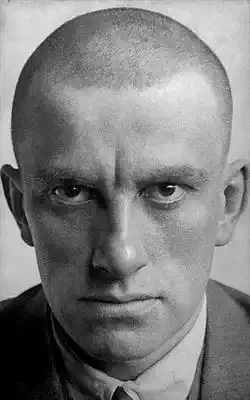
Vladimir Maiakovski
1893–1930
· lived 36 years
 GE
GE
GE
Vladimir Mayakovsky was a Russian poet, playwright, and artist, a prominent figure of Russian Futurism. His work, marked by vigorous language, formal experimentation, and strong political engagement, expressed the turbulence and aspirations of pre- and post-revolutionary Russia. He was one of the most important Soviet poets, although his relationship with the regime became complex.
n. 1893-07-07, Baghdati · m. 1930-04-14, Moscovo
11
Views
Bio
Identification and Basic Context
Vladimir Vladimirovich Mayakovsky (in Russian: Влади́мир Влади́мирович Маяко́вский) was a Russian, and later Soviet, poet, playwright, artist, and activist. He was one of the most influential and controversial figures of Russian Futurism, a movement that sought to break with tradition and radically innovate artistic language and form. His work, characterized by a grandiloquent tone, linguistic experimentation, and strong engagement with social and political issues, reflects the upheavals in Russia at the beginning of the 20th century.Childhood and Education
Born in Baghdati, Georgia, then part of the Russian Empire. His father, a forester, died when Vladimir was young, an event that profoundly marked his life. After his father's death, the family moved to Moscow. Mayakovsky showed a rebellious temperament and artistic inclinations from an early age. He was arrested several times for revolutionary activities and in 1908 enrolled in the Moscow School of Painting, Sculpture, and Architecture, where he met other artists who would become prominent in the Futurist movement.Literary Career
Mayakovsky's literary career began with his adherence to Futurism. He was one of the signatories of the manifesto "A Slap in the Face of Public Taste" (1912), which advocated for the rejection of bourgeois art and the creation of a new poetic language. His early poems, such as "A Cloud in Trousers" (1915) and "The End of the Theater" (1916), shocked the public with their formal audacity, colloquial vocabulary, and urban and social themes. After the October Revolution of 1917, Mayakovsky enthusiastically embraced the new regime, seeing in the revolution an opportunity to fulfill his artistic and social ambitions.Work, Style, and Literary Characteristics
Mayakovsky's work is marked by a unique and innovative style. He used free verse with an almost oratorical cadence, dramatic rhythmic breaks, and the use of "stairs" (staggered lines) to emphasize rhythm and intonation. His language was full of neologisms, slang, technical, and advertising vocabulary, creating an effect of shock and dynamism. Themes included love (often tormented and grandiose), criticism of bourgeois society, the exaltation of revolution, and life in the modern city. Works like "Man" (1918) and "Vladimir Ilyich Lenin" (1924) demonstrate his commitment to the Bolshevik cause. His theater, such as "The Bedbug" (1919) and "The Bathhouse" (1929), also experimented with revolutionary forms and themes.Cultural and Historical Context
Mayakovsky lived and produced his work during one of the most turbulent periods in Russian and world history. The Russian Revolution of 1917 was a watershed moment, and the poet became a fervent supporter of the Bolshevik regime, seeing art as a tool for social transformation. He worked with LEF (Left Front of the Arts), a group that advocated for engaged and utilitarian art. His work was used as propaganda, but it also expressed the contradictions and difficulties of building socialism in the USSR. His relationship with the Soviet authorities, however, became increasingly tense, especially with the hardening of socialist realism.Personal Life
Mayakovsky's personal life was intense and tormented. His love affairs, particularly his relationship with Lili Brik, were a source of inspiration and suffering, as evidenced in poems like "A Cloud in Trousers." His public persona was that of a revolutionary artist, but internally he faced existential crises and the pressure of censorship and regime expectations. The complexity of his relationships and his internal struggles are crucial aspects for understanding his work.Recognition and Reception
During his lifetime, Mayakovsky was a celebrated and controversial artist. His poetic performances were significant events, and his public persona was imposing. After his death, his work was initially promoted by the Soviet regime but later underwent periods of disapproval due to certain ideological "deviations." However, his legacy as one of the greatest poets of the 20th century and an innovator of poetic language is undeniable, influencing generations of writers and artists.Influences and Legacy
Mayakovsky was influenced by Italian Futurism and the European avant-garde but developed an unmistakable style. His poetry influenced Soviet poetry and revolutionary poetry worldwide. His formal experimentation, use of everyday language, and fusion of art and politics opened new paths for artistic expression. His work continues to be studied and admired for its strength, originality, and ability to capture the spirit of an era of profound transformations.Interpretation and Critical Analysis
Mayakovsky's work is often analyzed from the perspective of his political engagement and formal innovations. Critics debate the authenticity of his revolutionary fervor versus the ideological pressures he faced. His love poetry, often grand and desperate, is also a fertile ground for analysis, revealing the duality between the public figure and the tormented individual. The "Mayakovsky problem" lies in the difficulty of separating the artist from the propagandist, the genius from the ideological instrument.Curiosities and Lesser-Known Aspects
Mayakovsky was known for his imposing stature (over two meters tall) and his flamboyant style of dress, which made him an instantly recognizable public figure. He was not limited to poetry; he worked extensively on propaganda posters, graphic designs, and even film scripts. His death by suicide in 1910, with a gunshot in his writing room, is one of the most tragic moments of his biography.Death and Memory
Vladimir Mayakovsky committed suicide on April 14, 1930, in Moscow, at the age of 36. In his farewell note, he wrote: "The ship of love has sunk / common life has ended / you and I are quits." His death shocked the artistic and political world. After a period in which his work was criticized and even suppressed, the Soviet regime, under Stalin's influence, eventually canonized him as "the best, most talented poet of our Soviet era," although this canonization simplified the complexity of his work and life.Poems
0No poems found
Quotes
2If you wish—
No poems found
Comments (0)
Log in
to post a comment.
No comments yet. Be the first to comment.