
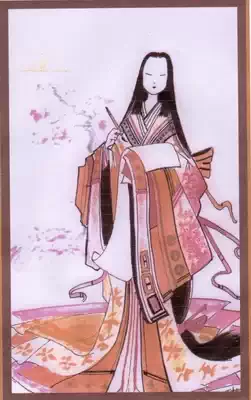
Sei Shônagon

Sei Shônagon was a Japanese writer and courtier of the Heian period. She is celebrated for her work "The Pillow Book" (Makura no Sōshi), a collection of notes, observations, poems, and essays that offer a vivid glimpse into life at the imperial court in Kyoto. Her writing is marked by insight, intelligence, and a keen sense of observation, covering a wide range of subjects, from the beauty of nature and court customs to human relationships and personal reflections.
n. 966ac, Heian-Kyo · m. 1020, Quioto
3
Views
Bio
Identification and basic context
Sei Shônagon (清少納言), whose birth name is unknown, was a Japanese writer and courtier, celebrated for her work "The Pillow Book" (Makura no Sōshi). She was born around 966 and died on an uncertain date, possibly in the early 11th century. It is believed she was born in Kai Province (modern Yamanashi Prefecture) or Tanba Province (modern Hyōgo Prefecture). She belonged to a family of mid-level administrators and poets, with connections to the imperial court. She was of Japanese nationality and wrote in Old Japanese (heian-kyō).Childhood and education
Little is known about Sei Shônagon's childhood. It is believed she received a privileged education for her time, including studies of classical Chinese and Japanese literature, calligraphy, and music. Her family had a literary tradition, which likely influenced her own inclination for writing. The Heian court environment, with its strict etiquette and cultural sophistication, was a crucial backdrop for her formation and observation.Literary career
Sei Shônagon's literary career is intrinsically linked to her life at court. It is believed she began writing "The Pillow Book" around 1001, while serving Empress Teishi (Sadako). The work was not formally published but circulated among her acquaintances. Her writing reflects a period of intense female literary production in Japan, with other writers like Murasaki Shikibu, author of "The Tale of Genji," who lived around the same time.Work, style, and literary characteristics
The main and almost sole work attributed to Sei Shônagon is "The Pillow Book" (Makura no Sōshi). This work is a collection of 164 chapters, varying in length, that address a myriad of topics, including lists of "things that delight," reflections on nature, descriptions of court events, poems (tanka), and observations on people and customs. Her style is characterized by keen observation, subtle irony, intelligence, and rich vocabulary. She demonstrates a deep understanding of Heian aesthetics and an unparalleled ability to capture the essence of human emotions and experiences. Her language is elegant and expressive, often using fragmentation and juxtaposition to create vivid effects. The work is associated with the literary style "tsurezuregusa" (casual essays and notes).Cultural and historical context
Sei Shônagon lived during the late Heian period (794-1185), a time of cultural and artistic flourishing at the Japanese imperial court, but also of increasing political instability. The court in Kyoto was the center of cultural life, with a strong focus on aesthetics, poetry, music, and literature. The position of women at court was paradoxical: restricted in many aspects, but with unique opportunities for literary expression and cultural influence. "The Pillow Book" offers an invaluable glimpse into this society.Personal life
Sei Shônagon was married and had at least one child. Her personal life is largely reconstructed from her work. It is believed she was married to a man named Tachibana no Michinari, and later, possibly, had a relationship with Minister Fujiwara no Kanesuke. After the death of Empress Teishi and the consequent fall from her court position, Shônagon appears to have withdrawn from public life, although details are scarce. Her life as a courtier exposed her to intrigues, rivalries, and political changes, elements that frequently transpire in her writing.Recognition and reception
"The Pillow Book" was immediately recognized as a work of great literary and cultural merit. It was widely copied and appreciated by her contemporaries and subsequent generations, solidifying Sei Shônagon's place as one of Japan's most important literary figures. Her work is studied to this day for its literary, historical, and anthropological value.Influences and legacy
Sei Shônagon was influenced by classical Chinese and Japanese literature, including the poetry of Ariwara no Narihira and Murasaki Shikibu's "The Tale of Genji," with whom, according to tradition, she had a literary rivalry. Her legacy lies in "The Pillow Book," which became a classic of Japanese literature and a primary source for understanding the culture and society of the Heian period. Her writing influenced numerous writers and artists over the centuries, and her work continues to be translated and admired internationally.Interpretation and critical analysis
Sei Shônagon's work has been interpreted in various ways. Some see it as a reflection of the ephemeral beauty and superficiality of Heian court life, while others highlight her critical intelligence, her capacity for irony, and her exploration of the human condition. Her emphasis on detailed observation and subjectivity made her a precursor to more modern literary forms. The duality between beauty and transience, and between courtly order and human spontaneity, are recurring themes in critical analysis.Curiosities and lesser-known aspects
One of the most curious aspects is the mystery surrounding her name. "Sei Shônagon" was not her birth name, but rather an official title "Shōnagon" (a low-ranking counselor position) to which the surname "Sei" (a Chinese reading of her family name, Kiyohara) was added. "The Pillow Book" was written on scrolls that were kept in "pillows" (makura), hence the title. There are accounts that she was known for her witty and sometimes bold personality.Death and memory
Details about Sei Shônagon's death are scarce and surrounded by uncertainty. It is believed she withdrew from public life after the fall of her patron, Empress Teishi, and lived the remainder of her days in relative seclusion. Posthumous publications and studies of her work have continued to keep her alive in Japanese literary memory.Poems
0No poems found
Comments (0)
Log in
to post a comment.
No comments yet. Be the first to comment.