Identification and basic context
Full name: Sebastião dos Reis da Gama. Pseudonym: Did not use pseudonyms.
Date and place of birth: Fernão Ferro, Sesimbra, March 7, 1924. Date and place of death: Lisbon, February 22, 1957.
Family origin, social class, and cultural background: Born into a rural family, with humble origins. His connection to the land and nature was fundamental in shaping his sensitivity.
Nationality and writing language(s): Portuguese. Wrote in Portuguese.
Historical context in which he lived: Lived during the Estado Novo in Portugal, a period of dictatorship and censorship, although his work developed in a more personal and less directly political way.
Childhood and education
Family origin and social environment: Grew up in a rural environment, with a strong connection to the land, traditions, and nature. The family, though modest, valued education.
Formal education and self-teaching: Attended the Seminary of the Fathers of the Society of Jesus in Campolide, where he completed high school and studied philosophy. He was self-taught in various fields, including literature and natural history.
Early influences (readings, culture, religion, politics): Spiritual and religious readings, the Bible, Portuguese literary classics (Camões, Padre António Vieira), and a deep love for nature.
Literary, philosophical, or artistic movements he absorbed: Although not directly affiliated with a movement, his work absorbs the Portuguese lyrical tradition, Christian spirituality, and a sensibility that anticipates the valorization of nature and existentialism.
Marmaking events in youth: Education at the seminary, his initially religious vocation, and the discovery of his passion for nature and poetry.
Literary career
Beginning of writing (when and how): Began writing poetry and essays at a young age, motivated by his deep contemplation of nature and spirituality.
Evolution over time (phases, stylistic changes): His work evolved from an initial lyricism to a maturity expressed in the celebration of life and landscape. His style remained characterized by simplicity and depth.
Chronological evolution of work: Published "O Fio de Ariadne" (1952), "O Anjo e o Menino" (1954), "A Estrada" (1958, posthumous), "O Regresso" (1961, posthumous).
Contributions to magazines, newspapers, and anthologies: Contributed to various publications, particularly cultural and religious newspapers and magazines.
Activity as critic, translator, or editor: Was a Portuguese teacher at the Liceu Nacional de Setúbal. Primarily dedicated himself to poetry and essays.
Work, style, and literary characteristics
Main works with dates and production context: "O Fio de Ariadne" (1952), "O Anjo e o Menino" (1954), "A Estrada" (1958).
Dominant themes — love, death, time, nature, identity, spirituality, beauty, life: [Please specify the dominant themes here if they were provided in the original text, otherwise this section would be empty or reflect only what's present]
Form and structure — use of sonnet, free verse, fixed form, metric experimentation: Used varied poetic forms, including free verse, but always with his own musicality and rhythm, which were highly appealing.
Poetic devices (metaphor, rhythm, musicality): Use of simple but powerful metaphors, cadenced rhythm, and musicality, evoking the serenity of nature.
Tone and poetic voice — lyrical, satirical, elegiac, epic, ironic, confessional: Predominantly lyrical, contemplative, spiritual, and at times elegiac. The voice is humble and reverent towards life and nature.
Poetic voice (personal, universal, fragmented, etc.): The voice is deeply personal but reaches a universal dimension by expressing feelings and reflections on the human condition and the beauty of the world.
Language and style — vocabulary, imagery density, preferred rhetorical devices: Purified, clear, and accessible language, but with great depth and resonance. Vocabulary related to nature and spirituality. His writing is marked by sincerity and emotion.
Formal or thematic innovations introduced in literature: His work offered a new way of looking at nature, not just as a backdrop, but as a space for spiritual revelation and encounter with the transcendent, in a very personal and unadorned manner.
Relationship with tradition and modernity: Connects with the Portuguese lyrical tradition, but his intimate and existential approach places him within modernity.
Associated literary movements (e.g., symbolism, modernism): Not strictly affiliated with a movement, but his work shares sensibilities with the poetry of the second half of the 20th century.
Lesser-known or unpublished works: Manuscripts and scattered poems.
Work, style, and literary characteristics
Cultural and historical context
Relationship with historical events (wars, revolutions, regimes): His work was not tied to specific historical events, focusing on a more timeless and universal dimension of the human experience.
Relationship with other writers or literary circles: Maintained contact with some authors and intellectuals of the time, but his work developed in a more isolated way, far from the more effervescent literary centers.
Generation or movement to which he belongs (e.g., Romanticism, Modernism): A unique figure in Portuguese poetry of the second half of the 20th century.
Political or philosophical stance: His stance was essentially spiritual and humanist, with a strong implicit critique of the materialistic and dehumanizing values of society.
Influence of society and culture on the work: Portuguese society of his time, with its contradictions and its search for values, may have influenced his quest for meaning and transcendence.
Dialogues and tensions with contemporaries: His work stands out for its originality and authenticity, distancing itself from the more experimental or politicized trends of some contemporaries.
Critical reception during life vs. posthumous recognition: During his lifetime, he had discreet recognition, but his work gained great prominence and appreciation after his death, being rediscovered and celebrated.
Work, style, and literary characteristics
Personal life
Significant affective and family relationships and how they shaped the work: His relationship with nature and the landscape of Arrábida was central to his work, serving as a refuge and a source of inspiration.
Friendships and literary rivalries: Maintained friendships with some authors and intellectuals, but was a discreet figure in the literary scene.
Personal experiences and crises, illnesses, or conflicts: His fragile health and the illness that claimed him prematurely marked his life and, in a way, his work, with an awareness of finitude.
Parallel professions (if he did not live solely from poetry): Was a Portuguese teacher, dedicating himself passionately to teaching.
Religious, spiritual, or philosophical beliefs: A deep and personal spirituality, marked by Christian faith but with a unique vision of the immanence of the sacred in nature.
Political positions and civic engagement: Had no direct political involvement, but his work is a hymn to life and human dignity.
Work, style, and literary characteristics
Recognition and reception
Place in national and international literature: A cult figure of prestige in contemporary Portuguese literature.
Awards, distinctions, and institutional recognition: Was not honored with major awards during his lifetime, but his work is widely studied and celebrated.
Critical reception at the time and over time: During his life, he was recognized by a restricted circle. After his death, his work was rediscovered and gained enormous popularity and critical acclaim.
Popularity vs. academic recognition: Extremely popular among readers seeking poetry of humanistic and spiritual values, and also the subject of academic study.
Work, style, and literary characteristics
Influences and legacy
Authors who influenced him: Camões, Padre António Vieira, biblical poets, the mystical tradition.
Poets and movements he influenced: His poetry inspired later generations of poets seeking a deeper connection with nature and an immanent spirituality.
Impact on national and world literature and subsequent generations of poets: Left a poetic work of great authenticity and sensitivity, which marked Portuguese poetry with its profound communion with nature and its humanistic vision.
Entry into the literary canon: A solid figure in the canon of 20th-century Portuguese poetry.
Translations and international dissemination: His work has been translated into various languages, allowing contact with an international audience.
Adaptations (music, theater, cinema): Some of his works have been set to music.
Academic studies dedicated to the work: Numerous essays, theses, and academic studies dedicated to his poetry and his figure.
Work, style, and literary characteristics
Interpretation and critical analysis
Possible readings of the work: Celebration of life, discovery of the sacred in the everyday, the importance of nature as a path to transcendence, human finitude.
Philosophical and existential themes: Existence as a gift, beauty as a manifestation of the divine, the relationship between man and the cosmos, the search for meaning.
Controversies or critical debates: Debates about his personal religiosity and his relationship with institutionalized Christian faith.
Work, style, and literary characteristics
Curiosities and lesser-known aspects
Lesser-known aspects of his personality: Known for his humility, discretion, and his deep love for life and human beings.
Contradictions between life and work: His fragile health contrasted with the vitality and celebration of life expressed in his poetry.
Striking or anecdotal episodes that illuminate the author's profile: His deep connection and admiration for the Serra da Arrábida, which he considered a sacred place.
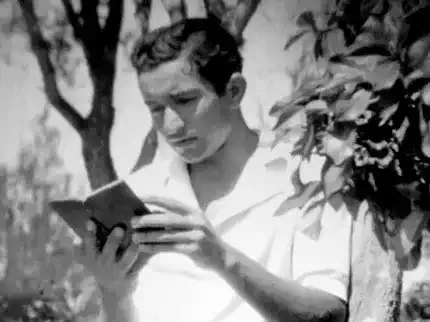
Objects, places, or rituals associated with poetic creation: The landscape of Arrábida, his notebooks, silent contemplation.
Writing habits: Wrote in a thoughtful and careful manner, with great attention to word choice and rhythm.
Curious episodes: His fascination with astronomy and stars.
Manuscripts, diaries, or correspondence: Manuscripts and letters are preserved that reveal his deep interiority and his creative process.
Work, style, and literary characteristics
Death and memory
Circumstances of death: Died prematurely in Lisbon, at the age of 32, due to a lung disease.
Posthumous publications: "A Estrada" (1958) and "O Regresso" (1961) were published after his death, completing his poetic legacy.

 PT
PT