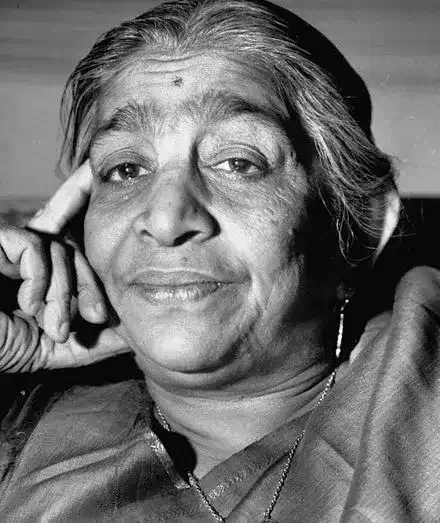
Identification and basic context
Sarojini Naidu, born Sarojini Chattopadhyay, was a pioneering Indian poet and political activist. She is widely celebrated as the "Nightingale of India" for her lyrical poetry and her significant role in the Indian independence movement. Her life and work embody a powerful fusion of literary artistry and unwavering commitment to social and political reform.
Childhood and education
Born into a prominent Bengali family in Hyderabad, Sarojini received an excellent education. Her father, Aghorenath Chattopadhyay, was a scholar and philanthropist, and her mother, Barada Sundari Devi, was a poet. Sarojini excelled in her studies, mastering several languages, including English, Bengali, Urdu, and Persian. She attended the University of Madras and later pursued higher education in London at King's College and Girton College, Cambridge, where she continued to hone her literary talents.
Literary trajectory
Naidu's poetic journey began early, and she published her first collection, 'The Golden Threshold,' in 1905. This was followed by 'The Bird of Time' (1912) and 'The Broken Wing' (1917). Her poems were admired for their lyrical beauty, rich imagery, and themes that often celebrated Indian life, nature, love, and the nascent spirit of Indian nationalism. Her literary success brought her international recognition, and she became known as the "Nightingale of India." She continued to write throughout her life, though her political activities increasingly took precedence.
Works, style, and literary characteristics
Sarojini Naidu's poetry is characterized by its musicality, vibrant imagery, and often romantic themes. She drew inspiration from the rich tapestry of Indian culture, folklore, and landscapes. Her style is lyrical and evocative, with a strong sense of rhythm and melody, which earned her the "Nightingale" moniker. Common themes in her work include love, beauty, death, patriotism, and the spiritual aspects of Indian life. She often employed traditional poetic forms but infused them with a distinctly Indian sensibility. Her language is elegant and accessible, making her poetry popular among a wide audience. Her later poems also began to reflect her growing political consciousness and her commitment to India's freedom.
Cultural and historical context
Naidu lived during a pivotal period in Indian history, marked by the struggle for independence from British colonial rule. She was a contemporary of Mahatma Gandhi, Jawaharlal Nehru, and other leading figures of the Indian National Congress. Her life spanned significant political events, including the Non-Cooperation Movement, the Civil Disobedience Movement, and the eventual attainment of independence. Her poetry served as a source of inspiration and national pride during this era, articulating the aspirations of a nation striving for self-determination.
Personal life
Sarojini Naidu married Govindarajulu Naidu, a non-Brahmin physician, in 1898, a union that challenged the prevailing social norms of the time. She had four children. Her intellectual and political engagements led her to form strong bonds with many leaders of the independence movement. Her speeches and writings were often infused with a deep sense of compassion and a commitment to social justice, advocating for women's rights and the eradication of untouchability.
Recognition and reception
Naidu received widespread acclaim for her poetry, both in India and internationally. She was awarded the Kaisar-i-Hind Medal by the British government for her public service, though she later renounced it in protest against British policies. Her political activism was equally recognized; she presided over the Kanpur session of the Indian National Congress in 1925, becoming the first Indian woman to do so. She was a prominent voice in national and international forums, advocating for India's cause.
Influences and legacy
Naidu was influenced by Romantic poets like Tennyson, Keats, and Shelley, as well as by the Indian poetic traditions. Her own legacy is profound. As a poet, she brought Indian themes and sensibilities to a global audience. As a political leader, she was a courageous advocate for freedom and equality. Her role in the independence movement and her pioneering efforts in promoting women's rights and social reform continue to inspire.
Interpretation and critical analysis
Critics have analyzed Naidu's poetry for its blend of Eastern and Western influences, its lyrical qualities, and its role in articulating nationalist sentiment. Her work is often seen as a bridge between traditional Indian culture and the emerging modern Indian identity. The themes of love and patriotism in her poetry are often interpreted as expressions of both personal emotion and collective national aspiration.
Curiosities and lesser-known aspects
Despite her aristocratic background and international acclaim, Naidu remained deeply connected to the common people of India. Her eloquence and charisma made her a powerful public speaker, capable of galvanizing crowds. She was also known for her sharp wit and her ability to navigate complex political landscapes with grace and determination.
Death and memory
Sarojini Naidu passed away in 1949. Her death was mourned by a nation that recognized her immense contributions to literature and its struggle for freedom. She is remembered today as a national hero, a celebrated poet, and a tireless champion of human rights and Indian independence. Her works continue to be studied and cherished, and her life serves as an enduring example of dedication to art and nation.