
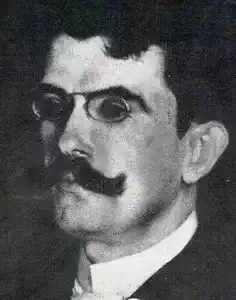
Raul Pompéia
 BR
BR
Raul Pompéia was a Brazilian writer, journalist, and professor, a prominent figure of Realism/Naturalism in Brazil. His most famous work, "O Ateneu", is a scathing and innovative portrait of the school environment, addressing themes such as social hypocrisy, the corruption of morals, and the formation of the individual in an oppressive environment. His writing is marked by a vigorous, ironic style and profound psychological analysis. Besides "O Ateneu", Pompéia produced chronicles, short stories, and poetry, demonstrating versatility. His work as a journalist and social critic was equally important, reflecting his engagement with the debates of his time. The life and work of Raul Pompéia, although marked by a relatively short career, left a significant legacy in Brazilian literature for their originality and trenchant social criticism.
n. 1863-04-12, Angra dos Reis · m. 1895-12-25, Rio de Janeiro
Bio
Identification and basic context
Raul Pompeia, full name Raul d'Ávila Pompéia, was a Brazilian writer, journalist, professor, and literary critic. He was born in Rio de Janeiro, Brazil, and his work is written in Portuguese. He is often associated with Realism and Naturalism in Brazil.Childhood and education
Raul Pompéia's childhood was marked by the premature death of his father, which forced him to work from an early age to support the family. He studied at the traditional Colégio São Pedro Nolasco in Rio de Janeiro, an experience that, in a distorted and fictionalized way, inspired his most famous novel, "O Ateneu". He later enrolled in the Law School of São Paulo but did not complete his degree.Literary career
Raul Pompéia's literary career began with his journalistic work and criticism. His main work, "O Ateneu", published in 1888, is considered a landmark of Brazilian Realism. Before that, he published "Uma Tragédia no Amazonas" (1873) and "Canções sem Metro" (1877), a collection of poems that demonstrates his early foray into poetry. As a journalist, he collaborated with various newspapers and magazines, playing an active role in the cultural and political debates of the time.Work, style, and literary characteristics
Raul Pompéia's most emblematic work is "O Ateneu" (1888), a novel that narrates Sérgio's experience in a boarding school, exposing the corruption of morals, social hypocrisy, and the ills of the educational system of the time. The book is notable for its ironic language, deep psychological analysis, and innovative narrative structure. Recurring themes in his work include criticism of bourgeois society, hypocrisy, repressed sexuality, character formation in oppressive environments, and the struggle for individuality. His style is marked by descriptive rigor, subtle irony, and an elaborate prose with traces of impressionism. In "O Ateneu", Pompéia uses a narrative voice that shifts between confessional and critical observer, building a dense and disturbing universe. The language is rich in metaphors and comparisons, with a rhythm that emulates the psychological tension of the characters. The novel is considered a masterpiece for its formal and thematic modernity.Cultural and historical context
Raul Pompéia lived in a period of great transformations in Brazil, such as the end of the Empire and the Proclamation of the Republic. He was an active intellectual, involved in the literary and political debates of his time, and his work reflects the social and moral tensions of Brazilian society in the second half of the 19th century.Personal life
His life was marked by financial difficulties and poor health. He was a professor of French and literature. He maintained relationships with other intellectuals of the time, but his personal life is less documented than his public work.Recognition and reception
"O Ateneu" received a mixed critical reception in its time, but over time it consolidated itself as one of the most important novels in Brazilian literature. Raul Pompéia is today recognized as one of the great names of Realism/Naturalism in Brazil, admired for his originality and trenchant social criticism.Influences and legacy
Raul Pompéia was influenced by European realist and naturalist authors. His legacy is the introduction of literary modernity in Brazil, with "O Ateneu" serving as a reference for the critical analysis of social institutions and the exploration of human psychology.Interpretation and critical analysis
"O Ateneu" is often interpreted as an allegory of Brazilian society, with the school serving as a microcosm of the country's flaws and hypocrisies. The work is also analyzed for its pioneering approach to sexuality and symbolic violence.Curiosities and lesser-known aspects
A curiosity is that, despite "O Ateneu" being his most famous work and critical of education, he himself was a teacher. His irony and sarcasm are striking features of his literary personality.Death and memory
Raul Pompéia died prematurely at the age of 37 from tuberculosis. His death interrupted a promising career, but his literary legacy endures.Poems
0No poems found
Comments (0)
No comments yet. Be the first to comment.