Identification and basic context
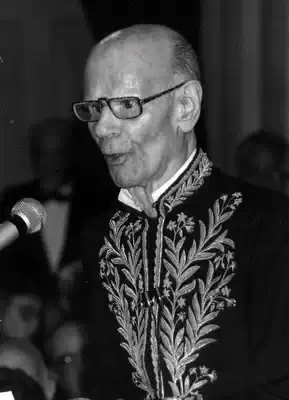
Abgar Renault was a Brazilian jurist, university professor, poet, and essayist. Born in Curvelo, Minas Gerais, he was a prominent figure in Brazil's intellectual and legal circles. His literary work is marked by profound lyricism and reflections on the human condition, society, and spirituality. He was a professor of Criminal Law at the Federal University of Minas Gerais (UFMG) and a member of the Academia Mineira de Letras.
Childhood and education
Abgar Renault received a solid education, which led him to study Law, an area in which he excelled as a jurist and professor. In parallel, he developed a strong inclination for literature, influenced by the cultural environment of Minas Gerais and by readings that shaped his worldview and his poetic expression. His dual education, between Law and Literature, gave him a unique and multifaceted perspective.
Literary career
Abgar Renault's literary career began to gain prominence with the publication of his poetic and essayistic works. His writing evolved over time, maintaining a thread of reflection and lyricism. He collaborated with various publications, contributing his critical vision and poetic sensitivity. His activity as a professor and jurist also dialogued with his literary universe, enriching his work.
Work, style, and literary characteristics
Abgar Renault's works include poetry books and essays, such as "Ventos de Minas" and "A Busca do Ser". His recurring themes involve reflection on life, death, time, justice, and spirituality. Renault's poetic style is marked by clarity, musicality, and a language that, while accessible, carries depth and imagistic density. He often addresses the duality between being and existing, the individual and the collective. His work dialogues with the Brazilian literary tradition while presenting a contemporary view on human issues.
Cultural and historical context
Abgar Renault lived and produced during a period of significant transformations in Brazil, especially in the intellectual and political spheres. His role as a university professor and member of cultural institutions like the Academia Mineira de Letras placed him in contact with other important thinkers and artists of his time. His work reflects, in many aspects, the concerns and debates of his era.
Personal life
Abgar Renault dedicated a large part of his life to teaching and Law, reconciling these activities with his passion for literature. His personal life, although not extensively explored in public detail, is marked by his intellectual integrity and his search for a deeper meaning of existence. His beliefs and positions, reflected in his work, denote a profound humanism.
Recognition and reception
Abgar Renault was recognized for his contribution to literature and Law in Brazil. His poetic work gained an important space, being admired for its lyricism and the depth of its reflections. His academic work also earned him prestige and respect.
Influences and legacy
Abgar Renault's influences include the rich Brazilian literary tradition and legal thought. His legacy lies in his ability to unite the precision of the jurist with the sensitivity of the poet, offering a work that invites reflection on the great themes of life. His poetry continues to resonate with readers who seek depth and beauty in words.
Interpretation and critical analysis
Abgar Renault's work has been subject to analysis for its philosophical and literary relevance. His reflections on the human condition, the search for meaning, and social critique are points of interest for critics, who highlight the strength of his poetry in addressing universal issues with a unique language.
Curiosities and lesser-known aspects
Lesser-known aspects of Abgar Renault's life may include details about his writing habits, his most intimate inspirations, or episodes from his personal life that shaped his worldview. His duality as a jurist and poet is, in itself, a fascinating aspect of his profile.
Death and memory
Abgar Renault passed away in Belo Horizonte. His memory is preserved through his literary work and his legacy as a jurist and professor, being remembered as an intellectual who masterfully navigated different fields of knowledge, always with a humanistic and reflective outlook.

 BR
BR