
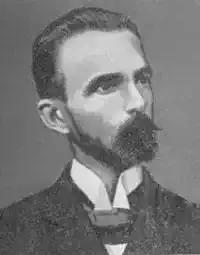
Raimundo Correia
1859–1911
· lived 52 years
 BR
BR
BR
Raimundo Correia was a Brazilian Parnassian poet, known for his work marked by musicality, formal rigor, and amorous and bucolic themes. He was a member of the Brazilian Academy of Letters. His poetry is an example of the influence of Parnassianism on Brazilian literature, with an erudite vocabulary and carefully crafted imagery.
n. 1859-05-13, São Luís · m. 1911-09-13, Paris
6
Views
Bio
Identification and Basic Context
Joaquim Raimundo de Oliveira Correia, known as Raimundo Correia, was a Brazilian poet. Born in Rio de Janeiro on May 29, 1859, and died in Rio de Janeiro on March 24, 1911. He was the son of a wealthy family with literary traditions. He was a founding member of the Brazilian Academy of Letters. He wrote in Portuguese.Childhood and Education
Coming from an elite Carioca family, he had a privileged childhood. He completed his preparatory studies at Colégio F. M. M. and later graduated in Law from the Faculty of Law of Recife in 1882. From an early age, he showed an inclination for poetry, influenced by French Parnassian poets and classical literature.Literary Career
He began publishing his verses in newspapers and magazines at a young age. His first book, "Primeiros Versos" (First Verses), was published in 1879. His work evolved within the canons of Parnassianism, maintaining a high degree of formal rigor and a constant concern with form. He was a highly respected poet during his lifetime, having been elected to the Brazilian Academy of Letters.Work, Style, and Literary Characteristics
His major works include "Primeiros Versos" (1879), "Sinfonias" (1883), "Versos e Rimas" (1887), "Alelysis" (1893), and "Dispersos" (published posthumously). The dominant themes are love, beauty, nature (with a bucolic and idyllic slant), and reflection on art and life. His poetic form is marked by metrical rigor, with a preference for the sonnet and other fixed forms, and by musicality. He used a cultured and precise vocabulary, with a lyrical and sometimes elegiac tone. His style is characterized by objectivity, clarity, and elegance, following the Parnassian precepts of "art for art's sake".Cultural and Historical Context
Raimundo Correia lived during the transition from the Empire to the Republic in Brazil, a period of political and social changes. Parnassianism, the movement to which he was associated, represented a reaction to Romanticism, seeking a more objective, formal, and descriptive poetry. He was a contemporary of poets such as Olavo Bilac and Alberto de Oliveira, with whom he formed the Parnassian trinity.Personal Life
He married Maria da Silva Guimarães Correia. He dedicated himself to diplomacy, having served as Brazil's consul in Lisbon from 1891 to 1895. His personal life, though less documented in biographical details than his literary life, seems to have been marked by discretion and the environment of the intellectual and political elite of the time.Recognition and Reception
He was widely recognized during his lifetime as one of the great Brazilian Parnassian poets, being one of the founders of the Brazilian Academy of Letters, where he occupied chair 15. His poetry was valued by critics of the time for its formal perfection and delicate lyricism.Influences and Legacy
Influenced by French Parnassian poetry (Gautier, Leconte de Lisle), Raimundo Correia contributed to the consolidation of Parnassianism in Brazil. His legacy lies in his work, which exemplifies the formal mastery and lyrical sensitivity of the movement, and in his contribution to the founding of the Brazilian Academy of Letters.Interpretation and Critical Analysis
Criticism has highlighted the apparent formal coldness of Parnassianism in Raimundo Correia's work, which, however, conceals a deep lyrical sensitivity, especially in amorous themes and the representation of nature. His poetry is seen as a model of balance between form and content.Curiosities and Lesser-Known Aspects
Although known for his poetry, Raimundo Correia also worked in diplomacy, demonstrating versatility. His lesser-known work includes more introspective and reflective poems.Death and Memory
He died in Rio de Janeiro in 1911 from pneumonia. His memory is preserved as one of the pillars of Brazilian Parnassian poetry and as one of the immortals of the Brazilian Academy of Letters.Poems
0No poems found
Comments (0)
Log in
to post a comment.
No comments yet. Be the first to comment.