
Poems List
Explore poems from our collection

Robert W. Service
Unholy Trinity
Unholy Trinity
Though Virtue hurt you Vice is nice;
Aye, Parson says it's wrong,
Yet for my pleasing I'll suffice
With Women, Wine and Song.
But though it be with jocund glee
my tavern voice is ringing,
Had I to chuck on of the three,
By gad! I'd give up singing.
Bu not the vine. What draught divine
Could better souse my throttle?
God never meant that mellow wine
Should languish in the bottle.
So Cellerman, your best bring up;
Let silver cobwebs mist it;
When gold or ruby brims the cup,
Could even saint resist it?
I love the ladies, yes, I do,
I always did and will;
I like with dainty dames to coo,
And have been known to bill.
Yes, I agree it's wrong of me,
So call me grey rapscallion,
But when a lusty lass I see
I whinny like a stallion.
Oh let me be a reprobate,
Your canting care defying;
I'll court that gay triumvirate
Right to the day I'm dying.
So troll until the rafter rings,
And may my life be long
To praise the Lord for precious things
like Women, Wine and Song.
Though Virtue hurt you Vice is nice;
Aye, Parson says it's wrong,
Yet for my pleasing I'll suffice
With Women, Wine and Song.
But though it be with jocund glee
my tavern voice is ringing,
Had I to chuck on of the three,
By gad! I'd give up singing.
Bu not the vine. What draught divine
Could better souse my throttle?
God never meant that mellow wine
Should languish in the bottle.
So Cellerman, your best bring up;
Let silver cobwebs mist it;
When gold or ruby brims the cup,
Could even saint resist it?
I love the ladies, yes, I do,
I always did and will;
I like with dainty dames to coo,
And have been known to bill.
Yes, I agree it's wrong of me,
So call me grey rapscallion,
But when a lusty lass I see
I whinny like a stallion.
Oh let me be a reprobate,
Your canting care defying;
I'll court that gay triumvirate
Right to the day I'm dying.
So troll until the rafter rings,
And may my life be long
To praise the Lord for precious things
like Women, Wine and Song.
192
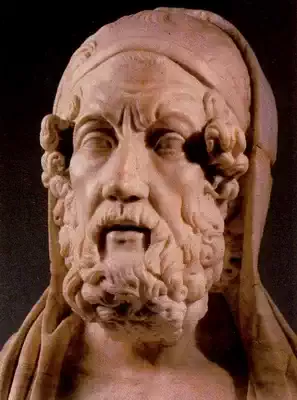
Homero
The Iliad: Book 20
The Iliad: Book 20
Thus, then, did the Achaeans arm by their ships round you, O son
of Peleus, who were hungering for battle; while the Trojans over
against them armed upon the rise of the plain.
Meanwhile Jove from the top of many-delled Olympus, bade Themis
gather the gods in council, whereon she went about and called them
to the house of Jove. There was not a river absent except Oceanus, nor
a single one of the nymphs that haunt fair groves, or springs of
rivers and meadows of green grass. When they reached the house of
cloud-compelling Jove, they took their seats in the arcades of
polished marble which Vulcan with his consummate skill had made for
father Jove.
In such wise, therefore, did they gather in the house of Jove.
Neptune also, lord of the earthquake, obeyed the call of the
goddess, and came up out of the sea to join them. There, sitting in
the midst of them, he asked what Jove's purpose might be. "Why,"
said he, "wielder of the lightning, have you called the gods in
council? Are you considering some matter that concerns the Trojans and
Achaeans- for the blaze of battle is on the point of being kindled
between them?"
And Jove answered, "You know my purpose, shaker of earth, and
wherefore I have called you hither. I take thought for them even in
their destruction. For my own part I shall stay here seated on Mt.
Olympus and look on in peace, but do you others go about among Trojans
and Achaeans, and help either side as you may be severally disposed.
If Achilles fights the Trojans without hindrance they will make no
stand against him; they have ever trembled at the sight of him, and
now that he is roused to such fury about his comrade, he will override
fate itself and storm their city."
Thus spoke Jove and gave the word for war, whereon the gods took
their several sides and went into battle. Juno, Pallas Minerva,
earth-encircling Neptune, Mercury bringer of good luck and excellent
in all cunning- all these joined the host that came from the ships;
with them also came Vulcan in all his glory, limping, but yet with his
thin legs plying lustily under him. Mars of gleaming helmet joined the
Trojans, and with him Apollo of locks unshorn, and the archer
goddess Diana, Leto, Xanthus, and laughter-loving Venus.
So long as the gods held themselves aloof from mortal warriors the
Achaeans were triumphant, for Achilles who had long refused to fight
was now with them. There was not a Trojan but his limbs failed him for
fear as he beheld the fleet son of Peleus all glorious in his
armour, and looking like Mars himself. When, however, the Olympians
came to take their part among men, forthwith uprose strong Strife,
rouser of hosts, and Minerva raised her loud voice, now standing by
the deep trench that ran outside the wall, and now shouting with all
her might upon the shore of the sounding sea. Mars also bellowed out
upon the other side, dark as some black thunder-cloud, and called on
the Trojans at the top of his voice, now from the acropolis, and now
speeding up the side of the river Simois till he came to the hill
Callicolone.
Thus did the gods spur on both hosts to fight, and rouse fierce
contention also among themselves. The sire of gods and men thundered
from heaven above, while from beneath Neptune shook the vast earth,
and bade the high hills tremble. The spurs and crests of
many-fountained Ida quaked, as also the city of the Trojans and the
ships of the Achaeans. Hades, king of the realms below, was struck
with fear; he sprang panic-stricken from his throne and cried aloud in
terror lest Neptune, lord of the earthquake, should crack the ground
over his head, and lay bare his mouldy mansions to the sight of
mortals and immortals- mansions so ghastly grim that even the gods
shudder to think of them. Such was the uproar as the gods came
together in battle. Apollo with his arrows took his stand to face King
Neptune, while Minerva took hers against the god of war; the
archer-goddess Diana with her golden arrows, sister of far-darting
Apollo, stood to face Juno; Mercury the lusty bringer of good luck
faced Leto, while the mighty eddying river whom men can Scamander, but
gods Xanthus, matched himself against Vulcan.
The gods, then, were thus ranged against one another. But the
heart of Achilles was set on meeting Hector son of Priam, for it was
with his blood that he longed above all things else to glut the
stubborn lord of battle. Meanwhile Apollo set Aeneas on to attack
the son of Peleus, and put courage into his heart, speaking with the
voice of Lycaon son of Priam. In his likeness therefore, he said to
Aeneas, "Aeneas, counsellor of the Trojans, where are now the brave
words with which you vaunted over your wine before the Trojan princes,
saying that you would fight Achilles son of Peleus in single combat?"
And Aeneas answered, "Why do you thus bid me fight the proud son
of Peleus, when I am in no mind to do so? Were I to face him now, it
would not be for the first time. His spear has already put me to Right
from Ida, when he attacked our cattle and sacked Lyrnessus and
Pedasus; Jove indeed saved me in that he vouchsafed me strength to
fly, else had the fallen by the hands of Achilles and Minerva, who
went before him to protect him and urged him to fall upon the
Lelegae and Trojans. No man may fight Achilles, for one of the gods is
always with him as his guardian angel, and even were it not so, his
weapon flies ever straight, and fails not to pierce the flesh of him
who is against him; if heaven would let me fight him on even terms
he should not soon overcome me, though he boasts that he is made of
bronze."
Then said King Apollo, son to Jove, "Nay, hero, pray to the
ever-living gods, for men say that you were born of Jove's daughter
Venus, whereas Achilles is son to a goddess of inferior rank. Venus is
child to Jove, while Thetis is but daughter to the old man of the sea.
Bring, therefore, your spear to bear upon him, and let him not scare
you with his taunts and menaces."
As he spoke he put courage into the heart of the shepherd of his
people, and he strode in full armour among the ranks of the foremost
fighters. Nor did the son of Anchises escape the notice of white-armed
Juno, as he went forth into the throng to meet Achilles. She called
the gods about her, and said, "Look to it, you two, Neptune and
Minerva, and consider how this shall be; Phoebus Apollo has been
sending Aeneas clad in full armour to fight Achilles. Shall we turn
him back at once, or shall one of us stand by Achilles and endow him
with strength so that his heart fail not, and he may learn that the
chiefs of the immortals are on his side, while the others who have all
along been defending the Trojans are but vain helpers? Let us all come
down from Olympus and join in the fight, that this day he may take
no hurt at the hands of the Trojans. Hereafter let him suffer whatever
fate may have spun out for him when he was begotten and his mother
bore him. If Achilles be not thus assured by the voice of a god, he
may come to fear presently when one of us meets him in battle, for the
gods are terrible if they are seen face to face."
Neptune lord of the earthquake answered her saying, "Juno,
restrain your fury; it is not well; I am not in favour of forcing
the other gods to fight us, for the advantage is too greatly on our
own side; let us take our places on some hill out of the beaten track,
and let mortals fight it out among themselves. If Mars or Phoebus
Apollo begin fighting, or keep Achilles in check so that he cannot
fight, we too, will at once raise the cry of battle, and in that
case they will soon leave the field and go back vanquished to
Olympus among the other gods."
With these words the dark-haired god led the way to the high
earth-barrow of Hercules, built round solid masonry, and made by the
Trojans and Pallas Minerva for him fly to when the sea-monster was
chasing him from the shore on to the plain. Here Neptune and those
that were with him took their seats, wrapped in a thick cloud of
darkness; but the other gods seated themselves on the brow of
Callicolone round you, O Phoebus, and Mars the waster of cities.
Thus did the gods sit apart and form their plans, but neither side
was willing to begin battle with the other, and Jove from his seat
on high was in command over them all. Meanwhile the whole plain was
alive with men and horses, and blazing with the gleam of armour. The
earth rang again under the tramp of their feet as they rushed
towards each other, and two champions, by far the foremost of them
all, met between the hosts to fight- to wit, Aeneas son of Anchises,
and noble Achilles.
Aeneas was first to stride forward in attack, his doughty helmet
tossing defiance as he came on. He held his strong shield before his
breast, and brandished his bronze spear. The son of Peleus from the
other side sprang forth to meet him, fike some fierce lion that the
whole country-side has met to hunt and kill- at first he bodes no ill,
but when some daring youth has struck him with a spear, he crouches
openmouthed, his jaws foam, he roars with fury, he lashes his tail
from side to side about his ribs and loins, and glares as he springs
straight before him, to find out whether he is to slay, or be slain
among the foremost of his foes- even with such fury did Achilles
burn to spring upon Aeneas.
When they were now close up with one another Achilles was first to
speak. "Aeneas," said he, "why do you stand thus out before the host
to fight me? Is it that you hope to reign over the Trojans in the seat
of Priam? Nay, though you kill me Priam will not hand his kingdom over
to you. He is a man of sound judgement, and he has sons of his own. Or
have the Trojans been allotting you a demesne of passing richness,
fair with orchard lawns and corn lands, if you should slay me? This
you shall hardly do. I have discomfited you once already. Have you
forgotten how when you were alone I chased you from your herds
helter-skelter down the slopes of Ida? You did not turn round to
look behind you; you took refuge in Lyrnessus, but I attacked the
city, and with the help of Minerva and father Jove I sacked it and
carried its women into captivity, though Jove and the other gods
rescued you. You think they will protect you now, but they will not do
so; therefore I say go back into the host, and do not face me, or
you will rue it. Even a fool may be wise after the event."
Then Aeneas answered, "Son of Peleus, think not that your words
can scare me as though I were a child. I too, if I will, can brag
and talk unseemly. We know one another's race and parentage as matters
of common fame, though neither have you ever seen my parents nor I
yours. Men say that you are son to noble Peleus, and that your
mother is Thetis, fair-haired daughter of the sea. I have noble
Anchises for my father, and Venus for my mother; the parents of one or
other of us shall this day mourn a son, for it will be more than silly
talk that shall part us when the fight is over. Learn, then, my
lineage if you will- and it is known to many.
"In the beginning Dardanus was the son of Jove, and founded
Dardania, for Ilius was not yet stablished on the plain for men to
dwell in, and her people still abode on the spurs of many-fountained
Ida. Dardanus had a son, king Erichthonius, who was wealthiest of
all men living; he had three thousand mares that fed by the
water-meadows, they and their foals with them. Boreas was enamoured of
them as they were feeding, and covered them in the semblance of a
dark-maned stallion. Twelve filly foals did they conceive and bear
him, and these, as they sped over the rich plain, would go bounding on
over the ripe ears of corn and not break them; or again when they
would disport themselves on the broad back of Ocean they could
gallop on the crest of a breaker. Erichthonius begat Tros, king of the
Trojans, and Tros had three noble sons, Ilus, Assaracus, and
Ganymede who was comeliest of mortal men; wherefore the gods carried
him off to be Jove's cupbearer, for his beauty's sake, that he might
dwell among the immortals. Ilus begat Laomedon, and Laomedon begat
Tithonus, Priam, Lampus, Clytius, and Hiketaon of the stock of Mars.
But Assaracus was father to Capys, and Capys to Anchises, who was my
father, while Hector is son to Priam.
"Such do I declare my blood and lineage, but as for valour, Jove
gives it or takes it as he will, for he is lord of all. And now let
there be no more of this prating in mid-battle as though we were
children. We could fling taunts without end at one another; a
hundred-oared galley would not hold them. The tongue can run all
whithers and talk all wise; it can go here and there, and as a man
says, so shall he be gainsaid. What is the use of our bandying hard
like women who when they fall foul of one another go out and wrangle
in the streets, one half true and the other lies, as rage inspires
them? No words of yours shall turn me now that I am fain to fighttherefore
let us make trial of one another with our spears."
As he spoke he drove his spear at the great and terrible shield of
Achilles, which rang out as the point struck it. The son of Peleus
held the shield before him with his strong hand, and he was afraid,
for he deemed that Aeneas's spear would go through it quite easily,
not reflecting that the god's glorious gifts were little likely to
yield before the blows of mortal men; and indeed Aeneas's spear did
not pierce the shield, for the layer of gold, gift of the god,
stayed the point. It went through two layers, but the god had made the
shield in five, two of bronze, the two innermost ones of tin, and
one of gold; it was in this that the spear was stayed.
Achilles in his turn threw, and struck the round shield of Aeneas at
the very edge, where the bronze was thinnest; the spear of Pelian
ash went clean through, and the shield rang under the blow; Aeneas was
afraid, and crouched backwards, holding the shield away from him;
the spear, however, flew over his back, and stuck quivering in the
ground, after having gone through both circles of the sheltering
shield. Aeneas though he had avoided the spear, stood still, blinded
with fear and grief because the weapon had gone so near him; then
Achilles sprang furiously upon him, with a cry as of death and with
his keen blade drawn, and Aeneas seized a great stone, so huge that
two men, as men now are, would be unable to lift it, but Aeneas
wielded it quite easily.
Aeneas would then have struck Achilles as he was springing towards
him, either on the helmet, or on the shield that covered him, and
Achilles would have closed with him and despatched him with his sword,
had not Neptune lord of the earthquake been quick to mark, and said
forthwith to the immortals, "Alas, I am sorry for great Aeneas, who
will now go down to the house of Hades, vanquished by the son of
Peleus. Fool that he was to give ear to the counsel of Apollo.
Apollo will never save him from destruction. Why should this man
suffer when he is guiltless, to no purpose, and in another's
quarrel? Has he not at all times offered acceptable sacrifice to the
gods that dwell in heaven? Let us then snatch him from death's jaws,
lest the son of Saturn be angry should Achilles slay him. It is fated,
moreover, that he should escape, and that the race of Dardanus, whom
Jove loved above all the sons born to him of mortal women, shall not
perish utterly without seed or sign. For now indeed has Jove hated the
blood of Priam, while Aeneas shall reign over the Trojans, he and
his children's children that shall be born hereafter."
Then answered Juno, "Earth-shaker, look to this matter yourself, and
consider concerning Aeneas, whether you will save him, or suffer
him, brave though he be, to fall by the hand of Achilles son of
Peleus. For of a truth we two, I and Pallas Minerva, have sworn full
many a time before all the immortals, that never would we shield
Trojans from destruction, not even when all Troy is burning in the
flames that the Achaeans shall kindle."
When earth-encircling Neptune heard this he went into the battle
amid the clash of spears, and came to the place where Achilles and
Aeneas were. Forthwith he shed a darkness before the eyes of the son
of Peleus, drew the bronze-headed ashen spear from the shield of
Aeneas, and laid it at the feet of Achilles. Then he lifted Aeneas
on high from off the earth and hurried him away. Over the heads of
many a band of warriors both horse and foot did he soar as the god's
hand sped him, till he came to the very fringe of the battle where the
Cauconians were arming themselves for fight. Neptune, shaker of the
earth, then came near to him and said, Aeneas, what god has egged
you on to this folly in fighting the son of Peleus, who is both a
mightier man of valour and more beloved of heaven than you are? Give
way before him whensoever you meet him, lest you go down to the
house of Hades even though fate would have it otherwise. When Achilles
is dead you may then fight among the foremost undaunted, for none
other of the Achaeans shall slay you."
The god left him when he had given him these instructions, and at
once removed the darkness from before the eyes of Achilles, who opened
them wide indeed and said in great anger, "Alas! what marvel am I
now beholding? Here is my spear upon the ground, but I see not him
whom I meant to kill when I hurled it. Of a truth Aeneas also must
be under heaven's protection, although I had thought his boasting
was idle. Let him go hang; he will be in no mood to fight me
further, seeing how narrowly he has missed being killed. I will now
give my orders to the Danaans and attack some other of the Trojans."
He sprang forward along the line and cheered his men on as he did
so. "Let not the Trojans," he cried, "keep you at arm's length,
Achaeans, but go for them and fight them man for man. However
valiant I may be, I cannot give chase to so many and fight all of
them. Even Mars, who is an immortal, or Minerva, would shrink from
flinging himself into the jaws of such a fight and laying about him;
nevertheless, so far as in me lies I will show no slackness of hand or
foot nor want of endurance, not even for a moment; I will utterly
break their ranks, and woe to the Trojan who shall venture within
reach of my spear."
Thus did he exhort them. Meanwhile Hector called upon the Trojans
and declared that he would fight Achilles. "Be not afraid, proud
Trojans," said he, "to face the son of Peleus; I could fight gods
myself if the battle were one of words only, but they would be more
than a match for me, if we had to use our spears. Even so the deed
of Achilles will fall somewhat short of his word; he will do in
part, and the other part he will clip short. I will go up against
him though his hands be as fire- though his hands be fire and his
strength iron."
Thus urged the Trojans lifted up their spears against the
Achaeans, and raised the cry of battle as they flung themselves into
the midst of their ranks. But Phoebus Apollo came up to Hector and
said, "Hector, on no account must you challenge Achilles to single
combat; keep a lookout for him while you are under cover of the others
and away from the thick of the fight, otherwise he will either hit you
with a spear or cut you down at close quarters."
Thus he spoke, and Hector drew back within the crowd, for he was
afraid when he heard what the god had said to him. Achilles then
sprang upon the Trojans with a terrible cry, clothed in valour as with
a garment. First he killed Iphition son of Otrynteus, a leader of much
people whom a naiad nymph had borne to Otrynteus waster of cities,
in the land of Hyde under the snowy heights of Mt. Tmolus. Achilles
struck him full on the head as he was coming on towards him, and split
it clean in two; whereon he fell heavily to the ground and Achilles
vaunted over him saying, "You he low, son of Otrynteus, mighty hero;
your death is here, but your lineage is on the Gygaean lake where your
father's estate lies, by Hyllus, rich in fish, and the eddying
waters of Hermus."
Thus did he vaunt, but darkness closed the eyes of the other. The
chariots of the Achaeans cut him up as their wheels passed over him in
the front of the battle, and after him Achilles killed Demoleon, a
valiant man of war and son to Antenor. He struck him on the temple
through his bronze-cheeked helmet. The helmet did not stay the
spear, but it went right on, crushing the bone so that the brain
inside was shed in all directions, and his lust of fighting was ended.
Then he struck Hippodamas in the midriff as he was springing down from
his chariot in front of him, and trying to escape. He breathed his
last, bellowing like a bull bellows when young men are dragging him to
offer him in sacrifice to the King of Helice, and the heart of the
earth-shaker is glad; even so did he bellow as he lay dying.
Achilles then went in pursuit of Polydorus son of Priam, whom his
father had always forbidden to fight because he was the youngest of
his sons, the one he loved best, and the fastest runner. He, in his
folly and showing off the fleetness of his feet, was rushing about
among front ranks until he lost his life, for Achilles struck him in
the middle of the back as he was darting past him: he struck him
just at the golden fastenings of his belt and where the two pieces
of the double breastplate overlapped. The point of the spear pierced
him through and came out by the navel, whereon he fell groaning on
to his knees and a cloud of darkness overshadowed him as he sank
holding his entrails in his hands.
When Hector saw his brother Polydorus with his entrails in his hands
and sinking down upon the ground, a mist came over his eyes, and he
could not bear to keep longer at a distance; he therefore poised his
spear and darted towards Achilles like a flame of fire. When
Achilles saw him he bounded forward and vaunted saying, "This is he
that has wounded my heart most deeply and has slain my beloved
comrade. Not for long shall we two quail before one another on the
highways of war."
He looked fiercely on Hector and said, "Draw near, that you may meet
your doom the sooner." Hector feared him not and answered, "Son of
Peleus, think not that your words can scare me as though I were a
child; I too if I will can brag and talk unseemly; I know that you are
a mighty warrior, mightier by far than I, nevertheless the issue
lies in the the lap of heaven whether I, worse man though I be, may
not slay you with my spear, for this too has been found keen ere now."
He hurled his spear as he spoke, but Minerva breathed upon it, and
though she breathed but very lightly she turned it back from going
towards Achilles, so that it returned to Hector and lay at his feet in
front of him. Achilles then sprang furiously on him with a loud cry,
bent on killing him, but Apollo caught him up easily as a god can, and
hid him in a thick darkness. Thrice did Achilles spring towards him
spear in hand, and thrice did he waste his blow upon the air. When
he rushed forward for the fourth time as though he were a god, he
shouted aloud saying, "Hound, this time too you have escaped deathbut
of a truth it came exceedingly near you. Phoebus Apollo, to whom
it seems you pray before you go into battle, has again saved you;
but if I too have any friend among the gods I will surely make an
end of you when I come across you at some other time. Now, however,
I will pursue and overtake other Trojans."
On this he struck Dryops with his spear, about the middle of his
neck, and he fell headlong at his feet. There he let him lie and
stayed Demouchus son of Philetor, a man both brave and of great
stature, by hitting him on the knee with a spear; then he smote him
with his sword and killed him. After this he sprang on Laogonus and
Dardanus, sons of Bias, and threw them from their chariot, the one
with a blow from a thrown spear, while the other he cut down in
hand-to-hand fight. There was also Tros the son of Alastor- he came up
to Achilles and clasped his knees in the hope that he would spare
him and not kill him but let him go, because they were both of the
same age. Fool, he might have known that he should not prevail with
him, for the man was in no mood for pity or forbearance but was in
grim earnest. Therefore when Tros laid hold of his knees and sought
a hearing for his prayers, Achilles drove his sword into his liver,
and the liver came rolling out, while his bosom was all covered with
the black blood that welled from the wound. Thus did death close his
eyes as he lay lifeless.
Achilles then went up to Mulius and struck him on the ear with a
spear, and the bronze spear-head came right out at the other ear. He
also struck Echeclus son of Agenor on the head with his sword, which
became warm with the blood, while death and stern fate closed the eyes
of Echeclus. Next in order the bronze point of his spear wounded
Deucalion in the fore-arm where the sinews of the elbow are united,
whereon he waited Achilles' onset with his arm hanging down and
death staring him in the face. Achilles cut his head off with a blow
from his sword and flung it helmet and all away from him, and the
marrow came oozing out of his backbone as he lay. He then went in
pursuit of Rhigmus, noble son of Peires, who had come from fertile
Thrace, and struck him through the middle with a spear which fixed
itself in his belly, so that he fell headlong from his chariot. He
also speared Areithous squire to Rhigmus in the back as he was turning
his horses in flight, and thrust him from his chariot, while the
horses were struck with panic.
As a fire raging in some mountain glen after long drought- and the
dense forest is in a blaze, while the wind carries great tongues of
fire in every direction- even so furiously did Achilles rage, wielding
his spear as though he were a god, and giving chase to those whom he
would slay, till the dark earth ran with blood. Or as one who yokes
broad-browed oxen that they may tread barley in a threshing-floor- and
it is soon bruised small under the feet of the lowing cattle- even
so did the horses of Achilles trample on the shields and bodies of the
slain. The axle underneath and the railing that ran round the car were
bespattered with clots of blood thrown up by the horses' hoofs, and
from the tyres of the wheels; but the son of Peleus pressed on to
win still further glory, and his hands were bedrabbled with gore.
Translated by Samuel Butler
Thus, then, did the Achaeans arm by their ships round you, O son
of Peleus, who were hungering for battle; while the Trojans over
against them armed upon the rise of the plain.
Meanwhile Jove from the top of many-delled Olympus, bade Themis
gather the gods in council, whereon she went about and called them
to the house of Jove. There was not a river absent except Oceanus, nor
a single one of the nymphs that haunt fair groves, or springs of
rivers and meadows of green grass. When they reached the house of
cloud-compelling Jove, they took their seats in the arcades of
polished marble which Vulcan with his consummate skill had made for
father Jove.
In such wise, therefore, did they gather in the house of Jove.
Neptune also, lord of the earthquake, obeyed the call of the
goddess, and came up out of the sea to join them. There, sitting in
the midst of them, he asked what Jove's purpose might be. "Why,"
said he, "wielder of the lightning, have you called the gods in
council? Are you considering some matter that concerns the Trojans and
Achaeans- for the blaze of battle is on the point of being kindled
between them?"
And Jove answered, "You know my purpose, shaker of earth, and
wherefore I have called you hither. I take thought for them even in
their destruction. For my own part I shall stay here seated on Mt.
Olympus and look on in peace, but do you others go about among Trojans
and Achaeans, and help either side as you may be severally disposed.
If Achilles fights the Trojans without hindrance they will make no
stand against him; they have ever trembled at the sight of him, and
now that he is roused to such fury about his comrade, he will override
fate itself and storm their city."
Thus spoke Jove and gave the word for war, whereon the gods took
their several sides and went into battle. Juno, Pallas Minerva,
earth-encircling Neptune, Mercury bringer of good luck and excellent
in all cunning- all these joined the host that came from the ships;
with them also came Vulcan in all his glory, limping, but yet with his
thin legs plying lustily under him. Mars of gleaming helmet joined the
Trojans, and with him Apollo of locks unshorn, and the archer
goddess Diana, Leto, Xanthus, and laughter-loving Venus.
So long as the gods held themselves aloof from mortal warriors the
Achaeans were triumphant, for Achilles who had long refused to fight
was now with them. There was not a Trojan but his limbs failed him for
fear as he beheld the fleet son of Peleus all glorious in his
armour, and looking like Mars himself. When, however, the Olympians
came to take their part among men, forthwith uprose strong Strife,
rouser of hosts, and Minerva raised her loud voice, now standing by
the deep trench that ran outside the wall, and now shouting with all
her might upon the shore of the sounding sea. Mars also bellowed out
upon the other side, dark as some black thunder-cloud, and called on
the Trojans at the top of his voice, now from the acropolis, and now
speeding up the side of the river Simois till he came to the hill
Callicolone.
Thus did the gods spur on both hosts to fight, and rouse fierce
contention also among themselves. The sire of gods and men thundered
from heaven above, while from beneath Neptune shook the vast earth,
and bade the high hills tremble. The spurs and crests of
many-fountained Ida quaked, as also the city of the Trojans and the
ships of the Achaeans. Hades, king of the realms below, was struck
with fear; he sprang panic-stricken from his throne and cried aloud in
terror lest Neptune, lord of the earthquake, should crack the ground
over his head, and lay bare his mouldy mansions to the sight of
mortals and immortals- mansions so ghastly grim that even the gods
shudder to think of them. Such was the uproar as the gods came
together in battle. Apollo with his arrows took his stand to face King
Neptune, while Minerva took hers against the god of war; the
archer-goddess Diana with her golden arrows, sister of far-darting
Apollo, stood to face Juno; Mercury the lusty bringer of good luck
faced Leto, while the mighty eddying river whom men can Scamander, but
gods Xanthus, matched himself against Vulcan.
The gods, then, were thus ranged against one another. But the
heart of Achilles was set on meeting Hector son of Priam, for it was
with his blood that he longed above all things else to glut the
stubborn lord of battle. Meanwhile Apollo set Aeneas on to attack
the son of Peleus, and put courage into his heart, speaking with the
voice of Lycaon son of Priam. In his likeness therefore, he said to
Aeneas, "Aeneas, counsellor of the Trojans, where are now the brave
words with which you vaunted over your wine before the Trojan princes,
saying that you would fight Achilles son of Peleus in single combat?"
And Aeneas answered, "Why do you thus bid me fight the proud son
of Peleus, when I am in no mind to do so? Were I to face him now, it
would not be for the first time. His spear has already put me to Right
from Ida, when he attacked our cattle and sacked Lyrnessus and
Pedasus; Jove indeed saved me in that he vouchsafed me strength to
fly, else had the fallen by the hands of Achilles and Minerva, who
went before him to protect him and urged him to fall upon the
Lelegae and Trojans. No man may fight Achilles, for one of the gods is
always with him as his guardian angel, and even were it not so, his
weapon flies ever straight, and fails not to pierce the flesh of him
who is against him; if heaven would let me fight him on even terms
he should not soon overcome me, though he boasts that he is made of
bronze."
Then said King Apollo, son to Jove, "Nay, hero, pray to the
ever-living gods, for men say that you were born of Jove's daughter
Venus, whereas Achilles is son to a goddess of inferior rank. Venus is
child to Jove, while Thetis is but daughter to the old man of the sea.
Bring, therefore, your spear to bear upon him, and let him not scare
you with his taunts and menaces."
As he spoke he put courage into the heart of the shepherd of his
people, and he strode in full armour among the ranks of the foremost
fighters. Nor did the son of Anchises escape the notice of white-armed
Juno, as he went forth into the throng to meet Achilles. She called
the gods about her, and said, "Look to it, you two, Neptune and
Minerva, and consider how this shall be; Phoebus Apollo has been
sending Aeneas clad in full armour to fight Achilles. Shall we turn
him back at once, or shall one of us stand by Achilles and endow him
with strength so that his heart fail not, and he may learn that the
chiefs of the immortals are on his side, while the others who have all
along been defending the Trojans are but vain helpers? Let us all come
down from Olympus and join in the fight, that this day he may take
no hurt at the hands of the Trojans. Hereafter let him suffer whatever
fate may have spun out for him when he was begotten and his mother
bore him. If Achilles be not thus assured by the voice of a god, he
may come to fear presently when one of us meets him in battle, for the
gods are terrible if they are seen face to face."
Neptune lord of the earthquake answered her saying, "Juno,
restrain your fury; it is not well; I am not in favour of forcing
the other gods to fight us, for the advantage is too greatly on our
own side; let us take our places on some hill out of the beaten track,
and let mortals fight it out among themselves. If Mars or Phoebus
Apollo begin fighting, or keep Achilles in check so that he cannot
fight, we too, will at once raise the cry of battle, and in that
case they will soon leave the field and go back vanquished to
Olympus among the other gods."
With these words the dark-haired god led the way to the high
earth-barrow of Hercules, built round solid masonry, and made by the
Trojans and Pallas Minerva for him fly to when the sea-monster was
chasing him from the shore on to the plain. Here Neptune and those
that were with him took their seats, wrapped in a thick cloud of
darkness; but the other gods seated themselves on the brow of
Callicolone round you, O Phoebus, and Mars the waster of cities.
Thus did the gods sit apart and form their plans, but neither side
was willing to begin battle with the other, and Jove from his seat
on high was in command over them all. Meanwhile the whole plain was
alive with men and horses, and blazing with the gleam of armour. The
earth rang again under the tramp of their feet as they rushed
towards each other, and two champions, by far the foremost of them
all, met between the hosts to fight- to wit, Aeneas son of Anchises,
and noble Achilles.
Aeneas was first to stride forward in attack, his doughty helmet
tossing defiance as he came on. He held his strong shield before his
breast, and brandished his bronze spear. The son of Peleus from the
other side sprang forth to meet him, fike some fierce lion that the
whole country-side has met to hunt and kill- at first he bodes no ill,
but when some daring youth has struck him with a spear, he crouches
openmouthed, his jaws foam, he roars with fury, he lashes his tail
from side to side about his ribs and loins, and glares as he springs
straight before him, to find out whether he is to slay, or be slain
among the foremost of his foes- even with such fury did Achilles
burn to spring upon Aeneas.
When they were now close up with one another Achilles was first to
speak. "Aeneas," said he, "why do you stand thus out before the host
to fight me? Is it that you hope to reign over the Trojans in the seat
of Priam? Nay, though you kill me Priam will not hand his kingdom over
to you. He is a man of sound judgement, and he has sons of his own. Or
have the Trojans been allotting you a demesne of passing richness,
fair with orchard lawns and corn lands, if you should slay me? This
you shall hardly do. I have discomfited you once already. Have you
forgotten how when you were alone I chased you from your herds
helter-skelter down the slopes of Ida? You did not turn round to
look behind you; you took refuge in Lyrnessus, but I attacked the
city, and with the help of Minerva and father Jove I sacked it and
carried its women into captivity, though Jove and the other gods
rescued you. You think they will protect you now, but they will not do
so; therefore I say go back into the host, and do not face me, or
you will rue it. Even a fool may be wise after the event."
Then Aeneas answered, "Son of Peleus, think not that your words
can scare me as though I were a child. I too, if I will, can brag
and talk unseemly. We know one another's race and parentage as matters
of common fame, though neither have you ever seen my parents nor I
yours. Men say that you are son to noble Peleus, and that your
mother is Thetis, fair-haired daughter of the sea. I have noble
Anchises for my father, and Venus for my mother; the parents of one or
other of us shall this day mourn a son, for it will be more than silly
talk that shall part us when the fight is over. Learn, then, my
lineage if you will- and it is known to many.
"In the beginning Dardanus was the son of Jove, and founded
Dardania, for Ilius was not yet stablished on the plain for men to
dwell in, and her people still abode on the spurs of many-fountained
Ida. Dardanus had a son, king Erichthonius, who was wealthiest of
all men living; he had three thousand mares that fed by the
water-meadows, they and their foals with them. Boreas was enamoured of
them as they were feeding, and covered them in the semblance of a
dark-maned stallion. Twelve filly foals did they conceive and bear
him, and these, as they sped over the rich plain, would go bounding on
over the ripe ears of corn and not break them; or again when they
would disport themselves on the broad back of Ocean they could
gallop on the crest of a breaker. Erichthonius begat Tros, king of the
Trojans, and Tros had three noble sons, Ilus, Assaracus, and
Ganymede who was comeliest of mortal men; wherefore the gods carried
him off to be Jove's cupbearer, for his beauty's sake, that he might
dwell among the immortals. Ilus begat Laomedon, and Laomedon begat
Tithonus, Priam, Lampus, Clytius, and Hiketaon of the stock of Mars.
But Assaracus was father to Capys, and Capys to Anchises, who was my
father, while Hector is son to Priam.
"Such do I declare my blood and lineage, but as for valour, Jove
gives it or takes it as he will, for he is lord of all. And now let
there be no more of this prating in mid-battle as though we were
children. We could fling taunts without end at one another; a
hundred-oared galley would not hold them. The tongue can run all
whithers and talk all wise; it can go here and there, and as a man
says, so shall he be gainsaid. What is the use of our bandying hard
like women who when they fall foul of one another go out and wrangle
in the streets, one half true and the other lies, as rage inspires
them? No words of yours shall turn me now that I am fain to fighttherefore
let us make trial of one another with our spears."
As he spoke he drove his spear at the great and terrible shield of
Achilles, which rang out as the point struck it. The son of Peleus
held the shield before him with his strong hand, and he was afraid,
for he deemed that Aeneas's spear would go through it quite easily,
not reflecting that the god's glorious gifts were little likely to
yield before the blows of mortal men; and indeed Aeneas's spear did
not pierce the shield, for the layer of gold, gift of the god,
stayed the point. It went through two layers, but the god had made the
shield in five, two of bronze, the two innermost ones of tin, and
one of gold; it was in this that the spear was stayed.
Achilles in his turn threw, and struck the round shield of Aeneas at
the very edge, where the bronze was thinnest; the spear of Pelian
ash went clean through, and the shield rang under the blow; Aeneas was
afraid, and crouched backwards, holding the shield away from him;
the spear, however, flew over his back, and stuck quivering in the
ground, after having gone through both circles of the sheltering
shield. Aeneas though he had avoided the spear, stood still, blinded
with fear and grief because the weapon had gone so near him; then
Achilles sprang furiously upon him, with a cry as of death and with
his keen blade drawn, and Aeneas seized a great stone, so huge that
two men, as men now are, would be unable to lift it, but Aeneas
wielded it quite easily.
Aeneas would then have struck Achilles as he was springing towards
him, either on the helmet, or on the shield that covered him, and
Achilles would have closed with him and despatched him with his sword,
had not Neptune lord of the earthquake been quick to mark, and said
forthwith to the immortals, "Alas, I am sorry for great Aeneas, who
will now go down to the house of Hades, vanquished by the son of
Peleus. Fool that he was to give ear to the counsel of Apollo.
Apollo will never save him from destruction. Why should this man
suffer when he is guiltless, to no purpose, and in another's
quarrel? Has he not at all times offered acceptable sacrifice to the
gods that dwell in heaven? Let us then snatch him from death's jaws,
lest the son of Saturn be angry should Achilles slay him. It is fated,
moreover, that he should escape, and that the race of Dardanus, whom
Jove loved above all the sons born to him of mortal women, shall not
perish utterly without seed or sign. For now indeed has Jove hated the
blood of Priam, while Aeneas shall reign over the Trojans, he and
his children's children that shall be born hereafter."
Then answered Juno, "Earth-shaker, look to this matter yourself, and
consider concerning Aeneas, whether you will save him, or suffer
him, brave though he be, to fall by the hand of Achilles son of
Peleus. For of a truth we two, I and Pallas Minerva, have sworn full
many a time before all the immortals, that never would we shield
Trojans from destruction, not even when all Troy is burning in the
flames that the Achaeans shall kindle."
When earth-encircling Neptune heard this he went into the battle
amid the clash of spears, and came to the place where Achilles and
Aeneas were. Forthwith he shed a darkness before the eyes of the son
of Peleus, drew the bronze-headed ashen spear from the shield of
Aeneas, and laid it at the feet of Achilles. Then he lifted Aeneas
on high from off the earth and hurried him away. Over the heads of
many a band of warriors both horse and foot did he soar as the god's
hand sped him, till he came to the very fringe of the battle where the
Cauconians were arming themselves for fight. Neptune, shaker of the
earth, then came near to him and said, Aeneas, what god has egged
you on to this folly in fighting the son of Peleus, who is both a
mightier man of valour and more beloved of heaven than you are? Give
way before him whensoever you meet him, lest you go down to the
house of Hades even though fate would have it otherwise. When Achilles
is dead you may then fight among the foremost undaunted, for none
other of the Achaeans shall slay you."
The god left him when he had given him these instructions, and at
once removed the darkness from before the eyes of Achilles, who opened
them wide indeed and said in great anger, "Alas! what marvel am I
now beholding? Here is my spear upon the ground, but I see not him
whom I meant to kill when I hurled it. Of a truth Aeneas also must
be under heaven's protection, although I had thought his boasting
was idle. Let him go hang; he will be in no mood to fight me
further, seeing how narrowly he has missed being killed. I will now
give my orders to the Danaans and attack some other of the Trojans."
He sprang forward along the line and cheered his men on as he did
so. "Let not the Trojans," he cried, "keep you at arm's length,
Achaeans, but go for them and fight them man for man. However
valiant I may be, I cannot give chase to so many and fight all of
them. Even Mars, who is an immortal, or Minerva, would shrink from
flinging himself into the jaws of such a fight and laying about him;
nevertheless, so far as in me lies I will show no slackness of hand or
foot nor want of endurance, not even for a moment; I will utterly
break their ranks, and woe to the Trojan who shall venture within
reach of my spear."
Thus did he exhort them. Meanwhile Hector called upon the Trojans
and declared that he would fight Achilles. "Be not afraid, proud
Trojans," said he, "to face the son of Peleus; I could fight gods
myself if the battle were one of words only, but they would be more
than a match for me, if we had to use our spears. Even so the deed
of Achilles will fall somewhat short of his word; he will do in
part, and the other part he will clip short. I will go up against
him though his hands be as fire- though his hands be fire and his
strength iron."
Thus urged the Trojans lifted up their spears against the
Achaeans, and raised the cry of battle as they flung themselves into
the midst of their ranks. But Phoebus Apollo came up to Hector and
said, "Hector, on no account must you challenge Achilles to single
combat; keep a lookout for him while you are under cover of the others
and away from the thick of the fight, otherwise he will either hit you
with a spear or cut you down at close quarters."
Thus he spoke, and Hector drew back within the crowd, for he was
afraid when he heard what the god had said to him. Achilles then
sprang upon the Trojans with a terrible cry, clothed in valour as with
a garment. First he killed Iphition son of Otrynteus, a leader of much
people whom a naiad nymph had borne to Otrynteus waster of cities,
in the land of Hyde under the snowy heights of Mt. Tmolus. Achilles
struck him full on the head as he was coming on towards him, and split
it clean in two; whereon he fell heavily to the ground and Achilles
vaunted over him saying, "You he low, son of Otrynteus, mighty hero;
your death is here, but your lineage is on the Gygaean lake where your
father's estate lies, by Hyllus, rich in fish, and the eddying
waters of Hermus."
Thus did he vaunt, but darkness closed the eyes of the other. The
chariots of the Achaeans cut him up as their wheels passed over him in
the front of the battle, and after him Achilles killed Demoleon, a
valiant man of war and son to Antenor. He struck him on the temple
through his bronze-cheeked helmet. The helmet did not stay the
spear, but it went right on, crushing the bone so that the brain
inside was shed in all directions, and his lust of fighting was ended.
Then he struck Hippodamas in the midriff as he was springing down from
his chariot in front of him, and trying to escape. He breathed his
last, bellowing like a bull bellows when young men are dragging him to
offer him in sacrifice to the King of Helice, and the heart of the
earth-shaker is glad; even so did he bellow as he lay dying.
Achilles then went in pursuit of Polydorus son of Priam, whom his
father had always forbidden to fight because he was the youngest of
his sons, the one he loved best, and the fastest runner. He, in his
folly and showing off the fleetness of his feet, was rushing about
among front ranks until he lost his life, for Achilles struck him in
the middle of the back as he was darting past him: he struck him
just at the golden fastenings of his belt and where the two pieces
of the double breastplate overlapped. The point of the spear pierced
him through and came out by the navel, whereon he fell groaning on
to his knees and a cloud of darkness overshadowed him as he sank
holding his entrails in his hands.
When Hector saw his brother Polydorus with his entrails in his hands
and sinking down upon the ground, a mist came over his eyes, and he
could not bear to keep longer at a distance; he therefore poised his
spear and darted towards Achilles like a flame of fire. When
Achilles saw him he bounded forward and vaunted saying, "This is he
that has wounded my heart most deeply and has slain my beloved
comrade. Not for long shall we two quail before one another on the
highways of war."
He looked fiercely on Hector and said, "Draw near, that you may meet
your doom the sooner." Hector feared him not and answered, "Son of
Peleus, think not that your words can scare me as though I were a
child; I too if I will can brag and talk unseemly; I know that you are
a mighty warrior, mightier by far than I, nevertheless the issue
lies in the the lap of heaven whether I, worse man though I be, may
not slay you with my spear, for this too has been found keen ere now."
He hurled his spear as he spoke, but Minerva breathed upon it, and
though she breathed but very lightly she turned it back from going
towards Achilles, so that it returned to Hector and lay at his feet in
front of him. Achilles then sprang furiously on him with a loud cry,
bent on killing him, but Apollo caught him up easily as a god can, and
hid him in a thick darkness. Thrice did Achilles spring towards him
spear in hand, and thrice did he waste his blow upon the air. When
he rushed forward for the fourth time as though he were a god, he
shouted aloud saying, "Hound, this time too you have escaped deathbut
of a truth it came exceedingly near you. Phoebus Apollo, to whom
it seems you pray before you go into battle, has again saved you;
but if I too have any friend among the gods I will surely make an
end of you when I come across you at some other time. Now, however,
I will pursue and overtake other Trojans."
On this he struck Dryops with his spear, about the middle of his
neck, and he fell headlong at his feet. There he let him lie and
stayed Demouchus son of Philetor, a man both brave and of great
stature, by hitting him on the knee with a spear; then he smote him
with his sword and killed him. After this he sprang on Laogonus and
Dardanus, sons of Bias, and threw them from their chariot, the one
with a blow from a thrown spear, while the other he cut down in
hand-to-hand fight. There was also Tros the son of Alastor- he came up
to Achilles and clasped his knees in the hope that he would spare
him and not kill him but let him go, because they were both of the
same age. Fool, he might have known that he should not prevail with
him, for the man was in no mood for pity or forbearance but was in
grim earnest. Therefore when Tros laid hold of his knees and sought
a hearing for his prayers, Achilles drove his sword into his liver,
and the liver came rolling out, while his bosom was all covered with
the black blood that welled from the wound. Thus did death close his
eyes as he lay lifeless.
Achilles then went up to Mulius and struck him on the ear with a
spear, and the bronze spear-head came right out at the other ear. He
also struck Echeclus son of Agenor on the head with his sword, which
became warm with the blood, while death and stern fate closed the eyes
of Echeclus. Next in order the bronze point of his spear wounded
Deucalion in the fore-arm where the sinews of the elbow are united,
whereon he waited Achilles' onset with his arm hanging down and
death staring him in the face. Achilles cut his head off with a blow
from his sword and flung it helmet and all away from him, and the
marrow came oozing out of his backbone as he lay. He then went in
pursuit of Rhigmus, noble son of Peires, who had come from fertile
Thrace, and struck him through the middle with a spear which fixed
itself in his belly, so that he fell headlong from his chariot. He
also speared Areithous squire to Rhigmus in the back as he was turning
his horses in flight, and thrust him from his chariot, while the
horses were struck with panic.
As a fire raging in some mountain glen after long drought- and the
dense forest is in a blaze, while the wind carries great tongues of
fire in every direction- even so furiously did Achilles rage, wielding
his spear as though he were a god, and giving chase to those whom he
would slay, till the dark earth ran with blood. Or as one who yokes
broad-browed oxen that they may tread barley in a threshing-floor- and
it is soon bruised small under the feet of the lowing cattle- even
so did the horses of Achilles trample on the shields and bodies of the
slain. The axle underneath and the railing that ran round the car were
bespattered with clots of blood thrown up by the horses' hoofs, and
from the tyres of the wheels; but the son of Peleus pressed on to
win still further glory, and his hands were bedrabbled with gore.
Translated by Samuel Butler
174
Robert W. Service
Two Words
Two Words
'God' is composed of letters three,
But if you put an 'l'
Before the last it seems to me
A synonym for Hell.
For all of envy, greed and hate
The human heart can hold
Respond unto the devil's bait
Of Gold.
When God created Gold to be
For our adorning fit,
I little think he dreamed that we
Would come to worship it.
But when you ruefully have scanned
The chronicles of Time,
You'll find that lucre lends a hand
To Crime.
So if you are a millionaire,
To be of Heaven sure,
Give every penny you can spare
Unto the sick and poor.
From Gold strike out the evil 'ell,'
And so with letters odd
You can with peace of spirit spell
Just GOD.
'God' is composed of letters three,
But if you put an 'l'
Before the last it seems to me
A synonym for Hell.
For all of envy, greed and hate
The human heart can hold
Respond unto the devil's bait
Of Gold.
When God created Gold to be
For our adorning fit,
I little think he dreamed that we
Would come to worship it.
But when you ruefully have scanned
The chronicles of Time,
You'll find that lucre lends a hand
To Crime.
So if you are a millionaire,
To be of Heaven sure,
Give every penny you can spare
Unto the sick and poor.
From Gold strike out the evil 'ell,'
And so with letters odd
You can with peace of spirit spell
Just GOD.
198
Homero
The Iliad: Book 19
The Iliad: Book 19
Now when Dawn in robe of saffron was hasting from the streams of
Oceanus, to bring light to mortals and immortals, Thetis reached the
ships with the armour that the god had given her. She found her son
fallen about the body of Patroclus and weeping bitterly. Many also
of his followers were weeping round him, but when the goddess came
among them she clasped his hand in her own, saying, "My son, grieve as
we may we must let this man lie, for it is by heaven's will that he
has fallen; now, therefore, accept from Vulcan this rich and goodly
armour, which no man has ever yet borne upon his shoulders."
As she spoke she set the armour before Achilles, and it rang out
bravely as she did so. The Myrmidons were struck with awe, and none
dared look full at it, for they were afraid; but Achilles was roused
to still greater fury, and his eyes gleamed with a fierce light, for
he was glad when he handled the splendid present which the god had
made him. Then, as soon as he had satisfied himself with looking at
it, he said to his mother, "Mother, the god has given me armour,
meet handiwork for an immortal and such as no living could have
fashioned; I will now arm, but I much fear that flies will settle upon
the son of Menoetius and breed worms about his wounds, so that his
body, now he is dead, will be disfigured and the flesh will rot."
Silver-footed Thetis answered, "My son, be not disquieted about this
matter. I will find means to protect him from the swarms of noisome
flies that prey on the bodies of men who have been killed in battle.
He may lie for a whole year, and his flesh shall still be as sound
as ever, or even sounder. Call, therefore, the Achaean heroes in
assembly; unsay your anger against Agamemnon; arm at once, and fight
with might and main."
As she spoke she put strength and courage into his heart, and she
then dropped ambrosia and red nectar into the wounds of Patroclus,
that his body might suffer no change.
Then Achilles went out upon the seashore, and with a loud cry called
on the Achaean heroes. On this even those who as yet had stayed always
at the ships, the pilots and helmsmen, and even the stewards who
were about the ships and served out rations, all came to the place
of assembly because Achilles had shown himself after having held aloof
so long from fighting. Two sons of Mars, Ulysses and the son of
Tydeus, came limping, for their wounds still pained them; nevertheless
they came, and took their seats in the front row of the assembly. Last
of all came Agamemnon, king of men, he too wounded, for Coon son of
Antenor had struck him with a spear in battle.
When the Achaeans were got together Achilles rose and said, "Son
of Atreus, surely it would have been better alike for both you and me,
when we two were in such high anger about Briseis, surely it would
have been better, had Diana's arrow slain her at the ships on the
day when I took her after having sacked Lyrnessus. For so, many an
Achaean the less would have bitten dust before the foe in the days
of my anger. It has been well for Hector and the Trojans, but the
Achaeans will long indeed remember our quarrel. Now, however, let it
be, for it is over. If we have been angry, necessity has schooled
our anger. I put it from me: I dare not nurse it for ever;
therefore, bid the Achaeans arm forthwith that I may go out against
the Trojans, and learn whether they will be in a mind to sleep by
the ships or no. Glad, I ween, will he be to rest his knees who may
fly my spear when I wield it."
Thus did he speak, and the Achaeans rejoiced in that he had put away
his anger.
Then Agamemnon spoke, rising in his place, and not going into the
middle of the assembly. "Danaan heroes," said he, "servants of Mars,
it is well to listen when a man stands up to speak, and it is not
seemly to interrupt him, or it will go hard even with a practised
speaker. Who can either hear or speak in an uproar? Even the finest
orator will be disconcerted by it. I will expound to the son of
Peleus, and do you other Achaeans heed me and mark me well. Often have
the Achaeans spoken to me of this matter and upbraided me, but it
was not I that did it: Jove, and Fate, and Erinys that walks in
darkness struck me mad when we were assembled on the day that I took
from Achilles the meed that had been awarded to him. What could I
do? All things are in the hand of heaven, and Folly, eldest of
Jove's daughters, shuts men's eyes to their destruction. She walks
delicately, not on the solid earth, but hovers over the heads of men
to make them stumble or to ensnare them.
"Time was when she fooled Jove himself, who they say is greatest
whether of gods or men; for Juno, woman though she was, beguiled him
on the day when Alcmena was to bring forth mighty Hercules in the fair
city of Thebes. He told it out among the gods saying, 'Hear me all
gods and goddesses, that I may speak even as I am minded; this day
shall an Ilithuia, helper of women who are in labour, bring a man
child into the world who shall be lord over all that dwell about him
who are of my blood and lineage.' Then said Juno all crafty and full
of guile, 'You will play false, and will not hold to your word.
Swear me, O Olympian, swear me a great oath, that he who shall this
day fall between the feet of a woman, shall be lord over all that
dwell about him who are of your blood and lineage.'
"Thus she spoke, and Jove suspected her not, but swore the great
oath, to his much ruing thereafter. For Juno darted down from the high
summit of Olympus, and went in haste to Achaean Argos where she knew
that the noble wife of Sthenelus son of Perseus then was. She being
with child and in her seventh month, Juno brought the child to birth
though there was a month still wanting, but she stayed the offspring
of Alcmena, and kept back the Ilithuiae. Then she went to tell Jove
the son of Saturn, and said, 'Father Jove, lord of the lightning- I
have a word for your ear. There is a fine child born this day,
Eurystheus, son to Sthenelus the son of Perseus; he is of your
lineage; it is well, therefore, that he should reign over the
Argives.'
"On this Jove was stung to the very quick, and in his rage he caught
Folly by the hair, and swore a great oath that never should she
again invade starry heaven and Olympus, for she was the bane of all.
Then he whirled her round with a twist of his hand, and flung her down
from heaven so that she fell on to the fields of mortal men; and he
was ever angry with her when he saw his son groaning under the cruel
labours that Eurystheus laid upon him. Even so did I grieve when
mighty Hector was killing the Argives at their ships, and all the time
I kept thinking of Folly who had so baned me. I was blind, and Jove
robbed me of my reason; I will now make atonement, and will add much
treasure by way of amends. Go, therefore, into battle, you and your
people with you. I will give you all that Ulysses offered you
yesterday in your tents: or if it so please you, wait, though you
would fain fight at once, and my squires shall bring the gifts from my
ship, that you may see whether what I give you is enough."
And Achilles answered, "Son of Atreus, king of men Agamemnon, you
can give such gifts as you think proper, or you can withhold them:
it is in your own hands. Let us now set battle in array; it is not
well to tarry talking about trifles, for there is a deed which is as
yet to do. Achilles shall again be seen fighting among the foremost,
and laying low the ranks of the Trojans: bear this in mind each one of
you when he is fighting."
Then Ulysses said, "Achilles, godlike and brave, send not the
Achaeans thus against Ilius to fight the Trojans fasting, for the
battle will be no brief one, when it is once begun, and heaven has
filled both sides with fury; bid them first take food both bread and
wine by the ships, for in this there is strength and stay. No man
can do battle the livelong day to the going down of the sun if he is
without food; however much he may want to fight his strength will fail
him before he knows it; hunger and thirst will find him out, and his
limbs will grow weary under him. But a man can fight all day if he
is full fed with meat and wine; his heart beats high, and his strength
will stay till he has routed all his foes; therefore, send the
people away and bid them prepare their meal; King Agamemnon will bring
out the gifts in presence of the assembly, that all may see them and
you may be satisfied. Moreover let him swear an oath before the
Argives that he has never gone up into the couch of Briseis, nor
been with her after the manner of men and women; and do you, too, show
yourself of a gracious mind; let Agamemnon entertain you in his
tents with a feast of reconciliation, that so you may have had your
dues in full. As for you, son of Atreus, treat people more righteously
in future; it is no disgrace even to a king that he should make amends
if he was wrong in the first instance."
And King Agamemnon answered, "Son of Laertes, your words please me
well, for throughout you have spoken wisely. I will swear as you would
have me do; I do so of my own free will, neither shall I take the name
of heaven in vain. Let, then, Achilles wait, though he would fain
fight at once, and do you others wait also, till the gifts come from
my tent and we ratify the oath with sacrifice. Thus, then, do I charge
you: take some noble young Achaeans with you, and bring from my
tents the gifts that I promised yesterday to Achilles, and bring the
women also; furthermore let Talthybius find me a boar from those
that are with the host, and make it ready for sacrifice to Jove and to
the sun."
Then said Achilles, "Son of Atreus, king of men Agamemnon, see to
these matters at some other season, when there is breathing time and
when I am calmer. Would you have men eat while the bodies of those
whom Hector son of Priam slew are still lying mangled upon the
plain? Let the sons of the Achaeans, say I, fight fasting and
without food, till we have avenged them; afterwards at the going
down of the sun let them eat their fill. As for me, Patroclus is lying
dead in my tent, all hacked and hewn, with his feet to the door, and
his comrades are mourning round him. Therefore I can take thought of
nothing save only slaughter and blood and the rattle in the throat
of the dying."
Ulysses answered, "Achilles, son of Peleus, mightiest of all the
Achaeans, in battle you are better than I, and that more than a
little, but in counsel I am much before you, for I am older and of
greater knowledge. Therefore be patient under my words. Fighting is
a thing of which men soon surfeit, and when Jove, who is wars steward,
weighs the upshot, it may well prove that the straw which our
sickles have reaped is far heavier than the grain. It may not be
that the Achaeans should mourn the dead with their bellies; day by day
men fall thick and threefold continually; when should we have
respite from our sorrow? Let us mourn our dead for a day and bury them
out of sight and mind, but let those of us who are left eat and
drink that we may arm and fight our foes more fiercely. In that hour
let no man hold back, waiting for a second summons; such summons shall
bode ill for him who is found lagging behind at our ships; let us
rather sally as one man and loose the fury of war upon the Trojans."
When he had thus spoken he took with him the sons of Nestor, with
Meges son of Phyleus, Thoas, Meriones, Lycomedes son of Creontes,
and Melanippus, and went to the tent of Agamemnon son of Atreus. The
word was not sooner said than the deed was done: they brought out
the seven tripods which Agamemnon had promised, with the twenty
metal cauldrons and the twelve horses; they also brought the women
skilled in useful arts, seven in number, with Briseis, which made
eight. Ulysses weighed out the ten talents of gold and then led the
way back, while the young Achaeans brought the rest of the gifts,
and laid them in the middle of the assembly.
Agamemnon then rose, and Talthybius whose voice was like that of a
god came to him with the boar. The son of Atreus drew the knife
which he wore by the scabbard of his mighty sword, and began by
cutting off some bristles from the boar, lifting up his hands in
prayer as he did so. The other Achaeans sat where they were all silent
and orderly to hear the king, and Agamemnon looked into the vault of
heaven and prayed saying, "I call Jove the first and mightiest of
all gods to witness, I call also Earth and Sun and the Erinyes who
dwell below and take vengeance on him who shall swear falsely, that
I have laid no hand upon the girl Briseis, neither to take her to my
bed nor otherwise, but that she has remained in my tents inviolate. If
I swear falsely may heaven visit me with all the penalties which it
metes out to those who perjure themselves."
He cut the boar's throat as he spoke, whereon Talthybius whirled
it round his head, and flung it into the wide sea to feed the
fishes. Then Achilles also rose and said to the Argives, "Father Jove,
of a truth you blind men's eyes and bane them. The son of Atreus had
not else stirred me to so fierce an anger, nor so stubbornly taken
Briseis from me against my will. Surely Jove must have counselled
the destruction of many an Argive. Go, now, and take your food that we
may begin fighting."
On this he broke up the assembly, and every man went back to his own
ship. The Myrmidons attended to the presents and took them away to the
ship of Achilles. They placed them in his tents, while the
stable-men drove the horses in among the others.
Briseis, fair as Venus, when she saw the mangled body of
Patroclus, flung herself upon it and cried aloud, tearing her
breast, her neck, and her lovely face with both her hands. Beautiful
as a goddess she wept and said, "Patroclus, dearest friend, when I
went hence I left you living; I return, O prince, to find you dead;
thus do fresh sorrows multiply upon me one after the other. I saw
him to whom my father and mother married me, cut down before our city,
and my three own dear brothers perished with him on the self-same day;
but you, Patroclus, even when Achilles slew my husband and sacked
the city of noble Mynes, told me that I was not to weep, for you
said you would make Achilles marry me, and take me back with him to
Phthia, we should have a wedding feast among the Myrmidons. You were
always kind to me and I shall never cease to grieve for you."
She wept as she spoke, and the women joined in her lament-making
as though their tears were for Patroclus, but in truth each was
weeping for her own sorrows. The elders of the Achaeans gathered round
Achilles and prayed him to take food, but he groaned and would not
do so. "I pray you," said he, "if any comrade will hear me, bid me
neither eat nor drink, for I am in great heaviness, and will stay
fasting even to the going down of the sun."
On this he sent the other princes away, save only the two sons of
Atreus and Ulysses, Nestor, Idomeneus, and the knight Phoenix, who
stayed behind and tried to comfort him in the bitterness of his
sorrow: but he would not be comforted till he should have flung
himself into the jaws of battle, and he fetched sigh on sigh, thinking
ever of Patroclus. Then he said
"Hapless and dearest comrade, you it was who would get a good dinner
ready for me at once and without delay when the Achaeans were
hasting to fight the Trojans; now, therefore, though I have meat and
drink in my tents, yet will I fast for sorrow. Grief greater than this
I could not know, not even though I were to hear of the death of my
father, who is now in Phthia weeping for the loss of me his son, who
am here fighting the Trojans in a strange land for the accursed sake
of Helen, nor yet though I should hear that my son is no more- he
who is being brought up in Scyros- if indeed Neoptolemus is still
living. Till now I made sure that I alone was to fall here at Troy
away from Argos, while you were to return to Phthia, bring back my son
with you in your own ship, and show him all my property, my
bondsmen, and the greatness of my house- for Peleus must surely be
either dead, or what little life remains to him is oppressed alike
with the infirmities of age and ever present fear lest he should
hear the sad tidings of my death."
He wept as he spoke, and the elders sighed in concert as each
thought on what he had left at home behind him. The son of Saturn
looked down with pity upon them, and said presently to Minerva, "My
child, you have quite deserted your hero; is he then gone so clean out
of your recollection? There he sits by the ships all desolate for
the loss of his dear comrade, and though the others are gone to
their dinner he will neither eat nor drink. Go then and drop nectar
and ambrosia into his breast, that he may know no hunger."
With these words he urged Minerva, who was already of the same mind.
She darted down from heaven into the air like some falcon sailing on
his broad wings and screaming. Meanwhile the Achaeans were arming
throughout the host, and when Minerva had dropped nectar and
ambrosia into Achilles so that no cruel hunger should cause his
limbs to fail him, she went back to the house of her mighty father.
Thick as the chill snow-flakes shed from the hand of Jove and borne on
the keen blasts of the north wind, even so thick did the gleaming
helmets, the bossed shields, the strongly plated breastplates, and the
ashen spears stream from the ships. The sheen pierced the sky, the
whole land was radiant with their flashing armour, and the sound of
the tramp of their treading rose from under their feet. In the midst
of them all Achilles put on his armour; he gnashed his teeth, his eyes
gleamed like fire, for his grief was greater than he could bear. Thus,
then, full of fury against the Trojans, did he don the gift of the
god, the armour that Vulcan had made him.
First he put on the goodly greaves fitted with ancle-clasps, and
next he did on the breastplate about his chest. He slung the
silver-studded sword of bronze about his shoulders, and then took up
the shield so great and strong that shone afar with a splendour as
of the moon. As the light seen by sailors from out at sea, when men
have lit a fire in their homestead high up among the mountains, but
the sailors are carried out to sea by wind and storm far from the
haven where they would be- even so did the gleam of Achilles' wondrous
shield strike up into the heavens. He lifted the redoubtable helmet,
and set it upon his head, from whence it shone like a star, and the
golden plumes which Vulcan had set thick about the ridge of the
helmet, waved all around it. Then Achilles made trial of himself in
his armour to see whether it fitted him, so that his limbs could
play freely under it, and it seemed to buoy him up as though it had
been wings.
He also drew his father's spear out of the spear-stand, a spear so
great and heavy and strong that none of the Achaeans save only
Achilles had strength to wield it; this was the spear of Pelian ash
from the topmost ridges of Mt. Pelion, which Chiron had once given
to Peleus, fraught with the death of heroes. Automedon and Alcimus
busied themselves with the harnessing of his horses; they made the
bands fast about them, and put the bit in their mouths, drawing the
reins back towards the chariot. Automedon, whip in hand, sprang up
behind the horses, and after him Achilles mounted in full armour,
resplendent as the sun-god Hyperion. Then with a loud voice he
chided with his father's horses saying, "Xanthus and Balius, famed
offspring of Podarge- this time when we have done fighting be sure and
bring your driver safely back to the host of the Achaeans, and do
not leave him dead on the plain as you did Patroclus."
Then fleet Xanthus answered under the yoke- for white-armed Juno had
endowed him with human speech- and he bowed his head till his mane
touched the ground as it hung down from under the yoke-band. "Dread
Achilles," said he, "we will indeed save you now, but the day of
your death is near, and the blame will not be ours, for it will be
heaven and stern fate that will destroy you. Neither was it through
any sloth or slackness on our part that the Trojans stripped Patroclus
of his armour; it was the mighty god whom lovely Leto bore that slew
him as he fought among the foremost, and vouchsafed a triumph to
Hector. We two can fly as swiftly as Zephyrus who they say is fleetest
of all winds; nevertheless it is your doom to fall by the hand of a
man and of a god."
When he had thus said the Erinyes stayed his speech, and Achilles
answered him in great sadness, saying, "Why, O Xanthus, do you thus
foretell my death? You need not do so, for I well know that I am to
fall here, far from my dear father and mother; none the more, however,
shall I stay my hand till I have given the Trojans their fill of
fighting."
So saying, with a loud cry he drove his horses to the front.
Translated by Samuel Butler
Now when Dawn in robe of saffron was hasting from the streams of
Oceanus, to bring light to mortals and immortals, Thetis reached the
ships with the armour that the god had given her. She found her son
fallen about the body of Patroclus and weeping bitterly. Many also
of his followers were weeping round him, but when the goddess came
among them she clasped his hand in her own, saying, "My son, grieve as
we may we must let this man lie, for it is by heaven's will that he
has fallen; now, therefore, accept from Vulcan this rich and goodly
armour, which no man has ever yet borne upon his shoulders."
As she spoke she set the armour before Achilles, and it rang out
bravely as she did so. The Myrmidons were struck with awe, and none
dared look full at it, for they were afraid; but Achilles was roused
to still greater fury, and his eyes gleamed with a fierce light, for
he was glad when he handled the splendid present which the god had
made him. Then, as soon as he had satisfied himself with looking at
it, he said to his mother, "Mother, the god has given me armour,
meet handiwork for an immortal and such as no living could have
fashioned; I will now arm, but I much fear that flies will settle upon
the son of Menoetius and breed worms about his wounds, so that his
body, now he is dead, will be disfigured and the flesh will rot."
Silver-footed Thetis answered, "My son, be not disquieted about this
matter. I will find means to protect him from the swarms of noisome
flies that prey on the bodies of men who have been killed in battle.
He may lie for a whole year, and his flesh shall still be as sound
as ever, or even sounder. Call, therefore, the Achaean heroes in
assembly; unsay your anger against Agamemnon; arm at once, and fight
with might and main."
As she spoke she put strength and courage into his heart, and she
then dropped ambrosia and red nectar into the wounds of Patroclus,
that his body might suffer no change.
Then Achilles went out upon the seashore, and with a loud cry called
on the Achaean heroes. On this even those who as yet had stayed always
at the ships, the pilots and helmsmen, and even the stewards who
were about the ships and served out rations, all came to the place
of assembly because Achilles had shown himself after having held aloof
so long from fighting. Two sons of Mars, Ulysses and the son of
Tydeus, came limping, for their wounds still pained them; nevertheless
they came, and took their seats in the front row of the assembly. Last
of all came Agamemnon, king of men, he too wounded, for Coon son of
Antenor had struck him with a spear in battle.
When the Achaeans were got together Achilles rose and said, "Son
of Atreus, surely it would have been better alike for both you and me,
when we two were in such high anger about Briseis, surely it would
have been better, had Diana's arrow slain her at the ships on the
day when I took her after having sacked Lyrnessus. For so, many an
Achaean the less would have bitten dust before the foe in the days
of my anger. It has been well for Hector and the Trojans, but the
Achaeans will long indeed remember our quarrel. Now, however, let it
be, for it is over. If we have been angry, necessity has schooled
our anger. I put it from me: I dare not nurse it for ever;
therefore, bid the Achaeans arm forthwith that I may go out against
the Trojans, and learn whether they will be in a mind to sleep by
the ships or no. Glad, I ween, will he be to rest his knees who may
fly my spear when I wield it."
Thus did he speak, and the Achaeans rejoiced in that he had put away
his anger.
Then Agamemnon spoke, rising in his place, and not going into the
middle of the assembly. "Danaan heroes," said he, "servants of Mars,
it is well to listen when a man stands up to speak, and it is not
seemly to interrupt him, or it will go hard even with a practised
speaker. Who can either hear or speak in an uproar? Even the finest
orator will be disconcerted by it. I will expound to the son of
Peleus, and do you other Achaeans heed me and mark me well. Often have
the Achaeans spoken to me of this matter and upbraided me, but it
was not I that did it: Jove, and Fate, and Erinys that walks in
darkness struck me mad when we were assembled on the day that I took
from Achilles the meed that had been awarded to him. What could I
do? All things are in the hand of heaven, and Folly, eldest of
Jove's daughters, shuts men's eyes to their destruction. She walks
delicately, not on the solid earth, but hovers over the heads of men
to make them stumble or to ensnare them.
"Time was when she fooled Jove himself, who they say is greatest
whether of gods or men; for Juno, woman though she was, beguiled him
on the day when Alcmena was to bring forth mighty Hercules in the fair
city of Thebes. He told it out among the gods saying, 'Hear me all
gods and goddesses, that I may speak even as I am minded; this day
shall an Ilithuia, helper of women who are in labour, bring a man
child into the world who shall be lord over all that dwell about him
who are of my blood and lineage.' Then said Juno all crafty and full
of guile, 'You will play false, and will not hold to your word.
Swear me, O Olympian, swear me a great oath, that he who shall this
day fall between the feet of a woman, shall be lord over all that
dwell about him who are of your blood and lineage.'
"Thus she spoke, and Jove suspected her not, but swore the great
oath, to his much ruing thereafter. For Juno darted down from the high
summit of Olympus, and went in haste to Achaean Argos where she knew
that the noble wife of Sthenelus son of Perseus then was. She being
with child and in her seventh month, Juno brought the child to birth
though there was a month still wanting, but she stayed the offspring
of Alcmena, and kept back the Ilithuiae. Then she went to tell Jove
the son of Saturn, and said, 'Father Jove, lord of the lightning- I
have a word for your ear. There is a fine child born this day,
Eurystheus, son to Sthenelus the son of Perseus; he is of your
lineage; it is well, therefore, that he should reign over the
Argives.'
"On this Jove was stung to the very quick, and in his rage he caught
Folly by the hair, and swore a great oath that never should she
again invade starry heaven and Olympus, for she was the bane of all.
Then he whirled her round with a twist of his hand, and flung her down
from heaven so that she fell on to the fields of mortal men; and he
was ever angry with her when he saw his son groaning under the cruel
labours that Eurystheus laid upon him. Even so did I grieve when
mighty Hector was killing the Argives at their ships, and all the time
I kept thinking of Folly who had so baned me. I was blind, and Jove
robbed me of my reason; I will now make atonement, and will add much
treasure by way of amends. Go, therefore, into battle, you and your
people with you. I will give you all that Ulysses offered you
yesterday in your tents: or if it so please you, wait, though you
would fain fight at once, and my squires shall bring the gifts from my
ship, that you may see whether what I give you is enough."
And Achilles answered, "Son of Atreus, king of men Agamemnon, you
can give such gifts as you think proper, or you can withhold them:
it is in your own hands. Let us now set battle in array; it is not
well to tarry talking about trifles, for there is a deed which is as
yet to do. Achilles shall again be seen fighting among the foremost,
and laying low the ranks of the Trojans: bear this in mind each one of
you when he is fighting."
Then Ulysses said, "Achilles, godlike and brave, send not the
Achaeans thus against Ilius to fight the Trojans fasting, for the
battle will be no brief one, when it is once begun, and heaven has
filled both sides with fury; bid them first take food both bread and
wine by the ships, for in this there is strength and stay. No man
can do battle the livelong day to the going down of the sun if he is
without food; however much he may want to fight his strength will fail
him before he knows it; hunger and thirst will find him out, and his
limbs will grow weary under him. But a man can fight all day if he
is full fed with meat and wine; his heart beats high, and his strength
will stay till he has routed all his foes; therefore, send the
people away and bid them prepare their meal; King Agamemnon will bring
out the gifts in presence of the assembly, that all may see them and
you may be satisfied. Moreover let him swear an oath before the
Argives that he has never gone up into the couch of Briseis, nor
been with her after the manner of men and women; and do you, too, show
yourself of a gracious mind; let Agamemnon entertain you in his
tents with a feast of reconciliation, that so you may have had your
dues in full. As for you, son of Atreus, treat people more righteously
in future; it is no disgrace even to a king that he should make amends
if he was wrong in the first instance."
And King Agamemnon answered, "Son of Laertes, your words please me
well, for throughout you have spoken wisely. I will swear as you would
have me do; I do so of my own free will, neither shall I take the name
of heaven in vain. Let, then, Achilles wait, though he would fain
fight at once, and do you others wait also, till the gifts come from
my tent and we ratify the oath with sacrifice. Thus, then, do I charge
you: take some noble young Achaeans with you, and bring from my
tents the gifts that I promised yesterday to Achilles, and bring the
women also; furthermore let Talthybius find me a boar from those
that are with the host, and make it ready for sacrifice to Jove and to
the sun."
Then said Achilles, "Son of Atreus, king of men Agamemnon, see to
these matters at some other season, when there is breathing time and
when I am calmer. Would you have men eat while the bodies of those
whom Hector son of Priam slew are still lying mangled upon the
plain? Let the sons of the Achaeans, say I, fight fasting and
without food, till we have avenged them; afterwards at the going
down of the sun let them eat their fill. As for me, Patroclus is lying
dead in my tent, all hacked and hewn, with his feet to the door, and
his comrades are mourning round him. Therefore I can take thought of
nothing save only slaughter and blood and the rattle in the throat
of the dying."
Ulysses answered, "Achilles, son of Peleus, mightiest of all the
Achaeans, in battle you are better than I, and that more than a
little, but in counsel I am much before you, for I am older and of
greater knowledge. Therefore be patient under my words. Fighting is
a thing of which men soon surfeit, and when Jove, who is wars steward,
weighs the upshot, it may well prove that the straw which our
sickles have reaped is far heavier than the grain. It may not be
that the Achaeans should mourn the dead with their bellies; day by day
men fall thick and threefold continually; when should we have
respite from our sorrow? Let us mourn our dead for a day and bury them
out of sight and mind, but let those of us who are left eat and
drink that we may arm and fight our foes more fiercely. In that hour
let no man hold back, waiting for a second summons; such summons shall
bode ill for him who is found lagging behind at our ships; let us
rather sally as one man and loose the fury of war upon the Trojans."
When he had thus spoken he took with him the sons of Nestor, with
Meges son of Phyleus, Thoas, Meriones, Lycomedes son of Creontes,
and Melanippus, and went to the tent of Agamemnon son of Atreus. The
word was not sooner said than the deed was done: they brought out
the seven tripods which Agamemnon had promised, with the twenty
metal cauldrons and the twelve horses; they also brought the women
skilled in useful arts, seven in number, with Briseis, which made
eight. Ulysses weighed out the ten talents of gold and then led the
way back, while the young Achaeans brought the rest of the gifts,
and laid them in the middle of the assembly.
Agamemnon then rose, and Talthybius whose voice was like that of a
god came to him with the boar. The son of Atreus drew the knife
which he wore by the scabbard of his mighty sword, and began by
cutting off some bristles from the boar, lifting up his hands in
prayer as he did so. The other Achaeans sat where they were all silent
and orderly to hear the king, and Agamemnon looked into the vault of
heaven and prayed saying, "I call Jove the first and mightiest of
all gods to witness, I call also Earth and Sun and the Erinyes who
dwell below and take vengeance on him who shall swear falsely, that
I have laid no hand upon the girl Briseis, neither to take her to my
bed nor otherwise, but that she has remained in my tents inviolate. If
I swear falsely may heaven visit me with all the penalties which it
metes out to those who perjure themselves."
He cut the boar's throat as he spoke, whereon Talthybius whirled
it round his head, and flung it into the wide sea to feed the
fishes. Then Achilles also rose and said to the Argives, "Father Jove,
of a truth you blind men's eyes and bane them. The son of Atreus had
not else stirred me to so fierce an anger, nor so stubbornly taken
Briseis from me against my will. Surely Jove must have counselled
the destruction of many an Argive. Go, now, and take your food that we
may begin fighting."
On this he broke up the assembly, and every man went back to his own
ship. The Myrmidons attended to the presents and took them away to the
ship of Achilles. They placed them in his tents, while the
stable-men drove the horses in among the others.
Briseis, fair as Venus, when she saw the mangled body of
Patroclus, flung herself upon it and cried aloud, tearing her
breast, her neck, and her lovely face with both her hands. Beautiful
as a goddess she wept and said, "Patroclus, dearest friend, when I
went hence I left you living; I return, O prince, to find you dead;
thus do fresh sorrows multiply upon me one after the other. I saw
him to whom my father and mother married me, cut down before our city,
and my three own dear brothers perished with him on the self-same day;
but you, Patroclus, even when Achilles slew my husband and sacked
the city of noble Mynes, told me that I was not to weep, for you
said you would make Achilles marry me, and take me back with him to
Phthia, we should have a wedding feast among the Myrmidons. You were
always kind to me and I shall never cease to grieve for you."
She wept as she spoke, and the women joined in her lament-making
as though their tears were for Patroclus, but in truth each was
weeping for her own sorrows. The elders of the Achaeans gathered round
Achilles and prayed him to take food, but he groaned and would not
do so. "I pray you," said he, "if any comrade will hear me, bid me
neither eat nor drink, for I am in great heaviness, and will stay
fasting even to the going down of the sun."
On this he sent the other princes away, save only the two sons of
Atreus and Ulysses, Nestor, Idomeneus, and the knight Phoenix, who
stayed behind and tried to comfort him in the bitterness of his
sorrow: but he would not be comforted till he should have flung
himself into the jaws of battle, and he fetched sigh on sigh, thinking
ever of Patroclus. Then he said
"Hapless and dearest comrade, you it was who would get a good dinner
ready for me at once and without delay when the Achaeans were
hasting to fight the Trojans; now, therefore, though I have meat and
drink in my tents, yet will I fast for sorrow. Grief greater than this
I could not know, not even though I were to hear of the death of my
father, who is now in Phthia weeping for the loss of me his son, who
am here fighting the Trojans in a strange land for the accursed sake
of Helen, nor yet though I should hear that my son is no more- he
who is being brought up in Scyros- if indeed Neoptolemus is still
living. Till now I made sure that I alone was to fall here at Troy
away from Argos, while you were to return to Phthia, bring back my son
with you in your own ship, and show him all my property, my
bondsmen, and the greatness of my house- for Peleus must surely be
either dead, or what little life remains to him is oppressed alike
with the infirmities of age and ever present fear lest he should
hear the sad tidings of my death."
He wept as he spoke, and the elders sighed in concert as each
thought on what he had left at home behind him. The son of Saturn
looked down with pity upon them, and said presently to Minerva, "My
child, you have quite deserted your hero; is he then gone so clean out
of your recollection? There he sits by the ships all desolate for
the loss of his dear comrade, and though the others are gone to
their dinner he will neither eat nor drink. Go then and drop nectar
and ambrosia into his breast, that he may know no hunger."
With these words he urged Minerva, who was already of the same mind.
She darted down from heaven into the air like some falcon sailing on
his broad wings and screaming. Meanwhile the Achaeans were arming
throughout the host, and when Minerva had dropped nectar and
ambrosia into Achilles so that no cruel hunger should cause his
limbs to fail him, she went back to the house of her mighty father.
Thick as the chill snow-flakes shed from the hand of Jove and borne on
the keen blasts of the north wind, even so thick did the gleaming
helmets, the bossed shields, the strongly plated breastplates, and the
ashen spears stream from the ships. The sheen pierced the sky, the
whole land was radiant with their flashing armour, and the sound of
the tramp of their treading rose from under their feet. In the midst
of them all Achilles put on his armour; he gnashed his teeth, his eyes
gleamed like fire, for his grief was greater than he could bear. Thus,
then, full of fury against the Trojans, did he don the gift of the
god, the armour that Vulcan had made him.
First he put on the goodly greaves fitted with ancle-clasps, and
next he did on the breastplate about his chest. He slung the
silver-studded sword of bronze about his shoulders, and then took up
the shield so great and strong that shone afar with a splendour as
of the moon. As the light seen by sailors from out at sea, when men
have lit a fire in their homestead high up among the mountains, but
the sailors are carried out to sea by wind and storm far from the
haven where they would be- even so did the gleam of Achilles' wondrous
shield strike up into the heavens. He lifted the redoubtable helmet,
and set it upon his head, from whence it shone like a star, and the
golden plumes which Vulcan had set thick about the ridge of the
helmet, waved all around it. Then Achilles made trial of himself in
his armour to see whether it fitted him, so that his limbs could
play freely under it, and it seemed to buoy him up as though it had
been wings.
He also drew his father's spear out of the spear-stand, a spear so
great and heavy and strong that none of the Achaeans save only
Achilles had strength to wield it; this was the spear of Pelian ash
from the topmost ridges of Mt. Pelion, which Chiron had once given
to Peleus, fraught with the death of heroes. Automedon and Alcimus
busied themselves with the harnessing of his horses; they made the
bands fast about them, and put the bit in their mouths, drawing the
reins back towards the chariot. Automedon, whip in hand, sprang up
behind the horses, and after him Achilles mounted in full armour,
resplendent as the sun-god Hyperion. Then with a loud voice he
chided with his father's horses saying, "Xanthus and Balius, famed
offspring of Podarge- this time when we have done fighting be sure and
bring your driver safely back to the host of the Achaeans, and do
not leave him dead on the plain as you did Patroclus."
Then fleet Xanthus answered under the yoke- for white-armed Juno had
endowed him with human speech- and he bowed his head till his mane
touched the ground as it hung down from under the yoke-band. "Dread
Achilles," said he, "we will indeed save you now, but the day of
your death is near, and the blame will not be ours, for it will be
heaven and stern fate that will destroy you. Neither was it through
any sloth or slackness on our part that the Trojans stripped Patroclus
of his armour; it was the mighty god whom lovely Leto bore that slew
him as he fought among the foremost, and vouchsafed a triumph to
Hector. We two can fly as swiftly as Zephyrus who they say is fleetest
of all winds; nevertheless it is your doom to fall by the hand of a
man and of a god."
When he had thus said the Erinyes stayed his speech, and Achilles
answered him in great sadness, saying, "Why, O Xanthus, do you thus
foretell my death? You need not do so, for I well know that I am to
fall here, far from my dear father and mother; none the more, however,
shall I stay my hand till I have given the Trojans their fill of
fighting."
So saying, with a loud cry he drove his horses to the front.
Translated by Samuel Butler
135
Robert W. Service
Two Husbands
Two Husbands
Unpenitent, I grieve to state,
Two good men stood by heaven's gate,
Saint Peter coming to await.
The stopped the Keeper of the Keys,
Saying: "What suppliants are these,
Who wait me not on bended knees?
"To get my heavenly Okay
A man should have been used to pray,
Or suffered in some grievous way."
"Oh I have suffered," cried the first.
"Of wives I had the wicked worst,
Who made my life a plague accurst.
"Such martyrdom no tongue can tell;
In mercy's name it is not well
To doom me to another hell."
Saint Peter said: "I comprehend;
But tribulations have their end.
The gate is open, - go my friend."
Then said the second: "What of me?
More I deserve to pass than he,
For I've been wedded twice, you see."
Saint Peter looked at him a while,
And then he answered with a smile:
"Your application I will file.
"Yet twice in double yoke you've driven . . .
Though sinners with our Saints we leaven,
We don't take IMBECILES in heaven."
Unpenitent, I grieve to state,
Two good men stood by heaven's gate,
Saint Peter coming to await.
The stopped the Keeper of the Keys,
Saying: "What suppliants are these,
Who wait me not on bended knees?
"To get my heavenly Okay
A man should have been used to pray,
Or suffered in some grievous way."
"Oh I have suffered," cried the first.
"Of wives I had the wicked worst,
Who made my life a plague accurst.
"Such martyrdom no tongue can tell;
In mercy's name it is not well
To doom me to another hell."
Saint Peter said: "I comprehend;
But tribulations have their end.
The gate is open, - go my friend."
Then said the second: "What of me?
More I deserve to pass than he,
For I've been wedded twice, you see."
Saint Peter looked at him a while,
And then he answered with a smile:
"Your application I will file.
"Yet twice in double yoke you've driven . . .
Though sinners with our Saints we leaven,
We don't take IMBECILES in heaven."
252
Homero
The Iliad: Book 17
The Iliad: Book 17
Brave Menelaus son of Atreus now came to know that Patroclus had
fallen, and made his way through the front ranks clad in full armour
to bestride him. As a cow stands lowing over her first calf, even so
did yellow-haired Menelaus bestride Patroclus. He held his round
shield and his spear in front of him, resolute to kill any who
should dare face him. But the son of Panthous had also noted the body,
and came up to Menelaus saying, "Menelaus, son of Atreus, draw back,
leave the body, and let the bloodstained spoils be. I was first of the
Trojans and their brave allies to drive my spear into Patroclus, let
me, therefore, have my full glory among the Trojans, or I will take
aim and kill you."
To this Menelaus answered in great anger "By father Jove, boasting
is an ill thing. The pard is not more bold, nor the lion nor savage
wild-boar, which is fiercest and most dauntless of all creatures, than
are the proud sons of Panthous. Yet Hyperenor did not see out the days
of his youth when he made light of me and withstood me, deeming me the
meanest soldier among the Danaans. His own feet never bore him back to
gladden his wife and parents. Even so shall I make an end of you
too, if you withstand me; get you back into the crowd and do not
face me, or it shall be worse for you. Even a fool may be wise after
the event."
Euphorbus would not listen, and said, "Now indeed, Menelaus, shall
you pay for the death of my brother over whom you vaunted, and whose
wife you widowed in her bridal chamber, while you brought grief
unspeakable on his parents. I shall comfort these poor people if I
bring your head and armour and place them in the hands of Panthous and
noble Phrontis. The time is come when this matter shall be fought
out and settled, for me or against me."
As he spoke he struck Menelaus full on the shield, but the spear did
not go through, for the shield turned its point. Menelaus then took
aim, praying to father Jove as he did so; Euphorbus was drawing
back, and Menelaus struck him about the roots of his throat, leaning
his whole weight on the spear, so as to drive it home. The point
went clean through his neck, and his armour rang rattling round him as
he fell heavily to the ground. His hair which was like that of the
Graces, and his locks so deftly bound in bands of silver and gold,
were all bedrabbled with blood. As one who has grown a fine young
olive tree in a clear space where there is abundance of water- the
plant is full of promise, and though the winds beat upon it from every
quarter it puts forth its white blossoms till the blasts of some
fierce hurricane sweep down upon it and level it with the ground- even
so did Menelaus strip the fair youth Euphorbus of his armour after
he had slain him. Or as some fierce lion upon the mountains in the
pride of his strength fastens on the finest heifer in a herd as it
is feeding- first he breaks her neck with his strong jaws, and then
gorges on her blood and entrails; dogs and shepherds raise a hue and
cry against him, but they stand aloof and will not come close to
him, for they are pale with fear- even so no one had the courage to
face valiant Menelaus. The son of Atreus would have then carried off
the armour of the son of Panthous with ease, had not Phoebus Apollo
been angry, and in the guise of Mentes chief of the Cicons incited
Hector to attack him. "Hector," said he, "you are now going after
the horses of the noble son of Aeacus, but you will not take them;
they cannot be kept in hand and driven by mortal man, save only by
Achilles, who is son to an immortal mother. Meanwhile Menelaus son
of Atreus has bestridden the body of Patroclus and killed the
noblest of the Trojans, Euphorbus son of Panthous, so that he can
fight no more."
The god then went back into the toil and turmoil, but the soul of
Hector was darkened with a cloud of grief; he looked along the ranks
and saw Euphorbus lying on the ground with the blood still flowing
from his wound, and Menelaus stripping him of his armour. On this he
made his way to the front like a flame of fire, clad in his gleaming
armour, and crying with a loud voice. When the son of Atreus heard
him, he said to himself in his dismay, "Alas! what shall I do? I may
not let the Trojans take the armour of Patroclus who has fallen
fighting on my behalf, lest some Danaan who sees me should cry shame
upon me. Still if for my honour's sake I fight Hector and the
Trojans single-handed, they will prove too many for me, for Hector
is bringing them up in force. Why, however, should I thus hesitate?
When a man fights in despite of heaven with one whom a god
befriends, he will soon rue it. Let no Danaan think ill of me if I
give place to Hector, for the hand of heaven is with him. Yet, if I
could find Ajax, the two of us would fight Hector and heaven too, if
we might only save the body of Patroclus for Achilles son of Peleus.
This, of many evils would be the least."
While he was thus in two minds, the Trojans came up to him with
Hector at their head; he therefore drew back and left the body,
turning about like some bearded lion who is being chased by dogs and
men from a stockyard with spears and hue and cry, whereon he is
daunted and slinks sulkily off- even so did Menelaus son of Atreus
turn and leave the body of Patroclus. When among the body of his
men, he looked around for mighty Ajax son of Telamon, and presently
saw him on the extreme left of the fight, cheering on his men and
exhorting them to keep on fighting, for Phoebus Apollo had spread a
great panic among them. He ran up to him and said, "Ajax, my good
friend, come with me at once to dead Patroclus, if so be that we may
take the body to Achilles- as for his armour, Hector already has it."
These words stirred the heart of Ajax, and he made his way among the
front ranks, Menelaus going with him. Hector had stripped Patroclus of
his armour, and was dragging him away to cut off his head and take the
body to fling before the dogs of Troy. But Ajax came up with his
shield like wall before him, on which Hector withdrew under shelter of
his men, and sprang on to his chariot, giving the armour over to the
Trojans to take to the city, as a great trophy for himself; Ajax,
therefore, covered the body of Patroclus with his broad shield and
bestrode him; as a lion stands over his whelps if hunters have come
upon him in a forest when he is with his little ones- in the pride and
fierceness of his strength he draws his knit brows down till they
cover his eyes- even so did Ajax bestride the body of Patroclus, and
by his side stood Menelaus son of Atreus, nursing great sorrow in
his heart.
Then Glaucus son of Hippolochus looked fiercely at Hector and
rebuked him sternly. "Hector," said he, "you make a brave show, but in
fight you are sadly wanting. A runaway like yourself has no claim to
so great a reputation. Think how you may now save your town and
citadel by the hands of your own people born in Ilius; for you will
get no Lycians to fight for you, seeing what thanks they have had
for their incessant hardships. Are you likely, sir, to do anything
to help a man of less note, after leaving Sarpedon, who was at once
your guest and comrade in arms, to be the spoil and prey of the
Danaans? So long as he lived he did good service both to your city and
yourself; yet you had no stomach to save his body from the dogs. If
the Lycians will listen to me, they will go home and leave Troy to its
fate. If the Trojans had any of that daring fearless spirit which lays
hold of men who are fighting for their country and harassing those who
would attack it, we should soon bear off Patroclus into Ilius. Could
we get this dead man away and bring him into the city of Priam, the
Argives would readily give up the armour of Sarpedon, and we should
get his body to boot. For he whose squire has been now killed is the
foremost man at the ships of the Achaeans- he and his close-fighting
followers. Nevertheless you dared not make a stand against Ajax, nor
face him, eye to eye, with battle all round you, for he is a braver
man than you are."
Hector scowled at him and answered, "Glaucus, you should know
better. I have held you so far as a man of more understanding than any
in all Lycia, but now I despise you for saying that I am afraid of
Ajax. I fear neither battle nor the din of chariots, but Jove's will
is stronger than ours; Jove at one time makes even a strong man draw
back and snatches victory from his grasp, while at another he will set
him on to fight. Come hither then, my friend, stand by me and see
indeed whether I shall play the coward the whole day through as you
say, or whether I shall not stay some even of the boldest Danaans from
fighting round the body of Patroclus."
As he spoke he called loudly on the Trojans saying, "Trojans,
Lycians, and Dardanians, fighters in close combat, be men, my friends,
and fight might and main, while I put on the goodly armour of
Achilles, which I took when I killed Patroclus."
With this Hector left the fight, and ran full speed after his men
who were taking the armour of Achilles to Troy, but had not yet got
far. Standing for a while apart from the woeful fight, he changed
his armour. His own he sent to the strong city of Ilius and to the
Trojans, while he put on the immortal armour of the son of Peleus,
which the gods had given to Peleus, who in his age gave it to his son;
but the son did not grow old in his father's armour.
When Jove, lord of the storm-cloud, saw Hector standing aloof and
arming himself in the armour of the son of Peleus, he wagged his
head and muttered to himself saying, "A! poor wretch, you arm in the
armour of a hero, before whom many another trembles, and you reck
nothing of the doom that is already close upon you. You have killed
his comrade so brave and strong, but it was not well that you should
strip the armour from his head and shoulders. I do indeed endow you
with great might now, but as against this you shall not return from
battle to lay the armour of the son of Peleus before Andromache."
The son of Saturn bowed his portentous brows, and Hector fitted
the armour to his body, while terrible Mars entered into him, and
filled his whole body with might and valour. With a shout he strode in
among the allies, and his armour flashed about him so that he seemed
to all of them like the great son of Peleus himself. He went about
among them and cheered them on- Mesthles, Glaucus, Medon,
Thersilochus, Asteropaeus, Deisenor and Hippothous, Phorcys,
Chromius and Ennomus the augur. All these did he exhort saying,
"Hear me, allies from other cities who are here in your thousands,
it was not in order to have a crowd about me that I called you
hither each from his several city, but that with heart and soul you
might defend the wives and little ones of the Trojans from the
fierce Achaeans. For this do I oppress my people with your food and
the presents that make you rich. Therefore turn, and charge at the
foe, to stand or fall as is the game of war; whoever shall bring
Patroclus, dead though he be, into the hands of the Trojans, and shall
make Ajax give way before him, I will give him one half of the
spoils while I keep the other. He will thus share like honour with
myself."
When he had thus spoken they charged full weight upon the Danaans
with their spears held out before them, and the hopes of each ran high
that he should force Ajax son of Telamon to yield up the body- fools
that they were, for he was about to take the lives of many. Then
Ajax said to Menelaus, "My good friend Menelaus, you and I shall
hardly come out of this fight alive. I am less concerned for the
body of Patroclus, who will shortly become meat for the dogs and
vultures of Troy, than for the safety of my own head and yours. Hector
has wrapped us round in a storm of battle from every quarter, and
our destruction seems now certain. Call then upon the princes of the
Danaans if there is any who can hear us."
Menelaus did as he said, and shouted to the Danaans for help at
the top of his voice. "My friends," he cried, "princes and counsellors
of the Argives, all you who with Agamemnon and Menelaus drink at the
public cost, and give orders each to his own people as Jove vouchsafes
him power and glory, the fight is so thick about me that I cannot
distinguish you severally; come on, therefore, every man unbidden, and
think it shame that Patroclus should become meat and morsel for Trojan
hounds."
Fleet Ajax son of Oileus heard him and was first to force his way
through the fight and run to help him. Next came Idomeneus and
Meriones his esquire, peer of murderous Mars. As for the others that
came into the fight after these, who of his own self could name them?
The Trojans with Hector at their head charged in a body. As a
great wave that comes thundering in at the mouth of some heaven-born
river, and the rocks that jut into the sea ring with the roar of the
breakers that beat and buffet them- even with such a roar did the
Trojans come on; but the Achaeans in singleness of heart stood firm
about the son of Menoetius, and fenced him with their bronze
shields. Jove, moreover, hid the brightness of their helmets in a
thick cloud, for he had borne no grudge against the son of Menoetius
while he was still alive and squire to the descendant of Aeacus;
therefore he was loth to let him fall a prey to the dogs of his foes
the Trojans, and urged his comrades on to defend him.
At first the Trojans drove the Achaeans back, and they withdrew from
the dead man daunted. The Trojans did not succeed in killing any
one, nevertheless they drew the body away. But the Achaeans did not
lose it long, for Ajax, foremost of all the Danaans after the son of
Peleus alike in stature and prowess, quickly rallied them and made
towards the front like a wild boar upon the mountains when he stands
at bay in the forest glades and routs the hounds and lusty youths that
have attacked him- even so did Ajax son of Telamon passing easily in
among the phalanxes of the Trojans, disperse those who had
bestridden Patroclus and were most bent on winning glory by dragging
him off to their city. At this moment Hippothous brave son of the
Pelasgian Lethus, in his zeal for Hector and the Trojans, was dragging
the body off by the foot through the press of the fight, having
bound a strap round the sinews near the ancle; but a mischief soon
befell him from which none of those could save him who would have
gladly done so, for the son of Telamon sprang forward and smote him on
his bronze-cheeked helmet. The plumed headpiece broke about the
point of the weapon, struck at once by the spear and by the strong
hand of Ajax, so that the bloody brain came oozing out through the
crest-socket. His strength then failed him and he let Patroclus'
foot drop from his hand, as he fell full length dead upon the body;
thus he died far from the fertile land of Larissa, and never repaid
his parents the cost of bringing him up, for his life was cut short
early by the spear of mighty Ajax. Hector then took aim at Ajax with a
spear, but he saw it coming and just managed to avoid it; the spear
passed on and struck Schedius son of noble Iphitus, captain of the
Phoceans, who dwelt in famed Panopeus and reigned over much people; it
struck him under the middle of the collar-bone the bronze point went
right through him, coming out at the bottom of his shoulder-blade, and
his armour rang rattling round him as he fell heavily to the ground.
Ajax in his turn struck noble Phorcys son of Phaenops in the middle of
the belly as he was bestriding Hippothous, and broke the plate of
his cuirass; whereon the spear tore out his entrails and he clutched
the ground in his palm as he fell to earth. Hector and those who
were in the front rank then gave ground, while the Argives raised a
loud cry of triumph, and drew off the bodies of Phorcys and Hippothous
which they stripped presently of their armour.
The Trojans would now have been worsted by the brave Achaeans and
driven back to Ilius through their own cowardice, while the Argives,
so great was their courage and endurance, would have achieved a
triumph even against the will of Jove, if Apollo had not roused
Aeneas, in the likeness of Periphas son of Epytus, an attendant who
had grown old in the service of Aeneas' aged father, and was at all
times devoted to him. In his likeness, then, Apollo said, "Aeneas, can
you not manage, even though heaven be against us, to save high
Ilius? I have known men, whose numbers, courage, and self-reliance
have saved their people in spite of Jove, whereas in this case he
would much rather give victory to us than to the Danaans, if you would
only fight instead of being so terribly afraid."
Aeneas knew Apollo when he looked straight at him, and shouted to
Hector saying, "Hector and all other Trojans and allies, shame on us
if we are beaten by the Achaeans and driven back to Ilius through
our own cowardice. A god has just come up to me and told me that
Jove the supreme disposer will be with us. Therefore let us make for
the Danaans, that it may go hard with them ere they bear away dead
Patroclus to the ships."
As he spoke he sprang out far in front of the others, who then
rallied and again faced the Achaeans. Aeneas speared Leiocritus son of
Arisbas, a valiant follower of Lycomedes, and Lycomedes was moved with
pity as he saw him fall; he therefore went close up, and speared
Apisaon son of Hippasus shepherd of his people in the liver under
the midriff, so that he died; he had come from fertile Paeonia and was
the best man of them all after Asteropaeus. Asteropaeus flew forward
to avenge him and attack the Danaans, but this might no longer be,
inasmuch as those about Patroclus were well covered by their
shields, and held their spears in front of them, for Ajax had given
them strict orders that no man was either to give ground, or to
stand out before the others, but all were to hold well together
about the body and fight hand to hand. Thus did huge Ajax bid them,
and the earth ran red with blood as the corpses fell thick on one
another alike on the side of the Trojans and allies, and on that of
the Danaans; for these last, too, fought no bloodless fight though
many fewer of them perished, through the care they took to defend
and stand by one another.
Thus did they fight as it were a flaming fire; it seemed as though
it had gone hard even with the sun and moon, for they were hidden over
all that part where the bravest heroes were fighting about the dead
son of Menoetius, whereas the other Danaans and Achaeans fought at
their ease in full daylight with brilliant sunshine all round them,
and there was not a cloud to be seen neither on plain nor mountain.
These last moreover would rest for a while and leave off fighting, for
they were some distance apart and beyond the range of one another's
weapons, whereas those who were in the thick of the fray suffered both
from battle and darkness. All the best of them were being worn out
by the great weight of their armour, but the two valiant heroes,
Thrasymedes and Antilochus, had not yet heard of the death of
Patroclus, and believed him to be still alive and leading the van
against the Trojans; they were keeping themselves in reserve against
the death or rout of their own comrades, for so Nestor had ordered
when he sent them from the ships into battle.
Thus through the livelong day did they wage fierce war, and the
sweat of their toil rained ever on their legs under them, and on their
hands and eyes, as they fought over the squire of the fleet son of
Peleus. It was as when a man gives a great ox-hide all drenched in fat
to his men, and bids them stretch it; whereon they stand round it in a
ring and tug till the moisture leaves it, and the fat soaks in for the
many that pull at it, and it is well stretched- even so did the two
sides tug the dead body hither and thither within the compass of but a
little space- the Trojans steadfastly set on drag ing it into Ilius,
while the Achaeans were no less so on taking it to their ships; and
fierce was the fight between them. Not Mars himself the lord of hosts,
nor yet Minerva, even in their fullest fury could make light of such a
battle.
Such fearful turmoil of men and horses did Jove on that day ordain
round the body of Patroclus. Meanwhile Achilles did not know that he
had fallen, for the fight was under the wall of Troy a long way off
the ships. He had no idea, therefore, that Patroclus was dead, and
deemed that he would return alive as soon as he had gone close up to
the gates. He knew that he was not to sack the city neither with nor
without himself, for his mother had often told him this when he had
sat alone with her, and she had informed him of the counsels of
great Jove. Now, however, she had not told him how great a disaster
had befallen him in the death of the one who was far dearest to him of
all his comrades.
The others still kept on charging one another round the body with
their pointed spears and killing each other. Then would one say, "My
friends, we can never again show our faces at the ships- better, and
greatly better, that earth should open and swallow us here in this
place, than that we should let the Trojans have the triumph of bearing
off Patroclus to their city."
The Trojans also on their part spoke to one another saying,
"Friends, though we fall to a man beside this body, let none shrink
from fighting." With such words did they exhort each other. They
fought and fought, and an iron clank rose through the void air to
the brazen vault of heaven. The horses of the descendant of Aeacus
stood out of the fight and wept when they heard that their driver
had been laid low by the hand of murderous Hector. Automedon,
valiant son of Diores, lashed them again and again; many a time did he
speak kindly to them, and many a time did he upbraid them, but they
would neither go back to the ships by the waters of the broad
Hellespont, nor yet into battle among the Achaeans; they stood with
their chariot stock still, as a pillar set over the tomb of some
dead man or woman, and bowed their heads to the ground. Hot tears fell
from their eyes as they mourned the loss of their charioteer, and
their noble manes drooped all wet from under the yokestraps on
either side the yoke.
The son of Saturn saw them and took pity upon their sorrow. He
wagged his head, and muttered to himself, saying, "Poor things, why
did we give you to King Peleus who is a mortal, while you are
yourselves ageless and immortal? Was it that you might share the
sorrows that befall mankind? for of all creatures that live and move
upon the earth there is none so pitiable as he is- still, Hector son
of Priam shall drive neither you nor your chariot. I will not have it.
It is enough that he should have the armour over which he vaunts so
vainly. Furthermore I will give you strength of heart and limb to bear
Automedon safely to the ships from battle, for I shall let the Trojans
triumph still further, and go on killing till they reach the ships;
whereon night shall fall and darkness overshadow the land."
As he spoke he breathed heart and strength into the horses so that
they shook the dust from out of their manes, and bore their chariot
swiftly into the fight that raged between Trojans and Achaeans. Behind
them fought Automedon full of sorrow for his comrade, as a vulture
amid a flock of geese. In and out, and here and there, full speed he
dashed amid the throng of the Trojans, but for all the fury of his
pursuit he killed no man, for he could not wield his spear and keep
his horses in hand when alone in the chariot; at last, however, a
comrade, Alcimedon, son of Laerces son of Haemon caught sight of him
and came up behind his chariot. "Automedon," said he, "what god has
put this folly into your heart and robbed you of your right mind, that
you fight the Trojans in the front rank single-handed? He who was your
comrade is slain, and Hector plumes himself on being armed in the
armour of the descendant of Aeacus."
Automedon son of Diores answered, "Alcimedon, there is no one else
who can control and guide the immortal steeds so well as you can, save
only Patroclus- while he was alive- peer of gods in counsel. Take then
the whip and reins, while I go down from the car and fight.
Alcimedon sprang on to the chariot, and caught up the whip and
reins, while Automedon leaped from off the car. When Hector saw him he
said to Aeneas who was near him, "Aeneas, counsellor of the
mail-clad Trojans, I see the steeds of the fleet son of Aeacus come
into battle with weak hands to drive them. I am sure, if you think
well, that we might take them; they will not dare face us if we both
attack them."
The valiant son of Anchises was of the same mind, and the pair
went right on, with their shoulders covered under shields of tough dry
ox-hide, overlaid with much bronze. Chromius and Aretus went also with
them, and their hearts beat high with hope that they might kill the
men and capture the horses- fools that they were, for they were not to
return scatheless from their meeting with Automedon, who prayed to
father Jove and was forthwith filled with courage and strength
abounding. He turned to his trusty comrade Alcimedon and said,
"Alcimedon, keep your horses so close up that I may feel their
breath upon my back; I doubt that we shall not stay Hector son of
Priam till he has killed us and mounted behind the horses; he will
then either spread panic among the ranks of the Achaeans, or himself
be killed among the foremost."
On this he cried out to the two Ajaxes and Menelaus, "Ajaxes
captains of the Argives, and Menelaus, give the dead body over to them
that are best able to defend it, and come to the rescue of us
living; for Hector and Aeneas who are the two best men among the
Trojans, are pressing us hard in the full tide of war. Nevertheless
the issue lies on the lap of heaven, I will therefore hurl my spear
and leave the rest to Jove."
He poised and hurled as he spoke, whereon the spear struck the round
shield of Aretus, and went right through it for the shield stayed it
not, so that it was driven through his belt into the lower part of his
belly. As when some sturdy youth, axe in hand, deals his blow behind
the horns of an ox and severs the tendons at the back of its neck so
that it springs forward and then drops, even so did Aretus give one
bound and then fall on his back the spear quivering in his body till
it made an end of him. Hector then aimed a spear at Automedon but he
saw it coming and stooped forward to avoid it, so that it flew past
him and the point stuck in the ground, while the butt-end went on
quivering till Mars robbed it of its force. They would then have
fought hand to hand with swords had not the two Ajaxes forced their
way through the crowd when they heard their comrade calling, and
parted them for all their fury- for Hector, Aeneas, and Chromius
were afraid and drew back, leaving Aretus to lie there struck to the
heart. Automedon, peer of fleet Mars, then stripped him of his
armour and vaunted over him saying, "I have done little to assuage
my sorrow for the son of Menoetius, for the man I have killed is not
so good as he was."
As he spoke he took the blood-stained spoils and laid them upon
his chariot; then he mounted the car with his hands and feet all
steeped in gore as a lion that has been gorging upon a bull.
And now the fierce groanful fight again raged about Patroclus, for
Minerva came down from heaven and roused its fury by the command of
far-seeing Jove, who had changed his mind and sent her to encourage
the Danaans. As when Jove bends his bright bow in heaven in token to
mankind either of war or of the chill storms that stay men from
their labour and plague the flocks- even so, wrapped in such radiant
raiment, did Minerva go in among the host and speak man by man to
each. First she took the form and voice of Phoenix and spoke to
Menelaus son of Atreus, who was standing near her. "Menelaus," said
she, "it will be shame and dishonour to you, if dogs tear the noble
comrade of Achilles under the walls of Troy. Therefore be staunch, and
urge your men to be so also."
Menelaus answered, "Phoenix, my good old friend, may Minerva
vouchsafe me strength and keep the darts from off me, for so shall I
stand by Patroclus and defend him; his death has gone to my heart, but
Hector is as a raging fire and deals his blows without ceasing, for
Jove is now granting him a time of triumph."
Minerva was pleased at his having named herself before any of the
other gods. Therefore she put strength into his knees and shoulders,
and made him as bold as a fly, which, though driven off will yet
come again and bite if it can, so dearly does it love man's bloodeven
so bold as this did she make him as he stood over Patroclus and
threw his spear. Now there was among the Trojans a man named Podes,
son of Eetion, who was both rich and valiant. Hector held him in the
highest honour for he was his comrade and boon companion; the spear of
Menelaus struck this man in the girdle just as he had turned in
flight, and went right through him. Whereon he fell heavily forward,
and Menelaus son of Atreus drew off his body from the Trojans into the
ranks of his own people.
Apollo then went up to Hector and spurred him on to fight, in the
likeness of Phaenops son of Asius who lived in Abydos and was the most
favoured of all Hector's guests. In his likeness Apollo said, "Hector,
who of the Achaeans will fear you henceforward now that you have
quailed before Menelaus who has ever been rated poorly as a soldier?
Yet he has now got a corpse away from the Trojans single-handed, and
has slain your own true comrade, a man brave among the foremost, Podes
son of Eetion.
A dark cloud of grief fell upon Hector as he heard, and he made
his way to the front clad in full armour. Thereon the son of Saturn
seized his bright tasselled aegis, and veiled Ida in cloud: he sent
forth his lightnings and his thunders, and as he shook his aegis he
gave victory to the Trojans and routed the Achaeans.
The panic was begun by Peneleos the Boeotian, for while keeping
his face turned ever towards the foe he had been hit with a spear on
the upper part of the shoulder; a spear thrown by Polydamas had grazed
the top of the bone, for Polydamas had come up to him and struck him
from close at hand. Then Hector in close combat struck Leitus son of
noble Alectryon in the hand by the wrist, and disabled him from
fighting further. He looked about him in dismay, knowing that never
again should he wield spear in battle with the Trojans. While Hector
was in pursuit of Leitus, Idomeneus struck him on the breastplate over
his chest near the nipple; but the spear broke in the shaft, and the
Trojans cheered aloud. Hector then aimed at Idomeneus son of Deucalion
as he was standing on his chariot, and very narrowly missed him, but
the spear hit Coiranus, a follower and charioteer of Meriones who
had come with him from Lyctus. Idomeneus had left the ships on foot
and would have afforded a great triumph to the Trojans if Coiranus had
not driven quickly up to him, he therefore brought life and rescue
to Idomeneus, but himself fell by the hand of murderous Hector. For
Hector hit him on the jaw under the ear; the end of the spear drove
out his teeth and cut his tongue in two pieces, so that he fell from
his chariot and let the reins fall to the ground. Meriones gathered
them up from the ground and took them into his own hands, then he said
to Idomeneus, "Lay on, till you get back to the ships, for you must
see that the day is no longer ours."
On this Idomeneus lashed the horses to the ships, for fear had taken
hold upon him.
Ajax and Menelaus noted how Jove had turned the scale in favour of
the Trojans, and Ajax was first to speak. "Alas," said he, "even a
fool may see that father Jove is helping the Trojans. All their
weapons strike home; no matter whether it be a brave man or a coward
that hurls them, Jove speeds all alike, whereas ours fall each one
of them without effect. What, then, will be best both as regards
rescuing the body, and our return to the joy of our friends who will
be grieving as they look hitherwards; for they will make sure that
nothing can now check the terrible hands of Hector, and that he will
fling himself upon our ships. I wish that some one would go and tell
the son of Peleus at once, for I do not think he can have yet heard
the sad news that the dearest of his friends has fallen. But I can see
not a man among the Achaeans to send, for they and their chariots
are alike hidden in darkness. O father Jove, lift this cloud from over
the sons of the Achaeans; make heaven serene, and let us see; if you
will that we perish, let us fall at any rate by daylight."
Father Jove heard him and had compassion upon his tears. Forthwith
he chased away the cloud of darkness, so that the sun shone out and
all the fighting was revealed. Ajax then said to Menelaus, "Look,
Menelaus, and if Antilochus son of Nestor be still living, send him at
once to tell Achilles that by far the dearest to him of all his
comrades has fallen."
Menelaus heeded his words and went his way as a lion from a
stockyard- the lion is tired of attacking the men and hounds, who keep
watch the whole night through and will not let him feast on the fat of
their herd. In his lust of meat he makes straight at them but in vain,
for darts from strong hands assail him, and burning brands which daunt
him for all his hunger, so in the morning he slinks sulkily away- even
so did Menelaus sorely against his will leave Patroclus, in great fear
lest the Achaeans should be driven back in rout and let him fall
into the hands of the foe. He charged Meriones and the two Ajaxes
straitly saying, "Ajaxes and Meriones, leaders of the Argives, now
indeed remember how good Patroclus was; he was ever courteous while
alive, bear it in mind now that he is dead."
With this Menelaus left them, looking round him as keenly as an
eagle, whose sight they say is keener than that of any other birdhowever
high he may be in the heavens, not a hare that runs can escape
him by crouching under bush or thicket, for he will swoop down upon it
and make an end of it- even so, O Menelaus, did your keen eyes range
round the mighty host of your followers to see if you could find the
son of Nestor still alive. Presently Menelaus saw him on the extreme
left of the battle cheering on his men and exhorting them to fight
boldly. Menelaus went up to him and said, "Antilochus, come here and
listen to sad news, which I would indeed were untrue. You must see
with your own eyes that heaven is heaping calamity upon the Danaans,
and giving victory to the Trojans. Patroclus has fallen, who was the
bravest of the Achaeans, and sorely will the Danaans miss him. Run
instantly to the ships and tell Achilles, that he may come to rescue
the body and bear it to the ships. As for the armour, Hector already
has it."
Antilochus was struck with horror. For a long time he was
speechless; his eyes filled with tears and he could find no utterance,
but he did as Menelaus had said, and set off running as soon as he had
given his armour to a comrade, Laodocus, who was wheeling his horses
round, close beside him.
Thus, then, did he run weeping from the field, to carry the bad news
to Achilles son of Peleus. Nor were you, O Menelaus, minded to succour
his harassed comrades, when Antilochus had left the Pylians- and
greatly did they miss him- but he sent them noble Thrasymedes, and
himself went back to Patroclus. He came running up to the two Ajaxes
and said, "I have sent Antilochus to the ships to tell Achilles, but
rage against Hector as he may, he cannot come, for he cannot fight
without armour. What then will be our best plan both as regards
rescuing the dead, and our own escape from death amid the battle-cries
of the Trojans?"
Ajax answered, "Menelaus, you have said well: do you, then, and
Meriones stoop down, raise the body, and bear it out of the fray,
while we two behind you keep off Hector and the Trojans, one in
heart as in name, and long used to fighting side by side with one
another."
On this Menelaus and Meriones took the dead man in their arms and
lifted him high aloft with a great effort. The Trojan host raised a
hue and cry behind them when they saw the Achaeans bearing the body
away, and flew after them like hounds attacking a wounded boar at
the loo of a band of young huntsmen. For a while the hounds fly at him
as though they would tear him in pieces, but now and again he turns on
them in a fury, scaring and scattering them in all directions- even so
did the Trojans for a while charge in a body, striking with sword
and with spears pointed ai both the ends, but when the two Ajaxes
faced them and stood at bay, they would turn pale and no man dared
press on to fight further about the dead.
In this wise did the two heroes strain every nerve to bear the
body to the ships out of the fight. The battle raged round them like
fierce flames that when once kindled spread like wildfire over a city,
and the houses fall in the glare of its burning- even such was the
roar and tramp of men and horses that pursued them as they bore
Patroclus from the field. Or as mules that put forth all their
strength to draw some beam or great piece of ship's timber down a
rough mountain-track, and they pant and sweat as they, go even so
did Menelaus and pant and sweat as they bore the body of Patroclus.
Behind them the two Ajaxes held stoutly out. As some wooded
mountain-spur that stretches across a plain will turn water and
check the flow even of a great river, nor is there any stream strong
enough to break through it- even so did the two Ajaxes face the
Trojans and stern the tide of their fighting though they kept
pouring on towards them and foremost among them all was Aeneas son
of Anchises with valiant Hector. As a flock of daws or starlings
fall to screaming and chattering when they see a falcon, foe to i'll
small birds, come soaring near them, even so did the Achaean youth
raise a babel of cries as they fled before Aeneas and Hector,
unmindful of their former prowess. In the rout of the Danaans much
goodly armour fell round about the trench, and of fighting there was
no end.
Translated by Samuel Butler
Brave Menelaus son of Atreus now came to know that Patroclus had
fallen, and made his way through the front ranks clad in full armour
to bestride him. As a cow stands lowing over her first calf, even so
did yellow-haired Menelaus bestride Patroclus. He held his round
shield and his spear in front of him, resolute to kill any who
should dare face him. But the son of Panthous had also noted the body,
and came up to Menelaus saying, "Menelaus, son of Atreus, draw back,
leave the body, and let the bloodstained spoils be. I was first of the
Trojans and their brave allies to drive my spear into Patroclus, let
me, therefore, have my full glory among the Trojans, or I will take
aim and kill you."
To this Menelaus answered in great anger "By father Jove, boasting
is an ill thing. The pard is not more bold, nor the lion nor savage
wild-boar, which is fiercest and most dauntless of all creatures, than
are the proud sons of Panthous. Yet Hyperenor did not see out the days
of his youth when he made light of me and withstood me, deeming me the
meanest soldier among the Danaans. His own feet never bore him back to
gladden his wife and parents. Even so shall I make an end of you
too, if you withstand me; get you back into the crowd and do not
face me, or it shall be worse for you. Even a fool may be wise after
the event."
Euphorbus would not listen, and said, "Now indeed, Menelaus, shall
you pay for the death of my brother over whom you vaunted, and whose
wife you widowed in her bridal chamber, while you brought grief
unspeakable on his parents. I shall comfort these poor people if I
bring your head and armour and place them in the hands of Panthous and
noble Phrontis. The time is come when this matter shall be fought
out and settled, for me or against me."
As he spoke he struck Menelaus full on the shield, but the spear did
not go through, for the shield turned its point. Menelaus then took
aim, praying to father Jove as he did so; Euphorbus was drawing
back, and Menelaus struck him about the roots of his throat, leaning
his whole weight on the spear, so as to drive it home. The point
went clean through his neck, and his armour rang rattling round him as
he fell heavily to the ground. His hair which was like that of the
Graces, and his locks so deftly bound in bands of silver and gold,
were all bedrabbled with blood. As one who has grown a fine young
olive tree in a clear space where there is abundance of water- the
plant is full of promise, and though the winds beat upon it from every
quarter it puts forth its white blossoms till the blasts of some
fierce hurricane sweep down upon it and level it with the ground- even
so did Menelaus strip the fair youth Euphorbus of his armour after
he had slain him. Or as some fierce lion upon the mountains in the
pride of his strength fastens on the finest heifer in a herd as it
is feeding- first he breaks her neck with his strong jaws, and then
gorges on her blood and entrails; dogs and shepherds raise a hue and
cry against him, but they stand aloof and will not come close to
him, for they are pale with fear- even so no one had the courage to
face valiant Menelaus. The son of Atreus would have then carried off
the armour of the son of Panthous with ease, had not Phoebus Apollo
been angry, and in the guise of Mentes chief of the Cicons incited
Hector to attack him. "Hector," said he, "you are now going after
the horses of the noble son of Aeacus, but you will not take them;
they cannot be kept in hand and driven by mortal man, save only by
Achilles, who is son to an immortal mother. Meanwhile Menelaus son
of Atreus has bestridden the body of Patroclus and killed the
noblest of the Trojans, Euphorbus son of Panthous, so that he can
fight no more."
The god then went back into the toil and turmoil, but the soul of
Hector was darkened with a cloud of grief; he looked along the ranks
and saw Euphorbus lying on the ground with the blood still flowing
from his wound, and Menelaus stripping him of his armour. On this he
made his way to the front like a flame of fire, clad in his gleaming
armour, and crying with a loud voice. When the son of Atreus heard
him, he said to himself in his dismay, "Alas! what shall I do? I may
not let the Trojans take the armour of Patroclus who has fallen
fighting on my behalf, lest some Danaan who sees me should cry shame
upon me. Still if for my honour's sake I fight Hector and the
Trojans single-handed, they will prove too many for me, for Hector
is bringing them up in force. Why, however, should I thus hesitate?
When a man fights in despite of heaven with one whom a god
befriends, he will soon rue it. Let no Danaan think ill of me if I
give place to Hector, for the hand of heaven is with him. Yet, if I
could find Ajax, the two of us would fight Hector and heaven too, if
we might only save the body of Patroclus for Achilles son of Peleus.
This, of many evils would be the least."
While he was thus in two minds, the Trojans came up to him with
Hector at their head; he therefore drew back and left the body,
turning about like some bearded lion who is being chased by dogs and
men from a stockyard with spears and hue and cry, whereon he is
daunted and slinks sulkily off- even so did Menelaus son of Atreus
turn and leave the body of Patroclus. When among the body of his
men, he looked around for mighty Ajax son of Telamon, and presently
saw him on the extreme left of the fight, cheering on his men and
exhorting them to keep on fighting, for Phoebus Apollo had spread a
great panic among them. He ran up to him and said, "Ajax, my good
friend, come with me at once to dead Patroclus, if so be that we may
take the body to Achilles- as for his armour, Hector already has it."
These words stirred the heart of Ajax, and he made his way among the
front ranks, Menelaus going with him. Hector had stripped Patroclus of
his armour, and was dragging him away to cut off his head and take the
body to fling before the dogs of Troy. But Ajax came up with his
shield like wall before him, on which Hector withdrew under shelter of
his men, and sprang on to his chariot, giving the armour over to the
Trojans to take to the city, as a great trophy for himself; Ajax,
therefore, covered the body of Patroclus with his broad shield and
bestrode him; as a lion stands over his whelps if hunters have come
upon him in a forest when he is with his little ones- in the pride and
fierceness of his strength he draws his knit brows down till they
cover his eyes- even so did Ajax bestride the body of Patroclus, and
by his side stood Menelaus son of Atreus, nursing great sorrow in
his heart.
Then Glaucus son of Hippolochus looked fiercely at Hector and
rebuked him sternly. "Hector," said he, "you make a brave show, but in
fight you are sadly wanting. A runaway like yourself has no claim to
so great a reputation. Think how you may now save your town and
citadel by the hands of your own people born in Ilius; for you will
get no Lycians to fight for you, seeing what thanks they have had
for their incessant hardships. Are you likely, sir, to do anything
to help a man of less note, after leaving Sarpedon, who was at once
your guest and comrade in arms, to be the spoil and prey of the
Danaans? So long as he lived he did good service both to your city and
yourself; yet you had no stomach to save his body from the dogs. If
the Lycians will listen to me, they will go home and leave Troy to its
fate. If the Trojans had any of that daring fearless spirit which lays
hold of men who are fighting for their country and harassing those who
would attack it, we should soon bear off Patroclus into Ilius. Could
we get this dead man away and bring him into the city of Priam, the
Argives would readily give up the armour of Sarpedon, and we should
get his body to boot. For he whose squire has been now killed is the
foremost man at the ships of the Achaeans- he and his close-fighting
followers. Nevertheless you dared not make a stand against Ajax, nor
face him, eye to eye, with battle all round you, for he is a braver
man than you are."
Hector scowled at him and answered, "Glaucus, you should know
better. I have held you so far as a man of more understanding than any
in all Lycia, but now I despise you for saying that I am afraid of
Ajax. I fear neither battle nor the din of chariots, but Jove's will
is stronger than ours; Jove at one time makes even a strong man draw
back and snatches victory from his grasp, while at another he will set
him on to fight. Come hither then, my friend, stand by me and see
indeed whether I shall play the coward the whole day through as you
say, or whether I shall not stay some even of the boldest Danaans from
fighting round the body of Patroclus."
As he spoke he called loudly on the Trojans saying, "Trojans,
Lycians, and Dardanians, fighters in close combat, be men, my friends,
and fight might and main, while I put on the goodly armour of
Achilles, which I took when I killed Patroclus."
With this Hector left the fight, and ran full speed after his men
who were taking the armour of Achilles to Troy, but had not yet got
far. Standing for a while apart from the woeful fight, he changed
his armour. His own he sent to the strong city of Ilius and to the
Trojans, while he put on the immortal armour of the son of Peleus,
which the gods had given to Peleus, who in his age gave it to his son;
but the son did not grow old in his father's armour.
When Jove, lord of the storm-cloud, saw Hector standing aloof and
arming himself in the armour of the son of Peleus, he wagged his
head and muttered to himself saying, "A! poor wretch, you arm in the
armour of a hero, before whom many another trembles, and you reck
nothing of the doom that is already close upon you. You have killed
his comrade so brave and strong, but it was not well that you should
strip the armour from his head and shoulders. I do indeed endow you
with great might now, but as against this you shall not return from
battle to lay the armour of the son of Peleus before Andromache."
The son of Saturn bowed his portentous brows, and Hector fitted
the armour to his body, while terrible Mars entered into him, and
filled his whole body with might and valour. With a shout he strode in
among the allies, and his armour flashed about him so that he seemed
to all of them like the great son of Peleus himself. He went about
among them and cheered them on- Mesthles, Glaucus, Medon,
Thersilochus, Asteropaeus, Deisenor and Hippothous, Phorcys,
Chromius and Ennomus the augur. All these did he exhort saying,
"Hear me, allies from other cities who are here in your thousands,
it was not in order to have a crowd about me that I called you
hither each from his several city, but that with heart and soul you
might defend the wives and little ones of the Trojans from the
fierce Achaeans. For this do I oppress my people with your food and
the presents that make you rich. Therefore turn, and charge at the
foe, to stand or fall as is the game of war; whoever shall bring
Patroclus, dead though he be, into the hands of the Trojans, and shall
make Ajax give way before him, I will give him one half of the
spoils while I keep the other. He will thus share like honour with
myself."
When he had thus spoken they charged full weight upon the Danaans
with their spears held out before them, and the hopes of each ran high
that he should force Ajax son of Telamon to yield up the body- fools
that they were, for he was about to take the lives of many. Then
Ajax said to Menelaus, "My good friend Menelaus, you and I shall
hardly come out of this fight alive. I am less concerned for the
body of Patroclus, who will shortly become meat for the dogs and
vultures of Troy, than for the safety of my own head and yours. Hector
has wrapped us round in a storm of battle from every quarter, and
our destruction seems now certain. Call then upon the princes of the
Danaans if there is any who can hear us."
Menelaus did as he said, and shouted to the Danaans for help at
the top of his voice. "My friends," he cried, "princes and counsellors
of the Argives, all you who with Agamemnon and Menelaus drink at the
public cost, and give orders each to his own people as Jove vouchsafes
him power and glory, the fight is so thick about me that I cannot
distinguish you severally; come on, therefore, every man unbidden, and
think it shame that Patroclus should become meat and morsel for Trojan
hounds."
Fleet Ajax son of Oileus heard him and was first to force his way
through the fight and run to help him. Next came Idomeneus and
Meriones his esquire, peer of murderous Mars. As for the others that
came into the fight after these, who of his own self could name them?
The Trojans with Hector at their head charged in a body. As a
great wave that comes thundering in at the mouth of some heaven-born
river, and the rocks that jut into the sea ring with the roar of the
breakers that beat and buffet them- even with such a roar did the
Trojans come on; but the Achaeans in singleness of heart stood firm
about the son of Menoetius, and fenced him with their bronze
shields. Jove, moreover, hid the brightness of their helmets in a
thick cloud, for he had borne no grudge against the son of Menoetius
while he was still alive and squire to the descendant of Aeacus;
therefore he was loth to let him fall a prey to the dogs of his foes
the Trojans, and urged his comrades on to defend him.
At first the Trojans drove the Achaeans back, and they withdrew from
the dead man daunted. The Trojans did not succeed in killing any
one, nevertheless they drew the body away. But the Achaeans did not
lose it long, for Ajax, foremost of all the Danaans after the son of
Peleus alike in stature and prowess, quickly rallied them and made
towards the front like a wild boar upon the mountains when he stands
at bay in the forest glades and routs the hounds and lusty youths that
have attacked him- even so did Ajax son of Telamon passing easily in
among the phalanxes of the Trojans, disperse those who had
bestridden Patroclus and were most bent on winning glory by dragging
him off to their city. At this moment Hippothous brave son of the
Pelasgian Lethus, in his zeal for Hector and the Trojans, was dragging
the body off by the foot through the press of the fight, having
bound a strap round the sinews near the ancle; but a mischief soon
befell him from which none of those could save him who would have
gladly done so, for the son of Telamon sprang forward and smote him on
his bronze-cheeked helmet. The plumed headpiece broke about the
point of the weapon, struck at once by the spear and by the strong
hand of Ajax, so that the bloody brain came oozing out through the
crest-socket. His strength then failed him and he let Patroclus'
foot drop from his hand, as he fell full length dead upon the body;
thus he died far from the fertile land of Larissa, and never repaid
his parents the cost of bringing him up, for his life was cut short
early by the spear of mighty Ajax. Hector then took aim at Ajax with a
spear, but he saw it coming and just managed to avoid it; the spear
passed on and struck Schedius son of noble Iphitus, captain of the
Phoceans, who dwelt in famed Panopeus and reigned over much people; it
struck him under the middle of the collar-bone the bronze point went
right through him, coming out at the bottom of his shoulder-blade, and
his armour rang rattling round him as he fell heavily to the ground.
Ajax in his turn struck noble Phorcys son of Phaenops in the middle of
the belly as he was bestriding Hippothous, and broke the plate of
his cuirass; whereon the spear tore out his entrails and he clutched
the ground in his palm as he fell to earth. Hector and those who
were in the front rank then gave ground, while the Argives raised a
loud cry of triumph, and drew off the bodies of Phorcys and Hippothous
which they stripped presently of their armour.
The Trojans would now have been worsted by the brave Achaeans and
driven back to Ilius through their own cowardice, while the Argives,
so great was their courage and endurance, would have achieved a
triumph even against the will of Jove, if Apollo had not roused
Aeneas, in the likeness of Periphas son of Epytus, an attendant who
had grown old in the service of Aeneas' aged father, and was at all
times devoted to him. In his likeness, then, Apollo said, "Aeneas, can
you not manage, even though heaven be against us, to save high
Ilius? I have known men, whose numbers, courage, and self-reliance
have saved their people in spite of Jove, whereas in this case he
would much rather give victory to us than to the Danaans, if you would
only fight instead of being so terribly afraid."
Aeneas knew Apollo when he looked straight at him, and shouted to
Hector saying, "Hector and all other Trojans and allies, shame on us
if we are beaten by the Achaeans and driven back to Ilius through
our own cowardice. A god has just come up to me and told me that
Jove the supreme disposer will be with us. Therefore let us make for
the Danaans, that it may go hard with them ere they bear away dead
Patroclus to the ships."
As he spoke he sprang out far in front of the others, who then
rallied and again faced the Achaeans. Aeneas speared Leiocritus son of
Arisbas, a valiant follower of Lycomedes, and Lycomedes was moved with
pity as he saw him fall; he therefore went close up, and speared
Apisaon son of Hippasus shepherd of his people in the liver under
the midriff, so that he died; he had come from fertile Paeonia and was
the best man of them all after Asteropaeus. Asteropaeus flew forward
to avenge him and attack the Danaans, but this might no longer be,
inasmuch as those about Patroclus were well covered by their
shields, and held their spears in front of them, for Ajax had given
them strict orders that no man was either to give ground, or to
stand out before the others, but all were to hold well together
about the body and fight hand to hand. Thus did huge Ajax bid them,
and the earth ran red with blood as the corpses fell thick on one
another alike on the side of the Trojans and allies, and on that of
the Danaans; for these last, too, fought no bloodless fight though
many fewer of them perished, through the care they took to defend
and stand by one another.
Thus did they fight as it were a flaming fire; it seemed as though
it had gone hard even with the sun and moon, for they were hidden over
all that part where the bravest heroes were fighting about the dead
son of Menoetius, whereas the other Danaans and Achaeans fought at
their ease in full daylight with brilliant sunshine all round them,
and there was not a cloud to be seen neither on plain nor mountain.
These last moreover would rest for a while and leave off fighting, for
they were some distance apart and beyond the range of one another's
weapons, whereas those who were in the thick of the fray suffered both
from battle and darkness. All the best of them were being worn out
by the great weight of their armour, but the two valiant heroes,
Thrasymedes and Antilochus, had not yet heard of the death of
Patroclus, and believed him to be still alive and leading the van
against the Trojans; they were keeping themselves in reserve against
the death or rout of their own comrades, for so Nestor had ordered
when he sent them from the ships into battle.
Thus through the livelong day did they wage fierce war, and the
sweat of their toil rained ever on their legs under them, and on their
hands and eyes, as they fought over the squire of the fleet son of
Peleus. It was as when a man gives a great ox-hide all drenched in fat
to his men, and bids them stretch it; whereon they stand round it in a
ring and tug till the moisture leaves it, and the fat soaks in for the
many that pull at it, and it is well stretched- even so did the two
sides tug the dead body hither and thither within the compass of but a
little space- the Trojans steadfastly set on drag ing it into Ilius,
while the Achaeans were no less so on taking it to their ships; and
fierce was the fight between them. Not Mars himself the lord of hosts,
nor yet Minerva, even in their fullest fury could make light of such a
battle.
Such fearful turmoil of men and horses did Jove on that day ordain
round the body of Patroclus. Meanwhile Achilles did not know that he
had fallen, for the fight was under the wall of Troy a long way off
the ships. He had no idea, therefore, that Patroclus was dead, and
deemed that he would return alive as soon as he had gone close up to
the gates. He knew that he was not to sack the city neither with nor
without himself, for his mother had often told him this when he had
sat alone with her, and she had informed him of the counsels of
great Jove. Now, however, she had not told him how great a disaster
had befallen him in the death of the one who was far dearest to him of
all his comrades.
The others still kept on charging one another round the body with
their pointed spears and killing each other. Then would one say, "My
friends, we can never again show our faces at the ships- better, and
greatly better, that earth should open and swallow us here in this
place, than that we should let the Trojans have the triumph of bearing
off Patroclus to their city."
The Trojans also on their part spoke to one another saying,
"Friends, though we fall to a man beside this body, let none shrink
from fighting." With such words did they exhort each other. They
fought and fought, and an iron clank rose through the void air to
the brazen vault of heaven. The horses of the descendant of Aeacus
stood out of the fight and wept when they heard that their driver
had been laid low by the hand of murderous Hector. Automedon,
valiant son of Diores, lashed them again and again; many a time did he
speak kindly to them, and many a time did he upbraid them, but they
would neither go back to the ships by the waters of the broad
Hellespont, nor yet into battle among the Achaeans; they stood with
their chariot stock still, as a pillar set over the tomb of some
dead man or woman, and bowed their heads to the ground. Hot tears fell
from their eyes as they mourned the loss of their charioteer, and
their noble manes drooped all wet from under the yokestraps on
either side the yoke.
The son of Saturn saw them and took pity upon their sorrow. He
wagged his head, and muttered to himself, saying, "Poor things, why
did we give you to King Peleus who is a mortal, while you are
yourselves ageless and immortal? Was it that you might share the
sorrows that befall mankind? for of all creatures that live and move
upon the earth there is none so pitiable as he is- still, Hector son
of Priam shall drive neither you nor your chariot. I will not have it.
It is enough that he should have the armour over which he vaunts so
vainly. Furthermore I will give you strength of heart and limb to bear
Automedon safely to the ships from battle, for I shall let the Trojans
triumph still further, and go on killing till they reach the ships;
whereon night shall fall and darkness overshadow the land."
As he spoke he breathed heart and strength into the horses so that
they shook the dust from out of their manes, and bore their chariot
swiftly into the fight that raged between Trojans and Achaeans. Behind
them fought Automedon full of sorrow for his comrade, as a vulture
amid a flock of geese. In and out, and here and there, full speed he
dashed amid the throng of the Trojans, but for all the fury of his
pursuit he killed no man, for he could not wield his spear and keep
his horses in hand when alone in the chariot; at last, however, a
comrade, Alcimedon, son of Laerces son of Haemon caught sight of him
and came up behind his chariot. "Automedon," said he, "what god has
put this folly into your heart and robbed you of your right mind, that
you fight the Trojans in the front rank single-handed? He who was your
comrade is slain, and Hector plumes himself on being armed in the
armour of the descendant of Aeacus."
Automedon son of Diores answered, "Alcimedon, there is no one else
who can control and guide the immortal steeds so well as you can, save
only Patroclus- while he was alive- peer of gods in counsel. Take then
the whip and reins, while I go down from the car and fight.
Alcimedon sprang on to the chariot, and caught up the whip and
reins, while Automedon leaped from off the car. When Hector saw him he
said to Aeneas who was near him, "Aeneas, counsellor of the
mail-clad Trojans, I see the steeds of the fleet son of Aeacus come
into battle with weak hands to drive them. I am sure, if you think
well, that we might take them; they will not dare face us if we both
attack them."
The valiant son of Anchises was of the same mind, and the pair
went right on, with their shoulders covered under shields of tough dry
ox-hide, overlaid with much bronze. Chromius and Aretus went also with
them, and their hearts beat high with hope that they might kill the
men and capture the horses- fools that they were, for they were not to
return scatheless from their meeting with Automedon, who prayed to
father Jove and was forthwith filled with courage and strength
abounding. He turned to his trusty comrade Alcimedon and said,
"Alcimedon, keep your horses so close up that I may feel their
breath upon my back; I doubt that we shall not stay Hector son of
Priam till he has killed us and mounted behind the horses; he will
then either spread panic among the ranks of the Achaeans, or himself
be killed among the foremost."
On this he cried out to the two Ajaxes and Menelaus, "Ajaxes
captains of the Argives, and Menelaus, give the dead body over to them
that are best able to defend it, and come to the rescue of us
living; for Hector and Aeneas who are the two best men among the
Trojans, are pressing us hard in the full tide of war. Nevertheless
the issue lies on the lap of heaven, I will therefore hurl my spear
and leave the rest to Jove."
He poised and hurled as he spoke, whereon the spear struck the round
shield of Aretus, and went right through it for the shield stayed it
not, so that it was driven through his belt into the lower part of his
belly. As when some sturdy youth, axe in hand, deals his blow behind
the horns of an ox and severs the tendons at the back of its neck so
that it springs forward and then drops, even so did Aretus give one
bound and then fall on his back the spear quivering in his body till
it made an end of him. Hector then aimed a spear at Automedon but he
saw it coming and stooped forward to avoid it, so that it flew past
him and the point stuck in the ground, while the butt-end went on
quivering till Mars robbed it of its force. They would then have
fought hand to hand with swords had not the two Ajaxes forced their
way through the crowd when they heard their comrade calling, and
parted them for all their fury- for Hector, Aeneas, and Chromius
were afraid and drew back, leaving Aretus to lie there struck to the
heart. Automedon, peer of fleet Mars, then stripped him of his
armour and vaunted over him saying, "I have done little to assuage
my sorrow for the son of Menoetius, for the man I have killed is not
so good as he was."
As he spoke he took the blood-stained spoils and laid them upon
his chariot; then he mounted the car with his hands and feet all
steeped in gore as a lion that has been gorging upon a bull.
And now the fierce groanful fight again raged about Patroclus, for
Minerva came down from heaven and roused its fury by the command of
far-seeing Jove, who had changed his mind and sent her to encourage
the Danaans. As when Jove bends his bright bow in heaven in token to
mankind either of war or of the chill storms that stay men from
their labour and plague the flocks- even so, wrapped in such radiant
raiment, did Minerva go in among the host and speak man by man to
each. First she took the form and voice of Phoenix and spoke to
Menelaus son of Atreus, who was standing near her. "Menelaus," said
she, "it will be shame and dishonour to you, if dogs tear the noble
comrade of Achilles under the walls of Troy. Therefore be staunch, and
urge your men to be so also."
Menelaus answered, "Phoenix, my good old friend, may Minerva
vouchsafe me strength and keep the darts from off me, for so shall I
stand by Patroclus and defend him; his death has gone to my heart, but
Hector is as a raging fire and deals his blows without ceasing, for
Jove is now granting him a time of triumph."
Minerva was pleased at his having named herself before any of the
other gods. Therefore she put strength into his knees and shoulders,
and made him as bold as a fly, which, though driven off will yet
come again and bite if it can, so dearly does it love man's bloodeven
so bold as this did she make him as he stood over Patroclus and
threw his spear. Now there was among the Trojans a man named Podes,
son of Eetion, who was both rich and valiant. Hector held him in the
highest honour for he was his comrade and boon companion; the spear of
Menelaus struck this man in the girdle just as he had turned in
flight, and went right through him. Whereon he fell heavily forward,
and Menelaus son of Atreus drew off his body from the Trojans into the
ranks of his own people.
Apollo then went up to Hector and spurred him on to fight, in the
likeness of Phaenops son of Asius who lived in Abydos and was the most
favoured of all Hector's guests. In his likeness Apollo said, "Hector,
who of the Achaeans will fear you henceforward now that you have
quailed before Menelaus who has ever been rated poorly as a soldier?
Yet he has now got a corpse away from the Trojans single-handed, and
has slain your own true comrade, a man brave among the foremost, Podes
son of Eetion.
A dark cloud of grief fell upon Hector as he heard, and he made
his way to the front clad in full armour. Thereon the son of Saturn
seized his bright tasselled aegis, and veiled Ida in cloud: he sent
forth his lightnings and his thunders, and as he shook his aegis he
gave victory to the Trojans and routed the Achaeans.
The panic was begun by Peneleos the Boeotian, for while keeping
his face turned ever towards the foe he had been hit with a spear on
the upper part of the shoulder; a spear thrown by Polydamas had grazed
the top of the bone, for Polydamas had come up to him and struck him
from close at hand. Then Hector in close combat struck Leitus son of
noble Alectryon in the hand by the wrist, and disabled him from
fighting further. He looked about him in dismay, knowing that never
again should he wield spear in battle with the Trojans. While Hector
was in pursuit of Leitus, Idomeneus struck him on the breastplate over
his chest near the nipple; but the spear broke in the shaft, and the
Trojans cheered aloud. Hector then aimed at Idomeneus son of Deucalion
as he was standing on his chariot, and very narrowly missed him, but
the spear hit Coiranus, a follower and charioteer of Meriones who
had come with him from Lyctus. Idomeneus had left the ships on foot
and would have afforded a great triumph to the Trojans if Coiranus had
not driven quickly up to him, he therefore brought life and rescue
to Idomeneus, but himself fell by the hand of murderous Hector. For
Hector hit him on the jaw under the ear; the end of the spear drove
out his teeth and cut his tongue in two pieces, so that he fell from
his chariot and let the reins fall to the ground. Meriones gathered
them up from the ground and took them into his own hands, then he said
to Idomeneus, "Lay on, till you get back to the ships, for you must
see that the day is no longer ours."
On this Idomeneus lashed the horses to the ships, for fear had taken
hold upon him.
Ajax and Menelaus noted how Jove had turned the scale in favour of
the Trojans, and Ajax was first to speak. "Alas," said he, "even a
fool may see that father Jove is helping the Trojans. All their
weapons strike home; no matter whether it be a brave man or a coward
that hurls them, Jove speeds all alike, whereas ours fall each one
of them without effect. What, then, will be best both as regards
rescuing the body, and our return to the joy of our friends who will
be grieving as they look hitherwards; for they will make sure that
nothing can now check the terrible hands of Hector, and that he will
fling himself upon our ships. I wish that some one would go and tell
the son of Peleus at once, for I do not think he can have yet heard
the sad news that the dearest of his friends has fallen. But I can see
not a man among the Achaeans to send, for they and their chariots
are alike hidden in darkness. O father Jove, lift this cloud from over
the sons of the Achaeans; make heaven serene, and let us see; if you
will that we perish, let us fall at any rate by daylight."
Father Jove heard him and had compassion upon his tears. Forthwith
he chased away the cloud of darkness, so that the sun shone out and
all the fighting was revealed. Ajax then said to Menelaus, "Look,
Menelaus, and if Antilochus son of Nestor be still living, send him at
once to tell Achilles that by far the dearest to him of all his
comrades has fallen."
Menelaus heeded his words and went his way as a lion from a
stockyard- the lion is tired of attacking the men and hounds, who keep
watch the whole night through and will not let him feast on the fat of
their herd. In his lust of meat he makes straight at them but in vain,
for darts from strong hands assail him, and burning brands which daunt
him for all his hunger, so in the morning he slinks sulkily away- even
so did Menelaus sorely against his will leave Patroclus, in great fear
lest the Achaeans should be driven back in rout and let him fall
into the hands of the foe. He charged Meriones and the two Ajaxes
straitly saying, "Ajaxes and Meriones, leaders of the Argives, now
indeed remember how good Patroclus was; he was ever courteous while
alive, bear it in mind now that he is dead."
With this Menelaus left them, looking round him as keenly as an
eagle, whose sight they say is keener than that of any other birdhowever
high he may be in the heavens, not a hare that runs can escape
him by crouching under bush or thicket, for he will swoop down upon it
and make an end of it- even so, O Menelaus, did your keen eyes range
round the mighty host of your followers to see if you could find the
son of Nestor still alive. Presently Menelaus saw him on the extreme
left of the battle cheering on his men and exhorting them to fight
boldly. Menelaus went up to him and said, "Antilochus, come here and
listen to sad news, which I would indeed were untrue. You must see
with your own eyes that heaven is heaping calamity upon the Danaans,
and giving victory to the Trojans. Patroclus has fallen, who was the
bravest of the Achaeans, and sorely will the Danaans miss him. Run
instantly to the ships and tell Achilles, that he may come to rescue
the body and bear it to the ships. As for the armour, Hector already
has it."
Antilochus was struck with horror. For a long time he was
speechless; his eyes filled with tears and he could find no utterance,
but he did as Menelaus had said, and set off running as soon as he had
given his armour to a comrade, Laodocus, who was wheeling his horses
round, close beside him.
Thus, then, did he run weeping from the field, to carry the bad news
to Achilles son of Peleus. Nor were you, O Menelaus, minded to succour
his harassed comrades, when Antilochus had left the Pylians- and
greatly did they miss him- but he sent them noble Thrasymedes, and
himself went back to Patroclus. He came running up to the two Ajaxes
and said, "I have sent Antilochus to the ships to tell Achilles, but
rage against Hector as he may, he cannot come, for he cannot fight
without armour. What then will be our best plan both as regards
rescuing the dead, and our own escape from death amid the battle-cries
of the Trojans?"
Ajax answered, "Menelaus, you have said well: do you, then, and
Meriones stoop down, raise the body, and bear it out of the fray,
while we two behind you keep off Hector and the Trojans, one in
heart as in name, and long used to fighting side by side with one
another."
On this Menelaus and Meriones took the dead man in their arms and
lifted him high aloft with a great effort. The Trojan host raised a
hue and cry behind them when they saw the Achaeans bearing the body
away, and flew after them like hounds attacking a wounded boar at
the loo of a band of young huntsmen. For a while the hounds fly at him
as though they would tear him in pieces, but now and again he turns on
them in a fury, scaring and scattering them in all directions- even so
did the Trojans for a while charge in a body, striking with sword
and with spears pointed ai both the ends, but when the two Ajaxes
faced them and stood at bay, they would turn pale and no man dared
press on to fight further about the dead.
In this wise did the two heroes strain every nerve to bear the
body to the ships out of the fight. The battle raged round them like
fierce flames that when once kindled spread like wildfire over a city,
and the houses fall in the glare of its burning- even such was the
roar and tramp of men and horses that pursued them as they bore
Patroclus from the field. Or as mules that put forth all their
strength to draw some beam or great piece of ship's timber down a
rough mountain-track, and they pant and sweat as they, go even so
did Menelaus and pant and sweat as they bore the body of Patroclus.
Behind them the two Ajaxes held stoutly out. As some wooded
mountain-spur that stretches across a plain will turn water and
check the flow even of a great river, nor is there any stream strong
enough to break through it- even so did the two Ajaxes face the
Trojans and stern the tide of their fighting though they kept
pouring on towards them and foremost among them all was Aeneas son
of Anchises with valiant Hector. As a flock of daws or starlings
fall to screaming and chattering when they see a falcon, foe to i'll
small birds, come soaring near them, even so did the Achaean youth
raise a babel of cries as they fled before Aeneas and Hector,
unmindful of their former prowess. In the rout of the Danaans much
goodly armour fell round about the trench, and of fighting there was
no end.
Translated by Samuel Butler
141
Robert W. Service
Two Children
Two Children
Give me your hand, oh little one!
Like children be we two;
Yet I am old, my day is done
That barely breaks for you.
A baby-basket hard you hold,
With in it cherries four:
You cherish them as men do gold,
And count them o'er.
And then you stumble in your walk;
The cherries scattered lie.
You pick them up with foolish talk
And foolish glad am I,
When you wipe one quite clean of dust
And give it unto me;
So in the baby-basket just
Are three.
All this is simple, I confess,
A moment piled with peace;
Yet loving men have died for less,
And will till time shall cease. . . .
A silken hand in crinkled one-O
Little Innocence!
O blessed moment in the son
E'er I go hence!
Give me your hand, oh little one!
Like children be we two;
Yet I am old, my day is done
That barely breaks for you.
A baby-basket hard you hold,
With in it cherries four:
You cherish them as men do gold,
And count them o'er.
And then you stumble in your walk;
The cherries scattered lie.
You pick them up with foolish talk
And foolish glad am I,
When you wipe one quite clean of dust
And give it unto me;
So in the baby-basket just
Are three.
All this is simple, I confess,
A moment piled with peace;
Yet loving men have died for less,
And will till time shall cease. . . .
A silken hand in crinkled one-O
Little Innocence!
O blessed moment in the son
E'er I go hence!
161
Homero
The Iliad: Book 15
The Iliad: Book 15
But when their flight had taken them past the trench and the set
stakes, and many had fallen by the hands of the Danaans, the Trojans
made a halt on reaching their chariots, routed and pale with fear.
Jove now woke on the crests of Ida, where he was lying with
golden-throned Juno by his side, and starting to his feet he saw the
Trojans and Achaeans, the one thrown into confusion, and the others
driving them pell-mell before them with King Neptune in their midst.
He saw Hector lying on the ground with his comrades gathered round
him, gasping for breath, wandering in mind and vomiting blood, for
it was not the feeblest of the Achaeans who struck him.
The sire of gods and men had pity on him, and looked fiercely on
Juno. "I see, Juno," said he, "you mischief- making trickster, that
your cunning has stayed Hector from fighting and has caused the rout
of his host. I am in half a mind to thrash you, in which case you will
be the first to reap the fruits of your scurvy knavery. Do you not
remember how once upon a time I had you hanged? I fastened two
anvils on to your feet, and bound your hands in a chain of gold
which none might break, and you hung in mid-air among the clouds.
All the gods in Olympus were in a fury, but they could not reach you
to set you free; when I caught any one of them I gripped him and
hurled him from the heavenly threshold till he came fainting down to
earth; yet even this did not relieve my mind from the incessant
anxiety which I felt about noble Hercules whom you and Boreas had
spitefully conveyed beyond the seas to Cos, after suborning the
tempests; but I rescued him, and notwithstanding all his mighty
labours I brought him back again to Argos. I would remind you of
this that you may learn to leave off being so deceitful, and
discover how much you are likely to gain by the embraces out of
which you have come here to trick me."
Juno trembled as he spoke, and said, "May heaven above and earth
below be my witnesses, with the waters of the river Styx- and this
is the most solemn oath that a blessed god can take- nay, I swear also
by your own almighty head and by our bridal bed- things over which I
could never possibly perjure myself- that Neptune is not punishing
Hector and the Trojans and helping the Achaeans through any doing of
mine; it is all of his own mere motion because he was sorry to see the
Achaeans hard pressed at their ships: if I were advising him, I should
tell him to do as you bid him."
The sire of gods and men smiled and answered, "If you, Juno, were
always to support me when we sit in council of the gods, Neptune, like
it or no, would soon come round to your and my way of thinking. If,
then, you are speaking the truth and mean what you say, go among the
rank and file of the gods, and tell Iris and Apollo lord of the bow,
that I want them- Iris, that she may go to the Achaean host and tell
Neptune to leave off fighting and go home, and Apollo, that he may
send Hector again into battle and give him fresh strength; he will
thus forget his present sufferings, and drive the Achaeans back in
confusion till they fall among the ships of Achilles son of Peleus.
Achilles will then send his comrade Patroclus into battle, and
Hector will kill him in front of Ilius after he has slain many
warriors, and among them my own noble son Sarpedon. Achilles will kill
Hector to avenge Patroclus, and from that time I will bring it about
that the Achaeans shall persistently drive the Trojans back till
they fulfil the counsels of Minerva and take Ilius. But I will not
stay my anger, nor permit any god to help the Danaans till I have
accomplished the desire of the son of Peleus, according to the promise
I made by bowing my head on the day when Thetis touched my knees and
besought me to give him honour."
Juno heeded his words and went from the heights of Ida to great
Olympus. Swift as the thought of one whose fancy carries him over vast
continents, and he says to himself, "Now I will be here, or there,"
and he would have all manner of things- even so swiftly did Juno
wing her way till she came to high Olympus and went in among the
gods who were gathered in the house of Jove. When they saw her they
all of them came up to her, and held out their cups to her by way of
greeting. She let the others be, but took the cup offered her by
lovely Themis, who was first to come running up to her. "Juno," said
she, "why are you here? And you seem troubled- has your husband the
son of Saturn been frightening you?"
And Juno answered, "Themis, do not ask me about it. You know what
a proud and cruel disposition my husband has. Lead the gods to
table, where you and all the immortals can hear the wicked designs
which he has avowed. Many a one, mortal and immortal, will be
angered by them, however peaceably he may be feasting now."
On this Juno sat down, and the gods were troubled throughout the
house of Jove. Laughter sat on her lips but her brow was furrowed with
care, and she spoke up in a rage. "Fools that we are," she cried,
"to be thus madly angry with Jove; we keep on wanting to go up to
him and stay him by force or by persuasion, but he sits aloof and
cares for nobody, for he knows that he is much stronger than any other
of the immortals. Make the best, therefore, of whatever ills he may
choose to send each one of you; Mars, I take it, has had a taste of
them already, for his son Ascalaphus has fallen in battle- the man
whom of all others he loved most dearly and whose father he owns
himself to be."
When he heard this Mars smote his two sturdy thighs with the flat of
his hands, and said in anger, "Do not blame me, you gods that dwell in
heaven, if I go to the ships of the Achaeans and avenge the death of
my son, even though it end in my being struck by Jove's lightning
and lying in blood and dust among the corpses."
As he spoke he gave orders to yoke his horses Panic and Rout,
while he put on his armour. On this, Jove would have been roused to
still more fierce and implacable enmity against the other immortals,
had not Minerva, ararmed for the safety of the gods, sprung from her
seat and hurried outside. She tore the helmet from his head and the
shield from his shoulders, and she took the bronze spear from his
strong hand and set it on one side; then she said to Mars, "Madman,
you are undone; you have ears that hear not, or you have lost all
judgement and understanding; have you not heard what Juno has said
on coming straight from the presence of Olympian Jove? Do you wish
to go through all kinds of suffering before you are brought back
sick and sorry to Olympus, after having caused infinite mischief to
all us others? Jove would instantly leave the Trojans and Achaeans
to themselves; he would come to Olympus to punish us, and would grip
us up one after another, guilty or not guilty. Therefore lay aside
your anger for the death of your son; better men than he have either
been killed already or will fall hereafter, and one cannot protect
every one's whole family."
With these words she took Mars back to his seat. Meanwhile Juno
called Apollo outside, with Iris the messenger of the gods. "Jove,"
she said to them, "desires you to go to him at once on Mt. Ida; when
you have seen him you are to do as he may then bid you."
Thereon Juno left them and resumed her seat inside, while Iris and
Apollo made all haste on their way. When they reached
many-fountained Ida, mother of wild beasts, they found Jove seated
on topmost Gargarus with a fragrant cloud encircling his head as
with a diadem. They stood before his presence, and he was pleased with
them for having been so quick in obeying the orders his wife had given
them.
He spoke to Iris first. "Go," said he, "fleet Iris, tell King
Neptune what I now bid you- and tell him true. Bid him leave off
fighting, and either join the company of the gods, or go down into the
sea. If he takes no heed and disobeys me, let him consider well
whether he is strong enough to hold his own against me if I attack
him. I am older and much stronger than he is; yet he is not afraid
to set himself up as on a level with myself, of whom all the other
gods stand in awe."
Iris, fleet as the wind, obeyed him, and as the cold hail or
snowflakes that fly from out the clouds before the blast of Boreas,
even so did she wing her way till she came close up to the great
shaker of the earth. Then she said, "I have come, O dark-haired king
that holds the world in his embrace, to bring you a message from Jove.
He bids you leave off fighting, and either join the company of the
gods or go down into the sea; if, however, you take no heed and
disobey him, he says he will come down here and fight you. He would
have you keep out of his reach, for he is older and much stronger than
you are, and yet you are not afraid to set yourself up as on a level
with himself, of whom all the other gods stand in awe."
Neptune was very angry and said, "Great heavens! strong as Jove
may be, he has said more than he can do if he has threatened
violence against me, who am of like honour with himself. We were three
brothers whom Rhea bore to Saturn- Jove, myself, and Hades who rules
the world below. Heaven and earth were divided into three parts, and
each of us was to have an equal share. When we cast lots, it fell to
me to have my dwelling in the sea for evermore; Hades took the
darkness of the realms under the earth, while air and sky and clouds
were the portion that fell to Jove; but earth and great Olympus are
the common property of all. Therefore I will not walk as Jove would
have me. For all his strength, let him keep to his own third share and
be contented without threatening to lay hands upon me as though I were
nobody. Let him keep his bragging talk for his own sons and daughters,
who must perforce obey him.
Iris fleet as the wind then answered, "Am I really, Neptune, to take
this daring and unyielding message to Jove, or will you reconsider
your answer? Sensible people are open to argument, and you know that
the Erinyes always range themselves on the side of the older person."
Neptune answered, "Goddess Iris, your words have been spoken in
season. It is well when a messenger shows so much discretion.
Nevertheless it cuts me to the very heart that any one should rebuke
so angrily another who is his own peer, and of like empire with
himself. Now, however, I will give way in spite of my displeasure;
furthermore let me tell you, and I mean what I say- if contrary to the
desire of myself, Minerva driver of the spoil, Juno, Mercury, and King
Vulcan, Jove spares steep Ilius, and will not let the Achaeans have
the great triumph of sacking it, let him understand that he will incur
our implacable resentment."
Neptune now left the field to go down under the sea, and sorely
did the Achaeans miss him. Then Jove said to Apollo, "Go, dear
Phoebus, to Hector, for Neptune who holds the earth in his embrace has
now gone down under the sea to avoid the severity of my displeasure.
Had he not done so those gods who are below with Saturn would have
come to hear of the fight between us. It is better for both of us that
he should have curbed his anger and kept out of my reach, for I should
have had much trouble with him. Take, then, your tasselled aegis,
and shake it furiously, so as to set the Achaean heroes in a panic;
take, moreover, brave Hector, O Far-Darter, into your own care, and
rouse him to deeds of daring, till the Achaeans are sent flying back
to their ships and to the Hellespont. From that point I will think
it well over, how the Achaeans may have a respite from their
troubles."
Apollo obeyed his father's saying, and left the crests of Ida,
flying like a falcon, bane of doves and swiftest of all birds. He
found Hector no longer lying upon the ground, but sitting up, for he
had just come to himself again. He knew those who were about him,
and the sweat and hard breathing had left him from the moment when the
will of aegis-bearing Jove had revived him. Apollo stood beside him
and said, "Hector, son of Priam, why are you so faint, and why are you
here away from the others? Has any mishap befallen you?"
Hector in a weak voice answered, "And which, kind sir, of the gods
are you, who now ask me thus? Do you not know that Ajax struck me on
the chest with a stone as I was killing his comrades at the ships of
the Achaeans, and compelled me to leave off fighting? I made sure that
this very day I should breathe my last and go down into the house of
Hades."
Then King Apollo said to him, "Take heart; the son of Saturn has
sent you a mighty helper from Ida to stand by you and defend you, even
me, Phoebus Apollo of the golden sword, who have been guardian
hitherto not only of yourself but of your city. Now, therefore,
order your horsemen to drive their chariots to the ships in great
multitudes. I will go before your horses to smooth the way for them,
and will turn the Achaeans in flight."
As he spoke he infused great strength into the shepherd of his
people. And as a horse, stabled and full-fed, breaks loose and gallops
gloriously over the plain to the place where he is wont to take his
bath in the river- he tosses his head, and his mane streams over his
shoulders as in all the pride of his strength he flies full speed to
the pastures where the mares are feeding- even so Hector, when he
heard what the god said, urged his horsemen on, and sped forward as
fast as his limbs could take him. As country peasants set their hounds
on to a homed stag or wild goat- he has taken shelter under rock or
thicket, and they cannot find him, but, lo, a bearded lion whom
their shouts have roused stands in their path, and they are in no
further humour for the chase- even so the Achaeans were still charging
on in a body, using their swords and spears pointed at both ends,
but when they saw Hector going about among his men they were afraid,
and their hearts fell down into their feet.
Then spoke Thoas son of Andraemon, leader of the Aetolians, a man
who could throw a good throw, and who was staunch also in close fight,
while few could surpass him in debate when opinions were divided. He
then with all sincerity and goodwill addressed them thus: "What, in
heaven's name, do I now see? Is it not Hector come to life again?
Every one made sure he had been killed by Ajax son of Telamon, but
it seems that one of the gods has again rescued him. He has killed
many of us Danaans already, and I take it will yet do so, for the hand
of Jove must be with him or he would never dare show himself so
masterful in the forefront of the battle. Now, therefore, let us all
do as I say; let us order the main body of our forces to fall back
upon the ships, but let those of us who profess to be the flower of
the army stand firm, and see whether we cannot hold Hector back at the
point of our spears as soon as he comes near us; I conceive that he
will then think better of it before he tries to charge into the
press of the Danaans."
Thus did he speak, and they did even as he had said. Those who
were about Ajax and King Idomeneus, the followers moreover of
Teucer, Meriones, and Meges peer of Mars called all their best men
about them and sustained the fight against Hector and the Trojans, but
the main body fell back upon the ships of the Achaeans.
The Trojans pressed forward in a dense body, with Hector striding on
at their head. Before him went Phoebus Apollo shrouded in cloud
about his shoulders. He bore aloft the terrible aegis with its
shaggy fringe, which Vulcan the smith had given Jove to strike
terror into the hearts of men. With this in his hand he led on the
Trojans.
The Argives held together and stood their ground. The cry of
battle rose high from either side, and the arrows flew from the
bowstrings. Many a spear sped from strong hands and fastened in the
bodies of many a valiant warrior, while others fell to earth midway,
before they could taste of man's fair flesh and glut themselves with
blood. So long as Phoebus Apollo held his aegis quietly and without
shaking it, the weapons on either side took effect and the people
fell, but when he shook it straight in the face of the Danaans and
raised his mighty battle-cry their hearts fainted within them and they
forgot their former prowess. As when two wild beasts spring in the
dead of night on a herd of cattle or a large flock of sheep when the
herdsman is not there- even so were the Danaans struck helpless, for
Apollo filled them with panic and gave victory to Hector and the
Trojans.
The fight then became more scattered and they killed one another
where they best could. Hector killed Stichius and Arcesilaus, the one,
leader of the Boeotians, and the other, friend and comrade of
Menestheus. Aeneas killed Medon and Iasus. The first was bastard son
to Oileus, and brother to Ajax, but he lived in Phylace away from
his own country, for he had killed a man, a kinsman of his
stepmother Eriopis whom Oileus had married. Iasus had become a
leader of the Athenians, and was son of Sphelus the son of Boucolos.
Polydamas killed Mecisteus, and Polites Echius, in the front of the
battle, while Agenor slew Clonius. Paris struck Deiochus from behind
in the lower part of the shoulder, as he was flying among the
foremost, and the point of the spear went clean through him.
While they were spoiling these heroes of their armour, the
Achaeans were flying pellmell to the trench and the set stakes, and
were forced back within their wall. Hector then cried out to the
Trojans, "Forward to the ships, and let the spoils be. If I see any
man keeping back on the other side the wall away from the ships I will
have him killed: his kinsmen and kinswomen shall not give him his dues
of fire, but dogs shall tear him in pieces in front of our city."
As he spoke he laid his whip about his horses' shoulders and
called to the Trojans throughout their ranks; the Trojans shouted with
a cry that rent the air, and kept their horses neck and neck with
his own. Phoebus Apollo went before, and kicked down the banks of
the deep trench into its middle so as to make a great broad bridge, as
broad as the throw of a spear when a man is trying his strength. The
Trojan battalions poured over the bridge, and Apollo with his
redoubtable aegis led the way. He kicked down the wall of the Achaeans
as easily as a child who playing on the sea-shore has built a house of
sand and then kicks it down again and destroys it- even so did you,
O Apollo, shed toil and trouble upon the Argives, filling them with
panic and confusion.
Thus then were the Achaeans hemmed in at their ships, calling out to
one another and raising their hands with loud cries every man to
heaven. Nestor of Gerene, tower of strength to the Achaeans, lifted up
his hands to the starry firmament of heaven, and prayed more fervently
than any of them. "Father Jove," said he, "if ever any one in
wheat-growing Argos burned you fat thigh-bones of sheep or heifer
and prayed that he might return safely home, whereon you bowed your
head to him in assent, bear it in mind now, and suffer not the Trojans
to triumph thus over the Achaeans."
All counselling Jove thundered loudly in answer to die prayer of the
aged son of Neleus. When the heard Jove thunder they flung
themselves yet more fiercely on the Achaeans. As a wave breaking
over the bulwarks of a ship when the sea runs high before a galefor
it is the force of the wind that makes the waves so great- even so
did the Trojans spring over the wall with a shout, and drive their
chariots onwards. The two sides fought with their double-pointed
spears in hand-to-hand encounter-the Trojans from their chariots,
and the Achaeans climbing up into their ships and wielding the long
pikes that were lying on the decks ready for use in a sea-fight,
jointed and shod with bronze.
Now Patroclus, so long as the Achaeans and Trojans were fighting
about the wall, but were not yet within it and at the ships,
remained sitting in the tent of good Eurypylus, entertaining him
with his conversation and spreading herbs over his wound to ease his
pain. When, however, he saw the Trojans swarming through the breach in
the wall, while the Achaeans were clamouring and struck with panic, he
cried aloud, and smote his two thighs with the flat of his hands.
"Eurypylus," said he in his dismay, "I know you want me badly, but I
cannot stay with you any longer, for there is hard fighting going
on; a servant shall take care of you now, for I must make all speed to
Achilles, and induce him to fight if I can; who knows but with
heaven's help I may persuade him. A man does well to listen to the
advice of a friend."
When he had thus spoken he went his way. The Achaeans stood firm and
resisted the attack of the Trojans, yet though these were fewer in
number, they could not drive them back from the ships, neither could
the Trojans break the Achaean ranks and make their way in among the
tents and ships. As a carpenter's line gives a true edge to a piece of
ship's timber, in the hand of some skilled workman whom Minerva has
instructed in all kinds of useful arts- even so level was the issue of
the fight between the two sides, as they fought some round one and
some round another.
Hector made straight for Ajax, and the two fought fiercely about the
same ship. Hector could not force Ajax back and fire the ship, nor yet
could Ajax drive Hector from the spot to which heaven had brought him.
Then Ajax struck Caletor son of Clytius in the chest with a spear as
he was bringing fire towards the ship. He fell heavily to the ground
and the torch dropped from his hand. When Hector saw his cousin fallen
in front of the ship he shouted to the Trojans and Lycians saying,
"Trojans, Lycians, and Dardanians good in close fight, bate not a jot,
but rescue the son of Clytius lest the Achaeans strip him of his
armour now that he has fallen."
He then aimed a spear at Ajax, and missed him, but he hit
Lycophron a follower of Ajax, who came from Cythera, but was living
with Ajax inasmuch as he had killed a man among the Cythereans.
Hector's spear struck him on the head below the ear, and he fell
headlong from the ship's prow on to the ground with no life left in
him. Ajax shook with rage and said to his brother, "Teucer, my good
fellow, our trusty comrade the son of Mastor has fallen, he came to
live with us from Cythera and whom we honoured as much as our own
parents. Hector has just killed him; fetch your deadly arrows at
once and the bow which Phoebus Apollo gave you."
Teucer heard him and hastened towards him with his bow and quiver in
his hands. Forthwith he showered his arrows on the Trojans, and hit
Cleitus the son of Pisenor, comrade of Polydamas the noble son of
Panthous, with the reins in his hands as he was attending to his
horses; he was in the middle of the very thickest part of the fight,
doing good service to Hector and the Trojans, but evil had now come
upon him, and not one of those who were fain to do so could avert
it, for the arrow struck him on the back of the neck. He fell from his
chariot and his horses shook the empty car as they swerved aside. King
Polydamas saw what had happened, and was the first to come up to the
horses; he gave them in charge to Astynous son of Protiaon, and
ordered him to look on, and to keep the horses near at hand. He then
went back and took his place in the front ranks.
Teucer then aimed another arrow at Hector, and there would have been
no more fighting at the ships if he had hit him and killed him then
and there: Jove, however, who kept watch over Hector, had his eyes
on Teucer, and deprived him of his triumph, by breaking his
bowstring for him just as he was drawing it and about to take his aim;
on this the arrow went astray and the bow fell from his hands.
Teucer shook with anger and said to his brother, "Alas, see how heaven
thwarts us in all we do; it has broken my bowstring and snatched the
bow from my hand, though I strung it this selfsame morning that it
might serve me for many an arrow."
Ajax son of Telamon answered, "My good fellow, let your bow and your
arrows be, for Jove has made them useless in order to spite the
Danaans. Take your spear, lay your shield upon your shoulder, and both
fight the Trojans yourself and urge others to do so. They may be
successful for the moment but if we fight as we ought they will find
it a hard matter to take the ships."
Teucer then took his bow and put it by in his tent. He hung a shield
four hides thick about his shoulders, and on his comely head he set
his helmet well wrought with a crest of horse-hair that nodded
menacingly above it; he grasped his redoubtable bronze-shod spear, and
forthwith he was by the side of Ajax.
When Hector saw that Teucer's bow was of no more use to him, he
shouted out to the Trojans and Lycians, "Trojans, Lycians, and
Dardanians good in close fight, be men, my friends, and show your
mettle here at the ships, for I see the weapon of one of their
chieftains made useless by the hand of Jove. It is easy to see when
Jove is helping people and means to help them still further, or
again when he is bringing them down and will do nothing for them; he
is now on our side, and is going against the Argives. Therefore
swarm round the ships and fight. If any of you is struck by spear or
sword and loses his life, let him die; he dies with honour who dies
fighting for his country; and he will leave his wife and children safe
behind him, with his house and allotment unplundered if only the
Achaeans can be driven back to their own land, they and their ships."
With these words he put heart and soul into them all. Ajax on the
other side exhorted his comrades saying, "Shame on you Argives, we are
now utterly undone, unless we can save ourselves by driving the
enemy from our ships. Do you think, if Hector takes them, that you
will be able to get home by land? Can you not hear him cheering on his
whole host to fire our fleet, and bidding them remember that they
are not at a dance but in battle? Our only course is to fight them
with might and main; we had better chance it, life or death, once
for all, than fight long and without issue hemmed in at our ships by
worse men than ourselves."
With these words he put life and soul into them all. Hector then
killed Schedius son of Perimedes, leader of the Phoceans, and Ajax
killed Laodamas captain of foot soldiers and son to Antenor. Polydamas
killed Otus of Cyllene a comrade of the son of Phyleus and chief of
the proud Epeans. When Meges saw this he sprang upon him, but
Polydamas crouched down, and he missed him, for Apollo would not
suffer the son of Panthous to fall in battle; but the spear hit
Croesmus in the middle of his chest, whereon he fell heavily to the
ground, and Meges stripped him of his armour. At that moment the
valiant soldier Dolops son of Lampus sprang upon Lampus was son of
Laomedon and for his valour, while his son Dolops was versed in all
the ways of war. He then struck the middle of the son of Phyleus'
shield with his spear, setting on him at close quarters, but his
good corslet made with plates of metal saved him; Phyleus had
brought it from Ephyra and the river Selleis, where his host, King
Euphetes, had given it him to wear in battle and protect him. It now
served to save the life of his son. Then Meges struck the topmost
crest of Dolops's bronze helmet with his spear and tore away its plume
of horse-hair, so that all newly dyed with scarlet as it was it
tumbled down into the dust. While he was still fighting and
confident of victory, Menelaus came up to help Meges, and got by the
side of Dolops unperceived; he then speared him in the shoulder,
from behind, and the point, driven so furiously, went through into his
chest, whereon he fell headlong. The two then made towards him to
strip him of his armour, but Hector called on all his brothers for
help, and he especially upbraided brave Melanippus son of Hiketaon,
who erewhile used to pasture his herds of cattle in Percote before the
war broke out; but when the ships of the Danaans came, he went back to
Ilius, where he was eminent among the Trojans, and lived near Priam
who treated him as one of his own sons. Hector now rebuked him and
said, "Why, Melanippus, are we thus remiss? do you take no note of the
death of your kinsman, and do you not see how they are trying to
take Dolops's armour? Follow me; there must be no fighting the Argives
from a distance now, but we must do so in close combat till either
we kill them or they take the high wall of Ilius and slay her people."
He led on as he spoke, and the hero Melanippus followed after.
Meanwhile Ajax son of Telamon was cheering on the Argives. "My
friends," he cried, "be men, and fear dishonour; quit yourselves in
battle so as to win respect from one another. Men who respect each
other's good opinion are less likely to be killed than those who do
not, but in flight there is neither gain nor glory."
Thus did he exhort men who were already bent upon driving back the
Trojans. They laid his words to heart and hedged the ships as with a
wall of bronze, while Jove urged on the Trojans. Menelaus of the
loud battle-cry urged Antilochus on. "Antilochus," said he, "you are
young and there is none of the Achaeans more fleet of foot or more
valiant than you are. See if you cannot spring upon some Trojan and
kill him."
He hurried away when he had thus spurred Antilochus, who at once
darted out from the front ranks and aimed a spear, after looking
carefully round him. The Trojans fell back as he threw, and the dart
did not speed from his hand without effect, for it struck Melanippus
the proud son of Hiketaon in the breast by the nipple as he was coming
forward, and his armour rang rattling round him as he fell heavily
to the ground. Antilochus sprang upon him as a dog springs on a fawn
which a hunter has hit as it was breaking away from its covert, and
killed it. Even so, O Melanippus, did stalwart Antilochus spring
upon you to strip you of your armour; but noble Hector marked him, and
came running up to him through the thick of the battle. Antilochus,
brave soldier though he was, would not stay to face him, but fled like
some savage creature which knows it has done wrong, and flies, when it
has killed a dog or a man who is herding his cattle, before a body
of men can be gathered to attack it. Even so did the son of Nestor
fly, and the Trojans and Hector with a cry that rent the air
showered their weapons after him; nor did he turn round and stay his
flight till he had reached his comrades.
The Trojans, fierce as lions, were still rushing on towards the
ships in fulfilment of the behests of Jove who kept spurring them on
to new deeds of daring, while he deadened the courage of the Argives
and defeated them by encouraging the Trojans. For he meant giving
glory to Hector son of Priam, and letting him throw fire upon the
ships, till he had fulfilled the unrighteous prayer that Thetis had
made him; Jove, therefore, bided his time till he should see the glare
of a blazing ship. From that hour he was about so to order that the
Trojans should be driven back from the ships and to vouchsafe glory to
the Achaeans. With this purpose he inspired Hector son of Priam, who
was cager enough already, to assail the ships. His fury was as that of
Mars, or as when a fire is raging in the glades of some dense forest
upon the mountains; he foamed at the mouth, his eyes glared under
his terrible eye-brows, and his helmet quivered on his temples by
reason of the fury with which he fought. Jove from heaven was with
him, and though he was but one against many, vouchsafed him victory
and glory; for he was doomed to an early death, and already Pallas
Minerva was hurrying on the hour of his destruction at the hands of
the son of Peleus. Now, however, he kept trying to break the ranks
of the enemy wherever he could see them thickest, and in the goodliest
armour; but do what he might he could not break through them, for they
stood as a tower foursquare, or as some high cliff rising from the
grey sea that braves the anger of the gale, and of the waves that
thunder up against it. He fell upon them like flames of fire from
every quarter. As when a wave, raised mountain high by wind and storm,
breaks over a ship and covers it deep in foam, the fierce winds roar
against the mast, the hearts of the sailors fail them for fear, and
they are saved but by a very little from destruction- even so were the
hearts of the Achaeans fainting within them. Or as a savage lion
attacking a herd of cows while they are feeding by thousands in the
low-lying meadows by some wide-watered shore- the herdsman is at his
wit's end how to protect his herd and keeps going about now in the van
and now in the rear of his cattle, while the lion springs into the
thick of them and fastens on a cow so that they all tremble for
fear- even so were the Achaeans utterly panic-stricken by Hector and
father Jove. Nevertheless Hector only killed Periphetes of Mycenae; he
was son of Copreus who was wont to take the orders of King
Eurystheus to mighty Hercules, but the son was a far better man than
the father in every way; he was fleet of foot, a valiant warrior,
and in understanding ranked among the foremost men of Mycenae. He it
was who then afforded Hector a triumph, for as he was turning back
he stumbled against the rim of his shield which reached his feet,
and served to keep the javelins off him. He tripped against this and
fell face upward, his helmet ringing loudly about his head as he did
so. Hector saw him fall and ran up to him; he then thrust a spear into
his chest, and killed him close to his own comrades. These, for all
their sorrow, could not help him for they were themselves terribly
afraid of Hector.
They had now reached the ships and the prows of those that had
been drawn up first were on every side of them, but the Trojans came
pouring after them. The Argives were driven back from the first row of
ships, but they made a stand by their tents without being broken up
and scattered; shame and fear restrained them. They kept shouting
incessantly to one another, and Nestor of Gerene, tower of strength to
the Achaeans, was loudest in imploring every man by his parents, and
beseeching him to stand firm.
"Be men, my friends," he cried, "and respect one another's good
opinion. Think, all of you, on your children, your wives, your
property, and your parents whether these be alive or dead. On their
behalf though they are not here, I implore you to stand firm, and
not to turn in flight."
With these words he put heart and soul into them all. Minerva lifted
the thick veil of darkness from their eyes, and much light fell upon
them, alike on the side of the ships and on that where the fight was
raging. They could see Hector and all his men, both those in the
rear who were taking no part in the battle, and those who were
fighting by the ships.
Ajax could not bring himself to retreat along with the rest, but
strode from deck to deck with a great sea-pike in his hands twelve
cubits long and jointed with rings. As a man skilled in feats of
horsemanship couples four horses together and comes tearing full speed
along the public way from the country into some large town- many
both men and women marvel as they see him for he keeps all the time
changing his horse, springing from one to another without ever missing
his feet while the horses are at a gallop- even so did Ajax go
striding from one ship's deck to another, and his voice went up into
the heavens. He kept on shouting his orders to the Danaans and
exhorting them to defend their ships and tents; neither did Hector
remain within the main body of the Trojan warriors, but as a dun eagle
swoops down upon a flock of wild-fowl feeding near a river-geese, it
may be, or cranes, or long-necked swans- even so did Hector make
straight for a dark-prowed ship, rushing right towards it; for Jove
with his mighty hand impelled him forward, and roused his people to
follow him.
And now the battle again raged furiously at the ships. You would
have thought the men were coming on fresh and unwearied, so fiercely
did they fight; and this was the mind in which they were- the Achaeans
did not believe they should escape destruction but thought
themselves doomed, while there was not a Trojan but his heart beat
high with the hope of firing the ships and putting the Achaean
heroes to the sword.
Thus were the two sides minded. Then Hector seized the stern of
the good ship that had brought Protesilaus to Troy, but never bore him
back to his native land. Round this ship there raged a close
hand-to-hand fight between Danaans and Trojans. They did not fight
at a distance with bows and javelins, but with one mind hacked at
one another in close combat with their mighty swords and spears
pointed at both ends; they fought moreover with keen battle-axes and
with hatchets. Many a good stout blade hilted and scabbarded with
iron, fell from hand or shoulder as they fought, and the earth ran red
with blood. Hector, when he had seized the ship, would not loose his
hold but held on to its curved stern and shouted to the Trojans,
"Bring fire, and raise the battle-cry all of you with a single
voice. Now has Jove vouchsafed us a day that will pay us for all the
rest; this day we shall take the ships which came hither against
heaven's will, and which have caused us such infinite suffering
through the cowardice of our councillors, who when I would have done
battle at the ships held me back and forbade the host to follow me; if
Jove did then indeed warp our judgements, himself now commands me
and cheers me on."
As he spoke thus the Trojans sprang yet more fiercely on the
Achaeans, and Ajax no longer held his ground, for he was overcome by
the darts that were flung at him, and made sure that he was doomed.
Therefore he left the raised deck at the stern, and stepped back on to
the seven-foot bench of the oarsmen. Here he stood on the look-out,
and with his spear held back Trojan whom he saw bringing fire to the
ships. All the time he kept on shouting at the top of his voice and
exhorting the Danaans. "My friends," he cried, "Danaan heroes,
servants of Mars, be men my friends, and fight with might and with
main. Can we hope to find helpers hereafter, or a wall to shield us
more surely than the one we have? There is no strong city within
reach, whence we may draw fresh forces to turn the scales in our
favour. We are on the plain of the armed Trojans with the sea behind
us, and far from our own country. Our salvation, therefore, is in
the might of our hands and in hard fighting."
As he spoke he wielded his spear with still greater fury, and when
any Trojan made towards the ships with fire at Hector's bidding, he
would be on the look-out for him, and drive at him with his long
spear. Twelve men did he thus kill in hand-to-hand fight before the
ships.
Translated by Samuel Butler
But when their flight had taken them past the trench and the set
stakes, and many had fallen by the hands of the Danaans, the Trojans
made a halt on reaching their chariots, routed and pale with fear.
Jove now woke on the crests of Ida, where he was lying with
golden-throned Juno by his side, and starting to his feet he saw the
Trojans and Achaeans, the one thrown into confusion, and the others
driving them pell-mell before them with King Neptune in their midst.
He saw Hector lying on the ground with his comrades gathered round
him, gasping for breath, wandering in mind and vomiting blood, for
it was not the feeblest of the Achaeans who struck him.
The sire of gods and men had pity on him, and looked fiercely on
Juno. "I see, Juno," said he, "you mischief- making trickster, that
your cunning has stayed Hector from fighting and has caused the rout
of his host. I am in half a mind to thrash you, in which case you will
be the first to reap the fruits of your scurvy knavery. Do you not
remember how once upon a time I had you hanged? I fastened two
anvils on to your feet, and bound your hands in a chain of gold
which none might break, and you hung in mid-air among the clouds.
All the gods in Olympus were in a fury, but they could not reach you
to set you free; when I caught any one of them I gripped him and
hurled him from the heavenly threshold till he came fainting down to
earth; yet even this did not relieve my mind from the incessant
anxiety which I felt about noble Hercules whom you and Boreas had
spitefully conveyed beyond the seas to Cos, after suborning the
tempests; but I rescued him, and notwithstanding all his mighty
labours I brought him back again to Argos. I would remind you of
this that you may learn to leave off being so deceitful, and
discover how much you are likely to gain by the embraces out of
which you have come here to trick me."
Juno trembled as he spoke, and said, "May heaven above and earth
below be my witnesses, with the waters of the river Styx- and this
is the most solemn oath that a blessed god can take- nay, I swear also
by your own almighty head and by our bridal bed- things over which I
could never possibly perjure myself- that Neptune is not punishing
Hector and the Trojans and helping the Achaeans through any doing of
mine; it is all of his own mere motion because he was sorry to see the
Achaeans hard pressed at their ships: if I were advising him, I should
tell him to do as you bid him."
The sire of gods and men smiled and answered, "If you, Juno, were
always to support me when we sit in council of the gods, Neptune, like
it or no, would soon come round to your and my way of thinking. If,
then, you are speaking the truth and mean what you say, go among the
rank and file of the gods, and tell Iris and Apollo lord of the bow,
that I want them- Iris, that she may go to the Achaean host and tell
Neptune to leave off fighting and go home, and Apollo, that he may
send Hector again into battle and give him fresh strength; he will
thus forget his present sufferings, and drive the Achaeans back in
confusion till they fall among the ships of Achilles son of Peleus.
Achilles will then send his comrade Patroclus into battle, and
Hector will kill him in front of Ilius after he has slain many
warriors, and among them my own noble son Sarpedon. Achilles will kill
Hector to avenge Patroclus, and from that time I will bring it about
that the Achaeans shall persistently drive the Trojans back till
they fulfil the counsels of Minerva and take Ilius. But I will not
stay my anger, nor permit any god to help the Danaans till I have
accomplished the desire of the son of Peleus, according to the promise
I made by bowing my head on the day when Thetis touched my knees and
besought me to give him honour."
Juno heeded his words and went from the heights of Ida to great
Olympus. Swift as the thought of one whose fancy carries him over vast
continents, and he says to himself, "Now I will be here, or there,"
and he would have all manner of things- even so swiftly did Juno
wing her way till she came to high Olympus and went in among the
gods who were gathered in the house of Jove. When they saw her they
all of them came up to her, and held out their cups to her by way of
greeting. She let the others be, but took the cup offered her by
lovely Themis, who was first to come running up to her. "Juno," said
she, "why are you here? And you seem troubled- has your husband the
son of Saturn been frightening you?"
And Juno answered, "Themis, do not ask me about it. You know what
a proud and cruel disposition my husband has. Lead the gods to
table, where you and all the immortals can hear the wicked designs
which he has avowed. Many a one, mortal and immortal, will be
angered by them, however peaceably he may be feasting now."
On this Juno sat down, and the gods were troubled throughout the
house of Jove. Laughter sat on her lips but her brow was furrowed with
care, and she spoke up in a rage. "Fools that we are," she cried,
"to be thus madly angry with Jove; we keep on wanting to go up to
him and stay him by force or by persuasion, but he sits aloof and
cares for nobody, for he knows that he is much stronger than any other
of the immortals. Make the best, therefore, of whatever ills he may
choose to send each one of you; Mars, I take it, has had a taste of
them already, for his son Ascalaphus has fallen in battle- the man
whom of all others he loved most dearly and whose father he owns
himself to be."
When he heard this Mars smote his two sturdy thighs with the flat of
his hands, and said in anger, "Do not blame me, you gods that dwell in
heaven, if I go to the ships of the Achaeans and avenge the death of
my son, even though it end in my being struck by Jove's lightning
and lying in blood and dust among the corpses."
As he spoke he gave orders to yoke his horses Panic and Rout,
while he put on his armour. On this, Jove would have been roused to
still more fierce and implacable enmity against the other immortals,
had not Minerva, ararmed for the safety of the gods, sprung from her
seat and hurried outside. She tore the helmet from his head and the
shield from his shoulders, and she took the bronze spear from his
strong hand and set it on one side; then she said to Mars, "Madman,
you are undone; you have ears that hear not, or you have lost all
judgement and understanding; have you not heard what Juno has said
on coming straight from the presence of Olympian Jove? Do you wish
to go through all kinds of suffering before you are brought back
sick and sorry to Olympus, after having caused infinite mischief to
all us others? Jove would instantly leave the Trojans and Achaeans
to themselves; he would come to Olympus to punish us, and would grip
us up one after another, guilty or not guilty. Therefore lay aside
your anger for the death of your son; better men than he have either
been killed already or will fall hereafter, and one cannot protect
every one's whole family."
With these words she took Mars back to his seat. Meanwhile Juno
called Apollo outside, with Iris the messenger of the gods. "Jove,"
she said to them, "desires you to go to him at once on Mt. Ida; when
you have seen him you are to do as he may then bid you."
Thereon Juno left them and resumed her seat inside, while Iris and
Apollo made all haste on their way. When they reached
many-fountained Ida, mother of wild beasts, they found Jove seated
on topmost Gargarus with a fragrant cloud encircling his head as
with a diadem. They stood before his presence, and he was pleased with
them for having been so quick in obeying the orders his wife had given
them.
He spoke to Iris first. "Go," said he, "fleet Iris, tell King
Neptune what I now bid you- and tell him true. Bid him leave off
fighting, and either join the company of the gods, or go down into the
sea. If he takes no heed and disobeys me, let him consider well
whether he is strong enough to hold his own against me if I attack
him. I am older and much stronger than he is; yet he is not afraid
to set himself up as on a level with myself, of whom all the other
gods stand in awe."
Iris, fleet as the wind, obeyed him, and as the cold hail or
snowflakes that fly from out the clouds before the blast of Boreas,
even so did she wing her way till she came close up to the great
shaker of the earth. Then she said, "I have come, O dark-haired king
that holds the world in his embrace, to bring you a message from Jove.
He bids you leave off fighting, and either join the company of the
gods or go down into the sea; if, however, you take no heed and
disobey him, he says he will come down here and fight you. He would
have you keep out of his reach, for he is older and much stronger than
you are, and yet you are not afraid to set yourself up as on a level
with himself, of whom all the other gods stand in awe."
Neptune was very angry and said, "Great heavens! strong as Jove
may be, he has said more than he can do if he has threatened
violence against me, who am of like honour with himself. We were three
brothers whom Rhea bore to Saturn- Jove, myself, and Hades who rules
the world below. Heaven and earth were divided into three parts, and
each of us was to have an equal share. When we cast lots, it fell to
me to have my dwelling in the sea for evermore; Hades took the
darkness of the realms under the earth, while air and sky and clouds
were the portion that fell to Jove; but earth and great Olympus are
the common property of all. Therefore I will not walk as Jove would
have me. For all his strength, let him keep to his own third share and
be contented without threatening to lay hands upon me as though I were
nobody. Let him keep his bragging talk for his own sons and daughters,
who must perforce obey him.
Iris fleet as the wind then answered, "Am I really, Neptune, to take
this daring and unyielding message to Jove, or will you reconsider
your answer? Sensible people are open to argument, and you know that
the Erinyes always range themselves on the side of the older person."
Neptune answered, "Goddess Iris, your words have been spoken in
season. It is well when a messenger shows so much discretion.
Nevertheless it cuts me to the very heart that any one should rebuke
so angrily another who is his own peer, and of like empire with
himself. Now, however, I will give way in spite of my displeasure;
furthermore let me tell you, and I mean what I say- if contrary to the
desire of myself, Minerva driver of the spoil, Juno, Mercury, and King
Vulcan, Jove spares steep Ilius, and will not let the Achaeans have
the great triumph of sacking it, let him understand that he will incur
our implacable resentment."
Neptune now left the field to go down under the sea, and sorely
did the Achaeans miss him. Then Jove said to Apollo, "Go, dear
Phoebus, to Hector, for Neptune who holds the earth in his embrace has
now gone down under the sea to avoid the severity of my displeasure.
Had he not done so those gods who are below with Saturn would have
come to hear of the fight between us. It is better for both of us that
he should have curbed his anger and kept out of my reach, for I should
have had much trouble with him. Take, then, your tasselled aegis,
and shake it furiously, so as to set the Achaean heroes in a panic;
take, moreover, brave Hector, O Far-Darter, into your own care, and
rouse him to deeds of daring, till the Achaeans are sent flying back
to their ships and to the Hellespont. From that point I will think
it well over, how the Achaeans may have a respite from their
troubles."
Apollo obeyed his father's saying, and left the crests of Ida,
flying like a falcon, bane of doves and swiftest of all birds. He
found Hector no longer lying upon the ground, but sitting up, for he
had just come to himself again. He knew those who were about him,
and the sweat and hard breathing had left him from the moment when the
will of aegis-bearing Jove had revived him. Apollo stood beside him
and said, "Hector, son of Priam, why are you so faint, and why are you
here away from the others? Has any mishap befallen you?"
Hector in a weak voice answered, "And which, kind sir, of the gods
are you, who now ask me thus? Do you not know that Ajax struck me on
the chest with a stone as I was killing his comrades at the ships of
the Achaeans, and compelled me to leave off fighting? I made sure that
this very day I should breathe my last and go down into the house of
Hades."
Then King Apollo said to him, "Take heart; the son of Saturn has
sent you a mighty helper from Ida to stand by you and defend you, even
me, Phoebus Apollo of the golden sword, who have been guardian
hitherto not only of yourself but of your city. Now, therefore,
order your horsemen to drive their chariots to the ships in great
multitudes. I will go before your horses to smooth the way for them,
and will turn the Achaeans in flight."
As he spoke he infused great strength into the shepherd of his
people. And as a horse, stabled and full-fed, breaks loose and gallops
gloriously over the plain to the place where he is wont to take his
bath in the river- he tosses his head, and his mane streams over his
shoulders as in all the pride of his strength he flies full speed to
the pastures where the mares are feeding- even so Hector, when he
heard what the god said, urged his horsemen on, and sped forward as
fast as his limbs could take him. As country peasants set their hounds
on to a homed stag or wild goat- he has taken shelter under rock or
thicket, and they cannot find him, but, lo, a bearded lion whom
their shouts have roused stands in their path, and they are in no
further humour for the chase- even so the Achaeans were still charging
on in a body, using their swords and spears pointed at both ends,
but when they saw Hector going about among his men they were afraid,
and their hearts fell down into their feet.
Then spoke Thoas son of Andraemon, leader of the Aetolians, a man
who could throw a good throw, and who was staunch also in close fight,
while few could surpass him in debate when opinions were divided. He
then with all sincerity and goodwill addressed them thus: "What, in
heaven's name, do I now see? Is it not Hector come to life again?
Every one made sure he had been killed by Ajax son of Telamon, but
it seems that one of the gods has again rescued him. He has killed
many of us Danaans already, and I take it will yet do so, for the hand
of Jove must be with him or he would never dare show himself so
masterful in the forefront of the battle. Now, therefore, let us all
do as I say; let us order the main body of our forces to fall back
upon the ships, but let those of us who profess to be the flower of
the army stand firm, and see whether we cannot hold Hector back at the
point of our spears as soon as he comes near us; I conceive that he
will then think better of it before he tries to charge into the
press of the Danaans."
Thus did he speak, and they did even as he had said. Those who
were about Ajax and King Idomeneus, the followers moreover of
Teucer, Meriones, and Meges peer of Mars called all their best men
about them and sustained the fight against Hector and the Trojans, but
the main body fell back upon the ships of the Achaeans.
The Trojans pressed forward in a dense body, with Hector striding on
at their head. Before him went Phoebus Apollo shrouded in cloud
about his shoulders. He bore aloft the terrible aegis with its
shaggy fringe, which Vulcan the smith had given Jove to strike
terror into the hearts of men. With this in his hand he led on the
Trojans.
The Argives held together and stood their ground. The cry of
battle rose high from either side, and the arrows flew from the
bowstrings. Many a spear sped from strong hands and fastened in the
bodies of many a valiant warrior, while others fell to earth midway,
before they could taste of man's fair flesh and glut themselves with
blood. So long as Phoebus Apollo held his aegis quietly and without
shaking it, the weapons on either side took effect and the people
fell, but when he shook it straight in the face of the Danaans and
raised his mighty battle-cry their hearts fainted within them and they
forgot their former prowess. As when two wild beasts spring in the
dead of night on a herd of cattle or a large flock of sheep when the
herdsman is not there- even so were the Danaans struck helpless, for
Apollo filled them with panic and gave victory to Hector and the
Trojans.
The fight then became more scattered and they killed one another
where they best could. Hector killed Stichius and Arcesilaus, the one,
leader of the Boeotians, and the other, friend and comrade of
Menestheus. Aeneas killed Medon and Iasus. The first was bastard son
to Oileus, and brother to Ajax, but he lived in Phylace away from
his own country, for he had killed a man, a kinsman of his
stepmother Eriopis whom Oileus had married. Iasus had become a
leader of the Athenians, and was son of Sphelus the son of Boucolos.
Polydamas killed Mecisteus, and Polites Echius, in the front of the
battle, while Agenor slew Clonius. Paris struck Deiochus from behind
in the lower part of the shoulder, as he was flying among the
foremost, and the point of the spear went clean through him.
While they were spoiling these heroes of their armour, the
Achaeans were flying pellmell to the trench and the set stakes, and
were forced back within their wall. Hector then cried out to the
Trojans, "Forward to the ships, and let the spoils be. If I see any
man keeping back on the other side the wall away from the ships I will
have him killed: his kinsmen and kinswomen shall not give him his dues
of fire, but dogs shall tear him in pieces in front of our city."
As he spoke he laid his whip about his horses' shoulders and
called to the Trojans throughout their ranks; the Trojans shouted with
a cry that rent the air, and kept their horses neck and neck with
his own. Phoebus Apollo went before, and kicked down the banks of
the deep trench into its middle so as to make a great broad bridge, as
broad as the throw of a spear when a man is trying his strength. The
Trojan battalions poured over the bridge, and Apollo with his
redoubtable aegis led the way. He kicked down the wall of the Achaeans
as easily as a child who playing on the sea-shore has built a house of
sand and then kicks it down again and destroys it- even so did you,
O Apollo, shed toil and trouble upon the Argives, filling them with
panic and confusion.
Thus then were the Achaeans hemmed in at their ships, calling out to
one another and raising their hands with loud cries every man to
heaven. Nestor of Gerene, tower of strength to the Achaeans, lifted up
his hands to the starry firmament of heaven, and prayed more fervently
than any of them. "Father Jove," said he, "if ever any one in
wheat-growing Argos burned you fat thigh-bones of sheep or heifer
and prayed that he might return safely home, whereon you bowed your
head to him in assent, bear it in mind now, and suffer not the Trojans
to triumph thus over the Achaeans."
All counselling Jove thundered loudly in answer to die prayer of the
aged son of Neleus. When the heard Jove thunder they flung
themselves yet more fiercely on the Achaeans. As a wave breaking
over the bulwarks of a ship when the sea runs high before a galefor
it is the force of the wind that makes the waves so great- even so
did the Trojans spring over the wall with a shout, and drive their
chariots onwards. The two sides fought with their double-pointed
spears in hand-to-hand encounter-the Trojans from their chariots,
and the Achaeans climbing up into their ships and wielding the long
pikes that were lying on the decks ready for use in a sea-fight,
jointed and shod with bronze.
Now Patroclus, so long as the Achaeans and Trojans were fighting
about the wall, but were not yet within it and at the ships,
remained sitting in the tent of good Eurypylus, entertaining him
with his conversation and spreading herbs over his wound to ease his
pain. When, however, he saw the Trojans swarming through the breach in
the wall, while the Achaeans were clamouring and struck with panic, he
cried aloud, and smote his two thighs with the flat of his hands.
"Eurypylus," said he in his dismay, "I know you want me badly, but I
cannot stay with you any longer, for there is hard fighting going
on; a servant shall take care of you now, for I must make all speed to
Achilles, and induce him to fight if I can; who knows but with
heaven's help I may persuade him. A man does well to listen to the
advice of a friend."
When he had thus spoken he went his way. The Achaeans stood firm and
resisted the attack of the Trojans, yet though these were fewer in
number, they could not drive them back from the ships, neither could
the Trojans break the Achaean ranks and make their way in among the
tents and ships. As a carpenter's line gives a true edge to a piece of
ship's timber, in the hand of some skilled workman whom Minerva has
instructed in all kinds of useful arts- even so level was the issue of
the fight between the two sides, as they fought some round one and
some round another.
Hector made straight for Ajax, and the two fought fiercely about the
same ship. Hector could not force Ajax back and fire the ship, nor yet
could Ajax drive Hector from the spot to which heaven had brought him.
Then Ajax struck Caletor son of Clytius in the chest with a spear as
he was bringing fire towards the ship. He fell heavily to the ground
and the torch dropped from his hand. When Hector saw his cousin fallen
in front of the ship he shouted to the Trojans and Lycians saying,
"Trojans, Lycians, and Dardanians good in close fight, bate not a jot,
but rescue the son of Clytius lest the Achaeans strip him of his
armour now that he has fallen."
He then aimed a spear at Ajax, and missed him, but he hit
Lycophron a follower of Ajax, who came from Cythera, but was living
with Ajax inasmuch as he had killed a man among the Cythereans.
Hector's spear struck him on the head below the ear, and he fell
headlong from the ship's prow on to the ground with no life left in
him. Ajax shook with rage and said to his brother, "Teucer, my good
fellow, our trusty comrade the son of Mastor has fallen, he came to
live with us from Cythera and whom we honoured as much as our own
parents. Hector has just killed him; fetch your deadly arrows at
once and the bow which Phoebus Apollo gave you."
Teucer heard him and hastened towards him with his bow and quiver in
his hands. Forthwith he showered his arrows on the Trojans, and hit
Cleitus the son of Pisenor, comrade of Polydamas the noble son of
Panthous, with the reins in his hands as he was attending to his
horses; he was in the middle of the very thickest part of the fight,
doing good service to Hector and the Trojans, but evil had now come
upon him, and not one of those who were fain to do so could avert
it, for the arrow struck him on the back of the neck. He fell from his
chariot and his horses shook the empty car as they swerved aside. King
Polydamas saw what had happened, and was the first to come up to the
horses; he gave them in charge to Astynous son of Protiaon, and
ordered him to look on, and to keep the horses near at hand. He then
went back and took his place in the front ranks.
Teucer then aimed another arrow at Hector, and there would have been
no more fighting at the ships if he had hit him and killed him then
and there: Jove, however, who kept watch over Hector, had his eyes
on Teucer, and deprived him of his triumph, by breaking his
bowstring for him just as he was drawing it and about to take his aim;
on this the arrow went astray and the bow fell from his hands.
Teucer shook with anger and said to his brother, "Alas, see how heaven
thwarts us in all we do; it has broken my bowstring and snatched the
bow from my hand, though I strung it this selfsame morning that it
might serve me for many an arrow."
Ajax son of Telamon answered, "My good fellow, let your bow and your
arrows be, for Jove has made them useless in order to spite the
Danaans. Take your spear, lay your shield upon your shoulder, and both
fight the Trojans yourself and urge others to do so. They may be
successful for the moment but if we fight as we ought they will find
it a hard matter to take the ships."
Teucer then took his bow and put it by in his tent. He hung a shield
four hides thick about his shoulders, and on his comely head he set
his helmet well wrought with a crest of horse-hair that nodded
menacingly above it; he grasped his redoubtable bronze-shod spear, and
forthwith he was by the side of Ajax.
When Hector saw that Teucer's bow was of no more use to him, he
shouted out to the Trojans and Lycians, "Trojans, Lycians, and
Dardanians good in close fight, be men, my friends, and show your
mettle here at the ships, for I see the weapon of one of their
chieftains made useless by the hand of Jove. It is easy to see when
Jove is helping people and means to help them still further, or
again when he is bringing them down and will do nothing for them; he
is now on our side, and is going against the Argives. Therefore
swarm round the ships and fight. If any of you is struck by spear or
sword and loses his life, let him die; he dies with honour who dies
fighting for his country; and he will leave his wife and children safe
behind him, with his house and allotment unplundered if only the
Achaeans can be driven back to their own land, they and their ships."
With these words he put heart and soul into them all. Ajax on the
other side exhorted his comrades saying, "Shame on you Argives, we are
now utterly undone, unless we can save ourselves by driving the
enemy from our ships. Do you think, if Hector takes them, that you
will be able to get home by land? Can you not hear him cheering on his
whole host to fire our fleet, and bidding them remember that they
are not at a dance but in battle? Our only course is to fight them
with might and main; we had better chance it, life or death, once
for all, than fight long and without issue hemmed in at our ships by
worse men than ourselves."
With these words he put life and soul into them all. Hector then
killed Schedius son of Perimedes, leader of the Phoceans, and Ajax
killed Laodamas captain of foot soldiers and son to Antenor. Polydamas
killed Otus of Cyllene a comrade of the son of Phyleus and chief of
the proud Epeans. When Meges saw this he sprang upon him, but
Polydamas crouched down, and he missed him, for Apollo would not
suffer the son of Panthous to fall in battle; but the spear hit
Croesmus in the middle of his chest, whereon he fell heavily to the
ground, and Meges stripped him of his armour. At that moment the
valiant soldier Dolops son of Lampus sprang upon Lampus was son of
Laomedon and for his valour, while his son Dolops was versed in all
the ways of war. He then struck the middle of the son of Phyleus'
shield with his spear, setting on him at close quarters, but his
good corslet made with plates of metal saved him; Phyleus had
brought it from Ephyra and the river Selleis, where his host, King
Euphetes, had given it him to wear in battle and protect him. It now
served to save the life of his son. Then Meges struck the topmost
crest of Dolops's bronze helmet with his spear and tore away its plume
of horse-hair, so that all newly dyed with scarlet as it was it
tumbled down into the dust. While he was still fighting and
confident of victory, Menelaus came up to help Meges, and got by the
side of Dolops unperceived; he then speared him in the shoulder,
from behind, and the point, driven so furiously, went through into his
chest, whereon he fell headlong. The two then made towards him to
strip him of his armour, but Hector called on all his brothers for
help, and he especially upbraided brave Melanippus son of Hiketaon,
who erewhile used to pasture his herds of cattle in Percote before the
war broke out; but when the ships of the Danaans came, he went back to
Ilius, where he was eminent among the Trojans, and lived near Priam
who treated him as one of his own sons. Hector now rebuked him and
said, "Why, Melanippus, are we thus remiss? do you take no note of the
death of your kinsman, and do you not see how they are trying to
take Dolops's armour? Follow me; there must be no fighting the Argives
from a distance now, but we must do so in close combat till either
we kill them or they take the high wall of Ilius and slay her people."
He led on as he spoke, and the hero Melanippus followed after.
Meanwhile Ajax son of Telamon was cheering on the Argives. "My
friends," he cried, "be men, and fear dishonour; quit yourselves in
battle so as to win respect from one another. Men who respect each
other's good opinion are less likely to be killed than those who do
not, but in flight there is neither gain nor glory."
Thus did he exhort men who were already bent upon driving back the
Trojans. They laid his words to heart and hedged the ships as with a
wall of bronze, while Jove urged on the Trojans. Menelaus of the
loud battle-cry urged Antilochus on. "Antilochus," said he, "you are
young and there is none of the Achaeans more fleet of foot or more
valiant than you are. See if you cannot spring upon some Trojan and
kill him."
He hurried away when he had thus spurred Antilochus, who at once
darted out from the front ranks and aimed a spear, after looking
carefully round him. The Trojans fell back as he threw, and the dart
did not speed from his hand without effect, for it struck Melanippus
the proud son of Hiketaon in the breast by the nipple as he was coming
forward, and his armour rang rattling round him as he fell heavily
to the ground. Antilochus sprang upon him as a dog springs on a fawn
which a hunter has hit as it was breaking away from its covert, and
killed it. Even so, O Melanippus, did stalwart Antilochus spring
upon you to strip you of your armour; but noble Hector marked him, and
came running up to him through the thick of the battle. Antilochus,
brave soldier though he was, would not stay to face him, but fled like
some savage creature which knows it has done wrong, and flies, when it
has killed a dog or a man who is herding his cattle, before a body
of men can be gathered to attack it. Even so did the son of Nestor
fly, and the Trojans and Hector with a cry that rent the air
showered their weapons after him; nor did he turn round and stay his
flight till he had reached his comrades.
The Trojans, fierce as lions, were still rushing on towards the
ships in fulfilment of the behests of Jove who kept spurring them on
to new deeds of daring, while he deadened the courage of the Argives
and defeated them by encouraging the Trojans. For he meant giving
glory to Hector son of Priam, and letting him throw fire upon the
ships, till he had fulfilled the unrighteous prayer that Thetis had
made him; Jove, therefore, bided his time till he should see the glare
of a blazing ship. From that hour he was about so to order that the
Trojans should be driven back from the ships and to vouchsafe glory to
the Achaeans. With this purpose he inspired Hector son of Priam, who
was cager enough already, to assail the ships. His fury was as that of
Mars, or as when a fire is raging in the glades of some dense forest
upon the mountains; he foamed at the mouth, his eyes glared under
his terrible eye-brows, and his helmet quivered on his temples by
reason of the fury with which he fought. Jove from heaven was with
him, and though he was but one against many, vouchsafed him victory
and glory; for he was doomed to an early death, and already Pallas
Minerva was hurrying on the hour of his destruction at the hands of
the son of Peleus. Now, however, he kept trying to break the ranks
of the enemy wherever he could see them thickest, and in the goodliest
armour; but do what he might he could not break through them, for they
stood as a tower foursquare, or as some high cliff rising from the
grey sea that braves the anger of the gale, and of the waves that
thunder up against it. He fell upon them like flames of fire from
every quarter. As when a wave, raised mountain high by wind and storm,
breaks over a ship and covers it deep in foam, the fierce winds roar
against the mast, the hearts of the sailors fail them for fear, and
they are saved but by a very little from destruction- even so were the
hearts of the Achaeans fainting within them. Or as a savage lion
attacking a herd of cows while they are feeding by thousands in the
low-lying meadows by some wide-watered shore- the herdsman is at his
wit's end how to protect his herd and keeps going about now in the van
and now in the rear of his cattle, while the lion springs into the
thick of them and fastens on a cow so that they all tremble for
fear- even so were the Achaeans utterly panic-stricken by Hector and
father Jove. Nevertheless Hector only killed Periphetes of Mycenae; he
was son of Copreus who was wont to take the orders of King
Eurystheus to mighty Hercules, but the son was a far better man than
the father in every way; he was fleet of foot, a valiant warrior,
and in understanding ranked among the foremost men of Mycenae. He it
was who then afforded Hector a triumph, for as he was turning back
he stumbled against the rim of his shield which reached his feet,
and served to keep the javelins off him. He tripped against this and
fell face upward, his helmet ringing loudly about his head as he did
so. Hector saw him fall and ran up to him; he then thrust a spear into
his chest, and killed him close to his own comrades. These, for all
their sorrow, could not help him for they were themselves terribly
afraid of Hector.
They had now reached the ships and the prows of those that had
been drawn up first were on every side of them, but the Trojans came
pouring after them. The Argives were driven back from the first row of
ships, but they made a stand by their tents without being broken up
and scattered; shame and fear restrained them. They kept shouting
incessantly to one another, and Nestor of Gerene, tower of strength to
the Achaeans, was loudest in imploring every man by his parents, and
beseeching him to stand firm.
"Be men, my friends," he cried, "and respect one another's good
opinion. Think, all of you, on your children, your wives, your
property, and your parents whether these be alive or dead. On their
behalf though they are not here, I implore you to stand firm, and
not to turn in flight."
With these words he put heart and soul into them all. Minerva lifted
the thick veil of darkness from their eyes, and much light fell upon
them, alike on the side of the ships and on that where the fight was
raging. They could see Hector and all his men, both those in the
rear who were taking no part in the battle, and those who were
fighting by the ships.
Ajax could not bring himself to retreat along with the rest, but
strode from deck to deck with a great sea-pike in his hands twelve
cubits long and jointed with rings. As a man skilled in feats of
horsemanship couples four horses together and comes tearing full speed
along the public way from the country into some large town- many
both men and women marvel as they see him for he keeps all the time
changing his horse, springing from one to another without ever missing
his feet while the horses are at a gallop- even so did Ajax go
striding from one ship's deck to another, and his voice went up into
the heavens. He kept on shouting his orders to the Danaans and
exhorting them to defend their ships and tents; neither did Hector
remain within the main body of the Trojan warriors, but as a dun eagle
swoops down upon a flock of wild-fowl feeding near a river-geese, it
may be, or cranes, or long-necked swans- even so did Hector make
straight for a dark-prowed ship, rushing right towards it; for Jove
with his mighty hand impelled him forward, and roused his people to
follow him.
And now the battle again raged furiously at the ships. You would
have thought the men were coming on fresh and unwearied, so fiercely
did they fight; and this was the mind in which they were- the Achaeans
did not believe they should escape destruction but thought
themselves doomed, while there was not a Trojan but his heart beat
high with the hope of firing the ships and putting the Achaean
heroes to the sword.
Thus were the two sides minded. Then Hector seized the stern of
the good ship that had brought Protesilaus to Troy, but never bore him
back to his native land. Round this ship there raged a close
hand-to-hand fight between Danaans and Trojans. They did not fight
at a distance with bows and javelins, but with one mind hacked at
one another in close combat with their mighty swords and spears
pointed at both ends; they fought moreover with keen battle-axes and
with hatchets. Many a good stout blade hilted and scabbarded with
iron, fell from hand or shoulder as they fought, and the earth ran red
with blood. Hector, when he had seized the ship, would not loose his
hold but held on to its curved stern and shouted to the Trojans,
"Bring fire, and raise the battle-cry all of you with a single
voice. Now has Jove vouchsafed us a day that will pay us for all the
rest; this day we shall take the ships which came hither against
heaven's will, and which have caused us such infinite suffering
through the cowardice of our councillors, who when I would have done
battle at the ships held me back and forbade the host to follow me; if
Jove did then indeed warp our judgements, himself now commands me
and cheers me on."
As he spoke thus the Trojans sprang yet more fiercely on the
Achaeans, and Ajax no longer held his ground, for he was overcome by
the darts that were flung at him, and made sure that he was doomed.
Therefore he left the raised deck at the stern, and stepped back on to
the seven-foot bench of the oarsmen. Here he stood on the look-out,
and with his spear held back Trojan whom he saw bringing fire to the
ships. All the time he kept on shouting at the top of his voice and
exhorting the Danaans. "My friends," he cried, "Danaan heroes,
servants of Mars, be men my friends, and fight with might and with
main. Can we hope to find helpers hereafter, or a wall to shield us
more surely than the one we have? There is no strong city within
reach, whence we may draw fresh forces to turn the scales in our
favour. We are on the plain of the armed Trojans with the sea behind
us, and far from our own country. Our salvation, therefore, is in
the might of our hands and in hard fighting."
As he spoke he wielded his spear with still greater fury, and when
any Trojan made towards the ships with fire at Hector's bidding, he
would be on the look-out for him, and drive at him with his long
spear. Twelve men did he thus kill in hand-to-hand fight before the
ships.
Translated by Samuel Butler
149
Robert W. Service
Trixie
Trixie
Dogs have a sense beyond our ken -
At least my little Trixie had:
Tail-wagging when I laughed, and when
I sighed, eyes luminously sad.
And if I planned to go away,
She'd know, oh, days and days before:
Aye, dogs I think are sometimes fey,
They seem to sense our fate in store.
Now take the case of old Tome Low;
With flowers each week he'd call on me.
Dear Trixie used to love him so,
With joyous jump upon his knee.
Yet when he wandered in one day,
Her hair grew sudden stark with dread;
She growled, she howled, she ran away . . .
Well, ten hours later Tom was dead.
Aye, dogs hear sounds we cannot hear,
And dogs see sights we cannot see;
And that is why I took the fear
That one day she would glare at me
As if a Shape cowered on my bead,
And with each hair on end she'd creep
Beneath the couch and whine with dread . . .
And so I've had her put to sleep.
Now Trixie's gone, the only one
Who loved me in my lonely life,
And here I wait, my race nigh run,
My ill too grievous for the knife.
My hand of ice she'll never lick,
My heedless mask she'll never see:
No heartbreak - just a needle prick. . . .
Oh, Doctor, do the same for me!
Dogs have a sense beyond our ken -
At least my little Trixie had:
Tail-wagging when I laughed, and when
I sighed, eyes luminously sad.
And if I planned to go away,
She'd know, oh, days and days before:
Aye, dogs I think are sometimes fey,
They seem to sense our fate in store.
Now take the case of old Tome Low;
With flowers each week he'd call on me.
Dear Trixie used to love him so,
With joyous jump upon his knee.
Yet when he wandered in one day,
Her hair grew sudden stark with dread;
She growled, she howled, she ran away . . .
Well, ten hours later Tom was dead.
Aye, dogs hear sounds we cannot hear,
And dogs see sights we cannot see;
And that is why I took the fear
That one day she would glare at me
As if a Shape cowered on my bead,
And with each hair on end she'd creep
Beneath the couch and whine with dread . . .
And so I've had her put to sleep.
Now Trixie's gone, the only one
Who loved me in my lonely life,
And here I wait, my race nigh run,
My ill too grievous for the knife.
My hand of ice she'll never lick,
My heedless mask she'll never see:
No heartbreak - just a needle prick. . . .
Oh, Doctor, do the same for me!
204
Homero
The Iliad: Book 13
The Iliad: Book 13
Now when Jove had thus brought Hector and the Trojans to the
ships, he left them to their never-ending toil, and turned his keen
eyes away, looking elsewhither towards the horse-breeders of Thrace,
the Mysians, fighters at close quarters, the noble Hippemolgi, who
live on milk, and the Abians, justest of mankind. He no longer
turned so much as a glance towards Troy, for he did not think that any
of the immortals would go and help either Trojans or Danaans.
But King Neptune had kept no blind look-out; he had been looking
admiringly on the battle from his seat on the topmost crests of wooded
Samothrace, whence he could see all Ida, with the city of Priam and
the ships of the Achaeans. He had come from under the sea and taken
his place here, for he pitied the Achaeans who were being overcome
by the Trojans; and he was furiously angry with Jove.
Presently he came down from his post on the mountain top, and as
he strode swiftly onwards the high hills and the forest quaked beneath
the tread of his immortal feet. Three strides he took, and with the
fourth he reached his goal- Aegae, where is his glittering golden
palace, imperishable, in the depths of the sea. When he got there,
he yoked his fleet brazen-footed steeds with their manes of gold all
flying in the wind; he clothed himself in raiment of gold, grasped his
gold whip, and took his stand upon his chariot. As he went his way
over the waves the sea-monsters left their lairs, for they knew
their lord, and came gambolling round him from every quarter of the
deep, while the sea in her gladness opened a path before his
chariot. So lightly did the horses fly that the bronze axle of the car
was not even wet beneath it; and thus his bounding steeds took him
to the ships of the Achaeans.
Now there is a certain huge cavern in the depths of the sea midway
between Tenedos and rocky Imbrus; here Neptune lord of the
earthquake stayed his horses, unyoked them, and set before them
their ambrosial forage. He hobbled their feet with hobbles of gold
which none could either unloose or break, so that they might stay
there in that place until their lord should return. This done he
went his way to the host of the Achaeans.
Now the Trojans followed Hector son of Priam in close array like a
storm-cloud or flame of fire, fighting with might and main and raising
the cry battle; for they deemed that they should take the ships of the
Achaeans and kill all their chiefest heroes then and there.
Meanwhile earth-encircling Neptune lord of the earthquake cheered on
the Argives, for he had come up out of the sea and had assumed the
form and voice of Calchas.
First he spoke to the two Ajaxes, who were doing their best already,
and said, "Ajaxes, you two can be the saving of the Achaeans if you
will put out all your strength and not let yourselves be daunted. I am
not afraid that the Trojans, who have got over the wall in force, will
be victorious in any other part, for the Achaeans can hold all of them
in check, but I much fear that some evil will befall us here where
furious Hector, who boasts himself the son of great Jove himself, is
leading them on like a pillar of flame. May some god, then, put it
into your hearts to make a firm stand here, and to incite others to do
the like. In this case you will drive him from the ships even though
he be inspired by Jove himself."
As he spoke the earth-encircling lord of the earthquake struck
both of them with his sceptre and filled their hearts with daring.
He made their legs light and active, as also their hands and their
feet. Then, as the soaring falcon poises on the wing high above some
sheer rock, and presently swoops down to chase some bird over the
plain, even so did Neptune lord of the earthquake wing his flight into
the air and leave them. Of the two, swift Ajax son of Oileus was the
first to know who it was that had been speaking with them, and said to
Ajax son of Telamon, "Ajax, this is one of the gods that dwell on
Olympus, who in the likeness of the prophet is bidding us fight hard
by our ships. It was not Calchas the seer and diviner of omens; I knew
him at once by his feet and knees as he turned away, for the gods
are soon recognised. Moreover I feel the lust of battle burn more
fiercely within me, while my hands and my feet under me are more eager
for the fray."
And Ajax son of Telamon answered, "I too feel my hands grasp my
spear more firmly; my strength is greater, and my feet more nimble;
I long, moreover, to meet furious Hector son of Priam, even in
single combat."
Thus did they converse, exulting in the hunger after battle with
which the god had filled them. Meanwhile the earth-encircler roused
the Achaeans, who were resting in the rear by the ships overcome at
once by hard fighting and by grief at seeing that the Trojans had
got over the wall in force. Tears began falling from their eyes as
they beheld them, for they made sure that they should not escape
destruction; but the lord of the earthquake passed lightly about among
them and urged their battalions to the front.
First he went up to Teucer and Leitus, the hero Peneleos, and
Thoas and Deipyrus; Meriones also and Antilochus, valiant warriors;
all did he exhort. "Shame on you young Argives," he cried, "it was
on your prowess I relied for the saving of our ships; if you fight not
with might and main, this very day will see us overcome by the
Trojans. Of a truth my eyes behold a great and terrible portent
which I had never thought to see- the Trojans at our ships- they,
who were heretofore like panic-stricken hinds, the prey of jackals and
wolves in a forest, with no strength but in flight for they cannot
defend themselves. Hitherto the Trojans dared not for one moment
face the attack of the Achaeans, but now they have sallied far from
their city and are fighting at our very ships through the cowardice of
our leader and the disaffection of the people themselves, who in their
discontent care not to fight in defence of the ships but are being
slaughtered near them. True, King Agamemnon son of Atreus is the cause
of our disaster by having insulted the son of Peleus, still this is no
reason why we should leave off fighting. Let us be quick to heal,
for the hearts of the brave heal quickly. You do ill to be thus
remiss, you, who are the finest soldiers in our whole army. I blame no
man for keeping out of battle if he is a weakling, but I am
indignant with such men as you are. My good friends, matters will soon
become even worse through this slackness; think, each one of you, of
his own honour and credit, for the hazard of the fight is extreme.
Great Hector is now fighting at our ships; he has broken through the
gates and the strong bolt that held them."
Thus did the earth-encircler address the Achaeans and urge them
on. Thereon round the two Ajaxes there gathered strong bands of men,
of whom not even Mars nor Minerva, marshaller of hosts could make
light if they went among them, for they were the picked men of all
those who were now awaiting the onset of Hector and the Trojans.
They made a living fence, spear to spear, shield to shield, buckler to
buckler, helmet to helmet, and man to man. The horse-hair crests on
their gleaming helmets touched one another as they nodded forward,
so closely seffied were they; the spears they brandished in their
strong hands were interlaced, and their hearts were set on battle.
The Trojans advanced in a dense body, with Hector at their head
pressing right on as a rock that comes thundering down the side of
some mountain from whose brow the winter torrents have torn it; the
foundations of the dull thing have been loosened by floods of rain,
and as it bounds headlong on its way it sets the whole forest in an
uproar; it swerves neither to right nor left till it reaches level
ground, but then for all its fury it can go no further- even so easily
did Hector for a while seem as though he would career through the
tents and ships of the Achaeans till he had reached the sea in his
murderous course; but the closely serried battalions stayed him when
he reached them, for the sons of the Achaeans thrust at him with
swords and spears pointed at both ends, and drove him from them so
that he staggered and gave ground; thereon he shouted to the
Trojans, "Trojans, Lycians, and Dardanians, fighters in close
combat, stand firm: the Achaeans have set themselves as a wall against
me, but they will not check me for long; they will give ground
before me if the mightiest of the gods, the thundering spouse of Juno,
has indeed inspired my onset."
With these words he put heart and soul into them all. Deiphobus
son of Priam went about among them intent on deeds of daring with
his round shield before him, under cover of which he strode quickly
forward. Meriones took aim at him with a spear, nor did he fail to hit
the broad orb of ox-hide; but he was far from piercing it for the
spear broke in two pieces long ere he could do so; moreover
Deiphobus had seen it coming and had held his shield well away from
him. Meriones drew back under cover of his comrades, angry alike at
having failed to vanquish Deiphobus, and having broken his spear. He
turned therefore towards the ships and tents to fetch a spear which he
had left behind in his tent.
The others continued fighting, and the cry of battle rose up into
the heavens. Teucer son of Telamon was the first to kill his man, to
wit, the warrior Imbrius son of Mentor rich in horses. Until the
Achaeans came he had lived in Pedaeum, and had married Medesicaste a
bastard daughter of Priam; but on the arrival of the Danaan fleet he
had gone back to Ilius, and was a great man among the Trojans,
dwelling near Priam himself, who gave him like honour with his own
sons. The son of Telamon now struck him under the ear with a spear
which he then drew back again, and Imbrius fell headlong as an
ash-tree when it is felled on the crest of some high mountain
beacon, and its delicate green foliage comes toppling down to the
ground. Thus did he fall with his bronze-dight armour ringing
harshly round him, and Teucer sprang forward with intent to strip
him of his armour; but as he was doing so, Hector took aim at him with
a spear. Teucer saw the spear coming and swerved aside, whereon it hit
Amphimachus, son of Cteatus son of Actor, in the chest as he was
coming into battle, and his armour rang rattling round him as he
fell heavily to the ground. Hector sprang forward to take
Amphimachus's helmet from off his temples, and in a moment Ajax
threw a spear at him, but did not wound him, for he was encased all
over in his terrible armour; nevertheless the spear struck the boss of
his shield with such force as to drive him back from the two
corpses, which the Achaeans then drew off. Stichius and Menestheus,
captains of the Athenians, bore away Amphimachus to the host of the
Achaeans, while the two brave and impetuous Ajaxes did the like by
Imbrius. As two lions snatch a goat from the hounds that have it in
their fangs, and bear it through thick brushwood high above the ground
in their jaws, thus did the Ajaxes bear aloft the body of Imbrius, and
strip it of its armour. Then the son of Oileus severed the head from
the neck in revenge for the death of Amphimachus, and sent it whirling
over the crowd as though it had been a ball, till fell in the dust
at Hector's feet.
Neptune was exceedingly angry that his grandson Amphimachus should
have fallen; he therefore went to the tents and ships of the
Achaeans to urge the Danaans still further, and to devise evil for the
Trojans. Idomeneus met him, as he was taking leave of a comrade, who
had just come to him from the fight, wounded in the knee. His
fellow-soldiers bore him off the field, and Idomeneus having given
orders to the physicians went on to his tent, for he was still
thirsting for battle. Neptune spoke in the likeness and with the voice
of Thoas son of Andraemon who ruled the Aetolians of all Pleuron and
high Calydon, and was honoured among his people as though he were a
god. "Idomeneus," said he, "lawgiver to the Cretans, what has now
become of the threats with which the sons of the Achaeans used to
threaten the Trojans?"
And Idomeneus chief among the Cretans answered, "Thoas, no one, so
far as I know, is in fault, for we can all fight. None are held back
neither by fear nor slackness, but it seems to be the of almighty Jove
that the Achaeans should perish ingloriously here far from Argos: you,
Thoas, have been always staunch, and you keep others in heart if you
see any fail in duty; be not then remiss now, but exhort all to do
their utmost."
To this Neptune lord of the earthquake made answer, "Idomeneus,
may he never return from Troy, but remain here for dogs to batten
upon, who is this day wilfully slack in fighting. Get your armour
and go, we must make all haste together if we may be of any use,
though we are only two. Even cowards gain courage from
companionship, and we two can hold our own with the bravest."
Therewith the god went back into the thick of the fight, and
Idomeneus when he had reached his tent donned his armour, grasped
his two spears, and sallied forth. As the lightning which the son of
Saturn brandishes from bright Olympus when he would show a sign to
mortals, and its gleam flashes far and wide- even so did his armour
gleam about him as he ran. Meriones his sturdy squire met him while he
was still near his tent (for he was going to fetch his spear) and
Idomeneus said
"Meriones, fleet son of Molus, best of comrades, why have you left
the field? Are you wounded, and is the point of the weapon hurting
you? or have you been sent to fetch me? I want no fetching; I had
far rather fight than stay in my tent."
"Idomeneus," answered Meriones, "I come for a spear, if I can find
one in my tent; I have broken the one I had, in throwing it at the
shield of Deiphobus."
And Idomeneus captain of the Cretans answered, "You will find one
spear, or twenty if you so please, standing up against the end wall of
my tent. I have taken them from Trojans whom I have killed, for I am
not one to keep my enemy at arm's length; therefore I have spears,
bossed shields, helmets, and burnished corslets."
Then Meriones said, "I too in my tent and at my ship have spoils
taken from the Trojans, but they are not at hand. I have been at all
times valorous, and wherever there has been hard fighting have held my
own among the foremost. There may be those among the Achaeans who do
not know how I fight, but you know it well enough yourself."
Idomeneus answered, "I know you for a brave man: you need not tell
me. If the best men at the ships were being chosen to go on an ambushand
there is nothing like this for showing what a man is made of; it
comes out then who is cowardly and who brave; the coward will change
colour at every touch and turn; he is full of fears, and keeps
shifting his weight first on one knee and then on the other; his heart
beats fast as he thinks of death, and one can hear the chattering of
his teeth; whereas the brave man will not change colour nor be on
finding himself in ambush, but is all the time longing to go into
action- if the best men were being chosen for such a service, no one
could make light of your courage nor feats of arms. If you were struck
by a dart or smitten in close combat, it would not be from behind,
in your neck nor back, but the weapon would hit you in the chest or
belly as you were pressing forward to a place in the front ranks.
But let us no longer stay here talking like children, lest we be ill
spoken of; go, fetch your spear from the tent at once."
On this Meriones, peer of Mars, went to the tent and got himself a
spear of bronze. He then followed after Idomeneus, big with great
deeds of valour. As when baneful Mars sallies forth to battle, and his
son Panic so strong and dauntless goes with him, to strike terror even
into the heart of a hero- the pair have gone from Thrace to arm
themselves among the Ephyri or the brave Phlegyans, but they will
not listen to both the contending hosts, and will give victory to
one side or to the other- even so did Meriones and Idomeneus, captains
of men, go out to battle clad in their bronze armour. Meriones was
first to speak. "Son of Deucalion," said he, "where would you have
us begin fighting? On the right wing of the host, in the centre, or on
the left wing, where I take it the Achaeans will be weakest?"
Idomeneus answered, "There are others to defend the centre- the
two Ajaxes and Teucer, who is the finest archer of all the Achaeans,
and is good also in a hand-to-hand fight. These will give Hector son
of Priam enough to do; fight as he may, he will find it hard to
vanquish their indomitable fury, and fire the ships, unless the son of
Saturn fling a firebrand upon them with his own hand. Great Ajax son
of Telamon will yield to no man who is in mortal mould and eats the
grain of Ceres, if bronze and great stones can overthrow him. He would
not yield even to Achilles in hand-to-hand fight, and in fleetness
of foot there is none to beat him; let us turn therefore towards the
left wing, that we may know forthwith whether we are to give glory
to some other, or he to us."
Meriones, peer of fleet Mars, then led the way till they came to the
part of the host which Idomeneus had named.
Now when the Trojans saw Idomeneus coming on like a flame of fire,
him and his squire clad in their richly wrought armour, they shouted
and made towards him all in a body, and a furious hand-to-hand fight
raged under the ships' sterns. Fierce as the shrill winds that whistle
upon a day when dust lies deep on the roads, and the gusts raise it
into a thick cloud- even such was the fury of the combat, and might
and main did they hack at each other with spear and sword throughout
the host. The field bristled with the long and deadly spears which
they bore. Dazzling was the sheen of their gleaming helmets, their
fresh-burnished breastplates, and glittering shields as they joined
battle with one another. Iron indeed must be his courage who could
take pleasure in the sight of such a turmoil, and look on it without
being dismayed.
Thus did the two mighty sons of Saturn devise evil for mortal
heroes. Jove was minded to give victory to the Trojans and to
Hector, so as to do honour to fleet Achilles, nevertheless he did
not mean to utterly overthrow the Achaean host before Ilius, and
only wanted to glorify Thetis and her valiant son. Neptune on the
other hand went about among the Argives to incite them, having come up
from the grey sea in secret, for he was grieved at seeing them
vanquished by the Trojans, and was furiously angry with Jove. Both
were of the same race and country, but Jove was elder born and knew
more, therefore Neptune feared to defend the Argives openly, but in
the likeness of man, he kept on encouraging them throughout their
host. Thus, then, did these two devise a knot of war and battle,
that none could unloose or break, and set both sides tugging at it, to
the failing of men's knees beneath them.
And now Idomeneus, though his hair was already flecked with grey,
called loud on the Danaans and spread panic among the Trojans as he
leaped in among them. He slew Othryoneus from Cabesus, a sojourner,
who had but lately come to take part in the war. He sought Cassandra
the fairest of Priam's daughters in marriage, but offered no gifts
of wooing, for he promised a great thing, to wit, that he would
drive the sons of the Achaeans willy nilly from Troy; old King Priam
had given his consent and promised her to him, whereon he fought on
the strength of the promises thus made to him. Idomeneus aimed a
spear, and hit him as he came striding on. His cuirass of bronze did
not protect him, and the spear stuck in his belly, so that he fell
heavily to the ground. Then Idomeneus vaunted over him saying,
"Othryoneus, there is no one in the world whom I shall admire more
than I do you, if you indeed perform what you have promised Priam
son of Dardanus in return for his daughter. We too will make you an
offer; we will give you the loveliest daughter of the son of Atreus,
and will bring her from Argos for you to marry, if you will sack the
goodly city of Ilius in company with ourselves; so come along with me,
that we may make a covenant at the ships about the marriage, and we
will not be hard upon you about gifts of wooing."
With this Idomeneus began dragging him by the foot through the thick
of the fight, but Asius came up to protect the body, on foot, in front
of his horses which his esquire drove so close behind him that he
could feel their 'breath upon his shoulder. He was longing to strike
down Idomeneus, but ere he could do so Idomeneus smote him with his
spear in the throat under the chin, and the bronze point went clean
through it. He fell as an oak, or poplar, or pine which shipwrights
have felled for ship's timber upon the mountains with whetted axeseven
thus did he lie full length in front of his chariot and horses,
grinding his teeth and clutching at the bloodstained just. His
charioteer was struck with panic and did not dare turn his horses
round and escape: thereupon Antilochus hit him in the middle of his
body with a spear; his cuirass of bronze did not protect him, and
the spear stuck in his belly. He fell gasping from his chariot and
Antilochus great Nestor's son, drove his horses from the Trojans to
the Achaeans.
Deiphobus then came close up to Idomeneus to avenge Asius, and
took aim at him with a spear, but Idomeneus was on the look-out and
avoided it, for he was covered by the round shield he always bore- a
shield of oxhide and bronze with two arm-rods on the inside. He
crouched under cover of this, and the spear flew over him, but the
shield rang out as the spear grazed it, and the weapon sped not in
vain from the strong hand of Deiphobus, for it struck Hypsenor son
of Hippasus, shepherd of his people, in the liver under the midriff,
and his limbs failed beneath him. Deiphobus vaunted over him and cried
with a loud voice saying, "Of a truth Asius has not fallen
unavenied; he will be glad even while passing into the house of Hades,
strong warden of the gate, that I have sent some one to escort him."
Thus did he vaunt, and the Argives were stung by his saying. Noble
Antilochus was more angry than any one, but grief did not make him
forget his friend and comrade. He ran up to him, bestrode him, and
covered him with his shield; then two of his staunch comrades,
Mecisteus son of Echius, and Alastor stooped down, and bore him away
groaning heavily to the ships. But Idomeneus ceased not his fury. He
kept on striving continually either to enshroud some Trojan in the
darkness of death, or himself to fall while warding off the evil day
from the Achaeans. Then fell Alcathous son of noble Aesyetes: he was
son-in-law to Anchises, having married his eldest daughter Hippodameia
who was the darling of her father and mother, and excelled all her
generation in beauty, accomplishments, and understanding, wherefore
the bravest man in all Troy had taken her to wife- him did Neptune lay
low by the hand of Idomeneus, blinding his bright eyes and binding his
strong limbs in fetters so that he could neither go back nor to one
side, but stood stock still like pillar or lofty tree when Idomeneus
struck him with a spear in the middle of his chest. The coat of mail
that had hitherto protected his body was now broken, and rang
harshly as the spear tore through it. He fell heavily to the ground,
and the spear stuck in his heart, which still beat, and made the
butt-end of the spear quiver till dread Mars put an end to his life.
Idomeneus vaunted over him and cried with a loud voice saying,
"Deiphobus, since you are in a mood to vaunt, shall we cry quits now
that we have killed three men to your one? Nay, sir, stand in fight
with me yourself, that you may learn what manner of Jove-begotten
man am I that have come hither. Jove first begot Minos chief ruler
in Crete, and Minos in his turn begot a son, noble Deucalion;
Deucalion begot me to be a ruler over many men in Crete, and my
ships have now brought me hither, to be the bane of yourself, your
father, and the Trojans."
Thus did he speak, and Deiphobus was in two minds, whether to go
back and fetch some other Trojan to help him, or to take up the
challenge single-handed. In the end, he deemed it best to go and fetch
Aeneas, whom he found standing in the rear, for he had long been
aggrieved with Priam because in spite his brave deeds he did not
give him his due share of honour. Deiphobus went up to him and said,
"Aeneas, prince among the Trojans, if you know any ties of kinship,
help me now to defend the body of your sister's husband; come with
me to the rescue of Alcathous, who being husband to your sister
brought you up when you were a child in his house, and now Idomeneus
has slain him."
With these words he moved the heart of Aeneas, and he went in
pursuit of Idomeneus, big with great deeds of valour; but Idomeneus
was not to be thus daunted as though he were a mere child; he held his
ground as a wild boar at bay upon the mountains, who abides the coming
of a great crowd of men in some lonely place- the bristles stand
upright on his back, his eyes flash fire, and he whets his tusks in
his eagerness to defend himself against hounds and men- even so did
famed Idomeneus hold his ground and budge not at the coming of Aeneas.
He cried aloud to his comrades looking towards Ascalaphus, Aphareus,
Deipyrus, Meriones, and Antilochus, all of them brave soldiers"
Hither my friends," he cried, "and leave me not single-handed- I go
in great fear by fleet Aeneas, who is coming against me, and is a
redoubtable dispenser of death battle. Moreover he is in the flower of
youth when a man's strength is greatest; if I was of the same age as
he is and in my present mind, either he or I should soon bear away the
prize of victory
On this, all of them as one man stood near him, shield on
shoulder. Aeneas on the other side called to his comrades, looking
towards Deiphobus, Paris, and Agenor, who were leaders of the
Trojans along with himself, and the people followed them as sheep
follow the ram when they go down to drink after they have been
feeding, and the heart of the shepherd is glad- even so was the
heart of Aeneas gladdened when he saw his people follow him.
Then they fought furiously in close combat about the body of
Alcathous, wielding their long spears; and the bronze armour about
their bodies rang fearfully as they took aim at one another in the
press of the fight, while the two heroes Aeneas and Idomeneus, peers
of Mars, outxied every one in their desire to hack at each other
with sword and spear. Aeneas took aim first, but Idomeneus was on
the lookout and avoided the spear, so that it sped from Aeneas' strong
hand in vain, and fell quivering in the ground. Idomeneus meanwhile
smote Oenomaus in the middle of his belly, and broke the plate of
his corslet, whereon his bowels came gushing out and he clutched the
earth in the palms of his hands as he fell sprawling in the dust.
Idomeneus drew his spear out of the body, but could not strip him of
the rest of his armour for the rain of darts that were showered upon
him: moreover his strength was now beginning to fail him so that he
could no longer charge, and could neither spring forward to recover
his own weapon nor swerve aside to avoid one that was aimed at him;
therefore, though he still defended himself in hand-to-hand fight, his
heavy feet could not bear him swiftly out of the battle. Deiphobus
aimed a spear at him as he was retreating slowly from the field, for
his bitterness against him was as fierce as ever, but again he
missed him, and hit Ascalaphus, the son of Mars; the spear went
through his shoulder, and he clutched the earth in the palms of his
hands as he fell sprawling in the dust.
Grim Mars of awful voice did not yet know that his son had fallen,
for he was sitting on the summits of Olympus under the golden
clouds, by command of Jove, where the other gods were also sitting,
forbidden to take part in the battle. Meanwhile men fought furiously
about the body. Deiphobus tore the helmet from off his head, but
Meriones sprang upon him, and struck him on the arm with a spear so
that the visored helmet fell from his hand and came ringing down
upon the ground. Thereon Meriones sprang upon him like a vulture, drew
the spear from his shoulder, and fell back under cover of his men.
Then Polites, own brother of Deiphobus passed his arms around his
waist, and bore him away from the battle till he got to his horses
that were standing in the rear of the fight with the chariot and their
driver. These took him towards the city groaning and in great pain,
with the blood flowing from his arm.
The others still fought on, and the battle-cry rose to heaven
without ceasing. Aeneas sprang on Aphareus son of Caletor, and
struck him with a spear in his throat which was turned towards him;
his head fell on one side, his helmet and shield came down along
with him, and death, life's foe, was shed around him. Antilochus spied
his chance, flew forward towards Thoon, and wounded him as he was
turning round. He laid open the vein that runs all the way up the back
to the neck; he cut this vein clean away throughout its whole
course, and Thoon fell in the dust face upwards, stretching out his
hands imploringly towards his comrades. Antilochus sprang upon him and
stripped the armour from his shoulders, glaring round him fearfully as
he did so. The Trojans came about him on every side and struck his
broad and gleaming shield, but could not wound his body, for Neptune
stood guard over the son of Nestor, though the darts fell thickly
round him. He was never clear of the foe, but was always in the
thick of the fight; his spear was never idle; he poised and aimed it
in every direction, so eager was he to hit some one from a distance or
to fight him hand to hand.
As he was thus aiming among the crowd, he was seen by Adamas son
of Asius, who rushed towards him and struck him with a spear in the
middle of his shield, but Neptune made its point without effect, for
he grudged him the life of Antilochus. One half, therefore, of the
spear stuck fast like a charred stake in Antilochus's shield, while
the other lay on the ground. Adamas then sought shelter under cover of
his men, but Meriones followed after and hit him with a spear midway
between the private parts and the navel, where a wound is particualrly
painful to wretched mortals. There did Meriones transfix him, and he
writhed convulsively about the spear as some bull whom mountain
herdsmen have bound with ropes of withes and are taking away perforce.
Even so did he move convulsively for a while, but not for very long,
till Meriones came up and drew the spear out of his body, and his eyes
were veiled in darkness.
Helenus then struck Deipyrus with a great Thracian sword, hitting
him on the temple in close combat and tearing the helmet from his
head; the helmet fell to the ground, and one of those who were
fighting on the Achaean side took charge of it as it rolled at his
feet, but the eyes of Deipyrus were closed in the darkness of death.
On this Menelaus was grieved, and made menacingly towards Helenus,
brandishing his spear; but Helenus drew his bow, and the two
attacked one another at one and the same moment, the one with his
spear, and the other with his bow and arrow. The son of Priam hit
the breastplate of Menelaus's corslet, but the arrow glanced from
off it. As black beans or pulse come pattering down on to a
threshing-floor from the broad winnowing-shovel, blown by shrill winds
and shaken by the shovel- even so did the arrow glance off and
recoil from the shield of Menelaus, who in his turn wounded the hand
with which Helenus carried his bow; the spear went right through his
hand and stuck in the bow itself, so that to his life he retreated
under cover of his men, with his hand dragging by his side- for the
spear weighed it down till Agenor drew it out and bound the hand
carefully up in a woollen sling which his esquire had with him.
Pisander then made straight at Menelaus- his evil destiny luring him
on to his doom, for he was to fall in fight with you, O Menelaus. When
the two were hard by one another the spear of the son of Atreus turned
aside and he missed his aim; Pisander then struck the shield of
brave Menelaus but could not pierce it, for the shield stayed the
spear and broke the shaft; nevertheless he was glad and made sure of
victory; forthwith, however, the son of Atreus drew his sword and
sprang upon him. Pisander then seized the bronze battle-axe, with
its long and polished handle of olive wood that hung by his side under
his shield, and the two made at one another. Pisander struck the
peak of Menelaus's crested helmet just under the crest itself, and
Menelaus hit Pisander as he was coming towards him, on the forehead,
just at the rise of his nose; the bones cracked and his two
gore-bedrabbled eyes fell by his feet in the dust. He fell backwards
to the ground, and Menelaus set his heel upon him, stripped him of his
armour, and vaunted over him saying, "Even thus shall you Trojans
leave the ships of the Achaeans, proud and insatiate of battle
though you be: nor shall you lack any of the disgrace and shame
which you have heaped upon myself. Cowardly she-wolves that you are,
you feared not the anger of dread Jove, avenger of violated
hospitality, who will one day destroy your city; you stole my wedded
wife and wickedly carried off much treasure when you were her guest,
and now you would fling fire upon our ships, and kill our heroes. A
day will come when, rage as you may, you shall be stayed. O father
Jove, you, who they say art above all both gods and men in wisdom, and
from whom all things that befall us do proceed, how can you thus
favour the Trojans- men so proud and overweening, that they are
never tired of fighting? All things pall after a while- sleep, love,
sweet song, and stately dance- still these are things of which a man
would surely have his fill rather than of battle, whereas it is of
battle that the Trojans are insatiate."
So saying Menelaus stripped the blood-stained armour from the body
of Pisander, and handed it over to his men; then he again ranged
himself among those who were in the front of the fight.
Harpalion son of King Pylaemenes then sprang upon him; he had come
to fight at Troy along with his father, but he did not go home
again. He struck the middle of Menelaus's shield with his spear but
could not pierce it, and to save his life drew back under cover of his
men, looking round him on every side lest he should be wounded. But
Meriones aimed a bronze-tipped arrow at him as he was leaving the
field, and hit him on the right buttock; the arrow pierced the bone
through and through, and penetrated the bladder, so he sat down
where he was and breathed his last in the arms of his comrades,
stretched like a worm upon the ground and watering the earth with
the blood that flowed from his wound. The brave Paphlagonians tended
him with all due care; they raised him into his chariot, and bore
him sadly off to the city of Troy; his father went also with him
weeping bitterly, but there was no ransom that could bring his dead
son to life again.
Paris was deeply grieved by the death of Harpalion, who was his host
when he went among the Paphlagonians; he aimed an arrow, therefore, in
order to avenge him. Now there was a certain man named Euchenor, son
of Polyidus the prophet, a brave man and wealthy, whose home was in
Corinth. This Euchenor had set sail for Troy well knowing that it
would be the death of him, for his good old father Polyidus had
often told him that he must either stay at home and die of a
terrible disease, or go with the Achaeans and perish at the hands of
the Trojans; he chose, therefore, to avoid incurring the heavy fine
the Achaeans would have laid upon him, and at the same time to
escape the pain and suffering of disease. Paris now smote him on the
jaw under his ear, whereon the life went out of him and he was
enshrouded in the darkness of death.
Thus then did they fight as it were a flaming fire. But Hector had
not yet heard, and did not know that the Argives were making havoc
of his men on the left wing of the battle, where the Achaeans ere long
would have triumphed over them, so vigorously did Neptune cheer them
on and help them. He therefore held on at the point where he had first
forced his way through the gates and the wall, after breaking
through the serried ranks of Danaan warriors. It was here that the
ships of Ajax and Protesilaus were drawn up by the sea-shore; here the
wall was at its lowest, and the fight both of man and horse raged most
fiercely. The Boeotians and the Ionians with their long tunics, the
Locrians, the men of Phthia, and the famous force of the Epeans
could hardly stay Hector as he rushed on towards the ships, nor
could they drive him from them, for he was as a wall of fire. The
chosen men of the Athenians were in the van, led by Menestheus son
of Peteos, with whom were also Pheidas, Stichius, and stalwart Bias:
Meges son of Phyleus, Amphion, and Dracius commanded the Epeans, while
Medon and staunch Podarces led the men of Phthia. Of these, Medon
was bastard son to Oileus and brother of Ajax, but he lived in Phylace
away from his own country, for he had killed the brother of his
stepmother Eriopis, the wife of Oileus; the other, Podarces, was the
son of Iphiclus son of Phylacus. These two stood in the van of the
Phthians, and defended the ships along with the Boeotians.
Ajax son of Oileus never for a moment left the side of Ajax son of
Telamon, but as two swart oxen both strain their utmost at the
plough which they are drawing in a fallow field, and the sweat
steams upwards from about the roots of their horns- nothing but the
yoke divides them as they break up the ground till they reach the
end of the field- even so did the two Ajaxes stand shoulder to
shoulder by one another. Many and brave comrades followed the son of
Telamon, to relieve him of his shield when he was overcome with
sweat and toil, but the Locrians did not follow so close after the son
of Oileus, for they could not hold their own in a hand-to-hand
fight. They had no bronze helmets with plumes of horse-hair, neither
had they shields nor ashen spears, but they had come to Troy armed
with bows, and with slings of twisted wool from which they showered
their missiles to break the ranks of the Trojans. The others,
therefore, with their heavy armour bore the brunt of the fight with
the Trojans and with Hector, while the Locrians shot from behind,
under their cover; and thus the Trojans began to lose heart, for the
arrows threw them into confusion.
The Trojans would now have been driven in sorry plight from the
ships and tents back to windy Ilius, had not Polydamas presently
said to Hector, "Hector, there is no persuading you to take advice.
Because heaven has so richly endowed you with the arts of war, you
think that you must therefore excel others in counsel; but you
cannot thus claim preeminence in all things. Heaven has made one man
an excellent soldier; of another it has made a dancer or a singer
and player on the lyre; while yet in another Jove has implanted a wise
understanding of which men reap fruit to the saving of many, and he
himself knows more about it than any one; therefore I will say what
I think will be best. The fight has hemmed you in as with a circle
of fire, and even now that the Trojans are within the wall some of
them stand aloof in full armour, while others are fighting scattered
and outnumbered near the ships. Draw back, therefore, and call your
chieftains round you, that we may advise together whether to fall
now upon the ships in the hope that heaven may vouchsafe us victory,
or to beat a retreat while we can yet safely do so. I greatly fear
that the Achaeans will pay us their debt of yesterday in full, for
there is one abiding at their ships who is never weary of battle,
and who will not hold aloof much longer."
Thus spoke Polydamas, and his words pleased Hector well. He sprang
in full armour from his chariot and said, "Polydamas, gather the
chieftains here; I will go yonder into the fight, but will return at
once when I have given them their orders."
He then sped onward, towering like a snowy mountain, and with a loud
cry flew through the ranks of the Trojans and their allies. When
they heard his voice they all hastened to gather round Polydamas the
excellent son of Panthous, but Hector kept on among the foremost,
looking everywhere to find Deiphobus and prince Helenus, Adamas son of
Asius, and Asius son of Hyrtacus; living, indeed, and scatheless he
could no longer find them, for the two last were lying by the sterns
of the Achaean ships, slain by the Argives, while the others had
been also stricken and wounded by them; but upon the left wing of
the dread battle he found Alexandrus, husband of lovely Helen,
cheering his men and urging them on to fight. He went up to him and
upbraided him. "Paris," said he, "evil-hearted Paris, fair to see
but woman-mad and false of tongue, where are Deiphobus and King
Helenus? Where are Adamas son of Asius, and Asius son of Hyrtacus?
Where too is Othryoneus? Ilius is undone and will now surely fall!"
Alexandrus answered, "Hector, why find fault when there is no one to
find fault with? I should hold aloof from battle on any day rather
than this, for my mother bore me with nothing of the coward about
me. From the moment when you set our men fighting about the ships we
have been staying here and doing battle with the Danaans. Our comrades
about whom you ask me are dead; Deiphobus and King Helenus alone
have left the field, wounded both of them in the hand, but the son
of Saturn saved them alive. Now, therefore, lead on where you would
have us go, and we will follow with right goodwill; you shall not find
us fail you in so far as our strength holds out, but no man can do
more than in him lies, no matter how willing he may be."
With these words he satisfied his brother, and the two went
towards the part of the battle where the fight was thickest, about
Cebriones, brave Polydamas, Phalces, Orthaeus, godlike Polyphetes,
Palmys, Ascanius, and Morys son of Hippotion, who had come from
fertile Ascania on the preceding day to relieve other troops. Then
Jove urged them on to fight. They flew forth like the blasts of some
fierce wind that strike earth in the van of a thunderstorm- they
buffet the salt sea into an uproar; many and mighty are the great
waves that come crashing in one after the other upon the shore with
their arching heads all crested with foam- even so did rank behind
rank of Trojans arrayed in gleaming armour follow their leaders
onward. The way was led by Hector son of Priam, peer of murderous
Mars, with his round shield before him- his shield of ox-hides covered
with plates of bronze- and his gleaming helmet upon his temples. He
kept stepping forward under cover of his shield in every direction,
making trial of the ranks to see if they would give way be him, but he
could not daunt the courage of the Achaeans. Ajax was the first to
stride out and challenge him. "Sir," he cried, "draw near; why do
you think thus vainly to dismay the Argives? We Achaeans are excellent
soldiers, but the scourge of Jove has fallen heavily upon us. Your
heart, forsooth, is set on destroying our ships, but we too have bands
that can keep you at bay, and your own fair town shall be sooner taken
and sacked by ourselves. The time is near when you shall pray Jove and
all the gods in your flight, that your steeds may be swifter than
hawks as they raise the dust on the plain and bear you back to your
city."
As he was thus speaking a bird flew by upon his right hand, and
the host of the Achaeans shouted, for they took heart at the omen. But
Hector answered, "Ajax, braggart and false of tongue, would that I
were as sure of being son for evermore to aegis-bearing Jove, with
Queen Juno for my mother, and of being held in like honour with
Minerva and Apollo, as I am that this day is big with the
destruction of the Achaeans; and you shall fall among them if you dare
abide my spear; it shall rend your fair body and bid you glut our
hounds and birds of prey with your fat and your flesh, as you fall
by the ships of the Achaeans."
With these words he led the way and the others followed after with a
cry that rent the air, while the host shouted behind them. The Argives
on their part raised a shout likewise, nor did they forget their
prowess, but stood firm against the onslaught of the Trojan
chieftains, and the cry from both the hosts rose up to heaven and to
the brightness of Jove's presence.
Translated by Samuel Butler
Now when Jove had thus brought Hector and the Trojans to the
ships, he left them to their never-ending toil, and turned his keen
eyes away, looking elsewhither towards the horse-breeders of Thrace,
the Mysians, fighters at close quarters, the noble Hippemolgi, who
live on milk, and the Abians, justest of mankind. He no longer
turned so much as a glance towards Troy, for he did not think that any
of the immortals would go and help either Trojans or Danaans.
But King Neptune had kept no blind look-out; he had been looking
admiringly on the battle from his seat on the topmost crests of wooded
Samothrace, whence he could see all Ida, with the city of Priam and
the ships of the Achaeans. He had come from under the sea and taken
his place here, for he pitied the Achaeans who were being overcome
by the Trojans; and he was furiously angry with Jove.
Presently he came down from his post on the mountain top, and as
he strode swiftly onwards the high hills and the forest quaked beneath
the tread of his immortal feet. Three strides he took, and with the
fourth he reached his goal- Aegae, where is his glittering golden
palace, imperishable, in the depths of the sea. When he got there,
he yoked his fleet brazen-footed steeds with their manes of gold all
flying in the wind; he clothed himself in raiment of gold, grasped his
gold whip, and took his stand upon his chariot. As he went his way
over the waves the sea-monsters left their lairs, for they knew
their lord, and came gambolling round him from every quarter of the
deep, while the sea in her gladness opened a path before his
chariot. So lightly did the horses fly that the bronze axle of the car
was not even wet beneath it; and thus his bounding steeds took him
to the ships of the Achaeans.
Now there is a certain huge cavern in the depths of the sea midway
between Tenedos and rocky Imbrus; here Neptune lord of the
earthquake stayed his horses, unyoked them, and set before them
their ambrosial forage. He hobbled their feet with hobbles of gold
which none could either unloose or break, so that they might stay
there in that place until their lord should return. This done he
went his way to the host of the Achaeans.
Now the Trojans followed Hector son of Priam in close array like a
storm-cloud or flame of fire, fighting with might and main and raising
the cry battle; for they deemed that they should take the ships of the
Achaeans and kill all their chiefest heroes then and there.
Meanwhile earth-encircling Neptune lord of the earthquake cheered on
the Argives, for he had come up out of the sea and had assumed the
form and voice of Calchas.
First he spoke to the two Ajaxes, who were doing their best already,
and said, "Ajaxes, you two can be the saving of the Achaeans if you
will put out all your strength and not let yourselves be daunted. I am
not afraid that the Trojans, who have got over the wall in force, will
be victorious in any other part, for the Achaeans can hold all of them
in check, but I much fear that some evil will befall us here where
furious Hector, who boasts himself the son of great Jove himself, is
leading them on like a pillar of flame. May some god, then, put it
into your hearts to make a firm stand here, and to incite others to do
the like. In this case you will drive him from the ships even though
he be inspired by Jove himself."
As he spoke the earth-encircling lord of the earthquake struck
both of them with his sceptre and filled their hearts with daring.
He made their legs light and active, as also their hands and their
feet. Then, as the soaring falcon poises on the wing high above some
sheer rock, and presently swoops down to chase some bird over the
plain, even so did Neptune lord of the earthquake wing his flight into
the air and leave them. Of the two, swift Ajax son of Oileus was the
first to know who it was that had been speaking with them, and said to
Ajax son of Telamon, "Ajax, this is one of the gods that dwell on
Olympus, who in the likeness of the prophet is bidding us fight hard
by our ships. It was not Calchas the seer and diviner of omens; I knew
him at once by his feet and knees as he turned away, for the gods
are soon recognised. Moreover I feel the lust of battle burn more
fiercely within me, while my hands and my feet under me are more eager
for the fray."
And Ajax son of Telamon answered, "I too feel my hands grasp my
spear more firmly; my strength is greater, and my feet more nimble;
I long, moreover, to meet furious Hector son of Priam, even in
single combat."
Thus did they converse, exulting in the hunger after battle with
which the god had filled them. Meanwhile the earth-encircler roused
the Achaeans, who were resting in the rear by the ships overcome at
once by hard fighting and by grief at seeing that the Trojans had
got over the wall in force. Tears began falling from their eyes as
they beheld them, for they made sure that they should not escape
destruction; but the lord of the earthquake passed lightly about among
them and urged their battalions to the front.
First he went up to Teucer and Leitus, the hero Peneleos, and
Thoas and Deipyrus; Meriones also and Antilochus, valiant warriors;
all did he exhort. "Shame on you young Argives," he cried, "it was
on your prowess I relied for the saving of our ships; if you fight not
with might and main, this very day will see us overcome by the
Trojans. Of a truth my eyes behold a great and terrible portent
which I had never thought to see- the Trojans at our ships- they,
who were heretofore like panic-stricken hinds, the prey of jackals and
wolves in a forest, with no strength but in flight for they cannot
defend themselves. Hitherto the Trojans dared not for one moment
face the attack of the Achaeans, but now they have sallied far from
their city and are fighting at our very ships through the cowardice of
our leader and the disaffection of the people themselves, who in their
discontent care not to fight in defence of the ships but are being
slaughtered near them. True, King Agamemnon son of Atreus is the cause
of our disaster by having insulted the son of Peleus, still this is no
reason why we should leave off fighting. Let us be quick to heal,
for the hearts of the brave heal quickly. You do ill to be thus
remiss, you, who are the finest soldiers in our whole army. I blame no
man for keeping out of battle if he is a weakling, but I am
indignant with such men as you are. My good friends, matters will soon
become even worse through this slackness; think, each one of you, of
his own honour and credit, for the hazard of the fight is extreme.
Great Hector is now fighting at our ships; he has broken through the
gates and the strong bolt that held them."
Thus did the earth-encircler address the Achaeans and urge them
on. Thereon round the two Ajaxes there gathered strong bands of men,
of whom not even Mars nor Minerva, marshaller of hosts could make
light if they went among them, for they were the picked men of all
those who were now awaiting the onset of Hector and the Trojans.
They made a living fence, spear to spear, shield to shield, buckler to
buckler, helmet to helmet, and man to man. The horse-hair crests on
their gleaming helmets touched one another as they nodded forward,
so closely seffied were they; the spears they brandished in their
strong hands were interlaced, and their hearts were set on battle.
The Trojans advanced in a dense body, with Hector at their head
pressing right on as a rock that comes thundering down the side of
some mountain from whose brow the winter torrents have torn it; the
foundations of the dull thing have been loosened by floods of rain,
and as it bounds headlong on its way it sets the whole forest in an
uproar; it swerves neither to right nor left till it reaches level
ground, but then for all its fury it can go no further- even so easily
did Hector for a while seem as though he would career through the
tents and ships of the Achaeans till he had reached the sea in his
murderous course; but the closely serried battalions stayed him when
he reached them, for the sons of the Achaeans thrust at him with
swords and spears pointed at both ends, and drove him from them so
that he staggered and gave ground; thereon he shouted to the
Trojans, "Trojans, Lycians, and Dardanians, fighters in close
combat, stand firm: the Achaeans have set themselves as a wall against
me, but they will not check me for long; they will give ground
before me if the mightiest of the gods, the thundering spouse of Juno,
has indeed inspired my onset."
With these words he put heart and soul into them all. Deiphobus
son of Priam went about among them intent on deeds of daring with
his round shield before him, under cover of which he strode quickly
forward. Meriones took aim at him with a spear, nor did he fail to hit
the broad orb of ox-hide; but he was far from piercing it for the
spear broke in two pieces long ere he could do so; moreover
Deiphobus had seen it coming and had held his shield well away from
him. Meriones drew back under cover of his comrades, angry alike at
having failed to vanquish Deiphobus, and having broken his spear. He
turned therefore towards the ships and tents to fetch a spear which he
had left behind in his tent.
The others continued fighting, and the cry of battle rose up into
the heavens. Teucer son of Telamon was the first to kill his man, to
wit, the warrior Imbrius son of Mentor rich in horses. Until the
Achaeans came he had lived in Pedaeum, and had married Medesicaste a
bastard daughter of Priam; but on the arrival of the Danaan fleet he
had gone back to Ilius, and was a great man among the Trojans,
dwelling near Priam himself, who gave him like honour with his own
sons. The son of Telamon now struck him under the ear with a spear
which he then drew back again, and Imbrius fell headlong as an
ash-tree when it is felled on the crest of some high mountain
beacon, and its delicate green foliage comes toppling down to the
ground. Thus did he fall with his bronze-dight armour ringing
harshly round him, and Teucer sprang forward with intent to strip
him of his armour; but as he was doing so, Hector took aim at him with
a spear. Teucer saw the spear coming and swerved aside, whereon it hit
Amphimachus, son of Cteatus son of Actor, in the chest as he was
coming into battle, and his armour rang rattling round him as he
fell heavily to the ground. Hector sprang forward to take
Amphimachus's helmet from off his temples, and in a moment Ajax
threw a spear at him, but did not wound him, for he was encased all
over in his terrible armour; nevertheless the spear struck the boss of
his shield with such force as to drive him back from the two
corpses, which the Achaeans then drew off. Stichius and Menestheus,
captains of the Athenians, bore away Amphimachus to the host of the
Achaeans, while the two brave and impetuous Ajaxes did the like by
Imbrius. As two lions snatch a goat from the hounds that have it in
their fangs, and bear it through thick brushwood high above the ground
in their jaws, thus did the Ajaxes bear aloft the body of Imbrius, and
strip it of its armour. Then the son of Oileus severed the head from
the neck in revenge for the death of Amphimachus, and sent it whirling
over the crowd as though it had been a ball, till fell in the dust
at Hector's feet.
Neptune was exceedingly angry that his grandson Amphimachus should
have fallen; he therefore went to the tents and ships of the
Achaeans to urge the Danaans still further, and to devise evil for the
Trojans. Idomeneus met him, as he was taking leave of a comrade, who
had just come to him from the fight, wounded in the knee. His
fellow-soldiers bore him off the field, and Idomeneus having given
orders to the physicians went on to his tent, for he was still
thirsting for battle. Neptune spoke in the likeness and with the voice
of Thoas son of Andraemon who ruled the Aetolians of all Pleuron and
high Calydon, and was honoured among his people as though he were a
god. "Idomeneus," said he, "lawgiver to the Cretans, what has now
become of the threats with which the sons of the Achaeans used to
threaten the Trojans?"
And Idomeneus chief among the Cretans answered, "Thoas, no one, so
far as I know, is in fault, for we can all fight. None are held back
neither by fear nor slackness, but it seems to be the of almighty Jove
that the Achaeans should perish ingloriously here far from Argos: you,
Thoas, have been always staunch, and you keep others in heart if you
see any fail in duty; be not then remiss now, but exhort all to do
their utmost."
To this Neptune lord of the earthquake made answer, "Idomeneus,
may he never return from Troy, but remain here for dogs to batten
upon, who is this day wilfully slack in fighting. Get your armour
and go, we must make all haste together if we may be of any use,
though we are only two. Even cowards gain courage from
companionship, and we two can hold our own with the bravest."
Therewith the god went back into the thick of the fight, and
Idomeneus when he had reached his tent donned his armour, grasped
his two spears, and sallied forth. As the lightning which the son of
Saturn brandishes from bright Olympus when he would show a sign to
mortals, and its gleam flashes far and wide- even so did his armour
gleam about him as he ran. Meriones his sturdy squire met him while he
was still near his tent (for he was going to fetch his spear) and
Idomeneus said
"Meriones, fleet son of Molus, best of comrades, why have you left
the field? Are you wounded, and is the point of the weapon hurting
you? or have you been sent to fetch me? I want no fetching; I had
far rather fight than stay in my tent."
"Idomeneus," answered Meriones, "I come for a spear, if I can find
one in my tent; I have broken the one I had, in throwing it at the
shield of Deiphobus."
And Idomeneus captain of the Cretans answered, "You will find one
spear, or twenty if you so please, standing up against the end wall of
my tent. I have taken them from Trojans whom I have killed, for I am
not one to keep my enemy at arm's length; therefore I have spears,
bossed shields, helmets, and burnished corslets."
Then Meriones said, "I too in my tent and at my ship have spoils
taken from the Trojans, but they are not at hand. I have been at all
times valorous, and wherever there has been hard fighting have held my
own among the foremost. There may be those among the Achaeans who do
not know how I fight, but you know it well enough yourself."
Idomeneus answered, "I know you for a brave man: you need not tell
me. If the best men at the ships were being chosen to go on an ambushand
there is nothing like this for showing what a man is made of; it
comes out then who is cowardly and who brave; the coward will change
colour at every touch and turn; he is full of fears, and keeps
shifting his weight first on one knee and then on the other; his heart
beats fast as he thinks of death, and one can hear the chattering of
his teeth; whereas the brave man will not change colour nor be on
finding himself in ambush, but is all the time longing to go into
action- if the best men were being chosen for such a service, no one
could make light of your courage nor feats of arms. If you were struck
by a dart or smitten in close combat, it would not be from behind,
in your neck nor back, but the weapon would hit you in the chest or
belly as you were pressing forward to a place in the front ranks.
But let us no longer stay here talking like children, lest we be ill
spoken of; go, fetch your spear from the tent at once."
On this Meriones, peer of Mars, went to the tent and got himself a
spear of bronze. He then followed after Idomeneus, big with great
deeds of valour. As when baneful Mars sallies forth to battle, and his
son Panic so strong and dauntless goes with him, to strike terror even
into the heart of a hero- the pair have gone from Thrace to arm
themselves among the Ephyri or the brave Phlegyans, but they will
not listen to both the contending hosts, and will give victory to
one side or to the other- even so did Meriones and Idomeneus, captains
of men, go out to battle clad in their bronze armour. Meriones was
first to speak. "Son of Deucalion," said he, "where would you have
us begin fighting? On the right wing of the host, in the centre, or on
the left wing, where I take it the Achaeans will be weakest?"
Idomeneus answered, "There are others to defend the centre- the
two Ajaxes and Teucer, who is the finest archer of all the Achaeans,
and is good also in a hand-to-hand fight. These will give Hector son
of Priam enough to do; fight as he may, he will find it hard to
vanquish their indomitable fury, and fire the ships, unless the son of
Saturn fling a firebrand upon them with his own hand. Great Ajax son
of Telamon will yield to no man who is in mortal mould and eats the
grain of Ceres, if bronze and great stones can overthrow him. He would
not yield even to Achilles in hand-to-hand fight, and in fleetness
of foot there is none to beat him; let us turn therefore towards the
left wing, that we may know forthwith whether we are to give glory
to some other, or he to us."
Meriones, peer of fleet Mars, then led the way till they came to the
part of the host which Idomeneus had named.
Now when the Trojans saw Idomeneus coming on like a flame of fire,
him and his squire clad in their richly wrought armour, they shouted
and made towards him all in a body, and a furious hand-to-hand fight
raged under the ships' sterns. Fierce as the shrill winds that whistle
upon a day when dust lies deep on the roads, and the gusts raise it
into a thick cloud- even such was the fury of the combat, and might
and main did they hack at each other with spear and sword throughout
the host. The field bristled with the long and deadly spears which
they bore. Dazzling was the sheen of their gleaming helmets, their
fresh-burnished breastplates, and glittering shields as they joined
battle with one another. Iron indeed must be his courage who could
take pleasure in the sight of such a turmoil, and look on it without
being dismayed.
Thus did the two mighty sons of Saturn devise evil for mortal
heroes. Jove was minded to give victory to the Trojans and to
Hector, so as to do honour to fleet Achilles, nevertheless he did
not mean to utterly overthrow the Achaean host before Ilius, and
only wanted to glorify Thetis and her valiant son. Neptune on the
other hand went about among the Argives to incite them, having come up
from the grey sea in secret, for he was grieved at seeing them
vanquished by the Trojans, and was furiously angry with Jove. Both
were of the same race and country, but Jove was elder born and knew
more, therefore Neptune feared to defend the Argives openly, but in
the likeness of man, he kept on encouraging them throughout their
host. Thus, then, did these two devise a knot of war and battle,
that none could unloose or break, and set both sides tugging at it, to
the failing of men's knees beneath them.
And now Idomeneus, though his hair was already flecked with grey,
called loud on the Danaans and spread panic among the Trojans as he
leaped in among them. He slew Othryoneus from Cabesus, a sojourner,
who had but lately come to take part in the war. He sought Cassandra
the fairest of Priam's daughters in marriage, but offered no gifts
of wooing, for he promised a great thing, to wit, that he would
drive the sons of the Achaeans willy nilly from Troy; old King Priam
had given his consent and promised her to him, whereon he fought on
the strength of the promises thus made to him. Idomeneus aimed a
spear, and hit him as he came striding on. His cuirass of bronze did
not protect him, and the spear stuck in his belly, so that he fell
heavily to the ground. Then Idomeneus vaunted over him saying,
"Othryoneus, there is no one in the world whom I shall admire more
than I do you, if you indeed perform what you have promised Priam
son of Dardanus in return for his daughter. We too will make you an
offer; we will give you the loveliest daughter of the son of Atreus,
and will bring her from Argos for you to marry, if you will sack the
goodly city of Ilius in company with ourselves; so come along with me,
that we may make a covenant at the ships about the marriage, and we
will not be hard upon you about gifts of wooing."
With this Idomeneus began dragging him by the foot through the thick
of the fight, but Asius came up to protect the body, on foot, in front
of his horses which his esquire drove so close behind him that he
could feel their 'breath upon his shoulder. He was longing to strike
down Idomeneus, but ere he could do so Idomeneus smote him with his
spear in the throat under the chin, and the bronze point went clean
through it. He fell as an oak, or poplar, or pine which shipwrights
have felled for ship's timber upon the mountains with whetted axeseven
thus did he lie full length in front of his chariot and horses,
grinding his teeth and clutching at the bloodstained just. His
charioteer was struck with panic and did not dare turn his horses
round and escape: thereupon Antilochus hit him in the middle of his
body with a spear; his cuirass of bronze did not protect him, and
the spear stuck in his belly. He fell gasping from his chariot and
Antilochus great Nestor's son, drove his horses from the Trojans to
the Achaeans.
Deiphobus then came close up to Idomeneus to avenge Asius, and
took aim at him with a spear, but Idomeneus was on the look-out and
avoided it, for he was covered by the round shield he always bore- a
shield of oxhide and bronze with two arm-rods on the inside. He
crouched under cover of this, and the spear flew over him, but the
shield rang out as the spear grazed it, and the weapon sped not in
vain from the strong hand of Deiphobus, for it struck Hypsenor son
of Hippasus, shepherd of his people, in the liver under the midriff,
and his limbs failed beneath him. Deiphobus vaunted over him and cried
with a loud voice saying, "Of a truth Asius has not fallen
unavenied; he will be glad even while passing into the house of Hades,
strong warden of the gate, that I have sent some one to escort him."
Thus did he vaunt, and the Argives were stung by his saying. Noble
Antilochus was more angry than any one, but grief did not make him
forget his friend and comrade. He ran up to him, bestrode him, and
covered him with his shield; then two of his staunch comrades,
Mecisteus son of Echius, and Alastor stooped down, and bore him away
groaning heavily to the ships. But Idomeneus ceased not his fury. He
kept on striving continually either to enshroud some Trojan in the
darkness of death, or himself to fall while warding off the evil day
from the Achaeans. Then fell Alcathous son of noble Aesyetes: he was
son-in-law to Anchises, having married his eldest daughter Hippodameia
who was the darling of her father and mother, and excelled all her
generation in beauty, accomplishments, and understanding, wherefore
the bravest man in all Troy had taken her to wife- him did Neptune lay
low by the hand of Idomeneus, blinding his bright eyes and binding his
strong limbs in fetters so that he could neither go back nor to one
side, but stood stock still like pillar or lofty tree when Idomeneus
struck him with a spear in the middle of his chest. The coat of mail
that had hitherto protected his body was now broken, and rang
harshly as the spear tore through it. He fell heavily to the ground,
and the spear stuck in his heart, which still beat, and made the
butt-end of the spear quiver till dread Mars put an end to his life.
Idomeneus vaunted over him and cried with a loud voice saying,
"Deiphobus, since you are in a mood to vaunt, shall we cry quits now
that we have killed three men to your one? Nay, sir, stand in fight
with me yourself, that you may learn what manner of Jove-begotten
man am I that have come hither. Jove first begot Minos chief ruler
in Crete, and Minos in his turn begot a son, noble Deucalion;
Deucalion begot me to be a ruler over many men in Crete, and my
ships have now brought me hither, to be the bane of yourself, your
father, and the Trojans."
Thus did he speak, and Deiphobus was in two minds, whether to go
back and fetch some other Trojan to help him, or to take up the
challenge single-handed. In the end, he deemed it best to go and fetch
Aeneas, whom he found standing in the rear, for he had long been
aggrieved with Priam because in spite his brave deeds he did not
give him his due share of honour. Deiphobus went up to him and said,
"Aeneas, prince among the Trojans, if you know any ties of kinship,
help me now to defend the body of your sister's husband; come with
me to the rescue of Alcathous, who being husband to your sister
brought you up when you were a child in his house, and now Idomeneus
has slain him."
With these words he moved the heart of Aeneas, and he went in
pursuit of Idomeneus, big with great deeds of valour; but Idomeneus
was not to be thus daunted as though he were a mere child; he held his
ground as a wild boar at bay upon the mountains, who abides the coming
of a great crowd of men in some lonely place- the bristles stand
upright on his back, his eyes flash fire, and he whets his tusks in
his eagerness to defend himself against hounds and men- even so did
famed Idomeneus hold his ground and budge not at the coming of Aeneas.
He cried aloud to his comrades looking towards Ascalaphus, Aphareus,
Deipyrus, Meriones, and Antilochus, all of them brave soldiers"
Hither my friends," he cried, "and leave me not single-handed- I go
in great fear by fleet Aeneas, who is coming against me, and is a
redoubtable dispenser of death battle. Moreover he is in the flower of
youth when a man's strength is greatest; if I was of the same age as
he is and in my present mind, either he or I should soon bear away the
prize of victory
On this, all of them as one man stood near him, shield on
shoulder. Aeneas on the other side called to his comrades, looking
towards Deiphobus, Paris, and Agenor, who were leaders of the
Trojans along with himself, and the people followed them as sheep
follow the ram when they go down to drink after they have been
feeding, and the heart of the shepherd is glad- even so was the
heart of Aeneas gladdened when he saw his people follow him.
Then they fought furiously in close combat about the body of
Alcathous, wielding their long spears; and the bronze armour about
their bodies rang fearfully as they took aim at one another in the
press of the fight, while the two heroes Aeneas and Idomeneus, peers
of Mars, outxied every one in their desire to hack at each other
with sword and spear. Aeneas took aim first, but Idomeneus was on
the lookout and avoided the spear, so that it sped from Aeneas' strong
hand in vain, and fell quivering in the ground. Idomeneus meanwhile
smote Oenomaus in the middle of his belly, and broke the plate of
his corslet, whereon his bowels came gushing out and he clutched the
earth in the palms of his hands as he fell sprawling in the dust.
Idomeneus drew his spear out of the body, but could not strip him of
the rest of his armour for the rain of darts that were showered upon
him: moreover his strength was now beginning to fail him so that he
could no longer charge, and could neither spring forward to recover
his own weapon nor swerve aside to avoid one that was aimed at him;
therefore, though he still defended himself in hand-to-hand fight, his
heavy feet could not bear him swiftly out of the battle. Deiphobus
aimed a spear at him as he was retreating slowly from the field, for
his bitterness against him was as fierce as ever, but again he
missed him, and hit Ascalaphus, the son of Mars; the spear went
through his shoulder, and he clutched the earth in the palms of his
hands as he fell sprawling in the dust.
Grim Mars of awful voice did not yet know that his son had fallen,
for he was sitting on the summits of Olympus under the golden
clouds, by command of Jove, where the other gods were also sitting,
forbidden to take part in the battle. Meanwhile men fought furiously
about the body. Deiphobus tore the helmet from off his head, but
Meriones sprang upon him, and struck him on the arm with a spear so
that the visored helmet fell from his hand and came ringing down
upon the ground. Thereon Meriones sprang upon him like a vulture, drew
the spear from his shoulder, and fell back under cover of his men.
Then Polites, own brother of Deiphobus passed his arms around his
waist, and bore him away from the battle till he got to his horses
that were standing in the rear of the fight with the chariot and their
driver. These took him towards the city groaning and in great pain,
with the blood flowing from his arm.
The others still fought on, and the battle-cry rose to heaven
without ceasing. Aeneas sprang on Aphareus son of Caletor, and
struck him with a spear in his throat which was turned towards him;
his head fell on one side, his helmet and shield came down along
with him, and death, life's foe, was shed around him. Antilochus spied
his chance, flew forward towards Thoon, and wounded him as he was
turning round. He laid open the vein that runs all the way up the back
to the neck; he cut this vein clean away throughout its whole
course, and Thoon fell in the dust face upwards, stretching out his
hands imploringly towards his comrades. Antilochus sprang upon him and
stripped the armour from his shoulders, glaring round him fearfully as
he did so. The Trojans came about him on every side and struck his
broad and gleaming shield, but could not wound his body, for Neptune
stood guard over the son of Nestor, though the darts fell thickly
round him. He was never clear of the foe, but was always in the
thick of the fight; his spear was never idle; he poised and aimed it
in every direction, so eager was he to hit some one from a distance or
to fight him hand to hand.
As he was thus aiming among the crowd, he was seen by Adamas son
of Asius, who rushed towards him and struck him with a spear in the
middle of his shield, but Neptune made its point without effect, for
he grudged him the life of Antilochus. One half, therefore, of the
spear stuck fast like a charred stake in Antilochus's shield, while
the other lay on the ground. Adamas then sought shelter under cover of
his men, but Meriones followed after and hit him with a spear midway
between the private parts and the navel, where a wound is particualrly
painful to wretched mortals. There did Meriones transfix him, and he
writhed convulsively about the spear as some bull whom mountain
herdsmen have bound with ropes of withes and are taking away perforce.
Even so did he move convulsively for a while, but not for very long,
till Meriones came up and drew the spear out of his body, and his eyes
were veiled in darkness.
Helenus then struck Deipyrus with a great Thracian sword, hitting
him on the temple in close combat and tearing the helmet from his
head; the helmet fell to the ground, and one of those who were
fighting on the Achaean side took charge of it as it rolled at his
feet, but the eyes of Deipyrus were closed in the darkness of death.
On this Menelaus was grieved, and made menacingly towards Helenus,
brandishing his spear; but Helenus drew his bow, and the two
attacked one another at one and the same moment, the one with his
spear, and the other with his bow and arrow. The son of Priam hit
the breastplate of Menelaus's corslet, but the arrow glanced from
off it. As black beans or pulse come pattering down on to a
threshing-floor from the broad winnowing-shovel, blown by shrill winds
and shaken by the shovel- even so did the arrow glance off and
recoil from the shield of Menelaus, who in his turn wounded the hand
with which Helenus carried his bow; the spear went right through his
hand and stuck in the bow itself, so that to his life he retreated
under cover of his men, with his hand dragging by his side- for the
spear weighed it down till Agenor drew it out and bound the hand
carefully up in a woollen sling which his esquire had with him.
Pisander then made straight at Menelaus- his evil destiny luring him
on to his doom, for he was to fall in fight with you, O Menelaus. When
the two were hard by one another the spear of the son of Atreus turned
aside and he missed his aim; Pisander then struck the shield of
brave Menelaus but could not pierce it, for the shield stayed the
spear and broke the shaft; nevertheless he was glad and made sure of
victory; forthwith, however, the son of Atreus drew his sword and
sprang upon him. Pisander then seized the bronze battle-axe, with
its long and polished handle of olive wood that hung by his side under
his shield, and the two made at one another. Pisander struck the
peak of Menelaus's crested helmet just under the crest itself, and
Menelaus hit Pisander as he was coming towards him, on the forehead,
just at the rise of his nose; the bones cracked and his two
gore-bedrabbled eyes fell by his feet in the dust. He fell backwards
to the ground, and Menelaus set his heel upon him, stripped him of his
armour, and vaunted over him saying, "Even thus shall you Trojans
leave the ships of the Achaeans, proud and insatiate of battle
though you be: nor shall you lack any of the disgrace and shame
which you have heaped upon myself. Cowardly she-wolves that you are,
you feared not the anger of dread Jove, avenger of violated
hospitality, who will one day destroy your city; you stole my wedded
wife and wickedly carried off much treasure when you were her guest,
and now you would fling fire upon our ships, and kill our heroes. A
day will come when, rage as you may, you shall be stayed. O father
Jove, you, who they say art above all both gods and men in wisdom, and
from whom all things that befall us do proceed, how can you thus
favour the Trojans- men so proud and overweening, that they are
never tired of fighting? All things pall after a while- sleep, love,
sweet song, and stately dance- still these are things of which a man
would surely have his fill rather than of battle, whereas it is of
battle that the Trojans are insatiate."
So saying Menelaus stripped the blood-stained armour from the body
of Pisander, and handed it over to his men; then he again ranged
himself among those who were in the front of the fight.
Harpalion son of King Pylaemenes then sprang upon him; he had come
to fight at Troy along with his father, but he did not go home
again. He struck the middle of Menelaus's shield with his spear but
could not pierce it, and to save his life drew back under cover of his
men, looking round him on every side lest he should be wounded. But
Meriones aimed a bronze-tipped arrow at him as he was leaving the
field, and hit him on the right buttock; the arrow pierced the bone
through and through, and penetrated the bladder, so he sat down
where he was and breathed his last in the arms of his comrades,
stretched like a worm upon the ground and watering the earth with
the blood that flowed from his wound. The brave Paphlagonians tended
him with all due care; they raised him into his chariot, and bore
him sadly off to the city of Troy; his father went also with him
weeping bitterly, but there was no ransom that could bring his dead
son to life again.
Paris was deeply grieved by the death of Harpalion, who was his host
when he went among the Paphlagonians; he aimed an arrow, therefore, in
order to avenge him. Now there was a certain man named Euchenor, son
of Polyidus the prophet, a brave man and wealthy, whose home was in
Corinth. This Euchenor had set sail for Troy well knowing that it
would be the death of him, for his good old father Polyidus had
often told him that he must either stay at home and die of a
terrible disease, or go with the Achaeans and perish at the hands of
the Trojans; he chose, therefore, to avoid incurring the heavy fine
the Achaeans would have laid upon him, and at the same time to
escape the pain and suffering of disease. Paris now smote him on the
jaw under his ear, whereon the life went out of him and he was
enshrouded in the darkness of death.
Thus then did they fight as it were a flaming fire. But Hector had
not yet heard, and did not know that the Argives were making havoc
of his men on the left wing of the battle, where the Achaeans ere long
would have triumphed over them, so vigorously did Neptune cheer them
on and help them. He therefore held on at the point where he had first
forced his way through the gates and the wall, after breaking
through the serried ranks of Danaan warriors. It was here that the
ships of Ajax and Protesilaus were drawn up by the sea-shore; here the
wall was at its lowest, and the fight both of man and horse raged most
fiercely. The Boeotians and the Ionians with their long tunics, the
Locrians, the men of Phthia, and the famous force of the Epeans
could hardly stay Hector as he rushed on towards the ships, nor
could they drive him from them, for he was as a wall of fire. The
chosen men of the Athenians were in the van, led by Menestheus son
of Peteos, with whom were also Pheidas, Stichius, and stalwart Bias:
Meges son of Phyleus, Amphion, and Dracius commanded the Epeans, while
Medon and staunch Podarces led the men of Phthia. Of these, Medon
was bastard son to Oileus and brother of Ajax, but he lived in Phylace
away from his own country, for he had killed the brother of his
stepmother Eriopis, the wife of Oileus; the other, Podarces, was the
son of Iphiclus son of Phylacus. These two stood in the van of the
Phthians, and defended the ships along with the Boeotians.
Ajax son of Oileus never for a moment left the side of Ajax son of
Telamon, but as two swart oxen both strain their utmost at the
plough which they are drawing in a fallow field, and the sweat
steams upwards from about the roots of their horns- nothing but the
yoke divides them as they break up the ground till they reach the
end of the field- even so did the two Ajaxes stand shoulder to
shoulder by one another. Many and brave comrades followed the son of
Telamon, to relieve him of his shield when he was overcome with
sweat and toil, but the Locrians did not follow so close after the son
of Oileus, for they could not hold their own in a hand-to-hand
fight. They had no bronze helmets with plumes of horse-hair, neither
had they shields nor ashen spears, but they had come to Troy armed
with bows, and with slings of twisted wool from which they showered
their missiles to break the ranks of the Trojans. The others,
therefore, with their heavy armour bore the brunt of the fight with
the Trojans and with Hector, while the Locrians shot from behind,
under their cover; and thus the Trojans began to lose heart, for the
arrows threw them into confusion.
The Trojans would now have been driven in sorry plight from the
ships and tents back to windy Ilius, had not Polydamas presently
said to Hector, "Hector, there is no persuading you to take advice.
Because heaven has so richly endowed you with the arts of war, you
think that you must therefore excel others in counsel; but you
cannot thus claim preeminence in all things. Heaven has made one man
an excellent soldier; of another it has made a dancer or a singer
and player on the lyre; while yet in another Jove has implanted a wise
understanding of which men reap fruit to the saving of many, and he
himself knows more about it than any one; therefore I will say what
I think will be best. The fight has hemmed you in as with a circle
of fire, and even now that the Trojans are within the wall some of
them stand aloof in full armour, while others are fighting scattered
and outnumbered near the ships. Draw back, therefore, and call your
chieftains round you, that we may advise together whether to fall
now upon the ships in the hope that heaven may vouchsafe us victory,
or to beat a retreat while we can yet safely do so. I greatly fear
that the Achaeans will pay us their debt of yesterday in full, for
there is one abiding at their ships who is never weary of battle,
and who will not hold aloof much longer."
Thus spoke Polydamas, and his words pleased Hector well. He sprang
in full armour from his chariot and said, "Polydamas, gather the
chieftains here; I will go yonder into the fight, but will return at
once when I have given them their orders."
He then sped onward, towering like a snowy mountain, and with a loud
cry flew through the ranks of the Trojans and their allies. When
they heard his voice they all hastened to gather round Polydamas the
excellent son of Panthous, but Hector kept on among the foremost,
looking everywhere to find Deiphobus and prince Helenus, Adamas son of
Asius, and Asius son of Hyrtacus; living, indeed, and scatheless he
could no longer find them, for the two last were lying by the sterns
of the Achaean ships, slain by the Argives, while the others had
been also stricken and wounded by them; but upon the left wing of
the dread battle he found Alexandrus, husband of lovely Helen,
cheering his men and urging them on to fight. He went up to him and
upbraided him. "Paris," said he, "evil-hearted Paris, fair to see
but woman-mad and false of tongue, where are Deiphobus and King
Helenus? Where are Adamas son of Asius, and Asius son of Hyrtacus?
Where too is Othryoneus? Ilius is undone and will now surely fall!"
Alexandrus answered, "Hector, why find fault when there is no one to
find fault with? I should hold aloof from battle on any day rather
than this, for my mother bore me with nothing of the coward about
me. From the moment when you set our men fighting about the ships we
have been staying here and doing battle with the Danaans. Our comrades
about whom you ask me are dead; Deiphobus and King Helenus alone
have left the field, wounded both of them in the hand, but the son
of Saturn saved them alive. Now, therefore, lead on where you would
have us go, and we will follow with right goodwill; you shall not find
us fail you in so far as our strength holds out, but no man can do
more than in him lies, no matter how willing he may be."
With these words he satisfied his brother, and the two went
towards the part of the battle where the fight was thickest, about
Cebriones, brave Polydamas, Phalces, Orthaeus, godlike Polyphetes,
Palmys, Ascanius, and Morys son of Hippotion, who had come from
fertile Ascania on the preceding day to relieve other troops. Then
Jove urged them on to fight. They flew forth like the blasts of some
fierce wind that strike earth in the van of a thunderstorm- they
buffet the salt sea into an uproar; many and mighty are the great
waves that come crashing in one after the other upon the shore with
their arching heads all crested with foam- even so did rank behind
rank of Trojans arrayed in gleaming armour follow their leaders
onward. The way was led by Hector son of Priam, peer of murderous
Mars, with his round shield before him- his shield of ox-hides covered
with plates of bronze- and his gleaming helmet upon his temples. He
kept stepping forward under cover of his shield in every direction,
making trial of the ranks to see if they would give way be him, but he
could not daunt the courage of the Achaeans. Ajax was the first to
stride out and challenge him. "Sir," he cried, "draw near; why do
you think thus vainly to dismay the Argives? We Achaeans are excellent
soldiers, but the scourge of Jove has fallen heavily upon us. Your
heart, forsooth, is set on destroying our ships, but we too have bands
that can keep you at bay, and your own fair town shall be sooner taken
and sacked by ourselves. The time is near when you shall pray Jove and
all the gods in your flight, that your steeds may be swifter than
hawks as they raise the dust on the plain and bear you back to your
city."
As he was thus speaking a bird flew by upon his right hand, and
the host of the Achaeans shouted, for they took heart at the omen. But
Hector answered, "Ajax, braggart and false of tongue, would that I
were as sure of being son for evermore to aegis-bearing Jove, with
Queen Juno for my mother, and of being held in like honour with
Minerva and Apollo, as I am that this day is big with the
destruction of the Achaeans; and you shall fall among them if you dare
abide my spear; it shall rend your fair body and bid you glut our
hounds and birds of prey with your fat and your flesh, as you fall
by the ships of the Achaeans."
With these words he led the way and the others followed after with a
cry that rent the air, while the host shouted behind them. The Argives
on their part raised a shout likewise, nor did they forget their
prowess, but stood firm against the onslaught of the Trojan
chieftains, and the cry from both the hosts rose up to heaven and to
the brightness of Jove's presence.
Translated by Samuel Butler
137
Robert W. Service
Tri-Colour
Tri-Colour
Poppies, you try to tell me, glowing there in the wheat;
Poppies! Ah no! You mock me: It's blood, I tell you, it's blood.
It's gleaming wet in the grasses; it's glist'ning warm in the wheat;
It dabbles the ferns and the clover; it brims in an angry flood;
It leaps to the startled heavens; it smothers the sun; it cries
With scarlet voices of triumph from blossom and bough and blade.
See the bright horror of it! It's roaring out of the skies,
And the whole red world is a-welter. . . . Oh God! I'm afraid! I'm afraid!
Cornflowers, you say, just cornflowers, gemming the golden grain;
Ah no! You can't deceive me. Can't I believe my eyes?
Look! It's the dead, my comrades, stark on the dreadful plain,
All in their dark-blue blouses, staring up at the skies.
Comrades of canteen laughter, dumb in the yellow wheat.
See how they sprawl and huddle! See how their brows are white!
Goaded on to the shambles, there in death and defeat. . . .
Father of Pity, hide them! Hasten, O God, Thy night!
Lillies (the light is waning), only lilies you say,
Nestling and softly shining there where the spear-grass waves.
No, my friend, I know better; brighter I see than day:
It's the poor little wooden crosses over their quiet graves.
Oh, how they're gleaming, gleaming! See! Each cross has a crown.
Yes, it's true I am dying; little will be the loss. . . .
Darkness . . . but look! In Heaven a light, and it's shining down. . . .
God's accolade! Lift me up, friends. I'm going to win -- my Cross.
Poppies, you try to tell me, glowing there in the wheat;
Poppies! Ah no! You mock me: It's blood, I tell you, it's blood.
It's gleaming wet in the grasses; it's glist'ning warm in the wheat;
It dabbles the ferns and the clover; it brims in an angry flood;
It leaps to the startled heavens; it smothers the sun; it cries
With scarlet voices of triumph from blossom and bough and blade.
See the bright horror of it! It's roaring out of the skies,
And the whole red world is a-welter. . . . Oh God! I'm afraid! I'm afraid!
Cornflowers, you say, just cornflowers, gemming the golden grain;
Ah no! You can't deceive me. Can't I believe my eyes?
Look! It's the dead, my comrades, stark on the dreadful plain,
All in their dark-blue blouses, staring up at the skies.
Comrades of canteen laughter, dumb in the yellow wheat.
See how they sprawl and huddle! See how their brows are white!
Goaded on to the shambles, there in death and defeat. . . .
Father of Pity, hide them! Hasten, O God, Thy night!
Lillies (the light is waning), only lilies you say,
Nestling and softly shining there where the spear-grass waves.
No, my friend, I know better; brighter I see than day:
It's the poor little wooden crosses over their quiet graves.
Oh, how they're gleaming, gleaming! See! Each cross has a crown.
Yes, it's true I am dying; little will be the loss. . . .
Darkness . . . but look! In Heaven a light, and it's shining down. . . .
God's accolade! Lift me up, friends. I'm going to win -- my Cross.
181
Homero
The Iliad: Book 11
The Iliad: Book 11
And now as Dawn rose from her couch beside Tithonus, harbinger of
light alike to mortals and immortals, Jove sent fierce Discord with
the ensign of war in her hands to the ships of the Achaeans. She
took her stand by the huge black hull of Ulysses' ship which was
middlemost of all, so that her voice might carry farthest on either
side, on the one hand towards the tents of Ajax son of Telamon, and on
the other towards those of Achilles- for these two heroes,
well-assured of their own strength, had valorously drawn up their
ships at the two ends of the line. There she took her stand, and
raised a cry both loud and shrill that filled the Achaeans with
courage, giving them heart to fight resolutely and with all their
might, so that they had rather stay there and do battle than go home
in their ships.
The son of Atreus shouted aloud and bade the Argives gird themselves
for battle while he put on his armour. First he girded his goodly
greaves about his legs, making them fast with ankle clasps of
silver; and about his chest he set the breastplate which Cinyras had
once given him as a guest-gift. It had been noised abroad as far as
Cyprus that the Achaeans were about to sail for Troy, and therefore he
gave it to the king. It had ten courses of dark cyanus, twelve of
gold, and ten of tin. There were serpents of cyanus that reared
themselves up towards the neck, three upon either side, like the
rainbows which the son of Saturn has set in heaven as a sign to mortal
men. About his shoulders he threw his sword, studded with bosses of
gold; and the scabbard was of silver with a chain of gold wherewith to
hang it. He took moreover the richly-dight shield that covered his
body when he was in battle- fair to see, with ten circles of bronze
running all round see, wit it. On the body of the shield there were
twenty bosses of white tin, with another of dark cyanus in the middle:
this last was made to show a Gorgon's head, fierce and grim, with Rout
and Panic on either side. The band for the arm to go through was of
silver, on which there was a writhing snake of cyanus with three heads
that sprang from a single neck, and went in and out among one another.
On his head Agamemnon set a helmet, with a peak before and behind, and
four plumes of horse-hair that nodded menacingly above it; then he
grasped two redoubtable bronze-shod spears, and the gleam of his
armour shot from him as a flame into the firmament, while Juno and
Minerva thundered in honour of the king of rich Mycene.
Every man now left his horses in charge of his charioteer to hold
them in readiness by the trench, while he went into battle on foot
clad in full armour, and a mighty uproar rose on high into the
dawning. The chiefs were armed and at the trench before the horses got
there, but these came up presently. The son of Saturn sent a portent
of evil sound about their host, and the dew fell red with blood, for
he was about to send many a brave man hurrying down to Hades.
The Trojans, on the other side upon the rising slope of the plain,
were gathered round great Hector, noble Polydamas, Aeneas who was
honoured by the Trojans like an immortal, and the three sons of
Antenor, Polybus, Agenor, and young Acamas beauteous as a god.
Hector's round shield showed in the front rank, and as some baneful
star that shines for a moment through a rent in the clouds and is
again hidden beneath them; even so was Hector now seen in the front
ranks and now again in the hindermost, and his bronze armour gleamed
like the lightning of aegis-bearing Jove.
And now as a band of reapers mow swathes of wheat or barley upon a
rich man's land, and the sheaves fall thick before them, even so did
the Trojans and Achaeans fall upon one another; they were in no mood
for yielding but fought like wolves, and neither side got the better
of the other. Discord was glad as she beheld them, for she was the
only god that went among them; the others were not there, but stayed
quietly each in his own home among the dells and valleys of Olympus.
All of them blamed the son of Saturn for wanting to Live victory to
the Trojans, but father Jove heeded them not: he held aloof from
all, and sat apart in his all-glorious majesty, looking down upon
the city of the Trojans, the ships of the Achaeans, the gleam of
bronze, and alike upon the slayers and on the slain.
Now so long as the day waxed and it was still morning, their darts
rained thick on one another and the people perished, but as the hour
drew nigh when a woodman working in some mountain forest will get
his midday meal- for he has felled till his hands are weary; he is
tired out, and must now have food- then the Danaans with a cry that
rang through all their ranks, broke the battalions of the enemy.
Agamemnon led them on, and slew first Bienor, a leader of his
people, and afterwards his comrade and charioteer Oileus, who sprang
from his chariot and was coming full towards him; but Agamemnon struck
him on the forehead with his spear; his bronze visor was of no avail
against the weapon, which pierced both bronze and bone, so that his
brains were battered in and he was killed in full fight.
Agamemnon stripped their shirts from off them and left them with
their breasts all bare to lie where they had fallen. He then went on
to kill Isus and Antiphus two sons of Priam, the one a bastard, the
other born in wedlock; they were in the same chariot- the bastard
driving, while noble Antiphus fought beside him. Achilles had once
taken both of them prisoners in the glades of Ida, and had bound
them with fresh withes as they were shepherding, but he had taken a
ransom for them; now, however, Agamemnon son of Atreus smote Isus in
the chest above the nipple with his spear, while he struck Antiphus
hard by the ear and threw him from his chariot. Forthwith he
stripped their goodly armour from off them and recognized them, for he
had already seen them at ships when Achilles brought them in from Ida.
As a lion fastens on the fawns of a hind and crushes them in his great
jaws, robbing them of their tender life while he on his way back to
his lair- the hind can do nothing for them even though she be close
by, for she is in an agony of fear, and flies through the thick
forest, sweating, and at her utmost speed before the mighty monsterso,
no man of the Trojans could help Isus and Antiphus, for they
were themselves flying panic before the Argives.
Then King Agamemnon took the two sons of Antimachus, Pisander and
brave Hippolochus. It was Antimachus who had been foremost in
preventing Helen's being restored to Menelaus, for he was largely
bribed by Alexandrus; and now Agamemnon took his two sons, both in the
same chariot, trying to bring their horses to a stand- for they had
lost hold of the reins and the horses were mad with fear. The son of
Atreus sprang upon them like a lion, and the pair besought him from
their chariot. "Take us alive," they cried, "son of Atreus, and you
shall receive a great ransom for us. Our father Antimachus has great
store of gold, bronze, and wrought iron, and from this he will satisfy
you with a very large ransom should he hear of our being alive at
the ships of the Achaeans."
With such piteous words and tears did they beseech the king, but
they heard no pitiful answer in return. "If," said Agamemnon, "you are
sons of Antimachus, who once at a council of Trojans proposed that
Menelaus and Ulysses, who had come to you as envoys, should be
killed and not suffered to return, you shall now pay for the foul
iniquity of your father."
As he spoke he felled Pisander from his chariot to the earth,
smiting him on the chest with his spear, so that he lay face uppermost
upon the ground. Hippolochus fled, but him too did Agamemnon smite; he
cut off his hands and his head- which he sent rolling in among the
crowd as though it were a ball. There he let them both lie, and
wherever the ranks were thickest thither he flew, while the other
Achaeans followed. Foot soldiers drove the foot soldiers of the foe in
rout before them, and slew them; horsemen did the like by horsemen,
and the thundering tramp of the horses raised a cloud of dust frim off
the plain. King Agamemnon followed after, ever slaying them and
cheering on the Achaeans. As when some mighty forest is all ablazethe
eddying gusts whirl fire in all directions till the thickets
shrivel and are consumed before the blast of the flame- even so fell
the heads of the flying Trojans before Agamemnon son of Atreus, and
many a noble pair of steeds drew an empty chariot along the highways
of war, for lack of drivers who were lying on the plain, more useful
now to vultures than to their wives.
Jove drew Hector away from the darts and dust, with the carnage
and din of battle; but the son of Atreus sped onwards, calling out
lustily to the Danaans. They flew on by the tomb of old Ilus, son of
Dardanus, in the middle of the plain, and past the place of the wild
fig-tree making always for the city- the son of Atreus still shouting,
and with hands all bedrabbled in gore; but when they had reached the
Scaean gates and the oak tree, there they halted and waited for the
others to come up. Meanwhile the Trojans kept on flying over the
middle of the plain like a herd cows maddened with fright when a
lion has attacked them in the dead of night- he springs on one of
them, seizes her neck in the grip of his strong teeth and then laps up
her blood and gorges himself upon her entrails- even so did King
Agamemnon son of Atreus pursue the foe, ever slaughtering the hindmost
as they fled pell-mell before him. Many a man was flung headlong
from his chariot by the hand of the son of Atreus, for he wielded
his spear with fury.
But when he was just about to reach the high wall and the city,
the father of gods and men came down from heaven and took his seat,
thunderbolt in hand, upon the crest of many-fountained Ida. He then
told Iris of the golden wings to carry a message for him. "Go," said
he, "fleet Iris, and speak thus to Hector-say that so long as he
sees Agamemnon heading his men and making havoc of the Trojan ranks,
he is to keep aloof and bid the others bear the brunt of the battle,
but when Agamemnon is wounded either by spear or arrow, and takes to
his chariot, then will I vouchsafe him strength to slay till he
reach the ships and night falls at the going down of the sun."
Iris hearkened and obeyed. Down she went to strong Ilius from the
crests of Ida, and found Hector son of Priam standing by his chariot
and horses. Then she said, "Hector son of Priam, peer of gods in
counsel, father Jove has sent me to bear you this message- so long
as you see Agamemnon heading his men and making havoc of the Trojan
ranks, you are to keep aloof and bid the others bear the brunt of
the battle, but when Agamemnon is wounded either by spear or arrow,
and takes to his chariot, then will Jove vouchsafe you strength to
slay till you reach the ships, and till night falls at the going
down of the sun."
When she had thus spoken Iris left him, and Hector sprang full armed
from his chariot to the ground, brandishing his spear as he went about
everywhere among the host, cheering his men on to fight, and
stirring the dread strife of battle. The Trojans then wheeled round,
and again met the Achaeans, while the Argives on their part
strengthened their battalions. The battle was now in array and they
stood face to face with one another, Agamemnon ever pressing forward
in his eagerness to be ahead of all others.
Tell me now ye Muses that dwell in the mansions of Olympus, who,
whether of the Trojans or of their allies, was first to face
Agamemnon? It was Iphidamas son of Antenor, a man both brave and of
great stature, who was brought up in fertile Thrace the mother of
sheep. Cisses, his mother's father, brought him up in his own house
when he was a child- Cisses, father to fair Theano. When he reached
manhood, Cisses would have kept him there, and was for giving him
his daughter in marriage, but as soon as he had married he set out
to fight the Achaeans with twelve ships that followed him: these he
had left at Percote and had come on by land to Ilius. He it was that
naw met Agamemnon son of Atreus. When they were close up with one
another, the son of Atreus missed his aim, and Iphidamas hit him on
the girdle below the cuirass and then flung himself upon him, trusting
to his strength of arm; the girdle, however, was not pierced, nor
nearly so, for the point of the spear struck against the silver and
was turned aside as though it had been lead: King Agamemnon caught
it from his hand, and drew it towards him with the fury of a lion;
he then drew his sword, and killed Iphidamas by striking him on the
neck. So there the poor fellow lay, sleeping a sleep as it were of
bronze, killed in the defence of his fellow-citizens, far from his
wedded wife, of whom he had had no joy though he had given much for
her: he had given a hundred-head of cattle down, and had promised
later on to give a thousand sheep and goats mixed, from the
countless flocks of which he was possessed. Agamemnon son of Atreus
then despoiled him, and carried off his armour into the host of the
Achaeans.
When noble Coon, Antenor's eldest son, saw this, sore indeed were
his eyes at the sight of his fallen brother. Unseen by Agamemnon he
got beside him, spear in hand, and wounded him in the middle of his
arm below the elbow, the point of the spear going right through the
arm. Agamemnon was convulsed with pain, but still not even for this
did he leave off struggling and fighting, but grasped his spear that
flew as fleet as the wind, and sprang upon Coon who was trying to drag
off the body of his brother- his father's son- by the foot, and was
crying for help to all the bravest of his comrades; but Agamemnon
struck him with a bronze-shod spear and killed him as he was
dragging the dead body through the press of men under cover of his
shield: he then cut off his head, standing over the body of Iphidamas.
Thus did the sons of Antenor meet their fate at the hands of the son
of Atreus, and go down into the house of Hades.
As long as the blood still welled warm from his wound Agamemnon went
about attacking the ranks of the enemy with spear and sword and with
great handfuls of stone, but when the blood had ceased to flow and the
wound grew dry, the pain became great. As the sharp pangs which the
Eilithuiae, goddesses of childbirth, daughters of Juno and
dispensers of cruel pain, send upon a woman when she is in laboureven
so sharp were the pangs of the son of Atreus. He sprang on to his
chariot, and bade his charioteer drive to the ships, for he was in
great agony. With a loud clear voice he shouted to the Danaans, "My
friends, princes and counsellors of the Argives, defend the ships
yourselves, for Jove has not suffered me to fight the whole day
through against the Trojans."
With this the charioteer turned his horses towards the ships, and
they flew forward nothing loth. Their chests were white with foam
and their bellies with dust, as they drew the wounded king out of
the battle.
When Hector saw Agamemnon quit the field, he shouted to the
Trojans and Lycians saying, "Trojans, Lycians, and Dardanian warriors,
be men, my friends, and acquit yourselves in battle bravely; their
best man has left them, and Jove has vouchsafed me a great triumph;
charge the foe with your chariots that. you may win still greater
glory."
With these words he put heart and soul into them all, and as a
huntsman hounds his dogs on against a lion or wild boar, even so did
Hector, peer of Mars, hound the proud Trojans on against the Achaeans.
Full of hope he plunged in among the foremost, and fell on the fight
like some fierce tempest that swoops down upon the sea, and lashes its
deep blue waters into fury.
What, then is the full tale of those whom Hector son of Priam killed
in the hour of triumph which Jove then vouchsafed him? First Asaeus,
Autonous, and Opites; Dolops son of Clytius, Opheltius and Agelaus;
Aesymnus, Orus and Hipponous steadfast in battle; these chieftains
of the Achaeans did Hector slay, and then he fell upon the rank and
file. As when the west wind hustles the clouds of the white south
and beats them down with the fierceness of its fury- the waves of
the sea roll high, and the spray is flung aloft in the rage of the
wandering wind- even so thick were the heads of them that fell by
the hand of Hector.
All had then been lost and no help for it, and the Achaeans would
have fled pell-mell to their ships, had not Ulysses cried out to
Diomed, "Son of Tydeus, what has happened to us that we thus forget
our prowess? Come, my good fellow, stand by my side and help me, we
shall be shamed for ever if Hector takes the ships."
And Diomed answered, "Come what may, I will stand firm; but we shall
have scant joy of it, for Jove is minded to give victory to the
Trojans rather than to us."
With these words he struck Thymbraeus from his chariot to the
ground, smiting him in the left breast with his spear, while Ulysses
killed Molion who was his squire. These they let lie, now that they
had stopped their fighting; the two heroes then went on playing
havoc with the foe, like two wild boars that turn in fury and rend the
hounds that hunt them. Thus did they turn upon the Trojans and slay
them, and the Achaeans were thankful to have breathing time in their
flight from Hector.
They then took two princes with their chariot, the two sons of
Merops of Percote, who excelled all others in the arts of
divination. He had forbidden his sons to go to the war, but they would
not obey him, for fate lured them to their fall. Diomed son of
Tydeus slew them both and stripped them of their armour, while Ulysses
killed Hippodamus and Hypeirochus.
And now the son of Saturn as he looked down from Ida ordained that
neither side should have the advantage, and they kept on killing one
another. The son of Tydeus speared Agastrophus son of Paeon in the
hip-joint with his spear. His chariot was not at hand for him to fly
with, so blindly confident had he been. His squire was in charge of it
at some distance and he was fighting on foot among the foremost
until he lost his life. Hector soon marked the havoc Diomed and
Ulysses were making, and bore down upon them with a loud cry, followed
by the Trojan ranks; brave Diomed was dismayed when he saw them, and
said to Ulysses who was beside him, "Great Hector is bearing down upon
us and we shall be undone; let us stand firm and wait his onset."
He poised his spear as he spoke and hurled it, nor did he miss his
mark. He had aimed at Hector's head near the top of his helmet, but
bronze was turned by bronze, and Hector was untouched, for the spear
was stayed by the visored helm made with three plates of metal,
which Phoebus Apollo had given him. Hector sprang back with a great
bound under cover of the ranks; he fell on his knees and propped
himself with his brawny hand leaning on the ground, for darkness had
fallen on his eyes. The son of Tydeus having thrown his spear dashed
in among the foremost fighters, to the place where he had seen it
strike the ground; meanwhile Hector recovered himself and springing
back into his chariot mingled with the crowd, by which means he
saved his life. But Diomed made at him with his spear and said,
"Dog, you have again got away though death was close on your heels.
Phoebus Apollo, to whom I ween you pray ere you go into battle, has
again saved you, nevertheless I will meet you and make and end of
you hereafter, if there is any god who will stand by me too and be
my helper. For the present I must pursue those I can lay hands on."
As he spoke he began stripping the spoils from the son of Paeon, but
Alexandrus husband of lovely Helen aimed an arrow at him, leaning
against a pillar of the monument which men had raised to Ilus son of
Dardanus, a ruler in days of old. Diomed had taken the cuirass from
off the breast of Agastrophus, his heavy helmet also, and the shield
from off his shoulders, when Paris drew his bow and let fly an arrow
that sped not from his hand in vain, but pierced the flat of
Diomed's right foot, going right through it and fixing itself in the
ground. Thereon Paris with a hearty laugh sprang forward from his
hiding-place, and taunted him saying, "You are wounded- my arrow has
not been shot in vain; would that it had hit you in the belly and
killed you, for thus the Trojans, who fear you as goats fear a lion,
would have had a truce from evil."
Diomed all undaunted answered, "Archer, you who without your bow are
nothing, slanderer and seducer, if you were to be tried in single
combat fighting in full armour, your bow and your arrows would serve
you in little stead. Vain is your boast in that you have scratched the
sole of my foot. I care no more than if a girl or some silly boy had
hit me. A worthless coward can inflict but a light wound; when I wound
a man though I but graze his skin it is another matter, for my
weapon will lay him low. His wife will tear her cheeks for grief and
his children will be fatherless: there will he rot, reddening the
earth with his blood, and vultures, not women, will gather round him."
Thus he spoke, but Ulysses came up and stood over him. Under this
cover he sat down to draw the arrow from his foot, and sharp was the
pain he suffered as he did so. Then he sprang on to his chariot and
bade the charioteer drive him to the ships, for he was sick at heart.
Ulysses was now alone; not one of the Argives stood by him, for they
were all panic-stricken. "Alas," said he to himself in his dismay,
"what will become of me? It is ill if I turn and fly before these
odds, but it will be worse if I am left alone and taken prisoner,
for the son of Saturn has struck the rest of the Danaans with panic.
But why talk to myself in this way? Well do I know that though cowards
quit the field, a hero, whether he wound or be wounded, must stand
firm and hold his own."
While he was thus in two minds, the ranks of the Trojans advanced
and hemmed him in, and bitterly did they come to me it. As hounds
and lusty youths set upon a wild boar that sallies from his lair
whetting his white tusks- they attack him from every side and can hear
the gnashing of his jaws, but for all his fierceness they still hold
their ground- even so furiously did the Trojans attack Ulysses.
First he sprang spear in hand upon Deiopites and wounded him on the
shoulder with a downward blow; then he killed Thoon and Ennomus. After
these he struck Chersidamas in the loins under his shield as he had
just sprung down from his chariot; so he fell in the dust and clutched
the earth in the hollow of his hand. These he let lie, and went on
to wound Charops son of Hippasus own brother to noble Socus. Socus,
hero that he was, made all speed to help him, and when he was close to
Ulysses he said, "Far-famed Ulysses, insatiable of craft and toil,
this day you shall either boast of having killed both the sons of
Hippasus and stripped them of their armour, or you shall fall before
my spear."
With these words he struck the shield of Ulysses. The spear went
through the shield and passed on through his richly wrought cuirass,
tearing the flesh from his side, but Pallas Minerva did not suffer
it to pierce the entrails of the hero. Ulysses knew that his hour
was not yet come, but he gave ground and said to Socus, "Wretch, you
shall now surely die. You have stayed me from fighting further with
the Trojans, but you shall now fall by my spear, yielding glory to
myself, and your soul to Hades of the noble steeds."
Socus had turned in flight, but as he did so, the spear struck him
in the back midway between the shoulders, and went right through his
chest. He fell heavily to the ground and Ulysses vaunted over him
saying, "O Socus, son of Hippasus tamer of horses, death has been
too quick for you and you have not escaped him: poor wretch, not
even in death shall your father and mother close your eyes, but the
ravening vultures shall enshroud you with the flapping of their dark
wings and devour you. Whereas even though I fall the Achaeans will
give me my due rites of burial."
So saying he drew Socus's heavy spear out of his flesh and from
his shield, and the blood welled forth when the spear was withdrawn so
that he was much dismayed. When the Trojans saw that Ulysses was
bleeding they raised a great shout and came on in a body towards
him; he therefore gave ground, and called his comrades to come and
help him. Thrice did he cry as loudly as man can cry, and thrice did
brave Menelaus hear him; he turned, therefore, to Ajax who was close
beside him and said, "Ajax, noble son of Telamon, captain of your
people, the cry of Ulysses rings in my ears, as though the Trojans had
cut him off and were worsting him while he is single-handed. Let us
make our way through the throng; it will be well that we defend him; I
fear he may come to harm for all his valour if he be left without
support, and the Danaans would miss him sorely."
He led the way and mighty Ajax went with him. The Trojans had
gathered round Ulysses like ravenous mountain jackals round the
carcase of some homed stag that has been hit with an arrow- the stag
has fled at full speed so long as his blood was warm and his
strength has lasted, but when the arrow has overcome him, the savage
jackals devour him in the shady glades of the forest. Then heaven
sends a fierce lion thither, whereon the jackals fly in terror and the
lion robs them of their prey- even so did Trojans many and brave
gather round crafty Ulysses, but the hero stood at bay and kept them
off with his spear. Ajax then came up with his shield before him
like a wall, and stood hard by, whereon the Trojans fled in all
directions. Menelaus took Ulysses by the hand, and led him out of
the press while his squire brought up his chariot, but Ajax rushed
furiously on the Trojans and killed Doryclus, a bastard son of
Priam; then he wounded Pandocus, Lysandrus, Pyrasus, and Pylartes;
as some swollen torrent comes rushing in full flood from the mountains
on to the plain, big with the rain of heaven- many a dry oak and
many a pine does it engulf, and much mud does it bring down and cast
into the sea- even so did brave Ajax chase the foe furiously over
the plain, slaying both men and horses.
Hector did not yet know what Ajax was doing, for he was fighting
on the extreme left of the battle by the banks of the river Scamander,
where the carnage was thickest and the war-cry loudest round Nestor
and brave Idomeneus. Among these Hector was making great slaughter
with his spear and furious driving, and was destroying the ranks
that were opposed to him; still the Achaeans would have given no
ground, had not Alexandrus husband of lovely Helen stayed the
prowess of Machaon shepherd of his people, by wounding him in the
right shoulder with a triple-barbed arrow. The Achaeans were in
great fear that as the fight had turned against them the Trojans might
take him prisoner, and Idomeneus said to Nestor, "Nestor son of
Neleus, honour to the Achaean name, mount your chariot at once; take
Machaon with you and drive your horses to the ships as fast as you
can. A physician is worth more than several other men put together,
for he can cut out arrows and spread healing herbs."
Nestor knight of Gerene did as Idomeneus had counselled; he at
once mounted his chariot, and Machaon son of the famed physician
Aesculapius went with him. He lashed his horses and they flew onward
nothing loth towards the ships, as though of their own free will.
Then Cebriones seeing the Trojans in confusion said to Hector from
his place beside him, "Hector, here are we two fighting on the extreme
wing of the battle, while the other Trojans are in pell-mell rout,
they and their horses. Ajax son of Telamon is driving them before him;
I know him by the breadth of his shield: let us turn our chariot and
horses thither, where horse and foot are fighting most desperately,
and where the cry of battle is loudest."
With this he lashed his goodly steeds, and when they felt the whip
they drew the chariot full speed among the Achaeans and Trojans,
over the bodies and shields of those that had fallen: the axle was
bespattered with blood, and the rail round the car was covered with
splashes both from the horses' hoofs and from the tyres of the wheels.
Hector tore his way through and flung himself into the thick of the
fight, and his presence threw the Danaans into confusion, for his
spear was not long idle; nevertheless though he went among the ranks
with sword and spear, and throwing great stones, he avoided Ajax son
of Telamon, for Jove would have been angry with him if he had fought a
better man than himself.
Then father Jove from his high throne struck fear into the heart
of Ajax, so that he stood there dazed and threw his shield behind himlooking
fearfully at the throng of his foes as though he were some
wild beast, and turning hither and thither but crouching slowly
backwards. As peasants with their hounds chase a lion from their
stockyard, and watch by night to prevent his carrying off the pick
of their herd- he makes his greedy spring, but in vain, for the
darts from many a strong hand fall thick around him, with burning
brands that scare him for all his fury, and when morning comes he
slinks foiled and angry away- even so did Ajax, sorely against his
will, retreat angrily before the Trojans, fearing for the ships of the
Achaeans. Or as some lazy ass that has had many a cudgel broken
about his back, when he into a field begins eating the corn- boys beat
him but he is too many for them, and though they lay about with
their sticks they cannot hurt him; still when he has had his fill they
at last drive him from the field- even so did the Trojans and their
allies pursue great Ajax, ever smiting the middle of his shield with
their darts. Now and again he would turn and show fight, keeping
back the battalions of the Trojans, and then he would again retreat;
but he prevented any of them from making his way to the ships.
Single-handed he stood midway between the Trojans and Achaeans: the
spears that sped from their hands stuck some of them in his mighty
shield, while many, though thirsting for his blood, fell to the ground
ere they could reach him to the wounding of his fair flesh.
Now when Eurypylus the brave son of Euaemon saw that Ajax was
being overpowered by the rain of arrows, he went up to him and
hurled his spear. He struck Apisaon son of Phausius in the liver below
the midriff, and laid him low. Eurypylus sprang upon him, and stripped
the armour from his shoulders; but when Alexandrus saw him, he aimed
an arrow at him which struck him in the right thigh; the arrow
broke, but the point that was left in the wound dragged on the
thigh; he drew back, therefore, under cover of his comrades to save
his life, shouting as he did so to the Danaans, "My friends, princes
and counsellors of the Argives, rally to the defence of Ajax who is
being overpowered, and I doubt whether he will come out of the fight
alive. Hither, then, to the rescue of great Ajax son of Telamon."
Even so did he cry when he was wounded; thereon the others came
near, and gathered round him, holding their shields upwards from their
shoulders so as to give him cover. Ajax then made towards them, and
turned round to stand at bay as soon as he had reached his men.
Thus then did they fight as it were a flaming fire. Meanwhile the
mares of Neleus, all in a lather with sweat, were bearing Nestor out
of the fight, and with him Machaon shepherd of his people. Achilles
saw and took note, for he was standing on the stern of his ship
watching the hard stress and struggle of the fight. He called from the
ship to his comrade Patroclus, who heard him in the tent and came
out looking like Mars himself- here indeed was the beginning of the
ill that presently befell him. "Why," said he, "Achilles do you call
me? what do you what do you want with me?" And Achilles answered,
"Noble son of Menoetius, man after my own heart, I take it that I
shall now have the Achaeans praying at my knees, for they are in great
straits; go, Patroclus, and ask Nestor who is that he is bearing
away wounded from the field; from his back I should say it was Machaon
son of Aesculapius, but I could not see his face for the horses went
by me at full speed."
Patroclus did as his dear comrade had bidden him, and set off
running by the ships and tents of the Achaeans.
When Nestor and Machaon had reached the tents of the son of
Neleus, they dismounted, and an esquire, Eurymedon, took the horses
from the chariot. The pair then stood in the breeze by the seaside
to dry the sweat from their shirts, and when they had so done they
came inside and took their seats. Fair Hecamede, whom Nestor had had
awarded to him from Tenedos when Achilles took it, mixed them a
mess; she was daughter of wise Arsinous, and the Achaeans had given
her to Nestor because he excelled all of them in counsel. First she
set for them a fair and well-made table that had feet of cyanus; on it
there was a vessel of bronze and an onion to give relish to the drink,
with honey and cakes of barley-meal. There was also a cup of rare
workmanship which the old man had brought with him from home,
studded with bosses of gold; it had four handles, on each of which
there were two golden doves feeding, and it had two feet to stand
on. Any one else would hardly have been able to lift it from the table
when it was full, but Nestor could do so quite easily. In this the
woman, as fair as a goddess, mixed them a mess with Pramnian wine; she
grated goat's milk cheese into it with a bronze grater, threw in a
handful of white barley-meal, and having thus prepared the mess she
bade them drink it. When they had done so and had thus quenched
their thirst, they fell talking with one another, and at this moment
Patroclus appeared at the door.
When the old man saw him he sprang from his seat, seized his hand,
led him into the tent, and bade him take his place among them; but
Patroclus stood where he was and said, "Noble sir, I may not stay, you
cannot persuade me to come in; he that sent me is not one to be
trifled with, and he bade me ask who the wounded man was whom you were
bearing away from the field. I can now see for myself that he is
Machaon shepherd of his people. I must go back and tell Achilles. You,
sir, know what a terrible man he is, and how ready to blame even where
no blame should lie."
And Nestor answered, "Why should Achilles care to know how many of
the Achaeans may be wounded? He recks not of the dismay that reigns in
our host; our most valiant chieftains lie disabled, brave Diomed son
of Tydeus is wounded; so are Ulysses and Agamemnon; Eurypylus has been
hit with an arrow in the thigh, and I have just been bringing this man
from the field- he too wounded- with an arrow; nevertheless
Achilles, so valiant though he be, cares not and knows no ruth. Will
he wait till the ships, do what we may, are in a blaze, and we
perish one upon the other? As for me, I have no strength nor stay in
me any longer; would that I Were still young and strong as in the days
when there was a fight between us and the men of Elis about some
cattle-raiding. I then killed Itymoneus the valiant son of Hypeirochus
a dweller in Elis, as I was driving in the spoil; he was hit by a dart
thrown my hand while fighting in the front rank in defence of his
cows, so he fell and the country people around him were in great fear.
We drove off a vast quantity of booty from the plain, fifty herds of
cattle and as many flocks of sheep; fifty droves also of pigs, and
as many wide-spreading flocks of goats. Of horses moreover we seized a
hundred and fifty, all of them mares, and many had foals running
with them. All these did we drive by night to Pylus the city of
Neleus, taking them within the city; and the heart of Neleus was
glad in that I had taken so much, though it was the first time I had
ever been in the field. At daybreak the heralds went round crying that
all in Elis to whom there was a debt owing should come; and the
leading Pylians assembled to divide the spoils. There were many to
whom the Epeans owed chattels, for we men of Pylus were few and had
been oppressed with wrong; in former years Hercules had come, and
had laid his hand heavy upon us, so that all our best men had
perished. Neleus had had twelve sons, but I alone was left; the others
had all been killed. The Epeans presuming upon all this had looked
down upon us and had done us much evil. My father chose a herd of
cattle and a great flock of sheep- three hundred in all- and he took
their shepherds with him, for there was a great debt due to him in
Elis, to wit four horses, winners of prizes. They and their chariots
with them had gone to the games and were to run for a tripod, but King
Augeas took them, and sent back their driver grieving for the loss
of his horses. Neleus was angered by what he had both said and done,
and took great value in return, but he divided the rest, that no man
might have less than his full share.
"Thus did we order all things, and offer sacrifices to the gods
throughout the city; but three days afterwards the Epeans came in a
body, many in number, they and their chariots, in full array, and with
them the two Moliones in their armour, though they were still lads and
unused to fighting. Now there is a certain town, Thryoessa, perched
upon a rock on the river Alpheus, the border city Pylus; this they
would destroy, and pitched their camp about it, but when they had
crossed their whole plain, Minerva darted down by night from Olympus
and bade us set ourselves in array; and she found willing soldiers
in Pylos, for the men meant fighting. Neleus would not let me arm, and
hid my horses, for he said that as yet I could know nothing about war;
nevertheless Minerva so ordered the fight that, all on foot as I
was, I fought among our mounted forces and vied with the foremost of
them. There is a river Minyeius that falls into the sea near Arene,
and there they that were mounted (and I with them) waited till
morning, when the companies of foot soldiers came up with us in force.
Thence in full panoply and equipment we came towards noon to the
sacred waters of the Alpheus, and there we offered victims to almighty
Jove, with a bull to Alpheus, another to Neptune, and a herd-heifer to
Minerva. After this we took supper in our companies, and laid us
down to rest each in his armour by the river.
"The Epeans were beleaguering the city and were determined to take
it, but ere this might be there was a desperate fight in store for
them. When the sun's rays began to fall upon the earth we joined
battle, praying to Jove and to Minerva, and when the fight had
begun, I was the first to kill my man and take his horses- to wit
the warrior Mulius. He was son-in-law to Augeas, having married his
eldest daughter, golden-haired Agamede, who knew the virtues of
every herb which grows upon the face of the earth. I speared him as he
was coming towards me, and when he fell headlong in the dust, I sprang
upon his chariot and took my place in the front ranks. The Epeans fled
in all directions when they saw the captain of their horsemen (the
best man they had) laid low, and I swept down on them like a
whirlwind, taking fifty chariots- and in each of them two men bit
the dust, slain by my spear. I should have even killed the two
Moliones sons of Actor, unless their real father, Neptune lord of
the earthquake, had hidden them in a thick mist and borne them out
of the fight. Thereon Jove vouchsafed the Pylians a great victory, for
we chased them far over the plain, killing the men and bringing in
their armour, till we had brought our horses to Buprasium rich in
wheat and to the Olenian rock, with the hill that is called Alision,
at which point Minerva turned the people back. There I slew the last
man and left him; then the Achaeans drove their horses back from
Buprasium to Pylos and gave thanks to Jove among the gods, and among
mortal men to Nestor.
"Such was I among my peers, as surely as ever was, but Achilles is
for keeping all his valour for himself; bitterly will he rue it
hereafter when the host is being cut to pieces. My good friend, did
not Menoetius charge you thus, on the day when he sent you from Phthia
to Agamemnon? Ulysses and I were in the house, inside, and heard all
that he said to you; for we came to the fair house of Peleus while
beating up recruits throughout all Achaea, and when we got there we
found Menoetius and yourself, and Achilles with you. The old knight
Peleus was in the outer court, roasting the fat thigh-bones of a
heifer to Jove the lord of thunder; and he held a gold chalice in
his hand from which he poured drink-offerings of wine over the burning
sacrifice. You two were busy cutting up the heifer, and at that moment
we stood at the gates, whereon Achilles sprang to his feet, led us
by the hand into the house, placed us at table, and set before us such
hospitable entertainment as guests expect. When we had satisfied
ourselves with meat and drink, I said my say and urged both of you
to join us. You were ready enough to do so, and the two old men
charged you much and straitly. Old Peleus bade his son Achilles
fight ever among the foremost and outvie his peers, while Menoetius
the son of Actor spoke thus to you: 'My son,' said he, 'Achilles is of
nobler birth than you are, but you are older than he, though he is far
the better man of the two. Counsel him wisely, guide him in the
right way, and he will follow you to his own profit.' Thus did your
father charge you, but you have forgotten; nevertheless, even now, say
all this to Achilles if he will listen to you. Who knows but with
heaven's help you may talk him over, for it is good to take a friend's
advice. If, however, he is fearful about some oracle, or if his mother
has told him something from Jove, then let him send you, and let the
rest of the Myrmidons follow with you, if perchance you may bring
light and saving to the Danaans. And let him send you into battle clad
in his own armour, that the Trojans may mistake you for him and
leave off fighting; the sons of the Achaeans may thus have time to get
their breath, for they are hard pressed and there is little
breathing time in battle. You, who are fresh, might easily drive a
tired enemy back to his walls and away from the tents and ships."
With these words he moved the heart of Patroclus, who set off
running by the line of the ships to Achilles, descendant of Aeacus.
When he had got as far as the ships of Ulysses, where was their
place of assembly and court of justice, with their altars dedicated to
the gods, Eurypylus son of Euaemon met him, wounded in the thigh
with an arrow, and limping out of the fight. Sweat rained from his
head and shoulders, and black blood welled from his cruel wound, but
his mind did not wander. The son of Menoetius when he saw him had
compassion upon him and spoke piteously saying, "O unhappy princes and
counsellors of the Danaans, are you then doomed to feed the hounds
of Troy with your fat, far from your friends and your native land?
say, noble Eurypylus, will the Achaeans be able to hold great Hector
in check, or will they fall now before his spear?"
Wounded Eurypylus made answer, "Noble Patroclus, there is no hope
left for the Achaeans but they will perish at their ships. All they
that were princes among us are lying struck down and wounded at the
hands of the Trojans, who are waxing stronger and stronger. But save
me and take me to your ship; cut out the arrow from my thigh; wash the
black blood from off it with warm water, and lay upon it those
gracious herbs which, so they say, have been shown you by Achilles,
who was himself shown them by Chiron, most righteous of all the
centaurs. For of the physicians Podalirius and Machaon, I hear that
the one is lying wounded in his tent and is himself in need of
healing, while the other is fighting the Trojans upon the plain."
"Hero Eurypylus," replied the brave son of Menoetius, "how may these
things be? What can I do? I am on my way to bear a message to noble
Achilles from Nestor of Gerene, bulwark of the Achaeans, but even so I
will not be unmindful your distress."
With this he clasped him round the middle and led him into the tent,
and a servant, when he saw him, spread bullock-skins on the ground for
him to lie on. He laid him at full length and cut out the sharp
arrow from his thigh; he washed the black blood from the wound with
warm water; he then crushed a bitter herb, rubbing it between his
hands, and spread it upon the wound; this was a virtuous herb which
killed all pain; so the wound presently dried and the blood left off
flowing.
Translated by Samuel Butler
And now as Dawn rose from her couch beside Tithonus, harbinger of
light alike to mortals and immortals, Jove sent fierce Discord with
the ensign of war in her hands to the ships of the Achaeans. She
took her stand by the huge black hull of Ulysses' ship which was
middlemost of all, so that her voice might carry farthest on either
side, on the one hand towards the tents of Ajax son of Telamon, and on
the other towards those of Achilles- for these two heroes,
well-assured of their own strength, had valorously drawn up their
ships at the two ends of the line. There she took her stand, and
raised a cry both loud and shrill that filled the Achaeans with
courage, giving them heart to fight resolutely and with all their
might, so that they had rather stay there and do battle than go home
in their ships.
The son of Atreus shouted aloud and bade the Argives gird themselves
for battle while he put on his armour. First he girded his goodly
greaves about his legs, making them fast with ankle clasps of
silver; and about his chest he set the breastplate which Cinyras had
once given him as a guest-gift. It had been noised abroad as far as
Cyprus that the Achaeans were about to sail for Troy, and therefore he
gave it to the king. It had ten courses of dark cyanus, twelve of
gold, and ten of tin. There were serpents of cyanus that reared
themselves up towards the neck, three upon either side, like the
rainbows which the son of Saturn has set in heaven as a sign to mortal
men. About his shoulders he threw his sword, studded with bosses of
gold; and the scabbard was of silver with a chain of gold wherewith to
hang it. He took moreover the richly-dight shield that covered his
body when he was in battle- fair to see, with ten circles of bronze
running all round see, wit it. On the body of the shield there were
twenty bosses of white tin, with another of dark cyanus in the middle:
this last was made to show a Gorgon's head, fierce and grim, with Rout
and Panic on either side. The band for the arm to go through was of
silver, on which there was a writhing snake of cyanus with three heads
that sprang from a single neck, and went in and out among one another.
On his head Agamemnon set a helmet, with a peak before and behind, and
four plumes of horse-hair that nodded menacingly above it; then he
grasped two redoubtable bronze-shod spears, and the gleam of his
armour shot from him as a flame into the firmament, while Juno and
Minerva thundered in honour of the king of rich Mycene.
Every man now left his horses in charge of his charioteer to hold
them in readiness by the trench, while he went into battle on foot
clad in full armour, and a mighty uproar rose on high into the
dawning. The chiefs were armed and at the trench before the horses got
there, but these came up presently. The son of Saturn sent a portent
of evil sound about their host, and the dew fell red with blood, for
he was about to send many a brave man hurrying down to Hades.
The Trojans, on the other side upon the rising slope of the plain,
were gathered round great Hector, noble Polydamas, Aeneas who was
honoured by the Trojans like an immortal, and the three sons of
Antenor, Polybus, Agenor, and young Acamas beauteous as a god.
Hector's round shield showed in the front rank, and as some baneful
star that shines for a moment through a rent in the clouds and is
again hidden beneath them; even so was Hector now seen in the front
ranks and now again in the hindermost, and his bronze armour gleamed
like the lightning of aegis-bearing Jove.
And now as a band of reapers mow swathes of wheat or barley upon a
rich man's land, and the sheaves fall thick before them, even so did
the Trojans and Achaeans fall upon one another; they were in no mood
for yielding but fought like wolves, and neither side got the better
of the other. Discord was glad as she beheld them, for she was the
only god that went among them; the others were not there, but stayed
quietly each in his own home among the dells and valleys of Olympus.
All of them blamed the son of Saturn for wanting to Live victory to
the Trojans, but father Jove heeded them not: he held aloof from
all, and sat apart in his all-glorious majesty, looking down upon
the city of the Trojans, the ships of the Achaeans, the gleam of
bronze, and alike upon the slayers and on the slain.
Now so long as the day waxed and it was still morning, their darts
rained thick on one another and the people perished, but as the hour
drew nigh when a woodman working in some mountain forest will get
his midday meal- for he has felled till his hands are weary; he is
tired out, and must now have food- then the Danaans with a cry that
rang through all their ranks, broke the battalions of the enemy.
Agamemnon led them on, and slew first Bienor, a leader of his
people, and afterwards his comrade and charioteer Oileus, who sprang
from his chariot and was coming full towards him; but Agamemnon struck
him on the forehead with his spear; his bronze visor was of no avail
against the weapon, which pierced both bronze and bone, so that his
brains were battered in and he was killed in full fight.
Agamemnon stripped their shirts from off them and left them with
their breasts all bare to lie where they had fallen. He then went on
to kill Isus and Antiphus two sons of Priam, the one a bastard, the
other born in wedlock; they were in the same chariot- the bastard
driving, while noble Antiphus fought beside him. Achilles had once
taken both of them prisoners in the glades of Ida, and had bound
them with fresh withes as they were shepherding, but he had taken a
ransom for them; now, however, Agamemnon son of Atreus smote Isus in
the chest above the nipple with his spear, while he struck Antiphus
hard by the ear and threw him from his chariot. Forthwith he
stripped their goodly armour from off them and recognized them, for he
had already seen them at ships when Achilles brought them in from Ida.
As a lion fastens on the fawns of a hind and crushes them in his great
jaws, robbing them of their tender life while he on his way back to
his lair- the hind can do nothing for them even though she be close
by, for she is in an agony of fear, and flies through the thick
forest, sweating, and at her utmost speed before the mighty monsterso,
no man of the Trojans could help Isus and Antiphus, for they
were themselves flying panic before the Argives.
Then King Agamemnon took the two sons of Antimachus, Pisander and
brave Hippolochus. It was Antimachus who had been foremost in
preventing Helen's being restored to Menelaus, for he was largely
bribed by Alexandrus; and now Agamemnon took his two sons, both in the
same chariot, trying to bring their horses to a stand- for they had
lost hold of the reins and the horses were mad with fear. The son of
Atreus sprang upon them like a lion, and the pair besought him from
their chariot. "Take us alive," they cried, "son of Atreus, and you
shall receive a great ransom for us. Our father Antimachus has great
store of gold, bronze, and wrought iron, and from this he will satisfy
you with a very large ransom should he hear of our being alive at
the ships of the Achaeans."
With such piteous words and tears did they beseech the king, but
they heard no pitiful answer in return. "If," said Agamemnon, "you are
sons of Antimachus, who once at a council of Trojans proposed that
Menelaus and Ulysses, who had come to you as envoys, should be
killed and not suffered to return, you shall now pay for the foul
iniquity of your father."
As he spoke he felled Pisander from his chariot to the earth,
smiting him on the chest with his spear, so that he lay face uppermost
upon the ground. Hippolochus fled, but him too did Agamemnon smite; he
cut off his hands and his head- which he sent rolling in among the
crowd as though it were a ball. There he let them both lie, and
wherever the ranks were thickest thither he flew, while the other
Achaeans followed. Foot soldiers drove the foot soldiers of the foe in
rout before them, and slew them; horsemen did the like by horsemen,
and the thundering tramp of the horses raised a cloud of dust frim off
the plain. King Agamemnon followed after, ever slaying them and
cheering on the Achaeans. As when some mighty forest is all ablazethe
eddying gusts whirl fire in all directions till the thickets
shrivel and are consumed before the blast of the flame- even so fell
the heads of the flying Trojans before Agamemnon son of Atreus, and
many a noble pair of steeds drew an empty chariot along the highways
of war, for lack of drivers who were lying on the plain, more useful
now to vultures than to their wives.
Jove drew Hector away from the darts and dust, with the carnage
and din of battle; but the son of Atreus sped onwards, calling out
lustily to the Danaans. They flew on by the tomb of old Ilus, son of
Dardanus, in the middle of the plain, and past the place of the wild
fig-tree making always for the city- the son of Atreus still shouting,
and with hands all bedrabbled in gore; but when they had reached the
Scaean gates and the oak tree, there they halted and waited for the
others to come up. Meanwhile the Trojans kept on flying over the
middle of the plain like a herd cows maddened with fright when a
lion has attacked them in the dead of night- he springs on one of
them, seizes her neck in the grip of his strong teeth and then laps up
her blood and gorges himself upon her entrails- even so did King
Agamemnon son of Atreus pursue the foe, ever slaughtering the hindmost
as they fled pell-mell before him. Many a man was flung headlong
from his chariot by the hand of the son of Atreus, for he wielded
his spear with fury.
But when he was just about to reach the high wall and the city,
the father of gods and men came down from heaven and took his seat,
thunderbolt in hand, upon the crest of many-fountained Ida. He then
told Iris of the golden wings to carry a message for him. "Go," said
he, "fleet Iris, and speak thus to Hector-say that so long as he
sees Agamemnon heading his men and making havoc of the Trojan ranks,
he is to keep aloof and bid the others bear the brunt of the battle,
but when Agamemnon is wounded either by spear or arrow, and takes to
his chariot, then will I vouchsafe him strength to slay till he
reach the ships and night falls at the going down of the sun."
Iris hearkened and obeyed. Down she went to strong Ilius from the
crests of Ida, and found Hector son of Priam standing by his chariot
and horses. Then she said, "Hector son of Priam, peer of gods in
counsel, father Jove has sent me to bear you this message- so long
as you see Agamemnon heading his men and making havoc of the Trojan
ranks, you are to keep aloof and bid the others bear the brunt of
the battle, but when Agamemnon is wounded either by spear or arrow,
and takes to his chariot, then will Jove vouchsafe you strength to
slay till you reach the ships, and till night falls at the going
down of the sun."
When she had thus spoken Iris left him, and Hector sprang full armed
from his chariot to the ground, brandishing his spear as he went about
everywhere among the host, cheering his men on to fight, and
stirring the dread strife of battle. The Trojans then wheeled round,
and again met the Achaeans, while the Argives on their part
strengthened their battalions. The battle was now in array and they
stood face to face with one another, Agamemnon ever pressing forward
in his eagerness to be ahead of all others.
Tell me now ye Muses that dwell in the mansions of Olympus, who,
whether of the Trojans or of their allies, was first to face
Agamemnon? It was Iphidamas son of Antenor, a man both brave and of
great stature, who was brought up in fertile Thrace the mother of
sheep. Cisses, his mother's father, brought him up in his own house
when he was a child- Cisses, father to fair Theano. When he reached
manhood, Cisses would have kept him there, and was for giving him
his daughter in marriage, but as soon as he had married he set out
to fight the Achaeans with twelve ships that followed him: these he
had left at Percote and had come on by land to Ilius. He it was that
naw met Agamemnon son of Atreus. When they were close up with one
another, the son of Atreus missed his aim, and Iphidamas hit him on
the girdle below the cuirass and then flung himself upon him, trusting
to his strength of arm; the girdle, however, was not pierced, nor
nearly so, for the point of the spear struck against the silver and
was turned aside as though it had been lead: King Agamemnon caught
it from his hand, and drew it towards him with the fury of a lion;
he then drew his sword, and killed Iphidamas by striking him on the
neck. So there the poor fellow lay, sleeping a sleep as it were of
bronze, killed in the defence of his fellow-citizens, far from his
wedded wife, of whom he had had no joy though he had given much for
her: he had given a hundred-head of cattle down, and had promised
later on to give a thousand sheep and goats mixed, from the
countless flocks of which he was possessed. Agamemnon son of Atreus
then despoiled him, and carried off his armour into the host of the
Achaeans.
When noble Coon, Antenor's eldest son, saw this, sore indeed were
his eyes at the sight of his fallen brother. Unseen by Agamemnon he
got beside him, spear in hand, and wounded him in the middle of his
arm below the elbow, the point of the spear going right through the
arm. Agamemnon was convulsed with pain, but still not even for this
did he leave off struggling and fighting, but grasped his spear that
flew as fleet as the wind, and sprang upon Coon who was trying to drag
off the body of his brother- his father's son- by the foot, and was
crying for help to all the bravest of his comrades; but Agamemnon
struck him with a bronze-shod spear and killed him as he was
dragging the dead body through the press of men under cover of his
shield: he then cut off his head, standing over the body of Iphidamas.
Thus did the sons of Antenor meet their fate at the hands of the son
of Atreus, and go down into the house of Hades.
As long as the blood still welled warm from his wound Agamemnon went
about attacking the ranks of the enemy with spear and sword and with
great handfuls of stone, but when the blood had ceased to flow and the
wound grew dry, the pain became great. As the sharp pangs which the
Eilithuiae, goddesses of childbirth, daughters of Juno and
dispensers of cruel pain, send upon a woman when she is in laboureven
so sharp were the pangs of the son of Atreus. He sprang on to his
chariot, and bade his charioteer drive to the ships, for he was in
great agony. With a loud clear voice he shouted to the Danaans, "My
friends, princes and counsellors of the Argives, defend the ships
yourselves, for Jove has not suffered me to fight the whole day
through against the Trojans."
With this the charioteer turned his horses towards the ships, and
they flew forward nothing loth. Their chests were white with foam
and their bellies with dust, as they drew the wounded king out of
the battle.
When Hector saw Agamemnon quit the field, he shouted to the
Trojans and Lycians saying, "Trojans, Lycians, and Dardanian warriors,
be men, my friends, and acquit yourselves in battle bravely; their
best man has left them, and Jove has vouchsafed me a great triumph;
charge the foe with your chariots that. you may win still greater
glory."
With these words he put heart and soul into them all, and as a
huntsman hounds his dogs on against a lion or wild boar, even so did
Hector, peer of Mars, hound the proud Trojans on against the Achaeans.
Full of hope he plunged in among the foremost, and fell on the fight
like some fierce tempest that swoops down upon the sea, and lashes its
deep blue waters into fury.
What, then is the full tale of those whom Hector son of Priam killed
in the hour of triumph which Jove then vouchsafed him? First Asaeus,
Autonous, and Opites; Dolops son of Clytius, Opheltius and Agelaus;
Aesymnus, Orus and Hipponous steadfast in battle; these chieftains
of the Achaeans did Hector slay, and then he fell upon the rank and
file. As when the west wind hustles the clouds of the white south
and beats them down with the fierceness of its fury- the waves of
the sea roll high, and the spray is flung aloft in the rage of the
wandering wind- even so thick were the heads of them that fell by
the hand of Hector.
All had then been lost and no help for it, and the Achaeans would
have fled pell-mell to their ships, had not Ulysses cried out to
Diomed, "Son of Tydeus, what has happened to us that we thus forget
our prowess? Come, my good fellow, stand by my side and help me, we
shall be shamed for ever if Hector takes the ships."
And Diomed answered, "Come what may, I will stand firm; but we shall
have scant joy of it, for Jove is minded to give victory to the
Trojans rather than to us."
With these words he struck Thymbraeus from his chariot to the
ground, smiting him in the left breast with his spear, while Ulysses
killed Molion who was his squire. These they let lie, now that they
had stopped their fighting; the two heroes then went on playing
havoc with the foe, like two wild boars that turn in fury and rend the
hounds that hunt them. Thus did they turn upon the Trojans and slay
them, and the Achaeans were thankful to have breathing time in their
flight from Hector.
They then took two princes with their chariot, the two sons of
Merops of Percote, who excelled all others in the arts of
divination. He had forbidden his sons to go to the war, but they would
not obey him, for fate lured them to their fall. Diomed son of
Tydeus slew them both and stripped them of their armour, while Ulysses
killed Hippodamus and Hypeirochus.
And now the son of Saturn as he looked down from Ida ordained that
neither side should have the advantage, and they kept on killing one
another. The son of Tydeus speared Agastrophus son of Paeon in the
hip-joint with his spear. His chariot was not at hand for him to fly
with, so blindly confident had he been. His squire was in charge of it
at some distance and he was fighting on foot among the foremost
until he lost his life. Hector soon marked the havoc Diomed and
Ulysses were making, and bore down upon them with a loud cry, followed
by the Trojan ranks; brave Diomed was dismayed when he saw them, and
said to Ulysses who was beside him, "Great Hector is bearing down upon
us and we shall be undone; let us stand firm and wait his onset."
He poised his spear as he spoke and hurled it, nor did he miss his
mark. He had aimed at Hector's head near the top of his helmet, but
bronze was turned by bronze, and Hector was untouched, for the spear
was stayed by the visored helm made with three plates of metal,
which Phoebus Apollo had given him. Hector sprang back with a great
bound under cover of the ranks; he fell on his knees and propped
himself with his brawny hand leaning on the ground, for darkness had
fallen on his eyes. The son of Tydeus having thrown his spear dashed
in among the foremost fighters, to the place where he had seen it
strike the ground; meanwhile Hector recovered himself and springing
back into his chariot mingled with the crowd, by which means he
saved his life. But Diomed made at him with his spear and said,
"Dog, you have again got away though death was close on your heels.
Phoebus Apollo, to whom I ween you pray ere you go into battle, has
again saved you, nevertheless I will meet you and make and end of
you hereafter, if there is any god who will stand by me too and be
my helper. For the present I must pursue those I can lay hands on."
As he spoke he began stripping the spoils from the son of Paeon, but
Alexandrus husband of lovely Helen aimed an arrow at him, leaning
against a pillar of the monument which men had raised to Ilus son of
Dardanus, a ruler in days of old. Diomed had taken the cuirass from
off the breast of Agastrophus, his heavy helmet also, and the shield
from off his shoulders, when Paris drew his bow and let fly an arrow
that sped not from his hand in vain, but pierced the flat of
Diomed's right foot, going right through it and fixing itself in the
ground. Thereon Paris with a hearty laugh sprang forward from his
hiding-place, and taunted him saying, "You are wounded- my arrow has
not been shot in vain; would that it had hit you in the belly and
killed you, for thus the Trojans, who fear you as goats fear a lion,
would have had a truce from evil."
Diomed all undaunted answered, "Archer, you who without your bow are
nothing, slanderer and seducer, if you were to be tried in single
combat fighting in full armour, your bow and your arrows would serve
you in little stead. Vain is your boast in that you have scratched the
sole of my foot. I care no more than if a girl or some silly boy had
hit me. A worthless coward can inflict but a light wound; when I wound
a man though I but graze his skin it is another matter, for my
weapon will lay him low. His wife will tear her cheeks for grief and
his children will be fatherless: there will he rot, reddening the
earth with his blood, and vultures, not women, will gather round him."
Thus he spoke, but Ulysses came up and stood over him. Under this
cover he sat down to draw the arrow from his foot, and sharp was the
pain he suffered as he did so. Then he sprang on to his chariot and
bade the charioteer drive him to the ships, for he was sick at heart.
Ulysses was now alone; not one of the Argives stood by him, for they
were all panic-stricken. "Alas," said he to himself in his dismay,
"what will become of me? It is ill if I turn and fly before these
odds, but it will be worse if I am left alone and taken prisoner,
for the son of Saturn has struck the rest of the Danaans with panic.
But why talk to myself in this way? Well do I know that though cowards
quit the field, a hero, whether he wound or be wounded, must stand
firm and hold his own."
While he was thus in two minds, the ranks of the Trojans advanced
and hemmed him in, and bitterly did they come to me it. As hounds
and lusty youths set upon a wild boar that sallies from his lair
whetting his white tusks- they attack him from every side and can hear
the gnashing of his jaws, but for all his fierceness they still hold
their ground- even so furiously did the Trojans attack Ulysses.
First he sprang spear in hand upon Deiopites and wounded him on the
shoulder with a downward blow; then he killed Thoon and Ennomus. After
these he struck Chersidamas in the loins under his shield as he had
just sprung down from his chariot; so he fell in the dust and clutched
the earth in the hollow of his hand. These he let lie, and went on
to wound Charops son of Hippasus own brother to noble Socus. Socus,
hero that he was, made all speed to help him, and when he was close to
Ulysses he said, "Far-famed Ulysses, insatiable of craft and toil,
this day you shall either boast of having killed both the sons of
Hippasus and stripped them of their armour, or you shall fall before
my spear."
With these words he struck the shield of Ulysses. The spear went
through the shield and passed on through his richly wrought cuirass,
tearing the flesh from his side, but Pallas Minerva did not suffer
it to pierce the entrails of the hero. Ulysses knew that his hour
was not yet come, but he gave ground and said to Socus, "Wretch, you
shall now surely die. You have stayed me from fighting further with
the Trojans, but you shall now fall by my spear, yielding glory to
myself, and your soul to Hades of the noble steeds."
Socus had turned in flight, but as he did so, the spear struck him
in the back midway between the shoulders, and went right through his
chest. He fell heavily to the ground and Ulysses vaunted over him
saying, "O Socus, son of Hippasus tamer of horses, death has been
too quick for you and you have not escaped him: poor wretch, not
even in death shall your father and mother close your eyes, but the
ravening vultures shall enshroud you with the flapping of their dark
wings and devour you. Whereas even though I fall the Achaeans will
give me my due rites of burial."
So saying he drew Socus's heavy spear out of his flesh and from
his shield, and the blood welled forth when the spear was withdrawn so
that he was much dismayed. When the Trojans saw that Ulysses was
bleeding they raised a great shout and came on in a body towards
him; he therefore gave ground, and called his comrades to come and
help him. Thrice did he cry as loudly as man can cry, and thrice did
brave Menelaus hear him; he turned, therefore, to Ajax who was close
beside him and said, "Ajax, noble son of Telamon, captain of your
people, the cry of Ulysses rings in my ears, as though the Trojans had
cut him off and were worsting him while he is single-handed. Let us
make our way through the throng; it will be well that we defend him; I
fear he may come to harm for all his valour if he be left without
support, and the Danaans would miss him sorely."
He led the way and mighty Ajax went with him. The Trojans had
gathered round Ulysses like ravenous mountain jackals round the
carcase of some homed stag that has been hit with an arrow- the stag
has fled at full speed so long as his blood was warm and his
strength has lasted, but when the arrow has overcome him, the savage
jackals devour him in the shady glades of the forest. Then heaven
sends a fierce lion thither, whereon the jackals fly in terror and the
lion robs them of their prey- even so did Trojans many and brave
gather round crafty Ulysses, but the hero stood at bay and kept them
off with his spear. Ajax then came up with his shield before him
like a wall, and stood hard by, whereon the Trojans fled in all
directions. Menelaus took Ulysses by the hand, and led him out of
the press while his squire brought up his chariot, but Ajax rushed
furiously on the Trojans and killed Doryclus, a bastard son of
Priam; then he wounded Pandocus, Lysandrus, Pyrasus, and Pylartes;
as some swollen torrent comes rushing in full flood from the mountains
on to the plain, big with the rain of heaven- many a dry oak and
many a pine does it engulf, and much mud does it bring down and cast
into the sea- even so did brave Ajax chase the foe furiously over
the plain, slaying both men and horses.
Hector did not yet know what Ajax was doing, for he was fighting
on the extreme left of the battle by the banks of the river Scamander,
where the carnage was thickest and the war-cry loudest round Nestor
and brave Idomeneus. Among these Hector was making great slaughter
with his spear and furious driving, and was destroying the ranks
that were opposed to him; still the Achaeans would have given no
ground, had not Alexandrus husband of lovely Helen stayed the
prowess of Machaon shepherd of his people, by wounding him in the
right shoulder with a triple-barbed arrow. The Achaeans were in
great fear that as the fight had turned against them the Trojans might
take him prisoner, and Idomeneus said to Nestor, "Nestor son of
Neleus, honour to the Achaean name, mount your chariot at once; take
Machaon with you and drive your horses to the ships as fast as you
can. A physician is worth more than several other men put together,
for he can cut out arrows and spread healing herbs."
Nestor knight of Gerene did as Idomeneus had counselled; he at
once mounted his chariot, and Machaon son of the famed physician
Aesculapius went with him. He lashed his horses and they flew onward
nothing loth towards the ships, as though of their own free will.
Then Cebriones seeing the Trojans in confusion said to Hector from
his place beside him, "Hector, here are we two fighting on the extreme
wing of the battle, while the other Trojans are in pell-mell rout,
they and their horses. Ajax son of Telamon is driving them before him;
I know him by the breadth of his shield: let us turn our chariot and
horses thither, where horse and foot are fighting most desperately,
and where the cry of battle is loudest."
With this he lashed his goodly steeds, and when they felt the whip
they drew the chariot full speed among the Achaeans and Trojans,
over the bodies and shields of those that had fallen: the axle was
bespattered with blood, and the rail round the car was covered with
splashes both from the horses' hoofs and from the tyres of the wheels.
Hector tore his way through and flung himself into the thick of the
fight, and his presence threw the Danaans into confusion, for his
spear was not long idle; nevertheless though he went among the ranks
with sword and spear, and throwing great stones, he avoided Ajax son
of Telamon, for Jove would have been angry with him if he had fought a
better man than himself.
Then father Jove from his high throne struck fear into the heart
of Ajax, so that he stood there dazed and threw his shield behind himlooking
fearfully at the throng of his foes as though he were some
wild beast, and turning hither and thither but crouching slowly
backwards. As peasants with their hounds chase a lion from their
stockyard, and watch by night to prevent his carrying off the pick
of their herd- he makes his greedy spring, but in vain, for the
darts from many a strong hand fall thick around him, with burning
brands that scare him for all his fury, and when morning comes he
slinks foiled and angry away- even so did Ajax, sorely against his
will, retreat angrily before the Trojans, fearing for the ships of the
Achaeans. Or as some lazy ass that has had many a cudgel broken
about his back, when he into a field begins eating the corn- boys beat
him but he is too many for them, and though they lay about with
their sticks they cannot hurt him; still when he has had his fill they
at last drive him from the field- even so did the Trojans and their
allies pursue great Ajax, ever smiting the middle of his shield with
their darts. Now and again he would turn and show fight, keeping
back the battalions of the Trojans, and then he would again retreat;
but he prevented any of them from making his way to the ships.
Single-handed he stood midway between the Trojans and Achaeans: the
spears that sped from their hands stuck some of them in his mighty
shield, while many, though thirsting for his blood, fell to the ground
ere they could reach him to the wounding of his fair flesh.
Now when Eurypylus the brave son of Euaemon saw that Ajax was
being overpowered by the rain of arrows, he went up to him and
hurled his spear. He struck Apisaon son of Phausius in the liver below
the midriff, and laid him low. Eurypylus sprang upon him, and stripped
the armour from his shoulders; but when Alexandrus saw him, he aimed
an arrow at him which struck him in the right thigh; the arrow
broke, but the point that was left in the wound dragged on the
thigh; he drew back, therefore, under cover of his comrades to save
his life, shouting as he did so to the Danaans, "My friends, princes
and counsellors of the Argives, rally to the defence of Ajax who is
being overpowered, and I doubt whether he will come out of the fight
alive. Hither, then, to the rescue of great Ajax son of Telamon."
Even so did he cry when he was wounded; thereon the others came
near, and gathered round him, holding their shields upwards from their
shoulders so as to give him cover. Ajax then made towards them, and
turned round to stand at bay as soon as he had reached his men.
Thus then did they fight as it were a flaming fire. Meanwhile the
mares of Neleus, all in a lather with sweat, were bearing Nestor out
of the fight, and with him Machaon shepherd of his people. Achilles
saw and took note, for he was standing on the stern of his ship
watching the hard stress and struggle of the fight. He called from the
ship to his comrade Patroclus, who heard him in the tent and came
out looking like Mars himself- here indeed was the beginning of the
ill that presently befell him. "Why," said he, "Achilles do you call
me? what do you what do you want with me?" And Achilles answered,
"Noble son of Menoetius, man after my own heart, I take it that I
shall now have the Achaeans praying at my knees, for they are in great
straits; go, Patroclus, and ask Nestor who is that he is bearing
away wounded from the field; from his back I should say it was Machaon
son of Aesculapius, but I could not see his face for the horses went
by me at full speed."
Patroclus did as his dear comrade had bidden him, and set off
running by the ships and tents of the Achaeans.
When Nestor and Machaon had reached the tents of the son of
Neleus, they dismounted, and an esquire, Eurymedon, took the horses
from the chariot. The pair then stood in the breeze by the seaside
to dry the sweat from their shirts, and when they had so done they
came inside and took their seats. Fair Hecamede, whom Nestor had had
awarded to him from Tenedos when Achilles took it, mixed them a
mess; she was daughter of wise Arsinous, and the Achaeans had given
her to Nestor because he excelled all of them in counsel. First she
set for them a fair and well-made table that had feet of cyanus; on it
there was a vessel of bronze and an onion to give relish to the drink,
with honey and cakes of barley-meal. There was also a cup of rare
workmanship which the old man had brought with him from home,
studded with bosses of gold; it had four handles, on each of which
there were two golden doves feeding, and it had two feet to stand
on. Any one else would hardly have been able to lift it from the table
when it was full, but Nestor could do so quite easily. In this the
woman, as fair as a goddess, mixed them a mess with Pramnian wine; she
grated goat's milk cheese into it with a bronze grater, threw in a
handful of white barley-meal, and having thus prepared the mess she
bade them drink it. When they had done so and had thus quenched
their thirst, they fell talking with one another, and at this moment
Patroclus appeared at the door.
When the old man saw him he sprang from his seat, seized his hand,
led him into the tent, and bade him take his place among them; but
Patroclus stood where he was and said, "Noble sir, I may not stay, you
cannot persuade me to come in; he that sent me is not one to be
trifled with, and he bade me ask who the wounded man was whom you were
bearing away from the field. I can now see for myself that he is
Machaon shepherd of his people. I must go back and tell Achilles. You,
sir, know what a terrible man he is, and how ready to blame even where
no blame should lie."
And Nestor answered, "Why should Achilles care to know how many of
the Achaeans may be wounded? He recks not of the dismay that reigns in
our host; our most valiant chieftains lie disabled, brave Diomed son
of Tydeus is wounded; so are Ulysses and Agamemnon; Eurypylus has been
hit with an arrow in the thigh, and I have just been bringing this man
from the field- he too wounded- with an arrow; nevertheless
Achilles, so valiant though he be, cares not and knows no ruth. Will
he wait till the ships, do what we may, are in a blaze, and we
perish one upon the other? As for me, I have no strength nor stay in
me any longer; would that I Were still young and strong as in the days
when there was a fight between us and the men of Elis about some
cattle-raiding. I then killed Itymoneus the valiant son of Hypeirochus
a dweller in Elis, as I was driving in the spoil; he was hit by a dart
thrown my hand while fighting in the front rank in defence of his
cows, so he fell and the country people around him were in great fear.
We drove off a vast quantity of booty from the plain, fifty herds of
cattle and as many flocks of sheep; fifty droves also of pigs, and
as many wide-spreading flocks of goats. Of horses moreover we seized a
hundred and fifty, all of them mares, and many had foals running
with them. All these did we drive by night to Pylus the city of
Neleus, taking them within the city; and the heart of Neleus was
glad in that I had taken so much, though it was the first time I had
ever been in the field. At daybreak the heralds went round crying that
all in Elis to whom there was a debt owing should come; and the
leading Pylians assembled to divide the spoils. There were many to
whom the Epeans owed chattels, for we men of Pylus were few and had
been oppressed with wrong; in former years Hercules had come, and
had laid his hand heavy upon us, so that all our best men had
perished. Neleus had had twelve sons, but I alone was left; the others
had all been killed. The Epeans presuming upon all this had looked
down upon us and had done us much evil. My father chose a herd of
cattle and a great flock of sheep- three hundred in all- and he took
their shepherds with him, for there was a great debt due to him in
Elis, to wit four horses, winners of prizes. They and their chariots
with them had gone to the games and were to run for a tripod, but King
Augeas took them, and sent back their driver grieving for the loss
of his horses. Neleus was angered by what he had both said and done,
and took great value in return, but he divided the rest, that no man
might have less than his full share.
"Thus did we order all things, and offer sacrifices to the gods
throughout the city; but three days afterwards the Epeans came in a
body, many in number, they and their chariots, in full array, and with
them the two Moliones in their armour, though they were still lads and
unused to fighting. Now there is a certain town, Thryoessa, perched
upon a rock on the river Alpheus, the border city Pylus; this they
would destroy, and pitched their camp about it, but when they had
crossed their whole plain, Minerva darted down by night from Olympus
and bade us set ourselves in array; and she found willing soldiers
in Pylos, for the men meant fighting. Neleus would not let me arm, and
hid my horses, for he said that as yet I could know nothing about war;
nevertheless Minerva so ordered the fight that, all on foot as I
was, I fought among our mounted forces and vied with the foremost of
them. There is a river Minyeius that falls into the sea near Arene,
and there they that were mounted (and I with them) waited till
morning, when the companies of foot soldiers came up with us in force.
Thence in full panoply and equipment we came towards noon to the
sacred waters of the Alpheus, and there we offered victims to almighty
Jove, with a bull to Alpheus, another to Neptune, and a herd-heifer to
Minerva. After this we took supper in our companies, and laid us
down to rest each in his armour by the river.
"The Epeans were beleaguering the city and were determined to take
it, but ere this might be there was a desperate fight in store for
them. When the sun's rays began to fall upon the earth we joined
battle, praying to Jove and to Minerva, and when the fight had
begun, I was the first to kill my man and take his horses- to wit
the warrior Mulius. He was son-in-law to Augeas, having married his
eldest daughter, golden-haired Agamede, who knew the virtues of
every herb which grows upon the face of the earth. I speared him as he
was coming towards me, and when he fell headlong in the dust, I sprang
upon his chariot and took my place in the front ranks. The Epeans fled
in all directions when they saw the captain of their horsemen (the
best man they had) laid low, and I swept down on them like a
whirlwind, taking fifty chariots- and in each of them two men bit
the dust, slain by my spear. I should have even killed the two
Moliones sons of Actor, unless their real father, Neptune lord of
the earthquake, had hidden them in a thick mist and borne them out
of the fight. Thereon Jove vouchsafed the Pylians a great victory, for
we chased them far over the plain, killing the men and bringing in
their armour, till we had brought our horses to Buprasium rich in
wheat and to the Olenian rock, with the hill that is called Alision,
at which point Minerva turned the people back. There I slew the last
man and left him; then the Achaeans drove their horses back from
Buprasium to Pylos and gave thanks to Jove among the gods, and among
mortal men to Nestor.
"Such was I among my peers, as surely as ever was, but Achilles is
for keeping all his valour for himself; bitterly will he rue it
hereafter when the host is being cut to pieces. My good friend, did
not Menoetius charge you thus, on the day when he sent you from Phthia
to Agamemnon? Ulysses and I were in the house, inside, and heard all
that he said to you; for we came to the fair house of Peleus while
beating up recruits throughout all Achaea, and when we got there we
found Menoetius and yourself, and Achilles with you. The old knight
Peleus was in the outer court, roasting the fat thigh-bones of a
heifer to Jove the lord of thunder; and he held a gold chalice in
his hand from which he poured drink-offerings of wine over the burning
sacrifice. You two were busy cutting up the heifer, and at that moment
we stood at the gates, whereon Achilles sprang to his feet, led us
by the hand into the house, placed us at table, and set before us such
hospitable entertainment as guests expect. When we had satisfied
ourselves with meat and drink, I said my say and urged both of you
to join us. You were ready enough to do so, and the two old men
charged you much and straitly. Old Peleus bade his son Achilles
fight ever among the foremost and outvie his peers, while Menoetius
the son of Actor spoke thus to you: 'My son,' said he, 'Achilles is of
nobler birth than you are, but you are older than he, though he is far
the better man of the two. Counsel him wisely, guide him in the
right way, and he will follow you to his own profit.' Thus did your
father charge you, but you have forgotten; nevertheless, even now, say
all this to Achilles if he will listen to you. Who knows but with
heaven's help you may talk him over, for it is good to take a friend's
advice. If, however, he is fearful about some oracle, or if his mother
has told him something from Jove, then let him send you, and let the
rest of the Myrmidons follow with you, if perchance you may bring
light and saving to the Danaans. And let him send you into battle clad
in his own armour, that the Trojans may mistake you for him and
leave off fighting; the sons of the Achaeans may thus have time to get
their breath, for they are hard pressed and there is little
breathing time in battle. You, who are fresh, might easily drive a
tired enemy back to his walls and away from the tents and ships."
With these words he moved the heart of Patroclus, who set off
running by the line of the ships to Achilles, descendant of Aeacus.
When he had got as far as the ships of Ulysses, where was their
place of assembly and court of justice, with their altars dedicated to
the gods, Eurypylus son of Euaemon met him, wounded in the thigh
with an arrow, and limping out of the fight. Sweat rained from his
head and shoulders, and black blood welled from his cruel wound, but
his mind did not wander. The son of Menoetius when he saw him had
compassion upon him and spoke piteously saying, "O unhappy princes and
counsellors of the Danaans, are you then doomed to feed the hounds
of Troy with your fat, far from your friends and your native land?
say, noble Eurypylus, will the Achaeans be able to hold great Hector
in check, or will they fall now before his spear?"
Wounded Eurypylus made answer, "Noble Patroclus, there is no hope
left for the Achaeans but they will perish at their ships. All they
that were princes among us are lying struck down and wounded at the
hands of the Trojans, who are waxing stronger and stronger. But save
me and take me to your ship; cut out the arrow from my thigh; wash the
black blood from off it with warm water, and lay upon it those
gracious herbs which, so they say, have been shown you by Achilles,
who was himself shown them by Chiron, most righteous of all the
centaurs. For of the physicians Podalirius and Machaon, I hear that
the one is lying wounded in his tent and is himself in need of
healing, while the other is fighting the Trojans upon the plain."
"Hero Eurypylus," replied the brave son of Menoetius, "how may these
things be? What can I do? I am on my way to bear a message to noble
Achilles from Nestor of Gerene, bulwark of the Achaeans, but even so I
will not be unmindful your distress."
With this he clasped him round the middle and led him into the tent,
and a servant, when he saw him, spread bullock-skins on the ground for
him to lie on. He laid him at full length and cut out the sharp
arrow from his thigh; he washed the black blood from the wound with
warm water; he then crushed a bitter herb, rubbing it between his
hands, and spread it upon the wound; this was a virtuous herb which
killed all pain; so the wound presently dried and the blood left off
flowing.
Translated by Samuel Butler
135
Robert W. Service
Treat 'Em Rough
Treat 'Em Rough
First time I dared propose,
A callow lad was I;
I donned my Sunday clothes,
I wore my Old School Tie.
Awaiting me Louise
Was dolled to beat the band,
So going on my knees
I begged her hand.
Oh yes, she gave me her hand,-A
box upon the ear;
I could not understand,
I blinked away a tear.
Then scornfully she said:
'Next time you kneel before
A maid, young man don't spread
Your hankey on the floor.'
So next time I proposed,
Thinks I, I'll treat 'em rough.
Her name was Lily Rose,
I gave her he-man stuff.
I yanked her on my knee,
And as her ear I bit,
To my amazement she
Seemed to like it.
The old cave-men knew best;
Grab girlies by the hair,
And though they may protest
Drag them into your lair.
So young men seeking mates,
Take my tip, if rejected:
A modern maid just hates
To be respected.
First time I dared propose,
A callow lad was I;
I donned my Sunday clothes,
I wore my Old School Tie.
Awaiting me Louise
Was dolled to beat the band,
So going on my knees
I begged her hand.
Oh yes, she gave me her hand,-A
box upon the ear;
I could not understand,
I blinked away a tear.
Then scornfully she said:
'Next time you kneel before
A maid, young man don't spread
Your hankey on the floor.'
So next time I proposed,
Thinks I, I'll treat 'em rough.
Her name was Lily Rose,
I gave her he-man stuff.
I yanked her on my knee,
And as her ear I bit,
To my amazement she
Seemed to like it.
The old cave-men knew best;
Grab girlies by the hair,
And though they may protest
Drag them into your lair.
So young men seeking mates,
Take my tip, if rejected:
A modern maid just hates
To be respected.
181
Homero
The Iliad: Book 1
The Iliad: Book 1
Sing, O goddess, the anger of Achilles son of Peleus, that brought
countless ills upon the Achaeans. Many a brave soul did it send
hurrying down to Hades, and many a hero did it yield a prey to dogs
and vultures, for so were the counsels of Jove fulfilled from the
day on which the son of Atreus, king of men, and great Achilles, first
fell out with one another.
And which of the gods was it that set them on to quarrel? It was the
son of Jove and Leto; for he was angry with the king and sent a
pestilence upon the host to plague the people, because the son of
Atreus had dishonoured Chryses his priest. Now Chryses had come to the
ships of the Achaeans to free his daughter, and had brought with him a
great ransom: moreover he bore in his hand the sceptre of Apollo
wreathed with a suppliant's wreath and he besought the Achaeans, but
most of all the two sons of Atreus, who were their chiefs.
"Sons of Atreus," he cried, "and all other Achaeans, may the gods
who dwell in Olympus grant you to sack the city of Priam, and to reach
your homes in safety; but free my daughter, and accept a ransom for
her, in reverence to Apollo, son of Jove."
On this the rest of the Achaeans with one voice were for
respecting the priest and taking the ransom that he offered; but not
so Agamemnon, who spoke fiercely to him and sent him roughly away.
"Old man," said he, "let me not find you tarrying about our ships, nor
yet coming hereafter. Your sceptre of the god and your wreath shall
profit you nothing. I will not free her. She shall grow old in my
house at Argos far from her own home, busying herself with her loom
and visiting my couch; so go, and do not provoke me or it shall be the
worse for you."
The old man feared him and obeyed. Not a word he spoke, but went
by the shore of the sounding sea and prayed apart to King Apollo
whom lovely Leto had borne. "Hear me," he cried, "O god of the
silver bow, that protectest Chryse and holy Cilla and rulest Tenedos
with thy might, hear me oh thou of Sminthe. If I have ever decked your
temple with garlands, or burned your thigh-bones in fat of bulls or
goats, grant my prayer, and let your arrows avenge these my tears upon
the Danaans."
Thus did he pray, and Apollo heard his prayer. He came down
furious from the summits of Olympus, with his bow and his quiver
upon his shoulder, and the arrows rattled on his back with the rage
that trembled within him. He sat himself down away from the ships with
a face as dark as night, and his silver bow rang death as he shot
his arrow in the midst of them. First he smote their mules and their
hounds, but presently he aimed his shafts at the people themselves,
and all day long the pyres of the dead were burning.
For nine whole days he shot his arrows among the people, but upon
the tenth day Achilles called them in assembly- moved thereto by Juno,
who saw the Achaeans in their death-throes and had compassion upon
them. Then, when they were got together, he rose and spoke among them.
"Son of Atreus," said he, "I deem that we should now turn roving
home if we would escape destruction, for we are being cut down by
war and pestilence at once. Let us ask some priest or prophet, or some
reader of dreams (for dreams, too, are of Jove) who can tell us why
Phoebus Apollo is so angry, and say whether it is for some vow that we
have broken, or hecatomb that we have not offered, and whether he will
accept the savour of lambs and goats without blemish, so as to take
away the plague from us."
With these words he sat down, and Calchas son of Thestor, wisest
of augurs, who knew things past present and to come, rose to speak. He
it was who had guided the Achaeans with their fleet to Ilius,
through the prophesyings with which Phoebus Apollo had inspired him.
With all sincerity and goodwill he addressed them thus:
"Achilles, loved of heaven, you bid me tell you about the anger of
King Apollo, I will therefore do so; but consider first and swear that
you will stand by me heartily in word and deed, for I know that I
shall offend one who rules the Argives with might, to whom all the
Achaeans are in subjection. A plain man cannot stand against the anger
of a king, who if he swallow his displeasure now, will yet nurse
revenge till he has wreaked it. Consider, therefore, whether or no you
will protect me."
And Achilles answered, "Fear not, but speak as it is borne in upon
you from heaven, for by Apollo, Calchas, to whom you pray, and whose
oracles you reveal to us, not a Danaan at our ships shall lay his hand
upon you, while I yet live to look upon the face of the earth- no, not
though you name Agamemnon himself, who is by far the foremost of the
Achaeans."
Thereon the seer spoke boldly. "The god," he said, "is angry neither
about vow nor hecatomb, but for his priest's sake, whom Agamemnon
has dishonoured, in that he would not free his daughter nor take a
ransom for her; therefore has he sent these evils upon us, and will
yet send others. He will not deliver the Danaans from this
pestilence till Agamemnon has restored the girl without fee or
ransom to her father, and has sent a holy hecatomb to Chryse. Thus
we may perhaps appease him."
With these words he sat down, and Agamemnon rose in anger. His heart
was black with rage, and his eyes flashed fire as he scowled on
Calchas and said, "Seer of evil, you never yet prophesied smooth
things concerning me, but have ever loved to foretell that which was
evil. You have brought me neither comfort nor performance; and now you
come seeing among Danaans, and saying that Apollo has plagued us
because I would not take a ransom for this girl, the daughter of
Chryses. I have set my heart on keeping her in my own house, for I
love her better even than my own wife Clytemnestra, whose peer she
is alike in form and feature, in understanding and accomplishments.
Still I will give her up if I must, for I would have the people
live, not die; but you must find me a prize instead, or I alone
among the Argives shall be without one. This is not well; for you
behold, all of you, that my prize is to go elsewhither."
And Achilles answered, "Most noble son of Atreus, covetous beyond
all mankind, how shall the Achaeans find you another prize? We have no
common store from which to take one. Those we took from the cities
have been awarded; we cannot disallow the awards that have been made
already. Give this girl, therefore, to the god, and if ever Jove
grants us to sack the city of Troy we will requite you three and
fourfold."
Then Agamemnon said, "Achilles, valiant though you be, you shall not
thus outwit me. You shall not overreach and you shall not persuade me.
Are you to keep your own prize, while I sit tamely under my loss and
give up the girl at your bidding? Let the Achaeans find me a prize
in fair exchange to my liking, or I will come and take your own, or
that of Ajax or of Ulysses; and he to whomsoever I may come shall
rue my coming. But of this we will take thought hereafter; for the
present, let us draw a ship into the sea, and find a crew for her
expressly; let us put a hecatomb on board, and let us send Chryseis
also; further, let some chief man among us be in command, either Ajax,
or Idomeneus, or yourself, son of Peleus, mighty warrior that you are,
that we may offer sacrifice and appease the the anger of the god."
Achilles scowled at him and answered, "You are steeped in
insolence and lust of gain. With what heart can any of the Achaeans do
your bidding, either on foray or in open fighting? I came not
warring here for any ill the Trojans had done me. I have no quarrel
with them. They have not raided my cattle nor my horses, nor cut
down my harvests on the rich plains of Phthia; for between me and them
there is a great space, both mountain and sounding sea. We have
followed you, Sir Insolence! for your pleasure, not ours- to gain
satisfaction from the Trojans for your shameless self and for
Menelaus. You forget this, and threaten to rob me of the prize for
which I have toiled, and which the sons of the Achaeans have given me.
Never when the Achaeans sack any rich city of the Trojans do I receive
so good a prize as you do, though it is my hands that do the better
part of the fighting. When the sharing comes, your share is far the
largest, and I, forsooth, must go back to my ships, take what I can
get and be thankful, when my labour of fighting is done. Now,
therefore, I shall go back to Phthia; it will be much better for me to
return home with my ships, for I will not stay here dishonoured to
gather gold and substance for you."
And Agamemnon answered, "Fly if you will, I shall make you no
prayers to stay you. I have others here who will do me honour, and
above all Jove, the lord of counsel. There is no king here so
hateful to me as you are, for you are ever quarrelsome and ill
affected. What though you be brave? Was it not heaven that made you
so? Go home, then, with your ships and comrades to lord it over the
Myrmidons. I care neither for you nor for your anger; and thus will
I do: since Phoebus Apollo is taking Chryseis from me, I shall send
her with my ship and my followers, but I shall come to your tent and
take your own prize Briseis, that you may learn how much stronger I am
than you are, and that another may fear to set himself up as equal
or comparable with me."
The son of Peleus was furious, and his heart within his shaggy
breast was divided whether to draw his sword, push the others aside,
and kill the son of Atreus, or to restrain himself and check his
anger. While he was thus in two minds, and was drawing his mighty
sword from its scabbard, Minerva came down from heaven (for Juno had
sent her in the love she bore to them both), and seized the son of
Peleus by his yellow hair, visible to him alone, for of the others
no man could see her. Achilles turned in amaze, and by the fire that
flashed from her eyes at once knew that she was Minerva. "Why are
you here," said he, "daughter of aegis-bearing Jove? To see the
pride of Agamemnon, son of Atreus? Let me tell you- and it shall
surely be- he shall pay for this insolence with his life."
And Minerva said, "I come from heaven, if you will hear me, to bid
you stay your anger. Juno has sent me, who cares for both of you
alike. Cease, then, this brawling, and do not draw your sword; rail at
him if you will, and your railing will not be vain, for I tell youand
it shall surely be- that you shall hereafter receive gifts three
times as splendid by reason of this present insult. Hold, therefore,
and obey."
"Goddess," answered Achilles, "however angry a man may be, he must
do as you two command him. This will be best, for the gods ever hear
the prayers of him who has obeyed them."
He stayed his hand on the silver hilt of his sword, and thrust it
back into the scabbard as Minerva bade him. Then she went back to
Olympus among the other gods, and to the house of aegis-bearing Jove.
But the son of Peleus again began railing at the son of Atreus,
for he was still in a rage. "Wine-bibber," he cried, "with the face of
a dog and the heart of a hind, you never dare to go out with the
host in fight, nor yet with our chosen men in ambuscade. You shun this
as you do death itself. You had rather go round and rob his prizes
from any man who contradicts you. You devour your people, for you
are king over a feeble folk; otherwise, son of Atreus, henceforward
you would insult no man. Therefore I say, and swear it with a great
oath- nay, by this my sceptre which shalt sprout neither leaf nor
shoot, nor bud anew from the day on which it left its parent stem upon
the mountains- for the axe stripped it of leaf and bark, and now the
sons of the Achaeans bear it as judges and guardians of the decrees of
heaven- so surely and solemnly do I swear that hereafter they shall
look fondly for Achilles and shall not find him. In the day of your
distress, when your men fall dying by the murderous hand of Hector,
you shall not know how to help them, and shall rend your heart with
rage for the hour when you offered insult to the bravest of the
Achaeans."
With this the son of Peleus dashed his gold-bestudded sceptre on the
ground and took his seat, while the son of Atreus was beginning
fiercely from his place upon the other side. Then uprose
smooth-tongued Nestor, the facile speaker of the Pylians, and the
words fell from his lips sweeter than honey. Two generations of men
born and bred in Pylos had passed away under his rule, and he was
now reigning over the third. With all sincerity and goodwill,
therefore, he addressed them thus:
"Of a truth," he said, "a great sorrow has befallen the Achaean
land. Surely Priam with his sons would rejoice, and the Trojans be
glad at heart if they could hear this quarrel between you two, who are
so excellent in fight and counsel. I am older than either of you;
therefore be guided by me. Moreover I have been the familiar friend of
men even greater than you are, and they did not disregard my counsels.
Never again can I behold such men as Pirithous and Dryas shepherd of
his people, or as Caeneus, Exadius, godlike Polyphemus, and Theseus
son of Aegeus, peer of the immortals. These were the mightiest men
ever born upon this earth: mightiest were they, and when they fought
the fiercest tribes of mountain savages they utterly overthrew them. I
came from distant Pylos, and went about among them, for they would
have me come, and I fought as it was in me to do. Not a man now living
could withstand them, but they heard my words, and were persuaded by
them. So be it also with yourselves, for this is the more excellent
way. Therefore, Agamemnon, though you be strong, take not this girl
away, for the sons of the Achaeans have already given her to Achilles;
and you, Achilles, strive not further with the king, for no man who by
the grace of Jove wields a sceptre has like honour with Agamemnon. You
are strong, and have a goddess for your mother; but Agamemnon is
stronger than you, for he has more people under him. Son of Atreus,
check your anger, I implore you; end this quarrel with Achilles, who
in the day of battle is a tower of strength to the Achaeans."
And Agamemnon answered, "Sir, all that you have said is true, but
this fellow must needs become our lord and master: he must be lord
of all, king of all, and captain of all, and this shall hardly be.
Granted that the gods have made him a great warrior, have they also
given him the right to speak with railing?"
Achilles interrupted him. "I should be a mean coward," he cried,
"were I to give in to you in all things. Order other people about, not
me, for I shall obey no longer. Furthermore I say- and lay my saying
to your heart- I shall fight neither you nor any man about this
girl, for those that take were those also that gave. But of all else
that is at my ship you shall carry away nothing by force. Try, that
others may see; if you do, my spear shall be reddened with your
blood."
When they had quarrelled thus angrily, they rose, and broke up the
assembly at the ships of the Achaeans. The son of Peleus went back
to his tents and ships with the son of Menoetius and his company,
while Agamemnon drew a vessel into the water and chose a crew of
twenty oarsmen. He escorted Chryseis on board and sent moreover a
hecatomb for the god. And Ulysses went as captain.
These, then, went on board and sailed their ways over the sea. But
the son of Atreus bade the people purify themselves; so they
purified themselves and cast their filth into the sea. Then they
offered hecatombs of bulls and goats without blemish on the sea-shore,
and the smoke with the savour of their sacrifice rose curling up
towards heaven.
Thus did they busy themselves throughout the host. But Agamemnon did
not forget the threat that he had made Achilles, and called his trusty
messengers and squires Talthybius and Eurybates. "Go," said he, "to
the tent of Achilles, son of Peleus; take Briseis by the hand and
bring her hither; if he will not give her I shall come with others and
take her- which will press him harder."
He charged them straightly further and dismissed them, whereon
they went their way sorrowfully by the seaside, till they came to
the tents and ships of the Myrmidons. They found Achilles sitting by
his tent and his ships, and ill-pleased he was when he beheld them.
They stood fearfully and reverently before him, and never a word did
they speak, but he knew them and said, "Welcome, heralds, messengers
of gods and men; draw near; my quarrel is not with you but with
Agamemnon who has sent you for the girl Briseis. Therefore, Patroclus,
bring her and give her to them, but let them be witnesses by the
blessed gods, by mortal men, and by the fierceness of Agamemnon's
anger, that if ever again there be need of me to save the people
from ruin, they shall seek and they shall not find. Agamemnon is mad
with rage and knows not how to look before and after that the Achaeans
may fight by their ships in safety."
Patroclus did as his dear comrade had bidden him. He brought Briseis
from the tent and gave her over to the heralds, who took her with them
to the ships of the Achaeans- and the woman was loth to go. Then
Achilles went all alone by the side of the hoar sea, weeping and
looking out upon the boundless waste of waters. He raised his hands in
prayer to his immortal mother, "Mother," he cried, "you bore me doomed
to live but for a little season; surely Jove, who thunders from
Olympus, might have made that little glorious. It is not so.
Agamemnon, son of Atreus, has done me dishonour, and has robbed me
of my prize by force."
As he spoke he wept aloud, and his mother heard him where she was
sitting in the depths of the sea hard by the old man her father.
Forthwith she rose as it were a grey mist out of the waves, sat down
before him as he stood weeping, caressed him with her hand, and
said, "My son, why are you weeping? What is it that grieves you?
Keep it not from me, but tell me, that we may know it together."
Achilles drew a deep sigh and said, "You know it; why tell you
what you know well already? We went to Thebe the strong city of
Eetion, sacked it, and brought hither the spoil. The sons of the
Achaeans shared it duly among themselves, and chose lovely Chryseis as
the meed of Agamemnon; but Chryses, priest of Apollo, came to the
ships of the Achaeans to free his daughter, and brought with him a
great ransom: moreover he bore in his hand the sceptre of Apollo,
wreathed with a suppliant's wreath, and he besought the Achaeans,
but most of all the two sons of Atreus who were their chiefs.
"On this the rest of the Achaeans with one voice were for respecting
the priest and taking the ransom that he offered; but not so
Agamemnon, who spoke fiercely to him and sent him roughly away. So
he went back in anger, and Apollo, who loved him dearly, heard his
prayer. Then the god sent a deadly dart upon the Argives, and the
people died thick on one another, for the arrows went everywhither
among the wide host of the Achaeans. At last a seer in the fulness
of his knowledge declared to us the oracles of Apollo, and I was
myself first to say that we should appease him. Whereon the son of
Atreus rose in anger, and threatened that which he has since done. The
Achaeans are now taking the girl in a ship to Chryse, and sending
gifts of sacrifice to the god; but the heralds have just taken from my
tent the daughter of Briseus, whom the Achaeans had awarded to myself.
"Help your brave son, therefore, if you are able. Go to Olympus, and
if you have ever done him service in word or deed, implore the aid
of Jove. Ofttimes in my father's house have I heard you glory in
that you alone of the immortals saved the son of Saturn from ruin,
when the others, with Juno, Neptune, and Pallas Minerva would have put
him in bonds. It was you, goddess, who delivered him by calling to
Olympus the hundred-handed monster whom gods call Briareus, but men
Aegaeon, for he is stronger even than his father; when therefore he
took his seat all-glorious beside the son of Saturn, the other gods
were afraid, and did not bind him. Go, then, to him, remind him of all
this, clasp his knees, and bid him give succour to the Trojans. Let
the Achaeans be hemmed in at the sterns of their ships, and perish
on the sea-shore, that they may reap what joy they may of their
king, and that Agamemnon may rue his blindness in offering insult to
the foremost of the Achaeans."
Thetis wept and answered, "My son, woe is me that I should have
borne or suckled you. Would indeed that you had lived your span free
from all sorrow at your ships, for it is all too brief; alas, that you
should be at once short of life and long of sorrow above your peers:
woe, therefore, was the hour in which I bore you; nevertheless I
will go to the snowy heights of Olympus, and tell this tale to Jove,
if he will hear our prayer: meanwhile stay where you are with your
ships, nurse your anger against the Achaeans, and hold aloof from
fight. For Jove went yesterday to Oceanus, to a feast among the
Ethiopians, and the other gods went with him. He will return to
Olympus twelve days hence; I will then go to his mansion paved with
bronze and will beseech him; nor do I doubt that I shall be able to
persuade him."
On this she left him, still furious at the loss of her that had been
taken from him. Meanwhile Ulysses reached Chryse with the hecatomb.
When they had come inside the harbour they furled the sails and laid
them in the ship's hold; they slackened the forestays, lowered the
mast into its place, and rowed the ship to the place where they
would have her lie; there they cast out their mooring-stones and
made fast the hawsers. They then got out upon the sea-shore and landed
the hecatomb for Apollo; Chryseis also left the ship, and Ulysses
led her to the altar to deliver her into the hands of her father.
"Chryses," said he, "King Agamemnon has sent me to bring you back your
child, and to offer sacrifice to Apollo on behalf of the Danaans, that
we may propitiate the god, who has now brought sorrow upon the
Argives."
So saying he gave the girl over to her father, who received her
gladly, and they ranged the holy hecatomb all orderly round the
altar of the god. They washed their hands and took up the
barley-meal to sprinkle over the victims, while Chryses lifted up
his hands and prayed aloud on their behalf. "Hear me," he cried, "O
god of the silver bow, that protectest Chryse and holy Cilla, and
rulest Tenedos with thy might. Even as thou didst hear me aforetime
when I prayed, and didst press hardly upon the Achaeans, so hear me
yet again, and stay this fearful pestilence from the Danaans."
Thus did he pray, and Apollo heard his prayer. When they had done
praying and sprinkling the barley-meal, they drew back the heads of
the victims and killed and flayed them. They cut out the
thigh-bones, wrapped them round in two layers of fat, set some
pieces of raw meat on the top of them, and then Chryses laid them on
the wood fire and poured wine over them, while the young men stood
near him with five-pronged spits in their hands. When the
thigh-bones were burned and they had tasted the inward meats, they cut
the rest up small, put the pieces upon the spits, roasted them till
they were done, and drew them off: then, when they had finished
their work and the feast was ready, they ate it, and every man had his
full share, so that all were satisfied. As soon as they had had enough
to eat and drink, pages filled the mixing-bowl with wine and water and
handed it round, after giving every man his drink-offering.
Thus all day long the young men worshipped the god with song,
hymning him and chaunting the joyous paean, and the god took
pleasure in their voices; but when the sun went down, and it came on
dark, they laid themselves down to sleep by the stern cables of the
ship, and when the child of morning, rosy-fingered Dawn, appeared they
again set sail for the host of the Achaeans. Apollo sent them a fair
wind, so they raised their mast and hoisted their white sails aloft.
As the sail bellied with the wind the ship flew through the deep
blue water, and the foam hissed against her bows as she sped onward.
When they reached the wide-stretching host of the Achaeans, they
drew the vessel ashore, high and dry upon the sands, set her strong
props beneath her, and went their ways to their own tents and ships.
But Achilles abode at his ships and nursed his anger. He went not to
the honourable assembly, and sallied not forth to fight, but gnawed at
his own heart, pining for battle and the war-cry.
Now after twelve days the immortal gods came back in a body to
Olympus, and Jove led the way. Thetis was not unmindful of the
charge her son had laid upon her, so she rose from under the sea and
went through great heaven with early morning to Olympus, where she
found the mighty son of Saturn sitting all alone upon its topmost
ridges. She sat herself down before him, and with her left hand seized
his knees, while with her right she caught him under the chin, and
besought him, saying
"Father Jove, if I ever did you service in word or deed among the
immortals, hear my prayer, and do honour to my son, whose life is to
be cut short so early. King Agamemnon has dishonoured him by taking
his prize and keeping her. Honour him then yourself, Olympian lord
of counsel, and grant victory to the Trojans, till the Achaeans give
my son his due and load him with riches in requital."
Jove sat for a while silent, and without a word, but Thetis still
kept firm hold of his knees, and besought him a second time.
"Incline your head," said she, "and promise me surely, or else deny
me- for you have nothing to fear- that I may learn how greatly you
disdain me."
At this Jove was much troubled and answered, "I shall have trouble
if you set me quarrelling with Juno, for she will provoke me with
her taunting speeches; even now she is always railing at me before the
other gods and accusing me of giving aid to the Trojans. Go back
now, lest she should find out. I will consider the matter, and will
bring it about as wish. See, I incline my head that you believe me.
This is the most solemn that I can give to any god. I never recall
my word, or deceive, or fail to do what I say, when I have nodded my
head."
As he spoke the son of Saturn bowed his dark brows, and the
ambrosial locks swayed on his immortal head, till vast Olympus reeled.
When the pair had thus laid their plans, they parted- Jove to his
house, while the goddess quitted the splendour of Olympus, and plunged
into the depths of the sea. The gods rose from their seats, before the
coming of their sire. Not one of them dared to remain sitting, but all
stood up as he came among them. There, then, he took his seat. But
Juno, when she saw him, knew that he and the old merman's daughter,
silver-footed Thetis, had been hatching mischief, so she at once began
to upbraid him. "Trickster," she cried, "which of the gods have you
been taking into your counsels now? You are always settling matters in
secret behind my back, and have never yet told me, if you could help
it, one word of your intentions."
"Juno," replied the sire of gods and men, "you must not expect to be
informed of all my counsels. You are my wife, but you would find it
hard to understand them. When it is proper for you to hear, there is
no one, god or man, who will be told sooner, but when I mean to keep a
matter to myself, you must not pry nor ask questions."
"Dread son of Saturn," answered Juno, "what are you talking about?
I? Pry and ask questions? Never. I let you have your own way in
everything. Still, I have a strong misgiving that the old merman's
daughter Thetis has been talking you over, for she was with you and
had hold of your knees this self-same morning. I believe, therefore,
that you have been promising her to give glory to Achilles, and to
kill much people at the ships of the Achaeans."
"Wife," said Jove, "I can do nothing but you suspect me and find
it out. You will take nothing by it, for I shall only dislike you
the more, and it will go harder with you. Granted that it is as you
say; I mean to have it so; sit down and hold your tongue as I bid
you for if I once begin to lay my hands about you, though all heaven
were on your side it would profit you nothing."
On this Juno was frightened, so she curbed her stubborn will and sat
down in silence. But the heavenly beings were disquieted throughout
the house of Jove, till the cunning workman Vulcan began to try and
pacify his mother Juno. "It will be intolerable," said he, "if you two
fall to wrangling and setting heaven in an uproar about a pack of
mortals. If such ill counsels are to prevail, we shall have no
pleasure at our banquet. Let me then advise my mother- and she must
herself know that it will be better- to make friends with my dear
father Jove, lest he again scold her and disturb our feast. If the
Olympian Thunderer wants to hurl us all from our seats, he can do
so, for he is far the strongest, so give him fair words, and he will
then soon be in a good humour with us."
As he spoke, he took a double cup of nectar, and placed it in his
mother's hand. "Cheer up, my dear mother," said he, "and make the best
of it. I love you dearly, and should be very sorry to see you get a
thrashing; however grieved I might be, I could not help for there is
no standing against Jove. Once before when I was trying to help you,
he caught me by the foot and flung me from the heavenly threshold. All
day long from morn till eve, was I falling, till at sunset I came to
ground in the island of Lemnos, and there I lay, with very little life
left in me, till the Sintians came and tended me."
Juno smiled at this, and as she smiled she took the cup from her
son's hands. Then Vulcan drew sweet nectar from the mixing-bowl, and
served it round among the gods, going from left to right; and the
blessed gods laughed out a loud applause as they saw him ing
bustling about the heavenly mansion.
Thus through the livelong day to the going down of the sun they
feasted, and every one had his full share, so that all were satisfied.
Apollo struck his lyre, and the Muses lifted up their sweet voices,
calling and answering one another. But when the sun's glorious light
had faded, they went home to bed, each in his own abode, which lame
Vulcan with his consummate skill had fashioned for them. So Jove,
the Olympian Lord of Thunder, hied him to the bed in which he always
slept; and when he had got on to it he went to sleep, with Juno of the
golden throne by his side.
Translated by Samuel Butler
Sing, O goddess, the anger of Achilles son of Peleus, that brought
countless ills upon the Achaeans. Many a brave soul did it send
hurrying down to Hades, and many a hero did it yield a prey to dogs
and vultures, for so were the counsels of Jove fulfilled from the
day on which the son of Atreus, king of men, and great Achilles, first
fell out with one another.
And which of the gods was it that set them on to quarrel? It was the
son of Jove and Leto; for he was angry with the king and sent a
pestilence upon the host to plague the people, because the son of
Atreus had dishonoured Chryses his priest. Now Chryses had come to the
ships of the Achaeans to free his daughter, and had brought with him a
great ransom: moreover he bore in his hand the sceptre of Apollo
wreathed with a suppliant's wreath and he besought the Achaeans, but
most of all the two sons of Atreus, who were their chiefs.
"Sons of Atreus," he cried, "and all other Achaeans, may the gods
who dwell in Olympus grant you to sack the city of Priam, and to reach
your homes in safety; but free my daughter, and accept a ransom for
her, in reverence to Apollo, son of Jove."
On this the rest of the Achaeans with one voice were for
respecting the priest and taking the ransom that he offered; but not
so Agamemnon, who spoke fiercely to him and sent him roughly away.
"Old man," said he, "let me not find you tarrying about our ships, nor
yet coming hereafter. Your sceptre of the god and your wreath shall
profit you nothing. I will not free her. She shall grow old in my
house at Argos far from her own home, busying herself with her loom
and visiting my couch; so go, and do not provoke me or it shall be the
worse for you."
The old man feared him and obeyed. Not a word he spoke, but went
by the shore of the sounding sea and prayed apart to King Apollo
whom lovely Leto had borne. "Hear me," he cried, "O god of the
silver bow, that protectest Chryse and holy Cilla and rulest Tenedos
with thy might, hear me oh thou of Sminthe. If I have ever decked your
temple with garlands, or burned your thigh-bones in fat of bulls or
goats, grant my prayer, and let your arrows avenge these my tears upon
the Danaans."
Thus did he pray, and Apollo heard his prayer. He came down
furious from the summits of Olympus, with his bow and his quiver
upon his shoulder, and the arrows rattled on his back with the rage
that trembled within him. He sat himself down away from the ships with
a face as dark as night, and his silver bow rang death as he shot
his arrow in the midst of them. First he smote their mules and their
hounds, but presently he aimed his shafts at the people themselves,
and all day long the pyres of the dead were burning.
For nine whole days he shot his arrows among the people, but upon
the tenth day Achilles called them in assembly- moved thereto by Juno,
who saw the Achaeans in their death-throes and had compassion upon
them. Then, when they were got together, he rose and spoke among them.
"Son of Atreus," said he, "I deem that we should now turn roving
home if we would escape destruction, for we are being cut down by
war and pestilence at once. Let us ask some priest or prophet, or some
reader of dreams (for dreams, too, are of Jove) who can tell us why
Phoebus Apollo is so angry, and say whether it is for some vow that we
have broken, or hecatomb that we have not offered, and whether he will
accept the savour of lambs and goats without blemish, so as to take
away the plague from us."
With these words he sat down, and Calchas son of Thestor, wisest
of augurs, who knew things past present and to come, rose to speak. He
it was who had guided the Achaeans with their fleet to Ilius,
through the prophesyings with which Phoebus Apollo had inspired him.
With all sincerity and goodwill he addressed them thus:
"Achilles, loved of heaven, you bid me tell you about the anger of
King Apollo, I will therefore do so; but consider first and swear that
you will stand by me heartily in word and deed, for I know that I
shall offend one who rules the Argives with might, to whom all the
Achaeans are in subjection. A plain man cannot stand against the anger
of a king, who if he swallow his displeasure now, will yet nurse
revenge till he has wreaked it. Consider, therefore, whether or no you
will protect me."
And Achilles answered, "Fear not, but speak as it is borne in upon
you from heaven, for by Apollo, Calchas, to whom you pray, and whose
oracles you reveal to us, not a Danaan at our ships shall lay his hand
upon you, while I yet live to look upon the face of the earth- no, not
though you name Agamemnon himself, who is by far the foremost of the
Achaeans."
Thereon the seer spoke boldly. "The god," he said, "is angry neither
about vow nor hecatomb, but for his priest's sake, whom Agamemnon
has dishonoured, in that he would not free his daughter nor take a
ransom for her; therefore has he sent these evils upon us, and will
yet send others. He will not deliver the Danaans from this
pestilence till Agamemnon has restored the girl without fee or
ransom to her father, and has sent a holy hecatomb to Chryse. Thus
we may perhaps appease him."
With these words he sat down, and Agamemnon rose in anger. His heart
was black with rage, and his eyes flashed fire as he scowled on
Calchas and said, "Seer of evil, you never yet prophesied smooth
things concerning me, but have ever loved to foretell that which was
evil. You have brought me neither comfort nor performance; and now you
come seeing among Danaans, and saying that Apollo has plagued us
because I would not take a ransom for this girl, the daughter of
Chryses. I have set my heart on keeping her in my own house, for I
love her better even than my own wife Clytemnestra, whose peer she
is alike in form and feature, in understanding and accomplishments.
Still I will give her up if I must, for I would have the people
live, not die; but you must find me a prize instead, or I alone
among the Argives shall be without one. This is not well; for you
behold, all of you, that my prize is to go elsewhither."
And Achilles answered, "Most noble son of Atreus, covetous beyond
all mankind, how shall the Achaeans find you another prize? We have no
common store from which to take one. Those we took from the cities
have been awarded; we cannot disallow the awards that have been made
already. Give this girl, therefore, to the god, and if ever Jove
grants us to sack the city of Troy we will requite you three and
fourfold."
Then Agamemnon said, "Achilles, valiant though you be, you shall not
thus outwit me. You shall not overreach and you shall not persuade me.
Are you to keep your own prize, while I sit tamely under my loss and
give up the girl at your bidding? Let the Achaeans find me a prize
in fair exchange to my liking, or I will come and take your own, or
that of Ajax or of Ulysses; and he to whomsoever I may come shall
rue my coming. But of this we will take thought hereafter; for the
present, let us draw a ship into the sea, and find a crew for her
expressly; let us put a hecatomb on board, and let us send Chryseis
also; further, let some chief man among us be in command, either Ajax,
or Idomeneus, or yourself, son of Peleus, mighty warrior that you are,
that we may offer sacrifice and appease the the anger of the god."
Achilles scowled at him and answered, "You are steeped in
insolence and lust of gain. With what heart can any of the Achaeans do
your bidding, either on foray or in open fighting? I came not
warring here for any ill the Trojans had done me. I have no quarrel
with them. They have not raided my cattle nor my horses, nor cut
down my harvests on the rich plains of Phthia; for between me and them
there is a great space, both mountain and sounding sea. We have
followed you, Sir Insolence! for your pleasure, not ours- to gain
satisfaction from the Trojans for your shameless self and for
Menelaus. You forget this, and threaten to rob me of the prize for
which I have toiled, and which the sons of the Achaeans have given me.
Never when the Achaeans sack any rich city of the Trojans do I receive
so good a prize as you do, though it is my hands that do the better
part of the fighting. When the sharing comes, your share is far the
largest, and I, forsooth, must go back to my ships, take what I can
get and be thankful, when my labour of fighting is done. Now,
therefore, I shall go back to Phthia; it will be much better for me to
return home with my ships, for I will not stay here dishonoured to
gather gold and substance for you."
And Agamemnon answered, "Fly if you will, I shall make you no
prayers to stay you. I have others here who will do me honour, and
above all Jove, the lord of counsel. There is no king here so
hateful to me as you are, for you are ever quarrelsome and ill
affected. What though you be brave? Was it not heaven that made you
so? Go home, then, with your ships and comrades to lord it over the
Myrmidons. I care neither for you nor for your anger; and thus will
I do: since Phoebus Apollo is taking Chryseis from me, I shall send
her with my ship and my followers, but I shall come to your tent and
take your own prize Briseis, that you may learn how much stronger I am
than you are, and that another may fear to set himself up as equal
or comparable with me."
The son of Peleus was furious, and his heart within his shaggy
breast was divided whether to draw his sword, push the others aside,
and kill the son of Atreus, or to restrain himself and check his
anger. While he was thus in two minds, and was drawing his mighty
sword from its scabbard, Minerva came down from heaven (for Juno had
sent her in the love she bore to them both), and seized the son of
Peleus by his yellow hair, visible to him alone, for of the others
no man could see her. Achilles turned in amaze, and by the fire that
flashed from her eyes at once knew that she was Minerva. "Why are
you here," said he, "daughter of aegis-bearing Jove? To see the
pride of Agamemnon, son of Atreus? Let me tell you- and it shall
surely be- he shall pay for this insolence with his life."
And Minerva said, "I come from heaven, if you will hear me, to bid
you stay your anger. Juno has sent me, who cares for both of you
alike. Cease, then, this brawling, and do not draw your sword; rail at
him if you will, and your railing will not be vain, for I tell youand
it shall surely be- that you shall hereafter receive gifts three
times as splendid by reason of this present insult. Hold, therefore,
and obey."
"Goddess," answered Achilles, "however angry a man may be, he must
do as you two command him. This will be best, for the gods ever hear
the prayers of him who has obeyed them."
He stayed his hand on the silver hilt of his sword, and thrust it
back into the scabbard as Minerva bade him. Then she went back to
Olympus among the other gods, and to the house of aegis-bearing Jove.
But the son of Peleus again began railing at the son of Atreus,
for he was still in a rage. "Wine-bibber," he cried, "with the face of
a dog and the heart of a hind, you never dare to go out with the
host in fight, nor yet with our chosen men in ambuscade. You shun this
as you do death itself. You had rather go round and rob his prizes
from any man who contradicts you. You devour your people, for you
are king over a feeble folk; otherwise, son of Atreus, henceforward
you would insult no man. Therefore I say, and swear it with a great
oath- nay, by this my sceptre which shalt sprout neither leaf nor
shoot, nor bud anew from the day on which it left its parent stem upon
the mountains- for the axe stripped it of leaf and bark, and now the
sons of the Achaeans bear it as judges and guardians of the decrees of
heaven- so surely and solemnly do I swear that hereafter they shall
look fondly for Achilles and shall not find him. In the day of your
distress, when your men fall dying by the murderous hand of Hector,
you shall not know how to help them, and shall rend your heart with
rage for the hour when you offered insult to the bravest of the
Achaeans."
With this the son of Peleus dashed his gold-bestudded sceptre on the
ground and took his seat, while the son of Atreus was beginning
fiercely from his place upon the other side. Then uprose
smooth-tongued Nestor, the facile speaker of the Pylians, and the
words fell from his lips sweeter than honey. Two generations of men
born and bred in Pylos had passed away under his rule, and he was
now reigning over the third. With all sincerity and goodwill,
therefore, he addressed them thus:
"Of a truth," he said, "a great sorrow has befallen the Achaean
land. Surely Priam with his sons would rejoice, and the Trojans be
glad at heart if they could hear this quarrel between you two, who are
so excellent in fight and counsel. I am older than either of you;
therefore be guided by me. Moreover I have been the familiar friend of
men even greater than you are, and they did not disregard my counsels.
Never again can I behold such men as Pirithous and Dryas shepherd of
his people, or as Caeneus, Exadius, godlike Polyphemus, and Theseus
son of Aegeus, peer of the immortals. These were the mightiest men
ever born upon this earth: mightiest were they, and when they fought
the fiercest tribes of mountain savages they utterly overthrew them. I
came from distant Pylos, and went about among them, for they would
have me come, and I fought as it was in me to do. Not a man now living
could withstand them, but they heard my words, and were persuaded by
them. So be it also with yourselves, for this is the more excellent
way. Therefore, Agamemnon, though you be strong, take not this girl
away, for the sons of the Achaeans have already given her to Achilles;
and you, Achilles, strive not further with the king, for no man who by
the grace of Jove wields a sceptre has like honour with Agamemnon. You
are strong, and have a goddess for your mother; but Agamemnon is
stronger than you, for he has more people under him. Son of Atreus,
check your anger, I implore you; end this quarrel with Achilles, who
in the day of battle is a tower of strength to the Achaeans."
And Agamemnon answered, "Sir, all that you have said is true, but
this fellow must needs become our lord and master: he must be lord
of all, king of all, and captain of all, and this shall hardly be.
Granted that the gods have made him a great warrior, have they also
given him the right to speak with railing?"
Achilles interrupted him. "I should be a mean coward," he cried,
"were I to give in to you in all things. Order other people about, not
me, for I shall obey no longer. Furthermore I say- and lay my saying
to your heart- I shall fight neither you nor any man about this
girl, for those that take were those also that gave. But of all else
that is at my ship you shall carry away nothing by force. Try, that
others may see; if you do, my spear shall be reddened with your
blood."
When they had quarrelled thus angrily, they rose, and broke up the
assembly at the ships of the Achaeans. The son of Peleus went back
to his tents and ships with the son of Menoetius and his company,
while Agamemnon drew a vessel into the water and chose a crew of
twenty oarsmen. He escorted Chryseis on board and sent moreover a
hecatomb for the god. And Ulysses went as captain.
These, then, went on board and sailed their ways over the sea. But
the son of Atreus bade the people purify themselves; so they
purified themselves and cast their filth into the sea. Then they
offered hecatombs of bulls and goats without blemish on the sea-shore,
and the smoke with the savour of their sacrifice rose curling up
towards heaven.
Thus did they busy themselves throughout the host. But Agamemnon did
not forget the threat that he had made Achilles, and called his trusty
messengers and squires Talthybius and Eurybates. "Go," said he, "to
the tent of Achilles, son of Peleus; take Briseis by the hand and
bring her hither; if he will not give her I shall come with others and
take her- which will press him harder."
He charged them straightly further and dismissed them, whereon
they went their way sorrowfully by the seaside, till they came to
the tents and ships of the Myrmidons. They found Achilles sitting by
his tent and his ships, and ill-pleased he was when he beheld them.
They stood fearfully and reverently before him, and never a word did
they speak, but he knew them and said, "Welcome, heralds, messengers
of gods and men; draw near; my quarrel is not with you but with
Agamemnon who has sent you for the girl Briseis. Therefore, Patroclus,
bring her and give her to them, but let them be witnesses by the
blessed gods, by mortal men, and by the fierceness of Agamemnon's
anger, that if ever again there be need of me to save the people
from ruin, they shall seek and they shall not find. Agamemnon is mad
with rage and knows not how to look before and after that the Achaeans
may fight by their ships in safety."
Patroclus did as his dear comrade had bidden him. He brought Briseis
from the tent and gave her over to the heralds, who took her with them
to the ships of the Achaeans- and the woman was loth to go. Then
Achilles went all alone by the side of the hoar sea, weeping and
looking out upon the boundless waste of waters. He raised his hands in
prayer to his immortal mother, "Mother," he cried, "you bore me doomed
to live but for a little season; surely Jove, who thunders from
Olympus, might have made that little glorious. It is not so.
Agamemnon, son of Atreus, has done me dishonour, and has robbed me
of my prize by force."
As he spoke he wept aloud, and his mother heard him where she was
sitting in the depths of the sea hard by the old man her father.
Forthwith she rose as it were a grey mist out of the waves, sat down
before him as he stood weeping, caressed him with her hand, and
said, "My son, why are you weeping? What is it that grieves you?
Keep it not from me, but tell me, that we may know it together."
Achilles drew a deep sigh and said, "You know it; why tell you
what you know well already? We went to Thebe the strong city of
Eetion, sacked it, and brought hither the spoil. The sons of the
Achaeans shared it duly among themselves, and chose lovely Chryseis as
the meed of Agamemnon; but Chryses, priest of Apollo, came to the
ships of the Achaeans to free his daughter, and brought with him a
great ransom: moreover he bore in his hand the sceptre of Apollo,
wreathed with a suppliant's wreath, and he besought the Achaeans,
but most of all the two sons of Atreus who were their chiefs.
"On this the rest of the Achaeans with one voice were for respecting
the priest and taking the ransom that he offered; but not so
Agamemnon, who spoke fiercely to him and sent him roughly away. So
he went back in anger, and Apollo, who loved him dearly, heard his
prayer. Then the god sent a deadly dart upon the Argives, and the
people died thick on one another, for the arrows went everywhither
among the wide host of the Achaeans. At last a seer in the fulness
of his knowledge declared to us the oracles of Apollo, and I was
myself first to say that we should appease him. Whereon the son of
Atreus rose in anger, and threatened that which he has since done. The
Achaeans are now taking the girl in a ship to Chryse, and sending
gifts of sacrifice to the god; but the heralds have just taken from my
tent the daughter of Briseus, whom the Achaeans had awarded to myself.
"Help your brave son, therefore, if you are able. Go to Olympus, and
if you have ever done him service in word or deed, implore the aid
of Jove. Ofttimes in my father's house have I heard you glory in
that you alone of the immortals saved the son of Saturn from ruin,
when the others, with Juno, Neptune, and Pallas Minerva would have put
him in bonds. It was you, goddess, who delivered him by calling to
Olympus the hundred-handed monster whom gods call Briareus, but men
Aegaeon, for he is stronger even than his father; when therefore he
took his seat all-glorious beside the son of Saturn, the other gods
were afraid, and did not bind him. Go, then, to him, remind him of all
this, clasp his knees, and bid him give succour to the Trojans. Let
the Achaeans be hemmed in at the sterns of their ships, and perish
on the sea-shore, that they may reap what joy they may of their
king, and that Agamemnon may rue his blindness in offering insult to
the foremost of the Achaeans."
Thetis wept and answered, "My son, woe is me that I should have
borne or suckled you. Would indeed that you had lived your span free
from all sorrow at your ships, for it is all too brief; alas, that you
should be at once short of life and long of sorrow above your peers:
woe, therefore, was the hour in which I bore you; nevertheless I
will go to the snowy heights of Olympus, and tell this tale to Jove,
if he will hear our prayer: meanwhile stay where you are with your
ships, nurse your anger against the Achaeans, and hold aloof from
fight. For Jove went yesterday to Oceanus, to a feast among the
Ethiopians, and the other gods went with him. He will return to
Olympus twelve days hence; I will then go to his mansion paved with
bronze and will beseech him; nor do I doubt that I shall be able to
persuade him."
On this she left him, still furious at the loss of her that had been
taken from him. Meanwhile Ulysses reached Chryse with the hecatomb.
When they had come inside the harbour they furled the sails and laid
them in the ship's hold; they slackened the forestays, lowered the
mast into its place, and rowed the ship to the place where they
would have her lie; there they cast out their mooring-stones and
made fast the hawsers. They then got out upon the sea-shore and landed
the hecatomb for Apollo; Chryseis also left the ship, and Ulysses
led her to the altar to deliver her into the hands of her father.
"Chryses," said he, "King Agamemnon has sent me to bring you back your
child, and to offer sacrifice to Apollo on behalf of the Danaans, that
we may propitiate the god, who has now brought sorrow upon the
Argives."
So saying he gave the girl over to her father, who received her
gladly, and they ranged the holy hecatomb all orderly round the
altar of the god. They washed their hands and took up the
barley-meal to sprinkle over the victims, while Chryses lifted up
his hands and prayed aloud on their behalf. "Hear me," he cried, "O
god of the silver bow, that protectest Chryse and holy Cilla, and
rulest Tenedos with thy might. Even as thou didst hear me aforetime
when I prayed, and didst press hardly upon the Achaeans, so hear me
yet again, and stay this fearful pestilence from the Danaans."
Thus did he pray, and Apollo heard his prayer. When they had done
praying and sprinkling the barley-meal, they drew back the heads of
the victims and killed and flayed them. They cut out the
thigh-bones, wrapped them round in two layers of fat, set some
pieces of raw meat on the top of them, and then Chryses laid them on
the wood fire and poured wine over them, while the young men stood
near him with five-pronged spits in their hands. When the
thigh-bones were burned and they had tasted the inward meats, they cut
the rest up small, put the pieces upon the spits, roasted them till
they were done, and drew them off: then, when they had finished
their work and the feast was ready, they ate it, and every man had his
full share, so that all were satisfied. As soon as they had had enough
to eat and drink, pages filled the mixing-bowl with wine and water and
handed it round, after giving every man his drink-offering.
Thus all day long the young men worshipped the god with song,
hymning him and chaunting the joyous paean, and the god took
pleasure in their voices; but when the sun went down, and it came on
dark, they laid themselves down to sleep by the stern cables of the
ship, and when the child of morning, rosy-fingered Dawn, appeared they
again set sail for the host of the Achaeans. Apollo sent them a fair
wind, so they raised their mast and hoisted their white sails aloft.
As the sail bellied with the wind the ship flew through the deep
blue water, and the foam hissed against her bows as she sped onward.
When they reached the wide-stretching host of the Achaeans, they
drew the vessel ashore, high and dry upon the sands, set her strong
props beneath her, and went their ways to their own tents and ships.
But Achilles abode at his ships and nursed his anger. He went not to
the honourable assembly, and sallied not forth to fight, but gnawed at
his own heart, pining for battle and the war-cry.
Now after twelve days the immortal gods came back in a body to
Olympus, and Jove led the way. Thetis was not unmindful of the
charge her son had laid upon her, so she rose from under the sea and
went through great heaven with early morning to Olympus, where she
found the mighty son of Saturn sitting all alone upon its topmost
ridges. She sat herself down before him, and with her left hand seized
his knees, while with her right she caught him under the chin, and
besought him, saying
"Father Jove, if I ever did you service in word or deed among the
immortals, hear my prayer, and do honour to my son, whose life is to
be cut short so early. King Agamemnon has dishonoured him by taking
his prize and keeping her. Honour him then yourself, Olympian lord
of counsel, and grant victory to the Trojans, till the Achaeans give
my son his due and load him with riches in requital."
Jove sat for a while silent, and without a word, but Thetis still
kept firm hold of his knees, and besought him a second time.
"Incline your head," said she, "and promise me surely, or else deny
me- for you have nothing to fear- that I may learn how greatly you
disdain me."
At this Jove was much troubled and answered, "I shall have trouble
if you set me quarrelling with Juno, for she will provoke me with
her taunting speeches; even now she is always railing at me before the
other gods and accusing me of giving aid to the Trojans. Go back
now, lest she should find out. I will consider the matter, and will
bring it about as wish. See, I incline my head that you believe me.
This is the most solemn that I can give to any god. I never recall
my word, or deceive, or fail to do what I say, when I have nodded my
head."
As he spoke the son of Saturn bowed his dark brows, and the
ambrosial locks swayed on his immortal head, till vast Olympus reeled.
When the pair had thus laid their plans, they parted- Jove to his
house, while the goddess quitted the splendour of Olympus, and plunged
into the depths of the sea. The gods rose from their seats, before the
coming of their sire. Not one of them dared to remain sitting, but all
stood up as he came among them. There, then, he took his seat. But
Juno, when she saw him, knew that he and the old merman's daughter,
silver-footed Thetis, had been hatching mischief, so she at once began
to upbraid him. "Trickster," she cried, "which of the gods have you
been taking into your counsels now? You are always settling matters in
secret behind my back, and have never yet told me, if you could help
it, one word of your intentions."
"Juno," replied the sire of gods and men, "you must not expect to be
informed of all my counsels. You are my wife, but you would find it
hard to understand them. When it is proper for you to hear, there is
no one, god or man, who will be told sooner, but when I mean to keep a
matter to myself, you must not pry nor ask questions."
"Dread son of Saturn," answered Juno, "what are you talking about?
I? Pry and ask questions? Never. I let you have your own way in
everything. Still, I have a strong misgiving that the old merman's
daughter Thetis has been talking you over, for she was with you and
had hold of your knees this self-same morning. I believe, therefore,
that you have been promising her to give glory to Achilles, and to
kill much people at the ships of the Achaeans."
"Wife," said Jove, "I can do nothing but you suspect me and find
it out. You will take nothing by it, for I shall only dislike you
the more, and it will go harder with you. Granted that it is as you
say; I mean to have it so; sit down and hold your tongue as I bid
you for if I once begin to lay my hands about you, though all heaven
were on your side it would profit you nothing."
On this Juno was frightened, so she curbed her stubborn will and sat
down in silence. But the heavenly beings were disquieted throughout
the house of Jove, till the cunning workman Vulcan began to try and
pacify his mother Juno. "It will be intolerable," said he, "if you two
fall to wrangling and setting heaven in an uproar about a pack of
mortals. If such ill counsels are to prevail, we shall have no
pleasure at our banquet. Let me then advise my mother- and she must
herself know that it will be better- to make friends with my dear
father Jove, lest he again scold her and disturb our feast. If the
Olympian Thunderer wants to hurl us all from our seats, he can do
so, for he is far the strongest, so give him fair words, and he will
then soon be in a good humour with us."
As he spoke, he took a double cup of nectar, and placed it in his
mother's hand. "Cheer up, my dear mother," said he, "and make the best
of it. I love you dearly, and should be very sorry to see you get a
thrashing; however grieved I might be, I could not help for there is
no standing against Jove. Once before when I was trying to help you,
he caught me by the foot and flung me from the heavenly threshold. All
day long from morn till eve, was I falling, till at sunset I came to
ground in the island of Lemnos, and there I lay, with very little life
left in me, till the Sintians came and tended me."
Juno smiled at this, and as she smiled she took the cup from her
son's hands. Then Vulcan drew sweet nectar from the mixing-bowl, and
served it round among the gods, going from left to right; and the
blessed gods laughed out a loud applause as they saw him ing
bustling about the heavenly mansion.
Thus through the livelong day to the going down of the sun they
feasted, and every one had his full share, so that all were satisfied.
Apollo struck his lyre, and the Muses lifted up their sweet voices,
calling and answering one another. But when the sun's glorious light
had faded, they went home to bed, each in his own abode, which lame
Vulcan with his consummate skill had fashioned for them. So Jove,
the Olympian Lord of Thunder, hied him to the bed in which he always
slept; and when he had got on to it he went to sleep, with Juno of the
golden throne by his side.
Translated by Samuel Butler
136
Robert W. Service
Tranquilism
Tranquilism
I call myself a Tranquilist;
With deep detachment I exist,
From friction free;
While others court the gilded throng
And worship Women, Wine and Song,
I scorn the three.
For I have reached the sober age
When I prefer to turn a page
Beside the fire,
And from the busy mart of men
To meditative book and pen
With grace retire.
If you are craving peace of mind,
In Tranquilism you will find
Philosophy;
Serenely fold your hands and wait
Be cloistered calm whatever fate
The Gods decree.
And though the world with rage be rent,
Hold it remote and claim content
With quiet heart;
You can't do much to better it,
But your good-will may help a bit,
Ere you depart.
So let us who are old and sere
To din of battle shut the ear,
And trumpet vain;
And though in no monastic mood
Accept the balm of solitude
And grace regain.
Let us be Tranquilists and try
In placid places to apply
Life's wisdom won;
In Nature's bounty we may bless
The Gods and wait with thankfulness
Our setting sun.
I call myself a Tranquilist;
With deep detachment I exist,
From friction free;
While others court the gilded throng
And worship Women, Wine and Song,
I scorn the three.
For I have reached the sober age
When I prefer to turn a page
Beside the fire,
And from the busy mart of men
To meditative book and pen
With grace retire.
If you are craving peace of mind,
In Tranquilism you will find
Philosophy;
Serenely fold your hands and wait
Be cloistered calm whatever fate
The Gods decree.
And though the world with rage be rent,
Hold it remote and claim content
With quiet heart;
You can't do much to better it,
But your good-will may help a bit,
Ere you depart.
So let us who are old and sere
To din of battle shut the ear,
And trumpet vain;
And though in no monastic mood
Accept the balm of solitude
And grace regain.
Let us be Tranquilists and try
In placid places to apply
Life's wisdom won;
In Nature's bounty we may bless
The Gods and wait with thankfulness
Our setting sun.
181
Homero
us.
us."
As he spoke, he took a double cup of nectar, and placed it in his mother's hand. "Cheer
up, my dear mother," said he, "and make the best of it. I love you dearly, and should
be very sorry to see you get a thrashing; however grieved I might be, I could not help
for there is no standing against Jove. Once before when I was trying to help you, he
caught me by the foot and flung me from the heavenly threshold. All day long from
morn till eve, was I falling, till at sunset I came to ground in the island of Lemnos, and
there I lay, with very little life left in me, till the Sintians came and tended me."
Juno smiled at this, and as she smiled she took the cup from her son's hands. Then
Vulcan drew sweet nectar from the mixing-bowl, and served it round among the gods,
going from left to right; and the blessed gods laughed out a loud applause as they saw
him ing bustling about the heavenly mansion.
Thus through the livelong day to the going down of the sun they feasted, and every
one had his full share, so that all were satisfied. Apollo struck his lyre, and the Muses
lifted up their sweet voices, calling and answering one another. But when the sun's
glorious light had faded, they went home to bed, each in his own abode, which lame
Vulcan with his consummate skill had fashioned for them. So Jove, the Olympian Lord
of Thunder, hied him to the bed in which he always slept; and when he had got on to it
he went to sleep, with Juno of the golden throne by his side.
As he spoke, he took a double cup of nectar, and placed it in his mother's hand. "Cheer
up, my dear mother," said he, "and make the best of it. I love you dearly, and should
be very sorry to see you get a thrashing; however grieved I might be, I could not help
for there is no standing against Jove. Once before when I was trying to help you, he
caught me by the foot and flung me from the heavenly threshold. All day long from
morn till eve, was I falling, till at sunset I came to ground in the island of Lemnos, and
there I lay, with very little life left in me, till the Sintians came and tended me."
Juno smiled at this, and as she smiled she took the cup from her son's hands. Then
Vulcan drew sweet nectar from the mixing-bowl, and served it round among the gods,
going from left to right; and the blessed gods laughed out a loud applause as they saw
him ing bustling about the heavenly mansion.
Thus through the livelong day to the going down of the sun they feasted, and every
one had his full share, so that all were satisfied. Apollo struck his lyre, and the Muses
lifted up their sweet voices, calling and answering one another. But when the sun's
glorious light had faded, they went home to bed, each in his own abode, which lame
Vulcan with his consummate skill had fashioned for them. So Jove, the Olympian Lord
of Thunder, hied him to the bed in which he always slept; and when he had got on to it
he went to sleep, with Juno of the golden throne by his side.
177
Robert W. Service
Tourist
Tourist
'Twas in a village in Lorraine
Whose name I quite forget,
I found I needfully was fain
To buy a serviette.
I sought a shop wherein they sell
Such articles as these,
And told a smiling mademoiselle;
'I want a towel, please.'
'Of kinds,' said she, 'I've only two,'
And took the bundles down;
And one was coloured azure blue,
And one was khaki brown.
With doubt I scratched my hoary head;
The quality was right;
The size too, yet I gravely said:
'Too bad you haven't white.'
That pretty maid had sunny hair,
Her gaze was free from guile,
And while I hesitated there
She watched me with a smile.
Then as I went to take the blue
She said 'Non' meaning no.
'Ze khaki ones are best, M'sieu:
Ze dirts zey do not show.'
'Twas in a village in Lorraine
Whose name I quite forget,
I found I needfully was fain
To buy a serviette.
I sought a shop wherein they sell
Such articles as these,
And told a smiling mademoiselle;
'I want a towel, please.'
'Of kinds,' said she, 'I've only two,'
And took the bundles down;
And one was coloured azure blue,
And one was khaki brown.
With doubt I scratched my hoary head;
The quality was right;
The size too, yet I gravely said:
'Too bad you haven't white.'
That pretty maid had sunny hair,
Her gaze was free from guile,
And while I hesitated there
She watched me with a smile.
Then as I went to take the blue
She said 'Non' meaning no.
'Ze khaki ones are best, M'sieu:
Ze dirts zey do not show.'
234
Hilaire Belloc
To A Rhinoceros
To A Rhinoceros
Rhinoceros, your hide looks all undone,
You do not take my fancy in the least:
You have a horn where other brutes have none:
Rhinoceros, you are an ugly beast.
Rhinoceros, your hide looks all undone,
You do not take my fancy in the least:
You have a horn where other brutes have none:
Rhinoceros, you are an ugly beast.
314
Robert W. Service
Tom
Tom
That Tom was poor was sure a pity,
Such guts for learning had the lad;
He took to Greek like babe to titty,
And he was mathematic mad.
I loved to prime him up with knowledge,
A brighter lad I never knew;
I dreamed that he would go to college
And there be honoured too.
But no! His Dad said, "Son, I need you
To keep the kettle on the boil;
No longer can I clothe and feed you,
Buy study books and midnight oil.
I carry on as best I'm able,
A humble tailor, as you know;
And you must squat cross-legged a table
And learn to snip and sew."
And that is what poor Tom is doing.
He bravely makes the best of it;
But as he "fits" you he is knowing
That he himself is a misfit;
And thinks as he fulfils his calling,
With patient heart yet deep distaste,
Like clippings from his shears down-falling,
--He, too, is Waste.
That Tom was poor was sure a pity,
Such guts for learning had the lad;
He took to Greek like babe to titty,
And he was mathematic mad.
I loved to prime him up with knowledge,
A brighter lad I never knew;
I dreamed that he would go to college
And there be honoured too.
But no! His Dad said, "Son, I need you
To keep the kettle on the boil;
No longer can I clothe and feed you,
Buy study books and midnight oil.
I carry on as best I'm able,
A humble tailor, as you know;
And you must squat cross-legged a table
And learn to snip and sew."
And that is what poor Tom is doing.
He bravely makes the best of it;
But as he "fits" you he is knowing
That he himself is a misfit;
And thinks as he fulfils his calling,
With patient heart yet deep distaste,
Like clippings from his shears down-falling,
--He, too, is Waste.
205
Hilaire Belloc
The Yak
The Yak
As a friend to the children commend me the Yak.
You will find it exactly the thing:
It will carry and fetch, you can ride on its back,
Or lead it about with a string.
The Tartar who dwells on the plains of Thibet
(A desolate region of snow)
Has for centuries made it a nursery pet.
And surely the Tartar should know!
Then tell your papa where the Yak can be got,
And if he is awfully rich
He will buy you the creature - or else he will not.
(I cannot be positive which.)
As a friend to the children commend me the Yak.
You will find it exactly the thing:
It will carry and fetch, you can ride on its back,
Or lead it about with a string.
The Tartar who dwells on the plains of Thibet
(A desolate region of snow)
Has for centuries made it a nursery pet.
And surely the Tartar should know!
Then tell your papa where the Yak can be got,
And if he is awfully rich
He will buy you the creature - or else he will not.
(I cannot be positive which.)
316
Robert W. Service
Toilet Seats
Toilet Seats
While I am emulating Keats
My brother fabrics toilet seats,
The which, they say, are works of art,
Aesthetic features of the mart;
So exquisitely are they made
With plastic of a pastel shade,
Of topaz, ivory or rose,
Inviting to serene repose.
Rajahs I'm told have seats of gold,-(
They must, I fear, be very cold).
But Tom's have thermostatic heat,
With sympathy your grace to greet.
Like silver they are neon lit,
Making a halo as you sit:
Then lo! they play with dulset tone
A melody by Mendelssohn.
Oh were I lyrical as Yeats
I would not sing of toilet seats,
But rather serenade a star,--
Yet I must take things as they are.
For even kings must coyly own
Them as essential as a throne:
So as I tug the Muse's teats
I envy Tom his toilet seats.
While I am emulating Keats
My brother fabrics toilet seats,
The which, they say, are works of art,
Aesthetic features of the mart;
So exquisitely are they made
With plastic of a pastel shade,
Of topaz, ivory or rose,
Inviting to serene repose.
Rajahs I'm told have seats of gold,-(
They must, I fear, be very cold).
But Tom's have thermostatic heat,
With sympathy your grace to greet.
Like silver they are neon lit,
Making a halo as you sit:
Then lo! they play with dulset tone
A melody by Mendelssohn.
Oh were I lyrical as Yeats
I would not sing of toilet seats,
But rather serenade a star,--
Yet I must take things as they are.
For even kings must coyly own
Them as essential as a throne:
So as I tug the Muse's teats
I envy Tom his toilet seats.
192
Hilaire Belloc
The Whale
The Whale
The Whale that wanders round the Pole
Is not a table fish.
You cannot bake or boil him whole
Nor serve him in a dish;
But you may cut his blubber up
And melt it down for oil.
And so replace the colza bean
(A product of the soil).
These facts should all be noted down
And ruminated on,
By every boy in Oxford town
Who wants to be a Don.
The Whale that wanders round the Pole
Is not a table fish.
You cannot bake or boil him whole
Nor serve him in a dish;
But you may cut his blubber up
And melt it down for oil.
And so replace the colza bean
(A product of the soil).
These facts should all be noted down
And ruminated on,
By every boy in Oxford town
Who wants to be a Don.
321
Robert W. Service
To Sunnydale
To Sunnydale
There lies the trail to Sunnydale,
Amid the lure of laughter.
Oh, how can we unhappy be
Beneath its leafy rafter!
Each perfect hour is like a flower,
Each day is like a posy.
How can you say the skies are grey?
You're wrong, my friend, they're rosy.
With right good will let's climb the hill,
And leave behind all sorrow.
Oh, we'll be gay! a bright to-day
Will make a bright to-morrow.
Oh, we'll be strong! the way is long
That never has a turning;
The hill is high, but there's the sky,
And how the West is burning!
And if through chance of circumstance
We have to go bare-foot, sir,
We'll not repine -- a friend of mine
Has got no feet to boot, sir.
This Happiness a habit is,
And Life is what we make it:
See! there's the trail to Sunnydale!
Up, friend! and let us take it.
There lies the trail to Sunnydale,
Amid the lure of laughter.
Oh, how can we unhappy be
Beneath its leafy rafter!
Each perfect hour is like a flower,
Each day is like a posy.
How can you say the skies are grey?
You're wrong, my friend, they're rosy.
With right good will let's climb the hill,
And leave behind all sorrow.
Oh, we'll be gay! a bright to-day
Will make a bright to-morrow.
Oh, we'll be strong! the way is long
That never has a turning;
The hill is high, but there's the sky,
And how the West is burning!
And if through chance of circumstance
We have to go bare-foot, sir,
We'll not repine -- a friend of mine
Has got no feet to boot, sir.
This Happiness a habit is,
And Life is what we make it:
See! there's the trail to Sunnydale!
Up, friend! and let us take it.
244
Hilaire Belloc
The Tiger
The Tiger
The tiger, on the other hand,
Is kittenish and mild,
And makes a pretty playfellow
For any little child.
And mothers of large families
(Who claim to common sense)
Will find a tiger well repays
The trouble and expense.
The tiger, on the other hand,
Is kittenish and mild,
And makes a pretty playfellow
For any little child.
And mothers of large families
(Who claim to common sense)
Will find a tiger well repays
The trouble and expense.
336