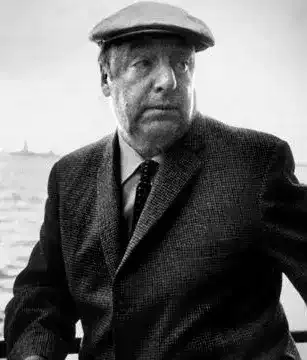
Identification and basic context
Pablo Neruda, born Ricardo Eliécer Neftalí Reyes Basoalto, was a renowned Chilean poet, diplomat, and politician. He is considered one of the most important literary figures of the 20th century and a significant voice for social justice in Latin America. Neruda's work is characterized by its passionate, often surreal imagery, its deep connection to nature, and its engagement with political and social issues. He wrote in Spanish, and his poetry has been translated into numerous languages.
Childhood and education
Neruda was born in Parral, Chile. His mother died shortly after his birth, and he was raised by his father and stepmother in Temuco. He showed an early aptitude for literature, publishing his first poems at the age of 13. He studied French at the Temuco Normal School for Men and later moved to Santiago to study at the University of Chile, although his primary focus remained his literary pursuits. His early life in the Chilean landscape, with its forests, rivers, and the proximity to the ocean, profoundly shaped his poetic sensibility.
Literary trajectory
Neruda's literary career began in his youth, and he quickly gained recognition. He published his first book, "Crepusculario" (Twilight), in 1923. However, it was "Veinte poemas de amor y una canción desesperada" (Twenty Love Poems and a Song of Despair, 1924) that brought him widespread fame. He served as a diplomat for Chile in various countries, including Burma, Ceylon, Java, Argentina, Spain, Mexico, and France. These experiences significantly influenced his writing, broadening his perspective and introducing him to new political and cultural landscapes. His poetry evolved from early romanticism and surrealism to a more politically engaged and socially conscious style.
Works, style, and literary characteristics
Neruda's vast body of work includes "Residencia en la tierra" (Residence on Earth), "Canto general" (General Song), and "Odas elementales" (Elemental Odes). His style is marked by its sensuousness, its rich metaphors, and its profound connection to the natural world. He explored themes of love, death, time, memory, political struggle, and the beauty of everyday objects and natural phenomena. His language is often direct yet deeply evocative, capable of capturing both the grand sweep of history and the intimate details of human experience. He experimented with various forms, from traditional verse to free verse, and his "Elemental Odes" are known for their concise, accessible celebration of ordinary things.
Cultural and historical context
Neruda lived through a turbulent period in Latin American history, marked by political instability, social upheaval, and the rise of authoritarian regimes. As a member of the Communist Party, his political activism led to periods of exile and persecution. His poetry often reflected these historical realities, serving as a voice for the oppressed and a testament to the struggles of the common people. He was a contemporary of other major Latin American writers and intellectuals, contributing to the vibrant literary and political discourse of the region.
Personal life
Neruda had three marriages and several significant relationships that influenced his poetry. His political activities often led to periods of separation from his loved ones. He was a dedicated communist, and his political beliefs deeply informed his life and work, leading him to serve as a senator and a presidential candidate before going into exile. He was known for his deep love of Chile, its landscapes, and its people, which he sought to express through his art and his political actions.
Recognition and reception
Neruda received numerous awards and honors throughout his career, most notably the Nobel Prize in Literature in 1971 for "his poetic works which, with the action of an elemental force, have given a continent its destiny and dreams." He is one of the most widely read poets in the world, and his work continues to resonate with readers across cultures and generations. His reception has been overwhelmingly positive, celebrating his lyrical genius and his unwavering commitment to humanity.
Influences and legacy
Neruda was influenced by poets like Walt Whitman and the European surrealists, but he forged a unique voice that became emblematic of Latin American poetry. He, in turn, influenced countless poets throughout the world with his passionate style, his commitment to social justice, and his ability to find poetry in the ordinary. His "Canto General" is considered a monumental epic of the Americas. Neruda's legacy is that of a poet who captured the soul of a continent and used his art as a powerful tool for social and political change.
Interpretation and critical analysis
Neruda's poetry is frequently analyzed for its exploration of identity, belonging, and the relationship between the individual and the collective. His surrealist leanings in earlier works are often contrasted with the direct political engagement of his later poetry. Critics have examined his role as a national poet and a voice for the marginalized, exploring the ways in which his work both reflects and shapes Latin American consciousness.
Curiosities and lesser-known aspects
Neruda was an avid collector of unusual objects, including various types of shells, ships in bottles, and typewriters, which he displayed in his homes. His houses, particularly La Chascona in Santiago, Isla Negra, and El Cañete in Buenos Aires, are now museums dedicated to his life and work. He was also known for his immense generosity and his support for other artists and writers.
Death and memory
Pablo Neruda died in 1973, shortly after the military coup in Chile that overthrew Salvador Allende's government. While officially attributed to cancer, there have been ongoing investigations and debates surrounding the possibility of foul play. His death was a profound loss for Chile and the literary world. His works continue to be widely read and celebrated, and his memory remains a potent symbol of artistic expression and political conviction in Latin America and beyond.