
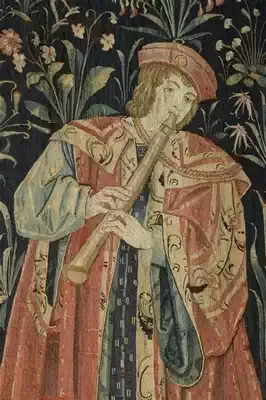
Martim Soares

Martim Soares was a Galician-Portuguese medieval troubadour, active in the 13th century. His work, part of the Galician-Portuguese lyric tradition, reflects the customs and mentality of the nobility of the time. His songs, although few in number, are representative of the troubadour repertoire, addressing themes such as courtly love and social satire with the characteristic mastery of the poets of his court.
n. , Portugal · m. , Portugal
9
Views
Bio
Identification and basic context
Martim Soares was a Galician-Portuguese troubadour of the 13th century. His poetic activity is part of the context of medieval Galician-Portuguese lyricism, being one of the representatives of the literary production that flourished in the courts of the Iberian Peninsula. His work, although limited in the number of attributed songs, is valuable for the study of the troubadour repertoire of the time.Childhood and education
Information about Martim Soares' childhood and education is scarce, as is common for most medieval troubadours. It is known that he probably belonged to the nobility, a requirement for troubadour activity, which involved an education that included knowledge of the arts and social conventions of the court.Literary career
Martim Soares' literary career is marked by the authorship of some songs of love and of scorn and slander (escárnio e maldizer). These songs were collected in medieval songbooks, the best known being those included in the "Cancioneiro da Vaticana" and the "Cancioneiro Colocci-Brancuti". His poetic activity seems to have occurred during the second half of the 13th century.Work, style, and literary characteristics
Martim Soares' songs reflect the themes and forms of the troubadour poetry of the time. In his love songs, he explores the motifs of courtly love, with the exaltation of the lady and the troubadour's submission. In his songs of scorn and slander, he shows a satirical vein, criticizing social customs and behaviors of court figures, using more direct and sometimes biting language. The meter used is typical of the "cantigas de amigo", redondilha maior (seven metrical syllables), with stanzas of five verses, with a refrain.Cultural and historical context
Martim Soares lived in a period of intense cultural activity in the courts of the Iberian Peninsula, where troubadour poetry was an important form of entertainment and social expression. His work is part of the Galician-Portuguese tradition, which was the vernacular language used by troubadours from all over the region.Personal life
Details about Martim Soares' personal life are practically non-existent. Like most troubadours, his biography is reconstructed from his work and the records that mention it.Recognition and reception
Martim Soares' recognition comes from his inclusion in the main songbooks of Galician-Portuguese lyricism, which guarantees his posterity and his study by researchers.Influences and legacy
As a medieval troubadour, Martim Soares is part of a vast poetic tradition that influenced Peninsular literature. His work, although limited, contributes to the heritage of Galician-Portuguese poetry.Interpretation and critical analysis
The critical analysis of Martim Soares' songs focuses on their adherence to generic models (love, scorn, slander) and their ability to portray the customs and mentality of the society of the time.Curiosities and lesser-known aspects
It is possible that Martim Soares had a connection to a specific court, but the data are imprecise.Death and memory
There is no specific information about Martim Soares' death. His memory endures through the songs attributed to him in medieval songbooks.Poems
0No poems found
Comments (0)
Log in
to post a comment.
No comments yet. Be the first to comment.