Identification and Basic Context
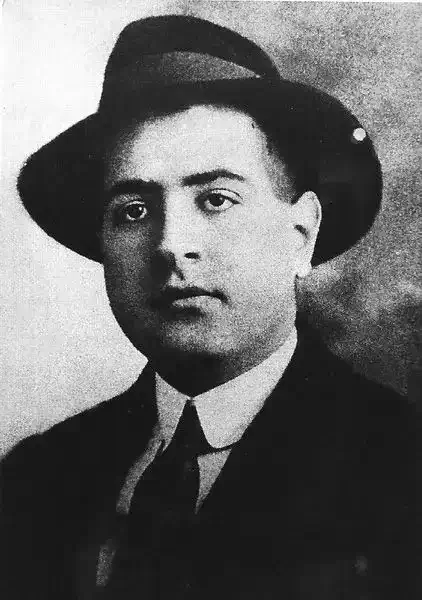
Mário de Sá-Carneiro was a Portuguese writer, born in Lisbon. He is best known as a poet, novelist, and short-story writer. His work is fundamental to understanding Portuguese Modernism, especially the first generation, also known as the "Orpheu Generation".
Childhood and Education
Born into a wealthy family, Sá-Carneiro's childhood was marked by the early death of his mother, an event that deeply affected him and echoed in his work. He attended the University of Coimbra, where he studied Law, but his true passion was literature. During this period, he absorbed influences from Romanticism, Symbolism, and authors such as Edgar Allan Poe, Charles Baudelaire, and Arthur Rimbaud. His intellectual formation was also shaped by a growing interest in the new philosophical and psychological currents of the time.
Literary Career
His literary activity began early, with contributions to newspapers and academic magazines. However, his literary career gained prominence with his active participation in the movement that gave rise to the magazine "Orpheu" (1915), a landmark of Portuguese Modernism. Although the magazine only had two issues, it was a catalyst for a new generation of artists. Sá-Carneiro published poems, short stories, and the novel "O Prisioneiro". His work evolved towards an increasingly intense exploration of the fragmentation of the "self" and existential anguish.
Work, Style, and Literary Characteristics
Sá-Carneiro's most notable works include the novel "O Prisioneiro" (1917) and the collection of short stories "Indícios de Oiro" (1937, posthumous). The dominant themes in his work are the search for identity, the duality of the "self", loneliness, madness, death, the ephemeral nature of life, and the tension between dream and reality. His poetic form is marked by strong subjectivity, sometimes with metrical experiments, but above all by the intensity of expression. The tone is predominantly elegiac, pessimistic, and anguished. The language is rich, sometimes baroque, laden with symbolism and deep emotional charge. He introduced a more introspective and fragmented vision of the human being into Portuguese literature. He is associated with Modernism and a pre-existentialist sensibility.
Cultural and Historical Context
Sá-Carneiro lived in a time of cultural effervescence and great political instability in Portugal, with the fall of the Monarchy and the establishment of the Republic. He was one of the driving forces of the "Orpheu Generation", alongside Fernando Pessoa and Almada Negreiros, with whom he shared a project of artistic renewal. His philosophical position was marked by deep skepticism and the search for transcendental meaning, often frustrated.
Personal Life
Sá-Carneiro's personal life was marked by profound melancholy and emotional instability that accompanied him until the end. His romantic relationships were complex, and his friendship with Fernando Pessoa was one of the pillars of his life and work, serving as confidants and intellectual partners. His struggle against depression and existential anguish had a direct impact on his literary production.
Recognition and Reception
Although his work had limited reception during his lifetime, Mário de Sá-Carneiro is today considered one of the most original and important poets of Portuguese Modernism. His recognition grew significantly after his death, with the critical re-examination of his work and its inclusion in the Portuguese literary canon. His influence is evident in later poets who explored similar themes of anguish and fragmentation.
Influences and Legacy
Sá-Carneiro was influenced by authors such as Edgar Allan Poe, Charles Baudelaire, Arthur Rimbaud, and, in Portugal, by Camilo Pessanha. He influenced, above all, Fernando Pessoa and other writers of his generation. His legacy lies in the way he addressed the crisis of the modern subject, the fragmentation of identity, and existential anguish, themes that continue to resonate in contemporary literature.
Interpretation and Critical Analysis
Sá-Carneiro's work has been the subject of numerous interpretations, many of them focused on his biography and his struggle against depression. His explorations of fragmented identity and the search for an authentic "self" are central to critical analysis, as is his pessimistic view of existence.
Curiosities and Lesser-Known Aspects
A curiosity about Sá-Carneiro is his obsession with the idea of death and the possibility of suicide, which he saw as a way to escape the suffering of existence. His correspondence with Fernando Pessoa reveals the depth of their bond and their intimate sharing.
Death and Memory
Mário de Sá-Carneiro died by suicide in Paris in 1916. His early death cut short a promising literary career. The posthumous publication of his short stories in "Indícios de Oiro" contributed to his consecration and the preservation of his memory as one of the greatest figures in Portuguese literature.

 PT
PT