
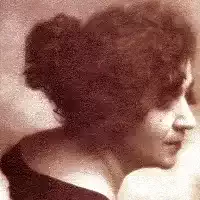
Judith Teixeira
 PT
PT
Judith Teixeira was a singular figure in Portuguese poetry, standing out for her avant-garde audacity and the expressionist force of her work. Born in 1880, she was a pioneer in exploring themes such as urban modernity, psychoanalysis, and the female condition, topics little addressed in her time. With intense language and a sometimes shocking style, she addressed the complexity of the human soul, drives, and desires, on a journey marked by innovation and the attempt to break with established literary conventions, leaving a legacy of visceral and visionary poetry.
n. 1880-01-25, Viseu · m. 1959-05-17, Lisboa
Bio
Identification and Basic Context
Judith Teixeira, whose full name was Judith de Sousa Teixeira, was born on December 11, 1880, and died on November 11, 1959. There are no records indicating the use of pseudonyms or heteronyms. She was born in Fafe, Portugal, into a family with some economic stability.Childhood and Education
Little is known about Judith Teixeira's childhood and education, but her work reveals a strong influence of the intellectual currents of the time, especially Freudian psychoanalysis, and contact with European avant-gardes, although her formal education is not widely documented.Literary Career
Judith Teixeira's literary career is marked by the publication of her most significant work, "Jardim Assombrado" (Haunted Garden), in 1924. This work, considered a precursor to modernism in Portugal, was written in response to a period of great intellectual and artistic effervescence.Work, Style, and Literary Characteristics
Judith Teixeira's work is dominated by "Jardim Assombrado," a book that stands out for its raw, expressionist language and its approach to themes such as sexuality, madness, existential anguish, and urban life. It explores the human psyche, unconscious drives, and the dark aspects of existence. Her style is characterized by imagistic intensity, the use of bold metaphors, and the disruption of traditional poetic structures, approaching free verse. The poetic voice is often confessional and imbued with a dark and tormented lyricism. Her language is dense, sometimes shocking, and uses rhetorical devices to evoke strong sensations. Judith Teixeira introduced thematic innovations by explicitly and unprecedentedly addressing the modern woman, psychoanalysis, and urban reality in Portuguese poetry. Her work engages with modernity and breaks with tradition, associating it with expressionism and the early modernist manifestations in Portugal.Work, Style, and Literary Characteristics
Cultural and Historical Context Judith Teixeira lived during a period of great transformations in Portugal and Europe, marked by the end of the First Republic, the rise of the Estado Novo, and the effervescence of artistic avant-gardes. Her work reflects a dialogue with new currents of thought, such as psychoanalysis, and with the atmosphere of artistic renewal of the time.Work, Style, and Literary Characteristics
Personal Life Details about Judith Teixeira's personal life are scarce. It is known that she lived a life dedicated to her work, with a deep interest in psychoanalysis, a theme that permeates her writing. Her affective and family relationships are not widely documented in the public sphere.Work, Style, and Literary Characteristics
Recognition and Reception "Jardim Assombrado" was a work that caused impact and some controversy at the time, but Judith Teixeira's recognition as an avant-garde and innovative poet was consolidated mainly posthumously. She is now seen as a pioneering figure of Portuguese modernism.Work, Style, and Literary Characteristics
Influences and Legacy Judith Teixeira's influences seem to stem from European avant-gardes and psychoanalytic theories. Her legacy lies in her thematic and stylistic boldness, paving the way for the exploration of new approaches in Portuguese poetry, especially regarding the psychological dimension and the female condition.Work, Style, and Literary Characteristics
Interpretation and Critical Analysis Judith Teixeira's work has been interpreted in light of psychoanalysis, exploring her exploration of the unconscious, repressed desires, and the fragmentation of the self. Her poetry raises questions about identity, madness, and female freedom in a patriarchal context.Work, Style, and Literary Characteristics
Curiosities and Lesser-Known Aspects A curious aspect of her work is how she anticipated themes that would be explored by later generations of writers, demonstrating a remarkable sensitivity to the social and psychological transformations of the 20th century.Work, Style, and Literary Characteristics
Death and Memory Judith Teixeira died in 1959. Her publications are limited to her main work, with later editions continuing her memory and the study of her unique work.Poems
0No poems found
Comments (0)
No comments yet. Be the first to comment.