
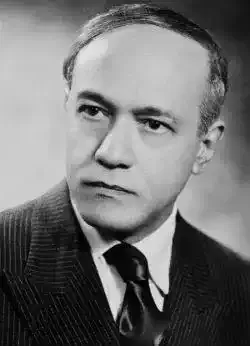
Jorge de Lima
1893–1953
· lived 60 years
 BR
BR
BR
Jorge de Lima was a Brazilian poet, doctor, and novelist, a central figure of the second generation of Modernism in Brazil. His work is marked by a deep religiosity, by the exploration of language, and by the influence of diverse aesthetic currents, such as Symbolism and Surrealism. He began with regionalist poetry and evolved towards formal experimentation and universal themes, masterfully addressing the sacred, the profane, love, and death.
n. 1893-04-23, União dos Palmares · m. 1953-11-15, Rio de Janeiro
8
Views
Bio
Identification and basic context
Jorge de Lima was a Brazilian poet, novelist, short-story writer, and doctor. He was born in União dos Palmares, Alagoas, and died in Rio de Janeiro. Pseudonyms or heteronyms are not prominent in his work. His family background was linked to the agrarian elite of Alagoas, and his initial cultural context was marked by rural tradition and religiosity. His nationality was Brazilian, and his written language was Portuguese. He lived during a period of significant social and political transformations in Brazil, with the consolidation of the Republic and the modernist movements.Childhood and education
Jorge de Lima had a childhood in Alagoas, where his family owned sugar mills. He received a formal education and also had contact with the popular and religious culture of his region. Later, he moved to Rio de Janeiro to study Medicine, graduating in 1921. During his studies, he came into contact with European literary vanguards and the early Brazilian modernist movements, which profoundly influenced his artistic vision.Literary career
Jorge de Lima's writing began in his youth, with the publication of "O Mundo do Menino Impossível" in 1925. His work evolved considerably over time, going through various phases. Initially, his poetry was marked by lyrical regionalism and themes related to childhood and his homeland. Subsequently, his work took on more experimental contours, with strong influences from Surrealism and Symbolism, exploring the dreamlike, mysticism, and the human condition. He collaborated in various literary magazines and was a translator and literary critic.Work, style, and literary characteristics
Jorge de Lima's main works include "O Mundo do Menino Impossível" (1925), "Poemas Negros" (1947), "A Túnica Inconsútil" (1938), "Invenção de Orfeu" (1952), among others. His dominant themes are religiosity (both Christian and mystical), love, death, childhood, nature, identity, and the search for the sacred. In terms of form, Jorge de Lima experimented extensively, using free verse as well as more complex and elaborate forms, demonstrating great mastery of meter and rhythm. His poetic devices are rich in metaphors, sensory imagery, and musicality. The tone of his poetic voice varies between the lyrical, the mystical, the elegiac, and the epic, especially in "Invenção de Orfeu." His language is dense, imagistic, and often surprising, with a vocabulary that moves between the archaic and the modern. He introduced formal and thematic innovations that established him as one of the great names in 20th-century Brazilian poetry. His work engages with literary tradition but also with modern vanguards, associating him with Brazilian Modernism, with strong Symbolist and Surrealist inclinations.Cultural and historical context
Jorge de Lima lived in a period of great cultural effervescence in Brazil, coinciding with the different moments of Modernism. His work dialogued with writers of his generation and later generations, such as Carlos Drummond de Andrade, Cecília Meireles, and Murilo Mendes. His medical training and his religiosity also shaped his worldview and his literary production. The historical context of social, political, and cultural transformations in Brazil influenced him, reflecting in his work the search for a national identity and the exploration of universal themes.Personal life
Jorge de Lima was married and had children. His profession as a doctor put him in direct contact with human suffering, which is reflected in his poetry. His deep religiosity, with a strong mystical component, was a hallmark of his life and work. There are no reports of major literary rivalries, but rather of admiration and dialogue with other poets. His religious and philosophical beliefs were central to his conception of life and art.Recognition and reception
Jorge de Lima is widely recognized as one of the most important poets of Brazilian Modernism. His work "Invenção de Orfeu" received the Jabuti Prize in 1953. His critical recognition has been growing over time, with academic studies dedicated to analyzing the complexity and depth of his poetry. He is considered a fundamental figure in the canon of Brazilian literature.Influences and legacy
Jorge de Lima was influenced by French Symbolist poets, such as Baudelaire and Verlaine, and by movements like Surrealism. His legacy is immense, with his poetry influencing later generations of writers through its formal daring, the depth of its themes, and its ability to merge the sacred and the profane. His work continues to be a subject of study and admiration, establishing itself as a landmark in Portuguese-language literature.Interpretation and critical analysis
Jorge de Lima's work allows for various interpretations, especially regarding his complex religiosity and his exploration of the unconscious. Poems such as those in "Poemas Negros" and "Invenção de Orfeu" are central to critical analyses that address human duality, the search for transcendence, and the existential condition. His poetry is often seen as a dialogue between faith and doubt, body and spirit.Curiosities and lesser-known aspects
A curiosity about Jorge de Lima is his connection with mysticism and his pursuit of a poetry that could express the ineffable. He had a habit of writing in notebooks and owned a vast library. His interest in Afro-Brazilian culture, present in "Poemas Negros," is a striking and innovative aspect of his work. The founding of a literary newspaper in Alagoas in his youth also demonstrates his early engagement with literature.Death and memory
Jorge de Lima died on February 21, 1953, in Rio de Janeiro. Posthumous publications of his writings, such as "A Sombra das Arálias" (1953), continued to expand knowledge of his work. His memory is perpetuated through studies, anthologies, and the relevance of his poetry in the Brazilian literary landscape.Poems
0No poems found
Comments (0)
Log in
to post a comment.
No comments yet. Be the first to comment.