
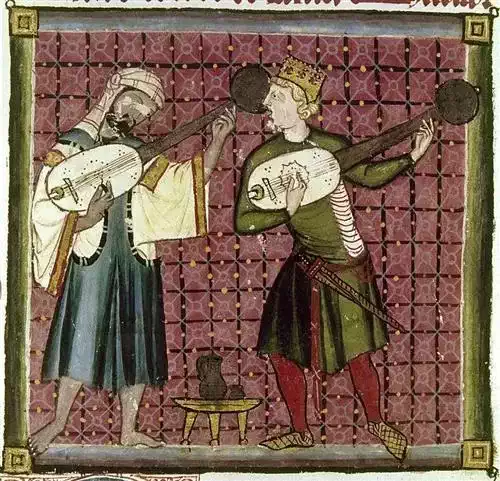
Jogral Lourenço

Jogral Lourenço is an enigmatic figure of Portuguese medieval poetry, identified as a troubadour of the 13th century. His poetic work, although scarce, is valued for its contribution to Galician-Portuguese lyric poetry. His verses reflect the sensibility and characteristic themes of troubadour poetry, such as courtly love and saudade, expressed in a musical and formally refined language. His production, inserted within the context of the cantiga de amor, offers a glimpse into the art and culture of the time.
8
Views
Bio
Identification and basic context
Jogral Lourenço is a troubadour of Galician-Portuguese lyric poetry, active in the 13th century. His exact identity and the full extent of his work are subjects of study and debate among specialists. He is classified as a troubadour of love songs (cantigas de amor), a genre that flourished in the court and noble circles of the medieval Iberian Peninsula.Childhood and education
As a jongleur and troubadour of the Middle Ages, Lourenço likely received training related to music, poetry, and performing arts, which were common for this type of artist. His ability to compose and sing verses suggests knowledge of the literary and musical conventions of the time, probably acquired through informal learning and interaction with other artists and patrons.Literary career
Jogral Lourenço's literary career is intrinsically linked to the tradition of love songs. He composed poems that followed the rules and themes of this genre, such as the exaltation of the lady, the suffering of the lover, and amorous vassalage. His work, preserved in medieval songbooks, is limited in number but significant for its representativeness within the corpus of Galician-Portuguese lyric poetry.Work, style, and literary characteristics
The work of Jogral Lourenço consists of love songs (cantigas de amor). These poetic compositions are characterized by the expression of an idealized and often suffering love, in which the troubadour places himself in a position of submission to his lady, who is generally a figure of high social status. The language used is marked by musicality, repetition of refrains, and vocabulary that evokes courtesy and nobility. The style is lyrical and sentimental, focused on exploring the feelings of the lyrical self towards the beloved.Cultural and historical context
Jogral Lourenço lived in the 13th century, a period when troubadour poetry was a dominant form of cultural expression in the courts of the Iberian Peninsula. Galician-Portuguese lyric poetry flourished in this environment, being transmitted orally and later recorded in songbooks. The troubadour played an important social role, not only as a creator of art but also as an entertainer at festivities and social events.Personal life
Information about Jogral Lourenço's personal life is scarce and speculative, given the nature of his status as a jongleur in the Middle Ages. His life was likely marked by itinerancy, dependence on patrons, and dedication to the arts of music and poetry.Recognition and reception
The recognition of Jogral Lourenço lies in his inclusion in medieval songbooks, which served as repositories of the poetry of the time. His work is studied as an example of the love song (cantiga de amor) and of Galician-Portuguese lyric production, contributing to the understanding of medieval literature and culture.Influences and legacy
Jogral Lourenço, like other troubadours of the era, was influenced by the Provençal lyric tradition and popular poetry. His legacy consists of his contribution to the development and preservation of Galician-Portuguese lyric poetry, enriching the medieval literary heritage with his expression of courtly love.Interpretation and critical analysis
Critical analysis of Jogral Lourenço's songs focuses on their adherence to genre conventions, the expressiveness of his amorous feelings, and the quality of his poetic and musical language. The interpretation of these songs allows for an understanding of the mentalities and values associated with courtly love in medieval society.Curiosities and lesser-known aspects
As a medieval troubadour, many aspects of Jogral Lourenço's life remain unknown. The very nature of his work as a jongleur, which involved performance and often left no personal written records, contributes to his enigmatic character.Death and memory
There are no specific records about Jogral Lourenço's death. His memory is preserved through his poetic compositions that have survived in medieval songbooks, a testament to his art and troubadour culture.Poems
0No poems found
Comments (0)
Log in
to post a comment.
No comments yet. Be the first to comment.