
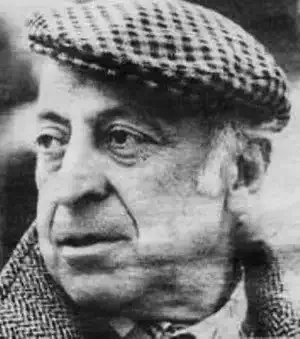
Joaquim Namorado
 PT
PT
Joaquim Namorado was a Portuguese poet, essayist, and professor, whose work is predominantly situated within the Neorealism and social poetry tradition. His writing is marked by a profound sense of civic engagement, the defense of democratic values, and the celebration of the Portuguese homeland and people. With a clear and direct language, yet imbued with lyricism, Namorado sang of the land, the sea, and the people of Portugal, denouncing social injustices and exalting the struggle for freedom. A high school teacher, his life was dedicated to education and poetry, reflecting an ethical and aesthetic commitment to the reality of his time. His vast and diverse work is a testament to his deep connection to Portugal and its history.
n. 1914-06-30, Alter do Chão · m. 1986-12-29, Coimbra
Bio
Identification and basic context
Joaquim Namorado, registered name of Joaquim de Oliveira Namorado, was a prominent Portuguese poet, essayist, and professor. He was born in Coimbra and died in Lisbon. He was a figure associated with Portuguese Neorealism and social intervention poetry. His work reflects the turbulent historical context of Portugal in the 20th century, including the period of Salazar's dictatorship.Childhood and education
Joaquim Namorado was born into a middle-class family. He pursued his higher education in Coimbra, where he attended the Faculty of Letters, graduating in Romance Philology. During his student years, he absorbed literary and philosophical influences that would shape his worldview and his writing.Literary career
Joaquim Namorado's literary career began with the publication of his first poems, which soon revealed a strong social and interventionist bent. He was one of the exponents of Portuguese Neorealism, a movement that sought to portray the country's social reality with objectivity and ethical commitment. He collaborated in various literary publications and newspapers of the time, also being an active essayist and literary critic.Work, style, and literary characteristics
Joaquim Namorado's most significant works include "O Poeta e a Cidade" (The Poet and the City), "A Geração de 50" (The 50s Generation), and "Poemas" (Poems). The central themes of his work are the homeland, the Portuguese people, the land, the sea, freedom, social justice, and the struggle against oppression. His style is characterized by clarity, expressive force, and vigorous lyricism, often associated with free verse, although he also explored more traditional forms. Namorado's poetic voice is markedly civic, adopting a tone of denunciation and exaltation, with an accessible yet profound language.Cultural and historical context
Joaquim Namorado lived and wrote during the Estado Novo (New State), a period of repression and censorship in Portugal. His work is a direct reflection of this context, expressing strong opposition to the regime and a yearning for democracy and freedom. He was an important figure of the "Generation of 50," a group of writers who sought to renew Portuguese literature with greater social and aesthetic commitment. His anti-fascist political stance deeply marked his life and writing.Personal life
Beyond his literary activity, Joaquim Namorado dedicated much of his life to teaching, serving as a high school professor. His personal and family relationships, though not widely publicized, were always intertwined with his civic and literary commitment. His political convictions were firm and shaped his stance on life and art.Recognition and reception
Joaquim Namorado was widely recognized for his contribution to Portuguese literature, especially within the scope of Neorealism and social poetry. He received several awards and distinctions throughout his career. His work is studied and appreciated for its historical relevance and aesthetic value, being considered an important milestone in intervention poetry in Portugal.Influences and legacy
Namorado was influenced by poets such as Miguel Torga and Fernando Namora, and by the neorealist movement. His legacy lies in his ability to unite poetry with civic engagement, inspiring generations of poets and activists to use art as a tool for social transformation. His work continues to be a symbol of resistance and hope.Interpretation and critical analysis
Joaquim Namorado's work has been analyzed from the perspective of Neorealism, highlighting his commitment to Portuguese social reality and his critique of injustices. His poetry is seen as a mirror of the struggle for freedom and human dignity, with a strong emotional charge and a call to action.Curiosities and lesser-known aspects
An interesting aspect of his life is his dual role as poet and teacher, which allowed him to shape the thinking of many young people. His passion for Portugal was palpable in all aspects of his life and work.Death and memory
Joaquim Namorado passed away in 2009, leaving behind a significant literary and civic legacy. His works continue to be published and studied, keeping alive the memory of a poet who dedicated his life to art and the struggle for a more just and free Portugal.Poems
0No poems found
Comments (0)
No comments yet. Be the first to comment.