
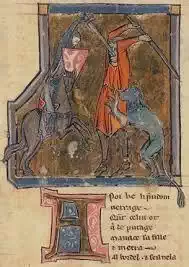
João Lobeira
 PT
PT
João Lobeira was a Galician-Portuguese troubadour and poet, active in the second half of the 13th century and the early 14th century. He stood out in Galician-Portuguese lyric poetry, particularly in the cantigas de amigo, where he explored themes of love and saudade with great sensitivity. His work is part of the context of medieval troubadour lyricism, being an important representative of this tradition in the Iberian Peninsula. Although less prolific than some contemporaries, Lobeira left a significant legacy in medieval Galician-Portuguese poetry.
n. 1233 · m. 1285, Madrid
Bio
Identification and Basic Context
João Lobeira is a name associated with a Galician-Portuguese troubadour, whose poetic activity is situated between the second half of the 13th century and the beginning of the 14th century. His work is scarce but relevant in the panorama of medieval Galician-Portuguese lyricism.Childhood and Education
Little is known about João Lobeira's childhood and education. His social origin and the environment in which he grew up are not detailed, but his literary production indicates a familiarity with the codes of nobility and courtly culture of the time. His education would have been typical for a member of the medieval nobility, with access to reading and writing, essential for the practice of troubadour lyricism.Literary Career
João Lobeira's literary career is intrinsically linked to the practice of the cantiga, the dominant poetic genre in medieval Galician-Portuguese lyricism. He is mainly known for a cantiga de amigo, "Perdida me sodes vós e eu também" ("You are lost and I too"), which is a paradigmatic example of the genre. His work, although reduced to a few compositions, demonstrates mastery in the exploration of characteristic themes and forms.Work, Style, and Literary Characteristics
The most famous work by João Lobeira is the cantiga de amigo "Perdida me sodes vós e eu também". This cantiga is famous for its lyrical expressiveness and for representing the female voice lamenting a separation or loss. The central theme is saudade (longing) and amorous anguish, expressed in language that combines apparent simplicity with a profound emotional charge. Lobeira's style in his cantiga de amigo is characterized by the use of parallelisms and refrains, typical elements of the genre. The poetic voice is that of a maiden expressing her feelings poignantly. The meter is traditional for cantigas, with syllables of variable count and rhyme.Cultural and Historical Context
João Lobeira lived in a period of great cultural effervescence in the Iberian Peninsula, marked by the rise and consolidation of Christian kingdoms and the production of troubadour lyricism in the Galician-Portuguese language. This cultural movement united the nobility of Portugal, Galicia, and León around a common poetic production that influenced later literature.Personal Life
Information about João Lobeira's personal life is scarce. It is known that he was a nobleman and likely participated in the courtly life of the time. There are no detailed records about his family, romantic relationships, or profession beyond his troubadour activity.Recognition and Reception
Although his work is limited in quantity, João Lobeira gained recognition for the quality of his cantiga de amigo. "Perdida me sodes vós e eu também" has become one of the most studied and cited examples of medieval Galician-Portuguese lyric poetry, attesting to his importance in the tradition.Influences and Legacy
João Lobeira belongs to the vast tradition of Galician-Portuguese lyric poetry, influenced by Provençal poetry and popular music. His legacy lies in his contribution to the development and sophistication of the cantiga de amigo, one of the pillars of this literary tradition. His work served as a model and inspiration for other troubadours and for the subsequent study of medieval lyricism.Interpretation and Critical Analysis
Lobeira's cantiga has been the subject of critical analysis from various perspectives, including its lyrical dimension, the representation of female psychology, and its integration into the codes of chivalry and courtly love. Its apparent simplicity hides an emotional complexity that continues to fascinate.Curiosities and Lesser-Known Aspects
Despite his literary relevance, João Lobeira remains a figure shrouded in mystery. The scarcity of biographical data fuels his aura as a literary figure of the past, whose work transcends the individuality of the author.Death and Memory
There is no detailed information about the circumstances of João Lobeira's death. His memory lives on through his single widely known cantiga de amigo, which continues to be studied and admired in anthologies and studies on medieval Galician-Portuguese literature.Poems
0No poems found
Comments (0)
No comments yet. Be the first to comment.