
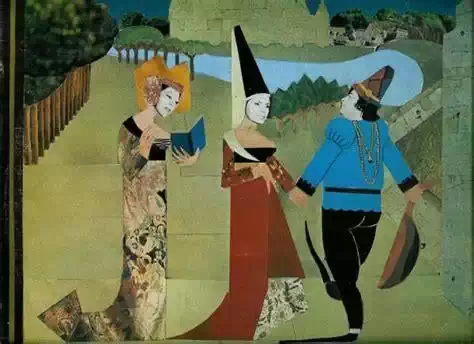
João Airas de Santiago

João Airas de Santiago was a Galician-Portuguese troubadour, active in the 13th century. He belongs to the period of medieval lyric poetry in the Galician-Portuguese language, being known for his cantigas, especially those of love and friend. His work, although belonging to a specific literary context, reflects the conventions of troubadour poetry, exploring themes such as courtly love and saudade, and contributing to the heritage of medieval literature of the Iberian Peninsula.
n. Séc. XIII, Santiago de Compostela
6
Views
Bio
Identification and basic context
João Airas de Santiago was a Galician-Portuguese troubadour, whose poetic activity took place in the 13th century. He is a prominent figure of the so-called "Very Noble and Ever Loyal City of Santiago de Compostela", which suggests a strong connection to the region of Galicia. His name indicates a family origin or an affiliation with the Order of Santiago.Childhood and education
Information about the childhood and education of João Airas de Santiago is scarce, as is common for most medieval troubadours. It is presumed that, like other renowned troubadours, he had access to an education that allowed him to master the art of poetic and musical composition, within the context of the courtly society of the time.Literary career
The literary career of João Airas de Santiago is centered on the production of cantigas, which are the characteristic poetic genre of medieval Galician-Portuguese lyric poetry. His work is composed of cantigas de amor and cantigas de amigo, demonstrating mastery in the conventional forms and themes of troubadour poetry.Work, style, and literary characteristics
The works of João Airas de Santiago include a set of cantigas, among which some cantigas de amor stand out, following the model of courtly love, and cantigas de amigo, which express the female voice and saudade. His style is characterized by musicality, formal elegance, and the expression of feelings in a conventional but sincere way, within the precepts of troubadour lyric poetry. His work contributes to the corpus of medieval Galician-Portuguese poetry, revealing the sensibilities and themes that shaped the literary production of that period.Cultural and historical context
João Airas de Santiago lived during the 13th century, a period marked by the expansion of Christian kingdoms in the Iberian Peninsula and the consolidation of a courtly culture where troubadour poetry flourished. His connection to Santiago de Compostela places him in an important cultural and religious center of the time. Galician-Portuguese poetry was the privileged language of literary expression for lyric poetry in the Iberian Peninsula during that period.Personal life
Little is known about the personal life of João Airas de Santiago. His affiliation with the Order of Santiago and his connection to Compostela are the best-known aspects of his biography, suggesting a life linked to religious or military activities, in addition to his activity as a troubadour.Recognition and reception
The recognition of João Airas de Santiago stems from his place as one of the troubadours of Galician-Portuguese lyric poetry. His work was preserved in medieval songbooks, which allowed its survival to the present day and its study by researchers of medieval literature.Influences and legacy
As a troubadour, João Airas de Santiago is part of the tradition of courtly lyric poetry that developed in medieval Europe. His legacy lies in his contribution to the repertoire of Galician-Portuguese poetry, a fundamental literary heritage for the history of the language and literature in Portugal and Galicia.Interpretation and critical analysis
The critical analysis of the work of João Airas de Santiago focuses on his adherence to the conventions of the cantiga de amor and cantiga de amigo, as well as his ability to express human emotions within a specific formal framework.Curiosities and lesser-known aspects
His connection to the Order of Santiago and the city of Compostela gives him particular interest, suggesting a life that combined religious or military practice with poetic art.Death and memory
The circumstances of João Airas de Santiago's death are unknown, as is the exact date of his death. His memory endures through his cantigas, preserved in medieval songbooks.Poems
0No poems found
Comments (0)
Log in
to post a comment.
No comments yet. Be the first to comment.