
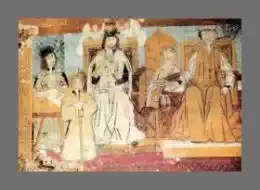
Fernão Garcia Esgaravunha
 PT
PT
Fernão Garcia Esgaravunha was a Portuguese medieval poet, a contemporary of Gil Vicente and Sá de Miranda. Although his work is less extensive than that of other authors of the time, it is significant for its satirical and moralizing poetry. He wrote in Galician-Portuguese and is considered one of the precursors of more socially and politically engaged lyricism in the Portuguese-language literature. His compositions often address the customs of the time, criticizing the hypocrisy and vices of society, sometimes with a biting tone, but always with a keen eye on human dynamics.
n. 1225, Reino de Portugal · m. 1280, Reino de Portugal
Bio
Identification and basic context
**Full name:** Fernão Garcia Esgaravunha **Nationality:** Portuguese **Period:** 16th centuryChildhood and education
Little is known about the childhood and education of Fernão Garcia Esgaravunha. His education, however, allowed him to master the Galician-Portuguese language and acquire the necessary knowledge for his literary production, which demonstrates a certain erudition and a critical view of society.Literary career
The literary career of Fernão Garcia Esgaravunha falls within the transition period between the Middle Ages and the Renaissance in Portugal. His work is marked by a satirical and moralizing vein, contrasting with the predominantly more lyrical and courtly poetry. He wrote in Galician-Portuguese, the literary language of the time, and his compositions circulated in manuscript copies. He is often associated with a group of poets who used poetry as a vehicle for social criticism.Work, style, and literary characteristics
The work of Fernão Garcia Esgaravunha is characterized by a satirical and critical tone, addressing themes such as social customs, hypocrisy, corruption, and the vices of the era. He masterfully uses the Galician-Portuguese language, employing an expressive and sometimes coarse vocabulary, suitable for his intention of denunciation. The poetic form varies, but his poetry shares with the tradition of cantigas, albeit with a more earthly and social theme. His style is direct and incisive, aiming to provoke reflection in the reader.Cultural and historical context
Fernão Garcia Esgaravunha lived in a period of significant transformations in Portugal, on the threshold of the Renaissance. His poetry reflects a changing society, with tensions between traditional values and new influences. His social and critical engagement places him in a literary context that, while still linked to the medieval tradition, already foreshadows the emergence of a literature more focused on human and social reality.Personal life
Information about the personal life of Fernão Garcia Esgaravunha is scarce. No details are known about his family, profession, or personal convictions that may have directly influenced his work, beyond his evident capacity for social observation.Recognition and reception
The recognition of Fernão Garcia Esgaravunha was limited in his time, and his work circulated mainly in restricted circles. However, over time, his poetry has been valued for its thematic and stylistic originality, recognizing his role as one of the first Portuguese poets to address social satire so forcefully.Influences and legacy
Influences on Fernão Garcia Esgaravunha can be found in the tradition of medieval satirical cantigas. His legacy lies in the introduction of a strong component of social criticism into Portuguese-language poetry, paving the way for future poets who would use art as a tool for intervention.Interpretation and critical analysis
The work of Fernão Garcia Esgaravunha is often interpreted as a vivid portrait of the society of his time, marked by a keen insight into moral and social failings. His poetry offers an interesting counterpoint to more idealized lyrical production, revealing a cruder and more realistic facet of human existence.Curiosities and lesser-known aspects
The name "Esgaravunha" suggests a perhaps more popular character or a connection to a trade or personal characteristic. However, there is no confirmation or detail about the exact meaning or the circumstances that led to the adoption of this surname.Death and memory
Information about the death of Fernão Garcia Esgaravunha is not available. His memory endures through his poetic compositions, which continue to be studied and appreciated for their historical and literary relevance.Poems
0No poems found
Comments (0)
No comments yet. Be the first to comment.