
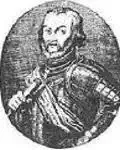
Cristóvão Falcão
1512–1557
· lived 45 years
 PT
PT
PT
Cristóvão Falcão was a Portuguese poet and humanist, whose work is fundamental to the study of Renaissance poetry in Portugal. His writing, marked by classical influence and the pursuit of formal perfection, addresses themes such as love, nature, and the transience of life. His greatest work, "O Labirinto" (The Labyrinth), is a poem of great complexity and erudition, reflecting his profound intellectual formation and his role in the cultural context of his time.
n. 1512-01-01, Portalegre · m. 1557-01-01
2
Views
Bio
Identification and basic context
Cristóvão Falcão was a Portuguese poet and humanist of the Renaissance. His best-known work is the poem "O Labirinto".Childhood and education
Cristóvão Falcão was born in Viana do Castelo, around 1517. His family background is obscure, but it is known that he had access to a careful education, probably in Coimbra, where he may have studied Law. He absorbed the ideals of Renaissance Humanism, influenced by readings of classical and contemporary authors.Literary career
Cristóvão Falcão began his literary activity in the context of the Portuguese Renaissance. His main work, "O Labirinto", written in 1540 but published posthumously in 1580, is an allegorical poem of great erudition and complexity. His literary activity was linked to the humanist circles of the time.Work, style, and literary characteristics
The work of Cristóvão Falcão, centered on "O Labirinto", explores themes such as love, earthly life, fortune, and the human condition. The poem is an allegory of life, presenting the challenges and temptations that human beings face. The style is erudite, with abundant mythological and classical references, demonstrating a mastery of Renaissance poetic meter and form, namely the octave verse.Work, style, and literary characteristics
Cultural and historical context Cristóvão Falcão lived at the height of the Portuguese Renaissance, a period of great cultural flourishing and maritime expansion. He was a contemporary of figures such as Luís de Camões. His humanism reflects the pursuit of knowledge and the appreciation of classical culture that characterized the era.Work, style, and literary characteristics
Personal life Little is known about the personal life of Cristóvão Falcão. He was a man of study and erudition, dedicated to letters. It is presumed that he led a discreet life, connected to the academic and intellectual world.Work, style, and literary characteristics
Recognition and reception The work of Cristóvão Falcão, especially "O Labirinto", was recognized for its literary quality and erudition. However, its late publication limited its immediate dissemination. Its importance was gradually recognized over time, and it is now considered one of the exponents of Portuguese Renaissance poetry.Work, style, and literary characteristics
Influences and legacy Cristóvão Falcão was influenced by classical poetry (Virgil, Ovid) and by Italian humanists. His legacy lies in his contribution to allegorical and erudite poetry of the Renaissance in Portugal, demonstrating a high technical and intellectual mastery.Work, style, and literary characteristics
Interpretation and critical analysis "O Labirinto" has been interpreted as an allegory of life, with its paths and detours, and a reflection on the moral and existential choices of human beings. Its erudition and structural complexity are frequently highlighted.Work, style, and literary characteristics
Curiosities and lesser-known aspects The posthumous publication of "O Labirinto" is one of the most notable aspects of his work, which only saw the light of day decades after its writing.Work, style, and literary characteristics
Death and memory Cristóvão Falcão died in 1557, in Lisbon. His memory endures through his work "O Labirinto", a landmark of Portuguese Renaissance poetry.Poems
0No poems found
Comments (0)
Log in
to post a comment.
No comments yet. Be the first to comment.