Identification and basic context
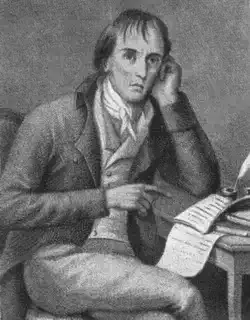
Manuel Maria Barbosa du Bocage, widely known by his nickname Bocage, was born in Setúbal, Portugal, on September 25, 1765, and died in Lisbon on October 21, 1805. He is considered one of the greatest Portuguese poets of the Neoclassical period, although his work anticipates many characteristics of Romanticism. He lived in a period of profound social and political changes in Portugal, marked by the influence of the Enlightenment and the events of the French Revolution. He was the son of José Barbosa da Silva and D. Maria Madalena Muge, of modest origin, but with social aspirations.
Childhood and education
Bocage's childhood was marked by economic difficulties and a complex relationship with his family. At the age of 14, he joined the Navy, where he served for a period, demonstrating an restless and rebellious spirit from an early age. His education was largely self-taught, fueled by extensive reading of classical and contemporary authors, including Portuguese Arcadian poets and French Enlightenment thinkers. His youth was characterized by intense passions, romantic disappointments, and a dissolute lifestyle that would follow him throughout his life.
Literary career
Bocage's literary career began early, with the production of sonnets that already revealed unusual talent. His most significant work was written and published between the ages of 20 and 30. Despite living a short and troubled life, Bocage produced a vast and diverse body of work, including sonnets, odes, eclogues, epistles, and satires. He published "Rimas" in 1791 and a complementary volume in 1799. He collaborated in various periodicals of the time, where he frequently published satirical poems and epigrams. He was also a translator of classical and modern works, demonstrating great erudition.
Work, style, and literary characteristics
Bocage's work is marked by deep lyricism and unparalleled expressiveness. He explored themes such as idealized and sensual love, the fleetingness of time, melancholy, nature, and social criticism. The sonnet was Bocage's preferred poetic form, in which he demonstrated exceptional technical mastery, combining formal rigidity with freedom of thought. His style is characterized by emotional intensity, the use of rich and sometimes innovative vocabulary, the musicality of verse, and the presence of antitheses and paradoxes that reflect the complexity of his poetic "self." His poetic voice is confessional, passionate, and often ironic and satirical, anticipating the Romantic spirit.
Cultural and historical context
Bocage lived in a transitional period between Neoclassicism and Romanticism. The Enlightenment, with its emphasis on reason and progress, coexisted with a growing sense of individualism and subjectivity. Portuguese society of the time was conservative and dogmatic, which contrasted with Bocage's free and rebellious spirit. He engaged with contemporaries like Tolentino de Almeida, but his work is distinguished by its originality and emotional intensity, which partly sets him apart from Arcadian canons.
Personal life
Bocage's personal life was intense and turbulent. Marked by romantic disappointments, such as his love for D. Eugénia, and by a troubled relationship with his family, who disapproved of his bohemian lifestyle. His frequent disputes with authorities and his tendency towards dissolute behavior led to his imprisonment and deportation to Portuguese India, where he spent a period. His fragile health and constant struggle against financial difficulties also marked his existence. His philosophical beliefs leaned towards skepticism and criticism of religious institutions.
Recognition and reception
During his lifetime, Bocage had limited and controversial recognition. He was admired by many for his poetic genius, but also criticized for his socially inappropriate behavior and his ideas considered subversive. It was only posthumously that his work gained the dimension and recognition it deserves today, being considered one of the pillars of Portuguese-language poetry. His entry into the literary canon was a gradual process, but today he is universally celebrated.
Influences and legacy
Bocage was influenced by Camões, Horace, and Virgil, but also by pre-Romantic and French Enlightenment poets. His legacy is immense, having influenced subsequent generations of Portuguese and Brazilian poets, particularly the Romantics and Symbolists. His formal mastery, lyrical intensity, and thematic boldness opened new paths for poetic expression in the Portuguese language. His work continues to be studied and celebrated for its artistic relevance and its ability to touch human emotions.
Interpretation and critical analysis
Bocage's work has been the subject of numerous interpretations. Critical readings highlight the duality of his poetic "self," divided between the ideal and the real, pure love and carnal passion, the search for transcendence and the awareness of finitude. His poetry can be seen as a reflection of the existential and cultural tensions of his time, a cry for freedom and anguish in the face of the human condition. The irony and humor, often present, invite a more complex analysis of his lyricism.
Curiosities and lesser-known aspects
Bocage was known for his explosive temper and witty remarks. A famous anecdote recounts that, when criticized for a physical defect (a squinting eye), he supposedly replied: "If I had your eye, I would have your eye." He was also an astute observer of society, whose vices and hypocrisies he frequently satirized. His manuscripts and letters reveal a tormented man, but also one gifted with remarkable intelligence and sensitivity.
Death and memory
Bocage died prematurely, at the age of 40, from tuberculosis, in a Holy House of Mercy, in great poverty. His death was surrounded by sadness and a growing posthumous recognition. His "Rimas" and other poems were published and reissued several times, consolidating his position as one of the greatest figures in Portuguese literature. Bocage's memory is that of a brilliant poet, a free spirit, and a rebel who, through his art, expressed the complexity of the human soul.

 PT
PT