
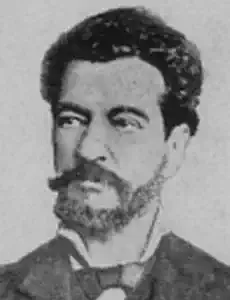
Bernardo Guimarães
 BR
BR
Bernardo Guimarães was a Brazilian poet and writer, considered one of the main representatives of Romanticism in Brazil. His work is marked by deep lyricism, with strong inspiration from nature and love, but also addresses social and historical themes, with emphasis on Indianism. He is the author of iconic works of Brazilian literature, such as "A Escrava Isaura" and "O Garatuja", which explore issues such as slavery and national identity, as well as poems that celebrate the beauty of the Brazilian natural landscape.
n. 1825-08-15, Ouro Preto · m. 1884-03-10, Ouro Preto
Bio
Identification and basic context
Bernardo Joaquim da Silva Guimarães was a Brazilian poet and novelist. He was born in Ouro Preto, Minas Gerais, on August 7, 1825, and died in the same city on March 10, 1884. The son of an apothecary and a housewife, he grew up in a bourgeois and cultured environment, during a time of cultural and political effervescence in Brazil.Childhood and education
He spent his childhood and youth in Ouro Preto, where he received primary and secondary education. He began his Law degree at the Faculty of Law of São Paulo, but did not complete it. He showed an early inclination for literature, influenced by readers in his family and by the literary environment of the time, which was beginning to take an interest in Romanticism.Literary career
Bernardo Guimarães began publishing his first poems at a young age, in newspapers and magazines in Minas Gerais. His literary career was consolidated with the publication of "O Trovador do Sertão" (1857) and "Evocação ao Brasil" (1858). The best-known phase of his work includes "A Escrava Isaura" (1875), "A Princesa das Flores" (1876), and "O Garatuja" (1877), where he explores Indianism.Work, style, and literary characteristics
His work encompasses lyrical poetry and novels. In poetry, themes of love, the exaltation of Brazilian nature, and Indianism, as in "O Índio", stand out. "A Escrava Isaura" is his most famous prose work, an abolitionist novel that became a great success. His style is marked by sentimentalism, lyricism, and accessible language. He frequently used decasyllabic verse and sonnets, but also explored other forms. The tone is predominantly lyrical and, at times, nationalist.Cultural and historical context
Bernardo Guimarães lived during the Second Reign in Brazil, a period of great social and political transformations, such as the abolitionist campaign. He is part of the Brazilian romantic movement, particularly the second generation, with a strong idealization of nature and the indigenous people. His work dialogues with growing nationalism and the social issues of the time.Personal life
Although little detail is available about his personal life, it is known that he dedicated himself to writing and journalism. He had a modest life and faced financial difficulties at times. His dedication to literature was constant.Recognition and reception
Bernardo Guimarães achieved great popularity during his lifetime, especially with "A Escrava Isaura", which was translated into several languages and adapted for theater and cinema, achieving international success. His work is a landmark in Brazilian literature, consolidating the abolitionist novel genre and Indianism.Influences and legacy
Influenced by European romantic poets and Brazilian literature of his time, Bernardo Guimarães, in turn, influenced later generations of writers. His work contributed to the formation of Brazilian literary identity, celebrating the indigenous person as a national hero and criticizing slavery.Interpretation and critical analysis
"A Escrava Isaura" is often analyzed from the perspective of criticism of slavery and the idealization of women. Guimarães's poetry is seen as a reflection of Brazilian Romanticism, with its universal themes of love and nature, but with a strong Brazilian character.Curiosities and lesser-known aspects
Bernardo Guimarães had a particular fascination with indigenous culture and the history of Brazil. "A Escrava Isaura" was written during a period of intense struggle for the end of slavery, which gives the work a sense of urgency and social denunciation.Death and memory
He died in Ouro Preto in 1884, victim of tuberculosis. His work, however, continued to be read and celebrated, ensuring his prominent place in the history of Brazilian literature. Posthumous publications of his poems and short stories kept his memory alive.Poems
0No poems found
Comments (0)
No comments yet. Be the first to comment.