
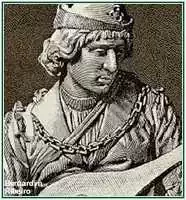
Bernardim Ribeiro
1482–1552
· lived 70 years
 PT
PT
PT
Bernardim Ribeiro was a Portuguese poet and prose writer of the 16th century, considered a transitional figure between classicism and humanism. His work, marked by melancholic and introspective lyricism, explores themes such as love, saudade, nature, and the transience of life, anticipating sensibilities that would become central to the Renaissance.
n. 1482-01-01, Torrão · m. 1552-01-01, Lisboa
1
Views
Bio
Identification and basic context
Bernardim Ribeiro, whose full name was Bernardi(m) de Ribeyro, was a Portuguese poet and prose writer. He was born in Torres Novas around 1482 and died in Rome, on an uncertain date, possibly in 1552 or 1553. He was the son of Lopo Gonçalves de Andrade and D. Maria da Silva. His family background was noble, which allowed him access to a privileged education. He was one of the most important names in Portuguese literature of his time, although his work was marked by a certain isolation and melancholy.Childhood and education
Bernardim Ribeiro had a childhood in a noble family environment. He received an excellent education, typical of his social class, which included the study of humanities and classical languages. His readings were fundamental to his formation, absorbing influences from classical Greco-Latin literature, as well as from troubadour poetry and the humanist currents that were beginning to emerge in Europe. Notable events in his youth include, possibly, participation in military campaigns and contact with the court.Literary career
Bernardim Ribeiro began writing in his youth, producing lyric poetry. Over time, his work evolved, moving from the influence of songbook poetry to a more personal and melancholic expression, with strong humanist traits. His best-known work is the novella "Menina e Moça" (or "Lírica dos Loves"), written in poetic prose and published posthumously. He collaborated in anthologies and literary circles of the time, although his output is not extensive.Work, style, and literary characteristics
Bernardim Ribeiro's work is marked by deep and melancholic lyricism. In "Menina e Moça," he explores themes such as idealized love, saudade, nature as a mirror of the soul, and the transience of human existence. His style is characterized by musicality, careful language, and introspection. He frequently uses allegory and metaphor to express his feelings and reflections. His writing anticipates Renaissance sensibility, with an elegiac tone and a search for beauty.Cultural and historical context
Bernardim Ribeiro lived in a time of transition, the Renaissance, which brought new philosophical and artistic perspectives. He engaged with European humanist currents but maintained a strong connection with Portuguese literary tradition. His work reflects the anxieties of a time of discoveries and questioning of medieval values. He was a contemporary of other important writers and artists, although his social circle appears to have been restricted.Personal life
Bernardim Ribeiro's life was marked by deep melancholy and romantic disillusionment, which is intensely reflected in his work. His affective relationships, especially an unrequited love, were a source of inspiration for his poetry. His personal life seems to have been solitary, with a progressive withdrawal from social life and a dedication to writing and reflection.Recognition and reception
Although his work was not widely disseminated during his lifetime, Bernardim Ribeiro was recognized by some contemporaries and later critics as one of the great names in Portuguese poetry. His "Menina e Moça" became a landmark in fiction prose and poetry in Portugal.Influences and legacy
Bernardim Ribeiro was influenced by troubadour poetry, classical literature, and Renaissance humanism. His legacy lies in the introduction of a more introspective and melancholic sensibility into Portuguese literature, anticipating modern lyricism and influencing later poets who explored the themes of love and saudade.Interpretation and critical analysis
Bernardim Ribeiro's work has been interpreted as a mirror of the complexities of love, human nature, and the existential condition. His "Menina e Moça" is often analyzed for its fragmented structure and symbolic depth.Curiosities and lesser-known aspects
It is known that Bernardim Ribeiro traveled abroad, having lived in Italy. His literary output is relatively scarce, which contributes to a certain mystery surrounding his figure. The exact circumstances of his death and the details of his life in Rome are little known.Death and memory
Bernardim Ribeiro died in Rome, on an uncertain date. His main work, "Menina e Moça," was published posthumously, ensuring its permanence in Portuguese literary memory.Poems
0No poems found
Comments (0)
Log in
to post a comment.
No comments yet. Be the first to comment.