
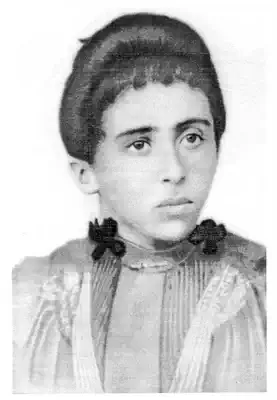
Auta de Souza
1876–1901
· lived 24 years
 BR
BR
BR
Auta de Souza was a Brazilian poet, a pioneer in religious literature of lyrical expression in Brazil. Her work is marked by a profound Catholic faith, expressed in poems that celebrate divinity, devotion, and hope, often with a tone of exaltation and spiritual contemplation.
n. 1876-09-12, Macaíba · m. 1901-02-07, Natal
9
Views
Bio
Identification and Basic Context
Auta de Souza, born Maria das Dores de Souza, was a Brazilian writer and poet, born in 1879. She is known as the "Poetess of Jesus" and is considered one of the precursors of religious literature in Brazil, with a work notably centered on Catholic faith and devotion to God. Her nationality was Brazilian, and her writing language was Portuguese.Childhood and Education
Auta de Souza was born into a wealthy family in Pindamonhangaba, São Paulo. From an early age, she showed an inclination for religious and spiritual life, influenced by her family environment and the religious education of her time. Although her formal education is not widely detailed, her work reflects a deep knowledge of Catholic doctrine and strong spirituality.Literary Career
Auta de Souza began writing poetry in her youth, dedicating herself to religious themes and the exaltation of faith. Her work gained notoriety with the publication of "Horto de Deus" (Garden of God) in 1901, which became a landmark in Brazilian religious literature. She continued to publish throughout her life, consolidating her position as a poetic voice of deep devotion and spiritual inspiration.Work, Style, and Literary Characteristics
Auta de Souza's work is predominantly religious, focusing on the celebration of God, the Virgin Mary, and the saints. Her poems explore themes such as faith, hope, divine love, penance, and eternal life. Her style is characterized by accessible language, yet rich in lyricism and devotion, using traditional poetic forms like the sonnet, and a tone of exaltation and contemplation. Her poetic voice is personal and fervent, expressing a deep intimacy with the divine.Cultural and Historical Context
Auta de Souza lived in a period of strong influence of the Catholic Church in Brazil, and her work reflects this religious and cultural atmosphere. She belongs to a movement of spiritual renewal that sought to express faith in a more personal and literary way. Her poetry, although focused on the spiritual, engaged with the aspirations of a society that found in religion an important pillar of its identity.Personal Life
Auta de Souza was a woman of deep devotion and simplicity. She dedicated her life to prayer and writing, maintaining a reclusive lifestyle focused on her spirituality. Her personal relationships were marked by her faith and her dedication to the religious cause. She never married and lived a life dedicated to poetry and contemplation.Recognition and Reception
Auta de Souza was widely recognized during her lifetime for her religious work, receiving the title "Poetess of Jesus." Her poetry touched the hearts of many faithful and inspired devotion. Although her recognition may have been more concentrated in religious circles, her importance as a pioneer of Brazilian religious poetry is undeniable.Influences and Legacy
The main influence on Auta de Souza's work was her Catholic faith and the Holy Scriptures. Her legacy lies in the introduction and consolidation of religious poetry in the Brazilian literary scene, paving the way for other writers who would explore this theme. Her work continues to be a source of inspiration for readers who seek in poetry an expression of faith.Interpretation and Critical Analysis
Auta de Souza's work has been interpreted as a genuine expression of Catholic faith and devotion. Critical analyses often highlight her ability to translate religious sentiments into touching and inspiring verses, reinforcing the idea that poetry can be a channel for the expression of the sacred and transcendence.Curiosities and Lesser-Known Aspects
A curious aspect of her life is the fact that she chose the pseudonym "Auta de Souza," which became her literary name. Her dedication to writing was such that she often dictated her poems, as she suffered from an illness that made writing difficult.Death and Memory
Auta de Souza passed away in 1911. Her memory is preserved through her works, which continue to be read and admired for their spiritual depth and poetic beauty. Posthumous publications have kept her work alive and accessible to new generations.Poems
0No poems found
Comments (0)
Log in
to post a comment.
No comments yet. Be the first to comment.