Identification and basic context
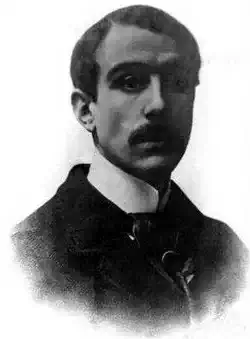
António Correia de Azevedo Nobre was a Portuguese poet, born in Porto. He is considered one of the main representatives of Symbolism and Decadentism in Portuguese literature. His work is marked by profound lyricism, melancholy, and an expressive saudade for his homeland, Portugal.
Childhood and education
Born into a wealthy family, he studied at various institutions, including the University of Coimbra, where he began his Law degree, which he never completed. He spent part of his youth and education in France, in Paris, a city that fascinated him but also intensified his feeling of uprooting and longing for Portugal.
Literary career
António Nobre began his literary activity with the publication of poetry, his work being marked by the influence of French Symbolism. His first book, 'Só' (Alone), published in 1892, is a landmark in Portuguese Symbolist poetry. It was followed by 'Duesas' (Goddesses) (1892) and 'Um Livro de Horas' (A Book of Hours) (1900), which consolidated his position in the literary landscape.
Work, style, and literary characteristics
António Nobre's main works include 'Só' (1892), 'Duesas' (1892), and 'Um Livro de Horas' (1900). His poetry is characterized by a markedly elegiac and melancholic tone, where saudade for Portugal, the fleetingness of time, ephemeral beauty, and the search for spiritual refuge are recurring themes. Love, death, and lost childhood are also central motifs.
His style is marked by musicality, subtlety of imagery, and a vocabulary that evokes a universe of dreams and nostalgia. He frequently uses resources such as alliteration, assonance, and synesthesia to create a unique sonic and sensory atmosphere. His poetic voice is profoundly subjective and confessional, conveying a sense of helplessness and yearning.
António Nobre is often associated with the Symbolist movement, but his work also presents strong Decadent and pre-Modernist traits, anticipating some of the concerns of the following generation.
Cultural and historical context
António Nobre lived in a time of transition in Portugal, marked by political crisis and disillusionment after the British Ultimatum of 1890. Symbolism and Decadentism, European movements that reflected a certain existential malaise and a search for new forms of expression, found in Nobre one of their most faithful interpreters in Portugal. He was a contemporary of other important poets, but his voluntary isolation and personal themes created a unique space for his work.
Personal life
António Nobre's life was marked by fragile health and a melancholic, introspective temperament. His experiences in Paris, his relationship with his homeland, and a certain disillusionment with life shaped his poetic sensibility. His connection to Portugal, expressed so intensely in his work, is one of the most striking aspects of his life.
Recognition and reception
During his lifetime, António Nobre received considerable recognition, being acclaimed as one of the great Portuguese poets of his generation. After his death, his work became consolidated in the canon of Portuguese literature, and his influence extended to later poets, who saw in him a master of expressing melancholy and saudade.
Influences and legacy
António Nobre was strongly influenced by French Symbolist poets such as Verlaine and Mallarmé. In turn, his poetry significantly influenced subsequent generations of Portuguese poets, particularly the Modernists, who recognized the power of his musicality and the depth of his exploration of the lyrical self. His legacy lies in how he managed to translate into verse a feeling of saudade and uprooting that resonates deeply in Portuguese culture.
Interpretation and critical analysis
António Nobre's work has been analyzed from various perspectives, highlighting the analysis of his relationship with Symbolism, Decadentism, and Romanticism. His poetry is seen as an intimate expression of a lyrical self in conflict with the world, in a constant search for beauty and meaning in a universe perceived as transient and melancholic.
Curiosities and lesser-known aspects
One of the most curious aspects of his life is his love-hate relationship with Paris, the city that inspired him but also made him feel further from Portugal. His fragile health and premature death contribute to the aura of fragility that surrounds his figure and work.
Death and memory
António Nobre died prematurely due to tuberculosis. His early death accentuated the image of a tormented poet with a short life, reinforcing the romantic aura associated with his figure. His memory is celebrated as one of the great lyrical poets of Portuguese literature.

 PT
PT