
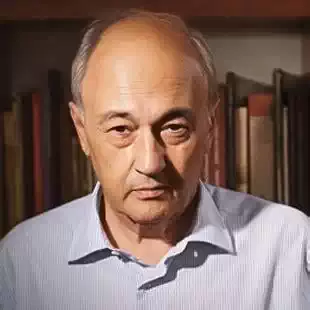
António Mega Ferreira
 PT
PT
António Mega Ferreira was a Portuguese writer, poet, and essayist whose work deeply explored identity, memory, and the human condition, in constant dialogue with history and culture. His poetry, marked by rigorous language and a strong reflective charge, explored themes such as time, the relationship between the individual and society, and the search for meaning in a constantly changing world. As an essayist and critic, Mega Ferreira contributed significantly to the analysis of Portuguese literature and culture, leaving a legacy of critical thought and an invaluable literary work.
n. 1949-03-25, Lisboa · m. 2022-12-26, Lisboa
Bio
Identification and Basic Context
António Mega Ferreira was born in Lisbon, Portugal, on March 11, 1949. He was a poet, essayist, literary critic, professor, and translator. He attended the Faculty of Arts of the University of Lisbon, where he studied Germanic Philology. He played an active role in Portuguese cultural life, being a prominent figure in the literary scene, especially from the 1970s onwards. His work is intrinsically linked to the historical and cultural context of Portugal in the 20th and 21st centuries, marked by the country's political and social transformations.Childhood and Education
Mega Ferreira had a solid academic background, graduating in Germanic Philology. This education provided him with a deep knowledge of foreign literatures, especially those in the German language, which would influence his own writing and his work as a translator. His youth and education took place during a period of cultural and political effervescence in Portugal, culminating in the Revolution of April 25, 1974, an event that directly or indirectly marked many intellectuals of his generation.Literary Career
António Mega Ferreira's literary career began with the publication of poetry. His poetic work evolved over time, demonstrating a constant deepening of themes and form. In addition to poetry, he distinguished himself as an essayist and literary critic, contributing regular texts to various cultural publications. He also translated important works of foreign literature into Portuguese. His literary activity spanned several decades, consolidating his position as a relevant voice in contemporary Portuguese literature.Work, Style, and Literary Characteristics
António Mega Ferreira's main works include poetry collections such as "O Nome das Coisas" (1971), "A Noite" (1974), "O Livro da Vontade" (1979), "O Campo da Sede" (1987), and "O Caminho das Pedras" (2006). The dominant themes in his work are identity, memory, time, the human condition, the relationship between the individual and the cosmos, and the search for meaning. His poetic style is characterized by dense, rigorous, and intellectualized language, with an often reflective and elegiac tone. He uses devices such as metaphor and cultural allusion to construct powerful images and evoke a universe of meanings. His poetry dialogues with the literary tradition but incorporates a modern sensibility, exploring the fragmentation and complexity of contemporary experience. He has been associated with poetry of an existential and metaphysical nature.Cultural and Historical Context
António Mega Ferreira lived and wrote during a period of profound transformations in Portugal, from the last years of the dictatorial regime to consolidated democracy. His work reflects, implicitly or explicitly, the tensions and dilemmas of a changing society. He belonged to a generation of intellectuals who emerged after April 25th and maintained a critical dialogue with his time and with other writers of his generation and previous ones. His intellectual position was marked by critical rigor and a deep reflection on Portuguese culture and society.Personal Life
Detailed information about António Mega Ferreira's personal life, such as specific affective or family relationships that shaped his work, is not widely disclosed. It is known that he dedicated much of his life to intellectual and literary activity, also working as a university professor. His philosophical and political beliefs, although they emerge in his work through a constant questioning of the human condition and the individual's role in society, are not explicitly autobiographical.Recognition and Reception
António Mega Ferreira was widely recognized as one of the most important poets and essayists of his generation. His work received distinctions and was the subject of academic study. Critical reception of his poetry was generally positive, valuing its intellectual depth and the quality of his writing. His place in Portuguese literature is that of a reference author, whose work continues to be read and interpreted.Influences and Legacy
António Mega Ferreira's influences include the Portuguese poetic tradition, but also authors from universal literature, particularly from the German language, such as Rilke. His legacy lies in his dense and reflective poetry, and in his critical essays that helped illuminate Portuguese culture. He influenced subsequent generations of writers and thinkers through his intellectual integrity and the demanding nature of his work. His work is part of the contemporary Portuguese literary canon.Interpretation and Critical Analysis
António Mega Ferreira's work has been the subject of various critical interpretations, which highlight his exploration of existential themes, his questioning of memory and time, and the complexity of his language. Critical analysis often focuses on his ability to merge personal experience with universal reflections.Curiosities and Lesser-Known Aspects
Beyond his public role as a writer and intellectual, less is known about more intimate aspects of his personality or his writing habits. His dedication to precision of language and depth of thought suggests a methodical and demanding creative process.Death and Memory
António Mega Ferreira passed away in Lisbon on June 26, 2022. His death represented a significant loss for Portuguese literature and culture. After his death, his work continues to be disseminated and studied, keeping his memory and intellectual legacy alive.Poems
0No poems found
Comments (0)
No comments yet. Be the first to comment.