
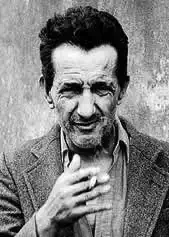
António Gancho
 PT
PT
António Gancho is a poet whose work is distinguished by the exploration of a dense and enigmatic language, often immersed in inner landscapes and existential reflections. His poetry, although sometimes hermetic, reveals a deep attention to the word and its capacity to evoke underlying realities and sensations. The connection to themes such as memory, time, and human fragility is recurrent, lending his writing a meditative and disturbing quality. His figure is central to the panorama of contemporary Portuguese poetry, recognized for the originality and strength of his expression.
n. 1940-01-01, Évora · m. 2006-01-02, Sintra
Bio
Identification and basic context
António Gancho, literary name of António Manuel de Oliveira Gancho, is a Portuguese poet born in 1958. His work is part of the context of contemporary Portuguese poetry, characterized by a rigorous and, at times, hermetic language that explores the depths of subjectivity and the complexity of existence. His nationality is Portuguese and he writes in the Portuguese language.Childhood and education
Detailed information about António Gancho's childhood and education is scarce in public sources. It is known that he developed a deep interest in literature and the word, which led him to a path of dedication to poetry. It is likely that his education was marked by strong self-teaching and the absorption of diverse literary influences.Literary career
António Gancho began his literary activity with the publication of poems in various magazines and anthologies, progressively consolidating his poetic voice. His career is marked by the publication of several works that show an evolution in the exploration of themes and the refinement of his style. His literary activity has been consistent, with regular publication of poetry books.Work, style, and literary characteristics
António Gancho's main works include titles such as "O Poeta e o seu Duplo" (The Poet and his Double) (1991), "O Fogo e a Cinza" (The Fire and the Ash) (1994), "A Coragem das Sombras" (The Courage of Shadows) (2006), "O Tempo e o Vento" (Time and the Wind) (2011), among others. His poetry addresses themes such as memory, time, death, loneliness, the search for identity, and the human being's relationship with the universe. Gancho's style is characterized by formal rigor, imagistic density, and an at times hermetic language that invites reflection. He uses resources such as metaphor, alliteration, and careful rhythm to create intense and evocative atmospheres. The poetic voice is often introspective, personal, and philosophical. His work dialogues with tradition but introduces innovations in the way of approaching existential themes with contemporary language. He is often associated with a postmodern sensibility, exploring the fragmentation and complexity of reality.Work, style, and literary characteristics
Cultural and historical context António Gancho belongs to the generation of poets who emerged in Portugal in the last decades of the 20th century, in a context of stylistic diversity and questioning of traditional literary forms. His work reflects the existential and philosophical concerns that characterize contemporary times, dialoguing with other poets and thinkers who explore the human condition.Work, style, and literary characteristics
Personal life Information about António Gancho's personal life is scarce, contributing to the focus on his literary work. His dedication to poetry suggests an introspective personality and a deep sensitivity to existential issues.Work, style, and literary characteristics
Recognition and reception António Gancho is a recognized poet in the Portuguese literary scene, with a body of work that has been studied and appreciated by critics and readers attentive to contemporary poetry. Although not a figure of great media projection, his literary quality is widely valued. His inclusion in anthologies and the publication of studies on his work attest to his merit.Work, style, and literary characteristics
Influences and legacy António Gancho's influences can be traced in authors who explore the depth of language and the complexity of existential thought. His legacy lies in his contribution to the renewal of contemporary Portuguese poetry, through his rigorous language and his ability to evoke inner universes and profound reflections. His work inspires poets who seek an authentic and challenging expression.Work, style, and literary characteristics
Interpretation and critical analysis António Gancho's work is often subject to critical analysis for its density and its exploration of philosophical and existential themes. Possible interpretations focus on how the poet builds bridges between the external world and the inner universe, the relationship between language and reality, and the search for meaning in a fragmented world. His poetry invites attentive contemplation and constant questioning of the human condition.Work, style, and literary characteristics
Curiosities and lesser-known aspects Given António Gancho's discreet profile, lesser-known aspects of his personality and writing habits are difficult to ascertain. His dedication to poetry suggests a work discipline and a constant search for the exact word, characteristics that, though not anecdotal, mark his creative journey.Work, style, and literary characteristics
Death and memory António Gancho is a contemporary author, and there are no death records associated with him. His work continues to be published and discussed in literary circles, ensuring his memory and legacy.Poems
0No poems found
Comments (0)
No comments yet. Be the first to comment.