
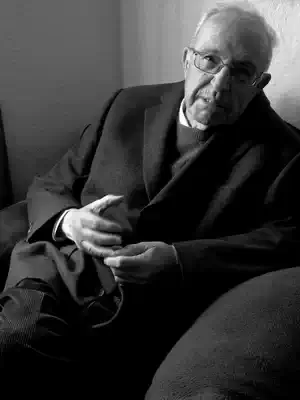
António Borges Coelho
 PT
PT
António Borges Coelho was a Portuguese poet, professor, and politician, known for his engaged poetry and his deep connection with the history and culture of Portugal. His work reflects a strong sense of social and political intervention, marked by accessible language that is nonetheless loaded with meaning. He explored themes such as national identity, the struggle for freedom, and the human condition, often using resources from Portuguese literary tradition. His career as a professor and his political activity influenced his worldview and his writing, making him a relevant figure in the cultural and political landscape of his time.
n. 1928-10-07, Murça · m. 2025-10-17, Carcavelos e Parede
Bio
Identification and basic context
Full name: António Manuel Monteiro Borges Coelho. Date and place of birth: Born on August 12, 1920, in Lisbon, Portugal. Family background, social class, and cultural origins: Son of António Augusto Coelho and Maria Manuela de Jesus Monteiro. Belonged to a middle-class family. Nationality and writing language(s): Portuguese. Historical context in which he lived: Lived most of his life under the dictatorial regime of the Estado Novo, actively participating in the democratic opposition. Witnessed and lived through significant historical events such as World War II, the Portuguese Colonial War, and the Carnation Revolution.Childhood and education
Borges Coelho's educational path was marked by a solid education and contact with the cultural and political values of the time. He attended secondary school and later entered higher education, where he earned a degree.Literary career
Borges Coelho began his literary activity early, developing a poetic work distinguished by its interventionist and social character. Throughout his career, he published several poetry books, which consistently show a concern for the social and political reality of Portugal. His writing sought to reflect the aspirations for freedom and justice, engaging with Portuguese literary tradition while always striving for his own contemporary voice. He collaborated in various publications, contributing to the dissemination of his work and other poetic voices.Work, style, and literary characteristics
Borges Coelho's works address themes such as homeland, freedom, the human condition, historical memory, and the struggle against oppression. His poetry is characterized by a confessional and interventionist tone, using clear and direct language, but with a strong symbolic and expressive charge. He made use of different poetic forms, adapting them to the message he intended to convey, valuing musicality and rhythm. His style is marked by profound humanity and an ethical and social commitment. His work fits within the context of Portuguese modernism, with particular emphasis on interventionist poetry.Cultural and historical context
António Borges Coelho lived in a period of great political and cultural effervescence in Portugal. His poetry reflects the climate of resistance against the dictatorship of the Estado Novo and his subsequent participation in the struggle for democracy. He maintained relationships with other writers and intellectuals who shared his political and cultural convictions, integrating into opposition circles and promoting culture as a form of social intervention. His work engages with the major themes of Portuguese history, seeking a critical reinterpretation and an appeal to civic consciousness.Personal life
In addition to his literary activity, Borges Coelho was a university professor, dedicating himself to teaching and research. His personal life was intimately linked to his political and civic engagement, reflecting a strong sense of social responsibility. His democratic convictions shaped his worldview and his poetic work.Recognition and reception
Although not a figure of great media popularity, António Borges Coelho is recognized as an important poet of his generation, with a solid and coherent body of work. His poetry has been studied by literary critics and academics, who highlight its aesthetic value and its historical and social relevance. His work is valued for its authenticity and its commitment to democratic values.Influences and legacy
Borges Coelho's work is influenced by poets such as Fernando Pessoa and other authors of social and interventionist poetry. His legacy lies in his poetry, which managed to combine aesthetic quality with a concern for social and political issues, inspiring later generations of poets and writers to use art as a vehicle for intervention and reflection on reality.Interpretation and critical analysis
Borges Coelho's poetry is often interpreted as a reflection of the struggle for freedom and human dignity in a context of oppression. His works are analyzed from the perspective of their political and social dimension, but also for their ability to evoke the universality of the human experience. Critics have valued his writing for its honesty and expressive power.Curiosities and lesser-known aspects
Borges Coelho always maintained a discreet stance regarding his personal life, focusing his intervention on the public and literary sphere. His dedication to university teaching and research in areas such as Portuguese literature and literary history gave him a prominent academic profile.Death and memory
António Borges Coelho passed away in 2002. His work continues to be studied and disseminated, keeping alive his memory as a poet and as a citizen committed to the values of freedom and democracy.Poems
0No poems found
Comments (0)
No comments yet. Be the first to comment.