 Escritas.org


Some Poems
Biography
Images
Videos
Books
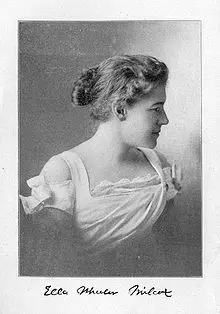
Ella Wheeler Wilcox (November 5, 1850 – October 30, 1919)
Ella Wheeler Wilcox was an American author and poet. Her best-known work
was Poems of Passion. Her most enduring work was " Solitude", which
contains the lines: "Laugh, and the world laughs with you; Weep, and you
weep alone". Her autobiography, The Worlds and I, was published in 1918, a
year before her death.
Biography
Ella Wheeler was born in 1850 on a farm in Johnstown, Wisconsin, east of
Janesville, the youngest of four children. The family soon moved north of
Madison. She started writing poetry at a very early age, and was well known
as a poet in her own state by the time she graduated from high school.
Her most famous poem, "Solitude", was first published in the February 25,
1883 issue of The New York Sun. The inspiration for the poem came as she
was travelling to attend the Governor's inaugural ball in Madison, Wisconsin.
On her way to the celebration, there was a young woman dressed in black
sitting across the aisle from her. The woman was crying. Miss Wheeler sat
next to her and sought to comfort her for the rest of the journey. When they
arrived, the poet was so depressed that she could barely attend the
scheduled festivities. As she looked at her own radiant face in the mirror, she
suddenly recalled the sorrowful widow. It was at that moment that she wrote
the opening lines of "Solitude":
Laugh, and the world laughs with you;
Weep, and you weep alone.
She sent the poem to the Sun and received $5 for her effort. It was collected
in the book Poems of Passion shortly after in May 1883.
In 1884, she married Robert Wilcox of Meriden, Connecticut, where the
couple lived before moving to New York City and then to Granite Bay in the
Short Beach section of Branford, Connecticut. The two homes they built on
Long Island Sound, along with several cottages, became known as Bungalow
Court, and they would hold gatherings there of literary and artistic friends.
They had one child, a son, who died shortly after birth. Not long after their
marriage, they both became interested in theosophy, new thought, and
spiritualism.
Early in their married life, Robert and Ella Wheeler Wilcox promised each
other that whoever went first through death would return and communicate
with the other. Robert Wilcox died in 1916, after over thirty years of
marriage. She was overcome with grief, which became ever more intense as
week after week went without any message from him. It was at this time
that she went to California to see the Rosicrucian astrologer, Max Heindel,
still seeking help in her sorrow, still unable to understand why she had no
word from her Robert. She wrote of this meeting:
In talking with Max Heindel, the leader of the Rosicrucian Philosophy in
California, he made very clear to me the effect of intense grief. Mr. Heindel
assured me that I would come in touch with the spirit of my husband when I
learned to control my sorrow. I replied that it seemed strange to me that an
omnipotent God could not send a flash of his light into a suffering soul to
bring its conviction when most needed. Did you ever stand beside a clear
pool of water, asked Mr. Heindel, and see the trees and skies repeated
therein? And did you ever cast a stone into that pool and see it clouded and
turmoiled, so it gave no reflection? Yet the skies and trees were waiting
above to be reflected when the waters grew calm. So God and your
husband's spirit wait to show themselves to you when the turbulence of
sorrow is quieted.
Several months later, she composed a little mantra or affirmative prayer
which she said over and over "I am the living witness: The dead live: And
they speak through us and to us: And I am the voice that gives this glorious
truth to the suffering world: I am ready, God: I am ready, Christ: I am
ready, Robert.".
Wilcox made efforts to teach occult things to the world. Her works, filled with
positive thinking, were popular in the New Thought Movement and by 1915
her booklet, What I Know About New Thought had a distribution of 50,000
copies, according to its publisher, Elizabeth Towne.
The following statement expresses Wilcox's unique blending of New Thought,
Spiritualism, and a Theosophical belief in reincarnation: "As we think, act,
and live here today, we built the structures of our homes in spirit realms
after we leave earth, and we build karma for future lives, thousands of years
to come, on this earth or other planets. Life will assume new dignity, and
labor new interest for us, when we come to the knowledge that death is but
a continuation of life and labor, in higher planes".
Her final words in her autobiography The Worlds and I: "From this mighty
storehouse (of God, and the hierarchies of Spiritual Beings ) we may gather
wisdom and knowledge, and receive light and power, as we pass through this
preparatory room of earth, which is only one of the innumerable mansions in
our Father's house. Think on these things".
Ella Wheeler Wilcox died of cancer on October 30, 1919
Poetry
A popular poet rather than a literary poet, in her poems she expresses
sentiments of cheer and optimism in plainly written, rhyming verse. Her
world view is expressed in the title of her poem "Whatever Is—Is Best",
suggesting an echo of Alexander Pope's "Whatever is, is right."
None of Wilcox's works were included by F. O. Matthiessen in The Oxford
Book of American Verse, but Hazel Felleman chose no fewer than fourteen of
her poems for Best Loved Poems of the American People, while Martin
Gardner selected "Solitude" and "The Winds of Fate" for Best Remembered
Poems.
She is frequently cited in anthologies of bad poetry, such as The Stuffed Owl:
An Anthology of Bad Verse and Very Bad Poetry. Sinclair Lewis indicates
Babbitt's lack of literary sophistication by having him refer to a piece of verse
as "one of the classic poems, like 'If' by Kipling, or Ella Wheeler Wilcox's 'The
Man Worth While.'" The latter opens:
It is easy enough to be pleasant,
When life flows by like a song,
But the man worth while is one who will smile,
When everything goes dead wrong.
Her most famous lines open her poem "Solitude":
Laugh and the world laughs with you,
Weep, and you weep alone;
The good old earth must borrow its mirth,
But has trouble enough of its own.
"The Winds of Fate" is a marvel of economy, far too short to summarize. In
full:
One ship drives east and another drives west
With the selfsame winds that blow.
'Tis the set of the sails,
And Not the gales,
That tell us the way to go.
Like the winds of the sea are the ways of fate;
As we voyage along through life,
'Tis the set of a soul
That decides its goal,
And not the calm or the strife.
Ella Wheeler Wilcox cared about alleviating animal suffering, as can be seen
from her poem, Voice of the Voiceless. It begins as follows.
I am the voice of the voiceless;
Through me the dumb shall speak,
Till the deaf world’s ear be made to hear
The wrongs of the wordless weak.
From street, from cage, and from kennel,
From stable and zoo, the wail
Of my tortured kin proclaims the sin
Of the mighty against the frail.
Legacy
Her quote "Love lights more fires than hate extinguishes" is inscribed on a
paving slab in Jack Kerouac Alley in San Francisco (next to the City Lights
Bookstore).
Ella Wheeler Wilcox's name provided the unlikely inspiration for doggerel by
the English humorist Richard Murdoch, which he set to the opening bars of
Alexandre Luigini's Ballet égyptien.
The first stanza of her poem "The Man Worth While" can be found in Disney's
Hollywood Studios, in the boiler room portion of the queue for The Twilight
Zone Tower of Terror.
Oliver's Stone movie JFK starts with a quote from her: "To sin by silence
when we should protest makes cowards out of men".
The first stanza of "The Man Worth While" is parodied in the movie
Caddyshack when the character Judge Smails (played by Ted Knight) reads
the following at the christening of his yacht: "It's easy to grin when your ship
comes in / And you've got the stock market beat. / But the man worthwhile
is the man who can smile / When his shorts are too tight in the seat."
The opening lines in her poem "Solitude" are recited in Park Chan-wook's
film Oldboy.
Her poem "Over the Banisters" was adapted into a song for Judy Garland in
the film "Meet Me in St. Louis".
Her poem "I like cigars beneath the stars" was set to music by an "E. C.
Walker," possibly British and not the politician E. C. Walker. The song was
recorded by the Huelgas Ensemble in 2010.
Eserleri:
Books
The Heart of New Thought, Chicago: The Psychic Research Company, 1902.
92 pages.
The Worlds and I, New York: George II Doran Company, c1918 www
Poetry
The Invisible Helpers in Cosmopolitan 57 (October 1914): 578-579 www
The Voice of the Voiceless
Disarmament
Roads to God
To An Astrologer
Secret Thoughts
An Ambitious Man
An Englishman and Other Poems
Hello, Boys!
The Kingdom of Love
Maurine and other Poems
New Thought Pastels
Poems of Cheer
Poems of Experience
Poems of Optimism
Poems of Passion
Poems of Power
Poems of Progress
Poems of Purpose
Poems of Sentiment
A Woman of the World
Yesterday
Poems of Reflection, 1905 copyright, M. A. Donahue & Co. (publisher)
The Man Worth While – E. W. Wilcox (Powerful Life Poetry)
Ella Wheeler Wilcox -- Poem: 'Solitude' read by Emma Fielding.
Ella Wheeler Wilcox - The Two Kinds of People ...
🔵 Solitude Poem by Ella Wheeler Wilcox - Summary Analysis - Solitude by Ella Wheeler Wilcox
Solitude Poem By Ella Wheeler Wilcox (Animated)
Ella Wheeler Wilcox - I Love You (audio with text)
Abbi Melanson: “Solitude”, Ella Wheeler Wilcox
Will - A Life Changing Poem by Ella Wheeler Wilcox | Recited by Simerjeet Singh | Inspirational Poem
Solitude - Powerful Life Poetry by Ella Wheeler Wilcox | Inspiration for Hard Times |Simerjeet Singh
Winds of Fate - Ella Wheeler-Wilcox (by Maggie Smith)
As You Go Through Life I Ella Wheeler Wilcox | Inspirational Poem | Life Lessons | Uplifting Poetry
Ella Wheeler Wilcox - The World Needs | Great Poems
Ella Wheeler Wilcox - Was, Is, And Yet-To-Be | Great Poems
Mélodie Cyr: "Solitude" by Ella Wheeler Wilcox
The Chosen by Ella Wheeler Wilcox
The Art of Uplifting: 'Which are you' Poem by Ella Wheeler Wilcox | Leadership Lessons in Verse
Will | Ella Wheeler Wilcox | Powerful Inspirational Poetry | Great Life Poetry
Life's Scars | Ella Wheeler Wilcox | A Poem about the Importance of Relationships That Matter
I AM - Poem By Ella Wheeler Wilcox
The Story Of Grumble Tone - Ella Wheeler Wilcox poem reading | Jordan Harling Reads
🔵 THE YEAR Poem by Ella Wheeler Wilcox - Summary Analysis - THE YEAR by Ella Wheeler Wilcox
"A Fallen Leaf" by Ella Wheeler Wilcox, read by The Wordman
Ella Wheeler Wilcox "Art and Heart" Poem animation
poem "Solitude" Ella Wheeler Wilcox = Laugh, and the world laughs with you Weep, and you weep alone
🔵 Smiles Poem by Ella Wheeler Wilcox - Summary Analysis - Smiles by Ella Wheeler Wilcox
[e- Poetry Book] "The Year" by Ella Wheeler Wilcox | Poem for Coronavirus Year | New Year Eve E-card
Ella Wheeler Wilcox "The Past" Poem animation
Solitude - Ella Wheeler Wilcox || Motivational poetry on loneliness ||
The Year by Ella Wheeler Wilcox
Protest – A poem by Ella Wheeler Wilcox, read by Alan Cumming
"It Might Have Been" by Ella Wheeler Wilcox, read by The Wordman
Listen - Ella Wheeler Wilcox
“Art and Heart” by Ella Wheeler Wilcox | Poetry
The Question - Ella Wheeler Wilcox (Life Changing Inspirational Poetry)
SOLITUDE | BY - ELLA WHEELER WILCOX
THE WORTHWHILE MAN - Ella Wheeler Wilcox (Life Changing Poem)
Poem Ella Wheeler Wilcox - Winds Of Fate ( Maggie Smith).avi
Ella Wheeler Wilcox - Loves Language
A Song of Life by Ella Wheeler Wilcox
A Baby in the House by Ella Wheeler Wilcox
Beyond by Ella Wheeler Wilcox
The Year by Ella Wheeler Wilcox #8 12 Poems for Christmas
"My Home" by Ella Wheeler Wilcox, recited by The Wordman
Creation by Ella Wheeler Wilcox
“Woman” by Ella Wheeler Wilcox — life poetry
"Friendship After Love" by Ella Wheeler Wilcox, read by The Wordman
Go Plant a Tree By Ella Wheeler Wilcox (Spoken Word Poetry)
The Winds of Fate by Ella Wheeler Wilcox
“Attainment” by Ella Wheeler Wilcox
"The Year" by Ella Wheeler Wilcox - The Reading Tree