
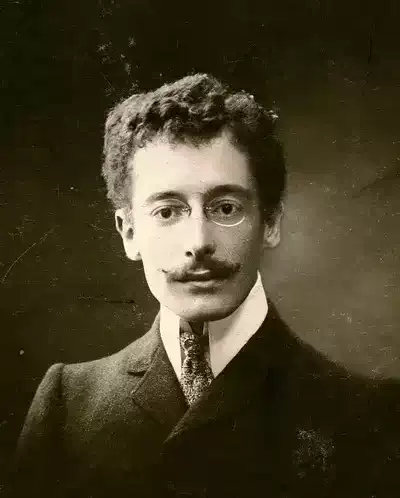
Victor Segalen
 FR
FR
Victor Segalen was a French poet, novelist, ethnographer, and physician, whose work is marked by the exploration of exotic cultures, aesthetic sensibility, and the search for innovative language. His poetry, in particular, is known for its musicality, richness of imagery, and profound reflection on identity, alterity, and the passage of time. Segalen moved between literature and anthropology, leaving a legacy that combines erudition with a deeply personal and artistic vision of the world. His work, although sometimes associated with movements such as symbolism and surrealism, possesses a uniqueness that transcends easy classifications, exploring the boundaries between East and West, the known and the unknown.
n. 1878-01-14, Brest · m. 1919-05-21, Huelgoat
Bio
Identification and basic context
Victor Segalen was born in Brest, France, on January 14, 1887. He was a French poet, novelist, ethnographer, physician, and archaeologist. He often used the pseudonym 'Maximilien Verbrugghe.' He died in Huelgoat, Finistère, France, on May 22, 1919. The son of a French father and a mother of German origin, he grew up in a cosmopolitan environment.Childhood and education
Segalen showed an early interest in arts and distant cultures. He studied medicine at the University of Rennes and later in Paris. His medical training, combined with his anthropological interests, shaped his worldview and his understanding of the human being, integrating science with art and cultural exploration. He was influenced by authors such as Arthur Rimbaud and symbolism, as well as by the anthropological and linguistic theories of the time.Literary career
Segalen's literary career began with the publication of poetic and essayistic works that reflected his fascination with non-Western civilizations. His work evolved from a more symbolist phase to a bolder exploration of language and form, especially in his poetic prose and his diaries. He collaborated with various publications and translated Greek and Chinese texts. His work as an archaeologist and ethnographer in Polynesia and China profoundly enriched his literary production, incorporating elements of these cultures into his works.Work, style, and literary characteristics
Segalen's main works include 'Les Stigmates' (1912), 'Le Fils du Chien' (1911), 'La Grande Marée' (1918), and 'Voyage au pays du réel' (published posthumously). Dominant themes in his work are alterity, identity, the exotic, death, time, travel, and the exploration of the 'self' in contact with the 'other.' His style is marked by dense poetic prose, rich in imagery and musicality, often experimental in its structure. He used resources such as synesthesia, bold metaphors, and the exploration of varied rhythms. The poetic voice is often that of a fragmented 'I,' in search of totality or meaning for the human experience. His language is erudite and sensory at the same time. Segalen introduced formal innovations by blending prose and poetry, and by bringing aesthetic and philosophical influences from Eastern cultures into Western literature. He was associated with modernism and surrealism, but his work is unique. 'Le Bardo' (1921) and 'Reno' (1921) are lesser-known works, published posthumously.Work, style, and literary characteristics
Cultural and historical context Victor Segalen lived during a period of cultural effervescence in Europe, marked by the end of the Belle Époque and the imminence of World War I. His work engages with the growing interest in the exotic and non-Western cultures, a trend in vogue among artists and intellectuals of the time. His generation, often associated with avant-garde movements, sought to break away from academic traditions. Although he did not affiliate himself with any political party, his humanistic vision and his critique of Western civilization can be seen as a reflection of the social and cultural tensions of his time. His experiences in French Polynesia and China brought him into direct contact with cultural realities very different from European ones.Work, style, and literary characteristics
Personal life Segalen's relationships with his family, especially with his mother of German origin, and his experiences at sea and in distant lands shaped his worldview and his work. He had an intense relationship with art and cultural exploration. He was friends with other artists and intellectuals, but his complex personality and his nomadic lifestyle sometimes placed him on the fringes of established literary circles. His dedication to ethnographic and archaeological research, often carried out in difficult conditions, demonstrates his passion for discovery and knowledge.Work, style, and literary characteristics
Recognition and reception During his lifetime, Segalen did not achieve the massive recognition of other contemporary authors, but his work was admired by a circle of intellectuals and artists who recognized its originality and depth. His recognition grew significantly after his death, with the posthumous publication of many of his writings. Today, he is considered a precursor to certain modernist trends and an important figure in 20th-century French literature, especially for his exploration of the 'other' and his innovative poetic prose.Work, style, and literary characteristics
Influences and legacy Segalen was influenced by authors such as Arthur Rimbaud, by symbolist poets, and by thinkers who explored alterity and cultural difference. He, in turn, influenced later generations of writers and artists, particularly those interested in the exploration of non-Western cultures, travel writing, and experimental poetic prose. His legacy lies in his ability to merge erudition, art, and ethnographic experience, opening paths to a deeper understanding of human diversity and the existential condition.Work, style, and literary characteristics
Interpretation and critical analysis Segalen's work has been the subject of various critical interpretations, focusing on his exploration of identity, his critique of Western civilization, his sensuality, and his search for the 'other.' Philosophically and existentially, his work addresses the solitude of the individual, the finitude of time, and the impossibility of a total understanding of the world. Critical debates arise around his representation of non-Western cultures and his own position as a 'traveler' and observer.Work, style, and literary characteristics
Curiosities and lesser-known aspects Victor Segalen was a talented athlete and practiced rowing. His expedition to China, in particular, was a milestone in his life and work, where he not only conducted archaeological excavations but also deeply studied Chinese culture and language. His diaries reveal an intense inner life and profound reflection on artistic creation and human experience. His premature death in tragic circumstances contributed to his status as a cult and enigmatic figure.Work, style, and literary characteristics
Death and memory Victor Segalen died unexpectedly, a victim of a car accident, on May 22, 1919, in Huelgoat, Finistère. His premature death interrupted a promising career and left behind a body of work that would be published posthumously, solidifying his memory as one of the great names in 20th-century French literature and a pioneer in the exploration of cultural alterity.Poems
0No poems found
Comments (0)
No comments yet. Be the first to comment.