
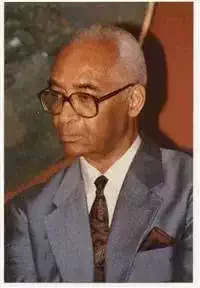
Vasco Cabral
1926–2005
· lived 79 years
 GW
GW
GW
Vasco Cabral is a Mozambican poet known for his engaged and reflective writing. His work often explores themes such as identity, history, and the human condition in complex social and political contexts. With a rich and evocative language, the author builds bridges between the personal and the collective, inviting introspection and critique.
n. 1926-01-01, Farim · m. 2005-01-01, Bissau
14
Views
Bio
Identification and basic context
Vasco Cabral is a Mozambican poet. His full name is Vasco Fernando da Luz Cabral. His poetic work is marked by a strong sense of social intervention and reflection on Mozambican and African identity.Childhood and education
Little detailed information is available about Vasco Cabral's childhood and education. However, it can be inferred that his education and experiences were shaped by the context of Mozambique, especially in the period preceding and following independence.Literary career
Vasco Cabral began his literary career as one of the important names in Mozambican poetry, emerging in a period of cultural and political effervescence. His writing is associated with the generation of poets who sought to give voice to the aspirations and realities of their country.Work, style, and literary characteristics
Vasco Cabral's works, although not voluminous, are significant for their thematic depth and the quality of their poetic expression. Central themes include national identity, the struggle for freedom, historical memory, the human condition, and the complexities of post-colonial society. His style is characterized by dense, imagery-rich language, often laden with symbolism, inviting reflection. He frequently uses free verse, but with rhythmic care and a musicality that gives it expressive power. His poetic voice is both personal and collective, reflecting the experiences and aspirations of a people.Cultural and historical context
Vasco Cabral lived and wrote during a crucial period in Mozambique's history, marked by the struggle for independence and nation-building. His work reflects the challenges and hopes of that period, engaging with ideals of liberation and emerging social and political realities. He is associated with a movement of Mozambican cultural affirmation.Personal life
Details about Vasco Cabral's personal life are scarce in public information. It is known that he was a figure linked to Mozambican intellectual circles and that his poetry reflects a deep involvement with the issues of his country.Recognition and reception
Although not as widely publicized as other poets, Vasco Cabral is recognized in Mozambican literary circles as a valuable poet whose work significantly contributes to the understanding of Portuguese-language African poetry. His reception is more academic and critical, valuing the depth and engagement of his writing.Influences and legacy
His writing was likely influenced by African and Portuguese poets, as well as by literary currents that valued social intervention and the exploration of identity. His legacy lies in his ability to translate the complexities of the Mozambican experience into high-quality poetry, serving as an inspiration for future generations of writers interested in issues of identity and emancipation.Interpretation and critical analysis
Vasco Cabral's work is often analyzed from the perspective of decolonization, the construction of post-colonial identity, and reflection on power and freedom. His poetry invites questioning about the individual's place in history and the marks left by the colonial past.Curiosities and lesser-known aspects
Specific information about curiosities or lesser-known aspects of Vasco Cabral's life and work is limited in publicly accessible sources.Death and memory
There are no widely publicized public records regarding the date or circumstances of Vasco Cabral's death. His memory endures through his poetic work, which continues to be studied and appreciated as an important part of Mozambique's literary heritage.Poems
0No poems found
Comments (0)
Log in
to post a comment.
No comments yet. Be the first to comment.