
Plato (c. 428/427 or 424/423 – 348/347 BC) was an Athenian philosopher who, along with his mentor Socrates and his student Aristotle, laid the foundations of Western and Greek philosophy. His best-known work is the Theory of Forms, according to which the sensible world is an imperfect copy of an intelligible world, of Forms or Ideas. Plato wrote numerous philosophical dialogues, in which Socrates is usually the main interlocutor. He founded the Academy in Athens, the first institution of higher learning in the Western world. His ideas profoundly influenced philosophy, theology, science, and politics. He is considered one of the greatest thinkers of all time.
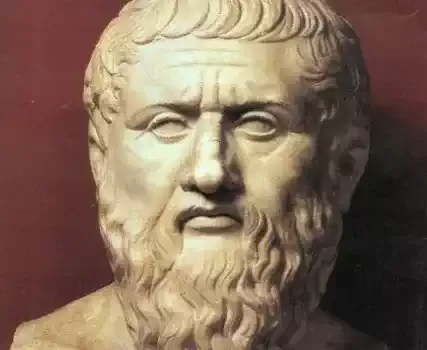
Platão
b. 427
 GR
GR
GR
Plato was an influential Greek philosopher of antiquity, a student of Socrates and master of Aristotle. He is considered one of the most important figures in the history of Western thought, founder of the Academy of Athens and author of works that address themes such as justice, beauty, equality, politics, cosmology and the philosophy of mind.
n. 0427-05-07, Atenas · m. -347ac, Atenas
104
Views
Poems
0No poems found
Quotes
461God ever geometrizes.
[ Socrates speaking :] Let us suppose that every mind contains a kind of aviary stocked with birds of every sort, some in flocks apart from the rest, some in small groups, and some solitary, flying in any direction among them all. . . . When we are babies we must suppose this receptacle empty, and take the birds to stand for pieces of knowledge. Whenever a person acquires any piece of knowledge and shuts it up in his enclosure, we must say he has learned or discovered the thing of which this is the knowledge, and that is what “knowing” means.
[ Socrates speaking :] Democracy . . . would, it seems, be a delightful form of government, anarchic and motley, assigning a kind of equality indiscriminately to equals and unequals alike!
[ Socrates speaking :] Picture men dwelling in a sort of subterranean cavern with a long entrance open to the light on its entire width. . . . Like to us. . . . Tell me do you think that these men would have seen anything of themselves or of one another except the shadows cast from the fire on the wall of the cave that fronted them?
[ Thrasymachus speaking :] I affirm that the just is nothing else than the advantage of the stronger.
[ Socrates speaking :] Unless either philosophers become kings in our states or those whom we now call our kings and rulers take to the pursuit of philosophy seriously and adequately, and there is a conjunction of these two things, political power and philosophical intelligence, while the motley horde of the natures who at present pursue either apart from the other are compulsorily excluded, there can be no cessation of troubles, dear Glaucon, for our states, nor, I fancy, for the human race either. Nor, until this happens, will this constitution which we have been expounding in theory ever be put into practice within the limits of possibility and see the light of the sun.
[ Socrates speaking :] If men learn this [writing], it will implant forgetfulness in their souls; they will cease to exercise memory because they rely on that which is written, calling things to remembrance no longer from within themselves, but by means of external marks. . . . And it is no true wisdom that you offer your disciples, but only its semblance, for by telling them of many things without teaching them you will make them seem to know much, while for the most part they know nothing, and as men filled, not with wisdom, but with the conceit of wisdom, they will be a burden to their fellows.
[ Of Socrates :] Such, Echecrates, was the end of our comrade, who was, we may fairly say, of all those whom we knew in our time, the bravest and also the wisest and most upright man.
[ Socrates speaking :] Life without this sort of examination is not worth living.
[ Socrates speaking :] Is what is holy holy because the gods approve it, or do they approve it because it is holy?
[ Socrates speaking, describing the charge against him :] Socrates is guilty of corrupting the minds of the young, and of believing in deities of his own invention instead of the gods recognized by the state.
It will be hard to discover a better [method of education] than that which the experience of so many ages has already discovered, and this may be summed up as consisting in gymnastics for the body, and _music_ for the soul... For this reason is a musical education so essential; since it causes Rhythm and Harmony to penetrate most intimately into the soul, taking the strongest hold upon it, filling it with _beauty_ and making the man _beautiful-minded_.
The punishment which the wise suffer who refuse to take part in the government is to live under the government of worse men.
You cannot conceive the many without the one.
I have hardly ever known a mathematician who was capable of reasoning.
...Then anyone who leaves behind him a written manual, and likewise anyone who receives it, in the belief that such writing will be clear and certain, must be exceedingly simple-minded...
God is always doing geometry.
The blame is his who chooses: God is blameless.
But if we are guided by me we shall believe that the soul is immortal and capable of enduring all extremes of good and evil, and so we shall hold ever to the upward way and pursue righteousness with wisdom always and ever.
Behold! human beings living in a underground den … Like ourselves … they see only their own shadows, or the shadows of one another, which the fire throws on the opposite wall of the cave.
And so with the objects of knowledge: these derive from the Good not only their power of being known, but their very being and reality; and Goodness is not the same thing as being, but even beyond being, surpassing it in dignity and power.
What I say is that ‘just’ or ‘right’ means nothing but what is in the interest of the stronger party.
Can we devise one of those lies—the kind which crop up as the occasion demands, which we were talking about not so long ago—so that with a single noble lie we can indocrinate the rulers themselves, preferably, but at least the rest of the community?
This was the end, Echekrates, of our friend; a man of whom we may say that of all whom we met at that time he was the wisest and justest and best.
Is that which is holy loved by the gods because it is holy, or is it holy because it is loved by the gods?
Socrates, he says, breaks the law by corrupting young men and not recognizing the gods that the city recognizes, but some other new deities.
No poems found
Comments (0)
Log in
to post a comment.
No comments yet. Be the first to comment.