
Travel and Horizons
Poems in this topic
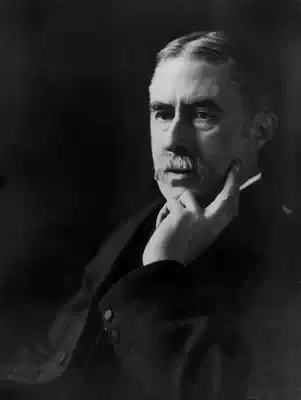
Alfred Edward Housman
Reveille
Reveille
Wake: the silver dusk returning
Up the beach of darkness brims,
And the ship of sunrise burning
Strands upon the eastern rims.
Wake: the vaulted shadow shatters,
Trampled to the floor it spanned,
And the tent of night in tatters
Straws the sky-pavilioned land.
Up, lad, up, 'tis late for lying:
Hear the drums of morning play;
Hark, the empty highways crying
"Who'll beyond the hills away?"
Towns and countries woo together,
Forelands beacon, belfries call;
Never lad that trod on leather
Lived to feast his heart with all.
Up, lad: thews that lie and cumber
Sunlit pallets never thrive;
Morns abed and daylight slumber
Were not meant for man alive.
Clay lies still, but blood's a rover;
Breath's a ware that will not keep.
Up, lad: when the journey's over
There'll be time enough to sleep.
Wake: the silver dusk returning
Up the beach of darkness brims,
And the ship of sunrise burning
Strands upon the eastern rims.
Wake: the vaulted shadow shatters,
Trampled to the floor it spanned,
And the tent of night in tatters
Straws the sky-pavilioned land.
Up, lad, up, 'tis late for lying:
Hear the drums of morning play;
Hark, the empty highways crying
"Who'll beyond the hills away?"
Towns and countries woo together,
Forelands beacon, belfries call;
Never lad that trod on leather
Lived to feast his heart with all.
Up, lad: thews that lie and cumber
Sunlit pallets never thrive;
Morns abed and daylight slumber
Were not meant for man alive.
Clay lies still, but blood's a rover;
Breath's a ware that will not keep.
Up, lad: when the journey's over
There'll be time enough to sleep.
1,083
1
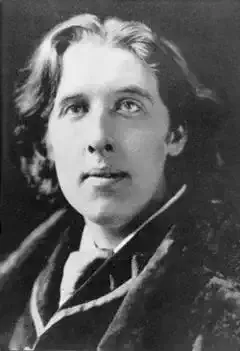
Oscar Wilde
Impression De Voyage
The sea was sapphire coloured, and the sky
Burned like a heated opal through the air;
We hoisted sail; the wind was blowing fair
For the blue lands that to the eastward lie.
From the steep prow I marked with quickening eye
Zakynthos, every olive grove and creek,
Ithaca's cliff, Lycaon's snowy peak,
And all the flower-strewn hills of Arcady.
The flapping of the sail against the mast,
The ripple of the water on the side,
The ripple of girls' laughter at the stern,
The only sounds:- when 'gan the West to burn,
And a red sun upon the seas to ride,
I stood upon the soil of Greece at last!
KATAKOLO.
Burned like a heated opal through the air;
We hoisted sail; the wind was blowing fair
For the blue lands that to the eastward lie.
From the steep prow I marked with quickening eye
Zakynthos, every olive grove and creek,
Ithaca's cliff, Lycaon's snowy peak,
And all the flower-strewn hills of Arcady.
The flapping of the sail against the mast,
The ripple of the water on the side,
The ripple of girls' laughter at the stern,
The only sounds:- when 'gan the West to burn,
And a red sun upon the seas to ride,
I stood upon the soil of Greece at last!
KATAKOLO.
660
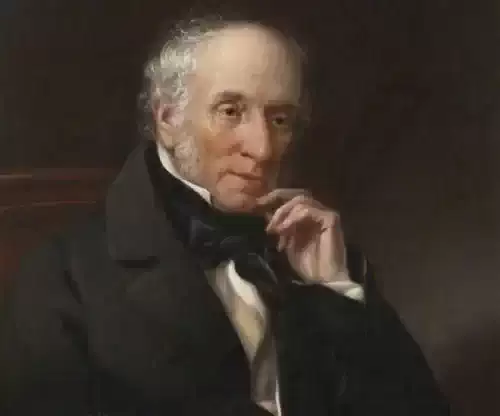
William Wordsworth
Yarrow Unvisited
Yarrow Unvisited
. From Stirling castle we had seen
The mazy Forth unravelled;
Had trod the banks of Clyde, and Tay,
And with the Tweed had travelled;
And when we came to Clovenford,
Then said my "winsome Marrow ,"
"Whate'er betide, we'll turn aside,
And see the Braes of Yarrow."
"Let Yarrow folk, frae Selkirk town,
Who have been buying, selling,
Go back to Yarrow, 'tis their own;
Each maiden to her dwelling!
On Yarrow's banks let her herons feed,
Hares couch, and rabbits burrow!
But we will downward with the Tweed
Nor turn aside to Yarrow.
"There's Galla Water, Leader Haughs,
Both lying right before us;
And Dryborough, where with chiming Tweed
The lintwhites sing in chorus;
There's pleasant Tiviot-dale, a land
Made blithe with plough and harrow:
Why throw away a needful day
To go in search of Yarrow?
"What's Yarrow but a river bare,
That glides the dark hills under?
There are a thousand such elsewhere
As worthy of your wonder."
--Strange words they seemed of slight and scorn;
My True-love sighed for sorrow;
And looked me in the face, to think
I thus could speak of Yarrow!
"Oh! green," said I, "are Yarrow's holms,
And sweet is Yarrow flowing!
Fair hangs the apple frae the rock,
But we will leave it growing.
O'er hilly path, and open Strath,
We'll wander Scotland thorough;
But, though so near, we will not turn
Into the dale of Yarrow.
"Let beeves and home-bred kine partake
The sweets of Burn-mill meadow,
The swan on still St. Mary's Lake
Float double, swan and shadow!
We will not see them; will not go,
To-day, nor yet to-morrow;
Enough if in our hearts we know
There's such a place as Yarrow.
"Be Yarrow stream unseen, unknown!
It must, or we shall rue it:
We have a vision of our own;
Ah! why should we undo it?
The treasured dreams of times long past,
We'll keep them, winsome Marrow!
For when we'er there, although 'tis fair,
'Twill be another Yarrow!
"If Care with freezing years should come,
And wandering seem but folly,--
Should we be loth to stir from home,
And yet be melancholy;
Should life be dull, and spirits low,
'Twill soothe us in our sorrow,
That earth has something yet to show,
The bonny holms of Yarrow!"
. From Stirling castle we had seen
The mazy Forth unravelled;
Had trod the banks of Clyde, and Tay,
And with the Tweed had travelled;
And when we came to Clovenford,
Then said my "winsome Marrow ,"
"Whate'er betide, we'll turn aside,
And see the Braes of Yarrow."
"Let Yarrow folk, frae Selkirk town,
Who have been buying, selling,
Go back to Yarrow, 'tis their own;
Each maiden to her dwelling!
On Yarrow's banks let her herons feed,
Hares couch, and rabbits burrow!
But we will downward with the Tweed
Nor turn aside to Yarrow.
"There's Galla Water, Leader Haughs,
Both lying right before us;
And Dryborough, where with chiming Tweed
The lintwhites sing in chorus;
There's pleasant Tiviot-dale, a land
Made blithe with plough and harrow:
Why throw away a needful day
To go in search of Yarrow?
"What's Yarrow but a river bare,
That glides the dark hills under?
There are a thousand such elsewhere
As worthy of your wonder."
--Strange words they seemed of slight and scorn;
My True-love sighed for sorrow;
And looked me in the face, to think
I thus could speak of Yarrow!
"Oh! green," said I, "are Yarrow's holms,
And sweet is Yarrow flowing!
Fair hangs the apple frae the rock,
But we will leave it growing.
O'er hilly path, and open Strath,
We'll wander Scotland thorough;
But, though so near, we will not turn
Into the dale of Yarrow.
"Let beeves and home-bred kine partake
The sweets of Burn-mill meadow,
The swan on still St. Mary's Lake
Float double, swan and shadow!
We will not see them; will not go,
To-day, nor yet to-morrow;
Enough if in our hearts we know
There's such a place as Yarrow.
"Be Yarrow stream unseen, unknown!
It must, or we shall rue it:
We have a vision of our own;
Ah! why should we undo it?
The treasured dreams of times long past,
We'll keep them, winsome Marrow!
For when we'er there, although 'tis fair,
'Twill be another Yarrow!
"If Care with freezing years should come,
And wandering seem but folly,--
Should we be loth to stir from home,
And yet be melancholy;
Should life be dull, and spirits low,
'Twill soothe us in our sorrow,
That earth has something yet to show,
The bonny holms of Yarrow!"
230
William Wordsworth
Written With a Pencil Upon a Stone In The Wall of The House, On The Island
Written With a Pencil Upon a Stone In The Wall of The House, On The Island
at Grasmere
Rude is this Edifice, and Thou hast seen
Buildings, albeit rude, that have maintained
Proportions more harmonious, and approached
To closer fellowship with ideal grace.
But take it in good part:--alas! the poor
Vitruvius of our village had no help
From the great City; never, upon leaves
Of red Morocco folio, saw displayed,
In long succession, pre-existing ghosts
Of Beauties yet unborn--the rustic Lodge
Antique, and Cottage with verandah graced,
Nor lacking, for fit company, alcove,
Green-house, shell-grot, and moss-lined hermitage.
Thou see'st a homely Pile, yet to these walls
The heifer comes in the snow-storm, and here
The new-dropped lamb finds shelter from the wind.
And hither does one Poet sometimes row
His pinnace, a small vagrant barge, up-piled
With plenteous store of heath and withered fern,
(A lading which he with his sickle cuts,
Among the mountains) and beneath this roof
He makes his summer couch, and here at noon
Spreads out his limbs, while, yet unshorn, the Sheep,
Panting beneath the burthen of their wool,
Lie round him, even as if they were a part
Of his own Household: nor, while from his bed
He looks, through the open door-place, toward the lake
And to the stirring breezes, does he want
Creations lovely as the work of sleep--
Fair sights, and visions of romantic joy!
at Grasmere
Rude is this Edifice, and Thou hast seen
Buildings, albeit rude, that have maintained
Proportions more harmonious, and approached
To closer fellowship with ideal grace.
But take it in good part:--alas! the poor
Vitruvius of our village had no help
From the great City; never, upon leaves
Of red Morocco folio, saw displayed,
In long succession, pre-existing ghosts
Of Beauties yet unborn--the rustic Lodge
Antique, and Cottage with verandah graced,
Nor lacking, for fit company, alcove,
Green-house, shell-grot, and moss-lined hermitage.
Thou see'st a homely Pile, yet to these walls
The heifer comes in the snow-storm, and here
The new-dropped lamb finds shelter from the wind.
And hither does one Poet sometimes row
His pinnace, a small vagrant barge, up-piled
With plenteous store of heath and withered fern,
(A lading which he with his sickle cuts,
Among the mountains) and beneath this roof
He makes his summer couch, and here at noon
Spreads out his limbs, while, yet unshorn, the Sheep,
Panting beneath the burthen of their wool,
Lie round him, even as if they were a part
Of his own Household: nor, while from his bed
He looks, through the open door-place, toward the lake
And to the stirring breezes, does he want
Creations lovely as the work of sleep--
Fair sights, and visions of romantic joy!
172
William Wordsworth
With ships the sea was sprinkled
With ships the sea was sprinkled
WITH ships the sea was sprinkled far and nigh,
Like stars in heaven, and joyously it showed;
Some lying fast at anchor in the road,
Some veering up and down, one knew not why.
A goodly vessel did I then espy
Come like a giant from a haven broad;
And lustily along the bay she strode,
Her tackling rich, and of apparel high.
The ship was nought to me, nor I to her,
Yet I pursued her with a lover's look;
This ship to all the rest did I prefer:
When will she turn, and whither? She will brook
No tarrying; where she comes the winds must stir:
On went she, and due north her journey took.
WITH ships the sea was sprinkled far and nigh,
Like stars in heaven, and joyously it showed;
Some lying fast at anchor in the road,
Some veering up and down, one knew not why.
A goodly vessel did I then espy
Come like a giant from a haven broad;
And lustily along the bay she strode,
Her tackling rich, and of apparel high.
The ship was nought to me, nor I to her,
Yet I pursued her with a lover's look;
This ship to all the rest did I prefer:
When will she turn, and whither? She will brook
No tarrying; where she comes the winds must stir:
On went she, and due north her journey took.
158
William Wordsworth
Resolution and Independence
Resolution and Independence
I
There was a roaring in the wind all night;
The rain came heavily and fell in floods;
But now the sun is rising calm and bright;
The birds are singing in the distant woods;
Over his own sweet voice the Stock-dove broods;
The Jay makes answer as the Magpie chatters;
And all the air is filled with pleasant noise of waters.
II
All things that love the sun are out of doors;
The sky rejoices in the morning's birth;
The grass is bright with rain-drops;--on the moors
The hare is running races in her mirth;
And with her feet she from the plashy earth
Raises a mist, that, glittering in the sun,
Runs with her all the way, wherever she doth run.
III
I was a Traveller then upon the moor,
I saw the hare that raced about with joy;
I heard the woods and distant waters roar;
Or heard them not, as happy as a boy:
The pleasant season did my heart employ:
My old remembrances went from me wholly;
And all the ways of men, so vain and melancholy.
IV
But, as it sometimes chanceth, from the might
Of joy in minds that can no further go,
As high as we have mounted in delight
In our dejection do we sink as low;
To me that morning did it happen so;
And fears and fancies thick upon me came;
Dim sadness--and blind thoughts, I knew not, nor could name.
V
I heard the sky-lark warbling in the sky;
And I bethought me of the playful hare:
Even such a happy Child of earth am I;
Even as these blissful creatures do I fare;
Far from the world I walk, and from all care;
But there may come another day to me--
Solitude, pain of heart, distress, and poverty.
VI
My whole life I have lived in pleasant thought,
As if life's business were a summer mood;
As if all needful things would come unsought
To genial faith, still rich in genial good;
But how can He expect that others should
Build for him, sow for him, and at his call
Love him, who for himself will take no heed at all?
VII
I thought of Chatterton, the marvellous Boy,
The sleepless Soul that perished in his pride;
Of Him who walked in glory and in joy
Following his plough, along the mountain-side:
By our own spirits are we deified:
We Poets in our youth begin in gladness;
But thereof come in the end despondency and madness.
VIII
Now, whether it were by peculiar grace,
A leading from above, a something given,
Yet it befell, that, in this lonely place,
When I with these untoward thoughts had striven,
Beside a pool bare to the eye of heaven
I saw a Man before me unawares:
The oldest man he seemed that ever wore grey hairs.
IX
As a huge stone is sometimes seen to lie
Couched on the bald top of an eminence;
Wonder to all who do the same espy,
By what means it could thither come, and whence;
So that it seems a thing endued with sense:
Like a sea-beast crawled forth, that on a shelf
Of rock or sand reposeth, there to sun itself;
X
Such seemed this Man, not all alive nor dead,
Nor all asleep--in his extreme old age:
His body was bent double, feet and head
Coming together in life's pilgrimage;
As if some dire constraint of pain, or rage
Of sickness felt by him in times long past,
A more than human weight upon his frame had cast.
XI
Himself he propped, limbs, body, and pale face,
Upon a long grey staff of shaven wood:
And, still as I drew near with gentle pace,
Upon the margin of that moorish flood
Motionless as a cloud the old Man stood,
That heareth not the loud winds when they call
And moveth all together, if it move at all.
XII
At length, himself unsettling, he the pond
Stirred with his staff, and fixedly did look
Upon the muddy water, which he conned,
As if he had been reading in a book:
And now a stranger's privilege I took;
And, drawing to his side, to him did say,
"This morning gives us promise of a glorious day."
XIII
A gentle answer did the old Man make,
In courteous speech which forth he slowly drew:
And him with further words I thus bespake,
"What occupation do you there pursue?
This is a lonesome place for one like you."
Ere he replied, a flash of mild surprise
Broke from the sable orbs of his yet-vivid eyes,
XIV
His words came feebly, from a feeble chest,
But each in solemn order followed each,
With something of a lofty utterance drest--
Choice word and measured phrase, above the reach
Of ordinary men; a stately speech;
Such as grave Livers do in Scotland use,
Religious men, who give to God and man their dues.
XV
He told, that to these waters he had come
To gather leeches, being old and poor:
Employment hazardous and wearisome!
And he had many hardships to endure:
From pond to pond he roamed, from moor to moor;
Housing, with God's good help, by choice or chance,
And in this way he gained an honest maintenance.
XVI
The old Man still stood talking by my side;
But now his voice to me was like a stream
Scarce heard; nor word from word could I divide;
And the whole body of the Man did seem
Like one whom I had met with in a dream;
Or like a man from some far region sent,
To give me human strength, by apt admonishment.
XVII
My former thoughts returned: the fear that kills;
And hope that is unwilling to be fed;
Cold, pain, and labour, and all fleshly ills;
And mighty Poets in their misery dead.
--Perplexed, and longing to be comforted,
My question eagerly did I renew,
"How is it that you live, and what is it you do?"
XVIII
He with a smile did then his words repeat;
And said, that, gathering leeches, far and wide
He travelled; stirring thus about his feet
The waters of the pools where they abide.
"Once I could meet with them on every side;
But they have dwindled long by slow decay;
Yet still I persevere, and find them where I may."
XIX
While he was talking thus, the lonely place,
The old Man's shape, and speech--all troubled me:
In my mind's eye I seemed to see him pace
About the weary moors continually,
Wandering about alone and silently.
While I these thoughts within myself pursued,
He, having made a pause, the same discourse renewed.
XX
And soon with this he other matter blended,
Cheerfully uttered, with demeanour kind,
But stately in the main; and when he ended,
I could have laughed myself to scorn to find
In that decrepit Man so firm a mind.
"God," said I, "be my help and stay secure;
I'll think of the Leech-gatherer on the lonely moor!"
I
There was a roaring in the wind all night;
The rain came heavily and fell in floods;
But now the sun is rising calm and bright;
The birds are singing in the distant woods;
Over his own sweet voice the Stock-dove broods;
The Jay makes answer as the Magpie chatters;
And all the air is filled with pleasant noise of waters.
II
All things that love the sun are out of doors;
The sky rejoices in the morning's birth;
The grass is bright with rain-drops;--on the moors
The hare is running races in her mirth;
And with her feet she from the plashy earth
Raises a mist, that, glittering in the sun,
Runs with her all the way, wherever she doth run.
III
I was a Traveller then upon the moor,
I saw the hare that raced about with joy;
I heard the woods and distant waters roar;
Or heard them not, as happy as a boy:
The pleasant season did my heart employ:
My old remembrances went from me wholly;
And all the ways of men, so vain and melancholy.
IV
But, as it sometimes chanceth, from the might
Of joy in minds that can no further go,
As high as we have mounted in delight
In our dejection do we sink as low;
To me that morning did it happen so;
And fears and fancies thick upon me came;
Dim sadness--and blind thoughts, I knew not, nor could name.
V
I heard the sky-lark warbling in the sky;
And I bethought me of the playful hare:
Even such a happy Child of earth am I;
Even as these blissful creatures do I fare;
Far from the world I walk, and from all care;
But there may come another day to me--
Solitude, pain of heart, distress, and poverty.
VI
My whole life I have lived in pleasant thought,
As if life's business were a summer mood;
As if all needful things would come unsought
To genial faith, still rich in genial good;
But how can He expect that others should
Build for him, sow for him, and at his call
Love him, who for himself will take no heed at all?
VII
I thought of Chatterton, the marvellous Boy,
The sleepless Soul that perished in his pride;
Of Him who walked in glory and in joy
Following his plough, along the mountain-side:
By our own spirits are we deified:
We Poets in our youth begin in gladness;
But thereof come in the end despondency and madness.
VIII
Now, whether it were by peculiar grace,
A leading from above, a something given,
Yet it befell, that, in this lonely place,
When I with these untoward thoughts had striven,
Beside a pool bare to the eye of heaven
I saw a Man before me unawares:
The oldest man he seemed that ever wore grey hairs.
IX
As a huge stone is sometimes seen to lie
Couched on the bald top of an eminence;
Wonder to all who do the same espy,
By what means it could thither come, and whence;
So that it seems a thing endued with sense:
Like a sea-beast crawled forth, that on a shelf
Of rock or sand reposeth, there to sun itself;
X
Such seemed this Man, not all alive nor dead,
Nor all asleep--in his extreme old age:
His body was bent double, feet and head
Coming together in life's pilgrimage;
As if some dire constraint of pain, or rage
Of sickness felt by him in times long past,
A more than human weight upon his frame had cast.
XI
Himself he propped, limbs, body, and pale face,
Upon a long grey staff of shaven wood:
And, still as I drew near with gentle pace,
Upon the margin of that moorish flood
Motionless as a cloud the old Man stood,
That heareth not the loud winds when they call
And moveth all together, if it move at all.
XII
At length, himself unsettling, he the pond
Stirred with his staff, and fixedly did look
Upon the muddy water, which he conned,
As if he had been reading in a book:
And now a stranger's privilege I took;
And, drawing to his side, to him did say,
"This morning gives us promise of a glorious day."
XIII
A gentle answer did the old Man make,
In courteous speech which forth he slowly drew:
And him with further words I thus bespake,
"What occupation do you there pursue?
This is a lonesome place for one like you."
Ere he replied, a flash of mild surprise
Broke from the sable orbs of his yet-vivid eyes,
XIV
His words came feebly, from a feeble chest,
But each in solemn order followed each,
With something of a lofty utterance drest--
Choice word and measured phrase, above the reach
Of ordinary men; a stately speech;
Such as grave Livers do in Scotland use,
Religious men, who give to God and man their dues.
XV
He told, that to these waters he had come
To gather leeches, being old and poor:
Employment hazardous and wearisome!
And he had many hardships to endure:
From pond to pond he roamed, from moor to moor;
Housing, with God's good help, by choice or chance,
And in this way he gained an honest maintenance.
XVI
The old Man still stood talking by my side;
But now his voice to me was like a stream
Scarce heard; nor word from word could I divide;
And the whole body of the Man did seem
Like one whom I had met with in a dream;
Or like a man from some far region sent,
To give me human strength, by apt admonishment.
XVII
My former thoughts returned: the fear that kills;
And hope that is unwilling to be fed;
Cold, pain, and labour, and all fleshly ills;
And mighty Poets in their misery dead.
--Perplexed, and longing to be comforted,
My question eagerly did I renew,
"How is it that you live, and what is it you do?"
XVIII
He with a smile did then his words repeat;
And said, that, gathering leeches, far and wide
He travelled; stirring thus about his feet
The waters of the pools where they abide.
"Once I could meet with them on every side;
But they have dwindled long by slow decay;
Yet still I persevere, and find them where I may."
XIX
While he was talking thus, the lonely place,
The old Man's shape, and speech--all troubled me:
In my mind's eye I seemed to see him pace
About the weary moors continually,
Wandering about alone and silently.
While I these thoughts within myself pursued,
He, having made a pause, the same discourse renewed.
XX
And soon with this he other matter blended,
Cheerfully uttered, with demeanour kind,
But stately in the main; and when he ended,
I could have laughed myself to scorn to find
In that decrepit Man so firm a mind.
"God," said I, "be my help and stay secure;
I'll think of the Leech-gatherer on the lonely moor!"
219
William Wordsworth
Elegiac Stanzas
Elegiac Stanzas
Lulled by the sound of pastoral bells,
Rude Nature's Pilgrims did we go,
From the dread summit of the Queen
Of mountains, through a deep ravine,
Where, in her holy chapel, dwells
"Our Lady of the Snow."
The sky was blue, the air was mild;
Free were the streams and green the bowers;
As if, to rough assaults unknown,
The genial spot had 'ever' shown
A countenance that as sweetly smiled--
The face of summer-hours.
And we were gay, our hearts at ease;
With pleasure dancing through the frame
We journeyed; all we knew of care--
Our path that straggled here and there;
Of trouble--but the fluttering breeze;
Of Winter--but a name.
If foresight could have rent the veil
Of three short days--but hush--no more!
Calm is the grave, and calmer none
Than that to which thy cares are gone,
Thou Victim of the stormy gale;
Asleep on ZURICH'S shore!
O GODDARD! what art thou?--a name--
A sunbeam followed by a shade!
Nor more, for aught that time supplies,
The great, the experienced, and the wise:
Too much from this frail earth we claim,
And therefore are betrayed.
We met, while festive mirth ran wild,
Where, from a deep lake's mighty urn,
Forth slips, like an enfranchised slave,
A sea-green river, proud to lave,
With current swift and undefiled,
The towers of old LUCERNE.
We parted upon solemn ground
Far-lifted towards the unfading sky;
But all our thoughts were 'then' of Earth,
That gives to common pleasures birth;
And nothing in our hearts we found
That prompted even a sigh.
Fetch, sympathising Powers of air,
Fetch, ye that post o'er seas and lands,
Herbs, moistened by Virginian dew,
A most untimely grave to strew,
Whose turf may never know the care
Of 'kindred' human hands!
Beloved by every gentle Muse
He left his Transatlantic home:
Europe, a realised romance,
Had opened on his eager glance;
What present bliss!--what golden views!
What stores for years to come!
Though lodged within no vigorous frame,
His soul her daily tasks renewed,
Blithe as the lark on sun-gilt wings
High poised--or as the wren that sings
In shady places, to proclaim
Her modest gratitude.
Not vain is sadly-uttered praise;
The words of truth's memorial vow
Are sweet as morning fragrance shed
From flowers 'mid GOLDAU'S ruins bred;
As evening's fondly-lingering rays,
On RIGHI'S silent brow.
Lamented Youth! to thy cold clay
Fit obsequies the Stranger paid;
And piety shall guard the Stone
Which hath not left the spot unknown
Where the wild waves resigned their prey--
And 'that' which marks thy bed.
And, when thy Mother weeps for Thee,
Lost Youth! a solitary Mother;
This tribute from a casual Friend
A not unwelcome aid may lend,
To feed the tender luxury,
The rising pang to smother.
Lulled by the sound of pastoral bells,
Rude Nature's Pilgrims did we go,
From the dread summit of the Queen
Of mountains, through a deep ravine,
Where, in her holy chapel, dwells
"Our Lady of the Snow."
The sky was blue, the air was mild;
Free were the streams and green the bowers;
As if, to rough assaults unknown,
The genial spot had 'ever' shown
A countenance that as sweetly smiled--
The face of summer-hours.
And we were gay, our hearts at ease;
With pleasure dancing through the frame
We journeyed; all we knew of care--
Our path that straggled here and there;
Of trouble--but the fluttering breeze;
Of Winter--but a name.
If foresight could have rent the veil
Of three short days--but hush--no more!
Calm is the grave, and calmer none
Than that to which thy cares are gone,
Thou Victim of the stormy gale;
Asleep on ZURICH'S shore!
O GODDARD! what art thou?--a name--
A sunbeam followed by a shade!
Nor more, for aught that time supplies,
The great, the experienced, and the wise:
Too much from this frail earth we claim,
And therefore are betrayed.
We met, while festive mirth ran wild,
Where, from a deep lake's mighty urn,
Forth slips, like an enfranchised slave,
A sea-green river, proud to lave,
With current swift and undefiled,
The towers of old LUCERNE.
We parted upon solemn ground
Far-lifted towards the unfading sky;
But all our thoughts were 'then' of Earth,
That gives to common pleasures birth;
And nothing in our hearts we found
That prompted even a sigh.
Fetch, sympathising Powers of air,
Fetch, ye that post o'er seas and lands,
Herbs, moistened by Virginian dew,
A most untimely grave to strew,
Whose turf may never know the care
Of 'kindred' human hands!
Beloved by every gentle Muse
He left his Transatlantic home:
Europe, a realised romance,
Had opened on his eager glance;
What present bliss!--what golden views!
What stores for years to come!
Though lodged within no vigorous frame,
His soul her daily tasks renewed,
Blithe as the lark on sun-gilt wings
High poised--or as the wren that sings
In shady places, to proclaim
Her modest gratitude.
Not vain is sadly-uttered praise;
The words of truth's memorial vow
Are sweet as morning fragrance shed
From flowers 'mid GOLDAU'S ruins bred;
As evening's fondly-lingering rays,
On RIGHI'S silent brow.
Lamented Youth! to thy cold clay
Fit obsequies the Stranger paid;
And piety shall guard the Stone
Which hath not left the spot unknown
Where the wild waves resigned their prey--
And 'that' which marks thy bed.
And, when thy Mother weeps for Thee,
Lost Youth! a solitary Mother;
This tribute from a casual Friend
A not unwelcome aid may lend,
To feed the tender luxury,
The rising pang to smother.
217
William Wordsworth
With Ships the Sea was Sprinkled Far and Nigh,
"With Ships the Sea was Sprinkled Far and Nigh,"
With ships the sea was sprinkled far and nigh,
Like stars in heaven, and joyously it showed;
Some lying fast at anchor in the road,
Some veering up and down, one knew not why.
A goodly vessel did I then espy
Come like a giant from a haven broad;
And lustily along the bay she strode,
Her tackling rich, and of apparel high.
The ship was nought to me, nor I to her,
Yet I pursued her with a lover's look;
This ship to all the rest did I prefer:
When will she turn, and whither? She will brook
No tarrying; where she comes the winds must stir:
On went she, and due north her journey took.
With ships the sea was sprinkled far and nigh,
Like stars in heaven, and joyously it showed;
Some lying fast at anchor in the road,
Some veering up and down, one knew not why.
A goodly vessel did I then espy
Come like a giant from a haven broad;
And lustily along the bay she strode,
Her tackling rich, and of apparel high.
The ship was nought to me, nor I to her,
Yet I pursued her with a lover's look;
This ship to all the rest did I prefer:
When will she turn, and whither? She will brook
No tarrying; where she comes the winds must stir:
On went she, and due north her journey took.
243
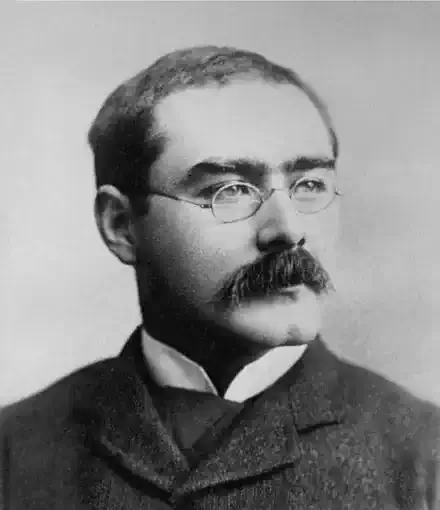
Rudyard Kipling
The Coiner
The Coiner
To be sung by the unlearned to the tune of "King John and the Abbot of
Canterbury," and by the learned to "Tempest-a-brewing."
Against the Bermudas we foundered, whereby
This Master, that Swabber, yon Bo'sun, and I
(Our pinnace and crew being drowned in the main)
Must beg for our bread through old England again.
For a bite and a sup, and a bed of clean straw,
We'll tell you such marvels as man never saw,
On a Magical Island which no one did spy
Save this Master, that Swabber, yon Bo'sun, and I.
Seven months among Mermaids and Devils and Sprites,
And Voices that howl in the cedars o'nights,
With further enchantments we underwent there.
Good Sirs, 'tis a tale to draw guts from a bear!
'Twixt Dover and Southwark it paid us our way,
Where we found some poor players were labouring a play;
And, willing to search what such business might be,
We entered the yard, both to hear and to see.
One hailed us for seamen and courteous-ly
Did guide us apart to a tavern near by
Where we told him our tale (as to many of late),
And he gave us good cheer, so we gave him good weight.
Mulled sack and strong waters on bellies well lined
With beef and black pudding do strengthen the mind;
And seeing him greedy for marvels, at last
From plain salted truth to flat leasing we passed.
But he, when on midnight our reckoning he paid,
Says, "Never match coins with a Coiner by trade,
Or he'll turn your lead pieces to metal as rare
As shall fill him this globe, and leave something to spare...."
We slept where they laid us, and when we awoke
Was a crown or five shillings in every man's poke.
We bit them and rang them, and, finding them good,
We drank to that Coiner as honest men should!
For a cup and a crust, and a truss, etc.
To be sung by the unlearned to the tune of "King John and the Abbot of
Canterbury," and by the learned to "Tempest-a-brewing."
Against the Bermudas we foundered, whereby
This Master, that Swabber, yon Bo'sun, and I
(Our pinnace and crew being drowned in the main)
Must beg for our bread through old England again.
For a bite and a sup, and a bed of clean straw,
We'll tell you such marvels as man never saw,
On a Magical Island which no one did spy
Save this Master, that Swabber, yon Bo'sun, and I.
Seven months among Mermaids and Devils and Sprites,
And Voices that howl in the cedars o'nights,
With further enchantments we underwent there.
Good Sirs, 'tis a tale to draw guts from a bear!
'Twixt Dover and Southwark it paid us our way,
Where we found some poor players were labouring a play;
And, willing to search what such business might be,
We entered the yard, both to hear and to see.
One hailed us for seamen and courteous-ly
Did guide us apart to a tavern near by
Where we told him our tale (as to many of late),
And he gave us good cheer, so we gave him good weight.
Mulled sack and strong waters on bellies well lined
With beef and black pudding do strengthen the mind;
And seeing him greedy for marvels, at last
From plain salted truth to flat leasing we passed.
But he, when on midnight our reckoning he paid,
Says, "Never match coins with a Coiner by trade,
Or he'll turn your lead pieces to metal as rare
As shall fill him this globe, and leave something to spare...."
We slept where they laid us, and when we awoke
Was a crown or five shillings in every man's poke.
We bit them and rang them, and, finding them good,
We drank to that Coiner as honest men should!
For a cup and a crust, and a truss, etc.
446
Rudyard Kipling
The Beginning of the Armadilloes
The Beginning of the Armadilloes
I've never sailed the Amazon,
I've never reached Brazil;
But the Don and Magdalena,
They can go there when they will!
Yes, weekly from Southampton
Great steamers, white and gold,
Go rolling down to Rio
(Roll down--roll down to Rio!).
And I'd like to roll to Rio
Some day before I'm old!
I've never seen a Jaguar,
Nor yet an Armadill--
He's dilloing in his armour,
And I s'pose I never will,
Unless I go to Rio
These wonders to behold--
Roll down--roll down to Rio--
Roll really down to Rio!
Oh, I'd love to roll to Rio
Some day before I'm old!
I've never sailed the Amazon,
I've never reached Brazil;
But the Don and Magdalena,
They can go there when they will!
Yes, weekly from Southampton
Great steamers, white and gold,
Go rolling down to Rio
(Roll down--roll down to Rio!).
And I'd like to roll to Rio
Some day before I'm old!
I've never seen a Jaguar,
Nor yet an Armadill--
He's dilloing in his armour,
And I s'pose I never will,
Unless I go to Rio
These wonders to behold--
Roll down--roll down to Rio--
Roll really down to Rio!
Oh, I'd love to roll to Rio
Some day before I'm old!
439
Rudyard Kipling
Sea-Wife
Sea-Wife
There dwells a wife by the Northern Gate,
And a wealthy wife is she;
She breeds a breed o' rovin' men
And casts them over sea.
And some are drowned in deep water,
And some in sight o' shore,
And word goes back to the weary wife
And ever she sends more.
For since that wife had gate or gear,
Or hearth or garth or bield,
She willed her sons to the white harvest,
And that is a bitter yield.
She wills her sons to the wet ploughing,
To ride the horse of tree,
And syne her sons come back again
Far-spent from out the sea.
The good wife's sons come home again
With little into their hands,
But the lore of men that ha' dealt with men
In the new and naked lands;
But the faith of men that ha' brothered men
By more than easy breath,
And the eyes o' men that ha' read wi' men
In the open books of death.
Rich are they, rich in wonders seen,
But poor in the goods o' men;
So what they ha' got by the skin o' their teeth
They sell for their teeth again.
For whether they lose to the naked life
Or win to their hearts' desire,
They tell it all to the weary wife
That nods beside the fire.
Her hearth is wide to every wind
That makes the white ash spin;
And tide and tide and 'tween the tides
Her sons go out and in;
(Out with great mirth that do desire
Hazard of trackless ways,
In with content to wait their watch
And warm before the blaze);
And some return by failing light,
And some in waking dream,
For she hears the heels of the dripping ghosts
That ride the rough roof-beam.
Home, they come home from all the ports,
The living and the dead;
The good wife's sons come home again
For her blessing on their head!
There dwells a wife by the Northern Gate,
And a wealthy wife is she;
She breeds a breed o' rovin' men
And casts them over sea.
And some are drowned in deep water,
And some in sight o' shore,
And word goes back to the weary wife
And ever she sends more.
For since that wife had gate or gear,
Or hearth or garth or bield,
She willed her sons to the white harvest,
And that is a bitter yield.
She wills her sons to the wet ploughing,
To ride the horse of tree,
And syne her sons come back again
Far-spent from out the sea.
The good wife's sons come home again
With little into their hands,
But the lore of men that ha' dealt with men
In the new and naked lands;
But the faith of men that ha' brothered men
By more than easy breath,
And the eyes o' men that ha' read wi' men
In the open books of death.
Rich are they, rich in wonders seen,
But poor in the goods o' men;
So what they ha' got by the skin o' their teeth
They sell for their teeth again.
For whether they lose to the naked life
Or win to their hearts' desire,
They tell it all to the weary wife
That nods beside the fire.
Her hearth is wide to every wind
That makes the white ash spin;
And tide and tide and 'tween the tides
Her sons go out and in;
(Out with great mirth that do desire
Hazard of trackless ways,
In with content to wait their watch
And warm before the blaze);
And some return by failing light,
And some in waking dream,
For she hears the heels of the dripping ghosts
That ride the rough roof-beam.
Home, they come home from all the ports,
The living and the dead;
The good wife's sons come home again
For her blessing on their head!
453
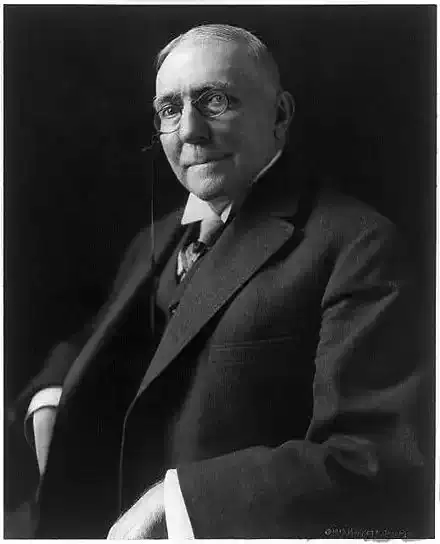
James Whitcomb Riley
A Noted Traveler
A Noted Traveler
Even in such a scene of senseless play
The children were surprised one summer-day
By a strange man who called across the fence,
Inquiring for their father's residence;
And, being answered that this was the place,
Opened the gate, and with a radiant face,
Came in and sat down with them in the shade
And waited--till the absent father made
His noon appearance, with a warmth and zest
That told he had no ordinary guest
In this man whose low-spoken name he knew
At once, demurring as the stranger drew
A stuffy notebook out and turned and set
A big fat finger on a page and let
The writing thereon testify instead
Of further speech. And as the father read
All silently, the curious children took
Exacting inventory both of book
And man:--He wore a long-napped white fur-hat
Pulled firmly on his head, and under that
Rather long silvery hair, or iron-gray--
For he was not an old man,--anyway,
Not beyond sixty. And he wore a pair
Of square-framed spectacles--or rather there
Were two more than a pair,--the extra two
Flared at the corners, at the eyes' side-view,
In as redundant vision as the eyes
Of grasshoppers or bees or dragonflies.
Later the children heard the father say
He was 'A Noted Traveler,' and would stay
Some days with them--In which time host and guest
Discussed, alone, in deepest interest,
Some vague, mysterious matter that defied
The wistful children, loitering outside
The spare-room door. There Bud acquired a quite
New list of big words--such as 'Disunite,'
And 'Shibboleth,' and 'Aristocracy,'
And 'Juggernaut,' and 'Squatter Sovereignty,'
And 'Anti-slavery,' 'Emancipate,'
'Irrepressible conflict,' and 'The Great
Battle of Armageddon'--obviously
A pamphlet brought from Washington, D. C.,
And spread among such friends as might occur
Of like views with 'The Noted Traveler.'
Even in such a scene of senseless play
The children were surprised one summer-day
By a strange man who called across the fence,
Inquiring for their father's residence;
And, being answered that this was the place,
Opened the gate, and with a radiant face,
Came in and sat down with them in the shade
And waited--till the absent father made
His noon appearance, with a warmth and zest
That told he had no ordinary guest
In this man whose low-spoken name he knew
At once, demurring as the stranger drew
A stuffy notebook out and turned and set
A big fat finger on a page and let
The writing thereon testify instead
Of further speech. And as the father read
All silently, the curious children took
Exacting inventory both of book
And man:--He wore a long-napped white fur-hat
Pulled firmly on his head, and under that
Rather long silvery hair, or iron-gray--
For he was not an old man,--anyway,
Not beyond sixty. And he wore a pair
Of square-framed spectacles--or rather there
Were two more than a pair,--the extra two
Flared at the corners, at the eyes' side-view,
In as redundant vision as the eyes
Of grasshoppers or bees or dragonflies.
Later the children heard the father say
He was 'A Noted Traveler,' and would stay
Some days with them--In which time host and guest
Discussed, alone, in deepest interest,
Some vague, mysterious matter that defied
The wistful children, loitering outside
The spare-room door. There Bud acquired a quite
New list of big words--such as 'Disunite,'
And 'Shibboleth,' and 'Aristocracy,'
And 'Juggernaut,' and 'Squatter Sovereignty,'
And 'Anti-slavery,' 'Emancipate,'
'Irrepressible conflict,' and 'The Great
Battle of Armageddon'--obviously
A pamphlet brought from Washington, D. C.,
And spread among such friends as might occur
Of like views with 'The Noted Traveler.'
279

Jack Kerouac
Nebraska
Nebraska
April doesnt hurt here
Like it does in New England
The ground
Vast and brown
Surrounds dry towns
Located in the dust
Of the coming locust
Live for survival, not for 'kicks'
Be a bangtail describer,
like of shrouded traveler
in Textile tenement & the birds fighting in yr ears-like Burroughs exact to describe &
gettin $
The Angry Hunger
(hunger is anger)
who fears the
hungry feareth
the angry)
And so I came home
To Golden far away
Twas on the horizon
Every blessed day
As we rolled And we rolled
From Donner tragic Pass
Thru April in Nevada And out Salt City Way Into the dry Nebraskas And sad Wyomings
Where young girls And pretty lover boys
With Mickey Mantle eyes
Wander under moons
Sawing in lost cradle
And Judge O Fasterc
Passes whiggling by To ask of young love: ,,Was it the same wind Of April Plains eve
that ruffled the dress
Of my lost love
Louanna
In the Western
Far off night
Lost as the whistle
Of the passing Train
Everywhere West
Roams moaning
The deep basso
-Vom! Vom!
-Was it the same love
Notified my bones As mortify yrs now
Children of the soft
Wyoming April night?
Couldna been!
But was! But was!'
And on the prairie
The wildflower blows
In the night For bees & birds And sleeping hidden Animals of life.
The Chicago
Spitters in the spotty street
Cheap beans, loop, Girls made eyes at me And I had 35 Cents in my jeans -
Then Toledo
Springtime starry
Lover night Of hot rod boys And cool girls A wandering
A wandering
In search of April pain A plash of rain
Will not dispel This fumigatin hell Of lover lane This park of roses Blue as bees
In former airy poses
In aerial O Way hoses
No tamarand And figancine Can the musterand Be less kind
Sol -
Sol -
Bring forth yr Ah Sunflower - Ah me Montana
Phosphorescent Rose
And bridge in
fairly land
I'd understand it all -
April doesnt hurt here
Like it does in New England
The ground
Vast and brown
Surrounds dry towns
Located in the dust
Of the coming locust
Live for survival, not for 'kicks'
Be a bangtail describer,
like of shrouded traveler
in Textile tenement & the birds fighting in yr ears-like Burroughs exact to describe &
gettin $
The Angry Hunger
(hunger is anger)
who fears the
hungry feareth
the angry)
And so I came home
To Golden far away
Twas on the horizon
Every blessed day
As we rolled And we rolled
From Donner tragic Pass
Thru April in Nevada And out Salt City Way Into the dry Nebraskas And sad Wyomings
Where young girls And pretty lover boys
With Mickey Mantle eyes
Wander under moons
Sawing in lost cradle
And Judge O Fasterc
Passes whiggling by To ask of young love: ,,Was it the same wind Of April Plains eve
that ruffled the dress
Of my lost love
Louanna
In the Western
Far off night
Lost as the whistle
Of the passing Train
Everywhere West
Roams moaning
The deep basso
-Vom! Vom!
-Was it the same love
Notified my bones As mortify yrs now
Children of the soft
Wyoming April night?
Couldna been!
But was! But was!'
And on the prairie
The wildflower blows
In the night For bees & birds And sleeping hidden Animals of life.
The Chicago
Spitters in the spotty street
Cheap beans, loop, Girls made eyes at me And I had 35 Cents in my jeans -
Then Toledo
Springtime starry
Lover night Of hot rod boys And cool girls A wandering
A wandering
In search of April pain A plash of rain
Will not dispel This fumigatin hell Of lover lane This park of roses Blue as bees
In former airy poses
In aerial O Way hoses
No tamarand And figancine Can the musterand Be less kind
Sol -
Sol -
Bring forth yr Ah Sunflower - Ah me Montana
Phosphorescent Rose
And bridge in
fairly land
I'd understand it all -
341
Rudyard Kipling
Chant-Pagan
Chant-Pagan
ENGLISH IRREGULAR, DISCHARGED
Me that 'ave been what I've been --
Me that 'ave gone where I've gone --
Me that 'ave seen what I've seen --
'Ow can I ever take on
With awful old England again,
An' 'ouses both sides of the street,
And 'edges two sides of the lane,
And the parson an' gentry between,
An' touchin' my 'at when we meet --
Me that 'ave been what I've been?
Me that 'ave watched 'arf a world
'Eave up all shiny with dew,
Kopje on kop to the sun,
An' as soon as the mist let 'em through
Our 'elios winkin' like fun --
Three sides of a ninety-mile square,
Over valleys as big as a shire --
"Are ye there? Are ye there? Are ye there?"
An' then the blind drum of our fire . . .
An' I'm rollin' 'is lawns for the Squire,
Me!
Me htat 'ave rode through the dark
Forty mile, often, on end,
Along the Ma'ollisberg Range,
With only the stars for my mark
An' only the night for my friend,
An' things runnin' off as you pass,
An' things jumpin' up in the grass,
An' the silence, the shine an' the size
Of the 'igh, unexpressible skies --
I am takin' some letters almost
As much as a mile to the post,
An' "mind you come back with the change!"
Me!
Me that saw Barberton took
When we dropped through the clouds on their 'ead,
An' they 'ove the guns over and fled --
Me that was through Di'mond I'll,
An' Pieters an' Springs an' Belfast --
From Dundee to Vereeniging all --
Me that stuck out to the last
(An' five bloomin' bars on my chest) --
I am doin' my Sunday-school best,
By the 'elp of the Squire an' 'is wife
(Not to mention the 'ousemaid an' cook),
To come in an' 'ands up an' be still,
An' honestly work for my bread,
My livin' in that state of life
To which it shall please God to call
Me!
Me that 'ave followed my trade
In the place where the Lightnin's are made;
"Twixt the Rains and the Sun and the Moon --
Me that lay down an' got up
Three years with the sky for my roof --
That 'ave ridden my 'unger an' thirst
Six thousand raw mile on the hoof,
With the Vaal and the Orange for cup,
An' the Brandwater Basin for dish, --
Oh! it's 'ard to be'ave as they wish
(Too 'ard, an' a little too soon),
I'll 'ave to think over it first --
Me!
I will arise an' get 'ence --
I will trek South and make sure
If it's only my fancy or not
That the sunshine of England is pale,
And the breezes of England are stale,
An' there's something' gone small with the lot.
For I know of a sun an' a wind,
An' some plains and a mountain be'ind,
An' some graves by a barb-wire fence,
An' a Dutchman I've fought 'oo might give
Me a job where I ever inclined
To look in an' offsaddle an' live
Where there's neither a road nor a tree --
But only my Maker an' me,
An I think it will kill me or cure,
So I think I will go there an' see.
ENGLISH IRREGULAR, DISCHARGED
Me that 'ave been what I've been --
Me that 'ave gone where I've gone --
Me that 'ave seen what I've seen --
'Ow can I ever take on
With awful old England again,
An' 'ouses both sides of the street,
And 'edges two sides of the lane,
And the parson an' gentry between,
An' touchin' my 'at when we meet --
Me that 'ave been what I've been?
Me that 'ave watched 'arf a world
'Eave up all shiny with dew,
Kopje on kop to the sun,
An' as soon as the mist let 'em through
Our 'elios winkin' like fun --
Three sides of a ninety-mile square,
Over valleys as big as a shire --
"Are ye there? Are ye there? Are ye there?"
An' then the blind drum of our fire . . .
An' I'm rollin' 'is lawns for the Squire,
Me!
Me htat 'ave rode through the dark
Forty mile, often, on end,
Along the Ma'ollisberg Range,
With only the stars for my mark
An' only the night for my friend,
An' things runnin' off as you pass,
An' things jumpin' up in the grass,
An' the silence, the shine an' the size
Of the 'igh, unexpressible skies --
I am takin' some letters almost
As much as a mile to the post,
An' "mind you come back with the change!"
Me!
Me that saw Barberton took
When we dropped through the clouds on their 'ead,
An' they 'ove the guns over and fled --
Me that was through Di'mond I'll,
An' Pieters an' Springs an' Belfast --
From Dundee to Vereeniging all --
Me that stuck out to the last
(An' five bloomin' bars on my chest) --
I am doin' my Sunday-school best,
By the 'elp of the Squire an' 'is wife
(Not to mention the 'ousemaid an' cook),
To come in an' 'ands up an' be still,
An' honestly work for my bread,
My livin' in that state of life
To which it shall please God to call
Me!
Me that 'ave followed my trade
In the place where the Lightnin's are made;
"Twixt the Rains and the Sun and the Moon --
Me that lay down an' got up
Three years with the sky for my roof --
That 'ave ridden my 'unger an' thirst
Six thousand raw mile on the hoof,
With the Vaal and the Orange for cup,
An' the Brandwater Basin for dish, --
Oh! it's 'ard to be'ave as they wish
(Too 'ard, an' a little too soon),
I'll 'ave to think over it first --
Me!
I will arise an' get 'ence --
I will trek South and make sure
If it's only my fancy or not
That the sunshine of England is pale,
And the breezes of England are stale,
An' there's something' gone small with the lot.
For I know of a sun an' a wind,
An' some plains and a mountain be'ind,
An' some graves by a barb-wire fence,
An' a Dutchman I've fought 'oo might give
Me a job where I ever inclined
To look in an' offsaddle an' live
Where there's neither a road nor a tree --
But only my Maker an' me,
An I think it will kill me or cure,
So I think I will go there an' see.
468
Jack Kerouac
Bus East
Bus East
Society has good intentions Bureaucracy is like a friend
5 years ago - other furies other losses
America's
trying to control the uncontrollable Forest fires, Vice
The essential smile In the essential sleep Of the children Of the essential mind
I'm
all thru playing the American
Now I'm going to live a good quiet life
The
world should be built for foot walkers
Oily
rivers Of spiney Nevady
I
am Jake Cake
Rake
Write like Blake
The
horse is not pleased Sight of his
gorgeous finery
in the dust Its silken
nostrils
did disgust
Cats
arent kind Kiddies anent sweet
April
in Nevada - Investigating Dismal Cheyenne Where the war parties
In fields
of straw
Aimed over oxen At Indian Chiefs
In wild headdress Pouring thru
the gap
In Wyoming plain
To make the settlers
Eat more dust than dust
was eaten In the States From East at Seacoast Where wagons made up To dreadful
Plains
Of clazer vup
Saltry
settlers
Anxious to masturbate The Mongol Sea (I'm too tired in Cheyenne -
No sleep in 4 nights now, & 2 to go)
Society has good intentions Bureaucracy is like a friend
5 years ago - other furies other losses
America's
trying to control the uncontrollable Forest fires, Vice
The essential smile In the essential sleep Of the children Of the essential mind
I'm
all thru playing the American
Now I'm going to live a good quiet life
The
world should be built for foot walkers
Oily
rivers Of spiney Nevady
I
am Jake Cake
Rake
Write like Blake
The
horse is not pleased Sight of his
gorgeous finery
in the dust Its silken
nostrils
did disgust
Cats
arent kind Kiddies anent sweet
April
in Nevada - Investigating Dismal Cheyenne Where the war parties
In fields
of straw
Aimed over oxen At Indian Chiefs
In wild headdress Pouring thru
the gap
In Wyoming plain
To make the settlers
Eat more dust than dust
was eaten In the States From East at Seacoast Where wagons made up To dreadful
Plains
Of clazer vup
Saltry
settlers
Anxious to masturbate The Mongol Sea (I'm too tired in Cheyenne -
No sleep in 4 nights now, & 2 to go)
341
Jack Kerouac
th Chorus Mexico City Blues
th Chorus Mexico City Blues
The great hanging weak teat of India
on the map
The Fingernail of Malaya
The Wall of China
The Korea Ti-Pousse Thumb
The Salamander Japan
the Okinawa Moon Spot
The Pacific
The Back of Hawaiian Mountains
coconuts
Kines, balconies, Ah Tarzan-
And D W Griffith
the great American Director
Strolling down disgruntled
Hollywood Lane
-to toot Nebraska,
Indian Village New York,
Atlantis, Rome,
Peleus and Melisander,
And
swans of Balls
Spots of foam on the ocean
The great hanging weak teat of India
on the map
The Fingernail of Malaya
The Wall of China
The Korea Ti-Pousse Thumb
The Salamander Japan
the Okinawa Moon Spot
The Pacific
The Back of Hawaiian Mountains
coconuts
Kines, balconies, Ah Tarzan-
And D W Griffith
the great American Director
Strolling down disgruntled
Hollywood Lane
-to toot Nebraska,
Indian Village New York,
Atlantis, Rome,
Peleus and Melisander,
And
swans of Balls
Spots of foam on the ocean
186
Rudyard Kipling
Anchor Song
Anchor Song
Heh! Walk her round. Heave, ah heave her short again!
Over, snatch her over, there, and hold her on the pawl.
Loose all sail, and brace your yards back and full --
Ready jib to pay her off and heave short all!
Well, ah fare you well; we can stay no more with you, my love --
Down, set down your liquor and your girl from off your knee;
For the wind has come to say:
"You must take me while you may,
If you'd go to Mother Carey
(Walk her down to Mother Carey!),
Oh, we're bound to Mother Carey where she feeds her chicks at sea!"
Heh! Walk her round. Break, ah break it out o' that!
Break our starboard-bower out, apeak, awash, and clear.
Port -- port she casts, with the harbour-mud beneath her foot,
And that's the last o' bottom we shall see this year!
Well, ah fare you well, for we've got to take her out again --
Take her out in ballast, riding light and cargo-free.
And it's time to clear and quit
When the hawser grips the bitt,
So we'll pay you with the foresheet and a promise from the sea!
Heh! Tally on. Aft and walk away with her!
Handsome to the cathead, now; O tally on the fall!
Stop, seize and fish, and easy on the davit-guy.
Up, well up the fluke of her, and inboard haul!
Well, ah fare you well, for the Channel wind's took hold of us,
Choking down our voices as we snatch the gaskets free.
And it's blowing up for night,
And she's dropping Light on Light,
And she's snorting under bonnets for a breath of open sea,
Wheel, full and by; but she'll smell her road alone to-night.
Sick she is and harbour-sick -- O sick to clear the land!
Roll down to Brest with the old Red Ensign over us --
Carry on and thrash her out with all she'll stand!
Well, ah fare you well, and it's Ushant slams the door on us,
Whirling like a windmill through the dirty scud to lee:
Till the last, last flicker goes
From the tumbling water-rows,
And we're off to Mother Carey
(Walk her down to Mother Carey!),
Oh, we're bound for Mother Carey where she feeds her chicks at sea!
Heh! Walk her round. Heave, ah heave her short again!
Over, snatch her over, there, and hold her on the pawl.
Loose all sail, and brace your yards back and full --
Ready jib to pay her off and heave short all!
Well, ah fare you well; we can stay no more with you, my love --
Down, set down your liquor and your girl from off your knee;
For the wind has come to say:
"You must take me while you may,
If you'd go to Mother Carey
(Walk her down to Mother Carey!),
Oh, we're bound to Mother Carey where she feeds her chicks at sea!"
Heh! Walk her round. Break, ah break it out o' that!
Break our starboard-bower out, apeak, awash, and clear.
Port -- port she casts, with the harbour-mud beneath her foot,
And that's the last o' bottom we shall see this year!
Well, ah fare you well, for we've got to take her out again --
Take her out in ballast, riding light and cargo-free.
And it's time to clear and quit
When the hawser grips the bitt,
So we'll pay you with the foresheet and a promise from the sea!
Heh! Tally on. Aft and walk away with her!
Handsome to the cathead, now; O tally on the fall!
Stop, seize and fish, and easy on the davit-guy.
Up, well up the fluke of her, and inboard haul!
Well, ah fare you well, for the Channel wind's took hold of us,
Choking down our voices as we snatch the gaskets free.
And it's blowing up for night,
And she's dropping Light on Light,
And she's snorting under bonnets for a breath of open sea,
Wheel, full and by; but she'll smell her road alone to-night.
Sick she is and harbour-sick -- O sick to clear the land!
Roll down to Brest with the old Red Ensign over us --
Carry on and thrash her out with all she'll stand!
Well, ah fare you well, and it's Ushant slams the door on us,
Whirling like a windmill through the dirty scud to lee:
Till the last, last flicker goes
From the tumbling water-rows,
And we're off to Mother Carey
(Walk her down to Mother Carey!),
Oh, we're bound for Mother Carey where she feeds her chicks at sea!
477

Horace
BkIII:IV Temper Power With Wisdom
BkIII:IV Temper Power With Wisdom
O royal Calliope, come from heaven,
and play a lengthy melody on the flute,
or, if you prefer, use your clear voice,
or pluck at the strings of Apollo’s lute.
Do you hear her, or does some lovely fancy
toy with me? I hear, and seem to wander, now,
through the sacred groves, where delightful
waters steal, where delightful breezes stray.
In my childhood, once, on pathless Vultur’s slopes,
beyond the bounds of nurturing Apulia,
exhausted with my play and weariness,
the fabled doves covered me with new leaves,
which was a wonder to everyone who holds
Acherontia’s high nest, and Bantia’s
woodland pastures, and the rich meadows
of low-lying Forentum, since I slept
safe from the bears and from the dark vipers,
the sacred laurel and the gathered myrtle
spread above me, a courageous child,
though it was thanks to the power of the gods.
Yours Muses, yours, I climb the high Sabine Hills,
or I’m carried off to my cool Praeneste,
to the slopes of Tibur, if I please,
or the cloudless loveliness of Baiae.
A friend of your sacred fountains and your
choirs, the rout of the army at Philippi
failed to kill me, and that accursed
tree, and Palinurus’ Sicilian Sea.
Whenever you are with me, as a sailor
I’ll attempt the raging Bosphorus, or be
a traveller in the burning sands
of the Syrian shore: as a stranger
I’ll see the fierce inhospitable Britons,
the Spaniards that love drinking horses’ blood,
I’ll see the quiver-bearing Thracians,
and, unharmed, visit the Scythian stream.
It’s you then who refresh our noble Caesar,
in your Pierian caves, when he’s settled
his weary troops in all the cities,
and he’s ready to complete his labours.
You give calm advice, and you delight in that
giving, kindly ones. We know how the evil
Titans, how their savage supporters
were struck down by the lightning from above,
by him who rules the silent earth, the stormy
sea, the cities, and the kingdoms of darkness,
alone, in imperial justice,
commanding the gods and the mortal crowd.
Great terror was visited on Jupiter
by all those bold warriors bristling with hands,
and by the brothers who tried to set
Pelion on shadowy Olympus.
But what power could Giant Typhoeus have,
or mighty Mimas, or that Porphyrion
with his menacing stance, Rhoetus,
or Enceladus, audacious hurler
of uprooted trees, against the bronze breastplate,
Minerva’s aegis? On one side stood eager
Vulcan, on the other maternal
Juno, and Apollo of Patera
and Delos, who is never without the bow
on his shoulder, who bathes his flowing hair
in Castalia’s pure dew, who holds
the forests, and thickets of Lycia.
Power without wisdom falls by its own weight:
The gods themselves advance temperate power:
and likewise hate force that, with its whole
consciousness, is intent on wickedness.
Let hundred-handed Gyas be the witness
to my statement: Orion too, well-known as
chaste Dian’s attacker, and tamed
by the arrows of the virgin goddess.
Earth, heaped above her monstrous children, laments
and grieves for her offspring, hurled down to murky
Orcus by the lightning bolt: The swift
fires have not yet eaten Aetna, set there,
nor the vultures ceased tearing at the liver
of intemperate Tityus, those guardians placed
over his sin: and three hundred chains
hold the amorous Pirithous fast.
O royal Calliope, come from heaven,
and play a lengthy melody on the flute,
or, if you prefer, use your clear voice,
or pluck at the strings of Apollo’s lute.
Do you hear her, or does some lovely fancy
toy with me? I hear, and seem to wander, now,
through the sacred groves, where delightful
waters steal, where delightful breezes stray.
In my childhood, once, on pathless Vultur’s slopes,
beyond the bounds of nurturing Apulia,
exhausted with my play and weariness,
the fabled doves covered me with new leaves,
which was a wonder to everyone who holds
Acherontia’s high nest, and Bantia’s
woodland pastures, and the rich meadows
of low-lying Forentum, since I slept
safe from the bears and from the dark vipers,
the sacred laurel and the gathered myrtle
spread above me, a courageous child,
though it was thanks to the power of the gods.
Yours Muses, yours, I climb the high Sabine Hills,
or I’m carried off to my cool Praeneste,
to the slopes of Tibur, if I please,
or the cloudless loveliness of Baiae.
A friend of your sacred fountains and your
choirs, the rout of the army at Philippi
failed to kill me, and that accursed
tree, and Palinurus’ Sicilian Sea.
Whenever you are with me, as a sailor
I’ll attempt the raging Bosphorus, or be
a traveller in the burning sands
of the Syrian shore: as a stranger
I’ll see the fierce inhospitable Britons,
the Spaniards that love drinking horses’ blood,
I’ll see the quiver-bearing Thracians,
and, unharmed, visit the Scythian stream.
It’s you then who refresh our noble Caesar,
in your Pierian caves, when he’s settled
his weary troops in all the cities,
and he’s ready to complete his labours.
You give calm advice, and you delight in that
giving, kindly ones. We know how the evil
Titans, how their savage supporters
were struck down by the lightning from above,
by him who rules the silent earth, the stormy
sea, the cities, and the kingdoms of darkness,
alone, in imperial justice,
commanding the gods and the mortal crowd.
Great terror was visited on Jupiter
by all those bold warriors bristling with hands,
and by the brothers who tried to set
Pelion on shadowy Olympus.
But what power could Giant Typhoeus have,
or mighty Mimas, or that Porphyrion
with his menacing stance, Rhoetus,
or Enceladus, audacious hurler
of uprooted trees, against the bronze breastplate,
Minerva’s aegis? On one side stood eager
Vulcan, on the other maternal
Juno, and Apollo of Patera
and Delos, who is never without the bow
on his shoulder, who bathes his flowing hair
in Castalia’s pure dew, who holds
the forests, and thickets of Lycia.
Power without wisdom falls by its own weight:
The gods themselves advance temperate power:
and likewise hate force that, with its whole
consciousness, is intent on wickedness.
Let hundred-handed Gyas be the witness
to my statement: Orion too, well-known as
chaste Dian’s attacker, and tamed
by the arrows of the virgin goddess.
Earth, heaped above her monstrous children, laments
and grieves for her offspring, hurled down to murky
Orcus by the lightning bolt: The swift
fires have not yet eaten Aetna, set there,
nor the vultures ceased tearing at the liver
of intemperate Tityus, those guardians placed
over his sin: and three hundred chains
hold the amorous Pirithous fast.
226
Horace
BkI:VII Tibur
BkI:VII Tibur
Let others sing in praise of Rhodes, or Mytilene,
or Ephesus, or Corinth on the Isthmus,
or Thebes that’s known for Bacchus, or Apollo’s isle
of Delphi, or Thessalian Tempe.
There’s some whose only purpose is to celebrate
virgin Athene’s city forever,
and set indiscriminately gathered olive on their heads.
Many a poet in honour of Juno
will speak fittingly of horses, Argos, rich Mycenae.
As for me not even stubborn Sparta
or the fields of lush Larisa are quite as striking,
as Albunea’s echoing cavern,
her headlong Anio, and the groves of Tiburnus,
and Tibur’s orchards, white with flowing streams.
Bright Notus from the south often blows away the clouds
from dark skies, without bringing endless rain,
so Plancus, my friend, remember to end a sad life
and your troubles, wisely, with sweet wine,
whether it’s the camp, and gleaming standards, that hold you
or the deep shadows of your own Tibur.
They say that Teucer, fleeing from Salamis and his
father, still wreathed the garlands, leaves of poplar,
round his forehead, flushed with wine, and in speech to his friends
said these words to them as they sorrowed:
‘Wherever fortune carries us, kinder than my father,
there, O friends and comrades, we’ll adventure!
Never despair, if Teucer leads, of Teucer’s omens!
Unerring Apollo surely promised,
in the uncertain future, a second Salamis
on a fresh soil. O you brave heroes, you
who suffered worse with me often, drown your cares with wine:
tomorrow we’ll sail the wide seas again.’
Let others sing in praise of Rhodes, or Mytilene,
or Ephesus, or Corinth on the Isthmus,
or Thebes that’s known for Bacchus, or Apollo’s isle
of Delphi, or Thessalian Tempe.
There’s some whose only purpose is to celebrate
virgin Athene’s city forever,
and set indiscriminately gathered olive on their heads.
Many a poet in honour of Juno
will speak fittingly of horses, Argos, rich Mycenae.
As for me not even stubborn Sparta
or the fields of lush Larisa are quite as striking,
as Albunea’s echoing cavern,
her headlong Anio, and the groves of Tiburnus,
and Tibur’s orchards, white with flowing streams.
Bright Notus from the south often blows away the clouds
from dark skies, without bringing endless rain,
so Plancus, my friend, remember to end a sad life
and your troubles, wisely, with sweet wine,
whether it’s the camp, and gleaming standards, that hold you
or the deep shadows of your own Tibur.
They say that Teucer, fleeing from Salamis and his
father, still wreathed the garlands, leaves of poplar,
round his forehead, flushed with wine, and in speech to his friends
said these words to them as they sorrowed:
‘Wherever fortune carries us, kinder than my father,
there, O friends and comrades, we’ll adventure!
Never despair, if Teucer leads, of Teucer’s omens!
Unerring Apollo surely promised,
in the uncertain future, a second Salamis
on a fresh soil. O you brave heroes, you
who suffered worse with me often, drown your cares with wine:
tomorrow we’ll sail the wide seas again.’
248

Homer
The Odyssey: Book 9
The Odyssey: Book 9
And Ulysses answered, "King Alcinous, it is a good thing to hear a
bard with such a divine voice as this man has. There is nothing better
or more delightful than when a whole people make merry together,
with the guests sitting orderly to listen, while the table is loaded
with bread and meats, and the cup-bearer draws wine and fills his
cup for every man. This is indeed as fair a sight as a man can see.
Now, however, since you are inclined to ask the story of my sorrows,
and rekindle my own sad memories in respect of them, I do not know how
to begin, nor yet how to continue and conclude my tale, for the hand
of heaven has been laid heavily upon me.
"Firstly, then, I will tell you my name that you too may know it,
and one day, if I outlive this time of sorrow, may become my there
guests though I live so far away from all of you. I am Ulysses son
of Laertes, reknowned among mankind for all manner of subtlety, so
that my fame ascends to heaven. I live in Ithaca, where there is a
high mountain called Neritum, covered with forests; and not far from
it there is a group of islands very near to one another- Dulichium,
Same, and the wooded island of Zacynthus. It lies squat on the
horizon, all highest up in the sea towards the sunset, while the
others lie away from it towards dawn. It is a rugged island, but it
breeds brave men, and my eyes know none that they better love to
look upon. The goddess Calypso kept me with her in her cave, and
wanted me to marry her, as did also the cunning Aeaean goddess
Circe; but they could neither of them persuade me, for there is
nothing dearer to a man than his own country and his parents, and
however splendid a home he may have in a foreign country, if it be far
from father or mother, he does not care about it. Now, however, I will
tell you of the many hazardous adventures which by Jove's will I met
with on my return from Troy.
"When I had set sail thence the wind took me first to Ismarus, which
is the city of the Cicons. There I sacked the town and put the
people to the sword. We took their wives and also much booty, which we
divided equitably amongst us, so that none might have reason to
complain. I then said that we had better make off at once, but my
men very foolishly would not obey me, so they stayed there drinking
much wine and killing great numbers of sheep and oxen on the sea
shore. Meanwhile the Cicons cried out for help to other Cicons who
lived inland. These were more in number, and stronger, and they were
more skilled in the art of war, for they could fight, either from
chariots or on foot as the occasion served; in the morning, therefore,
they came as thick as leaves and bloom in summer, and the hand of
heaven was against us, so that we were hard pressed. They set the
battle in array near the ships, and the hosts aimed their
bronze-shod spears at one another. So long as the day waxed and it was
still morning, we held our own against them, though they were more
in number than we; but as the sun went down, towards the time when men
loose their oxen, the Cicons got the better of us, and we lost half
a dozen men from every ship we had; so we got away with those that
were left.
"Thence we sailed onward with sorrow in our hearts, but glad to have
escaped death though we had lost our comrades, nor did we leave till
we had thrice invoked each one of the poor fellows who had perished by
the hands of the Cicons. Then Jove raised the North wind against us
till it blew a hurricane, so that land and sky were hidden in thick
clouds, and night sprang forth out of the heavens. We let the ships
run before the gale, but the force of the wind tore our sails to
tatters, so we took them down for fear of shipwreck, and rowed our
hardest towards the land. There we lay two days and two nights
suffering much alike from toil and distress of mind, but on the
morning of the third day we again raised our masts, set sail, and took
our places, letting the wind and steersmen direct our ship. I should
have got home at that time unharmed had not the North wind and the
currents been against me as I was doubling Cape Malea, and set me
off my course hard by the island of Cythera.
"I was driven thence by foul winds for a space of nine days upon the
sea, but on the tenth day we reached the land of the Lotus-eater,
who live on a food that comes from a kind of flower. Here we landed to
take in fresh water, and our crews got their mid-day meal on the shore
near the ships. When they had eaten and drunk I sent two of my company
to see what manner of men the people of the place might be, and they
had a third man under them. They started at once, and went about among
the Lotus-eaters, who did them no hurt, but gave them to eat of the
lotus, which was so delicious that those who ate of it left off caring
about home, and did not even want to go back and say what had happened
to them, but were for staying and munching lotus with the
Lotus-eater without thinking further of their return; nevertheless,
though they wept bitterly I forced them back to the ships and made
them fast under the benches. Then I told the rest to go on board at
once, lest any of them should taste of the lotus and leave off wanting
to get home, so they took their places and smote the grey sea with
their oars.
"We sailed hence, always in much distress, till we came to the
land of the lawless and inhuman Cyclopes. Now the Cyclopes neither
plant nor plough, but trust in providence, and live on such wheat,
barley, and grapes as grow wild without any kind of tillage, and their
wild grapes yield them wine as the sun and the rain may grow them.
They have no laws nor assemblies of the people, but live in caves on
the tops of high mountains; each is lord and master in his family, and
they take no account of their neighbours.
"Now off their harbour there lies a wooded and fertile island not
quite close to the land of the Cyclopes, but still not far. It is
overrun with wild goats, that breed there in great numbers and are
never disturbed by foot of man; for sportsmen- who as a rule will
suffer so much hardship in forest or among mountain precipices- do not
go there, nor yet again is it ever ploughed or fed down, but it lies a
wilderness untilled and unsown from year to year, and has no living
thing upon it but only goats. For the Cyclopes have no ships, nor
yet shipwrights who could make ships for them; they cannot therefore
go from city to city, or sail over the sea to one another's country as
people who have ships can do; if they had had these they would have
colonized the island, for it is a very good one, and would yield
everything in due season. There are meadows that in some places come
right down to the sea shore, well watered and full of luscious
grass; grapes would do there excellently; there is level land for
ploughing, and it would always yield heavily at harvest time, for
the soil is deep. There is a good harbour where no cables are
wanted, nor yet anchors, nor need a ship be moored, but all one has to
do is to beach one's vessel and stay there till the wind becomes
fair for putting out to sea again. At the head of the harbour there is
a spring of clear water coming out of a cave, and there are poplars
growing all round it.
"Here we entered, but so dark was the night that some god must
have brought us in, for there was nothing whatever to be seen. A thick
mist hung all round our ships; the moon was hidden behind a mass of
clouds so that no one could have seen the island if he had looked
for it, nor were there any breakers to tell us we were close in
shore before we found ourselves upon the land itself; when, however,
we had beached the ships, we took down the sails, went ashore and
camped upon the beach till daybreak.
"When the child of morning, rosy-fingered Dawn, appeared, we admired
the island and wandered all over it, while the nymphs Jove's daughters
roused the wild goats that we might get some meat for our dinner. On
this we fetched our spears and bows and arrows from the ships, and
dividing ourselves into three bands began to shoot the goats. Heaven
sent us excellent sport; I had twelve ships with me, and each ship got
nine goats, while my own ship had ten; thus through the livelong day
to the going down of the sun we ate and drank our fill,- and we had
plenty of wine left, for each one of us had taken many jars full
when we sacked the city of the Cicons, and this had not yet run out.
While we were feasting we kept turning our eyes towards the land of
the Cyclopes, which was hard by, and saw the smoke of their stubble
fires. We could almost fancy we heard their voices and the bleating of
their sheep and goats, but when the sun went down and it came on dark,
we camped down upon the beach, and next morning I called a council.
"'Stay here, my brave fellows,' said I, 'all the rest of you,
while I go with my ship and exploit these people myself: I want to see
if they are uncivilized savages, or a hospitable and humane race.'
"I went on board, bidding my men to do so also and loose the
hawsers; so they took their places and smote the grey sea with their
oars. When we got to the land, which was not far, there, on the face
of a cliff near the sea, we saw a great cave overhung with laurels. It
was a station for a great many sheep and goats, and outside there
was a large yard, with a high wall round it made of stones built
into the ground and of trees both pine and oak. This was the abode
of a huge monster who was then away from home shepherding his
flocks. He would have nothing to do with other people, but led the
life of an outlaw. He was a horrid creature, not like a human being at
all, but resembling rather some crag that stands out boldly against
the sky on the top of a high mountain.
"I told my men to draw the ship ashore, and stay where they were,
all but the twelve best among them, who were to go along with
myself. I also took a goatskin of sweet black wine which had been
given me by Maron, Apollo son of Euanthes, who was priest of Apollo
the patron god of Ismarus, and lived within the wooded precincts of
the temple. When we were sacking the city we respected him, and spared
his life, as also his wife and child; so he made me some presents of
great value- seven talents of fine gold, and a bowl of silver, with
twelve jars of sweet wine, unblended, and of the most exquisite
flavour. Not a man nor maid in the house knew about it, but only
himself, his wife, and one housekeeper: when he drank it he mixed
twenty parts of water to one of wine, and yet the fragrance from the
mixing-bowl was so exquisite that it was impossible to refrain from
drinking. I filled a large skin with this wine, and took a wallet full
of provisions with me, for my mind misgave me that I might have to
deal with some savage who would be of great strength, and would
respect neither right nor law.
"We soon reached his cave, but he was out shepherding, so we went
inside and took stock of all that we could see. His cheese-racks
were loaded with cheeses, and he had more lambs and kids than his pens
could hold. They were kept in separate flocks; first there were the
hoggets, then the oldest of the younger lambs and lastly the very
young ones all kept apart from one another; as for his dairy, all
the vessels, bowls, and milk pails into which he milked, were swimming
with whey. When they saw all this, my men begged me to let them
first steal some cheeses, and make off with them to the ship; they
would then return, drive down the lambs and kids, put them on board
and sail away with them. It would have been indeed better if we had
done so but I would not listen to them, for I wanted to see the
owner himself, in the hope that he might give me a present. When,
however, we saw him my poor men found him ill to deal with.
"We lit a fire, offered some of the cheeses in sacrifice, ate others
of them, and then sat waiting till the Cyclops should come in with his
sheep. When he came, he brought in with him a huge load of dry
firewood to light the fire for his supper, and this he flung with such
a noise on to the floor of his cave that we hid ourselves for fear
at the far end of the cavern. Meanwhile he drove all the ewes
inside, as well as the she-goats that he was going to milk, leaving
the males, both rams and he-goats, outside in the yards. Then he
rolled a huge stone to the mouth of the cave- so huge that two and
twenty strong four-wheeled waggons would not be enough to draw it from
its place against the doorway. When he had so done he sat down and
milked his ewes and goats, all in due course, and then let each of
them have her own young. He curdled half the milk and set it aside
in wicker strainers, but the other half he poured into bowls that he
might drink it for his supper. When he had got through with all his
work, he lit the fire, and then caught sight of us, whereon he said:
"'Strangers, who are you? Where do sail from? Are you traders, or do
you sail the as rovers, with your hands against every man, and every
man's hand against you?'
"We were frightened out of our senses by his loud voice and
monstrous form, but I managed to say, 'We are Achaeans on our way home
from Troy, but by the will of Jove, and stress of weather, we have
been driven far out of our course. We are the people of Agamemnon, son
of Atreus, who has won infinite renown throughout the whole world,
by sacking so great a city and killing so many people. We therefore
humbly pray you to show us some hospitality, and otherwise make us
such presents as visitors may reasonably expect. May your excellency
fear the wrath of heaven, for we are your suppliants, and Jove takes
all respectable travellers under his protection, for he is the avenger
of all suppliants and foreigners in distress.'
"To this he gave me but a pitiless answer, 'Stranger,' said he, 'you
are a fool, or else you know nothing of this country. Talk to me,
indeed, about fearing the gods or shunning their anger? We Cyclopes do
not care about Jove or any of your blessed gods, for we are ever so
much stronger than they. I shall not spare either yourself or your
companions out of any regard for Jove, unless I am in the humour for
doing so. And now tell me where you made your ship fast when you
came on shore. Was it round the point, or is she lying straight off
the land?'
"He said this to draw me out, but I was too cunning to be caught
in that way, so I answered with a lie; 'Neptune,' said I, 'sent my
ship on to the rocks at the far end of your country, and wrecked it.
We were driven on to them from the open sea, but I and those who are
with me escaped the jaws of death.'
"The cruel wretch vouchsafed me not one word of answer, but with a
sudden clutch he gripped up two of my men at once and dashed them down
upon the ground as though they had been puppies. Their brains were
shed upon the ground, and the earth was wet with their blood. Then
he tore them limb from limb and supped upon them. He gobbled them up
like a lion in the wilderness, flesh, bones, marrow, and entrails,
without leaving anything uneaten. As for us, we wept and lifted up our
hands to heaven on seeing such a horrid sight, for we did not know
what else to do; but when the Cyclops had filled his huge paunch,
and had washed down his meal of human flesh with a drink of neat milk,
he stretched himself full length upon the ground among his sheep,
and went to sleep. I was at first inclined to seize my sword, draw it,
and drive it into his vitals, but I reflected that if I did we
should all certainly be lost, for we should never be able to shift the
stone which the monster had put in front of the door. So we stayed
sobbing and sighing where we were till morning came.
"When the child of morning, rosy-fingered Dawn, appeared, he again
lit his fire, milked his goats and ewes, all quite rightly, and then
let each have her own young one; as soon as he had got through with
all his work, he clutched up two more of my men, and began eating them
for his morning's meal. Presently, with the utmost ease, he rolled the
stone away from the door and drove out his sheep, but he at once put
it back again- as easily as though he were merely clapping the lid
on to a quiver full of arrows. As soon as he had done so he shouted,
and cried 'Shoo, shoo,' after his sheep to drive them on to the
mountain; so I was left to scheme some way of taking my revenge and
covering myself with glory.
"In the end I deemed it would be the best plan to do as follows. The
Cyclops had a great club which was lying near one of the sheep pens;
it was of green olive wood, and he had cut it intending to use it
for a staff as soon as it should be dry. It was so huge that we
could only compare it to the mast of a twenty-oared merchant vessel of
large burden, and able to venture out into open sea. I went up to this
club and cut off about six feet of it; I then gave this piece to the
men and told them to fine it evenly off at one end, which they
proceeded to do, and lastly I brought it to a point myself, charring
the end in the fire to make it harder. When I had done this I hid it
under dung, which was lying about all over the cave, and told the
men to cast lots which of them should venture along with myself to
lift it and bore it into the monster's eye while he was asleep. The
lot fell upon the very four whom I should have chosen, and I myself
made five. In the evening the wretch came back from shepherding, and
drove his flocks into the cave- this time driving them all inside, and
not leaving any in the yards; I suppose some fancy must have taken
him, or a god must have prompted him to do so. As soon as he had put
the stone back to its place against the door, he sat down, milked
his ewes and his goats all quite rightly, and then let each have her
own young one; when he had got through with all this work, he
gripped up two more of my men, and made his supper off them. So I went
up to him with an ivy-wood bowl of black wine in my hands:
"'Look here, Cyclops,' said I, you have been eating a great deal
of man's flesh, so take this and drink some wine, that you may see
what kind of liquor we had on board my ship. I was bringing it to
you as a drink-offering, in the hope that you would take compassion
upon me and further me on my way home, whereas all you do is to go
on ramping and raving most intolerably. You ought to be ashamed
yourself; how can you expect people to come see you any more if you
treat them in this way?'
"He then took the cup and drank. He was so delighted with the
taste of the wine that he begged me for another bowl full. 'Be so
kind,' he said, 'as to give me some more, and tell me your name at
once. I want to make you a present that you will be glad to have. We
have wine even in this country, for our soil grows grapes and the
sun ripens them, but this drinks like nectar and ambrosia all in one.'
"I then gave him some more; three times did I fill the bowl for him,
and three times did he drain it without thought or heed; then, when
I saw that the wine had got into his head, I said to him as
plausibly as I could: 'Cyclops, you ask my name and I will tell it
you; give me, therefore, the present you promised me; my name is
Noman; this is what my father and mother and my friends have always
called me.'
"But the cruel wretch said, 'Then I will eat all Noman's comrades
before Noman himself, and will keep Noman for the last. This is the
present that I will make him.'
As he spoke he reeled, and fell sprawling face upwards on the
ground. His great neck hung heavily backwards and a deep sleep took
hold upon him. Presently he turned sick, and threw up both wine and
the gobbets of human flesh on which he had been gorging, for he was
very drunk. Then I thrust the beam of wood far into the embers to heat
it, and encouraged my men lest any of them should turn
faint-hearted. When the wood, green though it was, was about to blaze,
I drew it out of the fire glowing with heat, and my men gathered round
me, for heaven had filled their hearts with courage. We drove the
sharp end of the beam into the monster's eye, and bearing upon it with
all my weight I kept turning it round and round as though I were
boring a hole in a ship's plank with an auger, which two men with a
wheel and strap can keep on turning as long as they choose. Even
thus did we bore the red hot beam into his eye, till the boiling blood
bubbled all over it as we worked it round and round, so that the steam
from the burning eyeball scalded his eyelids and eyebrows, and the
roots of the eye sputtered in the fire. As a blacksmith plunges an axe
or hatchet into cold water to temper it- for it is this that gives
strength to the iron- and it makes a great hiss as he does so, even
thus did the Cyclops' eye hiss round the beam of olive wood, and his
hideous yells made the cave ring again. We ran away in a fright, but
he plucked the beam all besmirched with gore from his eye, and
hurled it from him in a frenzy of rage and pain, shouting as he did so
to the other Cyclopes who lived on the bleak headlands near him; so
they gathered from all quarters round his cave when they heard him
crying, and asked what was the matter with him.
"'What ails you, Polyphemus,' said they, 'that you make such a
noise, breaking the stillness of the night, and preventing us from
being able to sleep? Surely no man is carrying off your sheep?
Surely no man is trying to kill you either by fraud or by force?
"But Polyphemus shouted to them from inside the cave, 'Noman is
killing me by fraud! Noman is killing me by force!'
"'Then,' said they, 'if no man is attacking you, you must be ill;
when Jove makes people ill, there is no help for it, and you had
better pray to your father Neptune.'
"Then they went away, and I laughed inwardly at the success of my
clever stratagem, but the Cyclops, groaning and in an agony of pain,
felt about with his hands till he found the stone and took it from the
door; then he sat in the doorway and stretched his hands in front of
it to catch anyone going out with the sheep, for he thought I might be
foolish enough to attempt this.
"As for myself I kept on puzzling to think how I could best save
my own life and those of my companions; I schemed and schemed, as
one who knows that his life depends upon it, for the danger was very
great. In the end I deemed that this plan would be the best. The
male sheep were well grown, and carried a heavy black fleece, so I
bound them noiselessly in threes together, with some of the withies on
which the wicked monster used to sleep. There was to be a man under
the middle sheep, and the two on either side were to cover him, so
that there were three sheep to each man. As for myself there was a ram
finer than any of the others, so I caught hold of him by the back,
esconced myself in the thick wool under his belly, and flung on
patiently to his fleece, face upwards, keeping a firm hold on it all
the time.
"Thus, then, did we wait in great fear of mind till morning came,
but when the child of morning, rosy-fingered Dawn, appeared, the
male sheep hurried out to feed, while the ewes remained bleating about
the pens waiting to be milked, for their udders were full to bursting;
but their master in spite of all his pain felt the backs of all the
sheep as they stood upright, without being sharp enough to find out
that the men were underneath their bellies. As the ram was going
out, last of all, heavy with its fleece and with the weight of my
crafty self; Polyphemus laid hold of it and said:
"'My good ram, what is it that makes you the last to leave my cave
this morning? You are not wont to let the ewes go before you, but lead
the mob with a run whether to flowery mead or bubbling fountain, and
are the first to come home again at night; but now you lag last of
all. Is it because you know your master has lost his eye, and are
sorry because that wicked Noman and his horrid crew have got him
down in his drink and blinded him? But I will have his life yet. If
you could understand and talk, you would tell me where the wretch is
hiding, and I would dash his brains upon the ground till they flew all
over the cave. I should thus have some satisfaction for the harm a
this no-good Noman has done me.'
"As spoke he drove the ram outside, but when we were a little way
out from the cave and yards, I first got from under the ram's belly,
and then freed my comrades; as for the sheep, which were very fat,
by constantly heading them in the right direction we managed to
drive them down to the ship. The crew rejoiced greatly at seeing those
of us who had escaped death, but wept for the others whom the
Cyclops had killed. However, I made signs to them by nodding and
frowning that they were to hush their crying, and told them to get all
the sheep on board at once and put out to sea; so they went aboard,
took their places, and smote the grey sea with their oars. Then,
when I had got as far out as my voice would reach, I began to jeer
at the Cyclops.
"'Cyclops,' said I, 'you should have taken better measure of your
man before eating up his comrades in your cave. You wretch, eat up
your visitors in your own house? You might have known that your sin
would find you out, and now Jove and the other gods have punished
you.'
"He got more and more furious as he heard me, so he tore the top
from off a high mountain, and flung it just in front of my ship so
that it was within a little of hitting the end of the rudder. The
sea quaked as the rock fell into it, and the wash of the wave it
raised carried us back towards the mainland, and forced us towards the
shore. But I snatched up a long pole and kept the ship off, making
signs to my men by nodding my head, that they must row for their
lives, whereon they laid out with a will. When we had got twice as far
as we were before, I was for jeering at the Cyclops again, but the men
begged and prayed of me to hold my tongue.
"'Do not,' they exclaimed, 'be mad enough to provoke this savage
creature further; he has thrown one rock at us already which drove
us back again to the mainland, and we made sure it had been the
death of us; if he had then heard any further sound of voices he would
have pounded our heads and our ship's timbers into a jelly with the
rugged rocks he would have heaved at us, for he can throw them a
long way.'
"But I would not listen to them, and shouted out to him in my
rage, 'Cyclops, if any one asks you who it was that put your eye out
and spoiled your beauty, say it was the valiant warrior Ulysses, son
of Laertes, who lives in Ithaca.'
"On this he groaned, and cried out, 'Alas, alas, then the old
prophecy about me is coming true. There was a prophet here, at one
time, a man both brave and of great stature, Telemus son of Eurymus,
who was an excellent seer, and did all the prophesying for the
Cyclopes till he grew old; he told me that all this would happen to me
some day, and said I should lose my sight by the hand of Ulysses. I
have been all along expecting some one of imposing presence and
superhuman strength, whereas he turns out to be a little insignificant
weakling, who has managed to blind my eye by taking advantage of me in
my drink; come here, then, Ulysses, that I may make you presents to
show my hospitality, and urge Neptune to help you forward on your
journey- for Neptune and I are father and son. He, if he so will,
shall heal me, which no one else neither god nor man can do.'
"Then I said, 'I wish I could be as sure of killing you outright and
sending you down to the house of Hades, as I am that it will take more
than Neptune to cure that eye of yours.'
"On this he lifted up his hands to the firmament of heaven and
prayed, saying, 'Hear me, great Neptune; if I am indeed your own
true-begotten son, grant that Ulysses may never reach his home
alive; or if he must get back to his friends at last, let him do so
late and in sore plight after losing all his men [let him reach his
home in another man's ship and find trouble in his house.']
"Thus did he pray, and Neptune heard his prayer. Then he picked up a
rock much larger than the first, swung it aloft and hurled it with
prodigious force. It fell just short of the ship, but was within a
little of hitting the end of the rudder. The sea quaked as the rock
fell into it, and the wash of the wave it raised drove us onwards on
our way towards the shore of the island.
"When at last we got to the island where we had left the rest of our
ships, we found our comrades lamenting us, and anxiously awaiting
our return. We ran our vessel upon the sands and got out of her on
to the sea shore; we also landed the Cyclops' sheep, and divided
them equitably amongst us so that none might have reason to
complain. As for the ram, my companions agreed that I should have it
as an extra share; so I sacrificed it on the sea shore, and burned its
thigh bones to Jove, who is the lord of all. But he heeded not my
sacrifice, and only thought how he might destroy my ships and my
comrades.
"Thus through the livelong day to the going down of the sun we
feasted our fill on meat and drink, but when the sun went down and
it came on dark, we camped upon the beach. When the child of
morning, rosy-fingered Dawn, appeared, I bade my men on board and
loose the hawsers. Then they took their places and smote the grey
sea with their oars; so we sailed on with sorrow in our hearts, but
glad to have escaped death though we had lost our comrades.
Translated by Samuel Butler
And Ulysses answered, "King Alcinous, it is a good thing to hear a
bard with such a divine voice as this man has. There is nothing better
or more delightful than when a whole people make merry together,
with the guests sitting orderly to listen, while the table is loaded
with bread and meats, and the cup-bearer draws wine and fills his
cup for every man. This is indeed as fair a sight as a man can see.
Now, however, since you are inclined to ask the story of my sorrows,
and rekindle my own sad memories in respect of them, I do not know how
to begin, nor yet how to continue and conclude my tale, for the hand
of heaven has been laid heavily upon me.
"Firstly, then, I will tell you my name that you too may know it,
and one day, if I outlive this time of sorrow, may become my there
guests though I live so far away from all of you. I am Ulysses son
of Laertes, reknowned among mankind for all manner of subtlety, so
that my fame ascends to heaven. I live in Ithaca, where there is a
high mountain called Neritum, covered with forests; and not far from
it there is a group of islands very near to one another- Dulichium,
Same, and the wooded island of Zacynthus. It lies squat on the
horizon, all highest up in the sea towards the sunset, while the
others lie away from it towards dawn. It is a rugged island, but it
breeds brave men, and my eyes know none that they better love to
look upon. The goddess Calypso kept me with her in her cave, and
wanted me to marry her, as did also the cunning Aeaean goddess
Circe; but they could neither of them persuade me, for there is
nothing dearer to a man than his own country and his parents, and
however splendid a home he may have in a foreign country, if it be far
from father or mother, he does not care about it. Now, however, I will
tell you of the many hazardous adventures which by Jove's will I met
with on my return from Troy.
"When I had set sail thence the wind took me first to Ismarus, which
is the city of the Cicons. There I sacked the town and put the
people to the sword. We took their wives and also much booty, which we
divided equitably amongst us, so that none might have reason to
complain. I then said that we had better make off at once, but my
men very foolishly would not obey me, so they stayed there drinking
much wine and killing great numbers of sheep and oxen on the sea
shore. Meanwhile the Cicons cried out for help to other Cicons who
lived inland. These were more in number, and stronger, and they were
more skilled in the art of war, for they could fight, either from
chariots or on foot as the occasion served; in the morning, therefore,
they came as thick as leaves and bloom in summer, and the hand of
heaven was against us, so that we were hard pressed. They set the
battle in array near the ships, and the hosts aimed their
bronze-shod spears at one another. So long as the day waxed and it was
still morning, we held our own against them, though they were more
in number than we; but as the sun went down, towards the time when men
loose their oxen, the Cicons got the better of us, and we lost half
a dozen men from every ship we had; so we got away with those that
were left.
"Thence we sailed onward with sorrow in our hearts, but glad to have
escaped death though we had lost our comrades, nor did we leave till
we had thrice invoked each one of the poor fellows who had perished by
the hands of the Cicons. Then Jove raised the North wind against us
till it blew a hurricane, so that land and sky were hidden in thick
clouds, and night sprang forth out of the heavens. We let the ships
run before the gale, but the force of the wind tore our sails to
tatters, so we took them down for fear of shipwreck, and rowed our
hardest towards the land. There we lay two days and two nights
suffering much alike from toil and distress of mind, but on the
morning of the third day we again raised our masts, set sail, and took
our places, letting the wind and steersmen direct our ship. I should
have got home at that time unharmed had not the North wind and the
currents been against me as I was doubling Cape Malea, and set me
off my course hard by the island of Cythera.
"I was driven thence by foul winds for a space of nine days upon the
sea, but on the tenth day we reached the land of the Lotus-eater,
who live on a food that comes from a kind of flower. Here we landed to
take in fresh water, and our crews got their mid-day meal on the shore
near the ships. When they had eaten and drunk I sent two of my company
to see what manner of men the people of the place might be, and they
had a third man under them. They started at once, and went about among
the Lotus-eaters, who did them no hurt, but gave them to eat of the
lotus, which was so delicious that those who ate of it left off caring
about home, and did not even want to go back and say what had happened
to them, but were for staying and munching lotus with the
Lotus-eater without thinking further of their return; nevertheless,
though they wept bitterly I forced them back to the ships and made
them fast under the benches. Then I told the rest to go on board at
once, lest any of them should taste of the lotus and leave off wanting
to get home, so they took their places and smote the grey sea with
their oars.
"We sailed hence, always in much distress, till we came to the
land of the lawless and inhuman Cyclopes. Now the Cyclopes neither
plant nor plough, but trust in providence, and live on such wheat,
barley, and grapes as grow wild without any kind of tillage, and their
wild grapes yield them wine as the sun and the rain may grow them.
They have no laws nor assemblies of the people, but live in caves on
the tops of high mountains; each is lord and master in his family, and
they take no account of their neighbours.
"Now off their harbour there lies a wooded and fertile island not
quite close to the land of the Cyclopes, but still not far. It is
overrun with wild goats, that breed there in great numbers and are
never disturbed by foot of man; for sportsmen- who as a rule will
suffer so much hardship in forest or among mountain precipices- do not
go there, nor yet again is it ever ploughed or fed down, but it lies a
wilderness untilled and unsown from year to year, and has no living
thing upon it but only goats. For the Cyclopes have no ships, nor
yet shipwrights who could make ships for them; they cannot therefore
go from city to city, or sail over the sea to one another's country as
people who have ships can do; if they had had these they would have
colonized the island, for it is a very good one, and would yield
everything in due season. There are meadows that in some places come
right down to the sea shore, well watered and full of luscious
grass; grapes would do there excellently; there is level land for
ploughing, and it would always yield heavily at harvest time, for
the soil is deep. There is a good harbour where no cables are
wanted, nor yet anchors, nor need a ship be moored, but all one has to
do is to beach one's vessel and stay there till the wind becomes
fair for putting out to sea again. At the head of the harbour there is
a spring of clear water coming out of a cave, and there are poplars
growing all round it.
"Here we entered, but so dark was the night that some god must
have brought us in, for there was nothing whatever to be seen. A thick
mist hung all round our ships; the moon was hidden behind a mass of
clouds so that no one could have seen the island if he had looked
for it, nor were there any breakers to tell us we were close in
shore before we found ourselves upon the land itself; when, however,
we had beached the ships, we took down the sails, went ashore and
camped upon the beach till daybreak.
"When the child of morning, rosy-fingered Dawn, appeared, we admired
the island and wandered all over it, while the nymphs Jove's daughters
roused the wild goats that we might get some meat for our dinner. On
this we fetched our spears and bows and arrows from the ships, and
dividing ourselves into three bands began to shoot the goats. Heaven
sent us excellent sport; I had twelve ships with me, and each ship got
nine goats, while my own ship had ten; thus through the livelong day
to the going down of the sun we ate and drank our fill,- and we had
plenty of wine left, for each one of us had taken many jars full
when we sacked the city of the Cicons, and this had not yet run out.
While we were feasting we kept turning our eyes towards the land of
the Cyclopes, which was hard by, and saw the smoke of their stubble
fires. We could almost fancy we heard their voices and the bleating of
their sheep and goats, but when the sun went down and it came on dark,
we camped down upon the beach, and next morning I called a council.
"'Stay here, my brave fellows,' said I, 'all the rest of you,
while I go with my ship and exploit these people myself: I want to see
if they are uncivilized savages, or a hospitable and humane race.'
"I went on board, bidding my men to do so also and loose the
hawsers; so they took their places and smote the grey sea with their
oars. When we got to the land, which was not far, there, on the face
of a cliff near the sea, we saw a great cave overhung with laurels. It
was a station for a great many sheep and goats, and outside there
was a large yard, with a high wall round it made of stones built
into the ground and of trees both pine and oak. This was the abode
of a huge monster who was then away from home shepherding his
flocks. He would have nothing to do with other people, but led the
life of an outlaw. He was a horrid creature, not like a human being at
all, but resembling rather some crag that stands out boldly against
the sky on the top of a high mountain.
"I told my men to draw the ship ashore, and stay where they were,
all but the twelve best among them, who were to go along with
myself. I also took a goatskin of sweet black wine which had been
given me by Maron, Apollo son of Euanthes, who was priest of Apollo
the patron god of Ismarus, and lived within the wooded precincts of
the temple. When we were sacking the city we respected him, and spared
his life, as also his wife and child; so he made me some presents of
great value- seven talents of fine gold, and a bowl of silver, with
twelve jars of sweet wine, unblended, and of the most exquisite
flavour. Not a man nor maid in the house knew about it, but only
himself, his wife, and one housekeeper: when he drank it he mixed
twenty parts of water to one of wine, and yet the fragrance from the
mixing-bowl was so exquisite that it was impossible to refrain from
drinking. I filled a large skin with this wine, and took a wallet full
of provisions with me, for my mind misgave me that I might have to
deal with some savage who would be of great strength, and would
respect neither right nor law.
"We soon reached his cave, but he was out shepherding, so we went
inside and took stock of all that we could see. His cheese-racks
were loaded with cheeses, and he had more lambs and kids than his pens
could hold. They were kept in separate flocks; first there were the
hoggets, then the oldest of the younger lambs and lastly the very
young ones all kept apart from one another; as for his dairy, all
the vessels, bowls, and milk pails into which he milked, were swimming
with whey. When they saw all this, my men begged me to let them
first steal some cheeses, and make off with them to the ship; they
would then return, drive down the lambs and kids, put them on board
and sail away with them. It would have been indeed better if we had
done so but I would not listen to them, for I wanted to see the
owner himself, in the hope that he might give me a present. When,
however, we saw him my poor men found him ill to deal with.
"We lit a fire, offered some of the cheeses in sacrifice, ate others
of them, and then sat waiting till the Cyclops should come in with his
sheep. When he came, he brought in with him a huge load of dry
firewood to light the fire for his supper, and this he flung with such
a noise on to the floor of his cave that we hid ourselves for fear
at the far end of the cavern. Meanwhile he drove all the ewes
inside, as well as the she-goats that he was going to milk, leaving
the males, both rams and he-goats, outside in the yards. Then he
rolled a huge stone to the mouth of the cave- so huge that two and
twenty strong four-wheeled waggons would not be enough to draw it from
its place against the doorway. When he had so done he sat down and
milked his ewes and goats, all in due course, and then let each of
them have her own young. He curdled half the milk and set it aside
in wicker strainers, but the other half he poured into bowls that he
might drink it for his supper. When he had got through with all his
work, he lit the fire, and then caught sight of us, whereon he said:
"'Strangers, who are you? Where do sail from? Are you traders, or do
you sail the as rovers, with your hands against every man, and every
man's hand against you?'
"We were frightened out of our senses by his loud voice and
monstrous form, but I managed to say, 'We are Achaeans on our way home
from Troy, but by the will of Jove, and stress of weather, we have
been driven far out of our course. We are the people of Agamemnon, son
of Atreus, who has won infinite renown throughout the whole world,
by sacking so great a city and killing so many people. We therefore
humbly pray you to show us some hospitality, and otherwise make us
such presents as visitors may reasonably expect. May your excellency
fear the wrath of heaven, for we are your suppliants, and Jove takes
all respectable travellers under his protection, for he is the avenger
of all suppliants and foreigners in distress.'
"To this he gave me but a pitiless answer, 'Stranger,' said he, 'you
are a fool, or else you know nothing of this country. Talk to me,
indeed, about fearing the gods or shunning their anger? We Cyclopes do
not care about Jove or any of your blessed gods, for we are ever so
much stronger than they. I shall not spare either yourself or your
companions out of any regard for Jove, unless I am in the humour for
doing so. And now tell me where you made your ship fast when you
came on shore. Was it round the point, or is she lying straight off
the land?'
"He said this to draw me out, but I was too cunning to be caught
in that way, so I answered with a lie; 'Neptune,' said I, 'sent my
ship on to the rocks at the far end of your country, and wrecked it.
We were driven on to them from the open sea, but I and those who are
with me escaped the jaws of death.'
"The cruel wretch vouchsafed me not one word of answer, but with a
sudden clutch he gripped up two of my men at once and dashed them down
upon the ground as though they had been puppies. Their brains were
shed upon the ground, and the earth was wet with their blood. Then
he tore them limb from limb and supped upon them. He gobbled them up
like a lion in the wilderness, flesh, bones, marrow, and entrails,
without leaving anything uneaten. As for us, we wept and lifted up our
hands to heaven on seeing such a horrid sight, for we did not know
what else to do; but when the Cyclops had filled his huge paunch,
and had washed down his meal of human flesh with a drink of neat milk,
he stretched himself full length upon the ground among his sheep,
and went to sleep. I was at first inclined to seize my sword, draw it,
and drive it into his vitals, but I reflected that if I did we
should all certainly be lost, for we should never be able to shift the
stone which the monster had put in front of the door. So we stayed
sobbing and sighing where we were till morning came.
"When the child of morning, rosy-fingered Dawn, appeared, he again
lit his fire, milked his goats and ewes, all quite rightly, and then
let each have her own young one; as soon as he had got through with
all his work, he clutched up two more of my men, and began eating them
for his morning's meal. Presently, with the utmost ease, he rolled the
stone away from the door and drove out his sheep, but he at once put
it back again- as easily as though he were merely clapping the lid
on to a quiver full of arrows. As soon as he had done so he shouted,
and cried 'Shoo, shoo,' after his sheep to drive them on to the
mountain; so I was left to scheme some way of taking my revenge and
covering myself with glory.
"In the end I deemed it would be the best plan to do as follows. The
Cyclops had a great club which was lying near one of the sheep pens;
it was of green olive wood, and he had cut it intending to use it
for a staff as soon as it should be dry. It was so huge that we
could only compare it to the mast of a twenty-oared merchant vessel of
large burden, and able to venture out into open sea. I went up to this
club and cut off about six feet of it; I then gave this piece to the
men and told them to fine it evenly off at one end, which they
proceeded to do, and lastly I brought it to a point myself, charring
the end in the fire to make it harder. When I had done this I hid it
under dung, which was lying about all over the cave, and told the
men to cast lots which of them should venture along with myself to
lift it and bore it into the monster's eye while he was asleep. The
lot fell upon the very four whom I should have chosen, and I myself
made five. In the evening the wretch came back from shepherding, and
drove his flocks into the cave- this time driving them all inside, and
not leaving any in the yards; I suppose some fancy must have taken
him, or a god must have prompted him to do so. As soon as he had put
the stone back to its place against the door, he sat down, milked
his ewes and his goats all quite rightly, and then let each have her
own young one; when he had got through with all this work, he
gripped up two more of my men, and made his supper off them. So I went
up to him with an ivy-wood bowl of black wine in my hands:
"'Look here, Cyclops,' said I, you have been eating a great deal
of man's flesh, so take this and drink some wine, that you may see
what kind of liquor we had on board my ship. I was bringing it to
you as a drink-offering, in the hope that you would take compassion
upon me and further me on my way home, whereas all you do is to go
on ramping and raving most intolerably. You ought to be ashamed
yourself; how can you expect people to come see you any more if you
treat them in this way?'
"He then took the cup and drank. He was so delighted with the
taste of the wine that he begged me for another bowl full. 'Be so
kind,' he said, 'as to give me some more, and tell me your name at
once. I want to make you a present that you will be glad to have. We
have wine even in this country, for our soil grows grapes and the
sun ripens them, but this drinks like nectar and ambrosia all in one.'
"I then gave him some more; three times did I fill the bowl for him,
and three times did he drain it without thought or heed; then, when
I saw that the wine had got into his head, I said to him as
plausibly as I could: 'Cyclops, you ask my name and I will tell it
you; give me, therefore, the present you promised me; my name is
Noman; this is what my father and mother and my friends have always
called me.'
"But the cruel wretch said, 'Then I will eat all Noman's comrades
before Noman himself, and will keep Noman for the last. This is the
present that I will make him.'
As he spoke he reeled, and fell sprawling face upwards on the
ground. His great neck hung heavily backwards and a deep sleep took
hold upon him. Presently he turned sick, and threw up both wine and
the gobbets of human flesh on which he had been gorging, for he was
very drunk. Then I thrust the beam of wood far into the embers to heat
it, and encouraged my men lest any of them should turn
faint-hearted. When the wood, green though it was, was about to blaze,
I drew it out of the fire glowing with heat, and my men gathered round
me, for heaven had filled their hearts with courage. We drove the
sharp end of the beam into the monster's eye, and bearing upon it with
all my weight I kept turning it round and round as though I were
boring a hole in a ship's plank with an auger, which two men with a
wheel and strap can keep on turning as long as they choose. Even
thus did we bore the red hot beam into his eye, till the boiling blood
bubbled all over it as we worked it round and round, so that the steam
from the burning eyeball scalded his eyelids and eyebrows, and the
roots of the eye sputtered in the fire. As a blacksmith plunges an axe
or hatchet into cold water to temper it- for it is this that gives
strength to the iron- and it makes a great hiss as he does so, even
thus did the Cyclops' eye hiss round the beam of olive wood, and his
hideous yells made the cave ring again. We ran away in a fright, but
he plucked the beam all besmirched with gore from his eye, and
hurled it from him in a frenzy of rage and pain, shouting as he did so
to the other Cyclopes who lived on the bleak headlands near him; so
they gathered from all quarters round his cave when they heard him
crying, and asked what was the matter with him.
"'What ails you, Polyphemus,' said they, 'that you make such a
noise, breaking the stillness of the night, and preventing us from
being able to sleep? Surely no man is carrying off your sheep?
Surely no man is trying to kill you either by fraud or by force?
"But Polyphemus shouted to them from inside the cave, 'Noman is
killing me by fraud! Noman is killing me by force!'
"'Then,' said they, 'if no man is attacking you, you must be ill;
when Jove makes people ill, there is no help for it, and you had
better pray to your father Neptune.'
"Then they went away, and I laughed inwardly at the success of my
clever stratagem, but the Cyclops, groaning and in an agony of pain,
felt about with his hands till he found the stone and took it from the
door; then he sat in the doorway and stretched his hands in front of
it to catch anyone going out with the sheep, for he thought I might be
foolish enough to attempt this.
"As for myself I kept on puzzling to think how I could best save
my own life and those of my companions; I schemed and schemed, as
one who knows that his life depends upon it, for the danger was very
great. In the end I deemed that this plan would be the best. The
male sheep were well grown, and carried a heavy black fleece, so I
bound them noiselessly in threes together, with some of the withies on
which the wicked monster used to sleep. There was to be a man under
the middle sheep, and the two on either side were to cover him, so
that there were three sheep to each man. As for myself there was a ram
finer than any of the others, so I caught hold of him by the back,
esconced myself in the thick wool under his belly, and flung on
patiently to his fleece, face upwards, keeping a firm hold on it all
the time.
"Thus, then, did we wait in great fear of mind till morning came,
but when the child of morning, rosy-fingered Dawn, appeared, the
male sheep hurried out to feed, while the ewes remained bleating about
the pens waiting to be milked, for their udders were full to bursting;
but their master in spite of all his pain felt the backs of all the
sheep as they stood upright, without being sharp enough to find out
that the men were underneath their bellies. As the ram was going
out, last of all, heavy with its fleece and with the weight of my
crafty self; Polyphemus laid hold of it and said:
"'My good ram, what is it that makes you the last to leave my cave
this morning? You are not wont to let the ewes go before you, but lead
the mob with a run whether to flowery mead or bubbling fountain, and
are the first to come home again at night; but now you lag last of
all. Is it because you know your master has lost his eye, and are
sorry because that wicked Noman and his horrid crew have got him
down in his drink and blinded him? But I will have his life yet. If
you could understand and talk, you would tell me where the wretch is
hiding, and I would dash his brains upon the ground till they flew all
over the cave. I should thus have some satisfaction for the harm a
this no-good Noman has done me.'
"As spoke he drove the ram outside, but when we were a little way
out from the cave and yards, I first got from under the ram's belly,
and then freed my comrades; as for the sheep, which were very fat,
by constantly heading them in the right direction we managed to
drive them down to the ship. The crew rejoiced greatly at seeing those
of us who had escaped death, but wept for the others whom the
Cyclops had killed. However, I made signs to them by nodding and
frowning that they were to hush their crying, and told them to get all
the sheep on board at once and put out to sea; so they went aboard,
took their places, and smote the grey sea with their oars. Then,
when I had got as far out as my voice would reach, I began to jeer
at the Cyclops.
"'Cyclops,' said I, 'you should have taken better measure of your
man before eating up his comrades in your cave. You wretch, eat up
your visitors in your own house? You might have known that your sin
would find you out, and now Jove and the other gods have punished
you.'
"He got more and more furious as he heard me, so he tore the top
from off a high mountain, and flung it just in front of my ship so
that it was within a little of hitting the end of the rudder. The
sea quaked as the rock fell into it, and the wash of the wave it
raised carried us back towards the mainland, and forced us towards the
shore. But I snatched up a long pole and kept the ship off, making
signs to my men by nodding my head, that they must row for their
lives, whereon they laid out with a will. When we had got twice as far
as we were before, I was for jeering at the Cyclops again, but the men
begged and prayed of me to hold my tongue.
"'Do not,' they exclaimed, 'be mad enough to provoke this savage
creature further; he has thrown one rock at us already which drove
us back again to the mainland, and we made sure it had been the
death of us; if he had then heard any further sound of voices he would
have pounded our heads and our ship's timbers into a jelly with the
rugged rocks he would have heaved at us, for he can throw them a
long way.'
"But I would not listen to them, and shouted out to him in my
rage, 'Cyclops, if any one asks you who it was that put your eye out
and spoiled your beauty, say it was the valiant warrior Ulysses, son
of Laertes, who lives in Ithaca.'
"On this he groaned, and cried out, 'Alas, alas, then the old
prophecy about me is coming true. There was a prophet here, at one
time, a man both brave and of great stature, Telemus son of Eurymus,
who was an excellent seer, and did all the prophesying for the
Cyclopes till he grew old; he told me that all this would happen to me
some day, and said I should lose my sight by the hand of Ulysses. I
have been all along expecting some one of imposing presence and
superhuman strength, whereas he turns out to be a little insignificant
weakling, who has managed to blind my eye by taking advantage of me in
my drink; come here, then, Ulysses, that I may make you presents to
show my hospitality, and urge Neptune to help you forward on your
journey- for Neptune and I are father and son. He, if he so will,
shall heal me, which no one else neither god nor man can do.'
"Then I said, 'I wish I could be as sure of killing you outright and
sending you down to the house of Hades, as I am that it will take more
than Neptune to cure that eye of yours.'
"On this he lifted up his hands to the firmament of heaven and
prayed, saying, 'Hear me, great Neptune; if I am indeed your own
true-begotten son, grant that Ulysses may never reach his home
alive; or if he must get back to his friends at last, let him do so
late and in sore plight after losing all his men [let him reach his
home in another man's ship and find trouble in his house.']
"Thus did he pray, and Neptune heard his prayer. Then he picked up a
rock much larger than the first, swung it aloft and hurled it with
prodigious force. It fell just short of the ship, but was within a
little of hitting the end of the rudder. The sea quaked as the rock
fell into it, and the wash of the wave it raised drove us onwards on
our way towards the shore of the island.
"When at last we got to the island where we had left the rest of our
ships, we found our comrades lamenting us, and anxiously awaiting
our return. We ran our vessel upon the sands and got out of her on
to the sea shore; we also landed the Cyclops' sheep, and divided
them equitably amongst us so that none might have reason to
complain. As for the ram, my companions agreed that I should have it
as an extra share; so I sacrificed it on the sea shore, and burned its
thigh bones to Jove, who is the lord of all. But he heeded not my
sacrifice, and only thought how he might destroy my ships and my
comrades.
"Thus through the livelong day to the going down of the sun we
feasted our fill on meat and drink, but when the sun went down and
it came on dark, we camped upon the beach. When the child of
morning, rosy-fingered Dawn, appeared, I bade my men on board and
loose the hawsers. Then they took their places and smote the grey
sea with their oars; so we sailed on with sorrow in our hearts, but
glad to have escaped death though we had lost our comrades.
Translated by Samuel Butler
146
Homer
The Odyssey: Book 7
The Odyssey: Book 7
Thus, then, did Ulysses wait and pray; but the girl drove on to
the town. When she reached her father's house she drew up at the
gateway, and her brothers- comely as the gods- gathered round her,
took the mules out of the waggon, and carried the clothes into the
house, while she went to her own room, where an old servant,
Eurymedusa of Apeira, lit the fire for her. This old woman had been
brought by sea from Apeira, and had been chosen as a prize for
Alcinous because he was king over the Phaecians, and the people obeyed
him as though he were a god. She had been nurse to Nausicaa, and had
now lit the fire for her, and brought her supper for her into her
own room.
Presently Ulysses got up to go towards the town; and Minerva shed
a thick mist all round him to hide him in case any of the proud
Phaecians who met him should be rude to him, or ask him who he was.
Then, as he was just entering the town, she came towards him in the
likeness of a little girl carrying a pitcher. She stood right in front
of him, and Ulysses said:
"My dear, will you be so kind as to show me the house of king
Alcinous? I am an unfortunate foreigner in distress, and do not know
one in your town and country."
Then Minerva said, "Yes, father stranger, I will show you the
house you want, for Alcinous lives quite close to my own father. I
will go before you and show the way, but say not a word as you go, and
do not look at any man, nor ask him questions; for the people here
cannot abide strangers, and do not like men who come from some other
place. They are a sea-faring folk, and sail the seas by the grace of
Neptune in ships that glide along like thought, or as a bird in the
air."
On this she led the way, and Ulysses followed in her steps; but
not one of the Phaecians could see him as he passed through the city
in the midst of them; for the great goddess Minerva in her good will
towards him had hidden him in a thick cloud of darkness. He admired
their harbours, ships, places of assembly, and the lofty walls of
the city, which, with the palisade on top of them, were very striking,
and when they reached the king's house Minerva said:
"This is the house, father stranger, which you would have me show
you. You will find a number of great people sitting at table, but do
not be afraid; go straight in, for the bolder a man is the more likely
he is to carry his point, even though he is a stranger. First find the
queen. Her name is Arete, and she comes of the same family as her
husband Alcinous. They both descend originally from Neptune, who was
father to Nausithous by Periboea, a woman of great beauty. Periboea
was the youngest daughter of Eurymedon, who at one time reigned over
the giants, but he ruined his ill-fated people and lost his own life
to boot.
"Neptune, however, lay with his daughter, and she had a son by
him, the great Nausithous, who reigned over the Phaecians.
Nausithous had two sons Rhexenor and Alcinous; Apollo killed the first
of them while he was still a bridegroom and without male issue; but he
left a daughter Arete, whom Alcinous married, and honours as no
other woman is honoured of all those that keep house along with
their husbands.
"Thus she both was, and still is, respected beyond measure by her
children, by Alcinous himself, and by the whole people, who look
upon her as a goddess, and greet her whenever she goes about the city,
for she is a thoroughly good woman both in head and heart, and when
any women are friends of hers, she will help their husbands also to
settle their disputes. If you can gain her good will, you may have
every hope of seeing your friends again, and getting safely back to
your home and country."
Then Minerva left Scheria and went away over the sea. She went to
Marathon and to the spacious streets of Athens, where she entered
the abode of Erechtheus; but Ulysses went on to the house of Alcinous,
and he pondered much as he paused a while before reaching the
threshold of bronze, for the splendour of the palace was like that
of the sun or moon. The walls on either side were of bronze from end
to end, and the cornice was of blue enamel. The doors were gold, and
hung on pillars of silver that rose from a floor of bronze, while
the lintel was silver and the hook of the door was of gold.
On either side there stood gold and silver mastiffs which Vulcan,
with his consummate skill, had fashioned expressly to keep watch
over the palace of king Alcinous; so they were immortal and could
never grow old. Seats were ranged all along the wall, here and there
from one end to the other, with coverings of fine woven work which the
women of the house had made. Here the chief persons of the Phaecians
used to sit and eat and drink, for there was abundance at all seasons;
and there were golden figures of young men with lighted torches in
their hands, raised on pedestals, to give light by night to those
who were at table. There are fifty maid servants in the house, some of
whom are always grinding rich yellow grain at the mill, while others
work at the loom, or sit and spin, and their shuttles go, backwards
and forwards like the fluttering of aspen leaves, while the linen is
so closely woven that it will turn oil. As the Phaecians are the
best sailors in the world, so their women excel all others in weaving,
for Minerva has taught them all manner of useful arts, and they are
very intelligent.
Outside the gate of the outer court there is a large garden of about
four acres with a wall all round it. It is full of beautiful treespears,
pomegranates, and the most delicious apples. There are luscious
figs also, and olives in full growth. The fruits never rot nor fail
all the year round, neither winter nor summer, for the air is so
soft that a new crop ripens before the old has dropped. Pear grows
on pear, apple on apple, and fig on fig, and so also with the
grapes, for there is an excellent vineyard: on the level ground of a
part of this, the grapes are being made into raisins; in another
part they are being gathered; some are being trodden in the wine tubs,
others further on have shed their blossom and are beginning to show
fruit, others again are just changing colour. In the furthest part
of the ground there are beautifully arranged beds of flowers that
are in bloom all the year round. Two streams go through it, the one
turned in ducts throughout the whole garden, while the other is
carried under the ground of the outer court to the house itself, and
the town's people draw water from it. Such, then, were the
splendours with which the gods had endowed the house of king Alcinous.
So here Ulysses stood for a while and looked about him, but when
he had looked long enough he crossed the threshold and went within the
precincts of the house. There he found all the chief people among
the Phaecians making their drink-offerings to Mercury, which they
always did the last thing before going away for the night. He went
straight through the court, still hidden by the cloak of darkness in
which Minerva had enveloped him, till he reached Arete and King
Alcinous; then he laid his hands upon the knees of the queen, and at
that moment the miraculous darkness fell away from him and he became
visible. Every one was speechless with surprise at seeing a man there,
but Ulysses began at once with his petition.
"Queen Arete," he exclaimed, "daughter of great Rhexenor, in my
distress I humbly pray you, as also your husband and these your guests
(whom may heaven prosper with long life and happiness, and may they
leave their possessions to their children, and all the honours
conferred upon them by the state) to help me home to my own country as
soon as possible; for I have been long in trouble and away from my
friends."
Then he sat down on the hearth among the ashes and they all held
their peace, till presently the old hero Echeneus, who was an
excellent speaker and an elder among the Phaeacians, plainly and in
all honesty addressed them thus:
"Alcinous," said he, "it is not creditable to you that a stranger
should be seen sitting among the ashes of your hearth; every one is
waiting to hear what you are about to say; tell him, then, to rise and
take a seat on a stool inlaid with silver, and bid your servants mix
some wine and water that we may make a drink-offering to Jove the lord
of thunder, who takes all well-disposed suppliants under his
protection; and let the housekeeper give him some supper, of
whatever there may be in the house."
When Alcinous heard this he took Ulysses by the hand, raised him
from the hearth, and bade him take the seat of Laodamas, who had
been sitting beside him, and was his favourite son. A maid servant
then brought him water in a beautiful golden ewer and poured it into a
silver basin for him to wash his hands, and she drew a clean table
beside him; an upper servant brought him bread and offered him many
good things of what there was in the house, and Ulysses ate and drank.
Then Alcinous said to one of the servants, "Pontonous, mix a cup of
wine and hand it round that we may make drink-offerings to Jove the
lord of thunder, who is the protector of all well-disposed
suppliants."
Pontonous then mixed wine and water, and handed it round after
giving every man his drink-offering. When they had made their
offerings, and had drunk each as much as he was minded, Alcinous said:
"Aldermen and town councillors of the Phaeacians, hear my words. You
have had your supper, so now go home to bed. To-morrow morning I shall
invite a still larger number of aldermen, and will give a
sacrificial banquet in honour of our guest; we can then discuss the
question of his escort, and consider how we may at once send him
back rejoicing to his own country without trouble or inconvenience
to himself, no matter how distant it may be. We must see that he comes
to no harm while on his homeward journey, but when he is once at
home he will have to take the luck he was born with for better or
worse like other people. It is possible, however, that the stranger is
one of the immortals who has come down from heaven to visit us; but in
this case the gods are departing from their usual practice, for
hitherto they have made themselves perfectly clear to us when we
have been offering them hecatombs. They come and sit at our feasts
just like one of our selves, and if any solitary wayfarer happens to
stumble upon some one or other of them, they affect no concealment,
for we are as near of kin to the gods as the Cyclopes and the savage
giants are."
Then Ulysses said: "Pray, Alcinous, do not take any such notion into
your head. I have nothing of the immortal about me, neither in body
nor mind, and most resemble those among you who are the most
afflicted. Indeed, were I to tell you all that heaven has seen fit
to lay upon me, you would say that I was still worse off than they
are. Nevertheless, let me sup in spite of sorrow, for an empty stomach
is a very importunate thing, and thrusts itself on a man's notice no
matter how dire is his distress. I am in great trouble, yet it insists
that I shall eat and drink, bids me lay aside all memory of my sorrows
and dwell only on the due replenishing of itself. As for yourselves,
do as you propose, and at break of day set about helping me to get
home. I shall be content to die if I may first once more behold my
property, my bondsmen, and all the greatness of my house."
Thus did he speak. Every one approved his saying, and agreed that he
should have his escort inasmuch as he had spoken reasonably. Then when
they had made their drink-offerings, and had drunk each as much as
he was minded they went home to bed every man in his own abode,
leaving Ulysses in the cloister with Arete and Alcinous while the
servants were taking the things away after supper. Arete was the first
to speak, for she recognized the shirt, cloak, and good clothes that
Ulysses was wearing, as the work of herself and of her maids; so she
said, "Stranger, before we go any further, there is a question I
should like to ask you. Who, and whence are you, and who gave you
those clothes? Did you not say you had come here from beyond the sea?"
And Ulysses answered, "It would be a long story Madam, were I to
relate in full the tale of my misfortunes, for the hand of heaven
has been laid heavy upon me; but as regards your question, there is an
island far away in the sea which is called 'the Ogygian.' Here
dwells the cunning and powerful goddess Calypso, daughter of Atlas.
She lives by herself far from all neighbours human or divine. Fortune,
however, me to her hearth all desolate and alone, for Jove struck my
ship with his thunderbolts, and broke it up in mid-ocean. My brave
comrades were drowned every man of them, but I stuck to the keel and
was carried hither and thither for the space of nine days, till at
last during the darkness of the tenth night the gods brought me to the
Ogygian island where the great goddess Calypso lives. She took me in
and treated me with the utmost kindness; indeed she wanted to make
me immortal that I might never grow old, but she could not persuade me
to let her do so.
"I stayed with Calypso seven years straight on end, and watered
the good clothes she gave me with my tears during the whole time;
but at last when the eighth year came round she bade me depart of
her own free will, either because Jove had told her she must, or
because she had changed her mind. She sent me from her island on a
raft, which she provisioned with abundance of bread and wine. Moreover
she gave me good stout clothing, and sent me a wind that blew both
warm and fair. Days seven and ten did I sail over the sea, and on
the eighteenth I caught sight of the first outlines of the mountains
upon your coast- and glad indeed was I to set eyes upon them.
Nevertheless there was still much trouble in store for me, for at this
point Neptune would let me go no further, and raised a great storm
against me; the sea was so terribly high that I could no longer keep
to my raft, which went to pieces under the fury of the gale, and I had
to swim for it, till wind and current brought me to your shores.
"There I tried to land, but could not, for it was a bad place and
the waves dashed me against the rocks, so I again took to the sea
and swam on till I came to a river that seemed the most likely landing
place, for there were no rocks and it was sheltered from the wind.
Here, then, I got out of the water and gathered my senses together
again. Night was coming on, so I left the river, and went into a
thicket, where I covered myself all over with leaves, and presently
heaven sent me off into a very deep sleep. Sick and sorry as I was I
slept among the leaves all night, and through the next day till
afternoon, when I woke as the sun was westering, and saw your
daughter's maid servants playing upon the beach, and your daughter
among them looking like a goddess. I besought her aid, and she
proved to be of an excellent disposition, much more so than could be
expected from so young a person- for young people are apt to be
thoughtless. She gave me plenty of bread and wine, and when she had
had me washed in the river she also gave me the clothes in which you
see me. Now, therefore, though it has pained me to do so, I have
told you the whole truth."
Then Alcinous said, "Stranger, it was very wrong of my daughter
not to bring you on at once to my house along with the maids, seeing
that she was the first person whose aid you asked."
"Pray do not scold her," replied Ulysses; "she is not to blame.
She did tell me to follow along with the maids, but I was ashamed
and afraid, for I thought you might perhaps be displeased if you saw
me. Every human being is sometimes a little suspicious and irritable."
"Stranger," replied Alcinous, "I am not the kind of man to get angry
about nothing; it is always better to be reasonable; but by Father
Jove, Minerva, and Apollo, now that I see what kind of person you are,
and how much you think as I do, I wish you would stay here, marry my
daughter, and become my son-in-law. If you will stay I will give you a
house and an estate, but no one (heaven forbid) shall keep you here
against your own wish, and that you may be sure of this I will
attend to-morrow to the matter of your escort. You can sleep during
the whole voyage if you like, and the men shall sail you over smooth
waters either to your own home, or wherever you please, even though it
be a long way further off than Euboea, which those of my people who
saw it when they took yellow-haired Rhadamanthus to see Tityus the son
of Gaia, tell me is the furthest of any place- and yet they did the
whole voyage in a single day without distressing themselves, and
came back again afterwards. You will thus see how much my ships
excel all others, and what magnificent oarsmen my sailors are."
Then was Ulysses glad and prayed aloud saying, "Father Jove, grant
that Alcinous may do all as he has said, for so he will win an
imperishable name among mankind, and at the same time I shall return
to my country."
Thus did they converse. Then Arete told her maids to set a bed in
the room that was in the gatehouse, and make it with good red rugs,
and to spread coverlets on the top of them with woollen cloaks for
Ulysses to wear. The maids thereon went out with torches in their
hands, and when they had made the bed they came up to Ulysses and
said, "Rise, sir stranger, and come with us for your bed is ready,"
and glad indeed was he to go to his rest.
So Ulysses slept in a bed placed in a room over the echoing gateway;
but Alcinous lay in the inner part of the house, with the queen his
wife by his side.
Translated by Samuel Butler
Thus, then, did Ulysses wait and pray; but the girl drove on to
the town. When she reached her father's house she drew up at the
gateway, and her brothers- comely as the gods- gathered round her,
took the mules out of the waggon, and carried the clothes into the
house, while she went to her own room, where an old servant,
Eurymedusa of Apeira, lit the fire for her. This old woman had been
brought by sea from Apeira, and had been chosen as a prize for
Alcinous because he was king over the Phaecians, and the people obeyed
him as though he were a god. She had been nurse to Nausicaa, and had
now lit the fire for her, and brought her supper for her into her
own room.
Presently Ulysses got up to go towards the town; and Minerva shed
a thick mist all round him to hide him in case any of the proud
Phaecians who met him should be rude to him, or ask him who he was.
Then, as he was just entering the town, she came towards him in the
likeness of a little girl carrying a pitcher. She stood right in front
of him, and Ulysses said:
"My dear, will you be so kind as to show me the house of king
Alcinous? I am an unfortunate foreigner in distress, and do not know
one in your town and country."
Then Minerva said, "Yes, father stranger, I will show you the
house you want, for Alcinous lives quite close to my own father. I
will go before you and show the way, but say not a word as you go, and
do not look at any man, nor ask him questions; for the people here
cannot abide strangers, and do not like men who come from some other
place. They are a sea-faring folk, and sail the seas by the grace of
Neptune in ships that glide along like thought, or as a bird in the
air."
On this she led the way, and Ulysses followed in her steps; but
not one of the Phaecians could see him as he passed through the city
in the midst of them; for the great goddess Minerva in her good will
towards him had hidden him in a thick cloud of darkness. He admired
their harbours, ships, places of assembly, and the lofty walls of
the city, which, with the palisade on top of them, were very striking,
and when they reached the king's house Minerva said:
"This is the house, father stranger, which you would have me show
you. You will find a number of great people sitting at table, but do
not be afraid; go straight in, for the bolder a man is the more likely
he is to carry his point, even though he is a stranger. First find the
queen. Her name is Arete, and she comes of the same family as her
husband Alcinous. They both descend originally from Neptune, who was
father to Nausithous by Periboea, a woman of great beauty. Periboea
was the youngest daughter of Eurymedon, who at one time reigned over
the giants, but he ruined his ill-fated people and lost his own life
to boot.
"Neptune, however, lay with his daughter, and she had a son by
him, the great Nausithous, who reigned over the Phaecians.
Nausithous had two sons Rhexenor and Alcinous; Apollo killed the first
of them while he was still a bridegroom and without male issue; but he
left a daughter Arete, whom Alcinous married, and honours as no
other woman is honoured of all those that keep house along with
their husbands.
"Thus she both was, and still is, respected beyond measure by her
children, by Alcinous himself, and by the whole people, who look
upon her as a goddess, and greet her whenever she goes about the city,
for she is a thoroughly good woman both in head and heart, and when
any women are friends of hers, she will help their husbands also to
settle their disputes. If you can gain her good will, you may have
every hope of seeing your friends again, and getting safely back to
your home and country."
Then Minerva left Scheria and went away over the sea. She went to
Marathon and to the spacious streets of Athens, where she entered
the abode of Erechtheus; but Ulysses went on to the house of Alcinous,
and he pondered much as he paused a while before reaching the
threshold of bronze, for the splendour of the palace was like that
of the sun or moon. The walls on either side were of bronze from end
to end, and the cornice was of blue enamel. The doors were gold, and
hung on pillars of silver that rose from a floor of bronze, while
the lintel was silver and the hook of the door was of gold.
On either side there stood gold and silver mastiffs which Vulcan,
with his consummate skill, had fashioned expressly to keep watch
over the palace of king Alcinous; so they were immortal and could
never grow old. Seats were ranged all along the wall, here and there
from one end to the other, with coverings of fine woven work which the
women of the house had made. Here the chief persons of the Phaecians
used to sit and eat and drink, for there was abundance at all seasons;
and there were golden figures of young men with lighted torches in
their hands, raised on pedestals, to give light by night to those
who were at table. There are fifty maid servants in the house, some of
whom are always grinding rich yellow grain at the mill, while others
work at the loom, or sit and spin, and their shuttles go, backwards
and forwards like the fluttering of aspen leaves, while the linen is
so closely woven that it will turn oil. As the Phaecians are the
best sailors in the world, so their women excel all others in weaving,
for Minerva has taught them all manner of useful arts, and they are
very intelligent.
Outside the gate of the outer court there is a large garden of about
four acres with a wall all round it. It is full of beautiful treespears,
pomegranates, and the most delicious apples. There are luscious
figs also, and olives in full growth. The fruits never rot nor fail
all the year round, neither winter nor summer, for the air is so
soft that a new crop ripens before the old has dropped. Pear grows
on pear, apple on apple, and fig on fig, and so also with the
grapes, for there is an excellent vineyard: on the level ground of a
part of this, the grapes are being made into raisins; in another
part they are being gathered; some are being trodden in the wine tubs,
others further on have shed their blossom and are beginning to show
fruit, others again are just changing colour. In the furthest part
of the ground there are beautifully arranged beds of flowers that
are in bloom all the year round. Two streams go through it, the one
turned in ducts throughout the whole garden, while the other is
carried under the ground of the outer court to the house itself, and
the town's people draw water from it. Such, then, were the
splendours with which the gods had endowed the house of king Alcinous.
So here Ulysses stood for a while and looked about him, but when
he had looked long enough he crossed the threshold and went within the
precincts of the house. There he found all the chief people among
the Phaecians making their drink-offerings to Mercury, which they
always did the last thing before going away for the night. He went
straight through the court, still hidden by the cloak of darkness in
which Minerva had enveloped him, till he reached Arete and King
Alcinous; then he laid his hands upon the knees of the queen, and at
that moment the miraculous darkness fell away from him and he became
visible. Every one was speechless with surprise at seeing a man there,
but Ulysses began at once with his petition.
"Queen Arete," he exclaimed, "daughter of great Rhexenor, in my
distress I humbly pray you, as also your husband and these your guests
(whom may heaven prosper with long life and happiness, and may they
leave their possessions to their children, and all the honours
conferred upon them by the state) to help me home to my own country as
soon as possible; for I have been long in trouble and away from my
friends."
Then he sat down on the hearth among the ashes and they all held
their peace, till presently the old hero Echeneus, who was an
excellent speaker and an elder among the Phaeacians, plainly and in
all honesty addressed them thus:
"Alcinous," said he, "it is not creditable to you that a stranger
should be seen sitting among the ashes of your hearth; every one is
waiting to hear what you are about to say; tell him, then, to rise and
take a seat on a stool inlaid with silver, and bid your servants mix
some wine and water that we may make a drink-offering to Jove the lord
of thunder, who takes all well-disposed suppliants under his
protection; and let the housekeeper give him some supper, of
whatever there may be in the house."
When Alcinous heard this he took Ulysses by the hand, raised him
from the hearth, and bade him take the seat of Laodamas, who had
been sitting beside him, and was his favourite son. A maid servant
then brought him water in a beautiful golden ewer and poured it into a
silver basin for him to wash his hands, and she drew a clean table
beside him; an upper servant brought him bread and offered him many
good things of what there was in the house, and Ulysses ate and drank.
Then Alcinous said to one of the servants, "Pontonous, mix a cup of
wine and hand it round that we may make drink-offerings to Jove the
lord of thunder, who is the protector of all well-disposed
suppliants."
Pontonous then mixed wine and water, and handed it round after
giving every man his drink-offering. When they had made their
offerings, and had drunk each as much as he was minded, Alcinous said:
"Aldermen and town councillors of the Phaeacians, hear my words. You
have had your supper, so now go home to bed. To-morrow morning I shall
invite a still larger number of aldermen, and will give a
sacrificial banquet in honour of our guest; we can then discuss the
question of his escort, and consider how we may at once send him
back rejoicing to his own country without trouble or inconvenience
to himself, no matter how distant it may be. We must see that he comes
to no harm while on his homeward journey, but when he is once at
home he will have to take the luck he was born with for better or
worse like other people. It is possible, however, that the stranger is
one of the immortals who has come down from heaven to visit us; but in
this case the gods are departing from their usual practice, for
hitherto they have made themselves perfectly clear to us when we
have been offering them hecatombs. They come and sit at our feasts
just like one of our selves, and if any solitary wayfarer happens to
stumble upon some one or other of them, they affect no concealment,
for we are as near of kin to the gods as the Cyclopes and the savage
giants are."
Then Ulysses said: "Pray, Alcinous, do not take any such notion into
your head. I have nothing of the immortal about me, neither in body
nor mind, and most resemble those among you who are the most
afflicted. Indeed, were I to tell you all that heaven has seen fit
to lay upon me, you would say that I was still worse off than they
are. Nevertheless, let me sup in spite of sorrow, for an empty stomach
is a very importunate thing, and thrusts itself on a man's notice no
matter how dire is his distress. I am in great trouble, yet it insists
that I shall eat and drink, bids me lay aside all memory of my sorrows
and dwell only on the due replenishing of itself. As for yourselves,
do as you propose, and at break of day set about helping me to get
home. I shall be content to die if I may first once more behold my
property, my bondsmen, and all the greatness of my house."
Thus did he speak. Every one approved his saying, and agreed that he
should have his escort inasmuch as he had spoken reasonably. Then when
they had made their drink-offerings, and had drunk each as much as
he was minded they went home to bed every man in his own abode,
leaving Ulysses in the cloister with Arete and Alcinous while the
servants were taking the things away after supper. Arete was the first
to speak, for she recognized the shirt, cloak, and good clothes that
Ulysses was wearing, as the work of herself and of her maids; so she
said, "Stranger, before we go any further, there is a question I
should like to ask you. Who, and whence are you, and who gave you
those clothes? Did you not say you had come here from beyond the sea?"
And Ulysses answered, "It would be a long story Madam, were I to
relate in full the tale of my misfortunes, for the hand of heaven
has been laid heavy upon me; but as regards your question, there is an
island far away in the sea which is called 'the Ogygian.' Here
dwells the cunning and powerful goddess Calypso, daughter of Atlas.
She lives by herself far from all neighbours human or divine. Fortune,
however, me to her hearth all desolate and alone, for Jove struck my
ship with his thunderbolts, and broke it up in mid-ocean. My brave
comrades were drowned every man of them, but I stuck to the keel and
was carried hither and thither for the space of nine days, till at
last during the darkness of the tenth night the gods brought me to the
Ogygian island where the great goddess Calypso lives. She took me in
and treated me with the utmost kindness; indeed she wanted to make
me immortal that I might never grow old, but she could not persuade me
to let her do so.
"I stayed with Calypso seven years straight on end, and watered
the good clothes she gave me with my tears during the whole time;
but at last when the eighth year came round she bade me depart of
her own free will, either because Jove had told her she must, or
because she had changed her mind. She sent me from her island on a
raft, which she provisioned with abundance of bread and wine. Moreover
she gave me good stout clothing, and sent me a wind that blew both
warm and fair. Days seven and ten did I sail over the sea, and on
the eighteenth I caught sight of the first outlines of the mountains
upon your coast- and glad indeed was I to set eyes upon them.
Nevertheless there was still much trouble in store for me, for at this
point Neptune would let me go no further, and raised a great storm
against me; the sea was so terribly high that I could no longer keep
to my raft, which went to pieces under the fury of the gale, and I had
to swim for it, till wind and current brought me to your shores.
"There I tried to land, but could not, for it was a bad place and
the waves dashed me against the rocks, so I again took to the sea
and swam on till I came to a river that seemed the most likely landing
place, for there were no rocks and it was sheltered from the wind.
Here, then, I got out of the water and gathered my senses together
again. Night was coming on, so I left the river, and went into a
thicket, where I covered myself all over with leaves, and presently
heaven sent me off into a very deep sleep. Sick and sorry as I was I
slept among the leaves all night, and through the next day till
afternoon, when I woke as the sun was westering, and saw your
daughter's maid servants playing upon the beach, and your daughter
among them looking like a goddess. I besought her aid, and she
proved to be of an excellent disposition, much more so than could be
expected from so young a person- for young people are apt to be
thoughtless. She gave me plenty of bread and wine, and when she had
had me washed in the river she also gave me the clothes in which you
see me. Now, therefore, though it has pained me to do so, I have
told you the whole truth."
Then Alcinous said, "Stranger, it was very wrong of my daughter
not to bring you on at once to my house along with the maids, seeing
that she was the first person whose aid you asked."
"Pray do not scold her," replied Ulysses; "she is not to blame.
She did tell me to follow along with the maids, but I was ashamed
and afraid, for I thought you might perhaps be displeased if you saw
me. Every human being is sometimes a little suspicious and irritable."
"Stranger," replied Alcinous, "I am not the kind of man to get angry
about nothing; it is always better to be reasonable; but by Father
Jove, Minerva, and Apollo, now that I see what kind of person you are,
and how much you think as I do, I wish you would stay here, marry my
daughter, and become my son-in-law. If you will stay I will give you a
house and an estate, but no one (heaven forbid) shall keep you here
against your own wish, and that you may be sure of this I will
attend to-morrow to the matter of your escort. You can sleep during
the whole voyage if you like, and the men shall sail you over smooth
waters either to your own home, or wherever you please, even though it
be a long way further off than Euboea, which those of my people who
saw it when they took yellow-haired Rhadamanthus to see Tityus the son
of Gaia, tell me is the furthest of any place- and yet they did the
whole voyage in a single day without distressing themselves, and
came back again afterwards. You will thus see how much my ships
excel all others, and what magnificent oarsmen my sailors are."
Then was Ulysses glad and prayed aloud saying, "Father Jove, grant
that Alcinous may do all as he has said, for so he will win an
imperishable name among mankind, and at the same time I shall return
to my country."
Thus did they converse. Then Arete told her maids to set a bed in
the room that was in the gatehouse, and make it with good red rugs,
and to spread coverlets on the top of them with woollen cloaks for
Ulysses to wear. The maids thereon went out with torches in their
hands, and when they had made the bed they came up to Ulysses and
said, "Rise, sir stranger, and come with us for your bed is ready,"
and glad indeed was he to go to his rest.
So Ulysses slept in a bed placed in a room over the echoing gateway;
but Alcinous lay in the inner part of the house, with the queen his
wife by his side.
Translated by Samuel Butler
172
Homer
The Odyssey: Book 5
The Odyssey: Book 5
And now, as Dawn rose from her couch beside Tithonus- harbinger of
light alike to mortals and immortals- the gods met in council and with
them, Jove the lord of thunder, who is their king. Thereon Minerva
began to tell them of the many sufferings of Ulysses, for she pitied
him away there in the house of the nymph Calypso.
"Father Jove," said she, "and all you other gods that live in
everlasting bliss, I hope there may never be such a thing as a kind
and well-disposed ruler any more, nor one who will govern equitably. I
hope they will be all henceforth cruel and unjust, for there is not
one of his subjects but has forgotten Ulysses, who ruled them as
though he were their father. There he is, lying in great pain in an
island where dwells the nymph Calypso, who will not let him go; and he
cannot get back to his own country, for he can find neither ships
nor sailors to take him over the sea. Furthermore, wicked people are
now trying to murder his only son Telemachus, who is coming home
from Pylos and Lacedaemon, where he has been to see if he can get news
of his father."
"What, my dear, are you talking about?" replied her father, "did you
not send him there yourself, because you thought it would help Ulysses
to get home and punish the suitors? Besides, you are perfectly able to
protect Telemachus, and to see him safely home again, while the
suitors have to come hurry-skurrying back without having killed him."
When he had thus spoken, he said to his son Mercury, "Mercury, you
are our messenger, go therefore and tell Calypso we have decreed
that poor Ulysses is to return home. He is to be convoyed neither by
gods nor men, but after a perilous voyage of twenty days upon a raft
he is to reach fertile Scheria, the land of the Phaeacians, who are
near of kin to the gods, and will honour him as though he were one
of ourselves. They will send him in a ship to his own country, and
will give him more bronze and gold and raiment than he would have
brought back from Troy, if he had had had all his prize money and
had got home without disaster. This is how we have settled that he
shall return to his country and his friends."
Thus he spoke, and Mercury, guide and guardian, slayer of Argus, did
as he was told. Forthwith he bound on his glittering golden sandals
with which he could fly like the wind over land and sea. He took the
wand with which he seals men's eyes in sleep or wakes them just as
he pleases, and flew holding it in his hand over Pieria; then he
swooped down through the firmament till he reached the level of the
sea, whose waves he skimmed like a cormorant that flies fishing
every hole and corner of the ocean, and drenching its thick plumage in
the spray. He flew and flew over many a weary wave, but when at last
he got to the island which was his journey's end, he left the sea
and went on by land till he came to the cave where the nymph Calypso
lived.
He found her at home. There was a large fire burning on the
hearth, and one could smell from far the fragrant reek of burning
cedar and sandal wood. As for herself, she was busy at her loom,
shooting her golden shuttle through the warp and singing
beautifully. Round her cave there was a thick wood of alder, poplar,
and sweet smelling cypress trees, wherein all kinds of great birds had
built their nests- owls, hawks, and chattering sea-crows that occupy
their business in the waters. A vine loaded with grapes was trained
and grew luxuriantly about the mouth of the cave; there were also four
running rills of water in channels cut pretty close together, and
turned hither and thither so as to irrigate the beds of violets and
luscious herbage over which they flowed. Even a god could not help
being charmed with such a lovely spot, so Mercury stood still and
looked at it; but when he had admired it sufficiently he went inside
the cave.
Calypso knew him at once- for the gods all know each other, no
matter how far they live from one another- but Ulysses was not within;
he was on the sea-shore as usual, looking out upon the barren ocean
with tears in his eyes, groaning and breaking his heart for sorrow.
Calypso gave Mercury a seat and said: "Why have you come to see me,
Mercury- honoured, and ever welcome- for you do not visit me often?
Say what you want; I will do it for be you at once if I can, and if it
can be done at all; but come inside, and let me set refreshment before
you.
As she spoke she drew a table loaded with ambrosia beside him and
mixed him some red nectar, so Mercury ate and drank till he had had
enough, and then said:
"We are speaking god and goddess to one another, one another, and
you ask me why I have come here, and I will tell you truly as you
would have me do. Jove sent me; it was no doing of mine; who could
possibly want to come all this way over the sea where there are no
cities full of people to offer me sacrifices or choice hecatombs?
Nevertheless I had to come, for none of us other gods can cross
Jove, nor transgress his orders. He says that you have here the most
ill-starred of alf those who fought nine years before the city of King
Priam and sailed home in the tenth year after having sacked it. On
their way home they sinned against Minerva, who raised both wind and
waves against them, so that all his brave companions perished, and
he alone was carried hither by wind and tide. Jove says that you are
to let this by man go at once, for it is decreed that he shall not
perish here, far from his own people, but shall return to his house
and country and see his friends again."
Calypso trembled with rage when she heard this, "You gods," she
exclaimed, to be ashamed of yourselves. You are always jealous and
hate seeing a goddess take a fancy to a mortal man, and live with
him in open matrimony. So when rosy-fingered Dawn made love to
Orion, you precious gods were all of you furious till Diana went and
killed him in Ortygia. So again when Ceres fell in love with Iasion,
and yielded to him in a thrice ploughed fallow field, Jove came to
hear of it before so long and killed Iasion with his thunder-bolts.
And now you are angry with me too because I have a man here. I found
the poor creature sitting all alone astride of a keel, for Jove had
struck his ship with lightning and sunk it in mid ocean, so that all
his crew were drowned, while he himself was driven by wind and waves
on to my island. I got fond of him and cherished him, and had set my
heart on making him immortal, so that he should never grow old all his
days; still I cannot cross Jove, nor bring his counsels to nothing;
therefore, if he insists upon it, let the man go beyond the seas
again; but I cannot send him anywhere myself for I have neither
ships nor men who can take him. Nevertheless I will readily give him
such advice, in all good faith, as will be likely to bring him
safely to his own country."
"Then send him away," said Mercury, "or Jove will be angry with
you and punish you"'
On this he took his leave, and Calypso went out to look for Ulysses,
for she had heard Jove's message. She found him sitting upon the beach
with his eyes ever filled with tears, and dying of sheer
home-sickness; for he had got tired of Calypso, and though he was
forced to sleep with her in the cave by night, it was she, not he,
that would have it so. As for the day time, he spent it on the rocks
and on the sea-shore, weeping, crying aloud for his despair, and
always looking out upon the sea. Calypso then went close up to him
said:
"My poor fellow, you shall not stay here grieving and fretting
your life out any longer. I am going to send you away of my own free
will; so go, cut some beams of wood, and make yourself a large raft
with an upper deck that it may carry you safely over the sea. I will
put bread, wine, and water on board to save you from starving. I
will also give you clothes, and will send you a fair wind to take
you home, if the gods in heaven so will it- for they know more about
these things, and can settle them better than I can."
Ulysses shuddered as he heard her. "Now goddess," he answered,
"there is something behind all this; you cannot be really meaning to
help me home when you bid me do such a dreadful thing as put to sea on
a raft. Not even a well-found ship with a fair wind could venture on
such a distant voyage: nothing that you can say or do shall mage me go
on board a raft unless you first solemnly swear that you mean me no
mischief."
Calypso smiled at this and caressed him with her hand: "You know a
great deal," said she, "but you are quite wrong here. May heaven above
and earth below be my witnesses, with the waters of the river Styxand
this is the most solemn oath which a blessed god can take- that
I mean you no sort of harm, and am only advising you to do exactly
what I should do myself in your place. I am dealing with you quite
straightforwardly; my heart is not made of iron, and I am very sorry
for you."
When she had thus spoken she led the way rapidly before him, and
Ulysses followed in her steps; so the pair, goddess and man, went on
and on till they came to Calypso's cave, where Ulysses took the seat
that Mercury had just left. Calypso set meat and drink before him of
the food that mortals eat; but her maids brought ambrosia and nectar
for herself, and they laid their hands on the good things that were
before them. When they had satisfied themselves with meat and drink,
Calypso spoke, saying:
"Ulysses, noble son of Laertes, so you would start home to your
own land at once? Good luck go with you, but if you could only know
how much suffering is in store for you before you get back to your own
country, you would stay where you are, keep house along with me, and
let me make you immortal, no matter how anxious you may be to see this
wife of yours, of whom you are thinking all the time day after day;
yet I flatter myself that at am no whit less tall or well-looking than
she is, for it is not to be expected that a mortal woman should
compare in beauty with an immortal."
"Goddess," replied Ulysses, "do not be angry with me about this. I
am quite aware that my wife Penelope is nothing like so tall or so
beautiful as yourself. She is only a woman, whereas you are an
immortal. Nevertheless, I want to get home, and can think of nothing
else. If some god wrecks me when I am on the sea, I will bear it and
make the best of it. I have had infinite trouble both by land and
sea already, so let this go with the rest."
Presently the sun set and it became dark, whereon the pair retired
into the inner part of the cave and went to bed.
When the child of morning, rosy-fingered Dawn, appeared, Ulysses put
on his shirt and cloak, while the goddess wore a dress of a light
gossamer fabric, very fine and graceful, with a beautiful golden
girdle about her waist and a veil to cover her head. She at once set
herself to think how she could speed Ulysses on his way. So she gave
him a great bronze axe that suited his hands; it was sharpened on both
sides, and had a beautiful olive-wood handle fitted firmly on to it.
She also gave him a sharp adze, and then led the way to the far end of
the island where the largest trees grew- alder, poplar and pine,
that reached the sky- very dry and well seasoned, so as to sail
light for him in the water. Then, when she had shown him where the
best trees grew, Calypso went home, leaving him to cut them, which
he soon finished doing. He cut down twenty trees in all and adzed them
smooth, squaring them by rule in good workmanlike fashion. Meanwhile
Calypso came back with some augers, so he bored holes with them and
fitted the timbers together with bolts and rivets. He made the raft as
broad as a skilled shipwright makes the beam of a large vessel, and he
filed a deck on top of the ribs, and ran a gunwale all round it. He
also made a mast with a yard arm, and a rudder to steer with. He
fenced the raft all round with wicker hurdles as a protection
against the waves, and then he threw on a quantity of wood. By and
by Calypso brought him some linen to make the sails, and he made these
too, excellently, making them fast with braces and sheets. Last of
all, with the help of levers, he drew the raft down into the water.
In four days he had completed the whole work, and on the fifth
Calypso sent him from the island after washing him and giving him some
clean clothes. She gave him a goat skin full of black wine, and
another larger one of water; she also gave him a wallet full of
provisions, and found him in much good meat. Moreover, she made the
wind fair and warm for him, and gladly did Ulysses spread his sail
before it, while he sat and guided the raft skilfully by means of
the rudder. He never closed his eyes, but kept them fixed on the
Pleiads, on late-setting Bootes, and on the Bear- which men also
call the wain, and which turns round and round where it is, facing
Orion, and alone never dipping into the stream of Oceanus- for Calypso
had told him to keep this to his left. Days seven and ten did he
sail over the sea, and on the eighteenth the dim outlines of the
mountains on the nearest part of the Phaeacian coast appeared,
rising like a shield on the horizon.
But King Neptune, who was returning from the Ethiopians, caught
sight of Ulysses a long way off, from the mountains of the Solymi.
He could see him sailing upon the sea, and it made him very angry,
so he wagged his head and muttered to himself, saying, heavens, so the
gods have been changing their minds about Ulysses while I was away
in Ethiopia, and now he is close to the land of the Phaeacians,
where it is decreed that he shall escape from the calamities that have
befallen him. Still, he shall have plenty of hardship yet before he
has done with it."
Thereon he gathered his clouds together, grasped his trident,
stirred it round in the sea, and roused the rage of every wind that
blows till earth, sea, and sky were hidden in cloud, and night
sprang forth out of the heavens. Winds from East, South, North, and
West fell upon him all at the same time, and a tremendous sea got
up, so that Ulysses' heart began to fail him. "Alas," he said to
himself in his dismay, "what ever will become of me? I am afraid
Calypso was right when she said I should have trouble by sea before
I got back home. It is all coming true. How black is Jove making
heaven with his clouds, and what a sea the winds are raising from
every quarter at once. I am now safe to perish. Blest and thrice blest
were those Danaans who fell before Troy in the cause of the sons of
Atreus. Would that had been killed on the day when the Trojans were
pressing me so sorely about the dead body of Achilles, for then I
should have had due burial and the Achaeans would have honoured my
name; but now it seems that I shall come to a most pitiable end."
As he spoke a sea broke over him with such terrific fury that the
raft reeled again, and he was carried overboard a long way off. He let
go the helm, and the force of the hurricane was so great that it broke
the mast half way up, and both sail and yard went over into the sea.
For a long time Ulysses was under water, and it was all he could do to
rise to the surface again, for the clothes Calypso had given him
weighed him down; but at last he got his head above water and spat out
the bitter brine that was running down his face in streams. In spite
of all this, however, he did not lose sight of his raft, but swam as
fast as he could towards it, got hold of it, and climbed on board
again so as to escape drowning. The sea took the raft and tossed it
about as Autumn winds whirl thistledown round and round upon a road.
It was as though the South, North, East, and West winds were all
playing battledore and shuttlecock with it at once.
When he was in this plight, Ino daughter of Cadmus, also called
Leucothea, saw him. She had formerly been a mere mortal, but had
been since raised to the rank of a marine goddess. Seeing in what
great distress Ulysses now was, she had compassion upon him, and,
rising like a sea-gull from the waves, took her seat upon the raft.
"My poor good man," said she, "why is Neptune so furiously angry
with you? He is giving you a great deal of trouble, but for all his
bluster he will not kill you. You seem to be a sensible person, do
then as I bid you; strip, leave your raft to drive before the wind,
and swim to the Phaecian coast where better luck awaits you. And here,
take my veil and put it round your chest; it is enchanted, and you can
come to no harm so long as you wear it. As soon as you touch land take
it off, throw it back as far as you can into the sea, and then go away
again." With these words she took off her veil and gave it him. Then
she dived down again like a sea-gull and vanished beneath the dark
blue waters.
But Ulysses did not know what to think. "Alas," he said to himself
in his dismay, "this is only some one or other of the gods who is
luring me to ruin by advising me to will quit my raft. At any rate I
will not do so at present, for the land where she said I should be
quit of all troubles seemed to be still a good way off. I know what
I will do- I am sure it will be best- no matter what happens I will
stick to the raft as long as her timbers hold together, but when the
sea breaks her up I will swim for it; I do not see how I can do any
better than this."
While he was thus in two minds, Neptune sent a terrible great wave
that seemed to rear itself above his head till it broke right over the
raft, which then went to pieces as though it were a heap of dry
chaff tossed about by a whirlwind. Ulysses got astride of one plank
and rode upon it as if he were on horseback; he then took off the
clothes Calypso had given him, bound Ino's veil under his arms, and
plunged into the sea- meaning to swim on shore. King Neptune watched
him as he did so, and wagged his head, muttering to himself and
saying, "'There now, swim up and down as you best can till you fall in
with well-to-do people. I do not think you will be able to say that
I have let you off too lightly." On this he lashed his horses and
drove to Aegae where his palace is.
But Minerva resolved to help Ulysses, so she bound the ways of all
the winds except one, and made them lie quite still; but she roused
a good stiff breeze from the North that should lay the waters till
Ulysses reached the land of the Phaeacians where he would be safe.
Thereon he floated about for two nights and two days in the water,
with a heavy swell on the sea and death staring him in the face; but
when the third day broke, the wind fell and there was a dead calm
without so much as a breath of air stirring. As he rose on the swell
he looked eagerly ahead, and could see land quite near. Then, as
children rejoice when their dear father begins to get better after
having for a long time borne sore affliction sent him by some angry
spirit, but the gods deliver him from evil, so was Ulysses thankful
when he again saw land and trees, and swam on with all his strength
that he might once more set foot upon dry ground. When, however, he
got within earshot, he began to hear the surf thundering up against
the rocks, for the swell still broke against them with a terrific
roar. Everything was enveloped in spray; there were no harbours
where a ship might ride, nor shelter of any kind, but only
headlands, low-lying rocks, and mountain tops.
Ulysses' heart now began to fail him, and he said despairingly to
himself, "Alas, Jove has let me see land after swimming so far that
I had given up all hope, but I can find no landing place, for the
coast is rocky and surf-beaten, the rocks are smooth and rise sheer
from the sea, with deep water close under them so that I cannot
climb out for want of foothold. I am afraid some great wave will
lift me off my legs and dash me against the rocks as I leave the
water- which would give me a sorry landing. If, on the other hand, I
swim further in search of some shelving beach or harbour, a
hurricane may carry me out to sea again sorely against my will, or
heaven may send some great monster of the deep to attack me; for
Amphitrite breeds many such, and I know that Neptune is very angry
with me."
While he was thus in two minds a wave caught him and took him with
such force against the rocks that he would have been smashed and
torn to pieces if Minerva had not shown him what to do. He caught hold
of the rock with both hands and clung to it groaning with pain till
the wave retired, so he was saved that time; but presently the wave
came on again and carried him back with it far into the sea-tearing
his hands as the suckers of a polypus are torn when some one plucks it
from its bed, and the stones come up along with it even so did the
rocks tear the skin from his strong hands, and then the wave drew
him deep down under the water.
Here poor Ulysses would have certainly perished even in spite of his
own destiny, if Minerva had not helped him to keep his wits about him.
He swam seaward again, beyond reach of the surf that was beating
against the land, and at the same time he kept looking towards the
shore to see if he could find some haven, or a spit that should take
the waves aslant. By and by, as he swam on, he came to the mouth of
a river, and here he thought would be the best place, for there were
no rocks, and it afforded shelter from the wind. He felt that there
was a current, so he prayed inwardly and said:
"Hear me, O King, whoever you may be, and save me from the anger
of the sea-god Neptune, for I approach you prayerfully. Any one who
has lost his way has at all times a claim even upon the gods,
wherefore in my distress I draw near to your stream, and cling to
the knees of your riverhood. Have mercy upon me, O king, for I declare
myself your suppliant."
Then the god stayed his stream and stilled the waves, making all
calm before him, and bringing him safely into the mouth of the
river. Here at last Ulysses' knees and strong hands failed him, for
the sea had completely broken him. His body was all swollen, and his
mouth and nostrils ran down like a river with sea-water, so that he
could neither breathe nor speak, and lay swooning from sheer
exhaustion; presently, when he had got his breath and came to
himself again, he took off the scarf that Ino had given him and
threw it back into the salt stream of the river, whereon Ino
received it into her hands from the wave that bore it towards her.
Then he left the river, laid himself down among the rushes, and kissed
the bounteous earth.
"Alas," he cried to himself in his dismay, "what ever will become of
me, and how is it all to end? If I stay here upon the river bed
through the long watches of the night, I am so exhausted that the
bitter cold and damp may make an end of me- for towards sunrise
there will be a keen wind blowing from off the river. If, on the other
hand, I climb the hill side, find shelter in the woods, and sleep in
some thicket, I may escape the cold and have a good night's rest,
but some savage beast may take advantage of me and devour me."
In the end he deemed it best to take to the woods, and he found
one upon some high ground not far from the water. There he crept
beneath two shoots of olive that grew from a single stock- the one
an ungrafted sucker, while the other had been grafted. No wind,
however squally, could break through the cover they afforded, nor
could the sun's rays pierce them, nor the rain get through them, so
closely did they grow into one another. Ulysses crept under these
and began to make himself a bed to lie on, for there was a great
litter of dead leaves lying about- enough to make a covering for two
or three men even in hard winter weather. He was glad enough to see
this, so he laid himself down and heaped the leaves all round him.
Then, as one who lives alone in the country, far from any neighbor,
hides a brand as fire-seed in the ashes to save himself from having to
get a light elsewhere, even so did Ulysses cover himself up with
leaves; and Minerva shed a sweet sleep upon his eyes, closed his
eyelids, and made him lose all memories of his sorrows.
Translated by Samuel Butler
And now, as Dawn rose from her couch beside Tithonus- harbinger of
light alike to mortals and immortals- the gods met in council and with
them, Jove the lord of thunder, who is their king. Thereon Minerva
began to tell them of the many sufferings of Ulysses, for she pitied
him away there in the house of the nymph Calypso.
"Father Jove," said she, "and all you other gods that live in
everlasting bliss, I hope there may never be such a thing as a kind
and well-disposed ruler any more, nor one who will govern equitably. I
hope they will be all henceforth cruel and unjust, for there is not
one of his subjects but has forgotten Ulysses, who ruled them as
though he were their father. There he is, lying in great pain in an
island where dwells the nymph Calypso, who will not let him go; and he
cannot get back to his own country, for he can find neither ships
nor sailors to take him over the sea. Furthermore, wicked people are
now trying to murder his only son Telemachus, who is coming home
from Pylos and Lacedaemon, where he has been to see if he can get news
of his father."
"What, my dear, are you talking about?" replied her father, "did you
not send him there yourself, because you thought it would help Ulysses
to get home and punish the suitors? Besides, you are perfectly able to
protect Telemachus, and to see him safely home again, while the
suitors have to come hurry-skurrying back without having killed him."
When he had thus spoken, he said to his son Mercury, "Mercury, you
are our messenger, go therefore and tell Calypso we have decreed
that poor Ulysses is to return home. He is to be convoyed neither by
gods nor men, but after a perilous voyage of twenty days upon a raft
he is to reach fertile Scheria, the land of the Phaeacians, who are
near of kin to the gods, and will honour him as though he were one
of ourselves. They will send him in a ship to his own country, and
will give him more bronze and gold and raiment than he would have
brought back from Troy, if he had had had all his prize money and
had got home without disaster. This is how we have settled that he
shall return to his country and his friends."
Thus he spoke, and Mercury, guide and guardian, slayer of Argus, did
as he was told. Forthwith he bound on his glittering golden sandals
with which he could fly like the wind over land and sea. He took the
wand with which he seals men's eyes in sleep or wakes them just as
he pleases, and flew holding it in his hand over Pieria; then he
swooped down through the firmament till he reached the level of the
sea, whose waves he skimmed like a cormorant that flies fishing
every hole and corner of the ocean, and drenching its thick plumage in
the spray. He flew and flew over many a weary wave, but when at last
he got to the island which was his journey's end, he left the sea
and went on by land till he came to the cave where the nymph Calypso
lived.
He found her at home. There was a large fire burning on the
hearth, and one could smell from far the fragrant reek of burning
cedar and sandal wood. As for herself, she was busy at her loom,
shooting her golden shuttle through the warp and singing
beautifully. Round her cave there was a thick wood of alder, poplar,
and sweet smelling cypress trees, wherein all kinds of great birds had
built their nests- owls, hawks, and chattering sea-crows that occupy
their business in the waters. A vine loaded with grapes was trained
and grew luxuriantly about the mouth of the cave; there were also four
running rills of water in channels cut pretty close together, and
turned hither and thither so as to irrigate the beds of violets and
luscious herbage over which they flowed. Even a god could not help
being charmed with such a lovely spot, so Mercury stood still and
looked at it; but when he had admired it sufficiently he went inside
the cave.
Calypso knew him at once- for the gods all know each other, no
matter how far they live from one another- but Ulysses was not within;
he was on the sea-shore as usual, looking out upon the barren ocean
with tears in his eyes, groaning and breaking his heart for sorrow.
Calypso gave Mercury a seat and said: "Why have you come to see me,
Mercury- honoured, and ever welcome- for you do not visit me often?
Say what you want; I will do it for be you at once if I can, and if it
can be done at all; but come inside, and let me set refreshment before
you.
As she spoke she drew a table loaded with ambrosia beside him and
mixed him some red nectar, so Mercury ate and drank till he had had
enough, and then said:
"We are speaking god and goddess to one another, one another, and
you ask me why I have come here, and I will tell you truly as you
would have me do. Jove sent me; it was no doing of mine; who could
possibly want to come all this way over the sea where there are no
cities full of people to offer me sacrifices or choice hecatombs?
Nevertheless I had to come, for none of us other gods can cross
Jove, nor transgress his orders. He says that you have here the most
ill-starred of alf those who fought nine years before the city of King
Priam and sailed home in the tenth year after having sacked it. On
their way home they sinned against Minerva, who raised both wind and
waves against them, so that all his brave companions perished, and
he alone was carried hither by wind and tide. Jove says that you are
to let this by man go at once, for it is decreed that he shall not
perish here, far from his own people, but shall return to his house
and country and see his friends again."
Calypso trembled with rage when she heard this, "You gods," she
exclaimed, to be ashamed of yourselves. You are always jealous and
hate seeing a goddess take a fancy to a mortal man, and live with
him in open matrimony. So when rosy-fingered Dawn made love to
Orion, you precious gods were all of you furious till Diana went and
killed him in Ortygia. So again when Ceres fell in love with Iasion,
and yielded to him in a thrice ploughed fallow field, Jove came to
hear of it before so long and killed Iasion with his thunder-bolts.
And now you are angry with me too because I have a man here. I found
the poor creature sitting all alone astride of a keel, for Jove had
struck his ship with lightning and sunk it in mid ocean, so that all
his crew were drowned, while he himself was driven by wind and waves
on to my island. I got fond of him and cherished him, and had set my
heart on making him immortal, so that he should never grow old all his
days; still I cannot cross Jove, nor bring his counsels to nothing;
therefore, if he insists upon it, let the man go beyond the seas
again; but I cannot send him anywhere myself for I have neither
ships nor men who can take him. Nevertheless I will readily give him
such advice, in all good faith, as will be likely to bring him
safely to his own country."
"Then send him away," said Mercury, "or Jove will be angry with
you and punish you"'
On this he took his leave, and Calypso went out to look for Ulysses,
for she had heard Jove's message. She found him sitting upon the beach
with his eyes ever filled with tears, and dying of sheer
home-sickness; for he had got tired of Calypso, and though he was
forced to sleep with her in the cave by night, it was she, not he,
that would have it so. As for the day time, he spent it on the rocks
and on the sea-shore, weeping, crying aloud for his despair, and
always looking out upon the sea. Calypso then went close up to him
said:
"My poor fellow, you shall not stay here grieving and fretting
your life out any longer. I am going to send you away of my own free
will; so go, cut some beams of wood, and make yourself a large raft
with an upper deck that it may carry you safely over the sea. I will
put bread, wine, and water on board to save you from starving. I
will also give you clothes, and will send you a fair wind to take
you home, if the gods in heaven so will it- for they know more about
these things, and can settle them better than I can."
Ulysses shuddered as he heard her. "Now goddess," he answered,
"there is something behind all this; you cannot be really meaning to
help me home when you bid me do such a dreadful thing as put to sea on
a raft. Not even a well-found ship with a fair wind could venture on
such a distant voyage: nothing that you can say or do shall mage me go
on board a raft unless you first solemnly swear that you mean me no
mischief."
Calypso smiled at this and caressed him with her hand: "You know a
great deal," said she, "but you are quite wrong here. May heaven above
and earth below be my witnesses, with the waters of the river Styxand
this is the most solemn oath which a blessed god can take- that
I mean you no sort of harm, and am only advising you to do exactly
what I should do myself in your place. I am dealing with you quite
straightforwardly; my heart is not made of iron, and I am very sorry
for you."
When she had thus spoken she led the way rapidly before him, and
Ulysses followed in her steps; so the pair, goddess and man, went on
and on till they came to Calypso's cave, where Ulysses took the seat
that Mercury had just left. Calypso set meat and drink before him of
the food that mortals eat; but her maids brought ambrosia and nectar
for herself, and they laid their hands on the good things that were
before them. When they had satisfied themselves with meat and drink,
Calypso spoke, saying:
"Ulysses, noble son of Laertes, so you would start home to your
own land at once? Good luck go with you, but if you could only know
how much suffering is in store for you before you get back to your own
country, you would stay where you are, keep house along with me, and
let me make you immortal, no matter how anxious you may be to see this
wife of yours, of whom you are thinking all the time day after day;
yet I flatter myself that at am no whit less tall or well-looking than
she is, for it is not to be expected that a mortal woman should
compare in beauty with an immortal."
"Goddess," replied Ulysses, "do not be angry with me about this. I
am quite aware that my wife Penelope is nothing like so tall or so
beautiful as yourself. She is only a woman, whereas you are an
immortal. Nevertheless, I want to get home, and can think of nothing
else. If some god wrecks me when I am on the sea, I will bear it and
make the best of it. I have had infinite trouble both by land and
sea already, so let this go with the rest."
Presently the sun set and it became dark, whereon the pair retired
into the inner part of the cave and went to bed.
When the child of morning, rosy-fingered Dawn, appeared, Ulysses put
on his shirt and cloak, while the goddess wore a dress of a light
gossamer fabric, very fine and graceful, with a beautiful golden
girdle about her waist and a veil to cover her head. She at once set
herself to think how she could speed Ulysses on his way. So she gave
him a great bronze axe that suited his hands; it was sharpened on both
sides, and had a beautiful olive-wood handle fitted firmly on to it.
She also gave him a sharp adze, and then led the way to the far end of
the island where the largest trees grew- alder, poplar and pine,
that reached the sky- very dry and well seasoned, so as to sail
light for him in the water. Then, when she had shown him where the
best trees grew, Calypso went home, leaving him to cut them, which
he soon finished doing. He cut down twenty trees in all and adzed them
smooth, squaring them by rule in good workmanlike fashion. Meanwhile
Calypso came back with some augers, so he bored holes with them and
fitted the timbers together with bolts and rivets. He made the raft as
broad as a skilled shipwright makes the beam of a large vessel, and he
filed a deck on top of the ribs, and ran a gunwale all round it. He
also made a mast with a yard arm, and a rudder to steer with. He
fenced the raft all round with wicker hurdles as a protection
against the waves, and then he threw on a quantity of wood. By and
by Calypso brought him some linen to make the sails, and he made these
too, excellently, making them fast with braces and sheets. Last of
all, with the help of levers, he drew the raft down into the water.
In four days he had completed the whole work, and on the fifth
Calypso sent him from the island after washing him and giving him some
clean clothes. She gave him a goat skin full of black wine, and
another larger one of water; she also gave him a wallet full of
provisions, and found him in much good meat. Moreover, she made the
wind fair and warm for him, and gladly did Ulysses spread his sail
before it, while he sat and guided the raft skilfully by means of
the rudder. He never closed his eyes, but kept them fixed on the
Pleiads, on late-setting Bootes, and on the Bear- which men also
call the wain, and which turns round and round where it is, facing
Orion, and alone never dipping into the stream of Oceanus- for Calypso
had told him to keep this to his left. Days seven and ten did he
sail over the sea, and on the eighteenth the dim outlines of the
mountains on the nearest part of the Phaeacian coast appeared,
rising like a shield on the horizon.
But King Neptune, who was returning from the Ethiopians, caught
sight of Ulysses a long way off, from the mountains of the Solymi.
He could see him sailing upon the sea, and it made him very angry,
so he wagged his head and muttered to himself, saying, heavens, so the
gods have been changing their minds about Ulysses while I was away
in Ethiopia, and now he is close to the land of the Phaeacians,
where it is decreed that he shall escape from the calamities that have
befallen him. Still, he shall have plenty of hardship yet before he
has done with it."
Thereon he gathered his clouds together, grasped his trident,
stirred it round in the sea, and roused the rage of every wind that
blows till earth, sea, and sky were hidden in cloud, and night
sprang forth out of the heavens. Winds from East, South, North, and
West fell upon him all at the same time, and a tremendous sea got
up, so that Ulysses' heart began to fail him. "Alas," he said to
himself in his dismay, "what ever will become of me? I am afraid
Calypso was right when she said I should have trouble by sea before
I got back home. It is all coming true. How black is Jove making
heaven with his clouds, and what a sea the winds are raising from
every quarter at once. I am now safe to perish. Blest and thrice blest
were those Danaans who fell before Troy in the cause of the sons of
Atreus. Would that had been killed on the day when the Trojans were
pressing me so sorely about the dead body of Achilles, for then I
should have had due burial and the Achaeans would have honoured my
name; but now it seems that I shall come to a most pitiable end."
As he spoke a sea broke over him with such terrific fury that the
raft reeled again, and he was carried overboard a long way off. He let
go the helm, and the force of the hurricane was so great that it broke
the mast half way up, and both sail and yard went over into the sea.
For a long time Ulysses was under water, and it was all he could do to
rise to the surface again, for the clothes Calypso had given him
weighed him down; but at last he got his head above water and spat out
the bitter brine that was running down his face in streams. In spite
of all this, however, he did not lose sight of his raft, but swam as
fast as he could towards it, got hold of it, and climbed on board
again so as to escape drowning. The sea took the raft and tossed it
about as Autumn winds whirl thistledown round and round upon a road.
It was as though the South, North, East, and West winds were all
playing battledore and shuttlecock with it at once.
When he was in this plight, Ino daughter of Cadmus, also called
Leucothea, saw him. She had formerly been a mere mortal, but had
been since raised to the rank of a marine goddess. Seeing in what
great distress Ulysses now was, she had compassion upon him, and,
rising like a sea-gull from the waves, took her seat upon the raft.
"My poor good man," said she, "why is Neptune so furiously angry
with you? He is giving you a great deal of trouble, but for all his
bluster he will not kill you. You seem to be a sensible person, do
then as I bid you; strip, leave your raft to drive before the wind,
and swim to the Phaecian coast where better luck awaits you. And here,
take my veil and put it round your chest; it is enchanted, and you can
come to no harm so long as you wear it. As soon as you touch land take
it off, throw it back as far as you can into the sea, and then go away
again." With these words she took off her veil and gave it him. Then
she dived down again like a sea-gull and vanished beneath the dark
blue waters.
But Ulysses did not know what to think. "Alas," he said to himself
in his dismay, "this is only some one or other of the gods who is
luring me to ruin by advising me to will quit my raft. At any rate I
will not do so at present, for the land where she said I should be
quit of all troubles seemed to be still a good way off. I know what
I will do- I am sure it will be best- no matter what happens I will
stick to the raft as long as her timbers hold together, but when the
sea breaks her up I will swim for it; I do not see how I can do any
better than this."
While he was thus in two minds, Neptune sent a terrible great wave
that seemed to rear itself above his head till it broke right over the
raft, which then went to pieces as though it were a heap of dry
chaff tossed about by a whirlwind. Ulysses got astride of one plank
and rode upon it as if he were on horseback; he then took off the
clothes Calypso had given him, bound Ino's veil under his arms, and
plunged into the sea- meaning to swim on shore. King Neptune watched
him as he did so, and wagged his head, muttering to himself and
saying, "'There now, swim up and down as you best can till you fall in
with well-to-do people. I do not think you will be able to say that
I have let you off too lightly." On this he lashed his horses and
drove to Aegae where his palace is.
But Minerva resolved to help Ulysses, so she bound the ways of all
the winds except one, and made them lie quite still; but she roused
a good stiff breeze from the North that should lay the waters till
Ulysses reached the land of the Phaeacians where he would be safe.
Thereon he floated about for two nights and two days in the water,
with a heavy swell on the sea and death staring him in the face; but
when the third day broke, the wind fell and there was a dead calm
without so much as a breath of air stirring. As he rose on the swell
he looked eagerly ahead, and could see land quite near. Then, as
children rejoice when their dear father begins to get better after
having for a long time borne sore affliction sent him by some angry
spirit, but the gods deliver him from evil, so was Ulysses thankful
when he again saw land and trees, and swam on with all his strength
that he might once more set foot upon dry ground. When, however, he
got within earshot, he began to hear the surf thundering up against
the rocks, for the swell still broke against them with a terrific
roar. Everything was enveloped in spray; there were no harbours
where a ship might ride, nor shelter of any kind, but only
headlands, low-lying rocks, and mountain tops.
Ulysses' heart now began to fail him, and he said despairingly to
himself, "Alas, Jove has let me see land after swimming so far that
I had given up all hope, but I can find no landing place, for the
coast is rocky and surf-beaten, the rocks are smooth and rise sheer
from the sea, with deep water close under them so that I cannot
climb out for want of foothold. I am afraid some great wave will
lift me off my legs and dash me against the rocks as I leave the
water- which would give me a sorry landing. If, on the other hand, I
swim further in search of some shelving beach or harbour, a
hurricane may carry me out to sea again sorely against my will, or
heaven may send some great monster of the deep to attack me; for
Amphitrite breeds many such, and I know that Neptune is very angry
with me."
While he was thus in two minds a wave caught him and took him with
such force against the rocks that he would have been smashed and
torn to pieces if Minerva had not shown him what to do. He caught hold
of the rock with both hands and clung to it groaning with pain till
the wave retired, so he was saved that time; but presently the wave
came on again and carried him back with it far into the sea-tearing
his hands as the suckers of a polypus are torn when some one plucks it
from its bed, and the stones come up along with it even so did the
rocks tear the skin from his strong hands, and then the wave drew
him deep down under the water.
Here poor Ulysses would have certainly perished even in spite of his
own destiny, if Minerva had not helped him to keep his wits about him.
He swam seaward again, beyond reach of the surf that was beating
against the land, and at the same time he kept looking towards the
shore to see if he could find some haven, or a spit that should take
the waves aslant. By and by, as he swam on, he came to the mouth of
a river, and here he thought would be the best place, for there were
no rocks, and it afforded shelter from the wind. He felt that there
was a current, so he prayed inwardly and said:
"Hear me, O King, whoever you may be, and save me from the anger
of the sea-god Neptune, for I approach you prayerfully. Any one who
has lost his way has at all times a claim even upon the gods,
wherefore in my distress I draw near to your stream, and cling to
the knees of your riverhood. Have mercy upon me, O king, for I declare
myself your suppliant."
Then the god stayed his stream and stilled the waves, making all
calm before him, and bringing him safely into the mouth of the
river. Here at last Ulysses' knees and strong hands failed him, for
the sea had completely broken him. His body was all swollen, and his
mouth and nostrils ran down like a river with sea-water, so that he
could neither breathe nor speak, and lay swooning from sheer
exhaustion; presently, when he had got his breath and came to
himself again, he took off the scarf that Ino had given him and
threw it back into the salt stream of the river, whereon Ino
received it into her hands from the wave that bore it towards her.
Then he left the river, laid himself down among the rushes, and kissed
the bounteous earth.
"Alas," he cried to himself in his dismay, "what ever will become of
me, and how is it all to end? If I stay here upon the river bed
through the long watches of the night, I am so exhausted that the
bitter cold and damp may make an end of me- for towards sunrise
there will be a keen wind blowing from off the river. If, on the other
hand, I climb the hill side, find shelter in the woods, and sleep in
some thicket, I may escape the cold and have a good night's rest,
but some savage beast may take advantage of me and devour me."
In the end he deemed it best to take to the woods, and he found
one upon some high ground not far from the water. There he crept
beneath two shoots of olive that grew from a single stock- the one
an ungrafted sucker, while the other had been grafted. No wind,
however squally, could break through the cover they afforded, nor
could the sun's rays pierce them, nor the rain get through them, so
closely did they grow into one another. Ulysses crept under these
and began to make himself a bed to lie on, for there was a great
litter of dead leaves lying about- enough to make a covering for two
or three men even in hard winter weather. He was glad enough to see
this, so he laid himself down and heaped the leaves all round him.
Then, as one who lives alone in the country, far from any neighbor,
hides a brand as fire-seed in the ashes to save himself from having to
get a light elsewhere, even so did Ulysses cover himself up with
leaves; and Minerva shed a sweet sleep upon his eyes, closed his
eyelids, and made him lose all memories of his sorrows.
Translated by Samuel Butler
130
Homer
The Odyssey: Book 3
The Odyssey: Book 3
But as the sun was rising from the fair sea into the firmament of
heaven to shed Blight on mortals and immortals, they reached Pylos the
city of Neleus. Now the people of Pylos were gathered on the sea shore
to offer sacrifice of black bulls to Neptune lord of the Earthquake.
There were nine guilds with five hundred men in each, and there were
nine bulls to each guild. As they were eating the inward meats and
burning the thigh bones [on the embers] in the name of Neptune,
Telemachus and his crew arrived, furled their sails, brought their
ship to anchor, and went ashore.
Minerva led the way and Telemachus followed her. Presently she said,
"Telemachus, you must not be in the least shy or nervous; you have
taken this voyage to try and find out where your father is buried
and how he came by his end; so go straight up to Nestor that we may
see what he has got to tell us. Beg of him to speak the truth, and
he will tell no lies, for he is an excellent person."
"But how, Mentor," replied Telemachus, "dare I go up to Nestor,
and how am I to address him? I have never yet been used to holding
long conversations with people, and am ashamed to begin questioning
one who is so much older than myself."
"Some things, Telemachus," answered Minerva, "will be suggested to
you by your own instinct, and heaven will prompt you further; for I am
assured that the gods have been with you from the time of your birth
until now."
She then went quickly on, and Telemachus followed in her steps
till they reached the place where the guilds of the Pylian people were
assembled. There they found Nestor sitting with his sons, while his
company round him were busy getting dinner ready, and putting pieces
of meat on to the spits while other pieces were cooking. When they saw
the strangers they crowded round them, took them by the hand and
bade them take their places. Nestor's son Pisistratus at once
offered his hand to each of them, and seated them on some soft
sheepskins that were lying on the sands near his father and his
brother Thrasymedes. Then he gave them their portions of the inward
meats and poured wine for them into a golden cup, handing it to
Minerva first, and saluting her at the same time.
"Offer a prayer, sir," said he, "to King Neptune, for it is his
feast that you are joining; when you have duly prayed and made your
drink-offering, pass the cup to your friend that he may do so also.
I doubt not that he too lifts his hands in prayer, for man cannot live
without God in the world. Still he is younger than you are, and is
much of an age with myself, so I he handed I will give you the
precedence."
As he spoke he handed her the cup. Minerva thought it very right and
proper of him to have given it to herself first; she accordingly began
praying heartily to Neptune. "O thou," she cried, "that encirclest the
earth, vouchsafe to grant the prayers of thy servants that call upon
thee. More especially we pray thee send down thy grace on Nestor and
on his sons; thereafter also make the rest of the Pylian people some
handsome return for the goodly hecatomb they are offering you. Lastly,
grant Telemachus and myself a happy issue, in respect of the matter
that has brought us in our to Pylos."
When she had thus made an end of praying, she handed the cup to
Telemachus and he prayed likewise. By and by, when the outer meats
were roasted and had been taken off the spits, the carvers gave
every man his portion and they all made an excellent dinner. As soon
as they had had enough to eat and drink, Nestor, knight of Gerene,
began to speak.
"Now," said he, "that our guests have done their dinner, it will
be best to ask them who they are. Who, then, sir strangers, are you,
and from what port have you sailed? Are you traders? or do you sail
the seas as rovers with your hand against every man, and every man's
hand against you?"
Telemachus answered boldly, for Minerva had given him courage to ask
about his father and get himself a good name.
"Nestor," said he, "son of Neleus, honour to the Achaean name, you
ask whence we come, and I will tell you. We come from Ithaca under
Neritum, and the matter about which I would speak is of private not
public import. I seek news of my unhappy father Ulysses, who is said
to have sacked the town of Troy in company with yourself. We know what
fate befell each one of the other heroes who fought at Troy, but as
regards Ulysses heaven has hidden from us the knowledge even that he
is dead at all, for no one can certify us in what place he perished,
nor say whether he fell in battle on the mainland, or was lost at
sea amid the waves of Amphitrite. Therefore I am suppliant at your
knees, if haply you may be pleased to tell me of his melancholy end,
whether you saw it with your own eyes, or heard it from some other
traveller, for he was a man born to trouble. Do not soften things
out of any pity for me, but tell me in all plainness exactly what
you saw. If my brave father Ulysses ever did you loyal service, either
by word or deed, when you Achaeans were harassed among the Trojans,
bear it in mind now as in my favour and tell me truly all."
"My friend," answered Nestor, "you recall a time of much sorrow to
my mind, for the brave Achaeans suffered much both at sea, while
privateering under Achilles, and when fighting before the great city
of king Priam. Our best men all of them fell there- Ajax, Achilles,
Patroclus peer of gods in counsel, and my own dear son Antilochus, a
man singularly fleet of foot and in fight valiant. But we suffered
much more than this; what mortal tongue indeed could tell the whole
story? Though you were to stay here and question me for five years, or
even six, I could not tell you all that the Achaeans suffered, and you
would turn homeward weary of my tale before it ended. Nine long
years did we try every kind of stratagem, but the hand of heaven was
against us; during all this time there was no one who could compare
with your father in subtlety- if indeed you are his son- I can
hardly believe my eyes- and you talk just like him too- no one would
say that people of such different ages could speak so much alike. He
and I never had any kind of difference from first to last neither in
camp nor council, but in singleness of heart and purpose we advised
the Argives how all might be ordered for the best.
"When however, we had sacked the city of Priam, and were setting
sail in our ships as heaven had dispersed us, then Jove saw fit to vex
the Argives on their homeward voyage; for they had Not all been either
wise or understanding, and hence many came to a bad end through the
displeasure of Jove's daughter Minerva, who brought about a quarrel
between the two sons of Atreus.
"The sons of Atreus called a meeting which was not as it should
be, for it was sunset and the Achaeans were heavy with wine. When they
explained why they had called- the people together, it seemed that
Menelaus was for sailing homeward at once, and this displeased
Agamemnon, who thought that we should wait till we had offered
hecatombs to appease the anger of Minerva. Fool that he was, he
might have known that he would not prevail with her, for when the gods
have made up their minds they do not change them lightly. So the two
stood bandying hard words, whereon the Achaeans sprang to their feet
with a cry that rent the air, and were of two minds as to what they
should do.
"That night we rested and nursed our anger, for Jove was hatching
mischief against us. But in the morning some of us drew our ships into
the water and put our goods with our women on board, while the rest,
about half in number, stayed behind with Agamemnon. We- the other
half- embarked and sailed; and the ships went well, for heaven had
smoothed the sea. When we reached Tenedos we offered sacrifices to the
gods, for we were longing to get home; cruel Jove, however, did not
yet mean that we should do so, and raised a second quarrel in the
course of which some among us turned their ships back again, and
sailed away under Ulysses to make their peace with Agamemnon; but I,
and all the ships that were with me pressed forward, for I saw that
mischief was brewing. The son of Tydeus went on also with me, and
his crews with him. Later on Menelaus joined us at Lesbos, and found
us making up our minds about our course- for we did not know whether
to go outside Chios by the island of Psyra, keeping this to our
left, or inside Chios, over against the stormy headland of Mimas. So
we asked heaven for a sign, and were shown one to the effect that we
should be soonest out of danger if we headed our ships across the open
sea to Euboea. This we therefore did, and a fair wind sprang up
which gave us a quick passage during the night to Geraestus, where
we offered many sacrifices to Neptune for having helped us so far on
our way. Four days later Diomed and his men stationed their ships in
Argos, but I held on for Pylos, and the wind never fell light from the
day when heaven first made it fair for me.
"Therefore, my dear young friend, I returned without hearing
anything about the others. I know neither who got home safely nor
who were lost but, as in duty bound, I will give you without reserve
the reports that have reached me since I have been here in my own
house. They say the Myrmidons returned home safely under Achilles' son
Neoptolemus; so also did the valiant son of Poias, Philoctetes.
Idomeneus, again, lost no men at sea, and all his followers who
escaped death in the field got safe home with him to Crete. No
matter how far out of the world you live, you will have heard of
Agamemnon and the bad end he came to at the hands of Aegisthus- and
a fearful reckoning did Aegisthus presently pay. See what a good thing
it is for a man to leave a son behind him to do as Orestes did, who
killed false Aegisthus the murderer of his noble father. You too,
then- for you are a tall, smart-looking fellow- show your mettle and
make yourself a name in story."
"Nestor son of Neleus," answered Telemachus, "honour to the
Achaean name, the Achaeans applaud Orestes and his name will live
through all time for he has avenged his father nobly. Would that
heaven might grant me to do like vengeance on the insolence of the
wicked suitors, who are ill treating me and plotting my ruin; but
the gods have no such happiness in store for me and for my father,
so we must bear it as best we may."
"My friend," said Nestor, "now that you remind me, I remember to
have heard that your mother has many suitors, who are ill disposed
towards you and are making havoc of your estate. Do you submit to this
tamely, or are public feeling and the voice of heaven against you? Who
knows but what Ulysses may come back after all, and pay these
scoundrels in full, either single-handed or with a force of Achaeans
behind him? If Minerva were to take as great a liking to you as she
did to Ulysses when we were fighting before Troy (for I never yet
saw the gods so openly fond of any one as Minerva then was of your
father), if she would take as good care of you as she did of him,
these wooers would soon some of them him, forget their wooing."
Telemachus answered, "I can expect nothing of the kind; it would
be far too much to hope for. I dare not let myself think of it. Even
though the gods themselves willed it no such good fortune could befall
me."
On this Minerva said, "Telemachus, what are you talking about?
Heaven has a long arm if it is minded to save a man; and if it were
me, I should not care how much I suffered before getting home,
provided I could be safe when I was once there. I would rather this,
than get home quickly, and then be killed in my own house as Agamemnon
was by the treachery of Aegisthus and his wife. Still, death is
certain, and when a man's hour is come, not even the gods can save
him, no matter how fond they are of him."
"Mentor," answered Telemachus, "do not let us talk about it any
more. There is no chance of my father's ever coming back; the gods
have long since counselled his destruction. There is something else,
however, about which I should like to ask Nestor, for he knows much
more than any one else does. They say he has reigned for three
generations so that it is like talking to an immortal. Tell me,
therefore, Nestor, and tell me true; how did Agamemnon come to die
in that way? What was Menelaus doing? And how came false Aegisthus
to kill so far better a man than himself? Was Menelaus away from
Achaean Argos, voyaging elsewhither among mankind, that Aegisthus took
heart and killed Agamemnon?"
"I will tell you truly," answered Nestor, "and indeed you have
yourself divined how it all happened. If Menelaus when he got back
from Troy had found Aegisthus still alive in his house, there would
have been no barrow heaped up for him, not even when he was dead,
but he would have been thrown outside the city to dogs and vultures,
and not a woman would have mourned him, for he had done a deed of
great wickedness; but we were over there, fighting hard at Troy, and
Aegisthus who was taking his ease quietly in the heart of Argos,
cajoled Agamemnon's wife Clytemnestra with incessant flattery.
"At first she would have nothing to do with his wicked scheme, for
she was of a good natural disposition; moreover there was a bard
with her, to whom Agamemnon had given strict orders on setting out for
Troy, that he was to keep guard over his wife; but when heaven had
counselled her destruction, Aegisthus thus this bard off to a desert
island and left him there for crows and seagulls to batten upon- after
which she went willingly enough to the house of Aegisthus. Then he
offered many burnt sacrifices to the gods, and decorated many
temples with tapestries and gilding, for he had succeeded far beyond
his expectations.
"Meanwhile Menelaus and I were on our way home from Troy, on good
terms with one another. When we got to Sunium, which is the point of
Athens, Apollo with his painless shafts killed Phrontis the
steersman of Menelaus' ship (and never man knew better how to handle a
vessel in rough weather) so that he died then and there with the
helm in his hand, and Menelaus, though very anxious to press
forward, had to wait in order to bury his comrade and give him his due
funeral rites. Presently, when he too could put to sea again, and
had sailed on as far as the Malean heads, Jove counselled evil against
him and made it it blow hard till the waves ran mountains high. Here
he divided his fleet and took the one half towards Crete where the
Cydonians dwell round about the waters of the river Iardanus. There is
a high headland hereabouts stretching out into the sea from a place
called Gortyn, and all along this part of the coast as far as Phaestus
the sea runs high when there is a south wind blowing, but arter
Phaestus the coast is more protected, for a small headland can make
a great shelter. Here this part of the fleet was driven on to the
rocks and wrecked; but the crews just managed to save themselves. As
for the other five ships, they were taken by winds and seas to
Egypt, where Menelaus gathered much gold and substance among people of
an alien speech. Meanwhile Aegisthus here at home plotted his evil
deed. For seven years after he had killed Agamemnon he ruled in
Mycene, and the people were obedient under him, but in the eighth year
Orestes came back from Athens to be his bane, and killed the
murderer of his father. Then he celebrated the funeral rites of his
mother and of false Aegisthus by a banquet to the people of Argos, and
on that very day Menelaus came home, with as much treasure as his
ships could carry.
"Take my advice then, and do not go travelling about for long so far
from home, nor leave your property with such dangerous people in
your house; they will eat up everything you have among them, and you
will have been on a fool's errand. Still, I should advise you by all
means to go and visit Menelaus, who has lately come off a voyage among
such distant peoples as no man could ever hope to get back from,
when the winds had once carried him so far out of his reckoning;
even birds cannot fly the distance in a twelvemonth, so vast and
terrible are the seas that they must cross. Go to him, therefore, by
sea, and take your own men with you; or if you would rather travel
by land you can have a chariot, you can have horses, and here are my
sons who can escort you to Lacedaemon where Menelaus lives. Beg of him
to speak the truth, and he will tell you no lies, for he is an
excellent person."
As he spoke the sun set and it came on dark, whereon Minerva said,
"Sir, all that you have said is well; now, however, order the
tongues of the victims to be cut, and mix wine that we may make
drink-offerings to Neptune, and the other immortals, and then go to
bed, for it is bed time. People should go away early and not keep late
hours at a religious festival."
Thus spoke the daughter of Jove, and they obeyed her saying. Men
servants poured water over the hands of the guests, while pages filled
the mixing-bowls with wine and water, and handed it round after giving
every man his drink-offering; then they threw the tongues of the
victims into the fire, and stood up to make their drink-offerings.
When they had made their offerings and had drunk each as much as he
was minded, Minerva and Telemachus were forgoing on board their
ship, but Nestor caught them up at once and stayed them.
"Heaven and the immortal gods," he exclaimed, "forbid that you
should leave my house to go on board of a ship. Do you think I am so
poor and short of clothes, or that I have so few cloaks and as to be
unable to find comfortable beds both for myself and for my guests? Let
me tell you I have store both of rugs and cloaks, and shall not permit
the son of my old friend Ulysses to camp down on the deck of a shipnot
while I live- nor yet will my sons after me, but they will keep
open house as have done."
Then Minerva answered, "Sir, you have spoken well, and it will be
much better that Telemachus should do as you have said; he, therefore,
shall return with you and sleep at your house, but I must go back to
give orders to my crew, and keep them in good heart. I am the only
older person among them; the rest are all young men of Telemachus' own
age, who have taken this voyage out of friendship; so I must return to
the ship and sleep there. Moreover to-morrow I must go to the
Cauconians where I have a large sum of money long owing to me. As
for Telemachus, now that he is your guest, send him to Lacedaemon in a
chariot, and let one of your sons go with him. Be pleased also to
provide him with your best and fleetest horses."
When she had thus spoken, she flew away in the form of an eagle, and
all marvelled as they beheld it. Nestor was astonished, and took
Telemachus by the hand. "My friend," said he, "I see that you are
going to be a great hero some day, since the gods wait upon you thus
while you are still so young. This can have been none other of those
who dwell in heaven than Jove's redoubtable daughter, the
Trito-born, who showed such favour towards your brave father among the
Argives." "Holy queen," he continued, "vouchsafe to send down thy
grace upon myself, my good wife, and my children. In return, I will
offer you in sacrifice a broad-browed heifer of a year old,
unbroken, and never yet brought by man under the yoke. I will gild her
horns, and will offer her up to you in sacrifice."
Thus did he pray, and Minerva heard his prayer. He then led the
way to his own house, followed by his sons and sons-in-law. When
they had got there and had taken their places on the benches and
seats, he mixed them a bowl of sweet wine that was eleven years old
when the housekeeper took the lid off the jar that held it. As he
mixed the wine, he prayed much and made drink-offerings to Minerva,
daughter of Aegis-bearing Jove. Then, when they had made their
drink-offerings and had drunk each as much as he was minded, the
others went home to bed each in his own abode; but Nestor put
Telemachus to sleep in the room that was over the gateway along with
Pisistratus, who was the only unmarried son now left him. As for
himself, he slept in an inner room of the house, with the queen his
wife by his side.
Now when the child of morning, rosy-fingered Dawn, appeared,
Nestor left his couch and took his seat on the benches of white and
polished marble that stood in front of his house. Here aforetime sat
Neleus, peer of gods in counsel, but he was now dead, and had gone
to the house of Hades; so Nestor sat in his seat, sceptre in hand,
as guardian of the public weal. His sons as they left their rooms
gathered round him, Echephron, Stratius, Perseus, Aretus, and
Thrasymedes; the sixth son was Pisistratus, and when Telemachus joined
them they made him sit with them. Nestor then addressed them.
"My sons," said he, "make haste to do as I shall bid you. I wish
first and foremost to propitiate the great goddess Minerva, who
manifested herself visibly to me during yesterday's festivities. Go,
then, one or other of you to the plain, tell the stockman to look me
out a heifer, and come on here with it at once. Another must go to
Telemachus's ship, and invite all the crew, leaving two men only in
charge of the vessel. Some one else will run and fetch Laerceus the
goldsmith to gild the horns of the heifer. The rest, stay all of you
where you are; tell the maids in the house to prepare an excellent
dinner, and to fetch seats, and logs of wood for a burnt offering.
Tell them also- to bring me some clear spring water."
On this they hurried off on their several errands. The heifer was
brought in from the plain, and Telemachus's crew came from the ship;
the goldsmith brought the anvil, hammer, and tongs, with which he
worked his gold, and Minerva herself came to the sacrifice. Nestor
gave out the gold, and the smith gilded the horns of the heifer that
the goddess might have pleasure in their beauty. Then Stratius and
Echephron brought her in by the horns; Aretus fetched water from the
house in a ewer that had a flower pattern on it, and in his other hand
he held a basket of barley meal; sturdy Thrasymedes stood by with a
sharp axe, ready to strike the heifer, while Perseus held a bucket.
Then Nestor began with washing his hands and sprinkling the barley
meal, and he offered many a prayer to Minerva as he threw a lock
from the heifer's head upon the fire.
When they had done praying and sprinkling the barley meal
Thrasymedes dealt his blow, and brought the heifer down with a
stroke that cut through the tendons at the base of her neck, whereon
the daughters and daughters-in-law of Nestor, and his venerable wife
Eurydice (she was eldest daughter to Clymenus) screamed with
delight. Then they lifted the heifer's head from off the ground, and
Pisistratus cut her throat. When she had done bleeding and was quite
dead, they cut her up. They cut out the thigh bones all in due course,
wrapped them round in two layers of fat, and set some pieces of raw
meat on the top of them; then Nestor laid them upon the wood fire
and poured wine over them, while the young men stood near him with
five-pronged spits in their hands. When the thighs were burned and
they had tasted the inward meats, they cut the rest of the meat up
small, put the pieces on the spits and toasted them over the fire.
Meanwhile lovely Polycaste, Nestor's youngest daughter, washed
Telemachus. When she had washed him and anointed him with oil, she
brought him a fair mantle and shirt, and he looked like a god as he
came from the bath and took his seat by the side of Nestor. When the
outer meats were done they drew them off the spits and sat down to
dinner where they were waited upon by some worthy henchmen, who kept
pouring them out their wine in cups of gold. As soon as they had had
had enough to eat and drink Nestor said, "Sons, put Telemachus's
horses to the chariot that he may start at once."
Thus did he speak, and they did even as he had said, and yoked the
fleet horses to the chariot. The housekeeper packed them up a
provision of bread, wine, and sweetmeats fit for the sons of
princes. Then Telemachus got into the chariot, while Pisistratus
gathered up the reins and took his seat beside him. He lashed the
horses on and they flew forward nothing loth into the open country,
leaving the high citadel of Pylos behind them. All that day did they
travel, swaying the yoke upon their necks till the sun went down and
darkness was over all the land. Then they reached Pherae where Diocles
lived, who was son to Ortilochus and grandson to Alpheus. Here they
passed the night and Diocles entertained them hospitably. When the
child of morning, rosy-fingered Dawn; appeared, they again yoked their
horses and drove out through the gateway under the echoing
gatehouse. Pisistratus lashed the horses on and they flew forward
nothing loth; presently they came to the corn lands Of the open
country, and in the course of time completed their journey, so well
did their steeds take them.
Now when the sun had set and darkness was over the land,
Translated by Samuel Butler
But as the sun was rising from the fair sea into the firmament of
heaven to shed Blight on mortals and immortals, they reached Pylos the
city of Neleus. Now the people of Pylos were gathered on the sea shore
to offer sacrifice of black bulls to Neptune lord of the Earthquake.
There were nine guilds with five hundred men in each, and there were
nine bulls to each guild. As they were eating the inward meats and
burning the thigh bones [on the embers] in the name of Neptune,
Telemachus and his crew arrived, furled their sails, brought their
ship to anchor, and went ashore.
Minerva led the way and Telemachus followed her. Presently she said,
"Telemachus, you must not be in the least shy or nervous; you have
taken this voyage to try and find out where your father is buried
and how he came by his end; so go straight up to Nestor that we may
see what he has got to tell us. Beg of him to speak the truth, and
he will tell no lies, for he is an excellent person."
"But how, Mentor," replied Telemachus, "dare I go up to Nestor,
and how am I to address him? I have never yet been used to holding
long conversations with people, and am ashamed to begin questioning
one who is so much older than myself."
"Some things, Telemachus," answered Minerva, "will be suggested to
you by your own instinct, and heaven will prompt you further; for I am
assured that the gods have been with you from the time of your birth
until now."
She then went quickly on, and Telemachus followed in her steps
till they reached the place where the guilds of the Pylian people were
assembled. There they found Nestor sitting with his sons, while his
company round him were busy getting dinner ready, and putting pieces
of meat on to the spits while other pieces were cooking. When they saw
the strangers they crowded round them, took them by the hand and
bade them take their places. Nestor's son Pisistratus at once
offered his hand to each of them, and seated them on some soft
sheepskins that were lying on the sands near his father and his
brother Thrasymedes. Then he gave them their portions of the inward
meats and poured wine for them into a golden cup, handing it to
Minerva first, and saluting her at the same time.
"Offer a prayer, sir," said he, "to King Neptune, for it is his
feast that you are joining; when you have duly prayed and made your
drink-offering, pass the cup to your friend that he may do so also.
I doubt not that he too lifts his hands in prayer, for man cannot live
without God in the world. Still he is younger than you are, and is
much of an age with myself, so I he handed I will give you the
precedence."
As he spoke he handed her the cup. Minerva thought it very right and
proper of him to have given it to herself first; she accordingly began
praying heartily to Neptune. "O thou," she cried, "that encirclest the
earth, vouchsafe to grant the prayers of thy servants that call upon
thee. More especially we pray thee send down thy grace on Nestor and
on his sons; thereafter also make the rest of the Pylian people some
handsome return for the goodly hecatomb they are offering you. Lastly,
grant Telemachus and myself a happy issue, in respect of the matter
that has brought us in our to Pylos."
When she had thus made an end of praying, she handed the cup to
Telemachus and he prayed likewise. By and by, when the outer meats
were roasted and had been taken off the spits, the carvers gave
every man his portion and they all made an excellent dinner. As soon
as they had had enough to eat and drink, Nestor, knight of Gerene,
began to speak.
"Now," said he, "that our guests have done their dinner, it will
be best to ask them who they are. Who, then, sir strangers, are you,
and from what port have you sailed? Are you traders? or do you sail
the seas as rovers with your hand against every man, and every man's
hand against you?"
Telemachus answered boldly, for Minerva had given him courage to ask
about his father and get himself a good name.
"Nestor," said he, "son of Neleus, honour to the Achaean name, you
ask whence we come, and I will tell you. We come from Ithaca under
Neritum, and the matter about which I would speak is of private not
public import. I seek news of my unhappy father Ulysses, who is said
to have sacked the town of Troy in company with yourself. We know what
fate befell each one of the other heroes who fought at Troy, but as
regards Ulysses heaven has hidden from us the knowledge even that he
is dead at all, for no one can certify us in what place he perished,
nor say whether he fell in battle on the mainland, or was lost at
sea amid the waves of Amphitrite. Therefore I am suppliant at your
knees, if haply you may be pleased to tell me of his melancholy end,
whether you saw it with your own eyes, or heard it from some other
traveller, for he was a man born to trouble. Do not soften things
out of any pity for me, but tell me in all plainness exactly what
you saw. If my brave father Ulysses ever did you loyal service, either
by word or deed, when you Achaeans were harassed among the Trojans,
bear it in mind now as in my favour and tell me truly all."
"My friend," answered Nestor, "you recall a time of much sorrow to
my mind, for the brave Achaeans suffered much both at sea, while
privateering under Achilles, and when fighting before the great city
of king Priam. Our best men all of them fell there- Ajax, Achilles,
Patroclus peer of gods in counsel, and my own dear son Antilochus, a
man singularly fleet of foot and in fight valiant. But we suffered
much more than this; what mortal tongue indeed could tell the whole
story? Though you were to stay here and question me for five years, or
even six, I could not tell you all that the Achaeans suffered, and you
would turn homeward weary of my tale before it ended. Nine long
years did we try every kind of stratagem, but the hand of heaven was
against us; during all this time there was no one who could compare
with your father in subtlety- if indeed you are his son- I can
hardly believe my eyes- and you talk just like him too- no one would
say that people of such different ages could speak so much alike. He
and I never had any kind of difference from first to last neither in
camp nor council, but in singleness of heart and purpose we advised
the Argives how all might be ordered for the best.
"When however, we had sacked the city of Priam, and were setting
sail in our ships as heaven had dispersed us, then Jove saw fit to vex
the Argives on their homeward voyage; for they had Not all been either
wise or understanding, and hence many came to a bad end through the
displeasure of Jove's daughter Minerva, who brought about a quarrel
between the two sons of Atreus.
"The sons of Atreus called a meeting which was not as it should
be, for it was sunset and the Achaeans were heavy with wine. When they
explained why they had called- the people together, it seemed that
Menelaus was for sailing homeward at once, and this displeased
Agamemnon, who thought that we should wait till we had offered
hecatombs to appease the anger of Minerva. Fool that he was, he
might have known that he would not prevail with her, for when the gods
have made up their minds they do not change them lightly. So the two
stood bandying hard words, whereon the Achaeans sprang to their feet
with a cry that rent the air, and were of two minds as to what they
should do.
"That night we rested and nursed our anger, for Jove was hatching
mischief against us. But in the morning some of us drew our ships into
the water and put our goods with our women on board, while the rest,
about half in number, stayed behind with Agamemnon. We- the other
half- embarked and sailed; and the ships went well, for heaven had
smoothed the sea. When we reached Tenedos we offered sacrifices to the
gods, for we were longing to get home; cruel Jove, however, did not
yet mean that we should do so, and raised a second quarrel in the
course of which some among us turned their ships back again, and
sailed away under Ulysses to make their peace with Agamemnon; but I,
and all the ships that were with me pressed forward, for I saw that
mischief was brewing. The son of Tydeus went on also with me, and
his crews with him. Later on Menelaus joined us at Lesbos, and found
us making up our minds about our course- for we did not know whether
to go outside Chios by the island of Psyra, keeping this to our
left, or inside Chios, over against the stormy headland of Mimas. So
we asked heaven for a sign, and were shown one to the effect that we
should be soonest out of danger if we headed our ships across the open
sea to Euboea. This we therefore did, and a fair wind sprang up
which gave us a quick passage during the night to Geraestus, where
we offered many sacrifices to Neptune for having helped us so far on
our way. Four days later Diomed and his men stationed their ships in
Argos, but I held on for Pylos, and the wind never fell light from the
day when heaven first made it fair for me.
"Therefore, my dear young friend, I returned without hearing
anything about the others. I know neither who got home safely nor
who were lost but, as in duty bound, I will give you without reserve
the reports that have reached me since I have been here in my own
house. They say the Myrmidons returned home safely under Achilles' son
Neoptolemus; so also did the valiant son of Poias, Philoctetes.
Idomeneus, again, lost no men at sea, and all his followers who
escaped death in the field got safe home with him to Crete. No
matter how far out of the world you live, you will have heard of
Agamemnon and the bad end he came to at the hands of Aegisthus- and
a fearful reckoning did Aegisthus presently pay. See what a good thing
it is for a man to leave a son behind him to do as Orestes did, who
killed false Aegisthus the murderer of his noble father. You too,
then- for you are a tall, smart-looking fellow- show your mettle and
make yourself a name in story."
"Nestor son of Neleus," answered Telemachus, "honour to the
Achaean name, the Achaeans applaud Orestes and his name will live
through all time for he has avenged his father nobly. Would that
heaven might grant me to do like vengeance on the insolence of the
wicked suitors, who are ill treating me and plotting my ruin; but
the gods have no such happiness in store for me and for my father,
so we must bear it as best we may."
"My friend," said Nestor, "now that you remind me, I remember to
have heard that your mother has many suitors, who are ill disposed
towards you and are making havoc of your estate. Do you submit to this
tamely, or are public feeling and the voice of heaven against you? Who
knows but what Ulysses may come back after all, and pay these
scoundrels in full, either single-handed or with a force of Achaeans
behind him? If Minerva were to take as great a liking to you as she
did to Ulysses when we were fighting before Troy (for I never yet
saw the gods so openly fond of any one as Minerva then was of your
father), if she would take as good care of you as she did of him,
these wooers would soon some of them him, forget their wooing."
Telemachus answered, "I can expect nothing of the kind; it would
be far too much to hope for. I dare not let myself think of it. Even
though the gods themselves willed it no such good fortune could befall
me."
On this Minerva said, "Telemachus, what are you talking about?
Heaven has a long arm if it is minded to save a man; and if it were
me, I should not care how much I suffered before getting home,
provided I could be safe when I was once there. I would rather this,
than get home quickly, and then be killed in my own house as Agamemnon
was by the treachery of Aegisthus and his wife. Still, death is
certain, and when a man's hour is come, not even the gods can save
him, no matter how fond they are of him."
"Mentor," answered Telemachus, "do not let us talk about it any
more. There is no chance of my father's ever coming back; the gods
have long since counselled his destruction. There is something else,
however, about which I should like to ask Nestor, for he knows much
more than any one else does. They say he has reigned for three
generations so that it is like talking to an immortal. Tell me,
therefore, Nestor, and tell me true; how did Agamemnon come to die
in that way? What was Menelaus doing? And how came false Aegisthus
to kill so far better a man than himself? Was Menelaus away from
Achaean Argos, voyaging elsewhither among mankind, that Aegisthus took
heart and killed Agamemnon?"
"I will tell you truly," answered Nestor, "and indeed you have
yourself divined how it all happened. If Menelaus when he got back
from Troy had found Aegisthus still alive in his house, there would
have been no barrow heaped up for him, not even when he was dead,
but he would have been thrown outside the city to dogs and vultures,
and not a woman would have mourned him, for he had done a deed of
great wickedness; but we were over there, fighting hard at Troy, and
Aegisthus who was taking his ease quietly in the heart of Argos,
cajoled Agamemnon's wife Clytemnestra with incessant flattery.
"At first she would have nothing to do with his wicked scheme, for
she was of a good natural disposition; moreover there was a bard
with her, to whom Agamemnon had given strict orders on setting out for
Troy, that he was to keep guard over his wife; but when heaven had
counselled her destruction, Aegisthus thus this bard off to a desert
island and left him there for crows and seagulls to batten upon- after
which she went willingly enough to the house of Aegisthus. Then he
offered many burnt sacrifices to the gods, and decorated many
temples with tapestries and gilding, for he had succeeded far beyond
his expectations.
"Meanwhile Menelaus and I were on our way home from Troy, on good
terms with one another. When we got to Sunium, which is the point of
Athens, Apollo with his painless shafts killed Phrontis the
steersman of Menelaus' ship (and never man knew better how to handle a
vessel in rough weather) so that he died then and there with the
helm in his hand, and Menelaus, though very anxious to press
forward, had to wait in order to bury his comrade and give him his due
funeral rites. Presently, when he too could put to sea again, and
had sailed on as far as the Malean heads, Jove counselled evil against
him and made it it blow hard till the waves ran mountains high. Here
he divided his fleet and took the one half towards Crete where the
Cydonians dwell round about the waters of the river Iardanus. There is
a high headland hereabouts stretching out into the sea from a place
called Gortyn, and all along this part of the coast as far as Phaestus
the sea runs high when there is a south wind blowing, but arter
Phaestus the coast is more protected, for a small headland can make
a great shelter. Here this part of the fleet was driven on to the
rocks and wrecked; but the crews just managed to save themselves. As
for the other five ships, they were taken by winds and seas to
Egypt, where Menelaus gathered much gold and substance among people of
an alien speech. Meanwhile Aegisthus here at home plotted his evil
deed. For seven years after he had killed Agamemnon he ruled in
Mycene, and the people were obedient under him, but in the eighth year
Orestes came back from Athens to be his bane, and killed the
murderer of his father. Then he celebrated the funeral rites of his
mother and of false Aegisthus by a banquet to the people of Argos, and
on that very day Menelaus came home, with as much treasure as his
ships could carry.
"Take my advice then, and do not go travelling about for long so far
from home, nor leave your property with such dangerous people in
your house; they will eat up everything you have among them, and you
will have been on a fool's errand. Still, I should advise you by all
means to go and visit Menelaus, who has lately come off a voyage among
such distant peoples as no man could ever hope to get back from,
when the winds had once carried him so far out of his reckoning;
even birds cannot fly the distance in a twelvemonth, so vast and
terrible are the seas that they must cross. Go to him, therefore, by
sea, and take your own men with you; or if you would rather travel
by land you can have a chariot, you can have horses, and here are my
sons who can escort you to Lacedaemon where Menelaus lives. Beg of him
to speak the truth, and he will tell you no lies, for he is an
excellent person."
As he spoke the sun set and it came on dark, whereon Minerva said,
"Sir, all that you have said is well; now, however, order the
tongues of the victims to be cut, and mix wine that we may make
drink-offerings to Neptune, and the other immortals, and then go to
bed, for it is bed time. People should go away early and not keep late
hours at a religious festival."
Thus spoke the daughter of Jove, and they obeyed her saying. Men
servants poured water over the hands of the guests, while pages filled
the mixing-bowls with wine and water, and handed it round after giving
every man his drink-offering; then they threw the tongues of the
victims into the fire, and stood up to make their drink-offerings.
When they had made their offerings and had drunk each as much as he
was minded, Minerva and Telemachus were forgoing on board their
ship, but Nestor caught them up at once and stayed them.
"Heaven and the immortal gods," he exclaimed, "forbid that you
should leave my house to go on board of a ship. Do you think I am so
poor and short of clothes, or that I have so few cloaks and as to be
unable to find comfortable beds both for myself and for my guests? Let
me tell you I have store both of rugs and cloaks, and shall not permit
the son of my old friend Ulysses to camp down on the deck of a shipnot
while I live- nor yet will my sons after me, but they will keep
open house as have done."
Then Minerva answered, "Sir, you have spoken well, and it will be
much better that Telemachus should do as you have said; he, therefore,
shall return with you and sleep at your house, but I must go back to
give orders to my crew, and keep them in good heart. I am the only
older person among them; the rest are all young men of Telemachus' own
age, who have taken this voyage out of friendship; so I must return to
the ship and sleep there. Moreover to-morrow I must go to the
Cauconians where I have a large sum of money long owing to me. As
for Telemachus, now that he is your guest, send him to Lacedaemon in a
chariot, and let one of your sons go with him. Be pleased also to
provide him with your best and fleetest horses."
When she had thus spoken, she flew away in the form of an eagle, and
all marvelled as they beheld it. Nestor was astonished, and took
Telemachus by the hand. "My friend," said he, "I see that you are
going to be a great hero some day, since the gods wait upon you thus
while you are still so young. This can have been none other of those
who dwell in heaven than Jove's redoubtable daughter, the
Trito-born, who showed such favour towards your brave father among the
Argives." "Holy queen," he continued, "vouchsafe to send down thy
grace upon myself, my good wife, and my children. In return, I will
offer you in sacrifice a broad-browed heifer of a year old,
unbroken, and never yet brought by man under the yoke. I will gild her
horns, and will offer her up to you in sacrifice."
Thus did he pray, and Minerva heard his prayer. He then led the
way to his own house, followed by his sons and sons-in-law. When
they had got there and had taken their places on the benches and
seats, he mixed them a bowl of sweet wine that was eleven years old
when the housekeeper took the lid off the jar that held it. As he
mixed the wine, he prayed much and made drink-offerings to Minerva,
daughter of Aegis-bearing Jove. Then, when they had made their
drink-offerings and had drunk each as much as he was minded, the
others went home to bed each in his own abode; but Nestor put
Telemachus to sleep in the room that was over the gateway along with
Pisistratus, who was the only unmarried son now left him. As for
himself, he slept in an inner room of the house, with the queen his
wife by his side.
Now when the child of morning, rosy-fingered Dawn, appeared,
Nestor left his couch and took his seat on the benches of white and
polished marble that stood in front of his house. Here aforetime sat
Neleus, peer of gods in counsel, but he was now dead, and had gone
to the house of Hades; so Nestor sat in his seat, sceptre in hand,
as guardian of the public weal. His sons as they left their rooms
gathered round him, Echephron, Stratius, Perseus, Aretus, and
Thrasymedes; the sixth son was Pisistratus, and when Telemachus joined
them they made him sit with them. Nestor then addressed them.
"My sons," said he, "make haste to do as I shall bid you. I wish
first and foremost to propitiate the great goddess Minerva, who
manifested herself visibly to me during yesterday's festivities. Go,
then, one or other of you to the plain, tell the stockman to look me
out a heifer, and come on here with it at once. Another must go to
Telemachus's ship, and invite all the crew, leaving two men only in
charge of the vessel. Some one else will run and fetch Laerceus the
goldsmith to gild the horns of the heifer. The rest, stay all of you
where you are; tell the maids in the house to prepare an excellent
dinner, and to fetch seats, and logs of wood for a burnt offering.
Tell them also- to bring me some clear spring water."
On this they hurried off on their several errands. The heifer was
brought in from the plain, and Telemachus's crew came from the ship;
the goldsmith brought the anvil, hammer, and tongs, with which he
worked his gold, and Minerva herself came to the sacrifice. Nestor
gave out the gold, and the smith gilded the horns of the heifer that
the goddess might have pleasure in their beauty. Then Stratius and
Echephron brought her in by the horns; Aretus fetched water from the
house in a ewer that had a flower pattern on it, and in his other hand
he held a basket of barley meal; sturdy Thrasymedes stood by with a
sharp axe, ready to strike the heifer, while Perseus held a bucket.
Then Nestor began with washing his hands and sprinkling the barley
meal, and he offered many a prayer to Minerva as he threw a lock
from the heifer's head upon the fire.
When they had done praying and sprinkling the barley meal
Thrasymedes dealt his blow, and brought the heifer down with a
stroke that cut through the tendons at the base of her neck, whereon
the daughters and daughters-in-law of Nestor, and his venerable wife
Eurydice (she was eldest daughter to Clymenus) screamed with
delight. Then they lifted the heifer's head from off the ground, and
Pisistratus cut her throat. When she had done bleeding and was quite
dead, they cut her up. They cut out the thigh bones all in due course,
wrapped them round in two layers of fat, and set some pieces of raw
meat on the top of them; then Nestor laid them upon the wood fire
and poured wine over them, while the young men stood near him with
five-pronged spits in their hands. When the thighs were burned and
they had tasted the inward meats, they cut the rest of the meat up
small, put the pieces on the spits and toasted them over the fire.
Meanwhile lovely Polycaste, Nestor's youngest daughter, washed
Telemachus. When she had washed him and anointed him with oil, she
brought him a fair mantle and shirt, and he looked like a god as he
came from the bath and took his seat by the side of Nestor. When the
outer meats were done they drew them off the spits and sat down to
dinner where they were waited upon by some worthy henchmen, who kept
pouring them out their wine in cups of gold. As soon as they had had
had enough to eat and drink Nestor said, "Sons, put Telemachus's
horses to the chariot that he may start at once."
Thus did he speak, and they did even as he had said, and yoked the
fleet horses to the chariot. The housekeeper packed them up a
provision of bread, wine, and sweetmeats fit for the sons of
princes. Then Telemachus got into the chariot, while Pisistratus
gathered up the reins and took his seat beside him. He lashed the
horses on and they flew forward nothing loth into the open country,
leaving the high citadel of Pylos behind them. All that day did they
travel, swaying the yoke upon their necks till the sun went down and
darkness was over all the land. Then they reached Pherae where Diocles
lived, who was son to Ortilochus and grandson to Alpheus. Here they
passed the night and Diocles entertained them hospitably. When the
child of morning, rosy-fingered Dawn; appeared, they again yoked their
horses and drove out through the gateway under the echoing
gatehouse. Pisistratus lashed the horses on and they flew forward
nothing loth; presently they came to the corn lands Of the open
country, and in the course of time completed their journey, so well
did their steeds take them.
Now when the sun had set and darkness was over the land,
Translated by Samuel Butler
107
Homer
The Odyssey: Book 12
The Odyssey: Book 12
"After we were clear of the river Oceanus, and had got out into
the open sea, we went on till we reached the Aeaean island where there
is dawn and sunrise as in other places. We then drew our ship on to
the sands and got out of her on to the shore, where we went to sleep
and waited till day should break.
"Then, when the child of morning, rosy-fingered Dawn, appeared, I
sent some men to Circe's house to fetch the body of Elpenor. We cut
firewood from a wood where the headland jutted out into the sea, and
after we had wept over him and lamented him we performed his funeral
rites. When his body and armour had been burned to ashes, we raised
a cairn, set a stone over it, and at the top of the cairn we fixed the
oar that he had been used to row with.
"While we were doing all this, Circe, who knew that we had got
back from the house of Hades, dressed herself and came to us as fast
as she could; and her maid servants came with her bringing us bread,
meat, and wine. Then she stood in the midst of us and said, 'You
have done a bold thing in going down alive to the house of Hades,
and you will have died twice, to other people's once; now, then,
stay here for the rest of the day, feast your fill, and go on with
your voyage at daybreak tomorrow morning. In the meantime I will
tell Ulysses about your course, and will explain everything to him
so as to prevent your suffering from misadventure either by land or
sea.'
"We agreed to do as she had said, and feasted through the livelong
day to the going down of the sun, but when the sun had set and it came
on dark, the men laid themselves down to sleep by the stern cables
of the ship. Then Circe took me by the hand and bade me be seated away
from the others, while she reclined by my side and asked me all
about our adventures.
"'So far so good,' said she, when I had ended my story, 'and now pay
attention to what I am about to tell you- heaven itself, indeed,
will recall it to your recollection. First you will come to the Sirens
who enchant all who come near them. If any one unwarily draws in too
close and hears the singing of the Sirens, his wife and children
will never welcome him home again, for they sit in a green field and
warble him to death with the sweetness of their song. There is a great
heap of dead men's bones lying all around, with the flesh still
rotting off them. Therefore pass these Sirens by, and stop your
men's ears with wax that none of them may hear; but if you like you
can listen yourself, for you may get the men to bind you as you
stand upright on a cross-piece half way up the mast, and they must
lash the rope's ends to the mast itself, that you may have the
pleasure of listening. If you beg and pray the men to unloose you,
then they must bind you faster.
"'When your crew have taken you past these Sirens, I cannot give you
coherent directions as to which of two courses you are to take; I will
lay the two alternatives before you, and you must consider them for
yourself. On the one hand there are some overhanging rocks against
which the deep blue waves of Amphitrite beat with terrific fury; the
blessed gods call these rocks the Wanderers. Here not even a bird
may pass, no, not even the timid doves that bring ambrosia to Father
Jove, but the sheer rock always carries off one of them, and Father
Jove has to send another to make up their number; no ship that ever
yet came to these rocks has got away again, but the waves and
whirlwinds of fire are freighted with wreckage and with the bodies
of dead men. The only vessel that ever sailed and got through, was the
famous Argo on her way from the house of Aetes, and she too would have
gone against these great rocks, only that Juno piloted her past them
for the love she bore to Jason.
"'Of these two rocks the one reaches heaven and its peak is lost
in a dark cloud. This never leaves it, so that the top is never
clear not even in summer and early autumn. No man though he had twenty
hands and twenty feet could get a foothold on it and climb it, for
it runs sheer up, as smooth as though it had been polished. In the
middle of it there is a large cavern, looking West and turned
towards Erebus; you must take your ship this way, but the cave is so
high up that not even the stoutest archer could send an arrow into it.
Inside it Scylla sits and yelps with a voice that you might take to be
that of a young hound, but in truth she is a dreadful monster and no
one- not even a god- could face her without being terror-struck. She
has twelve mis-shapen feet, and six necks of the most prodigious
length; and at the end of each neck she has a frightful head with
three rows of teeth in each, all set very close together, so that they
would crunch any one to death in a moment, and she sits deep within
her shady cell thrusting out her heads and peering all round the rock,
fishing for dolphins or dogfish or any larger monster that she can
catch, of the thousands with which Amphitrite teems. No ship ever
yet got past her without losing some men, for she shoots out all her
heads at once, and carries off a man in each mouth.
"'You will find the other rocks lie lower, but they are so close
together that there is not more than a bowshot between them. [A
large fig tree in full leaf grows upon it], and under it lies the
sucking whirlpool of Charybdis. Three times in the day does she
vomit forth her waters, and three times she sucks them down again; see
that you be not there when she is sucking, for if you are, Neptune
himself could not save you; you must hug the Scylla side and drive
ship by as fast as you can, for you had better lose six men than
your whole crew.'
"'Is there no way,' said I, 'of escaping Charybdis, and at the
same time keeping Scylla off when she is trying to harm my men?'
"'You dare-devil,' replied the goddess, you are always wanting to
fight somebody or something; you will not let yourself be beaten
even by the immortals. For Scylla is not mortal; moreover she is
savage, extreme, rude, cruel and invincible. There is no help for
it; your best chance will be to get by her as fast as ever you can,
for if you dawdle about her rock while you are putting on your armour,
she may catch you with a second cast of her six heads, and snap up
another half dozen of your men; so drive your ship past her at full
speed, and roar out lustily to Crataiis who is Scylla's dam, bad
luck to her; she will then stop her from making a second raid upon
you.
"'You will now come to the Thrinacian island, and here you will
see many herds of cattle and flocks of sheep belonging to the sun-godseven
herds of cattle and seven flocks of sheep, with fifty head in
each flock. They do not breed, nor do they become fewer in number, and
they are tended by the goddesses Phaethusa and Lampetie, who are
children of the sun-god Hyperion by Neaera. Their mother when she
had borne them and had done suckling them sent them to the
Thrinacian island, which was a long way off, to live there and look
after their father's flocks and herds. If you leave these flocks
unharmed, and think of nothing but getting home, you may yet after
much hardship reach Ithaca; but if you harm them, then I forewarn
you of the destruction both of your ship and of your comrades; and
even though you may yourself escape, you will return late, in bad
plight, after losing all your men.'
"Here she ended, and dawn enthroned in gold began to show in heaven,
whereon she returned inland. I then went on board and told my men to
loose the ship from her moorings; so they at once got into her, took
their places, and began to smite the grey sea with their oars.
Presently the great and cunning goddess Circe befriended us with a
fair wind that blew dead aft, and stayed steadily with us, keeping our
sails well filled, so we did whatever wanted doing to the ship's gear,
and let her go as wind and helmsman headed her.
"Then, being much troubled in mind, I said to my men, 'My friends,
it is not right that one or two of us alone should know the prophecies
that Circe has made me, I will therefore tell you about them, so
that whether we live or die we may do so with our eyes open. First she
said we were to keep clear of the Sirens, who sit and sing most
beautifully in a field of flowers; but she said I might hear them
myself so long as no one else did. Therefore, take me and bind me to
the crosspiece half way up the mast; bind me as I stand upright,
with a bond so fast that I cannot possibly break away, and lash the
rope's ends to the mast itself. If I beg and pray you to set me
free, then bind me more tightly still.'
"I had hardly finished telling everything to the men before we
reached the island of the two Sirens, for the wind had been very
favourable. Then all of a sudden it fell dead calm; there was not a
breath of wind nor a ripple upon the water, so the men furled the
sails and stowed them; then taking to their oars they whitened the
water with the foam they raised in rowing. Meanwhile I look a large
wheel of wax and cut it up small with my sword. Then I kneaded the wax
in my strong hands till it became soft, which it soon did between
the kneading and the rays of the sun-god son of Hyperion. Then I
stopped the ears of all my men, and they bound me hands and feet to
the mast as I stood upright on the crosspiece; but they went on rowing
themselves. When we had got within earshot of the land, and the ship
was going at a good rate, the Sirens saw that we were getting in shore
and began with their singing.
"'Come here,' they sang, 'renowned Ulysses, honour to the Achaean
name, and listen to our two voices. No one ever sailed past us without
staying to hear the enchanting sweetness of our song- and he who
listens will go on his way not only charmed, but wiser, for we know
all the ills that the gods laid upon the Argives and Trojans before
Troy, and can tell you everything that is going to happen over the
whole world.'
"They sang these words most musically, and as I longed to hear
them further I made by frowning to my men that they should set me
free; but they quickened their stroke, and Eurylochus and Perimedes
bound me with still stronger bonds till we had got out of hearing of
the Sirens' voices. Then my men took the wax from their ears and
unbound me.
"Immediately after we had got past the island I saw a great wave
from which spray was rising, and I heard a loud roaring sound. The men
were so frightened that they loosed hold of their oars, for the
whole sea resounded with the rushing of the waters, but the ship
stayed where it was, for the men had left off rowing. I went round,
therefore, and exhorted them man by man not to lose heart.
"'My friends,' said I, 'this is not the first time that we have been
in danger, and we are in nothing like so bad a case as when the
Cyclops shut us up in his cave; nevertheless, my courage and wise
counsel saved us then, and we shall live to look back on all this as
well. Now, therefore, let us all do as I say, trust in Jove and row on
with might and main. As for you, coxswain, these are your orders;
attend to them, for the ship is in your hands; turn her head away from
these steaming rapids and hug the rock, or she will give you the
slip and be over yonder before you know where you are, and you will be
the death of us.'
"So they did as I told them; but I said nothing about the awful
monster Scylla, for I knew the men would not on rowing if I did, but
would huddle together in the hold. In one thing only did I disobey
Circe's strict instructions- I put on my armour. Then seizing two
strong spears I took my stand on the ship Is bows, for it was there
that I expected first to see the monster of the rock, who was to do my
men so much harm; but I could not make her out anywhere, though I
strained my eyes with looking the gloomy rock all over and over
"Then we entered the Straits in great fear of mind, for on the one
hand was Scylla, and on the other dread Charybdis kept sucking up
the salt water. As she vomited it up, it was like the water in a
cauldron when it is boiling over upon a great fire, and the spray
reached the top of the rocks on either side. When she began to suck
again, we could see the water all inside whirling round and round, and
it made a deafening sound as it broke against the rocks. We could
see the bottom of the whirlpool all black with sand and mud, and the
men were at their wit's ends for fear. While we were taken up with
this, and were expecting each moment to be our last, Scylla pounced
down suddenly upon us and snatched up my six best men. I was looking
at once after both ship and men, and in a moment I saw their hands and
feet ever so high above me, struggling in the air as Scylla was
carrying them off, and I heard them call out my name in one last
despairing cry. As a fisherman, seated, spear in hand, upon some
jutting rock throws bait into the water to deceive the poor little
fishes, and spears them with the ox's horn with which his spear is
shod, throwing them gasping on to the land as he catches them one by
one- even so did Scylla land these panting creatures on her rock and
munch them up at the mouth of her den, while they screamed and
stretched out their hands to me in their mortal agony. This was the
most sickening sight that I saw throughout all my voyages.
"When we had passed the [Wandering] rocks, with Scylla and
terrible Charybdis, we reached the noble island of the sun-god,
where were the goodly cattle and sheep belonging to the sun
Hyperion. While still at sea in my ship I could bear the cattle lowing
as they came home to the yards, and the sheep bleating. Then I
remembered what the blind Theban prophet Teiresias had told me, and
how carefully Aeaean Circe had warned me to shun the island of the
blessed sun-god. So being much troubled I said to the men, 'My men,
I know you are hard pressed, but listen while I tell you the
prophecy that Teiresias made me, and how carefully Aeaean Circe warned
me to shun the island of the blessed sun-god, for it was here, she
said, that our worst danger would lie. Head the ship, therefore,
away from the island.'
"The men were in despair at this, and Eurylochus at once gave me
an insolent answer. 'Ulysses,' said he, 'you are cruel; you are very
strong yourself and never get worn out; you seem to be made of iron,
and now, though your men are exhausted with toil and want of sleep,
you will not let them land and cook themselves a good supper upon this
island, but bid them put out to sea and go faring fruitlessly on
through the watches of the flying night. It is by night that the winds
blow hardest and do so much damage; how can we escape should one of
those sudden squalls spring up from South West or West, which so often
wreck a vessel when our lords the gods are unpropitious? Now,
therefore, let us obey the of night and prepare our supper here hard
by the ship; to-morrow morning we will go on board again and put out
to sea.'
"Thus spoke Eurylochus, and the men approved his words. I saw that
heaven meant us a mischief and said, 'You force me to yield, for you
are many against one, but at any rate each one of you must take his
solemn oath that if he meet with a herd of cattle or a large flock
of sheep, he will not be so mad as to kill a single head of either,
but will be satisfied with the food that Circe has given us.'
"They all swore as I bade them, and when they had completed their
oath we made the ship fast in a harbour that was near a stream of
fresh water, and the men went ashore and cooked their suppers. As soon
as they had had enough to eat and drink, they began talking about
their poor comrades whom Scylla had snatched up and eaten; this set
them weeping and they went on crying till they fell off into a sound
sleep.
"In the third watch of the night when the stars had shifted their
places, Jove raised a great gale of wind that flew a hurricane so that
land and sea were covered with thick clouds, and night sprang forth
out of the heavens. When the child of morning, rosy-fingered Dawn,
appeared, we brought the ship to land and drew her into a cave wherein
the sea-nymphs hold their courts and dances, and I called the men
together in council.
"'My friends,' said I, 'we have meat and drink in the ship, let us
mind, therefore, and not touch the cattle, or we shall suffer for
it; for these cattle and sheep belong to the mighty sun, who sees
and gives ear to everything. And again they promised that they would
obey.
"For a whole month the wind blew steadily from the South, and
there was no other wind, but only South and East. As long as corn
and wine held out the men did not touch the cattle when they were
hungry; when, however, they had eaten all there was in the ship,
they were forced to go further afield, with hook and line, catching
birds, and taking whatever they could lay their hands on; for they
were starving. One day, therefore, I went up inland that I might
pray heaven to show me some means of getting away. When I had gone far
enough to be clear of all my men, and had found a place that was
well sheltered from the wind, I washed my hands and prayed to all
the gods in Olympus till by and by they sent me off into a sweet
sleep.
"Meanwhile Eurylochus had been giving evil counsel to the men,
'Listen to me,' said he, 'my poor comrades. All deaths are bad
enough but there is none so bad as famine. Why should not we drive
in the best of these cows and offer them in sacrifice to the
immortal Rods? If we ever get back to Ithaca, we can build a fine
temple to the sun-god and enrich it with every kind of ornament; if,
however, he is determined to sink our ship out of revenge for these
homed cattle, and the other gods are of the same mind, I for one would
rather drink salt water once for all and have done with it, than be
starved to death by inches in such a desert island as this is.'
"Thus spoke Eurylochus, and the men approved his words. Now the
cattle, so fair and goodly, were feeding not far from the ship; the
men, therefore drove in the best of them, and they all stood round
them saying their prayers, and using young oak-shoots instead of
barley-meal, for there was no barley left. When they had done
praying they killed the cows and dressed their carcasses; they cut out
the thigh bones, wrapped them round in two layers of fat, and set some
pieces of raw meat on top of them. They had no wine with which to make
drink-offerings over the sacrifice while it was cooking, so they
kept pouring on a little water from time to time while the inward
meats were being grilled; then, when the thigh bones were burned and
they had tasted the inward meats, they cut the rest up small and put
the pieces upon the spits.
"By this time my deep sleep had left me, and I turned back to the
ship and to the sea shore. As I drew near I began to smell hot roast
meat, so I groaned out a prayer to the immortal gods. 'Father Jove,' I
exclaimed, 'and all you other gods who live in everlasting bliss,
you have done me a cruel mischief by the sleep into which you have
sent me; see what fine work these men of mine have been making in my
absence.'
"Meanwhile Lampetie went straight off to the sun and told him we had
been killing his cows, whereon he flew into a great rage, and said
to the immortals, 'Father Jove, and all you other gods who live in
everlasting bliss, I must have vengeance on the crew of Ulysses' ship:
they have had the insolence to kill my cows, which were the one
thing I loved to look upon, whether I was going up heaven or down
again. If they do not square accounts with me about my cows, I will go
down to Hades and shine there among the dead.'
"'Sun,' said Jove, 'go on shining upon us gods and upon mankind over
the fruitful earth. I will shiver their ship into little pieces with a
bolt of white lightning as soon as they get out to sea.'
"I was told all this by Calypso, who said she had heard it from
the mouth of Mercury.
"As soon as I got down to my ship and to the sea shore I rebuked
each one of the men separately, but we could see no way out of it, for
the cows were dead already. And indeed the gods began at once to
show signs and wonders among us, for the hides of the cattle crawled
about, and the joints upon the spits began to low like cows, and the
meat, whether cooked or raw, kept on making a noise just as cows do.
"For six days my men kept driving in the best cows and feasting upon
them, but when Jove the son of Saturn had added a seventh day, the
fury of the gale abated; we therefore went on board, raised our masts,
spread sail, and put out to sea. As soon as we were well away from the
island, and could see nothing but sky and sea, the son of Saturn
raised a black cloud over our ship, and the sea grew dark beneath
it. We not get on much further, for in another moment we were caught
by a terrific squall from the West that snapped the forestays of the
mast so that it fell aft, while all the ship's gear tumbled about at
the bottom of the vessel. The mast fell upon the head of the
helmsman in the ship's stern, so that the bones of his head were
crushed to pieces, and he fell overboard as though he were diving,
with no more life left in him.
"Then Jove let fly with his thunderbolts, and the ship went round
and round, and was filled with fire and brimstone as the lightning
struck it. The men all fell into the sea; they were carried about in
the water round the ship, looking like so many sea-gulls, but the
god presently deprived them of all chance of getting home again.
"I stuck to the ship till the sea knocked her sides from her keel
(which drifted about by itself) and struck the mast out of her in
the direction of the keel; but there was a backstay of stout
ox-thong still hanging about it, and with this I lashed the mast and
keel together, and getting astride of them was carried wherever the
winds chose to take me.
"[The gale from the West had now spent its force, and the wind got
into the South again, which frightened me lest I should be taken
back to the terrible whirlpool of Charybdis. This indeed was what
actually happened, for I was borne along by the waves all night, and
by sunrise had reacfied the rock of Scylla, and the whirlpool. She was
then sucking down the salt sea water, but I was carried aloft toward
the fig tree, which I caught hold of and clung on to like a bat. I
could not plant my feet anywhere so as to stand securely, for the
roots were a long way off and the boughs that overshadowed the whole
pool were too high, too vast, and too far apart for me to reach
them; so I hung patiently on, waiting till the pool should discharge
my mast and raft again- and a very long while it seemed. A juryman
is not more glad to get home to supper, after having been long
detained in court by troublesome cases, than I was to see my raft
beginning to work its way out of the whirlpool again. At last I let go
with my hands and feet, and fell heavily into the sea, bard by my raft
on to which I then got, and began to row with my hands. As for Scylla,
the father of gods and men would not let her get further sight of
me- otherwise I should have certainly been lost.]
"Hence I was carried along for nine days till on the tenth night the
gods stranded me on the Ogygian island, where dwells the great and
powerful goddess Calypso. She took me in and was kind to me, but I
need say no more about this, for I told you and your noble wife all
about it yesterday, and I hate saying the same thing over and over
again."
Translated by Samuel Butler
"After we were clear of the river Oceanus, and had got out into
the open sea, we went on till we reached the Aeaean island where there
is dawn and sunrise as in other places. We then drew our ship on to
the sands and got out of her on to the shore, where we went to sleep
and waited till day should break.
"Then, when the child of morning, rosy-fingered Dawn, appeared, I
sent some men to Circe's house to fetch the body of Elpenor. We cut
firewood from a wood where the headland jutted out into the sea, and
after we had wept over him and lamented him we performed his funeral
rites. When his body and armour had been burned to ashes, we raised
a cairn, set a stone over it, and at the top of the cairn we fixed the
oar that he had been used to row with.
"While we were doing all this, Circe, who knew that we had got
back from the house of Hades, dressed herself and came to us as fast
as she could; and her maid servants came with her bringing us bread,
meat, and wine. Then she stood in the midst of us and said, 'You
have done a bold thing in going down alive to the house of Hades,
and you will have died twice, to other people's once; now, then,
stay here for the rest of the day, feast your fill, and go on with
your voyage at daybreak tomorrow morning. In the meantime I will
tell Ulysses about your course, and will explain everything to him
so as to prevent your suffering from misadventure either by land or
sea.'
"We agreed to do as she had said, and feasted through the livelong
day to the going down of the sun, but when the sun had set and it came
on dark, the men laid themselves down to sleep by the stern cables
of the ship. Then Circe took me by the hand and bade me be seated away
from the others, while she reclined by my side and asked me all
about our adventures.
"'So far so good,' said she, when I had ended my story, 'and now pay
attention to what I am about to tell you- heaven itself, indeed,
will recall it to your recollection. First you will come to the Sirens
who enchant all who come near them. If any one unwarily draws in too
close and hears the singing of the Sirens, his wife and children
will never welcome him home again, for they sit in a green field and
warble him to death with the sweetness of their song. There is a great
heap of dead men's bones lying all around, with the flesh still
rotting off them. Therefore pass these Sirens by, and stop your
men's ears with wax that none of them may hear; but if you like you
can listen yourself, for you may get the men to bind you as you
stand upright on a cross-piece half way up the mast, and they must
lash the rope's ends to the mast itself, that you may have the
pleasure of listening. If you beg and pray the men to unloose you,
then they must bind you faster.
"'When your crew have taken you past these Sirens, I cannot give you
coherent directions as to which of two courses you are to take; I will
lay the two alternatives before you, and you must consider them for
yourself. On the one hand there are some overhanging rocks against
which the deep blue waves of Amphitrite beat with terrific fury; the
blessed gods call these rocks the Wanderers. Here not even a bird
may pass, no, not even the timid doves that bring ambrosia to Father
Jove, but the sheer rock always carries off one of them, and Father
Jove has to send another to make up their number; no ship that ever
yet came to these rocks has got away again, but the waves and
whirlwinds of fire are freighted with wreckage and with the bodies
of dead men. The only vessel that ever sailed and got through, was the
famous Argo on her way from the house of Aetes, and she too would have
gone against these great rocks, only that Juno piloted her past them
for the love she bore to Jason.
"'Of these two rocks the one reaches heaven and its peak is lost
in a dark cloud. This never leaves it, so that the top is never
clear not even in summer and early autumn. No man though he had twenty
hands and twenty feet could get a foothold on it and climb it, for
it runs sheer up, as smooth as though it had been polished. In the
middle of it there is a large cavern, looking West and turned
towards Erebus; you must take your ship this way, but the cave is so
high up that not even the stoutest archer could send an arrow into it.
Inside it Scylla sits and yelps with a voice that you might take to be
that of a young hound, but in truth she is a dreadful monster and no
one- not even a god- could face her without being terror-struck. She
has twelve mis-shapen feet, and six necks of the most prodigious
length; and at the end of each neck she has a frightful head with
three rows of teeth in each, all set very close together, so that they
would crunch any one to death in a moment, and she sits deep within
her shady cell thrusting out her heads and peering all round the rock,
fishing for dolphins or dogfish or any larger monster that she can
catch, of the thousands with which Amphitrite teems. No ship ever
yet got past her without losing some men, for she shoots out all her
heads at once, and carries off a man in each mouth.
"'You will find the other rocks lie lower, but they are so close
together that there is not more than a bowshot between them. [A
large fig tree in full leaf grows upon it], and under it lies the
sucking whirlpool of Charybdis. Three times in the day does she
vomit forth her waters, and three times she sucks them down again; see
that you be not there when she is sucking, for if you are, Neptune
himself could not save you; you must hug the Scylla side and drive
ship by as fast as you can, for you had better lose six men than
your whole crew.'
"'Is there no way,' said I, 'of escaping Charybdis, and at the
same time keeping Scylla off when she is trying to harm my men?'
"'You dare-devil,' replied the goddess, you are always wanting to
fight somebody or something; you will not let yourself be beaten
even by the immortals. For Scylla is not mortal; moreover she is
savage, extreme, rude, cruel and invincible. There is no help for
it; your best chance will be to get by her as fast as ever you can,
for if you dawdle about her rock while you are putting on your armour,
she may catch you with a second cast of her six heads, and snap up
another half dozen of your men; so drive your ship past her at full
speed, and roar out lustily to Crataiis who is Scylla's dam, bad
luck to her; she will then stop her from making a second raid upon
you.
"'You will now come to the Thrinacian island, and here you will
see many herds of cattle and flocks of sheep belonging to the sun-godseven
herds of cattle and seven flocks of sheep, with fifty head in
each flock. They do not breed, nor do they become fewer in number, and
they are tended by the goddesses Phaethusa and Lampetie, who are
children of the sun-god Hyperion by Neaera. Their mother when she
had borne them and had done suckling them sent them to the
Thrinacian island, which was a long way off, to live there and look
after their father's flocks and herds. If you leave these flocks
unharmed, and think of nothing but getting home, you may yet after
much hardship reach Ithaca; but if you harm them, then I forewarn
you of the destruction both of your ship and of your comrades; and
even though you may yourself escape, you will return late, in bad
plight, after losing all your men.'
"Here she ended, and dawn enthroned in gold began to show in heaven,
whereon she returned inland. I then went on board and told my men to
loose the ship from her moorings; so they at once got into her, took
their places, and began to smite the grey sea with their oars.
Presently the great and cunning goddess Circe befriended us with a
fair wind that blew dead aft, and stayed steadily with us, keeping our
sails well filled, so we did whatever wanted doing to the ship's gear,
and let her go as wind and helmsman headed her.
"Then, being much troubled in mind, I said to my men, 'My friends,
it is not right that one or two of us alone should know the prophecies
that Circe has made me, I will therefore tell you about them, so
that whether we live or die we may do so with our eyes open. First she
said we were to keep clear of the Sirens, who sit and sing most
beautifully in a field of flowers; but she said I might hear them
myself so long as no one else did. Therefore, take me and bind me to
the crosspiece half way up the mast; bind me as I stand upright,
with a bond so fast that I cannot possibly break away, and lash the
rope's ends to the mast itself. If I beg and pray you to set me
free, then bind me more tightly still.'
"I had hardly finished telling everything to the men before we
reached the island of the two Sirens, for the wind had been very
favourable. Then all of a sudden it fell dead calm; there was not a
breath of wind nor a ripple upon the water, so the men furled the
sails and stowed them; then taking to their oars they whitened the
water with the foam they raised in rowing. Meanwhile I look a large
wheel of wax and cut it up small with my sword. Then I kneaded the wax
in my strong hands till it became soft, which it soon did between
the kneading and the rays of the sun-god son of Hyperion. Then I
stopped the ears of all my men, and they bound me hands and feet to
the mast as I stood upright on the crosspiece; but they went on rowing
themselves. When we had got within earshot of the land, and the ship
was going at a good rate, the Sirens saw that we were getting in shore
and began with their singing.
"'Come here,' they sang, 'renowned Ulysses, honour to the Achaean
name, and listen to our two voices. No one ever sailed past us without
staying to hear the enchanting sweetness of our song- and he who
listens will go on his way not only charmed, but wiser, for we know
all the ills that the gods laid upon the Argives and Trojans before
Troy, and can tell you everything that is going to happen over the
whole world.'
"They sang these words most musically, and as I longed to hear
them further I made by frowning to my men that they should set me
free; but they quickened their stroke, and Eurylochus and Perimedes
bound me with still stronger bonds till we had got out of hearing of
the Sirens' voices. Then my men took the wax from their ears and
unbound me.
"Immediately after we had got past the island I saw a great wave
from which spray was rising, and I heard a loud roaring sound. The men
were so frightened that they loosed hold of their oars, for the
whole sea resounded with the rushing of the waters, but the ship
stayed where it was, for the men had left off rowing. I went round,
therefore, and exhorted them man by man not to lose heart.
"'My friends,' said I, 'this is not the first time that we have been
in danger, and we are in nothing like so bad a case as when the
Cyclops shut us up in his cave; nevertheless, my courage and wise
counsel saved us then, and we shall live to look back on all this as
well. Now, therefore, let us all do as I say, trust in Jove and row on
with might and main. As for you, coxswain, these are your orders;
attend to them, for the ship is in your hands; turn her head away from
these steaming rapids and hug the rock, or she will give you the
slip and be over yonder before you know where you are, and you will be
the death of us.'
"So they did as I told them; but I said nothing about the awful
monster Scylla, for I knew the men would not on rowing if I did, but
would huddle together in the hold. In one thing only did I disobey
Circe's strict instructions- I put on my armour. Then seizing two
strong spears I took my stand on the ship Is bows, for it was there
that I expected first to see the monster of the rock, who was to do my
men so much harm; but I could not make her out anywhere, though I
strained my eyes with looking the gloomy rock all over and over
"Then we entered the Straits in great fear of mind, for on the one
hand was Scylla, and on the other dread Charybdis kept sucking up
the salt water. As she vomited it up, it was like the water in a
cauldron when it is boiling over upon a great fire, and the spray
reached the top of the rocks on either side. When she began to suck
again, we could see the water all inside whirling round and round, and
it made a deafening sound as it broke against the rocks. We could
see the bottom of the whirlpool all black with sand and mud, and the
men were at their wit's ends for fear. While we were taken up with
this, and were expecting each moment to be our last, Scylla pounced
down suddenly upon us and snatched up my six best men. I was looking
at once after both ship and men, and in a moment I saw their hands and
feet ever so high above me, struggling in the air as Scylla was
carrying them off, and I heard them call out my name in one last
despairing cry. As a fisherman, seated, spear in hand, upon some
jutting rock throws bait into the water to deceive the poor little
fishes, and spears them with the ox's horn with which his spear is
shod, throwing them gasping on to the land as he catches them one by
one- even so did Scylla land these panting creatures on her rock and
munch them up at the mouth of her den, while they screamed and
stretched out their hands to me in their mortal agony. This was the
most sickening sight that I saw throughout all my voyages.
"When we had passed the [Wandering] rocks, with Scylla and
terrible Charybdis, we reached the noble island of the sun-god,
where were the goodly cattle and sheep belonging to the sun
Hyperion. While still at sea in my ship I could bear the cattle lowing
as they came home to the yards, and the sheep bleating. Then I
remembered what the blind Theban prophet Teiresias had told me, and
how carefully Aeaean Circe had warned me to shun the island of the
blessed sun-god. So being much troubled I said to the men, 'My men,
I know you are hard pressed, but listen while I tell you the
prophecy that Teiresias made me, and how carefully Aeaean Circe warned
me to shun the island of the blessed sun-god, for it was here, she
said, that our worst danger would lie. Head the ship, therefore,
away from the island.'
"The men were in despair at this, and Eurylochus at once gave me
an insolent answer. 'Ulysses,' said he, 'you are cruel; you are very
strong yourself and never get worn out; you seem to be made of iron,
and now, though your men are exhausted with toil and want of sleep,
you will not let them land and cook themselves a good supper upon this
island, but bid them put out to sea and go faring fruitlessly on
through the watches of the flying night. It is by night that the winds
blow hardest and do so much damage; how can we escape should one of
those sudden squalls spring up from South West or West, which so often
wreck a vessel when our lords the gods are unpropitious? Now,
therefore, let us obey the of night and prepare our supper here hard
by the ship; to-morrow morning we will go on board again and put out
to sea.'
"Thus spoke Eurylochus, and the men approved his words. I saw that
heaven meant us a mischief and said, 'You force me to yield, for you
are many against one, but at any rate each one of you must take his
solemn oath that if he meet with a herd of cattle or a large flock
of sheep, he will not be so mad as to kill a single head of either,
but will be satisfied with the food that Circe has given us.'
"They all swore as I bade them, and when they had completed their
oath we made the ship fast in a harbour that was near a stream of
fresh water, and the men went ashore and cooked their suppers. As soon
as they had had enough to eat and drink, they began talking about
their poor comrades whom Scylla had snatched up and eaten; this set
them weeping and they went on crying till they fell off into a sound
sleep.
"In the third watch of the night when the stars had shifted their
places, Jove raised a great gale of wind that flew a hurricane so that
land and sea were covered with thick clouds, and night sprang forth
out of the heavens. When the child of morning, rosy-fingered Dawn,
appeared, we brought the ship to land and drew her into a cave wherein
the sea-nymphs hold their courts and dances, and I called the men
together in council.
"'My friends,' said I, 'we have meat and drink in the ship, let us
mind, therefore, and not touch the cattle, or we shall suffer for
it; for these cattle and sheep belong to the mighty sun, who sees
and gives ear to everything. And again they promised that they would
obey.
"For a whole month the wind blew steadily from the South, and
there was no other wind, but only South and East. As long as corn
and wine held out the men did not touch the cattle when they were
hungry; when, however, they had eaten all there was in the ship,
they were forced to go further afield, with hook and line, catching
birds, and taking whatever they could lay their hands on; for they
were starving. One day, therefore, I went up inland that I might
pray heaven to show me some means of getting away. When I had gone far
enough to be clear of all my men, and had found a place that was
well sheltered from the wind, I washed my hands and prayed to all
the gods in Olympus till by and by they sent me off into a sweet
sleep.
"Meanwhile Eurylochus had been giving evil counsel to the men,
'Listen to me,' said he, 'my poor comrades. All deaths are bad
enough but there is none so bad as famine. Why should not we drive
in the best of these cows and offer them in sacrifice to the
immortal Rods? If we ever get back to Ithaca, we can build a fine
temple to the sun-god and enrich it with every kind of ornament; if,
however, he is determined to sink our ship out of revenge for these
homed cattle, and the other gods are of the same mind, I for one would
rather drink salt water once for all and have done with it, than be
starved to death by inches in such a desert island as this is.'
"Thus spoke Eurylochus, and the men approved his words. Now the
cattle, so fair and goodly, were feeding not far from the ship; the
men, therefore drove in the best of them, and they all stood round
them saying their prayers, and using young oak-shoots instead of
barley-meal, for there was no barley left. When they had done
praying they killed the cows and dressed their carcasses; they cut out
the thigh bones, wrapped them round in two layers of fat, and set some
pieces of raw meat on top of them. They had no wine with which to make
drink-offerings over the sacrifice while it was cooking, so they
kept pouring on a little water from time to time while the inward
meats were being grilled; then, when the thigh bones were burned and
they had tasted the inward meats, they cut the rest up small and put
the pieces upon the spits.
"By this time my deep sleep had left me, and I turned back to the
ship and to the sea shore. As I drew near I began to smell hot roast
meat, so I groaned out a prayer to the immortal gods. 'Father Jove,' I
exclaimed, 'and all you other gods who live in everlasting bliss,
you have done me a cruel mischief by the sleep into which you have
sent me; see what fine work these men of mine have been making in my
absence.'
"Meanwhile Lampetie went straight off to the sun and told him we had
been killing his cows, whereon he flew into a great rage, and said
to the immortals, 'Father Jove, and all you other gods who live in
everlasting bliss, I must have vengeance on the crew of Ulysses' ship:
they have had the insolence to kill my cows, which were the one
thing I loved to look upon, whether I was going up heaven or down
again. If they do not square accounts with me about my cows, I will go
down to Hades and shine there among the dead.'
"'Sun,' said Jove, 'go on shining upon us gods and upon mankind over
the fruitful earth. I will shiver their ship into little pieces with a
bolt of white lightning as soon as they get out to sea.'
"I was told all this by Calypso, who said she had heard it from
the mouth of Mercury.
"As soon as I got down to my ship and to the sea shore I rebuked
each one of the men separately, but we could see no way out of it, for
the cows were dead already. And indeed the gods began at once to
show signs and wonders among us, for the hides of the cattle crawled
about, and the joints upon the spits began to low like cows, and the
meat, whether cooked or raw, kept on making a noise just as cows do.
"For six days my men kept driving in the best cows and feasting upon
them, but when Jove the son of Saturn had added a seventh day, the
fury of the gale abated; we therefore went on board, raised our masts,
spread sail, and put out to sea. As soon as we were well away from the
island, and could see nothing but sky and sea, the son of Saturn
raised a black cloud over our ship, and the sea grew dark beneath
it. We not get on much further, for in another moment we were caught
by a terrific squall from the West that snapped the forestays of the
mast so that it fell aft, while all the ship's gear tumbled about at
the bottom of the vessel. The mast fell upon the head of the
helmsman in the ship's stern, so that the bones of his head were
crushed to pieces, and he fell overboard as though he were diving,
with no more life left in him.
"Then Jove let fly with his thunderbolts, and the ship went round
and round, and was filled with fire and brimstone as the lightning
struck it. The men all fell into the sea; they were carried about in
the water round the ship, looking like so many sea-gulls, but the
god presently deprived them of all chance of getting home again.
"I stuck to the ship till the sea knocked her sides from her keel
(which drifted about by itself) and struck the mast out of her in
the direction of the keel; but there was a backstay of stout
ox-thong still hanging about it, and with this I lashed the mast and
keel together, and getting astride of them was carried wherever the
winds chose to take me.
"[The gale from the West had now spent its force, and the wind got
into the South again, which frightened me lest I should be taken
back to the terrible whirlpool of Charybdis. This indeed was what
actually happened, for I was borne along by the waves all night, and
by sunrise had reacfied the rock of Scylla, and the whirlpool. She was
then sucking down the salt sea water, but I was carried aloft toward
the fig tree, which I caught hold of and clung on to like a bat. I
could not plant my feet anywhere so as to stand securely, for the
roots were a long way off and the boughs that overshadowed the whole
pool were too high, too vast, and too far apart for me to reach
them; so I hung patiently on, waiting till the pool should discharge
my mast and raft again- and a very long while it seemed. A juryman
is not more glad to get home to supper, after having been long
detained in court by troublesome cases, than I was to see my raft
beginning to work its way out of the whirlpool again. At last I let go
with my hands and feet, and fell heavily into the sea, bard by my raft
on to which I then got, and began to row with my hands. As for Scylla,
the father of gods and men would not let her get further sight of
me- otherwise I should have certainly been lost.]
"Hence I was carried along for nine days till on the tenth night the
gods stranded me on the Ogygian island, where dwells the great and
powerful goddess Calypso. She took me in and was kind to me, but I
need say no more about this, for I told you and your noble wife all
about it yesterday, and I hate saying the same thing over and over
again."
Translated by Samuel Butler
115
Page 1
Next