

Poems in this theme
Travel and Horizons
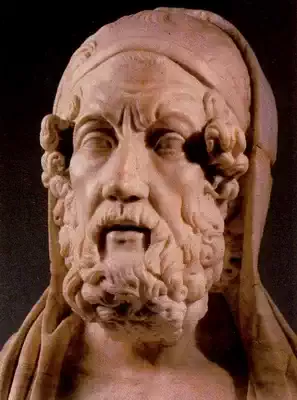
Homero
The Odyssey: Book 12
The Odyssey: Book 12
"After we were clear of the river Oceanus, and had got out into
the open sea, we went on till we reached the Aeaean island where there
is dawn and sunrise as in other places. We then drew our ship on to
the sands and got out of her on to the shore, where we went to sleep
and waited till day should break.
"Then, when the child of morning, rosy-fingered Dawn, appeared, I
sent some men to Circe's house to fetch the body of Elpenor. We cut
firewood from a wood where the headland jutted out into the sea, and
after we had wept over him and lamented him we performed his funeral
rites. When his body and armour had been burned to ashes, we raised
a cairn, set a stone over it, and at the top of the cairn we fixed the
oar that he had been used to row with.
"While we were doing all this, Circe, who knew that we had got
back from the house of Hades, dressed herself and came to us as fast
as she could; and her maid servants came with her bringing us bread,
meat, and wine. Then she stood in the midst of us and said, 'You
have done a bold thing in going down alive to the house of Hades,
and you will have died twice, to other people's once; now, then,
stay here for the rest of the day, feast your fill, and go on with
your voyage at daybreak tomorrow morning. In the meantime I will
tell Ulysses about your course, and will explain everything to him
so as to prevent your suffering from misadventure either by land or
sea.'
"We agreed to do as she had said, and feasted through the livelong
day to the going down of the sun, but when the sun had set and it came
on dark, the men laid themselves down to sleep by the stern cables
of the ship. Then Circe took me by the hand and bade me be seated away
from the others, while she reclined by my side and asked me all
about our adventures.
"'So far so good,' said she, when I had ended my story, 'and now pay
attention to what I am about to tell you- heaven itself, indeed,
will recall it to your recollection. First you will come to the Sirens
who enchant all who come near them. If any one unwarily draws in too
close and hears the singing of the Sirens, his wife and children
will never welcome him home again, for they sit in a green field and
warble him to death with the sweetness of their song. There is a great
heap of dead men's bones lying all around, with the flesh still
rotting off them. Therefore pass these Sirens by, and stop your
men's ears with wax that none of them may hear; but if you like you
can listen yourself, for you may get the men to bind you as you
stand upright on a cross-piece half way up the mast, and they must
lash the rope's ends to the mast itself, that you may have the
pleasure of listening. If you beg and pray the men to unloose you,
then they must bind you faster.
"'When your crew have taken you past these Sirens, I cannot give you
coherent directions as to which of two courses you are to take; I will
lay the two alternatives before you, and you must consider them for
yourself. On the one hand there are some overhanging rocks against
which the deep blue waves of Amphitrite beat with terrific fury; the
blessed gods call these rocks the Wanderers. Here not even a bird
may pass, no, not even the timid doves that bring ambrosia to Father
Jove, but the sheer rock always carries off one of them, and Father
Jove has to send another to make up their number; no ship that ever
yet came to these rocks has got away again, but the waves and
whirlwinds of fire are freighted with wreckage and with the bodies
of dead men. The only vessel that ever sailed and got through, was the
famous Argo on her way from the house of Aetes, and she too would have
gone against these great rocks, only that Juno piloted her past them
for the love she bore to Jason.
"'Of these two rocks the one reaches heaven and its peak is lost
in a dark cloud. This never leaves it, so that the top is never
clear not even in summer and early autumn. No man though he had twenty
hands and twenty feet could get a foothold on it and climb it, for
it runs sheer up, as smooth as though it had been polished. In the
middle of it there is a large cavern, looking West and turned
towards Erebus; you must take your ship this way, but the cave is so
high up that not even the stoutest archer could send an arrow into it.
Inside it Scylla sits and yelps with a voice that you might take to be
that of a young hound, but in truth she is a dreadful monster and no
one- not even a god- could face her without being terror-struck. She
has twelve mis-shapen feet, and six necks of the most prodigious
length; and at the end of each neck she has a frightful head with
three rows of teeth in each, all set very close together, so that they
would crunch any one to death in a moment, and she sits deep within
her shady cell thrusting out her heads and peering all round the rock,
fishing for dolphins or dogfish or any larger monster that she can
catch, of the thousands with which Amphitrite teems. No ship ever
yet got past her without losing some men, for she shoots out all her
heads at once, and carries off a man in each mouth.
"'You will find the other rocks lie lower, but they are so close
together that there is not more than a bowshot between them. [A
large fig tree in full leaf grows upon it], and under it lies the
sucking whirlpool of Charybdis. Three times in the day does she
vomit forth her waters, and three times she sucks them down again; see
that you be not there when she is sucking, for if you are, Neptune
himself could not save you; you must hug the Scylla side and drive
ship by as fast as you can, for you had better lose six men than
your whole crew.'
"'Is there no way,' said I, 'of escaping Charybdis, and at the
same time keeping Scylla off when she is trying to harm my men?'
"'You dare-devil,' replied the goddess, you are always wanting to
fight somebody or something; you will not let yourself be beaten
even by the immortals. For Scylla is not mortal; moreover she is
savage, extreme, rude, cruel and invincible. There is no help for
it; your best chance will be to get by her as fast as ever you can,
for if you dawdle about her rock while you are putting on your armour,
she may catch you with a second cast of her six heads, and snap up
another half dozen of your men; so drive your ship past her at full
speed, and roar out lustily to Crataiis who is Scylla's dam, bad
luck to her; she will then stop her from making a second raid upon
you.
"'You will now come to the Thrinacian island, and here you will
see many herds of cattle and flocks of sheep belonging to the sun-godseven
herds of cattle and seven flocks of sheep, with fifty head in
each flock. They do not breed, nor do they become fewer in number, and
they are tended by the goddesses Phaethusa and Lampetie, who are
children of the sun-god Hyperion by Neaera. Their mother when she
had borne them and had done suckling them sent them to the
Thrinacian island, which was a long way off, to live there and look
after their father's flocks and herds. If you leave these flocks
unharmed, and think of nothing but getting home, you may yet after
much hardship reach Ithaca; but if you harm them, then I forewarn
you of the destruction both of your ship and of your comrades; and
even though you may yourself escape, you will return late, in bad
plight, after losing all your men.'
"Here she ended, and dawn enthroned in gold began to show in heaven,
whereon she returned inland. I then went on board and told my men to
loose the ship from her moorings; so they at once got into her, took
their places, and began to smite the grey sea with their oars.
Presently the great and cunning goddess Circe befriended us with a
fair wind that blew dead aft, and stayed steadily with us, keeping our
sails well filled, so we did whatever wanted doing to the ship's gear,
and let her go as wind and helmsman headed her.
"Then, being much troubled in mind, I said to my men, 'My friends,
it is not right that one or two of us alone should know the prophecies
that Circe has made me, I will therefore tell you about them, so
that whether we live or die we may do so with our eyes open. First she
said we were to keep clear of the Sirens, who sit and sing most
beautifully in a field of flowers; but she said I might hear them
myself so long as no one else did. Therefore, take me and bind me to
the crosspiece half way up the mast; bind me as I stand upright,
with a bond so fast that I cannot possibly break away, and lash the
rope's ends to the mast itself. If I beg and pray you to set me
free, then bind me more tightly still.'
"I had hardly finished telling everything to the men before we
reached the island of the two Sirens, for the wind had been very
favourable. Then all of a sudden it fell dead calm; there was not a
breath of wind nor a ripple upon the water, so the men furled the
sails and stowed them; then taking to their oars they whitened the
water with the foam they raised in rowing. Meanwhile I look a large
wheel of wax and cut it up small with my sword. Then I kneaded the wax
in my strong hands till it became soft, which it soon did between
the kneading and the rays of the sun-god son of Hyperion. Then I
stopped the ears of all my men, and they bound me hands and feet to
the mast as I stood upright on the crosspiece; but they went on rowing
themselves. When we had got within earshot of the land, and the ship
was going at a good rate, the Sirens saw that we were getting in shore
and began with their singing.
"'Come here,' they sang, 'renowned Ulysses, honour to the Achaean
name, and listen to our two voices. No one ever sailed past us without
staying to hear the enchanting sweetness of our song- and he who
listens will go on his way not only charmed, but wiser, for we know
all the ills that the gods laid upon the Argives and Trojans before
Troy, and can tell you everything that is going to happen over the
whole world.'
"They sang these words most musically, and as I longed to hear
them further I made by frowning to my men that they should set me
free; but they quickened their stroke, and Eurylochus and Perimedes
bound me with still stronger bonds till we had got out of hearing of
the Sirens' voices. Then my men took the wax from their ears and
unbound me.
"Immediately after we had got past the island I saw a great wave
from which spray was rising, and I heard a loud roaring sound. The men
were so frightened that they loosed hold of their oars, for the
whole sea resounded with the rushing of the waters, but the ship
stayed where it was, for the men had left off rowing. I went round,
therefore, and exhorted them man by man not to lose heart.
"'My friends,' said I, 'this is not the first time that we have been
in danger, and we are in nothing like so bad a case as when the
Cyclops shut us up in his cave; nevertheless, my courage and wise
counsel saved us then, and we shall live to look back on all this as
well. Now, therefore, let us all do as I say, trust in Jove and row on
with might and main. As for you, coxswain, these are your orders;
attend to them, for the ship is in your hands; turn her head away from
these steaming rapids and hug the rock, or she will give you the
slip and be over yonder before you know where you are, and you will be
the death of us.'
"So they did as I told them; but I said nothing about the awful
monster Scylla, for I knew the men would not on rowing if I did, but
would huddle together in the hold. In one thing only did I disobey
Circe's strict instructions- I put on my armour. Then seizing two
strong spears I took my stand on the ship Is bows, for it was there
that I expected first to see the monster of the rock, who was to do my
men so much harm; but I could not make her out anywhere, though I
strained my eyes with looking the gloomy rock all over and over
"Then we entered the Straits in great fear of mind, for on the one
hand was Scylla, and on the other dread Charybdis kept sucking up
the salt water. As she vomited it up, it was like the water in a
cauldron when it is boiling over upon a great fire, and the spray
reached the top of the rocks on either side. When she began to suck
again, we could see the water all inside whirling round and round, and
it made a deafening sound as it broke against the rocks. We could
see the bottom of the whirlpool all black with sand and mud, and the
men were at their wit's ends for fear. While we were taken up with
this, and were expecting each moment to be our last, Scylla pounced
down suddenly upon us and snatched up my six best men. I was looking
at once after both ship and men, and in a moment I saw their hands and
feet ever so high above me, struggling in the air as Scylla was
carrying them off, and I heard them call out my name in one last
despairing cry. As a fisherman, seated, spear in hand, upon some
jutting rock throws bait into the water to deceive the poor little
fishes, and spears them with the ox's horn with which his spear is
shod, throwing them gasping on to the land as he catches them one by
one- even so did Scylla land these panting creatures on her rock and
munch them up at the mouth of her den, while they screamed and
stretched out their hands to me in their mortal agony. This was the
most sickening sight that I saw throughout all my voyages.
"When we had passed the [Wandering] rocks, with Scylla and
terrible Charybdis, we reached the noble island of the sun-god,
where were the goodly cattle and sheep belonging to the sun
Hyperion. While still at sea in my ship I could bear the cattle lowing
as they came home to the yards, and the sheep bleating. Then I
remembered what the blind Theban prophet Teiresias had told me, and
how carefully Aeaean Circe had warned me to shun the island of the
blessed sun-god. So being much troubled I said to the men, 'My men,
I know you are hard pressed, but listen while I tell you the
prophecy that Teiresias made me, and how carefully Aeaean Circe warned
me to shun the island of the blessed sun-god, for it was here, she
said, that our worst danger would lie. Head the ship, therefore,
away from the island.'
"The men were in despair at this, and Eurylochus at once gave me
an insolent answer. 'Ulysses,' said he, 'you are cruel; you are very
strong yourself and never get worn out; you seem to be made of iron,
and now, though your men are exhausted with toil and want of sleep,
you will not let them land and cook themselves a good supper upon this
island, but bid them put out to sea and go faring fruitlessly on
through the watches of the flying night. It is by night that the winds
blow hardest and do so much damage; how can we escape should one of
those sudden squalls spring up from South West or West, which so often
wreck a vessel when our lords the gods are unpropitious? Now,
therefore, let us obey the of night and prepare our supper here hard
by the ship; to-morrow morning we will go on board again and put out
to sea.'
"Thus spoke Eurylochus, and the men approved his words. I saw that
heaven meant us a mischief and said, 'You force me to yield, for you
are many against one, but at any rate each one of you must take his
solemn oath that if he meet with a herd of cattle or a large flock
of sheep, he will not be so mad as to kill a single head of either,
but will be satisfied with the food that Circe has given us.'
"They all swore as I bade them, and when they had completed their
oath we made the ship fast in a harbour that was near a stream of
fresh water, and the men went ashore and cooked their suppers. As soon
as they had had enough to eat and drink, they began talking about
their poor comrades whom Scylla had snatched up and eaten; this set
them weeping and they went on crying till they fell off into a sound
sleep.
"In the third watch of the night when the stars had shifted their
places, Jove raised a great gale of wind that flew a hurricane so that
land and sea were covered with thick clouds, and night sprang forth
out of the heavens. When the child of morning, rosy-fingered Dawn,
appeared, we brought the ship to land and drew her into a cave wherein
the sea-nymphs hold their courts and dances, and I called the men
together in council.
"'My friends,' said I, 'we have meat and drink in the ship, let us
mind, therefore, and not touch the cattle, or we shall suffer for
it; for these cattle and sheep belong to the mighty sun, who sees
and gives ear to everything. And again they promised that they would
obey.
"For a whole month the wind blew steadily from the South, and
there was no other wind, but only South and East. As long as corn
and wine held out the men did not touch the cattle when they were
hungry; when, however, they had eaten all there was in the ship,
they were forced to go further afield, with hook and line, catching
birds, and taking whatever they could lay their hands on; for they
were starving. One day, therefore, I went up inland that I might
pray heaven to show me some means of getting away. When I had gone far
enough to be clear of all my men, and had found a place that was
well sheltered from the wind, I washed my hands and prayed to all
the gods in Olympus till by and by they sent me off into a sweet
sleep.
"Meanwhile Eurylochus had been giving evil counsel to the men,
'Listen to me,' said he, 'my poor comrades. All deaths are bad
enough but there is none so bad as famine. Why should not we drive
in the best of these cows and offer them in sacrifice to the
immortal Rods? If we ever get back to Ithaca, we can build a fine
temple to the sun-god and enrich it with every kind of ornament; if,
however, he is determined to sink our ship out of revenge for these
homed cattle, and the other gods are of the same mind, I for one would
rather drink salt water once for all and have done with it, than be
starved to death by inches in such a desert island as this is.'
"Thus spoke Eurylochus, and the men approved his words. Now the
cattle, so fair and goodly, were feeding not far from the ship; the
men, therefore drove in the best of them, and they all stood round
them saying their prayers, and using young oak-shoots instead of
barley-meal, for there was no barley left. When they had done
praying they killed the cows and dressed their carcasses; they cut out
the thigh bones, wrapped them round in two layers of fat, and set some
pieces of raw meat on top of them. They had no wine with which to make
drink-offerings over the sacrifice while it was cooking, so they
kept pouring on a little water from time to time while the inward
meats were being grilled; then, when the thigh bones were burned and
they had tasted the inward meats, they cut the rest up small and put
the pieces upon the spits.
"By this time my deep sleep had left me, and I turned back to the
ship and to the sea shore. As I drew near I began to smell hot roast
meat, so I groaned out a prayer to the immortal gods. 'Father Jove,' I
exclaimed, 'and all you other gods who live in everlasting bliss,
you have done me a cruel mischief by the sleep into which you have
sent me; see what fine work these men of mine have been making in my
absence.'
"Meanwhile Lampetie went straight off to the sun and told him we had
been killing his cows, whereon he flew into a great rage, and said
to the immortals, 'Father Jove, and all you other gods who live in
everlasting bliss, I must have vengeance on the crew of Ulysses' ship:
they have had the insolence to kill my cows, which were the one
thing I loved to look upon, whether I was going up heaven or down
again. If they do not square accounts with me about my cows, I will go
down to Hades and shine there among the dead.'
"'Sun,' said Jove, 'go on shining upon us gods and upon mankind over
the fruitful earth. I will shiver their ship into little pieces with a
bolt of white lightning as soon as they get out to sea.'
"I was told all this by Calypso, who said she had heard it from
the mouth of Mercury.
"As soon as I got down to my ship and to the sea shore I rebuked
each one of the men separately, but we could see no way out of it, for
the cows were dead already. And indeed the gods began at once to
show signs and wonders among us, for the hides of the cattle crawled
about, and the joints upon the spits began to low like cows, and the
meat, whether cooked or raw, kept on making a noise just as cows do.
"For six days my men kept driving in the best cows and feasting upon
them, but when Jove the son of Saturn had added a seventh day, the
fury of the gale abated; we therefore went on board, raised our masts,
spread sail, and put out to sea. As soon as we were well away from the
island, and could see nothing but sky and sea, the son of Saturn
raised a black cloud over our ship, and the sea grew dark beneath
it. We not get on much further, for in another moment we were caught
by a terrific squall from the West that snapped the forestays of the
mast so that it fell aft, while all the ship's gear tumbled about at
the bottom of the vessel. The mast fell upon the head of the
helmsman in the ship's stern, so that the bones of his head were
crushed to pieces, and he fell overboard as though he were diving,
with no more life left in him.
"Then Jove let fly with his thunderbolts, and the ship went round
and round, and was filled with fire and brimstone as the lightning
struck it. The men all fell into the sea; they were carried about in
the water round the ship, looking like so many sea-gulls, but the
god presently deprived them of all chance of getting home again.
"I stuck to the ship till the sea knocked her sides from her keel
(which drifted about by itself) and struck the mast out of her in
the direction of the keel; but there was a backstay of stout
ox-thong still hanging about it, and with this I lashed the mast and
keel together, and getting astride of them was carried wherever the
winds chose to take me.
"[The gale from the West had now spent its force, and the wind got
into the South again, which frightened me lest I should be taken
back to the terrible whirlpool of Charybdis. This indeed was what
actually happened, for I was borne along by the waves all night, and
by sunrise had reacfied the rock of Scylla, and the whirlpool. She was
then sucking down the salt sea water, but I was carried aloft toward
the fig tree, which I caught hold of and clung on to like a bat. I
could not plant my feet anywhere so as to stand securely, for the
roots were a long way off and the boughs that overshadowed the whole
pool were too high, too vast, and too far apart for me to reach
them; so I hung patiently on, waiting till the pool should discharge
my mast and raft again- and a very long while it seemed. A juryman
is not more glad to get home to supper, after having been long
detained in court by troublesome cases, than I was to see my raft
beginning to work its way out of the whirlpool again. At last I let go
with my hands and feet, and fell heavily into the sea, bard by my raft
on to which I then got, and began to row with my hands. As for Scylla,
the father of gods and men would not let her get further sight of
me- otherwise I should have certainly been lost.]
"Hence I was carried along for nine days till on the tenth night the
gods stranded me on the Ogygian island, where dwells the great and
powerful goddess Calypso. She took me in and was kind to me, but I
need say no more about this, for I told you and your noble wife all
about it yesterday, and I hate saying the same thing over and over
again."
Translated by Samuel Butler
"After we were clear of the river Oceanus, and had got out into
the open sea, we went on till we reached the Aeaean island where there
is dawn and sunrise as in other places. We then drew our ship on to
the sands and got out of her on to the shore, where we went to sleep
and waited till day should break.
"Then, when the child of morning, rosy-fingered Dawn, appeared, I
sent some men to Circe's house to fetch the body of Elpenor. We cut
firewood from a wood where the headland jutted out into the sea, and
after we had wept over him and lamented him we performed his funeral
rites. When his body and armour had been burned to ashes, we raised
a cairn, set a stone over it, and at the top of the cairn we fixed the
oar that he had been used to row with.
"While we were doing all this, Circe, who knew that we had got
back from the house of Hades, dressed herself and came to us as fast
as she could; and her maid servants came with her bringing us bread,
meat, and wine. Then she stood in the midst of us and said, 'You
have done a bold thing in going down alive to the house of Hades,
and you will have died twice, to other people's once; now, then,
stay here for the rest of the day, feast your fill, and go on with
your voyage at daybreak tomorrow morning. In the meantime I will
tell Ulysses about your course, and will explain everything to him
so as to prevent your suffering from misadventure either by land or
sea.'
"We agreed to do as she had said, and feasted through the livelong
day to the going down of the sun, but when the sun had set and it came
on dark, the men laid themselves down to sleep by the stern cables
of the ship. Then Circe took me by the hand and bade me be seated away
from the others, while she reclined by my side and asked me all
about our adventures.
"'So far so good,' said she, when I had ended my story, 'and now pay
attention to what I am about to tell you- heaven itself, indeed,
will recall it to your recollection. First you will come to the Sirens
who enchant all who come near them. If any one unwarily draws in too
close and hears the singing of the Sirens, his wife and children
will never welcome him home again, for they sit in a green field and
warble him to death with the sweetness of their song. There is a great
heap of dead men's bones lying all around, with the flesh still
rotting off them. Therefore pass these Sirens by, and stop your
men's ears with wax that none of them may hear; but if you like you
can listen yourself, for you may get the men to bind you as you
stand upright on a cross-piece half way up the mast, and they must
lash the rope's ends to the mast itself, that you may have the
pleasure of listening. If you beg and pray the men to unloose you,
then they must bind you faster.
"'When your crew have taken you past these Sirens, I cannot give you
coherent directions as to which of two courses you are to take; I will
lay the two alternatives before you, and you must consider them for
yourself. On the one hand there are some overhanging rocks against
which the deep blue waves of Amphitrite beat with terrific fury; the
blessed gods call these rocks the Wanderers. Here not even a bird
may pass, no, not even the timid doves that bring ambrosia to Father
Jove, but the sheer rock always carries off one of them, and Father
Jove has to send another to make up their number; no ship that ever
yet came to these rocks has got away again, but the waves and
whirlwinds of fire are freighted with wreckage and with the bodies
of dead men. The only vessel that ever sailed and got through, was the
famous Argo on her way from the house of Aetes, and she too would have
gone against these great rocks, only that Juno piloted her past them
for the love she bore to Jason.
"'Of these two rocks the one reaches heaven and its peak is lost
in a dark cloud. This never leaves it, so that the top is never
clear not even in summer and early autumn. No man though he had twenty
hands and twenty feet could get a foothold on it and climb it, for
it runs sheer up, as smooth as though it had been polished. In the
middle of it there is a large cavern, looking West and turned
towards Erebus; you must take your ship this way, but the cave is so
high up that not even the stoutest archer could send an arrow into it.
Inside it Scylla sits and yelps with a voice that you might take to be
that of a young hound, but in truth she is a dreadful monster and no
one- not even a god- could face her without being terror-struck. She
has twelve mis-shapen feet, and six necks of the most prodigious
length; and at the end of each neck she has a frightful head with
three rows of teeth in each, all set very close together, so that they
would crunch any one to death in a moment, and she sits deep within
her shady cell thrusting out her heads and peering all round the rock,
fishing for dolphins or dogfish or any larger monster that she can
catch, of the thousands with which Amphitrite teems. No ship ever
yet got past her without losing some men, for she shoots out all her
heads at once, and carries off a man in each mouth.
"'You will find the other rocks lie lower, but they are so close
together that there is not more than a bowshot between them. [A
large fig tree in full leaf grows upon it], and under it lies the
sucking whirlpool of Charybdis. Three times in the day does she
vomit forth her waters, and three times she sucks them down again; see
that you be not there when she is sucking, for if you are, Neptune
himself could not save you; you must hug the Scylla side and drive
ship by as fast as you can, for you had better lose six men than
your whole crew.'
"'Is there no way,' said I, 'of escaping Charybdis, and at the
same time keeping Scylla off when she is trying to harm my men?'
"'You dare-devil,' replied the goddess, you are always wanting to
fight somebody or something; you will not let yourself be beaten
even by the immortals. For Scylla is not mortal; moreover she is
savage, extreme, rude, cruel and invincible. There is no help for
it; your best chance will be to get by her as fast as ever you can,
for if you dawdle about her rock while you are putting on your armour,
she may catch you with a second cast of her six heads, and snap up
another half dozen of your men; so drive your ship past her at full
speed, and roar out lustily to Crataiis who is Scylla's dam, bad
luck to her; she will then stop her from making a second raid upon
you.
"'You will now come to the Thrinacian island, and here you will
see many herds of cattle and flocks of sheep belonging to the sun-godseven
herds of cattle and seven flocks of sheep, with fifty head in
each flock. They do not breed, nor do they become fewer in number, and
they are tended by the goddesses Phaethusa and Lampetie, who are
children of the sun-god Hyperion by Neaera. Their mother when she
had borne them and had done suckling them sent them to the
Thrinacian island, which was a long way off, to live there and look
after their father's flocks and herds. If you leave these flocks
unharmed, and think of nothing but getting home, you may yet after
much hardship reach Ithaca; but if you harm them, then I forewarn
you of the destruction both of your ship and of your comrades; and
even though you may yourself escape, you will return late, in bad
plight, after losing all your men.'
"Here she ended, and dawn enthroned in gold began to show in heaven,
whereon she returned inland. I then went on board and told my men to
loose the ship from her moorings; so they at once got into her, took
their places, and began to smite the grey sea with their oars.
Presently the great and cunning goddess Circe befriended us with a
fair wind that blew dead aft, and stayed steadily with us, keeping our
sails well filled, so we did whatever wanted doing to the ship's gear,
and let her go as wind and helmsman headed her.
"Then, being much troubled in mind, I said to my men, 'My friends,
it is not right that one or two of us alone should know the prophecies
that Circe has made me, I will therefore tell you about them, so
that whether we live or die we may do so with our eyes open. First she
said we were to keep clear of the Sirens, who sit and sing most
beautifully in a field of flowers; but she said I might hear them
myself so long as no one else did. Therefore, take me and bind me to
the crosspiece half way up the mast; bind me as I stand upright,
with a bond so fast that I cannot possibly break away, and lash the
rope's ends to the mast itself. If I beg and pray you to set me
free, then bind me more tightly still.'
"I had hardly finished telling everything to the men before we
reached the island of the two Sirens, for the wind had been very
favourable. Then all of a sudden it fell dead calm; there was not a
breath of wind nor a ripple upon the water, so the men furled the
sails and stowed them; then taking to their oars they whitened the
water with the foam they raised in rowing. Meanwhile I look a large
wheel of wax and cut it up small with my sword. Then I kneaded the wax
in my strong hands till it became soft, which it soon did between
the kneading and the rays of the sun-god son of Hyperion. Then I
stopped the ears of all my men, and they bound me hands and feet to
the mast as I stood upright on the crosspiece; but they went on rowing
themselves. When we had got within earshot of the land, and the ship
was going at a good rate, the Sirens saw that we were getting in shore
and began with their singing.
"'Come here,' they sang, 'renowned Ulysses, honour to the Achaean
name, and listen to our two voices. No one ever sailed past us without
staying to hear the enchanting sweetness of our song- and he who
listens will go on his way not only charmed, but wiser, for we know
all the ills that the gods laid upon the Argives and Trojans before
Troy, and can tell you everything that is going to happen over the
whole world.'
"They sang these words most musically, and as I longed to hear
them further I made by frowning to my men that they should set me
free; but they quickened their stroke, and Eurylochus and Perimedes
bound me with still stronger bonds till we had got out of hearing of
the Sirens' voices. Then my men took the wax from their ears and
unbound me.
"Immediately after we had got past the island I saw a great wave
from which spray was rising, and I heard a loud roaring sound. The men
were so frightened that they loosed hold of their oars, for the
whole sea resounded with the rushing of the waters, but the ship
stayed where it was, for the men had left off rowing. I went round,
therefore, and exhorted them man by man not to lose heart.
"'My friends,' said I, 'this is not the first time that we have been
in danger, and we are in nothing like so bad a case as when the
Cyclops shut us up in his cave; nevertheless, my courage and wise
counsel saved us then, and we shall live to look back on all this as
well. Now, therefore, let us all do as I say, trust in Jove and row on
with might and main. As for you, coxswain, these are your orders;
attend to them, for the ship is in your hands; turn her head away from
these steaming rapids and hug the rock, or she will give you the
slip and be over yonder before you know where you are, and you will be
the death of us.'
"So they did as I told them; but I said nothing about the awful
monster Scylla, for I knew the men would not on rowing if I did, but
would huddle together in the hold. In one thing only did I disobey
Circe's strict instructions- I put on my armour. Then seizing two
strong spears I took my stand on the ship Is bows, for it was there
that I expected first to see the monster of the rock, who was to do my
men so much harm; but I could not make her out anywhere, though I
strained my eyes with looking the gloomy rock all over and over
"Then we entered the Straits in great fear of mind, for on the one
hand was Scylla, and on the other dread Charybdis kept sucking up
the salt water. As she vomited it up, it was like the water in a
cauldron when it is boiling over upon a great fire, and the spray
reached the top of the rocks on either side. When she began to suck
again, we could see the water all inside whirling round and round, and
it made a deafening sound as it broke against the rocks. We could
see the bottom of the whirlpool all black with sand and mud, and the
men were at their wit's ends for fear. While we were taken up with
this, and were expecting each moment to be our last, Scylla pounced
down suddenly upon us and snatched up my six best men. I was looking
at once after both ship and men, and in a moment I saw their hands and
feet ever so high above me, struggling in the air as Scylla was
carrying them off, and I heard them call out my name in one last
despairing cry. As a fisherman, seated, spear in hand, upon some
jutting rock throws bait into the water to deceive the poor little
fishes, and spears them with the ox's horn with which his spear is
shod, throwing them gasping on to the land as he catches them one by
one- even so did Scylla land these panting creatures on her rock and
munch them up at the mouth of her den, while they screamed and
stretched out their hands to me in their mortal agony. This was the
most sickening sight that I saw throughout all my voyages.
"When we had passed the [Wandering] rocks, with Scylla and
terrible Charybdis, we reached the noble island of the sun-god,
where were the goodly cattle and sheep belonging to the sun
Hyperion. While still at sea in my ship I could bear the cattle lowing
as they came home to the yards, and the sheep bleating. Then I
remembered what the blind Theban prophet Teiresias had told me, and
how carefully Aeaean Circe had warned me to shun the island of the
blessed sun-god. So being much troubled I said to the men, 'My men,
I know you are hard pressed, but listen while I tell you the
prophecy that Teiresias made me, and how carefully Aeaean Circe warned
me to shun the island of the blessed sun-god, for it was here, she
said, that our worst danger would lie. Head the ship, therefore,
away from the island.'
"The men were in despair at this, and Eurylochus at once gave me
an insolent answer. 'Ulysses,' said he, 'you are cruel; you are very
strong yourself and never get worn out; you seem to be made of iron,
and now, though your men are exhausted with toil and want of sleep,
you will not let them land and cook themselves a good supper upon this
island, but bid them put out to sea and go faring fruitlessly on
through the watches of the flying night. It is by night that the winds
blow hardest and do so much damage; how can we escape should one of
those sudden squalls spring up from South West or West, which so often
wreck a vessel when our lords the gods are unpropitious? Now,
therefore, let us obey the of night and prepare our supper here hard
by the ship; to-morrow morning we will go on board again and put out
to sea.'
"Thus spoke Eurylochus, and the men approved his words. I saw that
heaven meant us a mischief and said, 'You force me to yield, for you
are many against one, but at any rate each one of you must take his
solemn oath that if he meet with a herd of cattle or a large flock
of sheep, he will not be so mad as to kill a single head of either,
but will be satisfied with the food that Circe has given us.'
"They all swore as I bade them, and when they had completed their
oath we made the ship fast in a harbour that was near a stream of
fresh water, and the men went ashore and cooked their suppers. As soon
as they had had enough to eat and drink, they began talking about
their poor comrades whom Scylla had snatched up and eaten; this set
them weeping and they went on crying till they fell off into a sound
sleep.
"In the third watch of the night when the stars had shifted their
places, Jove raised a great gale of wind that flew a hurricane so that
land and sea were covered with thick clouds, and night sprang forth
out of the heavens. When the child of morning, rosy-fingered Dawn,
appeared, we brought the ship to land and drew her into a cave wherein
the sea-nymphs hold their courts and dances, and I called the men
together in council.
"'My friends,' said I, 'we have meat and drink in the ship, let us
mind, therefore, and not touch the cattle, or we shall suffer for
it; for these cattle and sheep belong to the mighty sun, who sees
and gives ear to everything. And again they promised that they would
obey.
"For a whole month the wind blew steadily from the South, and
there was no other wind, but only South and East. As long as corn
and wine held out the men did not touch the cattle when they were
hungry; when, however, they had eaten all there was in the ship,
they were forced to go further afield, with hook and line, catching
birds, and taking whatever they could lay their hands on; for they
were starving. One day, therefore, I went up inland that I might
pray heaven to show me some means of getting away. When I had gone far
enough to be clear of all my men, and had found a place that was
well sheltered from the wind, I washed my hands and prayed to all
the gods in Olympus till by and by they sent me off into a sweet
sleep.
"Meanwhile Eurylochus had been giving evil counsel to the men,
'Listen to me,' said he, 'my poor comrades. All deaths are bad
enough but there is none so bad as famine. Why should not we drive
in the best of these cows and offer them in sacrifice to the
immortal Rods? If we ever get back to Ithaca, we can build a fine
temple to the sun-god and enrich it with every kind of ornament; if,
however, he is determined to sink our ship out of revenge for these
homed cattle, and the other gods are of the same mind, I for one would
rather drink salt water once for all and have done with it, than be
starved to death by inches in such a desert island as this is.'
"Thus spoke Eurylochus, and the men approved his words. Now the
cattle, so fair and goodly, were feeding not far from the ship; the
men, therefore drove in the best of them, and they all stood round
them saying their prayers, and using young oak-shoots instead of
barley-meal, for there was no barley left. When they had done
praying they killed the cows and dressed their carcasses; they cut out
the thigh bones, wrapped them round in two layers of fat, and set some
pieces of raw meat on top of them. They had no wine with which to make
drink-offerings over the sacrifice while it was cooking, so they
kept pouring on a little water from time to time while the inward
meats were being grilled; then, when the thigh bones were burned and
they had tasted the inward meats, they cut the rest up small and put
the pieces upon the spits.
"By this time my deep sleep had left me, and I turned back to the
ship and to the sea shore. As I drew near I began to smell hot roast
meat, so I groaned out a prayer to the immortal gods. 'Father Jove,' I
exclaimed, 'and all you other gods who live in everlasting bliss,
you have done me a cruel mischief by the sleep into which you have
sent me; see what fine work these men of mine have been making in my
absence.'
"Meanwhile Lampetie went straight off to the sun and told him we had
been killing his cows, whereon he flew into a great rage, and said
to the immortals, 'Father Jove, and all you other gods who live in
everlasting bliss, I must have vengeance on the crew of Ulysses' ship:
they have had the insolence to kill my cows, which were the one
thing I loved to look upon, whether I was going up heaven or down
again. If they do not square accounts with me about my cows, I will go
down to Hades and shine there among the dead.'
"'Sun,' said Jove, 'go on shining upon us gods and upon mankind over
the fruitful earth. I will shiver their ship into little pieces with a
bolt of white lightning as soon as they get out to sea.'
"I was told all this by Calypso, who said she had heard it from
the mouth of Mercury.
"As soon as I got down to my ship and to the sea shore I rebuked
each one of the men separately, but we could see no way out of it, for
the cows were dead already. And indeed the gods began at once to
show signs and wonders among us, for the hides of the cattle crawled
about, and the joints upon the spits began to low like cows, and the
meat, whether cooked or raw, kept on making a noise just as cows do.
"For six days my men kept driving in the best cows and feasting upon
them, but when Jove the son of Saturn had added a seventh day, the
fury of the gale abated; we therefore went on board, raised our masts,
spread sail, and put out to sea. As soon as we were well away from the
island, and could see nothing but sky and sea, the son of Saturn
raised a black cloud over our ship, and the sea grew dark beneath
it. We not get on much further, for in another moment we were caught
by a terrific squall from the West that snapped the forestays of the
mast so that it fell aft, while all the ship's gear tumbled about at
the bottom of the vessel. The mast fell upon the head of the
helmsman in the ship's stern, so that the bones of his head were
crushed to pieces, and he fell overboard as though he were diving,
with no more life left in him.
"Then Jove let fly with his thunderbolts, and the ship went round
and round, and was filled with fire and brimstone as the lightning
struck it. The men all fell into the sea; they were carried about in
the water round the ship, looking like so many sea-gulls, but the
god presently deprived them of all chance of getting home again.
"I stuck to the ship till the sea knocked her sides from her keel
(which drifted about by itself) and struck the mast out of her in
the direction of the keel; but there was a backstay of stout
ox-thong still hanging about it, and with this I lashed the mast and
keel together, and getting astride of them was carried wherever the
winds chose to take me.
"[The gale from the West had now spent its force, and the wind got
into the South again, which frightened me lest I should be taken
back to the terrible whirlpool of Charybdis. This indeed was what
actually happened, for I was borne along by the waves all night, and
by sunrise had reacfied the rock of Scylla, and the whirlpool. She was
then sucking down the salt sea water, but I was carried aloft toward
the fig tree, which I caught hold of and clung on to like a bat. I
could not plant my feet anywhere so as to stand securely, for the
roots were a long way off and the boughs that overshadowed the whole
pool were too high, too vast, and too far apart for me to reach
them; so I hung patiently on, waiting till the pool should discharge
my mast and raft again- and a very long while it seemed. A juryman
is not more glad to get home to supper, after having been long
detained in court by troublesome cases, than I was to see my raft
beginning to work its way out of the whirlpool again. At last I let go
with my hands and feet, and fell heavily into the sea, bard by my raft
on to which I then got, and began to row with my hands. As for Scylla,
the father of gods and men would not let her get further sight of
me- otherwise I should have certainly been lost.]
"Hence I was carried along for nine days till on the tenth night the
gods stranded me on the Ogygian island, where dwells the great and
powerful goddess Calypso. She took me in and was kind to me, but I
need say no more about this, for I told you and your noble wife all
about it yesterday, and I hate saying the same thing over and over
again."
Translated by Samuel Butler
130
Homero
The Odyssey: Book 10
The Odyssey: Book 10
Thence we went on to the Aeoli island where lives Aeolus son of
Hippotas, dear to the immortal gods. It is an island that floats (as
it were) upon the sea, iron bound with a wall that girds it. Now,
Aeolus has six daughters and six lusty sons, so he made the sons marry
the daughters, and they all live with their dear father and mother,
feasting and enjoying every conceivable kind of luxury. All day long
the atmosphere of the house is loaded with the savour of roasting
meats till it groans again, yard and all; but by night they sleep on
their well-made bedsteads, each with his own wife between the
blankets. These were the people among whom we had now come.
"Aeolus entertained me for a whole month asking me questions all the
time about Troy, the Argive fleet, and the return of the Achaeans. I
told him exactly how everything had happened, and when I said I must
go, and asked him to further me on my way, he made no sort of
difficulty, but set about doing so at once. Moreover, he flayed me a
prime ox-hide to hold the ways of the roaring winds, which he shut
up in the hide as in a sack- for Jove had made him captain over the
winds, and he could stir or still each one of them according to his
own pleasure. He put the sack in the ship and bound the mouth so
tightly with a silver thread that not even a breath of a side-wind
could blow from any quarter. The West wind which was fair for us did
he alone let blow as it chose; but it all came to nothing, for we were
lost through our own folly.
"Nine days and nine nights did we sail, and on the tenth day our
native land showed on the horizon. We got so close in that we could
see the stubble fires burning, and I, being then dead beat, fell
into a light sleep, for I had never let the rudder out of my own
hands, that we might get home the faster. On this the men fell to
talking among themselves, and said I was bringing back gold and silver
in the sack that Aeolus had given me. 'Bless my heart,' would one turn
to his neighbour, saying, 'how this man gets honoured and makes
friends to whatever city or country he may go. See what fine prizes he
is taking home from Troy, while we, who have travelled just as far
as he has, come back with hands as empty as we set out with- and now
Aeolus has given him ever so much more. Quick- let us see what it
all is, and how much gold and silver there is in the sack he gave
him.'
"Thus they talked and evil counsels prevailed. They loosed the sack,
whereupon the wind flew howling forth and raised a storm that
carried us weeping out to sea and away from our own country. Then I
awoke, and knew not whether to throw myself into the sea or to live on
and make the best of it; but I bore it, covered myself up, and lay
down in the ship, while the men lamented bitterly as the fierce
winds bore our fleet back to the Aeolian island.
"When we reached it we went ashore to take in water, and dined
hard by the ships. Immediately after dinner I took a herald and one of
my men and went straight to the house of Aeolus, where I found him
feasting with his wife and family; so we sat down as suppliants on the
threshold. They were astounded when they saw us and said, 'Ulysses,
what brings you here? What god has been ill-treating you? We took
great pains to further you on your way home to Ithaca, or wherever
it was that you wanted to go to.'
"Thus did they speak, but I answered sorrowfully, 'My men have
undone me; they, and cruel sleep, have ruined me. My friends, mend
me this mischief, for you can if you will.'
"I spoke as movingly as I could, but they said nothing, till their
father answered, 'Vilest of mankind, get you gone at once out of the
island; him whom heaven hates will I in no wise help. Be off, for
you come here as one abhorred of heaven. "And with these words he sent
me sorrowing from his door.
"Thence we sailed sadly on till the men were worn out with long
and fruitless rowing, for there was no longer any wind to help them.
Six days, night and day did we toil, and on the seventh day we reached
the rocky stronghold of Lamus- Telepylus, the city of the
Laestrygonians, where the shepherd who is driving in his sheep and
goats [to be milked] salutes him who is driving out his flock [to
feed] and this last answers the salute. In that country a man who
could do without sleep might earn double wages, one as a herdsman of
cattle, and another as a shepherd, for they work much the same by
night as they do by day.
"When we reached the harbour we found it land-locked under steep
cliffs, with a narrow entrance between two headlands. My captains took
all their ships inside, and made them fast close to one another, for
there was never so much as a breath of wind inside, but it was
always dead calm. I kept my own ship outside, and moored it to a
rock at the very end of the point; then I climbed a high rock to
reconnoitre, but could see no sign neither of man nor cattle, only
some smoke rising from the ground. So I sent two of my company with an
attendant to find out what sort of people the inhabitants were.
"The men when they got on shore followed a level road by which the
people draw their firewood from the mountains into the town, till
presently they met a young woman who had come outside to fetch
water, and who was daughter to a Laestrygonian named Antiphates. She
was going to the fountain Artacia from which the people bring in their
water, and when my men had come close up to her, they asked her who
the king of that country might be, and over what kind of people he
ruled; so she directed them to her father's house, but when they got
there they found his wife to be a giantess as huge as a mountain,
and they were horrified at the sight of her.
"She at once called her husband Antiphates from the place of
assembly, and forthwith he set about killing my men. He snatched up
one of them, and began to make his dinner off him then and there,
whereon the other two ran back to the ships as fast as ever they
could. But Antiphates raised a hue and cry after them, and thousands
of sturdy Laestrygonians sprang up from every quarter- ogres, not men.
They threw vast rocks at us from the cliffs as though they had been
mere stones, and I heard the horrid sound of the ships crunching up
against one another, and the death cries of my men, as the
Laestrygonians speared them like fishes and took them home to eat
them. While they were thus killing my men within the harbour I drew my
sword, cut the cable of my own ship, and told my men to row with alf
their might if they too would not fare like the rest; so they laid out
for their lives, and we were thankful enough when we got into open
water out of reach of the rocks they hurled at us. As for the others
there was not one of them left.
"Thence we sailed sadly on, glad to have escaped death, though we
had lost our comrades, and came to the Aeaean island, where Circe
lives a great and cunning goddess who is own sister to the magician
Aeetes- for they are both children of the sun by Perse, who is
daughter to Oceanus. We brought our ship into a safe harbour without a
word, for some god guided us thither, and having landed we there for
two days and two nights, worn out in body and mind. When the morning
of the third day came I took my spear and my sword, and went away from
the ship to reconnoitre, and see if I could discover signs of human
handiwork, or hear the sound of voices. Climbing to the top of a
high look-out I espied the smoke of Circe's house rising upwards
amid a dense forest of trees, and when I saw this I doubted whether,
having seen the smoke, I would not go on at once and find out more,
but in the end I deemed it best to go back to the ship, give the men
their dinners, and send some of them instead of going myself.
"When I had nearly got back to the ship some god took pity upon my
solitude, and sent a fine antlered stag right into the middle of my
path. He was coming down his pasture in the forest to drink of the
river, for the heat of the sun drove him, and as he passed I struck
him in the middle of the back; the bronze point of the spear went
clean through him, and he lay groaning in the dust until the life went
out of him. Then I set my foot upon him, drew my spear from the wound,
and laid it down; I also gathered rough grass and rushes and twisted
them into a fathom or so of good stout rope, with which I bound the
four feet of the noble creature together; having so done I hung him
round my neck and walked back to the ship leaning upon my spear, for
the stag was much too big for me to be able to carry him on my
shoulder, steadying him with one hand. As I threw him down in front of
the ship, I called the men and spoke cheeringly man by man to each
of them. 'Look here my friends,' said I, 'we are not going to die so
much before our time after all, and at any rate we will not starve
so long as we have got something to eat and drink on board.' On this
they uncovered their heads upon the sea shore and admired the stag,
for he was indeed a splendid fellow. Then, when they had feasted their
eyes upon him sufficiently, they washed their hands and began to
cook him for dinner.
"Thus through the livelong day to the going down of the sun we
stayed there eating and drinking our fill, but when the sun went
down and it came on dark, we camped upon the sea shore. When the child
of morning, fingered Dawn, appeared, I called a council and said,
'My friends, we are in very great difficulties; listen therefore to
me. We have no idea where the sun either sets or rises, so that we
do not even know East from West. I see no way out of it; nevertheless,
we must try and find one. We are certainly on an island, for I went as
high as I could this morning, and saw the sea reaching all round it to
the horizon; it lies low, but towards the middle I saw smoke rising
from out of a thick forest of trees.'
"Their hearts sank as they heard me, for they remembered how they
had been treated by the Laestrygonian Antiphates, and by the savage
ogre Polyphemus. They wept bitterly in their dismay, but there was
nothing to be got by crying, so I divided them into two companies
and set a captain over each; I gave one company to Eurylochus, while I
took command of the other myself. Then we cast lots in a helmet, and
the lot fell upon Eurylochus; so he set out with his twenty-two men,
and they wept, as also did we who were left behind.
"When they reached Circe's house they found it built of cut
stones, on a site that could be seen from far, in the middle of the
forest. There were wild mountain wolves and lions prowling all round
it- poor bewitched creatures whom she had tamed by her enchantments
and drugged into subjection. They did not attack my men, but wagged
their great tails, fawned upon them, and rubbed their noses lovingly
against them. As hounds crowd round their master when they see him
coming from dinner- for they know he will bring them something- even
so did these wolves and lions with their great claws fawn upon my men,
but the men were terribly frightened at seeing such strange creatures.
Presently they reached the gates of the goddess's house, and as they
stood there they could hear Circe within, singing most beautifully
as she worked at her loom, making a web so fine, so soft, and of
such dazzling colours as no one but a goddess could weave. On this
Polites, whom I valued and trusted more than any other of my men,
said, 'There is some one inside working at a loom and singing most
beautifully; the whole place resounds with it, let us call her and see
whether she is woman or goddess.'
"They called her and she came down, unfastened the door, and bade
them enter. They, thinking no evil, followed her, all except
Eurylochus, who suspected mischief and stayed outside. When she had
got them into her house, she set them upon benches and seats and mixed
them a mess with cheese, honey, meal, and Pramnian but she drugged
it with wicked poisons to make them forget their homes, and when
they had drunk she turned them into pigs by a stroke of her wand,
and shut them up in her pigsties. They were like pigs-head, hair,
and all, and they grunted just as pigs do; but their senses were the
same as before, and they remembered everything.
"Thus then were they shut up squealing, and Circe threw them some
acorns and beech masts such as pigs eat, but Eurylochus hurried back
to tell me about the sad fate of our comrades. He was so overcome with
dismay that though he tried to speak he could find no words to do
so; his eyes filled with tears and he could only sob and sigh, till at
last we forced his story out of him, and he told us what had
happened to the others.
"'We went,' said he, as you told us, through the forest, and in
the middle of it there was a fine house built with cut stones in a
place that could be seen from far. There we found a woman, or else she
was a goddess, working at her loom and singing sweetly; so the men
shouted to her and called her, whereon she at once came down, opened
the door, and invited us in. The others did not suspect any mischief
so they followed her into the house, but I stayed where I was, for I
thought there might be some treachery. From that moment I saw them
no more, for not one of them ever came out, though I sat a long time
watching for them.'
"Then I took my sword of bronze and slung it over my shoulders; I
also took my bow, and told Eurylochus to come back with me and show me
the way. But he laid hold of me with both his hands and spoke
piteously, saying, 'Sir, do not force me to go with you, but let me
stay here, for I know you will not bring one of them back with you,
nor even return alive yourself; let us rather see if we cannot
escape at any rate with the few that are left us, for we may still
save our lives.'
"'Stay where you are, then, 'answered I, 'eating and drinking at the
ship, but I must go, for I am most urgently bound to do so.'
"With this I left the ship and went up inland. When I got through
the charmed grove, and was near the great house of the enchantress
Circe, I met Mercury with his golden wand, disguised as a young man in
the hey-day of his youth and beauty with the down just coming upon his
face. He came up to me and took my hand within his own, saying, 'My
poor unhappy man, whither are you going over this mountain top,
alone and without knowing the way? Your men are shut up in Circe's
pigsties, like so many wild boars in their lairs. You surely do not
fancy that you can set them free? I can tell you that you will never
get back and will have to stay there with the rest of them. But
never mind, I will protect you and get you out of your difficulty.
Take this herb, which is one of great virtue, and keep it about you
when you go to Circe's house, it will be a talisman to you against
every kind of mischief.
"'And I will tell you of all the wicked witchcraft that Circe will
try to practise upon you. She will mix a mess for you to drink, and
she will drug the meal with which she makes it, but she will not be
able to charm you, for the virtue of the herb that I shall give you
will prevent her spells from working. I will tell you all about it.
When Circe strikes you with her wand, draw your sword and spring
upon her as though you were goings to kill her. She will then be
frightened and will desire you to go to bed with her; on this you must
not point blank refuse her, for you want her to set your companions
free, and to take good care also of yourself, but you make her swear
solemnly by all the blessed that she will plot no further mischief
against you, or else when she has got you naked she will unman you and
make you fit for nothing.'
"As he spoke he pulled the herb out of the ground an showed me
what it was like. The root was black, while the flower was as white as
milk; the gods call it Moly, and mortal men cannot uproot it, but
the gods can do whatever they like.
"Then Mercury went back to high Olympus passing over the wooded
island; but I fared onward to the house of Circe, and my heart was
clouded with care as I walked along. When I got to the gates I stood
there and called the goddess, and as soon as she heard me she came
down, opened the door, and asked me to come in; so I followed hermuch
troubled in my mind. She set me on a richly decorated seat inlaid
with silver, there was a footstool also under my feet, and she mixed a
mess in a golden goblet for me to drink; but she drugged it, for she
meant me mischief. When she had given it me, and I had drunk it
without its charming me, she struck she, struck me with her wand.
'There now,' she cried, 'be off to the pigsty, and make your lair with
the rest of them.'
"But I rushed at her with my sword drawn as though I would kill her,
whereon she fell with a loud scream, clasped my knees, and spoke
piteously, saying, 'Who and whence are you? from what place and people
have you come? How can it be that my drugs have no power to charm you?
Never yet was any man able to stand so much as a taste of the herb I
gave you; you must be spell-proof; surely you can be none other than
the bold hero Ulysses, who Mercury always said would come here some
day with his ship while on his way home form Troy; so be it then;
sheathe your sword and let us go to bed, that we may make friends
and learn to trust each other.'
"And I answered, 'Circe, how can you expect me to be friendly with
you when you have just been turning all my men into pigs? And now that
you have got me here myself, you mean me mischief when you ask me to
go to bed with you, and will unman me and make me fit for nothing. I
shall certainly not consent to go to bed with you unless you will
first take your solemn oath to plot no further harm against me.'
"So she swore at once as I had told her, and when she had
completed her oath then I went to bed with her.
"Meanwhile her four servants, who are her housemaids, set about
their work. They are the children of the groves and fountains, and
of the holy waters that run down into the sea. One of them spread a
fair purple cloth over a seat, and laid a carpet underneath it.
Another brought tables of silver up to the seats, and set them with
baskets of gold. A third mixed some sweet wine with water in a
silver bowl and put golden cups upon the tables, while the fourth
she brought in water and set it to boil in a large cauldron over a
good fire which she had lighted. When the water in the cauldron was
boiling, she poured cold into it till it was just as I liked it, and
then she set me in a bath and began washing me from the cauldron about
the head and shoulders, to take the tire and stiffness out of my
limbs. As soon as she had done washing me and anointing me with oil,
she arrayed me in a good cloak and shirt and led me to a richly
decorated seat inlaid with silver; there was a footstool also under my
feet. A maid servant then brought me water in a beautiful golden
ewer and poured it into a silver basin for me to wash my hands, and
she drew a clean table beside me; an upper servant brought me bread
and offered me many things of what there was in the house, and then
Circe bade me eat, but I would not, and sat without heeding what was
before me, still moody and suspicious.
"When Circe saw me sitting there without eating, and in great grief,
she came to me and said, 'Ulysses, why do you sit like that as
though you were dumb, gnawing at your own heart, and refusing both
meat and drink? Is it that you are still suspicious? You ought not
to be, for I have already sworn solemnly that I will not hurt you.'
"And I said, 'Circe, no man with any sense of what is right can
think of either eating or drinking in your house until you have set
his friends free and let him see them. If you want me to eat and
drink, you must free my men and bring them to me that I may see them
with my own eyes.'
"When I had said this she went straight through the court with her
wand in her hand and opened the pigsty doors. My men came out like
so many prime hogs and stood looking at her, but she went about
among them and anointed each with a second drug, whereon the
bristles that the bad drug had given them fell off, and they became
men again, younger than they were before, and much taller and better
looking. They knew me at once, seized me each of them by the hand, and
wept for joy till the whole house was filled with the sound of their
hullabalooing, and Circe herself was so sorry for them that she came
up to me and said, 'Ulysses, noble son of Laertes, go back at once
to the sea where you have left your ship, and first draw it on to
the land. Then, hide all your ship's gear and property in some cave,
and come back here with your men.'
"I agreed to this, so I went back to the sea shore, and found the
men at the ship weeping and wailing most piteously. When they saw me
the silly blubbering fellows began frisking round me as calves break
out and gambol round their mothers, when they see them coming home
to be milked after they have been feeding all day, and the homestead
resounds with their lowing. They seemed as glad to see me as though
they had got back to their own rugged Ithaca, where they had been born
and bred. 'Sir,' said the affectionate creatures, 'we are as glad to
see you back as though we had got safe home to Ithaca; but tell us all
about the fate of our comrades.'
"I spoke comfortingly to them and said, 'We must draw our ship on to
the land, and hide the ship's gear with all our property in some cave;
then come with me all of you as fast as you can to Circe's house,
where you will find your comrades eating and drinking in the midst
of great abundance.'
"On this the men would have come with me at once, but Eurylochus
tried to hold them back and said, 'Alas, poor wretches that we are,
what will become of us? Rush not on your ruin by going to the house of
Circe, who will turn us all into pigs or wolves or lions, and we shall
have to keep guard over her house. Remember how the Cyclops treated us
when our comrades went inside his cave, and Ulysses with them. It
was all through his sheer folly that those men lost their lives.'
"When I heard him I was in two minds whether or no to draw the
keen blade that hung by my sturdy thigh and cut his head off in
spite of his being a near relation of my own; but the men interceded
for him and said, 'Sir, if it may so be, let this fellow stay here and
mind the ship, but take the rest of us with you to Circe's house.'
"On this we all went inland, and Eurylochus was not left behind
after all, but came on too, for he was frightened by the severe
reprimand that I had given him.
"Meanwhile Circe had been seeing that the men who had been left
behind were washed and anointed with olive oil; she had also given
them woollen cloaks and shirts, and when we came we found them all
comfortably at dinner in her house. As soon as the men saw each
other face to face and knew one another, they wept for joy and cried
aloud till the whole palace rang again. Thereon Circe came up to me
and said, 'Ulysses, noble son of Laertes, tell your men to leave off
crying; I know how much you have all of you suffered at sea, and how
ill you have fared among cruel savages on the mainland, but that is
over now, so stay here, and eat and drink till you are once more as
strong and hearty as you were when you left Ithaca; for at present you
are weakened both in body and mind; you keep all the time thinking
of the hardships- you have suffered during your travels, so that you
have no more cheerfulness left in you.'
"Thus did she speak and we assented. We stayed with Circe for a
whole twelvemonth feasting upon an untold quantity both of meat and
wine. But when the year had passed in the waning of moons and the long
days had come round, my men called me apart and said, 'Sir, it is time
you began to think about going home, if so be you are to be spared
to see your house and native country at all.'
"Thus did they speak and I assented. Thereon through the livelong
day to the going down of the sun we feasted our fill on meat and wine,
but when the sun went down and it came on dark the men laid themselves
down to sleep in the covered cloisters. I, however, after I had got
into bed with Circe, besought her by her knees, and the goddess
listened to what I had got to say. 'Circe,' said I, 'please to keep
the promise you made me about furthering me on my homeward voyage. I
want to get back and so do my men, they are always pestering me with
their complaints as soon as ever your back is turned.'
"And the goddess answered, 'Ulysses, noble son of Laertes, you shall
none of you stay here any longer if you do not want to, but there is
another journey which you have got to take before you can sail
homewards. You must go to the house of Hades and of dread Proserpine
to consult the ghost of the blind Theban prophet Teiresias whose
reason is still unshaken. To him alone has Proserpine left his
understanding even in death, but the other ghosts flit about
aimlessly.'
"I was dismayed when I heard this. I sat up in bed and wept, and
would gladly have lived no longer to see the light of the sun, but
presently when I was tired of weeping and tossing myself about, I
said, 'And who shall guide me upon this voyage- for the house of Hades
is a port that no ship can reach.'
"'You will want no guide,' she answered; 'raise you mast, set your
white sails, sit quite still, and the North Wind will blow you there
of itself. When your ship has traversed the waters of Oceanus, you
will reach the fertile shore of Proserpine's country with its groves
of tall poplars and willows that shed their fruit untimely; here beach
your ship upon the shore of Oceanus, and go straight on to the dark
abode of Hades. You will find it near the place where the rivers
Pyriphlegethon and Cocytus (which is a branch of the river Styx)
flow into Acheron, and you will see a rock near it, just where the two
roaring rivers run into one another.
"'When you have reached this spot, as I now tell you, dig a trench a
cubit or so in length, breadth, and depth, and pour into it as a
drink-offering to all the dead, first, honey mixed with milk, then
wine, and in the third place water-sprinkling white barley meal over
the whole. Moreover you must offer many prayers to the poor feeble
ghosts, and promise them that when you get back to Ithaca you will
sacrifice a barren heifer to them, the best you have, and will load
the pyre with good things. More particularly you must promise that
Teiresias shall have a black sheep all to himself, the finest in all
your flocks.
"'When you shall have thus besought the ghosts with your prayers,
offer them a ram and a black ewe, bending their heads towards
Erebus; but yourself turn away from them as though you would make
towards the river. On this, many dead men's ghosts will come to you,
and you must tell your men to skin the two sheep that you have just
killed, and offer them as a burnt sacrifice with prayers to Hades
and to Proserpine. Then draw your sword and sit there, so as to
prevent any other poor ghost from coming near the split blood before
Teiresias shall have answered your questions. The seer will
presently come to you, and will tell you about your voyage- what
stages you are to make, and how you are to sail the see so as to reach
your home.'
"It was day-break by the time she had done speaking, so she
dressed me in my shirt and cloak. As for herself she threw a beautiful
light gossamer fabric over her shoulders, fastening it with a golden
girdle round her waist, and she covered her head with a mantle. Then I
went about among the men everywhere all over the house, and spoke
kindly to each of them man by man: 'You must not lie sleeping here any
longer,' said I to them, 'we must be going, for Circe has told me
all about it.' And this they did as I bade them.
"Even so, however, I did not get them away without misadventure.
We had with us a certain youth named Elpenor, not very remarkable
for sense or courage, who had got drunk and was lying on the house-top
away from the rest of the men, to sleep off his liquor in the cool.
When he heard the noise of the men bustling about, he jumped up on a
sudden and forgot all about coming down by the main staircase, so he
tumbled right off the roof and broke his neck, and his soul went
down to the house of Hades.
"When I had got the men together I said to them, 'You think you
are about to start home again, but Circe has explained to me that
instead of this, we have got to go to the house of Hades and
Proserpine to consult the ghost of the Theban prophet Teiresias.'
"The men were broken-hearted as they heard me, and threw
themselves on the ground groaning and tearing their hair, but they did
not mend matters by crying. When we reached the sea shore, weeping and
lamenting our fate, Circe brought the ram and the ewe, and we made
them fast hard by the ship. She passed through the midst of us without
our knowing it, for who can see the comings and goings of a god, if
the god does not wish to be seen?
Translated by Samuel Butler
Thence we went on to the Aeoli island where lives Aeolus son of
Hippotas, dear to the immortal gods. It is an island that floats (as
it were) upon the sea, iron bound with a wall that girds it. Now,
Aeolus has six daughters and six lusty sons, so he made the sons marry
the daughters, and they all live with their dear father and mother,
feasting and enjoying every conceivable kind of luxury. All day long
the atmosphere of the house is loaded with the savour of roasting
meats till it groans again, yard and all; but by night they sleep on
their well-made bedsteads, each with his own wife between the
blankets. These were the people among whom we had now come.
"Aeolus entertained me for a whole month asking me questions all the
time about Troy, the Argive fleet, and the return of the Achaeans. I
told him exactly how everything had happened, and when I said I must
go, and asked him to further me on my way, he made no sort of
difficulty, but set about doing so at once. Moreover, he flayed me a
prime ox-hide to hold the ways of the roaring winds, which he shut
up in the hide as in a sack- for Jove had made him captain over the
winds, and he could stir or still each one of them according to his
own pleasure. He put the sack in the ship and bound the mouth so
tightly with a silver thread that not even a breath of a side-wind
could blow from any quarter. The West wind which was fair for us did
he alone let blow as it chose; but it all came to nothing, for we were
lost through our own folly.
"Nine days and nine nights did we sail, and on the tenth day our
native land showed on the horizon. We got so close in that we could
see the stubble fires burning, and I, being then dead beat, fell
into a light sleep, for I had never let the rudder out of my own
hands, that we might get home the faster. On this the men fell to
talking among themselves, and said I was bringing back gold and silver
in the sack that Aeolus had given me. 'Bless my heart,' would one turn
to his neighbour, saying, 'how this man gets honoured and makes
friends to whatever city or country he may go. See what fine prizes he
is taking home from Troy, while we, who have travelled just as far
as he has, come back with hands as empty as we set out with- and now
Aeolus has given him ever so much more. Quick- let us see what it
all is, and how much gold and silver there is in the sack he gave
him.'
"Thus they talked and evil counsels prevailed. They loosed the sack,
whereupon the wind flew howling forth and raised a storm that
carried us weeping out to sea and away from our own country. Then I
awoke, and knew not whether to throw myself into the sea or to live on
and make the best of it; but I bore it, covered myself up, and lay
down in the ship, while the men lamented bitterly as the fierce
winds bore our fleet back to the Aeolian island.
"When we reached it we went ashore to take in water, and dined
hard by the ships. Immediately after dinner I took a herald and one of
my men and went straight to the house of Aeolus, where I found him
feasting with his wife and family; so we sat down as suppliants on the
threshold. They were astounded when they saw us and said, 'Ulysses,
what brings you here? What god has been ill-treating you? We took
great pains to further you on your way home to Ithaca, or wherever
it was that you wanted to go to.'
"Thus did they speak, but I answered sorrowfully, 'My men have
undone me; they, and cruel sleep, have ruined me. My friends, mend
me this mischief, for you can if you will.'
"I spoke as movingly as I could, but they said nothing, till their
father answered, 'Vilest of mankind, get you gone at once out of the
island; him whom heaven hates will I in no wise help. Be off, for
you come here as one abhorred of heaven. "And with these words he sent
me sorrowing from his door.
"Thence we sailed sadly on till the men were worn out with long
and fruitless rowing, for there was no longer any wind to help them.
Six days, night and day did we toil, and on the seventh day we reached
the rocky stronghold of Lamus- Telepylus, the city of the
Laestrygonians, where the shepherd who is driving in his sheep and
goats [to be milked] salutes him who is driving out his flock [to
feed] and this last answers the salute. In that country a man who
could do without sleep might earn double wages, one as a herdsman of
cattle, and another as a shepherd, for they work much the same by
night as they do by day.
"When we reached the harbour we found it land-locked under steep
cliffs, with a narrow entrance between two headlands. My captains took
all their ships inside, and made them fast close to one another, for
there was never so much as a breath of wind inside, but it was
always dead calm. I kept my own ship outside, and moored it to a
rock at the very end of the point; then I climbed a high rock to
reconnoitre, but could see no sign neither of man nor cattle, only
some smoke rising from the ground. So I sent two of my company with an
attendant to find out what sort of people the inhabitants were.
"The men when they got on shore followed a level road by which the
people draw their firewood from the mountains into the town, till
presently they met a young woman who had come outside to fetch
water, and who was daughter to a Laestrygonian named Antiphates. She
was going to the fountain Artacia from which the people bring in their
water, and when my men had come close up to her, they asked her who
the king of that country might be, and over what kind of people he
ruled; so she directed them to her father's house, but when they got
there they found his wife to be a giantess as huge as a mountain,
and they were horrified at the sight of her.
"She at once called her husband Antiphates from the place of
assembly, and forthwith he set about killing my men. He snatched up
one of them, and began to make his dinner off him then and there,
whereon the other two ran back to the ships as fast as ever they
could. But Antiphates raised a hue and cry after them, and thousands
of sturdy Laestrygonians sprang up from every quarter- ogres, not men.
They threw vast rocks at us from the cliffs as though they had been
mere stones, and I heard the horrid sound of the ships crunching up
against one another, and the death cries of my men, as the
Laestrygonians speared them like fishes and took them home to eat
them. While they were thus killing my men within the harbour I drew my
sword, cut the cable of my own ship, and told my men to row with alf
their might if they too would not fare like the rest; so they laid out
for their lives, and we were thankful enough when we got into open
water out of reach of the rocks they hurled at us. As for the others
there was not one of them left.
"Thence we sailed sadly on, glad to have escaped death, though we
had lost our comrades, and came to the Aeaean island, where Circe
lives a great and cunning goddess who is own sister to the magician
Aeetes- for they are both children of the sun by Perse, who is
daughter to Oceanus. We brought our ship into a safe harbour without a
word, for some god guided us thither, and having landed we there for
two days and two nights, worn out in body and mind. When the morning
of the third day came I took my spear and my sword, and went away from
the ship to reconnoitre, and see if I could discover signs of human
handiwork, or hear the sound of voices. Climbing to the top of a
high look-out I espied the smoke of Circe's house rising upwards
amid a dense forest of trees, and when I saw this I doubted whether,
having seen the smoke, I would not go on at once and find out more,
but in the end I deemed it best to go back to the ship, give the men
their dinners, and send some of them instead of going myself.
"When I had nearly got back to the ship some god took pity upon my
solitude, and sent a fine antlered stag right into the middle of my
path. He was coming down his pasture in the forest to drink of the
river, for the heat of the sun drove him, and as he passed I struck
him in the middle of the back; the bronze point of the spear went
clean through him, and he lay groaning in the dust until the life went
out of him. Then I set my foot upon him, drew my spear from the wound,
and laid it down; I also gathered rough grass and rushes and twisted
them into a fathom or so of good stout rope, with which I bound the
four feet of the noble creature together; having so done I hung him
round my neck and walked back to the ship leaning upon my spear, for
the stag was much too big for me to be able to carry him on my
shoulder, steadying him with one hand. As I threw him down in front of
the ship, I called the men and spoke cheeringly man by man to each
of them. 'Look here my friends,' said I, 'we are not going to die so
much before our time after all, and at any rate we will not starve
so long as we have got something to eat and drink on board.' On this
they uncovered their heads upon the sea shore and admired the stag,
for he was indeed a splendid fellow. Then, when they had feasted their
eyes upon him sufficiently, they washed their hands and began to
cook him for dinner.
"Thus through the livelong day to the going down of the sun we
stayed there eating and drinking our fill, but when the sun went
down and it came on dark, we camped upon the sea shore. When the child
of morning, fingered Dawn, appeared, I called a council and said,
'My friends, we are in very great difficulties; listen therefore to
me. We have no idea where the sun either sets or rises, so that we
do not even know East from West. I see no way out of it; nevertheless,
we must try and find one. We are certainly on an island, for I went as
high as I could this morning, and saw the sea reaching all round it to
the horizon; it lies low, but towards the middle I saw smoke rising
from out of a thick forest of trees.'
"Their hearts sank as they heard me, for they remembered how they
had been treated by the Laestrygonian Antiphates, and by the savage
ogre Polyphemus. They wept bitterly in their dismay, but there was
nothing to be got by crying, so I divided them into two companies
and set a captain over each; I gave one company to Eurylochus, while I
took command of the other myself. Then we cast lots in a helmet, and
the lot fell upon Eurylochus; so he set out with his twenty-two men,
and they wept, as also did we who were left behind.
"When they reached Circe's house they found it built of cut
stones, on a site that could be seen from far, in the middle of the
forest. There were wild mountain wolves and lions prowling all round
it- poor bewitched creatures whom she had tamed by her enchantments
and drugged into subjection. They did not attack my men, but wagged
their great tails, fawned upon them, and rubbed their noses lovingly
against them. As hounds crowd round their master when they see him
coming from dinner- for they know he will bring them something- even
so did these wolves and lions with their great claws fawn upon my men,
but the men were terribly frightened at seeing such strange creatures.
Presently they reached the gates of the goddess's house, and as they
stood there they could hear Circe within, singing most beautifully
as she worked at her loom, making a web so fine, so soft, and of
such dazzling colours as no one but a goddess could weave. On this
Polites, whom I valued and trusted more than any other of my men,
said, 'There is some one inside working at a loom and singing most
beautifully; the whole place resounds with it, let us call her and see
whether she is woman or goddess.'
"They called her and she came down, unfastened the door, and bade
them enter. They, thinking no evil, followed her, all except
Eurylochus, who suspected mischief and stayed outside. When she had
got them into her house, she set them upon benches and seats and mixed
them a mess with cheese, honey, meal, and Pramnian but she drugged
it with wicked poisons to make them forget their homes, and when
they had drunk she turned them into pigs by a stroke of her wand,
and shut them up in her pigsties. They were like pigs-head, hair,
and all, and they grunted just as pigs do; but their senses were the
same as before, and they remembered everything.
"Thus then were they shut up squealing, and Circe threw them some
acorns and beech masts such as pigs eat, but Eurylochus hurried back
to tell me about the sad fate of our comrades. He was so overcome with
dismay that though he tried to speak he could find no words to do
so; his eyes filled with tears and he could only sob and sigh, till at
last we forced his story out of him, and he told us what had
happened to the others.
"'We went,' said he, as you told us, through the forest, and in
the middle of it there was a fine house built with cut stones in a
place that could be seen from far. There we found a woman, or else she
was a goddess, working at her loom and singing sweetly; so the men
shouted to her and called her, whereon she at once came down, opened
the door, and invited us in. The others did not suspect any mischief
so they followed her into the house, but I stayed where I was, for I
thought there might be some treachery. From that moment I saw them
no more, for not one of them ever came out, though I sat a long time
watching for them.'
"Then I took my sword of bronze and slung it over my shoulders; I
also took my bow, and told Eurylochus to come back with me and show me
the way. But he laid hold of me with both his hands and spoke
piteously, saying, 'Sir, do not force me to go with you, but let me
stay here, for I know you will not bring one of them back with you,
nor even return alive yourself; let us rather see if we cannot
escape at any rate with the few that are left us, for we may still
save our lives.'
"'Stay where you are, then, 'answered I, 'eating and drinking at the
ship, but I must go, for I am most urgently bound to do so.'
"With this I left the ship and went up inland. When I got through
the charmed grove, and was near the great house of the enchantress
Circe, I met Mercury with his golden wand, disguised as a young man in
the hey-day of his youth and beauty with the down just coming upon his
face. He came up to me and took my hand within his own, saying, 'My
poor unhappy man, whither are you going over this mountain top,
alone and without knowing the way? Your men are shut up in Circe's
pigsties, like so many wild boars in their lairs. You surely do not
fancy that you can set them free? I can tell you that you will never
get back and will have to stay there with the rest of them. But
never mind, I will protect you and get you out of your difficulty.
Take this herb, which is one of great virtue, and keep it about you
when you go to Circe's house, it will be a talisman to you against
every kind of mischief.
"'And I will tell you of all the wicked witchcraft that Circe will
try to practise upon you. She will mix a mess for you to drink, and
she will drug the meal with which she makes it, but she will not be
able to charm you, for the virtue of the herb that I shall give you
will prevent her spells from working. I will tell you all about it.
When Circe strikes you with her wand, draw your sword and spring
upon her as though you were goings to kill her. She will then be
frightened and will desire you to go to bed with her; on this you must
not point blank refuse her, for you want her to set your companions
free, and to take good care also of yourself, but you make her swear
solemnly by all the blessed that she will plot no further mischief
against you, or else when she has got you naked she will unman you and
make you fit for nothing.'
"As he spoke he pulled the herb out of the ground an showed me
what it was like. The root was black, while the flower was as white as
milk; the gods call it Moly, and mortal men cannot uproot it, but
the gods can do whatever they like.
"Then Mercury went back to high Olympus passing over the wooded
island; but I fared onward to the house of Circe, and my heart was
clouded with care as I walked along. When I got to the gates I stood
there and called the goddess, and as soon as she heard me she came
down, opened the door, and asked me to come in; so I followed hermuch
troubled in my mind. She set me on a richly decorated seat inlaid
with silver, there was a footstool also under my feet, and she mixed a
mess in a golden goblet for me to drink; but she drugged it, for she
meant me mischief. When she had given it me, and I had drunk it
without its charming me, she struck she, struck me with her wand.
'There now,' she cried, 'be off to the pigsty, and make your lair with
the rest of them.'
"But I rushed at her with my sword drawn as though I would kill her,
whereon she fell with a loud scream, clasped my knees, and spoke
piteously, saying, 'Who and whence are you? from what place and people
have you come? How can it be that my drugs have no power to charm you?
Never yet was any man able to stand so much as a taste of the herb I
gave you; you must be spell-proof; surely you can be none other than
the bold hero Ulysses, who Mercury always said would come here some
day with his ship while on his way home form Troy; so be it then;
sheathe your sword and let us go to bed, that we may make friends
and learn to trust each other.'
"And I answered, 'Circe, how can you expect me to be friendly with
you when you have just been turning all my men into pigs? And now that
you have got me here myself, you mean me mischief when you ask me to
go to bed with you, and will unman me and make me fit for nothing. I
shall certainly not consent to go to bed with you unless you will
first take your solemn oath to plot no further harm against me.'
"So she swore at once as I had told her, and when she had
completed her oath then I went to bed with her.
"Meanwhile her four servants, who are her housemaids, set about
their work. They are the children of the groves and fountains, and
of the holy waters that run down into the sea. One of them spread a
fair purple cloth over a seat, and laid a carpet underneath it.
Another brought tables of silver up to the seats, and set them with
baskets of gold. A third mixed some sweet wine with water in a
silver bowl and put golden cups upon the tables, while the fourth
she brought in water and set it to boil in a large cauldron over a
good fire which she had lighted. When the water in the cauldron was
boiling, she poured cold into it till it was just as I liked it, and
then she set me in a bath and began washing me from the cauldron about
the head and shoulders, to take the tire and stiffness out of my
limbs. As soon as she had done washing me and anointing me with oil,
she arrayed me in a good cloak and shirt and led me to a richly
decorated seat inlaid with silver; there was a footstool also under my
feet. A maid servant then brought me water in a beautiful golden
ewer and poured it into a silver basin for me to wash my hands, and
she drew a clean table beside me; an upper servant brought me bread
and offered me many things of what there was in the house, and then
Circe bade me eat, but I would not, and sat without heeding what was
before me, still moody and suspicious.
"When Circe saw me sitting there without eating, and in great grief,
she came to me and said, 'Ulysses, why do you sit like that as
though you were dumb, gnawing at your own heart, and refusing both
meat and drink? Is it that you are still suspicious? You ought not
to be, for I have already sworn solemnly that I will not hurt you.'
"And I said, 'Circe, no man with any sense of what is right can
think of either eating or drinking in your house until you have set
his friends free and let him see them. If you want me to eat and
drink, you must free my men and bring them to me that I may see them
with my own eyes.'
"When I had said this she went straight through the court with her
wand in her hand and opened the pigsty doors. My men came out like
so many prime hogs and stood looking at her, but she went about
among them and anointed each with a second drug, whereon the
bristles that the bad drug had given them fell off, and they became
men again, younger than they were before, and much taller and better
looking. They knew me at once, seized me each of them by the hand, and
wept for joy till the whole house was filled with the sound of their
hullabalooing, and Circe herself was so sorry for them that she came
up to me and said, 'Ulysses, noble son of Laertes, go back at once
to the sea where you have left your ship, and first draw it on to
the land. Then, hide all your ship's gear and property in some cave,
and come back here with your men.'
"I agreed to this, so I went back to the sea shore, and found the
men at the ship weeping and wailing most piteously. When they saw me
the silly blubbering fellows began frisking round me as calves break
out and gambol round their mothers, when they see them coming home
to be milked after they have been feeding all day, and the homestead
resounds with their lowing. They seemed as glad to see me as though
they had got back to their own rugged Ithaca, where they had been born
and bred. 'Sir,' said the affectionate creatures, 'we are as glad to
see you back as though we had got safe home to Ithaca; but tell us all
about the fate of our comrades.'
"I spoke comfortingly to them and said, 'We must draw our ship on to
the land, and hide the ship's gear with all our property in some cave;
then come with me all of you as fast as you can to Circe's house,
where you will find your comrades eating and drinking in the midst
of great abundance.'
"On this the men would have come with me at once, but Eurylochus
tried to hold them back and said, 'Alas, poor wretches that we are,
what will become of us? Rush not on your ruin by going to the house of
Circe, who will turn us all into pigs or wolves or lions, and we shall
have to keep guard over her house. Remember how the Cyclops treated us
when our comrades went inside his cave, and Ulysses with them. It
was all through his sheer folly that those men lost their lives.'
"When I heard him I was in two minds whether or no to draw the
keen blade that hung by my sturdy thigh and cut his head off in
spite of his being a near relation of my own; but the men interceded
for him and said, 'Sir, if it may so be, let this fellow stay here and
mind the ship, but take the rest of us with you to Circe's house.'
"On this we all went inland, and Eurylochus was not left behind
after all, but came on too, for he was frightened by the severe
reprimand that I had given him.
"Meanwhile Circe had been seeing that the men who had been left
behind were washed and anointed with olive oil; she had also given
them woollen cloaks and shirts, and when we came we found them all
comfortably at dinner in her house. As soon as the men saw each
other face to face and knew one another, they wept for joy and cried
aloud till the whole palace rang again. Thereon Circe came up to me
and said, 'Ulysses, noble son of Laertes, tell your men to leave off
crying; I know how much you have all of you suffered at sea, and how
ill you have fared among cruel savages on the mainland, but that is
over now, so stay here, and eat and drink till you are once more as
strong and hearty as you were when you left Ithaca; for at present you
are weakened both in body and mind; you keep all the time thinking
of the hardships- you have suffered during your travels, so that you
have no more cheerfulness left in you.'
"Thus did she speak and we assented. We stayed with Circe for a
whole twelvemonth feasting upon an untold quantity both of meat and
wine. But when the year had passed in the waning of moons and the long
days had come round, my men called me apart and said, 'Sir, it is time
you began to think about going home, if so be you are to be spared
to see your house and native country at all.'
"Thus did they speak and I assented. Thereon through the livelong
day to the going down of the sun we feasted our fill on meat and wine,
but when the sun went down and it came on dark the men laid themselves
down to sleep in the covered cloisters. I, however, after I had got
into bed with Circe, besought her by her knees, and the goddess
listened to what I had got to say. 'Circe,' said I, 'please to keep
the promise you made me about furthering me on my homeward voyage. I
want to get back and so do my men, they are always pestering me with
their complaints as soon as ever your back is turned.'
"And the goddess answered, 'Ulysses, noble son of Laertes, you shall
none of you stay here any longer if you do not want to, but there is
another journey which you have got to take before you can sail
homewards. You must go to the house of Hades and of dread Proserpine
to consult the ghost of the blind Theban prophet Teiresias whose
reason is still unshaken. To him alone has Proserpine left his
understanding even in death, but the other ghosts flit about
aimlessly.'
"I was dismayed when I heard this. I sat up in bed and wept, and
would gladly have lived no longer to see the light of the sun, but
presently when I was tired of weeping and tossing myself about, I
said, 'And who shall guide me upon this voyage- for the house of Hades
is a port that no ship can reach.'
"'You will want no guide,' she answered; 'raise you mast, set your
white sails, sit quite still, and the North Wind will blow you there
of itself. When your ship has traversed the waters of Oceanus, you
will reach the fertile shore of Proserpine's country with its groves
of tall poplars and willows that shed their fruit untimely; here beach
your ship upon the shore of Oceanus, and go straight on to the dark
abode of Hades. You will find it near the place where the rivers
Pyriphlegethon and Cocytus (which is a branch of the river Styx)
flow into Acheron, and you will see a rock near it, just where the two
roaring rivers run into one another.
"'When you have reached this spot, as I now tell you, dig a trench a
cubit or so in length, breadth, and depth, and pour into it as a
drink-offering to all the dead, first, honey mixed with milk, then
wine, and in the third place water-sprinkling white barley meal over
the whole. Moreover you must offer many prayers to the poor feeble
ghosts, and promise them that when you get back to Ithaca you will
sacrifice a barren heifer to them, the best you have, and will load
the pyre with good things. More particularly you must promise that
Teiresias shall have a black sheep all to himself, the finest in all
your flocks.
"'When you shall have thus besought the ghosts with your prayers,
offer them a ram and a black ewe, bending their heads towards
Erebus; but yourself turn away from them as though you would make
towards the river. On this, many dead men's ghosts will come to you,
and you must tell your men to skin the two sheep that you have just
killed, and offer them as a burnt sacrifice with prayers to Hades
and to Proserpine. Then draw your sword and sit there, so as to
prevent any other poor ghost from coming near the split blood before
Teiresias shall have answered your questions. The seer will
presently come to you, and will tell you about your voyage- what
stages you are to make, and how you are to sail the see so as to reach
your home.'
"It was day-break by the time she had done speaking, so she
dressed me in my shirt and cloak. As for herself she threw a beautiful
light gossamer fabric over her shoulders, fastening it with a golden
girdle round her waist, and she covered her head with a mantle. Then I
went about among the men everywhere all over the house, and spoke
kindly to each of them man by man: 'You must not lie sleeping here any
longer,' said I to them, 'we must be going, for Circe has told me
all about it.' And this they did as I bade them.
"Even so, however, I did not get them away without misadventure.
We had with us a certain youth named Elpenor, not very remarkable
for sense or courage, who had got drunk and was lying on the house-top
away from the rest of the men, to sleep off his liquor in the cool.
When he heard the noise of the men bustling about, he jumped up on a
sudden and forgot all about coming down by the main staircase, so he
tumbled right off the roof and broke his neck, and his soul went
down to the house of Hades.
"When I had got the men together I said to them, 'You think you
are about to start home again, but Circe has explained to me that
instead of this, we have got to go to the house of Hades and
Proserpine to consult the ghost of the Theban prophet Teiresias.'
"The men were broken-hearted as they heard me, and threw
themselves on the ground groaning and tearing their hair, but they did
not mend matters by crying. When we reached the sea shore, weeping and
lamenting our fate, Circe brought the ram and the ewe, and we made
them fast hard by the ship. She passed through the midst of us without
our knowing it, for who can see the comings and goings of a god, if
the god does not wish to be seen?
Translated by Samuel Butler
191
Henry Wadsworth Longfellow
Travels By The Fireside. (Birds Of Passage. Flight The Fourth)
Travels By The Fireside. (Birds Of Passage. Flight The Fourth)
The ceaseless rain is falling fast,
And yonder gilded vane,
Immovable for three days past,
Points to the misty main,
It drives me in upon myself
And to the fireside gleams,
To pleasant books that crowd my shelf,
And still more pleasant dreams,
I read whatever bards have sung
Of lands beyond the sea,
And the bright days when I was young
Come thronging back to me.
In fancy I can hear again
The Alpine torrent's roar,
The mule-bells on the hills of Spain,
The sea at Elsinore.
I see the convent's gleaming wall
Rise from its groves of pine,
And towers of old cathedrals tall,
And castles by the Rhine.
I journey on by park and spire,
Beneath centennial trees,
Through fields with poppies all on fire,
And gleams of distant seas.
I fear no more the dust and heat,
No more I feel fatigue,
While journeying with another's feet
O'er many a lengthening league.
Let others traverse sea and land,
And toil through various climes,
I turn the world round with my hand
Reading these poets' rhymes.
From them I learn whatever lies
Beneath each changing zone,
And see, when looking with their eyes,
Better than with mine own.
The ceaseless rain is falling fast,
And yonder gilded vane,
Immovable for three days past,
Points to the misty main,
It drives me in upon myself
And to the fireside gleams,
To pleasant books that crowd my shelf,
And still more pleasant dreams,
I read whatever bards have sung
Of lands beyond the sea,
And the bright days when I was young
Come thronging back to me.
In fancy I can hear again
The Alpine torrent's roar,
The mule-bells on the hills of Spain,
The sea at Elsinore.
I see the convent's gleaming wall
Rise from its groves of pine,
And towers of old cathedrals tall,
And castles by the Rhine.
I journey on by park and spire,
Beneath centennial trees,
Through fields with poppies all on fire,
And gleams of distant seas.
I fear no more the dust and heat,
No more I feel fatigue,
While journeying with another's feet
O'er many a lengthening league.
Let others traverse sea and land,
And toil through various climes,
I turn the world round with my hand
Reading these poets' rhymes.
From them I learn whatever lies
Beneath each changing zone,
And see, when looking with their eyes,
Better than with mine own.
308
Henry Wadsworth Longfellow
Tide Rises, the Tide Falls, The
Tide Rises, the Tide Falls, The
The tide rises, the tide falls,
The twilight darkens, the curlew calls;
Along the sea-sands damp and brown
The traveler hastens toward the town,
And the tide rises, the tide falls.
Darkness settles on roofs and walls,
But the sea, the sea in darkness calls;
The little waves, with their soft, white hands
Efface the footprints in the sands,
And the tide rises, the tide falls.
The morning breaks; the steeds in their stalls
Stamp and neigh, as the hostler calls;
The day returns, but nevermore
Returns the traveler to the shore.
And the tide rises, the tide falls.
The tide rises, the tide falls,
The twilight darkens, the curlew calls;
Along the sea-sands damp and brown
The traveler hastens toward the town,
And the tide rises, the tide falls.
Darkness settles on roofs and walls,
But the sea, the sea in darkness calls;
The little waves, with their soft, white hands
Efface the footprints in the sands,
And the tide rises, the tide falls.
The morning breaks; the steeds in their stalls
Stamp and neigh, as the hostler calls;
The day returns, but nevermore
Returns the traveler to the shore.
And the tide rises, the tide falls.
301
Henry Wadsworth Longfellow
The Golden Legend: IV. The Road To Hirschau
The Golden Legend: IV. The Road To Hirschau
PRINCE HENRY _and_ ELSIE, _with their attendants, on
horseback._
_Elsie._ Onward and onward the highway runs
to the distant city, impatiently bearing
Tidings of human joy and disaster, of love and of
hate, of doing and daring!
_Prince Henry._ This life of ours is a wild aeolian
harp of many a joyous strain,
But under them all there runs a loud perpetual wail,
as of souls in pain.
_Elsie._ Faith alone can interpret life, and the heart
that aches and bleeds with the stigma
Of pain, alone bears the likeness of Christ, and can
comprehend its dark enigma.
_Prince Henry._ Man is selfish, and seeketh pleasure
with little care of what may betide;
Else why am I travelling here beside thee, a demon
that rides by an angel's side?
_Elsie._ All the hedges are white with dust, and
the great dog under the creaking wain
Hangs his head in the lazy heat, while onward the
horses toil and strain
_Prince Henry._ Now they stop at the wayside inn,
and the wagoner laughs with the landlord's daughter,
While out of the dripping trough the horses distend
their leathern sides with water.
_Elsie._ All through life there are wayside inns,
where man may refresh his soul with love;
Even the lowest may quench his thirst at rivulets fed
by springs from above.
_Prince Henry._ Yonder, where rises the cross of
stone, our journey along the highway ends,
And over the fields, by a bridle path, down into the
broad green valley descends.
_Elsie._ I am not sorry to leave behind the beaten
road with its dust and heat;
The air will be sweeter far, and the turf will be softer
under our horses' feet.
(_They turn down a green lane._)
_Elsie._ Sweet is the air with the budding haws,
and the valley stretching for miles below
Is white with blossoming cheery trees, as if just covered
with lightest snow.
_Prince Henry._ Over our heads a white cascade is
gleaming against the distant hill;
We cannot hear it, nor see it move, but it hangs like
a banner when winds are still.
_Elsie._ Damp and cool is this deep ravine, and
cool the sound of the brook by our side!
What is this castle that rises above us, and lords it
over a land so wide?
_Prince Henry._ It is the home of the Counts of
Calva; well have I known these scenes of old,
Well I remember each tower and turret, remember the
brooklet, the wood, and the wold.
_Elsie._ Hark! from the little village below us the
bells of the church are ringing for rain!
Priests and peasants in long procession come forth
and kneel on the arid plain.
_Prince Henry._ They have not long to wait, for I
see in the south uprising a little cloud,
That before the sun shall be set will cover the sky
above us as with a shroud.
(_They pass on._)
* * * * *
THE CONVENT OF HIRSCHAU IN THE BLACK FOREST.
* * * * *
_The Convent cellar._ FRIAR CLAUS _comes in with a
light and a basket of empty flagons._
_Friar Claus._ I always enter this sacred place
With a thoughtful, solemn, and reverent pace,
Pausing long enough on each stair
To breathe an ejaculatory prayer,
And a benediction on the vines
That produce these various sorts of wines!
For my part, I am well content
That we have got through with the tedious Lent!
Fasting is all very well for those
Who have to contend with invisible foes;
But I am quite sure it does not agree
With a quiet, peaceable man like me,
Who am not of that nervous and meagre kind
That are always distressed in body and mind!
And at times it really does me good
To come down among this brotherhood,
Dwelling forever under ground,
Silent, contemplative, round and sound;
Each one old, and brown with mould,
But filled to the lips with the ardor of youth,
With the latent power and love of truth,
And with virtues fervent and manifold.
I have heard it said, that at Easter-tide,
When buds are swelling on every side,
And the sap begins to move in the vine.
Then in all the cellars, far and wide,
The oldest, as well as the newest, wine
Begins to stir itself, and ferment,
With a kind of revolt and discontent
At being so long in darkness pent,
And fain would burst from its sombre tun
To bask on the hillside in the sun;
As in the bosom of us poor friars,
The tumult of half-subdued desires
For the world that we have left behind
Disturbs at times all peace of mind!
And now that we have lived through Lent,
My duty it is, as often before,
To open awhile the prison-door,
And give these restless spirits vent.
Now here is a cask that stands alone,
And has stood a hundred years or more,
Its beard of cobwebs, long and hoar,
Trailing and sweeping along the floor,
Like Barbarossa, who sits in his cave,
Taciturn, sombre, sedate, and grave,
Till his beard has grown through the table of stone!
It is of the quick and not of the dead!
In its veins the blood is hot and red,
And a heart still beats in those ribs of oak
That time may have tamed, but has not broke;
It comes from Bacharach on the Rhine,
Is one of the three best kinds of wine,
And costs some hundred florins the ohm;
But that I do not consider dear,
When I remember that every year
Four butts are sent to the Pope of Rome.
And whenever a goblet thereof I drain,
The old rhyme keeps running in my brain:
At Bacharach on the Rhine,
At Hochheim on the Main,
And at Wuerzburg on the Stein,
Grow the three best kinds of wine!
They are all good wines, and better far
Than those of the Neckar, or those of the Ahr
In particular, Wuerzburg well may boast
Of its blessed wine of the Holy Ghost,
Which of all wines I like the most.
This I shall draw for the Abbot's drinking,
Who seems to be much of my way of thinking.
(_Fills a flagon._)
Ah! how the streamlet laughs and sings!
What a delicious fragrance springs
From the deep flagon, while it fills,
As of hyacinths and daffodils!
Between this cask and the Abbot's lips
Many have been the sips and slips;
Many have been the draughts of wine,
On their way to his, that have stopped at mine;
And many a time my soul has hankered
For a deep draught out of his silver tankard,
When it should have been busy with other affairs,
Less with its longings and more with its prayers.
But now there is no such awkward condition,
No danger of death and eternal perdition;
So here's to the Abbot and Brothers all,
Who dwell in this convent of Peter and Paul!
(_He drinks._)
O cordial delicious! O soother of pain!
It flashes like sunshine into my brain!
A benison rest on the Bishop who sends
Such a fudder of wine as this to his friends!
And now a flagon for such as may ask
A draught from the noble Bacharach cask,
And I will be gone, though I know full well
The cellar's a cheerfuller place than the cell.
Behold where he stands, all sound and good,
Brown and old in his oaken hood;
Silent he seems externally
As any Carthusian monk may be;
But within, what a spirit of deep unrest!
What a seething and simmering in his breast!
As if the heaving of his great heart
Would burst his belt of oak apart!
Let me unloose this button of wood,
And quiet a little his turbulent mood.
(_Sets it running._)
See! how its currents gleam and shine,
As if they had caught the purple hues
Of autumn sunsets on the Rhine,
Descending and mingling with the dews;
Or as if the grapes were stained with the blood
Of the innocent boy, who, some years back,
Was taken and crucified by the Jews,
In that ancient town of Bacharach;
Perdition upon those infidel Jews,
In that ancient town of Bacharach!
The beautiful town, that gives us wine
With the fragrant odor of Muscadine!
I should deem it wrong to let this pass
Without first touching my lips to the glass,
For here in the midst of the current I stand,
Like the stone Pfalz in the midst of the river
Taking toll upon either hand,
And much more grateful to the giver.
(_He drinks._)
Here, now, is a very inferior kind,
Such as in any town you may find,
Such as one might imagine would suit
The rascal who drank wine out of a boot,
And, after all, it was not a crime,
For he won thereby Dorf Hueffelsheim.
A jolly old toper! who at a pull
Could drink a postilion's jack boot full,
And ask with a laugh, when that was done,
If the fellow had left the other one!
This wine is as good as we can afford
To the friars, who sit at the lower board,
And cannot distinguish bad from good,
And are far better off than if they could,
Being rather the rude disciples of beer
Than of anything more refined and dear!
(_Fills the other flagon and departs._)
* * * * *
THE SCRIPTORIUM.
FRIAR PACIFICUS _transcribing and illuminating._
_Friar Pacificus_ It is growing dark! Yet one line more,
And then my work for today is o'er.
I come again to the name of the Lord!
Ere I that awful name record,
That is spoken so lightly among men,
Let me pause awhile, and wash my pen;
Pure from blemish and blot must it be
When it writes that word of mystery!
Thus have I labored on and on,
Nearly through the Gospel of John.
Can it be that from the lips
Of this same gentle Evangelist,
That Christ himself perhaps has kissed,
Came the dread Apocalypse!
It has a very awful look,
As it stands there at the end of the book,
Like the sun in an eclipse.
Ah me! when I think of that vision divine,
Think of writing it, line by line,
I stand in awe of the terrible curse,
Like the trump of doom, in the closing verse!
God forgive me! if ever I
Take aught from the book of that Prophecy,
Lest my part too should be taken away
From the Book of Life on the Judgment Day.
This is well written, though I say it!
I should not be afraid to display it,
In open day, on the selfsame shelf
With the writings of St Thecla herself,
Or of Theodosius, who of old
Wrote the Gospels in letters of gold!
That goodly folio standing yonder,
Without a single blot or blunder,
Would not bear away the palm from mine,
If we should compare them line for line.
There, now, is an initial letter!
King Rene himself never made a better!
Finished down to the leaf and the snail,
Down to the eyes on the peacock's tail!
And now, as I turn the volume over,
And see what lies between cover and cover,
What treasures of art these pages hold,
All ablaze with crimson and gold,
God forgive me! I seem to feel
A certain satisfaction steal
Into my heart, and into my brain,
As if my talent had not lain
Wrapped in a napkin, and all in vain.
Yes, I might almost say to the Lord,
Here is a copy of thy Word,
Written out with much toil and pain;
Take it, O Lord, and let it be
As something I have done for thee!
(_He looks from the window._)
How sweet the air is! How fair the scene!
I wish I had as lovely a green
To paint my landscapes and my leaves!
How the swallows twitter under the eaves!
There, now, there is one in her nest;
I can just catch a glimpse of her head and breast,
And will sketch her thus, in her quiet nook,
In the margin of my Gospel book.
(_He makes a sketch._)
I can see no more. Through the valley yonder
A shower is passing; I hear the thunder
Mutter its curses in the air,
The Devil's own and only prayer!
The dusty road is brown with rain,
And speeding on with might and main,
Hitherward rides a gallant train.
They do not parley, they cannot wait,
But hurry in at the convent gate.
What a fair lady! and beside her
What a handsome, graceful, noble rider!
Now she gives him her hand to alight;
They will beg a shelter for the night.
I will go down to the corridor,
And try to see that face once more;
It will do for the face of some beautiful Saint,
Or for one of the Maries I shall paint.
(_Goes out._)
* * * * *
THE CLOISTERS.
* * * * *
_The_ ABBOT ERNESTUS _pacing to and fro._
_Abbot._ Slowly, slowly up the wall
Steals the sunshine, steals the shade;
Evening damps begin to fall,
Evening shadows are displayed.
Round me, o'er me, everywhere,
All the sky is grand with clouds,
And athwart the evening air
Wheel the swallows home in crowds.
Shafts of sunshine from the west
Paint the dusky windows red;
Darker shadows, deeper rest,
Underneath and overhead.
Darker, darker, and more wan,
In my breast the shadows fall;
Upward steals the life of man,
As the sunshine from the wall.
From the wall into the sky,
From the roof along the spire;
Ah, the souls of those that die
Are but sunbeams lifted higher.
(_Enter_ PRINCE HENRY.)
_Prince Henry._ Christ is arisen!
_Abbot._ Amen! he is arisen!
His peace be with you!
_Prince Henry._ Here it reigns forever!
The peace of God, that passeth understanding,
Reigns in these cloisters and these corridors,
Are you Ernestus, Abbot of the convent?
_Abbot._ I am.
_Prince Henry._ And I Prince Henry of Hoheneck,
Who crave your hospitality to-night.
_Abbot._ You are thrice welcome to our humble walls.
You do us honor; and we shall requite it,
I fear, but poorly, entertaining you
With Paschal eggs, and our poor convent wine,
The remnants of our Easter holidays.
_Prince Henry._ How fares it with the holy monks of Hirschau?
Are all things well with them?
_Abbot._ All things are well.
_Prince Henry._ A noble convent! I have known it long
By the report of travellers. I now see
Their commendations lag behind the truth.
You lie here in the valley of the Nagold
As in a nest: and the still river, gliding
Along its bed, is like an admonition
How all things pass. Your lands are rich and ample,
And your revenues large. God's benediction
Rests on your convent.
_Abbot._ By our charities
We strive to merit it. Our Lord and Master,
When he departed, left us in his will,
As our best legacy on earth, the poor!
These we have always with us; had we not,
Our hearts would grow as hard as are these stones.
_Prince Henry._ If I remember right, the Counts of Calva
Founded your convent.
_Abbot._ Even as you say.
_Prince Henry._ And, if I err not, it is very old.
_Abbot._ Within these cloisters lie already buried
Twelve holy Abbots. Underneath the flags
On which we stand, the Abbot William lies,
Of blessed memory.
_Prince Henry._ And whose tomb is that,
Which bears the brass escutcheon?
_Abbot._ A benefactor's.
Conrad, a Count of Calva, he who stood
Godfather to our bells.
_Prince Henry._ Your monks are learned
And holy men, I trust.
_Abbot._ There are among them
Learned and holy men. Yet in this age
We need another Hildebrand, to shake
And purify us like a mighty wind.
The world is wicked, and sometimes I wonder
God does not lose his patience with it wholly,
And shatter it like glass! Even here, at times,
Within these walls, where all should be at peace,
I have my trials. Time has laid his hand
Upon my heart, gently, not smiting it,
But as a harper lays his open palm
Upon his harp, to deaden its vibrations.
Ashes are on my head, and on my lips
Sackcloth, and in my breast a heaviness
And weariness of life, that makes me ready
To say to the dead Abbots under us,
'Make room for me!' Only I see the dusk
Of evening twilight coming, and have not
Completed half my task; and so at times
The thought of my shortcomings in this life
Falls like a shadow on the life to come.
_Prince Henry._ We must all die, and not the old alone;
The young have no exemption from that doom.
_Abbot._ Ah, yes! the young may die, but the old must!
That is the difference.
_Prince Henry._ I have heard much laud
Of your transcribers. Your Scriptorium
Is famous among all, your manuscripts
Praised for their beauty and their excellence.
_Abbot._ That is indeed our boast. If you desire it,
You shall behold these treasures. And meanwhile
Shall the Refectorarius bestow
Your horses and attendants for the night.
(_They go in. The Vesper-bell rings._)
* * * * *
THE CHAPEL.
* * * * *
_Vespers; after which the monks retire, a chorister
leading an old monk who is blind_.
_Prince Henry._ They are all gone, save one who lingers,
Absorbed in deep and silent prayer.
As if his heart could find no rest,
At times he beats his heaving breast
With clenched and convulsive fingers,
Then lifts them trembling in the air.
A chorister, with golden hair,
Guides hitherward his heavy pace.
Can it be so? Or does my sight
Deceive me in the uncertain light?
Ah no! I recognize that face,
Though Time has touched it in his flight,
And changed the auburn hair to white.
It is Count Hugo of the Rhine,
The deadliest foe of all our race,
And hateful unto me and mine!
_The Blind Monk_. Who is it that doth stand so near
His whispered words I almost hear?
_Prince Henry_. I am Prince Henry of Hoheneck,
And you, Count Hugo of the Rhine!
I know you, and I see the scar,
The brand upon your forehead, shine
And redden like a baleful star!
_The Blind Monk_. Count Hugo once, but now the wreck
Of what I was. O Hoheneck!
The passionate will, the pride, the wrath
That bore me headlong on my path,
Stumbled and staggered into fear,
And failed me in my mad career,
As a tired steed some evil-doer,
Alone upon a desolate moor,
Bewildered, lost, deserted, blind,
And hearing loud and close behind
The o'ertaking steps of his pursuer.
Then suddenly, from the dark there came
A voice that called me by my name,
And said to me, 'Kneel down and pray!'
And so my terror passed away,
Passed utterly away forever.
Contrition, penitence, remorse,
Came on me, with o'erwhelming force;
A hope, a longing, an endeavor,
By days of penance and nights of prayer,
To frustrate and defeat despair!
Calm, deep, and still is now my heart.
With tranquil waters overflowed;
A lake whose unseen fountains start,
Where once the hot volcano glowed.
And you, O Prince of Hoheneck!
Have known me in that earlier time,
A man of violence and crime,
Whose passions brooked no curb nor check.
Behold me now, in gentler mood,
One of this holy brotherhood.
Give me your hand; here let me kneel;
Make your reproaches sharp as steel;
Spurn me, and smite me on each cheek;
No violence can harm the meek,
There is no wound Christ cannot heal!
Yes; lift your princely hand, and take
Revenge, if 't is revenge you seek,
Then pardon me, for Jesus' sake!
_Prince Henry._ Arise, Count Hugo! let there be
No farther strife nor enmity
Between us twain; we both have erred!
Too rash in act, too wroth in word,
From the beginning have we stood
In fierce, defiant attitude,
Each thoughtless of the other's right,
And each reliant on his might.
But now our souls are more subdued;
The hand of God, and not in vain,
Has touched us with the fire of pain.
Let us kneel down, and side by side
Pray, till our souls are purified,
And pardon will not be denied!
(_They kneel._)
* * * * *
THE REFECTORY.
* * * * *
_Gaudiolum of Monks at midnight. LUCIFER disguised
as a Friar._
_Friar Paul (sings)._ Ave! color vini clari,
Dulcis potus, non aman,
Tua nos inebriari
Digneris potentia!
_Friar Cuthbert._ Not so much noise, my worthy freres,
You'll disturb the Abbot at his prayers.
_Friar Paul (sings)._ O! quam placens in colore!
O! quam fragrans in odore!
O! quam sapidum in ore!
Dulce linguse vinculum!
_Friar Cuthbert._ I should think your tongue had
broken its chain!
_Friar Paul (sings)._ Felix venter quern intrabis!
Felix guttur quod rigabis!
Felix os quod tu lavabis!
Et beata labia!
_Friar Cuthbert._ Peace! I say, peace!
Will you never cease!
You will rouse up the Abbot, I tell you again!
_Friar John._ No danger! to-night he will let us alone,
As I happen to know he has guests of his own.
_Friar Cuthbert._ Who are they?
_Friar John._ A German Prince and his train,
Who arrived here just before the rain.
There is with him a damsel fair to see,
As slender and graceful as a reed!
When she alighted from her steed,
It seemed like a blossom blown from a tree.
_Friar Cuthbert._ None of your pale-faced girls for me!
(_Kisses the girl at his side_.)
_Friar John._ Come, old fellow, drink down to your peg!
do not drink any farther, I beg!
_Friar Paul (sings)._ In the days of gold,
The days of old,
Cross of wood
And bishop of gold!
_Friar Cuthbert (to the girl)._ What an infernal racket and din!
No need not blush so, that's no sin.
You look very holy in this disguise,
Though there's something wicked in your eyes!
_Friar Paul (continues.)_ Now we have changed
That law so good,
To cross of gold
And bishop of wood!
_Friar Cuthbert._ I like your sweet face under a hood.
Sister! how came you into this way?
_Girl._ It was you, Friar Cuthbert, who led me astray.
Have you forgotten that day in June,
When the church was so cool in the afternoon,
And I came in to confess my sins?
That is where my ruin begins.
_Friar John._ What is the name of yonder friar,
With an eye that glows like a coal of fire,
And such a black mass of tangled hair?
_Friar Paul._ He who is sitting there,
With a rollicking,
Devil may care,
Free and easy look and air,
As if he were used to such feasting and frollicking?
_Friar John._ The same.
_Friar Paul._ He's a stranger. You had better ask his name,
And where he is going, and whence he came.
_Friar John._ Hallo! Sir Friar!
_Friar Paul._ You must raise your voice a little higher,
He does not seem to hear what you say.
Now, try again! He is looking this way.
_Friar John._ Hallo! Sir Friar,
We wish to inquire
Whence you came, and where you are going,
And anything else that is worth the knowing.
So be so good as to open your head.
_Lucifer._ I am a Frenchman born and bred,
Going on a pilgrimage to Rome.
My home
Is the convent of St. Gildas de Rhuys,
Of which, very like, you never have heard.
_Monks._ Never a word!
_Lucifer._ You must know, then, it is in the diocese
Called the Diocese of Vannes,
In the province of Brittany.
From the gray rocks of Morbihan
It overlooks the angry sea;
The very seashore where,
In his great despair,
Abbot Abelard walked to and fro,
Filling the night with woe,
And wailing aloud to the merciless seas
The name of his sweet Heloise!
Whilst overhead
The convent windows gleamed as red
As the fiery eyes of the monks within,
Who with jovial din
Gave themselves up to all kinds of sin!
Ha! that is a convent! that is an abbey!
Over the doors,
None of your death-heads carved in wood,
None of your Saints looking pious and good,
None of your Patriarchs old and shabby!
But the heads and tusks of boars,
And the cells
Hung all round with the fells
of the fallow-deer,
And then what cheer!
What jolly, fat friars,
Sitting round the great, roaring fires,
Roaring louder than they,
With their strong wines,
And their concubines,
And never a bell,
With its swagger and swell,
Calling you up with a start of affright
In the dead of night,
To send you grumbling down dark stairs,
To mumble your prayers,
But the cheery crow
Of cocks in the yard below,
After daybreak, an hour or so,
And the barking of deep-mouthed hounds,
These are the sounds
That, instead of bells, salute the ear.
And then all day
Up and away
Through the forest, hunting the deer!
Ah, my friends! I'm afraid that here
You are a little too pious, a little too tame,
And the more is the shame,
It is the greatest folly
Not to be jolly;
That's what I think!
Come, drink, drink,
Drink, and die game!
_Monks,_ And your Abbot What's-his-name?
_Lucifer._ Abelard!
_Monks._ Did he drink hard?
_Lucifer._ O, no! Not he!
He was a dry old fellow,
Without juice enough to get thoroughly mellow.
There he stood,
Lowering at us in sullen mood,
As if he had come into Brittany
Just to reform our brotherhood!
(_A roar of laughter_.)
But you see
It never would do!
For some of us knew a thing or two,
In the Abbey of St. Gildas de Rhuys!
For instance, the great ado
With old Fulbert's niece,
The young and lovely Heloise!
_Friar John._ Stop there, if you please,
Till we drink to the fair Heloise.
_All (drinking and shouting)._ Heloise! Heloise!
(_The Chapel-bell tolls_.)
_Lucifer (starting)._ What is that bell for? Are you such asses
As to keep up the fashion of midnight masses?
_Friar Cuthbert._ It is only a poor, unfortunate brother,
Who is gifted with most miraculous powers
Of getting up at all sorts of hours,
And, by way of penance and Christian meekness,
Of creeping silently out of his cell
To take a pull at that hideous bell;
So that all the monks who are lying awake
May murmur some kind of prayer for his sake,
And adapted to his peculiar weakness!
_Friar John._ From frailty and fall-
_All._ Good Lord, deliver us all!
_Friar Cuthbert._ And before the bell for matins sounds,
He takes his lantern, and goes the rounds,
Flashing it into our sleepy eyes,
Merely to say it is time to arise.
But enough of that. Go on, if you please,
With your story about St. Gildas de Rhuys.
_Lucifer._ Well, it finally came to pass
That, half in fun and half in malice,
One Sunday at Mass
We put some poison into the chalice.
But, either by accident or design,
Peter Abelard kept away
From the chapel that day,
And a poor, young friar, who in his stead
Drank the sacramental wine,
Fell on the steps of the altar, dead!
But look! do you see at the window there
That face, with a look of grief and despair,
That ghastly face, as of one in pain?
_Monks._ Who? where?
_Lucifer._ As I spoke, it vanished away again.
_Friar Cuthbert._ It is that nefarious
Siebald the Refectorarius.
That fellow is always playing the scout,
Creeping and peeping and prowling about;
And then he regales
The Abbot with Scandalous tales.
_Lucifer_. A spy in the convent? One of the brothers
Telling scandalous tales of the others?
Out upon him, the lazy loon!
I would put a stop to that pretty soon,
In a way he should rue it.
_Monks_. How shall we do it?
_Lucifer_. Do you, brother Paul,
Creep under the window, close to the wall,
And open it suddenly when I call.
Then seize the villain by the hair,
And hold him there,
And punish him soundly, once for all.
_Friar Cuthbert_. As St. Dustan of old,
We are told,
Once caught the Devil by the nose!
_Lucifer_. Ha! ha! that story is very clever,
But has no foundation whatsoever.
Quick! for I see his face again
Glaring in at the window pane;
Now! now! and do not spare your blows.
(FRIAR PAUL _opens the window suddenly, and seizes_
SIEBALD. _They beat him._)
_Friar Siebald_. Help! help! are you going to slay me?
_Friar Paul_. That will teach you again to betray me!
_Friar Siebald_. Mercy! mercy!
_Friar Paul_ (_shouting and beating_). Rumpas bellorum lorum,
Vim confer amorum
Morum verorum, rorun.
Tu plena polorum!
_Lucifer_. Who stands in the doorway yonder,
Stretching out his trembling hand,
Just as Abelard used to stand,
The flash of his keen, black eyes
Forerunning the thunder?
_The Monks (in confusion)_. The Abbot! the
Abbot!
_Friar Cuthbert (to the girl)_. Put on your disguise!
_Friar Francis_. Hide the great flagon
From the eyes of the dragon!
_Friar Cuthbert_. Pull the brown hood over your face,
Lest you bring me into disgrace!
_Abbot_. What means this revel and carouse?
Is this a tavern and drinking-house?
Are you Christian monks, or heathen devils,
To pollute this convent with your revels?
Were Peter Damian still upon earth,
To be shocked by such ungodly mirth,
He would write your names, with pen of gall,
In his Book of Gomorrah, one and all!
Away, you drunkards! to your cells,
And pray till you hear the matin-bells;
You, Brother Francis, and you, Brother Paul!
And as a penance mark each prayer
With the scourge upon your shoulders bare;
Nothing atones for such a sin
But the blood that follows the discipline.
And you, Brother Cuthbert, come with me
Alone into the sacristy;
You, who should be a guide to your brothers,
And are ten times worse than all the others,
For you I've a draught that has long been brewing
You shall do a penance worth the doing!
Away to your prayers, then, one and all!
I wonder the very, convent wall
Does not crumble and crush you in its fall!
* * * * *
THE NEIGHBORING NUNNERY.
* * * * *
_The_ ABBESS IRMINGARD _sitting with_ ELSIE _in the
moonlight._
_Irmingard_ The night is silent, the wind is still,
The moon is looking from yonder hill
Down upon convent, and grove, and garden;
The clouds have passed away from her face,
Leaving behind them no sorrowful trace,
Only the tender and quiet grace
Of one, whose heart had been healed with pardon!
And such am I. My soul within
Was dark with passion and soiled with sin.
But now its wounds are healed again;
Gone are the anguish, the terror, and pain;
For across that desolate land of woe,
O'er whose burning sands I was forced to go,
A wind from heaven began to blow;
And all my being trembled and shook,
As the leaves of the tree, or the grass of the field,
And I was healed, as the sick are healed,
When fanned by the leaves of the Holy Book!
As thou sittest in the moonlight there,
Its glory flooding thy golden hair,
And the only darkness that which lies
In the haunted chambers of thine eyes,
I feel my soul drawn unto thee,
Strangely, and strongly, and more and more,
As to one I have known and loved before;
For every soul is akin to me
That dwells in the land of mystery!
I am the Lady Irmingard,
Born of a noble race and name!
Many a wandering Suabian bard,
Whose life was dreary, and bleak, and hard,
Has found through me the way to fame.
Brief and bright were those days, and the night
Which followed was full of a lurid light.
Love, that of every woman's heart
Will have the whole, and not a part,
That is to her, in Nature's plan,
More than ambition is to man,
Her light, her life, her very breath,
With no alternative but death,
Found me a maiden soft and young,
Just from the convent's cloistered school,
And seated on my lowly stool,
Attentive while the minstrels sung.
Gallant, graceful, gentle, tall,
Fairest, noblest, best of all,
Was Walter of the Vogelweid,
And, whatsoever may betide,
Still I think of him with pride!
His song was of the summer-time
The very birds sang in his rhyme;
The sunshine, the delicious air,
The fragrance of the flowers, were there,
And I grew restless as I heard,
Restless and buoyant as a bird,
Down soft, aerial currents sailing,
O'er blossomed orchards, and fields in bloom,
And through the momentary gloom
Of shadows o'er the landscape trailing,
Yielding and borne I knew not where,
But feeling resistance unavailing.
And thus, unnoticed and apart,
And more by accident than choice.
I listened to that single voice
Until the chambers of my heart
Were filled with it by night and day,
One night,--it was a night in May,--
Within the garden, unawares,
Under the blossoms in the gloom,
I heard it utter my own name
With protestations and wild prayers;
And it rang through me, and became
Like the archangel's trump of doom,
Which the soul hears, and must obey;
And mine arose as from a tomb.
My former life now seemed to me
Such as hereafter death may be,
When in the great Eternity
We shall awake and find it day.
It was a dream, and would not stay;
A dream, that in a single night
Faded and vanished out of sight.
My father's anger followed fast
This passion, as a freshening blast
Seeks out and fans the fire, whose rage
It may increase, but not assuage.
And he exclaimed: 'No wandering bard
Shall win thy hand, O Irmingard!
For which Prince Henry of Hoheneck
By messenger and letter sues.'
Gently, but firmly, I replied:
'Henry of Hoheneck I discard!
Never the hand of Irmingard
Shall lie in his as the hand of a bride!'
This said I, Walter, for thy sake:
This said I, for I could not choose.
After a pause, my father spake
In that cold and deliberate tone
Which turns the hearer into stone,
And seems itself the act to be
That follows with such dread certainty;
'This, or the cloister and the veil!'
No other words than these he said,
But they were like a funeral wail;
My life was ended, my heart was dead.
That night from the castle-gate went down,
With silent, slow, and stealthy pace,
Two shadows, mounted on shadowy steeds,
Taking the narrow path that leads
Into the forest dense and brown,
In the leafy darkness of the place,
One could not distinguish form nor face,
Only a bulk without a shape,
A darker shadow in the shade;
One scarce could say it moved or stayed,
Thus it was we made our escape!
A foaming brook, with many a bound,
Followed us like a playful hound;
Then leaped before us, and in the hollow
Paused, and waited for us to follow,
And seemed impatient, and afraid
That our tardy flight should be betrayed
By the sound our horses' hoof-beats made,
And when we reached the plain below,
He paused a moment and drew rein
To look back at the castle again;
And we saw the windows all aglow
With lights, that were passing to and fro;
Our hearts with terror ceased to beat;
The brook crept silent to our feet;
We knew what most we feared to know.
Then suddenly horns began to blow;
And we heard a shout, and a heavy tramp,
And our horses snorted in the damp
Night-air of the meadows green and wide,
And in a moment, side by side,
So close, they must have seemed but one,
The shadows across the moonlight run,
And another came, and swept behind,
Like the shadow of clouds before the wind!
How I remember that breathless flight
Across the moors, in the summer night!
How under our feet the long, white road
Backward like a river flowed,
Sweeping with it fences and hedges,
Whilst farther away, and overhead,
Paler than I, with fear and dread,
The moon fled with us, as we fled
Along the forest's jagged edges!
All this I can remember well;
But of what afterward befell
I nothing farther can recall
Than a blind, desperate, headlong fall;
The rest is a blank and darkness all.
When I awoke out of this swoon,
The sun was shining, not the moon,
Making a cross upon the wall
With the bars of my windows narrow and tall;
And I prayed to it, as I had been wont to pray,
From early childhood, day by day,
Each morning, as in bed I lay!
I was lying again in my own room!
And I thanked God, in my fever and pain,
That those shadows on the midnight plain
Were gone, and could not come again!
I struggled no longer with my doom!
This happened many years ago.
I left my father's home to come
Like Catherine to her martyrdom,
For blindly I esteemed it so.
And when I heard the convent door
Behind me close, to ope no more,
I felt it smite me like a blow,
Through all my limbs a shudder ran,
And on my bruised spirit fell
The dampness of my narrow cell
As night-air on a wounded man,
Giving intolerable pain.
But now a better life began,
I felt the agony decrease
By slow degrees, then wholly cease,
Ending in perfect rest and peace!
It was not apathy, nor dulness,
That weighed and pressed upon my brain,
But the same passion I had given
To earth before, now turned to heaven
With all its overflowing fulness.
Alas! the world is full of peril!
The path that runs through the fairest meads,
On the sunniest side of the valley, leads
Into a region bleak and sterile!
Alike in the high-born and the lowly,
The will is feeble, and passion strong.
We cannot sever right from wrong;
Some falsehood mingles with all truth;
Nor is it strange the heart of youth
Should waver and comprehend but slowly
The things that are holy and unholy!
But in this sacred and calm retreat,
We are all well and safely shielded
From winds that blow, and waves that beat,
From the cold, and rain, and blighting heat,
To which the strongest hearts have yielded.
Here we stand as the Virgins Seven,
For our celestial bridegroom yearning;
Our hearts are lamps forever burning,
With a steady and unwavering flame,
Pointing upward, forever the same,
Steadily upward toward the Heaven!
The moon is hidden behind a cloud;
A sudden darkness fills the room,
And thy deep eyes, amid the gloom,
Shine like jewels in a shroud.
On the leaves is a sound of falling rain;
A bird, awakened in its nest,
Gives a faint twitter of unrest,
Then smoothes its plumes and sleeps again.
No other sounds than these I hear;
The hour of midnight must be near.
Thou art o'erspent with the day's fatigue
Of riding many a dusty league;
Sink, then, gently to thy slumber;
Me so many cares encumber,
So many ghosts, and forms of fright,
Have started from their graves to-night,
They have driven sleep from mine eyes away:
I will go down to the chapel and pray.
PRINCE HENRY _and_ ELSIE, _with their attendants, on
horseback._
_Elsie._ Onward and onward the highway runs
to the distant city, impatiently bearing
Tidings of human joy and disaster, of love and of
hate, of doing and daring!
_Prince Henry._ This life of ours is a wild aeolian
harp of many a joyous strain,
But under them all there runs a loud perpetual wail,
as of souls in pain.
_Elsie._ Faith alone can interpret life, and the heart
that aches and bleeds with the stigma
Of pain, alone bears the likeness of Christ, and can
comprehend its dark enigma.
_Prince Henry._ Man is selfish, and seeketh pleasure
with little care of what may betide;
Else why am I travelling here beside thee, a demon
that rides by an angel's side?
_Elsie._ All the hedges are white with dust, and
the great dog under the creaking wain
Hangs his head in the lazy heat, while onward the
horses toil and strain
_Prince Henry._ Now they stop at the wayside inn,
and the wagoner laughs with the landlord's daughter,
While out of the dripping trough the horses distend
their leathern sides with water.
_Elsie._ All through life there are wayside inns,
where man may refresh his soul with love;
Even the lowest may quench his thirst at rivulets fed
by springs from above.
_Prince Henry._ Yonder, where rises the cross of
stone, our journey along the highway ends,
And over the fields, by a bridle path, down into the
broad green valley descends.
_Elsie._ I am not sorry to leave behind the beaten
road with its dust and heat;
The air will be sweeter far, and the turf will be softer
under our horses' feet.
(_They turn down a green lane._)
_Elsie._ Sweet is the air with the budding haws,
and the valley stretching for miles below
Is white with blossoming cheery trees, as if just covered
with lightest snow.
_Prince Henry._ Over our heads a white cascade is
gleaming against the distant hill;
We cannot hear it, nor see it move, but it hangs like
a banner when winds are still.
_Elsie._ Damp and cool is this deep ravine, and
cool the sound of the brook by our side!
What is this castle that rises above us, and lords it
over a land so wide?
_Prince Henry._ It is the home of the Counts of
Calva; well have I known these scenes of old,
Well I remember each tower and turret, remember the
brooklet, the wood, and the wold.
_Elsie._ Hark! from the little village below us the
bells of the church are ringing for rain!
Priests and peasants in long procession come forth
and kneel on the arid plain.
_Prince Henry._ They have not long to wait, for I
see in the south uprising a little cloud,
That before the sun shall be set will cover the sky
above us as with a shroud.
(_They pass on._)
* * * * *
THE CONVENT OF HIRSCHAU IN THE BLACK FOREST.
* * * * *
_The Convent cellar._ FRIAR CLAUS _comes in with a
light and a basket of empty flagons._
_Friar Claus._ I always enter this sacred place
With a thoughtful, solemn, and reverent pace,
Pausing long enough on each stair
To breathe an ejaculatory prayer,
And a benediction on the vines
That produce these various sorts of wines!
For my part, I am well content
That we have got through with the tedious Lent!
Fasting is all very well for those
Who have to contend with invisible foes;
But I am quite sure it does not agree
With a quiet, peaceable man like me,
Who am not of that nervous and meagre kind
That are always distressed in body and mind!
And at times it really does me good
To come down among this brotherhood,
Dwelling forever under ground,
Silent, contemplative, round and sound;
Each one old, and brown with mould,
But filled to the lips with the ardor of youth,
With the latent power and love of truth,
And with virtues fervent and manifold.
I have heard it said, that at Easter-tide,
When buds are swelling on every side,
And the sap begins to move in the vine.
Then in all the cellars, far and wide,
The oldest, as well as the newest, wine
Begins to stir itself, and ferment,
With a kind of revolt and discontent
At being so long in darkness pent,
And fain would burst from its sombre tun
To bask on the hillside in the sun;
As in the bosom of us poor friars,
The tumult of half-subdued desires
For the world that we have left behind
Disturbs at times all peace of mind!
And now that we have lived through Lent,
My duty it is, as often before,
To open awhile the prison-door,
And give these restless spirits vent.
Now here is a cask that stands alone,
And has stood a hundred years or more,
Its beard of cobwebs, long and hoar,
Trailing and sweeping along the floor,
Like Barbarossa, who sits in his cave,
Taciturn, sombre, sedate, and grave,
Till his beard has grown through the table of stone!
It is of the quick and not of the dead!
In its veins the blood is hot and red,
And a heart still beats in those ribs of oak
That time may have tamed, but has not broke;
It comes from Bacharach on the Rhine,
Is one of the three best kinds of wine,
And costs some hundred florins the ohm;
But that I do not consider dear,
When I remember that every year
Four butts are sent to the Pope of Rome.
And whenever a goblet thereof I drain,
The old rhyme keeps running in my brain:
At Bacharach on the Rhine,
At Hochheim on the Main,
And at Wuerzburg on the Stein,
Grow the three best kinds of wine!
They are all good wines, and better far
Than those of the Neckar, or those of the Ahr
In particular, Wuerzburg well may boast
Of its blessed wine of the Holy Ghost,
Which of all wines I like the most.
This I shall draw for the Abbot's drinking,
Who seems to be much of my way of thinking.
(_Fills a flagon._)
Ah! how the streamlet laughs and sings!
What a delicious fragrance springs
From the deep flagon, while it fills,
As of hyacinths and daffodils!
Between this cask and the Abbot's lips
Many have been the sips and slips;
Many have been the draughts of wine,
On their way to his, that have stopped at mine;
And many a time my soul has hankered
For a deep draught out of his silver tankard,
When it should have been busy with other affairs,
Less with its longings and more with its prayers.
But now there is no such awkward condition,
No danger of death and eternal perdition;
So here's to the Abbot and Brothers all,
Who dwell in this convent of Peter and Paul!
(_He drinks._)
O cordial delicious! O soother of pain!
It flashes like sunshine into my brain!
A benison rest on the Bishop who sends
Such a fudder of wine as this to his friends!
And now a flagon for such as may ask
A draught from the noble Bacharach cask,
And I will be gone, though I know full well
The cellar's a cheerfuller place than the cell.
Behold where he stands, all sound and good,
Brown and old in his oaken hood;
Silent he seems externally
As any Carthusian monk may be;
But within, what a spirit of deep unrest!
What a seething and simmering in his breast!
As if the heaving of his great heart
Would burst his belt of oak apart!
Let me unloose this button of wood,
And quiet a little his turbulent mood.
(_Sets it running._)
See! how its currents gleam and shine,
As if they had caught the purple hues
Of autumn sunsets on the Rhine,
Descending and mingling with the dews;
Or as if the grapes were stained with the blood
Of the innocent boy, who, some years back,
Was taken and crucified by the Jews,
In that ancient town of Bacharach;
Perdition upon those infidel Jews,
In that ancient town of Bacharach!
The beautiful town, that gives us wine
With the fragrant odor of Muscadine!
I should deem it wrong to let this pass
Without first touching my lips to the glass,
For here in the midst of the current I stand,
Like the stone Pfalz in the midst of the river
Taking toll upon either hand,
And much more grateful to the giver.
(_He drinks._)
Here, now, is a very inferior kind,
Such as in any town you may find,
Such as one might imagine would suit
The rascal who drank wine out of a boot,
And, after all, it was not a crime,
For he won thereby Dorf Hueffelsheim.
A jolly old toper! who at a pull
Could drink a postilion's jack boot full,
And ask with a laugh, when that was done,
If the fellow had left the other one!
This wine is as good as we can afford
To the friars, who sit at the lower board,
And cannot distinguish bad from good,
And are far better off than if they could,
Being rather the rude disciples of beer
Than of anything more refined and dear!
(_Fills the other flagon and departs._)
* * * * *
THE SCRIPTORIUM.
FRIAR PACIFICUS _transcribing and illuminating._
_Friar Pacificus_ It is growing dark! Yet one line more,
And then my work for today is o'er.
I come again to the name of the Lord!
Ere I that awful name record,
That is spoken so lightly among men,
Let me pause awhile, and wash my pen;
Pure from blemish and blot must it be
When it writes that word of mystery!
Thus have I labored on and on,
Nearly through the Gospel of John.
Can it be that from the lips
Of this same gentle Evangelist,
That Christ himself perhaps has kissed,
Came the dread Apocalypse!
It has a very awful look,
As it stands there at the end of the book,
Like the sun in an eclipse.
Ah me! when I think of that vision divine,
Think of writing it, line by line,
I stand in awe of the terrible curse,
Like the trump of doom, in the closing verse!
God forgive me! if ever I
Take aught from the book of that Prophecy,
Lest my part too should be taken away
From the Book of Life on the Judgment Day.
This is well written, though I say it!
I should not be afraid to display it,
In open day, on the selfsame shelf
With the writings of St Thecla herself,
Or of Theodosius, who of old
Wrote the Gospels in letters of gold!
That goodly folio standing yonder,
Without a single blot or blunder,
Would not bear away the palm from mine,
If we should compare them line for line.
There, now, is an initial letter!
King Rene himself never made a better!
Finished down to the leaf and the snail,
Down to the eyes on the peacock's tail!
And now, as I turn the volume over,
And see what lies between cover and cover,
What treasures of art these pages hold,
All ablaze with crimson and gold,
God forgive me! I seem to feel
A certain satisfaction steal
Into my heart, and into my brain,
As if my talent had not lain
Wrapped in a napkin, and all in vain.
Yes, I might almost say to the Lord,
Here is a copy of thy Word,
Written out with much toil and pain;
Take it, O Lord, and let it be
As something I have done for thee!
(_He looks from the window._)
How sweet the air is! How fair the scene!
I wish I had as lovely a green
To paint my landscapes and my leaves!
How the swallows twitter under the eaves!
There, now, there is one in her nest;
I can just catch a glimpse of her head and breast,
And will sketch her thus, in her quiet nook,
In the margin of my Gospel book.
(_He makes a sketch._)
I can see no more. Through the valley yonder
A shower is passing; I hear the thunder
Mutter its curses in the air,
The Devil's own and only prayer!
The dusty road is brown with rain,
And speeding on with might and main,
Hitherward rides a gallant train.
They do not parley, they cannot wait,
But hurry in at the convent gate.
What a fair lady! and beside her
What a handsome, graceful, noble rider!
Now she gives him her hand to alight;
They will beg a shelter for the night.
I will go down to the corridor,
And try to see that face once more;
It will do for the face of some beautiful Saint,
Or for one of the Maries I shall paint.
(_Goes out._)
* * * * *
THE CLOISTERS.
* * * * *
_The_ ABBOT ERNESTUS _pacing to and fro._
_Abbot._ Slowly, slowly up the wall
Steals the sunshine, steals the shade;
Evening damps begin to fall,
Evening shadows are displayed.
Round me, o'er me, everywhere,
All the sky is grand with clouds,
And athwart the evening air
Wheel the swallows home in crowds.
Shafts of sunshine from the west
Paint the dusky windows red;
Darker shadows, deeper rest,
Underneath and overhead.
Darker, darker, and more wan,
In my breast the shadows fall;
Upward steals the life of man,
As the sunshine from the wall.
From the wall into the sky,
From the roof along the spire;
Ah, the souls of those that die
Are but sunbeams lifted higher.
(_Enter_ PRINCE HENRY.)
_Prince Henry._ Christ is arisen!
_Abbot._ Amen! he is arisen!
His peace be with you!
_Prince Henry._ Here it reigns forever!
The peace of God, that passeth understanding,
Reigns in these cloisters and these corridors,
Are you Ernestus, Abbot of the convent?
_Abbot._ I am.
_Prince Henry._ And I Prince Henry of Hoheneck,
Who crave your hospitality to-night.
_Abbot._ You are thrice welcome to our humble walls.
You do us honor; and we shall requite it,
I fear, but poorly, entertaining you
With Paschal eggs, and our poor convent wine,
The remnants of our Easter holidays.
_Prince Henry._ How fares it with the holy monks of Hirschau?
Are all things well with them?
_Abbot._ All things are well.
_Prince Henry._ A noble convent! I have known it long
By the report of travellers. I now see
Their commendations lag behind the truth.
You lie here in the valley of the Nagold
As in a nest: and the still river, gliding
Along its bed, is like an admonition
How all things pass. Your lands are rich and ample,
And your revenues large. God's benediction
Rests on your convent.
_Abbot._ By our charities
We strive to merit it. Our Lord and Master,
When he departed, left us in his will,
As our best legacy on earth, the poor!
These we have always with us; had we not,
Our hearts would grow as hard as are these stones.
_Prince Henry._ If I remember right, the Counts of Calva
Founded your convent.
_Abbot._ Even as you say.
_Prince Henry._ And, if I err not, it is very old.
_Abbot._ Within these cloisters lie already buried
Twelve holy Abbots. Underneath the flags
On which we stand, the Abbot William lies,
Of blessed memory.
_Prince Henry._ And whose tomb is that,
Which bears the brass escutcheon?
_Abbot._ A benefactor's.
Conrad, a Count of Calva, he who stood
Godfather to our bells.
_Prince Henry._ Your monks are learned
And holy men, I trust.
_Abbot._ There are among them
Learned and holy men. Yet in this age
We need another Hildebrand, to shake
And purify us like a mighty wind.
The world is wicked, and sometimes I wonder
God does not lose his patience with it wholly,
And shatter it like glass! Even here, at times,
Within these walls, where all should be at peace,
I have my trials. Time has laid his hand
Upon my heart, gently, not smiting it,
But as a harper lays his open palm
Upon his harp, to deaden its vibrations.
Ashes are on my head, and on my lips
Sackcloth, and in my breast a heaviness
And weariness of life, that makes me ready
To say to the dead Abbots under us,
'Make room for me!' Only I see the dusk
Of evening twilight coming, and have not
Completed half my task; and so at times
The thought of my shortcomings in this life
Falls like a shadow on the life to come.
_Prince Henry._ We must all die, and not the old alone;
The young have no exemption from that doom.
_Abbot._ Ah, yes! the young may die, but the old must!
That is the difference.
_Prince Henry._ I have heard much laud
Of your transcribers. Your Scriptorium
Is famous among all, your manuscripts
Praised for their beauty and their excellence.
_Abbot._ That is indeed our boast. If you desire it,
You shall behold these treasures. And meanwhile
Shall the Refectorarius bestow
Your horses and attendants for the night.
(_They go in. The Vesper-bell rings._)
* * * * *
THE CHAPEL.
* * * * *
_Vespers; after which the monks retire, a chorister
leading an old monk who is blind_.
_Prince Henry._ They are all gone, save one who lingers,
Absorbed in deep and silent prayer.
As if his heart could find no rest,
At times he beats his heaving breast
With clenched and convulsive fingers,
Then lifts them trembling in the air.
A chorister, with golden hair,
Guides hitherward his heavy pace.
Can it be so? Or does my sight
Deceive me in the uncertain light?
Ah no! I recognize that face,
Though Time has touched it in his flight,
And changed the auburn hair to white.
It is Count Hugo of the Rhine,
The deadliest foe of all our race,
And hateful unto me and mine!
_The Blind Monk_. Who is it that doth stand so near
His whispered words I almost hear?
_Prince Henry_. I am Prince Henry of Hoheneck,
And you, Count Hugo of the Rhine!
I know you, and I see the scar,
The brand upon your forehead, shine
And redden like a baleful star!
_The Blind Monk_. Count Hugo once, but now the wreck
Of what I was. O Hoheneck!
The passionate will, the pride, the wrath
That bore me headlong on my path,
Stumbled and staggered into fear,
And failed me in my mad career,
As a tired steed some evil-doer,
Alone upon a desolate moor,
Bewildered, lost, deserted, blind,
And hearing loud and close behind
The o'ertaking steps of his pursuer.
Then suddenly, from the dark there came
A voice that called me by my name,
And said to me, 'Kneel down and pray!'
And so my terror passed away,
Passed utterly away forever.
Contrition, penitence, remorse,
Came on me, with o'erwhelming force;
A hope, a longing, an endeavor,
By days of penance and nights of prayer,
To frustrate and defeat despair!
Calm, deep, and still is now my heart.
With tranquil waters overflowed;
A lake whose unseen fountains start,
Where once the hot volcano glowed.
And you, O Prince of Hoheneck!
Have known me in that earlier time,
A man of violence and crime,
Whose passions brooked no curb nor check.
Behold me now, in gentler mood,
One of this holy brotherhood.
Give me your hand; here let me kneel;
Make your reproaches sharp as steel;
Spurn me, and smite me on each cheek;
No violence can harm the meek,
There is no wound Christ cannot heal!
Yes; lift your princely hand, and take
Revenge, if 't is revenge you seek,
Then pardon me, for Jesus' sake!
_Prince Henry._ Arise, Count Hugo! let there be
No farther strife nor enmity
Between us twain; we both have erred!
Too rash in act, too wroth in word,
From the beginning have we stood
In fierce, defiant attitude,
Each thoughtless of the other's right,
And each reliant on his might.
But now our souls are more subdued;
The hand of God, and not in vain,
Has touched us with the fire of pain.
Let us kneel down, and side by side
Pray, till our souls are purified,
And pardon will not be denied!
(_They kneel._)
* * * * *
THE REFECTORY.
* * * * *
_Gaudiolum of Monks at midnight. LUCIFER disguised
as a Friar._
_Friar Paul (sings)._ Ave! color vini clari,
Dulcis potus, non aman,
Tua nos inebriari
Digneris potentia!
_Friar Cuthbert._ Not so much noise, my worthy freres,
You'll disturb the Abbot at his prayers.
_Friar Paul (sings)._ O! quam placens in colore!
O! quam fragrans in odore!
O! quam sapidum in ore!
Dulce linguse vinculum!
_Friar Cuthbert._ I should think your tongue had
broken its chain!
_Friar Paul (sings)._ Felix venter quern intrabis!
Felix guttur quod rigabis!
Felix os quod tu lavabis!
Et beata labia!
_Friar Cuthbert._ Peace! I say, peace!
Will you never cease!
You will rouse up the Abbot, I tell you again!
_Friar John._ No danger! to-night he will let us alone,
As I happen to know he has guests of his own.
_Friar Cuthbert._ Who are they?
_Friar John._ A German Prince and his train,
Who arrived here just before the rain.
There is with him a damsel fair to see,
As slender and graceful as a reed!
When she alighted from her steed,
It seemed like a blossom blown from a tree.
_Friar Cuthbert._ None of your pale-faced girls for me!
(_Kisses the girl at his side_.)
_Friar John._ Come, old fellow, drink down to your peg!
do not drink any farther, I beg!
_Friar Paul (sings)._ In the days of gold,
The days of old,
Cross of wood
And bishop of gold!
_Friar Cuthbert (to the girl)._ What an infernal racket and din!
No need not blush so, that's no sin.
You look very holy in this disguise,
Though there's something wicked in your eyes!
_Friar Paul (continues.)_ Now we have changed
That law so good,
To cross of gold
And bishop of wood!
_Friar Cuthbert._ I like your sweet face under a hood.
Sister! how came you into this way?
_Girl._ It was you, Friar Cuthbert, who led me astray.
Have you forgotten that day in June,
When the church was so cool in the afternoon,
And I came in to confess my sins?
That is where my ruin begins.
_Friar John._ What is the name of yonder friar,
With an eye that glows like a coal of fire,
And such a black mass of tangled hair?
_Friar Paul._ He who is sitting there,
With a rollicking,
Devil may care,
Free and easy look and air,
As if he were used to such feasting and frollicking?
_Friar John._ The same.
_Friar Paul._ He's a stranger. You had better ask his name,
And where he is going, and whence he came.
_Friar John._ Hallo! Sir Friar!
_Friar Paul._ You must raise your voice a little higher,
He does not seem to hear what you say.
Now, try again! He is looking this way.
_Friar John._ Hallo! Sir Friar,
We wish to inquire
Whence you came, and where you are going,
And anything else that is worth the knowing.
So be so good as to open your head.
_Lucifer._ I am a Frenchman born and bred,
Going on a pilgrimage to Rome.
My home
Is the convent of St. Gildas de Rhuys,
Of which, very like, you never have heard.
_Monks._ Never a word!
_Lucifer._ You must know, then, it is in the diocese
Called the Diocese of Vannes,
In the province of Brittany.
From the gray rocks of Morbihan
It overlooks the angry sea;
The very seashore where,
In his great despair,
Abbot Abelard walked to and fro,
Filling the night with woe,
And wailing aloud to the merciless seas
The name of his sweet Heloise!
Whilst overhead
The convent windows gleamed as red
As the fiery eyes of the monks within,
Who with jovial din
Gave themselves up to all kinds of sin!
Ha! that is a convent! that is an abbey!
Over the doors,
None of your death-heads carved in wood,
None of your Saints looking pious and good,
None of your Patriarchs old and shabby!
But the heads and tusks of boars,
And the cells
Hung all round with the fells
of the fallow-deer,
And then what cheer!
What jolly, fat friars,
Sitting round the great, roaring fires,
Roaring louder than they,
With their strong wines,
And their concubines,
And never a bell,
With its swagger and swell,
Calling you up with a start of affright
In the dead of night,
To send you grumbling down dark stairs,
To mumble your prayers,
But the cheery crow
Of cocks in the yard below,
After daybreak, an hour or so,
And the barking of deep-mouthed hounds,
These are the sounds
That, instead of bells, salute the ear.
And then all day
Up and away
Through the forest, hunting the deer!
Ah, my friends! I'm afraid that here
You are a little too pious, a little too tame,
And the more is the shame,
It is the greatest folly
Not to be jolly;
That's what I think!
Come, drink, drink,
Drink, and die game!
_Monks,_ And your Abbot What's-his-name?
_Lucifer._ Abelard!
_Monks._ Did he drink hard?
_Lucifer._ O, no! Not he!
He was a dry old fellow,
Without juice enough to get thoroughly mellow.
There he stood,
Lowering at us in sullen mood,
As if he had come into Brittany
Just to reform our brotherhood!
(_A roar of laughter_.)
But you see
It never would do!
For some of us knew a thing or two,
In the Abbey of St. Gildas de Rhuys!
For instance, the great ado
With old Fulbert's niece,
The young and lovely Heloise!
_Friar John._ Stop there, if you please,
Till we drink to the fair Heloise.
_All (drinking and shouting)._ Heloise! Heloise!
(_The Chapel-bell tolls_.)
_Lucifer (starting)._ What is that bell for? Are you such asses
As to keep up the fashion of midnight masses?
_Friar Cuthbert._ It is only a poor, unfortunate brother,
Who is gifted with most miraculous powers
Of getting up at all sorts of hours,
And, by way of penance and Christian meekness,
Of creeping silently out of his cell
To take a pull at that hideous bell;
So that all the monks who are lying awake
May murmur some kind of prayer for his sake,
And adapted to his peculiar weakness!
_Friar John._ From frailty and fall-
_All._ Good Lord, deliver us all!
_Friar Cuthbert._ And before the bell for matins sounds,
He takes his lantern, and goes the rounds,
Flashing it into our sleepy eyes,
Merely to say it is time to arise.
But enough of that. Go on, if you please,
With your story about St. Gildas de Rhuys.
_Lucifer._ Well, it finally came to pass
That, half in fun and half in malice,
One Sunday at Mass
We put some poison into the chalice.
But, either by accident or design,
Peter Abelard kept away
From the chapel that day,
And a poor, young friar, who in his stead
Drank the sacramental wine,
Fell on the steps of the altar, dead!
But look! do you see at the window there
That face, with a look of grief and despair,
That ghastly face, as of one in pain?
_Monks._ Who? where?
_Lucifer._ As I spoke, it vanished away again.
_Friar Cuthbert._ It is that nefarious
Siebald the Refectorarius.
That fellow is always playing the scout,
Creeping and peeping and prowling about;
And then he regales
The Abbot with Scandalous tales.
_Lucifer_. A spy in the convent? One of the brothers
Telling scandalous tales of the others?
Out upon him, the lazy loon!
I would put a stop to that pretty soon,
In a way he should rue it.
_Monks_. How shall we do it?
_Lucifer_. Do you, brother Paul,
Creep under the window, close to the wall,
And open it suddenly when I call.
Then seize the villain by the hair,
And hold him there,
And punish him soundly, once for all.
_Friar Cuthbert_. As St. Dustan of old,
We are told,
Once caught the Devil by the nose!
_Lucifer_. Ha! ha! that story is very clever,
But has no foundation whatsoever.
Quick! for I see his face again
Glaring in at the window pane;
Now! now! and do not spare your blows.
(FRIAR PAUL _opens the window suddenly, and seizes_
SIEBALD. _They beat him._)
_Friar Siebald_. Help! help! are you going to slay me?
_Friar Paul_. That will teach you again to betray me!
_Friar Siebald_. Mercy! mercy!
_Friar Paul_ (_shouting and beating_). Rumpas bellorum lorum,
Vim confer amorum
Morum verorum, rorun.
Tu plena polorum!
_Lucifer_. Who stands in the doorway yonder,
Stretching out his trembling hand,
Just as Abelard used to stand,
The flash of his keen, black eyes
Forerunning the thunder?
_The Monks (in confusion)_. The Abbot! the
Abbot!
_Friar Cuthbert (to the girl)_. Put on your disguise!
_Friar Francis_. Hide the great flagon
From the eyes of the dragon!
_Friar Cuthbert_. Pull the brown hood over your face,
Lest you bring me into disgrace!
_Abbot_. What means this revel and carouse?
Is this a tavern and drinking-house?
Are you Christian monks, or heathen devils,
To pollute this convent with your revels?
Were Peter Damian still upon earth,
To be shocked by such ungodly mirth,
He would write your names, with pen of gall,
In his Book of Gomorrah, one and all!
Away, you drunkards! to your cells,
And pray till you hear the matin-bells;
You, Brother Francis, and you, Brother Paul!
And as a penance mark each prayer
With the scourge upon your shoulders bare;
Nothing atones for such a sin
But the blood that follows the discipline.
And you, Brother Cuthbert, come with me
Alone into the sacristy;
You, who should be a guide to your brothers,
And are ten times worse than all the others,
For you I've a draught that has long been brewing
You shall do a penance worth the doing!
Away to your prayers, then, one and all!
I wonder the very, convent wall
Does not crumble and crush you in its fall!
* * * * *
THE NEIGHBORING NUNNERY.
* * * * *
_The_ ABBESS IRMINGARD _sitting with_ ELSIE _in the
moonlight._
_Irmingard_ The night is silent, the wind is still,
The moon is looking from yonder hill
Down upon convent, and grove, and garden;
The clouds have passed away from her face,
Leaving behind them no sorrowful trace,
Only the tender and quiet grace
Of one, whose heart had been healed with pardon!
And such am I. My soul within
Was dark with passion and soiled with sin.
But now its wounds are healed again;
Gone are the anguish, the terror, and pain;
For across that desolate land of woe,
O'er whose burning sands I was forced to go,
A wind from heaven began to blow;
And all my being trembled and shook,
As the leaves of the tree, or the grass of the field,
And I was healed, as the sick are healed,
When fanned by the leaves of the Holy Book!
As thou sittest in the moonlight there,
Its glory flooding thy golden hair,
And the only darkness that which lies
In the haunted chambers of thine eyes,
I feel my soul drawn unto thee,
Strangely, and strongly, and more and more,
As to one I have known and loved before;
For every soul is akin to me
That dwells in the land of mystery!
I am the Lady Irmingard,
Born of a noble race and name!
Many a wandering Suabian bard,
Whose life was dreary, and bleak, and hard,
Has found through me the way to fame.
Brief and bright were those days, and the night
Which followed was full of a lurid light.
Love, that of every woman's heart
Will have the whole, and not a part,
That is to her, in Nature's plan,
More than ambition is to man,
Her light, her life, her very breath,
With no alternative but death,
Found me a maiden soft and young,
Just from the convent's cloistered school,
And seated on my lowly stool,
Attentive while the minstrels sung.
Gallant, graceful, gentle, tall,
Fairest, noblest, best of all,
Was Walter of the Vogelweid,
And, whatsoever may betide,
Still I think of him with pride!
His song was of the summer-time
The very birds sang in his rhyme;
The sunshine, the delicious air,
The fragrance of the flowers, were there,
And I grew restless as I heard,
Restless and buoyant as a bird,
Down soft, aerial currents sailing,
O'er blossomed orchards, and fields in bloom,
And through the momentary gloom
Of shadows o'er the landscape trailing,
Yielding and borne I knew not where,
But feeling resistance unavailing.
And thus, unnoticed and apart,
And more by accident than choice.
I listened to that single voice
Until the chambers of my heart
Were filled with it by night and day,
One night,--it was a night in May,--
Within the garden, unawares,
Under the blossoms in the gloom,
I heard it utter my own name
With protestations and wild prayers;
And it rang through me, and became
Like the archangel's trump of doom,
Which the soul hears, and must obey;
And mine arose as from a tomb.
My former life now seemed to me
Such as hereafter death may be,
When in the great Eternity
We shall awake and find it day.
It was a dream, and would not stay;
A dream, that in a single night
Faded and vanished out of sight.
My father's anger followed fast
This passion, as a freshening blast
Seeks out and fans the fire, whose rage
It may increase, but not assuage.
And he exclaimed: 'No wandering bard
Shall win thy hand, O Irmingard!
For which Prince Henry of Hoheneck
By messenger and letter sues.'
Gently, but firmly, I replied:
'Henry of Hoheneck I discard!
Never the hand of Irmingard
Shall lie in his as the hand of a bride!'
This said I, Walter, for thy sake:
This said I, for I could not choose.
After a pause, my father spake
In that cold and deliberate tone
Which turns the hearer into stone,
And seems itself the act to be
That follows with such dread certainty;
'This, or the cloister and the veil!'
No other words than these he said,
But they were like a funeral wail;
My life was ended, my heart was dead.
That night from the castle-gate went down,
With silent, slow, and stealthy pace,
Two shadows, mounted on shadowy steeds,
Taking the narrow path that leads
Into the forest dense and brown,
In the leafy darkness of the place,
One could not distinguish form nor face,
Only a bulk without a shape,
A darker shadow in the shade;
One scarce could say it moved or stayed,
Thus it was we made our escape!
A foaming brook, with many a bound,
Followed us like a playful hound;
Then leaped before us, and in the hollow
Paused, and waited for us to follow,
And seemed impatient, and afraid
That our tardy flight should be betrayed
By the sound our horses' hoof-beats made,
And when we reached the plain below,
He paused a moment and drew rein
To look back at the castle again;
And we saw the windows all aglow
With lights, that were passing to and fro;
Our hearts with terror ceased to beat;
The brook crept silent to our feet;
We knew what most we feared to know.
Then suddenly horns began to blow;
And we heard a shout, and a heavy tramp,
And our horses snorted in the damp
Night-air of the meadows green and wide,
And in a moment, side by side,
So close, they must have seemed but one,
The shadows across the moonlight run,
And another came, and swept behind,
Like the shadow of clouds before the wind!
How I remember that breathless flight
Across the moors, in the summer night!
How under our feet the long, white road
Backward like a river flowed,
Sweeping with it fences and hedges,
Whilst farther away, and overhead,
Paler than I, with fear and dread,
The moon fled with us, as we fled
Along the forest's jagged edges!
All this I can remember well;
But of what afterward befell
I nothing farther can recall
Than a blind, desperate, headlong fall;
The rest is a blank and darkness all.
When I awoke out of this swoon,
The sun was shining, not the moon,
Making a cross upon the wall
With the bars of my windows narrow and tall;
And I prayed to it, as I had been wont to pray,
From early childhood, day by day,
Each morning, as in bed I lay!
I was lying again in my own room!
And I thanked God, in my fever and pain,
That those shadows on the midnight plain
Were gone, and could not come again!
I struggled no longer with my doom!
This happened many years ago.
I left my father's home to come
Like Catherine to her martyrdom,
For blindly I esteemed it so.
And when I heard the convent door
Behind me close, to ope no more,
I felt it smite me like a blow,
Through all my limbs a shudder ran,
And on my bruised spirit fell
The dampness of my narrow cell
As night-air on a wounded man,
Giving intolerable pain.
But now a better life began,
I felt the agony decrease
By slow degrees, then wholly cease,
Ending in perfect rest and peace!
It was not apathy, nor dulness,
That weighed and pressed upon my brain,
But the same passion I had given
To earth before, now turned to heaven
With all its overflowing fulness.
Alas! the world is full of peril!
The path that runs through the fairest meads,
On the sunniest side of the valley, leads
Into a region bleak and sterile!
Alike in the high-born and the lowly,
The will is feeble, and passion strong.
We cannot sever right from wrong;
Some falsehood mingles with all truth;
Nor is it strange the heart of youth
Should waver and comprehend but slowly
The things that are holy and unholy!
But in this sacred and calm retreat,
We are all well and safely shielded
From winds that blow, and waves that beat,
From the cold, and rain, and blighting heat,
To which the strongest hearts have yielded.
Here we stand as the Virgins Seven,
For our celestial bridegroom yearning;
Our hearts are lamps forever burning,
With a steady and unwavering flame,
Pointing upward, forever the same,
Steadily upward toward the Heaven!
The moon is hidden behind a cloud;
A sudden darkness fills the room,
And thy deep eyes, amid the gloom,
Shine like jewels in a shroud.
On the leaves is a sound of falling rain;
A bird, awakened in its nest,
Gives a faint twitter of unrest,
Then smoothes its plumes and sleeps again.
No other sounds than these I hear;
The hour of midnight must be near.
Thou art o'erspent with the day's fatigue
Of riding many a dusty league;
Sink, then, gently to thy slumber;
Me so many cares encumber,
So many ghosts, and forms of fright,
Have started from their graves to-night,
They have driven sleep from mine eyes away:
I will go down to the chapel and pray.
303
Henry Wadsworth Longfellow
Thangbrand the Priest
Thangbrand the Priest
Short of stature, large of limb,
Burly face and russet beard,
All the women stared at him,
When in Iceland he appeared.
"Look!" they said,
With nodding head,
"There goes Thangbrand, Olaf's Priest."
All the prayers he knew by rote,
He could preach like Chrysostome,
From the Fathers he could quote,
He had even been at Rome.
A learned clerk,
A man of mark,
Was this Thangbrand, Olaf's Priest.
He was quarrelsome and loud,
And impatient of control,
Boisterous in the market crowd,
Boisterous at the wassail-bowl,
Everywhere
Would drink and swear,
Swaggering Thangbrand, Olaf's Priest.
In his house this malcontent
Could the King no longer bear,
So to Iceland he was sent
To convert the heathen there,
And away
One summer day
Sailed this Thangbrand, Olaf's Priest.
There in Iceland, o'er their books
Pored the people day and night,
But he did not like their looks,
Nor the songs they used to write.
All this rhyme
Is waste of time! "
Grumbled Thangbrand, Olaf's Priest.
To the alehouse, where he sat,
Came the Scalds and Saga men;
Is it to be wondered at,
That they quarrelled now and then,
When o'er his beer
Began to leer
Drunken Thangbrand, Olaf's Priest?
All the folk in Altafiord
Boasted of their island grand;
Saying in a single word,
"Iceland is the finest land
That the sun
Doth shine upon!"
Loud laughed Thangbrand, Olaf's Priest.
And he answered: "What's the use
Of this bragging up and down,
When three women and one goose
Make a market in your town! "
Every Scald
Satires scrawled
On poor Thangbrand, Olaf's Priest.
Something worse they did than that!
And what vexed him most of all
Was a figure in shovel hat,
Drawn in charcoal on the wall;
With words that go
Sprawling below,
"This is Thangbrand, Olaf's Priest."
Hardly knowing what he did,
Then he smote them might and main,
Thorvald Veile and Veterlid
Lay there in the alehouse slain.
"To-day we are gold,
To-morrow mould!"
Muttered Thangbrand, Olaf's Priest
Much in fear of axe and rope,
Back to Norway sailed he then.
"O, King Olaf! little hope
Is there of these Iceland men!"
Meekly said,
With bending head,
Pious Thangbrand, Olaf's Priest.
Short of stature, large of limb,
Burly face and russet beard,
All the women stared at him,
When in Iceland he appeared.
"Look!" they said,
With nodding head,
"There goes Thangbrand, Olaf's Priest."
All the prayers he knew by rote,
He could preach like Chrysostome,
From the Fathers he could quote,
He had even been at Rome.
A learned clerk,
A man of mark,
Was this Thangbrand, Olaf's Priest.
He was quarrelsome and loud,
And impatient of control,
Boisterous in the market crowd,
Boisterous at the wassail-bowl,
Everywhere
Would drink and swear,
Swaggering Thangbrand, Olaf's Priest.
In his house this malcontent
Could the King no longer bear,
So to Iceland he was sent
To convert the heathen there,
And away
One summer day
Sailed this Thangbrand, Olaf's Priest.
There in Iceland, o'er their books
Pored the people day and night,
But he did not like their looks,
Nor the songs they used to write.
All this rhyme
Is waste of time! "
Grumbled Thangbrand, Olaf's Priest.
To the alehouse, where he sat,
Came the Scalds and Saga men;
Is it to be wondered at,
That they quarrelled now and then,
When o'er his beer
Began to leer
Drunken Thangbrand, Olaf's Priest?
All the folk in Altafiord
Boasted of their island grand;
Saying in a single word,
"Iceland is the finest land
That the sun
Doth shine upon!"
Loud laughed Thangbrand, Olaf's Priest.
And he answered: "What's the use
Of this bragging up and down,
When three women and one goose
Make a market in your town! "
Every Scald
Satires scrawled
On poor Thangbrand, Olaf's Priest.
Something worse they did than that!
And what vexed him most of all
Was a figure in shovel hat,
Drawn in charcoal on the wall;
With words that go
Sprawling below,
"This is Thangbrand, Olaf's Priest."
Hardly knowing what he did,
Then he smote them might and main,
Thorvald Veile and Veterlid
Lay there in the alehouse slain.
"To-day we are gold,
To-morrow mould!"
Muttered Thangbrand, Olaf's Priest
Much in fear of axe and rope,
Back to Norway sailed he then.
"O, King Olaf! little hope
Is there of these Iceland men!"
Meekly said,
With bending head,
Pious Thangbrand, Olaf's Priest.
389
Henry Wadsworth Longfellow
Tales Of A Wayside Inn : Part 2. Prelude
Tales Of A Wayside Inn : Part 2. Prelude
A cold, uninterrupted rain,
That washed each southern window-pane,
And made a river of the road;
A sea of mist that overflowed
The house, the barns, the gilded vane,
And drowned the upland and the plain,
Through which the oak-trees, broad and high,
Like phantom ships went drifting by;
And, hidden behind a watery screen,
The sun unseen, or only seen
As a faint pallor in the sky;--
Thus cold and colorless and gray,
The morn of that autumnal day,
As if reluctant to begin,
Dawned on the silent Sudbury Inn,
And all the guests that in it lay.
Full late they slept. They did not hear
The challenge of Sir Chanticleer,
Who on the empty threshing-floor,
Disdainful of the rain outside,
Was strutting with a martial stride,
As if upon his thigh he wore
The famous broadsword of the Squire,
And said, 'Behold me, and admire!'
Only the Poet seemed to hear,
In drowse or dream, more near and near
Across the border-land of sleep,
The blowing of a blithesome horn,
That laughed the dismal day to scorn;
A splash of hoofs and rush of wheels
Through sand and mire like stranding keels,
As from the road with sudden sweep
The Mail drove up the little steep,
And stopped beside the tavern door;
A moment stopped, and then again
With crack of whip and bark of dog
Plunged forward through the sea of fog,
And all was silent as before,--
All silent save the dripping rain.
Then one by one the guests came down,
And greeted with a smile the Squire,
Who sat before the parlor fire,
Reading the paper fresh from town.
First the Sicilian, like a bird,
Before his form appeared, was heard
Whistling and singing down the stair;
Then came the Student, with a look
As placid as a meadow-brook;
The Theologian, still perplexed
With thoughts of this world and the next;
The Poet then, as one who seems
Walking in visions and in dreams;
Then the Musician, like a fair
Hyperion from whose golden hair
The radiance of the morning streams;
And last the aromatic Jew
Of Alicant, who, as he threw
The door wide open, on the air
Breathed round about him a perfume
Of damask roses in full bloom,
Making a garden of the room.
The breakfast ended, each pursued
The promptings of his various mood;
Beside the fire in silence smoked
The taciturn, impassive Jew,
Lost in a pleasant revery;
While, by his gravity provoked,
His portrait the Sicilian drew,
And wrote beneath it 'Edrehi,
At the Red Horse in Sudbury.'
By far the busiest of them all,
The Theologian in the hall
Was feeding robins in a cage,--
Two corpulent and lazy birds,
Vagrants and pilferers at best,
If one might trust the hostler's words,
Chief instrument of their arrest;
Two poets of the Golden Age,
Heirs of a boundless heritage
Of fields and orchards, east and west,
And sunshine of long summer days,
Though outlawed now and dispossessed!--
Such was the Theologian's phrase.
Meanwhile the Student held discourse
With the Musician, on the source
Of all the legendary lore
Among the nations, scattered wide
Like silt and seaweed by the force
And fluctuation of the tide;
The tale repeated o'er and o'er,
With change of place and change of name,
Disguised, transformed, and yet the same
We've heard a hundred times before.
The Poet at the window mused,
And saw, as in a dream confused,
The countenance of the Sun, discrowned,
And haggard with a pale despair,
And saw the cloud-rack trail and drift
Before it, and the trees uplift
Their leafless branches, and the air
Filled with the arrows of the rain,
And heard amid the mist below,
Like voices of distress and pain,
That haunt the thoughts of men insane,
The fateful cawings of the crow.
Then down the road, with mud besprent,
And drenched with rain from head to hoof,
The rain-drops dripping from his mane
And tail as from a pent-house roof,
A jaded horse, his head down bent,
Passed slowly, limping as he went.
The young Sicilian--who had grown
Impatient longer to abide
A prisoner, greatly mortified
To see completely overthrown
His plans for angling in the brook,
And, leaning o'er the bridge of stone,
To watch the speckled trout glide by,
And float through the inverted sky,
Still round and round the baited hook--
Now paced the room with rapid stride,
And, pausing at the Poet's side,
Looked forth, and saw the wretched steed,
And said: 'Alas for human greed,
That with cold hand and stony eye
Thus turns an old friend out to die,
Or beg his food from gate to gate!
This brings a tale into my mind,
Which, if you are not disinclined
To listen, I will now relate.'
All gave assent; all wished to hear,
Not without many a jest and jeer,
The story of a spavined steed;
And even the Student with the rest
Put in his pleasant little jest
Out of Malherbe, that Pegasus
Is but a horse that with all speed
Bears poets to the hospital;
While the Sicilian, self-possessed,
After a moment's interval
Began his simple story thus.
A cold, uninterrupted rain,
That washed each southern window-pane,
And made a river of the road;
A sea of mist that overflowed
The house, the barns, the gilded vane,
And drowned the upland and the plain,
Through which the oak-trees, broad and high,
Like phantom ships went drifting by;
And, hidden behind a watery screen,
The sun unseen, or only seen
As a faint pallor in the sky;--
Thus cold and colorless and gray,
The morn of that autumnal day,
As if reluctant to begin,
Dawned on the silent Sudbury Inn,
And all the guests that in it lay.
Full late they slept. They did not hear
The challenge of Sir Chanticleer,
Who on the empty threshing-floor,
Disdainful of the rain outside,
Was strutting with a martial stride,
As if upon his thigh he wore
The famous broadsword of the Squire,
And said, 'Behold me, and admire!'
Only the Poet seemed to hear,
In drowse or dream, more near and near
Across the border-land of sleep,
The blowing of a blithesome horn,
That laughed the dismal day to scorn;
A splash of hoofs and rush of wheels
Through sand and mire like stranding keels,
As from the road with sudden sweep
The Mail drove up the little steep,
And stopped beside the tavern door;
A moment stopped, and then again
With crack of whip and bark of dog
Plunged forward through the sea of fog,
And all was silent as before,--
All silent save the dripping rain.
Then one by one the guests came down,
And greeted with a smile the Squire,
Who sat before the parlor fire,
Reading the paper fresh from town.
First the Sicilian, like a bird,
Before his form appeared, was heard
Whistling and singing down the stair;
Then came the Student, with a look
As placid as a meadow-brook;
The Theologian, still perplexed
With thoughts of this world and the next;
The Poet then, as one who seems
Walking in visions and in dreams;
Then the Musician, like a fair
Hyperion from whose golden hair
The radiance of the morning streams;
And last the aromatic Jew
Of Alicant, who, as he threw
The door wide open, on the air
Breathed round about him a perfume
Of damask roses in full bloom,
Making a garden of the room.
The breakfast ended, each pursued
The promptings of his various mood;
Beside the fire in silence smoked
The taciturn, impassive Jew,
Lost in a pleasant revery;
While, by his gravity provoked,
His portrait the Sicilian drew,
And wrote beneath it 'Edrehi,
At the Red Horse in Sudbury.'
By far the busiest of them all,
The Theologian in the hall
Was feeding robins in a cage,--
Two corpulent and lazy birds,
Vagrants and pilferers at best,
If one might trust the hostler's words,
Chief instrument of their arrest;
Two poets of the Golden Age,
Heirs of a boundless heritage
Of fields and orchards, east and west,
And sunshine of long summer days,
Though outlawed now and dispossessed!--
Such was the Theologian's phrase.
Meanwhile the Student held discourse
With the Musician, on the source
Of all the legendary lore
Among the nations, scattered wide
Like silt and seaweed by the force
And fluctuation of the tide;
The tale repeated o'er and o'er,
With change of place and change of name,
Disguised, transformed, and yet the same
We've heard a hundred times before.
The Poet at the window mused,
And saw, as in a dream confused,
The countenance of the Sun, discrowned,
And haggard with a pale despair,
And saw the cloud-rack trail and drift
Before it, and the trees uplift
Their leafless branches, and the air
Filled with the arrows of the rain,
And heard amid the mist below,
Like voices of distress and pain,
That haunt the thoughts of men insane,
The fateful cawings of the crow.
Then down the road, with mud besprent,
And drenched with rain from head to hoof,
The rain-drops dripping from his mane
And tail as from a pent-house roof,
A jaded horse, his head down bent,
Passed slowly, limping as he went.
The young Sicilian--who had grown
Impatient longer to abide
A prisoner, greatly mortified
To see completely overthrown
His plans for angling in the brook,
And, leaning o'er the bridge of stone,
To watch the speckled trout glide by,
And float through the inverted sky,
Still round and round the baited hook--
Now paced the room with rapid stride,
And, pausing at the Poet's side,
Looked forth, and saw the wretched steed,
And said: 'Alas for human greed,
That with cold hand and stony eye
Thus turns an old friend out to die,
Or beg his food from gate to gate!
This brings a tale into my mind,
Which, if you are not disinclined
To listen, I will now relate.'
All gave assent; all wished to hear,
Not without many a jest and jeer,
The story of a spavined steed;
And even the Student with the rest
Put in his pleasant little jest
Out of Malherbe, that Pegasus
Is but a horse that with all speed
Bears poets to the hospital;
While the Sicilian, self-possessed,
After a moment's interval
Began his simple story thus.
294
Henry Wadsworth Longfellow
Song. (From The Portuguese)
Song. (From The Portuguese)
If thou art sleeping, maiden,
Awake, and open thy door:
'Tis the break of day, and we must away,
O'er meadow, and mount, and moor.
Wait not to find thy slippers,
But come with thy naked feet:
We shall have to pass through the dewy grass,
And waters wide and fleet.
If thou art sleeping, maiden,
Awake, and open thy door:
'Tis the break of day, and we must away,
O'er meadow, and mount, and moor.
Wait not to find thy slippers,
But come with thy naked feet:
We shall have to pass through the dewy grass,
And waters wide and fleet.
266
Henry Wadsworth Longfellow
Ovid In Exile, At Tomis, In Bessarabia, Near The Mouths Of The Danube
Ovid In Exile, At Tomis, In Bessarabia, Near The Mouths Of The Danube
(Tristia, Book III. Elegy X.)
Should any one there in Rome remember Ovid the exile,
And, without me, my name still in the city survive;
Tell him that under stars which never set in the ocean
I am existing still, here in a barbarous land.
Fierce Sarmatians encompass me round, and the Bessi and Getae;
Names how unworthy to be sung by a genius like mine!
Yet when the air is warm, intervening Ister defends us:
He, as he flows, repels inroads of war with his waves.
But when the dismal winter reveals its hideous aspect,
When all the earth becomes white with a marble-like frost;
And when Boreas is loosed, and the snow hurled under Arcturus,
Then these nations, in sooth, shudder and shiver with cold.
Deep lies the snow, and neither the sun nor the rain can dissolve
it;
Boreas hardens it still, makes it forever remain.
Hence, ere the first ha-s melted away, another succeeds it,
And two years it is wont, in many places, to lie.
And so great is the power of the Northwind awakened, it levels
Lofty towers with the ground, roofs uplifted bears off.
Wrapped in skins, and with trousers sewed, they contend with the
weather,
And their faces alone of the whole body are seen.
Often their tresses, when shaken, with pendent icicles tinkle,
And their whitened beards shine with the gathering frost.
Wines consolidate stand, preserving the form of the vessels;
No more draughts of wine,--pieces presented they drink.
Why should I tell you how all the rivers are frozen and solid,
And from out of the lake frangible water is dug?
Ister,--no narrower stream than the river that bears the
papyrus,--
Which through its many mouths mingles its waves with the deep;
Ister, with hardening winds, congeals its cerulean waters,
Under a roof of ice, winding its way to the sea.
There where ships have sailed, men go on foot; and the billows,
Solid made by the frost, hoof-beats of horses indent.
Over unwonted bridges, with water gliding beneath them,
The Sarmatian steers drag their barbarian carts.
Scarcely shall I be believed; yet when naught is gained by a
falsehood,
Absolute credence then should to a witness be given.
I have beheld the vast Black Sea of ice all compacted,
And a slippery crust pressing its motionless tides.
'Tis not enough to have seen, I have trodden this indurate
ocean;
Dry shod passed my foot over its uppermost wave.
If thou hadst had of old such a sea as this is, Leander!
Then thy death had not been charged as a crime to the Strait.
Nor can the curved dolphins uplift themselves from the water;
All their struggles to rise merciless winter prevents;
And though Boreas sound with roar of wings in commotion,
In the blockaded gulf never a wave will there be;
And the ships will stand hemmed in by the frost, as in marble,
Nor will the oar have power through the stiff waters to cleave.
Fast-bound in the ice have I seen the fishes adhering,
Yet notwithstanding this some of them still were alive.
Hence, if the savage strength of omnipotent Boreas freezes
Whether the salt-sea wave, whether the refluent stream,-
Straightway,--the Ister made level by arid blasts of the North-wind,--
Comes the barbaric foe borne on his swift-footed steed;
Foe, that powerful made by his steed and his far-flying arrows,
All the neighboring land void of inhabitants makes.
Some take flight, and none being left to defend their possessions,
Unprotected, their goods pillage and plunder become;
Cattle and creaking carts, the little wealth of the country,
And what riches beside indigent peasants possess.
Some as captives are driven along, their hands bound behind them,
Looking backward in vain toward their Lares and lands.
Others, transfixed with barbed arrows, in agony perish,
For the swift arrow-heads all have in poison been dipped.
What they cannot carry or lead away they demolish,
And the hostile flames burn up the innocent cots.
Even when there is peace, the fear of war is impending;
None, with the ploughshare pressed, furrows the soil any more.
Either this region sees, or fears a foe that it sees not,
And the sluggish land slumbers in utter neglect.
No sweet grape lies hidden here in the shade of its vine-leaves,
No fermenting must fills and o'erflows the deep vats.
Apples the region denies; nor would Acontius have found here
Aught upon which to write words for his mistress to read.
Naked and barren plains without leaves or trees we behold here,--
Places, alas! unto which no happy man would repair.
Since then this mighty orb lies open so wide upon all sides,
Has this region been found only my prison to be?
(Tristia, Book III. Elegy XII.)
Now the zephyrs diminish the cold, and the year being ended,
Winter Maeotian seems longer than ever before;
And the Ram that bore unsafely the burden of Helle,
Now makes the hours of the day equal with those of the night.
Now the boys and the laughing girls the violet gather,
Which the fields bring forth, nobody sowing the seed.
Now the meadows are blooming with flowers of various colors,
And with untaught throats carol the garrulous birds.
Now the swallow, to shun the crime of her merciless mother,
Under the rafters builds cradles and dear little homes;
And the blade that lay hid, covered up in the furrows of Ceres,
Now from the tepid ground raises its delicate head.
Where there is ever a vine, the bud shoots forth from the tendrils,
But from the Getic shore distant afar is the vine!
Where there is ever a tree, on the tree the branches are swelling,
But from the Getic land distant afar is the tree!
Now it is holiday there in Rome, and to games in due order
Give place the windy wars of the vociferous bar.
Now they are riding the horses; with light arms now they are playing,
Now with the ball, and now round rolls the swift-flying hoop:
Now, when the young athlete with flowing oil is anointed,
He in the Virgin's Fount bathes, over-wearied, his limbs.
Thrives the stage; and applause, with voices at variance, thunders,
And the Theatres three for the three Forums resound.
Four times happy is he, and times without number is happy,
Who the city of Rome, uninterdicted, enjoys.
But all I see is the snow in the vernal sunshine dissolving,
And the waters no more delved from the indurate lake.
Nor is the sea now frozen, nor as before o'er the Ister
Comes the Sarmatian boor driving his stridulous cart.
Hitherward, nevertheless, some keels already are steering,
And on this Pontic shore alien vessels will be.
Eagerly shall I run to the sailor, and, having saluted,
Who he may be, I shall ask; wherefore and whence he hath come.
Strange indeed will it be, if he come not from regions adjacent,
And incautious unless ploughing the neighboring sea.
Rarely a mariner over the deep from Italy passes,
Rarely he comes to these shores, wholly of harbors devoid.
Whether he knoweth Greek, or whether in Latin he speaketh,
Surely on this account he the more welcome will be.
Also perchance from the mouth of the Strait and the waters Propontic,
Unto the steady South-wind, some one is spreading his sails.
Whosoever he is, the news he can faithfully tell me,
Which may become a part and an approach to the truth.
He, I pray, may he able to tell me the triumphs of Caesar,
Which he has heard of, and vows paid to the Latian Jove;
And that thy sorrowful head, Germania, thou, the rebellious,
Under the feet, at last, of the Great Captain hast laid.
Whoso shall tell me these things, that not to have seen will afflict me,
Forthwith unto my house welcomed as guest shall he be.
Woe is me! Is the house of Ovid in Scythian lands now?
And doth punishment now give me its place for a home?
Grant, ye gods, that Caesar make this not my house and my homestead,
But decree it to be only the inn of my pain.
(Tristia, Book III. Elegy X.)
Should any one there in Rome remember Ovid the exile,
And, without me, my name still in the city survive;
Tell him that under stars which never set in the ocean
I am existing still, here in a barbarous land.
Fierce Sarmatians encompass me round, and the Bessi and Getae;
Names how unworthy to be sung by a genius like mine!
Yet when the air is warm, intervening Ister defends us:
He, as he flows, repels inroads of war with his waves.
But when the dismal winter reveals its hideous aspect,
When all the earth becomes white with a marble-like frost;
And when Boreas is loosed, and the snow hurled under Arcturus,
Then these nations, in sooth, shudder and shiver with cold.
Deep lies the snow, and neither the sun nor the rain can dissolve
it;
Boreas hardens it still, makes it forever remain.
Hence, ere the first ha-s melted away, another succeeds it,
And two years it is wont, in many places, to lie.
And so great is the power of the Northwind awakened, it levels
Lofty towers with the ground, roofs uplifted bears off.
Wrapped in skins, and with trousers sewed, they contend with the
weather,
And their faces alone of the whole body are seen.
Often their tresses, when shaken, with pendent icicles tinkle,
And their whitened beards shine with the gathering frost.
Wines consolidate stand, preserving the form of the vessels;
No more draughts of wine,--pieces presented they drink.
Why should I tell you how all the rivers are frozen and solid,
And from out of the lake frangible water is dug?
Ister,--no narrower stream than the river that bears the
papyrus,--
Which through its many mouths mingles its waves with the deep;
Ister, with hardening winds, congeals its cerulean waters,
Under a roof of ice, winding its way to the sea.
There where ships have sailed, men go on foot; and the billows,
Solid made by the frost, hoof-beats of horses indent.
Over unwonted bridges, with water gliding beneath them,
The Sarmatian steers drag their barbarian carts.
Scarcely shall I be believed; yet when naught is gained by a
falsehood,
Absolute credence then should to a witness be given.
I have beheld the vast Black Sea of ice all compacted,
And a slippery crust pressing its motionless tides.
'Tis not enough to have seen, I have trodden this indurate
ocean;
Dry shod passed my foot over its uppermost wave.
If thou hadst had of old such a sea as this is, Leander!
Then thy death had not been charged as a crime to the Strait.
Nor can the curved dolphins uplift themselves from the water;
All their struggles to rise merciless winter prevents;
And though Boreas sound with roar of wings in commotion,
In the blockaded gulf never a wave will there be;
And the ships will stand hemmed in by the frost, as in marble,
Nor will the oar have power through the stiff waters to cleave.
Fast-bound in the ice have I seen the fishes adhering,
Yet notwithstanding this some of them still were alive.
Hence, if the savage strength of omnipotent Boreas freezes
Whether the salt-sea wave, whether the refluent stream,-
Straightway,--the Ister made level by arid blasts of the North-wind,--
Comes the barbaric foe borne on his swift-footed steed;
Foe, that powerful made by his steed and his far-flying arrows,
All the neighboring land void of inhabitants makes.
Some take flight, and none being left to defend their possessions,
Unprotected, their goods pillage and plunder become;
Cattle and creaking carts, the little wealth of the country,
And what riches beside indigent peasants possess.
Some as captives are driven along, their hands bound behind them,
Looking backward in vain toward their Lares and lands.
Others, transfixed with barbed arrows, in agony perish,
For the swift arrow-heads all have in poison been dipped.
What they cannot carry or lead away they demolish,
And the hostile flames burn up the innocent cots.
Even when there is peace, the fear of war is impending;
None, with the ploughshare pressed, furrows the soil any more.
Either this region sees, or fears a foe that it sees not,
And the sluggish land slumbers in utter neglect.
No sweet grape lies hidden here in the shade of its vine-leaves,
No fermenting must fills and o'erflows the deep vats.
Apples the region denies; nor would Acontius have found here
Aught upon which to write words for his mistress to read.
Naked and barren plains without leaves or trees we behold here,--
Places, alas! unto which no happy man would repair.
Since then this mighty orb lies open so wide upon all sides,
Has this region been found only my prison to be?
(Tristia, Book III. Elegy XII.)
Now the zephyrs diminish the cold, and the year being ended,
Winter Maeotian seems longer than ever before;
And the Ram that bore unsafely the burden of Helle,
Now makes the hours of the day equal with those of the night.
Now the boys and the laughing girls the violet gather,
Which the fields bring forth, nobody sowing the seed.
Now the meadows are blooming with flowers of various colors,
And with untaught throats carol the garrulous birds.
Now the swallow, to shun the crime of her merciless mother,
Under the rafters builds cradles and dear little homes;
And the blade that lay hid, covered up in the furrows of Ceres,
Now from the tepid ground raises its delicate head.
Where there is ever a vine, the bud shoots forth from the tendrils,
But from the Getic shore distant afar is the vine!
Where there is ever a tree, on the tree the branches are swelling,
But from the Getic land distant afar is the tree!
Now it is holiday there in Rome, and to games in due order
Give place the windy wars of the vociferous bar.
Now they are riding the horses; with light arms now they are playing,
Now with the ball, and now round rolls the swift-flying hoop:
Now, when the young athlete with flowing oil is anointed,
He in the Virgin's Fount bathes, over-wearied, his limbs.
Thrives the stage; and applause, with voices at variance, thunders,
And the Theatres three for the three Forums resound.
Four times happy is he, and times without number is happy,
Who the city of Rome, uninterdicted, enjoys.
But all I see is the snow in the vernal sunshine dissolving,
And the waters no more delved from the indurate lake.
Nor is the sea now frozen, nor as before o'er the Ister
Comes the Sarmatian boor driving his stridulous cart.
Hitherward, nevertheless, some keels already are steering,
And on this Pontic shore alien vessels will be.
Eagerly shall I run to the sailor, and, having saluted,
Who he may be, I shall ask; wherefore and whence he hath come.
Strange indeed will it be, if he come not from regions adjacent,
And incautious unless ploughing the neighboring sea.
Rarely a mariner over the deep from Italy passes,
Rarely he comes to these shores, wholly of harbors devoid.
Whether he knoweth Greek, or whether in Latin he speaketh,
Surely on this account he the more welcome will be.
Also perchance from the mouth of the Strait and the waters Propontic,
Unto the steady South-wind, some one is spreading his sails.
Whosoever he is, the news he can faithfully tell me,
Which may become a part and an approach to the truth.
He, I pray, may he able to tell me the triumphs of Caesar,
Which he has heard of, and vows paid to the Latian Jove;
And that thy sorrowful head, Germania, thou, the rebellious,
Under the feet, at last, of the Great Captain hast laid.
Whoso shall tell me these things, that not to have seen will afflict me,
Forthwith unto my house welcomed as guest shall he be.
Woe is me! Is the house of Ovid in Scythian lands now?
And doth punishment now give me its place for a home?
Grant, ye gods, that Caesar make this not my house and my homestead,
But decree it to be only the inn of my pain.
262
Henry Wadsworth Longfellow
Hiawatha's Fishing
Hiawatha's Fishing
Forth upon the Gitche Gumee,
On the shining Big-Sea-Water,
With his fishing-line of cedar,
Of the twisted bark of cedar,
Forth to catch the sturgeon Nahma,
Mishe-Nahma, King of Fishes,
In his birch canoe exulting
All alone went Hiawatha.
Through the clear, transparent water
He could see the fishes swimming
Far down in the depths below him;
See the yellow perch, the Sahwa,
Like a sunbeam in the water,
See the Shawgashee, the craw-fish,
Like a spider on the bottom,
On the white and sandy bottom.
At the stern sat Hiawatha,
With his fishing-line of cedar;
In his plumes the breeze of morning
Played as in the hemlock branches;
On the bows, with tail erected,
Sat the squirrel, Adjidaumo;
In his fur the breeze of morning
Played as in the prairie grasses.
On the white sand of the bottom
Lay the monster Mishe-Nahma,
Lay the sturgeon, King of Fishes;
Through his gills he breathed the water,
With his fins he fanned and winnowed,
With his tail he swept the sand-floor.
There he lay in all his armor;
On each side a shield to guard him,
Plates of bone upon his forehead,
Down his sides and back and shoulders
Plates of bone with spines projecting
Painted was he with his war-paints,
Stripes of yellow, red, and azure,
Spots of brown and spots of sable;
And he lay there on the bottom,
Fanning with his fins of purple,
As above him Hiawatha
In his birch canoe came sailing,
With his fishing-line of cedar.
"Take my bait," cried Hiawatha,
Dawn into the depths beneath him,
"Take my bait, O Sturgeon, Nahma!
Come up from below the water,
Let us see which is the stronger!"
And he dropped his line of cedar
Through the clear, transparent water,
Waited vainly for an answer,
Long sat waiting for an answer,
And repeating loud and louder,
"Take my bait, O King of Fishes!"
Quiet lay the sturgeon, Nahma,
Fanning slowly in the water,
Looking up at Hiawatha,
Listening to his call and clamor,
His unnecessary tumult,
Till he wearied of the shouting;
And he said to the Kenozha,
To the pike, the Maskenozha,
"Take the bait of this rude fellow,
Break the line of Hiawatha!"
In his fingers Hiawatha
Felt the loose line jerk and tighten,
As he drew it in, it tugged so
That the birch canoe stood endwise,
Like a birch log in the water,
With the squirrel, Adjidaumo,
Perched and frisking on the summit.
Full of scorn was Hiawatha
When he saw the fish rise upward,
Saw the pike, the Maskenozha,
Coming nearer, nearer to him,
And he shouted through the water,
"Esa! esa! shame upon you!
You are but the pike, Kenozha,
You are not the fish I wanted,
You are not the King of Fishes!"
Reeling downward to the bottom
Sank the pike in great confusion,
And the mighty sturgeon, Nahma,
Said to Ugudwash, the sun-fish,
To the bream, with scales of crimson,
"Take the bait of this great boaster,
Break the line of Hiawatha!"
Slowly upward, wavering, gleaming,
Rose the Ugudwash, the sun-fish,
Seized the line of Hiawatha,
Swung with all his weight upon it,
Made a whirlpool in the water,
Whirled the birch canoe in circles,
Round and round in gurgling eddies,
Till the circles in the water
Reached the far-off sandy beaches,
Till the water-flags and rushes
Nodded on the distant margins.
But when Hiawatha saw him
Slowly rising through the water,
Lifting up his disk refulgent,
Loud he shouted in derision,
"Esa! esa! shame upon you!
You are Ugudwash, the sun-fish,
You are not the fish I wanted,
You are not the King of Fishes!"
Slowly downward, wavering, gleaming,
Sank the Ugudwash, the sun-fish,
And again the sturgeon, Nahma,
Heard the shout of Hiawatha,
Heard his challenge of defiance,
The unnecessary tumult,
Ringing far across the water.
From the white sand of the bottom
Up he rose with angry gesture,
Quivering in each nerve and fibre,
Clashing all his plates of armor,
Gleaming bright with all his war-paint;
In his wrath he darted upward,
Flashing leaped into the sunshine,
Opened his great jaws, and swallowed
Both canoe and Hiawatha.
Down into that darksome cavern
Plunged the headlong Hiawatha,
As a log on some black river
Shoots and plunges down the rapids,
Found himself in utter darkness,
Groped about in helpless wonder,
Till he felt a great heart beating,
Throbbing in that utter darkness.
And he smote it in his anger,
With his fist, the heart of Nahma,
Felt the mighty King of Fishes
Shudder through each nerve and fibre,
Heard the water gurgle round him
As he leaped and staggered through it,
Sick at heart, and faint and weary.
Crosswise then did Hiawatha
Drag his birch-canoe for safety,
Lest from out the jaws of Nahma,
In the turmoil and confusion,
Forth he might be hurled and perish.
And the squirrel, Adjidaumo,
Frisked and chatted very gayly,
Toiled and tugged with Hiawatha
Till the labor was completed.
Then said Hiawatha to him,
"O my little friend, the squirrel,
Bravely have you toiled to help me;
Take the thanks of Hiawatha,
And the name which now he gives you;
For hereafter and forever
Boys shall call you Adjidaumo,
Tail-in-air the boys shall call you!"
And again the sturgeon, Nahma,
Gasped and quivered in the water,
Then was still, and drifted landward
Till he grated on the pebbles,
Till the listening Hiawatha
Heard him grate upon the margin,
Felt him strand upon the pebbles,
Knew that Nahma, King of Fishes,
Lay there dead upon the margin.
Then he heard a clang and flapping,
As of many wings assembling,
Heard a screaming and confusion,
As of birds of prey contending,
Saw a gleam of light above him,
Shining through the ribs of Nahma,
Saw the glittering eyes of sea-gulls,
Of Kayoshk, the sea-gulls, peering,
Gazing at him through the opening,
Heard them saying to each other,
"'T is our brother, Hiawatha!"
And he shouted from below them,
Cried exulting from the caverns:
"O ye sea-gulls! O my brothers!
I have slain the sturgeon, Nahma;
Make the rifts a little larger,
With your claws the openings widen,
Set me free from this dark prison,
And henceforward and forever
Men shall speak of your achievements,
Calling you Kayoshk, the sea-gulls,
Yes, Kayoshk, the Noble Scratchers!"
And the wild and clamorous sea-gulls
Toiled with beak and claws together,
Made the rifts and openings wider
In the mighty ribs of Nahma,
And from peril and from prison,
From the body of the sturgeon,
From the peril of the water,
They released my Hiawatha.
He was standing near his wigwam,
On the margin of the water,
And he called to old Nokomis,
Called and beckoned to Nokomis,
Pointed to the sturgeon, Nahma,
Lying lifeless on the pebbles,
With the sea-gulls feeding on him.
"I have slain the Mishe-Nahma,
Slain the King of Fishes!" said he'
"Look! the sea-gulls feed upon him,
Yes, my friends Kayoshk, the sea-gulls;
Drive them not away, Nokomis,
They have saved me from great peril
In the body of the sturgeon,
Wait until their meal is ended,
Till their craws are full with feasting,
Till they homeward fly, at sunset,
To their nests among the marshes;
Then bring all your pots and kettles,
And make oil for us in Winter."
And she waited till the sun set,
Till the pallid moon, the Night-sun,
Rose above the tranquil water,
Till Kayoshk, the sated sea-gulls,
From their banquet rose with clamor,
And across the fiery sunset
Winged their way to far-off islands,
To their nests among the rushes.
To his sleep went Hiawatha,
And Nokomis to her labor,
Toiling patient in the moonlight,
Till the sun and moon changed places,
Till the sky was red with sunrise,
And Kayoshk, the hungry sea-gulls,
Came back from the reedy islands,
Clamorous for their morning banquet.
Three whole days and nights alternate
Old Nokomis and the sea-gulls
Stripped the oily flesh of Nahma,
Till the waves washed through the rib-bones,
Till the sea-gulls came no longer,
And upon the sands lay nothing
But the skeleton of Nahma.
Forth upon the Gitche Gumee,
On the shining Big-Sea-Water,
With his fishing-line of cedar,
Of the twisted bark of cedar,
Forth to catch the sturgeon Nahma,
Mishe-Nahma, King of Fishes,
In his birch canoe exulting
All alone went Hiawatha.
Through the clear, transparent water
He could see the fishes swimming
Far down in the depths below him;
See the yellow perch, the Sahwa,
Like a sunbeam in the water,
See the Shawgashee, the craw-fish,
Like a spider on the bottom,
On the white and sandy bottom.
At the stern sat Hiawatha,
With his fishing-line of cedar;
In his plumes the breeze of morning
Played as in the hemlock branches;
On the bows, with tail erected,
Sat the squirrel, Adjidaumo;
In his fur the breeze of morning
Played as in the prairie grasses.
On the white sand of the bottom
Lay the monster Mishe-Nahma,
Lay the sturgeon, King of Fishes;
Through his gills he breathed the water,
With his fins he fanned and winnowed,
With his tail he swept the sand-floor.
There he lay in all his armor;
On each side a shield to guard him,
Plates of bone upon his forehead,
Down his sides and back and shoulders
Plates of bone with spines projecting
Painted was he with his war-paints,
Stripes of yellow, red, and azure,
Spots of brown and spots of sable;
And he lay there on the bottom,
Fanning with his fins of purple,
As above him Hiawatha
In his birch canoe came sailing,
With his fishing-line of cedar.
"Take my bait," cried Hiawatha,
Dawn into the depths beneath him,
"Take my bait, O Sturgeon, Nahma!
Come up from below the water,
Let us see which is the stronger!"
And he dropped his line of cedar
Through the clear, transparent water,
Waited vainly for an answer,
Long sat waiting for an answer,
And repeating loud and louder,
"Take my bait, O King of Fishes!"
Quiet lay the sturgeon, Nahma,
Fanning slowly in the water,
Looking up at Hiawatha,
Listening to his call and clamor,
His unnecessary tumult,
Till he wearied of the shouting;
And he said to the Kenozha,
To the pike, the Maskenozha,
"Take the bait of this rude fellow,
Break the line of Hiawatha!"
In his fingers Hiawatha
Felt the loose line jerk and tighten,
As he drew it in, it tugged so
That the birch canoe stood endwise,
Like a birch log in the water,
With the squirrel, Adjidaumo,
Perched and frisking on the summit.
Full of scorn was Hiawatha
When he saw the fish rise upward,
Saw the pike, the Maskenozha,
Coming nearer, nearer to him,
And he shouted through the water,
"Esa! esa! shame upon you!
You are but the pike, Kenozha,
You are not the fish I wanted,
You are not the King of Fishes!"
Reeling downward to the bottom
Sank the pike in great confusion,
And the mighty sturgeon, Nahma,
Said to Ugudwash, the sun-fish,
To the bream, with scales of crimson,
"Take the bait of this great boaster,
Break the line of Hiawatha!"
Slowly upward, wavering, gleaming,
Rose the Ugudwash, the sun-fish,
Seized the line of Hiawatha,
Swung with all his weight upon it,
Made a whirlpool in the water,
Whirled the birch canoe in circles,
Round and round in gurgling eddies,
Till the circles in the water
Reached the far-off sandy beaches,
Till the water-flags and rushes
Nodded on the distant margins.
But when Hiawatha saw him
Slowly rising through the water,
Lifting up his disk refulgent,
Loud he shouted in derision,
"Esa! esa! shame upon you!
You are Ugudwash, the sun-fish,
You are not the fish I wanted,
You are not the King of Fishes!"
Slowly downward, wavering, gleaming,
Sank the Ugudwash, the sun-fish,
And again the sturgeon, Nahma,
Heard the shout of Hiawatha,
Heard his challenge of defiance,
The unnecessary tumult,
Ringing far across the water.
From the white sand of the bottom
Up he rose with angry gesture,
Quivering in each nerve and fibre,
Clashing all his plates of armor,
Gleaming bright with all his war-paint;
In his wrath he darted upward,
Flashing leaped into the sunshine,
Opened his great jaws, and swallowed
Both canoe and Hiawatha.
Down into that darksome cavern
Plunged the headlong Hiawatha,
As a log on some black river
Shoots and plunges down the rapids,
Found himself in utter darkness,
Groped about in helpless wonder,
Till he felt a great heart beating,
Throbbing in that utter darkness.
And he smote it in his anger,
With his fist, the heart of Nahma,
Felt the mighty King of Fishes
Shudder through each nerve and fibre,
Heard the water gurgle round him
As he leaped and staggered through it,
Sick at heart, and faint and weary.
Crosswise then did Hiawatha
Drag his birch-canoe for safety,
Lest from out the jaws of Nahma,
In the turmoil and confusion,
Forth he might be hurled and perish.
And the squirrel, Adjidaumo,
Frisked and chatted very gayly,
Toiled and tugged with Hiawatha
Till the labor was completed.
Then said Hiawatha to him,
"O my little friend, the squirrel,
Bravely have you toiled to help me;
Take the thanks of Hiawatha,
And the name which now he gives you;
For hereafter and forever
Boys shall call you Adjidaumo,
Tail-in-air the boys shall call you!"
And again the sturgeon, Nahma,
Gasped and quivered in the water,
Then was still, and drifted landward
Till he grated on the pebbles,
Till the listening Hiawatha
Heard him grate upon the margin,
Felt him strand upon the pebbles,
Knew that Nahma, King of Fishes,
Lay there dead upon the margin.
Then he heard a clang and flapping,
As of many wings assembling,
Heard a screaming and confusion,
As of birds of prey contending,
Saw a gleam of light above him,
Shining through the ribs of Nahma,
Saw the glittering eyes of sea-gulls,
Of Kayoshk, the sea-gulls, peering,
Gazing at him through the opening,
Heard them saying to each other,
"'T is our brother, Hiawatha!"
And he shouted from below them,
Cried exulting from the caverns:
"O ye sea-gulls! O my brothers!
I have slain the sturgeon, Nahma;
Make the rifts a little larger,
With your claws the openings widen,
Set me free from this dark prison,
And henceforward and forever
Men shall speak of your achievements,
Calling you Kayoshk, the sea-gulls,
Yes, Kayoshk, the Noble Scratchers!"
And the wild and clamorous sea-gulls
Toiled with beak and claws together,
Made the rifts and openings wider
In the mighty ribs of Nahma,
And from peril and from prison,
From the body of the sturgeon,
From the peril of the water,
They released my Hiawatha.
He was standing near his wigwam,
On the margin of the water,
And he called to old Nokomis,
Called and beckoned to Nokomis,
Pointed to the sturgeon, Nahma,
Lying lifeless on the pebbles,
With the sea-gulls feeding on him.
"I have slain the Mishe-Nahma,
Slain the King of Fishes!" said he'
"Look! the sea-gulls feed upon him,
Yes, my friends Kayoshk, the sea-gulls;
Drive them not away, Nokomis,
They have saved me from great peril
In the body of the sturgeon,
Wait until their meal is ended,
Till their craws are full with feasting,
Till they homeward fly, at sunset,
To their nests among the marshes;
Then bring all your pots and kettles,
And make oil for us in Winter."
And she waited till the sun set,
Till the pallid moon, the Night-sun,
Rose above the tranquil water,
Till Kayoshk, the sated sea-gulls,
From their banquet rose with clamor,
And across the fiery sunset
Winged their way to far-off islands,
To their nests among the rushes.
To his sleep went Hiawatha,
And Nokomis to her labor,
Toiling patient in the moonlight,
Till the sun and moon changed places,
Till the sky was red with sunrise,
And Kayoshk, the hungry sea-gulls,
Came back from the reedy islands,
Clamorous for their morning banquet.
Three whole days and nights alternate
Old Nokomis and the sea-gulls
Stripped the oily flesh of Nahma,
Till the waves washed through the rib-bones,
Till the sea-gulls came no longer,
And upon the sands lay nothing
But the skeleton of Nahma.
389
Henry Wadsworth Longfellow
Discoverer Of The North Cape. A Leaf From King Alfred's Orosius. (Birds Of
Discoverer Of The North Cape. A Leaf From King Alfred's Orosius. (Birds Of
Passage. Flight The First)
Othere, the old sea-captain,
Who dwelt in Helgoland,
To King Alfred, the Lover of Truth,
Brought a snow-white walrus-tooth,
Which he held in his brown right hand.
His figure was tall and stately,
Like a boy's his eye appeared;
His hair was yellow as hay,
But threads of a silvery gray
Gleamed in his tawny beard.
Hearty and hale was Othere,
His cheek had the color of oak;
With a kind of laugh in his speech,
Like the sea-tide on a beach,
As unto the King he spoke.
And Alfred, King of the Saxons,
Had a book upon his knees,
And wrote down the wondrous tale
Of him who was first to sail
Into the Arctic seas.
'So far I live to the northward,
No man lives north of me;
To the east are wild mountain-chains;
And beyond them meres and plains;
To the westward all is sea.
'So far I live to the northward,
From the harbor of Skeringes-hale,
If you only sailed by day,
With a fair wind all the way,
More than a month would you sail.
'I own six hundred reindeer,
With sheep and swine beside;
I have tribute from the Finns,
Whalebone and reindeer-skins,
And ropes of walrus-hide.
'I ploughed the land with horses,
But my heart was ill at ease,
For the old seafaring men
Came to me now and then,
With their sagas of the seas;-
'Of Iceland and of Greenland,
And the stormy Hebrides,
And the undiscovered deep;--
Oh I could not eat nor sleep
For thinking of those seas.
'To the northward stretched the desert,
How far I fain would know;
So at last I sallied forth,
And three days sailed due north,
As far as the whale-ships go.
'To the west of me was the ocean,
To the right the desolate shore,
But I did not slacken sail
For the walrus or the whale,
Till after three days more.
'The days grew longer and longer,
Till they became as one,
And northward through the haze
I saw the sullen blaze
Of the red midnight sun.
'And then uprose before me,
Upon the water's edge,
The huge and haggard shape
Of that unknown North Cape,
Whose form is like a wedge.
'The sea was rough and stormy,
The tempest howled and wailed,
And the sea-fog, like a ghost,
Haunted that dreary coast,
But onward still I sailed.
'Four days I steered to eastward,
Four days without a night:
Round in a fiery ring
Went the great sun, O King,
With red and lurid light.'
Here Alfred, King of the Saxons,
Ceased writing for a while;
And raised his eyes from his book,
With a strange and puzzled look,
And an incredulous smile.
But Othere, the old sea-captain,
He neither paused nor stirred,
Till the King listened, and then
Once more took up his pen,
And wrote down every word.
'And now the land,' said Othere,
'Bent southward suddenly,
And I followed the curving shore
And ever southward bore
Into a nameless sea.
'And there we hunted the walrus,
The narwhale, and the seal;
Ha! 't was a noble game!
And like the lightning's flame
Flew our harpoons of steel.
'There were six of us all together,
Norsemen of Helgoland;
In two days and no more
We killed of them threescore,
And dragged them to the strand!'
Here Alfred the Truth-Teller
Suddenly closed his book,
And lifted his blue eyes,
With doubt and strange surmise
Depicted in their look.
And Othere the old sea-captain
Stared at him wild and weird,
Then smiled, till his shining teeth
Gleamed white from underneath
His tawny, quivering beard.
And to the King of the Saxons,
In witness of the truth,
Raising his noble head,
He stretched his brown hand, and said,
'Behold this walrus-tooth!'
Passage. Flight The First)
Othere, the old sea-captain,
Who dwelt in Helgoland,
To King Alfred, the Lover of Truth,
Brought a snow-white walrus-tooth,
Which he held in his brown right hand.
His figure was tall and stately,
Like a boy's his eye appeared;
His hair was yellow as hay,
But threads of a silvery gray
Gleamed in his tawny beard.
Hearty and hale was Othere,
His cheek had the color of oak;
With a kind of laugh in his speech,
Like the sea-tide on a beach,
As unto the King he spoke.
And Alfred, King of the Saxons,
Had a book upon his knees,
And wrote down the wondrous tale
Of him who was first to sail
Into the Arctic seas.
'So far I live to the northward,
No man lives north of me;
To the east are wild mountain-chains;
And beyond them meres and plains;
To the westward all is sea.
'So far I live to the northward,
From the harbor of Skeringes-hale,
If you only sailed by day,
With a fair wind all the way,
More than a month would you sail.
'I own six hundred reindeer,
With sheep and swine beside;
I have tribute from the Finns,
Whalebone and reindeer-skins,
And ropes of walrus-hide.
'I ploughed the land with horses,
But my heart was ill at ease,
For the old seafaring men
Came to me now and then,
With their sagas of the seas;-
'Of Iceland and of Greenland,
And the stormy Hebrides,
And the undiscovered deep;--
Oh I could not eat nor sleep
For thinking of those seas.
'To the northward stretched the desert,
How far I fain would know;
So at last I sallied forth,
And three days sailed due north,
As far as the whale-ships go.
'To the west of me was the ocean,
To the right the desolate shore,
But I did not slacken sail
For the walrus or the whale,
Till after three days more.
'The days grew longer and longer,
Till they became as one,
And northward through the haze
I saw the sullen blaze
Of the red midnight sun.
'And then uprose before me,
Upon the water's edge,
The huge and haggard shape
Of that unknown North Cape,
Whose form is like a wedge.
'The sea was rough and stormy,
The tempest howled and wailed,
And the sea-fog, like a ghost,
Haunted that dreary coast,
But onward still I sailed.
'Four days I steered to eastward,
Four days without a night:
Round in a fiery ring
Went the great sun, O King,
With red and lurid light.'
Here Alfred, King of the Saxons,
Ceased writing for a while;
And raised his eyes from his book,
With a strange and puzzled look,
And an incredulous smile.
But Othere, the old sea-captain,
He neither paused nor stirred,
Till the King listened, and then
Once more took up his pen,
And wrote down every word.
'And now the land,' said Othere,
'Bent southward suddenly,
And I followed the curving shore
And ever southward bore
Into a nameless sea.
'And there we hunted the walrus,
The narwhale, and the seal;
Ha! 't was a noble game!
And like the lightning's flame
Flew our harpoons of steel.
'There were six of us all together,
Norsemen of Helgoland;
In two days and no more
We killed of them threescore,
And dragged them to the strand!'
Here Alfred the Truth-Teller
Suddenly closed his book,
And lifted his blue eyes,
With doubt and strange surmise
Depicted in their look.
And Othere the old sea-captain
Stared at him wild and weird,
Then smiled, till his shining teeth
Gleamed white from underneath
His tawny, quivering beard.
And to the King of the Saxons,
In witness of the truth,
Raising his noble head,
He stretched his brown hand, and said,
'Behold this walrus-tooth!'
312
Henry Wadsworth Longfellow
Catawba Wine. (Birds Of Passage. Flight The First)
Catawba Wine. (Birds Of Passage. Flight The First)
This song of mine
Is a Song of the Vine,
To be sung by the glowing embers
Of wayside inns,
When the rain begins
To darken the drear Novembers.
It is not a song
Of the Scuppernong,
From warm Carolinian valleys,
Nor the Isabel
And the Muscadel
That bask in our garden alleys.
Nor the red Mustang,
Whose clusters hang
O'er the waves of the Colorado,
And the fiery flood
Of whose purple blood
Has a dash of Spanish bravado.
For richest and best
Is the wine of the West,
That grows by the Beautiful River;
Whose sweet perfume
Fills all the room
With a benison on the giver.
And as hollow trees
Are the haunts of bees,
Forever going and coming;
So this crystal hive
Is all alive
With a swarming and buzzing and humming.
Very good in its way
Is the Verzenay,
Or the Sillery soft and creamy;
But Catawba wine
Has a taste more divine,
More dulcet, delicious, and dreamy.
There grows no vine
By the haunted Rhine,
By Danube or Guadalquivir,
Nor on island or cape,
That bears such a grape
As grows by the Beautiful River.
Drugged is their juice
For foreign use,
When shipped o'er the reeling Atlantic,
To rack our brains
With the fever pains,
That have driven the Old World frantic.
To the sewers and sinks
With all such drinks,
And after them tumble the mixer;
For a poison malign
Is such Borgia wine,
Or at best but a Devil's Elixir.
While pure as a spring
Is the wine I sing,
And to praise it, one needs but name it;
For Catawba wine
Has need of no sign,
No tavern-bush to proclaim it.
And this Song of the Vine,
This greeting of mine,
The winds and the birds shall deliver
To the Queen of the West,
In her garlands dressed,
On the banks of the Beautiful River.
This song of mine
Is a Song of the Vine,
To be sung by the glowing embers
Of wayside inns,
When the rain begins
To darken the drear Novembers.
It is not a song
Of the Scuppernong,
From warm Carolinian valleys,
Nor the Isabel
And the Muscadel
That bask in our garden alleys.
Nor the red Mustang,
Whose clusters hang
O'er the waves of the Colorado,
And the fiery flood
Of whose purple blood
Has a dash of Spanish bravado.
For richest and best
Is the wine of the West,
That grows by the Beautiful River;
Whose sweet perfume
Fills all the room
With a benison on the giver.
And as hollow trees
Are the haunts of bees,
Forever going and coming;
So this crystal hive
Is all alive
With a swarming and buzzing and humming.
Very good in its way
Is the Verzenay,
Or the Sillery soft and creamy;
But Catawba wine
Has a taste more divine,
More dulcet, delicious, and dreamy.
There grows no vine
By the haunted Rhine,
By Danube or Guadalquivir,
Nor on island or cape,
That bears such a grape
As grows by the Beautiful River.
Drugged is their juice
For foreign use,
When shipped o'er the reeling Atlantic,
To rack our brains
With the fever pains,
That have driven the Old World frantic.
To the sewers and sinks
With all such drinks,
And after them tumble the mixer;
For a poison malign
Is such Borgia wine,
Or at best but a Devil's Elixir.
While pure as a spring
Is the wine I sing,
And to praise it, one needs but name it;
For Catawba wine
Has need of no sign,
No tavern-bush to proclaim it.
And this Song of the Vine,
This greeting of mine,
The winds and the birds shall deliver
To the Queen of the West,
In her garlands dressed,
On the banks of the Beautiful River.
255
Henry Wadsworth Longfellow
Beowulf's Expedition To Heort
Beowulf's Expedition To Heort
Thus then, much care-worn,
The son of Healfden
Sorrowed evermore,
Nor might the prudent hero
His woes avert.
The war was too hard,
Too loath and longsome,
That on the people came,
Dire wrath and grim,
Of night-woes the worst.
This from home heard
Higelac's Thane,
Good among the Goths,
Grendel's deeds.
He was of mankind
In might the strongest,
At that day
Of this life,
Noble and stalwart.
He bade him a sea-ship,
A goodly one, prepare.
Quoth he, the war-king,
Over the swan's road,
Seek he would
The mighty monarch,
Since he wanted men.
For him that journey
His prudent fellows
Straight made ready,
Those that loved him.
They excited their souls,
The omen they beheld.
Had the good-man
Of the Gothic people
Champions chosen,
Of those that keenest
He might find,
Some fifteen men.
The sea-wood sought he.
The warrior showed,
Sea-crafty man!
The land-marks,
And first went forth.
The ship was on the waves,
Boat under the cliffs.
The barons ready
To the prow mounted.
The streams they whirled
The sea against the sands.
The chieftains bore
On the naked breast
Bright ornaments,
War-gear, Goth-like.
The men shoved off,
Men on their willing way,
The bounden wood.
Then went over the sea-waves,
Hurried by the wind,
The ship with foamy neck,
Most like a sea-fowl,
Till about one hour
Of the second day
The curved prow
Had passed onward
So that the sailors
The land saw,
The shore-cliffs shining,
Mountains steep,
And broad sea-noses.
Then was the sea-sailing
Of the Earl at an end.
Then up speedily
The Weather people
On the land went,
The sea-bark moored,
Their mail-sarks shook,
Their war-weeds.
God thanked they,
That to them the sea-journey
Easy had been.
Then from the wall beheld
The warden of the Scyldings,
He who the sea-cliffs
Had in his keeping,
Bear o'er the balks
The bright shields,
The war-weapons speedily.
Him the doubt disturbed
In his mind's thought,
What these men might be.
Went then to the shore,
On his steed riding,
The Thane of Hrothgar.
Before the host he shook
His warden's-staff in hand,
In measured words demanded:
'What men are ye
War-gear wearing,
Host in harness,
Who thus the brown keel
Over the water-street
Leading come
Hither over the sea?
I these boundaries
As shore-warden hold,
That in the Land of the Danes
Nothing loathsome
With a ship-crew
Scathe us might. . . .
Ne'er saw I mightier
Earl upon earth
Than is your own,
Hero in harness.
Not seldom this warrior
Is in weapons distinguished;
Never his beauty belies him,
His peerless countenance!
Now would I fain
Your origin know,
Ere ye forth
As false spies
Into the Land of the Danes
Farther fare.
Now, ye dwellers afar-off!
Ye sailors of the sea!
Listen to my
One-fold thought.
Quickest is best
To make known
Whence your coming may be.'
Thus then, much care-worn,
The son of Healfden
Sorrowed evermore,
Nor might the prudent hero
His woes avert.
The war was too hard,
Too loath and longsome,
That on the people came,
Dire wrath and grim,
Of night-woes the worst.
This from home heard
Higelac's Thane,
Good among the Goths,
Grendel's deeds.
He was of mankind
In might the strongest,
At that day
Of this life,
Noble and stalwart.
He bade him a sea-ship,
A goodly one, prepare.
Quoth he, the war-king,
Over the swan's road,
Seek he would
The mighty monarch,
Since he wanted men.
For him that journey
His prudent fellows
Straight made ready,
Those that loved him.
They excited their souls,
The omen they beheld.
Had the good-man
Of the Gothic people
Champions chosen,
Of those that keenest
He might find,
Some fifteen men.
The sea-wood sought he.
The warrior showed,
Sea-crafty man!
The land-marks,
And first went forth.
The ship was on the waves,
Boat under the cliffs.
The barons ready
To the prow mounted.
The streams they whirled
The sea against the sands.
The chieftains bore
On the naked breast
Bright ornaments,
War-gear, Goth-like.
The men shoved off,
Men on their willing way,
The bounden wood.
Then went over the sea-waves,
Hurried by the wind,
The ship with foamy neck,
Most like a sea-fowl,
Till about one hour
Of the second day
The curved prow
Had passed onward
So that the sailors
The land saw,
The shore-cliffs shining,
Mountains steep,
And broad sea-noses.
Then was the sea-sailing
Of the Earl at an end.
Then up speedily
The Weather people
On the land went,
The sea-bark moored,
Their mail-sarks shook,
Their war-weeds.
God thanked they,
That to them the sea-journey
Easy had been.
Then from the wall beheld
The warden of the Scyldings,
He who the sea-cliffs
Had in his keeping,
Bear o'er the balks
The bright shields,
The war-weapons speedily.
Him the doubt disturbed
In his mind's thought,
What these men might be.
Went then to the shore,
On his steed riding,
The Thane of Hrothgar.
Before the host he shook
His warden's-staff in hand,
In measured words demanded:
'What men are ye
War-gear wearing,
Host in harness,
Who thus the brown keel
Over the water-street
Leading come
Hither over the sea?
I these boundaries
As shore-warden hold,
That in the Land of the Danes
Nothing loathsome
With a ship-crew
Scathe us might. . . .
Ne'er saw I mightier
Earl upon earth
Than is your own,
Hero in harness.
Not seldom this warrior
Is in weapons distinguished;
Never his beauty belies him,
His peerless countenance!
Now would I fain
Your origin know,
Ere ye forth
As false spies
Into the Land of the Danes
Farther fare.
Now, ye dwellers afar-off!
Ye sailors of the sea!
Listen to my
One-fold thought.
Quickest is best
To make known
Whence your coming may be.'
420
Henry Van Dyke
The Glory of Ships
The Glory of Ships
The glory of ships is an old, old song,
since the days when the sea-rovers ran
In their open boats through the roaring surf,
and the spread of the world began;
The glory of ships is a light on the sea,
and a star in the story of man.
When Homer sang of the galleys of Greece
that conquered the Trojan shore,
And Solomon lauded the barks of Tyre that
brought great wealth to his door,
'Twas little they knew, those ancient men,
what would come of the sail and the oar.
The Greek ships rescued the West from the East,
when they harried the Persians home;
And the Roman ships were the wings of strength
that bore up the empire, Rome;
And the ships of Spain found a wide new world,
far over the fields of foam.
Then the tribes of courage at last saw clear
that the ocean was not a bound,
But a broad highway, and a challenge to seek
for treasure as yet unfound;
So the fearless ships fared forth to the search,
in joy that the globe was round.
Their hulls were heightened, their sails spread out,
they grew with the growth of their quest;
They opened the secret doors of the East,
and the golden gates of the West;
And many a city of high renown
was proud of a ship on its crest.
The fleets of England and Holland and France
were at strife with each other and Spain;
And battle and storm sent a myriad ships
to sleep in the depths of the main;
But the seafaring spirit could never be drowned,
and it filled up the fleets again.
They greatened and grew, with the aid of steam,
to a wonderful, vast array,
That carries the thoughts and the traffic of men
into every harbor and bay;
And now in the world-wide work of the ships
'tis England that leads the way.
O well for the leading that follows the law
of a common right on the sea!
But ill for the leader who tries to hold
what belongs to mankind in fee!
The way of the ships is an open way,
and the ocean must ever be free!
Remember, O first of the maritime folk,
how the rise of your greatness began.
It will live if you safeguard the round-the-world road
from the shame of a selfish ban;
For the glory of ships is a light on the sea,
and a star in the story of man!
The glory of ships is an old, old song,
since the days when the sea-rovers ran
In their open boats through the roaring surf,
and the spread of the world began;
The glory of ships is a light on the sea,
and a star in the story of man.
When Homer sang of the galleys of Greece
that conquered the Trojan shore,
And Solomon lauded the barks of Tyre that
brought great wealth to his door,
'Twas little they knew, those ancient men,
what would come of the sail and the oar.
The Greek ships rescued the West from the East,
when they harried the Persians home;
And the Roman ships were the wings of strength
that bore up the empire, Rome;
And the ships of Spain found a wide new world,
far over the fields of foam.
Then the tribes of courage at last saw clear
that the ocean was not a bound,
But a broad highway, and a challenge to seek
for treasure as yet unfound;
So the fearless ships fared forth to the search,
in joy that the globe was round.
Their hulls were heightened, their sails spread out,
they grew with the growth of their quest;
They opened the secret doors of the East,
and the golden gates of the West;
And many a city of high renown
was proud of a ship on its crest.
The fleets of England and Holland and France
were at strife with each other and Spain;
And battle and storm sent a myriad ships
to sleep in the depths of the main;
But the seafaring spirit could never be drowned,
and it filled up the fleets again.
They greatened and grew, with the aid of steam,
to a wonderful, vast array,
That carries the thoughts and the traffic of men
into every harbor and bay;
And now in the world-wide work of the ships
'tis England that leads the way.
O well for the leading that follows the law
of a common right on the sea!
But ill for the leader who tries to hold
what belongs to mankind in fee!
The way of the ships is an open way,
and the ocean must ever be free!
Remember, O first of the maritime folk,
how the rise of your greatness began.
It will live if you safeguard the round-the-world road
from the shame of a selfish ban;
For the glory of ships is a light on the sea,
and a star in the story of man!
360
Henry Van Dyke
Hudson's Last Voyage
Hudson's Last Voyage
June 22, 1611
THE SHALLOP ON HUDSON BAY
One sail in sight upon the lonely sea
And only one, God knows! For never ship
But mine broke through the icy gates that guard
These waters, greater grown than any since
We left the shores of England. We were first,
My men, to battle in between the bergs
And floes to these wide waves. This gulf is mine;
I name it! and that flying sail is mine!
And there, hull-down below that flying sail,
The ship that staggers home is mine, mine, mine!
My ship Discoverie!
The sullen dogs
Of mutineers, the bitches' whelps that snatched
Their food and bit the hand that nourished them,
Have stolen her. You ingrate Henry Greene,
I picked you from the gutter of Houndsditch,
And paid your debts, and kept you in my house,
And brought you here to make a man of you!
You Robert Juet, ancient, crafty man,
Toothless and tremulous, how many times
Have I employed you as a master's mate
To give you bread? And you Abacuck Prickett,
You sailor-clerk, you salted puritan,
You knew the plot and silently agreed,
Salving your conscience with a pious lie!
Yes, all of you -- hounds, rebels, thieves! Bring back
My ship!
Too late, -- I rave, -- they cannot hear
My voice: and if they heard, a drunken laugh
Would be their answer; for their minds have caught
The fatal firmness of the fool's resolve,
That looks like courage but is only fear.
They'll blunder on, and lose my ship, and drown, --
Or blunder home to England and be hanged.
Their skeletons will rattle in the chains
Of some tall gibbet on the Channel cliffs,
While passing mariners look up and say:
"Those are the rotten bones of Hudson's men
"Who left their captain in the frozen North!"
O God of justice, why hast Thou ordained
Plans of the wise and actions of the brave
Dependent on the aid of fools and cowards?
Look, -- there she goes, -- her topsails in the sun
Gleam from the ragged ocean edge, and drop
Clean out of sight! So let the traitors go
Clean out of mind! We'll think of braver things!
Come closer in the boat, my friends. John King,
You take the tiller, keep her head nor'west.
You Philip Staffe, the only one who chose
Freely to share our little shallop's fate,
Rather than travel in the hell-bound ship, --
Too good an English seaman to desert
These crippled comrades, -- try to make them rest
More easy on the thwarts. And John, my son,
My little shipmate, come and lean your head
Against your father's knee. Do you recall
That April morn in Ethelburga's church,
Five years ago, when side by side we kneeled
To take the sacrament with all our men,
Before the Hopewell left St. Catherine's docks
On our first voyage? It was then I vowed
My sailor-soul and years to search the sea
Until we found the water-path that leads
From Europe into Asia.
I believe
That God has poured the ocean round His world,
Not to divide, but to unite the lands.
And all the English captains that have dared
In little ships to plough uncharted waves, --
Davis and Drake, Hawkins and Frobisher,
Raleigh and Gilbert, -- all the other names, --
Are written in the chivalry of God
As men who served His purpose. I would claim
A place among that knighthood of the sea;
And I have earned it, though my quest should fail!
For, mark me well, the honour of our life
Derives from this: to have a certain aim
Before us always, which our will must seek
Amid the peril of uncertain ways.
Then, though we miss the goal, our search is crowned
With courage, and we find along our path
A rich reward of unexpected things.
Press towards the aim: take fortune as it fares!
I know not why, but something in my heart
Has always whispered, "Westward seek your goal!"
Three times they sent me east, but still I turned
The bowsprit west, and felt among the floes
Of ruttling ice along the Gröneland coast,
And down the rugged shore of Newfoundland,
And past the rocky capes and wooded bays
Where Gosnold sailed, -- like one who feels his way
With outstretched hand across a darkened room, --
I groped among the inlets and the isles,
To find the passage to the Land of Spice.
I have not found it yet, -- but I have found
Things worth the finding!
Son, have you forgot
Those mellow autumn days, two years ago,
When first we sent our little ship Half-Moon, --
The flag of Holland floating at her peak, --
Across a sandy bar, and sounded in
Among the channels, to a goodly bay
Where all the navies of the world could ride?
A fertile island that the redmen called
Manhattan, lay above the bay: the land
Around was bountiful and friendly fair.
But never land was fair enough to hold
The seaman from the calling of the sea.
And so we bore to westward of the isle,
Along a mighty inlet, where the tide
Was troubled by a downward-flowing flood
That seemed to come from far away, -- perhaps
From some mysterious gulf of Tartary?
Inland we held our course; by palisades
Of naked rock where giants might have built
Their fortress; and by rolling hills adorned
With forests rich in timber for great ships;
Through narrows where the mountains shut us in
With frowning cliffs that seemed to bar the stream;
And then through open reaches where the banks
Sloped to the water gently, with their fields
Of corn and lentils smiling in the sun.
Ten days we voyaged through that placid land,
Until we came to shoals, and sent a boat
Upstream to find, -- what I already knew, --
We travelled on a river, not a strait.
But what a river! God has never poured
A stream more royal through a land more rich.
Even now I see it flowing in my dream,
While coming ages people it with men
Of manhood equal to the river's pride.
I see the wigwams of the redmen changed
To ample houses, and the tiny plots
Of maize and green tobacco broadened out
To prosperous farms, that spread o'er hill and dale
The many-coloured mantle of their crops;
I see the terraced vineyard on the slope
Where now the fox-grape loops its tangled vine;
And cattle feeding where the red deer roam;
And wild-bees gathered into busy hives,
To store the silver comb with golden sweet;
And all the promised land begins to flow
With milk and honey. Stately manors rise
Along the banks, and castles top the hills,
And little villages grow populous with trade,
Until the river runs as proudly as the Rhine, --
The thread that links a hundred towns and towers!
And looking deeper in my dream, I see
A mighty city covering the isle
They call Manhattan, equal in her state
To all the older capitals of earth, --
The gateway city of a golden world, --
A city girt with masts, and crowned with spires,
And swarming with a host of busy men,
While to her open door across the bay
The ships of all the nations flock like doves.
My name will be remembered there, for men
Will say, "This river and this isle were found
By Henry Hudson, on his way to seek
The Northwest Passage into Farthest Inde."
Yes! yes! I sought it then, I seek it still, --
My great adventure and my guiding star!
For look ye, friends, our voyage is not done;
We hold by hope as long as life endures!
Somewhere among these floating fields of ice,
Somewhere along this westward widening bay,
Somewhere beneath this luminous northern night,
The channel opens to the Orient, --
I know it, -- and some day a little ship
Will push her bowsprit in, and battle through!
And why not ours, -- to-morrow, -- who can tell?
The lucky chance awaits the fearless heart!
These are the longest days of all the year;
The world is round and God is everywhere,
And while our shallop floats we still can steer.
So point her up, John King, nor'west by north.
We 'l1 keep the honour of a certain aim
Amid the peril of uncertain ways,
And sail ahead, and leave the rest to God.
June 22, 1611
THE SHALLOP ON HUDSON BAY
One sail in sight upon the lonely sea
And only one, God knows! For never ship
But mine broke through the icy gates that guard
These waters, greater grown than any since
We left the shores of England. We were first,
My men, to battle in between the bergs
And floes to these wide waves. This gulf is mine;
I name it! and that flying sail is mine!
And there, hull-down below that flying sail,
The ship that staggers home is mine, mine, mine!
My ship Discoverie!
The sullen dogs
Of mutineers, the bitches' whelps that snatched
Their food and bit the hand that nourished them,
Have stolen her. You ingrate Henry Greene,
I picked you from the gutter of Houndsditch,
And paid your debts, and kept you in my house,
And brought you here to make a man of you!
You Robert Juet, ancient, crafty man,
Toothless and tremulous, how many times
Have I employed you as a master's mate
To give you bread? And you Abacuck Prickett,
You sailor-clerk, you salted puritan,
You knew the plot and silently agreed,
Salving your conscience with a pious lie!
Yes, all of you -- hounds, rebels, thieves! Bring back
My ship!
Too late, -- I rave, -- they cannot hear
My voice: and if they heard, a drunken laugh
Would be their answer; for their minds have caught
The fatal firmness of the fool's resolve,
That looks like courage but is only fear.
They'll blunder on, and lose my ship, and drown, --
Or blunder home to England and be hanged.
Their skeletons will rattle in the chains
Of some tall gibbet on the Channel cliffs,
While passing mariners look up and say:
"Those are the rotten bones of Hudson's men
"Who left their captain in the frozen North!"
O God of justice, why hast Thou ordained
Plans of the wise and actions of the brave
Dependent on the aid of fools and cowards?
Look, -- there she goes, -- her topsails in the sun
Gleam from the ragged ocean edge, and drop
Clean out of sight! So let the traitors go
Clean out of mind! We'll think of braver things!
Come closer in the boat, my friends. John King,
You take the tiller, keep her head nor'west.
You Philip Staffe, the only one who chose
Freely to share our little shallop's fate,
Rather than travel in the hell-bound ship, --
Too good an English seaman to desert
These crippled comrades, -- try to make them rest
More easy on the thwarts. And John, my son,
My little shipmate, come and lean your head
Against your father's knee. Do you recall
That April morn in Ethelburga's church,
Five years ago, when side by side we kneeled
To take the sacrament with all our men,
Before the Hopewell left St. Catherine's docks
On our first voyage? It was then I vowed
My sailor-soul and years to search the sea
Until we found the water-path that leads
From Europe into Asia.
I believe
That God has poured the ocean round His world,
Not to divide, but to unite the lands.
And all the English captains that have dared
In little ships to plough uncharted waves, --
Davis and Drake, Hawkins and Frobisher,
Raleigh and Gilbert, -- all the other names, --
Are written in the chivalry of God
As men who served His purpose. I would claim
A place among that knighthood of the sea;
And I have earned it, though my quest should fail!
For, mark me well, the honour of our life
Derives from this: to have a certain aim
Before us always, which our will must seek
Amid the peril of uncertain ways.
Then, though we miss the goal, our search is crowned
With courage, and we find along our path
A rich reward of unexpected things.
Press towards the aim: take fortune as it fares!
I know not why, but something in my heart
Has always whispered, "Westward seek your goal!"
Three times they sent me east, but still I turned
The bowsprit west, and felt among the floes
Of ruttling ice along the Gröneland coast,
And down the rugged shore of Newfoundland,
And past the rocky capes and wooded bays
Where Gosnold sailed, -- like one who feels his way
With outstretched hand across a darkened room, --
I groped among the inlets and the isles,
To find the passage to the Land of Spice.
I have not found it yet, -- but I have found
Things worth the finding!
Son, have you forgot
Those mellow autumn days, two years ago,
When first we sent our little ship Half-Moon, --
The flag of Holland floating at her peak, --
Across a sandy bar, and sounded in
Among the channels, to a goodly bay
Where all the navies of the world could ride?
A fertile island that the redmen called
Manhattan, lay above the bay: the land
Around was bountiful and friendly fair.
But never land was fair enough to hold
The seaman from the calling of the sea.
And so we bore to westward of the isle,
Along a mighty inlet, where the tide
Was troubled by a downward-flowing flood
That seemed to come from far away, -- perhaps
From some mysterious gulf of Tartary?
Inland we held our course; by palisades
Of naked rock where giants might have built
Their fortress; and by rolling hills adorned
With forests rich in timber for great ships;
Through narrows where the mountains shut us in
With frowning cliffs that seemed to bar the stream;
And then through open reaches where the banks
Sloped to the water gently, with their fields
Of corn and lentils smiling in the sun.
Ten days we voyaged through that placid land,
Until we came to shoals, and sent a boat
Upstream to find, -- what I already knew, --
We travelled on a river, not a strait.
But what a river! God has never poured
A stream more royal through a land more rich.
Even now I see it flowing in my dream,
While coming ages people it with men
Of manhood equal to the river's pride.
I see the wigwams of the redmen changed
To ample houses, and the tiny plots
Of maize and green tobacco broadened out
To prosperous farms, that spread o'er hill and dale
The many-coloured mantle of their crops;
I see the terraced vineyard on the slope
Where now the fox-grape loops its tangled vine;
And cattle feeding where the red deer roam;
And wild-bees gathered into busy hives,
To store the silver comb with golden sweet;
And all the promised land begins to flow
With milk and honey. Stately manors rise
Along the banks, and castles top the hills,
And little villages grow populous with trade,
Until the river runs as proudly as the Rhine, --
The thread that links a hundred towns and towers!
And looking deeper in my dream, I see
A mighty city covering the isle
They call Manhattan, equal in her state
To all the older capitals of earth, --
The gateway city of a golden world, --
A city girt with masts, and crowned with spires,
And swarming with a host of busy men,
While to her open door across the bay
The ships of all the nations flock like doves.
My name will be remembered there, for men
Will say, "This river and this isle were found
By Henry Hudson, on his way to seek
The Northwest Passage into Farthest Inde."
Yes! yes! I sought it then, I seek it still, --
My great adventure and my guiding star!
For look ye, friends, our voyage is not done;
We hold by hope as long as life endures!
Somewhere among these floating fields of ice,
Somewhere along this westward widening bay,
Somewhere beneath this luminous northern night,
The channel opens to the Orient, --
I know it, -- and some day a little ship
Will push her bowsprit in, and battle through!
And why not ours, -- to-morrow, -- who can tell?
The lucky chance awaits the fearless heart!
These are the longest days of all the year;
The world is round and God is everywhere,
And while our shallop floats we still can steer.
So point her up, John King, nor'west by north.
We 'l1 keep the honour of a certain aim
Amid the peril of uncertain ways,
And sail ahead, and leave the rest to God.
307
Henry Van Dyke
An American in Europe
An American in Europe
'Tis fine to see the Old World, and travel up and down
Among the famous palaces and cities of renown,
To admire the crumbly castles and the statues of the kings, --
But now I think I've had enough of antiquated things.
So it's home again, and home again, America for me!
My heart is turning home again, and there I long to be,
In the land of youth and freedom beyond the ocean bars,
Where the air is full of sunlight and the flag is full of stars.
Oh, London is a man's town, there's power in the air;
And Paris is a woman's town, with flowers in her hair;
And it's sweet to dream in Venice, and it's great to study Rome;
But when it comes to living there is no place like home.
I like the German fir-woods, in green battalions drilled;
I like the gardens of Versailles with flashing fountains filled;
But, oh, to take your hand, my dear, and ramble for a day
In the friendly western woodland where Nature has her way!
I know that Europe's wonderful, yet something seems to lack:
The Past is too much with her, and the people looking back.
But the glory of the Present is to make the Future free, --
We love our land for what she is and what she is to be.
So it's home again, and home again, America for me!
I want a ship that's westward bound to plough the rolling sea,
To the blessed Land of Room Enough beyond the ocean bars,
Where the air is full of sunlight and the flag is full of stars.
'Tis fine to see the Old World, and travel up and down
Among the famous palaces and cities of renown,
To admire the crumbly castles and the statues of the kings, --
But now I think I've had enough of antiquated things.
So it's home again, and home again, America for me!
My heart is turning home again, and there I long to be,
In the land of youth and freedom beyond the ocean bars,
Where the air is full of sunlight and the flag is full of stars.
Oh, London is a man's town, there's power in the air;
And Paris is a woman's town, with flowers in her hair;
And it's sweet to dream in Venice, and it's great to study Rome;
But when it comes to living there is no place like home.
I like the German fir-woods, in green battalions drilled;
I like the gardens of Versailles with flashing fountains filled;
But, oh, to take your hand, my dear, and ramble for a day
In the friendly western woodland where Nature has her way!
I know that Europe's wonderful, yet something seems to lack:
The Past is too much with her, and the people looking back.
But the glory of the Present is to make the Future free, --
We love our land for what she is and what she is to be.
So it's home again, and home again, America for me!
I want a ship that's westward bound to plough the rolling sea,
To the blessed Land of Room Enough beyond the ocean bars,
Where the air is full of sunlight and the flag is full of stars.
304
Henry Van Dyke
America for Me
America for Me
'Tis fine to see the Old World and travel up and down
Among the famous palaces and cities of renown,
To admire the crumblyh castles and the statues and kings
But now I think I've had enough of antiquated things.
So it's home again, and home again, America for me!
My heart is turning home again and there I long to be,
In the land of youth and freedom, beyond the ocean bars,
Where the air is full of sunlight and the flag is full of stars.
Oh, London is a man's town, there's power in the air;
And Paris is a woman's town, with flowers in her hair;
And it's sweet to dream in Venice, and it's great to study Rome;
But when it comes to living there is no place like home.
I like the German fir-woods in green battalions drilled;
I like the gardens of Versailles with flashing foutains filled;
But, oh, to take your had, my dear, and ramble for a day
In the friendly western woodland where Nature has her sway!
I know that Europe's wonderful, yet something seems to lack!
The Past is too much with her, and the people looking back.
But the glory of the Present is to make the Future free--
We love our land for what she is and what she is to be.
Oh, it's home again, and home again, America for me!
I want a ship that's westward bound to plough the rolling sea,
To the blessed Land of Room Enough, beyond the ocean bars,
Where the air is full of sunlight and the flag is full of stars.
'Tis fine to see the Old World and travel up and down
Among the famous palaces and cities of renown,
To admire the crumblyh castles and the statues and kings
But now I think I've had enough of antiquated things.
So it's home again, and home again, America for me!
My heart is turning home again and there I long to be,
In the land of youth and freedom, beyond the ocean bars,
Where the air is full of sunlight and the flag is full of stars.
Oh, London is a man's town, there's power in the air;
And Paris is a woman's town, with flowers in her hair;
And it's sweet to dream in Venice, and it's great to study Rome;
But when it comes to living there is no place like home.
I like the German fir-woods in green battalions drilled;
I like the gardens of Versailles with flashing foutains filled;
But, oh, to take your had, my dear, and ramble for a day
In the friendly western woodland where Nature has her sway!
I know that Europe's wonderful, yet something seems to lack!
The Past is too much with her, and the people looking back.
But the glory of the Present is to make the Future free--
We love our land for what she is and what she is to be.
Oh, it's home again, and home again, America for me!
I want a ship that's westward bound to plough the rolling sea,
To the blessed Land of Room Enough, beyond the ocean bars,
Where the air is full of sunlight and the flag is full of stars.
323

Henry Lawson
Up The Country
Up The Country
I am back from up the country -- very sorry that I went --
Seeking for the Southern poets' land whereon to pitch my tent;
I have lost a lot of idols, which were broken on the track,
Burnt a lot of fancy verses, and I'm glad that I am back.
Further out may be the pleasant scenes of which our poets boast,
But I think the country's rather more inviting round the coast.
Anyway, I'll stay at present at a boarding-house in town,
Drinking beer and lemon-squashes, taking baths and cooling down.
`Sunny plains'! Great Scott! -- those burning
wastes of barren soil and sand
With their everlasting fences stretching out across the land!
Desolation where the crow is! Desert where the eagle flies,
Paddocks where the luny bullock starts and stares with reddened eyes;
Where, in clouds of dust enveloped, roasted bullock-drivers creep
Slowly past the sun-dried shepherd dragged behind his crawling sheep.
Stunted peak of granite gleaming, glaring like a molten mass
Turned from some infernal furnace on a plain devoid of grass.
Miles and miles of thirsty gutters -- strings of muddy water-holes
In the place of `shining rivers' -- `walled by cliffs and forest boles.'
Barren ridges, gullies, ridges! where the ever-madd'ning flies --
Fiercer than the plagues of Egypt -- swarm about your blighted eyes!
Bush! where there is no horizon! where the buried bushman sees
Nothing -- Nothing! but the sameness of the ragged, stunted trees!
Lonely hut where drought's eternal, suffocating atmosphere
Where the God-forgotten hatter dreams of city life and beer.
Treacherous tracks that trap the stranger,
endless roads that gleam and glare,
Dark and evil-looking gullies, hiding secrets here and there!
Dull dumb flats and stony rises, where the toiling bullocks bake,
And the sinister `gohanna', and the lizard, and the snake.
Land of day and night -- no morning freshness, and no afternoon,
When the great white sun in rising bringeth summer heat in June.
Dismal country for the exile, when the shades begin to fall
From the sad heart-breaking sunset, to the new-chum worst of all.
Dreary land in rainy weather, with the endless clouds that drift
O'er the bushman like a blanket that the Lord will never lift --
Dismal land when it is raining -- growl of floods, and, oh! the woosh
Of the rain and wind together on the dark bed of the bush --
Ghastly fires in lonely humpies where the granite rocks are piled
In the rain-swept wildernesses that are wildest of the wild.
Land where gaunt and haggard women live alone and work like men,
Till their husbands, gone a-droving, will return to them again:
Homes of men! if home had ever such a God-forgotten place,
Where the wild selector's children fly before a stranger's face.
Home of tragedy applauded by the dingoes' dismal yell,
Heaven of the shanty-keeper -- fitting fiend for such a hell -
And the wallaroos and wombats, and, of course, the curlew's call --
And the lone sundowner tramping ever onward through it all!
I am back from up the country, up the country where I went
Seeking for the Southern poets' land whereon to pitch my tent;
I have shattered many idols out along the dusty track,
Burnt a lot of fancy verses -- and I'm glad that I am back.
I believe the Southern poets' dream will not be realised
Till the plains are irrigated and the land is humanised.
I intend to stay at present, as I said before, in town
Drinking beer and lemon-squashes, taking baths and cooling down.
I am back from up the country -- very sorry that I went --
Seeking for the Southern poets' land whereon to pitch my tent;
I have lost a lot of idols, which were broken on the track,
Burnt a lot of fancy verses, and I'm glad that I am back.
Further out may be the pleasant scenes of which our poets boast,
But I think the country's rather more inviting round the coast.
Anyway, I'll stay at present at a boarding-house in town,
Drinking beer and lemon-squashes, taking baths and cooling down.
`Sunny plains'! Great Scott! -- those burning
wastes of barren soil and sand
With their everlasting fences stretching out across the land!
Desolation where the crow is! Desert where the eagle flies,
Paddocks where the luny bullock starts and stares with reddened eyes;
Where, in clouds of dust enveloped, roasted bullock-drivers creep
Slowly past the sun-dried shepherd dragged behind his crawling sheep.
Stunted peak of granite gleaming, glaring like a molten mass
Turned from some infernal furnace on a plain devoid of grass.
Miles and miles of thirsty gutters -- strings of muddy water-holes
In the place of `shining rivers' -- `walled by cliffs and forest boles.'
Barren ridges, gullies, ridges! where the ever-madd'ning flies --
Fiercer than the plagues of Egypt -- swarm about your blighted eyes!
Bush! where there is no horizon! where the buried bushman sees
Nothing -- Nothing! but the sameness of the ragged, stunted trees!
Lonely hut where drought's eternal, suffocating atmosphere
Where the God-forgotten hatter dreams of city life and beer.
Treacherous tracks that trap the stranger,
endless roads that gleam and glare,
Dark and evil-looking gullies, hiding secrets here and there!
Dull dumb flats and stony rises, where the toiling bullocks bake,
And the sinister `gohanna', and the lizard, and the snake.
Land of day and night -- no morning freshness, and no afternoon,
When the great white sun in rising bringeth summer heat in June.
Dismal country for the exile, when the shades begin to fall
From the sad heart-breaking sunset, to the new-chum worst of all.
Dreary land in rainy weather, with the endless clouds that drift
O'er the bushman like a blanket that the Lord will never lift --
Dismal land when it is raining -- growl of floods, and, oh! the woosh
Of the rain and wind together on the dark bed of the bush --
Ghastly fires in lonely humpies where the granite rocks are piled
In the rain-swept wildernesses that are wildest of the wild.
Land where gaunt and haggard women live alone and work like men,
Till their husbands, gone a-droving, will return to them again:
Homes of men! if home had ever such a God-forgotten place,
Where the wild selector's children fly before a stranger's face.
Home of tragedy applauded by the dingoes' dismal yell,
Heaven of the shanty-keeper -- fitting fiend for such a hell -
And the wallaroos and wombats, and, of course, the curlew's call --
And the lone sundowner tramping ever onward through it all!
I am back from up the country, up the country where I went
Seeking for the Southern poets' land whereon to pitch my tent;
I have shattered many idols out along the dusty track,
Burnt a lot of fancy verses -- and I'm glad that I am back.
I believe the Southern poets' dream will not be realised
Till the plains are irrigated and the land is humanised.
I intend to stay at present, as I said before, in town
Drinking beer and lemon-squashes, taking baths and cooling down.
209
Henry Lawson
The Wander-Light
The Wander-Light
And they heard the tent-poles clatter,
And the fly in twain was torn –
'Tis the soiled rag of a tatter
Of the tent where I was born.
And what matters it, I wonder?
Brick or stone or calico? –
Or a bush you were born under,
When it happened long ago?
And my beds were camp beds and tramp beds and damp beds,
And my beds were dry beds on drought-stricken ground,
Hard beds and soft beds, and wide beds and narrow –
For my beds were strange beds the wide world round.
And the old hag seemed to ponder
('Twas my mother told me so),
And she said that I would wander
Where but few would think to go.
"He will fly the haunts of tailors,
He will cross the ocean wide,
For his fathers, they were sailors
All on his good father's side."
Behind me, before me, Oh! my roads are stormy
The thunder of skies and the sea's sullen sound,
The coaster or liner, the English or foreign,
The state-room or steerage the wide world round.
And the old hag she seemed troubled
As she bent above the bed,
"He will dream things and he'll see things
To come true when he is dead.
He will see things all too plainly,
And his fellows will deride,
For his mothers they were gipsies
All on his good mother's side."
And my dreams are strange dreams, are day dreams, are grey dreams,
And my dreams are wild dreams, and old dreams and new;
They haunt me and daunt me with fears of the morrow –
My brothers they doubt me – but my dreams come true.
And so I was born of fathers
From where ice-bound harbours are
Men whose strong limbs never rested
And whose blue eyes saw afar.
Till, for gold, one left the ocean,
Seeking over plain and hill;
And so I was born of mothers
Whose deep minds were never still.
I rest not, 'tis best not, the world is a wide one
And, caged for an hour, I pace to and fro;
I see things and dree things and plan while I'm sleeping,
I wander for ever and dream as I go.
I have stood by Table Mountain
On the Lion at Capetown,
And I watched the sunset fading
From the roads that I marked down,
And I looked out with my brothers
From the heights behind Bombay,
Gazing north and west and eastward,
Over roads I'll tread some day.
For my ways are strange ways and new ways and old ways,
And deep ways and steep ways and high ways and low;
I'm at home and at ease on a track that I know not,
And restless and lost on a road that I know.
And they heard the tent-poles clatter,
And the fly in twain was torn –
'Tis the soiled rag of a tatter
Of the tent where I was born.
And what matters it, I wonder?
Brick or stone or calico? –
Or a bush you were born under,
When it happened long ago?
And my beds were camp beds and tramp beds and damp beds,
And my beds were dry beds on drought-stricken ground,
Hard beds and soft beds, and wide beds and narrow –
For my beds were strange beds the wide world round.
And the old hag seemed to ponder
('Twas my mother told me so),
And she said that I would wander
Where but few would think to go.
"He will fly the haunts of tailors,
He will cross the ocean wide,
For his fathers, they were sailors
All on his good father's side."
Behind me, before me, Oh! my roads are stormy
The thunder of skies and the sea's sullen sound,
The coaster or liner, the English or foreign,
The state-room or steerage the wide world round.
And the old hag she seemed troubled
As she bent above the bed,
"He will dream things and he'll see things
To come true when he is dead.
He will see things all too plainly,
And his fellows will deride,
For his mothers they were gipsies
All on his good mother's side."
And my dreams are strange dreams, are day dreams, are grey dreams,
And my dreams are wild dreams, and old dreams and new;
They haunt me and daunt me with fears of the morrow –
My brothers they doubt me – but my dreams come true.
And so I was born of fathers
From where ice-bound harbours are
Men whose strong limbs never rested
And whose blue eyes saw afar.
Till, for gold, one left the ocean,
Seeking over plain and hill;
And so I was born of mothers
Whose deep minds were never still.
I rest not, 'tis best not, the world is a wide one
And, caged for an hour, I pace to and fro;
I see things and dree things and plan while I'm sleeping,
I wander for ever and dream as I go.
I have stood by Table Mountain
On the Lion at Capetown,
And I watched the sunset fading
From the roads that I marked down,
And I looked out with my brothers
From the heights behind Bombay,
Gazing north and west and eastward,
Over roads I'll tread some day.
For my ways are strange ways and new ways and old ways,
And deep ways and steep ways and high ways and low;
I'm at home and at ease on a track that I know not,
And restless and lost on a road that I know.
274
Henry Lawson
The Three Kings [1]
The Three Kings [1]
The East is dead and the West is done, and again our course lies thus
South-east by Fate and the Rising Sun where the Three Kings wait for us.
When our hearts are young and the world is wide, and the heights seem grand to
climb—
We are off and away to the Sydney-side; but the Three Kings bide their time.
‘I’ve been to the West,’ the digger said: he was bearded, bronzed and old;
Ah, the smothering curse of the East is wool, and the curse of the West is gold.
I went to the West in the golden boom, with Hope and a life-long mate,
‘They sleep in the sand by the Boulder Soak, and long may the Three Kings wait.’
‘I’ve had my fling on the Sydney-side,’ said a blacksheep to the sea,
Let the young fool learn when he can’t be taught: I’ve learnt what’s good for me.’
And he gazed ahead on the sea-line dim—grown dim in his softened eyes—
With a pain in his heart that was good for him—as he saw the Three Kings rise.
A pale girl sits on the foc’sle head—she is back, Three Kings! so soon;
But it seems to her like a life-time dead since she fled with him ‘saloon.’
There is refuge still in the old folks’ arms for the child that loved too well;
They will hide her shame on the Southern farm—and the Three Kings will not tell.
’Twas a restless heart on the tide of life, and a false star in the skies
That led me on to the deadly strife where the Southern London lies;
But I dream in peace of a home for me, by a glorious southern sound,
As the sunset fades from a moonlit sea, and the Three Kings show us round.
Our hearts are young and the old hearts old, and life, on the farms is slow,
And away in the world there is fame and gold—and the Three Kings watch us go.
Our heads seem wise and the world seems wide, and its heights are ours to climb,
So it’s off and away in our youthful pride—but the Three Kings bide our time.
The East is dead and the West is done, and again our course lies thus
South-east by Fate and the Rising Sun where the Three Kings wait for us.
When our hearts are young and the world is wide, and the heights seem grand to
climb—
We are off and away to the Sydney-side; but the Three Kings bide their time.
‘I’ve been to the West,’ the digger said: he was bearded, bronzed and old;
Ah, the smothering curse of the East is wool, and the curse of the West is gold.
I went to the West in the golden boom, with Hope and a life-long mate,
‘They sleep in the sand by the Boulder Soak, and long may the Three Kings wait.’
‘I’ve had my fling on the Sydney-side,’ said a blacksheep to the sea,
Let the young fool learn when he can’t be taught: I’ve learnt what’s good for me.’
And he gazed ahead on the sea-line dim—grown dim in his softened eyes—
With a pain in his heart that was good for him—as he saw the Three Kings rise.
A pale girl sits on the foc’sle head—she is back, Three Kings! so soon;
But it seems to her like a life-time dead since she fled with him ‘saloon.’
There is refuge still in the old folks’ arms for the child that loved too well;
They will hide her shame on the Southern farm—and the Three Kings will not tell.
’Twas a restless heart on the tide of life, and a false star in the skies
That led me on to the deadly strife where the Southern London lies;
But I dream in peace of a home for me, by a glorious southern sound,
As the sunset fades from a moonlit sea, and the Three Kings show us round.
Our hearts are young and the old hearts old, and life, on the farms is slow,
And away in the world there is fame and gold—and the Three Kings watch us go.
Our heads seem wise and the world seems wide, and its heights are ours to climb,
So it’s off and away in our youthful pride—but the Three Kings bide our time.
274
Henry Lawson
The Tracks That Lie By India
The Tracks That Lie By India
Now this is not a dismal song, like some I’ve sung of late,
When I’ve been brooding all day long about my muddled fate;
For though I’ve had a rocky time I’ll never quite forget,
And though I never was so deep in trouble and in debt,
And though I never was so poor nor in a fix so tight—
The tracks that run by India are shining in my sight.
The roads that run by India, and all the ports of call—
I’m going back to London first to raise the wherewithal.
I’ll call at Suez and Port Said as I am going past
(I was too worried to take notes when I was that way last),
At Naples and at Genoa, and, if I get the chance,
Who knows but I might run across the pleasant land of France.
The track that runs by India goes up the hot Red Sea—
The other side of Africa is far too dull for me.
(I fear that I have missed a chance I’ll never get again
To see the land of chivalry and bide awhile in Spain.)
I’ll graft a year in London, and if fortune smiles on me
I’ll take the track to India by France and Italy.
’Tis sweet to court some foreign girl with eyes of lustrous glow,
Who does not know my language and whose language I don’t know;
To loll on gently-rolling decks beneath the softening skies,
While she sits knitting opposite, and make love with our eyes—
The glance that says far more than words, the old half-mystic smile—
The track that runs by India will wait for me awhile.
The tracks that run by India to China and Japan,
The tracks where all the rovers go—the tracks that call a Man!
I’m wearied of the formal lands of parson and of priest,
Of dollars and of fashions, and I’m drifting towards the East;
I’m tired of cant and cackle, and of sordid jobbery—
The mystery of the East hath cast its glamour over me.
Now this is not a dismal song, like some I’ve sung of late,
When I’ve been brooding all day long about my muddled fate;
For though I’ve had a rocky time I’ll never quite forget,
And though I never was so deep in trouble and in debt,
And though I never was so poor nor in a fix so tight—
The tracks that run by India are shining in my sight.
The roads that run by India, and all the ports of call—
I’m going back to London first to raise the wherewithal.
I’ll call at Suez and Port Said as I am going past
(I was too worried to take notes when I was that way last),
At Naples and at Genoa, and, if I get the chance,
Who knows but I might run across the pleasant land of France.
The track that runs by India goes up the hot Red Sea—
The other side of Africa is far too dull for me.
(I fear that I have missed a chance I’ll never get again
To see the land of chivalry and bide awhile in Spain.)
I’ll graft a year in London, and if fortune smiles on me
I’ll take the track to India by France and Italy.
’Tis sweet to court some foreign girl with eyes of lustrous glow,
Who does not know my language and whose language I don’t know;
To loll on gently-rolling decks beneath the softening skies,
While she sits knitting opposite, and make love with our eyes—
The glance that says far more than words, the old half-mystic smile—
The track that runs by India will wait for me awhile.
The tracks that run by India to China and Japan,
The tracks where all the rovers go—the tracks that call a Man!
I’m wearied of the formal lands of parson and of priest,
Of dollars and of fashions, and I’m drifting towards the East;
I’m tired of cant and cackle, and of sordid jobbery—
The mystery of the East hath cast its glamour over me.
266
Henry Lawson
The Teams
The Teams
A cloud of dust on the long white road,
And the teams go creeping on
Inch by inch with the weary load;
And by the power of the green-hide goad
The distant goal is won.
With eyes half-shut to the blinding dust,
And necks to the yokes bent low,
The beasts are pulling as bullocks must;
And the shining tires might almost rust
While the spokes are turning slow.
With face half-hid 'neath a broad-brimmed hat
That shades from the heat's white waves,
And shouldered whip with its green-hide plait,
The driver plods with a gait like that
Of his weary, patient slaves.
He wipes his brow, for the day is hot,
And spits to the left with spite;
He shouts at `Bally', and flicks at `Scot',
And raises dust from the back of `Spot',
And spits to the dusty right.
He'll sometimes pause as a thing of form
In front of a settler's door,
And ask for a drink, and remark `It's warm,
Or say `There's signs of a thunder-storm';
But he seldom utters more.
But the rains are heavy on roads like these;
And, fronting his lonely home,
For weeks together the settler sees
The teams bogged down to the axletrees,
Or ploughing the sodden loam.
And then when the roads are at their worst,
The bushman's children hear
The cruel blows of the whips reversed
While bullocks pull as their hearts would burst,
And bellow with pain and fear.
And thus with little of joy or rest
Are the long, long journeys done;
And thus -- 'tis a cruel war at the best --
Is distance fought in the mighty West,
And the lonely battles won.
A cloud of dust on the long white road,
And the teams go creeping on
Inch by inch with the weary load;
And by the power of the green-hide goad
The distant goal is won.
With eyes half-shut to the blinding dust,
And necks to the yokes bent low,
The beasts are pulling as bullocks must;
And the shining tires might almost rust
While the spokes are turning slow.
With face half-hid 'neath a broad-brimmed hat
That shades from the heat's white waves,
And shouldered whip with its green-hide plait,
The driver plods with a gait like that
Of his weary, patient slaves.
He wipes his brow, for the day is hot,
And spits to the left with spite;
He shouts at `Bally', and flicks at `Scot',
And raises dust from the back of `Spot',
And spits to the dusty right.
He'll sometimes pause as a thing of form
In front of a settler's door,
And ask for a drink, and remark `It's warm,
Or say `There's signs of a thunder-storm';
But he seldom utters more.
But the rains are heavy on roads like these;
And, fronting his lonely home,
For weeks together the settler sees
The teams bogged down to the axletrees,
Or ploughing the sodden loam.
And then when the roads are at their worst,
The bushman's children hear
The cruel blows of the whips reversed
While bullocks pull as their hearts would burst,
And bellow with pain and fear.
And thus with little of joy or rest
Are the long, long journeys done;
And thus -- 'tis a cruel war at the best --
Is distance fought in the mighty West,
And the lonely battles won.
285
Henry Lawson
The Rovers
The Rovers
Some born of homely parents
For ages settled down—
The steady generations
Of village, farm, and town:
And some of dusky fathers
Who wandered since the flood—
The fairest skin or darkest
Might hold the roving blood—
Some born of brutish peasants,
And some of dainty peers,
In poverty or plenty
They pass their early years;
But, born in pride of purple,
Or straw and squalid sin,
In all the far world corners
The wanderers are kin.
A rover or a rebel,
Conceived and born to roam,
As babies they will toddle
With faces turned from home;
They’ve fought beyond the vanguard
Wherever storm has raged,
And home is but a prison
They pace like lions caged.
They smile and are not happy;
They sing and are not gay;
They weary, yet they wander;
They love, and cannot stay;
They marry, and are single
Who watch the roving star,
For, by the family fireside,
Oh, lonely men they are!
They die of peace and quiet—
The deadly ease of life;
They die of home and comfort;
They live in storm and strife;
No poverty can tie them,
Nor wealth nor place restrain—
Girl, wife, or child might draw them,
But they’ll be gone again!
Across the glowing desert;
Through naked trees and snow;
Across the rolling prairies
The skies have seen them go;
They fought to where the ocean
Receives the setting sun;—
But where shall fight the rovers
When all the lands are won?
They thirst on Greenland snowfields,
On Never-Never sands;
Where man is not to conquer
They conquer barren lands;
They feel that most are cowards,
That all depends on ‘nerve,’
They lead who cannot follow,
They rule who cannot serve.
Across the plains and ranges,
Away across the seas,
On blue and green horizons
They camp by twos and threes;
They hold on stormy borders
Of states that trouble earth
The honour of the country
That only gave them birth.
Unlisted, uncommissioned,
Untaught of any school,
In far-away world corners
Unconquered tribes they rule;
The lone hand and revolver—
Sad eyes that never quail—
The lone hand and the rifle
That win where armies fail.
They slumber sound where murder
And treachery are bare—
The pluck of self-reliance,
The pluck of past despair;
Thin brown men in pyjamas—
The thin brown wiry men!—
The helmet and revolver
That lie beside the pen.
Through drought and desolation
They won the way Out Back;
The commonplace and selfish
Have followed on their track;
They conquer lands for others,
For others find the gold,
But where shall go the rovers
When all the lands are old?
A rover and a rebel—
And so the worlds commence!
Their hearts shall beat as wildly
Ten generations hence;
And when the world is crowded—
’Tis signed and sealed by Fate—
The roving blood will rise to make
The countries desolate.
Some born of homely parents
For ages settled down—
The steady generations
Of village, farm, and town:
And some of dusky fathers
Who wandered since the flood—
The fairest skin or darkest
Might hold the roving blood—
Some born of brutish peasants,
And some of dainty peers,
In poverty or plenty
They pass their early years;
But, born in pride of purple,
Or straw and squalid sin,
In all the far world corners
The wanderers are kin.
A rover or a rebel,
Conceived and born to roam,
As babies they will toddle
With faces turned from home;
They’ve fought beyond the vanguard
Wherever storm has raged,
And home is but a prison
They pace like lions caged.
They smile and are not happy;
They sing and are not gay;
They weary, yet they wander;
They love, and cannot stay;
They marry, and are single
Who watch the roving star,
For, by the family fireside,
Oh, lonely men they are!
They die of peace and quiet—
The deadly ease of life;
They die of home and comfort;
They live in storm and strife;
No poverty can tie them,
Nor wealth nor place restrain—
Girl, wife, or child might draw them,
But they’ll be gone again!
Across the glowing desert;
Through naked trees and snow;
Across the rolling prairies
The skies have seen them go;
They fought to where the ocean
Receives the setting sun;—
But where shall fight the rovers
When all the lands are won?
They thirst on Greenland snowfields,
On Never-Never sands;
Where man is not to conquer
They conquer barren lands;
They feel that most are cowards,
That all depends on ‘nerve,’
They lead who cannot follow,
They rule who cannot serve.
Across the plains and ranges,
Away across the seas,
On blue and green horizons
They camp by twos and threes;
They hold on stormy borders
Of states that trouble earth
The honour of the country
That only gave them birth.
Unlisted, uncommissioned,
Untaught of any school,
In far-away world corners
Unconquered tribes they rule;
The lone hand and revolver—
Sad eyes that never quail—
The lone hand and the rifle
That win where armies fail.
They slumber sound where murder
And treachery are bare—
The pluck of self-reliance,
The pluck of past despair;
Thin brown men in pyjamas—
The thin brown wiry men!—
The helmet and revolver
That lie beside the pen.
Through drought and desolation
They won the way Out Back;
The commonplace and selfish
Have followed on their track;
They conquer lands for others,
For others find the gold,
But where shall go the rovers
When all the lands are old?
A rover and a rebel—
And so the worlds commence!
Their hearts shall beat as wildly
Ten generations hence;
And when the world is crowded—
’Tis signed and sealed by Fate—
The roving blood will rise to make
The countries desolate.
196
Henry Lawson
The Professional Wanderer
The Professional Wanderer
When you’ve knocked about the country—been away from home for years;
When the past, by distance softened, nearly fills your eyes with tears—
You are haunted oft, wherever or however you may roam,
By a fancy that you ought to go and see the folks at home.
You forget the family quarrels—little things that used to jar—
And you think of how they’ll worry—how they wonder where you are;
You will think you served them badly, and your own part you’ll condemn,
And it strikes you that you’ll surely be a novelty to them,
For your voice has somewhat altered, and your face has somewhat changed—
And your views of men and matters over wider fields have ranged.
Then it’s time to save your money, or to watch it (how it goes!);
Then it’s time to get a ‘Gladstone’ and a decent suit of clothes;
Then it’s time to practise daily with a hair-brush and a comb,
Till you drop in unexpected on the folks and friends at home.
When you’ve been at home for some time, and the novelty’s worn off,
And old chums no longer court you, and your friends begin to scoff;
When ‘the girls’ no longer kiss you, crying ‘Jack! how you have changed!’
When you’re stale to your relations, and their manner seems estranged ;
When the old domestic quarrels, round the table thrice a day,
Make it too much like the old times—make you wish you’d stayed away,
When, in short, you’ve spent your money in the fulness of your heart,
And your clothes are getting shabby . . . Then it’s high time to depart.
When you’ve knocked about the country—been away from home for years;
When the past, by distance softened, nearly fills your eyes with tears—
You are haunted oft, wherever or however you may roam,
By a fancy that you ought to go and see the folks at home.
You forget the family quarrels—little things that used to jar—
And you think of how they’ll worry—how they wonder where you are;
You will think you served them badly, and your own part you’ll condemn,
And it strikes you that you’ll surely be a novelty to them,
For your voice has somewhat altered, and your face has somewhat changed—
And your views of men and matters over wider fields have ranged.
Then it’s time to save your money, or to watch it (how it goes!);
Then it’s time to get a ‘Gladstone’ and a decent suit of clothes;
Then it’s time to practise daily with a hair-brush and a comb,
Till you drop in unexpected on the folks and friends at home.
When you’ve been at home for some time, and the novelty’s worn off,
And old chums no longer court you, and your friends begin to scoff;
When ‘the girls’ no longer kiss you, crying ‘Jack! how you have changed!’
When you’re stale to your relations, and their manner seems estranged ;
When the old domestic quarrels, round the table thrice a day,
Make it too much like the old times—make you wish you’d stayed away,
When, in short, you’ve spent your money in the fulness of your heart,
And your clothes are getting shabby . . . Then it’s high time to depart.
231