

Poems in this theme
Work and Profession
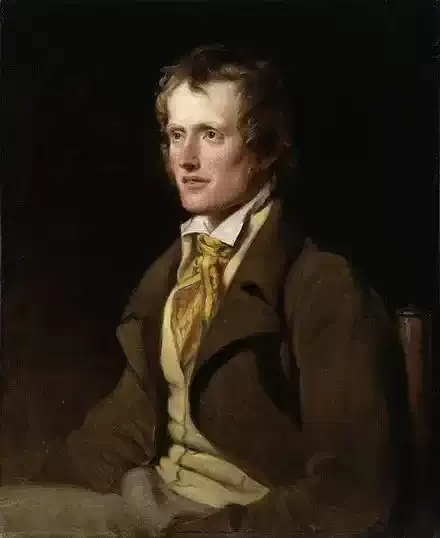
John Clare
Merry Maid
Merry Maid
Bonny and stout and brown, without a hat,
She frowns offended when they call her fat--
Yet fat she is, the merriest in the place,
And all can know she wears a pretty face.
But still she never heeds what praise can say,
But does the work, and oft runs out to play,
To run about the yard and ramp and noise
And spring the mop upon the servant boys.
When old hens noise and cackle every where
She hurries eager if the eggs are dear,
And runs to seek them when they lay away
To get them ready for the market day.
She gambols with the men and laughs aloud
And only quarrels when they call her proud.
Bonny and stout and brown, without a hat,
She frowns offended when they call her fat--
Yet fat she is, the merriest in the place,
And all can know she wears a pretty face.
But still she never heeds what praise can say,
But does the work, and oft runs out to play,
To run about the yard and ramp and noise
And spring the mop upon the servant boys.
When old hens noise and cackle every where
She hurries eager if the eggs are dear,
And runs to seek them when they lay away
To get them ready for the market day.
She gambols with the men and laughs aloud
And only quarrels when they call her proud.
361
John Clare
Market Day
Market Day
With arms and legs at work and gentle stroke
That urges switching tail nor mends his pace,
On an old ribbed and weather beaten horse,
The farmer goes jogtrotting to the fair.
Both keep their pace that nothing can provoke
Followed by brindled dog that snuffs the ground
With urging bark and hurries at his heels.
His hat slouched down, and great coat buttoned close
Bellied like hooped keg, and chuffy face
Red as the morning sun, he takes his round
And talks of stock: and when his jobs are done
And Dobbin's hay is eaten from the rack,
He drinks success to corn in language hoarse,
And claps old Dobbin's hide, and potters back.
With arms and legs at work and gentle stroke
That urges switching tail nor mends his pace,
On an old ribbed and weather beaten horse,
The farmer goes jogtrotting to the fair.
Both keep their pace that nothing can provoke
Followed by brindled dog that snuffs the ground
With urging bark and hurries at his heels.
His hat slouched down, and great coat buttoned close
Bellied like hooped keg, and chuffy face
Red as the morning sun, he takes his round
And talks of stock: and when his jobs are done
And Dobbin's hay is eaten from the rack,
He drinks success to corn in language hoarse,
And claps old Dobbin's hide, and potters back.
409
John Clare
From The Parish: A Satire
From The Parish: A Satire
I
In politics and politicians' lies
The modern farmer waxes wondrous wise;
Opinionates with wisdom all compact,
And een could tell a nation how to act;
Throws light on darkness with excessive skill,
Knows who acts well and whose designs are ill,
Proves half the members nought but bribery's tools,
And calls the past a dull dark age of fools.
As wise as Solomon they read the news,
Not with their blind forefathers' simple views,
Who read of wars, and wished that wars would cease,
And blessed the King, and wished his country peace;
Who marked the weight of each fat sheep and ox,
The price of grain and rise and fall of stocks;
Who thought it learning how to buy and sell,
And him a wise man who could manage well.
No, not with such old-fashioned, idle views
Do these newsmongers traffic with the news.
They read of politics and not of grain,
And speechify and comment and explain,
And know so much of Parliament and state
You'd think they're members when you heard them prate;
And know so little of their farms the while
They can but urge a wiser man to smile.
II
A thing all consequence here takes the lead,
Reigning knight-errant oer this dirty breed--
A bailiff he, and who so great to brag
Of law and all its terrors as Bumtagg;
Fawning a puppy at his master's side
And frowning like a wolf on all beside;
Who fattens best where sorrow worst appears
And feeds on sad misfortune's bitterest tears?
Such is Bumtagg the bailiff to a hair,
The worshipper and demon of despair,
Who waits and hopes and wishes for success
At every nod and signal of distress,
Happy at heart, when storms begin to boil,
To seek the shipwreck and to share the spoil.
Brave is this Bumtagg, match him if you can;
For there's none like him living--save his man.
As every animal assists his kind
Just so are these in blood and business joined;
Yet both in different colours hide their art,
And each as suits his ends transacts his part.
One keeps the heart-bred villain full in sight,
The other cants and acts the hypocrite,
Smoothing the deed where law sharks set their gin
Like a coy dog to draw misfortune in.
But both will chuckle oer their prisoners' sighs
And are as blest as spiders over flies.
Such is Bumtagg, whose history I resign,
As other knaves wait room to stink and shine;
And, as the meanest knave a dog can brag,
Such is the lurcher that assists Bumtagg.
I
In politics and politicians' lies
The modern farmer waxes wondrous wise;
Opinionates with wisdom all compact,
And een could tell a nation how to act;
Throws light on darkness with excessive skill,
Knows who acts well and whose designs are ill,
Proves half the members nought but bribery's tools,
And calls the past a dull dark age of fools.
As wise as Solomon they read the news,
Not with their blind forefathers' simple views,
Who read of wars, and wished that wars would cease,
And blessed the King, and wished his country peace;
Who marked the weight of each fat sheep and ox,
The price of grain and rise and fall of stocks;
Who thought it learning how to buy and sell,
And him a wise man who could manage well.
No, not with such old-fashioned, idle views
Do these newsmongers traffic with the news.
They read of politics and not of grain,
And speechify and comment and explain,
And know so much of Parliament and state
You'd think they're members when you heard them prate;
And know so little of their farms the while
They can but urge a wiser man to smile.
II
A thing all consequence here takes the lead,
Reigning knight-errant oer this dirty breed--
A bailiff he, and who so great to brag
Of law and all its terrors as Bumtagg;
Fawning a puppy at his master's side
And frowning like a wolf on all beside;
Who fattens best where sorrow worst appears
And feeds on sad misfortune's bitterest tears?
Such is Bumtagg the bailiff to a hair,
The worshipper and demon of despair,
Who waits and hopes and wishes for success
At every nod and signal of distress,
Happy at heart, when storms begin to boil,
To seek the shipwreck and to share the spoil.
Brave is this Bumtagg, match him if you can;
For there's none like him living--save his man.
As every animal assists his kind
Just so are these in blood and business joined;
Yet both in different colours hide their art,
And each as suits his ends transacts his part.
One keeps the heart-bred villain full in sight,
The other cants and acts the hypocrite,
Smoothing the deed where law sharks set their gin
Like a coy dog to draw misfortune in.
But both will chuckle oer their prisoners' sighs
And are as blest as spiders over flies.
Such is Bumtagg, whose history I resign,
As other knaves wait room to stink and shine;
And, as the meanest knave a dog can brag,
Such is the lurcher that assists Bumtagg.
348
John Clare
Farmer's Boy
Farmer's Boy
He waits all day beside his little flock
And asks the passing stranger what's o'clock,
But those who often pass his daily tasks
Look at their watch and tell before he asks.
He mutters stories to himself and lies
Where the thick hedge the warmest house supplies,
And when he hears the hunters far and wide
He climbs the highest tree to see them ride--
He climbs till all the fields are blea and bare
And makes the old crow's nest an easy chair.
And soon his sheep are got in other grounds--
He hastens down and fears his master come,
He stops the gap and keeps them all in bounds
And tends them closely till it's time for home.
He waits all day beside his little flock
And asks the passing stranger what's o'clock,
But those who often pass his daily tasks
Look at their watch and tell before he asks.
He mutters stories to himself and lies
Where the thick hedge the warmest house supplies,
And when he hears the hunters far and wide
He climbs the highest tree to see them ride--
He climbs till all the fields are blea and bare
And makes the old crow's nest an easy chair.
And soon his sheep are got in other grounds--
He hastens down and fears his master come,
He stops the gap and keeps them all in bounds
And tends them closely till it's time for home.
410
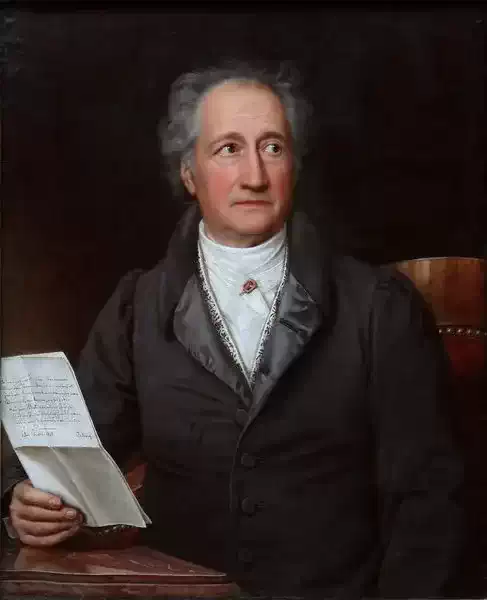
Johann Wolfgang von Goethe
To The Husbandman
To The Husbandman
SMOOTHLY and lightly the golden seed by the furrow is cover'd;
Yet will a deeper one, friend, cover thy bones at the last.
Joyously plough'd and sow'd! Here food all living is budding,
E'en from the side of the tomb Hope will not vanish away.
SMOOTHLY and lightly the golden seed by the furrow is cover'd;
Yet will a deeper one, friend, cover thy bones at the last.
Joyously plough'd and sow'd! Here food all living is budding,
E'en from the side of the tomb Hope will not vanish away.
373
Johann Wolfgang von Goethe
Hermann And Dorothea - III. Thalia
Hermann And Dorothea - III. Thalia
THE BURGHERS.
THUS did the prudent son escape from the hot conversation,
But the father continued precisely as he had begun it
What is not in a man can never come out of him, surely!
Never, I fear, shall I see fulfill'd my dearest of wishes,
That my son should be unlike his father, but better.
What would be the fate of a house or a town, if its inmates
Did not all take pride in preserving, renewing, improving,
As we are taught by the age, and by the wisdom of strangers?
Man is not born to spring out of the ground, just like a mere mushroom,
And to rot away soon in the very place that produced him!
Leaving behind him no trace of what he has done in his lifetime.
One can judge by the look of a house of the taste of its master,
As on ent'ring a town, one can judge the authorities' fitness.
For where the towers and walls are falling, where in the ditches
Dirt is collected, and dirt in every street is seen lying,
Where the stones come out of their groove, and are not replaced there,
Where the beams are rotting, and vainly the houses are waiting
New supports; that town is sure to be wretchedly managed.
For where order and cleanliness reign not supreme in high places,
Then to dirt and delay the citizens soon get accustom'd,
Just as the beggar's accustom'd to wear his cloths full of tatters.
Therefore I often have wish'd that Hermann would start on his travels
Ere he's much older, and visit at any rate Strasburg and Frankfort,
And that pleasant town, Mannheim, so evenly built and so cheerful.
He who has seen such large and cleanly cities rests never
Till his own native town, however small, he sees better'd.
Do not all strangers who visit us praise our well-mended gateways,
And the well-whited tower, the church so neatly repair'd too?
Do not all praise our pavements? Our well-arranged cover'd-in conduits,
Always well furnish'd with water, utility blending with safety,
So that a fire, whenever it happens, is straightway extinguish'd,--
Is not this the result of that conflagration so dreadful?
Six times in Council I superintended the town's works, receiving
Hearty thanks and assistance from every well-disposed burgher.
How I design'd, follow'd up, and ensured the completion of measures
Worthy men had projected, and afterwards left all unfinish'd!
Finally, every man in the Council took pleasure in working.
All put forth their exertions, and now they have finally settled
That new highway to make, which will join our town with the main road.
But I am greatly afraid that the young generation won't act thus;
Some on the one hand think only of pleasure and trumpery dresses,
Others wont stir out of doors, and pass all their time by the fireside,
And our Hermann, I fear, will always be one of this last sort.'
Forthwith to him replied the excellent sensible mother
'Father, you're always unjust whenever you speak of your son, and
That is the least likely way to obtain your wishes' fulfillment,
For we cannot fashion our children after our fancy.
We must have them and love them, as God has given them to us,
Bring them up for the best, and let each do as he listeth.
One has one kind of gift, another possesses another,
Each one employs them, and each in turn in his separate fashion
Good and happy becomes. My Hermann shall not be upbraided,
For I know that he well deserves the wealth he'll inherit;
He'll be an excellent landlord, a pattern to burghers and peasants,
And, as I clearly foresee, by no means the last in the Council.
But with your blame and reproaches, you daily dishearten him sadly,
As you have done just now, and make the poor fellow unhappy.'
Then she left the apartment, and after her son hasten'd quickly,
Hoping somewhere to find him, and with her words of affection
Gladden his heart, for he, the excellent son, well deserved it.
Smilingly, when she had closed the door, continued the father
'What a wonderful race of people are women and children.
All of them fain would do whatever pleases their fancy,
And we're only alow'd to praise them and flatter them freely.
Once for all there's truth in the ancient proverb which tells us:
He who moves not forward, goes backward! a capital saying!'
Speaking with much circumspection, the druggist made answer as follows
'What you say, good neighbour, is certainly true, and my plan is
Always to think of improvement, provided tho' new, 'tis not costly.
But what avails it in truth, unless one has plenty of money,
Active and fussy to he, improving both inside and outside?
Sadly confined are the means of a burgher; e'en when he knows it,
Little that's good he is able to do, his purse is too narrow,
And the sum wanted too great; and so he is always prevented.
I have had plenty of schemes! but then I was terribly frighten'd
At the expense, especially during a time of such danger.
Long had my house smiled upon me, decked out in modish exterior,
Long had my windows with large panes of glass resplendently glitterd.
Who can compete with a merchant, however, who, rolling in riches,
Also knows the manner in which what is best can be purchased?
Only look at the house up yonder, the new one: how handsome
Looks the stucco of those white scrolls on the green-colour'd panels!
Large are the plates of the windows--how shining and brilliant the panes are,
Quite eclipsing the rest of the houses that stand in the market!
Yet at the time of the fire, our two were by far the most handsome,
Mine at the sign of the Angel, and yours at the old Golden Lion.
Then my garden was famous throughout the whole country, and strangers
Used to stop as they pass'd and peep through my red-colourd palings
At my beggars of stone, and at my dwarfs, which were painted,
He to whom I gave coffee inside my beautiful grotto,
Which, alas! is now cover'd with dust and tumbling to pieces,
Used to rejoice in the colour'd glimmering light of the mussels,
Ranged in natural order around it, and connoisseurs even
Used with dazzled eyes to gaze at the spars and the coral.
Then, in the drawing-room, people look'd with delight on the painting,
Where the prim ladies and gentlemen walked in the garden demurely,
And with pointed fingers presented the flowers, and held them.
Ah, if only such things were now to be seen! Little care I
Now to go out; for everything needs to be alter'd and tasteful,
As it is call'd; and white are the benches of wood and the palings;
All things are simple and plain; and neither carving not gilding
Now are employ'd, and foreign timber is now all the fashion.
I should be only too pleased to possess some novelty also,
So as to march with the times, and my household furniture alter.
But we all are afraid to make the least alteration,
For who is able to pay the present charges of workmen?
Lately a fancy possess'd me, the angel Michael, whose figure
Hangs up over my shop, to treat to a new coat of gilding,
And the terrible Dragon, who round his feet is entwining;
But I have left him all brown; as he is; for the cost quite alarm'd me.'
THE BURGHERS.
THUS did the prudent son escape from the hot conversation,
But the father continued precisely as he had begun it
What is not in a man can never come out of him, surely!
Never, I fear, shall I see fulfill'd my dearest of wishes,
That my son should be unlike his father, but better.
What would be the fate of a house or a town, if its inmates
Did not all take pride in preserving, renewing, improving,
As we are taught by the age, and by the wisdom of strangers?
Man is not born to spring out of the ground, just like a mere mushroom,
And to rot away soon in the very place that produced him!
Leaving behind him no trace of what he has done in his lifetime.
One can judge by the look of a house of the taste of its master,
As on ent'ring a town, one can judge the authorities' fitness.
For where the towers and walls are falling, where in the ditches
Dirt is collected, and dirt in every street is seen lying,
Where the stones come out of their groove, and are not replaced there,
Where the beams are rotting, and vainly the houses are waiting
New supports; that town is sure to be wretchedly managed.
For where order and cleanliness reign not supreme in high places,
Then to dirt and delay the citizens soon get accustom'd,
Just as the beggar's accustom'd to wear his cloths full of tatters.
Therefore I often have wish'd that Hermann would start on his travels
Ere he's much older, and visit at any rate Strasburg and Frankfort,
And that pleasant town, Mannheim, so evenly built and so cheerful.
He who has seen such large and cleanly cities rests never
Till his own native town, however small, he sees better'd.
Do not all strangers who visit us praise our well-mended gateways,
And the well-whited tower, the church so neatly repair'd too?
Do not all praise our pavements? Our well-arranged cover'd-in conduits,
Always well furnish'd with water, utility blending with safety,
So that a fire, whenever it happens, is straightway extinguish'd,--
Is not this the result of that conflagration so dreadful?
Six times in Council I superintended the town's works, receiving
Hearty thanks and assistance from every well-disposed burgher.
How I design'd, follow'd up, and ensured the completion of measures
Worthy men had projected, and afterwards left all unfinish'd!
Finally, every man in the Council took pleasure in working.
All put forth their exertions, and now they have finally settled
That new highway to make, which will join our town with the main road.
But I am greatly afraid that the young generation won't act thus;
Some on the one hand think only of pleasure and trumpery dresses,
Others wont stir out of doors, and pass all their time by the fireside,
And our Hermann, I fear, will always be one of this last sort.'
Forthwith to him replied the excellent sensible mother
'Father, you're always unjust whenever you speak of your son, and
That is the least likely way to obtain your wishes' fulfillment,
For we cannot fashion our children after our fancy.
We must have them and love them, as God has given them to us,
Bring them up for the best, and let each do as he listeth.
One has one kind of gift, another possesses another,
Each one employs them, and each in turn in his separate fashion
Good and happy becomes. My Hermann shall not be upbraided,
For I know that he well deserves the wealth he'll inherit;
He'll be an excellent landlord, a pattern to burghers and peasants,
And, as I clearly foresee, by no means the last in the Council.
But with your blame and reproaches, you daily dishearten him sadly,
As you have done just now, and make the poor fellow unhappy.'
Then she left the apartment, and after her son hasten'd quickly,
Hoping somewhere to find him, and with her words of affection
Gladden his heart, for he, the excellent son, well deserved it.
Smilingly, when she had closed the door, continued the father
'What a wonderful race of people are women and children.
All of them fain would do whatever pleases their fancy,
And we're only alow'd to praise them and flatter them freely.
Once for all there's truth in the ancient proverb which tells us:
He who moves not forward, goes backward! a capital saying!'
Speaking with much circumspection, the druggist made answer as follows
'What you say, good neighbour, is certainly true, and my plan is
Always to think of improvement, provided tho' new, 'tis not costly.
But what avails it in truth, unless one has plenty of money,
Active and fussy to he, improving both inside and outside?
Sadly confined are the means of a burgher; e'en when he knows it,
Little that's good he is able to do, his purse is too narrow,
And the sum wanted too great; and so he is always prevented.
I have had plenty of schemes! but then I was terribly frighten'd
At the expense, especially during a time of such danger.
Long had my house smiled upon me, decked out in modish exterior,
Long had my windows with large panes of glass resplendently glitterd.
Who can compete with a merchant, however, who, rolling in riches,
Also knows the manner in which what is best can be purchased?
Only look at the house up yonder, the new one: how handsome
Looks the stucco of those white scrolls on the green-colour'd panels!
Large are the plates of the windows--how shining and brilliant the panes are,
Quite eclipsing the rest of the houses that stand in the market!
Yet at the time of the fire, our two were by far the most handsome,
Mine at the sign of the Angel, and yours at the old Golden Lion.
Then my garden was famous throughout the whole country, and strangers
Used to stop as they pass'd and peep through my red-colourd palings
At my beggars of stone, and at my dwarfs, which were painted,
He to whom I gave coffee inside my beautiful grotto,
Which, alas! is now cover'd with dust and tumbling to pieces,
Used to rejoice in the colour'd glimmering light of the mussels,
Ranged in natural order around it, and connoisseurs even
Used with dazzled eyes to gaze at the spars and the coral.
Then, in the drawing-room, people look'd with delight on the painting,
Where the prim ladies and gentlemen walked in the garden demurely,
And with pointed fingers presented the flowers, and held them.
Ah, if only such things were now to be seen! Little care I
Now to go out; for everything needs to be alter'd and tasteful,
As it is call'd; and white are the benches of wood and the palings;
All things are simple and plain; and neither carving not gilding
Now are employ'd, and foreign timber is now all the fashion.
I should be only too pleased to possess some novelty also,
So as to march with the times, and my household furniture alter.
But we all are afraid to make the least alteration,
For who is able to pay the present charges of workmen?
Lately a fancy possess'd me, the angel Michael, whose figure
Hangs up over my shop, to treat to a new coat of gilding,
And the terrible Dragon, who round his feet is entwining;
But I have left him all brown; as he is; for the cost quite alarm'd me.'
346
Johann Wolfgang von Goethe
Book Of Contemplation - Five Things
Book Of Contemplation - Five Things
WHAT makes time short to me?
Activity!
What makes it long and spiritless?
'Tis idleness!
What brings us to debt?
To delay and forget!
What makes us succeed?
Decision with speed
How to fame to ascend?
Oneself to defend!
WHAT makes time short to me?
Activity!
What makes it long and spiritless?
'Tis idleness!
What brings us to debt?
To delay and forget!
What makes us succeed?
Decision with speed
How to fame to ascend?
Oneself to defend!
402
Johann Wolfgang von Goethe
Authors
Authors
OVER the meadows, and down the stream,
And through the garden-walks straying,
He plucks the flowers that fairest seem;
His throbbing heart brooks no delaying.
His maiden then comes--oh, what ecstasy!
Thy flowers thou giv'st for one glance of her eye!
The gard'ner next door o'er the hedge sees the youth:
"I'm not such a fool as that, in good truth;
My pleasure is ever to cherish each flower,
And see that no birds my fruit e'er devour.
But when 'tis ripe, your money, good neighbour!
'Twas not for nothing I took all this labour!"
And such, methinks, are the author-tribe.
The one his pleasures around him strews,
That his friends, the public, may reap, if they choose;
The other would fain make them all subscribe.
OVER the meadows, and down the stream,
And through the garden-walks straying,
He plucks the flowers that fairest seem;
His throbbing heart brooks no delaying.
His maiden then comes--oh, what ecstasy!
Thy flowers thou giv'st for one glance of her eye!
The gard'ner next door o'er the hedge sees the youth:
"I'm not such a fool as that, in good truth;
My pleasure is ever to cherish each flower,
And see that no birds my fruit e'er devour.
But when 'tis ripe, your money, good neighbour!
'Twas not for nothing I took all this labour!"
And such, methinks, are the author-tribe.
The one his pleasures around him strews,
That his friends, the public, may reap, if they choose;
The other would fain make them all subscribe.
478
Johann Wolfgang von Goethe
A Symbol
A Symbol
THE mason's trade Observe them well,
Resembles life, And watch them revealing
With all its strife,--How solemn feeling
Is like the stir made And wonderment swell
By man on earth's face. The hearts of the brave.
Though weal and woe The voice of the blest,
The future may hide, And of spirits on high
Unterrified Seems loudly to cry:
We onward go "To do what is best,
In ne'er changing race. Unceasing endeavour!
A veil of dread "In silence eterne
Hangs heavier still. Here chaplets are twin'd,
Deep slumbers fill That each noble mind
The stars over-head, Its guerdon may earn.--
And the foot-trodden grave. Then hope ye for ever!"
THE mason's trade Observe them well,
Resembles life, And watch them revealing
With all its strife,--How solemn feeling
Is like the stir made And wonderment swell
By man on earth's face. The hearts of the brave.
Though weal and woe The voice of the blest,
The future may hide, And of spirits on high
Unterrified Seems loudly to cry:
We onward go "To do what is best,
In ne'er changing race. Unceasing endeavour!
A veil of dread "In silence eterne
Hangs heavier still. Here chaplets are twin'd,
Deep slumbers fill That each noble mind
The stars over-head, Its guerdon may earn.--
And the foot-trodden grave. Then hope ye for ever!"
469
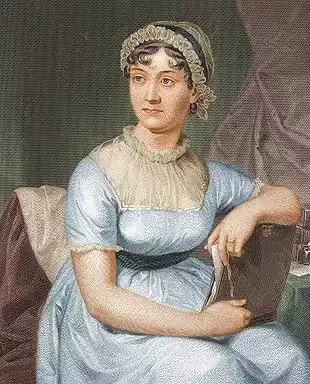
Jane Austen
Happy the Lab'rer
Happy the Lab'rer
Happy the lab'rer in his Sunday clothes!
In light-drab coat, smart waistcoat, well-darn'd hose,
Andhat upon his head, to church he goes;
As oft, with conscious pride, he downward throws
A glance upon the ample cabbage rose
That, stuck in button-hole, regales his nose,
He envies not the gayest London beaux.
In church he takes his seat among the rows,
Pays to the place the reverence he owes,
Likes best the prayers whose meaning least he knows,
Lists to the sermon in a softening doze,
And rouses joyous at the welcome close.
Happy the lab'rer in his Sunday clothes!
In light-drab coat, smart waistcoat, well-darn'd hose,
Andhat upon his head, to church he goes;
As oft, with conscious pride, he downward throws
A glance upon the ample cabbage rose
That, stuck in button-hole, regales his nose,
He envies not the gayest London beaux.
In church he takes his seat among the rows,
Pays to the place the reverence he owes,
Likes best the prayers whose meaning least he knows,
Lists to the sermon in a softening doze,
And rouses joyous at the welcome close.
205
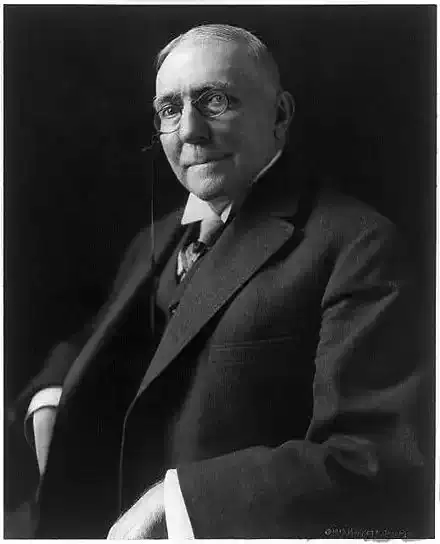
James Whitcomb Riley
The Boy Lives On Our Farm
The Boy Lives On Our Farm
The boy lives on our Farm, he's not
Afeard o' horses none!
An' he can make 'em lope, er trot,
Er rack, er pace, er run.
Sometimes he drives two horses, when
He comes to town an' brings
A wagon-full o' 'taters nen,
An' roastin'-ears an' things.
Two horses is 'a team,' he says,
An' when you drive er hitch,
The right-un's a 'near-horse,' I guess
Er 'off'--I don't know which--
The Boy lives on our Farm, he told
Me, too, 'at he can see,
By lookin' at their teeth, how old
A horse is, to a T!
I'd be the gladdest boy alive
Ef I knowed much as that,
An' could stand up like him an' drive,
An' ist push back my hat,
Like he comes skallyhootin' through
Our alley, with one arm
A-wavin' Fare-ye-well! to you--
The Boy lives on our Farm!
The boy lives on our Farm, he's not
Afeard o' horses none!
An' he can make 'em lope, er trot,
Er rack, er pace, er run.
Sometimes he drives two horses, when
He comes to town an' brings
A wagon-full o' 'taters nen,
An' roastin'-ears an' things.
Two horses is 'a team,' he says,
An' when you drive er hitch,
The right-un's a 'near-horse,' I guess
Er 'off'--I don't know which--
The Boy lives on our Farm, he told
Me, too, 'at he can see,
By lookin' at their teeth, how old
A horse is, to a T!
I'd be the gladdest boy alive
Ef I knowed much as that,
An' could stand up like him an' drive,
An' ist push back my hat,
Like he comes skallyhootin' through
Our alley, with one arm
A-wavin' Fare-ye-well! to you--
The Boy lives on our Farm!
300
James Whitcomb Riley
Song
Song
'Why do I sing--Tra-la-la-la-la!
Glad as a King?--Tra-la-la-la-la!
Well, since you ask,--
I have such a pleasant task,
I can not help but sing!
'Why do I smile--Tra-la-la-la-la!
Working the while?--Tra-la-la-la-la!
Work like this is play,--
So I'm playing all the day--
I can not help but smile!
'So, If you please--Tra-la-la-la-la!
Live at your ease!--Tra-la-la-la-la!
You've only got to turn,
And, you see, its bound to churn--
I can not help but please!'
The farmer pondered and scratched his head,
Reading over each mystic word.-'
Some o' the Dreamer's work!' he said-'
Ah, here's more--and name and date
In his hand-write'!'--And the good man read,-''
Patent applied for, July third,
Eighteen hundred and forty-eight'!'
The fragment fell from his nerveless grasp--
His awed lips thrilled with the joyous gasp:
'I see the p'int to the whole concern,-He's
studied out a patent churn!'
'Why do I sing--Tra-la-la-la-la!
Glad as a King?--Tra-la-la-la-la!
Well, since you ask,--
I have such a pleasant task,
I can not help but sing!
'Why do I smile--Tra-la-la-la-la!
Working the while?--Tra-la-la-la-la!
Work like this is play,--
So I'm playing all the day--
I can not help but smile!
'So, If you please--Tra-la-la-la-la!
Live at your ease!--Tra-la-la-la-la!
You've only got to turn,
And, you see, its bound to churn--
I can not help but please!'
The farmer pondered and scratched his head,
Reading over each mystic word.-'
Some o' the Dreamer's work!' he said-'
Ah, here's more--and name and date
In his hand-write'!'--And the good man read,-''
Patent applied for, July third,
Eighteen hundred and forty-eight'!'
The fragment fell from his nerveless grasp--
His awed lips thrilled with the joyous gasp:
'I see the p'int to the whole concern,-He's
studied out a patent churn!'
243
James Whitcomb Riley
Our Hired Girl
Our Hired Girl
1
2
3
4
6
7
8
9
11
12
13
14
Our hired girl, she's 'Lizabuth Ann;
An' she can cook best things to eat!
She ist puts dough in our pie-pan,
An' pours in somepin' 'at's good an' sweet;
An' nen she salts it all on top
With cinnamon; an' nen she'll stop
An' stoop an' slide it, ist as slow,
In th' old cook-stove, so's 'twon't slop
An' git all spilled; nen bakes it, so
It's custard-pie, first thing you know!
An' nen she'll say,
"Clear out o' my way!
They's time fer work, an' time fer play!
Take yer dough, an' run, child, run!
Er I cain't git no cookin' done!"
16
17
18
19
21
22
23
24
26
27
28
29
When our hired girl 'tends like she's mad,
An' says folks got to walk the chalk
When she's around, er wisht they had!
I play out on our porch an' talk
To Th' Raggedy Man 'at mows our lawn;
An' he says, "Whew!" an' nen leans on
His old crook-scythe, and blinks his eyes,
An' sniffs all 'round an' says, "I swawn!
Ef my old nose don't tell me lies,
It 'pears like I smell custard-pies!"
An' nen he'll say,
"Clear out o' my way!
They's time fer work, an' time fer play!
Take yer dough, an' run, child, run!
Er she cain't git no cookin' done!"
31
32
33
34
Wunst our hired girl, when she
Got the supper, an' we all et,
An' it wuz night, an' Ma an' me
An' Pa went wher' the "Social" met, --
An' nen when we come home, an' see
36
37
38
A light in the kitchen door, an' we
Heerd a maccordeun, Pa says, "Lan'O'-
Gracious! who can her beau be?"
39 An' I marched in, an' 'Lizabuth Ann
41
42
43
44
Wuz parchin' corn fer The Raggedy Man!
Better say,
"Clear out o' the way!
They's time fer work, an' time fer play!
Take the hint, an' run, child, run!
Er we cain't git no courtin' done!"
1
2
3
4
6
7
8
9
11
12
13
14
Our hired girl, she's 'Lizabuth Ann;
An' she can cook best things to eat!
She ist puts dough in our pie-pan,
An' pours in somepin' 'at's good an' sweet;
An' nen she salts it all on top
With cinnamon; an' nen she'll stop
An' stoop an' slide it, ist as slow,
In th' old cook-stove, so's 'twon't slop
An' git all spilled; nen bakes it, so
It's custard-pie, first thing you know!
An' nen she'll say,
"Clear out o' my way!
They's time fer work, an' time fer play!
Take yer dough, an' run, child, run!
Er I cain't git no cookin' done!"
16
17
18
19
21
22
23
24
26
27
28
29
When our hired girl 'tends like she's mad,
An' says folks got to walk the chalk
When she's around, er wisht they had!
I play out on our porch an' talk
To Th' Raggedy Man 'at mows our lawn;
An' he says, "Whew!" an' nen leans on
His old crook-scythe, and blinks his eyes,
An' sniffs all 'round an' says, "I swawn!
Ef my old nose don't tell me lies,
It 'pears like I smell custard-pies!"
An' nen he'll say,
"Clear out o' my way!
They's time fer work, an' time fer play!
Take yer dough, an' run, child, run!
Er she cain't git no cookin' done!"
31
32
33
34
Wunst our hired girl, when she
Got the supper, an' we all et,
An' it wuz night, an' Ma an' me
An' Pa went wher' the "Social" met, --
An' nen when we come home, an' see
36
37
38
A light in the kitchen door, an' we
Heerd a maccordeun, Pa says, "Lan'O'-
Gracious! who can her beau be?"
39 An' I marched in, an' 'Lizabuth Ann
41
42
43
44
Wuz parchin' corn fer The Raggedy Man!
Better say,
"Clear out o' the way!
They's time fer work, an' time fer play!
Take the hint, an' run, child, run!
Er we cain't git no courtin' done!"
305
James Whitcomb Riley
Mylo Jones's Wife
Mylo Jones's Wife
'Mylo Jones's wife' was all
I heerd, mighty near, last Fall--
Visitun relations down
T'other side of Morgantown!
Mylo Jones's wife she does
This and that, and 'those' and 'thus'!-Can't
'bide babies in her sight--
Ner no childern, day and night,
Whoopin' round the premises--
NER NO NOTHIN' ELSE, I guess!
Mylo Jones's wife she 'lows
She's the boss of her own house!-Mylo--
consequences is--
Stays whare things seem SOME like HIS,--
Uses, mostly, with the stock--
Coaxin' 'Old Kate' not to balk,
Ner kick hoss-flies' branes out, ner
Act, I s'pose, so much like HER!
Yit the wimmern-folks tells you
She's PERFECTION.--Yes they do!
Mylo's wife she says she's found
Home hain't home with MEN-FOLKS round
When they's work like HERN to do-
Picklin' pears and BUTCHERN, too,
And a-rendern lard, and then
Cookin' fer a pack of men
To come trackin' up the flore
SHE'S scrubbed TEL she'll scrub no MORE!--
Yit she'd keep things clean ef they
Made her scrub tel Jedgmunt Day!
Mylo Jones's wife she sews
Carpet-rags and patches clothes
Jest year IN and OUT!--and yit
Whare's the livin' use of it?
She asts Mylo that.--And he
Gits back whare he'd ruther be,
With his team;--jest PLOWS--and don't
Never sware--like some folks won't!
Think ef HE'D CUT LOOSE, I gum!
'D he'p his heavenly chances some!
Mylo's wife don't see no use,
Ner no reason ner excuse
Fer his pore relations to
Hang round like they allus do!
Thare 'bout onc't a year--and SHE--
She jest GA'NTS 'em, folks tells me,
On spiced pears!--Pass Mylo one,
He says 'No, he don't chuse none!'
Workin'men like Mylo they
'D ort to have MEAT ev'ry day!
Dad-burn Mylo Jones's wife!
Ruther rake a blame caseknife
'Crost my wizzen than to see
Sich a womern rulin' ME!--
Ruther take and turn in and
Raise a fool mule-colt by hand'
MYLO, though--od-rot the man!--
Jest keeps ca'm--like some folks CAN--
And 'lows sich as her, I s'pose,
Is MAN'S HE'PMEET'--Mercy knows!
'Mylo Jones's wife' was all
I heerd, mighty near, last Fall--
Visitun relations down
T'other side of Morgantown!
Mylo Jones's wife she does
This and that, and 'those' and 'thus'!-Can't
'bide babies in her sight--
Ner no childern, day and night,
Whoopin' round the premises--
NER NO NOTHIN' ELSE, I guess!
Mylo Jones's wife she 'lows
She's the boss of her own house!-Mylo--
consequences is--
Stays whare things seem SOME like HIS,--
Uses, mostly, with the stock--
Coaxin' 'Old Kate' not to balk,
Ner kick hoss-flies' branes out, ner
Act, I s'pose, so much like HER!
Yit the wimmern-folks tells you
She's PERFECTION.--Yes they do!
Mylo's wife she says she's found
Home hain't home with MEN-FOLKS round
When they's work like HERN to do-
Picklin' pears and BUTCHERN, too,
And a-rendern lard, and then
Cookin' fer a pack of men
To come trackin' up the flore
SHE'S scrubbed TEL she'll scrub no MORE!--
Yit she'd keep things clean ef they
Made her scrub tel Jedgmunt Day!
Mylo Jones's wife she sews
Carpet-rags and patches clothes
Jest year IN and OUT!--and yit
Whare's the livin' use of it?
She asts Mylo that.--And he
Gits back whare he'd ruther be,
With his team;--jest PLOWS--and don't
Never sware--like some folks won't!
Think ef HE'D CUT LOOSE, I gum!
'D he'p his heavenly chances some!
Mylo's wife don't see no use,
Ner no reason ner excuse
Fer his pore relations to
Hang round like they allus do!
Thare 'bout onc't a year--and SHE--
She jest GA'NTS 'em, folks tells me,
On spiced pears!--Pass Mylo one,
He says 'No, he don't chuse none!'
Workin'men like Mylo they
'D ort to have MEAT ev'ry day!
Dad-burn Mylo Jones's wife!
Ruther rake a blame caseknife
'Crost my wizzen than to see
Sich a womern rulin' ME!--
Ruther take and turn in and
Raise a fool mule-colt by hand'
MYLO, though--od-rot the man!--
Jest keeps ca'm--like some folks CAN--
And 'lows sich as her, I s'pose,
Is MAN'S HE'PMEET'--Mercy knows!
295
James Whitcomb Riley
John McKeen
John McKeen
John McKeen, in his rusty dress,
His loosened collar, and swarthy throat,
His face unshaven, and none the less,
His hearty laugh and his wholesomeness,
And the wealth of a workman's vote!
Bring him, O Memory, here once more,
And tilt him back in his Windsor chair
By the kitchen stove, when the day is o'er
And the light of the hearth is across the floor,
And the crickets everywhere!
And let their voices be gladly blent
With a watery jingle of pans and spoons,
And a motherly chirrup of sweet content,
And neighborly gossip and merriment,
And old-time fiddle-tunes!
Tick the clock with a wooden sound,
And fill the hearing with childish glee
Of rhyming riddle, or story found
In the Robinson Crusoe, leather-bound
Old book of the Used-to-be!
John McKeen of the Past! Ah John,
To have grown ambitious in worldly ways--!
To have rolled your shirt-sleeves down, to don
A broadcloth suit, and forgetful, gone
Out on election days!
John ah, John! Did it prove your worth
To yield you the office you still maintain--?
To fill your pockets, but leave the dearth
Of all the happier things on earth
To the hunger of heart and brain?
Under the dusk of your villa trees,
Edging the drives where your blooded span
Paw the pebbles and wait your ease--,
Where are the children about your knees,
And the mirth, and the happy man?
The blinds of your mansion are battened to;
Your faded wife is a close recluse;
And your 'finished' daughters will doubtless do
Dutifully all that is willed of you,
And marry as you shall choose--!
But O for the old-home voices, blent
With the watery jingle of pans and spoons,
And the motherly chirrup of glad content,
And neighborly gossip and merriment,
And the old-time fiddle-tunes!
John McKeen, in his rusty dress,
His loosened collar, and swarthy throat,
His face unshaven, and none the less,
His hearty laugh and his wholesomeness,
And the wealth of a workman's vote!
Bring him, O Memory, here once more,
And tilt him back in his Windsor chair
By the kitchen stove, when the day is o'er
And the light of the hearth is across the floor,
And the crickets everywhere!
And let their voices be gladly blent
With a watery jingle of pans and spoons,
And a motherly chirrup of sweet content,
And neighborly gossip and merriment,
And old-time fiddle-tunes!
Tick the clock with a wooden sound,
And fill the hearing with childish glee
Of rhyming riddle, or story found
In the Robinson Crusoe, leather-bound
Old book of the Used-to-be!
John McKeen of the Past! Ah John,
To have grown ambitious in worldly ways--!
To have rolled your shirt-sleeves down, to don
A broadcloth suit, and forgetful, gone
Out on election days!
John ah, John! Did it prove your worth
To yield you the office you still maintain--?
To fill your pockets, but leave the dearth
Of all the happier things on earth
To the hunger of heart and brain?
Under the dusk of your villa trees,
Edging the drives where your blooded span
Paw the pebbles and wait your ease--,
Where are the children about your knees,
And the mirth, and the happy man?
The blinds of your mansion are battened to;
Your faded wife is a close recluse;
And your 'finished' daughters will doubtless do
Dutifully all that is willed of you,
And marry as you shall choose--!
But O for the old-home voices, blent
With the watery jingle of pans and spoons,
And the motherly chirrup of glad content,
And neighborly gossip and merriment,
And the old-time fiddle-tunes!
257
James Whitcomb Riley
Doc Sifers
Doc Sifers
Of all the doctors I could cite you to in this-'ere town
Doc Sifers is my favorite, jes' take him up and down!
Count in the Bethel Neighberhood, and Rollins, and Big Bear,
And Sifers' standin's jes' as good as ary doctor's there!
There's old Doc Wick, and Glenn, and Hall, and Wurgler, and McVeigh,
But I'll buck Sifers 'ginst 'em all and down 'em any day!
Most old Wick ever knowed, I s'pose, was _whisky!_ Wurgler--well,
He et morphine--ef actions shows, and facts' reliable!
But Sifers--though he ain't no sot, he's got his faults; and yit
When you _git_ Sifers one't, you've got _a doctor_, don't fergit!
He ain't much at his office, er his house, er anywhere
You'd natchurly think certain far to ketch the feller there.--
But don't blame Doc: he's got all sorts o' cur'ous notions--as
The feller says; his odd-come-shorts, like smart men mostly has.
He'll more'n like be potter'n 'round the Blacksmith Shop; er in
Some back lot, spadin' up the ground, er gradin' it agin.
Er at the workbench, planin' things; er buildin' little traps
To ketch birds; galvenizin' rings; er graftin' plums, perhaps.
Make anything! good as the best!--a gunstock--er a flute;
He whittled out a set o' chesstmen one't o' laurel root,
Durin' the Army--got his trade o' surgeon there--I own
To-day a finger-ring Doc made out of a Sesesh bone!
An' glued a fiddle one't far me--jes' all so busted you
'D a throwed the thing away, but he fixed her as good as new!
And take Doc, now, in _ager_, say, er _biles_, er _rheumatiz_,
And all afflictions thataway, and he's the best they is!
Er janders--milksick--I don't keer--k-yore anything he tries--
A abscess; getherin' in yer yeer; er granilated eyes!
There was the Widder Daubenspeck they all give up far dead;
A blame cowbuncle on her neck, and clean out of her head!
First had this doctor, what's-his-name, from 'Puddlesburg,' and then
This little red-head, 'Burnin' Shame' they call him--Dr. Glenn.
And they 'consulted' on the case, and claimed she'd haf to die,--
I jes' was joggin' by the place, and heerd her dorter cry,
And stops and calls her to the fence; and I-says-I, 'Let me
Send Sifers--bet you fifteen cents he'll k-yore her!' 'Well,' says
she,
'Light out!' she says: And, lipp-tee-cut! I loped in town, and rid
'Bout two hours more to find him, but I kussed him when I did!
He was down at the Gunsmith Shop a-stuffin' birds! Says he,
'My sulky's broke.' Says I, 'You hop right on and ride with me!'
I got him there.--'Well, Aunty, ten days k-yores you,' Sifers said,
'But what's yer idy livin' when yer jes' as good as dead?'
And there's Dave Banks--jes' back from war without a scratch--one
day
Got ketched up in a sickle-bar, a reaper runaway.--
His shoulders, arms, and hands and legs jes' sawed in strips! And
Jake
Dunn starts far Sifers--feller begs to shoot him far God-sake.
Doc, 'course, was gone, but he had penned the notice, 'At Big Bear--
Be back to-morry; Gone to 'tend the Bee Convention there.'
But Jake, he tracked him--rid and rode the whole endurin' night!
And 'bout the time the roosters crowed they both hove into sight.
Doc had to ampitate, but 'greed to save Dave's arms, and swore
He could a-saved his legs ef he'd ben there the day before.
Like when his wife's own mother died 'fore Sifers could be found,
And all the neighbors far and wide a' all jes' chasin' round;
Tel finally--I had to laugh--it's jes' like Doc, you know,--
Was learnin' far to telegraph, down at the old deepo.
But all they're faultin' Sifers far, there's none of 'em kin say
He's biggoty, er keerless, er not posted anyway;
He ain't built on the common plan of doctors now-a-days,
He's jes' a great, big, brainy man--that's where the trouble lays!
Of all the doctors I could cite you to in this-'ere town
Doc Sifers is my favorite, jes' take him up and down!
Count in the Bethel Neighberhood, and Rollins, and Big Bear,
And Sifers' standin's jes' as good as ary doctor's there!
There's old Doc Wick, and Glenn, and Hall, and Wurgler, and McVeigh,
But I'll buck Sifers 'ginst 'em all and down 'em any day!
Most old Wick ever knowed, I s'pose, was _whisky!_ Wurgler--well,
He et morphine--ef actions shows, and facts' reliable!
But Sifers--though he ain't no sot, he's got his faults; and yit
When you _git_ Sifers one't, you've got _a doctor_, don't fergit!
He ain't much at his office, er his house, er anywhere
You'd natchurly think certain far to ketch the feller there.--
But don't blame Doc: he's got all sorts o' cur'ous notions--as
The feller says; his odd-come-shorts, like smart men mostly has.
He'll more'n like be potter'n 'round the Blacksmith Shop; er in
Some back lot, spadin' up the ground, er gradin' it agin.
Er at the workbench, planin' things; er buildin' little traps
To ketch birds; galvenizin' rings; er graftin' plums, perhaps.
Make anything! good as the best!--a gunstock--er a flute;
He whittled out a set o' chesstmen one't o' laurel root,
Durin' the Army--got his trade o' surgeon there--I own
To-day a finger-ring Doc made out of a Sesesh bone!
An' glued a fiddle one't far me--jes' all so busted you
'D a throwed the thing away, but he fixed her as good as new!
And take Doc, now, in _ager_, say, er _biles_, er _rheumatiz_,
And all afflictions thataway, and he's the best they is!
Er janders--milksick--I don't keer--k-yore anything he tries--
A abscess; getherin' in yer yeer; er granilated eyes!
There was the Widder Daubenspeck they all give up far dead;
A blame cowbuncle on her neck, and clean out of her head!
First had this doctor, what's-his-name, from 'Puddlesburg,' and then
This little red-head, 'Burnin' Shame' they call him--Dr. Glenn.
And they 'consulted' on the case, and claimed she'd haf to die,--
I jes' was joggin' by the place, and heerd her dorter cry,
And stops and calls her to the fence; and I-says-I, 'Let me
Send Sifers--bet you fifteen cents he'll k-yore her!' 'Well,' says
she,
'Light out!' she says: And, lipp-tee-cut! I loped in town, and rid
'Bout two hours more to find him, but I kussed him when I did!
He was down at the Gunsmith Shop a-stuffin' birds! Says he,
'My sulky's broke.' Says I, 'You hop right on and ride with me!'
I got him there.--'Well, Aunty, ten days k-yores you,' Sifers said,
'But what's yer idy livin' when yer jes' as good as dead?'
And there's Dave Banks--jes' back from war without a scratch--one
day
Got ketched up in a sickle-bar, a reaper runaway.--
His shoulders, arms, and hands and legs jes' sawed in strips! And
Jake
Dunn starts far Sifers--feller begs to shoot him far God-sake.
Doc, 'course, was gone, but he had penned the notice, 'At Big Bear--
Be back to-morry; Gone to 'tend the Bee Convention there.'
But Jake, he tracked him--rid and rode the whole endurin' night!
And 'bout the time the roosters crowed they both hove into sight.
Doc had to ampitate, but 'greed to save Dave's arms, and swore
He could a-saved his legs ef he'd ben there the day before.
Like when his wife's own mother died 'fore Sifers could be found,
And all the neighbors far and wide a' all jes' chasin' round;
Tel finally--I had to laugh--it's jes' like Doc, you know,--
Was learnin' far to telegraph, down at the old deepo.
But all they're faultin' Sifers far, there's none of 'em kin say
He's biggoty, er keerless, er not posted anyway;
He ain't built on the common plan of doctors now-a-days,
He's jes' a great, big, brainy man--that's where the trouble lays!
302
James Whitcomb Riley
As My Uncle Used To Say
As My Uncle Used To Say
I've thought a power on men and things,
As my uncle ust to say,--
And ef folks don't work as they pray, i jings!
W'y, they ain't no use to pray!
Ef you want somepin', and jes dead-set
A-pleadin' fer it with both eyes wet,
And _tears_ won't bring it, w'y, you try _sweat_,
As my uncle ust to say.
They's some don't know their A, B, Cs,
As my uncle ust to say,
And yit don't waste no candle-grease,
Ner whistle their lives away!
But ef they can't write no book, ner rhyme
No ringin' song fer to last all time,
They can blaze the way fer the march sublime,
As my uncle ust to say.
Whoever's Foreman of all things here,
As my uncle ust to say,
He knows each job 'at we 're best fit fer,
And our round-up, night and day:
And a-sizin' _His_ work, east and west,
And north and south, and worst and best
I ain't got nothin' to suggest,
As my uncle ust to say.
I've thought a power on men and things,
As my uncle ust to say,--
And ef folks don't work as they pray, i jings!
W'y, they ain't no use to pray!
Ef you want somepin', and jes dead-set
A-pleadin' fer it with both eyes wet,
And _tears_ won't bring it, w'y, you try _sweat_,
As my uncle ust to say.
They's some don't know their A, B, Cs,
As my uncle ust to say,
And yit don't waste no candle-grease,
Ner whistle their lives away!
But ef they can't write no book, ner rhyme
No ringin' song fer to last all time,
They can blaze the way fer the march sublime,
As my uncle ust to say.
Whoever's Foreman of all things here,
As my uncle ust to say,
He knows each job 'at we 're best fit fer,
And our round-up, night and day:
And a-sizin' _His_ work, east and west,
And north and south, and worst and best
I ain't got nothin' to suggest,
As my uncle ust to say.
289
James Whitcomb Riley
A Full Harvest
A Full Harvest
Seems like a feller'd ort 'o jes' to-day
Git down and roll and waller, don't you know,
In that-air stubble, and flop up and crow,
Seein' sich craps! I'll undertake to say
There're no wheat's ever turned out thataway
Afore this season!--Folks is keerless tho',
And too fergitful--'caze we'd ort 'o show
More thankfulness!--Jes' looky hyonder, hey?--
And watch that little reaper wadin' thue
That last old yaller hunk o' harvest-ground--
Jes' natchur'ly a-slicin' it in-two
Like honey-comb, and gaumin' it around
The field--like it had nothin' else to do
On'y jes' waste it all on me and you!
Seems like a feller'd ort 'o jes' to-day
Git down and roll and waller, don't you know,
In that-air stubble, and flop up and crow,
Seein' sich craps! I'll undertake to say
There're no wheat's ever turned out thataway
Afore this season!--Folks is keerless tho',
And too fergitful--'caze we'd ort 'o show
More thankfulness!--Jes' looky hyonder, hey?--
And watch that little reaper wadin' thue
That last old yaller hunk o' harvest-ground--
Jes' natchur'ly a-slicin' it in-two
Like honey-comb, and gaumin' it around
The field--like it had nothin' else to do
On'y jes' waste it all on me and you!
321
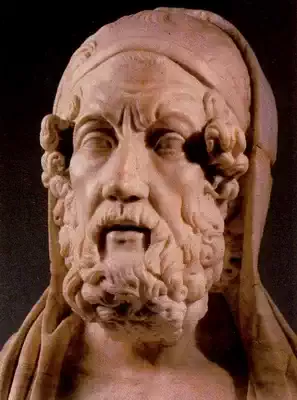
Homero
The Odyssey: Book 18
The Odyssey: Book 18
Now there came a certain common tramp who used to go begging all
over the city of Ithaca, and was notorious as an incorrigible
glutton and drunkard. This man had no strength nor stay in him, but he
was a great hulking fellow to look at; his real name, the one his
mother gave him, was Arnaeus, but the young men of the place called
him Irus, because he used to run errands for any one who would send
him. As soon as he came he began to insult Ulysses, and to try and
drive him out of his own house.
"Be off, old man," he cried, "from the doorway, or you shall be
dragged out neck and heels. Do you not see that they are all giving me
the wink, and wanting me to turn you out by force, only I do not
like to do so? Get up then, and go of yourself, or we shall come to
blows."
Ulysses frowned on him and said, "My friend, I do you no manner of
harm; people give you a great deal, but I am not jealous. There is
room enough in this doorway for the pair of us, and you need not
grudge me things that are not yours to give. You seem to be just
such another tramp as myself, but perhaps the gods will give us better
luck by and by. Do not, however, talk too much about fighting or you
will incense me, and old though I am, I shall cover your mouth and
chest with blood. I shall have more peace to-morrow if I do, for you
will not come to the house of Ulysses any more."
Irus was very angry and answered, "You filthy glutton, you run on
trippingly like an old fish-fag. I have a good mind to lay both
hands about you, and knock your teeth out of your head like so many
boar's tusks. Get ready, therefore, and let these people here stand by
and look on. You will never be able to fight one who is so much
younger than yourself."
Thus roundly did they rate one another on the smooth pavement in
front of the doorway, and when Antinous saw what was going on he
laughed heartily and said to the others, "This is the finest sport
that you ever saw; heaven never yet sent anything like it into this
house. The stranger and Irus have quarreled and are going to fight,
let us set them on to do so at once."
The suitors all came up laughing, and gathered round the two
ragged tramps. "Listen to me," said Antinous, "there are some goats'
paunches down at the fire, which we have filled with blood and fat,
and set aside for supper; he who is victorious and proves himself to
be the better man shall have his pick of the lot; he shall be free
of our table and we will not allow any other beggar about the house at
all."
The others all agreed, but Ulysses, to throw them off the scent,
said, "Sirs, an old man like myself, worn out with suffering, cannot
hold his own against a young one; but my irrepressible belly urges
me on, though I know it can only end in my getting a drubbing. You
must swear, however that none of you will give me a foul blow to
favour Irus and secure him the victory."
They swore as he told them, and when they had completed their oath
Telemachus put in a word and said, "Stranger, if you have a mind to
settle with this fellow, you need not be afraid of any one here.
Whoever strikes you will have to fight more than one. I am host, and
the other chiefs, Antinous and Eurymachus, both of them men of
understanding, are of the same mind as I am."
Every one assented, and Ulysses girded his old rags about his loins,
thus baring his stalwart thighs, his broad chest and shoulders, and
his mighty arms; but Minerva came up to him and made his limbs even
stronger still. The suitors were beyond measure astonished, and one
would turn towards his neighbour saying, "The stranger has brought
such a thigh out of his old rags that there will soon be nothing
left of Irus."
Irus began to be very uneasy as he heard them, but the servants
girded him by force, and brought him [into the open part of the court]
in such a fright that his limbs were all of a tremble. Antinous
scolded him and said, "You swaggering bully, you ought never to have
been born at all if you are afraid of such an old broken-down creature
as this tramp is. I say, therefore- and it shall surely be- if he
beats you and proves himself the better man, I shall pack you off on
board ship to the mainland and send you to king Echetus, who kills
every one that comes near him. He will cut off your nose and ears, and
draw out your entrails for the dogs to eat."
This frightened Irus still more, but they brought him into the
middle of the court, and the two men raised their hands to fight. Then
Ulysses considered whether he should let drive so hard at him as to
make an end of him then and there, or whether he should give him a
lighter blow that should only knock him down; in the end he deemed
it best to give the lighter blow for fear the Achaeans should begin to
suspect who he was. Then they began to fight, and Irus hit Ulysses
on the right shoulder; but Ulysses gave Irus a blow on the neck
under the ear that broke in the bones of his skull, and the blood came
gushing out of his mouth; he fell groaning in the dust, gnashing his
teeth and kicking on the ground, but the suitors threw up their
hands and nearly died of laughter, as Ulysses caught hold of him by
the foot and dragged him into the outer court as far as the
gate-house. There he propped him up against the wall and put his staff
in his hands. "Sit here," said he, "and keep the dogs and pigs off;
you are a pitiful creature, and if you try to make yourself king of
the beggars any more you shall fare still worse."
Then he threw his dirty old wallet, all tattered and torn, over
his shoulder with the cord by which it hung, and went back to sit down
upon the threshold; but the suitors went within the cloisters,
laughing and saluting him, "May Jove, and all the other gods," said
they, 'grant you whatever you want for having put an end to the
importunity of this insatiable tramp. We will take him over to the
mainland presently, to king Echetus, who kills every one that comes
near him."
Ulysses hailed this as of good omen, and Antinous set a great goat's
paunch before him filled with blood and fat. Amphinomus took two
loaves out of the bread-basket and brought them to him, pledging him
as he did so in a golden goblet of wine. "Good luck to you," he
said, "father stranger, you are very badly off at present, but I
hope you will have better times by and by."
To this Ulysses answered, "Amphinomus, you seem to be a man of
good understanding, as indeed you may well be, seeing whose son you
are. I have heard your father well spoken of; he is Nisus of
Dulichium, a man both brave and wealthy. They tell me you are his son,
and you appear to be a considerable person; listen, therefore, and
take heed to what I am saying. Man is the vainest of all creatures
that have their being upon earth. As long as heaven vouchsafes him
health and strength, he thinks that he shall come to no harm
hereafter, and even when the blessed gods bring sorrow upon him, he
bears it as he needs must, and makes the best of it; for God
Almighty gives men their daily minds day by day. I know all about
it, for I was a rich man once, and did much wrong in the
stubbornness of my pride, and in the confidence that my father and
my brothers would support me; therefore let a man fear God in all
things always, and take the good that heaven may see fit to send him
without vainglory. Consider the infamy of what these suitors are
doing; see how they are wasting the estate, and doing dishonour to the
wife, of one who is certain to return some day, and that, too, not
long hence. Nay, he will be here soon; may heaven send you home
quietly first that you may not meet with him in the day of his coming,
for once he is here the suitors and he will not part bloodlessly."
With these words he made a drink-offering, and when he had drunk
he put the gold cup again into the hands of Amphinomus, who walked
away serious and bowing his head, for he foreboded evil. But even so
he did not escape destruction, for Minerva had doomed him fall by
the hand of Telemachus. So he took his seat again at the place from
which he had come.
Then Minerva put it into the mind of Penelope to show herself to the
suitors, that she might make them still more enamoured of her, and win
still further honour from her son and husband. So she feigned a
mocking laugh and said, "Eurynome, I have changed my and have a
fancy to show myself to the suitors although I detest them. I should
like also to give my son a hint that he had better not have anything
more to do with them. They speak fairly enough but they mean
mischief."
"My dear child," answered Eurynome, "all that you have said is true,
go and tell your son about it, but first wash yourself and anoint your
face. Do not go about with your cheeks all covered with tears; it is
not right that you should grieve so incessantly; for Telemachus,
whom you always prayed that you might live to see with a beard, is
already grown up."
"I know, Eurynome," replied Penelope, "that you mean well, but do
not try and persuade me to wash and to anoint myself, for heaven
robbed me of all my beauty on the day my husband sailed; nevertheless,
tell Autonoe and Hippodamia that I want them. They must be with me
when I am in the cloister; I am not going among the men alone; it
would not be proper for me to do so."
On this the old woman went out of the room to bid the maids go to
their mistress. In the meantime Minerva bethought her of another
matter, and sent Penelope off into a sweet slumber; so she lay down on
her couch and her limbs became heavy with sleep. Then the goddess shed
grace and beauty over her that all the Achaeans might admire her.
She washed her face with the ambrosial loveliness that Venus wears
when she goes dancing with the Graces; she made her taller and of a
more commanding figure, while as for her complexion it was whiter than
sawn ivory. When Minerva had done all this she went away, whereon
the maids came in from the women's room and woke Penelope with the
sound of their talking.
"What an exquisitely delicious sleep I have been having," said
she, as she passed her hands over her face, "in spite of all my
misery. I wish Diana would let me die so sweetly now at this very
moment, that I might no longer waste in despair for the loss of my
dear husband, who possessed every kind of good quality and was the
most distinguished man among the Achaeans."
With these words she came down from her upper room, not alone but
attended by two of her maidens, and when she reached the suitors she
stood by one of the bearing-posts supporting the roof of the cloister,
holding a veil before her face, and with a staid maid servant on
either side of her. As they beheld her the suitors were so overpowered
and became so desperately enamoured of her, that each one prayed he
might win her for his own bed fellow.
"Telemachus," said she, addressing her son, "I fear you are no
longer so discreet and well conducted as you used to be. When you were
younger you had a greater sense of propriety; now, however, that you
are grown up, though a stranger to look at you would take you for
the son of a well-to-do father as far as size and good looks go,
your conduct is by no means what it should be. What is all this
disturbance that has been going on, and how came you to allow a
stranger to be so disgracefully ill-treated? What would have
happened if he had suffered serious injury while a suppliant in our
house? Surely this would have been very discreditable to you."
"I am not surprised, my dear mother, at your displeasure," replied
Telemachus, "I understand all about it and know when things are not as
they should be, which I could not do when I was younger; I cannot,
however, behave with perfect propriety at all times. First one and
then another of these wicked people here keeps driving me out of my
mind, and I have no one to stand by me. After all, however, this fight
between Irus and the stranger did not turn out as the suitors meant it
to do, for the stranger got the best of it. I wish Father Jove,
Minerva, and Apollo would break the neck of every one of these
wooers of yours, some inside the house and some out; and I wish they
might all be as limp as Irus is over yonder in the gate of the outer
court. See how he nods his head like a drunken man; he has had such
a thrashing that he cannot stand on his feet nor get back to his home,
wherever that may be, for has no strength left in him."
Thus did they converse. Eurymachus then came up and said, "Queen
Penelope, daughter of Icarius, if all the Achaeans in Iasian Argos
could see you at this moment, you would have still more suitors in
your house by tomorrow morning, for you are the most admirable woman
in the whole world both as regards personal beauty and strength of
understanding."
To this Penelope replied, "Eurymachus, heaven robbed me of all my
beauty whether of face or figure when the Argives set sail for Troy
and my dear husband with them. If he were to return and look after
my affairs, I should both be more respected and show a better presence
to the world. As it is, I am oppressed with care, and with the
afflictions which heaven has seen fit to heap upon me. My husband
foresaw it all, and when he was leaving home he took my right wrist in
his hand- 'Wife, 'he said, 'we shall not all of us come safe home
from Troy, for the Trojans fight well both with bow and spear. They
are excellent also at fighting from chariots, and nothing decides
the issue of a fight sooner than this. I know not, therefore,
whether heaven will send me back to you, or whether I may not fall
over there at Troy. In the meantime do you look after things here.
Take care of my father and mother as at present, and even more so
during my absence, but when you see our son growing a beard, then
marry whom you will, and leave this your present home. This is what he
said and now it is all coming true. A night will come when I shall
have to yield myself to a marriage which I detest, for Jove has
taken from me all hope of happiness. This further grief, moreover,
cuts me to the very heart. You suitors are not wooing me after the
custom of my country. When men are courting a woman who they think
will be a good wife to them and who is of noble birth, and when they
are each trying to win her for himself, they usually bring oxen and
sheep to feast the friends of the lady, and they make her
magnificent presents, instead of eating up other people's property
without paying for it."
This was what she said, and Ulysses was glad when he heard her
trying to get presents out of the suitors, and flattering them with
fair words which he knew she did not mean.
Then Antinous said, "Queen Penelope, daughter of Icarius, take as
many presents as you please from any one who will give them to you; it
is not well to refuse a present; but we will not go about our business
nor stir from where we are, till you have married the best man among
us whoever he may be."
The others applauded what Antinous had said, and each one sent his
servant to bring his present. Antinous's man returned with a large and
lovely dress most exquisitely embroidered. It had twelve beautifully
made brooch pins of pure gold with which to fasten it. Eurymachus
immediately brought her a magnificent chain of gold and amber beads
that gleamed like sunlight. Eurydamas's two men returned with some
earrings fashioned into three brilliant pendants which glistened
most beautifully; while king Pisander son of Polyctor gave her a
necklace of the rarest workmanship, and every one else brought her a
beautiful present of some kind.
Then the queen went back to her room upstairs, and her maids brought
the presents after her. Meanwhile the suitors took to singing and
dancing, and stayed till evening came. They danced and sang till it
grew dark; they then brought in three braziers to give light, and
piled them up with chopped firewood very and dry, and they lit torches
from them, which the maids held up turn and turn about. Then Ulysses
said:
"Maids, servants of Ulysses who has so long been absent, go to the
queen inside the house; sit with her and amuse her, or spin, and
pick wool. I will hold the light for all these people. They may stay
till morning, but shall not beat me, for I can stand a great deal."
The maids looked at one another and laughed, while pretty Melantho
began to gibe at him contemptuously. She was daughter to Dolius, but
had been brought up by Penelope, who used to give her toys to play
with, and looked after her when she was a child; but in spite of all
this she showed no consideration for the sorrows of her mistress,
and used to misconduct herself with Eurymachus, with whom she was in
love.
"Poor wretch," said she, "are you gone clean out of your mind? Go
and sleep in some smithy, or place of public gossips, instead of
chattering here. Are you not ashamed of opening your mouth before your
betters- so many of them too? Has the wine been getting into your
head, or do you always babble in this way? You seem to have lost
your wits because you beat the tramp Irus; take care that a better man
than he does not come and cudgel you about the head till he pack you
bleeding out of the house."
"Vixen," replied Ulysses, scowling at her, "I will go and tell
Telemachus what you have been saying, and he will have you torn limb
from limb."
With these words he scared the women, and they went off into the
body of the house. They trembled all aver, for they thought he would
do as he said. But Ulysses took his stand near the burning braziers,
holding up torches and looking at the people- brooding the while on
things that should surely come to pass.
But Minerva would not let the suitors for one moment cease their
insolence, for she wanted Ulysses to become even more bitter against
them; she therefore set Eurymachus son of Polybus on to gibe at him,
which made the others laugh. "Listen to me," said he, "you suitors
of Queen Penelope, that I may speak even as I am minded. It is not for
nothing that this man has come to the house of Ulysses; I believe
the light has not been coming from the torches, but from his own headfor
his hair is all gone, every bit of it."
Then turning to Ulysses he said, "Stranger, will you work as a
servant, if I send you to the wolds and see that you are well paid?
Can you build a stone fence, or plant trees? I will have you fed all
the year round, and will find you in shoes and clothing. Will you
go, then? Not you; for you have got into bad ways, and do not want
to work; you had rather fill your belly by going round the country
begging."
"Eurymachus," answered Ulysses, "if you and I were to work one
against the other in early summer when the days are at their
longest- give me a good scythe, and take another yourself, and let
us see which will fast the longer or mow the stronger, from dawn
till dark when the mowing grass is about. Or if you will plough
against me, let us each take a yoke of tawny oxen, well-mated and of
great strength and endurance: turn me into a four acre field, and
see whether you or I can drive the straighter furrow. If, again, war
were to break out this day, give me a shield, a couple of spears and a
helmet fitting well upon my temples- you would find me foremost in the
fray, and would cease your gibes about my belly. You are insolent
and cruel, and think yourself a great man because you live in a little
world, ind that a bad one. If Ulysses comes to his own again, the
doors of his house are wide, but you will find them narrow when you
try to fly through them."
Eurymachus was furious at all this. He scowled at him and cried,
"You wretch, I will soon pay you out for daring to say such things
to me, and in public too. Has the wine been getting into your head
or do you always babble in this way? You seem to have lost your wits
because you beat the tramp Irus. With this he caught hold of a
footstool, but Ulysses sought protection at the knees of Amphinomus of
Dulichium, for he was afraid. The stool hit the cupbearer on his right
hand and knocked him down: the man fell with a cry flat on his back,
and his wine-jug fell ringing to the ground. The suitors in the
covered cloister were now in an uproar, and one would turn towards his
neighbour, saying, "I wish the stranger had gone somewhere else, bad
luck to hide, for all the trouble he gives us. We cannot permit such
disturbance about a beggar; if such ill counsels are to prevail we
shall have no more pleasure at our banquet."
On this Telemachus came forward and said, "Sirs, are you mad? Can
you not carry your meat and your liquor decently? Some evil spirit has
possessed you. I do not wish to drive any of you away, but you have
had your suppers, and the sooner you all go home to bed the better."
The suitors bit their lips and marvelled at the boldness of his
speech; but Amphinomus the son of Nisus, who was son to Aretias, said,
"Do not let us take offence; it is reasonable, so let us make no
answer. Neither let us do violence to the stranger nor to any of
Ulysses' servants. Let the cupbearer go round with the
drink-offerings, that we may make them and go home to our rest. As for
the stranger, let us leave Telemachus to deal with him, for it is to
his house that he has come."
Thus did he speak, and his saying pleased them well, so Mulius of
Dulichium, servant to Amphinomus, mixed them a bowl of wine and
water and handed it round to each of them man by man, whereon they
made their drink-offerings to the blessed gods: Then, when they had
made their drink-offerings and had drunk each one as he was minded,
they took their several ways each of them to his own abode.
Translated by Samuel Butler
Now there came a certain common tramp who used to go begging all
over the city of Ithaca, and was notorious as an incorrigible
glutton and drunkard. This man had no strength nor stay in him, but he
was a great hulking fellow to look at; his real name, the one his
mother gave him, was Arnaeus, but the young men of the place called
him Irus, because he used to run errands for any one who would send
him. As soon as he came he began to insult Ulysses, and to try and
drive him out of his own house.
"Be off, old man," he cried, "from the doorway, or you shall be
dragged out neck and heels. Do you not see that they are all giving me
the wink, and wanting me to turn you out by force, only I do not
like to do so? Get up then, and go of yourself, or we shall come to
blows."
Ulysses frowned on him and said, "My friend, I do you no manner of
harm; people give you a great deal, but I am not jealous. There is
room enough in this doorway for the pair of us, and you need not
grudge me things that are not yours to give. You seem to be just
such another tramp as myself, but perhaps the gods will give us better
luck by and by. Do not, however, talk too much about fighting or you
will incense me, and old though I am, I shall cover your mouth and
chest with blood. I shall have more peace to-morrow if I do, for you
will not come to the house of Ulysses any more."
Irus was very angry and answered, "You filthy glutton, you run on
trippingly like an old fish-fag. I have a good mind to lay both
hands about you, and knock your teeth out of your head like so many
boar's tusks. Get ready, therefore, and let these people here stand by
and look on. You will never be able to fight one who is so much
younger than yourself."
Thus roundly did they rate one another on the smooth pavement in
front of the doorway, and when Antinous saw what was going on he
laughed heartily and said to the others, "This is the finest sport
that you ever saw; heaven never yet sent anything like it into this
house. The stranger and Irus have quarreled and are going to fight,
let us set them on to do so at once."
The suitors all came up laughing, and gathered round the two
ragged tramps. "Listen to me," said Antinous, "there are some goats'
paunches down at the fire, which we have filled with blood and fat,
and set aside for supper; he who is victorious and proves himself to
be the better man shall have his pick of the lot; he shall be free
of our table and we will not allow any other beggar about the house at
all."
The others all agreed, but Ulysses, to throw them off the scent,
said, "Sirs, an old man like myself, worn out with suffering, cannot
hold his own against a young one; but my irrepressible belly urges
me on, though I know it can only end in my getting a drubbing. You
must swear, however that none of you will give me a foul blow to
favour Irus and secure him the victory."
They swore as he told them, and when they had completed their oath
Telemachus put in a word and said, "Stranger, if you have a mind to
settle with this fellow, you need not be afraid of any one here.
Whoever strikes you will have to fight more than one. I am host, and
the other chiefs, Antinous and Eurymachus, both of them men of
understanding, are of the same mind as I am."
Every one assented, and Ulysses girded his old rags about his loins,
thus baring his stalwart thighs, his broad chest and shoulders, and
his mighty arms; but Minerva came up to him and made his limbs even
stronger still. The suitors were beyond measure astonished, and one
would turn towards his neighbour saying, "The stranger has brought
such a thigh out of his old rags that there will soon be nothing
left of Irus."
Irus began to be very uneasy as he heard them, but the servants
girded him by force, and brought him [into the open part of the court]
in such a fright that his limbs were all of a tremble. Antinous
scolded him and said, "You swaggering bully, you ought never to have
been born at all if you are afraid of such an old broken-down creature
as this tramp is. I say, therefore- and it shall surely be- if he
beats you and proves himself the better man, I shall pack you off on
board ship to the mainland and send you to king Echetus, who kills
every one that comes near him. He will cut off your nose and ears, and
draw out your entrails for the dogs to eat."
This frightened Irus still more, but they brought him into the
middle of the court, and the two men raised their hands to fight. Then
Ulysses considered whether he should let drive so hard at him as to
make an end of him then and there, or whether he should give him a
lighter blow that should only knock him down; in the end he deemed
it best to give the lighter blow for fear the Achaeans should begin to
suspect who he was. Then they began to fight, and Irus hit Ulysses
on the right shoulder; but Ulysses gave Irus a blow on the neck
under the ear that broke in the bones of his skull, and the blood came
gushing out of his mouth; he fell groaning in the dust, gnashing his
teeth and kicking on the ground, but the suitors threw up their
hands and nearly died of laughter, as Ulysses caught hold of him by
the foot and dragged him into the outer court as far as the
gate-house. There he propped him up against the wall and put his staff
in his hands. "Sit here," said he, "and keep the dogs and pigs off;
you are a pitiful creature, and if you try to make yourself king of
the beggars any more you shall fare still worse."
Then he threw his dirty old wallet, all tattered and torn, over
his shoulder with the cord by which it hung, and went back to sit down
upon the threshold; but the suitors went within the cloisters,
laughing and saluting him, "May Jove, and all the other gods," said
they, 'grant you whatever you want for having put an end to the
importunity of this insatiable tramp. We will take him over to the
mainland presently, to king Echetus, who kills every one that comes
near him."
Ulysses hailed this as of good omen, and Antinous set a great goat's
paunch before him filled with blood and fat. Amphinomus took two
loaves out of the bread-basket and brought them to him, pledging him
as he did so in a golden goblet of wine. "Good luck to you," he
said, "father stranger, you are very badly off at present, but I
hope you will have better times by and by."
To this Ulysses answered, "Amphinomus, you seem to be a man of
good understanding, as indeed you may well be, seeing whose son you
are. I have heard your father well spoken of; he is Nisus of
Dulichium, a man both brave and wealthy. They tell me you are his son,
and you appear to be a considerable person; listen, therefore, and
take heed to what I am saying. Man is the vainest of all creatures
that have their being upon earth. As long as heaven vouchsafes him
health and strength, he thinks that he shall come to no harm
hereafter, and even when the blessed gods bring sorrow upon him, he
bears it as he needs must, and makes the best of it; for God
Almighty gives men their daily minds day by day. I know all about
it, for I was a rich man once, and did much wrong in the
stubbornness of my pride, and in the confidence that my father and
my brothers would support me; therefore let a man fear God in all
things always, and take the good that heaven may see fit to send him
without vainglory. Consider the infamy of what these suitors are
doing; see how they are wasting the estate, and doing dishonour to the
wife, of one who is certain to return some day, and that, too, not
long hence. Nay, he will be here soon; may heaven send you home
quietly first that you may not meet with him in the day of his coming,
for once he is here the suitors and he will not part bloodlessly."
With these words he made a drink-offering, and when he had drunk
he put the gold cup again into the hands of Amphinomus, who walked
away serious and bowing his head, for he foreboded evil. But even so
he did not escape destruction, for Minerva had doomed him fall by
the hand of Telemachus. So he took his seat again at the place from
which he had come.
Then Minerva put it into the mind of Penelope to show herself to the
suitors, that she might make them still more enamoured of her, and win
still further honour from her son and husband. So she feigned a
mocking laugh and said, "Eurynome, I have changed my and have a
fancy to show myself to the suitors although I detest them. I should
like also to give my son a hint that he had better not have anything
more to do with them. They speak fairly enough but they mean
mischief."
"My dear child," answered Eurynome, "all that you have said is true,
go and tell your son about it, but first wash yourself and anoint your
face. Do not go about with your cheeks all covered with tears; it is
not right that you should grieve so incessantly; for Telemachus,
whom you always prayed that you might live to see with a beard, is
already grown up."
"I know, Eurynome," replied Penelope, "that you mean well, but do
not try and persuade me to wash and to anoint myself, for heaven
robbed me of all my beauty on the day my husband sailed; nevertheless,
tell Autonoe and Hippodamia that I want them. They must be with me
when I am in the cloister; I am not going among the men alone; it
would not be proper for me to do so."
On this the old woman went out of the room to bid the maids go to
their mistress. In the meantime Minerva bethought her of another
matter, and sent Penelope off into a sweet slumber; so she lay down on
her couch and her limbs became heavy with sleep. Then the goddess shed
grace and beauty over her that all the Achaeans might admire her.
She washed her face with the ambrosial loveliness that Venus wears
when she goes dancing with the Graces; she made her taller and of a
more commanding figure, while as for her complexion it was whiter than
sawn ivory. When Minerva had done all this she went away, whereon
the maids came in from the women's room and woke Penelope with the
sound of their talking.
"What an exquisitely delicious sleep I have been having," said
she, as she passed her hands over her face, "in spite of all my
misery. I wish Diana would let me die so sweetly now at this very
moment, that I might no longer waste in despair for the loss of my
dear husband, who possessed every kind of good quality and was the
most distinguished man among the Achaeans."
With these words she came down from her upper room, not alone but
attended by two of her maidens, and when she reached the suitors she
stood by one of the bearing-posts supporting the roof of the cloister,
holding a veil before her face, and with a staid maid servant on
either side of her. As they beheld her the suitors were so overpowered
and became so desperately enamoured of her, that each one prayed he
might win her for his own bed fellow.
"Telemachus," said she, addressing her son, "I fear you are no
longer so discreet and well conducted as you used to be. When you were
younger you had a greater sense of propriety; now, however, that you
are grown up, though a stranger to look at you would take you for
the son of a well-to-do father as far as size and good looks go,
your conduct is by no means what it should be. What is all this
disturbance that has been going on, and how came you to allow a
stranger to be so disgracefully ill-treated? What would have
happened if he had suffered serious injury while a suppliant in our
house? Surely this would have been very discreditable to you."
"I am not surprised, my dear mother, at your displeasure," replied
Telemachus, "I understand all about it and know when things are not as
they should be, which I could not do when I was younger; I cannot,
however, behave with perfect propriety at all times. First one and
then another of these wicked people here keeps driving me out of my
mind, and I have no one to stand by me. After all, however, this fight
between Irus and the stranger did not turn out as the suitors meant it
to do, for the stranger got the best of it. I wish Father Jove,
Minerva, and Apollo would break the neck of every one of these
wooers of yours, some inside the house and some out; and I wish they
might all be as limp as Irus is over yonder in the gate of the outer
court. See how he nods his head like a drunken man; he has had such
a thrashing that he cannot stand on his feet nor get back to his home,
wherever that may be, for has no strength left in him."
Thus did they converse. Eurymachus then came up and said, "Queen
Penelope, daughter of Icarius, if all the Achaeans in Iasian Argos
could see you at this moment, you would have still more suitors in
your house by tomorrow morning, for you are the most admirable woman
in the whole world both as regards personal beauty and strength of
understanding."
To this Penelope replied, "Eurymachus, heaven robbed me of all my
beauty whether of face or figure when the Argives set sail for Troy
and my dear husband with them. If he were to return and look after
my affairs, I should both be more respected and show a better presence
to the world. As it is, I am oppressed with care, and with the
afflictions which heaven has seen fit to heap upon me. My husband
foresaw it all, and when he was leaving home he took my right wrist in
his hand- 'Wife, 'he said, 'we shall not all of us come safe home
from Troy, for the Trojans fight well both with bow and spear. They
are excellent also at fighting from chariots, and nothing decides
the issue of a fight sooner than this. I know not, therefore,
whether heaven will send me back to you, or whether I may not fall
over there at Troy. In the meantime do you look after things here.
Take care of my father and mother as at present, and even more so
during my absence, but when you see our son growing a beard, then
marry whom you will, and leave this your present home. This is what he
said and now it is all coming true. A night will come when I shall
have to yield myself to a marriage which I detest, for Jove has
taken from me all hope of happiness. This further grief, moreover,
cuts me to the very heart. You suitors are not wooing me after the
custom of my country. When men are courting a woman who they think
will be a good wife to them and who is of noble birth, and when they
are each trying to win her for himself, they usually bring oxen and
sheep to feast the friends of the lady, and they make her
magnificent presents, instead of eating up other people's property
without paying for it."
This was what she said, and Ulysses was glad when he heard her
trying to get presents out of the suitors, and flattering them with
fair words which he knew she did not mean.
Then Antinous said, "Queen Penelope, daughter of Icarius, take as
many presents as you please from any one who will give them to you; it
is not well to refuse a present; but we will not go about our business
nor stir from where we are, till you have married the best man among
us whoever he may be."
The others applauded what Antinous had said, and each one sent his
servant to bring his present. Antinous's man returned with a large and
lovely dress most exquisitely embroidered. It had twelve beautifully
made brooch pins of pure gold with which to fasten it. Eurymachus
immediately brought her a magnificent chain of gold and amber beads
that gleamed like sunlight. Eurydamas's two men returned with some
earrings fashioned into three brilliant pendants which glistened
most beautifully; while king Pisander son of Polyctor gave her a
necklace of the rarest workmanship, and every one else brought her a
beautiful present of some kind.
Then the queen went back to her room upstairs, and her maids brought
the presents after her. Meanwhile the suitors took to singing and
dancing, and stayed till evening came. They danced and sang till it
grew dark; they then brought in three braziers to give light, and
piled them up with chopped firewood very and dry, and they lit torches
from them, which the maids held up turn and turn about. Then Ulysses
said:
"Maids, servants of Ulysses who has so long been absent, go to the
queen inside the house; sit with her and amuse her, or spin, and
pick wool. I will hold the light for all these people. They may stay
till morning, but shall not beat me, for I can stand a great deal."
The maids looked at one another and laughed, while pretty Melantho
began to gibe at him contemptuously. She was daughter to Dolius, but
had been brought up by Penelope, who used to give her toys to play
with, and looked after her when she was a child; but in spite of all
this she showed no consideration for the sorrows of her mistress,
and used to misconduct herself with Eurymachus, with whom she was in
love.
"Poor wretch," said she, "are you gone clean out of your mind? Go
and sleep in some smithy, or place of public gossips, instead of
chattering here. Are you not ashamed of opening your mouth before your
betters- so many of them too? Has the wine been getting into your
head, or do you always babble in this way? You seem to have lost
your wits because you beat the tramp Irus; take care that a better man
than he does not come and cudgel you about the head till he pack you
bleeding out of the house."
"Vixen," replied Ulysses, scowling at her, "I will go and tell
Telemachus what you have been saying, and he will have you torn limb
from limb."
With these words he scared the women, and they went off into the
body of the house. They trembled all aver, for they thought he would
do as he said. But Ulysses took his stand near the burning braziers,
holding up torches and looking at the people- brooding the while on
things that should surely come to pass.
But Minerva would not let the suitors for one moment cease their
insolence, for she wanted Ulysses to become even more bitter against
them; she therefore set Eurymachus son of Polybus on to gibe at him,
which made the others laugh. "Listen to me," said he, "you suitors
of Queen Penelope, that I may speak even as I am minded. It is not for
nothing that this man has come to the house of Ulysses; I believe
the light has not been coming from the torches, but from his own headfor
his hair is all gone, every bit of it."
Then turning to Ulysses he said, "Stranger, will you work as a
servant, if I send you to the wolds and see that you are well paid?
Can you build a stone fence, or plant trees? I will have you fed all
the year round, and will find you in shoes and clothing. Will you
go, then? Not you; for you have got into bad ways, and do not want
to work; you had rather fill your belly by going round the country
begging."
"Eurymachus," answered Ulysses, "if you and I were to work one
against the other in early summer when the days are at their
longest- give me a good scythe, and take another yourself, and let
us see which will fast the longer or mow the stronger, from dawn
till dark when the mowing grass is about. Or if you will plough
against me, let us each take a yoke of tawny oxen, well-mated and of
great strength and endurance: turn me into a four acre field, and
see whether you or I can drive the straighter furrow. If, again, war
were to break out this day, give me a shield, a couple of spears and a
helmet fitting well upon my temples- you would find me foremost in the
fray, and would cease your gibes about my belly. You are insolent
and cruel, and think yourself a great man because you live in a little
world, ind that a bad one. If Ulysses comes to his own again, the
doors of his house are wide, but you will find them narrow when you
try to fly through them."
Eurymachus was furious at all this. He scowled at him and cried,
"You wretch, I will soon pay you out for daring to say such things
to me, and in public too. Has the wine been getting into your head
or do you always babble in this way? You seem to have lost your wits
because you beat the tramp Irus. With this he caught hold of a
footstool, but Ulysses sought protection at the knees of Amphinomus of
Dulichium, for he was afraid. The stool hit the cupbearer on his right
hand and knocked him down: the man fell with a cry flat on his back,
and his wine-jug fell ringing to the ground. The suitors in the
covered cloister were now in an uproar, and one would turn towards his
neighbour, saying, "I wish the stranger had gone somewhere else, bad
luck to hide, for all the trouble he gives us. We cannot permit such
disturbance about a beggar; if such ill counsels are to prevail we
shall have no more pleasure at our banquet."
On this Telemachus came forward and said, "Sirs, are you mad? Can
you not carry your meat and your liquor decently? Some evil spirit has
possessed you. I do not wish to drive any of you away, but you have
had your suppers, and the sooner you all go home to bed the better."
The suitors bit their lips and marvelled at the boldness of his
speech; but Amphinomus the son of Nisus, who was son to Aretias, said,
"Do not let us take offence; it is reasonable, so let us make no
answer. Neither let us do violence to the stranger nor to any of
Ulysses' servants. Let the cupbearer go round with the
drink-offerings, that we may make them and go home to our rest. As for
the stranger, let us leave Telemachus to deal with him, for it is to
his house that he has come."
Thus did he speak, and his saying pleased them well, so Mulius of
Dulichium, servant to Amphinomus, mixed them a bowl of wine and
water and handed it round to each of them man by man, whereon they
made their drink-offerings to the blessed gods: Then, when they had
made their drink-offerings and had drunk each one as he was minded,
they took their several ways each of them to his own abode.
Translated by Samuel Butler
144
Homero
The Odyssey: Book 14
The Odyssey: Book 14
Ulysses now left the haven, and took the rough track up through
the wooded country and over the crest of the mountain till he
reached the place where Minerva had said that he would find the
swineherd, who was the most thrifty servant he had. He found him
sitting in front of his hut, which was by the yards that he had
built on a site which could be seen from far. He had made them
spacious and fair to see, with a free ran for the pigs all round them;
he had built them during his master's absence, of stones which he
had gathered out of the ground, without saying anything to Penelope or
Laertes, and he had fenced them on top with thorn bushes. Outside
the yard he had run a strong fence of oaken posts, split, and set
pretty close together, while inside lie had built twelve sties near
one another for the sows to lie in. There were fifty pigs wallowing in
each sty, all of them breeding sows; but the boars slept outside and
were much fewer in number, for the suitors kept on eating them, and
die swineherd had to send them the best he had continually. There were
three hundred and sixty boar pigs, and the herdsman's four hounds,
which were as fierce as wolves, slept always with them. The
swineherd was at that moment cutting out a pair of sandals from a good
stout ox hide. Three of his men were out herding the pigs in one place
or another, and he had sent the fourth to town with a boar that he had
been forced to send the suitors that they might sacrifice it and
have their fill of meat.
When the hounds saw Ulysses they set up a furious barking and flew
at him, but Ulysses was cunning enough to sit down and loose his
hold of the stick that he had in his hand: still, he would have been
torn by them in his own homestead had not the swineherd dropped his ox
hide, rushed full speed through the gate of the yard and driven the
dogs off by shouting and throwing stones at them. Then he said to
Ulysses, "Old man, the dogs were likely to have made short work of
you, and then you would have got me into trouble. The gods have
given me quite enough worries without that, for I have lost the best
of masters, and am in continual grief on his account. I have to attend
swine for other people to eat, while he, if he yet lives to see the
light of day, is starving in some distant land. But come inside, and
when you have had your fill of bread and wine, tell me where you
come from, and all about your misfortunes."
On this the swineherd led the way into the hut and bade him sit
down. He strewed a good thick bed of rushes upon the floor, and on the
top of this he threw the shaggy chamois skin- a great thick one- on
which he used to sleep by night. Ulysses was pleased at being made
thus welcome, and said "May Jove, sir, and the rest of the gods
grant you your heart's desire in return for the kind way in which
you have received me."
To this you answered, O swineherd Eumaeus, "Stranger, though a still
poorer man should come here, it would not be right for me to insult
him, for all strangers and beggars are from Jove. You must take what
you can get and be thankful, for servants live in fear when they
have young lords for their masters; and this is my misfortune now, for
heaven has hindered the return of him who would have been always
good to me and given me something of my own- a house, a piece of land,
a good looking wife, and all else that a liberal master allows a
servant who has worked hard for him, and whose labour the gods have
prospered as they have mine in the situation which I hold. If my
master had grown old here he would have done great things by me, but
he is gone, and I wish that Helen's whole race were utterly destroyed,
for she has been the death of many a good man. It was this matter that
took my master to Ilius, the land of noble steeds, to fight the
Trojans in the cause of kin Agamemnon."
As he spoke he bound his girdle round him and went to the sties
where the young sucking pigs were penned. He picked out two which he
brought back with him and sacrificed. He singed them, cut them up, and
spitted on them; when the meat was cooked he brought it all in and set
it before Ulysses, hot and still on the spit, whereon Ulysses
sprinkled it over with white barley meal. The swineherd then mixed
wine in a bowl of ivy-wood, and taking a seat opposite Ulysses told
him to begin.
"Fall to, stranger," said he, "on a dish of servant's pork. The
fat pigs have to go to the suitors, who eat them up without shame or
scruple; but the blessed gods love not such shameful doings, and
respect those who do what is lawful and right. Even the fierce
free-booters who go raiding on other people's land, and Jove gives
them their spoil- even they, when they have filled their ships and got
home again live conscience-stricken, and look fearfully for judgement;
but some god seems to have told these people that Ulysses is dead
and gone; they will not, therefore, go back to their own homes and
make their offers of marriage in the usual way, but waste his estate
by force, without fear or stint. Not a day or night comes out of
heaven, but they sacrifice not one victim nor two only, and they
take the run of his wine, for he was exceedingly rich. No other
great man either in Ithaca or on the mainland is as rich as he was; he
had as much as twenty men put together. I will tell you what he had.
There are twelve herds of cattle upon the mainland, and as many flocks
of sheep, there are also twelve droves of pigs, while his own men
and hired strangers feed him twelve widely spreading herds of goats.
Here in Ithaca he runs even large flocks of goats on the far end of
the island, and they are in the charge of excellent goatherds. Each
one of these sends the suitors the best goat in the flock every day.
As for myself, I am in charge of the pigs that you see here, and I
have to keep picking out the best I have and sending it to them."
This was his story, but Ulysses went on eating and drinking
ravenously without a word, brooding his revenge. When he had eaten
enough and was satisfied, the swineherd took the bowl from which he
usually drank, filled it with wine, and gave it to Ulysses, who was
pleased, and said as he took it in his hands, "My friend, who was this
master of yours that bought you and paid for you, so rich and so
powerful as you tell me? You say he perished in the cause of King
Agamemnon; tell me who he was, in case I may have met with such a
person. Jove and the other gods know, but I may be able to give you
news of him, for I have travelled much."
Eumaeus answered, "Old man, no traveller who comes here with news
will get Ulysses' wife and son to believe his story. Nevertheless,
tramps in want of a lodging keep coming with their mouths full of
lies, and not a word of truth; every one who finds his way to Ithaca
goes to my mistress and tells her falsehoods, whereon she takes them
in, makes much of them, and asks them all manner of questions,
crying all the time as women will when they have lost their
husbands. And you too, old man, for a shirt and a cloak would
doubtless make up a very pretty story. But the wolves and birds of
prey have long since torn Ulysses to pieces, or the fishes of the
sea have eaten him, and his bones are lying buried deep in sand upon
some foreign shore; he is dead and gone, and a bad business it is
for all his friends- for me especially; go where I may I shall never
find so good a master, not even if I were to go home to my mother
and father where I was bred and born. I do not so much care,
however, about my parents now, though I should dearly like to see them
again in my own country; it is the loss of Ulysses that grieves me
most; I cannot speak of him without reverence though he is here no
longer, for he was very fond of me, and took such care of me that
whereever he may be I shall always honour his memory."
"My friend," replied Ulysses, "you are very positive, and very
hard of belief about your master's coming home again, nevertheless I
will not merely say, but will swear, that he is coming. Do not give me
anything for my news till he has actually come, you may then give me a
shirt and cloak of good wear if you will. I am in great want, but I
will not take anything at all till then, for I hate a man, even as I
hate hell fire, who lets his poverty tempt him into lying. I swear
by king Jove, by the rites of hospitality, and by that hearth of
Ulysses to which I have now come, that all will surely happen as I
have said it will. Ulysses will return in this self same year; with
the end of this moon and the beginning of the next he will be here
to do vengeance on all those who are ill treating his wife and son."
To this you answered, O swineherd Eumaeus, "Old man, you will
neither get paid for bringing good news, nor will Ulysses ever come
home; drink you wine in peace, and let us talk about something else.
Do not keep on reminding me of all this; it always pains me when any
one speaks about my honoured master. As for your oath we will let it
alone, but I only wish he may come, as do Penelope, his old father
Laertes, and his son Telemachus. I am terribly unhappy too about
this same boy of his; he was running up fast into manhood, and bade
fare to be no worse man, face and figure, than his father, but some
one, either god or man, has been unsettling his mind, so he has gone
off to Pylos to try and get news of his father, and the suitors are
lying in wait for him as he is coming home, in the hope of leaving the
house of Arceisius without a name in Ithaca. But let us say no more
about him, and leave him to be taken, or else to escape if the son
of Saturn holds his hand over him to protect him. And now, old man,
tell me your own story; tell me also, for I want to know, who you
are and where you come from. Tell me of your town and parents, what
manner of ship you came in, how crew brought you to Ithaca, and from
what country they professed to come- for you cannot have come by
land."
And Ulysses answered, "I will tell you all about it. If there were
meat and wine enough, and we could stay here in the hut with nothing
to do but to eat and drink while the others go to their work, I
could easily talk on for a whole twelve months without ever
finishing the story of the sorrows with which it has pleased heaven to
visit me.
"I am by birth a Cretan; my father was a well-to-do man, who had
many sons born in marriage, whereas I was the son of a slave whom he
had purchased for a concubine; nevertheless, my father Castor son of
Hylax (whose lineage I claim, and who was held in the highest honour
among the Cretans for his wealth, prosperity, and the valour of his
sons) put me on the same level with my brothers who had been born in
wedlock. When, however, death took him to the house of Hades, his sons
divided his estate and cast lots for their shares, but to me they gave
a holding and little else; nevertheless, my valour enabled me to marry
into a rich family, for I was not given to bragging, or shirking on
the field of battle. It is all over now; still, if you look at the
straw you can see what the ear was, for I have had trouble enough
and to spare. Mars and Minerva made me doughty in war; when I had
picked my men to surprise the enemy with an ambuscade I never gave
death so much as a thought, but was the first to leap forward and
spear all whom I could overtake. Such was I in battle, but I did not
care about farm work, nor the frugal home life of those who would
bring up children. My delight was in ships, fighting, javelins, and
arrows- things that most men shudder to think of; but one man likes
one thing and another another, and this was what I was most
naturally inclined to. Before the Achaeans went to Troy, nine times
was I in command of men and ships on foreign service, and I amassed
much wealth. I had my pick of the spoil in the first instance, and
much more was allotted to me later on.
"My house grew apace and I became a great man among the Cretans, but
when Jove counselled that terrible expedition, in which so many
perished, the people required me and Idomeneus to lead their ships
to Troy, and there was no way out of it, for they insisted on our
doing so. There we fought for nine whole years, but in the tenth we
sacked the city of Priam and sailed home again as heaven dispersed us.
Then it was that Jove devised evil against me. I spent but one month
happily with my children, wife, and property, and then I conceived the
idea of making a descent on Egypt, so I fitted out a fine fleet and
manned it. I had nine ships, and the people flocked to fill them.
For six days I and my men made feast, and I found them many victims
both for sacrifice to the gods and for themselves, but on the
seventh day we went on board and set sail from Crete with a fair North
wind behind us though we were going down a river. Nothing went ill
with any of our ships, and we had no sickness on board, but sat
where we were and let the ships go as the wind and steersmen took
them. On the fifth day we reached the river Aegyptus; there I
stationed my ships in the river, bidding my men stay by them and
keep guard over them while I sent out scouts to reconnoitre from every
point of vantage.
"But the men disobeyed my orders, took to their own devices, and
ravaged the land of the Egyptians, killing the men, and taking their
wives and children captive. The alarm was soon carried to the city,
and when they heard the war cry, the people came out at daybreak
till the plain was filled with horsemen and foot soldiers and with the
gleam of armour. Then Jove spread panic among my men, and they would
no longer face the enemy, for they found themselves surrounded. The
Egyptians killed many of us, and took the rest alive to do forced
labour for them. Jove, however, put it in my mind to do thus- and I
wish I had died then and there in Egypt instead, for there was much
sorrow in store for me- I took off my helmet and shield and dropped my
spear from my hand; then I went straight up to the king's chariot,
clasped his knees and kissed them, whereon he spared my life, bade
me get into his chariot, and took me weeping to his own home. Many
made at me with their ashen spears and tried to kil me in their
fury, but the king protected me, for he feared the wrath of Jove the
protector of strangers, who punishes those who do evil.
"I stayed there for seven years and got together much money among
the Egyptians, for they all gave me something; but when it was now
going on for eight years there came a certain Phoenician, a cunning
rascal, who had already committed all sorts of villainy, and this
man talked me over into going with him to Phoenicia, where his house
and his possessions lay. I stayed there for a whole twelve months, but
at the end of that time when months and days had gone by till the same
season had come round again, he set me on board a ship bound for
Libya, on a pretence that I was to take a cargo along with him to that
place, but really that he might sell me as a slave and take the
money I fetched. I suspected his intention, but went on board with
him, for I could not help it.
"The ship ran before a fresh North wind till we had reached the
sea that lies between Crete and Libya; there, however, Jove counselled
their destruction, for as soon as we were well out from Crete and
could see nothing but sea and sky, he raised a black cloud over our
ship and the sea grew dark beneath it. Then Jove let fly with his
thunderbolts and the ship went round and round and was filled with
fire and brimstone as the lightning struck it. The men fell all into
the sea; they were carried about in the water round the ship looking
like so many sea-gulls, but the god presently deprived them of all
chance of getting home again. I was all dismayed; Jove, however,
sent the ship's mast within my reach, which saved my life, for I clung
to it, and drifted before the fury of the gale. Nine days did I
drift but in the darkness of the tenth night a great wave bore me on
to the Thesprotian coast. There Pheidon king of the Thesprotians
entertained me hospitably without charging me anything at all for
his son found me when I was nearly dead with cold and fatigue, whereon
he raised me by the hand, took me to his father's house and gave me
clothes to wear.
"There it was that I heard news of Ulysses, for the king told me
he had entertained him, and shown him much hospitality while he was on
his homeward journey. He showed me also the treasure of gold, and
wrought iron that Ulysses had got together. There was enough to keep
his family for ten generations, so much had he left in the house of
king Pheidon. But the king said Ulysses had gone to Dodona that he
might learn Jove's mind from the god's high oak tree, and know whether
after so long an absence he should return to Ithaca openly, or in
secret. Moreover the king swore in my presence, making drink-offerings
in his own house as he did so, that the ship was by the water side,
and the crew found, that should take him to his own country. He sent
me off however before Ulysses returned, for there happened to be a
Thesprotian ship sailing for the wheat-growing island of Dulichium,
and he told those in charge of her to be sure and take me safely to
King Acastus.
"These men hatched a plot against me that would have reduced me to
the very extreme of misery, for when the ship had got some way out
from land they resolved on selling me as a slave. They stripped me
of the shirt and cloak that I was wearing, and gave me instead the
tattered old clouts in which you now see me; then, towards
nightfall, they reached the tilled lands of Ithaca, and there they
bound me with a strong rope fast in the ship, while they went on shore
to get supper by the sea side. But the gods soon undid my bonds for
me, and having drawn my rags over my head I slid down the rudder
into the sea, where I struck out and swam till I was well clear of
them, and came ashore near a thick wood in which I lay concealed. They
were very angry at my having escaped and went searching about for
me, till at last they thought it was no further use and went back to
their ship. The gods, having hidden me thus easily, then took me to
a good man's door- for it seems that I am not to die yet awhile."
To this you answered, O swineherd Eumaeus, "Poor unhappy stranger, I
have found the story of your misfortunes extremely interesting, but
that part about Ulysses is not right; and you will never get me to
believe it. Why should a man like you go about telling lies in this
way? I know all about the return of my master. The gods one and all of
them detest him, or they would have taken him before Troy, or let
him die with friends around him when the days of his fighting were
done; for then the Achaeans would have built a mound over his ashes
and his son would have been heir to his renown, but now the storm
winds have spirited him away we know not whither.
"As for me I live out of the way here with the pigs, and never go to
the town unless when Penelope sends for me on the arrival of some news
about Ulysses. Then they all sit round and ask questions, both those
who grieve over the king's absence, and those who rejoice at it
because they can eat up his property without paying for it. For my own
part I have never cared about asking anyone else since the time when I
was taken in by an Aetolian, who had killed a man and come a long
way till at last he reached my station, and I was very kind to him. He
said he had seen Ulysses with Idomeneus among the Cretans, refitting
his ships which had been damaged in a gale. He said Ulysses would
return in the following summer or autumn with his men, and that he
would bring back much wealth. And now you, you unfortunate old man,
since fate has brought you to my door, do not try to flatter me in
this way with vain hopes. It is not for any such reason that I shall
treat you kindly, but only out of respect for Jove the god of
hospitality, as fearing him and pitying you."
Ulysses answered, "I see that you are of an unbelieving mind; I have
given you my oath, and yet you will not credit me; let us then make
a bargain, and call all the gods in heaven to witness it. If your
master comes home, give me a cloak and shirt of good wear, and send me
to Dulichium where I want to go; but if he does not come as I say he
will, set your men on to me, and tell them to throw me from yonder
precepice, as a warning to tramps not to go about the country
telling lies."
"And a pretty figure I should cut then," replied Eumaeus, both now
and hereafter, if I were to kill you after receiving you into my hut
and showing you hospitality. I should have to say my prayers in good
earnest if I did; but it is just supper time and I hope my men will
come in directly, that we may cook something savoury for supper."
Thus did they converse, and presently the swineherds came up with
the pigs, which were then shut up for the night in their sties, and
a tremendous squealing they made as they were being driven into
them. But Eumaeus called to his men and said, "Bring in the best pig
you have, that I may sacrifice for this stranger, and we will take
toll of him ourselves. We have had trouble enough this long time
feeding pigs, while others reap the fruit of our labour."
On this he began chopping firewood, while the others brought in a
fine fat five year old boar pig, and set it at the altar. Eumaeus
did not forget the gods, for he was a man of good principles, so the
first thing he did was to cut bristles from the pig's face and throw
them into the fire, praying to all the gods as he did so that
Ulysses might return home again. Then he clubbed the pig with a billet
of oak which he had kept back when he was chopping the firewood, and
stunned it, while the others slaughtered and singed it. Then they
cut it up, and Eumaeus began by putting raw pieces from each joint
on to some of the fat; these he sprinkled with barley meal, and laid
upon the embers; they cut the rest of the meat up small, put the
pieces upon the spits and roasted them till they were done; when
they had taken them off the spits they threw them on to the dresser in
a heap. The swineherd, who was a most equitable man, then stood up
to give every one his share. He made seven portions; one of these he
set apart for Mercury the son of Maia and the nymphs, praying to
them as he did so; the others he dealt out to the men man by man. He
gave Ulysses some slices cut lengthways down the loin as a mark of
especial honour, and Ulysses was much pleased. "I hope, Eumaeus," said
he, "that Jove will be as well disposed towards you as I am, for the
respect you are showing to an outcast like myself."
To this you answered, O swineherd Eumaeus, "Eat, my good fellow, and
enjoy your supper, such as it is. God grants this, and withholds that,
just as he thinks right, for he can do whatever he chooses."
As he spoke he cut off the first piece and offered it as a burnt
sacrifice to the immortal gods; then he made them a drink-offering,
put the cup in the hands of Ulysses, and sat down to his own
portion. Mesaulius brought them their bread; the swineherd had
bought this man on his own account from among the Taphians during
his master's absence, and had paid for him with his own money
without saying anything either to his mistress or Laertes. They then
laid their hands upon the good things that were before them, and
when they had had enough to eat and drink, Mesaulius took away what
was left of the bread, and they all went to bed after having made a
hearty supper.
Now the night came on stormy and very dark, for there was no moon.
It poured without ceasing, and the wind blew strong from the West,
which is a wet quarter, so Ulysses thought he would see whether
Eumaeus, in the excellent care he took of him, would take off his
own cloak and give it him, or make one of his men give him one.
"Listen to me," said he, "Eumaeus and the rest of you; when I have
said a prayer I will tell you something. It is the wine that makes
me talk in this way; wine will make even a wise man fall to singing;
it will make him chuckle and dance and say many a word that he had
better leave unspoken; still, as I have begun, I will go on. Would
that I were still young and strong as when we got up an ambuscade
before Troy. Menelaus and Ulysses were the leaders, but I was in
command also, for the other two would have it so. When we had come
up to the wall of the city we crouched down beneath our armour and lay
there under cover of the reeds and thick brush-wood that grew about
the swamp. It came on to freeze with a North wind blowing; the snow
fell small and fine like hoar frost, and our shields were coated thick
with rime. The others had all got cloaks and shirts, and slept
comfortably enough with their shields about their shoulders, but I had
carelessly left my cloak behind me, not thinking that I should be
too cold, and had gone off in nothing but my shirt and shield. When
the night was two-thirds through and the stars had shifted their their
places, I nudged Ulysses who was close to me with my elbow, and he
at once gave me his ear.
"'Ulysses,' said I, 'this cold will be the death of me, for I have
no cloak; some god fooled me into setting off with nothing on but my
shirt, and I do not know what to do.'
"Ulysses, who was as crafty as he was valiant, hit upon the
following plan:
"'Keep still,' said he in a low voice, 'or the others will hear
you.' Then he raised his head on his elbow.
"'My friends,' said he, 'I have had a dream from heaven in my sleep.
We are a long way from the ships; I wish some one would go down and
tell Agamemnon to send us up more men at once.'
"On this Thoas son of Andraemon threw off his cloak and set out
running to the ships, whereon I took the cloak and lay in it
comfortably enough till morning. Would that I were still young and
strong as I was in those days, for then some one of you swineherds
would give me a cloak both out of good will and for the respect due to
a brave soldier; but now people look down upon me because my clothes
are shabby."
And Eumaeus answered, "Old man, you have told us an excellent story,
and have said nothing so far but what is quite satisfactory; for the
present, therefore, you shall want neither clothing nor anything
else that a stranger in distress may reasonably expect, but
to-morrow morning you have to shake your own old rags about your
body again, for we have not many spare cloaks nor shirts up here,
but every man has only one. When Ulysses' son comes home again he will
give you both cloak and shirt, and send you wherever you may want to
go."
With this he got up and made a bed for Ulysses by throwing some
goatskins and sheepskins on the ground in front of the fire. Here
Ulysses lay down, and Eumaeus covered him over with a great heavy
cloak that he kept for a change in case of extraordinarily bad
weather.
Thus did Ulysses sleep, and the young men slept beside him. But
the swineherd did not like sleeping away from his pigs, so he got
ready to go and Ulysses was glad to see that he looked after his
property during his master's absence. First he slung his sword over
his brawny shoulders and put on a thick cloak to keep out the wind. He
also took the skin of a large and well fed goat, and a javelin in case
of attack from men or dogs. Thus equipped he went to his rest where
the pigs were camping under an overhanging rock that gave them shelter
from the North wind.
Translated by Samuel Butler
Ulysses now left the haven, and took the rough track up through
the wooded country and over the crest of the mountain till he
reached the place where Minerva had said that he would find the
swineherd, who was the most thrifty servant he had. He found him
sitting in front of his hut, which was by the yards that he had
built on a site which could be seen from far. He had made them
spacious and fair to see, with a free ran for the pigs all round them;
he had built them during his master's absence, of stones which he
had gathered out of the ground, without saying anything to Penelope or
Laertes, and he had fenced them on top with thorn bushes. Outside
the yard he had run a strong fence of oaken posts, split, and set
pretty close together, while inside lie had built twelve sties near
one another for the sows to lie in. There were fifty pigs wallowing in
each sty, all of them breeding sows; but the boars slept outside and
were much fewer in number, for the suitors kept on eating them, and
die swineherd had to send them the best he had continually. There were
three hundred and sixty boar pigs, and the herdsman's four hounds,
which were as fierce as wolves, slept always with them. The
swineherd was at that moment cutting out a pair of sandals from a good
stout ox hide. Three of his men were out herding the pigs in one place
or another, and he had sent the fourth to town with a boar that he had
been forced to send the suitors that they might sacrifice it and
have their fill of meat.
When the hounds saw Ulysses they set up a furious barking and flew
at him, but Ulysses was cunning enough to sit down and loose his
hold of the stick that he had in his hand: still, he would have been
torn by them in his own homestead had not the swineherd dropped his ox
hide, rushed full speed through the gate of the yard and driven the
dogs off by shouting and throwing stones at them. Then he said to
Ulysses, "Old man, the dogs were likely to have made short work of
you, and then you would have got me into trouble. The gods have
given me quite enough worries without that, for I have lost the best
of masters, and am in continual grief on his account. I have to attend
swine for other people to eat, while he, if he yet lives to see the
light of day, is starving in some distant land. But come inside, and
when you have had your fill of bread and wine, tell me where you
come from, and all about your misfortunes."
On this the swineherd led the way into the hut and bade him sit
down. He strewed a good thick bed of rushes upon the floor, and on the
top of this he threw the shaggy chamois skin- a great thick one- on
which he used to sleep by night. Ulysses was pleased at being made
thus welcome, and said "May Jove, sir, and the rest of the gods
grant you your heart's desire in return for the kind way in which
you have received me."
To this you answered, O swineherd Eumaeus, "Stranger, though a still
poorer man should come here, it would not be right for me to insult
him, for all strangers and beggars are from Jove. You must take what
you can get and be thankful, for servants live in fear when they
have young lords for their masters; and this is my misfortune now, for
heaven has hindered the return of him who would have been always
good to me and given me something of my own- a house, a piece of land,
a good looking wife, and all else that a liberal master allows a
servant who has worked hard for him, and whose labour the gods have
prospered as they have mine in the situation which I hold. If my
master had grown old here he would have done great things by me, but
he is gone, and I wish that Helen's whole race were utterly destroyed,
for she has been the death of many a good man. It was this matter that
took my master to Ilius, the land of noble steeds, to fight the
Trojans in the cause of kin Agamemnon."
As he spoke he bound his girdle round him and went to the sties
where the young sucking pigs were penned. He picked out two which he
brought back with him and sacrificed. He singed them, cut them up, and
spitted on them; when the meat was cooked he brought it all in and set
it before Ulysses, hot and still on the spit, whereon Ulysses
sprinkled it over with white barley meal. The swineherd then mixed
wine in a bowl of ivy-wood, and taking a seat opposite Ulysses told
him to begin.
"Fall to, stranger," said he, "on a dish of servant's pork. The
fat pigs have to go to the suitors, who eat them up without shame or
scruple; but the blessed gods love not such shameful doings, and
respect those who do what is lawful and right. Even the fierce
free-booters who go raiding on other people's land, and Jove gives
them their spoil- even they, when they have filled their ships and got
home again live conscience-stricken, and look fearfully for judgement;
but some god seems to have told these people that Ulysses is dead
and gone; they will not, therefore, go back to their own homes and
make their offers of marriage in the usual way, but waste his estate
by force, without fear or stint. Not a day or night comes out of
heaven, but they sacrifice not one victim nor two only, and they
take the run of his wine, for he was exceedingly rich. No other
great man either in Ithaca or on the mainland is as rich as he was; he
had as much as twenty men put together. I will tell you what he had.
There are twelve herds of cattle upon the mainland, and as many flocks
of sheep, there are also twelve droves of pigs, while his own men
and hired strangers feed him twelve widely spreading herds of goats.
Here in Ithaca he runs even large flocks of goats on the far end of
the island, and they are in the charge of excellent goatherds. Each
one of these sends the suitors the best goat in the flock every day.
As for myself, I am in charge of the pigs that you see here, and I
have to keep picking out the best I have and sending it to them."
This was his story, but Ulysses went on eating and drinking
ravenously without a word, brooding his revenge. When he had eaten
enough and was satisfied, the swineherd took the bowl from which he
usually drank, filled it with wine, and gave it to Ulysses, who was
pleased, and said as he took it in his hands, "My friend, who was this
master of yours that bought you and paid for you, so rich and so
powerful as you tell me? You say he perished in the cause of King
Agamemnon; tell me who he was, in case I may have met with such a
person. Jove and the other gods know, but I may be able to give you
news of him, for I have travelled much."
Eumaeus answered, "Old man, no traveller who comes here with news
will get Ulysses' wife and son to believe his story. Nevertheless,
tramps in want of a lodging keep coming with their mouths full of
lies, and not a word of truth; every one who finds his way to Ithaca
goes to my mistress and tells her falsehoods, whereon she takes them
in, makes much of them, and asks them all manner of questions,
crying all the time as women will when they have lost their
husbands. And you too, old man, for a shirt and a cloak would
doubtless make up a very pretty story. But the wolves and birds of
prey have long since torn Ulysses to pieces, or the fishes of the
sea have eaten him, and his bones are lying buried deep in sand upon
some foreign shore; he is dead and gone, and a bad business it is
for all his friends- for me especially; go where I may I shall never
find so good a master, not even if I were to go home to my mother
and father where I was bred and born. I do not so much care,
however, about my parents now, though I should dearly like to see them
again in my own country; it is the loss of Ulysses that grieves me
most; I cannot speak of him without reverence though he is here no
longer, for he was very fond of me, and took such care of me that
whereever he may be I shall always honour his memory."
"My friend," replied Ulysses, "you are very positive, and very
hard of belief about your master's coming home again, nevertheless I
will not merely say, but will swear, that he is coming. Do not give me
anything for my news till he has actually come, you may then give me a
shirt and cloak of good wear if you will. I am in great want, but I
will not take anything at all till then, for I hate a man, even as I
hate hell fire, who lets his poverty tempt him into lying. I swear
by king Jove, by the rites of hospitality, and by that hearth of
Ulysses to which I have now come, that all will surely happen as I
have said it will. Ulysses will return in this self same year; with
the end of this moon and the beginning of the next he will be here
to do vengeance on all those who are ill treating his wife and son."
To this you answered, O swineherd Eumaeus, "Old man, you will
neither get paid for bringing good news, nor will Ulysses ever come
home; drink you wine in peace, and let us talk about something else.
Do not keep on reminding me of all this; it always pains me when any
one speaks about my honoured master. As for your oath we will let it
alone, but I only wish he may come, as do Penelope, his old father
Laertes, and his son Telemachus. I am terribly unhappy too about
this same boy of his; he was running up fast into manhood, and bade
fare to be no worse man, face and figure, than his father, but some
one, either god or man, has been unsettling his mind, so he has gone
off to Pylos to try and get news of his father, and the suitors are
lying in wait for him as he is coming home, in the hope of leaving the
house of Arceisius without a name in Ithaca. But let us say no more
about him, and leave him to be taken, or else to escape if the son
of Saturn holds his hand over him to protect him. And now, old man,
tell me your own story; tell me also, for I want to know, who you
are and where you come from. Tell me of your town and parents, what
manner of ship you came in, how crew brought you to Ithaca, and from
what country they professed to come- for you cannot have come by
land."
And Ulysses answered, "I will tell you all about it. If there were
meat and wine enough, and we could stay here in the hut with nothing
to do but to eat and drink while the others go to their work, I
could easily talk on for a whole twelve months without ever
finishing the story of the sorrows with which it has pleased heaven to
visit me.
"I am by birth a Cretan; my father was a well-to-do man, who had
many sons born in marriage, whereas I was the son of a slave whom he
had purchased for a concubine; nevertheless, my father Castor son of
Hylax (whose lineage I claim, and who was held in the highest honour
among the Cretans for his wealth, prosperity, and the valour of his
sons) put me on the same level with my brothers who had been born in
wedlock. When, however, death took him to the house of Hades, his sons
divided his estate and cast lots for their shares, but to me they gave
a holding and little else; nevertheless, my valour enabled me to marry
into a rich family, for I was not given to bragging, or shirking on
the field of battle. It is all over now; still, if you look at the
straw you can see what the ear was, for I have had trouble enough
and to spare. Mars and Minerva made me doughty in war; when I had
picked my men to surprise the enemy with an ambuscade I never gave
death so much as a thought, but was the first to leap forward and
spear all whom I could overtake. Such was I in battle, but I did not
care about farm work, nor the frugal home life of those who would
bring up children. My delight was in ships, fighting, javelins, and
arrows- things that most men shudder to think of; but one man likes
one thing and another another, and this was what I was most
naturally inclined to. Before the Achaeans went to Troy, nine times
was I in command of men and ships on foreign service, and I amassed
much wealth. I had my pick of the spoil in the first instance, and
much more was allotted to me later on.
"My house grew apace and I became a great man among the Cretans, but
when Jove counselled that terrible expedition, in which so many
perished, the people required me and Idomeneus to lead their ships
to Troy, and there was no way out of it, for they insisted on our
doing so. There we fought for nine whole years, but in the tenth we
sacked the city of Priam and sailed home again as heaven dispersed us.
Then it was that Jove devised evil against me. I spent but one month
happily with my children, wife, and property, and then I conceived the
idea of making a descent on Egypt, so I fitted out a fine fleet and
manned it. I had nine ships, and the people flocked to fill them.
For six days I and my men made feast, and I found them many victims
both for sacrifice to the gods and for themselves, but on the
seventh day we went on board and set sail from Crete with a fair North
wind behind us though we were going down a river. Nothing went ill
with any of our ships, and we had no sickness on board, but sat
where we were and let the ships go as the wind and steersmen took
them. On the fifth day we reached the river Aegyptus; there I
stationed my ships in the river, bidding my men stay by them and
keep guard over them while I sent out scouts to reconnoitre from every
point of vantage.
"But the men disobeyed my orders, took to their own devices, and
ravaged the land of the Egyptians, killing the men, and taking their
wives and children captive. The alarm was soon carried to the city,
and when they heard the war cry, the people came out at daybreak
till the plain was filled with horsemen and foot soldiers and with the
gleam of armour. Then Jove spread panic among my men, and they would
no longer face the enemy, for they found themselves surrounded. The
Egyptians killed many of us, and took the rest alive to do forced
labour for them. Jove, however, put it in my mind to do thus- and I
wish I had died then and there in Egypt instead, for there was much
sorrow in store for me- I took off my helmet and shield and dropped my
spear from my hand; then I went straight up to the king's chariot,
clasped his knees and kissed them, whereon he spared my life, bade
me get into his chariot, and took me weeping to his own home. Many
made at me with their ashen spears and tried to kil me in their
fury, but the king protected me, for he feared the wrath of Jove the
protector of strangers, who punishes those who do evil.
"I stayed there for seven years and got together much money among
the Egyptians, for they all gave me something; but when it was now
going on for eight years there came a certain Phoenician, a cunning
rascal, who had already committed all sorts of villainy, and this
man talked me over into going with him to Phoenicia, where his house
and his possessions lay. I stayed there for a whole twelve months, but
at the end of that time when months and days had gone by till the same
season had come round again, he set me on board a ship bound for
Libya, on a pretence that I was to take a cargo along with him to that
place, but really that he might sell me as a slave and take the
money I fetched. I suspected his intention, but went on board with
him, for I could not help it.
"The ship ran before a fresh North wind till we had reached the
sea that lies between Crete and Libya; there, however, Jove counselled
their destruction, for as soon as we were well out from Crete and
could see nothing but sea and sky, he raised a black cloud over our
ship and the sea grew dark beneath it. Then Jove let fly with his
thunderbolts and the ship went round and round and was filled with
fire and brimstone as the lightning struck it. The men fell all into
the sea; they were carried about in the water round the ship looking
like so many sea-gulls, but the god presently deprived them of all
chance of getting home again. I was all dismayed; Jove, however,
sent the ship's mast within my reach, which saved my life, for I clung
to it, and drifted before the fury of the gale. Nine days did I
drift but in the darkness of the tenth night a great wave bore me on
to the Thesprotian coast. There Pheidon king of the Thesprotians
entertained me hospitably without charging me anything at all for
his son found me when I was nearly dead with cold and fatigue, whereon
he raised me by the hand, took me to his father's house and gave me
clothes to wear.
"There it was that I heard news of Ulysses, for the king told me
he had entertained him, and shown him much hospitality while he was on
his homeward journey. He showed me also the treasure of gold, and
wrought iron that Ulysses had got together. There was enough to keep
his family for ten generations, so much had he left in the house of
king Pheidon. But the king said Ulysses had gone to Dodona that he
might learn Jove's mind from the god's high oak tree, and know whether
after so long an absence he should return to Ithaca openly, or in
secret. Moreover the king swore in my presence, making drink-offerings
in his own house as he did so, that the ship was by the water side,
and the crew found, that should take him to his own country. He sent
me off however before Ulysses returned, for there happened to be a
Thesprotian ship sailing for the wheat-growing island of Dulichium,
and he told those in charge of her to be sure and take me safely to
King Acastus.
"These men hatched a plot against me that would have reduced me to
the very extreme of misery, for when the ship had got some way out
from land they resolved on selling me as a slave. They stripped me
of the shirt and cloak that I was wearing, and gave me instead the
tattered old clouts in which you now see me; then, towards
nightfall, they reached the tilled lands of Ithaca, and there they
bound me with a strong rope fast in the ship, while they went on shore
to get supper by the sea side. But the gods soon undid my bonds for
me, and having drawn my rags over my head I slid down the rudder
into the sea, where I struck out and swam till I was well clear of
them, and came ashore near a thick wood in which I lay concealed. They
were very angry at my having escaped and went searching about for
me, till at last they thought it was no further use and went back to
their ship. The gods, having hidden me thus easily, then took me to
a good man's door- for it seems that I am not to die yet awhile."
To this you answered, O swineherd Eumaeus, "Poor unhappy stranger, I
have found the story of your misfortunes extremely interesting, but
that part about Ulysses is not right; and you will never get me to
believe it. Why should a man like you go about telling lies in this
way? I know all about the return of my master. The gods one and all of
them detest him, or they would have taken him before Troy, or let
him die with friends around him when the days of his fighting were
done; for then the Achaeans would have built a mound over his ashes
and his son would have been heir to his renown, but now the storm
winds have spirited him away we know not whither.
"As for me I live out of the way here with the pigs, and never go to
the town unless when Penelope sends for me on the arrival of some news
about Ulysses. Then they all sit round and ask questions, both those
who grieve over the king's absence, and those who rejoice at it
because they can eat up his property without paying for it. For my own
part I have never cared about asking anyone else since the time when I
was taken in by an Aetolian, who had killed a man and come a long
way till at last he reached my station, and I was very kind to him. He
said he had seen Ulysses with Idomeneus among the Cretans, refitting
his ships which had been damaged in a gale. He said Ulysses would
return in the following summer or autumn with his men, and that he
would bring back much wealth. And now you, you unfortunate old man,
since fate has brought you to my door, do not try to flatter me in
this way with vain hopes. It is not for any such reason that I shall
treat you kindly, but only out of respect for Jove the god of
hospitality, as fearing him and pitying you."
Ulysses answered, "I see that you are of an unbelieving mind; I have
given you my oath, and yet you will not credit me; let us then make
a bargain, and call all the gods in heaven to witness it. If your
master comes home, give me a cloak and shirt of good wear, and send me
to Dulichium where I want to go; but if he does not come as I say he
will, set your men on to me, and tell them to throw me from yonder
precepice, as a warning to tramps not to go about the country
telling lies."
"And a pretty figure I should cut then," replied Eumaeus, both now
and hereafter, if I were to kill you after receiving you into my hut
and showing you hospitality. I should have to say my prayers in good
earnest if I did; but it is just supper time and I hope my men will
come in directly, that we may cook something savoury for supper."
Thus did they converse, and presently the swineherds came up with
the pigs, which were then shut up for the night in their sties, and
a tremendous squealing they made as they were being driven into
them. But Eumaeus called to his men and said, "Bring in the best pig
you have, that I may sacrifice for this stranger, and we will take
toll of him ourselves. We have had trouble enough this long time
feeding pigs, while others reap the fruit of our labour."
On this he began chopping firewood, while the others brought in a
fine fat five year old boar pig, and set it at the altar. Eumaeus
did not forget the gods, for he was a man of good principles, so the
first thing he did was to cut bristles from the pig's face and throw
them into the fire, praying to all the gods as he did so that
Ulysses might return home again. Then he clubbed the pig with a billet
of oak which he had kept back when he was chopping the firewood, and
stunned it, while the others slaughtered and singed it. Then they
cut it up, and Eumaeus began by putting raw pieces from each joint
on to some of the fat; these he sprinkled with barley meal, and laid
upon the embers; they cut the rest of the meat up small, put the
pieces upon the spits and roasted them till they were done; when
they had taken them off the spits they threw them on to the dresser in
a heap. The swineherd, who was a most equitable man, then stood up
to give every one his share. He made seven portions; one of these he
set apart for Mercury the son of Maia and the nymphs, praying to
them as he did so; the others he dealt out to the men man by man. He
gave Ulysses some slices cut lengthways down the loin as a mark of
especial honour, and Ulysses was much pleased. "I hope, Eumaeus," said
he, "that Jove will be as well disposed towards you as I am, for the
respect you are showing to an outcast like myself."
To this you answered, O swineherd Eumaeus, "Eat, my good fellow, and
enjoy your supper, such as it is. God grants this, and withholds that,
just as he thinks right, for he can do whatever he chooses."
As he spoke he cut off the first piece and offered it as a burnt
sacrifice to the immortal gods; then he made them a drink-offering,
put the cup in the hands of Ulysses, and sat down to his own
portion. Mesaulius brought them their bread; the swineherd had
bought this man on his own account from among the Taphians during
his master's absence, and had paid for him with his own money
without saying anything either to his mistress or Laertes. They then
laid their hands upon the good things that were before them, and
when they had had enough to eat and drink, Mesaulius took away what
was left of the bread, and they all went to bed after having made a
hearty supper.
Now the night came on stormy and very dark, for there was no moon.
It poured without ceasing, and the wind blew strong from the West,
which is a wet quarter, so Ulysses thought he would see whether
Eumaeus, in the excellent care he took of him, would take off his
own cloak and give it him, or make one of his men give him one.
"Listen to me," said he, "Eumaeus and the rest of you; when I have
said a prayer I will tell you something. It is the wine that makes
me talk in this way; wine will make even a wise man fall to singing;
it will make him chuckle and dance and say many a word that he had
better leave unspoken; still, as I have begun, I will go on. Would
that I were still young and strong as when we got up an ambuscade
before Troy. Menelaus and Ulysses were the leaders, but I was in
command also, for the other two would have it so. When we had come
up to the wall of the city we crouched down beneath our armour and lay
there under cover of the reeds and thick brush-wood that grew about
the swamp. It came on to freeze with a North wind blowing; the snow
fell small and fine like hoar frost, and our shields were coated thick
with rime. The others had all got cloaks and shirts, and slept
comfortably enough with their shields about their shoulders, but I had
carelessly left my cloak behind me, not thinking that I should be
too cold, and had gone off in nothing but my shirt and shield. When
the night was two-thirds through and the stars had shifted their their
places, I nudged Ulysses who was close to me with my elbow, and he
at once gave me his ear.
"'Ulysses,' said I, 'this cold will be the death of me, for I have
no cloak; some god fooled me into setting off with nothing on but my
shirt, and I do not know what to do.'
"Ulysses, who was as crafty as he was valiant, hit upon the
following plan:
"'Keep still,' said he in a low voice, 'or the others will hear
you.' Then he raised his head on his elbow.
"'My friends,' said he, 'I have had a dream from heaven in my sleep.
We are a long way from the ships; I wish some one would go down and
tell Agamemnon to send us up more men at once.'
"On this Thoas son of Andraemon threw off his cloak and set out
running to the ships, whereon I took the cloak and lay in it
comfortably enough till morning. Would that I were still young and
strong as I was in those days, for then some one of you swineherds
would give me a cloak both out of good will and for the respect due to
a brave soldier; but now people look down upon me because my clothes
are shabby."
And Eumaeus answered, "Old man, you have told us an excellent story,
and have said nothing so far but what is quite satisfactory; for the
present, therefore, you shall want neither clothing nor anything
else that a stranger in distress may reasonably expect, but
to-morrow morning you have to shake your own old rags about your
body again, for we have not many spare cloaks nor shirts up here,
but every man has only one. When Ulysses' son comes home again he will
give you both cloak and shirt, and send you wherever you may want to
go."
With this he got up and made a bed for Ulysses by throwing some
goatskins and sheepskins on the ground in front of the fire. Here
Ulysses lay down, and Eumaeus covered him over with a great heavy
cloak that he kept for a change in case of extraordinarily bad
weather.
Thus did Ulysses sleep, and the young men slept beside him. But
the swineherd did not like sleeping away from his pigs, so he got
ready to go and Ulysses was glad to see that he looked after his
property during his master's absence. First he slung his sword over
his brawny shoulders and put on a thick cloak to keep out the wind. He
also took the skin of a large and well fed goat, and a javelin in case
of attack from men or dogs. Thus equipped he went to his rest where
the pigs were camping under an overhanging rock that gave them shelter
from the North wind.
Translated by Samuel Butler
159
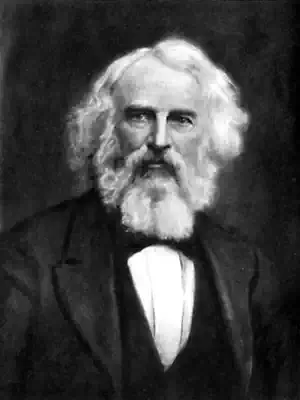
Henry Wadsworth Longfellow
Village Blacksmith, The
Village Blacksmith, The
Under a spreading chestnut tree
The village smithy stands;
The Smith, a mighty man is he,
With large and sinewy hands;
And the muscles of his brawny arms
Are strong as iron bands.
His hair is crisp, and black, and long,
His face is like the tan;
His brow is wet with honest sweat,
He earns whate'er he can
And looks the whole world in the face
For he owes not any man.
Week in, week out, from morn till night,
You can hear his bellows blow;
You can hear him swing his heavy sledge,
With measured beat and slow,
Like a sexton ringing the village bell,
When the evening sun is low.
And children coming home from school
Look in at the open door;
They love to see the flaming furge,
And hear the bellows roar,
And catch the burning sparks that fly
Like chaff from a threshing floor.
He goes on Sunday to the church
and sits among his boys;
He hears the parson pray and preach.
He hears his daughter's voice
singing in the village choir,
And it makes his heart rejoice.
It sounds to him like her mother's voice,
Singing in Paradise!
He needs must think of her once more,
How in the grave she lies;
And with his hard, rough hand he wipes
A tear out of his eyes.
Toiling, rejoicing,-sorrowing,
Onward through life he goes;
Each morning sees some task begin,
Each evening sees it close;
Something attempted, something done,
Has earned a night's repose.
Thanks, thanks to thee, my worthy friend
For the lesson thou hast taught!
Thus at the flaming forge of life
Our fortunes must be wrought;
Thus on its sounding anvil shaped
Each burning deed and thought!
Under a spreading chestnut tree
The village smithy stands;
The Smith, a mighty man is he,
With large and sinewy hands;
And the muscles of his brawny arms
Are strong as iron bands.
His hair is crisp, and black, and long,
His face is like the tan;
His brow is wet with honest sweat,
He earns whate'er he can
And looks the whole world in the face
For he owes not any man.
Week in, week out, from morn till night,
You can hear his bellows blow;
You can hear him swing his heavy sledge,
With measured beat and slow,
Like a sexton ringing the village bell,
When the evening sun is low.
And children coming home from school
Look in at the open door;
They love to see the flaming furge,
And hear the bellows roar,
And catch the burning sparks that fly
Like chaff from a threshing floor.
He goes on Sunday to the church
and sits among his boys;
He hears the parson pray and preach.
He hears his daughter's voice
singing in the village choir,
And it makes his heart rejoice.
It sounds to him like her mother's voice,
Singing in Paradise!
He needs must think of her once more,
How in the grave she lies;
And with his hard, rough hand he wipes
A tear out of his eyes.
Toiling, rejoicing,-sorrowing,
Onward through life he goes;
Each morning sees some task begin,
Each evening sees it close;
Something attempted, something done,
Has earned a night's repose.
Thanks, thanks to thee, my worthy friend
For the lesson thou hast taught!
Thus at the flaming forge of life
Our fortunes must be wrought;
Thus on its sounding anvil shaped
Each burning deed and thought!
705
Henry Wadsworth Longfellow
The Village Blacksmith
The Village Blacksmith
Under a spreading chestnut tree
The village smithy stands;
The smith, a might man is he,
With large and sinewy hands;
And the muscles of his brawney arms
Are strong as iron bands.
His hair is crisp, and black, and long,
His face is like the tan;
His brow is wet with honest sweat,
He earns what'er he can,
And looks the whole word in the face,
For he owes not any man.
Week in, week out, from morn till night,
You can hear the bellows blow;
You can hear him swing his might sledge,
With measure beat and slow,
Like a sexton ringing the village bell,
When the evening sun is low.
And children coming home from school
Look in the open door;
They love to see the flaming forge,
And hear the bellows roar.
And catch the flaming sparks that fly
Like chaff from a threshing floor.
He goes on Sunday to the church,
And sits among his boys;
He hears the parson pray and preach,
He hears his daughter's voice,
Singing in the choir,
And it makes his heart rejoice.
It sounds to him like his mother's voice,
Singing in Paradise!
He needs must think of her once more,
How in the grave she lies;
And with his hard, rough hands he wipes
A tear out of his eyes.
Toiing, -- rejoicing, -- sorrowing,
Onward in life he goes;
Each morning sees some task begin,
Each evening sees it close;
Something attempted, something done,
Has earned his night's repose.
Thanks, thanks to thee, my worthy friend,
For the lesson thou has taught!
Thus at the flaming forge of life
Our fortunes must be wrought;
Thus on its sounding anvil shaped
Each burning deed and thought.
Under a spreading chestnut tree
The village smithy stands;
The smith, a might man is he,
With large and sinewy hands;
And the muscles of his brawney arms
Are strong as iron bands.
His hair is crisp, and black, and long,
His face is like the tan;
His brow is wet with honest sweat,
He earns what'er he can,
And looks the whole word in the face,
For he owes not any man.
Week in, week out, from morn till night,
You can hear the bellows blow;
You can hear him swing his might sledge,
With measure beat and slow,
Like a sexton ringing the village bell,
When the evening sun is low.
And children coming home from school
Look in the open door;
They love to see the flaming forge,
And hear the bellows roar.
And catch the flaming sparks that fly
Like chaff from a threshing floor.
He goes on Sunday to the church,
And sits among his boys;
He hears the parson pray and preach,
He hears his daughter's voice,
Singing in the choir,
And it makes his heart rejoice.
It sounds to him like his mother's voice,
Singing in Paradise!
He needs must think of her once more,
How in the grave she lies;
And with his hard, rough hands he wipes
A tear out of his eyes.
Toiing, -- rejoicing, -- sorrowing,
Onward in life he goes;
Each morning sees some task begin,
Each evening sees it close;
Something attempted, something done,
Has earned his night's repose.
Thanks, thanks to thee, my worthy friend,
For the lesson thou has taught!
Thus at the flaming forge of life
Our fortunes must be wrought;
Thus on its sounding anvil shaped
Each burning deed and thought.
333
Henry Wadsworth Longfellow
The Song Of Hiawatha VII: Hiawatha's Sailing
The Song Of Hiawatha VII: Hiawatha's Sailing
'Give me of your bark, O Birch-tree!
Of your yellow bark, O Birch-tree!
Growing by the rushing river,
Tall and stately in the valley!
I a light canoe will build me,
Build a swift Cheemaun for sailing,
That shall float on the river,
Like a yellow leaf in Autumn,
Like a yellow water-lily!
'Lay aside your cloak, O Birch-tree!
Lay aside your white-skin wrapper,
For the Summer-time is coming,
And the sun is warm in heaven,
And you need no white-skin wrapper!'
Thus aloud cried Hiawatha
In the solitary forest,
By the rushing Taquamenaw,
When the birds were singing gayly,
In the Moon of Leaves were singing,
And the sun, from sleep awaking,
Started up and said, 'Behold me!
Gheezis, the great Sun, behold me!'
And the tree with all its branches
Rustled in the breeze of morning,
Saying, with a sigh of patience,
'Take my cloak, O Hiawatha!'
With his knife the tree he girdled;
Just beneath its lowest branches,
Just above the roots, he cut it,
Till the sap came oozing outward;
Down the trunk, from top to bottom,
Sheer he cleft the bark asunder,
With a wooden wedge he raised it,
Stripped it from the trunk unbroken.
'Give me of your boughs, O Cedar!
Of your strong and pliant branches,
My canoe to make more steady,
Make more strong and firm beneath me!'
Through the summit of the Cedar
Went a sound, a cry of horror,
Went a murmur of resistance;
But it whispered, bending downward,
'Take my boughs, O Hiawatha!'
Down he hewed the boughs of cedar,
Shaped them straightway to a frame-work,
Like two bows he formed and shaped them,
Like two bended bows together.
'Give me of your roots, O Tamarack!
Of your fibrous roots, O Larch-tree!
My canoe to bind together,
So to bind the ends together
That the water may not enter,
That the river may not wet me!'
And the Larch, with all its fibres,
Shivered in the air of morning,
Touched his forehead with its tassels,
Slid, with one long sigh of sorrow.
'Take them all, O Hiawatha!'
From the earth he tore the fibres,
Tore the tough roots of the Larch-tree,
Closely sewed the hark together,
Bound it closely to the frame-work.
'Give me of your balm, O Fir-tree!
Of your balsam and your resin,
So to close the seams together
That the water may not enter,
That the river may not wet me!'
And the Fir-tree, tall and sombre,
Sobbed through all its robes of darkness,
Rattled like a shore with pebbles,
Answered wailing, answered weeping,
'Take my balm, O Hiawatha!'
And he took the tears of balsam,
Took the resin of the Fir-tree,
Smeared therewith each seam and fissure,
Made each crevice safe from water.
'Give me of your quills, O Hedgehog!
All your quills, O Kagh, the Hedgehog!
I will make a necklace of them,
Make a girdle for my beauty,
And two stars to deck her bosom!'
From a hollow tree the Hedgehog
With his sleepy eyes looked at him,
Shot his shining quills, like arrows,
Saying with a drowsy murmur,
Through the tangle of his whiskers,
'Take my quills, O Hiawatha!'
From the ground the quills he gathered,
All the little shining arrows,
Stained them red and blue and yellow,
With the juice of roots and berries;
Into his canoe he wrought them,
Round its waist a shining girdle,
Round its bows a gleaming necklace,
On its breast two stars resplendent.
Thus the Birch Canoe was builded
In the valley, by the river,
In the bosom of the forest;
And the forest's life was in it,
All its mystery and its magic,
All the lightness of the birch-tree,
All the toughness of the cedar,
All the larch's supple sinews;
And it floated on the river
Like a yellow leaf in Autumn,
Like a yellow water-lily.
Paddles none had Hiawatha,
Paddles none he had or needed,
For his thoughts as paddles served him,
And his wishes served to guide him;
Swift or slow at will he glided,
Veered to right or left at pleasure.
Then he called aloud to Kwasind,
To his friend, the strong man, Kwasind,
Saying, 'Help me clear this river
Of its sunken logs and sand-bars.'
Straight into the river Kwasind
Plunged as if he were an otter,
Dived as if he were a beaver,
Stood up to his waist in water,
To his arm-pits in the river,
Swam and scouted in the river,
Tugged at sunken logs and branches,
With his hands he scooped the sand-bars,
With his feet the ooze and tangle.
And thus sailed my Hiawatha
Down the rushing Taquamenaw,
Sailed through all its bends and windings,
Sailed through all its deeps and shallows,
While his friend, the strong man, Kwasind,
Swam the deeps, the shallows waded.
Up and down the river went they,
In and out among its islands,
Cleared its bed of root and sand-bar,
Dragged the dead trees from its channel,
Made its passage safe and certain,
Made a pathway for the people,
From its springs among the mountains,
To the waters of Pauwating,
To the bay of Taquamenaw.
'Give me of your bark, O Birch-tree!
Of your yellow bark, O Birch-tree!
Growing by the rushing river,
Tall and stately in the valley!
I a light canoe will build me,
Build a swift Cheemaun for sailing,
That shall float on the river,
Like a yellow leaf in Autumn,
Like a yellow water-lily!
'Lay aside your cloak, O Birch-tree!
Lay aside your white-skin wrapper,
For the Summer-time is coming,
And the sun is warm in heaven,
And you need no white-skin wrapper!'
Thus aloud cried Hiawatha
In the solitary forest,
By the rushing Taquamenaw,
When the birds were singing gayly,
In the Moon of Leaves were singing,
And the sun, from sleep awaking,
Started up and said, 'Behold me!
Gheezis, the great Sun, behold me!'
And the tree with all its branches
Rustled in the breeze of morning,
Saying, with a sigh of patience,
'Take my cloak, O Hiawatha!'
With his knife the tree he girdled;
Just beneath its lowest branches,
Just above the roots, he cut it,
Till the sap came oozing outward;
Down the trunk, from top to bottom,
Sheer he cleft the bark asunder,
With a wooden wedge he raised it,
Stripped it from the trunk unbroken.
'Give me of your boughs, O Cedar!
Of your strong and pliant branches,
My canoe to make more steady,
Make more strong and firm beneath me!'
Through the summit of the Cedar
Went a sound, a cry of horror,
Went a murmur of resistance;
But it whispered, bending downward,
'Take my boughs, O Hiawatha!'
Down he hewed the boughs of cedar,
Shaped them straightway to a frame-work,
Like two bows he formed and shaped them,
Like two bended bows together.
'Give me of your roots, O Tamarack!
Of your fibrous roots, O Larch-tree!
My canoe to bind together,
So to bind the ends together
That the water may not enter,
That the river may not wet me!'
And the Larch, with all its fibres,
Shivered in the air of morning,
Touched his forehead with its tassels,
Slid, with one long sigh of sorrow.
'Take them all, O Hiawatha!'
From the earth he tore the fibres,
Tore the tough roots of the Larch-tree,
Closely sewed the hark together,
Bound it closely to the frame-work.
'Give me of your balm, O Fir-tree!
Of your balsam and your resin,
So to close the seams together
That the water may not enter,
That the river may not wet me!'
And the Fir-tree, tall and sombre,
Sobbed through all its robes of darkness,
Rattled like a shore with pebbles,
Answered wailing, answered weeping,
'Take my balm, O Hiawatha!'
And he took the tears of balsam,
Took the resin of the Fir-tree,
Smeared therewith each seam and fissure,
Made each crevice safe from water.
'Give me of your quills, O Hedgehog!
All your quills, O Kagh, the Hedgehog!
I will make a necklace of them,
Make a girdle for my beauty,
And two stars to deck her bosom!'
From a hollow tree the Hedgehog
With his sleepy eyes looked at him,
Shot his shining quills, like arrows,
Saying with a drowsy murmur,
Through the tangle of his whiskers,
'Take my quills, O Hiawatha!'
From the ground the quills he gathered,
All the little shining arrows,
Stained them red and blue and yellow,
With the juice of roots and berries;
Into his canoe he wrought them,
Round its waist a shining girdle,
Round its bows a gleaming necklace,
On its breast two stars resplendent.
Thus the Birch Canoe was builded
In the valley, by the river,
In the bosom of the forest;
And the forest's life was in it,
All its mystery and its magic,
All the lightness of the birch-tree,
All the toughness of the cedar,
All the larch's supple sinews;
And it floated on the river
Like a yellow leaf in Autumn,
Like a yellow water-lily.
Paddles none had Hiawatha,
Paddles none he had or needed,
For his thoughts as paddles served him,
And his wishes served to guide him;
Swift or slow at will he glided,
Veered to right or left at pleasure.
Then he called aloud to Kwasind,
To his friend, the strong man, Kwasind,
Saying, 'Help me clear this river
Of its sunken logs and sand-bars.'
Straight into the river Kwasind
Plunged as if he were an otter,
Dived as if he were a beaver,
Stood up to his waist in water,
To his arm-pits in the river,
Swam and scouted in the river,
Tugged at sunken logs and branches,
With his hands he scooped the sand-bars,
With his feet the ooze and tangle.
And thus sailed my Hiawatha
Down the rushing Taquamenaw,
Sailed through all its bends and windings,
Sailed through all its deeps and shallows,
While his friend, the strong man, Kwasind,
Swam the deeps, the shallows waded.
Up and down the river went they,
In and out among its islands,
Cleared its bed of root and sand-bar,
Dragged the dead trees from its channel,
Made its passage safe and certain,
Made a pathway for the people,
From its springs among the mountains,
To the waters of Pauwating,
To the bay of Taquamenaw.
315
Henry Wadsworth Longfellow
Discoverer Of The North Cape. A Leaf From King Alfred's Orosius. (Birds Of
Discoverer Of The North Cape. A Leaf From King Alfred's Orosius. (Birds Of
Passage. Flight The First)
Othere, the old sea-captain,
Who dwelt in Helgoland,
To King Alfred, the Lover of Truth,
Brought a snow-white walrus-tooth,
Which he held in his brown right hand.
His figure was tall and stately,
Like a boy's his eye appeared;
His hair was yellow as hay,
But threads of a silvery gray
Gleamed in his tawny beard.
Hearty and hale was Othere,
His cheek had the color of oak;
With a kind of laugh in his speech,
Like the sea-tide on a beach,
As unto the King he spoke.
And Alfred, King of the Saxons,
Had a book upon his knees,
And wrote down the wondrous tale
Of him who was first to sail
Into the Arctic seas.
'So far I live to the northward,
No man lives north of me;
To the east are wild mountain-chains;
And beyond them meres and plains;
To the westward all is sea.
'So far I live to the northward,
From the harbor of Skeringes-hale,
If you only sailed by day,
With a fair wind all the way,
More than a month would you sail.
'I own six hundred reindeer,
With sheep and swine beside;
I have tribute from the Finns,
Whalebone and reindeer-skins,
And ropes of walrus-hide.
'I ploughed the land with horses,
But my heart was ill at ease,
For the old seafaring men
Came to me now and then,
With their sagas of the seas;-
'Of Iceland and of Greenland,
And the stormy Hebrides,
And the undiscovered deep;--
Oh I could not eat nor sleep
For thinking of those seas.
'To the northward stretched the desert,
How far I fain would know;
So at last I sallied forth,
And three days sailed due north,
As far as the whale-ships go.
'To the west of me was the ocean,
To the right the desolate shore,
But I did not slacken sail
For the walrus or the whale,
Till after three days more.
'The days grew longer and longer,
Till they became as one,
And northward through the haze
I saw the sullen blaze
Of the red midnight sun.
'And then uprose before me,
Upon the water's edge,
The huge and haggard shape
Of that unknown North Cape,
Whose form is like a wedge.
'The sea was rough and stormy,
The tempest howled and wailed,
And the sea-fog, like a ghost,
Haunted that dreary coast,
But onward still I sailed.
'Four days I steered to eastward,
Four days without a night:
Round in a fiery ring
Went the great sun, O King,
With red and lurid light.'
Here Alfred, King of the Saxons,
Ceased writing for a while;
And raised his eyes from his book,
With a strange and puzzled look,
And an incredulous smile.
But Othere, the old sea-captain,
He neither paused nor stirred,
Till the King listened, and then
Once more took up his pen,
And wrote down every word.
'And now the land,' said Othere,
'Bent southward suddenly,
And I followed the curving shore
And ever southward bore
Into a nameless sea.
'And there we hunted the walrus,
The narwhale, and the seal;
Ha! 't was a noble game!
And like the lightning's flame
Flew our harpoons of steel.
'There were six of us all together,
Norsemen of Helgoland;
In two days and no more
We killed of them threescore,
And dragged them to the strand!'
Here Alfred the Truth-Teller
Suddenly closed his book,
And lifted his blue eyes,
With doubt and strange surmise
Depicted in their look.
And Othere the old sea-captain
Stared at him wild and weird,
Then smiled, till his shining teeth
Gleamed white from underneath
His tawny, quivering beard.
And to the King of the Saxons,
In witness of the truth,
Raising his noble head,
He stretched his brown hand, and said,
'Behold this walrus-tooth!'
Passage. Flight The First)
Othere, the old sea-captain,
Who dwelt in Helgoland,
To King Alfred, the Lover of Truth,
Brought a snow-white walrus-tooth,
Which he held in his brown right hand.
His figure was tall and stately,
Like a boy's his eye appeared;
His hair was yellow as hay,
But threads of a silvery gray
Gleamed in his tawny beard.
Hearty and hale was Othere,
His cheek had the color of oak;
With a kind of laugh in his speech,
Like the sea-tide on a beach,
As unto the King he spoke.
And Alfred, King of the Saxons,
Had a book upon his knees,
And wrote down the wondrous tale
Of him who was first to sail
Into the Arctic seas.
'So far I live to the northward,
No man lives north of me;
To the east are wild mountain-chains;
And beyond them meres and plains;
To the westward all is sea.
'So far I live to the northward,
From the harbor of Skeringes-hale,
If you only sailed by day,
With a fair wind all the way,
More than a month would you sail.
'I own six hundred reindeer,
With sheep and swine beside;
I have tribute from the Finns,
Whalebone and reindeer-skins,
And ropes of walrus-hide.
'I ploughed the land with horses,
But my heart was ill at ease,
For the old seafaring men
Came to me now and then,
With their sagas of the seas;-
'Of Iceland and of Greenland,
And the stormy Hebrides,
And the undiscovered deep;--
Oh I could not eat nor sleep
For thinking of those seas.
'To the northward stretched the desert,
How far I fain would know;
So at last I sallied forth,
And three days sailed due north,
As far as the whale-ships go.
'To the west of me was the ocean,
To the right the desolate shore,
But I did not slacken sail
For the walrus or the whale,
Till after three days more.
'The days grew longer and longer,
Till they became as one,
And northward through the haze
I saw the sullen blaze
Of the red midnight sun.
'And then uprose before me,
Upon the water's edge,
The huge and haggard shape
Of that unknown North Cape,
Whose form is like a wedge.
'The sea was rough and stormy,
The tempest howled and wailed,
And the sea-fog, like a ghost,
Haunted that dreary coast,
But onward still I sailed.
'Four days I steered to eastward,
Four days without a night:
Round in a fiery ring
Went the great sun, O King,
With red and lurid light.'
Here Alfred, King of the Saxons,
Ceased writing for a while;
And raised his eyes from his book,
With a strange and puzzled look,
And an incredulous smile.
But Othere, the old sea-captain,
He neither paused nor stirred,
Till the King listened, and then
Once more took up his pen,
And wrote down every word.
'And now the land,' said Othere,
'Bent southward suddenly,
And I followed the curving shore
And ever southward bore
Into a nameless sea.
'And there we hunted the walrus,
The narwhale, and the seal;
Ha! 't was a noble game!
And like the lightning's flame
Flew our harpoons of steel.
'There were six of us all together,
Norsemen of Helgoland;
In two days and no more
We killed of them threescore,
And dragged them to the strand!'
Here Alfred the Truth-Teller
Suddenly closed his book,
And lifted his blue eyes,
With doubt and strange surmise
Depicted in their look.
And Othere the old sea-captain
Stared at him wild and weird,
Then smiled, till his shining teeth
Gleamed white from underneath
His tawny, quivering beard.
And to the King of the Saxons,
In witness of the truth,
Raising his noble head,
He stretched his brown hand, and said,
'Behold this walrus-tooth!'
312