

Poems
Time and Its Passage
Poems in this topic
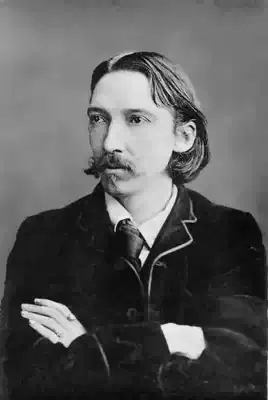
Robert Louis Stevenson
The Summer Sun Shone Round Me
The Summer Sun Shone Round Me
THE summer sun shone round me,
The folded valley lay
In a stream of sun and odour,
That sultry summer day.
The tall trees stood in the sunlight
As still as still could be,
But the deep grass sighed and rustled
And bowed and beckoned me.
The deep grass moved and whispered
And bowed and brushed my face.
It whispered in the sunshine:
"The winter comes apace."
THE summer sun shone round me,
The folded valley lay
In a stream of sun and odour,
That sultry summer day.
The tall trees stood in the sunlight
As still as still could be,
But the deep grass sighed and rustled
And bowed and beckoned me.
The deep grass moved and whispered
And bowed and brushed my face.
It whispered in the sunshine:
"The winter comes apace."
350
Robert Louis Stevenson
Sonnet VII
Sonnet VII
The strong man's hand, the snow-cool head of age,
The certain-footed sympathies of youth -
These, and that lofty passion after truth,
Hunger unsatisfied in priest or sage
Or the great men of former years, he needs
That not unworthily would dare to sing
(Hard task!) black care's inevitable ring
Settling with years upon the heart that feeds
Incessantly on glory. Year by year
The narrowing toil grows closer round his feet;
With disenchanting touch rude-handed time
The unlovely web discloses, and strange fear
Leads him at last to eld's inclement seat,
The bitter north of life - a frozen clime.
The strong man's hand, the snow-cool head of age,
The certain-footed sympathies of youth -
These, and that lofty passion after truth,
Hunger unsatisfied in priest or sage
Or the great men of former years, he needs
That not unworthily would dare to sing
(Hard task!) black care's inevitable ring
Settling with years upon the heart that feeds
Incessantly on glory. Year by year
The narrowing toil grows closer round his feet;
With disenchanting touch rude-handed time
The unlovely web discloses, and strange fear
Leads him at last to eld's inclement seat,
The bitter north of life - a frozen clime.
361
Robert Louis Stevenson
So Live, So Love, So Use That Fragile Hour
So Live, So Love, So Use That Fragile Hour
SO live, so love, so use that fragile hour,
That when the dark hand of the shining power
Shall one from other, wife or husband, take,
The poor survivor may not weep and wake.
SO live, so love, so use that fragile hour,
That when the dark hand of the shining power
Shall one from other, wife or husband, take,
The poor survivor may not weep and wake.
346
Robert Louis Stevenson
For Richmond's Garden Wall
For Richmond's Garden Wall
WHEN Thomas set this tablet here,
Time laughed at the vain chanticleer;
And ere the moss had dimmed the stone,
Time had defaced that garrison.
Now I in turn keep watch and ward
In my red house, in my walled yard
Of sunflowers, sitting here at ease
With friends and my bright canvases.
But hark, and you may hear quite plain
Time's chuckled laughter in the lane.
WHEN Thomas set this tablet here,
Time laughed at the vain chanticleer;
And ere the moss had dimmed the stone,
Time had defaced that garrison.
Now I in turn keep watch and ward
In my red house, in my walled yard
Of sunflowers, sitting here at ease
With friends and my bright canvases.
But hark, and you may hear quite plain
Time's chuckled laughter in the lane.
319
Robert Louis Stevenson
As In Their Flight The Birds Of Song
As In Their Flight The Birds Of Song
AS in their flight the birds of song
Halt here and there in sweet and sunny dales,
But halt not overlong;
The time one rural song to sing
They pause; then following bounteous gales
Steer forward on the wing:
Sun-servers they, from first to last,
Upon the sun they wait
To ride the sailing blast.
So he awhile in our contested state,
Awhile abode, not longer, for his Sun -
Mother we say, no tenderer name we know -
With whose diviner glow
His early days had shone,
Now to withdraw her radiance had begun.
Or lest a wrong I say, not she withdrew,
But the loud stream of men day after day
And great dust columns of the common way
Between them grew and grew:
And he and she for evermore might yearn,
But to the spring the rivulets not return
Nor to the bosom comes the child again.
And he (O may we fancy so!),
He, feeling time forever flow
And flowing bear him forth and far away
From that dear ingle where his life began
And all his treasure lay -
He, waxing into man,
And ever farther, ever closer wound
In this obstreperous world's ignoble round,
From that poor prospect turned his face away.
AS in their flight the birds of song
Halt here and there in sweet and sunny dales,
But halt not overlong;
The time one rural song to sing
They pause; then following bounteous gales
Steer forward on the wing:
Sun-servers they, from first to last,
Upon the sun they wait
To ride the sailing blast.
So he awhile in our contested state,
Awhile abode, not longer, for his Sun -
Mother we say, no tenderer name we know -
With whose diviner glow
His early days had shone,
Now to withdraw her radiance had begun.
Or lest a wrong I say, not she withdrew,
But the loud stream of men day after day
And great dust columns of the common way
Between them grew and grew:
And he and she for evermore might yearn,
But to the spring the rivulets not return
Nor to the bosom comes the child again.
And he (O may we fancy so!),
He, feeling time forever flow
And flowing bear him forth and far away
From that dear ingle where his life began
And all his treasure lay -
He, waxing into man,
And ever farther, ever closer wound
In this obstreperous world's ignoble round,
From that poor prospect turned his face away.
324
Robert Louis Stevenson
Air Of Diabelli's
Air Of Diabelli's
CALL it to mind, O my love.
Dear were your eyes as the day,
Bright as the day and the sky;
Like the stream of gold and the sky above,
Dear were your eyes in the grey.
We have lived, my love, O, we have lived, my love!
Now along the silent river, azure
Through the sky's inverted image,
Softly swam the boat that bore our love,
Swiftly ran the shallow of our love
Through the heaven's inverted image,
In the reedy mazes round the river.
See along the silent river,
See of old the lover's shallop steer.
Berried brake and reedy island,
Heaven below and only heaven above.
Through the sky's inverted image
Swiftly swam the boat that bore our love.
Berried brake and reedy island,
Mirrored flower and shallop gliding by.
All the earth and all the sky were ours,
Silent sat the wafted lovers,
Bound with grain and watched by all the sky,
Hand to hand and eye to . . . eye.
Days of April, airs of Eden,
Call to mind how bright the vanished angel hours,
Golden hours of evening,
When our boat drew homeward filled with flowers.
O darling, call them to mind; love the past, my love.
Days of April, airs of Eden.
How the glory died through golden hours,
And the shining moon arising;
How the boat drew homeward filled with flowers.
Age and winter close us slowly in.
Level river, cloudless heaven,
Islanded reed mazes, silver weirs;
How the silent boat with silver
Threads the inverted forest as she goes,
Broke the trembling green of mirrored trees.
O, remember, and remember
How the berries hung in garlands.
Still in the river see the shallop floats.
Hark! Chimes the falling oar.
Still in the mind
Hark to the song of the past!
Dream, and they pass in their dreams.
Those that loved of yore, O those that loved of yore!
Hark through the stillness, O darling, hark!
Through it all the ear of the mind
Knows the boat of love. Hark!
Chimes the falling oar.
O half in vain they grew old.
Now the halcyon days are over,
Age and winter close us slowly round,
And these sounds at fall of even
Dim the sight and muffle all the sound.
And at the married fireside, sleep of soul and sleep of fancy,
Joan and Darby.
Silence of the world without a sound;
And beside the winter faggot
Joan and Darby sit and dose and dream and wake -
Dream they hear the flowing, singing river,
See the berries in the island brake;
Dream they hear the weir,
See the gliding shallop mar the stream.
Hark! in your dreams do you hear?
Snow has filled the drifted forest;
Ice has bound the . . . stream.
Frost has bound our flowing river;
Snow has whitened all our island brake.
Berried brake and reedy island,
Heaven below and only heaven above azure
Through the sky's inverted image
Safely swam the boat that bore our love.
Dear were your eyes as the day,
Bright ran the stream, bright hung the sky above.
Days of April, airs of Eden.
How the glory died through golden hours,
And the shining moon arising,
How the boat drew homeward filled with flowers.
Bright were your eyes in the night:
We have lived, my love;
O, we have loved, my love.
Now the . . . days are over,
Age and winter close us slowly round.
Vainly time departs, and vainly
Age and winter come and close us round.
Hark the river's long continuous sound.
Hear the river ripples in the reeds.
Lo, in dreams they see their shallop
Run the lilies down and drown the weeds
Mid the sound of crackling faggots.
So in dreams the new created
Happy past returns, to-day recedes,
And they hear once more,
From the old years,
Yesterday returns, to-day recedes,
And they hear with aged hearing warbles
Love's own river ripple in the weeds.
And again the lover's shallop;
Lo, the shallop sheds the streaming weeds;
And afar in foreign countries
In the ears of aged lovers.
And again in winter evens
Starred with lilies . . . with stirring weeds.
In these ears of aged lovers
Love's own river ripples in the reeds.
CALL it to mind, O my love.
Dear were your eyes as the day,
Bright as the day and the sky;
Like the stream of gold and the sky above,
Dear were your eyes in the grey.
We have lived, my love, O, we have lived, my love!
Now along the silent river, azure
Through the sky's inverted image,
Softly swam the boat that bore our love,
Swiftly ran the shallow of our love
Through the heaven's inverted image,
In the reedy mazes round the river.
See along the silent river,
See of old the lover's shallop steer.
Berried brake and reedy island,
Heaven below and only heaven above.
Through the sky's inverted image
Swiftly swam the boat that bore our love.
Berried brake and reedy island,
Mirrored flower and shallop gliding by.
All the earth and all the sky were ours,
Silent sat the wafted lovers,
Bound with grain and watched by all the sky,
Hand to hand and eye to . . . eye.
Days of April, airs of Eden,
Call to mind how bright the vanished angel hours,
Golden hours of evening,
When our boat drew homeward filled with flowers.
O darling, call them to mind; love the past, my love.
Days of April, airs of Eden.
How the glory died through golden hours,
And the shining moon arising;
How the boat drew homeward filled with flowers.
Age and winter close us slowly in.
Level river, cloudless heaven,
Islanded reed mazes, silver weirs;
How the silent boat with silver
Threads the inverted forest as she goes,
Broke the trembling green of mirrored trees.
O, remember, and remember
How the berries hung in garlands.
Still in the river see the shallop floats.
Hark! Chimes the falling oar.
Still in the mind
Hark to the song of the past!
Dream, and they pass in their dreams.
Those that loved of yore, O those that loved of yore!
Hark through the stillness, O darling, hark!
Through it all the ear of the mind
Knows the boat of love. Hark!
Chimes the falling oar.
O half in vain they grew old.
Now the halcyon days are over,
Age and winter close us slowly round,
And these sounds at fall of even
Dim the sight and muffle all the sound.
And at the married fireside, sleep of soul and sleep of fancy,
Joan and Darby.
Silence of the world without a sound;
And beside the winter faggot
Joan and Darby sit and dose and dream and wake -
Dream they hear the flowing, singing river,
See the berries in the island brake;
Dream they hear the weir,
See the gliding shallop mar the stream.
Hark! in your dreams do you hear?
Snow has filled the drifted forest;
Ice has bound the . . . stream.
Frost has bound our flowing river;
Snow has whitened all our island brake.
Berried brake and reedy island,
Heaven below and only heaven above azure
Through the sky's inverted image
Safely swam the boat that bore our love.
Dear were your eyes as the day,
Bright ran the stream, bright hung the sky above.
Days of April, airs of Eden.
How the glory died through golden hours,
And the shining moon arising,
How the boat drew homeward filled with flowers.
Bright were your eyes in the night:
We have lived, my love;
O, we have loved, my love.
Now the . . . days are over,
Age and winter close us slowly round.
Vainly time departs, and vainly
Age and winter come and close us round.
Hark the river's long continuous sound.
Hear the river ripples in the reeds.
Lo, in dreams they see their shallop
Run the lilies down and drown the weeds
Mid the sound of crackling faggots.
So in dreams the new created
Happy past returns, to-day recedes,
And they hear once more,
From the old years,
Yesterday returns, to-day recedes,
And they hear with aged hearing warbles
Love's own river ripple in the weeds.
And again the lover's shallop;
Lo, the shallop sheds the streaming weeds;
And afar in foreign countries
In the ears of aged lovers.
And again in winter evens
Starred with lilies . . . with stirring weeds.
In these ears of aged lovers
Love's own river ripples in the reeds.
360

Robert Frost
Nothing Gold Can Stay
Nothing Gold Can Stay
Nature's first green is gold,
Her hardest hue to hold.
Her early leaf's a flower;
But only so an hour.
Then leaf subsides to leaf,
So Eden sank to grief,
So dawn goes down to day
Nothing gold can stay.
Nature's first green is gold,
Her hardest hue to hold.
Her early leaf's a flower;
But only so an hour.
Then leaf subsides to leaf,
So Eden sank to grief,
So dawn goes down to day
Nothing gold can stay.
381
Robert Frost
In Hardwood Groves
In Hardwood Groves
The same leaves over and over again! They fall from giving shade above To make one
texture of faded brown And fit the earth like a leather glove. Before the leaves can
mount again To fill the trees with another shade, They must go down past things
coming up. They must go down into the dark decayed. They must be pierced by
flowers and put Beneath the feet of dancing flowers. However it is in some other world
I know that this is way in ours.
The same leaves over and over again! They fall from giving shade above To make one
texture of faded brown And fit the earth like a leather glove. Before the leaves can
mount again To fill the trees with another shade, They must go down past things
coming up. They must go down into the dark decayed. They must be pierced by
flowers and put Beneath the feet of dancing flowers. However it is in some other world
I know that this is way in ours.
469
Robert Frost
After Apple-Picking
After Apple-Picking
My long two-pointed ladder's sticking through a tree
Toward heaven still,
And there's a barrel that I didn't fill
Beside it, and there may be two or three
Apples I didn't pick upon some bough.
But I am done with apple-picking now.
Essence of winter sleep is on the night,
The scent of apples: I am drowsing off.
I cannot rub the strangeness from my sight
I got from looking through a pane of glass
I skimmed this morning from the drinking trough
And held against the world of hoary grass.
It melted, and I let it fall and break.
But I was well
Upon my way to sleep before it fell,
And I could tell
What form my dreaming was about to take.
Magnified apples appear and disappear,
Stem end and blossom end,
And every fleck of russet showing clear.
My instep arch not only keeps the ache,
It keeps the pressure of a ladder-round.
I feel the ladder sway as the boughs bend.
And I keep hearing from the cellar bin
The rumbling sound
Of load on load of apples coming in.
For I have had too much
Of apple-picking: I am overtired
Of the great harvest I myself desired.
There were ten thousand thousand fruit to touch,
Cherish in hand, lift down, and not let fall.
For all
That struck the earth,
No matter if not bruised or spiked with stubble,
Went surely to the cider-apple heap
As of no worth.
One can see what will trouble
This sleep of mine, whatever sleep it is.
Were he not gone,
The woodchuck could say whether it's like his
Long sleep, as I describe its coming on,
Or just some human sleep.
My long two-pointed ladder's sticking through a tree
Toward heaven still,
And there's a barrel that I didn't fill
Beside it, and there may be two or three
Apples I didn't pick upon some bough.
But I am done with apple-picking now.
Essence of winter sleep is on the night,
The scent of apples: I am drowsing off.
I cannot rub the strangeness from my sight
I got from looking through a pane of glass
I skimmed this morning from the drinking trough
And held against the world of hoary grass.
It melted, and I let it fall and break.
But I was well
Upon my way to sleep before it fell,
And I could tell
What form my dreaming was about to take.
Magnified apples appear and disappear,
Stem end and blossom end,
And every fleck of russet showing clear.
My instep arch not only keeps the ache,
It keeps the pressure of a ladder-round.
I feel the ladder sway as the boughs bend.
And I keep hearing from the cellar bin
The rumbling sound
Of load on load of apples coming in.
For I have had too much
Of apple-picking: I am overtired
Of the great harvest I myself desired.
There were ten thousand thousand fruit to touch,
Cherish in hand, lift down, and not let fall.
For all
That struck the earth,
No matter if not bruised or spiked with stubble,
Went surely to the cider-apple heap
As of no worth.
One can see what will trouble
This sleep of mine, whatever sleep it is.
Were he not gone,
The woodchuck could say whether it's like his
Long sleep, as I describe its coming on,
Or just some human sleep.
456
Robert Frost
A Patch of Old Snow
A Patch of Old Snow
There's a patch of old snow in a corner
That I should have guessed
Was a blow-away paper the rain
Had brought to rest.
It is speckled with grime as if
Small print overspread it,
The news of a day I've forgotten --
If I ever read it.
There's a patch of old snow in a corner
That I should have guessed
Was a blow-away paper the rain
Had brought to rest.
It is speckled with grime as if
Small print overspread it,
The news of a day I've forgotten --
If I ever read it.
386
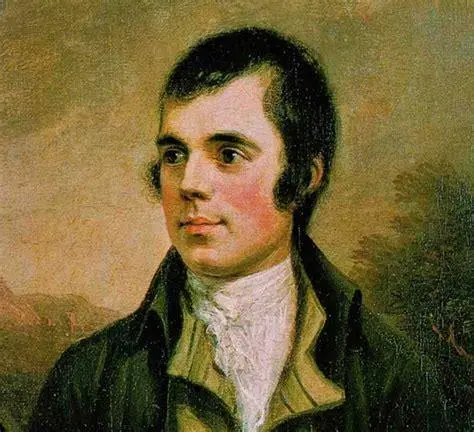
Robert Burns
The Auld Farmer's New-Year-Morning Salutation to His Auld Mare , Maggie
The Auld Farmer's New-Year-Morning Salutation to His Auld Mare , Maggie
A Guide New-year I wish thee, Maggie!
Hae, there's a ripp to thy auld baggie:
Tho' thou's howe-backit now, an' knaggie,
I've seen the day
There could hae gaen like ony staggie,
Out-owre the lay.
Tho' now thou's dowie, stiff an' crazy,
An' thy auld hide as white's a daisie,
I've seen the dappl't, sleek an' glaizie,
A bonie gray:
He should been tight that daur't to raize thee,
Ance in a day.
Thou ance was i' the foremost rank,
A filly buirdly, steeve an' swank;
An' set weel down a shapely shank,
As e'er tread yird;
An' could hae flown out-owre a stank,
Like ony bird.
It's now some nine-an'-twenty year,
Sin' thou was my guid-father's mear;
He gied me thee, o' tocher clear,
An' fifty mark;
Tho' it was sma', 'twas weel-won gear,
An' thou was stark.
When first I gaed to woo my Jenny,
Ye then was trotting wi' your minnie:
Tho' ye was trickie, slee, an funnie,
Ye ne'er was donsie;
But hamely, tawie, quiet, an' cannie,
An' unco sonsie.
That day, ye pranc'd wi' muckle pride,
When ye bure hame my bonie bride:
An' sweet an' gracefu' she did ride,
Wi' maiden air!
Kyle-Stewart I could bragged wide
For sic a pair.
Tho' now ye dow but hoyte and hobble,
An' wintle like a saumont coble,
That day, ye was a jinker noble,
For heels an' win'!
An' ran them till they a' did wauble,
Far, far, behin'!
When thou an' I were young an' skeigh
An' stable-meals at fairs were dreigh,
How thou wad prance, and snore, an' skreigh
An' tak the road!
Town's-bodies ran, an' stood abeigh,
An' ca't thee mad.
When thou was corn't, an' I was mellow,
We took the road aye like a swallow:
At brooses thou had ne'er a fellow,
For pith an' speed;
But ev'ry tail thou pay't them hollow,
Whare'er thou gaed.
The sma', droop-rumpl't, hunter cattle
Might aiblins waurt thee for a brattle;
But sax Scotch mile, thou try't their mettle,
An' gar't them whaizle:
Nae whip nor spur, but just a wattle
O' saugh or hazel.
Thou was a noble fittie-lan',
As e'er in tug or tow was drawn!
Aft thee an' I, in aught hours' gaun,
In guid March-weather,
Hae turn'd sax rood beside our han',
For days thegither.
Thou never braing't, an' fetch't, an' fliskit;
But thy auld tail thou wad hae whiskit,
An' spread abreed thy weel-fill'd brisket,
Wi' pith an' power;
Till sprittie knowes wad rair't an' riskit
An' slypet owre.
When frosts lay lang, an' snaws were deep,
An' threaten'd labour back to keep,
I gied thy cog a wee bit heap
Aboon the timmer:
I ken'd my Maggie wad na sleep,
For that, or simmer.
In cart or car thou never reestit;
The steyest brae thou wad hae fac't it;
Thou never lap, an' sten't, and breastit,
Then stood to blaw;
But just thy step a wee thing hastit,
Thou snoov't awa.
My pleugh is now thy bairn-time a',
Four gallant brutes as e'er did draw;
Forbye sax mae I've sell't awa,
That thou hast nurst:
They drew me thretteen pund an' twa,
The vera warst.
Mony a sair daurk we twa hae wrought,
An' wi' the weary warl' fought!
An' mony an anxious day, I thought
We wad be beat!
Yet here to crazy age we're brought,
Wi' something yet.
An' think na', my auld trusty servan',
That now perhaps thou's less deservin,
An' thy auld days may end in starvin;
For my last fow,
A heapit stimpart, I'll reserve ane
Laid by for you.
We've worn to crazy years thegither;
We'll toyte about wi' ane anither;
Wi' tentie care I'll flit thy tether
To some hain'd rig,
Whare ye may nobly rax your leather,
Wi' sma' fatigue.
A Guide New-year I wish thee, Maggie!
Hae, there's a ripp to thy auld baggie:
Tho' thou's howe-backit now, an' knaggie,
I've seen the day
There could hae gaen like ony staggie,
Out-owre the lay.
Tho' now thou's dowie, stiff an' crazy,
An' thy auld hide as white's a daisie,
I've seen the dappl't, sleek an' glaizie,
A bonie gray:
He should been tight that daur't to raize thee,
Ance in a day.
Thou ance was i' the foremost rank,
A filly buirdly, steeve an' swank;
An' set weel down a shapely shank,
As e'er tread yird;
An' could hae flown out-owre a stank,
Like ony bird.
It's now some nine-an'-twenty year,
Sin' thou was my guid-father's mear;
He gied me thee, o' tocher clear,
An' fifty mark;
Tho' it was sma', 'twas weel-won gear,
An' thou was stark.
When first I gaed to woo my Jenny,
Ye then was trotting wi' your minnie:
Tho' ye was trickie, slee, an funnie,
Ye ne'er was donsie;
But hamely, tawie, quiet, an' cannie,
An' unco sonsie.
That day, ye pranc'd wi' muckle pride,
When ye bure hame my bonie bride:
An' sweet an' gracefu' she did ride,
Wi' maiden air!
Kyle-Stewart I could bragged wide
For sic a pair.
Tho' now ye dow but hoyte and hobble,
An' wintle like a saumont coble,
That day, ye was a jinker noble,
For heels an' win'!
An' ran them till they a' did wauble,
Far, far, behin'!
When thou an' I were young an' skeigh
An' stable-meals at fairs were dreigh,
How thou wad prance, and snore, an' skreigh
An' tak the road!
Town's-bodies ran, an' stood abeigh,
An' ca't thee mad.
When thou was corn't, an' I was mellow,
We took the road aye like a swallow:
At brooses thou had ne'er a fellow,
For pith an' speed;
But ev'ry tail thou pay't them hollow,
Whare'er thou gaed.
The sma', droop-rumpl't, hunter cattle
Might aiblins waurt thee for a brattle;
But sax Scotch mile, thou try't their mettle,
An' gar't them whaizle:
Nae whip nor spur, but just a wattle
O' saugh or hazel.
Thou was a noble fittie-lan',
As e'er in tug or tow was drawn!
Aft thee an' I, in aught hours' gaun,
In guid March-weather,
Hae turn'd sax rood beside our han',
For days thegither.
Thou never braing't, an' fetch't, an' fliskit;
But thy auld tail thou wad hae whiskit,
An' spread abreed thy weel-fill'd brisket,
Wi' pith an' power;
Till sprittie knowes wad rair't an' riskit
An' slypet owre.
When frosts lay lang, an' snaws were deep,
An' threaten'd labour back to keep,
I gied thy cog a wee bit heap
Aboon the timmer:
I ken'd my Maggie wad na sleep,
For that, or simmer.
In cart or car thou never reestit;
The steyest brae thou wad hae fac't it;
Thou never lap, an' sten't, and breastit,
Then stood to blaw;
But just thy step a wee thing hastit,
Thou snoov't awa.
My pleugh is now thy bairn-time a',
Four gallant brutes as e'er did draw;
Forbye sax mae I've sell't awa,
That thou hast nurst:
They drew me thretteen pund an' twa,
The vera warst.
Mony a sair daurk we twa hae wrought,
An' wi' the weary warl' fought!
An' mony an anxious day, I thought
We wad be beat!
Yet here to crazy age we're brought,
Wi' something yet.
An' think na', my auld trusty servan',
That now perhaps thou's less deservin,
An' thy auld days may end in starvin;
For my last fow,
A heapit stimpart, I'll reserve ane
Laid by for you.
We've worn to crazy years thegither;
We'll toyte about wi' ane anither;
Wi' tentie care I'll flit thy tether
To some hain'd rig,
Whare ye may nobly rax your leather,
Wi' sma' fatigue.
321
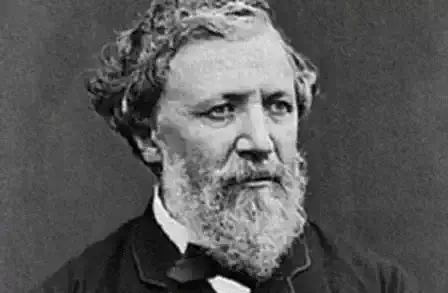
Robert Browning
In Three Days
In Three Days
I.
So, I shall see her in three days
And just one night, but nights are short,
Then two long hours, and that is morn.
See how I come, unchanged, unworn!
Feel, where my life broke off from thine,
How fresh the splinters keep and fine,---
Only a touch and we combine!
II.
Too long, this time of year, the days!
But nights, at least the nights are short.
As night shows where ger one moon is,
A hand's-breadth of pure light and bliss,
So life's night gives my lady birth
And my eyes hold her! What is worth
The rest of heaven, the rest of earth?
III.
O loaded curls, release your store
Of warmth and scent, as once before
The tingling hair did, lights and darks
Outbreaking into fairy sparks,
When under curl and curl I pried
After the warmth and scent inside,
Thro' lights and darks how manifold---
The dark inspired, the light controlled
As early Art embrowns the gold.
IV.
What great fear, should one say, ``Three days
``That change the world might change as well
``Your fortune; and if joy delays,
``Be happy that no worse befell!''
What small fear, if another says,
``Three days and one short night beside
``May throw no shadow on your ways;
``But years must teem with change untried,
``With chance not easily defied,
``With an end somewhere undescried.''
No fear!---or if a fear be born
This minute, it dies out in scorn.
Fear? I shall see her in three days
And one night, now the nights are short,
Then just two hours, and that is morn.
I.
So, I shall see her in three days
And just one night, but nights are short,
Then two long hours, and that is morn.
See how I come, unchanged, unworn!
Feel, where my life broke off from thine,
How fresh the splinters keep and fine,---
Only a touch and we combine!
II.
Too long, this time of year, the days!
But nights, at least the nights are short.
As night shows where ger one moon is,
A hand's-breadth of pure light and bliss,
So life's night gives my lady birth
And my eyes hold her! What is worth
The rest of heaven, the rest of earth?
III.
O loaded curls, release your store
Of warmth and scent, as once before
The tingling hair did, lights and darks
Outbreaking into fairy sparks,
When under curl and curl I pried
After the warmth and scent inside,
Thro' lights and darks how manifold---
The dark inspired, the light controlled
As early Art embrowns the gold.
IV.
What great fear, should one say, ``Three days
``That change the world might change as well
``Your fortune; and if joy delays,
``Be happy that no worse befell!''
What small fear, if another says,
``Three days and one short night beside
``May throw no shadow on your ways;
``But years must teem with change untried,
``With chance not easily defied,
``With an end somewhere undescried.''
No fear!---or if a fear be born
This minute, it dies out in scorn.
Fear? I shall see her in three days
And one night, now the nights are short,
Then just two hours, and that is morn.
409
Robert Browning
Earth's Immortalities
Earth's Immortalities
FAME.
See, as the prettiest graves will do in time,
Our poet's wants the freshness of its prime;
Spite of the sexton's browsing horse, the sods
Have struggled through its binding osier rods;
Headstone and half-sunk footstone lean awry,
Wanting the brick-work promised by-and-by;
How the minute grey lichens, plate o'er plate,
Have softened down the crisp-cut name and date!
LOVE.
So, the year's done with
(_Love me for ever!_)
All March begun with,
April's endeavour;
May-wreaths that bound me
June needs must sever;
Now snows fall round me,
Quenching June's fever---
(_Love me for ever!_)
FAME.
See, as the prettiest graves will do in time,
Our poet's wants the freshness of its prime;
Spite of the sexton's browsing horse, the sods
Have struggled through its binding osier rods;
Headstone and half-sunk footstone lean awry,
Wanting the brick-work promised by-and-by;
How the minute grey lichens, plate o'er plate,
Have softened down the crisp-cut name and date!
LOVE.
So, the year's done with
(_Love me for ever!_)
All March begun with,
April's endeavour;
May-wreaths that bound me
June needs must sever;
Now snows fall round me,
Quenching June's fever---
(_Love me for ever!_)
294
Robert Browning
A Toccata Of Galuppi's
A Toccata Of Galuppi's
I.
Oh Galuppi, Baldassaro, this is very sad to find!
I can hardly misconceive you; it would prove me deaf and blind;
But although I take your meaning, 'tis with such a heavy mind!
II.
Here you come with all your music, and here's all the good it brings.
What, they lived once thus at Venice where the merchants were the kings,
Where Saint Mark's is, where the Doges used to wed the sea with rings?
III.
Ay, because the sea's the street there; and 'tis arched by ... what you call
... Shylock's bridge with houses on it, where they kept the carnival:
I was never out of England---it's as if I saw it all.
IV.
Did young people take their pleasure when the sea was warm in May?
Balls and masks begun at midnight, burning ever to mid-day,
When they made up fresh adventures for the morrow, do you say?
V.
Was a lady such a lady, cheeks so round and lips so red,---
On her neck the small face buoyant, like a bell-flower on its bed,
O'er the breast's superb abundance where a man might base his head?
VI.
Well, and it was graceful of them---they'd break talk off and afford
---She, to bite her mask's black velvet---he, to finger on his sword,
While you sat and played Toccatas, stately at the clavichord?
VII.
What? Those lesser thirds so plaintive, sixths diminished, sigh on sigh,
Told them something? Those suspensions, those solutions---``Must we die?''
Those commiserating sevenths---``Life might last! we can but try!''
VIII.
``Were you happy?''---``Yes.''---``And are you still as happy?''---``Yes. And you?''
---``Then, more kisses!''---``Did _I_ stop them, when a million seemed so few?''
Hark, the dominant's persistence till it must be answered to!
IX.
So, an octave struck the answer. Oh, they praised you, I dare say!
``Brave Galuppi! that was music! good alike at grave and gay!
``I can always leave off talking when I hear a master play!''
X.
Then they left you for their pleasure: till in due time, one by one,
Some with lives that came to nothing, some with deeds as well undone,
Death stepped tacitly and took them where they never see the sun.
XI.
But when I sit down to reason, think to take my stand nor swerve,
While I triumph o'er a secret wrung from nature's close reserve,
In you come with your cold music till I creep thro' every nerve.
XII.
Yes, you, like a ghostly cricket, creaking where a house was burned:
``Dust and ashes, dead and done with, Venice spent what Venice earned.
``The soul, doubtless, is immortal---where a soul can be discerned.
XIII.
``Yours for instance: you know physics, something of geology,
``Mathematics are your pastime; souls shall rise in their degree;
``Butterflies may dread extinction,---you'll not die, it cannot be!
XIV.
``As for Venice and her people, merely born to bloom and drop,
``Here on earth they bore their fruitage, mirth and folly were the crop:
``What of soul was left, I wonder, when the kissing had to stop?
XV.
``Dust and ashes!'' So you creak it, and I want the heart to scold.
Dear dead women, with such hair, too---what's become of all the gold
Used to hang and brush their bosoms? I feel chilly and grown old.
* . An overture---a touch piece.
I.
Oh Galuppi, Baldassaro, this is very sad to find!
I can hardly misconceive you; it would prove me deaf and blind;
But although I take your meaning, 'tis with such a heavy mind!
II.
Here you come with all your music, and here's all the good it brings.
What, they lived once thus at Venice where the merchants were the kings,
Where Saint Mark's is, where the Doges used to wed the sea with rings?
III.
Ay, because the sea's the street there; and 'tis arched by ... what you call
... Shylock's bridge with houses on it, where they kept the carnival:
I was never out of England---it's as if I saw it all.
IV.
Did young people take their pleasure when the sea was warm in May?
Balls and masks begun at midnight, burning ever to mid-day,
When they made up fresh adventures for the morrow, do you say?
V.
Was a lady such a lady, cheeks so round and lips so red,---
On her neck the small face buoyant, like a bell-flower on its bed,
O'er the breast's superb abundance where a man might base his head?
VI.
Well, and it was graceful of them---they'd break talk off and afford
---She, to bite her mask's black velvet---he, to finger on his sword,
While you sat and played Toccatas, stately at the clavichord?
VII.
What? Those lesser thirds so plaintive, sixths diminished, sigh on sigh,
Told them something? Those suspensions, those solutions---``Must we die?''
Those commiserating sevenths---``Life might last! we can but try!''
VIII.
``Were you happy?''---``Yes.''---``And are you still as happy?''---``Yes. And you?''
---``Then, more kisses!''---``Did _I_ stop them, when a million seemed so few?''
Hark, the dominant's persistence till it must be answered to!
IX.
So, an octave struck the answer. Oh, they praised you, I dare say!
``Brave Galuppi! that was music! good alike at grave and gay!
``I can always leave off talking when I hear a master play!''
X.
Then they left you for their pleasure: till in due time, one by one,
Some with lives that came to nothing, some with deeds as well undone,
Death stepped tacitly and took them where they never see the sun.
XI.
But when I sit down to reason, think to take my stand nor swerve,
While I triumph o'er a secret wrung from nature's close reserve,
In you come with your cold music till I creep thro' every nerve.
XII.
Yes, you, like a ghostly cricket, creaking where a house was burned:
``Dust and ashes, dead and done with, Venice spent what Venice earned.
``The soul, doubtless, is immortal---where a soul can be discerned.
XIII.
``Yours for instance: you know physics, something of geology,
``Mathematics are your pastime; souls shall rise in their degree;
``Butterflies may dread extinction,---you'll not die, it cannot be!
XIV.
``As for Venice and her people, merely born to bloom and drop,
``Here on earth they bore their fruitage, mirth and folly were the crop:
``What of soul was left, I wonder, when the kissing had to stop?
XV.
``Dust and ashes!'' So you creak it, and I want the heart to scold.
Dear dead women, with such hair, too---what's become of all the gold
Used to hang and brush their bosoms? I feel chilly and grown old.
* . An overture---a touch piece.
334
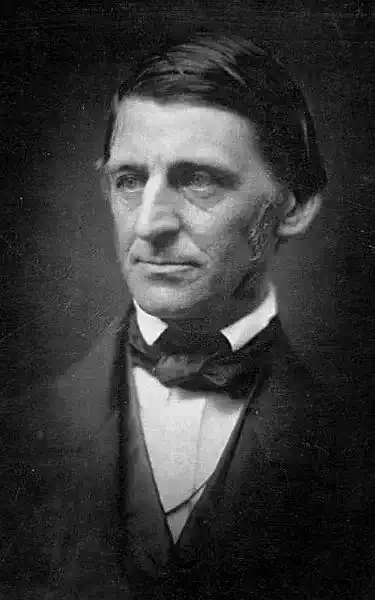
Ralph Waldo Emerson
Monadnoc
Monadnoc
Thousand minstrels woke within me,
"Our music's in the hills; "—
Gayest pictures rose to win me,
Leopard-colored rills.
Up!—If thou knew'st who calls
To twilight parks of beech and pine,
High over the river intervals,
Above the ploughman's highest line,
Over the owner's farthest walls;—
Up!—where the airy citadel
O'erlooks the purging landscape's swell.
Let not unto the stones the day
Her lily and rose, her sea and land display;
Read the celestial sign!
Lo! the South answers to the North;
Bookworm, break this sloth urbane;
A greater Spirit bids thee forth,
Than the gray dreams which thee detain.
Mark how the climbing Oreads
Beckon thee to their arcades;
Youth, for a moment free as they,
Teach thy feet to feel the ground,
Ere yet arrive the wintry day
When Time thy feet has bound.
Accept the bounty of thy birth;
Taste the lordship of the earth.
I heard and I obeyed,
Assured that he who pressed the claim,
Well-known, but loving not a name,
Was not to be gainsaid.
Ere yet the summoning voice was still,
I turned to Cheshire's haughty hill.
From the fixed cone the cloud-rack flowed
Like ample banner flung abroad
Round about, a hundred miles,
With invitation to the sea, and to the bordering isles.
In his own loom's garment drest,
By his own bounty blest,
Fast abides this constant giver,
Pouring many a cheerful river;
To far eyes, an aërial isle,
Unploughed, which finer spirits pile,
Which morn and crimson evening paint
For bard, for lover, and for saint;
The country's core,
Inspirer, prophet evermore,
Pillar which God aloft had set
So that men might it not forget,
It should be their life's ornament,
And mix itself with each event;
Their calendar and dial,
Barometer, and chemic phial,
Garden of berries, perch of birds,
Pasture of pool-haunting herds,
Graced by each change of sum untold,
Earth-baking heat, stone-cleaving cold.
The Titan minds his sky-affairs,
Rich rents and wide alliance shares;
Mysteries of color daily laid
By the great sun in light and shade,
And, sweet varieties of chance,
And the mystic seasons' dance,
And thief-like step of liberal hours
Which thawed the snow-drift into flowers.
O wondrous craft of plant and stone
By eldest science done and shown!
Happy, I said, whose home is here,
Fair fortunes to the mountaineer!
Boon nature to his poorest shed
Has royal pleasure-grounds outspread.
Intent I searched the region round,
And in low hut my monarch found.
He was no eagle and no earl,
Alas! my foundling was a churl,
With heart of cat, and eyes of bug,
Dull victim of his pipe and mug;
Woe is me for my hopes' downfall!
Lord! is yon squalid peasant all
That this proud nursery could breed
For God's vicegerency and stead?
Time out of mind this forge of ores,
Quarry of spars in mountain pores,
Old cradle, hunting ground, and bier
Of wolf and otter, bear, and deer;
Well-built abode of many a race;
Tower of observance searching space;
Factory of river, and of rain;
Link in the alps' globe-girding chain;
By million changes skilled to tell
What in the Eternal standeth well,
And what obedient nature can,—
Is this colossal talisman
Kindly to creature, blood, and kind,
And speechless to the master's mind?
I thought to find the patriots
In whom the stock of freedom roots.
To myself I oft recount
Tales of many a famous mount.—
Wales, Scotland, Uri, Hungary's dells,
Roys, and Scanderbegs, and Tells.
Here now shall nature crowd her powers,
Her music, and her meteors,
And, lifting man to the blue deep
Where stars their perfect courses keep,
Like wise preceptor lure his eye
To sound the science of the sky,
And carry learning to its height
Of untried power and sane delight;
The Indian cheer, the frosty skies
Breed purer wits, inventive eyes,
Eyes that frame cities where none be,
And hands that stablish what these see:
And, by the moral of his place,
Hint summits of heroic grace;
Man in these crags a fastness find
To fight pollution of the mind;
In the wide thaw and ooze of wrong,
Adhere like this foundation strong,
The insanity of towns to stem
With simpleness for stratagem.
But if the brave old mould is broke,
And end in clowns the mountain-folk,
In tavern cheer and tavern joke,—
Sink, O mountain! in the swamp,
Hide in thy skies, O sovereign lap!
Perish like leaves the highland breed!
No sire survive, no son succeed!
Soft! let not the offended muse
Toil's hard hap with scorn accuse.
Many hamlets sought I then,
Many farms of mountain men;—
Found I not a minstrel seed,
But men of bone, and good at need.
Rallying round a parish steeple
Nestle warm the highland people,
Coarse and boisterous, yet mild,
Strong as giant, slow as child,
Smoking in a squalid room,
Where yet the westland breezes come.
Close hid in those rough guises lurk
Western magians, here they work;
Sweat and season are their arts,
Their talismans are ploughs and carts;
And well the youngest can command
Honey from the frozen land,
With sweet hay the swamp adorn,
Change the running sand to corn,
For wolves and foxes, lowing herds,
And for cold mosses, cream and curds;
Weave wood to canisters and mats,
Drain sweet maple-juice in vats.
No bird is safe that cuts the air,
From their rifle or their snare;
No fish in river or in lake,
But their long hands it thence will take;
And the country's iron face
Like wax their fashioning skill betrays,
To fill the hollows, sink the hills,
Bridge gulfs, drain swamps, build dams and mills,
And fit the bleak and howling place
For gardens of a finer race,
The world-soul knows his own affair,
Fore-looking when his hands prepare
For the next ages men of mould,
Well embodied, well ensouled,
He cools the present's fiery glow,
Sets the life pulse strong, but slow.
Bitter winds and fasts austere.
His quarantines and grottos, where
He slowly cures decrepit flesh,
And brings it infantile and fresh.
These exercises are the toys
And games with which he breathes his boys.
They bide their time, and well can prove,
If need were, their line from Jove,
Of the same stuff, and so allayed,
As that whereof the sun is made;
And of that fibre quick and strong
Whose throbs are love, whose thrills are song.
Now in sordid weeds they sleep,
Their secret now in dulness keep.
Yet, will you learn our ancient speech,
These the masters who can teach,
Fourscore or a hundred words
All their vocal muse affords,
These they turn in other fashion
Than the writer or the parson.
I can spare the college-bell,
And the learned lecture well.
Spare the clergy and libraries,
Institutes and dictionaries,
For the hardy English root
Thrives here unvalued underfoot.
Rude poets of the tavern hearth,
Squandering your unquoted mirth,
Which keeps the ground and never soars,
While Jake retorts and Reuben roars,
Tough and screaming as birch-bark,
Goes like bullet to its mark,
While the solid curse and jeer
Never balk the waiting ear:
To student ears keen-relished jokes
On truck, and stock, and farming-folks,—
Nought the mountain yields thereof
But savage health and sinews tough.
On the summit as I stood,
O'er the wide floor of plain and flood,
Seemed to me the towering hill
Was not altogether still,
But a quiet sense conveyed;
If I err not, thus it said:
Many feet in summer seek
Betimes my far-appearing peak;
In the dreaded winter-time,
None save dappling shadows climb
Under clouds my lonely head,
Old as the sun, old almost as the shade.
And comest thou
To see strange forests and new snow,
And tread uplifted land?
And leavest thou thy lowland race,
Here amid clouds to stand,
And would'st be my companion,
Where I gaze
And shall gaze
When forests fall, and man is gone,
Over tribes and over times
As the burning Lyre
Nearing me,
With its stars of northern fire,
In many a thousand years.
Ah! welcome, if thou bring
My secret in thy brain;
To mountain-top may muse's wing
With good allowance strain.
Gentle pilgrim, if thou know
The gamut old of Pan,
And how the hills began,
The frank blessings of the hill
Fall on thee, as fall they will.
'Tis the law of bush and stone—
Each can only take his own.
Let him heed who can and will,—
Enchantment fixed me here
To stand the hurts of time, until
In mightier chant I disappear.
If thou trowest
How the chemic eddies play
Pole to pole, and what they say,
And that these gray crags
Not on crags are hung,
But beads are of a rosary
On prayer and music strung;
And, credulous, through the granite seeming
Seest the smile of Reason beaming;
Can thy style-discerning eye
The hidden-working Builder spy,
Who builds, yet makes no chips, no din,
With hammer soft as snow-flake's flight;
Knowest thou this?
O pilgrim, wandering not amiss!
Already my rocks lie light,
And soon my cone will spin.
For the world was built in order,
And the atoms march in tune,
Rhyme the pipe, and time the warder,
Cannot forget the sun, the moon.
Orb and atom forth they prance,
When they hear from far the rune,
None so backward in the troop,
When the music and the dance
Reach his place and circumstance,
But knows the sun-creating sound,
And, though a pyramid, will bound.
Monadnoc is a mountain strong,
Tall and good my kind among,
But well I know, no mountain can
Measure with a perfect man;
For it is on Zodiack's writ,
Adamant is soft to wit;
And when the greater comes again,
With my music in his brain,
I shall pass as glides my shadow
Daily over hill and meadow.
Through all time
I hear the approaching feet
Along the flinty pathway beat
Of him that cometh, and shall come,—
Of him who shall as lightly bear
My daily load of woods and streams,
As now the round sky-cleaving boat
Which never strains its rocky beams,
Whose timbers, as they silent float,
Alps and Caucasus uprear,
And the long Alleghanies here,
And all town-sprinkled lands that be,
Sailing through stars with all their history.
Every morn I lift my head,
Gaze o'er New England underspread
South from Saint Lawrence to the Sound,
From Katshill east to the sea-bound.
Anchored fast for many an age,
I await the bard and sage,
Who in large thoughts, like fair pearl-seed,
Shall string Monadnoc like a bead.
Comes that cheerful troubadour,
This mound shall throb his face before,
As when with inward fires and pain
It rose a bubble from the plain.
When he cometh, I shall shed
From this well-spring in my head
Fountain drop of spicier worth
Than all vintage of the earth.
There's fruit upon my barren soil
Costlier far than wine or oil;
There's a berry blue and gold,—
Autumn-ripe its juices hold,
Sparta's stoutness, Bethlehem's heart,
Asia's rancor, Athens' art,
Slowsure Britain's secular might,
And the German's inward sight;
I will give my son to eat
Best of Pan's immortal meat,
Bread to eat and juice to drink,
So the thoughts that he shall think
Shall not be forms of stars, but stars,
Nor pictures pale, but Jove and Mars.
He comes, but not of that race bred
Who daily climb my specular head.
Oft as morning wreathes my scarf,
Fled the last plumule of the dark,
Pants up hither the spruce clerk
From South-Cove and City-wharf;
I take him up my rugged sides,
Half-repentant, scant of breath,—
Bead-eyes my granite chaos show,
And my midsummer snow;
Open the daunting map beneath,—
All his county, sea and land,
Dwarfed to measure of his hand;
His day's ride is a furlong space,
His city tops a glimmering haze:
I plant his eyes on the sky-hoop bounding;—
See there the grim gray rounding
Of the bullet of the earth
Whereon ye sail,
Tumbling steep
In the uncontinented deep;—
He looks on that, and he turns pale:
'Tis even so, this treacherous kite,
Farm-furrowed, town-incrusted sphere,
Thoughtless of its anxious freight,
Plunges eyeless on for ever,
And he, poor parasite,—
Cooped in a ship he cannot steer,
Who is the captain he knows not,
Port or pilot trows not,—
Risk or ruin he must share.
I scowl on him with my cloud,
With my north wind chill his blood,
I lame him clattering down the rocks,
And to live he is in fear.
Then, at last, I let him down
Once more into his dapper town,
To chatter frightened to his clan,
And forget me, if he can.
As in the old poetic fame
The gods are blind and lame,
And the simular despite
Betrays the more abounding might,
So call not waste that barren cone
Above the floral zone,
Where forests starve:
It is pure use;
What sheaves like those which here we glean and bind,
Of a celestial Ceres, and the Muse?
Ages are thy days,
Thou grand expressor of the present tense,
And type of permanence,
Firm ensign of the fatal Being,
Amid these coward shapes of joy and grief
That will not bide the seeing.
Hither we bring
Our insect miseries to the rocks,
And the whole flight with pestering wing
Vanish and end their murmuring,
Vanish beside these dedicated blocks,
Which, who can tell what mason laid?
Spoils of a front none need restore,
Replacing frieze and architrave;
Yet flowers each stone rosette and metope brave,
Still is the haughty pile erect
Of the old building Intellect.
Complement of human kind,
Having us at vantage still,
Our sumptuous indigence,
O barren mound! thy plenties fill.
We fool and prate,—
Thou art silent and sedate.
To million kinds and times one sense
The constant mountain doth dispense,
Shedding on all its snows and leaves,
One joy it joys, one grief it grieves.
Thou seest, O watchman tall!
Our towns and races grow and fall,
And imagest the stable Good
For which we all our lifetime grope,
In shifting form the formless mind;
And though the substance us elude,
We in thee the shadow find.
Thou in our astronomy
An opaker star,
Seen, haply, from afar,
Above the horizon's hoop.
A moment by the railway troop,
As o'er some bolder height they speed,—
By circumspect ambition,
By errant Gain,
By feasters, and the frivolous,—
Recallest us,
And makest sane.
Mute orator! well-skilled to plead,
And send conviction without phrase,
Thou dost supply
The shortness of our days,
And promise, on thy Founder's truth,
Long morrow to this mortal youth.
Thousand minstrels woke within me,
"Our music's in the hills; "—
Gayest pictures rose to win me,
Leopard-colored rills.
Up!—If thou knew'st who calls
To twilight parks of beech and pine,
High over the river intervals,
Above the ploughman's highest line,
Over the owner's farthest walls;—
Up!—where the airy citadel
O'erlooks the purging landscape's swell.
Let not unto the stones the day
Her lily and rose, her sea and land display;
Read the celestial sign!
Lo! the South answers to the North;
Bookworm, break this sloth urbane;
A greater Spirit bids thee forth,
Than the gray dreams which thee detain.
Mark how the climbing Oreads
Beckon thee to their arcades;
Youth, for a moment free as they,
Teach thy feet to feel the ground,
Ere yet arrive the wintry day
When Time thy feet has bound.
Accept the bounty of thy birth;
Taste the lordship of the earth.
I heard and I obeyed,
Assured that he who pressed the claim,
Well-known, but loving not a name,
Was not to be gainsaid.
Ere yet the summoning voice was still,
I turned to Cheshire's haughty hill.
From the fixed cone the cloud-rack flowed
Like ample banner flung abroad
Round about, a hundred miles,
With invitation to the sea, and to the bordering isles.
In his own loom's garment drest,
By his own bounty blest,
Fast abides this constant giver,
Pouring many a cheerful river;
To far eyes, an aërial isle,
Unploughed, which finer spirits pile,
Which morn and crimson evening paint
For bard, for lover, and for saint;
The country's core,
Inspirer, prophet evermore,
Pillar which God aloft had set
So that men might it not forget,
It should be their life's ornament,
And mix itself with each event;
Their calendar and dial,
Barometer, and chemic phial,
Garden of berries, perch of birds,
Pasture of pool-haunting herds,
Graced by each change of sum untold,
Earth-baking heat, stone-cleaving cold.
The Titan minds his sky-affairs,
Rich rents and wide alliance shares;
Mysteries of color daily laid
By the great sun in light and shade,
And, sweet varieties of chance,
And the mystic seasons' dance,
And thief-like step of liberal hours
Which thawed the snow-drift into flowers.
O wondrous craft of plant and stone
By eldest science done and shown!
Happy, I said, whose home is here,
Fair fortunes to the mountaineer!
Boon nature to his poorest shed
Has royal pleasure-grounds outspread.
Intent I searched the region round,
And in low hut my monarch found.
He was no eagle and no earl,
Alas! my foundling was a churl,
With heart of cat, and eyes of bug,
Dull victim of his pipe and mug;
Woe is me for my hopes' downfall!
Lord! is yon squalid peasant all
That this proud nursery could breed
For God's vicegerency and stead?
Time out of mind this forge of ores,
Quarry of spars in mountain pores,
Old cradle, hunting ground, and bier
Of wolf and otter, bear, and deer;
Well-built abode of many a race;
Tower of observance searching space;
Factory of river, and of rain;
Link in the alps' globe-girding chain;
By million changes skilled to tell
What in the Eternal standeth well,
And what obedient nature can,—
Is this colossal talisman
Kindly to creature, blood, and kind,
And speechless to the master's mind?
I thought to find the patriots
In whom the stock of freedom roots.
To myself I oft recount
Tales of many a famous mount.—
Wales, Scotland, Uri, Hungary's dells,
Roys, and Scanderbegs, and Tells.
Here now shall nature crowd her powers,
Her music, and her meteors,
And, lifting man to the blue deep
Where stars their perfect courses keep,
Like wise preceptor lure his eye
To sound the science of the sky,
And carry learning to its height
Of untried power and sane delight;
The Indian cheer, the frosty skies
Breed purer wits, inventive eyes,
Eyes that frame cities where none be,
And hands that stablish what these see:
And, by the moral of his place,
Hint summits of heroic grace;
Man in these crags a fastness find
To fight pollution of the mind;
In the wide thaw and ooze of wrong,
Adhere like this foundation strong,
The insanity of towns to stem
With simpleness for stratagem.
But if the brave old mould is broke,
And end in clowns the mountain-folk,
In tavern cheer and tavern joke,—
Sink, O mountain! in the swamp,
Hide in thy skies, O sovereign lap!
Perish like leaves the highland breed!
No sire survive, no son succeed!
Soft! let not the offended muse
Toil's hard hap with scorn accuse.
Many hamlets sought I then,
Many farms of mountain men;—
Found I not a minstrel seed,
But men of bone, and good at need.
Rallying round a parish steeple
Nestle warm the highland people,
Coarse and boisterous, yet mild,
Strong as giant, slow as child,
Smoking in a squalid room,
Where yet the westland breezes come.
Close hid in those rough guises lurk
Western magians, here they work;
Sweat and season are their arts,
Their talismans are ploughs and carts;
And well the youngest can command
Honey from the frozen land,
With sweet hay the swamp adorn,
Change the running sand to corn,
For wolves and foxes, lowing herds,
And for cold mosses, cream and curds;
Weave wood to canisters and mats,
Drain sweet maple-juice in vats.
No bird is safe that cuts the air,
From their rifle or their snare;
No fish in river or in lake,
But their long hands it thence will take;
And the country's iron face
Like wax their fashioning skill betrays,
To fill the hollows, sink the hills,
Bridge gulfs, drain swamps, build dams and mills,
And fit the bleak and howling place
For gardens of a finer race,
The world-soul knows his own affair,
Fore-looking when his hands prepare
For the next ages men of mould,
Well embodied, well ensouled,
He cools the present's fiery glow,
Sets the life pulse strong, but slow.
Bitter winds and fasts austere.
His quarantines and grottos, where
He slowly cures decrepit flesh,
And brings it infantile and fresh.
These exercises are the toys
And games with which he breathes his boys.
They bide their time, and well can prove,
If need were, their line from Jove,
Of the same stuff, and so allayed,
As that whereof the sun is made;
And of that fibre quick and strong
Whose throbs are love, whose thrills are song.
Now in sordid weeds they sleep,
Their secret now in dulness keep.
Yet, will you learn our ancient speech,
These the masters who can teach,
Fourscore or a hundred words
All their vocal muse affords,
These they turn in other fashion
Than the writer or the parson.
I can spare the college-bell,
And the learned lecture well.
Spare the clergy and libraries,
Institutes and dictionaries,
For the hardy English root
Thrives here unvalued underfoot.
Rude poets of the tavern hearth,
Squandering your unquoted mirth,
Which keeps the ground and never soars,
While Jake retorts and Reuben roars,
Tough and screaming as birch-bark,
Goes like bullet to its mark,
While the solid curse and jeer
Never balk the waiting ear:
To student ears keen-relished jokes
On truck, and stock, and farming-folks,—
Nought the mountain yields thereof
But savage health and sinews tough.
On the summit as I stood,
O'er the wide floor of plain and flood,
Seemed to me the towering hill
Was not altogether still,
But a quiet sense conveyed;
If I err not, thus it said:
Many feet in summer seek
Betimes my far-appearing peak;
In the dreaded winter-time,
None save dappling shadows climb
Under clouds my lonely head,
Old as the sun, old almost as the shade.
And comest thou
To see strange forests and new snow,
And tread uplifted land?
And leavest thou thy lowland race,
Here amid clouds to stand,
And would'st be my companion,
Where I gaze
And shall gaze
When forests fall, and man is gone,
Over tribes and over times
As the burning Lyre
Nearing me,
With its stars of northern fire,
In many a thousand years.
Ah! welcome, if thou bring
My secret in thy brain;
To mountain-top may muse's wing
With good allowance strain.
Gentle pilgrim, if thou know
The gamut old of Pan,
And how the hills began,
The frank blessings of the hill
Fall on thee, as fall they will.
'Tis the law of bush and stone—
Each can only take his own.
Let him heed who can and will,—
Enchantment fixed me here
To stand the hurts of time, until
In mightier chant I disappear.
If thou trowest
How the chemic eddies play
Pole to pole, and what they say,
And that these gray crags
Not on crags are hung,
But beads are of a rosary
On prayer and music strung;
And, credulous, through the granite seeming
Seest the smile of Reason beaming;
Can thy style-discerning eye
The hidden-working Builder spy,
Who builds, yet makes no chips, no din,
With hammer soft as snow-flake's flight;
Knowest thou this?
O pilgrim, wandering not amiss!
Already my rocks lie light,
And soon my cone will spin.
For the world was built in order,
And the atoms march in tune,
Rhyme the pipe, and time the warder,
Cannot forget the sun, the moon.
Orb and atom forth they prance,
When they hear from far the rune,
None so backward in the troop,
When the music and the dance
Reach his place and circumstance,
But knows the sun-creating sound,
And, though a pyramid, will bound.
Monadnoc is a mountain strong,
Tall and good my kind among,
But well I know, no mountain can
Measure with a perfect man;
For it is on Zodiack's writ,
Adamant is soft to wit;
And when the greater comes again,
With my music in his brain,
I shall pass as glides my shadow
Daily over hill and meadow.
Through all time
I hear the approaching feet
Along the flinty pathway beat
Of him that cometh, and shall come,—
Of him who shall as lightly bear
My daily load of woods and streams,
As now the round sky-cleaving boat
Which never strains its rocky beams,
Whose timbers, as they silent float,
Alps and Caucasus uprear,
And the long Alleghanies here,
And all town-sprinkled lands that be,
Sailing through stars with all their history.
Every morn I lift my head,
Gaze o'er New England underspread
South from Saint Lawrence to the Sound,
From Katshill east to the sea-bound.
Anchored fast for many an age,
I await the bard and sage,
Who in large thoughts, like fair pearl-seed,
Shall string Monadnoc like a bead.
Comes that cheerful troubadour,
This mound shall throb his face before,
As when with inward fires and pain
It rose a bubble from the plain.
When he cometh, I shall shed
From this well-spring in my head
Fountain drop of spicier worth
Than all vintage of the earth.
There's fruit upon my barren soil
Costlier far than wine or oil;
There's a berry blue and gold,—
Autumn-ripe its juices hold,
Sparta's stoutness, Bethlehem's heart,
Asia's rancor, Athens' art,
Slowsure Britain's secular might,
And the German's inward sight;
I will give my son to eat
Best of Pan's immortal meat,
Bread to eat and juice to drink,
So the thoughts that he shall think
Shall not be forms of stars, but stars,
Nor pictures pale, but Jove and Mars.
He comes, but not of that race bred
Who daily climb my specular head.
Oft as morning wreathes my scarf,
Fled the last plumule of the dark,
Pants up hither the spruce clerk
From South-Cove and City-wharf;
I take him up my rugged sides,
Half-repentant, scant of breath,—
Bead-eyes my granite chaos show,
And my midsummer snow;
Open the daunting map beneath,—
All his county, sea and land,
Dwarfed to measure of his hand;
His day's ride is a furlong space,
His city tops a glimmering haze:
I plant his eyes on the sky-hoop bounding;—
See there the grim gray rounding
Of the bullet of the earth
Whereon ye sail,
Tumbling steep
In the uncontinented deep;—
He looks on that, and he turns pale:
'Tis even so, this treacherous kite,
Farm-furrowed, town-incrusted sphere,
Thoughtless of its anxious freight,
Plunges eyeless on for ever,
And he, poor parasite,—
Cooped in a ship he cannot steer,
Who is the captain he knows not,
Port or pilot trows not,—
Risk or ruin he must share.
I scowl on him with my cloud,
With my north wind chill his blood,
I lame him clattering down the rocks,
And to live he is in fear.
Then, at last, I let him down
Once more into his dapper town,
To chatter frightened to his clan,
And forget me, if he can.
As in the old poetic fame
The gods are blind and lame,
And the simular despite
Betrays the more abounding might,
So call not waste that barren cone
Above the floral zone,
Where forests starve:
It is pure use;
What sheaves like those which here we glean and bind,
Of a celestial Ceres, and the Muse?
Ages are thy days,
Thou grand expressor of the present tense,
And type of permanence,
Firm ensign of the fatal Being,
Amid these coward shapes of joy and grief
That will not bide the seeing.
Hither we bring
Our insect miseries to the rocks,
And the whole flight with pestering wing
Vanish and end their murmuring,
Vanish beside these dedicated blocks,
Which, who can tell what mason laid?
Spoils of a front none need restore,
Replacing frieze and architrave;
Yet flowers each stone rosette and metope brave,
Still is the haughty pile erect
Of the old building Intellect.
Complement of human kind,
Having us at vantage still,
Our sumptuous indigence,
O barren mound! thy plenties fill.
We fool and prate,—
Thou art silent and sedate.
To million kinds and times one sense
The constant mountain doth dispense,
Shedding on all its snows and leaves,
One joy it joys, one grief it grieves.
Thou seest, O watchman tall!
Our towns and races grow and fall,
And imagest the stable Good
For which we all our lifetime grope,
In shifting form the formless mind;
And though the substance us elude,
We in thee the shadow find.
Thou in our astronomy
An opaker star,
Seen, haply, from afar,
Above the horizon's hoop.
A moment by the railway troop,
As o'er some bolder height they speed,—
By circumspect ambition,
By errant Gain,
By feasters, and the frivolous,—
Recallest us,
And makest sane.
Mute orator! well-skilled to plead,
And send conviction without phrase,
Thou dost supply
The shortness of our days,
And promise, on thy Founder's truth,
Long morrow to this mortal youth.
467
Ralph Waldo Emerson
Compensation
Compensation
Why should I keep holiday,
When other men have none?
Why but because when these are gay,
I sit and mourn alone.
And why when mirth unseals all tongues
Should mine alone be dumb?
Ah! late I spoke to silent throngs,
And now their hour is come.
Why should I keep holiday,
When other men have none?
Why but because when these are gay,
I sit and mourn alone.
And why when mirth unseals all tongues
Should mine alone be dumb?
Ah! late I spoke to silent throngs,
And now their hour is come.
269
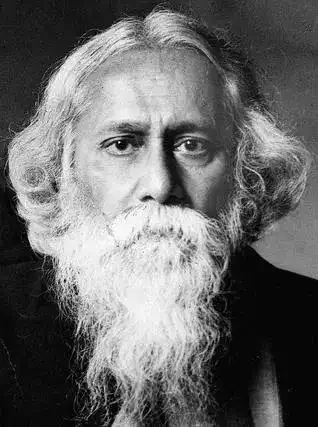
Rabindranath Tagore
The Gift
The Gift
I want to give you something, my child, for we are drifting in the
stream of the world.
Our lives will be carried apart, and our love forgotten.
But I am not so foolish as to hope that I could buy your heart
with my gifts.
Young is your life, your path long, and you drink the love we
bring you at one draught and turn and run away from us.
You have your play and your playmates. What harm is there if
you have no time or thought for us!
We, indeed, have leisure enough in old age to count the days
that are past, to cherish in our hearts what our hands have lost
for ever.
The river runs swift with a song, breaking through all
barriers. But the mountain stays and remembers, and follows her
with his love.
I want to give you something, my child, for we are drifting in the
stream of the world.
Our lives will be carried apart, and our love forgotten.
But I am not so foolish as to hope that I could buy your heart
with my gifts.
Young is your life, your path long, and you drink the love we
bring you at one draught and turn and run away from us.
You have your play and your playmates. What harm is there if
you have no time or thought for us!
We, indeed, have leisure enough in old age to count the days
that are past, to cherish in our hearts what our hands have lost
for ever.
The river runs swift with a song, breaking through all
barriers. But the mountain stays and remembers, and follows her
with his love.
581
Rabindranath Tagore
Signet of Eternity
Signet of Eternity
The day was when I did not keep myself in readiness for thee;
and entering my heart unbidden even as one of the common crowd,
unknown to me, my king, thou didst press the signet of eternity upon
many a fleeting moment of my life.
And today when by chance I light upon them and see thy signature,
I find they have lain scattered in the dust mixed with the memory of
joys and sorrows of my trivial days forgotten.
Thou didst not turn in contempt from my childish play among dust,
and the steps that I heard in my playroom
are the same that are echoing from star to star.
The day was when I did not keep myself in readiness for thee;
and entering my heart unbidden even as one of the common crowd,
unknown to me, my king, thou didst press the signet of eternity upon
many a fleeting moment of my life.
And today when by chance I light upon them and see thy signature,
I find they have lain scattered in the dust mixed with the memory of
joys and sorrows of my trivial days forgotten.
Thou didst not turn in contempt from my childish play among dust,
and the steps that I heard in my playroom
are the same that are echoing from star to star.
497
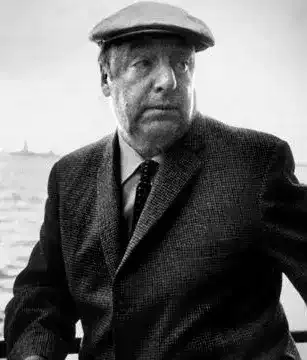
Pablo Neruda
The Wide Ocean
The Wide Ocean
Ocean, if you were to give, a measure, a ferment, a fruit
of your gifts and destructions, into my hand,
I would choose your far-off repose, your contour of steel,
your vigilant spaces of air and darkness,
and the power of your white tongue,
that shatters and overthrows columns,
breaking them down to your proper purity.
Not the final breaker, heavy with brine,
that thunders onshore, and creates
the silence of sand, that encircles the world,
but the inner spaces of force,
the naked power of the waters,
the immoveable solitude, brimming with lives.
It is Time perhaps, or the vessel filled
with all motion, pure Oneness,
that death cannot touch, the visceral green
of consuming totality.
Only a salt kiss remains of the drowned arm,
that lifts a spray: a humid scent,
of the damp flower, is left,
from the bodies of men. Your energies
form, in a trickle that is not spent,
form, in retreat into silence.
The falling wave,
arch of identity, shattering feathers,
is only spume when it clears,
and returns to its source, unconsumed.
Your whole force heads for its origin.
The husks that your load threshes,
are only the crushed, plundered, deliveries,
that your act of abundance expelled,
all those that take life from your branches.
Your form extends beyond breakers,
vibrant, and rhythmic, like the chest, cloaking
a single being, and its breathings,
that lift into the content of light,
plains raised above waves,
forming the naked surface of earth.
You fill your true self with your substance.
You overflow curve with silence.
The vessel trembles with your salt and sweetness,
the universal cavern of waters,
and nothing is lost from you, as it is
from the desolate crater, or the bay of a hill,
those empty heights, signs, scars,
guarding the wounded air.
Your petals throbbing against the Earth,
trembling your submarine harvests,
your menace thickening the smooth swell,
with pulsations and swarming of schools,
and only the thread of the net raises
the dead lightning of fish-scale,
one wounded millimetre, in the space
of your crystal completeness.
Ocean, if you were to give, a measure, a ferment, a fruit
of your gifts and destructions, into my hand,
I would choose your far-off repose, your contour of steel,
your vigilant spaces of air and darkness,
and the power of your white tongue,
that shatters and overthrows columns,
breaking them down to your proper purity.
Not the final breaker, heavy with brine,
that thunders onshore, and creates
the silence of sand, that encircles the world,
but the inner spaces of force,
the naked power of the waters,
the immoveable solitude, brimming with lives.
It is Time perhaps, or the vessel filled
with all motion, pure Oneness,
that death cannot touch, the visceral green
of consuming totality.
Only a salt kiss remains of the drowned arm,
that lifts a spray: a humid scent,
of the damp flower, is left,
from the bodies of men. Your energies
form, in a trickle that is not spent,
form, in retreat into silence.
The falling wave,
arch of identity, shattering feathers,
is only spume when it clears,
and returns to its source, unconsumed.
Your whole force heads for its origin.
The husks that your load threshes,
are only the crushed, plundered, deliveries,
that your act of abundance expelled,
all those that take life from your branches.
Your form extends beyond breakers,
vibrant, and rhythmic, like the chest, cloaking
a single being, and its breathings,
that lift into the content of light,
plains raised above waves,
forming the naked surface of earth.
You fill your true self with your substance.
You overflow curve with silence.
The vessel trembles with your salt and sweetness,
the universal cavern of waters,
and nothing is lost from you, as it is
from the desolate crater, or the bay of a hill,
those empty heights, signs, scars,
guarding the wounded air.
Your petals throbbing against the Earth,
trembling your submarine harvests,
your menace thickening the smooth swell,
with pulsations and swarming of schools,
and only the thread of the net raises
the dead lightning of fish-scale,
one wounded millimetre, in the space
of your crystal completeness.
619
Pablo Neruda
The Tree Is Here, Still, In Pure Stone
The Tree Is Here, Still, In Pure Stone
The tree is here, still, in pure stone,
in deep evidence, in solid beauty,
layered, through a hundred million years.
Agate, cornelian, gemstone
transmuted the timber and sap
until damp corruptions
fissured the giant's trunk
fusing a parallel being:
the living leaves
unmade themselves
and when the pillar was overthrown
fire in the forest, blaze of the dust-cloud,
celestial ashes mantled it round,
until time, and the lava, created
this gift, of translucent stone.
The tree is here, still, in pure stone,
in deep evidence, in solid beauty,
layered, through a hundred million years.
Agate, cornelian, gemstone
transmuted the timber and sap
until damp corruptions
fissured the giant's trunk
fusing a parallel being:
the living leaves
unmade themselves
and when the pillar was overthrown
fire in the forest, blaze of the dust-cloud,
celestial ashes mantled it round,
until time, and the lava, created
this gift, of translucent stone.
537
Pablo Neruda
Sonnet LXXXI
Sonnet LXXXI
And now you're mine. Rest with your dream in my dream.
Love and pain and work should all sleep, now.
The night turns on its invisible wheels,
and you are pure beside me as a sleeping amber.
No one else, Love, will sleep in my dreams. You will go,
we will go together, over the waters of time.
No one else will travel through the shadows with me,
only you, evergreen, ever sun, ever moon.
Your hands have already opened their delicate fists
and let their soft drifting signs drop away; your eyes closed like two gray
wings, and I move
after, following the folding water you carry, that carries
me away. The night, the world, the wind spin out their destiny.
Without you, I am your dream, only that, and that is all.
And now you're mine. Rest with your dream in my dream.
Love and pain and work should all sleep, now.
The night turns on its invisible wheels,
and you are pure beside me as a sleeping amber.
No one else, Love, will sleep in my dreams. You will go,
we will go together, over the waters of time.
No one else will travel through the shadows with me,
only you, evergreen, ever sun, ever moon.
Your hands have already opened their delicate fists
and let their soft drifting signs drop away; your eyes closed like two gray
wings, and I move
after, following the folding water you carry, that carries
me away. The night, the world, the wind spin out their destiny.
Without you, I am your dream, only that, and that is all.
630

Ogden Nash
The Sunset Years of Samuel Shy
The Sunset Years of Samuel Shy
Master I may be,
But not of my fate.
Now come the kisses, too many too late.
Tell me, O Parcae,
For fain would I know,
Where were these kisses three decades ago?
Girls there were plenty,
Mint julep girls, beer girls,
Gay younger married and headstrong career girls,
The girls of my friends
And the wives of my friends,
Some smugly settled and some at loose ends,
Sad girls, serene girls,
Girls breathless and turbulent,
Debs cosmopolitan, matrons suburbulent,
All of them amiable,
All of them cordial,
Innocent rousers of instincts primordial,
But even though health and wealth
Hadn't yet missed me,
None of them,
Not even Jenny,
Once kissed me.
These very same girls
Who with me have grown older
Now freely relax with a head on my shoulder,
And now come the kisses,
A flood in full spate,
The meaningless kisses, too many too late.
They kiss me hello,
They kiss me goodbye,
Should I offer a light, there's a kiss for reply.
They kiss me at weddings,
They kiss me at wakes,
The drop of a hat is less than it takes.
They kiss me at cocktails,
They kiss me at bridge,
It's all automatic, like slapping a midge.
The sound of their kisses
Is loud in my ears
Like the locusts that swarm every seventeen years.
I'm arthritic, dyspeptic,
Potentially ulcery,
And weary of kisses by custom compulsory.
Should my dear ones commit me
As senile demential,
It's from kisses perfunctory, inconsequential.
Answer, O Parcae,
For fain would I know,
Where were these kisses three decades ago?
Master I may be,
But not of my fate.
Now come the kisses, too many too late.
Tell me, O Parcae,
For fain would I know,
Where were these kisses three decades ago?
Girls there were plenty,
Mint julep girls, beer girls,
Gay younger married and headstrong career girls,
The girls of my friends
And the wives of my friends,
Some smugly settled and some at loose ends,
Sad girls, serene girls,
Girls breathless and turbulent,
Debs cosmopolitan, matrons suburbulent,
All of them amiable,
All of them cordial,
Innocent rousers of instincts primordial,
But even though health and wealth
Hadn't yet missed me,
None of them,
Not even Jenny,
Once kissed me.
These very same girls
Who with me have grown older
Now freely relax with a head on my shoulder,
And now come the kisses,
A flood in full spate,
The meaningless kisses, too many too late.
They kiss me hello,
They kiss me goodbye,
Should I offer a light, there's a kiss for reply.
They kiss me at weddings,
They kiss me at wakes,
The drop of a hat is less than it takes.
They kiss me at cocktails,
They kiss me at bridge,
It's all automatic, like slapping a midge.
The sound of their kisses
Is loud in my ears
Like the locusts that swarm every seventeen years.
I'm arthritic, dyspeptic,
Potentially ulcery,
And weary of kisses by custom compulsory.
Should my dear ones commit me
As senile demential,
It's from kisses perfunctory, inconsequential.
Answer, O Parcae,
For fain would I know,
Where were these kisses three decades ago?
250
Ogden Nash
A Lady Who Thinks She Is Thirty
A Lady Who Thinks She Is Thirty
Unwillingly Miranda wakes,
Feels the sun with terror,
One unwilling step she takes,
Shuddering to the mirror.
Miranda in Miranda's sight
Is old and gray and dirty;
Twenty-nine she was last night;
This morning she is thirty.
Shining like the morning star,
Like the twilight shining,
Haunted by a calendar,
Miranda is a-pining.
Silly girl, silver girl,
Draw the mirror toward you;
Time who makes the years to whirl
Adorned as he adored you.
Time is timelessness for you;
Calendars for the human;
What's a year, or thirty, to
Loveliness made woman?
Oh, Night will not see thirty again,
Yet soft her wing, Miranda;
Pick up your glass and tell me, then--
How old is Spring, Miranda?
Unwillingly Miranda wakes,
Feels the sun with terror,
One unwilling step she takes,
Shuddering to the mirror.
Miranda in Miranda's sight
Is old and gray and dirty;
Twenty-nine she was last night;
This morning she is thirty.
Shining like the morning star,
Like the twilight shining,
Haunted by a calendar,
Miranda is a-pining.
Silly girl, silver girl,
Draw the mirror toward you;
Time who makes the years to whirl
Adorned as he adored you.
Time is timelessness for you;
Calendars for the human;
What's a year, or thirty, to
Loveliness made woman?
Oh, Night will not see thirty again,
Yet soft her wing, Miranda;
Pick up your glass and tell me, then--
How old is Spring, Miranda?
254
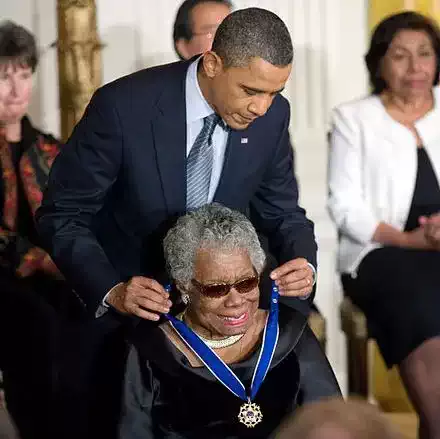
Maya Angelou
Passing Time
Passing Time
Your skin like dawn
Mine like musk
One paints the beginning
of a certain end.
The other, the end of a
sure beginning.
Your skin like dawn
Mine like musk
One paints the beginning
of a certain end.
The other, the end of a
sure beginning.
273