

Poems in this theme
Romantic Love
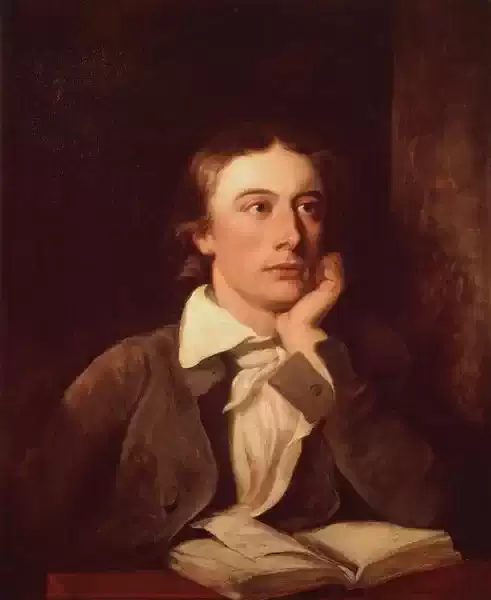
John Keats
You Say You Love
You Say You Love
I
You say you love ; but with a voice
Chaster than a nun's, who singeth
The soft Vespers to herself
While the chime-bell ringeth-
O love me truly!
II
You say you love; but with a smile
Cold as sunrise in September,
As you were Saint Cupid 's nun,
And kept his weeks of Ember.
O love me truly!
III
You say you love but then your lips
Coral tinted teach no blisses,
More than coral in the sea
They never pout for kisses
O love me truly!
IV
You say you love ; but then your hand
No soft squeeze for squeeze returneth,
It is like a statue's dead
While mine to passion burneth
O love me truly!
V
O breathe a word or two of fire!
Smile, as if those words should bum me,
Squeeze as lovers should O kiss
And in thy heart inurn me!
O love me truly!
I
You say you love ; but with a voice
Chaster than a nun's, who singeth
The soft Vespers to herself
While the chime-bell ringeth-
O love me truly!
II
You say you love; but with a smile
Cold as sunrise in September,
As you were Saint Cupid 's nun,
And kept his weeks of Ember.
O love me truly!
III
You say you love but then your lips
Coral tinted teach no blisses,
More than coral in the sea
They never pout for kisses
O love me truly!
IV
You say you love ; but then your hand
No soft squeeze for squeeze returneth,
It is like a statue's dead
While mine to passion burneth
O love me truly!
V
O breathe a word or two of fire!
Smile, as if those words should bum me,
Squeeze as lovers should O kiss
And in thy heart inurn me!
O love me truly!
464
John Keats
Where Be Ye Going, You Devon Maid?
Where Be Ye Going, You Devon Maid?
WHERE be ye going, you Devon maid?
And what have ye there i' the basket?
Ye tight little fairy, just fresh from the dairy,
Will ye give me some cream if I ask it?
I love your meads, and I love your flowers,
And I love your junkets mainly,
But 'hind the door, I love kissing more,
O look not so disdainly!
I love your hills, and I love your dales,
And I love your flocks a-bleating;
But O, on the heather to lie together,
With both our hearts a-beating!
I'll put your basket all safe in a nook,
Your shawl I'll hang up on this willow,
And we will sigh in the daisy's eye,
And kiss on a grass-green pillow.
WHERE be ye going, you Devon maid?
And what have ye there i' the basket?
Ye tight little fairy, just fresh from the dairy,
Will ye give me some cream if I ask it?
I love your meads, and I love your flowers,
And I love your junkets mainly,
But 'hind the door, I love kissing more,
O look not so disdainly!
I love your hills, and I love your dales,
And I love your flocks a-bleating;
But O, on the heather to lie together,
With both our hearts a-beating!
I'll put your basket all safe in a nook,
Your shawl I'll hang up on this willow,
And we will sigh in the daisy's eye,
And kiss on a grass-green pillow.
422
John Keats
When I Have Fears
When I Have Fears
When I have fears that I may cease to be
Before my pen has glean'd my teeming brain,
Before high-piled books, in charactery,
Hold like rich garners the full ripen'd grain;
When I behold, upon the night's starr'd face,
Huge cloudy symbols of a high romance,
And think that I may never live to trace
Their shadows, with the magic hand of chance;
And when I feel, fair creature of an hour,
That I shall never look upon thee more,
Never have relish in the faery power
Of unreflecting love;--then on the shore
Of the wide world I stand alone, and think
Till love and fame to nothingness do sink.
When I have fears that I may cease to be
Before my pen has glean'd my teeming brain,
Before high-piled books, in charactery,
Hold like rich garners the full ripen'd grain;
When I behold, upon the night's starr'd face,
Huge cloudy symbols of a high romance,
And think that I may never live to trace
Their shadows, with the magic hand of chance;
And when I feel, fair creature of an hour,
That I shall never look upon thee more,
Never have relish in the faery power
Of unreflecting love;--then on the shore
Of the wide world I stand alone, and think
Till love and fame to nothingness do sink.
464
John Keats
To Fanny
To Fanny
I cry your mercy-pity-love!-aye, love!
Merciful love that tantalizes not,
One-thoughted, never-wandering, guileless love,
Unmasked, and being seen-without a blot!
O! let me have thee whole,-all-all-be mine!
That shape, that fairness, that sweet minor zest
Of love, your kiss,-those hands, those eyes divine,
That warm, white, lucent, million-pleasured breast,Yourself-
your soul-in pity give me all,
Withhold no atom's atom or I die,
Or living on, perhaps, your wretched thrall,
Forget, in the mist of idle misery,
Life's purposes,-the palate of my mind
Losing its gust, and my ambition blind!
I cry your mercy-pity-love!-aye, love!
Merciful love that tantalizes not,
One-thoughted, never-wandering, guileless love,
Unmasked, and being seen-without a blot!
O! let me have thee whole,-all-all-be mine!
That shape, that fairness, that sweet minor zest
Of love, your kiss,-those hands, those eyes divine,
That warm, white, lucent, million-pleasured breast,Yourself-
your soul-in pity give me all,
Withhold no atom's atom or I die,
Or living on, perhaps, your wretched thrall,
Forget, in the mist of idle misery,
Life's purposes,-the palate of my mind
Losing its gust, and my ambition blind!
444
John Keats
To ****
To ****
Hadst thou liv'd in days of old,
O what wonders had been told
Of thy lively countenance,
And thy humid eyes that dance
In the midst of their own brightness;
In the very fane of lightness.
Over which thine eyebrows, leaning,
Picture out each lovely meaning:
In a dainty bend they lie,
Like to streaks across the sky,
Or the feathers from a crow,
Fallen on a bed of snow.
Of thy dark hair that extends
Into many graceful bends:
As the leaves of Hellebore
Turn to whence they sprung before.
And behind each ample curl
Peeps the richness of a pearl.
Downward too flows many a tress
With a glossy waviness;
Full, and round like globes that rise
From the censer to the skies
Through sunny air. Add too, the sweetness
Of thy honied voice; the neatness
Of thine ankle lightly turn'd:
With those beauties, scarce discern'd,
Kept with such sweet privacy,
That they seldom meet the eye
Of the little loves that fly
Round about with eager pry.
Saving when, with freshening lave,
Thou dipp'st them in the taintless wave;
Like twin water lillies, born
In the coolness of the morn.
O, if thou hadst breathed then,
Now the Muses had been ten.
Couldst thou wish for lineage higher
Than twin sister of Thalia?
At least for ever, evermore,
Will I call the Graces four.
Hadst thou liv'd when chivalry
Lifted up her lance on high,
Tell me what thou wouldst have been?
Ah! I see the silver sheen
Of thy broidered, floating vest
Cov’ring half thine ivory breast;
Which, O heavens! I should see,
But that cruel destiny
Has placed a golden cuirass there;
Keeping secret what is fair.
Like sunbeams in a cloudlet nested
Thy locks in knightly casque are rested:
O’er which bend four milky plumes
Like the gentle lilly’s blooms
Springing from a costly vase.
See with what a stately pace
Comes thine alabaster steed;
Servant of heroic deed!
O'er his loins, his trappings glow
Like the northern lights on snow.
Mount his back! thy sword unsheath!
Sign of the enchanter's death;
Bane of every wicked spell;
Silencer of dragon's yell.
Alas! thou this wilt never do:
Thou art an enchantress too,
And wilt surely never spill
Blood of those whose eyes can kill.
Hadst thou liv'd in days of old,
O what wonders had been told
Of thy lively countenance,
And thy humid eyes that dance
In the midst of their own brightness;
In the very fane of lightness.
Over which thine eyebrows, leaning,
Picture out each lovely meaning:
In a dainty bend they lie,
Like to streaks across the sky,
Or the feathers from a crow,
Fallen on a bed of snow.
Of thy dark hair that extends
Into many graceful bends:
As the leaves of Hellebore
Turn to whence they sprung before.
And behind each ample curl
Peeps the richness of a pearl.
Downward too flows many a tress
With a glossy waviness;
Full, and round like globes that rise
From the censer to the skies
Through sunny air. Add too, the sweetness
Of thy honied voice; the neatness
Of thine ankle lightly turn'd:
With those beauties, scarce discern'd,
Kept with such sweet privacy,
That they seldom meet the eye
Of the little loves that fly
Round about with eager pry.
Saving when, with freshening lave,
Thou dipp'st them in the taintless wave;
Like twin water lillies, born
In the coolness of the morn.
O, if thou hadst breathed then,
Now the Muses had been ten.
Couldst thou wish for lineage higher
Than twin sister of Thalia?
At least for ever, evermore,
Will I call the Graces four.
Hadst thou liv'd when chivalry
Lifted up her lance on high,
Tell me what thou wouldst have been?
Ah! I see the silver sheen
Of thy broidered, floating vest
Cov’ring half thine ivory breast;
Which, O heavens! I should see,
But that cruel destiny
Has placed a golden cuirass there;
Keeping secret what is fair.
Like sunbeams in a cloudlet nested
Thy locks in knightly casque are rested:
O’er which bend four milky plumes
Like the gentle lilly’s blooms
Springing from a costly vase.
See with what a stately pace
Comes thine alabaster steed;
Servant of heroic deed!
O'er his loins, his trappings glow
Like the northern lights on snow.
Mount his back! thy sword unsheath!
Sign of the enchanter's death;
Bane of every wicked spell;
Silencer of dragon's yell.
Alas! thou this wilt never do:
Thou art an enchantress too,
And wilt surely never spill
Blood of those whose eyes can kill.
428
John Keats
The Day Is Gone, And All Its Sweets Are Gone
The Day Is Gone, And All Its Sweets Are Gone
The day is gone, and all its sweets are gone!
Sweet voice, sweet lips, soft hand, and softer breast,
Warm breath, light whisper, tender semitone,
Bright eyes, accomplished shape, and lang'rous waist!
Faded the flower and all its budded charms,
Faded the sight of beauty from my eyes,
Faded the shape of beauty from my arms,
Faded the voice, warmth, whiteness, paradise-
Vanished unseasonably at shut of eve,
When the dusk holiday-or holinight
Of fragrant-curtained love begins to weave
The woof of darkness thick, for hid delight;
But, as I've read love's missal through today,
He'll let me sleep, seeing I fast and pray.
The day is gone, and all its sweets are gone!
Sweet voice, sweet lips, soft hand, and softer breast,
Warm breath, light whisper, tender semitone,
Bright eyes, accomplished shape, and lang'rous waist!
Faded the flower and all its budded charms,
Faded the sight of beauty from my eyes,
Faded the shape of beauty from my arms,
Faded the voice, warmth, whiteness, paradise-
Vanished unseasonably at shut of eve,
When the dusk holiday-or holinight
Of fragrant-curtained love begins to weave
The woof of darkness thick, for hid delight;
But, as I've read love's missal through today,
He'll let me sleep, seeing I fast and pray.
463
John Keats
Stanzas To Miss Wylie
Stanzas To Miss Wylie
1.
O come Georgiana! the rose is full blown,
The riches of Flora are lavishly strown,
The air is all softness, and crystal the streams,
The West is resplendently clothed in beams.
2.
O come! let us haste to the freshening shades,
The quaintly carv'd seats, and the opening glades;
Where the faeries are chanting their evening hymns,
And in the last sun-beam the sylph lightly swims.
3.
And when thou art weary I'll find thee a bed,
Of mosses and flowers to pillow thy head:
And there Georgiana I'll sit at thy feet,
While my story of love I enraptur'd repeat.
4.
So fondly I'll breathe, and so softly I'll sigh,
Thou wilt think that some amorous Zephyr is nigh:
Yet no -- as I breathe I will press thy fair knee,
And then thou wilt know that the sigh comes from me.
5.
Ah! why dearest girl should we lose all these blisses?
That mortal's a fool who such happiness misses:
So smile acquiescence, and give me thy hand,
With love-looking eyes, and with voice sweetly bland.
1.
O come Georgiana! the rose is full blown,
The riches of Flora are lavishly strown,
The air is all softness, and crystal the streams,
The West is resplendently clothed in beams.
2.
O come! let us haste to the freshening shades,
The quaintly carv'd seats, and the opening glades;
Where the faeries are chanting their evening hymns,
And in the last sun-beam the sylph lightly swims.
3.
And when thou art weary I'll find thee a bed,
Of mosses and flowers to pillow thy head:
And there Georgiana I'll sit at thy feet,
While my story of love I enraptur'd repeat.
4.
So fondly I'll breathe, and so softly I'll sigh,
Thou wilt think that some amorous Zephyr is nigh:
Yet no -- as I breathe I will press thy fair knee,
And then thou wilt know that the sigh comes from me.
5.
Ah! why dearest girl should we lose all these blisses?
That mortal's a fool who such happiness misses:
So smile acquiescence, and give me thy hand,
With love-looking eyes, and with voice sweetly bland.
452
John Keats
Sonnet. To A Lady Seen For A Few Moments At Vauxhall
Sonnet. To A Lady Seen For A Few Moments At Vauxhall
Time's sea hath been five years at its slow ebb,
Long hours have to and fro let creep the sand,
Since I was tangled in thy beauty's web,
And snared by the ungloving of thine hand.
And yet I never look on midnight sky,
But I behold thine eyes' well memory'd light;
I cannot look upon the rose's dye,
But to thy cheek my soul doth take its flight.
I cannot look on any budding flower,
But my fond ear, in fancy at thy lips
And hearkening for a love-sound, doth devour
Its sweets in the wrong sense: -- Thou dost eclipse
Every delight with sweet remembering,
And grief unto my darling joys dost bring.
Time's sea hath been five years at its slow ebb,
Long hours have to and fro let creep the sand,
Since I was tangled in thy beauty's web,
And snared by the ungloving of thine hand.
And yet I never look on midnight sky,
But I behold thine eyes' well memory'd light;
I cannot look upon the rose's dye,
But to thy cheek my soul doth take its flight.
I cannot look on any budding flower,
But my fond ear, in fancy at thy lips
And hearkening for a love-sound, doth devour
Its sweets in the wrong sense: -- Thou dost eclipse
Every delight with sweet remembering,
And grief unto my darling joys dost bring.
499
John Keats
Sonnet. The Day Is Gone
Sonnet. The Day Is Gone
The day is gone, and all its sweets are gone!
Sweet voice, sweet lips, soft hand, and softer breast,
Warm breath, light whisper, tender semitone,
Bright eyes, accomplished shape, and lang'rous waist!
Faded the flower and all its budded charms,
Faded the sight of beauty from my eyes,
Faded the shape of beauty from my arms,
Faded the voice, warmth, whiteness, paradise--
Vanished unseasonably at shut of eve,
When the dusk holiday -- or holinight
Of fragrant-curtained love begins to weave
The woof of darkness thick, for hid delight;
But, as I've read love's missal through today,
He'll let me sleep, seeing I fast and pray.
The day is gone, and all its sweets are gone!
Sweet voice, sweet lips, soft hand, and softer breast,
Warm breath, light whisper, tender semitone,
Bright eyes, accomplished shape, and lang'rous waist!
Faded the flower and all its budded charms,
Faded the sight of beauty from my eyes,
Faded the shape of beauty from my arms,
Faded the voice, warmth, whiteness, paradise--
Vanished unseasonably at shut of eve,
When the dusk holiday -- or holinight
Of fragrant-curtained love begins to weave
The woof of darkness thick, for hid delight;
But, as I've read love's missal through today,
He'll let me sleep, seeing I fast and pray.
415
John Keats
Sonnet. On A Picture Of Leander
Sonnet. On A Picture Of Leander
Come hither all sweet Maidens soberly
Down looking aye, and with a chasten'd light
Hid in the fringes of your eyelids white,
And meekly let your fair hands joined be,
As if so gentle that ye could not see,
Untouch'd, a victim of your beauty bright,
Sinking away to his young spirit's night,
Sinking bewilder'd 'mid the dreary sea.
'Tis young Leander toiling to his death.
Nigh swooning he doth purse his weary lips
For Hero's cheek, and smiles against her smile.
O horrid dream! see how his body dips
Dead-heavy; arms and shoulders gleam awhile;
He's gone; up bubbles all his amorous breath!
Come hither all sweet Maidens soberly
Down looking aye, and with a chasten'd light
Hid in the fringes of your eyelids white,
And meekly let your fair hands joined be,
As if so gentle that ye could not see,
Untouch'd, a victim of your beauty bright,
Sinking away to his young spirit's night,
Sinking bewilder'd 'mid the dreary sea.
'Tis young Leander toiling to his death.
Nigh swooning he doth purse his weary lips
For Hero's cheek, and smiles against her smile.
O horrid dream! see how his body dips
Dead-heavy; arms and shoulders gleam awhile;
He's gone; up bubbles all his amorous breath!
523
John Keats
Sonnet. A Dream, After Reading Dante's Episode Of Paulo And Francesca
Sonnet. A Dream, After Reading Dante's Episode Of Paulo And Francesca
As Hermes once took to his feathers light,
When lulled Argus, baffled, swooned and slept,
So on a Delphic reed, my idle spright
So played, so charmed, so conquered, so bereft
The dragon-world of all its hundred eyes;
And seeing it asleep, so fled away--
Not to pure Ida with its snow-cold skies,
Nor unto Tempe, where Jove grieved a day;
But to that second circle of sad Hell,
Where in the gust, the whirlwind, and the flaw
Of rain and hail-stones, lovers need not tell
Their sorrows. Pale were the sweet lips I saw,
Pale were the lips I kissed, and fair the form
I floated with, about that melancholy storm.
As Hermes once took to his feathers light,
When lulled Argus, baffled, swooned and slept,
So on a Delphic reed, my idle spright
So played, so charmed, so conquered, so bereft
The dragon-world of all its hundred eyes;
And seeing it asleep, so fled away--
Not to pure Ida with its snow-cold skies,
Nor unto Tempe, where Jove grieved a day;
But to that second circle of sad Hell,
Where in the gust, the whirlwind, and the flaw
Of rain and hail-stones, lovers need not tell
Their sorrows. Pale were the sweet lips I saw,
Pale were the lips I kissed, and fair the form
I floated with, about that melancholy storm.
420
John Keats
Sonnet XVII. Happy Is England
Sonnet XVII. Happy Is England
Happy is England! I could be content
To see no other verdure than its own;
To feel no other breezes than are blown
Through its tall woods with high romances blent:
Yet do I sometimes feel a languishment
For skies Italian, and an inward groan
To sit upon an Alp as on a throne,
And half forget what world or worldling meant.
Happy is England, sweet her artless daughters;
Enough their simple loveliness for me,
Enough their whitest arms in silence clinging:
Yet do I often warmly burn to see
Beauties of deeper glance, and hear their singing,
And float with them about the summer waters.
Happy is England! I could be content
To see no other verdure than its own;
To feel no other breezes than are blown
Through its tall woods with high romances blent:
Yet do I sometimes feel a languishment
For skies Italian, and an inward groan
To sit upon an Alp as on a throne,
And half forget what world or worldling meant.
Happy is England, sweet her artless daughters;
Enough their simple loveliness for me,
Enough their whitest arms in silence clinging:
Yet do I often warmly burn to see
Beauties of deeper glance, and hear their singing,
And float with them about the summer waters.
450
John Keats
Song. Hush, Hush! Tread Softly!
Song. Hush, Hush! Tread Softly!
1.
Hush, hush! tread softly! hush, hush my dear!
All the house is asleep, but we know very well
That the jealous, the jealous old bald-pate may hear.
Tho' you've padded his night-cap -- O sweet Isabel!
Tho' your feet are more light than a Fairy's feet,
Who dances on bubbles where brooklets meet,--
Hush, hush! soft tiptoe! hush, hush my dear!
For less than a nothing the jealous can hear.
2.
No leaf doth tremble, no ripple is there
On the river, -- all's still, and the night's sleepy eye
Closes up, and forgets all its Lethean care,
Charm'd to death by the drone of the humming May-fly;
And the Moon, whether prudish or complaisant,
Hath fled to her bower, well knowing I want
No light in the dusk, no torch in the gloom,
But my Isabel's eyes, and her lips pulp'd with bloom.
3.
Lift the latch! ah gently! ah tenderly -- sweet!
We are dead if that latchet gives one little chink!
Well done -- now those lips, and a flowery seat --
The old man may sleep, and the planets may wink;
The shut rose shall dream of our loves, and awake
Full blown, and such warmth for the morning's take;
The stock-dove shall hatch her soft brace and shall coo,
While I kiss to the melody, aching all through!
1.
Hush, hush! tread softly! hush, hush my dear!
All the house is asleep, but we know very well
That the jealous, the jealous old bald-pate may hear.
Tho' you've padded his night-cap -- O sweet Isabel!
Tho' your feet are more light than a Fairy's feet,
Who dances on bubbles where brooklets meet,--
Hush, hush! soft tiptoe! hush, hush my dear!
For less than a nothing the jealous can hear.
2.
No leaf doth tremble, no ripple is there
On the river, -- all's still, and the night's sleepy eye
Closes up, and forgets all its Lethean care,
Charm'd to death by the drone of the humming May-fly;
And the Moon, whether prudish or complaisant,
Hath fled to her bower, well knowing I want
No light in the dusk, no torch in the gloom,
But my Isabel's eyes, and her lips pulp'd with bloom.
3.
Lift the latch! ah gently! ah tenderly -- sweet!
We are dead if that latchet gives one little chink!
Well done -- now those lips, and a flowery seat --
The old man may sleep, and the planets may wink;
The shut rose shall dream of our loves, and awake
Full blown, and such warmth for the morning's take;
The stock-dove shall hatch her soft brace and shall coo,
While I kiss to the melody, aching all through!
389
John Keats
Ode to Fanny
Ode to Fanny
Physician Nature! Let my spirit blood!
O ease my heart of verse and let me rest;
Throw me upon thy Tripod, till the flood
Of stifling numbers ebbs from my full breast.
A theme! a theme! great nature! give a theme;
Let me begin my dream.
I come -- I see thee, as thou standest there,
Beckon me not into the wintry air.
Ah! dearest love, sweet home of all my fears,
And hopes, and joys, and panting miseries, -To-
night, if I may guess, thy beauty wears
A smile of such delight,
As brilliant and as bright,
As when with ravished, aching, vassal eyes,
Lost in soft amaze,
I gaze, I gaze!
Who now, with greedy looks, eats up my feast?
What stare outfaces now my silver moon!
Ah! keep that hand unravished at the least;
Let, let, the amorous burn --
But pr'ythee, do not turn
The current of your heart from me so soon.
O! save, in charity,
The quickest pulse for me.
Save it for me, sweet love! though music breathe
Voluptuous visions into the warm air;
Though swimming through the dance's dangerous wreath,
Be like an April day,
Smiling and cold and gay,
A temperate lilly, temperate as fair;
Then, Heaven! there will be
A warmer June for me.
Why, this, you'll say, my Fanny! is not true:
Put your soft hand upon your snowy side,
Where the heart beats: confess -- 'tis nothing new --
Must not a woman be
A feather on the sea,
Sway'd to and fro by every wind and tide?
Of as uncertain speed
As blow-ball from the mead?
I know it -- and to know it is despair
To one who loves you as I love, sweet Fanny!
Whose heart goes fluttering for you every where,
Nor, when away you roam,
Dare keep its wretched home,
Love, love alone, his pains severe and many:
Then, loveliest! keep me free,
From torturing jealousy.
Ah! if you prize my subdued soul above
The poor, the fading, brief, pride of an hour;
Let none profane my Holy See of love,
Or with a rude hand break
The sacramental cake:
Let none else touch the just new-budded flower;
If not -- may my eyes close,
Love! on their lost repose.
Physician Nature! Let my spirit blood!
O ease my heart of verse and let me rest;
Throw me upon thy Tripod, till the flood
Of stifling numbers ebbs from my full breast.
A theme! a theme! great nature! give a theme;
Let me begin my dream.
I come -- I see thee, as thou standest there,
Beckon me not into the wintry air.
Ah! dearest love, sweet home of all my fears,
And hopes, and joys, and panting miseries, -To-
night, if I may guess, thy beauty wears
A smile of such delight,
As brilliant and as bright,
As when with ravished, aching, vassal eyes,
Lost in soft amaze,
I gaze, I gaze!
Who now, with greedy looks, eats up my feast?
What stare outfaces now my silver moon!
Ah! keep that hand unravished at the least;
Let, let, the amorous burn --
But pr'ythee, do not turn
The current of your heart from me so soon.
O! save, in charity,
The quickest pulse for me.
Save it for me, sweet love! though music breathe
Voluptuous visions into the warm air;
Though swimming through the dance's dangerous wreath,
Be like an April day,
Smiling and cold and gay,
A temperate lilly, temperate as fair;
Then, Heaven! there will be
A warmer June for me.
Why, this, you'll say, my Fanny! is not true:
Put your soft hand upon your snowy side,
Where the heart beats: confess -- 'tis nothing new --
Must not a woman be
A feather on the sea,
Sway'd to and fro by every wind and tide?
Of as uncertain speed
As blow-ball from the mead?
I know it -- and to know it is despair
To one who loves you as I love, sweet Fanny!
Whose heart goes fluttering for you every where,
Nor, when away you roam,
Dare keep its wretched home,
Love, love alone, his pains severe and many:
Then, loveliest! keep me free,
From torturing jealousy.
Ah! if you prize my subdued soul above
The poor, the fading, brief, pride of an hour;
Let none profane my Holy See of love,
Or with a rude hand break
The sacramental cake:
Let none else touch the just new-budded flower;
If not -- may my eyes close,
Love! on their lost repose.
490
John Keats
O Blush Not So!
O Blush Not So!
O BLUSH not so! O blush not so!
Or I shall think you knowing;
And if you smile the blushing while,
Then maidenheads are going.
There's a blush for want, and a blush for shan't,
And a blush for having done it;
There's a blush for thought, and a blush for nought,
And a blush for just begun it.
O sigh not so! O sigh not so!
For it sounds of Eve's sweet pippin;
By these loosen'd lips you have tasted the pips
And fought in an amorous nipping.
Will you play once more at nice-cut-core,
For it only will last our youth out,
And we have the prime of the kissing time,
We have not one sweet tooth out.
There's a sigh for aye, and a sigh for nay,
And a sigh for "I can't bear it!"
O what can be done, shall we stay or run?
O cut the sweet apple and share it!
O BLUSH not so! O blush not so!
Or I shall think you knowing;
And if you smile the blushing while,
Then maidenheads are going.
There's a blush for want, and a blush for shan't,
And a blush for having done it;
There's a blush for thought, and a blush for nought,
And a blush for just begun it.
O sigh not so! O sigh not so!
For it sounds of Eve's sweet pippin;
By these loosen'd lips you have tasted the pips
And fought in an amorous nipping.
Will you play once more at nice-cut-core,
For it only will last our youth out,
And we have the prime of the kissing time,
We have not one sweet tooth out.
There's a sigh for aye, and a sigh for nay,
And a sigh for "I can't bear it!"
O what can be done, shall we stay or run?
O cut the sweet apple and share it!
534
John Keats
Lamia. Part II
Lamia. Part II
Love in a hut, with water and a crust,
Is—Love, forgive us!—cinders, ashes, dust;
Love in a palace is perhaps at last
More grievous torment than a hermit’s fast:—
That is a doubtful tale from faery land,
Hard for the non-elect to understand.
Had Lycius liv’d to hand his story down,
He might have given the moral a fresh frown,
Or clench’d it quite: but too short was their bliss
To breed distrust and hate, that make the soft voice hiss.
Besides, there, nightly, with terrific glare,
Love, jealous grown of so complete a pair,
Hover’d and buzz’d his wings, with fearful roar,
Above the lintel of their chamber door,
And down the passage cast a glow upon the floor.
For all this came a ruin: side by side
They were enthroned, in the even tide,
Upon a couch, near to a curtaining
Whose airy texture, from a golden string,
Floated into the room, and let appear
Unveil’d the summer heaven, blue and clear,
Betwixt two marble shafts:—there they reposed,
Where use had made it sweet, with eyelids closed,
Saving a tythe which love still open kept,
That they might see each other while they almost slept;
When from the slope side of a suburb hill,
Deafening the swallow’s twitter, came a thrill
Of trumpets—Lycius started—the sounds fled,
But left a thought, a buzzing in his head.
For the first time, since first he harbour’d in
That purple-lined palace of sweet sin,
His spirit pass’d beyond its golden bourn
Into the noisy world almost forsworn.
The lady, ever watchful, penetrant,
Saw this with pain, so arguing a want
Of something more, more than her empery
Of joys; and she began to moan and sigh
Because he mused beyond her, knowing well
That but a moment’s thought is passion’s passing bell.
“Why do you sigh, fair creature?” whisper’d he:
“Why do you think?” return’d she tenderly:
“You have deserted me;—where am I now?
“Not in your heart while care weighs on your brow:
“No, no, you have dismiss’d me; and I go
“From your breast houseless: ay, it must be so.”
He answer’d, bending to her open eyes,
Where he was mirror’d small in paradise,
“My silver planet, both of eve and morn!
“Why will you plead yourself so sad forlorn,
“While I am striving how to fill my heart
“With deeper crimson, and a double smart?
“How to entangle, trammel up and snare
“Your soul in mine, and labyrinth you there
“Like the hid scent in an unbudded rose?
“Ay, a sweet kiss—you see your mighty woes.
“My thoughts! shall I unveil them? Listen then!
“What mortal hath a prize, that other men
“May be confounded and abash’d withal,
“But lets it sometimes pace abroad majestical,
“And triumph, as in thee I should rejoice
“Amid the hoarse alarm of Corinth’s voice.
“Let my foes choke, and my friends shout afar,
“While through the thronged streets your bridal car
“Wheels round its dazzling spokes.”—The lady’s cheek
Trembled; she nothing said, but, pale and meek,
Arose and knelt before him, wept a rain
Of sorrows at his words; at last with pain
Beseeching him, the while his hand she wrung,
To change his purpose. He thereat was stung,
Perverse, with stronger fancy to reclaim
Her wild and timid nature to his aim:
Besides, for all his love, in self despite,
Against his better self, he took delight
Luxurious in her sorrows, soft and new.
His passion, cruel grown, took on a hue
Fierce and sanguineous as ’twas possible
In one whose brow had no dark veins to swell.
Fine was the mitigated fury, like
Apollo’s presence when in act to strike
The serpent—Ha, the serpent! certes, she
Was none. She burnt, she lov’d the tyranny,
And, all subdued, consented to the hour
When to the bridal he should lead his paramour.
Whispering in midnight silence, said the youth,
“Sure some sweet name thou hast, though, by my truth,
“I have not ask’d it, ever thinking thee
“Not mortal, but of heavenly progeny,
“As still I do. Hast any mortal name,
“Fit appellation for this dazzling frame?
“Or friends or kinsfolk on the citied earth,
“To share our marriage feast and nuptial mirth?”
“I have no friends,” said Lamia, “no, not one;
“My presence in wide Corinth hardly known:
“My parents’ bones are in their dusty urns
“Sepulchred, where no kindled incense burns,
“Seeing all their luckless race are dead, save me,
“And I neglect the holy rite for thee.
“Even as you list invite your many guests;
“But if, as now it seems, your vision rests
“With any pleasure on me, do not bid
“Old Apollonius—from him keep me hid.”
Lycius, perplex’d at words so blind and blank,
Made close inquiry; from whose touch she shrank,
Feigning a sleep; and he to the dull shade
Of deep sleep in a moment was betray’d.
It was the custom then to bring away
The bride from home at blushing shut of day,
Veil’d, in a chariot, heralded along
By strewn flowers, torches, and a marriage song,
With other pageants: but this fair unknown
Had not a friend. So being left alone,
(Lycius was gone to summon all his kin)
And knowing surely she could never win
His foolish heart from its mad pompousness,
She set herself, high-thoughted, how to dress
The misery in fit magnificence.
She did so, but ’tis doubtful how and whence
Came, and who were her subtle servitors.
About the halls, and to and from the doors,
There was a noise of wings, till in short space
The glowing banquet-room shone with wide-arched grace.
A haunting music, sole perhaps and lone
Supportress of the faery-roof, made moan
Throughout, as fearful the whole charm might fade.
Fresh carved cedar, mimicking a glade
Of palm and plantain, met from either side,
High in the midst, in honour of the bride:
Two palms and then two plantains, and so on,
From either side their stems branch’d one to one
All down the aisled place; and beneath all
There ran a stream of lamps straight on from wall to wall.
So canopied, lay an untasted feast
Teeming with odours. Lamia, regal drest,
Silently paced about, and as she went,
In pale contented sort of discontent,
Mission’d her viewless servants to enrich
The fretted splendour of each nook and niche.
Between the tree-stems, marbled plain at first,
Came jasper pannels; then, anon, there burst
Forth creeping imagery of slighter trees,
And with the larger wove in small intricacies.
Approving all, she faded at self-will,
And shut the chamber up, close, hush’d and still,
Complete and ready for the revels rude,
When dreadful guests would come to spoil her solitude.
The day appear’d, and all the gossip rout.
O senseless Lycius! Madman! wherefore flout
The silent-blessing fate, warm cloister’d hours,
And show to common eyes these secret bowers?
The herd approach’d; each guest, with busy brain,
Arriving at the portal, gaz’d amain,
And enter’d marveling: for they knew the street,
Remember’d it from childhood all complete
Without a gap, yet ne’er before had seen
That royal porch, that high-built fair demesne;
So in they hurried all, maz’d, curious and keen:
Save one, who look’d thereon with eye severe,
And with calm-planted steps walk’d in austere;
’Twas Apollonius: something too he laugh’d,
As though some knotty problem, that had daft
His patient thought, had now begun to thaw,
And solve and melt:—’twas just as he foresaw.
He met within the murmurous vestibule
His young disciple. “’Tis no common rule,
“Lycius,” said he, “for uninvited guest
“To force himself upon you, and infest
“With an unbidden presence the bright throng
“Of younger friends; yet must I do this wrong,
“And you forgive me.” Lycius blush’d, and led
The old man through the inner doors broad-spread;
With reconciling words and courteous mien
Turning into sweet milk the sophist’s spleen.
Of wealthy lustre was the banquet-room,
Fill’d with pervading brilliance and perfume:
Before each lucid pannel fuming stood
A censer fed with myrrh and spiced wood,
Each by a sacred tripod held aloft,
Whose slender feet wide-swerv’d upon the soft
Wool-woofed carpets: fifty wreaths of smoke
From fifty censers their light voyage took
To the high roof, still mimick’d as they rose
Along the mirror’d walls by twin-clouds odorous.
Twelve sphered tables, by silk seats insphered,
High as the level of a man’s breast rear’d
On libbard’s paws, upheld the heavy gold
Of cups and goblets, and the store thrice told
Of Ceres’ horn, and, in huge vessels, wine
Came from the gloomy tun with merry shine.
Thus loaded with a feast the tables stood,
Each shrining in the midst the image of a God.
When in an antichamber every guest
Had felt the cold full sponge to pleasure press’d,
By minist’ring slaves, upon his hands and feet,
And fragrant oils with ceremony meet
Pour’d on his hair, they all mov’d to the feast
In white robes, and themselves in order placed
Around the silken couches, wondering
Whence all this mighty cost and blaze of wealth could spring.
Soft went the music the soft air along,
While fluent Greek a vowel’d undersong
Kept up among the guests discoursing low
At first, for scarcely was the wine at flow;
But when the happy vintage touch’d their brains,
Louder they talk, and louder come the strains
Of powerful instruments:—the gorgeous dyes,
The space, the splendour of the draperies,
The roof of awful richness, nectarous cheer,
Beautiful slaves, and Lamia’s self, appear,
Now, when the wine has done its rosy deed,
And every soul from human trammels freed,
No more so strange; for merry wine, sweet wine,
Will make Elysian shades not too fair, too divine.
Soon was God Bacchus at meridian height;
Flush’d were their cheeks, and bright eyes double bright:
Garlands of every green, and every scent
From vales deflower’d, or forest-trees branch rent,
In baskets of bright osier’d gold were brought
High as the handles heap’d, to suit the thought
Of every guest; that each, as he did please,
Might fancy-fit his brows, silk-pillow’d at his ease.
What wreath for Lamia? What for Lycius?
What for the sage, old Apollonius?
Upon her aching forehead be there hung
The leaves of willow and of adder’s tongue;
And for the youth, quick, let us strip for him
The thyrsus, that his watching eyes may swim
Into forgetfulness; and, for the sage,
Let spear-grass and the spiteful thistle wage
War on his temples. Do not all charms fly
At the mere touch of cold philosophy?
There was an awful rainbow once in heaven:
We know her woof, her texture; she is given
In the dull catalogue of common things.
Philosophy will clip an Angel’s wings,
Conquer all mysteries by rule and line,
Empty the haunted air, and gnomed mine—
Unweave a rainbow, as it erewhile made
The tender-person’d Lamia melt into a shade.
By her glad Lycius sitting, in chief place,
Scarce saw in all the room another face,
Till, checking his love trance, a cup he took
Full brimm’d, and opposite sent forth a look
’Cross the broad table, to beseech a glance
From his old teacher’s wrinkled countenance,
And pledge him. The bald-head philosopher
Had fix’d his eye, without a twinkle or stir
Full on the alarmed beauty of the bride,
Brow-beating her fair form, and troubling her sweet pride.
Lycius then press’d her hand, with devout touch,
As pale it lay upon the rosy couch:
’Twas icy, and the cold ran through his veins;
Then sudden it grew hot, and all the pains
Of an unnatural heat shot to his heart.
“Lamia, what means this? Wherefore dost thou start?
“Know’st thou that man?” Poor Lamia answer’d not.
He gaz’d into her eyes, and not a jot
Own’d they the lovelorn piteous appeal:
More, more he gaz’d: his human senses reel:
Some hungry spell that loveliness absorbs;
There was no recognition in those orbs.
“Lamia!” he cried—and no soft-toned reply.
The many heard, and the loud revelry
Grew hush; the stately music no more breathes;
The myrtle sicken’d in a thousand wreaths.
By faint degrees, voice, lute, and pleasure ceased;
A deadly silence step by step increased,
Until it seem’d a horrid presence there,
And not a man but felt the terror in his hair.
“Lamia!” he shriek’d; and nothing but the shriek
With its sad echo did the silence break.
“Begone, foul dream!” he cried, gazing again
In the bride’s face, where now no azure vein
Wander’d on fair-spaced temples; no soft bloom
Misted the cheek; no passion to illume
The deep-recessed vision:—all was blight;
Lamia, no longer fair, there sat a deadly white.
“Shut, shut those juggling eyes, thou ruthless man!
“Turn them aside, wretch! or the righteous ban
“Of all the Gods, whose dreadful images
“Here represent their shadowy presences,
“May pierce them on the sudden with the thorn
“Of painful blindness; leaving thee forlorn,
“In trembling dotage to the feeblest fright
“Of conscience, for their long offended might,
“For all thine impious proud-heart sophistries,
“Unlawful magic, and enticing lies.
“Corinthians! look upon that gray-beard wretch!
“Mark how, possess’d, his lashless eyelids stretch
“Around his demon eyes! Corinthians, see!
“My sweet bride withers at their potency.”
“Fool!” said the sophist, in an under-tone
Gruff with contempt; which a death-nighing moan
From Lycius answer’d, as heart-struck and lost,
He sank supine beside the aching ghost.
“Fool! Fool!” repeated he, while his eyes still
Relented not, nor mov’d; “from every ill
“Of life have I preserv’d thee to this day,
“And shall I see thee made a serpent’s prey?
Then Lamia breath’d death breath; the sophist’s eye,
Like a sharp spear, went through her utterly,
Keen, cruel, perceant, stinging: she, as well
As her weak hand could any meaning tell,
Motion’d him to be silent; vainly so,
He look’d and look’d again a level--No!
“A Serpent!” echoed he; no sooner said,
Than with a frightful scream she vanished:
And Lycius’ arms were empty of delight,
As were his limbs of life, from that same night.
On the high couch he lay!—his friends came round--
Supported him—no pulse, or breath they found,
And, in its marriage robe, the heavy body wound.
Love in a hut, with water and a crust,
Is—Love, forgive us!—cinders, ashes, dust;
Love in a palace is perhaps at last
More grievous torment than a hermit’s fast:—
That is a doubtful tale from faery land,
Hard for the non-elect to understand.
Had Lycius liv’d to hand his story down,
He might have given the moral a fresh frown,
Or clench’d it quite: but too short was their bliss
To breed distrust and hate, that make the soft voice hiss.
Besides, there, nightly, with terrific glare,
Love, jealous grown of so complete a pair,
Hover’d and buzz’d his wings, with fearful roar,
Above the lintel of their chamber door,
And down the passage cast a glow upon the floor.
For all this came a ruin: side by side
They were enthroned, in the even tide,
Upon a couch, near to a curtaining
Whose airy texture, from a golden string,
Floated into the room, and let appear
Unveil’d the summer heaven, blue and clear,
Betwixt two marble shafts:—there they reposed,
Where use had made it sweet, with eyelids closed,
Saving a tythe which love still open kept,
That they might see each other while they almost slept;
When from the slope side of a suburb hill,
Deafening the swallow’s twitter, came a thrill
Of trumpets—Lycius started—the sounds fled,
But left a thought, a buzzing in his head.
For the first time, since first he harbour’d in
That purple-lined palace of sweet sin,
His spirit pass’d beyond its golden bourn
Into the noisy world almost forsworn.
The lady, ever watchful, penetrant,
Saw this with pain, so arguing a want
Of something more, more than her empery
Of joys; and she began to moan and sigh
Because he mused beyond her, knowing well
That but a moment’s thought is passion’s passing bell.
“Why do you sigh, fair creature?” whisper’d he:
“Why do you think?” return’d she tenderly:
“You have deserted me;—where am I now?
“Not in your heart while care weighs on your brow:
“No, no, you have dismiss’d me; and I go
“From your breast houseless: ay, it must be so.”
He answer’d, bending to her open eyes,
Where he was mirror’d small in paradise,
“My silver planet, both of eve and morn!
“Why will you plead yourself so sad forlorn,
“While I am striving how to fill my heart
“With deeper crimson, and a double smart?
“How to entangle, trammel up and snare
“Your soul in mine, and labyrinth you there
“Like the hid scent in an unbudded rose?
“Ay, a sweet kiss—you see your mighty woes.
“My thoughts! shall I unveil them? Listen then!
“What mortal hath a prize, that other men
“May be confounded and abash’d withal,
“But lets it sometimes pace abroad majestical,
“And triumph, as in thee I should rejoice
“Amid the hoarse alarm of Corinth’s voice.
“Let my foes choke, and my friends shout afar,
“While through the thronged streets your bridal car
“Wheels round its dazzling spokes.”—The lady’s cheek
Trembled; she nothing said, but, pale and meek,
Arose and knelt before him, wept a rain
Of sorrows at his words; at last with pain
Beseeching him, the while his hand she wrung,
To change his purpose. He thereat was stung,
Perverse, with stronger fancy to reclaim
Her wild and timid nature to his aim:
Besides, for all his love, in self despite,
Against his better self, he took delight
Luxurious in her sorrows, soft and new.
His passion, cruel grown, took on a hue
Fierce and sanguineous as ’twas possible
In one whose brow had no dark veins to swell.
Fine was the mitigated fury, like
Apollo’s presence when in act to strike
The serpent—Ha, the serpent! certes, she
Was none. She burnt, she lov’d the tyranny,
And, all subdued, consented to the hour
When to the bridal he should lead his paramour.
Whispering in midnight silence, said the youth,
“Sure some sweet name thou hast, though, by my truth,
“I have not ask’d it, ever thinking thee
“Not mortal, but of heavenly progeny,
“As still I do. Hast any mortal name,
“Fit appellation for this dazzling frame?
“Or friends or kinsfolk on the citied earth,
“To share our marriage feast and nuptial mirth?”
“I have no friends,” said Lamia, “no, not one;
“My presence in wide Corinth hardly known:
“My parents’ bones are in their dusty urns
“Sepulchred, where no kindled incense burns,
“Seeing all their luckless race are dead, save me,
“And I neglect the holy rite for thee.
“Even as you list invite your many guests;
“But if, as now it seems, your vision rests
“With any pleasure on me, do not bid
“Old Apollonius—from him keep me hid.”
Lycius, perplex’d at words so blind and blank,
Made close inquiry; from whose touch she shrank,
Feigning a sleep; and he to the dull shade
Of deep sleep in a moment was betray’d.
It was the custom then to bring away
The bride from home at blushing shut of day,
Veil’d, in a chariot, heralded along
By strewn flowers, torches, and a marriage song,
With other pageants: but this fair unknown
Had not a friend. So being left alone,
(Lycius was gone to summon all his kin)
And knowing surely she could never win
His foolish heart from its mad pompousness,
She set herself, high-thoughted, how to dress
The misery in fit magnificence.
She did so, but ’tis doubtful how and whence
Came, and who were her subtle servitors.
About the halls, and to and from the doors,
There was a noise of wings, till in short space
The glowing banquet-room shone with wide-arched grace.
A haunting music, sole perhaps and lone
Supportress of the faery-roof, made moan
Throughout, as fearful the whole charm might fade.
Fresh carved cedar, mimicking a glade
Of palm and plantain, met from either side,
High in the midst, in honour of the bride:
Two palms and then two plantains, and so on,
From either side their stems branch’d one to one
All down the aisled place; and beneath all
There ran a stream of lamps straight on from wall to wall.
So canopied, lay an untasted feast
Teeming with odours. Lamia, regal drest,
Silently paced about, and as she went,
In pale contented sort of discontent,
Mission’d her viewless servants to enrich
The fretted splendour of each nook and niche.
Between the tree-stems, marbled plain at first,
Came jasper pannels; then, anon, there burst
Forth creeping imagery of slighter trees,
And with the larger wove in small intricacies.
Approving all, she faded at self-will,
And shut the chamber up, close, hush’d and still,
Complete and ready for the revels rude,
When dreadful guests would come to spoil her solitude.
The day appear’d, and all the gossip rout.
O senseless Lycius! Madman! wherefore flout
The silent-blessing fate, warm cloister’d hours,
And show to common eyes these secret bowers?
The herd approach’d; each guest, with busy brain,
Arriving at the portal, gaz’d amain,
And enter’d marveling: for they knew the street,
Remember’d it from childhood all complete
Without a gap, yet ne’er before had seen
That royal porch, that high-built fair demesne;
So in they hurried all, maz’d, curious and keen:
Save one, who look’d thereon with eye severe,
And with calm-planted steps walk’d in austere;
’Twas Apollonius: something too he laugh’d,
As though some knotty problem, that had daft
His patient thought, had now begun to thaw,
And solve and melt:—’twas just as he foresaw.
He met within the murmurous vestibule
His young disciple. “’Tis no common rule,
“Lycius,” said he, “for uninvited guest
“To force himself upon you, and infest
“With an unbidden presence the bright throng
“Of younger friends; yet must I do this wrong,
“And you forgive me.” Lycius blush’d, and led
The old man through the inner doors broad-spread;
With reconciling words and courteous mien
Turning into sweet milk the sophist’s spleen.
Of wealthy lustre was the banquet-room,
Fill’d with pervading brilliance and perfume:
Before each lucid pannel fuming stood
A censer fed with myrrh and spiced wood,
Each by a sacred tripod held aloft,
Whose slender feet wide-swerv’d upon the soft
Wool-woofed carpets: fifty wreaths of smoke
From fifty censers their light voyage took
To the high roof, still mimick’d as they rose
Along the mirror’d walls by twin-clouds odorous.
Twelve sphered tables, by silk seats insphered,
High as the level of a man’s breast rear’d
On libbard’s paws, upheld the heavy gold
Of cups and goblets, and the store thrice told
Of Ceres’ horn, and, in huge vessels, wine
Came from the gloomy tun with merry shine.
Thus loaded with a feast the tables stood,
Each shrining in the midst the image of a God.
When in an antichamber every guest
Had felt the cold full sponge to pleasure press’d,
By minist’ring slaves, upon his hands and feet,
And fragrant oils with ceremony meet
Pour’d on his hair, they all mov’d to the feast
In white robes, and themselves in order placed
Around the silken couches, wondering
Whence all this mighty cost and blaze of wealth could spring.
Soft went the music the soft air along,
While fluent Greek a vowel’d undersong
Kept up among the guests discoursing low
At first, for scarcely was the wine at flow;
But when the happy vintage touch’d their brains,
Louder they talk, and louder come the strains
Of powerful instruments:—the gorgeous dyes,
The space, the splendour of the draperies,
The roof of awful richness, nectarous cheer,
Beautiful slaves, and Lamia’s self, appear,
Now, when the wine has done its rosy deed,
And every soul from human trammels freed,
No more so strange; for merry wine, sweet wine,
Will make Elysian shades not too fair, too divine.
Soon was God Bacchus at meridian height;
Flush’d were their cheeks, and bright eyes double bright:
Garlands of every green, and every scent
From vales deflower’d, or forest-trees branch rent,
In baskets of bright osier’d gold were brought
High as the handles heap’d, to suit the thought
Of every guest; that each, as he did please,
Might fancy-fit his brows, silk-pillow’d at his ease.
What wreath for Lamia? What for Lycius?
What for the sage, old Apollonius?
Upon her aching forehead be there hung
The leaves of willow and of adder’s tongue;
And for the youth, quick, let us strip for him
The thyrsus, that his watching eyes may swim
Into forgetfulness; and, for the sage,
Let spear-grass and the spiteful thistle wage
War on his temples. Do not all charms fly
At the mere touch of cold philosophy?
There was an awful rainbow once in heaven:
We know her woof, her texture; she is given
In the dull catalogue of common things.
Philosophy will clip an Angel’s wings,
Conquer all mysteries by rule and line,
Empty the haunted air, and gnomed mine—
Unweave a rainbow, as it erewhile made
The tender-person’d Lamia melt into a shade.
By her glad Lycius sitting, in chief place,
Scarce saw in all the room another face,
Till, checking his love trance, a cup he took
Full brimm’d, and opposite sent forth a look
’Cross the broad table, to beseech a glance
From his old teacher’s wrinkled countenance,
And pledge him. The bald-head philosopher
Had fix’d his eye, without a twinkle or stir
Full on the alarmed beauty of the bride,
Brow-beating her fair form, and troubling her sweet pride.
Lycius then press’d her hand, with devout touch,
As pale it lay upon the rosy couch:
’Twas icy, and the cold ran through his veins;
Then sudden it grew hot, and all the pains
Of an unnatural heat shot to his heart.
“Lamia, what means this? Wherefore dost thou start?
“Know’st thou that man?” Poor Lamia answer’d not.
He gaz’d into her eyes, and not a jot
Own’d they the lovelorn piteous appeal:
More, more he gaz’d: his human senses reel:
Some hungry spell that loveliness absorbs;
There was no recognition in those orbs.
“Lamia!” he cried—and no soft-toned reply.
The many heard, and the loud revelry
Grew hush; the stately music no more breathes;
The myrtle sicken’d in a thousand wreaths.
By faint degrees, voice, lute, and pleasure ceased;
A deadly silence step by step increased,
Until it seem’d a horrid presence there,
And not a man but felt the terror in his hair.
“Lamia!” he shriek’d; and nothing but the shriek
With its sad echo did the silence break.
“Begone, foul dream!” he cried, gazing again
In the bride’s face, where now no azure vein
Wander’d on fair-spaced temples; no soft bloom
Misted the cheek; no passion to illume
The deep-recessed vision:—all was blight;
Lamia, no longer fair, there sat a deadly white.
“Shut, shut those juggling eyes, thou ruthless man!
“Turn them aside, wretch! or the righteous ban
“Of all the Gods, whose dreadful images
“Here represent their shadowy presences,
“May pierce them on the sudden with the thorn
“Of painful blindness; leaving thee forlorn,
“In trembling dotage to the feeblest fright
“Of conscience, for their long offended might,
“For all thine impious proud-heart sophistries,
“Unlawful magic, and enticing lies.
“Corinthians! look upon that gray-beard wretch!
“Mark how, possess’d, his lashless eyelids stretch
“Around his demon eyes! Corinthians, see!
“My sweet bride withers at their potency.”
“Fool!” said the sophist, in an under-tone
Gruff with contempt; which a death-nighing moan
From Lycius answer’d, as heart-struck and lost,
He sank supine beside the aching ghost.
“Fool! Fool!” repeated he, while his eyes still
Relented not, nor mov’d; “from every ill
“Of life have I preserv’d thee to this day,
“And shall I see thee made a serpent’s prey?
Then Lamia breath’d death breath; the sophist’s eye,
Like a sharp spear, went through her utterly,
Keen, cruel, perceant, stinging: she, as well
As her weak hand could any meaning tell,
Motion’d him to be silent; vainly so,
He look’d and look’d again a level--No!
“A Serpent!” echoed he; no sooner said,
Than with a frightful scream she vanished:
And Lycius’ arms were empty of delight,
As were his limbs of life, from that same night.
On the high couch he lay!—his friends came round--
Supported him—no pulse, or breath they found,
And, in its marriage robe, the heavy body wound.
513
John Keats
Lines
Lines
UNFELT unheard, unseen,
I've left my little queen,
Her languid arms in silver slumber lying:
Ah! through their nestling touch,
Who---who could tell how much
There is for madness---cruel, or complying?
Those faery lids how sleek!
Those lips how moist!---they speak,
In ripest quiet, shadows of sweet sounds:
Into my fancy's ear
Melting a burden dear,
How "Love doth know no fulness, nor no bounds."
True!---tender monitors!
I bend unto your laws:
This sweetest day for dalliance was born!
So, without more ado,
I'll feel my heaven anew,
For all the blushing of the hasty morn.
.
UNFELT unheard, unseen,
I've left my little queen,
Her languid arms in silver slumber lying:
Ah! through their nestling touch,
Who---who could tell how much
There is for madness---cruel, or complying?
Those faery lids how sleek!
Those lips how moist!---they speak,
In ripest quiet, shadows of sweet sounds:
Into my fancy's ear
Melting a burden dear,
How "Love doth know no fulness, nor no bounds."
True!---tender monitors!
I bend unto your laws:
This sweetest day for dalliance was born!
So, without more ado,
I'll feel my heaven anew,
For all the blushing of the hasty morn.
.
434
John Keats
Isabella; Or, The Pot Of Basil: A Story From Boccaccio
Isabella; Or, The Pot Of Basil: A Story From Boccaccio
I.
Fair Isabel, poor simple Isabel!
Lorenzo, a young palmer in Love's eye!
They could not in the self-same mansion dwell
Without some stir of heart, some malady;
They could not sit at meals but feel how well
It soothed each to be the other by;
They could not, sure, beneath the same roof sleep
But to each other dream, and nightly weep.
II.
With every morn their love grew tenderer,
With every eve deeper and tenderer still;
He might not in house, field, or garden stir,
But her full shape would all his seeing fill;
And his continual voice was pleasanter
To her, than noise of trees or hidden rill;
Her lute-string gave an echo of his name,
She spoilt her half-done broidery with the same.
III.
He knew whose gentle hand was at the latch,
Before the door had given her to his eyes;
And from her chamber-window he would catch
Her beauty farther than the falcon spies;
And constant as her vespers would he watch,
Because her face was turn'd to the same skies;
And with sick longing all the night outwear,
To hear her morning-step upon the stair.
IV.
A whole long month of May in this sad plight
Made their cheeks paler by the break of June:
'To morrow will I bow to my delight,
'To-morrow will I ask my lady's boon.''
O may I never see another night,
'Lorenzo, if thy lips breathe not love's tune.'-
So spake they to their pillows; but, alas,
Honeyless days and days did he let pass;
V.
Until sweet Isabella's untouch'd cheek
Fell sick within the rose's just domain,
Fell thin as a young mother's, who doth seek
By every lull to cool her infant's pain:
'How ill she is,' said he, 'I may not speak,
'And yet I will, and tell my love all plain:
'If looks speak love-laws, I will drink her tears,
'And at the least 'twill startle off her cares.'
VI.
So said he one fair morning, and all day
His heart beat awfully against his side;
And to his heart he inwardly did pray
For power to speak; but still the ruddy tide
Stifled his voice, and puls'd resolve awayFever'd
his high conceit of such a bride,
Yet brought him to the meekness of a child:
Alas! when passion is both meek and wild!
VII.
So once more he had wak'd and anguished
A dreary night of love and misery,
If Isabel's quick eye had not been wed
To every symbol on his forehead high;
She saw it waxing very pale and dead,
And straight all flush'd; so, lisped tenderly,
'Lorenzo!'-here she ceas'd her timid quest,
But in her tone and look he read the rest.
VIII.
'O Isabella, I can half perceive
'That I may speak my grief into thine ear;
'If thou didst ever any thing believe,
'Believe how I love thee, believe how near
'My soul is to its doom: I would not grieve
'Thy hand by unwelcome pressing, would not fear
'Thine eyes by gazing; but I cannot live
'Another night, and not my passion shrive.
IX.
'Love! thou art leading me from wintry cold,
'Lady! thou leadest me to summer clime,
'And I must taste the blossoms that unfold
'In its ripe warmth this gracious morning time.'
So said, his erewhile timid lips grew bold,
And poesied with hers in dewy rhyme:
Great bliss was with them, and great happiness
Grew, like a lusty flower in June's caress.
X.
Parting they seem'd to tread upon the air,
Twin roses by the zephyr blown apart
Only to meet again more close, and share
The inward fragrance of each other's heart.
She, to her chamber gone, a ditty fair
Sang, of delicious love and honey'd dart;
He with light steps went up a western hill,
And bade the sun farewell, and joy'd his fill.
XI.
All close they met again, before the dusk
Had taken from the stars its pleasant veil,
All close they met, all eves, before the dusk
Had taken from the stars its pleasant veil,
Close in a bower of hyacinth and musk,
Unknown of any, free from whispering tale.
Ah! better had it been for ever so,
Than idle ears should pleasure in their woe.
XII.
Were they unhappy then?-It cannot be-
Too many tears for lovers have been shed,
Too many sighs give we to them in fee,
Too much of pity after they are dead,
Too many doleful stories do we see,
Whose matter in bright gold were best be read;
Except in such a page where Theseus' spouse
Over the pathless waves towards him bows.
XIII.
But, for the general award of love,
The little sweet doth kill much bitterness;
Though Dido silent is in under-grove,
And Isabella's was a great distress,
Though young Lorenzo in warm Indian clove
Was not embalm'd, this truth is not the less-
Even bees, the little almsmen of spring-bowers,
Know there is richest juice in poison-flowers.
XIV.
With her two brothers this fair lady dwelt,
Enriched from ancestral merchandize,
And for them many a weary hand did swelt
In torched mines and noisy factories,
And many once proud-quiver'd loins did melt
In blood from stinging whip;-with hollow eyes
Many all day in dazzling river stood,
To take the rich-ored driftings of the flood.
XV.
For them the Ceylon diver held his breath,
And went all naked to the hungry shark;
For them his ears gush'd blood; for them in death
The seal on the cold ice with piteous bark
Lay full of darts; for them alone did seethe
A thousand men in troubles wide and dark:
Half-ignorant, they turn'd an easy wheel,
That set sharp racks at work, to pinch and peel.
XVI.
Why were they proud? Because their marble founts
Gush'd with more pride than do a wretch's tears?-
Why were they proud? Because fair orange-mounts
Were of more soft ascent than lazar stairs?-
Why were they proud? Because red-lin'd accounts
Were richer than the songs of Grecian years?-
Why were they proud? again we ask aloud,
Why in the name of Glory were they proud?
XVII.
Yet were these Florentines as self-retired
In hungry pride and gainful cowardice,
As two close Hebrews in that land inspired,
Paled in and vineyarded from beggar-spies,
The hawks of ship-mast forests-the untired
And pannier'd mules for ducats and old lies-
Quick cat's-paws on the generous stray-away,-
Great wits in Spanish, Tuscan, and Malay.
XVIII.
How was it these same ledger-men could spy
Fair Isabella in her downy nest?
How could they find out in Lorenzo's eye
A straying from his toil? Hot Egypt's pest
Into their vision covetous and sly!
How could these money-bags see east and west?-
Yet so they did-and every dealer fair
Must see behind, as doth the hunted hare.
XIX.
O eloquent and famed Boccaccio!
Of thee we now should ask forgiving boon,
And of thy spicy myrtles as they blow,
And of thy roses amorous of the moon,
And of thy lilies, that do paler grow
Now they can no more hear thy ghittern's tune,
For venturing syllables that ill beseem
The quiet glooms of such a piteous theme.
XX.
Grant thou a pardon here, and then the tale
Shall move on soberly, as it is meet;
There is no other crime, no mad assail
To make old prose in modern rhyme more sweet:
But it is done-succeed the verse or fail-
To honour thee, and thy gone spirit greet;
To stead thee as a verse in English tongue,
An echo of thee in the north-wind sung.
XXI.
These brethren having found by many signs
What love Lorenzo for their sister had,
And how she lov'd him too, each unconfines
His bitter thoughts to other, well nigh mad
That he, the servant of their trade designs,
Should in their sister's love be blithe and glad,
When 'twas their plan to coax her by degrees
To some high noble and his olive-trees.
XXII.
And many a jealous conference had they,
And many times they bit their lips alone,
Before they fix'd upon a surest way
To make the youngster for his crime atone;
And at the last, these men of cruel clay
Cut Mercy with a sharp knife to the bone;
For they resolved in some forest dim
To kill Lorenzo, and there bury him.
XXIII.
So on a pleasant morning, as he leant
Into the sun-rise, o'er the balustrade
Of the garden-terrace, towards him they bent
Their footing through the dews; and to him said,
'You seem there in the quiet of content,
'Lorenzo, and we are most loth to invade
'Calm speculation; but if you are wise,
'Bestride your steed while cold is in the skies.
XXIV.
'To-day we purpose, ay, this hour we mount
'To spur three leagues towards the Apennine;
'Come down, we pray thee, ere the hot sun count
'His dewy rosary on the eglantine.'
Lorenzo, courteously as he was wont,
Bow'd a fair greeting to these serpents' whine;
And went in haste, to get in readiness,
With belt, and spur, and bracing huntsman's dress.
XXV.
And as he to the court-yard pass'd along,
Each third step did he pause, and listen'd oft
If he could hear his lady's matin-song,
Or the light whisper of her footstep soft;
And as he thus over his passion hung,
He heard a laugh full musical aloft;
When, looking up, he saw her features bright
Smile through an in-door lattice, all delight.
XXVI.
'Love, Isabel!' said he, 'I was in pain
'Lest I should miss to bid thee a good morrow:
'Ah! what if I should lose thee, when so fain
'I am to stifle all the heavy sorrow
'Of a poor three hours' absence? but we'll gain
'Out of the amorous dark what day doth borrow.
'Good bye! I'll soon be back.'-'Good bye!' said she:-
And as he went she chanted merrily.
XXVII.
So the two brothers and their murder'd man
Rode past fair Florence, to where Arno's stream
Gurgles through straiten'd banks, and still doth fan
Itself with dancing bulrush, and the bream
Keeps head against the freshets. Sick and wan
The brothers' faces in the ford did seem,
Lorenzo's flush with love.-They pass'd the water
Into a forest quiet for the slaughter.
XXVIII.
There was Lorenzo slain and buried in,
There in that forest did his great love cease;
Ah! when a soul doth thus its freedom win,
It aches in loneliness-is ill at peace
As the break-covert blood-hounds of such sin:
They dipp'd their swords in the water, and did tease
Their horses homeward, with convulsed spur,
Each richer by his being a murderer.
XXIX.
They told their sister how, with sudden speed,
Lorenzo had ta'en ship for foreign lands,
Because of some great urgency and need
In their affairs, requiring trusty hands.
Poor Girl! put on thy stifling widow's weed,
And 'scape at once from Hope's accursed bands;
To-day thou wilt not see him, nor to-morrow,
And the next day will be a day of sorrow.
XXX.
She weeps alone for pleasures not to be;
Sorely she wept until the night came on,
And then, instead of love, O misery!
She brooded o'er the luxury alone:
His image in the dusk she seem'd to see,
And to the silence made a gentle moan,
Spreading her perfect arms upon the air,
And on her couch low murmuring, 'Where? O where?'
XXXI.
But Selfishness, Love's cousin, held not long
Its fiery vigil in her single breast;
She fretted for the golden hour, and hung
Upon the time with feverish unrest-
Not long-for soon into her heart a throng
Of higher occupants, a richer zest,
Came tragic; passion not to be subdued,
And sorrow for her love in travels rude.
XXXII.
In the mid days of autumn, on their eves
The breath of Winter comes from far away,
And the sick west continually bereaves
Of some gold tinge, and plays a roundelay
Of death among the bushes and the leaves,
To make all bare before he dares to stray
From his north cavern. So sweet Isabel
By gradual decay from beauty fell,
XXXIII.
Because Lorenzo came not. Oftentimes
She ask'd her brothers, with an eye all pale,
Striving to be itself, what dungeon climes
Could keep him off so long? They spake a tale
Time after time, to quiet her. Their crimes
Came on them, like a smoke from Hinnom's vale;
And every night in dreams they groan'd aloud,
To see their sister in her snowy shroud.
XXXIV.
And she had died in drowsy ignorance,
But for a thing more deadly dark than all;
It came like a fierce potion, drunk by chance,
Which saves a sick man from the feather'd pall
For some few gasping moments; like a lance,
Waking an Indian from his cloudy hall
With cruel pierce, and bringing him again
Sense of the gnawing fire at heart and brain.
XXXV.
It was a vision.-In the drowsy gloom,
The dull of midnight, at her couch's foot
Lorenzo stood, and wept: the forest tomb
Had marr'd his glossy hair which once could shoot
Lustre into the sun, and put cold doom
Upon his lips, and taken the soft lute
From his lorn voice, and past his loamed ears
Had made a miry channel for his tears.
XXXVI.
Strange sound it was, when the pale shadow spake;
For there was striving, in its piteous tongue,
To speak as when on earth it was awake,
And Isabella on its music hung:
Languor there was in it, and tremulous shake,
As in a palsied Druid's harp unstrung;
And through it moan'd a ghostly under-song,
Like hoarse night-gusts sepulchral briars among.
XXXVII.
Its eyes, though wild, were still all dewy bright
With love, and kept all phantom fear aloof
From the poor girl by magic of their light,
The while it did unthread the horrid woof
Of the late darken'd time,-the murderous spite
Of pride and avarice,-the dark pine roof
In the forest,-and the sodden turfed dell,
Where, without any word, from stabs he fell.
XXXVIII.
Saying moreover, 'Isabel, my sweet!
'Red whortle-berries droop above my head,
'And a large flint-stone weighs upon my feet;
'Around me beeches and high chestnuts shed
'Their leaves and prickly nuts; a sheep-fold bleat
'Comes from beyond the river to my bed:
'Go, shed one tear upon my heather-bloom,
'And it shall comfort me within the tomb.
XXXIX.
'I am a shadow now, alas! alas!
'Upon the skirts of human-nature dwelling
'Alone: I chant alone the holy mass,
'While little sounds of life are round me knelling,
'And glossy bees at noon do fieldward pass,
'And many a chapel bell the hour is telling,
'Paining me through: those sounds grow strange to me,
'And thou art distant in Humanity.
XL.
'I know what was, I feel full well what is,
'And I should rage, if spirits could go mad;
'Though I forget the taste of earthly bliss,
'That paleness warms my grave, as though I had
'A Seraph chosen from the bright abyss
'To be my spouse: thy paleness makes me glad;
'Thy beauty grows upon me, and I feel
'A greater love through all my essence steal.'
XLI.
The Spirit mourn'd 'Adieu!'-dissolv'd, and left
The atom darkness in a slow turmoil;
As when of healthful midnight sleep bereft,
Thinking on rugged hours and fruitless toil,
We put our eyes into a pillowy cleft,
And see the spangly gloom froth up and boil:
It made sad Isabella's eyelids ache,
And in the dawn she started up awake;
XLII.
'Ha! ha!' said she, 'I knew not this hard life,
'I thought the worst was simple misery;
'I thought some Fate with pleasure or with strife
'Portion'd us-happy days, or else to die;
'But there is crime-a brother's bloody knife!
'Sweet Spirit, thou hast school'd my infancy:
'I'll visit thee for this, and kiss thine eyes,
'And greet thee morn and even in the skies.'
XLIII.
When the full morning came, she had devised
How she might secret to the forest hie;
How she might find the clay, so dearly prized,
And sing to it one latest lullaby;
How her short absence might be unsurmised,
While she the inmost of the dream would try.
Resolv'd, she took with her an aged nurse,
And went into that dismal forest-hearse.
XLIV.
See, as they creep along the river side,
How she doth whisper to that aged Dame,
And, after looking round the champaign wide,
Shows her a knife.-'What feverous hectic flame
'Burns in thee, child?-What good can thee betide,
'That thou should'st smile again?'-The evening came,
And they had found Lorenzo's earthy bed;
The flint was there, the berries at his head.
XLV.
Who hath not loiter'd in a green church-yard,
And let his spirit, like a demon-mole,
Work through the clayey soil and gravel hard,
To see skull, coffin'd bones, and funeral stole;
Pitying each form that hungry Death hath marr'd,
And filling it once more with human soul?
Ah! this is holiday to what was felt
When Isabella by Lorenzo knelt.
XLVI.
She gaz'd into the fresh-thrown mould, as though
One glance did fully all its secrets tell;
Clearly she saw, as other eyes would know
Pale limbs at bottom of a crystal well;
Upon the murderous spot she seem'd to grow,
Like to a native lily of the dell:
Then with her knife, all sudden, she began
To dig more fervently than misers can.
XLVII.
Soon she turn'd up a soiled glove, whereon
Her silk had play'd in purple phantasies,
She kiss'd it with a lip more chill than stone,
And put it in her bosom, where it dries
And freezes utterly unto the bone
Those dainties made to still an infant's cries:
Then 'gan she work again; nor stay'd her care,
But to throw back at times her veiling hair.
XLVIII.
That old nurse stood beside her wondering,
Until her heart felt pity to the core
At sight of such a dismal labouring,
And so she kneeled, with her locks all hoar,
And put her lean hands to the horrid thing:
Three hours they labour'd at this travail sore;
At last they felt the kernel of the grave,
And Isabella did not stamp and rave.
XLIX.
Ah! wherefore all this wormy circumstance?
Why linger at the yawning tomb so long?
O for the gentleness of old Romance,
The simple plaining of a minstrel's song!
Fair reader, at the old tale take a glance,
For here, in truth, it doth not well belong
To speak:-O turn thee to the very tale,
And taste the music of that vision pale.
L.
With duller steel than the Persèan sword
They cut away no formless monster's head,
But one, whose gentleness did well accord
With death, as life. The ancient harps have said,
Love never dies, but lives, immortal Lord:
If Love impersonate was ever dead,
Pale Isabella kiss'd it, and low moan'd.
'Twas love; cold,-dead indeed, but not dethroned.
LI.
In anxious secrecy they took it home,
And then the prize was all for Isabel:
She calm'd its wild hair with a golden comb,
And all around each eye's sepulchral cell
Pointed each fringed lash; the smeared loam
With tears, as chilly as a dripping well,
She drench'd away:-and still she comb'd, and kept
Sighing all day-and still she kiss'd, and wept.
LII.
Then in a silken scarf,-sweet with the dews
Of precious flowers pluck'd in Araby,
And divine liquids come with odorous ooze
Through the cold serpent pipe refreshfully,-
She wrapp'd it up; and for its tomb did choose
A garden-pot, wherein she laid it by,
And cover'd it with mould, and o'er it set
Sweet Basil, which her tears kept ever wet.
LIII.
And she forgot the stars, the moon, and sun,
And she forgot the blue above the trees,
And she forgot the dells where waters run,
And she forgot the chilly autumn breeze;
She had no knowledge when the day was done,
And the new morn she saw not: but in peace
Hung over her sweet Basil evermore,
And moisten'd it with tears unto the core.
LIV.
And so she ever fed it with thin tears,
Whence thick, and green, and beautiful it grew,
So that it smelt more balmy than its peers
Of Basil-tufts in Florence; for it drew
Nurture besides, and life, from human fears,
From the fast mouldering head there shut from view:
So that the jewel, safely casketed,
Came forth, and in perfumed leafits spread.
LV.
O Melancholy, linger here awhile!
O Music, Music, breathe despondingly!
O Echo, Echo, from some sombre isle,
Unknown, Lethean, sigh to us-O sigh!
Spirits in grief, lift up your heads, and smile;
Lift up your heads, sweet Spirits, heavily,
And make a pale light in your cypress glooms,
Tinting with silver wan your marble tombs.
LVI.
Moan hither, all ye syllables of woe,
From the deep throat of sad Melpomene!
Through bronzed lyre in tragic order go,
And touch the strings into a mystery;
Sound mournfully upon the winds and low;
For simple Isabel is soon to be
Among the dead: She withers, like a palm
Cut by an Indian for its juicy balm.
LVII.
O leave the palm to wither by itself;
Let not quick Winter chill its dying hour!-
It may not be-those Baalites of pelf,
Her brethren, noted the continual shower
From her dead eyes; and many a curious elf,
Among her kindred, wonder'd that such dower
Of youth and beauty should be thrown aside
By one mark'd out to be a Noble's bride.
LVIII.
And, furthermore, her brethren wonder'd much
Why she sat drooping by the Basil green,
And why it flourish'd, as by magic touch;
Greatly they wonder'd what the thing might mean:
They could not surely give belief, that such
A very nothing would have power to wean
Her from her own fair youth, and pleasures gay,
And even remembrance of her love's delay.
LIX.
Therefore they watch'd a time when they might sift
This hidden whim; and long they watch'd in vain;
For seldom did she go to chapel-shrift,
And seldom felt she any hunger-pain;
And when she left, she hurried back, as swift
As bird on wing to breast its eggs again;
And, patient as a hen-bird, sat her there
Beside her Basil, weeping through her hair.
LX.
Yet they contriv'd to steal the Basil-pot,
And to examine it in secret place:
The thing was vile with green and livid spot,
And yet they knew it was Lorenzo's face:
The guerdon of their murder they had got,
And so left Florence in a moment's space,
Never to turn again.-Away they went,
With blood upon their heads, to banishment.
LXI.
O Melancholy, turn thine eyes away!
O Music, Music, breathe despondingly!
O Echo, Echo, on some other day,
From isles Lethean, sigh to us-O sigh!
Spirits of grief, sing not your 'Well-a-way!'
For Isabel, sweet Isabel, will die;
Will die a death too lone and incomplete,
Now they have ta'en away her Basil sweet.
LXII.
Piteous she look'd on dead and senseless things,
Asking for her lost Basil amorously:
And with melodious chuckle in the strings
Of her lorn voice, she oftentimes would cry
After the Pilgrim in his wanderings,
To ask him where her Basil was; and why
'Twas hid from her: 'For cruel 'tis,' said she,
'To steal my Basil-pot away from me.'
LXIII.
And so she pined, and so she died forlorn,
Imploring for her Basil to the last.
No heart was there in Florence but did mourn
In pity of her love, so overcast.
And a sad ditty of this story born
From mouth to mouth through all the country pass'd:
Still is the burthen sung-'O cruelty,
'To steal my Basil-pot away from me!'
I.
Fair Isabel, poor simple Isabel!
Lorenzo, a young palmer in Love's eye!
They could not in the self-same mansion dwell
Without some stir of heart, some malady;
They could not sit at meals but feel how well
It soothed each to be the other by;
They could not, sure, beneath the same roof sleep
But to each other dream, and nightly weep.
II.
With every morn their love grew tenderer,
With every eve deeper and tenderer still;
He might not in house, field, or garden stir,
But her full shape would all his seeing fill;
And his continual voice was pleasanter
To her, than noise of trees or hidden rill;
Her lute-string gave an echo of his name,
She spoilt her half-done broidery with the same.
III.
He knew whose gentle hand was at the latch,
Before the door had given her to his eyes;
And from her chamber-window he would catch
Her beauty farther than the falcon spies;
And constant as her vespers would he watch,
Because her face was turn'd to the same skies;
And with sick longing all the night outwear,
To hear her morning-step upon the stair.
IV.
A whole long month of May in this sad plight
Made their cheeks paler by the break of June:
'To morrow will I bow to my delight,
'To-morrow will I ask my lady's boon.''
O may I never see another night,
'Lorenzo, if thy lips breathe not love's tune.'-
So spake they to their pillows; but, alas,
Honeyless days and days did he let pass;
V.
Until sweet Isabella's untouch'd cheek
Fell sick within the rose's just domain,
Fell thin as a young mother's, who doth seek
By every lull to cool her infant's pain:
'How ill she is,' said he, 'I may not speak,
'And yet I will, and tell my love all plain:
'If looks speak love-laws, I will drink her tears,
'And at the least 'twill startle off her cares.'
VI.
So said he one fair morning, and all day
His heart beat awfully against his side;
And to his heart he inwardly did pray
For power to speak; but still the ruddy tide
Stifled his voice, and puls'd resolve awayFever'd
his high conceit of such a bride,
Yet brought him to the meekness of a child:
Alas! when passion is both meek and wild!
VII.
So once more he had wak'd and anguished
A dreary night of love and misery,
If Isabel's quick eye had not been wed
To every symbol on his forehead high;
She saw it waxing very pale and dead,
And straight all flush'd; so, lisped tenderly,
'Lorenzo!'-here she ceas'd her timid quest,
But in her tone and look he read the rest.
VIII.
'O Isabella, I can half perceive
'That I may speak my grief into thine ear;
'If thou didst ever any thing believe,
'Believe how I love thee, believe how near
'My soul is to its doom: I would not grieve
'Thy hand by unwelcome pressing, would not fear
'Thine eyes by gazing; but I cannot live
'Another night, and not my passion shrive.
IX.
'Love! thou art leading me from wintry cold,
'Lady! thou leadest me to summer clime,
'And I must taste the blossoms that unfold
'In its ripe warmth this gracious morning time.'
So said, his erewhile timid lips grew bold,
And poesied with hers in dewy rhyme:
Great bliss was with them, and great happiness
Grew, like a lusty flower in June's caress.
X.
Parting they seem'd to tread upon the air,
Twin roses by the zephyr blown apart
Only to meet again more close, and share
The inward fragrance of each other's heart.
She, to her chamber gone, a ditty fair
Sang, of delicious love and honey'd dart;
He with light steps went up a western hill,
And bade the sun farewell, and joy'd his fill.
XI.
All close they met again, before the dusk
Had taken from the stars its pleasant veil,
All close they met, all eves, before the dusk
Had taken from the stars its pleasant veil,
Close in a bower of hyacinth and musk,
Unknown of any, free from whispering tale.
Ah! better had it been for ever so,
Than idle ears should pleasure in their woe.
XII.
Were they unhappy then?-It cannot be-
Too many tears for lovers have been shed,
Too many sighs give we to them in fee,
Too much of pity after they are dead,
Too many doleful stories do we see,
Whose matter in bright gold were best be read;
Except in such a page where Theseus' spouse
Over the pathless waves towards him bows.
XIII.
But, for the general award of love,
The little sweet doth kill much bitterness;
Though Dido silent is in under-grove,
And Isabella's was a great distress,
Though young Lorenzo in warm Indian clove
Was not embalm'd, this truth is not the less-
Even bees, the little almsmen of spring-bowers,
Know there is richest juice in poison-flowers.
XIV.
With her two brothers this fair lady dwelt,
Enriched from ancestral merchandize,
And for them many a weary hand did swelt
In torched mines and noisy factories,
And many once proud-quiver'd loins did melt
In blood from stinging whip;-with hollow eyes
Many all day in dazzling river stood,
To take the rich-ored driftings of the flood.
XV.
For them the Ceylon diver held his breath,
And went all naked to the hungry shark;
For them his ears gush'd blood; for them in death
The seal on the cold ice with piteous bark
Lay full of darts; for them alone did seethe
A thousand men in troubles wide and dark:
Half-ignorant, they turn'd an easy wheel,
That set sharp racks at work, to pinch and peel.
XVI.
Why were they proud? Because their marble founts
Gush'd with more pride than do a wretch's tears?-
Why were they proud? Because fair orange-mounts
Were of more soft ascent than lazar stairs?-
Why were they proud? Because red-lin'd accounts
Were richer than the songs of Grecian years?-
Why were they proud? again we ask aloud,
Why in the name of Glory were they proud?
XVII.
Yet were these Florentines as self-retired
In hungry pride and gainful cowardice,
As two close Hebrews in that land inspired,
Paled in and vineyarded from beggar-spies,
The hawks of ship-mast forests-the untired
And pannier'd mules for ducats and old lies-
Quick cat's-paws on the generous stray-away,-
Great wits in Spanish, Tuscan, and Malay.
XVIII.
How was it these same ledger-men could spy
Fair Isabella in her downy nest?
How could they find out in Lorenzo's eye
A straying from his toil? Hot Egypt's pest
Into their vision covetous and sly!
How could these money-bags see east and west?-
Yet so they did-and every dealer fair
Must see behind, as doth the hunted hare.
XIX.
O eloquent and famed Boccaccio!
Of thee we now should ask forgiving boon,
And of thy spicy myrtles as they blow,
And of thy roses amorous of the moon,
And of thy lilies, that do paler grow
Now they can no more hear thy ghittern's tune,
For venturing syllables that ill beseem
The quiet glooms of such a piteous theme.
XX.
Grant thou a pardon here, and then the tale
Shall move on soberly, as it is meet;
There is no other crime, no mad assail
To make old prose in modern rhyme more sweet:
But it is done-succeed the verse or fail-
To honour thee, and thy gone spirit greet;
To stead thee as a verse in English tongue,
An echo of thee in the north-wind sung.
XXI.
These brethren having found by many signs
What love Lorenzo for their sister had,
And how she lov'd him too, each unconfines
His bitter thoughts to other, well nigh mad
That he, the servant of their trade designs,
Should in their sister's love be blithe and glad,
When 'twas their plan to coax her by degrees
To some high noble and his olive-trees.
XXII.
And many a jealous conference had they,
And many times they bit their lips alone,
Before they fix'd upon a surest way
To make the youngster for his crime atone;
And at the last, these men of cruel clay
Cut Mercy with a sharp knife to the bone;
For they resolved in some forest dim
To kill Lorenzo, and there bury him.
XXIII.
So on a pleasant morning, as he leant
Into the sun-rise, o'er the balustrade
Of the garden-terrace, towards him they bent
Their footing through the dews; and to him said,
'You seem there in the quiet of content,
'Lorenzo, and we are most loth to invade
'Calm speculation; but if you are wise,
'Bestride your steed while cold is in the skies.
XXIV.
'To-day we purpose, ay, this hour we mount
'To spur three leagues towards the Apennine;
'Come down, we pray thee, ere the hot sun count
'His dewy rosary on the eglantine.'
Lorenzo, courteously as he was wont,
Bow'd a fair greeting to these serpents' whine;
And went in haste, to get in readiness,
With belt, and spur, and bracing huntsman's dress.
XXV.
And as he to the court-yard pass'd along,
Each third step did he pause, and listen'd oft
If he could hear his lady's matin-song,
Or the light whisper of her footstep soft;
And as he thus over his passion hung,
He heard a laugh full musical aloft;
When, looking up, he saw her features bright
Smile through an in-door lattice, all delight.
XXVI.
'Love, Isabel!' said he, 'I was in pain
'Lest I should miss to bid thee a good morrow:
'Ah! what if I should lose thee, when so fain
'I am to stifle all the heavy sorrow
'Of a poor three hours' absence? but we'll gain
'Out of the amorous dark what day doth borrow.
'Good bye! I'll soon be back.'-'Good bye!' said she:-
And as he went she chanted merrily.
XXVII.
So the two brothers and their murder'd man
Rode past fair Florence, to where Arno's stream
Gurgles through straiten'd banks, and still doth fan
Itself with dancing bulrush, and the bream
Keeps head against the freshets. Sick and wan
The brothers' faces in the ford did seem,
Lorenzo's flush with love.-They pass'd the water
Into a forest quiet for the slaughter.
XXVIII.
There was Lorenzo slain and buried in,
There in that forest did his great love cease;
Ah! when a soul doth thus its freedom win,
It aches in loneliness-is ill at peace
As the break-covert blood-hounds of such sin:
They dipp'd their swords in the water, and did tease
Their horses homeward, with convulsed spur,
Each richer by his being a murderer.
XXIX.
They told their sister how, with sudden speed,
Lorenzo had ta'en ship for foreign lands,
Because of some great urgency and need
In their affairs, requiring trusty hands.
Poor Girl! put on thy stifling widow's weed,
And 'scape at once from Hope's accursed bands;
To-day thou wilt not see him, nor to-morrow,
And the next day will be a day of sorrow.
XXX.
She weeps alone for pleasures not to be;
Sorely she wept until the night came on,
And then, instead of love, O misery!
She brooded o'er the luxury alone:
His image in the dusk she seem'd to see,
And to the silence made a gentle moan,
Spreading her perfect arms upon the air,
And on her couch low murmuring, 'Where? O where?'
XXXI.
But Selfishness, Love's cousin, held not long
Its fiery vigil in her single breast;
She fretted for the golden hour, and hung
Upon the time with feverish unrest-
Not long-for soon into her heart a throng
Of higher occupants, a richer zest,
Came tragic; passion not to be subdued,
And sorrow for her love in travels rude.
XXXII.
In the mid days of autumn, on their eves
The breath of Winter comes from far away,
And the sick west continually bereaves
Of some gold tinge, and plays a roundelay
Of death among the bushes and the leaves,
To make all bare before he dares to stray
From his north cavern. So sweet Isabel
By gradual decay from beauty fell,
XXXIII.
Because Lorenzo came not. Oftentimes
She ask'd her brothers, with an eye all pale,
Striving to be itself, what dungeon climes
Could keep him off so long? They spake a tale
Time after time, to quiet her. Their crimes
Came on them, like a smoke from Hinnom's vale;
And every night in dreams they groan'd aloud,
To see their sister in her snowy shroud.
XXXIV.
And she had died in drowsy ignorance,
But for a thing more deadly dark than all;
It came like a fierce potion, drunk by chance,
Which saves a sick man from the feather'd pall
For some few gasping moments; like a lance,
Waking an Indian from his cloudy hall
With cruel pierce, and bringing him again
Sense of the gnawing fire at heart and brain.
XXXV.
It was a vision.-In the drowsy gloom,
The dull of midnight, at her couch's foot
Lorenzo stood, and wept: the forest tomb
Had marr'd his glossy hair which once could shoot
Lustre into the sun, and put cold doom
Upon his lips, and taken the soft lute
From his lorn voice, and past his loamed ears
Had made a miry channel for his tears.
XXXVI.
Strange sound it was, when the pale shadow spake;
For there was striving, in its piteous tongue,
To speak as when on earth it was awake,
And Isabella on its music hung:
Languor there was in it, and tremulous shake,
As in a palsied Druid's harp unstrung;
And through it moan'd a ghostly under-song,
Like hoarse night-gusts sepulchral briars among.
XXXVII.
Its eyes, though wild, were still all dewy bright
With love, and kept all phantom fear aloof
From the poor girl by magic of their light,
The while it did unthread the horrid woof
Of the late darken'd time,-the murderous spite
Of pride and avarice,-the dark pine roof
In the forest,-and the sodden turfed dell,
Where, without any word, from stabs he fell.
XXXVIII.
Saying moreover, 'Isabel, my sweet!
'Red whortle-berries droop above my head,
'And a large flint-stone weighs upon my feet;
'Around me beeches and high chestnuts shed
'Their leaves and prickly nuts; a sheep-fold bleat
'Comes from beyond the river to my bed:
'Go, shed one tear upon my heather-bloom,
'And it shall comfort me within the tomb.
XXXIX.
'I am a shadow now, alas! alas!
'Upon the skirts of human-nature dwelling
'Alone: I chant alone the holy mass,
'While little sounds of life are round me knelling,
'And glossy bees at noon do fieldward pass,
'And many a chapel bell the hour is telling,
'Paining me through: those sounds grow strange to me,
'And thou art distant in Humanity.
XL.
'I know what was, I feel full well what is,
'And I should rage, if spirits could go mad;
'Though I forget the taste of earthly bliss,
'That paleness warms my grave, as though I had
'A Seraph chosen from the bright abyss
'To be my spouse: thy paleness makes me glad;
'Thy beauty grows upon me, and I feel
'A greater love through all my essence steal.'
XLI.
The Spirit mourn'd 'Adieu!'-dissolv'd, and left
The atom darkness in a slow turmoil;
As when of healthful midnight sleep bereft,
Thinking on rugged hours and fruitless toil,
We put our eyes into a pillowy cleft,
And see the spangly gloom froth up and boil:
It made sad Isabella's eyelids ache,
And in the dawn she started up awake;
XLII.
'Ha! ha!' said she, 'I knew not this hard life,
'I thought the worst was simple misery;
'I thought some Fate with pleasure or with strife
'Portion'd us-happy days, or else to die;
'But there is crime-a brother's bloody knife!
'Sweet Spirit, thou hast school'd my infancy:
'I'll visit thee for this, and kiss thine eyes,
'And greet thee morn and even in the skies.'
XLIII.
When the full morning came, she had devised
How she might secret to the forest hie;
How she might find the clay, so dearly prized,
And sing to it one latest lullaby;
How her short absence might be unsurmised,
While she the inmost of the dream would try.
Resolv'd, she took with her an aged nurse,
And went into that dismal forest-hearse.
XLIV.
See, as they creep along the river side,
How she doth whisper to that aged Dame,
And, after looking round the champaign wide,
Shows her a knife.-'What feverous hectic flame
'Burns in thee, child?-What good can thee betide,
'That thou should'st smile again?'-The evening came,
And they had found Lorenzo's earthy bed;
The flint was there, the berries at his head.
XLV.
Who hath not loiter'd in a green church-yard,
And let his spirit, like a demon-mole,
Work through the clayey soil and gravel hard,
To see skull, coffin'd bones, and funeral stole;
Pitying each form that hungry Death hath marr'd,
And filling it once more with human soul?
Ah! this is holiday to what was felt
When Isabella by Lorenzo knelt.
XLVI.
She gaz'd into the fresh-thrown mould, as though
One glance did fully all its secrets tell;
Clearly she saw, as other eyes would know
Pale limbs at bottom of a crystal well;
Upon the murderous spot she seem'd to grow,
Like to a native lily of the dell:
Then with her knife, all sudden, she began
To dig more fervently than misers can.
XLVII.
Soon she turn'd up a soiled glove, whereon
Her silk had play'd in purple phantasies,
She kiss'd it with a lip more chill than stone,
And put it in her bosom, where it dries
And freezes utterly unto the bone
Those dainties made to still an infant's cries:
Then 'gan she work again; nor stay'd her care,
But to throw back at times her veiling hair.
XLVIII.
That old nurse stood beside her wondering,
Until her heart felt pity to the core
At sight of such a dismal labouring,
And so she kneeled, with her locks all hoar,
And put her lean hands to the horrid thing:
Three hours they labour'd at this travail sore;
At last they felt the kernel of the grave,
And Isabella did not stamp and rave.
XLIX.
Ah! wherefore all this wormy circumstance?
Why linger at the yawning tomb so long?
O for the gentleness of old Romance,
The simple plaining of a minstrel's song!
Fair reader, at the old tale take a glance,
For here, in truth, it doth not well belong
To speak:-O turn thee to the very tale,
And taste the music of that vision pale.
L.
With duller steel than the Persèan sword
They cut away no formless monster's head,
But one, whose gentleness did well accord
With death, as life. The ancient harps have said,
Love never dies, but lives, immortal Lord:
If Love impersonate was ever dead,
Pale Isabella kiss'd it, and low moan'd.
'Twas love; cold,-dead indeed, but not dethroned.
LI.
In anxious secrecy they took it home,
And then the prize was all for Isabel:
She calm'd its wild hair with a golden comb,
And all around each eye's sepulchral cell
Pointed each fringed lash; the smeared loam
With tears, as chilly as a dripping well,
She drench'd away:-and still she comb'd, and kept
Sighing all day-and still she kiss'd, and wept.
LII.
Then in a silken scarf,-sweet with the dews
Of precious flowers pluck'd in Araby,
And divine liquids come with odorous ooze
Through the cold serpent pipe refreshfully,-
She wrapp'd it up; and for its tomb did choose
A garden-pot, wherein she laid it by,
And cover'd it with mould, and o'er it set
Sweet Basil, which her tears kept ever wet.
LIII.
And she forgot the stars, the moon, and sun,
And she forgot the blue above the trees,
And she forgot the dells where waters run,
And she forgot the chilly autumn breeze;
She had no knowledge when the day was done,
And the new morn she saw not: but in peace
Hung over her sweet Basil evermore,
And moisten'd it with tears unto the core.
LIV.
And so she ever fed it with thin tears,
Whence thick, and green, and beautiful it grew,
So that it smelt more balmy than its peers
Of Basil-tufts in Florence; for it drew
Nurture besides, and life, from human fears,
From the fast mouldering head there shut from view:
So that the jewel, safely casketed,
Came forth, and in perfumed leafits spread.
LV.
O Melancholy, linger here awhile!
O Music, Music, breathe despondingly!
O Echo, Echo, from some sombre isle,
Unknown, Lethean, sigh to us-O sigh!
Spirits in grief, lift up your heads, and smile;
Lift up your heads, sweet Spirits, heavily,
And make a pale light in your cypress glooms,
Tinting with silver wan your marble tombs.
LVI.
Moan hither, all ye syllables of woe,
From the deep throat of sad Melpomene!
Through bronzed lyre in tragic order go,
And touch the strings into a mystery;
Sound mournfully upon the winds and low;
For simple Isabel is soon to be
Among the dead: She withers, like a palm
Cut by an Indian for its juicy balm.
LVII.
O leave the palm to wither by itself;
Let not quick Winter chill its dying hour!-
It may not be-those Baalites of pelf,
Her brethren, noted the continual shower
From her dead eyes; and many a curious elf,
Among her kindred, wonder'd that such dower
Of youth and beauty should be thrown aside
By one mark'd out to be a Noble's bride.
LVIII.
And, furthermore, her brethren wonder'd much
Why she sat drooping by the Basil green,
And why it flourish'd, as by magic touch;
Greatly they wonder'd what the thing might mean:
They could not surely give belief, that such
A very nothing would have power to wean
Her from her own fair youth, and pleasures gay,
And even remembrance of her love's delay.
LIX.
Therefore they watch'd a time when they might sift
This hidden whim; and long they watch'd in vain;
For seldom did she go to chapel-shrift,
And seldom felt she any hunger-pain;
And when she left, she hurried back, as swift
As bird on wing to breast its eggs again;
And, patient as a hen-bird, sat her there
Beside her Basil, weeping through her hair.
LX.
Yet they contriv'd to steal the Basil-pot,
And to examine it in secret place:
The thing was vile with green and livid spot,
And yet they knew it was Lorenzo's face:
The guerdon of their murder they had got,
And so left Florence in a moment's space,
Never to turn again.-Away they went,
With blood upon their heads, to banishment.
LXI.
O Melancholy, turn thine eyes away!
O Music, Music, breathe despondingly!
O Echo, Echo, on some other day,
From isles Lethean, sigh to us-O sigh!
Spirits of grief, sing not your 'Well-a-way!'
For Isabel, sweet Isabel, will die;
Will die a death too lone and incomplete,
Now they have ta'en away her Basil sweet.
LXII.
Piteous she look'd on dead and senseless things,
Asking for her lost Basil amorously:
And with melodious chuckle in the strings
Of her lorn voice, she oftentimes would cry
After the Pilgrim in his wanderings,
To ask him where her Basil was; and why
'Twas hid from her: 'For cruel 'tis,' said she,
'To steal my Basil-pot away from me.'
LXIII.
And so she pined, and so she died forlorn,
Imploring for her Basil to the last.
No heart was there in Florence but did mourn
In pity of her love, so overcast.
And a sad ditty of this story born
From mouth to mouth through all the country pass'd:
Still is the burthen sung-'O cruelty,
'To steal my Basil-pot away from me!'
706
John Keats
Hither, Hither, Love
Hither, Hither, Love
HITHER hither, love--'
Tis a shady mead---
Hither, hither, love!
Let us feed and feed!
Hither, hither, sweet--'
Tis a cowslip bed---
Hither, hither, sweet!
'Tis with dew bespread!
Hither, hither, dear
By the breath of life,
Hither, hither, dear!--Be
the summer's wife!
Though one moment's pleasure
In one moment flies---
Though the passion's treasure
In one moment dies;---
Yet it has not passed--Think
how near, how near!---
And while it doth last,
Think how dear, how dear!
Hither, hither, hither
Love its boon has sent---
If I die and wither
I shall die content!
HITHER hither, love--'
Tis a shady mead---
Hither, hither, love!
Let us feed and feed!
Hither, hither, sweet--'
Tis a cowslip bed---
Hither, hither, sweet!
'Tis with dew bespread!
Hither, hither, dear
By the breath of life,
Hither, hither, dear!--Be
the summer's wife!
Though one moment's pleasure
In one moment flies---
Though the passion's treasure
In one moment dies;---
Yet it has not passed--Think
how near, how near!---
And while it doth last,
Think how dear, how dear!
Hither, hither, hither
Love its boon has sent---
If I die and wither
I shall die content!
390
John Keats
Fill For Me A Brimming Bowl
Fill For Me A Brimming Bowl
Fill for me a brimming bowl
And in it let me drown my soul:
But put therein some drug, designed
To Banish Women from my mind:
For I want not the stream inspiring
That fills the mind with--fond desiring,
But I want as deep a draught
As e'er from Lethe's wave was quaff'd;
From my despairing heart to charm
The Image of the fairest form
That e'er my reveling eyes beheld,
That e'er my wandering fancy spell'd.
In vain! away I cannot chace
The melting softness of that face,
The beaminess of those bright eyes,
That breast--earth's only Paradise.
My sight will never more be blest;
For all I see has lost its zest:
Nor with delight can I explore,
The Classic page, or Muse's lore.
Had she but known how beat my heart,
And with one smile reliev'd its smart
I should have felt a sweet relief,
I should have felt ``the joy of grief.''
Yet as the Tuscan mid the snow
Of Lapland dreams on sweet Arno,
Even so for ever shall she be
The Halo of my Memory.
Fill for me a brimming bowl
And in it let me drown my soul:
But put therein some drug, designed
To Banish Women from my mind:
For I want not the stream inspiring
That fills the mind with--fond desiring,
But I want as deep a draught
As e'er from Lethe's wave was quaff'd;
From my despairing heart to charm
The Image of the fairest form
That e'er my reveling eyes beheld,
That e'er my wandering fancy spell'd.
In vain! away I cannot chace
The melting softness of that face,
The beaminess of those bright eyes,
That breast--earth's only Paradise.
My sight will never more be blest;
For all I see has lost its zest:
Nor with delight can I explore,
The Classic page, or Muse's lore.
Had she but known how beat my heart,
And with one smile reliev'd its smart
I should have felt a sweet relief,
I should have felt ``the joy of grief.''
Yet as the Tuscan mid the snow
Of Lapland dreams on sweet Arno,
Even so for ever shall she be
The Halo of my Memory.
459
John Keats
Endymion: Book II
Endymion: Book II
O Sovereign power of love! O grief! O balm!
All records, saving thine, come cool, and calm,
And shadowy, through the mist of passed years:
For others, good or bad, hatred and tears
Have become indolent; but touching thine,
One sigh doth echo, one poor sob doth pine,
One kiss brings honey-dew from buried days.
The woes of Troy, towers smothering o'er their blaze,
Stiff-holden shields, far-piercing spears, keen blades,
Struggling, and blood, and shrieks--all dimly fades
Into some backward corner of the brain;
Yet, in our very souls, we feel amain
The close of Troilus and Cressid sweet.
Hence, pageant history! hence, gilded cheat!
Swart planet in the universe of deeds!
Wide sea, that one continuous murmur breeds
Along the pebbled shore of memory!
Many old rotten-timber'd boats there be
Upon thy vaporous bosom, magnified
To goodly vessels; many a sail of pride,
And golden keel'd, is left unlaunch'd and dry.
But wherefore this? What care, though owl did fly
About the great Athenian admiral's mast?
What care, though striding Alexander past
The Indus with his Macedonian numbers?
Though old Ulysses tortured from his slumbers
The glutted Cyclops, what care?--Juliet leaning
Amid her window-flowers,--sighing,--weaning
Tenderly her fancy from its maiden snow,
Doth more avail than these: the silver flow
Of Hero's tears, the swoon of Imogen,
Fair Pastorella in the bandit's den,
Are things to brood on with more ardency
Than the death-day of empires. Fearfully
Must such conviction come upon his head,
Who, thus far, discontent, has dared to tread,
Without one muse's smile, or kind behest,
The path of love and poesy. But rest,
In chaffing restlessness, is yet more drear
Than to be crush'd, in striving to uprear
Love's standard on the battlements of song.
So once more days and nights aid me along,
Like legion'd soldiers.
Brain-sick shepherd-prince,
What promise hast thou faithful guarded since
The day of sacrifice? Or, have new sorrows
Come with the constant dawn upon thy morrows?
Alas! 'tis his old grief. For many days,
Has he been wandering in uncertain ways:
Through wilderness, and woods of mossed oaks;
Counting his woe-worn minutes, by the strokes
Of the lone woodcutter; and listening still,
Hour after hour, to each lush-leav'd rill.
Now he is sitting by a shady spring,
And elbow-deep with feverous fingering
Stems the upbursting cold: a wild rose tree
Pavilions him in bloom, and he doth see
A bud which snares his fancy: lo! but now
He plucks it, dips its stalk in the water: how!
It swells, it buds, it flowers beneath his sight;
And, in the middle, there is softly pight
A golden butterfly; upon whose wings
There must be surely character'd strange things,
For with wide eye he wonders, and smiles oft.
Lightly this little herald flew aloft,
Follow'd by glad Endymion's clasped hands:
Onward it flies. From languor's sullen bands
His limbs are loos'd, and eager, on he hies
Dazzled to trace it in the sunny skies.
It seem'd he flew, the way so easy was;
And like a new-born spirit did he pass
Through the green evening quiet in the sun,
O'er many a heath, through many a woodland dun,
Through buried paths, where sleepy twilight dreams
The summer time away. One track unseams
A wooded cleft, and, far away, the blue
Of ocean fades upon him; then, anew,
He sinks adown a solitary glen,
Where there was never sound of mortal men,
Saving, perhaps, some snow-light cadences
Melting to silence, when upon the breeze
Some holy bark let forth an anthem sweet,
To cheer itself to Delphi. Still his feet
Went swift beneath the merry-winged guide,
Until it reached a splashing fountain's side
That, near a cavern's mouth, for ever pour'd
Unto the temperate air: then high it soar'd,
And, downward, suddenly began to dip,
As if, athirst with so much toil, 'twould sip
The crystal spout-head: so it did, with touch
Most delicate, as though afraid to smutch
Even with mealy gold the waters clear.
But, at that very touch, to disappear
So fairy-quick, was strange! Bewildered,
Endymion sought around, and shook each bed
Of covert flowers in vain; and then he flung
Himself along the grass. What gentle tongue,
What whisperer disturb'd his gloomy rest?
It was a nymph uprisen to the breast
In the fountain's pebbly margin, and she stood
'Mong lilies, like the youngest of the brood.
To him her dripping hand she softly kist,
And anxiously began to plait and twist
Her ringlets round her fingers, saying: "Youth!
Too long, alas, hast thou starv'd on the ruth,
The bitterness of love: too long indeed,
Seeing thou art so gentle. Could I weed
Thy soul of care, by heavens, I would offer
All the bright riches of my crystal coffer
To Amphitrite; all my clear-eyed fish,
Golden, or rainbow-sided, or purplish,
Vermilion-tail'd, or finn'd with silvery gauze;
Yea, or my veined pebble-floor, that draws
A virgin light to the deep; my grotto-sands
Tawny and gold, ooz'd slowly from far lands
By my diligent springs; my level lilies, shells,
My charming rod, my potent river spells;
Yes, every thing, even to the pearly cup
Meander gave me,--for I bubbled up
To fainting creatures in a desert wild.
But woe is me, I am but as a child
To gladden thee; and all I dare to say,
Is, that I pity thee; that on this day
I've been thy guide; that thou must wander far
In other regions, past the scanty bar
To mortal steps, before thou cans't be ta'en
From every wasting sigh, from every pain,
Into the gentle bosom of thy love.
Why it is thus, one knows in heaven above:
But, a poor Naiad, I guess not. Farewel!
I have a ditty for my hollow cell."
Hereat, she vanished from Endymion's gaze,
Who brooded o'er the water in amaze:
The dashing fount pour'd on, and where its pool
Lay, half asleep, in grass and rushes cool,
Quick waterflies and gnats were sporting still,
And fish were dimpling, as if good nor ill
Had fallen out that hour. The wanderer,
Holding his forehead, to keep off the burr
Of smothering fancies, patiently sat down;
And, while beneath the evening's sleepy frown
Glow-worms began to trim their starry lamps,
Thus breath'd he to himself: "Whoso encamps
To take a fancied city of delight,
O what a wretch is he! and when 'tis his,
After long toil and travelling, to miss
The kernel of his hopes, how more than vile:
Yet, for him there's refreshment even in toil;
Another city doth he set about,
Free from the smallest pebble-bead of doubt
That he will seize on trickling honey-combs:
Alas, he finds them dry; and then he foams,
And onward to another city speeds.
But this is human life: the war, the deeds,
The disappointment, the anxiety,
Imagination's struggles, far and nigh,
All human; bearing in themselves this good,
That they are sill the air, the subtle food,
To make us feel existence, and to shew
How quiet death is. Where soil is men grow,
Whether to weeds or flowers; but for me,
There is no depth to strike in: I can see
Nought earthly worth my compassing; so stand
Upon a misty, jutting head of land--
Alone? No, no; and by the Orphean lute,
When mad Eurydice is listening to 't;
I'd rather stand upon this misty peak,
With not a thing to sigh for, or to seek,
But the soft shadow of my thrice-seen love,
Than be--I care not what. O meekest dove
Of heaven! O Cynthia, ten-times bright and fair!
From thy blue throne, now filling all the air,
Glance but one little beam of temper'd light
Into my bosom, that the dreadful might
And tyranny of love be somewhat scar'd!
Yet do not so, sweet queen; one torment spar'd,
Would give a pang to jealous misery,
Worse than the torment's self: but rather tie
Large wings upon my shoulders, and point out
My love's far dwelling. Though the playful rout
Of Cupids shun thee, too divine art thou,
Too keen in beauty, for thy silver prow
Not to have dipp'd in love's most gentle stream.
O be propitious, nor severely deem
My madness impious; for, by all the stars
That tend thy bidding, I do think the bars
That kept my spirit in are burst--that I
Am sailing with thee through the dizzy sky!
How beautiful thou art! The world how deep!
How tremulous-dazzlingly the wheels sweep
Around their axle! Then these gleaming reins,
How lithe! When this thy chariot attains
Is airy goal, haply some bower veils
Those twilight eyes? Those eyes!--my spirit fails--
Dear goddess, help! or the wide-gaping air
Will gulph me--help!"--At this with madden'd stare,
And lifted hands, and trembling lips he stood;
Like old Deucalion mountain'd o'er the flood,
Or blind Orion hungry for the morn.
And, but from the deep cavern there was borne
A voice, he had been froze to senseless stone;
Nor sigh of his, nor plaint, nor passion'd moan
Had more been heard. Thus swell'd it forth: "Descend,
Young mountaineer! descend where alleys bend
Into the sparry hollows of the world!
Oft hast thou seen bolts of the thunder hurl'd
As from thy threshold, day by day hast been
A little lower than the chilly sheen
Of icy pinnacles, and dipp'dst thine arms
Into the deadening ether that still charms
Their marble being: now, as deep profound
As those are high, descend! He ne'er is crown'd
With immortality, who fears to follow
Where airy voices lead: so through the hollow,
The silent mysteries of earth, descend!"
He heard but the last words, nor could contend
One moment in reflection: for he fled
Into the fearful deep, to hide his head
From the clear moon, the trees, and coming madness.
'Twas far too strange, and wonderful for sadness;
Sharpening, by degrees, his appetite
To dive into the deepest. Dark, nor light,
The region; nor bright, nor sombre wholly,
But mingled up; a gleaming melancholy;
A dusky empire and its diadems;
One faint eternal eventide of gems.
Aye, millions sparkled on a vein of gold,
Along whose track the prince quick footsteps told,
With all its lines abrupt and angular:
Out-shooting sometimes, like a meteor-star,
Through a vast antre; then the metal woof,
Like Vulcan's rainbow, with some monstrous roof
Curves hugely: now, far in the deep abyss,
It seems an angry lightning, and doth hiss
Fancy into belief: anon it leads
Through winding passages, where sameness breeds
Vexing conceptions of some sudden change;
Whether to silver grots, or giant range
Of sapphire columns, or fantastic bridge
Athwart a flood of crystal. On a ridge
Now fareth he, that o'er the vast beneath
Towers like an ocean-cliff, and whence he seeth
A hundred waterfalls, whose voices come
But as the murmuring surge. Chilly and numb
His bosom grew, when first he, far away,
Descried an orbed diamond, set to fray
Old darkness from his throne: 'twas like the sun
Uprisen o'er chaos: and with such a stun
Came the amazement, that, absorb'd in it,
He saw not fiercer wonders--past the wit
Of any spirit to tell, but one of those
Who, when this planet's sphering time doth close,
Will be its high remembrancers: who they?
The mighty ones who have made eternal day
For Greece and England. While astonishment
With deep-drawn sighs was quieting, he went
Into a marble gallery, passing through
A mimic temple, so complete and true
In sacred custom, that he well nigh fear'd
To search it inwards, whence far off appear'd,
Through a long pillar'd vista, a fair shrine,
And, just beyond, on light tiptoe divine,
A quiver'd Dian. Stepping awfully,
The youth approach'd; oft turning his veil'd eye
Down sidelong aisles, and into niches old.
And when, more near against the marble cold
He had touch'd his forehead, he began to thread
All courts and passages, where silence dead
Rous'd by his whispering footsteps murmured faint:
And long he travers'd to and fro, to acquaint
Himself with every mystery, and awe;
Till, weary, he sat down before the maw
Of a wide outlet, fathomless and dim
To wild uncertainty and shadows grim.
There, when new wonders ceas'd to float before,
And thoughts of self came on, how crude and sore
The journey homeward to habitual self!
A mad-pursuing of the fog-born elf,
Whose flitting lantern, through rude nettle-briar,
Cheats us into a swamp, into a fire,
Into the bosom of a hated thing.
What misery most drowningly doth sing
In lone Endymion's ear, now he has caught
The goal of consciousness? Ah, 'tis the thought,
The deadly feel of solitude: for lo!
He cannot see the heavens, nor the flow
Of rivers, nor hill-flowers running wild
In pink and purple chequer, nor, up-pil'd,
The cloudy rack slow journeying in the west,
Like herded elephants; nor felt, nor prest
Cool grass, nor tasted the fresh slumberous air;
But far from such companionship to wear
An unknown time, surcharg'd with grief, away,
Was now his lot. And must he patient stay,
Tracing fantastic figures with his spear?
"No!" exclaimed he, "why should I tarry here?"
No! loudly echoed times innumerable.
At which he straightway started, and 'gan tell
His paces back into the temple's chief;
Warming and glowing strong in the belief
Of help from Dian: so that when again
He caught her airy form, thus did he plain,
Moving more near the while. "O Haunter chaste
Of river sides, and woods, and heathy waste,
Where with thy silver bow and arrows keen
Art thou now forested? O woodland Queen,
What smoothest air thy smoother forehead woos?
Where dost thou listen to the wide halloos
Of thy disparted nymphs? Through what dark tree
Glimmers thy crescent? Wheresoe'er it be,
'Tis in the breath of heaven: thou dost taste
Freedom as none can taste it, nor dost waste
Thy loveliness in dismal elements;
But, finding in our green earth sweet contents,
There livest blissfully. Ah, if to thee
It feels Elysian, how rich to me,
An exil'd mortal, sounds its pleasant name!
Within my breast there lives a choking flame--
O let me cool it among the zephyr-boughs!
A homeward fever parches up my tongue--
O let me slake it at the running springs!
Upon my ear a noisy nothing rings--
O let me once more hear the linnet's note!
Before mine eyes thick films and shadows float--
O let me 'noint them with the heaven's light!
Dost thou now lave thy feet and ankles white?
O think how sweet to me the freshening sluice!
Dost thou now please thy thirst with berry-juice?
O think how this dry palate would rejoice!
If in soft slumber thou dost hear my voice,
Oh think how I should love a bed of flowers!--
Young goddess! let me see my native bowers!
Deliver me from this rapacious deep!"
Thus ending loudly, as he would o'erleap
His destiny, alert he stood: but when
Obstinate silence came heavily again,
Feeling about for its old couch of space
And airy cradle, lowly bow'd his face
Desponding, o'er the marble floor's cold thrill.
But 'twas not long; for, sweeter than the rill
To its old channel, or a swollen tide
To margin sallows, were the leaves he spied,
And flowers, and wreaths, and ready myrtle crowns
Up heaping through the slab: refreshment drowns
Itself, and strives its own delights to hide--
Nor in one spot alone; the floral pride
In a long whispering birth enchanted grew
Before his footsteps; as when heav'd anew
Old ocean rolls a lengthened wave to the shore,
Down whose green back the short-liv'd foam, all hoar,
Bursts gradual, with a wayward indolence.
Increasing still in heart, and pleasant sense,
Upon his fairy journey on he hastes;
So anxious for the end, he scarcely wastes
One moment with his hand among the sweets:
Onward he goes--he stops--his bosom beats
As plainly in his ear, as the faint charm
Of which the throbs were born. This still alarm,
This sleepy music, forc'd him walk tiptoe:
For it came more softly than the east could blow
Arion's magic to the Atlantic isles;
Or than the west, made jealous by the smiles
Of thron'd Apollo, could breathe back the lyre
To seas Ionian and Tyrian.
O did he ever live, that lonely man,
Who lov'd--and music slew not? 'Tis the pest
Of love, that fairest joys give most unrest;
That things of delicate and tenderest worth
Are swallow'd all, and made a seared dearth,
By one consuming flame: it doth immerse
And suffocate true blessings in a curse.
Half-happy, by comparison of bliss,
Is miserable. 'Twas even so with this
Dew-dropping melody, in the Carian's ear;
First heaven, then hell, and then forgotten clear,
Vanish'd in elemental passion.
And down some swart abysm he had gone,
Had not a heavenly guide benignant led
To where thick myrtle branches, 'gainst his head
Brushing, awakened: then the sounds again
Went noiseless as a passing noontide rain
Over a bower, where little space he stood;
For as the sunset peeps into a wood
So saw he panting light, and towards it went
Through winding alleys; and lo, wonderment!
Upon soft verdure saw, one here, one there,
Cupids a slumbering on their pinions fair.
After a thousand mazes overgone,
At last, with sudden step, he came upon
A chamber, myrtle wall'd, embowered high,
Full of light, incense, tender minstrelsy,
And more of beautiful and strange beside:
For on a silken couch of rosy pride,
In midst of all, there lay a sleeping youth
Of fondest beauty; fonder, in fair sooth,
Than sighs could fathom, or contentment reach:
And coverlids gold-tinted like the peach,
Or ripe October's faded marigolds,
Fell sleek about him in a thousand folds--
Not hiding up an Apollonian curve
Of neck and shoulder, nor the tenting swerve
Of knee from knee, nor ankles pointing light;
But rather, giving them to the filled sight
Officiously. Sideway his face repos'd
On one white arm, and tenderly unclos'd,
By tenderest pressure, a faint damask mouth
To slumbery pout; just as the morning south
Disparts a dew-lipp'd rose. Above his head,
Four lily stalks did their white honours wed
To make a coronal; and round him grew
All tendrils green, of every bloom and hue,
Together intertwin'd and trammel'd fresh:
The vine of glossy sprout; the ivy mesh,
Shading its Ethiop berries; and woodbine,
Of velvet leaves and bugle-blooms divine;
Convolvulus in streaked vases flush;
The creeper, mellowing for an autumn blush;
And virgin's bower, trailing airily;
With others of the sisterhood. Hard by,
Stood serene Cupids watching silently.
One, kneeling to a lyre, touch'd the strings,
Muffling to death the pathos with his wings;
And, ever and anon, uprose to look
At the youth's slumber; while another took
A willow-bough, distilling odorous dew,
And shook it on his hair; another flew
In through the woven roof, and fluttering-wise
Rain'd violets upon his sleeping eyes.
At these enchantments, and yet many more,
The breathless Latmian wonder'd o'er and o'er;
Until, impatient in embarrassment,
He forthright pass'd, and lightly treading went
To that same feather'd lyrist, who straightway,
Smiling, thus whisper'd: "Though from upper day
Thou art a wanderer, and thy presence here
Might seem unholy, be of happy cheer!
For 'tis the nicest touch of human honour,
When some ethereal and high-favouring donor
Presents immortal bowers to mortal sense;
As now 'tis done to thee, Endymion. Hence
Was I in no wise startled. So recline
Upon these living flowers. Here is wine,
Alive with sparkles--never, I aver,
Since Ariadne was a vintager,
So cool a purple: taste these juicy pears,
Sent me by sad Vertumnus, when his fears
Were high about Pomona: here is cream,
Deepening to richness from a snowy gleam;
Sweeter than that nurse Amalthea skimm'd
For the boy Jupiter: and here, undimm'd
By any touch, a bunch of blooming plums
Ready to melt between an infant's gums:
And here is manna pick'd from Syrian trees,
In starlight, by the three Hesperides.
Feast on, and meanwhile I will let thee know
Of all these things around us." He did so,
Still brooding o'er the cadence of his lyre;
And thus: "I need not any hearing tire
By telling how the sea-born goddess pin'd
For a mortal youth, and how she strove to bind
Him all in all unto her doting self.
Who would not be so prison'd? but, fond elf,
He was content to let her amorous plea
Faint through his careless arms; content to see
An unseiz'd heaven dying at his feet;
Content, O fool! to make a cold retreat,
When on the pleasant grass such love, lovelorn,
Lay sorrowing; when every tear was born
Of diverse passion; when her lips and eyes
Were clos'd in sullen moisture, and quick sighs
Came vex'd and pettish through her nostrils small.
Hush! no exclaim--yet, justly mightst thou call
Curses upon his head.--I was half glad,
But my poor mistress went distract and mad,
When the boar tusk'd him: so away she flew
To Jove's high throne, and by her plainings drew
Immortal tear-drops down the thunderer's beard;
Whereon, it was decreed he should be rear'd
Each summer time to life. Lo! this is he,
That same Adonis, safe in the privacy
Of this still region all his winter-sleep.
Aye, sleep; for when our love-sick queen did weep
Over his waned corse, the tremulous shower
Heal'd up the wound, and, with a balmy power,
Medicined death to a lengthened drowsiness:
The which she fills with visions, and doth dress
In all this quiet luxury; and hath set
Us young immortals, without any let,
To watch his slumber through. 'Tis well nigh pass'd,
Even to a moment's filling up, and fast
She scuds with summer breezes, to pant through
The first long kiss, warm firstling, to renew
Embower'd sports in Cytherea's isle.
Look! how those winged listeners all this while
Stand anxious: see! behold!"--This clamant word
Broke through the careful silence; for they heard
A rustling noise of leaves, and out there flutter'd
Pigeons and doves: Adonis something mutter'd,
The while one hand, that erst upon his thigh
Lay dormant, mov'd convuls'd and gradually
Up to his forehead. Then there was a hum
Of sudden voices, echoing, "Come! come!
Arise! awake! Clear summer has forth walk'd
Unto the clover-sward, and she has talk'd
Full soothingly to every nested finch:
Rise, Cupids! or we'll give the blue-bell pinch
To your dimpled arms. Once more sweet life begin!"
At this, from every side they hurried in,
Rubbing their sleepy eyes with lazy wrists,
And doubling overhead their little fists
In backward yawns. But all were soon alive:
For as delicious wine doth, sparkling, dive
In nectar'd clouds and curls through water fair,
So from the arbour roof down swell'd an air
Odorous and enlivening; making all
To laugh, and play, and sing, and loudly call
For their sweet queen: when lo! the wreathed green
Disparted, and far upward could be seen
Blue heaven, and a silver car, air-borne,
Whose silent wheels, fresh wet from clouds of morn,
Spun off a drizzling dew,--which falling chill
On soft Adonis' shoulders, made him still
Nestle and turn uneasily about.
Soon were the white doves plain, with necks stretch'd out,
And silken traces lighten'd in descent;
And soon, returning from love's banishment,
Queen Venus leaning downward open arm'd:
Her shadow fell upon his breast, and charm'd
A tumult to his heart, and a new life
Into his eyes. Ah, miserable strife,
But for her comforting! unhappy sight,
But meeting her blue orbs! Who, who can write
Of these first minutes? The unchariest muse
To embracements warm as theirs makes coy excuse.
O it has ruffled every spirit there,
Saving love's self, who stands superb to share
The general gladness: awfully he stands;
A sovereign quell is in his waving hands;
No sight can bear the lightning of his bow;
His quiver is mysterious, none can know
What themselves think of it; from forth his eyes
There darts strange light of varied hues and dyes:
A scowl is sometimes on his brow, but who
Look full upon it feel anon the blue
Of his fair eyes run liquid through their souls.
Endymion feels it, and no more controls
The burning prayer within him; so, bent low,
He had begun a plaining of his woe.
But Venus, bending forward, said: "My child,
Favour this gentle youth; his days are wild
With love--he--but alas! too well I see
Thou know'st the deepness of his misery.
Ah, smile not so, my son: I tell thee true,
That when through heavy hours I used to rue
The endless sleep of this new-born Adon',
This stranger ay I pitied. For upon
A dreary morning once I fled away
Into the breezy clouds, to weep and pray
For this my love: for vexing Mars had teaz'd
Me even to tears: thence, when a little eas'd,
Down-looking, vacant, through a hazy wood,
I saw this youth as he despairing stood:
Those same dark curls blown vagrant in the wind:
Those same full fringed lids a constant blind
Over his sullen eyes: I saw him throw
Himself on wither'd leaves, even as though
Death had come sudden; for no jot he mov'd,
Yet mutter'd wildly. I could hear he lov'd
Some fair immortal, and that his embrace
Had zoned her through the night. There is no trace
Of this in heaven: I have mark'd each cheek,
And find it is the vainest thing to seek;
And that of all things 'tis kept secretest.
Endymion! one day thou wilt be blest:
So still obey the guiding hand that fends
Thee safely through these wonders for sweet ends.
'Tis a concealment needful in extreme;
And if I guess'd not so, the sunny beam
Thou shouldst mount up to with me. Now adieu!
Here must we leave thee."--At these words up flew
The impatient doves, up rose the floating car,
Up went the hum celestial. High afar
The Latmian saw them minish into nought;
And, when all were clear vanish'd, still he caught
A vivid lightning from that dreadful bow.
When all was darkened, with Etnean throe
The earth clos'd--gave a solitary moan--
And left him once again in twilight lone.
He did not rave, he did not stare aghast,
For all those visions were o'ergone, and past,
And he in loneliness: he felt assur'd
Of happy times, when all he had endur'd
Would seem a feather to the mighty prize.
So, with unusual gladness, on he hies
Through caves, and palaces of mottled ore,
Gold dome, and crystal wall, and turquois floor,
Black polish'd porticos of awful shade,
And, at the last, a diamond balustrade,
Leading afar past wild magnificence,
Spiral through ruggedest loopholes, and thence
Stretching across a void, then guiding o'er
Enormous chasms, where, all foam and roar,
Streams subterranean tease their granite beds;
Then heighten'd just above the silvery heads
Of a thousand fountains, so that he could dash
The waters with his spear; but at the splash,
Done heedlessly, those spouting columns rose
Sudden a poplar's height, and 'gan to enclose
His diamond path with fretwork, streaming round
Alive, and dazzling cool, and with a sound,
Haply, like dolphin tumults, when sweet shells
Welcome the float of Thetis. Long he dwells
On this delight; for, every minute's space,
The streams with changed magic interlace:
Sometimes like delicatest lattices,
Cover'd with crystal vines; then weeping trees,
Moving about as in a gentle wind,
Which, in a wink, to watery gauze refin'd,
Pour'd into shapes of curtain'd canopies,
Spangled, and rich with liquid broideries
Of flowers, peacocks, swans, and naiads fair.
Swifter than lightning went these wonders rare;
And then the water, into stubborn streams
Collecting, mimick'd the wrought oaken beams,
Pillars, and frieze, and high fantastic roof,
Of those dusk places in times far aloof
Cathedrals call'd. He bade a loth farewel
To these founts Protean, passing gulph, and dell,
And torrent, and ten thousand jutting shapes,
Half seen through deepest gloom, and griesly gapes,
Blackening on every side, and overhead
A vaulted dome like Heaven's, far bespread
With starlight gems: aye, all so huge and strange,
The solitary felt a hurried change
Working within him into something dreary,-Vex'd
like a morning eagle, lost, and weary,
And purblind amid foggy, midnight wolds.
But he revives at once: for who beholds
New sudden things, nor casts his mental slough?
Forth from a rugged arch, in the dusk below,
Came mother Cybele! alone--alone--
In sombre chariot; dark foldings thrown
About her majesty, and front death-pale,
With turrets crown'd. Four maned lions hale
The sluggish wheels; solemn their toothed maws,
Their surly eyes brow-hidden, heavy paws
Uplifted drowsily, and nervy tails
Cowering their tawny brushes. Silent sails
This shadowy queen athwart, and faints away
In another gloomy arch.
Wherefore delay,
Young traveller, in such a mournful place?
Art thou wayworn, or canst not further trace
The diamond path? And does it indeed end
Abrupt in middle air? Yet earthward bend
Thy forehead, and to Jupiter cloud-borne
Call ardently! He was indeed wayworn;
Abrupt, in middle air, his way was lost;
To cloud-borne Jove he bowed, and there crost
Towards him a large eagle, 'twixt whose wings,
Without one impious word, himself he flings,
Committed to the darkness and the gloom:
Down, down, uncertain to what pleasant doom,
Swift as a fathoming plummet down he fell
Through unknown things; till exhaled asphodel,
And rose, with spicy fannings interbreath'd,
Came swelling forth where little caves were wreath'd
So thick with leaves and mosses, that they seem'd
Large honey-combs of green, and freshly teem'd
With airs delicious. In the greenest nook
The eagle landed him, and farewel took.
It was a jasmine bower, all bestrown
With golden moss. His every sense had grown
Ethereal for pleasure; 'bove his head
Flew a delight half-graspable; his tread
Was Hesperean; to his capable ears
Silence was music from the holy spheres;
A dewy luxury was in his eyes;
The little flowers felt his pleasant sighs
And stirr'd them faintly. Verdant cave and cell
He wander'd through, oft wondering at such swell
Of sudden exaltation: but, "Alas!
Said he, "will all this gush of feeling pass
Away in solitude? And must they wane,
Like melodies upon a sandy plain,
Without an echo? Then shall I be left
So sad, so melancholy, so bereft!
Yet still I feel immortal! O my love,
My breath of life, where art thou? High above,
Dancing before the morning gates of heaven?
Or keeping watch among those starry seven,
Old Atlas' children? Art a maid of the waters,
One of shell-winding Triton's bright-hair'd daughters?
Or art, impossible! a nymph of Dian's,
Weaving a coronal of tender scions
For very idleness? Where'er thou art,
Methinks it now is at my will to start
Into thine arms; to scare Aurora's train,
And snatch thee from the morning; o'er the main
To scud like a wild bird, and take thee off
From thy sea-foamy cradle; or to doff
Thy shepherd vest, and woo thee mid fresh leaves.
No, no, too eagerly my soul deceives
Its powerless self: I know this cannot be.
O let me then by some sweet dreaming flee
To her entrancements: hither sleep awhile!
Hither most gentle sleep! and soothing foil
For some few hours the coming solitude."
Thus spake he, and that moment felt endued
With power to dream deliciously; so wound
Through a dim passage, searching till he found
The smoothest mossy bed and deepest, where
He threw himself, and just into the air
Stretching his indolent arms, he took, O bliss!
A naked waist: "Fair Cupid, whence is this?"
A well-known voice sigh'd, "Sweetest, here am I!"
At which soft ravishment, with doating cry
They trembled to each other.--Helicon!
O fountain'd hill! Old Homer's Helicon!
That thou wouldst spout a little streamlet o'er
These sorry pages; then the verse would soar
And sing above this gentle pair, like lark
Over his nested young: but all is dark
Around thine aged top, and thy clear fount
Exhales in mists to heaven. Aye, the count
Of mighty Poets is made up; the scroll
Is folded by the Muses; the bright roll
Is in Apollo's hand: our dazed eyes
Have seen a new tinge in the western skies:
The world has done its duty. Yet, oh yet,
Although the sun of poesy is set,
These lovers did embrace, and we must weep
That there is no old power left to steep
A quill immortal in their joyous tears.
Long time in silence did their anxious fears
Question that thus it was; long time they lay
Fondling and kissing every doubt away;
Long time ere soft caressing sobs began
To mellow into words, and then there ran
Two bubbling springs of talk from their sweet lips.
"O known Unknown! from whom my being sips
Such darling essence, wherefore may I not
Be ever in these arms? in this sweet spot
Pillow my chin for ever? ever press
These toying hands and kiss their smooth excess?
Why not for ever and for ever feel
That breath about my eyes? Ah, thou wilt steal
Away from me again, indeed, indeed--
Thou wilt be gone away, and wilt not heed
My lonely madness. Speak, my kindest fair!
Is--is it to be so? No! Who will dare
To pluck thee from me? And, of thine own will,
Full well I feel thou wouldst not leave me. Still
Let me entwine thee surer, surer--now
How can we part? Elysium! who art thou?
Who, that thou canst not be for ever here,
Or lift me with thee to some starry sphere?
Enchantress! tell me by this soft embrace,
By the most soft completion of thy face,
Those lips, O slippery blisses, twinkling eyes,
And by these tenderest, milky sovereignties--
These tenderest, and by the nectar-wine,
The passion"--------"O lov'd Ida the divine!
Endymion! dearest! Ah, unhappy me!
His soul will 'scape us--O felicity!
How he does love me! His poor temples beat
To the very tune of love--how sweet, sweet, sweet.
Revive, dear youth, or I shall faint and die;
Revive, or these soft hours will hurry by
In tranced dulness; speak, and let that spell
Affright this lethargy! I cannot quell
Its heavy pressure, and will press at least
My lips to thine, that they may richly feast
Until we taste the life of love again.
What! dost thou move? dost kiss? O bliss! O pain!
I love thee, youth, more than I can conceive;
And so long absence from thee doth bereave
My soul of any rest: yet must I hence:
Yet, can I not to starry eminence
Uplift thee; nor for very shame can own
Myself to thee. Ah, dearest, do not groan
Or thou wilt force me from this secrecy,
And I must blush in heaven. O that I
Had done it already; that the dreadful smiles
At my lost brightness, my impassion'd wiles,
Had waned from Olympus' solemn height,
And from all serious Gods; that our delight
Was quite forgotten, save of us alone!
And wherefore so ashamed? 'Tis but to atone
For endless pleasure, by some coward blushes:
Yet must I be a coward!--Horror rushes
Too palpable before me--the sad look
Of Jove--Minerva's start--no bosom shook
With awe of purity--no Cupid pinion
In reverence veiled--my crystaline dominion
Half lost, and all old hymns made nullity!
But what is this to love? O I could fly
With thee into the ken of heavenly powers,
So thou wouldst thus, for many sequent hours,
Press me so sweetly. Now I swear at once
That I am wise, that Pallas is a dunce--
Perhaps her love like mine is but unknown--
O I do think that I have been alone
In chastity: yes, Pallas has been sighing,
While every eve saw me my hair uptying
With fingers cool as aspen leaves. Sweet love,
I was as vague as solitary dove,
Nor knew that nests were built. Now a soft kiss--
Aye, by that kiss, I vow an endless bliss,
An immortality of passion's thine:
Ere long I will exalt thee to the shine
Of heaven ambrosial; and we will shade
Ourselves whole summers by a river glade;
And I will tell thee stories of the sky,
And breathe thee whispers of its minstrelsy.
My happy love will overwing all bounds!
O let me melt into thee; let the sounds
Of our close voices marry at their birth;
Let us entwine hoveringly--O dearth
Of human words! roughness of mortal speech!
Lispings empyrean will I sometime teach
Thine honied tongue--lute-breathings, which I gasp
To have thee understand, now while I clasp
Thee thus, and weep for fondness--I am pain'd,
Endymion: woe! woe! is grief contain'd
In the very deeps of pleasure, my sole life?"--
Hereat, with many sobs, her gentle strife
Melted into a languor. He return'd
Entranced vows and tears.
Ye who have yearn'd
With too much passion, will here stay and pity,
For the mere sake of truth; as 'tis a ditty
Not of these days, but long ago 'twas told
By a cavern wind unto a forest old;
And then the forest told it in a dream
To a sleeping lake, whose cool and level gleam
A poet caught as he was journeying
To Phoebus' shrine; and in it he did fling
His weary limbs, bathing an hour's space,
And after, straight in that inspired place
He sang the story up into the air,
Giving it universal freedom. There
Has it been ever sounding for those ears
Whose tips are glowing hot. The legend cheers
Yon centinel stars; and he who listens to it
Must surely be self-doomed or he will rue it:
For quenchless burnings come upon the heart,
Made fiercer by a fear lest any part
Should be engulphed in the eddying wind.
As much as here is penn'd doth always find
A resting place, thus much comes clear and plain;
Anon the strange voice is upon the wane--
And 'tis but echo'd from departing sound,
That the fair visitant at last unwound
Her gentle limbs, and left the youth asleep.--
Thus the tradition of the gusty deep.
Now turn we to our former chroniclers.--
Endymion awoke, that grief of hers
Sweet paining on his ear: he sickly guess'd
How lone he was once more, and sadly press'd
His empty arms together, hung his head,
And most forlorn upon that widow'd bed
Sat silently. Love's madness he had known:
Often with more than tortured lion's groan
Moanings had burst from him; but now that rage
Had pass'd away: no longer did he wage
A rough-voic'd war against the dooming stars.
No, he had felt too much for such harsh jars:
The lyre of his soul Eolian tun'd
Forgot all violence, and but commun'd
With melancholy thought: O he had swoon'd
Drunken from pleasure's nipple; and his love
Henceforth was dove-like.--Loth was he to move
From the imprinted couch, and when he did,
'Twas with slow, languid paces, and face hid
In muffling hands. So temper'd, out he stray'd
Half seeing visions that might have dismay'd
Alecto's serpents; ravishments more keen
Than Hermes' pipe, when anxious he did lean
Over eclipsing eyes: and at the last
It was a sounding grotto, vaulted, vast,
O'er studded with a thousand, thousand pearls,
And crimson mouthed shells with stubborn curls,
Of every shape and size, even to the bulk
In which whales arbour close, to brood and sulk
Against an endless storm. Moreover too,
Fish-semblances, of green and azure hue,
Ready to snort their streams. In this cool wonder
Endymion sat down, and 'gan to ponder
On all his life: his youth, up to the day
When 'mid acclaim, and feasts, and garlands gay,
He stept upon his shepherd throne: the look
Of his white palace in wild forest nook,
And all the revels he had lorded there:
Each tender maiden whom he once thought fair,
With every friend and fellow-woodlander-Pass'd
like a dream before him. Then the spur
Of the old bards to mighty deeds: his plans
To nurse the golden age 'mong shepherd clans:
That wondrous night: the great Pan-festival:
His sister's sorrow; and his wanderings all,
Until into the earth's deep maw he rush'd:
Then all its buried magic, till it flush'd
High with excessive love. "And now," thought he,
"How long must I remain in jeopardy
Of blank amazements that amaze no more?
Now I have tasted her sweet soul to the core
All other depths are shallow: essences,
Once spiritual, are like muddy lees,
Meant but to fertilize my earthly root,
And make my branches lift a golden fruit
Into the bloom of heaven: other light,
Though it be quick and sharp enough to blight
The Olympian eagle's vision, is dark,
Dark as the parentage of chaos. Hark!
My silent thoughts are echoing from these shells;
Or they are but the ghosts, the dying swells
Of noises far away?--list!"--Hereupon
He kept an anxious ear. The humming tone
Came louder, and behold, there as he lay,
On either side outgush'd, with misty spray,
A copious spring; and both together dash'd
Swift, mad, fantastic round the rocks, and lash'd
Among the conchs and shells of the lofty grot,
Leaving a trickling dew. At last they shot
Down from the ceiling's height, pouring a noise
As of some breathless racers whose hopes poize
Upon the last few steps, and with spent force
Along the ground they took a winding course.
Endymion follow'd--for it seem'd that one
Ever pursued, the other strove to shun-Follow'd
their languid mazes, till well nigh
He had left thinking of the mystery,--
And was now rapt in tender hoverings
Over the vanish'd bliss. Ah! what is it sings
His dream away? What melodies are these?
They sound as through the whispering of trees,
Not native in such barren vaults. Give ear!
"O Arethusa, peerless nymph! why fear
Such tenderness as mine? Great Dian, why,
Why didst thou hear her prayer? O that I
Were rippling round her dainty fairness now,
Circling about her waist, and striving how
To entice her to a dive! then stealing in
Between her luscious lips and eyelids thin.
O that her shining hair was in the sun,
And I distilling from it thence to run
In amorous rillets down her shrinking form!
To linger on her lily shoulders, warm
Between her kissing breasts, and every charm
Touch raptur'd!--See how painfully I flow:
Fair maid, be pitiful to my great woe.
Stay, stay thy weary course, and let me lead,
A happy wooer, to the flowery mead
Where all that beauty snar'd me."--"Cruel god,
Desist! or my offended mistress' nod
Will stagnate all thy fountains:--tease me not
With syren words--Ah, have I really got
Such power to madden thee? And is it true--
Away, away, or I shall dearly rue
My very thoughts: in mercy then away,
Kindest Alpheus for should I obey
My own dear will, 'twould be a deadly bane."-"
O, Oread-Queen! would that thou hadst a pain
Like this of mine, then would I fearless turn
And be a criminal."--"Alas, I burn,
I shudder--gentle river, get thee hence.
Alpheus! thou enchanter! every sense
Of mine was once made perfect in these woods.
Fresh breezes, bowery lawns, and innocent floods,
Ripe fruits, and lonely couch, contentment gave;
But ever since I heedlessly did lave
In thy deceitful stream, a panting glow
Grew strong within me: wherefore serve me so,
And call it love? Alas, 'twas cruelty.
Not once more did I close my happy eyes
Amid the thrush's song. Away! Avaunt!
O 'twas a cruel thing."--"Now thou dost taunt
So softly, Arethusa, that I think
If thou wast playing on my shady brink,
Thou wouldst bathe once again. Innocent maid!
Stifle thine heart no more;--nor be afraid
Of angry powers: there are deities
Will shade us with their wings. Those fitful sighs
'Tis almost death to hear: O let me pour
A dewy balm upon them!--fear no more,
Sweet Arethusa! Dian's self must feel
Sometimes these very pangs. Dear maiden, steal
Blushing into my soul, and let us fly
These dreary caverns for the open sky.
I will delight thee all my winding course,
From the green sea up to my hidden source
About Arcadian forests; and will shew
The channels where my coolest waters flow
Through mossy rocks; where, 'mid exuberant green,
I roam in pleasant darkness, more unseen
Than Saturn in his exile; where I brim
Round flowery islands, and take thence a skim
Of mealy sweets, which myriads of bees
Buzz from their honied wings: and thou shouldst please
Thyself to choose the richest, where we might
Be incense-pillow'd every summer night.
Doff all sad fears, thou white deliciousness,
And let us be thus comforted; unless
Thou couldst rejoice to see my hopeless stream
Hurry distracted from Sol's temperate beam,
And pour to death along some hungry sands."-"
What can I do, Alpheus? Dian stands
Severe before me: persecuting fate!
Unhappy Arethusa! thou wast late
A huntress free in"--At this, sudden fell
Those two sad streams adown a fearful dell.
The Latmian listen'd, but he heard no more,
Save echo, faint repeating o'er and o'er
The name of Arethusa. On the verge
Of that dark gulph he wept, and said: "I urge
Thee, gentle Goddess of my pilgrimage,
By our eternal hopes, to soothe, to assuage,
If thou art powerful, these lovers pains;
And make them happy in some happy plains.
He turn'd--there was a whelming sound--he stept,
There was a cooler light; and so he kept
Towards it by a sandy path, and lo!
More suddenly than doth a moment go,
The visions of the earth were gone and fled--
He saw the giant sea above his head.
O Sovereign power of love! O grief! O balm!
All records, saving thine, come cool, and calm,
And shadowy, through the mist of passed years:
For others, good or bad, hatred and tears
Have become indolent; but touching thine,
One sigh doth echo, one poor sob doth pine,
One kiss brings honey-dew from buried days.
The woes of Troy, towers smothering o'er their blaze,
Stiff-holden shields, far-piercing spears, keen blades,
Struggling, and blood, and shrieks--all dimly fades
Into some backward corner of the brain;
Yet, in our very souls, we feel amain
The close of Troilus and Cressid sweet.
Hence, pageant history! hence, gilded cheat!
Swart planet in the universe of deeds!
Wide sea, that one continuous murmur breeds
Along the pebbled shore of memory!
Many old rotten-timber'd boats there be
Upon thy vaporous bosom, magnified
To goodly vessels; many a sail of pride,
And golden keel'd, is left unlaunch'd and dry.
But wherefore this? What care, though owl did fly
About the great Athenian admiral's mast?
What care, though striding Alexander past
The Indus with his Macedonian numbers?
Though old Ulysses tortured from his slumbers
The glutted Cyclops, what care?--Juliet leaning
Amid her window-flowers,--sighing,--weaning
Tenderly her fancy from its maiden snow,
Doth more avail than these: the silver flow
Of Hero's tears, the swoon of Imogen,
Fair Pastorella in the bandit's den,
Are things to brood on with more ardency
Than the death-day of empires. Fearfully
Must such conviction come upon his head,
Who, thus far, discontent, has dared to tread,
Without one muse's smile, or kind behest,
The path of love and poesy. But rest,
In chaffing restlessness, is yet more drear
Than to be crush'd, in striving to uprear
Love's standard on the battlements of song.
So once more days and nights aid me along,
Like legion'd soldiers.
Brain-sick shepherd-prince,
What promise hast thou faithful guarded since
The day of sacrifice? Or, have new sorrows
Come with the constant dawn upon thy morrows?
Alas! 'tis his old grief. For many days,
Has he been wandering in uncertain ways:
Through wilderness, and woods of mossed oaks;
Counting his woe-worn minutes, by the strokes
Of the lone woodcutter; and listening still,
Hour after hour, to each lush-leav'd rill.
Now he is sitting by a shady spring,
And elbow-deep with feverous fingering
Stems the upbursting cold: a wild rose tree
Pavilions him in bloom, and he doth see
A bud which snares his fancy: lo! but now
He plucks it, dips its stalk in the water: how!
It swells, it buds, it flowers beneath his sight;
And, in the middle, there is softly pight
A golden butterfly; upon whose wings
There must be surely character'd strange things,
For with wide eye he wonders, and smiles oft.
Lightly this little herald flew aloft,
Follow'd by glad Endymion's clasped hands:
Onward it flies. From languor's sullen bands
His limbs are loos'd, and eager, on he hies
Dazzled to trace it in the sunny skies.
It seem'd he flew, the way so easy was;
And like a new-born spirit did he pass
Through the green evening quiet in the sun,
O'er many a heath, through many a woodland dun,
Through buried paths, where sleepy twilight dreams
The summer time away. One track unseams
A wooded cleft, and, far away, the blue
Of ocean fades upon him; then, anew,
He sinks adown a solitary glen,
Where there was never sound of mortal men,
Saving, perhaps, some snow-light cadences
Melting to silence, when upon the breeze
Some holy bark let forth an anthem sweet,
To cheer itself to Delphi. Still his feet
Went swift beneath the merry-winged guide,
Until it reached a splashing fountain's side
That, near a cavern's mouth, for ever pour'd
Unto the temperate air: then high it soar'd,
And, downward, suddenly began to dip,
As if, athirst with so much toil, 'twould sip
The crystal spout-head: so it did, with touch
Most delicate, as though afraid to smutch
Even with mealy gold the waters clear.
But, at that very touch, to disappear
So fairy-quick, was strange! Bewildered,
Endymion sought around, and shook each bed
Of covert flowers in vain; and then he flung
Himself along the grass. What gentle tongue,
What whisperer disturb'd his gloomy rest?
It was a nymph uprisen to the breast
In the fountain's pebbly margin, and she stood
'Mong lilies, like the youngest of the brood.
To him her dripping hand she softly kist,
And anxiously began to plait and twist
Her ringlets round her fingers, saying: "Youth!
Too long, alas, hast thou starv'd on the ruth,
The bitterness of love: too long indeed,
Seeing thou art so gentle. Could I weed
Thy soul of care, by heavens, I would offer
All the bright riches of my crystal coffer
To Amphitrite; all my clear-eyed fish,
Golden, or rainbow-sided, or purplish,
Vermilion-tail'd, or finn'd with silvery gauze;
Yea, or my veined pebble-floor, that draws
A virgin light to the deep; my grotto-sands
Tawny and gold, ooz'd slowly from far lands
By my diligent springs; my level lilies, shells,
My charming rod, my potent river spells;
Yes, every thing, even to the pearly cup
Meander gave me,--for I bubbled up
To fainting creatures in a desert wild.
But woe is me, I am but as a child
To gladden thee; and all I dare to say,
Is, that I pity thee; that on this day
I've been thy guide; that thou must wander far
In other regions, past the scanty bar
To mortal steps, before thou cans't be ta'en
From every wasting sigh, from every pain,
Into the gentle bosom of thy love.
Why it is thus, one knows in heaven above:
But, a poor Naiad, I guess not. Farewel!
I have a ditty for my hollow cell."
Hereat, she vanished from Endymion's gaze,
Who brooded o'er the water in amaze:
The dashing fount pour'd on, and where its pool
Lay, half asleep, in grass and rushes cool,
Quick waterflies and gnats were sporting still,
And fish were dimpling, as if good nor ill
Had fallen out that hour. The wanderer,
Holding his forehead, to keep off the burr
Of smothering fancies, patiently sat down;
And, while beneath the evening's sleepy frown
Glow-worms began to trim their starry lamps,
Thus breath'd he to himself: "Whoso encamps
To take a fancied city of delight,
O what a wretch is he! and when 'tis his,
After long toil and travelling, to miss
The kernel of his hopes, how more than vile:
Yet, for him there's refreshment even in toil;
Another city doth he set about,
Free from the smallest pebble-bead of doubt
That he will seize on trickling honey-combs:
Alas, he finds them dry; and then he foams,
And onward to another city speeds.
But this is human life: the war, the deeds,
The disappointment, the anxiety,
Imagination's struggles, far and nigh,
All human; bearing in themselves this good,
That they are sill the air, the subtle food,
To make us feel existence, and to shew
How quiet death is. Where soil is men grow,
Whether to weeds or flowers; but for me,
There is no depth to strike in: I can see
Nought earthly worth my compassing; so stand
Upon a misty, jutting head of land--
Alone? No, no; and by the Orphean lute,
When mad Eurydice is listening to 't;
I'd rather stand upon this misty peak,
With not a thing to sigh for, or to seek,
But the soft shadow of my thrice-seen love,
Than be--I care not what. O meekest dove
Of heaven! O Cynthia, ten-times bright and fair!
From thy blue throne, now filling all the air,
Glance but one little beam of temper'd light
Into my bosom, that the dreadful might
And tyranny of love be somewhat scar'd!
Yet do not so, sweet queen; one torment spar'd,
Would give a pang to jealous misery,
Worse than the torment's self: but rather tie
Large wings upon my shoulders, and point out
My love's far dwelling. Though the playful rout
Of Cupids shun thee, too divine art thou,
Too keen in beauty, for thy silver prow
Not to have dipp'd in love's most gentle stream.
O be propitious, nor severely deem
My madness impious; for, by all the stars
That tend thy bidding, I do think the bars
That kept my spirit in are burst--that I
Am sailing with thee through the dizzy sky!
How beautiful thou art! The world how deep!
How tremulous-dazzlingly the wheels sweep
Around their axle! Then these gleaming reins,
How lithe! When this thy chariot attains
Is airy goal, haply some bower veils
Those twilight eyes? Those eyes!--my spirit fails--
Dear goddess, help! or the wide-gaping air
Will gulph me--help!"--At this with madden'd stare,
And lifted hands, and trembling lips he stood;
Like old Deucalion mountain'd o'er the flood,
Or blind Orion hungry for the morn.
And, but from the deep cavern there was borne
A voice, he had been froze to senseless stone;
Nor sigh of his, nor plaint, nor passion'd moan
Had more been heard. Thus swell'd it forth: "Descend,
Young mountaineer! descend where alleys bend
Into the sparry hollows of the world!
Oft hast thou seen bolts of the thunder hurl'd
As from thy threshold, day by day hast been
A little lower than the chilly sheen
Of icy pinnacles, and dipp'dst thine arms
Into the deadening ether that still charms
Their marble being: now, as deep profound
As those are high, descend! He ne'er is crown'd
With immortality, who fears to follow
Where airy voices lead: so through the hollow,
The silent mysteries of earth, descend!"
He heard but the last words, nor could contend
One moment in reflection: for he fled
Into the fearful deep, to hide his head
From the clear moon, the trees, and coming madness.
'Twas far too strange, and wonderful for sadness;
Sharpening, by degrees, his appetite
To dive into the deepest. Dark, nor light,
The region; nor bright, nor sombre wholly,
But mingled up; a gleaming melancholy;
A dusky empire and its diadems;
One faint eternal eventide of gems.
Aye, millions sparkled on a vein of gold,
Along whose track the prince quick footsteps told,
With all its lines abrupt and angular:
Out-shooting sometimes, like a meteor-star,
Through a vast antre; then the metal woof,
Like Vulcan's rainbow, with some monstrous roof
Curves hugely: now, far in the deep abyss,
It seems an angry lightning, and doth hiss
Fancy into belief: anon it leads
Through winding passages, where sameness breeds
Vexing conceptions of some sudden change;
Whether to silver grots, or giant range
Of sapphire columns, or fantastic bridge
Athwart a flood of crystal. On a ridge
Now fareth he, that o'er the vast beneath
Towers like an ocean-cliff, and whence he seeth
A hundred waterfalls, whose voices come
But as the murmuring surge. Chilly and numb
His bosom grew, when first he, far away,
Descried an orbed diamond, set to fray
Old darkness from his throne: 'twas like the sun
Uprisen o'er chaos: and with such a stun
Came the amazement, that, absorb'd in it,
He saw not fiercer wonders--past the wit
Of any spirit to tell, but one of those
Who, when this planet's sphering time doth close,
Will be its high remembrancers: who they?
The mighty ones who have made eternal day
For Greece and England. While astonishment
With deep-drawn sighs was quieting, he went
Into a marble gallery, passing through
A mimic temple, so complete and true
In sacred custom, that he well nigh fear'd
To search it inwards, whence far off appear'd,
Through a long pillar'd vista, a fair shrine,
And, just beyond, on light tiptoe divine,
A quiver'd Dian. Stepping awfully,
The youth approach'd; oft turning his veil'd eye
Down sidelong aisles, and into niches old.
And when, more near against the marble cold
He had touch'd his forehead, he began to thread
All courts and passages, where silence dead
Rous'd by his whispering footsteps murmured faint:
And long he travers'd to and fro, to acquaint
Himself with every mystery, and awe;
Till, weary, he sat down before the maw
Of a wide outlet, fathomless and dim
To wild uncertainty and shadows grim.
There, when new wonders ceas'd to float before,
And thoughts of self came on, how crude and sore
The journey homeward to habitual self!
A mad-pursuing of the fog-born elf,
Whose flitting lantern, through rude nettle-briar,
Cheats us into a swamp, into a fire,
Into the bosom of a hated thing.
What misery most drowningly doth sing
In lone Endymion's ear, now he has caught
The goal of consciousness? Ah, 'tis the thought,
The deadly feel of solitude: for lo!
He cannot see the heavens, nor the flow
Of rivers, nor hill-flowers running wild
In pink and purple chequer, nor, up-pil'd,
The cloudy rack slow journeying in the west,
Like herded elephants; nor felt, nor prest
Cool grass, nor tasted the fresh slumberous air;
But far from such companionship to wear
An unknown time, surcharg'd with grief, away,
Was now his lot. And must he patient stay,
Tracing fantastic figures with his spear?
"No!" exclaimed he, "why should I tarry here?"
No! loudly echoed times innumerable.
At which he straightway started, and 'gan tell
His paces back into the temple's chief;
Warming and glowing strong in the belief
Of help from Dian: so that when again
He caught her airy form, thus did he plain,
Moving more near the while. "O Haunter chaste
Of river sides, and woods, and heathy waste,
Where with thy silver bow and arrows keen
Art thou now forested? O woodland Queen,
What smoothest air thy smoother forehead woos?
Where dost thou listen to the wide halloos
Of thy disparted nymphs? Through what dark tree
Glimmers thy crescent? Wheresoe'er it be,
'Tis in the breath of heaven: thou dost taste
Freedom as none can taste it, nor dost waste
Thy loveliness in dismal elements;
But, finding in our green earth sweet contents,
There livest blissfully. Ah, if to thee
It feels Elysian, how rich to me,
An exil'd mortal, sounds its pleasant name!
Within my breast there lives a choking flame--
O let me cool it among the zephyr-boughs!
A homeward fever parches up my tongue--
O let me slake it at the running springs!
Upon my ear a noisy nothing rings--
O let me once more hear the linnet's note!
Before mine eyes thick films and shadows float--
O let me 'noint them with the heaven's light!
Dost thou now lave thy feet and ankles white?
O think how sweet to me the freshening sluice!
Dost thou now please thy thirst with berry-juice?
O think how this dry palate would rejoice!
If in soft slumber thou dost hear my voice,
Oh think how I should love a bed of flowers!--
Young goddess! let me see my native bowers!
Deliver me from this rapacious deep!"
Thus ending loudly, as he would o'erleap
His destiny, alert he stood: but when
Obstinate silence came heavily again,
Feeling about for its old couch of space
And airy cradle, lowly bow'd his face
Desponding, o'er the marble floor's cold thrill.
But 'twas not long; for, sweeter than the rill
To its old channel, or a swollen tide
To margin sallows, were the leaves he spied,
And flowers, and wreaths, and ready myrtle crowns
Up heaping through the slab: refreshment drowns
Itself, and strives its own delights to hide--
Nor in one spot alone; the floral pride
In a long whispering birth enchanted grew
Before his footsteps; as when heav'd anew
Old ocean rolls a lengthened wave to the shore,
Down whose green back the short-liv'd foam, all hoar,
Bursts gradual, with a wayward indolence.
Increasing still in heart, and pleasant sense,
Upon his fairy journey on he hastes;
So anxious for the end, he scarcely wastes
One moment with his hand among the sweets:
Onward he goes--he stops--his bosom beats
As plainly in his ear, as the faint charm
Of which the throbs were born. This still alarm,
This sleepy music, forc'd him walk tiptoe:
For it came more softly than the east could blow
Arion's magic to the Atlantic isles;
Or than the west, made jealous by the smiles
Of thron'd Apollo, could breathe back the lyre
To seas Ionian and Tyrian.
O did he ever live, that lonely man,
Who lov'd--and music slew not? 'Tis the pest
Of love, that fairest joys give most unrest;
That things of delicate and tenderest worth
Are swallow'd all, and made a seared dearth,
By one consuming flame: it doth immerse
And suffocate true blessings in a curse.
Half-happy, by comparison of bliss,
Is miserable. 'Twas even so with this
Dew-dropping melody, in the Carian's ear;
First heaven, then hell, and then forgotten clear,
Vanish'd in elemental passion.
And down some swart abysm he had gone,
Had not a heavenly guide benignant led
To where thick myrtle branches, 'gainst his head
Brushing, awakened: then the sounds again
Went noiseless as a passing noontide rain
Over a bower, where little space he stood;
For as the sunset peeps into a wood
So saw he panting light, and towards it went
Through winding alleys; and lo, wonderment!
Upon soft verdure saw, one here, one there,
Cupids a slumbering on their pinions fair.
After a thousand mazes overgone,
At last, with sudden step, he came upon
A chamber, myrtle wall'd, embowered high,
Full of light, incense, tender minstrelsy,
And more of beautiful and strange beside:
For on a silken couch of rosy pride,
In midst of all, there lay a sleeping youth
Of fondest beauty; fonder, in fair sooth,
Than sighs could fathom, or contentment reach:
And coverlids gold-tinted like the peach,
Or ripe October's faded marigolds,
Fell sleek about him in a thousand folds--
Not hiding up an Apollonian curve
Of neck and shoulder, nor the tenting swerve
Of knee from knee, nor ankles pointing light;
But rather, giving them to the filled sight
Officiously. Sideway his face repos'd
On one white arm, and tenderly unclos'd,
By tenderest pressure, a faint damask mouth
To slumbery pout; just as the morning south
Disparts a dew-lipp'd rose. Above his head,
Four lily stalks did their white honours wed
To make a coronal; and round him grew
All tendrils green, of every bloom and hue,
Together intertwin'd and trammel'd fresh:
The vine of glossy sprout; the ivy mesh,
Shading its Ethiop berries; and woodbine,
Of velvet leaves and bugle-blooms divine;
Convolvulus in streaked vases flush;
The creeper, mellowing for an autumn blush;
And virgin's bower, trailing airily;
With others of the sisterhood. Hard by,
Stood serene Cupids watching silently.
One, kneeling to a lyre, touch'd the strings,
Muffling to death the pathos with his wings;
And, ever and anon, uprose to look
At the youth's slumber; while another took
A willow-bough, distilling odorous dew,
And shook it on his hair; another flew
In through the woven roof, and fluttering-wise
Rain'd violets upon his sleeping eyes.
At these enchantments, and yet many more,
The breathless Latmian wonder'd o'er and o'er;
Until, impatient in embarrassment,
He forthright pass'd, and lightly treading went
To that same feather'd lyrist, who straightway,
Smiling, thus whisper'd: "Though from upper day
Thou art a wanderer, and thy presence here
Might seem unholy, be of happy cheer!
For 'tis the nicest touch of human honour,
When some ethereal and high-favouring donor
Presents immortal bowers to mortal sense;
As now 'tis done to thee, Endymion. Hence
Was I in no wise startled. So recline
Upon these living flowers. Here is wine,
Alive with sparkles--never, I aver,
Since Ariadne was a vintager,
So cool a purple: taste these juicy pears,
Sent me by sad Vertumnus, when his fears
Were high about Pomona: here is cream,
Deepening to richness from a snowy gleam;
Sweeter than that nurse Amalthea skimm'd
For the boy Jupiter: and here, undimm'd
By any touch, a bunch of blooming plums
Ready to melt between an infant's gums:
And here is manna pick'd from Syrian trees,
In starlight, by the three Hesperides.
Feast on, and meanwhile I will let thee know
Of all these things around us." He did so,
Still brooding o'er the cadence of his lyre;
And thus: "I need not any hearing tire
By telling how the sea-born goddess pin'd
For a mortal youth, and how she strove to bind
Him all in all unto her doting self.
Who would not be so prison'd? but, fond elf,
He was content to let her amorous plea
Faint through his careless arms; content to see
An unseiz'd heaven dying at his feet;
Content, O fool! to make a cold retreat,
When on the pleasant grass such love, lovelorn,
Lay sorrowing; when every tear was born
Of diverse passion; when her lips and eyes
Were clos'd in sullen moisture, and quick sighs
Came vex'd and pettish through her nostrils small.
Hush! no exclaim--yet, justly mightst thou call
Curses upon his head.--I was half glad,
But my poor mistress went distract and mad,
When the boar tusk'd him: so away she flew
To Jove's high throne, and by her plainings drew
Immortal tear-drops down the thunderer's beard;
Whereon, it was decreed he should be rear'd
Each summer time to life. Lo! this is he,
That same Adonis, safe in the privacy
Of this still region all his winter-sleep.
Aye, sleep; for when our love-sick queen did weep
Over his waned corse, the tremulous shower
Heal'd up the wound, and, with a balmy power,
Medicined death to a lengthened drowsiness:
The which she fills with visions, and doth dress
In all this quiet luxury; and hath set
Us young immortals, without any let,
To watch his slumber through. 'Tis well nigh pass'd,
Even to a moment's filling up, and fast
She scuds with summer breezes, to pant through
The first long kiss, warm firstling, to renew
Embower'd sports in Cytherea's isle.
Look! how those winged listeners all this while
Stand anxious: see! behold!"--This clamant word
Broke through the careful silence; for they heard
A rustling noise of leaves, and out there flutter'd
Pigeons and doves: Adonis something mutter'd,
The while one hand, that erst upon his thigh
Lay dormant, mov'd convuls'd and gradually
Up to his forehead. Then there was a hum
Of sudden voices, echoing, "Come! come!
Arise! awake! Clear summer has forth walk'd
Unto the clover-sward, and she has talk'd
Full soothingly to every nested finch:
Rise, Cupids! or we'll give the blue-bell pinch
To your dimpled arms. Once more sweet life begin!"
At this, from every side they hurried in,
Rubbing their sleepy eyes with lazy wrists,
And doubling overhead their little fists
In backward yawns. But all were soon alive:
For as delicious wine doth, sparkling, dive
In nectar'd clouds and curls through water fair,
So from the arbour roof down swell'd an air
Odorous and enlivening; making all
To laugh, and play, and sing, and loudly call
For their sweet queen: when lo! the wreathed green
Disparted, and far upward could be seen
Blue heaven, and a silver car, air-borne,
Whose silent wheels, fresh wet from clouds of morn,
Spun off a drizzling dew,--which falling chill
On soft Adonis' shoulders, made him still
Nestle and turn uneasily about.
Soon were the white doves plain, with necks stretch'd out,
And silken traces lighten'd in descent;
And soon, returning from love's banishment,
Queen Venus leaning downward open arm'd:
Her shadow fell upon his breast, and charm'd
A tumult to his heart, and a new life
Into his eyes. Ah, miserable strife,
But for her comforting! unhappy sight,
But meeting her blue orbs! Who, who can write
Of these first minutes? The unchariest muse
To embracements warm as theirs makes coy excuse.
O it has ruffled every spirit there,
Saving love's self, who stands superb to share
The general gladness: awfully he stands;
A sovereign quell is in his waving hands;
No sight can bear the lightning of his bow;
His quiver is mysterious, none can know
What themselves think of it; from forth his eyes
There darts strange light of varied hues and dyes:
A scowl is sometimes on his brow, but who
Look full upon it feel anon the blue
Of his fair eyes run liquid through their souls.
Endymion feels it, and no more controls
The burning prayer within him; so, bent low,
He had begun a plaining of his woe.
But Venus, bending forward, said: "My child,
Favour this gentle youth; his days are wild
With love--he--but alas! too well I see
Thou know'st the deepness of his misery.
Ah, smile not so, my son: I tell thee true,
That when through heavy hours I used to rue
The endless sleep of this new-born Adon',
This stranger ay I pitied. For upon
A dreary morning once I fled away
Into the breezy clouds, to weep and pray
For this my love: for vexing Mars had teaz'd
Me even to tears: thence, when a little eas'd,
Down-looking, vacant, through a hazy wood,
I saw this youth as he despairing stood:
Those same dark curls blown vagrant in the wind:
Those same full fringed lids a constant blind
Over his sullen eyes: I saw him throw
Himself on wither'd leaves, even as though
Death had come sudden; for no jot he mov'd,
Yet mutter'd wildly. I could hear he lov'd
Some fair immortal, and that his embrace
Had zoned her through the night. There is no trace
Of this in heaven: I have mark'd each cheek,
And find it is the vainest thing to seek;
And that of all things 'tis kept secretest.
Endymion! one day thou wilt be blest:
So still obey the guiding hand that fends
Thee safely through these wonders for sweet ends.
'Tis a concealment needful in extreme;
And if I guess'd not so, the sunny beam
Thou shouldst mount up to with me. Now adieu!
Here must we leave thee."--At these words up flew
The impatient doves, up rose the floating car,
Up went the hum celestial. High afar
The Latmian saw them minish into nought;
And, when all were clear vanish'd, still he caught
A vivid lightning from that dreadful bow.
When all was darkened, with Etnean throe
The earth clos'd--gave a solitary moan--
And left him once again in twilight lone.
He did not rave, he did not stare aghast,
For all those visions were o'ergone, and past,
And he in loneliness: he felt assur'd
Of happy times, when all he had endur'd
Would seem a feather to the mighty prize.
So, with unusual gladness, on he hies
Through caves, and palaces of mottled ore,
Gold dome, and crystal wall, and turquois floor,
Black polish'd porticos of awful shade,
And, at the last, a diamond balustrade,
Leading afar past wild magnificence,
Spiral through ruggedest loopholes, and thence
Stretching across a void, then guiding o'er
Enormous chasms, where, all foam and roar,
Streams subterranean tease their granite beds;
Then heighten'd just above the silvery heads
Of a thousand fountains, so that he could dash
The waters with his spear; but at the splash,
Done heedlessly, those spouting columns rose
Sudden a poplar's height, and 'gan to enclose
His diamond path with fretwork, streaming round
Alive, and dazzling cool, and with a sound,
Haply, like dolphin tumults, when sweet shells
Welcome the float of Thetis. Long he dwells
On this delight; for, every minute's space,
The streams with changed magic interlace:
Sometimes like delicatest lattices,
Cover'd with crystal vines; then weeping trees,
Moving about as in a gentle wind,
Which, in a wink, to watery gauze refin'd,
Pour'd into shapes of curtain'd canopies,
Spangled, and rich with liquid broideries
Of flowers, peacocks, swans, and naiads fair.
Swifter than lightning went these wonders rare;
And then the water, into stubborn streams
Collecting, mimick'd the wrought oaken beams,
Pillars, and frieze, and high fantastic roof,
Of those dusk places in times far aloof
Cathedrals call'd. He bade a loth farewel
To these founts Protean, passing gulph, and dell,
And torrent, and ten thousand jutting shapes,
Half seen through deepest gloom, and griesly gapes,
Blackening on every side, and overhead
A vaulted dome like Heaven's, far bespread
With starlight gems: aye, all so huge and strange,
The solitary felt a hurried change
Working within him into something dreary,-Vex'd
like a morning eagle, lost, and weary,
And purblind amid foggy, midnight wolds.
But he revives at once: for who beholds
New sudden things, nor casts his mental slough?
Forth from a rugged arch, in the dusk below,
Came mother Cybele! alone--alone--
In sombre chariot; dark foldings thrown
About her majesty, and front death-pale,
With turrets crown'd. Four maned lions hale
The sluggish wheels; solemn their toothed maws,
Their surly eyes brow-hidden, heavy paws
Uplifted drowsily, and nervy tails
Cowering their tawny brushes. Silent sails
This shadowy queen athwart, and faints away
In another gloomy arch.
Wherefore delay,
Young traveller, in such a mournful place?
Art thou wayworn, or canst not further trace
The diamond path? And does it indeed end
Abrupt in middle air? Yet earthward bend
Thy forehead, and to Jupiter cloud-borne
Call ardently! He was indeed wayworn;
Abrupt, in middle air, his way was lost;
To cloud-borne Jove he bowed, and there crost
Towards him a large eagle, 'twixt whose wings,
Without one impious word, himself he flings,
Committed to the darkness and the gloom:
Down, down, uncertain to what pleasant doom,
Swift as a fathoming plummet down he fell
Through unknown things; till exhaled asphodel,
And rose, with spicy fannings interbreath'd,
Came swelling forth where little caves were wreath'd
So thick with leaves and mosses, that they seem'd
Large honey-combs of green, and freshly teem'd
With airs delicious. In the greenest nook
The eagle landed him, and farewel took.
It was a jasmine bower, all bestrown
With golden moss. His every sense had grown
Ethereal for pleasure; 'bove his head
Flew a delight half-graspable; his tread
Was Hesperean; to his capable ears
Silence was music from the holy spheres;
A dewy luxury was in his eyes;
The little flowers felt his pleasant sighs
And stirr'd them faintly. Verdant cave and cell
He wander'd through, oft wondering at such swell
Of sudden exaltation: but, "Alas!
Said he, "will all this gush of feeling pass
Away in solitude? And must they wane,
Like melodies upon a sandy plain,
Without an echo? Then shall I be left
So sad, so melancholy, so bereft!
Yet still I feel immortal! O my love,
My breath of life, where art thou? High above,
Dancing before the morning gates of heaven?
Or keeping watch among those starry seven,
Old Atlas' children? Art a maid of the waters,
One of shell-winding Triton's bright-hair'd daughters?
Or art, impossible! a nymph of Dian's,
Weaving a coronal of tender scions
For very idleness? Where'er thou art,
Methinks it now is at my will to start
Into thine arms; to scare Aurora's train,
And snatch thee from the morning; o'er the main
To scud like a wild bird, and take thee off
From thy sea-foamy cradle; or to doff
Thy shepherd vest, and woo thee mid fresh leaves.
No, no, too eagerly my soul deceives
Its powerless self: I know this cannot be.
O let me then by some sweet dreaming flee
To her entrancements: hither sleep awhile!
Hither most gentle sleep! and soothing foil
For some few hours the coming solitude."
Thus spake he, and that moment felt endued
With power to dream deliciously; so wound
Through a dim passage, searching till he found
The smoothest mossy bed and deepest, where
He threw himself, and just into the air
Stretching his indolent arms, he took, O bliss!
A naked waist: "Fair Cupid, whence is this?"
A well-known voice sigh'd, "Sweetest, here am I!"
At which soft ravishment, with doating cry
They trembled to each other.--Helicon!
O fountain'd hill! Old Homer's Helicon!
That thou wouldst spout a little streamlet o'er
These sorry pages; then the verse would soar
And sing above this gentle pair, like lark
Over his nested young: but all is dark
Around thine aged top, and thy clear fount
Exhales in mists to heaven. Aye, the count
Of mighty Poets is made up; the scroll
Is folded by the Muses; the bright roll
Is in Apollo's hand: our dazed eyes
Have seen a new tinge in the western skies:
The world has done its duty. Yet, oh yet,
Although the sun of poesy is set,
These lovers did embrace, and we must weep
That there is no old power left to steep
A quill immortal in their joyous tears.
Long time in silence did their anxious fears
Question that thus it was; long time they lay
Fondling and kissing every doubt away;
Long time ere soft caressing sobs began
To mellow into words, and then there ran
Two bubbling springs of talk from their sweet lips.
"O known Unknown! from whom my being sips
Such darling essence, wherefore may I not
Be ever in these arms? in this sweet spot
Pillow my chin for ever? ever press
These toying hands and kiss their smooth excess?
Why not for ever and for ever feel
That breath about my eyes? Ah, thou wilt steal
Away from me again, indeed, indeed--
Thou wilt be gone away, and wilt not heed
My lonely madness. Speak, my kindest fair!
Is--is it to be so? No! Who will dare
To pluck thee from me? And, of thine own will,
Full well I feel thou wouldst not leave me. Still
Let me entwine thee surer, surer--now
How can we part? Elysium! who art thou?
Who, that thou canst not be for ever here,
Or lift me with thee to some starry sphere?
Enchantress! tell me by this soft embrace,
By the most soft completion of thy face,
Those lips, O slippery blisses, twinkling eyes,
And by these tenderest, milky sovereignties--
These tenderest, and by the nectar-wine,
The passion"--------"O lov'd Ida the divine!
Endymion! dearest! Ah, unhappy me!
His soul will 'scape us--O felicity!
How he does love me! His poor temples beat
To the very tune of love--how sweet, sweet, sweet.
Revive, dear youth, or I shall faint and die;
Revive, or these soft hours will hurry by
In tranced dulness; speak, and let that spell
Affright this lethargy! I cannot quell
Its heavy pressure, and will press at least
My lips to thine, that they may richly feast
Until we taste the life of love again.
What! dost thou move? dost kiss? O bliss! O pain!
I love thee, youth, more than I can conceive;
And so long absence from thee doth bereave
My soul of any rest: yet must I hence:
Yet, can I not to starry eminence
Uplift thee; nor for very shame can own
Myself to thee. Ah, dearest, do not groan
Or thou wilt force me from this secrecy,
And I must blush in heaven. O that I
Had done it already; that the dreadful smiles
At my lost brightness, my impassion'd wiles,
Had waned from Olympus' solemn height,
And from all serious Gods; that our delight
Was quite forgotten, save of us alone!
And wherefore so ashamed? 'Tis but to atone
For endless pleasure, by some coward blushes:
Yet must I be a coward!--Horror rushes
Too palpable before me--the sad look
Of Jove--Minerva's start--no bosom shook
With awe of purity--no Cupid pinion
In reverence veiled--my crystaline dominion
Half lost, and all old hymns made nullity!
But what is this to love? O I could fly
With thee into the ken of heavenly powers,
So thou wouldst thus, for many sequent hours,
Press me so sweetly. Now I swear at once
That I am wise, that Pallas is a dunce--
Perhaps her love like mine is but unknown--
O I do think that I have been alone
In chastity: yes, Pallas has been sighing,
While every eve saw me my hair uptying
With fingers cool as aspen leaves. Sweet love,
I was as vague as solitary dove,
Nor knew that nests were built. Now a soft kiss--
Aye, by that kiss, I vow an endless bliss,
An immortality of passion's thine:
Ere long I will exalt thee to the shine
Of heaven ambrosial; and we will shade
Ourselves whole summers by a river glade;
And I will tell thee stories of the sky,
And breathe thee whispers of its minstrelsy.
My happy love will overwing all bounds!
O let me melt into thee; let the sounds
Of our close voices marry at their birth;
Let us entwine hoveringly--O dearth
Of human words! roughness of mortal speech!
Lispings empyrean will I sometime teach
Thine honied tongue--lute-breathings, which I gasp
To have thee understand, now while I clasp
Thee thus, and weep for fondness--I am pain'd,
Endymion: woe! woe! is grief contain'd
In the very deeps of pleasure, my sole life?"--
Hereat, with many sobs, her gentle strife
Melted into a languor. He return'd
Entranced vows and tears.
Ye who have yearn'd
With too much passion, will here stay and pity,
For the mere sake of truth; as 'tis a ditty
Not of these days, but long ago 'twas told
By a cavern wind unto a forest old;
And then the forest told it in a dream
To a sleeping lake, whose cool and level gleam
A poet caught as he was journeying
To Phoebus' shrine; and in it he did fling
His weary limbs, bathing an hour's space,
And after, straight in that inspired place
He sang the story up into the air,
Giving it universal freedom. There
Has it been ever sounding for those ears
Whose tips are glowing hot. The legend cheers
Yon centinel stars; and he who listens to it
Must surely be self-doomed or he will rue it:
For quenchless burnings come upon the heart,
Made fiercer by a fear lest any part
Should be engulphed in the eddying wind.
As much as here is penn'd doth always find
A resting place, thus much comes clear and plain;
Anon the strange voice is upon the wane--
And 'tis but echo'd from departing sound,
That the fair visitant at last unwound
Her gentle limbs, and left the youth asleep.--
Thus the tradition of the gusty deep.
Now turn we to our former chroniclers.--
Endymion awoke, that grief of hers
Sweet paining on his ear: he sickly guess'd
How lone he was once more, and sadly press'd
His empty arms together, hung his head,
And most forlorn upon that widow'd bed
Sat silently. Love's madness he had known:
Often with more than tortured lion's groan
Moanings had burst from him; but now that rage
Had pass'd away: no longer did he wage
A rough-voic'd war against the dooming stars.
No, he had felt too much for such harsh jars:
The lyre of his soul Eolian tun'd
Forgot all violence, and but commun'd
With melancholy thought: O he had swoon'd
Drunken from pleasure's nipple; and his love
Henceforth was dove-like.--Loth was he to move
From the imprinted couch, and when he did,
'Twas with slow, languid paces, and face hid
In muffling hands. So temper'd, out he stray'd
Half seeing visions that might have dismay'd
Alecto's serpents; ravishments more keen
Than Hermes' pipe, when anxious he did lean
Over eclipsing eyes: and at the last
It was a sounding grotto, vaulted, vast,
O'er studded with a thousand, thousand pearls,
And crimson mouthed shells with stubborn curls,
Of every shape and size, even to the bulk
In which whales arbour close, to brood and sulk
Against an endless storm. Moreover too,
Fish-semblances, of green and azure hue,
Ready to snort their streams. In this cool wonder
Endymion sat down, and 'gan to ponder
On all his life: his youth, up to the day
When 'mid acclaim, and feasts, and garlands gay,
He stept upon his shepherd throne: the look
Of his white palace in wild forest nook,
And all the revels he had lorded there:
Each tender maiden whom he once thought fair,
With every friend and fellow-woodlander-Pass'd
like a dream before him. Then the spur
Of the old bards to mighty deeds: his plans
To nurse the golden age 'mong shepherd clans:
That wondrous night: the great Pan-festival:
His sister's sorrow; and his wanderings all,
Until into the earth's deep maw he rush'd:
Then all its buried magic, till it flush'd
High with excessive love. "And now," thought he,
"How long must I remain in jeopardy
Of blank amazements that amaze no more?
Now I have tasted her sweet soul to the core
All other depths are shallow: essences,
Once spiritual, are like muddy lees,
Meant but to fertilize my earthly root,
And make my branches lift a golden fruit
Into the bloom of heaven: other light,
Though it be quick and sharp enough to blight
The Olympian eagle's vision, is dark,
Dark as the parentage of chaos. Hark!
My silent thoughts are echoing from these shells;
Or they are but the ghosts, the dying swells
Of noises far away?--list!"--Hereupon
He kept an anxious ear. The humming tone
Came louder, and behold, there as he lay,
On either side outgush'd, with misty spray,
A copious spring; and both together dash'd
Swift, mad, fantastic round the rocks, and lash'd
Among the conchs and shells of the lofty grot,
Leaving a trickling dew. At last they shot
Down from the ceiling's height, pouring a noise
As of some breathless racers whose hopes poize
Upon the last few steps, and with spent force
Along the ground they took a winding course.
Endymion follow'd--for it seem'd that one
Ever pursued, the other strove to shun-Follow'd
their languid mazes, till well nigh
He had left thinking of the mystery,--
And was now rapt in tender hoverings
Over the vanish'd bliss. Ah! what is it sings
His dream away? What melodies are these?
They sound as through the whispering of trees,
Not native in such barren vaults. Give ear!
"O Arethusa, peerless nymph! why fear
Such tenderness as mine? Great Dian, why,
Why didst thou hear her prayer? O that I
Were rippling round her dainty fairness now,
Circling about her waist, and striving how
To entice her to a dive! then stealing in
Between her luscious lips and eyelids thin.
O that her shining hair was in the sun,
And I distilling from it thence to run
In amorous rillets down her shrinking form!
To linger on her lily shoulders, warm
Between her kissing breasts, and every charm
Touch raptur'd!--See how painfully I flow:
Fair maid, be pitiful to my great woe.
Stay, stay thy weary course, and let me lead,
A happy wooer, to the flowery mead
Where all that beauty snar'd me."--"Cruel god,
Desist! or my offended mistress' nod
Will stagnate all thy fountains:--tease me not
With syren words--Ah, have I really got
Such power to madden thee? And is it true--
Away, away, or I shall dearly rue
My very thoughts: in mercy then away,
Kindest Alpheus for should I obey
My own dear will, 'twould be a deadly bane."-"
O, Oread-Queen! would that thou hadst a pain
Like this of mine, then would I fearless turn
And be a criminal."--"Alas, I burn,
I shudder--gentle river, get thee hence.
Alpheus! thou enchanter! every sense
Of mine was once made perfect in these woods.
Fresh breezes, bowery lawns, and innocent floods,
Ripe fruits, and lonely couch, contentment gave;
But ever since I heedlessly did lave
In thy deceitful stream, a panting glow
Grew strong within me: wherefore serve me so,
And call it love? Alas, 'twas cruelty.
Not once more did I close my happy eyes
Amid the thrush's song. Away! Avaunt!
O 'twas a cruel thing."--"Now thou dost taunt
So softly, Arethusa, that I think
If thou wast playing on my shady brink,
Thou wouldst bathe once again. Innocent maid!
Stifle thine heart no more;--nor be afraid
Of angry powers: there are deities
Will shade us with their wings. Those fitful sighs
'Tis almost death to hear: O let me pour
A dewy balm upon them!--fear no more,
Sweet Arethusa! Dian's self must feel
Sometimes these very pangs. Dear maiden, steal
Blushing into my soul, and let us fly
These dreary caverns for the open sky.
I will delight thee all my winding course,
From the green sea up to my hidden source
About Arcadian forests; and will shew
The channels where my coolest waters flow
Through mossy rocks; where, 'mid exuberant green,
I roam in pleasant darkness, more unseen
Than Saturn in his exile; where I brim
Round flowery islands, and take thence a skim
Of mealy sweets, which myriads of bees
Buzz from their honied wings: and thou shouldst please
Thyself to choose the richest, where we might
Be incense-pillow'd every summer night.
Doff all sad fears, thou white deliciousness,
And let us be thus comforted; unless
Thou couldst rejoice to see my hopeless stream
Hurry distracted from Sol's temperate beam,
And pour to death along some hungry sands."-"
What can I do, Alpheus? Dian stands
Severe before me: persecuting fate!
Unhappy Arethusa! thou wast late
A huntress free in"--At this, sudden fell
Those two sad streams adown a fearful dell.
The Latmian listen'd, but he heard no more,
Save echo, faint repeating o'er and o'er
The name of Arethusa. On the verge
Of that dark gulph he wept, and said: "I urge
Thee, gentle Goddess of my pilgrimage,
By our eternal hopes, to soothe, to assuage,
If thou art powerful, these lovers pains;
And make them happy in some happy plains.
He turn'd--there was a whelming sound--he stept,
There was a cooler light; and so he kept
Towards it by a sandy path, and lo!
More suddenly than doth a moment go,
The visions of the earth were gone and fled--
He saw the giant sea above his head.
557
John Keats
Bright Star
Bright Star
Bright star, would I were stedfast as thou art-Not
in lone splendour hung aloft the night
And watching, with eternal lids apart,
Like nature's patient, sleepless Eremite,
The moving waters at their priestlike task
Of pure ablution round earth's human shores,
Or gazing on the new soft-fallen mask
Of snow upon the mountains and the moors-No--
yet still stedfast, still unchangeable,
Pillow'd upon my fair love's ripening breast,
To feel for ever its soft fall and swell,
Awake for ever in a sweet unrest,
Still, still to hear her tender-taken breath,
And so live ever--or else swoon to death.
Bright star, would I were stedfast as thou art-Not
in lone splendour hung aloft the night
And watching, with eternal lids apart,
Like nature's patient, sleepless Eremite,
The moving waters at their priestlike task
Of pure ablution round earth's human shores,
Or gazing on the new soft-fallen mask
Of snow upon the mountains and the moors-No--
yet still stedfast, still unchangeable,
Pillow'd upon my fair love's ripening breast,
To feel for ever its soft fall and swell,
Awake for ever in a sweet unrest,
Still, still to hear her tender-taken breath,
And so live ever--or else swoon to death.
334
John Keats
A Dream, After Reading Dante's Episode Of Paolo And Francesca
A Dream, After Reading Dante's Episode Of Paolo And Francesca
As Hermes once took to his feathers light,
When lulled Argus, baffled, swooned and slept,
So on a Delphic reed, my idle spright
So played, so charmed, so conquered, so bereft
The dragon-world of all its hundred eyes;
And seeing it asleep, so fled away,
Not to pure Ida with its snow-cold skies,
Nor unto Tempe, where Jove grieved a day;
But to that second circle of sad Hell,
Where in the gust, the whirlwind, and the flaw
Of rain and hail-stones, lovers need not tell
Their sorrows. Pale were the sweet lips I saw,
Pale were the lips I kissed, and fair the form
I floated with, about that melancholy storm.
As Hermes once took to his feathers light,
When lulled Argus, baffled, swooned and slept,
So on a Delphic reed, my idle spright
So played, so charmed, so conquered, so bereft
The dragon-world of all its hundred eyes;
And seeing it asleep, so fled away,
Not to pure Ida with its snow-cold skies,
Nor unto Tempe, where Jove grieved a day;
But to that second circle of sad Hell,
Where in the gust, the whirlwind, and the flaw
Of rain and hail-stones, lovers need not tell
Their sorrows. Pale were the sweet lips I saw,
Pale were the lips I kissed, and fair the form
I floated with, about that melancholy storm.
459
John Greenleaf Whittier
The Sisters
The Sisters
ANNIE and Rhoda, sisters twain,
Woke in the night to the sound of rain,
The rush of wind, the ramp and roar
Of great waves climbing a rocky shore.
Annie rose up in her bed-gown white,
And looked out into the storm and night.
'Hush, and hearken!' she cried in fear,
'Hearest thou nothing, sister dear?'
'I hear the sea, and the plash of rain,
And roar of the northeast hurricane.
'Get thee back to the bed so warm,
No good comes of watching a storm.
'What is it to thee, I fain would know,
That waves are roaring and wild winds blow?
'No lover of thine's afloat to miss
The harbor-lights on a night like this.'
'But I heard a voice cry out my name,
Up from the sea on the wind it came.
'Twice and thrice have I heard it call,
And the voice is the voice of Estwick Hall!'
On her pillow the sister tossed her head.
'Hall of the Heron is safe,' she said.
'In the tautest schooner that ever swam
He rides at anchor in Anisquam.
'And, if in peril from swamping sea
Or lee shore rocks, would he call on thee?'
But the girl heard only the wind and tide,
And wringing her small white hands she cried,
'O sister Rhoda, there's something wrong;
I hear it again, so loud and long.
''Annie! Annie!' I hear it call,
And the voice is the voice of Estwick Hall!'
Up sprang the elder, with eyes aflame,
'Thou liest! He never would call thy name!
'If he did, I would pray the wind and sea
To keep him forever from thee and me!'
Then out of the sea blew a dreadful blast;
Like the cry of a dying man it passed.
The young girl hushed on her lips a groan,
But through her tears a strange light shone,-
The solemn joy of her heart's release
To own and cherish its love in peace.
'Dearest!' she whispered, under breath,
'Life was a lie, but true is death.
'The love I hid from myself away
Shall crown me now in the light of day.
'My ears shall never to wooer list,
Never by lover my lips be kissed.
'Sacred to thee am I henceforth,
Thou in heaven and I on earth!'
She came and stood by her sister's bed
'Hall of the Heron is dead!' she said.
'The wind and the waves their work have done,
We shall see him no more beneath the sun.
'Little will reek that heart of thine,
It loved him not with a love like mine.
'I, for his sake, were he but here,
Could hem and 'broider thy bridal gear,
'Though hands should tremble and eyes be wet,
And stitch for stitch in my heart be set.
'But now my soul with his soul I wed;
Thine the living, and mine the dead!'
ANNIE and Rhoda, sisters twain,
Woke in the night to the sound of rain,
The rush of wind, the ramp and roar
Of great waves climbing a rocky shore.
Annie rose up in her bed-gown white,
And looked out into the storm and night.
'Hush, and hearken!' she cried in fear,
'Hearest thou nothing, sister dear?'
'I hear the sea, and the plash of rain,
And roar of the northeast hurricane.
'Get thee back to the bed so warm,
No good comes of watching a storm.
'What is it to thee, I fain would know,
That waves are roaring and wild winds blow?
'No lover of thine's afloat to miss
The harbor-lights on a night like this.'
'But I heard a voice cry out my name,
Up from the sea on the wind it came.
'Twice and thrice have I heard it call,
And the voice is the voice of Estwick Hall!'
On her pillow the sister tossed her head.
'Hall of the Heron is safe,' she said.
'In the tautest schooner that ever swam
He rides at anchor in Anisquam.
'And, if in peril from swamping sea
Or lee shore rocks, would he call on thee?'
But the girl heard only the wind and tide,
And wringing her small white hands she cried,
'O sister Rhoda, there's something wrong;
I hear it again, so loud and long.
''Annie! Annie!' I hear it call,
And the voice is the voice of Estwick Hall!'
Up sprang the elder, with eyes aflame,
'Thou liest! He never would call thy name!
'If he did, I would pray the wind and sea
To keep him forever from thee and me!'
Then out of the sea blew a dreadful blast;
Like the cry of a dying man it passed.
The young girl hushed on her lips a groan,
But through her tears a strange light shone,-
The solemn joy of her heart's release
To own and cherish its love in peace.
'Dearest!' she whispered, under breath,
'Life was a lie, but true is death.
'The love I hid from myself away
Shall crown me now in the light of day.
'My ears shall never to wooer list,
Never by lover my lips be kissed.
'Sacred to thee am I henceforth,
Thou in heaven and I on earth!'
She came and stood by her sister's bed
'Hall of the Heron is dead!' she said.
'The wind and the waves their work have done,
We shall see him no more beneath the sun.
'Little will reek that heart of thine,
It loved him not with a love like mine.
'I, for his sake, were he but here,
Could hem and 'broider thy bridal gear,
'Though hands should tremble and eyes be wet,
And stitch for stitch in my heart be set.
'But now my soul with his soul I wed;
Thine the living, and mine the dead!'
285