

Poems in this theme
Pain and Despair
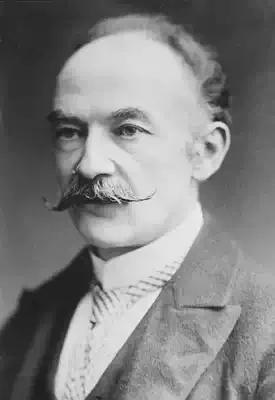
Thomas Hardy
The Mother Mourns
The Mother Mourns
When mid-autumn's moan shook the night-time,
And sedges were horny,
And summer's green wonderwork faltered
On leaze and in lane,
I fared Yell'ham-Firs way, where dimly
Came wheeling around me
Those phantoms obscure and insistent
That shadows unchain.
Till airs from the needle-thicks brought me
A low lamentation,
As 'twere of a tree-god disheartened,
Perplexed, or in pain.
And, heeding, it awed me to gather
That Nature herself there
Was breathing in aerie accents,
With dirgeful refrain,
Weary plaint that Mankind, in these late days,
Had grieved her by holding
Her ancient high fame of perfection
In doubt and disdain . . .
- "I had not proposed me a Creature
(She soughed) so excelling
All else of my kingdom in compass
And brightness of brain
"As to read my defects with a god-glance,
Uncover each vestige
Of old inadvertence, annunciate
Each flaw and each stain!
"My purpose went not to develop
Such insight in Earthland;
Such potent appraisements affront me,
And sadden my reign!
"Why loosened I olden control here
To mechanize skywards,
Undeeming great scope could outshape in
A globe of such grain?
"Man's mountings of mind-sight I checked not,
Till range of his vision
Has topped my intent, and found blemish
Throughout my domain.
"He holds as inept his own soul-shell -
My deftest achievement -
Contemns me for fitful inventions
Ill-timed and inane:
"No more sees my sun as a Sanct-shape,
My moon as the Night-queen,
My stars as august and sublime ones
That influences rain:
"Reckons gross and ignoble my teaching,
Immoral my story,
My love-lights a lure, that my species
May gather and gain.
"'Give me,' he has said, 'but the matter
And means the gods lot her,
My brain could evolve a creation
More seemly, more sane.'
- "If ever a naughtiness seized me
To woo adulation
From creatures more keen than those crude ones
That first formed my train -
"If inly a moment I murmured,
'The simple praise sweetly,
But sweetlier the sage'--and did rashly
Man's vision unrein,
"I rue it! . . . His guileless forerunners,
Whose brains I could blandish,
To measure the deeps of my mysteries
Applied them in vain.
"From them my waste aimings and futile
I subtly could cover;
'Every best thing,' said they, 'to best purpose
Her powers preordain.' -
"No more such! . . . My species are dwindling,
My forests grow barren,
My popinjays fail from their tappings,
My larks from their strain.
"My leopardine beauties are rarer,
My tusky ones vanish,
My children have aped mine own slaughters
To quicken my wane.
"Let me grow, then, but mildews and mandrakes,
And slimy distortions,
Let nevermore things good and lovely
To me appertain;
"For Reason is rank in my temples,
And Vision unruly,
And chivalrous laud of my cunning
Is heard not again!"
When mid-autumn's moan shook the night-time,
And sedges were horny,
And summer's green wonderwork faltered
On leaze and in lane,
I fared Yell'ham-Firs way, where dimly
Came wheeling around me
Those phantoms obscure and insistent
That shadows unchain.
Till airs from the needle-thicks brought me
A low lamentation,
As 'twere of a tree-god disheartened,
Perplexed, or in pain.
And, heeding, it awed me to gather
That Nature herself there
Was breathing in aerie accents,
With dirgeful refrain,
Weary plaint that Mankind, in these late days,
Had grieved her by holding
Her ancient high fame of perfection
In doubt and disdain . . .
- "I had not proposed me a Creature
(She soughed) so excelling
All else of my kingdom in compass
And brightness of brain
"As to read my defects with a god-glance,
Uncover each vestige
Of old inadvertence, annunciate
Each flaw and each stain!
"My purpose went not to develop
Such insight in Earthland;
Such potent appraisements affront me,
And sadden my reign!
"Why loosened I olden control here
To mechanize skywards,
Undeeming great scope could outshape in
A globe of such grain?
"Man's mountings of mind-sight I checked not,
Till range of his vision
Has topped my intent, and found blemish
Throughout my domain.
"He holds as inept his own soul-shell -
My deftest achievement -
Contemns me for fitful inventions
Ill-timed and inane:
"No more sees my sun as a Sanct-shape,
My moon as the Night-queen,
My stars as august and sublime ones
That influences rain:
"Reckons gross and ignoble my teaching,
Immoral my story,
My love-lights a lure, that my species
May gather and gain.
"'Give me,' he has said, 'but the matter
And means the gods lot her,
My brain could evolve a creation
More seemly, more sane.'
- "If ever a naughtiness seized me
To woo adulation
From creatures more keen than those crude ones
That first formed my train -
"If inly a moment I murmured,
'The simple praise sweetly,
But sweetlier the sage'--and did rashly
Man's vision unrein,
"I rue it! . . . His guileless forerunners,
Whose brains I could blandish,
To measure the deeps of my mysteries
Applied them in vain.
"From them my waste aimings and futile
I subtly could cover;
'Every best thing,' said they, 'to best purpose
Her powers preordain.' -
"No more such! . . . My species are dwindling,
My forests grow barren,
My popinjays fail from their tappings,
My larks from their strain.
"My leopardine beauties are rarer,
My tusky ones vanish,
My children have aped mine own slaughters
To quicken my wane.
"Let me grow, then, but mildews and mandrakes,
And slimy distortions,
Let nevermore things good and lovely
To me appertain;
"For Reason is rank in my temples,
And Vision unruly,
And chivalrous laud of my cunning
Is heard not again!"
228
Thomas Hardy
The King's Experiment
The King's Experiment
It was a wet wan hour in spring,
And Nature met King Doom beside a lane,
Wherein Hodge trudged, all blithely ballading
The Mother's smiling reign.
"Why warbles he that skies are fair
And coombs alight," she cried, "and fallows gay,
When I have placed no sunshine in the air
Or glow on earth to-day?"
"'Tis in the comedy of things
That such should be," returned the one of Doom;
"Charge now the scene with brightest blazonings,
And he shall call them gloom."
She gave the word: the sun outbroke,
All Froomside shone, the hedgebirds raised a song;
And later Hodge, upon the midday stroke,
Returned the lane along,
Low murmuring: "O this bitter scene,
And thrice accurst horizon hung with gloom!
How deadly like this sky, these fields, these treen,
To trappings of the tomb!"
The Beldame then: "The fool and blind!
Such mad perverseness who may apprehend?" -
"Nay; there's no madness in it; thou shalt find
Thy law there," said her friend.
"When Hodge went forth 'twas to his Love,
To make her, ere this eve, his wedded prize,
And Earth, despite the heaviness above,
Was bright as Paradise.
"But I sent on my messenger,
With cunning arrows poisonous and keen,
To take forthwith her laughing life from her,
And dull her little een,
"And white her cheek, and still her breath,
Ere her too buoyant Hodge had reached her side;
So, when he came, he clasped her but in death,
And never as his bride.
"And there's the humour, as I said;
Thy dreary dawn he saw as gleaming gold,
And in thy glistening green and radiant red
Funereal gloom and cold."
It was a wet wan hour in spring,
And Nature met King Doom beside a lane,
Wherein Hodge trudged, all blithely ballading
The Mother's smiling reign.
"Why warbles he that skies are fair
And coombs alight," she cried, "and fallows gay,
When I have placed no sunshine in the air
Or glow on earth to-day?"
"'Tis in the comedy of things
That such should be," returned the one of Doom;
"Charge now the scene with brightest blazonings,
And he shall call them gloom."
She gave the word: the sun outbroke,
All Froomside shone, the hedgebirds raised a song;
And later Hodge, upon the midday stroke,
Returned the lane along,
Low murmuring: "O this bitter scene,
And thrice accurst horizon hung with gloom!
How deadly like this sky, these fields, these treen,
To trappings of the tomb!"
The Beldame then: "The fool and blind!
Such mad perverseness who may apprehend?" -
"Nay; there's no madness in it; thou shalt find
Thy law there," said her friend.
"When Hodge went forth 'twas to his Love,
To make her, ere this eve, his wedded prize,
And Earth, despite the heaviness above,
Was bright as Paradise.
"But I sent on my messenger,
With cunning arrows poisonous and keen,
To take forthwith her laughing life from her,
And dull her little een,
"And white her cheek, and still her breath,
Ere her too buoyant Hodge had reached her side;
So, when he came, he clasped her but in death,
And never as his bride.
"And there's the humour, as I said;
Thy dreary dawn he saw as gleaming gold,
And in thy glistening green and radiant red
Funereal gloom and cold."
231
Thomas Hardy
The Fire at Tranter Sweatley’s
The Fire at Tranter Sweatley’s
The Fire at Tranter Sweatley’s
They had long met o’ Zundays—her true love and she—
And at junketings, maypoles, and flings;
But she bode wi’ a thirtover uncle, and he
Swore by noon and by night that her goodman should be
Naibor Sweatley—a gaffer oft weak at the knee
From taking o’ sommat more cheerful than tea—
Who tranted, and moved people’s things.
She cried, “O pray pity me!” Nought would he hear;
Then with wild rainy eyes she obeyed,
She chid when her Love was for clinking off wi’ her.
The pa’son was told, as the season drew near
To throw over pu’pit the names of the peäir
As fitting one flesh to be made.
The wedding-day dawned and the morning drew on;
The couple stood bridegroom and bride;
The evening was passed, and when midnight had gone
The folks horned out, “God save the King,” and anon
The two home-along gloomily hied.
The lover Tim Tankens mourned heart-sick and drear
To be thus of his darling deprived:
He roamed in the dark ath’art field, mound, and mere,
And, a’most without knowing it, found himself near
The house of the tranter, and now of his Dear,
Where the lantern-light showed ’em arrived.
The bride sought her cham’er so calm and so pale
That a Northern had thought her resigned;
But to eyes that had seen her in tide-times of weal,
Like the white cloud o’ smoke, the red battlefield’s vail,
That look spak’ of havoc behind.
The bridegroom yet laitered a beaker to drain,
Then reeled to the linhay for more,
When the candle-snoff kindled some chaff from his grain—
Flames spread, and red vlankers, wi’ might and wi’ main,
And round beams, thatch, and chimley-tun roar.
Young Tim away yond, rafted up by the light,
Through brimble and underwood tears,
Till he comes to the orchet, when crooping thereright
In the lewth of a codlin-tree, bivering wi’ fright,
Wi’ on’y her night-rail to screen her from sight,
His lonesome young Barbree appears.
Her cwold little figure half-naked he views
Played about by the frolicsome breeze,
Her light-tripping totties, her ten little tooes,
All bare and besprinkled wi’ Fall’s chilly dews,
While her great gallied eyes, through her hair hanging loose,
Sheened as stars through a tardle o’ trees.
She eyed en; and, as when a weir-hatch is drawn,
Her tears, penned by terror afore,
With a rushing of sobs in a shower were strawn,
Till her power to pour ’em seemed wasted and gone
From the heft o’ misfortune she bore.
“O Tim, my own Tim I must call ’ee—I will!
All the world ha’ turned round on me so!
Can you help her who loved ’ee, though acting so ill?
Can you pity her misery—feel for her still?
When worse than her body so quivering and chill
Is her heart in its winter o’ woe!
“I think I mid almost ha’ borne it,” she said,
“Had my griefs one by one come to hand;
But O, to be slave to thik husbird for bread,
And then, upon top o’ that, driven to wed,
And then, upon top o’ that, burnt out o’ bed,
Is more than my nater can stand!”
Tim’s soul like a lion ’ithin en outsprung—
(Tim had a great soul when his feelings were wrung)—
“Feel for ’ee, dear Barbree?” he cried;
And his warm working-jacket about her he flung,
Made a back, horsed her up, till behind him she clung
Like a chiel on a gipsy, her figure uphung
By the sleeves that around her he tied.
Over piggeries, and mixens, and apples, and hay,
They lumpered straight into the night;
And finding bylong where a halter-path lay,
At dawn reached Tim’s house, on’y seen on their way
By a naibor or two who were up wi’ the day;
But they gathered no clue to the sight.
Then tender Tim Tankens he searched here and there
For some garment to clothe her fair skin;
But though he had breeches and waistcoats to spare,
He had nothing quite seemly for Barbree to wear,
Who, half shrammed to death, stood and cried on a chair
At the caddle she found herself in.
There was one thing to do, and that one thing he did,
He lent her some clouts of his own,
And she took ’em perforce; and while in ’em she slid,
Tim turned to the winder, as modesty bid,
Thinking, “O that the picter my duty keeps hid
To the sight o’ my eyes mid be shown!”
In the tallet he stowed her; there huddied she lay,
Shortening sleeves, legs, and tails to her limbs;
But most o’ the time in a mortal bad way,
Well knowing that there’d be the divel to pay
If ’twere found that, instead o’ the elements’ prey,
She was living in lodgings at Tim’s.
“Where’s the tranter?” said men and boys; “where can er be?”
“Where’s the tranter?” said Barbree alone.
“Where on e’th is the tranter?” said everybod-y:
They sifted the dust of his perished roof-tree,
And all they could find was a bone.
Then the uncle cried, “Lord, pray have mercy on me!”
And in terror began to repent.
But before ’twas complete, and till sure she was free,
Barbree drew up her loft-ladder, tight turned her key—
Tim bringing up breakfast and dinner and tea—
Till the news of her hiding got vent.
Then followed the custom-kept rout, shout, and flare
Of a skimmington-ride through the naiborhood, ere
Folk had proof o’ wold Sweatley’s decay.
Whereupon decent people all stood in a stare,
Saying Tim and his lodger should risk it, and pair:
So he took her to church. An’ some laughing lads there
Cried to Tim, “After Sweatley!” She said, “I declare
I stand as a maiden to-day!”
The Fire at Tranter Sweatley’s
They had long met o’ Zundays—her true love and she—
And at junketings, maypoles, and flings;
But she bode wi’ a thirtover uncle, and he
Swore by noon and by night that her goodman should be
Naibor Sweatley—a gaffer oft weak at the knee
From taking o’ sommat more cheerful than tea—
Who tranted, and moved people’s things.
She cried, “O pray pity me!” Nought would he hear;
Then with wild rainy eyes she obeyed,
She chid when her Love was for clinking off wi’ her.
The pa’son was told, as the season drew near
To throw over pu’pit the names of the peäir
As fitting one flesh to be made.
The wedding-day dawned and the morning drew on;
The couple stood bridegroom and bride;
The evening was passed, and when midnight had gone
The folks horned out, “God save the King,” and anon
The two home-along gloomily hied.
The lover Tim Tankens mourned heart-sick and drear
To be thus of his darling deprived:
He roamed in the dark ath’art field, mound, and mere,
And, a’most without knowing it, found himself near
The house of the tranter, and now of his Dear,
Where the lantern-light showed ’em arrived.
The bride sought her cham’er so calm and so pale
That a Northern had thought her resigned;
But to eyes that had seen her in tide-times of weal,
Like the white cloud o’ smoke, the red battlefield’s vail,
That look spak’ of havoc behind.
The bridegroom yet laitered a beaker to drain,
Then reeled to the linhay for more,
When the candle-snoff kindled some chaff from his grain—
Flames spread, and red vlankers, wi’ might and wi’ main,
And round beams, thatch, and chimley-tun roar.
Young Tim away yond, rafted up by the light,
Through brimble and underwood tears,
Till he comes to the orchet, when crooping thereright
In the lewth of a codlin-tree, bivering wi’ fright,
Wi’ on’y her night-rail to screen her from sight,
His lonesome young Barbree appears.
Her cwold little figure half-naked he views
Played about by the frolicsome breeze,
Her light-tripping totties, her ten little tooes,
All bare and besprinkled wi’ Fall’s chilly dews,
While her great gallied eyes, through her hair hanging loose,
Sheened as stars through a tardle o’ trees.
She eyed en; and, as when a weir-hatch is drawn,
Her tears, penned by terror afore,
With a rushing of sobs in a shower were strawn,
Till her power to pour ’em seemed wasted and gone
From the heft o’ misfortune she bore.
“O Tim, my own Tim I must call ’ee—I will!
All the world ha’ turned round on me so!
Can you help her who loved ’ee, though acting so ill?
Can you pity her misery—feel for her still?
When worse than her body so quivering and chill
Is her heart in its winter o’ woe!
“I think I mid almost ha’ borne it,” she said,
“Had my griefs one by one come to hand;
But O, to be slave to thik husbird for bread,
And then, upon top o’ that, driven to wed,
And then, upon top o’ that, burnt out o’ bed,
Is more than my nater can stand!”
Tim’s soul like a lion ’ithin en outsprung—
(Tim had a great soul when his feelings were wrung)—
“Feel for ’ee, dear Barbree?” he cried;
And his warm working-jacket about her he flung,
Made a back, horsed her up, till behind him she clung
Like a chiel on a gipsy, her figure uphung
By the sleeves that around her he tied.
Over piggeries, and mixens, and apples, and hay,
They lumpered straight into the night;
And finding bylong where a halter-path lay,
At dawn reached Tim’s house, on’y seen on their way
By a naibor or two who were up wi’ the day;
But they gathered no clue to the sight.
Then tender Tim Tankens he searched here and there
For some garment to clothe her fair skin;
But though he had breeches and waistcoats to spare,
He had nothing quite seemly for Barbree to wear,
Who, half shrammed to death, stood and cried on a chair
At the caddle she found herself in.
There was one thing to do, and that one thing he did,
He lent her some clouts of his own,
And she took ’em perforce; and while in ’em she slid,
Tim turned to the winder, as modesty bid,
Thinking, “O that the picter my duty keeps hid
To the sight o’ my eyes mid be shown!”
In the tallet he stowed her; there huddied she lay,
Shortening sleeves, legs, and tails to her limbs;
But most o’ the time in a mortal bad way,
Well knowing that there’d be the divel to pay
If ’twere found that, instead o’ the elements’ prey,
She was living in lodgings at Tim’s.
“Where’s the tranter?” said men and boys; “where can er be?”
“Where’s the tranter?” said Barbree alone.
“Where on e’th is the tranter?” said everybod-y:
They sifted the dust of his perished roof-tree,
And all they could find was a bone.
Then the uncle cried, “Lord, pray have mercy on me!”
And in terror began to repent.
But before ’twas complete, and till sure she was free,
Barbree drew up her loft-ladder, tight turned her key—
Tim bringing up breakfast and dinner and tea—
Till the news of her hiding got vent.
Then followed the custom-kept rout, shout, and flare
Of a skimmington-ride through the naiborhood, ere
Folk had proof o’ wold Sweatley’s decay.
Whereupon decent people all stood in a stare,
Saying Tim and his lodger should risk it, and pair:
So he took her to church. An’ some laughing lads there
Cried to Tim, “After Sweatley!” She said, “I declare
I stand as a maiden to-day!”
212
Thomas Hardy
San Sebastian
San Sebastian
With Thoughts of Sergeant M---- (Pensioner), who died -
"WHY, Sergeant, stray on the Ivel Way,
As though at home there were spectres rife?
From first to last 'twas a proud career!
And your sunny years with a gracious wife
Have brought you a daughter dear.
"I watched her to-day; a more comely maid,
As she danced in her muslin bowed with blue,
Round a Hintock maypole never gayed."
--"Aye, aye; I watched her this day, too,
As it happens," the Sergeant said.
"My daughter is now," he again began,
"Of just such an age as one I knew
When we of the Line, in the Foot-Guard van,
On an August morning--a chosen few--
Stormed San Sebastian.
"She's a score less three; so about was she--
The maiden I wronged in Peninsular days....
You may prate of your prowess in lusty times,
But as years gnaw inward you blink your bays,
And see too well your crimes!
"We'd stormed it at night, by the vlanker-light
Of burning towers, and the mortar's boom:
We'd topped the breach but had failed to stay,
For our files were misled by the baffling gloom;
And we said we'd storm by day.
"So, out of the trenches, with features set,
On that hot, still morning, in measured pace,
Our column climbed; climbed higher yet,
Past the fauss'bray, scarp, up the curtain-face,
And along the parapet.
"From the batteried hornwork the cannoneers
Hove crashing balls of iron fire;
On the shaking gap mount the volunteers
In files, and as they mount expire
Amid curses, groans, and cheers.
"Five hours did we storm, five hours re-form,
As Death cooled those hot blood pricked on;
Till our cause was helped by a woe within;
They swayed from the summit we'd leapt upon,
And madly we entered in.
"On end for plunder, 'mid rain and thunder
That burst with the lull of our cannonade,
We vamped the streets in the stifling air--
Our hunger unsoothed, our thirst unstayed--
And ransacked the buildings there.
"Down the stony steps of the house-fronts white
We rolled rich puncheons of Spanish grape,
Till at length, with the fire of the wine alight,
I saw at a doorway a fair fresh shape--
A woman, a sylph, or sprite.
"Afeard she fled, and with heated head
I pursued to the chamber she called her own;
--When might is right no qualms deter,
And having her helpless and alone
I wreaked my lust on her.
"She raised her beseeching eyes to me,
And I heard the words of prayer she sent
In her own soft language.... Seemingly
I copied those eyes for my punishment
In begetting the girl you see!
"So, to-day I stand with a God-set brand
Like Cain's, when he wandered from kindred's ken....
I served through the war that made Europe free;
I wived me in peace-year. But, hid from men,
I bear that mark on me.
"And I nightly stray on the Ivel Way
As though at home there were spectres rife;
I delight me not in my proud career;
And 'tis coals of fire that a gracious wife
Should have brought me a daughter dear!"
With Thoughts of Sergeant M---- (Pensioner), who died -
"WHY, Sergeant, stray on the Ivel Way,
As though at home there were spectres rife?
From first to last 'twas a proud career!
And your sunny years with a gracious wife
Have brought you a daughter dear.
"I watched her to-day; a more comely maid,
As she danced in her muslin bowed with blue,
Round a Hintock maypole never gayed."
--"Aye, aye; I watched her this day, too,
As it happens," the Sergeant said.
"My daughter is now," he again began,
"Of just such an age as one I knew
When we of the Line, in the Foot-Guard van,
On an August morning--a chosen few--
Stormed San Sebastian.
"She's a score less three; so about was she--
The maiden I wronged in Peninsular days....
You may prate of your prowess in lusty times,
But as years gnaw inward you blink your bays,
And see too well your crimes!
"We'd stormed it at night, by the vlanker-light
Of burning towers, and the mortar's boom:
We'd topped the breach but had failed to stay,
For our files were misled by the baffling gloom;
And we said we'd storm by day.
"So, out of the trenches, with features set,
On that hot, still morning, in measured pace,
Our column climbed; climbed higher yet,
Past the fauss'bray, scarp, up the curtain-face,
And along the parapet.
"From the batteried hornwork the cannoneers
Hove crashing balls of iron fire;
On the shaking gap mount the volunteers
In files, and as they mount expire
Amid curses, groans, and cheers.
"Five hours did we storm, five hours re-form,
As Death cooled those hot blood pricked on;
Till our cause was helped by a woe within;
They swayed from the summit we'd leapt upon,
And madly we entered in.
"On end for plunder, 'mid rain and thunder
That burst with the lull of our cannonade,
We vamped the streets in the stifling air--
Our hunger unsoothed, our thirst unstayed--
And ransacked the buildings there.
"Down the stony steps of the house-fronts white
We rolled rich puncheons of Spanish grape,
Till at length, with the fire of the wine alight,
I saw at a doorway a fair fresh shape--
A woman, a sylph, or sprite.
"Afeard she fled, and with heated head
I pursued to the chamber she called her own;
--When might is right no qualms deter,
And having her helpless and alone
I wreaked my lust on her.
"She raised her beseeching eyes to me,
And I heard the words of prayer she sent
In her own soft language.... Seemingly
I copied those eyes for my punishment
In begetting the girl you see!
"So, to-day I stand with a God-set brand
Like Cain's, when he wandered from kindred's ken....
I served through the war that made Europe free;
I wived me in peace-year. But, hid from men,
I bear that mark on me.
"And I nightly stray on the Ivel Way
As though at home there were spectres rife;
I delight me not in my proud career;
And 'tis coals of fire that a gracious wife
Should have brought me a daughter dear!"
185
Thomas Hardy
Neutral Tones
Neutral Tones
WE stood by a pond that winter day,
And the sun was white, as though chidden of God,
And a few leaves lay on the starving sod,
--They had fallen from an ash, and were gray.
Your eyes on me were as eyes that rove
Over tedious riddles solved years ago;
And some words played between us to and fro--
On which lost the more by our love.
The smile on your mouth was the deadest thing
Alive enough to have strength to die;
And a grin of bitterness swept thereby
Like an ominous bird a-wing....
Since then, keen lessons that love deceives,
And wrings with wrong, have shaped to me
Your face, and the God-curst sun, and a tree,
And a pond edged with grayish leaves.
WE stood by a pond that winter day,
And the sun was white, as though chidden of God,
And a few leaves lay on the starving sod,
--They had fallen from an ash, and were gray.
Your eyes on me were as eyes that rove
Over tedious riddles solved years ago;
And some words played between us to and fro--
On which lost the more by our love.
The smile on your mouth was the deadest thing
Alive enough to have strength to die;
And a grin of bitterness swept thereby
Like an ominous bird a-wing....
Since then, keen lessons that love deceives,
And wrings with wrong, have shaped to me
Your face, and the God-curst sun, and a tree,
And a pond edged with grayish leaves.
208
Thomas Hardy
In Tenebris
In Tenebris
Wintertime nighs;
But my bereavement-pain
It cannot bring again:
Twice no one dies.
Flower-petals flee;
But since it once hath been,
No more that severing scene
Can harrow me.
Birds faint in dread:
I shall not lose old strength
In the lone frost's black length:
Strength long since fled!
Leaves freeze to dun;
But friends cannot turn cold
This season as of old
For him with none.
Tempests may scath;
But love cannot make smart
Again this year his heart
Who no heart hath.
Black is night's cope;
But death will not appal
One, who past doubtings all,
Waits in unhope.
Wintertime nighs;
But my bereavement-pain
It cannot bring again:
Twice no one dies.
Flower-petals flee;
But since it once hath been,
No more that severing scene
Can harrow me.
Birds faint in dread:
I shall not lose old strength
In the lone frost's black length:
Strength long since fled!
Leaves freeze to dun;
But friends cannot turn cold
This season as of old
For him with none.
Tempests may scath;
But love cannot make smart
Again this year his heart
Who no heart hath.
Black is night's cope;
But death will not appal
One, who past doubtings all,
Waits in unhope.
212
Thomas Hardy
I said to Love
I said to Love
I said to Love,
"It is not now as in old days
When men adored thee and thy ways
All else above;
Named thee the Boy, the Bright, the One
Who spread a heaven beneath the sun,"
I said to Love.
I said to him,
"We now know more of thee than then;
We were but weak in judgment when,
With hearts abrim,
We clamoured thee that thou would'st please
Inflict on us thine agonies,"
I said to him.
I said to Love,
"Thou art not young, thou art not fair,
No elfin darts, no cherub air,
Nor swan, nor dove
Are thine; but features pitiless,
And iron daggers of distress,"
I said to Love.
"Depart then, Love!
Man's race shall perish, threatenest thou,
WIthout thy kindling coupling-vow?
The age to come the man of now
Know nothing of?
We fear not such a threat from thee;
We are too old in apathy!
Mankind shall cease.. -
So let it be,"
I said to Love.
I said to Love,
"It is not now as in old days
When men adored thee and thy ways
All else above;
Named thee the Boy, the Bright, the One
Who spread a heaven beneath the sun,"
I said to Love.
I said to him,
"We now know more of thee than then;
We were but weak in judgment when,
With hearts abrim,
We clamoured thee that thou would'st please
Inflict on us thine agonies,"
I said to him.
I said to Love,
"Thou art not young, thou art not fair,
No elfin darts, no cherub air,
Nor swan, nor dove
Are thine; but features pitiless,
And iron daggers of distress,"
I said to Love.
"Depart then, Love!
Man's race shall perish, threatenest thou,
WIthout thy kindling coupling-vow?
The age to come the man of now
Know nothing of?
We fear not such a threat from thee;
We are too old in apathy!
Mankind shall cease.. -
So let it be,"
I said to Love.
277
Thomas Hardy
Her Dilemma
Her Dilemma
THE two were silent in a sunless church,
Whose mildewed walls, uneven paving-stones,
And wasted carvings passed antique research;
And nothing broke the clock's dull monotones.
Leaning against a wormy poppy-head,
So wan and worn that he could scarcely stand,
--For he was soon to die,--he softly said,
"Tell me you love me!"--holding hard her hand.
She would have given a world to breathe "yes" truly,
So much his life seemed hanging on her mind,
And hence she lied, her heart persuaded throughly,
'Twas worth her soul to be a moment kind.
But the sad need thereof, his nearing death,
So mocked humanity that she shamed to prize
A world conditioned thus, or care for breath
Where Nature such dilemmas could devise.
THE two were silent in a sunless church,
Whose mildewed walls, uneven paving-stones,
And wasted carvings passed antique research;
And nothing broke the clock's dull monotones.
Leaning against a wormy poppy-head,
So wan and worn that he could scarcely stand,
--For he was soon to die,--he softly said,
"Tell me you love me!"--holding hard her hand.
She would have given a world to breathe "yes" truly,
So much his life seemed hanging on her mind,
And hence she lied, her heart persuaded throughly,
'Twas worth her soul to be a moment kind.
But the sad need thereof, his nearing death,
So mocked humanity that she shamed to prize
A world conditioned thus, or care for breath
Where Nature such dilemmas could devise.
261
Thomas Hardy
Hap
Hap
IF but some vengeful god would call to me
From up the sky, and laugh: "Thou suffering thing,
Know that thy sorrow is my ecstasy,
That thy love's loss is my hate's profiting!"
Then would I bear, and clench myself, and die,
Steeled by the sense of ire unmerited;
Half-eased, too, that a Powerfuller than I
Had willed and meted me the tears I shed.
But not so. How arrives it joy lies slain,
And why unblooms the best hope ever sown?
--Crass Casualty obstructs the sun and rain,
And dicing Time for gladness casts a moan....
These purblind Doomsters had as readily strown
Blisses about my pilgrimage as pain.
IF but some vengeful god would call to me
From up the sky, and laugh: "Thou suffering thing,
Know that thy sorrow is my ecstasy,
That thy love's loss is my hate's profiting!"
Then would I bear, and clench myself, and die,
Steeled by the sense of ire unmerited;
Half-eased, too, that a Powerfuller than I
Had willed and meted me the tears I shed.
But not so. How arrives it joy lies slain,
And why unblooms the best hope ever sown?
--Crass Casualty obstructs the sun and rain,
And dicing Time for gladness casts a moan....
These purblind Doomsters had as readily strown
Blisses about my pilgrimage as pain.
231
Thomas Hardy
Channel Firing
Channel Firing
That night your great guns, unawares,
Shook all our coffins as we lay,
And broke the chancel window-squares,
We thought it was the judgement day
And sat upright. While drearisome
Arose the howl of wakened hounds:
The mouse let fall the altar-crumb,
The worms drew back into the mounds,
The glebe cow drooled. Till God called, "No;
It's gunnery practice out at sea
Just as before you went below;
The world is as it used to be:
"All nations striving strong to make
Red war yet redder. Mad as hatters
They do more for Christés sake
Than you who are helpless in such matters.
"That this is not the judgment hour
For some of them's a blessed thing,
For if it were they'd have to scour
Hells floor for so much threatening...
"Ha, ha. It will be warmer when
I blow the trumpet (if indeed
I ever do; for you are men,
And rest eternal sorely need)."
So down we lay again. "I wonder,
Will the world ever saner be,"
Said one, "than when He sent us under
In our indifferent century!"
And many a skeleton shook his head.
"Instead of preaching forty year,"
My neighbor Oarson Thirdly said,
"I wish I had stuck to pipes and beer."
Again the guns disturbed the hour,
Roaring their readiness to avenge,
As far inland as Stourton Tower,
And Camelot, and starlit Stonehenge.
That night your great guns, unawares,
Shook all our coffins as we lay,
And broke the chancel window-squares,
We thought it was the judgement day
And sat upright. While drearisome
Arose the howl of wakened hounds:
The mouse let fall the altar-crumb,
The worms drew back into the mounds,
The glebe cow drooled. Till God called, "No;
It's gunnery practice out at sea
Just as before you went below;
The world is as it used to be:
"All nations striving strong to make
Red war yet redder. Mad as hatters
They do more for Christés sake
Than you who are helpless in such matters.
"That this is not the judgment hour
For some of them's a blessed thing,
For if it were they'd have to scour
Hells floor for so much threatening...
"Ha, ha. It will be warmer when
I blow the trumpet (if indeed
I ever do; for you are men,
And rest eternal sorely need)."
So down we lay again. "I wonder,
Will the world ever saner be,"
Said one, "than when He sent us under
In our indifferent century!"
And many a skeleton shook his head.
"Instead of preaching forty year,"
My neighbor Oarson Thirdly said,
"I wish I had stuck to pipes and beer."
Again the guns disturbed the hour,
Roaring their readiness to avenge,
As far inland as Stourton Tower,
And Camelot, and starlit Stonehenge.
231
Thomas Hardy
A Wasted Illness
A Wasted Illness
Through vaults of pain,
Enribbed and wrought with groins of ghastliness,
I passed, and garish spectres moved my brain
To dire distress.
And hammerings,
And quakes, and shoots, and stifling hotness, blent
With webby waxing things and waning things
As on I went.
"Where lies the end
To this foul way?" I asked with weakening breath.
Thereon ahead I saw a door extend -
The door to death.
It loomed more clear:
"At last!" I cried. "The all-delivering door!"
And then, I knew not how, it grew less near
Than theretofore.
And back slid I
Along the galleries by which I came,
And tediously the day returned, and sky,
And life--the same.
And all was well:
Old circumstance resumed its former show,
And on my head the dews of comfort fell
As ere my woe.
I roam anew,
Scarce conscious of my late distress . . . And yet
Those backward steps through pain I cannot view
Without regret.
For that dire train
Of waxing shapes and waning, passed before,
And those grim aisles, must be traversed again
To reach that door.
Through vaults of pain,
Enribbed and wrought with groins of ghastliness,
I passed, and garish spectres moved my brain
To dire distress.
And hammerings,
And quakes, and shoots, and stifling hotness, blent
With webby waxing things and waning things
As on I went.
"Where lies the end
To this foul way?" I asked with weakening breath.
Thereon ahead I saw a door extend -
The door to death.
It loomed more clear:
"At last!" I cried. "The all-delivering door!"
And then, I knew not how, it grew less near
Than theretofore.
And back slid I
Along the galleries by which I came,
And tediously the day returned, and sky,
And life--the same.
And all was well:
Old circumstance resumed its former show,
And on my head the dews of comfort fell
As ere my woe.
I roam anew,
Scarce conscious of my late distress . . . And yet
Those backward steps through pain I cannot view
Without regret.
For that dire train
Of waxing shapes and waning, passed before,
And those grim aisles, must be traversed again
To reach that door.
234
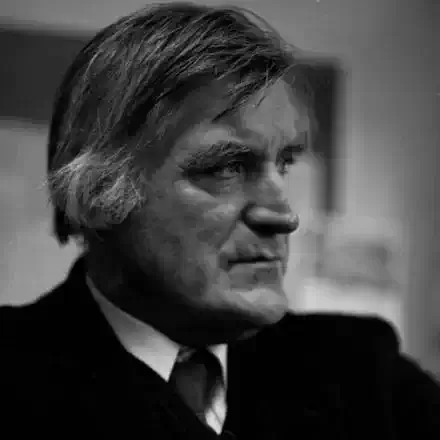
Ted Hughes
Tractor
Tractor
The tractor stands frozen - an agony
To think of. All night
Snow packed its open entrails. Now a head-pincering gale,
A spill of molten ice, smoking snow,
Pours into its steel.
At white heat of numbness it stands
In the aimed hosing of ground-level fieriness.
It defied flesh and won't start.
Hands are like wounds already
Inside armour gloves, and feet are unbelievable
As if the toe-nails were all just torn off.
I stare at it in hatred. Beyond it
The copse hisses - capitulates miserably
In the fleeing, failing light. Starlings,
A dirtier sleetier snow, blow smokily, unendingly, over
Towards plantations Eastward.
All the time the tractor is sinking
Through the degrees, deepening
Into its hell of ice.
The starting lever
Cracks its action, like a snapping knuckle.
The battery is alive - but like a lamb
Trying to nudge its solid-frozen mother -
While the seat claims my buttock-bones, bites
With the space-cold of earth, which it has joined
In one solid lump.
I squirt commercial sure-fire
Down the black throat - it just coughs.
It ridicules me - a trap of iron stupidity
I've stepped into. I drive the battery
As if I were hammering and hammering
The frozen arrangement to pieces with a hammer
And it jabbers laughing pain-crying mockingly
Into happy life.
And stands
Shuddering itself full of heat, seeming to enlarge slowly
Like a demon demonstrating
A more-than-usually-complete materialization -
Suddenly it jerks from its solidarity
With the concrete, and lurches towards a stanchion
Bursting with superhuman well-being and abandon
Shouting Where Where?
Worse iron is waiting. Power-lift kneels
Levers awake imprisoned deadweight,
Shackle-pins bedded in cast-iron cow-shit.
The blind and vibrating condemned obedience
Of iron to the cruelty of iron,
Wheels screeched out of their night-locks -
Fingers
Among the tormented
Tonnage and burning of iron
Eyes
Weeping in the wind of chloroform
And the tractor, streaming with sweat,
Raging and trembling and rejoicing.
The tractor stands frozen - an agony
To think of. All night
Snow packed its open entrails. Now a head-pincering gale,
A spill of molten ice, smoking snow,
Pours into its steel.
At white heat of numbness it stands
In the aimed hosing of ground-level fieriness.
It defied flesh and won't start.
Hands are like wounds already
Inside armour gloves, and feet are unbelievable
As if the toe-nails were all just torn off.
I stare at it in hatred. Beyond it
The copse hisses - capitulates miserably
In the fleeing, failing light. Starlings,
A dirtier sleetier snow, blow smokily, unendingly, over
Towards plantations Eastward.
All the time the tractor is sinking
Through the degrees, deepening
Into its hell of ice.
The starting lever
Cracks its action, like a snapping knuckle.
The battery is alive - but like a lamb
Trying to nudge its solid-frozen mother -
While the seat claims my buttock-bones, bites
With the space-cold of earth, which it has joined
In one solid lump.
I squirt commercial sure-fire
Down the black throat - it just coughs.
It ridicules me - a trap of iron stupidity
I've stepped into. I drive the battery
As if I were hammering and hammering
The frozen arrangement to pieces with a hammer
And it jabbers laughing pain-crying mockingly
Into happy life.
And stands
Shuddering itself full of heat, seeming to enlarge slowly
Like a demon demonstrating
A more-than-usually-complete materialization -
Suddenly it jerks from its solidarity
With the concrete, and lurches towards a stanchion
Bursting with superhuman well-being and abandon
Shouting Where Where?
Worse iron is waiting. Power-lift kneels
Levers awake imprisoned deadweight,
Shackle-pins bedded in cast-iron cow-shit.
The blind and vibrating condemned obedience
Of iron to the cruelty of iron,
Wheels screeched out of their night-locks -
Fingers
Among the tormented
Tonnage and burning of iron
Eyes
Weeping in the wind of chloroform
And the tractor, streaming with sweat,
Raging and trembling and rejoicing.
425
Ted Hughes
The Seven Sorrows
The Seven Sorrows
The first sorrow of autumn
Is the slow goodbye
Of the garden who stands so long in the evening-
A brown poppy head,
The stalk of a lily,
And still cannot go.
The second sorrow
Is the empty feet
Of a pheasant who hangs from a hook with his brothers.
The woodland of gold
Is folded in feathers
With its head in a bag.
And the third sorrow
Is the slow goodbye
Of the sun who has gathered the birds and who gathers
The minutes of evening,
The golden and holy
Ground of the picture.
The fourth sorrow
Is the pond gone black
Ruined and sunken the city of water-
The beetle's palace,
The catacombs
Of the dragonfly.
And the fifth sorrow
Is the slow goodbye
Of the woodland that quietly breaks up its camp.
One day it's gone.
It has only left litter-
Firewood, tentpoles.
And the sixth sorrow
Is the fox's sorrow
The joy of the huntsman, the joy of the hounds,
The hooves that pound
Till earth closes her ear
To the fox's prayer.
And the seventh sorrow
Is the slow goodbye
Of the face with its wrinkles that looks through the window
As the year packs up
Like a tatty fairground
That came for the children.
The first sorrow of autumn
Is the slow goodbye
Of the garden who stands so long in the evening-
A brown poppy head,
The stalk of a lily,
And still cannot go.
The second sorrow
Is the empty feet
Of a pheasant who hangs from a hook with his brothers.
The woodland of gold
Is folded in feathers
With its head in a bag.
And the third sorrow
Is the slow goodbye
Of the sun who has gathered the birds and who gathers
The minutes of evening,
The golden and holy
Ground of the picture.
The fourth sorrow
Is the pond gone black
Ruined and sunken the city of water-
The beetle's palace,
The catacombs
Of the dragonfly.
And the fifth sorrow
Is the slow goodbye
Of the woodland that quietly breaks up its camp.
One day it's gone.
It has only left litter-
Firewood, tentpoles.
And the sixth sorrow
Is the fox's sorrow
The joy of the huntsman, the joy of the hounds,
The hooves that pound
Till earth closes her ear
To the fox's prayer.
And the seventh sorrow
Is the slow goodbye
Of the face with its wrinkles that looks through the window
As the year packs up
Like a tatty fairground
That came for the children.
691
Ted Hughes
The Minotaur
The Minotaur
The mahogany table-top you smashed
Had been the broad plank top
Of my mother's heirloom sideboard-
Mapped with the scars of my whole life.
That came under the hammer.
That high stool you swung that day
Demented by my being
Twenty minutes late for baby-minding.
'Marvellous!' I shouted, 'Go on,
Smash it into kindling.
That's the stuff you're keeping out of your poems!'
And later, considered and calmer,
'Get that shoulder under your stanzas
And we'll be away.' Deep in the cave of your ear
The goblin snapped his fingers.
So what had I given him?
The bloody end of the skein
That unravelled your marriage,
Left your children echoing
Like tunnels in a labyrinth.
Left your mother a dead-end,
Brought you to the horned, bellowing
Grave of your risen father
And your own corpse in it.
The mahogany table-top you smashed
Had been the broad plank top
Of my mother's heirloom sideboard-
Mapped with the scars of my whole life.
That came under the hammer.
That high stool you swung that day
Demented by my being
Twenty minutes late for baby-minding.
'Marvellous!' I shouted, 'Go on,
Smash it into kindling.
That's the stuff you're keeping out of your poems!'
And later, considered and calmer,
'Get that shoulder under your stanzas
And we'll be away.' Deep in the cave of your ear
The goblin snapped his fingers.
So what had I given him?
The bloody end of the skein
That unravelled your marriage,
Left your children echoing
Like tunnels in a labyrinth.
Left your mother a dead-end,
Brought you to the horned, bellowing
Grave of your risen father
And your own corpse in it.
359
Ted Hughes
Lineage
Lineage
In the beginning was Scream
Who begat Blood
Who begat Eye
Who begat Fear
Who begat Wing
Who begat Bone
Who begat Granite
Who begat Violet
Who begat Guitar
Who begat Sweat
Who begat Adam
Who begat Mary
Who begat God
Who begat Nothing
Who begat Never
Never Never Never
Who begat Crow
Screaming for Blood
Grubs, crusts
Anything
Trembling featherless elbows in the nest's filth
In the beginning was Scream
Who begat Blood
Who begat Eye
Who begat Fear
Who begat Wing
Who begat Bone
Who begat Granite
Who begat Violet
Who begat Guitar
Who begat Sweat
Who begat Adam
Who begat Mary
Who begat God
Who begat Nothing
Who begat Never
Never Never Never
Who begat Crow
Screaming for Blood
Grubs, crusts
Anything
Trembling featherless elbows in the nest's filth
287
Ted Hughes
Crow's Nerve Fails
Crow's Nerve Fails
Crow, feeling his brain slip,
Finds his every feather the fossil of a murder.
Who murdered all these?
These living dead, that root in his nerves and his blood
Till he is visibly black?
How can he fly from his feathers?
And why have they homed on him?
Is he the archive of their accusations?
Or their ghostly purpose, their pining vengeance?
Or their unforgiven prisoner?
He cannot be forgiven.
His prison is the earth. Clothed in his conviction,
Trying to remember his crimes
Heavily he flies.
Crow, feeling his brain slip,
Finds his every feather the fossil of a murder.
Who murdered all these?
These living dead, that root in his nerves and his blood
Till he is visibly black?
How can he fly from his feathers?
And why have they homed on him?
Is he the archive of their accusations?
Or their ghostly purpose, their pining vengeance?
Or their unforgiven prisoner?
He cannot be forgiven.
His prison is the earth. Clothed in his conviction,
Trying to remember his crimes
Heavily he flies.
383
Ted Hughes
Examination at the Womb-Door
Examination at the Womb-Door
Who owns those scrawny little feet? Death.
Who owns this bristly scorched-looking face? Death.
Who owns these still-working lungs? Death.
Who owns this utility coat of muscles? Death.
Who owns these unspeakable guts? Death.
Who owns these questionable brains? Death.
All this messy blood? Death.
These minimum-efficiency eyes? Death.
This wicked little tongue? Death.
This occasional wakefulness? Death.
Given, stolen, or held pending trial?
Held.
Who owns the whole rainy, stony earth? Death.
Who owns all of space? Death.
Who is stronger than hope? Death.
Who is stronger than the will? Death.
Stronger than love? Death.
Stronger than life? Death.
But who is stronger than Death?
Me, evidently.
Pass, Crow.
Who owns those scrawny little feet? Death.
Who owns this bristly scorched-looking face? Death.
Who owns these still-working lungs? Death.
Who owns this utility coat of muscles? Death.
Who owns these unspeakable guts? Death.
Who owns these questionable brains? Death.
All this messy blood? Death.
These minimum-efficiency eyes? Death.
This wicked little tongue? Death.
This occasional wakefulness? Death.
Given, stolen, or held pending trial?
Held.
Who owns the whole rainy, stony earth? Death.
Who owns all of space? Death.
Who is stronger than hope? Death.
Who is stronger than the will? Death.
Stronger than love? Death.
Stronger than life? Death.
But who is stronger than Death?
Me, evidently.
Pass, Crow.
694
Ted Hughes
A Woman Unconscious
A Woman Unconscious
Russia and America circle each other;
Threats nudge an act that were without doubt
A melting of the mould in the mother,
Stones melting about the root.
The quick of the earth burned out:
The toil of all our ages a loss
With leaf and insect. Yet flitting thought
(Not to be thought ridiculous)
Shies from the world-cancelling black
Of its playing shadow: it has learned
That there's no trusting (trusting to luck)
Dates when the world's due to be burned;
That the future's no calamitous change
But a malingering of now,
Histories, towns, faces that no
Malice or accident much derange.
And though bomb be matched against bomb,
Though all mankind wince out and nothing endure --
Earth gone in an instant flare --
Did a lesser death come
Onto the white hospital bed
Where one, numb beyond her last of sense,
Closed her eyes on the world's evidence
And into pillows sunk her head.
Submitted by Andrew Mayers
Russia and America circle each other;
Threats nudge an act that were without doubt
A melting of the mould in the mother,
Stones melting about the root.
The quick of the earth burned out:
The toil of all our ages a loss
With leaf and insect. Yet flitting thought
(Not to be thought ridiculous)
Shies from the world-cancelling black
Of its playing shadow: it has learned
That there's no trusting (trusting to luck)
Dates when the world's due to be burned;
That the future's no calamitous change
But a malingering of now,
Histories, towns, faces that no
Malice or accident much derange.
And though bomb be matched against bomb,
Though all mankind wince out and nothing endure --
Earth gone in an instant flare --
Did a lesser death come
Onto the white hospital bed
Where one, numb beyond her last of sense,
Closed her eyes on the world's evidence
And into pillows sunk her head.
Submitted by Andrew Mayers
616

Spike Milligan
Unto Us...
Unto Us...
Somewhere at some time
They committed themselves to me
And so, I was!
Small, but I WAS!
Tiny, in shape
Lusting to live
I hung in my pulsing cave.
Soon they knew of me
My mother --my father.
I had no say in my being
I lived on trust
And love
Tho' I couldn't think
Each part of me was saying
A silent 'Wait for me
I will bring you love!'
I was taken
Blind, naked, defenseless
By the hand of one
Whose good name
Was graven on a brass plate
in Wimpole Street,
and dropped on the sterile floor
of a foot operated plastic waste
bucket.
There was no Queens Counsel
To take my brief.
The cot I might have warmed
Stood in Harrod's shop window.
When my passing was told
My father smiled.
No grief filled my empty space.
My death was celebrated
With tickets to see Danny la Rue
Who was pretending to be a woman
Like my mother was.
Somewhere at some time
They committed themselves to me
And so, I was!
Small, but I WAS!
Tiny, in shape
Lusting to live
I hung in my pulsing cave.
Soon they knew of me
My mother --my father.
I had no say in my being
I lived on trust
And love
Tho' I couldn't think
Each part of me was saying
A silent 'Wait for me
I will bring you love!'
I was taken
Blind, naked, defenseless
By the hand of one
Whose good name
Was graven on a brass plate
in Wimpole Street,
and dropped on the sterile floor
of a foot operated plastic waste
bucket.
There was no Queens Counsel
To take my brief.
The cot I might have warmed
Stood in Harrod's shop window.
When my passing was told
My father smiled.
No grief filled my empty space.
My death was celebrated
With tickets to see Danny la Rue
Who was pretending to be a woman
Like my mother was.
278
Spike Milligan
Welcome Home
Welcome Home
Unaware of my crime
they stood me in the dock.
I was sentenced to life....
without her.
Strange trial.
No judge.
No jury.
I wonder who my visitors will be.
Unaware of my crime
they stood me in the dock.
I was sentenced to life....
without her.
Strange trial.
No judge.
No jury.
I wonder who my visitors will be.
246
Spike Milligan
So Fair is She
So Fair is She
So fair is she!
So fair her face
So fair her pulsing figure
Not so fair
The maniacal stare
Of a husband who's much bigger.
So fair is she!
So fair her face
So fair her pulsing figure
Not so fair
The maniacal stare
Of a husband who's much bigger.
226
Spike Milligan
Feelings
Feelings
There must be a wound!
No one can be this hurt
and not bleed.
How could she injure me so?
No marks
No bruise
Worse!
People say 'My, you're looking well'
.....God help me!
She's mummified me -
ALIVE!
There must be a wound!
No one can be this hurt
and not bleed.
How could she injure me so?
No marks
No bruise
Worse!
People say 'My, you're looking well'
.....God help me!
She's mummified me -
ALIVE!
276

Siegfried Sassoon
Villon
Villon
They threw me from the gates: my matted hair
Was dank with dungeon wetness; my spent frame
O’erlaid with marish agues: everywhere
Tortured by leaping pangs of frost and flame,
So hideous was I that even Lazarus there
In noisome rags arrayed and leprous shame,
Beside me set had seemed full sweet and fair,
And looked on me with loathing.
But one came
Who laid a cloak on me and brought me in
Tenderly to an hostel quiet and clean;
Used me with healing hands for all my needs.
The mortal stain of my reputed sin,
My state despised, and my defilèd weeds,
He hath put by as though they had not been.
They threw me from the gates: my matted hair
Was dank with dungeon wetness; my spent frame
O’erlaid with marish agues: everywhere
Tortured by leaping pangs of frost and flame,
So hideous was I that even Lazarus there
In noisome rags arrayed and leprous shame,
Beside me set had seemed full sweet and fair,
And looked on me with loathing.
But one came
Who laid a cloak on me and brought me in
Tenderly to an hostel quiet and clean;
Used me with healing hands for all my needs.
The mortal stain of my reputed sin,
My state despised, and my defilèd weeds,
He hath put by as though they had not been.
114
Siegfried Sassoon
To His Dead Body
To His Dead Body
When roaring gloom surged inward and you cried,
Groping for friendly hands, and clutched, and died,
Like racing smoke, swift from your lolling head
phantoms of thought and memory thinned and fled.
Yet, though my dreams that throng the darkened stair
Can bring me no report of how you fare,
Safe quit of wars, I speed you on your way
Up lonely, glimmering fields to find new day,
Slow-rising, saintless, confident and kind—
Dear, red-faced father God who lit your mind.
When roaring gloom surged inward and you cried,
Groping for friendly hands, and clutched, and died,
Like racing smoke, swift from your lolling head
phantoms of thought and memory thinned and fled.
Yet, though my dreams that throng the darkened stair
Can bring me no report of how you fare,
Safe quit of wars, I speed you on your way
Up lonely, glimmering fields to find new day,
Slow-rising, saintless, confident and kind—
Dear, red-faced father God who lit your mind.
98