

Poems in this theme
Art
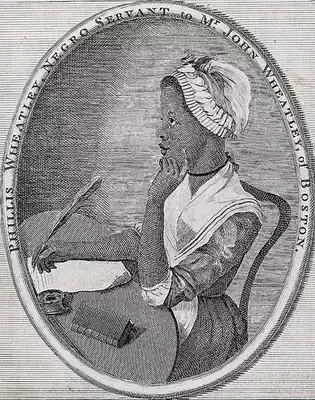
Phillis Wheatley
To S.M. a Young African Painter
To S.M. a Young African Painter
To show the lab'ring bosom's deep intent,
And thought in living characters to paint,
When first thy pencil did those beauties give,
And breathing figures learnt from thee to live,
How did those prospects give my soul delight,
A new creation rushing on my sight?
Still, wond'rous youth! each noble path pursue,
On deathless glories fix thine ardent view:
Still may the painter's and the poet's fire
To aid thy pencil, and thy verse conspire!
And may the charms of each seraphic theme
Conduct thy footsteps to immortal fame!
High to the blissful wonders of the skies
Elate thy soul, and raise thy wishful eyes.
Thrice happy, when exalted to survey
That splendid city, crown'd with endless day,
Whose twice six gates on radiant hinges ring:
Celestial Salem blooms in endless spring.
Calm and serene thy moments glide along,
And may the muse inspire each future song!
Still, with the sweets of contemplation bless'd,
May peace with balmy wings your soul invest!
But when these shades of time are chas'd away,
And darkness ends in everlasting day,
On what seraphic pinions shall we move,
And view the landscapes in the realms above?
There shall thy tongue in heav'nly murmurs flow,
And there my muse with heav'nly transport glow:
No more to tell of Damon's tender sighs,
Or rising radiance of Aurora's eyes,
For nobler themes demand a nobler strain,
And purer language on th' ethereal plain.
Cease, gentle muse! the solemn gloom of night
Now seals the fair creation from my sight.
To show the lab'ring bosom's deep intent,
And thought in living characters to paint,
When first thy pencil did those beauties give,
And breathing figures learnt from thee to live,
How did those prospects give my soul delight,
A new creation rushing on my sight?
Still, wond'rous youth! each noble path pursue,
On deathless glories fix thine ardent view:
Still may the painter's and the poet's fire
To aid thy pencil, and thy verse conspire!
And may the charms of each seraphic theme
Conduct thy footsteps to immortal fame!
High to the blissful wonders of the skies
Elate thy soul, and raise thy wishful eyes.
Thrice happy, when exalted to survey
That splendid city, crown'd with endless day,
Whose twice six gates on radiant hinges ring:
Celestial Salem blooms in endless spring.
Calm and serene thy moments glide along,
And may the muse inspire each future song!
Still, with the sweets of contemplation bless'd,
May peace with balmy wings your soul invest!
But when these shades of time are chas'd away,
And darkness ends in everlasting day,
On what seraphic pinions shall we move,
And view the landscapes in the realms above?
There shall thy tongue in heav'nly murmurs flow,
And there my muse with heav'nly transport glow:
No more to tell of Damon's tender sighs,
Or rising radiance of Aurora's eyes,
For nobler themes demand a nobler strain,
And purer language on th' ethereal plain.
Cease, gentle muse! the solemn gloom of night
Now seals the fair creation from my sight.
237
Phillis Wheatley
To Maecenas
To Maecenas
MAECENAS, you, beneath the myrtle shade,
Read o'er what poets sung, and shepherds play'd.
What felt those poets but you feel the same?
Does not your soul possess the sacred flame?
Their noble strains your equal genius shares
In softer language, and diviner airs.
While Homer paints, lo! circumfus'd in air,
Celestial Gods in mortal forms appear;
Swift as they move hear each recess rebound,
Heav'n quakes, earth trembles, and the shores resound.
Great Sire of verse, before my mortal eyes,
The lightnings blaze across the vaulted skies,
And, as the thunder shakes the heav'nly plains,
A deep felt horror thrills through all my veins.
When gentler strains demand thy graceful song,
The length'ning line moves languishing along.
When great Patroclus courts Achilles' aid,
The grateful tribute of my tears is paid;
Prone on the shore he feels the pangs of love,
And stern Pelides tend'rest passions move.
Great Maro's strain in heav'nly numbers flows,
The Nine inspire, and all the bosom glows.
O could I rival thine and Virgil's page,
Or claim the Muses with the Mantuan Sage;
Soon the same beauties should my mind adorn,
And the same ardors in my soul should burn:
Then should my song in bolder notes arise,
And all my numbers pleasingly surprise;
But here I sit, and mourn a grov'ling mind,
That fain would mount, and ride upon the wind.
Not you, my friend, these plaintive strains become,
Not you, whose bosom is the Muses home;
When they from tow'ring Helicon retire,
They fan in you the bright immortal fire,
But I less happy, cannot raise the song,
The fault'ring music dies upon my tongue.
The happier Terence* all the choir inspir'd,
His soul replenish'd, and his bosom fir'd;
But say, ye Muses, why this partial grace,
To one alone of Afric's sable race;
From age to age transmitting thus his name
With the finest glory in the rolls of fame?
Thy virtues, great Maecenas! shall be sung
In praise of him, from whom those virtues sprung:
While blooming wreaths around thy temples spread,
I'll snatch a laurel from thine honour'd head,
While you indulgent smile upon the deed.
*He was an African by birth.
As long as Thames in streams majestic flows,
Or Naiads in their oozy beds repose
While Phoebus reigns above the starry train
While bright Aurora purples o'er the main,
So long, great Sir, the muse thy praise shall sing,
So long thy praise shal' make Parnassus ring:
Then grant, Maecenas, thy paternal rays,
Hear me propitious, and defend my lays.
MAECENAS, you, beneath the myrtle shade,
Read o'er what poets sung, and shepherds play'd.
What felt those poets but you feel the same?
Does not your soul possess the sacred flame?
Their noble strains your equal genius shares
In softer language, and diviner airs.
While Homer paints, lo! circumfus'd in air,
Celestial Gods in mortal forms appear;
Swift as they move hear each recess rebound,
Heav'n quakes, earth trembles, and the shores resound.
Great Sire of verse, before my mortal eyes,
The lightnings blaze across the vaulted skies,
And, as the thunder shakes the heav'nly plains,
A deep felt horror thrills through all my veins.
When gentler strains demand thy graceful song,
The length'ning line moves languishing along.
When great Patroclus courts Achilles' aid,
The grateful tribute of my tears is paid;
Prone on the shore he feels the pangs of love,
And stern Pelides tend'rest passions move.
Great Maro's strain in heav'nly numbers flows,
The Nine inspire, and all the bosom glows.
O could I rival thine and Virgil's page,
Or claim the Muses with the Mantuan Sage;
Soon the same beauties should my mind adorn,
And the same ardors in my soul should burn:
Then should my song in bolder notes arise,
And all my numbers pleasingly surprise;
But here I sit, and mourn a grov'ling mind,
That fain would mount, and ride upon the wind.
Not you, my friend, these plaintive strains become,
Not you, whose bosom is the Muses home;
When they from tow'ring Helicon retire,
They fan in you the bright immortal fire,
But I less happy, cannot raise the song,
The fault'ring music dies upon my tongue.
The happier Terence* all the choir inspir'd,
His soul replenish'd, and his bosom fir'd;
But say, ye Muses, why this partial grace,
To one alone of Afric's sable race;
From age to age transmitting thus his name
With the finest glory in the rolls of fame?
Thy virtues, great Maecenas! shall be sung
In praise of him, from whom those virtues sprung:
While blooming wreaths around thy temples spread,
I'll snatch a laurel from thine honour'd head,
While you indulgent smile upon the deed.
*He was an African by birth.
As long as Thames in streams majestic flows,
Or Naiads in their oozy beds repose
While Phoebus reigns above the starry train
While bright Aurora purples o'er the main,
So long, great Sir, the muse thy praise shall sing,
So long thy praise shal' make Parnassus ring:
Then grant, Maecenas, thy paternal rays,
Hear me propitious, and defend my lays.
216

Paul Laurence Dunbar
A Choice
A Choice
They please me not-- these solemn songs
That hint of sermons covered up.
'T is true the world should heed its wrongs,
But in a poem let me sup,
Not simples brewed to cure or ease
Humanity's confessed disease,
But the spirit-wine of a singing line,
Or a dew-drop in a honey cup!
They please me not-- these solemn songs
That hint of sermons covered up.
'T is true the world should heed its wrongs,
But in a poem let me sup,
Not simples brewed to cure or ease
Humanity's confessed disease,
But the spirit-wine of a singing line,
Or a dew-drop in a honey cup!
409
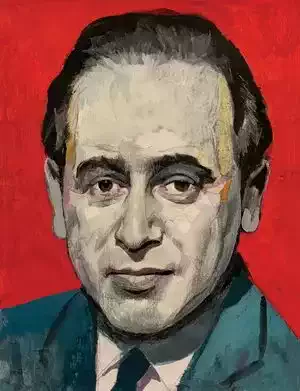
Paul Celan
Afternoon Of Circus And Citadel
Afternoon Of Circus And Citadel
In Brest, before the Fire-Hoops burning,
In the Tent, where Tigers sprang,
there I heard you, Finite, singing,
there I saw you, Mandelstam.
The Sky hung over the Roadstead,
the Gull, hung over the Crane.
The Finite sang there, the Constant –
you, the Gunboat, Baobab.
I hailed the Tricolor
with a Russian Word –
the Lost was Un-Lost,
the Heart Anchored there.
In Brest, before the Fire-Hoops burning,
In the Tent, where Tigers sprang,
there I heard you, Finite, singing,
there I saw you, Mandelstam.
The Sky hung over the Roadstead,
the Gull, hung over the Crane.
The Finite sang there, the Constant –
you, the Gunboat, Baobab.
I hailed the Tricolor
with a Russian Word –
the Lost was Un-Lost,
the Heart Anchored there.
428
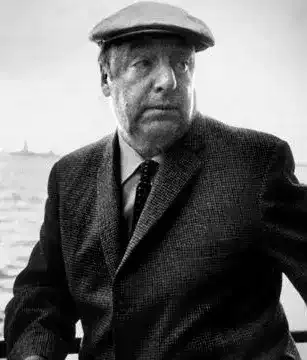
Pablo Neruda
The House of Odes
The House of Odes
Writing
these
odes
in this
year nineteen
hundred and
fifty-five,
readying and tuning
my demanding, murmuring lyre,
I know who I am
and where my song is going.
I understand
that the shopper for myths
and mysteries
may enter
my wood
and adobe
house of odes,
may despise
the utensils,
the portraits
of father and mother and country
on the walls,
the simplicity
of the bread
and the saltcellar. But
that's how it is in my house of odes.
I deposed the dark monarchy,
the useless flowing hair of dreams,
I trod on the tail
of the cerebral reptile,
and set things
-- water and fire in
harmony with man and earth.
I want everything
to have
a handle,
I want everything to be
a cup or a tool,
I want people to enter a hardware
store through the door of my odes.
I work at
cutting
newly hewn boards,
storing casks
of honey,
arranging
horseshoes, harness,
forks:
I want everyone to enter here,
let them ask questions,
ask for anything they want.
I am from the South, a Chilean,
a sailor
returned
from the seas.
I did not stay in the islands,
a king.
I did not stay ensconced
in the land of dreams.
I returned to labor simply
beside others,
for everyone.
So that everyone
may live here,
I build my house
with transparent
odes.
Writing
these
odes
in this
year nineteen
hundred and
fifty-five,
readying and tuning
my demanding, murmuring lyre,
I know who I am
and where my song is going.
I understand
that the shopper for myths
and mysteries
may enter
my wood
and adobe
house of odes,
may despise
the utensils,
the portraits
of father and mother and country
on the walls,
the simplicity
of the bread
and the saltcellar. But
that's how it is in my house of odes.
I deposed the dark monarchy,
the useless flowing hair of dreams,
I trod on the tail
of the cerebral reptile,
and set things
-- water and fire in
harmony with man and earth.
I want everything
to have
a handle,
I want everything to be
a cup or a tool,
I want people to enter a hardware
store through the door of my odes.
I work at
cutting
newly hewn boards,
storing casks
of honey,
arranging
horseshoes, harness,
forks:
I want everyone to enter here,
let them ask questions,
ask for anything they want.
I am from the South, a Chilean,
a sailor
returned
from the seas.
I did not stay in the islands,
a king.
I did not stay ensconced
in the land of dreams.
I returned to labor simply
beside others,
for everyone.
So that everyone
may live here,
I build my house
with transparent
odes.
571
Pablo Neruda
Poetry
Poetry
And it was at that age ... Poetry arrived
in search of me. I don't know, I don't know where
it came from, from winter or a river.
I don't know how or when,
no they were not voices, they were not
words, nor silence,
but from a street I was summoned,
from the branches of night,
abruptly from the others,
among violent fires
or returning alone,
there I was without a face
and it touched me.
I did not know what to say, my mouth
had no way
with names,
my eyes were blind,
and something started in my soul,
fever or forgotten wings,
and I made my own way,
deciphering
that fire,
and I wrote the first faint line,
faint, without substance, pure
nonsense,
pure wisdom
of someone who knows nothing,
and suddenly I saw
the heavens
unfastened
and open,
planets,
palpitating plantations,
shadow perforated,
riddled
with arrows, fire and flowers,
the winding night, the universe.
And I, infinitesimal being,
drunk with the great starry
void,
likeness, image of
mystery,
felt myself a pure part
of the abyss,
I wheeled with the stars,
my heart broke loose on the wind.
And it was at that age ... Poetry arrived
in search of me. I don't know, I don't know where
it came from, from winter or a river.
I don't know how or when,
no they were not voices, they were not
words, nor silence,
but from a street I was summoned,
from the branches of night,
abruptly from the others,
among violent fires
or returning alone,
there I was without a face
and it touched me.
I did not know what to say, my mouth
had no way
with names,
my eyes were blind,
and something started in my soul,
fever or forgotten wings,
and I made my own way,
deciphering
that fire,
and I wrote the first faint line,
faint, without substance, pure
nonsense,
pure wisdom
of someone who knows nothing,
and suddenly I saw
the heavens
unfastened
and open,
planets,
palpitating plantations,
shadow perforated,
riddled
with arrows, fire and flowers,
the winding night, the universe.
And I, infinitesimal being,
drunk with the great starry
void,
likeness, image of
mystery,
felt myself a pure part
of the abyss,
I wheeled with the stars,
my heart broke loose on the wind.
745
Pablo Neruda
A Lemon
A Lemon
Out of lemon flowers
loosed
on the moonlight, love's
lashed and insatiable
essences,
sodden with fragrance,
the lemon tree's yellow
emerges,
the lemons
move down
from the tree's planetarium
Delicate merchandise!
The harbors are big with itbazaars
for the light and the
barbarous gold.
We open
the halves
of a miracle,
and a clotting of acids
brims
into the starry
divisions:
creation's
original juices,
irreducible, changeless,
alive:
so the freshness lives on
in a lemon,
in the sweet-smelling house of the rind,
the proportions, arcane and acerb.
Cutting the lemon
the knife
leaves a little cathedral:
alcoves unguessed by the eye
that open acidulous glass
to the light; topazes
riding the droplets,
altars,
aromatic facades.
So, while the hand
holds the cut of the lemon,
half a world
on a trencher,
the gold of the universe
wells
to your touch:
a cup yellow
with miracles,
a breast and a nipple
perfuming the earth;
a flashing made fruitage,
the diminutive fire of a planet.
Out of lemon flowers
loosed
on the moonlight, love's
lashed and insatiable
essences,
sodden with fragrance,
the lemon tree's yellow
emerges,
the lemons
move down
from the tree's planetarium
Delicate merchandise!
The harbors are big with itbazaars
for the light and the
barbarous gold.
We open
the halves
of a miracle,
and a clotting of acids
brims
into the starry
divisions:
creation's
original juices,
irreducible, changeless,
alive:
so the freshness lives on
in a lemon,
in the sweet-smelling house of the rind,
the proportions, arcane and acerb.
Cutting the lemon
the knife
leaves a little cathedral:
alcoves unguessed by the eye
that open acidulous glass
to the light; topazes
riding the droplets,
altars,
aromatic facades.
So, while the hand
holds the cut of the lemon,
half a world
on a trencher,
the gold of the universe
wells
to your touch:
a cup yellow
with miracles,
a breast and a nipple
perfuming the earth;
a flashing made fruitage,
the diminutive fire of a planet.
957
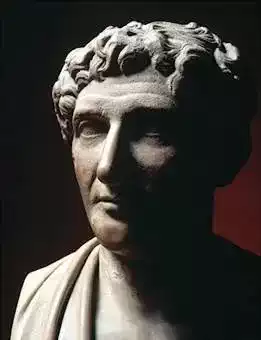
Ovídio
Metamorphoses: Book The Sixth
Metamorphoses: Book The Sixth
PALLAS, attending to the Muse's song,
Approv'd the just resentment of their wrong;
And thus reflects: While tamely I commend
Those who their injur'd deities defend,
My own divinity affronted stands,
And calls aloud for justice at my hands;
Then takes the hint, asham'd to lag behind,
And on Arachne' bends her vengeful mind;
One at the loom so excellently skill'd,
That to the Goddess she refus'd to yield.
The Low was her birth, and small her native town,
Transformation She from her art alone obtain'd renown.
of Arachne Idmon, her father, made it his employ,
into a Spider To give the spungy fleece a purple dye:
Of vulgar strain her mother, lately dead,
With her own rank had been content to wed;
Yet she their daughter, tho' her time was spent
In a small hamlet, and of mean descent,
Thro' the great towns of Lydia gain'd a name,
And fill'd the neighb'ring countries with her fame.
Oft, to admire the niceness of her skill,
The Nymphs would quit their fountain, shade, or
hill:
Thither, from green Tymolus, they repair,
And leave the vineyards, their peculiar care;
Thither, from fam'd Pactolus' golden stream,
Drawn by her art, the curious Naiads came.
Nor would the work, when finish'd, please so much,
As, while she wrought, to view each graceful touch;
Whether the shapeless wool in balls she wound,
Or with quick motion turn'd the spindle round,
Or with her pencil drew the neat design,
Pallas her mistress shone in every line.
This the proud maid with scornful air denies,
And ev'n the Goddess at her work defies;
Disowns her heav'nly mistress ev'ry hour,
Nor asks her aid, nor deprecates her pow'r.
Let us, she cries, but to a tryal come,
And, if she conquers, let her fix my doom.
The Goddess then a beldame's form put on,
With silver hairs her hoary temples shone;
Prop'd by a staff, she hobbles in her walk,
And tott'ring thus begins her old wives' talk.
Young maid attend, nor stubbornly despise
The admonitions of the old, and wise;
For age, tho' scorn'd, a ripe experience bears,
That golden fruit, unknown to blooming years:
Still may remotest fame your labours crown,
And mortals your superior genius own;
But to the Goddess yield, and humbly meek
A pardon for your bold presumption seek;
The Goddess will forgive. At this the maid,
With passion fir'd, her gliding shuttle stay'd;
And, darting vengeance with an angry look,
To Pallas in disguise thus fiercely spoke.
Thou doating thing, whose idle babling tongue
But too well shews the plague of living long;
Hence, and reprove, with this your sage advice,
Your giddy daughter, or your aukward neice;
Know, I despise your counsel, and am still
A woman, ever wedded to my will;
And, if your skilful Goddess better knows,
Let her accept the tryal I propose.
She does, impatient Pallas strait replies,
And, cloath'd with heavenly light, sprung from her
odd disguise.
The Nymphs, and virgins of the plain adore
The awful Goddess, and confess her pow'r;
The maid alone stood unappall'd; yet show'd
A transient blush, that for a moment glow'd,
Then disappear'd; as purple streaks adorn
The opening beauties of the rosy morn;
Till Phoebus rising prevalently bright,
Allays the tincture with his silver light.
Yet she persists, and obstinately great,
In hopes of conquest hurries on her fate.
The Goddess now the challenge waves no more,
Nor, kindly good, advises as before.
Strait to their posts appointed both repair,
And fix their threaded looms with equal care:
Around the solid beam the web is ty'd,
While hollow canes the parting warp divide;
Thro' which with nimble flight the shuttles play,
And for the woof prepare a ready way;
The woof and warp unite, press'd by the toothy
slay.
Thus both, their mantles button'd to their
breast,
Their skilful fingers ply with willing haste,
And work with pleasure; while they chear the eye
With glowing purple of the Tyrian dye:
Or, justly intermixing shades with light,
Their colourings insensibly unite.
As when a show'r transpierc'd with sunny rays,
Its mighty arch along the heav'n displays;
From whence a thousand diff'rent colours rise,
Whose fine transition cheats the clearest eyes;
So like the intermingled shading seems,
And only differs in the last extreams.
Then threads of gold both artfully dispose,
And, as each part in just proportion rose,
Some antique fable in their work disclose.
Pallas in figures wrought the heav'nly Pow'rs,
And Mars's hill among th' Athenian tow'rs.
On lofty thrones twice six celestials sate,
Jove in the midst, and held their warm debate;
The subject weighty, and well-known to fame,
From whom the city shou'd receive its name.
Each God by proper features was exprest,
Jove with majestick mein excell'd the rest.
His three-fork'd mace the dewy sea-God shook,
And, looking sternly, smote the ragged rock;
When from the stone leapt forth a spritely steed,
And Neptune claims the city for the deed.
Herself she blazons, with a glitt'ring spear,
And crested helm that veil'd her braided hair,
With shield, and scaly breast-plate, implements of
war.
Struck with her pointed launce, the teeming Earth
Seem'd to produce a new surprizing birth;
When, from the glebe, the pledge of conquest
sprung,
A tree pale-green with fairest olives hung.
And then, to let her giddy rival learn
What just rewards such boldness was to earn,
Four tryals at each corner had their part,
Design'd in miniature, and touch'd with art.
Haemus in one, and Rodope of Thrace
Transform'd to mountains, fill'd the foremost
place;
Who claim'd the titles of the Gods above,
And vainly us'd the epithets of Jove.
Another shew'd, where the Pigmaean dame,
Profaning Juno's venerable name,
Turn'd to an airy crane, descends from far,
And with her Pigmy subjects wages war.
In a third part, the rage of Heav'n's great queen,
Display'd on proud Antigone, was seen:
Who with presumptuous boldness dar'd to vye,
For beauty with the empress of the sky.
Ah! what avails her ancient princely race,
Her sire a king, and Troy her native place:
Now, to a noisy stork transform'd, she flies,
And with her whiten'd pinions cleaves the skies.
And in the last remaining part was drawn
Poor Cinyras that seem'd to weep in stone;
Clasping the temple steps, he sadly mourn'd
His lovely daughters, now to marble turn'd.
With her own tree the finish'd piece is crown'd,
And wreaths of peaceful olive all the work
surround.
Arachne drew the fam'd intrigues of Jove,
Chang'd to a bull to gratify his love;
How thro' the briny tide all foaming hoar,
Lovely Europa on his back he bore.
The sea seem'd waving, and the trembling maid
Shrunk up her tender feet, as if afraid;
And, looking back on the forsaken strand,
To her companions wafts her distant hand.
Next she design'd Asteria's fabled rape,
When Jove assum'd a soaring eagle's shape:
And shew'd how Leda lay supinely press'd,
Whilst the soft snowy swan sate hov'ring o'er her
breast,
How in a satyr's form the God beguil'd,
When fair Antiope with twins he fill'd.
Then, like Amphytrion, but a real Jove,
In fair Alcmena's arms he cool'd his love.
In fluid gold to Danae's heart he came,
Aegina felt him in a lambent flame.
He took Mnemosyne in shepherd's make,
And for Deois was a speckled snake.
She made thee, Neptune, like a wanton steer,
Pacing the meads for love of Arne dear;
Next like a stream, thy burning flame to slake,
And like a ram, for fair Bisaltis' sake.
Then Ceres in a steed your vigour try'd,
Nor cou'd the mare the yellow Goddess hide.
Next, to a fowl transform'd, you won by force
The snake-hair'd mother of the winged horse;
And, in a dolphin's fishy form, subdu'd
Melantho sweet beneath the oozy flood.
All these the maid with lively features drew,
And open'd proper landskips to the view.
There Phoebus, roving like a country swain,
Attunes his jolly pipe along the plain;
For lovely Isse's sake in shepherd's weeds,
O'er pastures green his bleating flock he feeds,
There Bacchus, imag'd like the clust'ring grape,
Melting bedrops Erigone's fair lap;
And there old Saturn, stung with youthful heat,
Form'd like a stallion, rushes to the feat.
Fresh flow'rs, which twists of ivy intertwine,
Mingling a running foliage, close the neat design.
This the bright Goddess passionately mov'd,
With envy saw, yet inwardly approv'd.
The scene of heav'nly guilt with haste she tore,
Nor longer the affront with patience bore;
A boxen shuttle in her hand she took,
And more than once Arachne's forehead struck.
Th' unhappy maid, impatient of the wrong,
Down from a beam her injur'd person hung;
When Pallas, pitying her wretched state,
At once prevented, and pronounc'd her fate:
Live; but depend, vile wretch, the Goddess cry'd,
Doom'd in suspence for ever to be ty'd;
That all your race, to utmost date of time,
May feel the vengeance, and detest the crime.
Then, going off, she sprinkled her with juice,
Which leaves of baneful aconite produce.
Touch'd with the pois'nous drug, her flowing hair
Fell to the ground, and left her temples bare;
Her usual features vanish'd from their place,
Her body lessen'd all, but most her face.
Her slender fingers, hanging on each side
With many joynts, the use of legs supply'd:
A spider's bag the rest, from which she gives
A thread, and still by constant weaving lives.
The Story of Swift thro' the Phrygian towns the rumour flies,
Niobe And the strange news each female tongue employs:
Niobe, who before she married knew
The famous nymph, now found the story true;
Yet, unreclaim'd by poor Arachne's fate,
Vainly above the Gods assum'd a state.
Her husband's fame, their family's descent,
Their pow'r, and rich dominion's wide extent,
Might well have justify'd a decent pride;
But not on these alone the dame rely'd.
Her lovely progeny, that far excell'd,
The mother's heart with vain ambition swell'd:
The happiest mother not unjustly styl'd,
Had no conceited thoughts her tow'ring fancy
fill'd.
For once a prophetess with zeal inspir'd,
Their slow neglect to warm devotion fir'd;
Thro' ev'ry street of Thebes who ran possess'd,
And thus in accents wild her charge express'd:
Haste, haste, ye Theban matrons, and adore,
With hallow'd rites, Latona's mighty pow'r;
And, to the heav'nly twins that from her spring,
With laurel crown'd, your smoaking incense bring.
Strait the great summons ev'ry dame obey'd,
And due submission to the Goddess paid:
Graceful, with laurel chaplets dress'd, they came,
And offer'd incense in the sacred flame.
Mean-while, surrounded with a courtly guard,
The royal Niobe in state appear'd;
Attir'd in robes embroider'd o'er with gold,
And mad with rage, yet lovely to behold:
Her comely tresses, trembling as she stood,
Down her fine neck with easy motion flow'd;
Then, darting round a proud disdainful look,
In haughty tone her hasty passion broke,
And thus began: What madness this, to court
A Goddess, founded meerly on report?
Dare ye a poor pretended Pow'r invoke,
While yet no altars to my godhead smoke?
Mine, whose immediate lineage stands confess'd
From Tantalus, the only mortal guest
That e'er the Gods admitted to their feast.
A sister of the Pleiads gave me birth;
And Atlas, mightiest mountain upon Earth,
Who bears the globe of all the stars above,
My grandsire was, and Atlas sprung from Jove.
The Theban towns my majesty adore,
And neighb'ring Phrygia trembles at my pow'r:
Rais'd by my husband's lute, with turrets crown'd,
Our lofty city stands secur'd around.
Within my court, where-e'er I turn my eyes,
Unbounded treasures to my prospect rise:
With these my face I modestly may name,
As not unworthy of so high a claim;
Seven are my daughters, of a form divine,
With seven fair sons, an indefective line.
Go, fools! consider this; and ask the cause
From which my pride its strong presumption draws;
Consider this; and then prefer to me
Caeus the Titan's vagrant progeny;
To whom, in travel, the whole spacious Earth
No room afforded for her spurious birth.
Not the least part in Earth, in Heav'n, or seas,
Would grant your out-law'd Goddess any ease:
'Till pitying hers, from his own wand'ring case,
Delos, the floating island, gave a place.
There she a mother was, of two at most;
Only the seventh part of what I boast.
My joys all are beyond suspicion fix'd;
With no pollutions of misfortune mix'd;
Safe on the Basis of my pow'r I stand,
Above the reach of Fortune's fickle hand.
Lessen she may my inexhausted store,
And much destroy, yet still must leave me more.
Suppose it possible that some may dye
Of this my num'rous lovely progeny;
Still with Latona I might safely vye.
Who, by her scanty breed, scarce fit to name,
But just escapes the childless woman's shame.
Go then, with speed your laurel'd heads uncrown,
And leave the silly farce you have begun.
The tim'rous throng their sacred rites forbore,
And from their heads the verdant laurel tore;
Their haughty queen they with regret obey'd,
And still in gentle murmurs softly pray'd.
High, on the top of Cynthus' shady mount,
With grief the Goddess saw the base affront;
And, the abuse revolving in her breast,
The mother her twin-offspring thus addrest.
Lo I, my children, who with comfort knew
Your God-like birth, and thence my glory drew;
And thence have claim'd precedency of place
From all but Juno of the heav'nly race,
Must now despair, and languish in disgrace.
My godhead question'd, and all rites divine,
Unless you succour, banish'd from my shrine.
Nay more, the imp of Tantalus has flung
Reflections with her vile paternal tongue;
Has dar'd prefer her mortal breed to mine,
And call'd me childless; which, just fate, may she
repine!
When to urge more the Goddess was prepar'd,
Phoebus in haste replies, Too much we've heard,
And ev'ry moment's lost, while vengeance is
defer'd.
Diana spoke the same. Then both enshroud
Their heav'nly bodies in a sable cloud;
And to the Theban tow'rs descending light,
Thro' the soft yielding air direct their flight.
Without the wall there lies a champian ground
With even surface, far extending round,
Beaten and level'd, while it daily feels
The trampling horse, and chariot's grinding wheels.
Part of proud Niobe's young rival breed,
Practising there to ride the manag'd steed,
Their bridles boss'd with gold, were mounted high
On stately furniture of Tyrian dye.
Of these, Ismenos, who by birth had been
The first fair issue of the fruitful queen,
Just as he drew the rein to guide his horse,
Around the compass of the circling course,
Sigh'd deeply, and the pangs of smart express'd,
While the shaft stuck, engor'd within his breast:
And, the reins dropping from his dying hand,
He sunk quite down, and tumbled on the sand.
Sipylus next the rattling quiver heard,
And with full speed for his escape prepar'd;
As when the pilot from the black'ning skies
A gath'ring storm of wintry rain descries,
His sails unfurl'd, and crowded all with wind,
He strives to leave the threat'ning cloud behind:
So fled the youth; but an unerring dart
O'ertook him, quick discharg'd, and sped with art;
Fix'd in his neck behind, it trembling stood,
And at his throat display'd the point besmear'd
with blood
Prone, as his posture was, he tumbled o'er,
And bath'd his courser's mane with steaming gore.
Next at young Phaedimus they took their aim,
And Tantalus who bore his grandsire's name:
These, when their other exercise was done,
To try the wrestler's oily sport begun;
And, straining ev'ry nerve, their skill express'd
In closest grapple, joining breast to breast:
When from the bending bow an arrow sent,
Joyn'd as they were, thro' both their bodies went:
Both groan'd, and writhing both their limbs with
pain,
They fell together bleeding on the plain;
Then both their languid eye-balls faintly roul,
And thus together breathe away their soul.
With grief Alphenor saw their doleful plight,
And smote his breast, and sicken'd at the sight;
Then to their succour ran with eager haste,
And, fondly griev'd, their stiff'ning limbs
embrac'd;
But in the action falls: a thrilling dart,
By Phoebus guided, pierc'd him to the heart.
This, as they drew it forth, his midriff tore,
Its barbed point the fleshy fragments bore,
And let the soul gush out in streams of purple
gore.
But Damasichthon, by a double wound,
Beardless, and young, lay gasping on the ground.
Fix'd in his sinewy ham, the steely point
Stuck thro' his knee, and pierc'd the nervous
joint:
And, as he stoop'd to tug the painful dart,
Another struck him in a vital part;
Shot thro' his wezon, by the wing it hung.
The life-blood forc'd it out, and darting upward
sprung,
Ilioneus, the last, with terror stands,
Lifting in pray'r his unavailing hands;
And, ignorant from whom his griefs arise,
Spare me, o all ye heav'nly Pow'rs, he cries:
Phoebus was touch'd too late, the sounding bow
Had sent the shaft, and struck the fatal blow;
Which yet but gently gor'd his tender side,
So by a slight and easy wound he dy'd.
Swift to the mother's ears the rumour came,
And doleful sighs the heavy news proclaim;
With anger and surprize inflam'd by turns,
In furious rage her haughty stomach burns:
First she disputes th' effects of heav'nly pow'r,
Then at their daring boldness wonders more;
For poor Amphion with sore grief distrest,
Hoping to sooth his cares by endless rest,
Had sheath'd a dagger in his wretched breast.
And she, who toss'd her high disdainful head,
When thro' the streets in solemn pomp she led
The throng that from Latona's altar fled,
Assuming state beyond the proudest queen;
Was now the miserablest object seen.
Prostrate among the clay-cold dead she fell,
And kiss'd an undistinguish'd last farewel.
Then her pale arms advancing to the skies,
Cruel Latona! triumph now, she cries.
My grieving soul in bitter anguish drench,
And with my woes your thirsty passion quench;
Feast your black malice at a price thus dear,
While the sore pangs of sev'n such deaths I bear.
Triumph, too cruel rival, and display
Your conqu'ring standard; for you've won the day.
Yet I'll excel; for yet, tho' sev'n are slain,
Superior still in number I remain.
Scarce had she spoke; the bow-string's twanging
sound
Was heard, and dealt fresh terrors all around;
Which all, but Niobe alone, confound.
Stunn'd, and obdurate by her load of grief,
Insensible she sits, nor hopes relief.
Before the fun'ral biers, all weeping sad,
Her daughters stood, in vests of sable clad,
When one, surpriz'd, and stung with sudden smart,
In vain attempts to draw the sticking dart:
But to grim death her blooming youth resigns,
And o'er her brother's corpse her dying head
reclines.
This, to asswage her mother's anguish tries,
And, silenc'd in the pious action, dies;
Shot by a secret arrow, wing'd with death,
Her fault'ring lips but only gasp'd for breath.
One, on her dying sister, breathes her last;
Vainly in flight another's hopes are plac'd:
This hiding, from her fate a shelter seeks;
That trembling stands, and fills the air with
shrieks.
And all in vain; for now all six had found
Their way to death, each by a diff'rent wound.
The last, with eager care the mother veil'd,
Behind her spreading mantle close conceal'd,
And with her body guarded, as a shield.
Only for this, this youngest, I implore,
Grant me this one request, I ask no more;
O grant me this! she passionately cries:
But while she speaks, the destin'd virgin dies.
The Widow'd, and childless, lamentable state!
Transformation A doleful sight, among the dead she sate;
of Niobe Harden'd with woes, a statue of despair,
To ev'ry breath of wind unmov'd her hair;
Her cheek still red'ning, but its colour dead,
Faded her eyes, and set within her head.
No more her pliant tongue its motion keeps,
But stands congeal'd within her frozen lips.
Stagnate, and dull, within her purple veins,
Its current stop'd, the lifeless blood remains.
Her feet their usual offices refuse,
Her arms, and neck their graceful gestures lose:
Action, and life from ev'ry part are gone,
And ev'n her entrails turn to solid stone;
Yet still she weeps, and whirl'd by stormy winds,
Born thro' the air, her native country finds;
There fix'd, she stands upon a bleaky hill,
There yet her marble cheeks eternal tears distil.
The Peasants Then all, reclaim'd by this example, show'd
of Lycia A due regard for each peculiar God:
transform'd to Both men, and women their devoirs express'd,
Frogs And great Latona's awful pow'r confess'd.
Then, tracing instances of older time,
To suit the nature of the present crime,
Thus one begins his tale.- Where Lycia yields
A golden harvest from its fertile fields,
Some churlish peasants, in the days of yore,
Provok'd the Goddess to exert her pow'r.
The thing indeed the meanness of the place
Has made obscure, surprizing as it was;
But I my self once happen'd to behold
This famous lake of which the story's told.
My father then, worn out by length of days,
Nor able to sustain the tedious ways,
Me with a guide had sent the plains to roam,
And drive his well-fed stragling heifers home.
Here, as we saunter'd thro' the verdant meads,
We spy'd a lake o'er-grown with trembling reeds,
Whose wavy tops an op'ning scene disclose,
From which an antique smoaky altar rose.
I, as my susperstitious guide had done,
Stop'd short, and bless'd my self, and then went
on;
Yet I enquir'd to whom the altar stood,
Faunus, the Naids, or some native God?
No silvan deity, my friend replies,
Enshrin'd within this hallow'd altar lies.
For this, o youth, to that fam'd Goddess stands,
Whom, at th' imperial Juno's rough commands,
Of ev'ry quarter of the Earth bereav'd,
Delos, the floating isle, at length receiv'd.
Who there, in spite of enemies, brought forth,
Beneath an olive's shade, her great twin-birth.
Hence too she fled the furious stepdame's pow'r,
And in her arms a double godhead bore;
And now the borders of fair Lycia gain'd,
Just when the summer solstice parch'd the land.
With thirst the Goddess languishing, no more
Her empty'd breast would yield its milky store;
When, from below, the smiling valley show'd
A silver lake that in its bottom flow'd:
A sort of clowns were reaping, near the bank,
The bending osier, and the bullrush dank;
The cresse, and water-lilly, fragrant weed,
Whose juicy stalk the liquid fountains feed.
The Goddess came, and kneeling on the brink,
Stoop'd at the fresh repast, prepar'd to drink.
Then thus, being hinder'd by the rabble race,
In accents mild expostulates the case.
Water I only ask, and sure 'tis hard
From Nature's common rights to be debar'd:
This, as the genial sun, and vital air,
Should flow alike to ev'ry creature's share.
Yet still I ask, and as a favour crave,
That which, a publick bounty, Nature gave.
Nor do I seek my weary limbs to drench;
Only, with one cool draught, my thirst I'd quench.
Now from my throat the usual moisture dries,
And ev'n my voice in broken accents dies:
One draught as dear as life I should esteem,
And water, now I thirst, would nectar seem.
Oh! let my little babes your pity move,
And melt your hearts to charitable love;
They (as by chance they did) extend to you
Their little hands, and my request pursue.
Whom would these soft perswasions not subdue,
Tho' the most rustick, and unmanner'd crew?
Yet they the Goddess's request refuse,
And with rude words reproachfully abuse:
Nay more, with spiteful feet the villains trod
O'er the soft bottom of the marshy flood,
And blacken'd all the lake with clouds of rising
mud.
Her thirst by indignation was suppress'd;
Bent on revenge, the Goddess stood confess'd.
Her suppliant hands uplifting to the skies,
For a redress, to Heav'n she now applies.
And, May you live, she passionately cry'd,
Doom'd in that pool for ever to abide.
The Goddess has her wish; for now they chuse
To plunge, and dive among the watry ooze;
Sometimes they shew their head above the brim,
And on the glassy surface spread to swim;
Often upon the bank their station take,
Then spring, and leap into the cooly lake.
Still, void of shame, they lead a clam'rous life,
And, croaking, still scold on in endless strife;
Compell'd to live beneath the liquid stream,
Where still they quarrel, and attempt to skream.
Now, from their bloated throat, their voice puts on
Imperfect murmurs in a hoarser tone;
Their noisy jaws, with bawling now grown wide,
An ugly sight! extend on either side:
Their motly back, streak'd with a list of green,
Joyn'd to their head, without a neck is seen;
And, with a belly broad and white, they look
Meer frogs, and still frequent the muddy brook.
The Fate of Scarce had the man this famous story told,
Marsyas Of vengeance on the Lycians shown of old,
When strait another pictures to their view
The Satyr's fate, whom angry Phoebus slew;
Who, rais'd with high conceit, and puff'd with
pride,
At his own pipe the skilful God defy'd.
Why do you tear me from my self, he cries?
Ah cruel! must my skin be made the prize?
This for a silly pipe? he roaring said,
Mean-while the skin from off his limbs was flay'd.
All bare, and raw, one large continu'd wound,
With streams of blood his body bath'd the ground.
The blueish veins their trembling pulse disclos'd,
The stringy nerves lay naked, and expos'd;
His guts appear'd, distinctly each express'd,
With ev'ry shining fibre of his breast.
The Fauns, and Silvans, with the Nymphs that rove
Among the Satyrs in the shady grove;
Olympus, known of old, and ev'ry swain
That fed, or flock, or herd upon the plain,
Bewail'd the loss; and with their tears that
flow'd,
A kindly moisture on the earth bestow'd;
That soon, conjoyn'd, and in a body rang'd,
Sprung from the ground, to limpid water chang'd;
Which, down thro' Phrygia's rocks, a mighty stream,
Comes tumbling to the sea, and Marsya is its name.
The Story of From these relations strait the people turn
Pelops To present truths, and lost Amphion mourn:
The mother most was blam'd, yet some relate
That Pelops pity'd, and bewail'd her fate,
And stript his cloaths, and laid his shoulder bare,
And made the iv'ry miracle appear.
This shoulder, from the first, was form'd of flesh,
As lively as the other, and as fresh;
But, when the youth was by his father slain,
The Gods restor'd his mangled limbs again;
Only that place which joins the neck and arm,
The rest untouch'd, was found to suffer harm:
The loss of which an iv'ry piece sustain'd;
And thus the youth his limbs, and life regain'd.
The Story of To Thebes the neighb'ring princes all repair,
Tereus, Procne, And with condolance the misfortune share.
and Philomela Each bord'ring state in solemn form address'd,
And each betimes a friendly grief express'd.
Argos, with Sparta's, and Mycenae's towns,
And Calydon, yet free from fierce Diana's frowns.
Corinth for finest brass well fam'd of old,
Orthomenos for men of courage bold:
Cleonae lying in the lowly dale,
And rich Messene with its fertile vale:
Pylos, for Nestor's City after fam'd,
And Troezen, not as yet from Pittheus nam'd.
And those fair cities, which are hem'd around
By double seas within the Isthmian ground;
And those, which farther from the sea-coast stand,
Lodg'd in the bosom of the spacious land.
Who can believe it? Athens was the last:
Tho' for politeness fam'd for ages past.
For a strait siege, which then their walls
enclos'd,
Such acts of kind humanity oppos'd:
And thick with ships, from foreign nations bound,
Sea-ward their city lay invested round.
These, with auxiliar forces led from far,
Tereus of Thrace, brave, and inur'd to war,
Had quite defeated, and obtain'd a name,
The warrior's due, among the sons of Fame.
This, with his wealth, and pow'r, and ancient line,
From Mars deriv'd, Pandions's thoughts incline
His daughter Procne with the prince to joyn.
Nor Hymen, nor the Graces here preside,
Nor Juno to befriend the blooming bride;
But Fiends with fun'ral brands the process led,
And Furies waited at the Genial bed:
And all night long the scrieching owl aloof,
With baleful notes, sate brooding o'er the roof.
With such ill Omens was the match begun,
That made them parents of a hopeful son.
Now Thrace congratulates their seeming joy,
And they, in thankful rites, their minds employ.
If the fair queen's espousals pleas'd before,
Itys, the new-born prince, now pleases more;
And each bright day, the birth, and bridal feast,
Were kept with hallow'd pomp above the rest.
So far true happiness may lye conceal'd,
When, by false lights, we fancy 'tis reveal'd!
Now, since their nuptials, had the golden sun
Five courses round his ample zodiac run;
When gentle Procne thus her lord address'd,
And spoke the secret wishes of her breast:
If I, she said, have ever favour found,
Let my petition with success be crown'd:
Let me at Athens my dear sister see,
Or let her come to Thrace, and visit me.
And, lest my father should her absence mourn,
Promise that she shall make a quick return.
With thanks I'd own the obligation due
Only, o Tereus, to the Gods, and you.
Now, ply'd with oar, and sail at his command,
The nimble gallies reach'd th' Athenian land,
And anchor'd in the fam'd Piraean bay,
While Tereus to the palace takes his way;
The king salutes, and ceremonies past,
Begins the fatal embassy at last;
The occasion of his voyage he declares,
And, with his own, his wife's request prefers:
Asks leave that, only for a little space,
Their lovely sister might embark for Thrace.
Thus while he spoke, appear'd the royal maid,
Bright Philomela, splendidly array'd;
But most attractive in her charming face,
And comely person, turn'd with ev'ry grace:
Like those fair Nymphs, that are describ'd to rove
Across the glades, and op'nings of the grove;
Only that these are dress'd for silvan sports,
And less become the finery of courts.
Tereus beheld the virgin, and admir'd,
And with the coals of burning lust was fir'd:
Like crackling stubble, or the summer hay,
When forked lightnings o'er the meadows play.
Such charms in any breast might kindle love,
But him the heats of inbred lewdness move;
To which, tho' Thrace is naturally prone,
Yet his is still superior, and his own.
Strait her attendants he designs to buy,
And with large bribes her governess would try:
Herself with ample gifts resolves to bend,
And his whole kingdom in th' attempt expend:
Or, snatch'd away by force of arms, to bear,
And justify the rape with open war.
The boundless passion boils within his breast,
And his projecting soul admits no rest.
And now, impatient of the least delay,
By pleading Procne's cause, he speeds his way:
The eloquence of love his tongue inspires,
And, in his wife's, he speaks his own desires;
Hence all his importunities arise,
And tears unmanly trickle from his eyes.
Ye Gods! what thick involving darkness blinds
The stupid faculties of mortal minds!
Tereus the credit of good-nature gains
From these his crimes; so well the villain feigns.
And, unsuspecting of his base designs,
In the request fair Philomela joyns;
Her snowy arms her aged sire embrace,
And clasp his neck with an endearing grace:
Only to see her sister she entreats,
A seeming blessing, which a curse compleats.
Tereus surveys her with a luscious eye,
And in his mind forestalls the blissful joy:
Her circling arms a scene of lust inspire,
And ev'ry kiss foments the raging fire.
Fondly he wishes for the father's place,
To feel, and to return the warm embrace;
Since not the nearest ties of filial blood
Would damp his flame, and force him to be good.
At length, for both their sakes, the king agrees;
And Philomela, on her bended knees,
Thanks him for what her fancy calls success,
When cruel fate intends her nothing less.
Now Phoebus, hastning to ambrosial rest,
His fiery steeds drove sloping down the west:
The sculptur'd gold with sparkling wines was
fill'd,
And, with rich meats, each chearful table smil'd.
Plenty, and mirth the royal banquet close,
Then all retire to sleep, and sweet repose.
But the lewd monarch, tho' withdrawn apart,
Still feels love's poison rankling in his heart:
Her face divine is stamp'd within his breast,
Fancy imagines, and improves the rest:
And thus, kept waking by intense desire,
He nourishes his own prevailing fire.
Next day the good old king for Tereus sends,
And to his charge the virgin recommends;
His hand with tears th' indulgent father press'd,
Then spoke, and thus with tenderness address'd.
Since the kind instances of pious love,
Do all pretence of obstacle remove;
Since Procne's, and her own, with your request,
O'er-rule the fears of a paternal breast;
With you, dear son, my daughter I entrust,
And by the Gods adjure you to be just;
By truth, and ev'ry consanguineal tye,
To watch, and guard her with a father's eye.
And, since the least delay will tedious prove,
In keeping from my sight the child I love,
With speed return her, kindly to asswage
The tedious troubles of my lingring age.
And you, my Philomel, let it suffice,
To know your sister's banish'd from my eyes;
If any sense of duty sways your mind,
Let me from you the shortest absence find.
He wept; then kiss'd his child; and while he
speaks,
The tears fall gently down his aged cheeks.
Next, as a pledge of fealty, he demands,
And, with a solemn charge, conjoyns their hands;
Then to his daughter, and his grandson sends,
And by their mouth a blessing recommends;
While, in a voice with dire forebodings broke,
Sobbing, and faint, the last farewel was spoke.
Now Philomela, scarce receiv'd on board,
And in the royal gilded bark secur'd,
Beheld the dashes of the bending oar,
The ruffled sea, and the receding shore;
When strait (his joy impatient of disguise)
We've gain'd our point, the rough Barbarian cries;
Now I possess the dear, the blissful hour,
And ev'ry wish subjected to my pow'r.
Transports of lust his vicious thoughts employ,
And he forbears, with pain, th' expected joy.
His gloting eyes incessantly survey'd
The virgin beauties of the lovely maid:
As when the bold rapacious bird of Jove,
With crooked talons stooping from above,
Has snatcht, and carry'd to his lofty nest
A captive hare, with cruel gripes opprest;
Secure, with fix'd, and unrelenting eyes,
He sits, and views the helpless, trembling prize.
Their vessels now had made th' intended land,
And all with joy descend upon the strand;
When the false tyrant seiz'd the princely maid,
And to a lodge in distant woods convey'd;
Pale, sinking, and distress'd with jealous fears,
And asking for her sister all in tears.
The letcher, for enjoyment fully bent,
No longer now conceal'd his base intent;
But with rude haste the bloomy girl deflow'r'd,
Tender, defenceless, and with ease o'erpower'd.
Her piercing accents to her sire complain,
And to her absent sister, but in vain:
In vain she importunes, with doleful cries,
Each unattentive godhead of the skies.
She pants and trembles, like the bleating prey,
From some close-hunted wolf just snatch'd away;
That still, with fearful horror, looks around,
And on its flank regards the bleeding wound.
Or, as the tim'rous dove, the danger o'er,
Beholds her shining plumes besmear'd with gore,
And, tho' deliver'd from the faulcon's claw,
Yet shivers, and retains a secret awe.
But when her mind a calm reflection shar'd,
And all her scatter'd spirits were repair'd:
Torn, and disorder'd while her tresses hung,
Her livid hands, like one that mourn'd, she wrung;
Then thus, with grief o'erwhelm'd her languid eyes,
Savage, inhumane, cruel wretch! she cries;
Whom not a parent's strict commands could move,
Tho' charg'd, and utter'd with the tears of love;
Nor virgin innocence, nor all that's due
To the strong contract of the nuptial vow:
Virtue, by this, in wild confusion's laid,
And I compell'd to wrong my sister's bed;
Whilst you, regardless of your marriage oath,
With stains of incest have defil'd us both.
Tho' I deserv'd some punishment to find,
This was, ye Gods! too cruel, and unkind.
Yet, villain, to compleat your horrid guilt,
Stab here, and let my tainted blood be spilt.
Oh happy! had it come, before I knew
The curs'd embrace of vile perfidious you;
Then my pale ghost, pure from incestuous love,
Had wander'd spotless thro' th' Elysian grove.
But, if the Gods above have pow'r to know,
And judge those actions that are done below;
Unless the dreaded thunders of the sky,
Like me, subdu'd, and violated lye;
Still my revenge shall take its proper time,
And suit the baseness of your hellish crime.
My self, abandon'd, and devoid of shame,
Thro' the wide world your actions will proclaim;
Or tho' I'm prison'd in this lonely den,
Obscur'd, and bury'd from the sight of men,
My mournful voice the pitying rocks shall move,
And my complainings eccho thro' the grove.
Hear me, o Heav'n! and, if a God be there,
Let him regard me, and accept my pray'r.
Struck with these words, the tyrant's guilty
breast
With fear, and anger, was, by turns, possest;
Now, with remorse his conscience deeply stung,
He drew the faulchion that beside her hung,
And first her tender arms behind her bound,
Then drag'd her by the hair along the ground.
The princess willingly her throat reclin'd,
And view'd the steel with a contented mind;
But soon her tongue the girding pinchers strain,
With anguish, soon she feels the piercing pain:
Oh father! father! would fain have spoke,
But the sharp torture her intention broke;
In vain she tries, for now the blade has cut
Her tongue sheer off, close to the trembling root.
The mangled part still quiver'd on the ground,
Murmuring with a faint imperfect sound:
And, as a serpent writhes his wounded train,
Uneasy, panting, and possess'd with pain;
The piece, while life remain'd, still trembled
fast,
And to its mistress pointed to the last.
Yet, after this so damn'd, and black a deed,
Fame (which I scarce can credit) has agreed,
That on her rifled charms, still void of shame,
He frequently indulg'd his lustful flame,
At last he ventures to his Procne's sight,
Loaded with guilt, and cloy'd with long delight;
There, with feign'd grief, and false, dissembled
sighs,
Begins a formal narrative of lies;
Her sister's death he artfully declares,
Then weeps, and raises credit from his tears.
Her vest, with flow'rs of gold embroider'd o'er,
With grief distress'd, the mournful matron tore,
And a beseeming suit of gloomy sable wore.
With cost, an honorary tomb she rais'd,
And thus th' imaginary ghost appeas'd.
Deluded queen! the fate of her you love,
Nor grief, nor pity, but revenge should move.
Thro' the twelve signs had pass'd the circling
sun,
And round the compass of the Zodiac run;
What must unhappy Philomela do,
For ever subject to her keeper's view?
Huge walls of massy stone the lodge surround,
From her own mouth no way of speaking's found.
But all our wants by wit may be supply'd,
And art makes up, what fortune has deny'd:
With skill exact a Phrygian web she strung,
Fix'd to a loom that in her chamber hung,
Where in-wrought letters, upon white display'd,
In purple notes, her wretched case betray'd:
The piece, when finish'd, secretly she gave
Into the charge of one poor menial slave;
And then, with gestures, made him understand,
It must be safe convey'd to Procne's hand.
The slave, with speed, the queen's apartment
sought,
And render'd up his charge, unknowing what he
brought.
But when the cyphers, figur'd in each fold,
Her sister's melancholy story told
(Strange that she could!) with silence, she
survey'd
The tragick piece, and without weeping read:
In such tumultuous haste her passions sprung,
They choak'd her voice, and quite disarm'd her
tongue.
No room for female tears; the Furies rise,
Darting vindictive glances from her eyes;
And, stung with rage, she bounds from place to
place,
While stern revenge sits low'ring in her face.
Now the triennial celebration came,
Observ'd to Bacchus by each Thracian dame;
When, in the privacies of night retir'd,
They act his rites, with sacred rapture fir'd:
By night, the tinkling cymbals ring around,
While the shrill notes from Rhodope resound;
By night, the queen, disguis'd, forsakes the court,
To mingle in the festival resort.
Leaves of the curling vine her temples shade,
And, with a circling wreath, adorn her head:
Adown her back the stag's rough spoils appear,
Light on her shoulder leans a cornel spear.
Thus, in the fury of the God conceal'd,
Procne her own mad headstrong passion veil'd;
Now, with her gang, to the thick wood she flies,
And with religious yellings fills the skies;
The fatal lodge, as 'twere by chance, she seeks,
And, thro' the bolted doors, an entrance breaks;
From thence, her sister snatching by the hand,
Mask'd like the ranting Bacchanalian band,
Within the limits of the court she drew,
Shading, with ivy green, her outward hue.
But Philomela, conscious of the place,
Felt new reviving pangs of her disgrace;
A shiv'ring cold prevail'd in ev'ry part,
And the chill'd blood ran trembling to her heart.
Soon as the queen a fit retirement found,
Stript of the garlands that her temples crown'd,
She strait unveil'd her blushing sister's face,
And fondly clasp'd her with a close embrace:
But, in confusion lost, th' unhappy maid,
With shame dejected, hung her drooping head,
As guilty of a crime that stain'd her sister's bed.
That speech, that should her injur'd virtue clear,
And make her spotless innocence appear,
Is now no more; only her hands, and eyes
Appeal, in signals, to the conscious skies.
In Procne's breast the rising passions boil,
And burst in anger with a mad recoil;
Her sister's ill-tim'd grief, with scorn, she
blames,
Then, in these furious words her rage proclaims.
Tears, unavailing, but defer our time,
The stabbing sword must expiate the crime;
Or worse, if wit, on bloody vengeance bent,
A weapon more tormenting can invent.
O sister! I've prepar'd my stubborn heart,
To act some hellish, and unheard-of part;
Either the palace to surround with fire,
And see the villain in the flames expire;
Or, with a knife, dig out his cursed eyes,
Or, his false tongue with racking engines seize;
Or, cut away the part that injur'd you,
And, thro' a thousand wounds, his guilty soul
pursue.
Tortures enough my passion has design'd,
But the variety distracts my mind.
A-while, thus wav'ring, stood the furious dame,
When Itys fondling to his mother came;
From him the cruel fatal hint she took,
She view'd him with a stern remorseless look:
Ah! but too like thy wicked sire, she said,
Forming the direful purpose in her head.
At this a sullen grief her voice supprest,
While silent passions struggle in her breast.
Now, at her lap arriv'd, the flatt'ring boy
Salutes his parent with a smiling joy:
About her neck his little arms are thrown,
And he accosts her in a pratling tone.
Then her tempestuous anger was allay'd,
And in its full career her vengeance stay'd;
While tender thoughts, in spite of passion, rise,
And melting tears disarm her threat'ning eyes.
But when she found the mother's easy heart,
Too fondly swerving from th' intended part;
Her injur'd sister's face again she view'd:
And, as by turns surveying both she stood,
While this fond boy (she said) can thus express
The moving accents of his fond address;
Why stands my sister of her tongue bereft,
Forlorn, and sad, in speechless silence left?
O Procne, see the fortune of your house!
Such is your fate, when match'd to such a spouse!
Conjugal duty, if observ'd to him,
Would change from virtue, and become a crime;
For all respect to Tereus must debase
The noble blood of great Pandion's race.
Strait at these words, with big resentment
fill'd,
Furious her look, she flew, and seiz'd her child;
Like a fell tigress of the savage kind,
That drags the tender suckling of the hind
Thro' India's gloomy groves, where Ganges laves
The shady scene, and rouls his streamy waves.
Now to a close apartment they were come,
Far off retir'd within the spacious dome;
When Procne, on revengeful mischief bent,
Home to his heart a piercing ponyard sent.
Itys, with rueful cries, but all too late,
Holds out his hands, and deprecates his fate;
Still at his mother's neck he fondly aims,
And strives to melt her with endearing names;
Yet still the cruel mother perseveres,
Nor with concern his bitter anguish hears.
This might suffice; but Philomela too
Across his throat a shining curtlass drew.
Then both, with knives, dissect each quiv'ring
part,
And carve the butcher'd limbs with cruel art;
Which, whelm'd in boiling cauldrons o'er the fire,
Or turn'd on spits, in steamy smoak aspire:
While the long entries, with their slipp'ry floor,
Run down in purple streams of clotted gore.
Ask'd by his wife to this inhuman feast,
Tereus unknowingly is made a guest:
Whilst she her plot the better to disguise,
Styles it some unknown mystick sacrifice;
And such the nature of the hallow'd rite,
The wife her husband only could invite,
The slaves must all withdraw, and be debarr'd the
sight.
Tereus, upon a throne of antique state,
Loftily rais'd, before the banquet sate;
And glutton like, luxuriously pleas'd,
With his own flesh his hungry maw appeas'd.
Nay, such a blindness o'er his senses falls,
That he for Itys to the table calls.
When Procne, now impatient to disclose
The joy that from her full revenge arose,
Cries out, in transports of a cruel mind,
Within your self your Itys you may find.
Still, at this puzzling answer, with surprise,
Around the room he sends his curious eyes;
And, as he still inquir'd, and call'd aloud,
Fierce Philomela, all besmear'd with blood,
Her hands with murder stain'd, her spreading hair
Hanging dishevel'd with a ghastly air,
Stept forth, and flung full in the tyrant's face
The head of Itys, goary as it was:
Nor ever so much to use her tongue,
And with a just reproach to vindicate her wrong.
The Thracian monarch from the table flings,
While with his cries the vaulted parlour rings;
His imprecations eccho down to Hell,
And rouze the snaky Furies from their Stygian cell.
One while he labours to disgorge his breast,
And free his stomach from the cursed feast;
Then, weeping o'er his lamentable doom,
He styles himself his son's sepulchral tomb.
Now, with drawn sabre, and impetuous speed,
In close pursuit he drives Pandion's breed;
Whose nimble feet spring with so swift a force
Across the fields, they seem to wing their course.
And now, on real wings themselves they raise,
And steer their airy flight by diff'rent ways;
One to the woodland's shady covert hies,
Around the smoaky roof the other flies;
Whose feathers yet the marks of murder stain,
Where stampt upon her breast, the crimson spots
remain.
Tereus, through grief, and haste to be reveng'd,
Shares the like fate, and to a bird is chang'd:
Fix'd on his head, the crested plumes appear,
Long is his beak, and sharpen'd like a spear;
Thus arm'd, his looks his inward mind display,
And, to a lapwing turn'd, he fans his way.
Exceeding trouble, for his children's fate,
Shorten'd Pandion's days, and chang'd his date;
Down to the shades below, with sorrow spent,
An earlier, unexpected ghost he went.
Boreas in Love Erechtheus next th' Athenian sceptre sway'd,
Whose rule the state with joynt consent obey'd;
So mix'd his justice with his valour flow'd,
His reign one scene of princely goodness shew'd.
Four hopeful youths, as many females bright,
Sprung from his loyns, and sooth'd him with
delight.
Two of these sisters, of a lovelier air,
Excell'd the rest, tho' all the rest were fair.
Procris, to Cephalus in wedlock ty'd,
Bless'd the young silvan with a blooming bride:
For Orithyia Boreas suffer'd pain,
For the coy maid sued long, but sued in vain;
Tereus his neighbour, and his Thracian blood,
Against the match a main objection stood;
Which made his vows, and all his suppliant love,
Empty as air and ineffectual prove.
But when he found his soothing flatt'ries fail,
Nor saw his soft addresses cou'd avail;
Blust'ring with ire, he quickly has recourse
To rougher arts, and his own native force.
'Tis well, he said; such usage is my due,
When thus disguis'd by foreign ways I sue;
When my stern airs, and fierceness I disclaim,
And sigh for love, ridiculously tame;
When soft addresses foolishly I try,
Nor my own stronger remedies apply.
By force and violence I chiefly live,
By them the lowring stormy tempests drive;
In foaming billows raise the hoary deep,
Writhe knotted oaks, and sandy desarts sweep;
Congeal the falling flakes of fleecy snow,
And bruise, with ratling hall, the plains below.
I, and my brother-winds, when joyn'd above,
Thro' the waste champian of the skies we rove,
With such a boist'rous full career engage,
That Heav'n's whole concave thunders at our rage.
While, struck from nitrous clouds, fierce
lightnings play,
Dart thro' the storm, and gild the gloomy day.
Or when, in subterraneous caverns pent,
My breath, against the hollow Earth, is bent,
The quaking world above, and ghosts below,
My mighty pow'r, by dear experience, know,
Tremble with fear, and dread the fatal blow.
This is the only cure to be apply'd,
Thus to Erechtheus I should be ally'd;
And thus the scornful virgin should be woo'd,
Not by intreaty, but by force subdu'd.
Boreas, in passion, spoke these huffing things,
And, as he spoke, he shook his dreadful wings;
At which, afar the shiv'ring sea was fan'd,
And the wide surface of the distant land:
His dusty mantle o'er the hills he drew,
And swept the lowly vallies, as he flew;
Then, with his yellow wings, embrac'd the maid,
And, wrapt in dusky clouds, far off convey'd.
The sparkling blaze of Love's prevailing fire
Shone brighter as he flew, and flam'd the higher.
And now the God, possess'd of his delight,
To northern Thrace pursu'd his airy flight,
Where the young ravish'd nymph became his bride,
And soon the luscious sweets of wedlock try'd.
Two lovely twins, th' effect of this embrace,
Crown their soft labours, and their nuptials grace;
Who, like their mother, beautiful, and fair,
Their father's strength, and feather'd pinions
share:
Yet these, at first, were wanting, as 'tis said,
And after, as they grew, their shoulders spread.
Zethes and Calais, the pretty twins,
Remain'd unfledg'd, while smooth their beardless
chins;
But when, in time, the budding silver down
Shaded their face, and on their cheeks was grown,
Two sprouting wings upon their shoulders sprung,
Like those in birds, that veil the callow young.
Then as their age advanc'd, and they began
From greener youth to ripen into man,
With Jason's Argonauts they cross'd the seas,
Embark'd in quest of the fam'd golden fleece;
There, with the rest, the first frail vessel try'd,
And boldly ventur'd on the swelling tide.
The End of the Sixth Book.
Translated into English verse under the direction of
Sir Samuel Garth by John Dryden, Alexander Pope, Joseph Addison,
William Congreve and other eminent hands
PALLAS, attending to the Muse's song,
Approv'd the just resentment of their wrong;
And thus reflects: While tamely I commend
Those who their injur'd deities defend,
My own divinity affronted stands,
And calls aloud for justice at my hands;
Then takes the hint, asham'd to lag behind,
And on Arachne' bends her vengeful mind;
One at the loom so excellently skill'd,
That to the Goddess she refus'd to yield.
The Low was her birth, and small her native town,
Transformation She from her art alone obtain'd renown.
of Arachne Idmon, her father, made it his employ,
into a Spider To give the spungy fleece a purple dye:
Of vulgar strain her mother, lately dead,
With her own rank had been content to wed;
Yet she their daughter, tho' her time was spent
In a small hamlet, and of mean descent,
Thro' the great towns of Lydia gain'd a name,
And fill'd the neighb'ring countries with her fame.
Oft, to admire the niceness of her skill,
The Nymphs would quit their fountain, shade, or
hill:
Thither, from green Tymolus, they repair,
And leave the vineyards, their peculiar care;
Thither, from fam'd Pactolus' golden stream,
Drawn by her art, the curious Naiads came.
Nor would the work, when finish'd, please so much,
As, while she wrought, to view each graceful touch;
Whether the shapeless wool in balls she wound,
Or with quick motion turn'd the spindle round,
Or with her pencil drew the neat design,
Pallas her mistress shone in every line.
This the proud maid with scornful air denies,
And ev'n the Goddess at her work defies;
Disowns her heav'nly mistress ev'ry hour,
Nor asks her aid, nor deprecates her pow'r.
Let us, she cries, but to a tryal come,
And, if she conquers, let her fix my doom.
The Goddess then a beldame's form put on,
With silver hairs her hoary temples shone;
Prop'd by a staff, she hobbles in her walk,
And tott'ring thus begins her old wives' talk.
Young maid attend, nor stubbornly despise
The admonitions of the old, and wise;
For age, tho' scorn'd, a ripe experience bears,
That golden fruit, unknown to blooming years:
Still may remotest fame your labours crown,
And mortals your superior genius own;
But to the Goddess yield, and humbly meek
A pardon for your bold presumption seek;
The Goddess will forgive. At this the maid,
With passion fir'd, her gliding shuttle stay'd;
And, darting vengeance with an angry look,
To Pallas in disguise thus fiercely spoke.
Thou doating thing, whose idle babling tongue
But too well shews the plague of living long;
Hence, and reprove, with this your sage advice,
Your giddy daughter, or your aukward neice;
Know, I despise your counsel, and am still
A woman, ever wedded to my will;
And, if your skilful Goddess better knows,
Let her accept the tryal I propose.
She does, impatient Pallas strait replies,
And, cloath'd with heavenly light, sprung from her
odd disguise.
The Nymphs, and virgins of the plain adore
The awful Goddess, and confess her pow'r;
The maid alone stood unappall'd; yet show'd
A transient blush, that for a moment glow'd,
Then disappear'd; as purple streaks adorn
The opening beauties of the rosy morn;
Till Phoebus rising prevalently bright,
Allays the tincture with his silver light.
Yet she persists, and obstinately great,
In hopes of conquest hurries on her fate.
The Goddess now the challenge waves no more,
Nor, kindly good, advises as before.
Strait to their posts appointed both repair,
And fix their threaded looms with equal care:
Around the solid beam the web is ty'd,
While hollow canes the parting warp divide;
Thro' which with nimble flight the shuttles play,
And for the woof prepare a ready way;
The woof and warp unite, press'd by the toothy
slay.
Thus both, their mantles button'd to their
breast,
Their skilful fingers ply with willing haste,
And work with pleasure; while they chear the eye
With glowing purple of the Tyrian dye:
Or, justly intermixing shades with light,
Their colourings insensibly unite.
As when a show'r transpierc'd with sunny rays,
Its mighty arch along the heav'n displays;
From whence a thousand diff'rent colours rise,
Whose fine transition cheats the clearest eyes;
So like the intermingled shading seems,
And only differs in the last extreams.
Then threads of gold both artfully dispose,
And, as each part in just proportion rose,
Some antique fable in their work disclose.
Pallas in figures wrought the heav'nly Pow'rs,
And Mars's hill among th' Athenian tow'rs.
On lofty thrones twice six celestials sate,
Jove in the midst, and held their warm debate;
The subject weighty, and well-known to fame,
From whom the city shou'd receive its name.
Each God by proper features was exprest,
Jove with majestick mein excell'd the rest.
His three-fork'd mace the dewy sea-God shook,
And, looking sternly, smote the ragged rock;
When from the stone leapt forth a spritely steed,
And Neptune claims the city for the deed.
Herself she blazons, with a glitt'ring spear,
And crested helm that veil'd her braided hair,
With shield, and scaly breast-plate, implements of
war.
Struck with her pointed launce, the teeming Earth
Seem'd to produce a new surprizing birth;
When, from the glebe, the pledge of conquest
sprung,
A tree pale-green with fairest olives hung.
And then, to let her giddy rival learn
What just rewards such boldness was to earn,
Four tryals at each corner had their part,
Design'd in miniature, and touch'd with art.
Haemus in one, and Rodope of Thrace
Transform'd to mountains, fill'd the foremost
place;
Who claim'd the titles of the Gods above,
And vainly us'd the epithets of Jove.
Another shew'd, where the Pigmaean dame,
Profaning Juno's venerable name,
Turn'd to an airy crane, descends from far,
And with her Pigmy subjects wages war.
In a third part, the rage of Heav'n's great queen,
Display'd on proud Antigone, was seen:
Who with presumptuous boldness dar'd to vye,
For beauty with the empress of the sky.
Ah! what avails her ancient princely race,
Her sire a king, and Troy her native place:
Now, to a noisy stork transform'd, she flies,
And with her whiten'd pinions cleaves the skies.
And in the last remaining part was drawn
Poor Cinyras that seem'd to weep in stone;
Clasping the temple steps, he sadly mourn'd
His lovely daughters, now to marble turn'd.
With her own tree the finish'd piece is crown'd,
And wreaths of peaceful olive all the work
surround.
Arachne drew the fam'd intrigues of Jove,
Chang'd to a bull to gratify his love;
How thro' the briny tide all foaming hoar,
Lovely Europa on his back he bore.
The sea seem'd waving, and the trembling maid
Shrunk up her tender feet, as if afraid;
And, looking back on the forsaken strand,
To her companions wafts her distant hand.
Next she design'd Asteria's fabled rape,
When Jove assum'd a soaring eagle's shape:
And shew'd how Leda lay supinely press'd,
Whilst the soft snowy swan sate hov'ring o'er her
breast,
How in a satyr's form the God beguil'd,
When fair Antiope with twins he fill'd.
Then, like Amphytrion, but a real Jove,
In fair Alcmena's arms he cool'd his love.
In fluid gold to Danae's heart he came,
Aegina felt him in a lambent flame.
He took Mnemosyne in shepherd's make,
And for Deois was a speckled snake.
She made thee, Neptune, like a wanton steer,
Pacing the meads for love of Arne dear;
Next like a stream, thy burning flame to slake,
And like a ram, for fair Bisaltis' sake.
Then Ceres in a steed your vigour try'd,
Nor cou'd the mare the yellow Goddess hide.
Next, to a fowl transform'd, you won by force
The snake-hair'd mother of the winged horse;
And, in a dolphin's fishy form, subdu'd
Melantho sweet beneath the oozy flood.
All these the maid with lively features drew,
And open'd proper landskips to the view.
There Phoebus, roving like a country swain,
Attunes his jolly pipe along the plain;
For lovely Isse's sake in shepherd's weeds,
O'er pastures green his bleating flock he feeds,
There Bacchus, imag'd like the clust'ring grape,
Melting bedrops Erigone's fair lap;
And there old Saturn, stung with youthful heat,
Form'd like a stallion, rushes to the feat.
Fresh flow'rs, which twists of ivy intertwine,
Mingling a running foliage, close the neat design.
This the bright Goddess passionately mov'd,
With envy saw, yet inwardly approv'd.
The scene of heav'nly guilt with haste she tore,
Nor longer the affront with patience bore;
A boxen shuttle in her hand she took,
And more than once Arachne's forehead struck.
Th' unhappy maid, impatient of the wrong,
Down from a beam her injur'd person hung;
When Pallas, pitying her wretched state,
At once prevented, and pronounc'd her fate:
Live; but depend, vile wretch, the Goddess cry'd,
Doom'd in suspence for ever to be ty'd;
That all your race, to utmost date of time,
May feel the vengeance, and detest the crime.
Then, going off, she sprinkled her with juice,
Which leaves of baneful aconite produce.
Touch'd with the pois'nous drug, her flowing hair
Fell to the ground, and left her temples bare;
Her usual features vanish'd from their place,
Her body lessen'd all, but most her face.
Her slender fingers, hanging on each side
With many joynts, the use of legs supply'd:
A spider's bag the rest, from which she gives
A thread, and still by constant weaving lives.
The Story of Swift thro' the Phrygian towns the rumour flies,
Niobe And the strange news each female tongue employs:
Niobe, who before she married knew
The famous nymph, now found the story true;
Yet, unreclaim'd by poor Arachne's fate,
Vainly above the Gods assum'd a state.
Her husband's fame, their family's descent,
Their pow'r, and rich dominion's wide extent,
Might well have justify'd a decent pride;
But not on these alone the dame rely'd.
Her lovely progeny, that far excell'd,
The mother's heart with vain ambition swell'd:
The happiest mother not unjustly styl'd,
Had no conceited thoughts her tow'ring fancy
fill'd.
For once a prophetess with zeal inspir'd,
Their slow neglect to warm devotion fir'd;
Thro' ev'ry street of Thebes who ran possess'd,
And thus in accents wild her charge express'd:
Haste, haste, ye Theban matrons, and adore,
With hallow'd rites, Latona's mighty pow'r;
And, to the heav'nly twins that from her spring,
With laurel crown'd, your smoaking incense bring.
Strait the great summons ev'ry dame obey'd,
And due submission to the Goddess paid:
Graceful, with laurel chaplets dress'd, they came,
And offer'd incense in the sacred flame.
Mean-while, surrounded with a courtly guard,
The royal Niobe in state appear'd;
Attir'd in robes embroider'd o'er with gold,
And mad with rage, yet lovely to behold:
Her comely tresses, trembling as she stood,
Down her fine neck with easy motion flow'd;
Then, darting round a proud disdainful look,
In haughty tone her hasty passion broke,
And thus began: What madness this, to court
A Goddess, founded meerly on report?
Dare ye a poor pretended Pow'r invoke,
While yet no altars to my godhead smoke?
Mine, whose immediate lineage stands confess'd
From Tantalus, the only mortal guest
That e'er the Gods admitted to their feast.
A sister of the Pleiads gave me birth;
And Atlas, mightiest mountain upon Earth,
Who bears the globe of all the stars above,
My grandsire was, and Atlas sprung from Jove.
The Theban towns my majesty adore,
And neighb'ring Phrygia trembles at my pow'r:
Rais'd by my husband's lute, with turrets crown'd,
Our lofty city stands secur'd around.
Within my court, where-e'er I turn my eyes,
Unbounded treasures to my prospect rise:
With these my face I modestly may name,
As not unworthy of so high a claim;
Seven are my daughters, of a form divine,
With seven fair sons, an indefective line.
Go, fools! consider this; and ask the cause
From which my pride its strong presumption draws;
Consider this; and then prefer to me
Caeus the Titan's vagrant progeny;
To whom, in travel, the whole spacious Earth
No room afforded for her spurious birth.
Not the least part in Earth, in Heav'n, or seas,
Would grant your out-law'd Goddess any ease:
'Till pitying hers, from his own wand'ring case,
Delos, the floating island, gave a place.
There she a mother was, of two at most;
Only the seventh part of what I boast.
My joys all are beyond suspicion fix'd;
With no pollutions of misfortune mix'd;
Safe on the Basis of my pow'r I stand,
Above the reach of Fortune's fickle hand.
Lessen she may my inexhausted store,
And much destroy, yet still must leave me more.
Suppose it possible that some may dye
Of this my num'rous lovely progeny;
Still with Latona I might safely vye.
Who, by her scanty breed, scarce fit to name,
But just escapes the childless woman's shame.
Go then, with speed your laurel'd heads uncrown,
And leave the silly farce you have begun.
The tim'rous throng their sacred rites forbore,
And from their heads the verdant laurel tore;
Their haughty queen they with regret obey'd,
And still in gentle murmurs softly pray'd.
High, on the top of Cynthus' shady mount,
With grief the Goddess saw the base affront;
And, the abuse revolving in her breast,
The mother her twin-offspring thus addrest.
Lo I, my children, who with comfort knew
Your God-like birth, and thence my glory drew;
And thence have claim'd precedency of place
From all but Juno of the heav'nly race,
Must now despair, and languish in disgrace.
My godhead question'd, and all rites divine,
Unless you succour, banish'd from my shrine.
Nay more, the imp of Tantalus has flung
Reflections with her vile paternal tongue;
Has dar'd prefer her mortal breed to mine,
And call'd me childless; which, just fate, may she
repine!
When to urge more the Goddess was prepar'd,
Phoebus in haste replies, Too much we've heard,
And ev'ry moment's lost, while vengeance is
defer'd.
Diana spoke the same. Then both enshroud
Their heav'nly bodies in a sable cloud;
And to the Theban tow'rs descending light,
Thro' the soft yielding air direct their flight.
Without the wall there lies a champian ground
With even surface, far extending round,
Beaten and level'd, while it daily feels
The trampling horse, and chariot's grinding wheels.
Part of proud Niobe's young rival breed,
Practising there to ride the manag'd steed,
Their bridles boss'd with gold, were mounted high
On stately furniture of Tyrian dye.
Of these, Ismenos, who by birth had been
The first fair issue of the fruitful queen,
Just as he drew the rein to guide his horse,
Around the compass of the circling course,
Sigh'd deeply, and the pangs of smart express'd,
While the shaft stuck, engor'd within his breast:
And, the reins dropping from his dying hand,
He sunk quite down, and tumbled on the sand.
Sipylus next the rattling quiver heard,
And with full speed for his escape prepar'd;
As when the pilot from the black'ning skies
A gath'ring storm of wintry rain descries,
His sails unfurl'd, and crowded all with wind,
He strives to leave the threat'ning cloud behind:
So fled the youth; but an unerring dart
O'ertook him, quick discharg'd, and sped with art;
Fix'd in his neck behind, it trembling stood,
And at his throat display'd the point besmear'd
with blood
Prone, as his posture was, he tumbled o'er,
And bath'd his courser's mane with steaming gore.
Next at young Phaedimus they took their aim,
And Tantalus who bore his grandsire's name:
These, when their other exercise was done,
To try the wrestler's oily sport begun;
And, straining ev'ry nerve, their skill express'd
In closest grapple, joining breast to breast:
When from the bending bow an arrow sent,
Joyn'd as they were, thro' both their bodies went:
Both groan'd, and writhing both their limbs with
pain,
They fell together bleeding on the plain;
Then both their languid eye-balls faintly roul,
And thus together breathe away their soul.
With grief Alphenor saw their doleful plight,
And smote his breast, and sicken'd at the sight;
Then to their succour ran with eager haste,
And, fondly griev'd, their stiff'ning limbs
embrac'd;
But in the action falls: a thrilling dart,
By Phoebus guided, pierc'd him to the heart.
This, as they drew it forth, his midriff tore,
Its barbed point the fleshy fragments bore,
And let the soul gush out in streams of purple
gore.
But Damasichthon, by a double wound,
Beardless, and young, lay gasping on the ground.
Fix'd in his sinewy ham, the steely point
Stuck thro' his knee, and pierc'd the nervous
joint:
And, as he stoop'd to tug the painful dart,
Another struck him in a vital part;
Shot thro' his wezon, by the wing it hung.
The life-blood forc'd it out, and darting upward
sprung,
Ilioneus, the last, with terror stands,
Lifting in pray'r his unavailing hands;
And, ignorant from whom his griefs arise,
Spare me, o all ye heav'nly Pow'rs, he cries:
Phoebus was touch'd too late, the sounding bow
Had sent the shaft, and struck the fatal blow;
Which yet but gently gor'd his tender side,
So by a slight and easy wound he dy'd.
Swift to the mother's ears the rumour came,
And doleful sighs the heavy news proclaim;
With anger and surprize inflam'd by turns,
In furious rage her haughty stomach burns:
First she disputes th' effects of heav'nly pow'r,
Then at their daring boldness wonders more;
For poor Amphion with sore grief distrest,
Hoping to sooth his cares by endless rest,
Had sheath'd a dagger in his wretched breast.
And she, who toss'd her high disdainful head,
When thro' the streets in solemn pomp she led
The throng that from Latona's altar fled,
Assuming state beyond the proudest queen;
Was now the miserablest object seen.
Prostrate among the clay-cold dead she fell,
And kiss'd an undistinguish'd last farewel.
Then her pale arms advancing to the skies,
Cruel Latona! triumph now, she cries.
My grieving soul in bitter anguish drench,
And with my woes your thirsty passion quench;
Feast your black malice at a price thus dear,
While the sore pangs of sev'n such deaths I bear.
Triumph, too cruel rival, and display
Your conqu'ring standard; for you've won the day.
Yet I'll excel; for yet, tho' sev'n are slain,
Superior still in number I remain.
Scarce had she spoke; the bow-string's twanging
sound
Was heard, and dealt fresh terrors all around;
Which all, but Niobe alone, confound.
Stunn'd, and obdurate by her load of grief,
Insensible she sits, nor hopes relief.
Before the fun'ral biers, all weeping sad,
Her daughters stood, in vests of sable clad,
When one, surpriz'd, and stung with sudden smart,
In vain attempts to draw the sticking dart:
But to grim death her blooming youth resigns,
And o'er her brother's corpse her dying head
reclines.
This, to asswage her mother's anguish tries,
And, silenc'd in the pious action, dies;
Shot by a secret arrow, wing'd with death,
Her fault'ring lips but only gasp'd for breath.
One, on her dying sister, breathes her last;
Vainly in flight another's hopes are plac'd:
This hiding, from her fate a shelter seeks;
That trembling stands, and fills the air with
shrieks.
And all in vain; for now all six had found
Their way to death, each by a diff'rent wound.
The last, with eager care the mother veil'd,
Behind her spreading mantle close conceal'd,
And with her body guarded, as a shield.
Only for this, this youngest, I implore,
Grant me this one request, I ask no more;
O grant me this! she passionately cries:
But while she speaks, the destin'd virgin dies.
The Widow'd, and childless, lamentable state!
Transformation A doleful sight, among the dead she sate;
of Niobe Harden'd with woes, a statue of despair,
To ev'ry breath of wind unmov'd her hair;
Her cheek still red'ning, but its colour dead,
Faded her eyes, and set within her head.
No more her pliant tongue its motion keeps,
But stands congeal'd within her frozen lips.
Stagnate, and dull, within her purple veins,
Its current stop'd, the lifeless blood remains.
Her feet their usual offices refuse,
Her arms, and neck their graceful gestures lose:
Action, and life from ev'ry part are gone,
And ev'n her entrails turn to solid stone;
Yet still she weeps, and whirl'd by stormy winds,
Born thro' the air, her native country finds;
There fix'd, she stands upon a bleaky hill,
There yet her marble cheeks eternal tears distil.
The Peasants Then all, reclaim'd by this example, show'd
of Lycia A due regard for each peculiar God:
transform'd to Both men, and women their devoirs express'd,
Frogs And great Latona's awful pow'r confess'd.
Then, tracing instances of older time,
To suit the nature of the present crime,
Thus one begins his tale.- Where Lycia yields
A golden harvest from its fertile fields,
Some churlish peasants, in the days of yore,
Provok'd the Goddess to exert her pow'r.
The thing indeed the meanness of the place
Has made obscure, surprizing as it was;
But I my self once happen'd to behold
This famous lake of which the story's told.
My father then, worn out by length of days,
Nor able to sustain the tedious ways,
Me with a guide had sent the plains to roam,
And drive his well-fed stragling heifers home.
Here, as we saunter'd thro' the verdant meads,
We spy'd a lake o'er-grown with trembling reeds,
Whose wavy tops an op'ning scene disclose,
From which an antique smoaky altar rose.
I, as my susperstitious guide had done,
Stop'd short, and bless'd my self, and then went
on;
Yet I enquir'd to whom the altar stood,
Faunus, the Naids, or some native God?
No silvan deity, my friend replies,
Enshrin'd within this hallow'd altar lies.
For this, o youth, to that fam'd Goddess stands,
Whom, at th' imperial Juno's rough commands,
Of ev'ry quarter of the Earth bereav'd,
Delos, the floating isle, at length receiv'd.
Who there, in spite of enemies, brought forth,
Beneath an olive's shade, her great twin-birth.
Hence too she fled the furious stepdame's pow'r,
And in her arms a double godhead bore;
And now the borders of fair Lycia gain'd,
Just when the summer solstice parch'd the land.
With thirst the Goddess languishing, no more
Her empty'd breast would yield its milky store;
When, from below, the smiling valley show'd
A silver lake that in its bottom flow'd:
A sort of clowns were reaping, near the bank,
The bending osier, and the bullrush dank;
The cresse, and water-lilly, fragrant weed,
Whose juicy stalk the liquid fountains feed.
The Goddess came, and kneeling on the brink,
Stoop'd at the fresh repast, prepar'd to drink.
Then thus, being hinder'd by the rabble race,
In accents mild expostulates the case.
Water I only ask, and sure 'tis hard
From Nature's common rights to be debar'd:
This, as the genial sun, and vital air,
Should flow alike to ev'ry creature's share.
Yet still I ask, and as a favour crave,
That which, a publick bounty, Nature gave.
Nor do I seek my weary limbs to drench;
Only, with one cool draught, my thirst I'd quench.
Now from my throat the usual moisture dries,
And ev'n my voice in broken accents dies:
One draught as dear as life I should esteem,
And water, now I thirst, would nectar seem.
Oh! let my little babes your pity move,
And melt your hearts to charitable love;
They (as by chance they did) extend to you
Their little hands, and my request pursue.
Whom would these soft perswasions not subdue,
Tho' the most rustick, and unmanner'd crew?
Yet they the Goddess's request refuse,
And with rude words reproachfully abuse:
Nay more, with spiteful feet the villains trod
O'er the soft bottom of the marshy flood,
And blacken'd all the lake with clouds of rising
mud.
Her thirst by indignation was suppress'd;
Bent on revenge, the Goddess stood confess'd.
Her suppliant hands uplifting to the skies,
For a redress, to Heav'n she now applies.
And, May you live, she passionately cry'd,
Doom'd in that pool for ever to abide.
The Goddess has her wish; for now they chuse
To plunge, and dive among the watry ooze;
Sometimes they shew their head above the brim,
And on the glassy surface spread to swim;
Often upon the bank their station take,
Then spring, and leap into the cooly lake.
Still, void of shame, they lead a clam'rous life,
And, croaking, still scold on in endless strife;
Compell'd to live beneath the liquid stream,
Where still they quarrel, and attempt to skream.
Now, from their bloated throat, their voice puts on
Imperfect murmurs in a hoarser tone;
Their noisy jaws, with bawling now grown wide,
An ugly sight! extend on either side:
Their motly back, streak'd with a list of green,
Joyn'd to their head, without a neck is seen;
And, with a belly broad and white, they look
Meer frogs, and still frequent the muddy brook.
The Fate of Scarce had the man this famous story told,
Marsyas Of vengeance on the Lycians shown of old,
When strait another pictures to their view
The Satyr's fate, whom angry Phoebus slew;
Who, rais'd with high conceit, and puff'd with
pride,
At his own pipe the skilful God defy'd.
Why do you tear me from my self, he cries?
Ah cruel! must my skin be made the prize?
This for a silly pipe? he roaring said,
Mean-while the skin from off his limbs was flay'd.
All bare, and raw, one large continu'd wound,
With streams of blood his body bath'd the ground.
The blueish veins their trembling pulse disclos'd,
The stringy nerves lay naked, and expos'd;
His guts appear'd, distinctly each express'd,
With ev'ry shining fibre of his breast.
The Fauns, and Silvans, with the Nymphs that rove
Among the Satyrs in the shady grove;
Olympus, known of old, and ev'ry swain
That fed, or flock, or herd upon the plain,
Bewail'd the loss; and with their tears that
flow'd,
A kindly moisture on the earth bestow'd;
That soon, conjoyn'd, and in a body rang'd,
Sprung from the ground, to limpid water chang'd;
Which, down thro' Phrygia's rocks, a mighty stream,
Comes tumbling to the sea, and Marsya is its name.
The Story of From these relations strait the people turn
Pelops To present truths, and lost Amphion mourn:
The mother most was blam'd, yet some relate
That Pelops pity'd, and bewail'd her fate,
And stript his cloaths, and laid his shoulder bare,
And made the iv'ry miracle appear.
This shoulder, from the first, was form'd of flesh,
As lively as the other, and as fresh;
But, when the youth was by his father slain,
The Gods restor'd his mangled limbs again;
Only that place which joins the neck and arm,
The rest untouch'd, was found to suffer harm:
The loss of which an iv'ry piece sustain'd;
And thus the youth his limbs, and life regain'd.
The Story of To Thebes the neighb'ring princes all repair,
Tereus, Procne, And with condolance the misfortune share.
and Philomela Each bord'ring state in solemn form address'd,
And each betimes a friendly grief express'd.
Argos, with Sparta's, and Mycenae's towns,
And Calydon, yet free from fierce Diana's frowns.
Corinth for finest brass well fam'd of old,
Orthomenos for men of courage bold:
Cleonae lying in the lowly dale,
And rich Messene with its fertile vale:
Pylos, for Nestor's City after fam'd,
And Troezen, not as yet from Pittheus nam'd.
And those fair cities, which are hem'd around
By double seas within the Isthmian ground;
And those, which farther from the sea-coast stand,
Lodg'd in the bosom of the spacious land.
Who can believe it? Athens was the last:
Tho' for politeness fam'd for ages past.
For a strait siege, which then their walls
enclos'd,
Such acts of kind humanity oppos'd:
And thick with ships, from foreign nations bound,
Sea-ward their city lay invested round.
These, with auxiliar forces led from far,
Tereus of Thrace, brave, and inur'd to war,
Had quite defeated, and obtain'd a name,
The warrior's due, among the sons of Fame.
This, with his wealth, and pow'r, and ancient line,
From Mars deriv'd, Pandions's thoughts incline
His daughter Procne with the prince to joyn.
Nor Hymen, nor the Graces here preside,
Nor Juno to befriend the blooming bride;
But Fiends with fun'ral brands the process led,
And Furies waited at the Genial bed:
And all night long the scrieching owl aloof,
With baleful notes, sate brooding o'er the roof.
With such ill Omens was the match begun,
That made them parents of a hopeful son.
Now Thrace congratulates their seeming joy,
And they, in thankful rites, their minds employ.
If the fair queen's espousals pleas'd before,
Itys, the new-born prince, now pleases more;
And each bright day, the birth, and bridal feast,
Were kept with hallow'd pomp above the rest.
So far true happiness may lye conceal'd,
When, by false lights, we fancy 'tis reveal'd!
Now, since their nuptials, had the golden sun
Five courses round his ample zodiac run;
When gentle Procne thus her lord address'd,
And spoke the secret wishes of her breast:
If I, she said, have ever favour found,
Let my petition with success be crown'd:
Let me at Athens my dear sister see,
Or let her come to Thrace, and visit me.
And, lest my father should her absence mourn,
Promise that she shall make a quick return.
With thanks I'd own the obligation due
Only, o Tereus, to the Gods, and you.
Now, ply'd with oar, and sail at his command,
The nimble gallies reach'd th' Athenian land,
And anchor'd in the fam'd Piraean bay,
While Tereus to the palace takes his way;
The king salutes, and ceremonies past,
Begins the fatal embassy at last;
The occasion of his voyage he declares,
And, with his own, his wife's request prefers:
Asks leave that, only for a little space,
Their lovely sister might embark for Thrace.
Thus while he spoke, appear'd the royal maid,
Bright Philomela, splendidly array'd;
But most attractive in her charming face,
And comely person, turn'd with ev'ry grace:
Like those fair Nymphs, that are describ'd to rove
Across the glades, and op'nings of the grove;
Only that these are dress'd for silvan sports,
And less become the finery of courts.
Tereus beheld the virgin, and admir'd,
And with the coals of burning lust was fir'd:
Like crackling stubble, or the summer hay,
When forked lightnings o'er the meadows play.
Such charms in any breast might kindle love,
But him the heats of inbred lewdness move;
To which, tho' Thrace is naturally prone,
Yet his is still superior, and his own.
Strait her attendants he designs to buy,
And with large bribes her governess would try:
Herself with ample gifts resolves to bend,
And his whole kingdom in th' attempt expend:
Or, snatch'd away by force of arms, to bear,
And justify the rape with open war.
The boundless passion boils within his breast,
And his projecting soul admits no rest.
And now, impatient of the least delay,
By pleading Procne's cause, he speeds his way:
The eloquence of love his tongue inspires,
And, in his wife's, he speaks his own desires;
Hence all his importunities arise,
And tears unmanly trickle from his eyes.
Ye Gods! what thick involving darkness blinds
The stupid faculties of mortal minds!
Tereus the credit of good-nature gains
From these his crimes; so well the villain feigns.
And, unsuspecting of his base designs,
In the request fair Philomela joyns;
Her snowy arms her aged sire embrace,
And clasp his neck with an endearing grace:
Only to see her sister she entreats,
A seeming blessing, which a curse compleats.
Tereus surveys her with a luscious eye,
And in his mind forestalls the blissful joy:
Her circling arms a scene of lust inspire,
And ev'ry kiss foments the raging fire.
Fondly he wishes for the father's place,
To feel, and to return the warm embrace;
Since not the nearest ties of filial blood
Would damp his flame, and force him to be good.
At length, for both their sakes, the king agrees;
And Philomela, on her bended knees,
Thanks him for what her fancy calls success,
When cruel fate intends her nothing less.
Now Phoebus, hastning to ambrosial rest,
His fiery steeds drove sloping down the west:
The sculptur'd gold with sparkling wines was
fill'd,
And, with rich meats, each chearful table smil'd.
Plenty, and mirth the royal banquet close,
Then all retire to sleep, and sweet repose.
But the lewd monarch, tho' withdrawn apart,
Still feels love's poison rankling in his heart:
Her face divine is stamp'd within his breast,
Fancy imagines, and improves the rest:
And thus, kept waking by intense desire,
He nourishes his own prevailing fire.
Next day the good old king for Tereus sends,
And to his charge the virgin recommends;
His hand with tears th' indulgent father press'd,
Then spoke, and thus with tenderness address'd.
Since the kind instances of pious love,
Do all pretence of obstacle remove;
Since Procne's, and her own, with your request,
O'er-rule the fears of a paternal breast;
With you, dear son, my daughter I entrust,
And by the Gods adjure you to be just;
By truth, and ev'ry consanguineal tye,
To watch, and guard her with a father's eye.
And, since the least delay will tedious prove,
In keeping from my sight the child I love,
With speed return her, kindly to asswage
The tedious troubles of my lingring age.
And you, my Philomel, let it suffice,
To know your sister's banish'd from my eyes;
If any sense of duty sways your mind,
Let me from you the shortest absence find.
He wept; then kiss'd his child; and while he
speaks,
The tears fall gently down his aged cheeks.
Next, as a pledge of fealty, he demands,
And, with a solemn charge, conjoyns their hands;
Then to his daughter, and his grandson sends,
And by their mouth a blessing recommends;
While, in a voice with dire forebodings broke,
Sobbing, and faint, the last farewel was spoke.
Now Philomela, scarce receiv'd on board,
And in the royal gilded bark secur'd,
Beheld the dashes of the bending oar,
The ruffled sea, and the receding shore;
When strait (his joy impatient of disguise)
We've gain'd our point, the rough Barbarian cries;
Now I possess the dear, the blissful hour,
And ev'ry wish subjected to my pow'r.
Transports of lust his vicious thoughts employ,
And he forbears, with pain, th' expected joy.
His gloting eyes incessantly survey'd
The virgin beauties of the lovely maid:
As when the bold rapacious bird of Jove,
With crooked talons stooping from above,
Has snatcht, and carry'd to his lofty nest
A captive hare, with cruel gripes opprest;
Secure, with fix'd, and unrelenting eyes,
He sits, and views the helpless, trembling prize.
Their vessels now had made th' intended land,
And all with joy descend upon the strand;
When the false tyrant seiz'd the princely maid,
And to a lodge in distant woods convey'd;
Pale, sinking, and distress'd with jealous fears,
And asking for her sister all in tears.
The letcher, for enjoyment fully bent,
No longer now conceal'd his base intent;
But with rude haste the bloomy girl deflow'r'd,
Tender, defenceless, and with ease o'erpower'd.
Her piercing accents to her sire complain,
And to her absent sister, but in vain:
In vain she importunes, with doleful cries,
Each unattentive godhead of the skies.
She pants and trembles, like the bleating prey,
From some close-hunted wolf just snatch'd away;
That still, with fearful horror, looks around,
And on its flank regards the bleeding wound.
Or, as the tim'rous dove, the danger o'er,
Beholds her shining plumes besmear'd with gore,
And, tho' deliver'd from the faulcon's claw,
Yet shivers, and retains a secret awe.
But when her mind a calm reflection shar'd,
And all her scatter'd spirits were repair'd:
Torn, and disorder'd while her tresses hung,
Her livid hands, like one that mourn'd, she wrung;
Then thus, with grief o'erwhelm'd her languid eyes,
Savage, inhumane, cruel wretch! she cries;
Whom not a parent's strict commands could move,
Tho' charg'd, and utter'd with the tears of love;
Nor virgin innocence, nor all that's due
To the strong contract of the nuptial vow:
Virtue, by this, in wild confusion's laid,
And I compell'd to wrong my sister's bed;
Whilst you, regardless of your marriage oath,
With stains of incest have defil'd us both.
Tho' I deserv'd some punishment to find,
This was, ye Gods! too cruel, and unkind.
Yet, villain, to compleat your horrid guilt,
Stab here, and let my tainted blood be spilt.
Oh happy! had it come, before I knew
The curs'd embrace of vile perfidious you;
Then my pale ghost, pure from incestuous love,
Had wander'd spotless thro' th' Elysian grove.
But, if the Gods above have pow'r to know,
And judge those actions that are done below;
Unless the dreaded thunders of the sky,
Like me, subdu'd, and violated lye;
Still my revenge shall take its proper time,
And suit the baseness of your hellish crime.
My self, abandon'd, and devoid of shame,
Thro' the wide world your actions will proclaim;
Or tho' I'm prison'd in this lonely den,
Obscur'd, and bury'd from the sight of men,
My mournful voice the pitying rocks shall move,
And my complainings eccho thro' the grove.
Hear me, o Heav'n! and, if a God be there,
Let him regard me, and accept my pray'r.
Struck with these words, the tyrant's guilty
breast
With fear, and anger, was, by turns, possest;
Now, with remorse his conscience deeply stung,
He drew the faulchion that beside her hung,
And first her tender arms behind her bound,
Then drag'd her by the hair along the ground.
The princess willingly her throat reclin'd,
And view'd the steel with a contented mind;
But soon her tongue the girding pinchers strain,
With anguish, soon she feels the piercing pain:
Oh father! father! would fain have spoke,
But the sharp torture her intention broke;
In vain she tries, for now the blade has cut
Her tongue sheer off, close to the trembling root.
The mangled part still quiver'd on the ground,
Murmuring with a faint imperfect sound:
And, as a serpent writhes his wounded train,
Uneasy, panting, and possess'd with pain;
The piece, while life remain'd, still trembled
fast,
And to its mistress pointed to the last.
Yet, after this so damn'd, and black a deed,
Fame (which I scarce can credit) has agreed,
That on her rifled charms, still void of shame,
He frequently indulg'd his lustful flame,
At last he ventures to his Procne's sight,
Loaded with guilt, and cloy'd with long delight;
There, with feign'd grief, and false, dissembled
sighs,
Begins a formal narrative of lies;
Her sister's death he artfully declares,
Then weeps, and raises credit from his tears.
Her vest, with flow'rs of gold embroider'd o'er,
With grief distress'd, the mournful matron tore,
And a beseeming suit of gloomy sable wore.
With cost, an honorary tomb she rais'd,
And thus th' imaginary ghost appeas'd.
Deluded queen! the fate of her you love,
Nor grief, nor pity, but revenge should move.
Thro' the twelve signs had pass'd the circling
sun,
And round the compass of the Zodiac run;
What must unhappy Philomela do,
For ever subject to her keeper's view?
Huge walls of massy stone the lodge surround,
From her own mouth no way of speaking's found.
But all our wants by wit may be supply'd,
And art makes up, what fortune has deny'd:
With skill exact a Phrygian web she strung,
Fix'd to a loom that in her chamber hung,
Where in-wrought letters, upon white display'd,
In purple notes, her wretched case betray'd:
The piece, when finish'd, secretly she gave
Into the charge of one poor menial slave;
And then, with gestures, made him understand,
It must be safe convey'd to Procne's hand.
The slave, with speed, the queen's apartment
sought,
And render'd up his charge, unknowing what he
brought.
But when the cyphers, figur'd in each fold,
Her sister's melancholy story told
(Strange that she could!) with silence, she
survey'd
The tragick piece, and without weeping read:
In such tumultuous haste her passions sprung,
They choak'd her voice, and quite disarm'd her
tongue.
No room for female tears; the Furies rise,
Darting vindictive glances from her eyes;
And, stung with rage, she bounds from place to
place,
While stern revenge sits low'ring in her face.
Now the triennial celebration came,
Observ'd to Bacchus by each Thracian dame;
When, in the privacies of night retir'd,
They act his rites, with sacred rapture fir'd:
By night, the tinkling cymbals ring around,
While the shrill notes from Rhodope resound;
By night, the queen, disguis'd, forsakes the court,
To mingle in the festival resort.
Leaves of the curling vine her temples shade,
And, with a circling wreath, adorn her head:
Adown her back the stag's rough spoils appear,
Light on her shoulder leans a cornel spear.
Thus, in the fury of the God conceal'd,
Procne her own mad headstrong passion veil'd;
Now, with her gang, to the thick wood she flies,
And with religious yellings fills the skies;
The fatal lodge, as 'twere by chance, she seeks,
And, thro' the bolted doors, an entrance breaks;
From thence, her sister snatching by the hand,
Mask'd like the ranting Bacchanalian band,
Within the limits of the court she drew,
Shading, with ivy green, her outward hue.
But Philomela, conscious of the place,
Felt new reviving pangs of her disgrace;
A shiv'ring cold prevail'd in ev'ry part,
And the chill'd blood ran trembling to her heart.
Soon as the queen a fit retirement found,
Stript of the garlands that her temples crown'd,
She strait unveil'd her blushing sister's face,
And fondly clasp'd her with a close embrace:
But, in confusion lost, th' unhappy maid,
With shame dejected, hung her drooping head,
As guilty of a crime that stain'd her sister's bed.
That speech, that should her injur'd virtue clear,
And make her spotless innocence appear,
Is now no more; only her hands, and eyes
Appeal, in signals, to the conscious skies.
In Procne's breast the rising passions boil,
And burst in anger with a mad recoil;
Her sister's ill-tim'd grief, with scorn, she
blames,
Then, in these furious words her rage proclaims.
Tears, unavailing, but defer our time,
The stabbing sword must expiate the crime;
Or worse, if wit, on bloody vengeance bent,
A weapon more tormenting can invent.
O sister! I've prepar'd my stubborn heart,
To act some hellish, and unheard-of part;
Either the palace to surround with fire,
And see the villain in the flames expire;
Or, with a knife, dig out his cursed eyes,
Or, his false tongue with racking engines seize;
Or, cut away the part that injur'd you,
And, thro' a thousand wounds, his guilty soul
pursue.
Tortures enough my passion has design'd,
But the variety distracts my mind.
A-while, thus wav'ring, stood the furious dame,
When Itys fondling to his mother came;
From him the cruel fatal hint she took,
She view'd him with a stern remorseless look:
Ah! but too like thy wicked sire, she said,
Forming the direful purpose in her head.
At this a sullen grief her voice supprest,
While silent passions struggle in her breast.
Now, at her lap arriv'd, the flatt'ring boy
Salutes his parent with a smiling joy:
About her neck his little arms are thrown,
And he accosts her in a pratling tone.
Then her tempestuous anger was allay'd,
And in its full career her vengeance stay'd;
While tender thoughts, in spite of passion, rise,
And melting tears disarm her threat'ning eyes.
But when she found the mother's easy heart,
Too fondly swerving from th' intended part;
Her injur'd sister's face again she view'd:
And, as by turns surveying both she stood,
While this fond boy (she said) can thus express
The moving accents of his fond address;
Why stands my sister of her tongue bereft,
Forlorn, and sad, in speechless silence left?
O Procne, see the fortune of your house!
Such is your fate, when match'd to such a spouse!
Conjugal duty, if observ'd to him,
Would change from virtue, and become a crime;
For all respect to Tereus must debase
The noble blood of great Pandion's race.
Strait at these words, with big resentment
fill'd,
Furious her look, she flew, and seiz'd her child;
Like a fell tigress of the savage kind,
That drags the tender suckling of the hind
Thro' India's gloomy groves, where Ganges laves
The shady scene, and rouls his streamy waves.
Now to a close apartment they were come,
Far off retir'd within the spacious dome;
When Procne, on revengeful mischief bent,
Home to his heart a piercing ponyard sent.
Itys, with rueful cries, but all too late,
Holds out his hands, and deprecates his fate;
Still at his mother's neck he fondly aims,
And strives to melt her with endearing names;
Yet still the cruel mother perseveres,
Nor with concern his bitter anguish hears.
This might suffice; but Philomela too
Across his throat a shining curtlass drew.
Then both, with knives, dissect each quiv'ring
part,
And carve the butcher'd limbs with cruel art;
Which, whelm'd in boiling cauldrons o'er the fire,
Or turn'd on spits, in steamy smoak aspire:
While the long entries, with their slipp'ry floor,
Run down in purple streams of clotted gore.
Ask'd by his wife to this inhuman feast,
Tereus unknowingly is made a guest:
Whilst she her plot the better to disguise,
Styles it some unknown mystick sacrifice;
And such the nature of the hallow'd rite,
The wife her husband only could invite,
The slaves must all withdraw, and be debarr'd the
sight.
Tereus, upon a throne of antique state,
Loftily rais'd, before the banquet sate;
And glutton like, luxuriously pleas'd,
With his own flesh his hungry maw appeas'd.
Nay, such a blindness o'er his senses falls,
That he for Itys to the table calls.
When Procne, now impatient to disclose
The joy that from her full revenge arose,
Cries out, in transports of a cruel mind,
Within your self your Itys you may find.
Still, at this puzzling answer, with surprise,
Around the room he sends his curious eyes;
And, as he still inquir'd, and call'd aloud,
Fierce Philomela, all besmear'd with blood,
Her hands with murder stain'd, her spreading hair
Hanging dishevel'd with a ghastly air,
Stept forth, and flung full in the tyrant's face
The head of Itys, goary as it was:
Nor ever so much to use her tongue,
And with a just reproach to vindicate her wrong.
The Thracian monarch from the table flings,
While with his cries the vaulted parlour rings;
His imprecations eccho down to Hell,
And rouze the snaky Furies from their Stygian cell.
One while he labours to disgorge his breast,
And free his stomach from the cursed feast;
Then, weeping o'er his lamentable doom,
He styles himself his son's sepulchral tomb.
Now, with drawn sabre, and impetuous speed,
In close pursuit he drives Pandion's breed;
Whose nimble feet spring with so swift a force
Across the fields, they seem to wing their course.
And now, on real wings themselves they raise,
And steer their airy flight by diff'rent ways;
One to the woodland's shady covert hies,
Around the smoaky roof the other flies;
Whose feathers yet the marks of murder stain,
Where stampt upon her breast, the crimson spots
remain.
Tereus, through grief, and haste to be reveng'd,
Shares the like fate, and to a bird is chang'd:
Fix'd on his head, the crested plumes appear,
Long is his beak, and sharpen'd like a spear;
Thus arm'd, his looks his inward mind display,
And, to a lapwing turn'd, he fans his way.
Exceeding trouble, for his children's fate,
Shorten'd Pandion's days, and chang'd his date;
Down to the shades below, with sorrow spent,
An earlier, unexpected ghost he went.
Boreas in Love Erechtheus next th' Athenian sceptre sway'd,
Whose rule the state with joynt consent obey'd;
So mix'd his justice with his valour flow'd,
His reign one scene of princely goodness shew'd.
Four hopeful youths, as many females bright,
Sprung from his loyns, and sooth'd him with
delight.
Two of these sisters, of a lovelier air,
Excell'd the rest, tho' all the rest were fair.
Procris, to Cephalus in wedlock ty'd,
Bless'd the young silvan with a blooming bride:
For Orithyia Boreas suffer'd pain,
For the coy maid sued long, but sued in vain;
Tereus his neighbour, and his Thracian blood,
Against the match a main objection stood;
Which made his vows, and all his suppliant love,
Empty as air and ineffectual prove.
But when he found his soothing flatt'ries fail,
Nor saw his soft addresses cou'd avail;
Blust'ring with ire, he quickly has recourse
To rougher arts, and his own native force.
'Tis well, he said; such usage is my due,
When thus disguis'd by foreign ways I sue;
When my stern airs, and fierceness I disclaim,
And sigh for love, ridiculously tame;
When soft addresses foolishly I try,
Nor my own stronger remedies apply.
By force and violence I chiefly live,
By them the lowring stormy tempests drive;
In foaming billows raise the hoary deep,
Writhe knotted oaks, and sandy desarts sweep;
Congeal the falling flakes of fleecy snow,
And bruise, with ratling hall, the plains below.
I, and my brother-winds, when joyn'd above,
Thro' the waste champian of the skies we rove,
With such a boist'rous full career engage,
That Heav'n's whole concave thunders at our rage.
While, struck from nitrous clouds, fierce
lightnings play,
Dart thro' the storm, and gild the gloomy day.
Or when, in subterraneous caverns pent,
My breath, against the hollow Earth, is bent,
The quaking world above, and ghosts below,
My mighty pow'r, by dear experience, know,
Tremble with fear, and dread the fatal blow.
This is the only cure to be apply'd,
Thus to Erechtheus I should be ally'd;
And thus the scornful virgin should be woo'd,
Not by intreaty, but by force subdu'd.
Boreas, in passion, spoke these huffing things,
And, as he spoke, he shook his dreadful wings;
At which, afar the shiv'ring sea was fan'd,
And the wide surface of the distant land:
His dusty mantle o'er the hills he drew,
And swept the lowly vallies, as he flew;
Then, with his yellow wings, embrac'd the maid,
And, wrapt in dusky clouds, far off convey'd.
The sparkling blaze of Love's prevailing fire
Shone brighter as he flew, and flam'd the higher.
And now the God, possess'd of his delight,
To northern Thrace pursu'd his airy flight,
Where the young ravish'd nymph became his bride,
And soon the luscious sweets of wedlock try'd.
Two lovely twins, th' effect of this embrace,
Crown their soft labours, and their nuptials grace;
Who, like their mother, beautiful, and fair,
Their father's strength, and feather'd pinions
share:
Yet these, at first, were wanting, as 'tis said,
And after, as they grew, their shoulders spread.
Zethes and Calais, the pretty twins,
Remain'd unfledg'd, while smooth their beardless
chins;
But when, in time, the budding silver down
Shaded their face, and on their cheeks was grown,
Two sprouting wings upon their shoulders sprung,
Like those in birds, that veil the callow young.
Then as their age advanc'd, and they began
From greener youth to ripen into man,
With Jason's Argonauts they cross'd the seas,
Embark'd in quest of the fam'd golden fleece;
There, with the rest, the first frail vessel try'd,
And boldly ventur'd on the swelling tide.
The End of the Sixth Book.
Translated into English verse under the direction of
Sir Samuel Garth by John Dryden, Alexander Pope, Joseph Addison,
William Congreve and other eminent hands
198
Ovídio
Metamorphoses: Book The Eleventh
Metamorphoses: Book The Eleventh
HERE, while the Thracian bard's enchanting strain
Sooths beasts, and woods, and all the listn'ing
plain,
The female Bacchanals, devoutly mad,
In shaggy skins, like savage creatures, clad,
Warbling in air perceiv'd his lovely lay,
And from a rising ground beheld him play.
When one, the wildest, with dishevel'd hair,
That loosely stream'd, and ruffled in the air;
Soon as her frantick eye the lyrist spy'd,
See, see! the hater of our sex, she cry'd.
Then at his face her missive javelin sent,
Which whiz'd along, and brusht him as it went;
But the soft wreathes of ivy twisted round,
Prevent a deep impression of the wound.
Another, for a weapon, hurls a stone,
Which, by the sound subdu'd as soon as thrown,
Falls at his feet, and with a seeming sense
Implores his pardon for its late offence.
The Death of But now their frantick rage unbounded grows,
Orpheus Turns all to madness, and no measure knows:
Yet this the charms of musick might subdue,
But that, with all its charms, is conquer'd too;
In louder strains their hideous yellings rise,
And squeaking horn-pipes eccho thro' the skies,
Which, in hoarse consort with the drum, confound
The moving lyre, and ev'ry gentle sound:
Then 'twas the deafen'd stones flew on with speed,
And saw, unsooth'd, their tuneful poet bleed.
The birds, the beasts, and all the savage crew
Which the sweet lyrist to attention drew,
Now, by the female mob's more furious rage,
Are driv'n, and forc'd to quit the shady stage.
Next their fierce hands the bard himself assail,
Nor can his song against their wrath prevail:
They flock, like birds, when in a clustring flight,
By day they chase the boding fowl of night.
So crowded amphitheatres survey
The stag, to greedy dogs a future prey.
Their steely javelins, which soft curls entwine
Of budding tendrils from the leafy vine,
For sacred rites of mild religion made,
Are flung promiscuous at the poet's head.
Those clods of earth or flints discharge, and these
Hurl prickly branches sliver'd from the trees.
And, lest their passion shou'd be unsupply'd,
The rabble crew, by chance, at distance spy'd
Where oxen, straining at the heavy yoke,
The fallow'd field with slow advances broke;
Nigh which the brawny peasants dug the soil,
Procuring food with long laborious toil.
These, when they saw the ranting throng draw near,
Quitted their tools, and fled, possest with fear.
Long spades, and rakes of mighty size were found,
Carelesly left upon the broken ground.
With these the furious lunaticks engage,
And first the lab'ring oxen feel their rage;
Then to the poet they return with speed,
Whose fate was, past prevention, now decreed:
In vain he lifts his suppliant hands, in vain
He tries, before, his never-failing strain.
And, from those sacred lips, whose thrilling sound
Fierce tygers, and insensate rocks cou'd wound,
Ah Gods! how moving was the mournful sight!
To see the fleeting soul now take its flight.
Thee the soft warblers of the feather'd kind
Bewail'd; for thee thy savage audience pin'd;
Those rocks and woods that oft thy strain had led,
Mourn for their charmer, and lament him dead;
And drooping trees their leafy glories shed.
Naids and Dryads with dishevel'd hair
Promiscuous weep, and scarfs of sable wear;
Nor cou'd the river-Gods conceal their moan,
But with new floods of tears augment their own.
His mangled limbs lay scatter'd all around,
His head, and harp a better fortune found;
In Hebrus' streams they gently roul'd along,
And sooth'd the waters with a mournful song.
Soft deadly notes the lifeless tongue inspire,
A doleful tune sounds from the floating lyre;
The hollows banks in solemn consort mourn,
And the sad strain in ecchoing groans return.
Now with the current to the sea they glide,
Born by the billows of the briny tide;
And driv'n where waves round rocky Lesbos roar,
They strand, and lodge upon Methymna's shore.
But here, when landed on the foreign soil,
A venom'd snake, the product of the isle
Attempts the head, and sacred locks embru'd
With clotted gore, and still fresh-dropping blood.
Phoebus, at last, his kind protection gives,
And from the fact the greedy monster drives:
Whose marbled jaws his impious crime atone,
Still grinning ghastly, tho' transform'd to stone.
His ghost flies downward to the Stygian shore,
And knows the places it had seen before:
Among the shadows of the pious train
He finds Eurydice, and loves again;
With pleasure views the beauteous phantom's charms,
And clasps her in his unsubstantial arms.
There side by side they unmolested walk,
Or pass their blissful hours in pleasing talk;
Aft or before the bard securely goes,
And, without danger, can review his spouse.
The Thracian Bacchus, resolving to revenge the wrong,
Women Of Orpheus murder'd, on the madding throng,
transform'd to Decreed that each accomplice dame should stand
Trees Fix'd by the roots along the conscious land.
Their wicked feet, that late so nimbly ran
To wreak their malice on the guiltless man,
Sudden with twisted ligatures were bound,
Like trees, deep planted in the turfy ground.
And, as the fowler with his subtle gins,
His feather'd captives by the feet entwines,
That flutt'ring pant, and struggle to get loose,
Yet only closer draw the fatal noose;
So these were caught; and, as they strove in vain
To quit the place, they but encreas'd their pain.
They flounce and toil, yet find themselves
controul'd;
The root, tho' pliant, toughly keeps its hold.
In vain their toes and feet they look to find,
For ev'n their shapely legs are cloath'd with rind.
One smites her thighs with a lamenting stroke,
And finds the flesh transform'd to solid oak;
Another, with surprize, and grief distrest,
Lays on above, but beats a wooden breast.
A rugged bark their softer neck invades,
Their branching arms shoot up delightful shades;
At once they seem, and are, a real grove,
With mossy trunks below, and verdant leaves above.
The Fable of Nor this suffic'd; the God's disgust remains,
Midas And he resolves to quit their hated plains;
The vineyards of Tymole ingross his care,
And, with a better choir, he fixes there;
Where the smooth streams of clear Pactolus roll'd,
Then undistinguish'd for its sands of gold.
The satyrs with the nymphs, his usual throng,
Come to salute their God, and jovial danc'd along.
Silenus only miss'd; for while he reel'd,
Feeble with age, and wine, about the field,
The hoary drunkard had forgot his way,
And to the Phrygian clowns became a prey;
Who to king Midas drag the captive God,
While on his totty pate the wreaths of ivy nod.
Midas from Orpheus had been taught his lore,
And knew the rites of Bacchus long before.
He, when he saw his venerable guest,
In honour of the God ordain'd a feast.
Ten days in course, with each continu'd night,
Were spent in genial mirth, and brisk delight:
Then on th' eleventh, when with brighter ray
Phosphor had chac'd the fading stars away,
The king thro' Lydia's fields young Bacchus sought,
And to the God his foster-father brought.
Pleas'd with the welcome sight, he bids him soon
But name his wish, and swears to grant the boon.
A glorious offer! yet but ill bestow'd
On him whose choice so little judgment show'd.
Give me, says he (nor thought he ask'd too much),
That with my body whatsoe'er I touch,
Chang'd from the nature which it held of old,
May be converted into yellow gold.
He had his wish; but yet the God repin'd,
To think the fool no better wish could find.
But the brave king departed from the place,
With smiles of gladness sparkling in his face:
Nor could contain, but, as he took his way,
Impatient longs to make the first essay.
Down from a lowly branch a twig he drew,
The twig strait glitter'd with a golden hue:
He takes a stone, the stone was turn'd to gold;
A clod he touches, and the crumbling mold
Acknowledg'd soon the great transforming pow'r,
In weight and substance like a mass of ore.
He pluck'd the corn, and strait his grasp appears
Fill'd with a bending tuft of golden ears.
An apple next he takes, and seems to hold
The bright Hesperian vegetable gold.
His hand he careless on a pillar lays.
With shining gold the fluted pillars blaze:
And while he washes, as the servants pour,
His touch converts the stream to Danae's show'r.
To see these miracles so finely wrought,
Fires with transporting joy his giddy thought.
The ready slaves prepare a sumptuous board,
Spread with rich dainties for their happy lord;
Whose pow'rful hands the bread no sooner hold,
But its whole substance is transform'd to gold:
Up to his mouth he lifts the sav'ry meat,
Which turns to gold as he attempts to eat:
His patron's noble juice of purple hue,
Touch'd by his lips, a gilded cordial grew;
Unfit for drink, and wondrous to behold,
It trickles from his jaws a fluid gold.
The rich poor fool, confounded with surprize,
Starving in all his various plenty lies:
Sick of his wish, he now detests the pow'r,
For which he ask'd so earnestly before;
Amidst his gold with pinching famine curst;
And justly tortur'd with an equal thirst.
At last his shining arms to Heav'n he rears,
And in distress, for refuge, flies to pray'rs.
O father Bacchus, I have sinn'd, he cry'd,
And foolishly thy gracious gift apply'd;
Thy pity now, repenting, I implore;
Oh! may I feel the golden plague no more.
The hungry wretch, his folly thus confest,
Touch'd the kind deity's good-natur'd breast;
The gentle God annull'd his first decree,
And from the cruel compact set him free.
But then, to cleanse him quite from further harm,
And to dilute the relicks of the charm,
He bids him seek the stream that cuts the land
Nigh where the tow'rs of Lydian Sardis stand;
Then trace the river to the fountain head,
And meet it rising from its rocky bed;
There, as the bubling tide pours forth amain,
To plunge his body in, and wash away the stain.
The king instructed to the fount retires,
But with the golden charm the stream inspires:
For while this quality the man forsakes,
An equal pow'r the limpid water takes;
Informs with veins of gold the neighb'ring land,
And glides along a bed of golden sand.
Now loathing wealth, th' occasion of his woes,
Far in the woods he sought a calm repose;
In caves and grottos, where the nymphs resort,
And keep with mountain Pan their sylvan court.
Ah! had he left his stupid soul behind!
But his condition alter'd not his mind.
For where high Tmolus rears his shady brow,
And from his cliffs surveys the seas below,
In his descent, by Sardis bounded here,
By the small confines of Hypaepa there,
Pan to the nymphs his frolick ditties play'd,
Tuning his reeds beneath the chequer'd shade.
The nymphs are pleas'd, the boasting sylvan plays,
And speaks with slight of great Apollo's lays.
Tmolus was arbiter; the boaster still
Accepts the tryal with unequal skill.
The venerable judge was seated high
On his own hill, that seem'd to touch the sky.
Above the whisp'ring trees his head he rears,
From their encumbring boughs to free his ears;
A wreath of oak alone his temples bound,
The pendant acorns loosely dangled round.
In me your judge, says he, there's no delay:
Then bids the goatherd God begin, and play.
Pan tun'd the pipe, and with his rural song
Pleas'd the low taste of all the vulgar throng;
Such songs a vulgar judgment mostly please,
Midas was there, and Midas judg'd with these.
The mountain sire with grave deportment now
To Phoebus turns his venerable brow:
And, as he turns, with him the listning wood
In the same posture of attention stood.
The God his own Parnassian laurel crown'd,
And in a wreath his golden tresses bound,
Graceful his purple mantle swept the ground.
High on the left his iv'ry lute he rais'd,
The lute, emboss'd with glitt'ring jewels, blaz'd
In his right hand he nicely held the quill,
His easy posture spoke a master's skill.
The strings he touch'd with more than human art,
Which pleas'd the judge's ear, and sooth'd his
heart;
Who soon judiciously the palm decreed,
And to the lute postpon'd the squeaking reed.
All, with applause, the rightful sentence heard,
Midas alone dissatisfy'd appear'd;
To him unjustly giv'n the judgment seems,
For Pan's barbarick notes he most esteems.
The lyrick God, who thought his untun'd ear
Deserv'd but ill a human form to wear,
Of that deprives him, and supplies the place
With some more fit, and of an ampler space:
Fix'd on his noddle an unseemly pair,
Flagging, and large, and full of whitish hair;
Without a total change from what he was,
Still in the man preserves the simple ass.
He, to conceal the scandal of the deed,
A purple turbant folds about his head;
Veils the reproach from publick view, and fears
The laughing world would spy his monstrous ears.
One trusty barber-slave, that us'd to dress
His master's hair, when lengthen'd to excess,
The mighty secret knew, but knew alone,
And, tho' impatient, durst not make it known.
Restless, at last, a private place he found,
Then dug a hole, and told it to the ground;
In a low whisper he reveal'd the case,
And cover'd in the earth, and silent left the
place.
In time, of trembling reeds a plenteous crop
From the confided furrow sprouted up;
Which, high advancing with the ripening year,
Made known the tiller, and his fruitless care:
For then the rustling blades, and whisp'ring wind,
To tell th' important secret, both combin'd.
The Building of Phoebus, with full revenge, from Tmolus flies,
Troy Darts thro' the air, and cleaves the liquid skies;
Near Hellespont he lights, and treads the plains
Where great Laomedon sole monarch reigns;
Where, built between the two projecting strands,
To Panomphaean Jove an altar stands.
Here first aspiring thoughts the king employ,
To found the lofty tow'rs of future Troy.
The work, from schemes magnificent begun,
At vast expence was slowly carry'd on:
Which Phoebus seeing, with the trident God
Who rules the swelling surges with his nod,
Assuming each a mortal shape, combine
At a set price to finish his design.
The work was built; the king their price denies,
And his injustice backs with perjuries.
This Neptune cou'd not brook, but drove the main,
A mighty deluge, o'er the Phrygian plain:
'Twas all a sea; the waters of the deep
From ev'ry vale the copious harvest sweep;
The briny billows overflow the soil,
Ravage the fields, and mock the plowman's toil.
Nor this appeas'd the God's revengeful mind,
For still a greater plague remains behind;
A huge sea-monster lodges on the sands,
And the king's daughter for his prey demands.
To him that sav'd the damsel, was decreed
A set of horses of the Sun's fine breed:
But when Alcides from the rock unty'd
The trembling fair, the ransom was deny'd.
He, in revenge, the new-built walls attack'd,
And the twice-perjur'd city bravely sack'd.
Telamon aided, and in justice shar'd
Part of the plunder as his due reward:
The princess, rescu'd late, with all her charms,
Hesione, was yielded to his arms;
For Peleus, with a Goddess-bride, was more
Proud of his spouse, than of his birth before:
Grandsons to Jove there might be more than one,
But he the Goddess had enjoy'd alone.
The Story of For Proteus thus to virgin Thetis said,
Thetis and Fair Goddess of the waves, consent to wed,
Peleus And take some spritely lover to your bed.
A son you'll have, the terror of the field,
To whom in fame, and pow'r his sire shall yield.
Jove, who ador'd the nymph with boundless love,
Did from his breast the dangerous flame remove.
He knew the Fates, nor car'd to raise up one,
Whose fame and greatness should eclipse his own,
On happy Peleus he bestow'd her charms,
And bless'd his grandson in the Goddess' arms:
A silent creek Thessalia's coast can show;
Two arms project, and shape it like a bow;
'Twould make a bay, but the transparent tide
Does scarce the yellow-gravell'd bottom hide;
For the quick eye may thro' the liquid wave
A firm unweedy level beach perceive.
A grove of fragrant myrtle near it grows,
Whose boughs, tho' thick, a beauteous grot
disclose;
The well-wrought fabrick, to discerning eyes,
Rather by art than Nature seems to rise.
A bridled dolphin oft fair Thetis bore
To this her lov'd retreat, her fav'rite shore.
Here Peleus seiz'd her, slumbring while she lay,
And urg'd his suit with all that love could say:
But when he found her obstinately coy,
Resolv'd to force her, and command the joy;
The nymph, o'erpowr'd, to art for succour flies
And various shapes the eager youth surprize:
A bird she seems, but plies her wings in vain,
His hands the fleeting substance still detain:
A branchy tree high in the air she grew;
About its bark his nimble arms he threw:
A tyger next she glares with flaming eyes;
The frighten'd lover quits his hold, and flies:
The sea-Gods he with sacred rites adores,
Then a libation on the ocean pours;
While the fat entrails crackle in the fire,
And sheets of smoak in sweet perfume aspire;
'Till Proteus rising from his oozy bed,
Thus to the poor desponding lover said:
No more in anxious thoughts your mind employ,
For yet you shall possess the dear expected joy.
You must once more th' unwary nymph surprize,
As in her cooly grot she slumbring lies;
Then bind her fast with unrelenting hands,
And strain her tender limbs with knotted bands.
Still hold her under ev'ry different shape,
'Till tir'd she tries no longer to escape.
Thus he: then sunk beneath the glassy flood,
And broken accents flutter'd, where he stood.
Bright Sol had almost now his journey done,
And down the steepy western convex run;
When the fair Nereid left the briny wave,
And, as she us'd, retreated to her cave.
He scarce had bound her fast, when she arose,
And into various shapes her body throws:
She went to move her arms, and found 'em ty'd;
Then with a sigh, Some God assists ye, cry'd,
And in her proper shape stood blushing by his side.
About her waiste his longing arms he flung,
From which embrace the great Achilles sprung.
The Peleus unmix'd felicity enjoy'd
Transformation (Blest in a valiant son, and virtuous bride),
of Daedalion 'Till Fortune did in blood his hands imbrue,
And his own brother by curst chance he slew:
Then driv'n from Thessaly, his native clime,
Trachinia first gave shelter to his crime;
Where peaceful Ceyx mildly fill'd the throne,
And like his sire, the morning planet, shone;
But now, unlike himself, bedew'd with tears,
Mourning a brother lost, his brow appears.
First to the town with travel spent, and care,
Peleus, and his small company repair:
His herds, and flocks the while at leisure feed,
On the rich pasture of a neighb'ring mead.
The prince before the royal presence brought,
Shew'd by the suppliant olive what he sought;
Then tells his name, and race, and country right,
But hides th' unhappy reason of his flight.
He begs the king some little town to give,
Where they may safe his faithful vassals live.
Ceyx reply'd: To all my bounty flows,
A hospitable realm your suit has chose.
Your glorious race, and far-resounding fame,
And grandsire Jove, peculiar favours claim.
All you can wish, I grant; entreaties spare;
My kingdom (would 'twere worth the sharing) share.
Tears stop'd his speech: astonish'd Peleus pleads
To know the cause from whence his grief proceeds.
The prince reply'd: There's none of ye but deems
This hawk was ever such as now it seems;
Know 'twas a heroe once, Daedalion nam'd,
For warlike deeds, and haughty valour fam'd;
Like me to that bright luminary born,
Who wakes Aurora, and brings on the morn.
His fierceness still remains, and love of blood,
Now dread of birds, and tyrant of the wood.
My make was softer, peace my greatest care;
But this my brother wholly bent on war;
Late nations fear'd, and routed armies fled
That force, which now the tim'rous pigeons dread.
A daughter he possess'd, divinely fair,
And scarcely yet had seen her fifteenth year;
Young Chione: a thousand rivals strove
To win the maid, and teach her how to love.
Phoebus, and Mercury by chance one day
From Delphi, and Cyllene past this way;
Together they the virgin saw: desire
At once warm'd both their breasts with am'rous
fire.
Phoebus resolv'd to wait 'till close of day;
But Mercury's hot love brook'd no delay;
With his entrancing rod the maid he charms,
And unresisted revels in her arms.
'Twas night, and Phoebus in a beldam's dress,
To the late rifled beauty got access.
Her time compleat nine circling moons had run;
To either God she bore a lovely son:
To Mercury Autolycus she brought,
Who turn'd to thefts and tricks his subtle thought;
Possess'd he was of all his father's slight,
At will made white look black, and black look
white.
Philammon born to Phoebus, like his sire,
The Muses lov'd, and finely struck the lyre,
And made his voice, and touch in harmony conspire.
In vain, fond maid, you boast this double birth,
The love of Gods, and royal father's worth,
And Jove among your ancestors rehearse!
Could blessings such as these e'er prove a curse?
To her they did, who with audacious pride,
Vain of her own, Diana's charms decry'd.
Her taunts the Goddess with resentment fill;
My face you like not, you shall try my skill.
She said; and strait her vengeful bow she strung,
And sent a shaft that pierc'd her guilty tongue:
The bleeding tongue in vain its accents tries;
In the red stream her soul reluctant flies.
With sorrow wild I ran to her relief,
And try'd to moderate my brother's grief.
He, deaf as rocks by stormy surges beat,
Loudly laments, and hears me not intreat.
When on the fun'ral pile he saw her laid,
Thrice he to rush into the flames assay'd,
Thrice with officious care by us was stay'd.
Now, mad with grief, away he fled amain,
Like a stung heifer that resents the pain,
And bellowing wildly bounds along the plain.
O'er the most rugged ways so fast he ran,
He seem'd a bird already, not a man:
He left us breathless all behind; and now
In quest of death had gain'd Parnassus' brow:
But when from thence headlong himself he threw,
He fell not, but with airy pinions flew.
Phoebus in pity chang'd him to a fowl,
Whose crooked beak and claws the birds controul,
Little of bulk, but of a warlike soul.
A hawk become, the feather'd race's foe,
He tries to case his own by other's woe.
A Wolf turn'd While they astonish'd heard the king relate
into Marble These wonders of his hapless brother's fate;
The prince's herdsman at the court arrives,
And fresh surprize to all the audience gives.
O Peleus, Peleus! dreadful news I bear,
He said; and trembled as he spoke for fear.
The worst, affrighted Peleus bid him tell,
Whilst Ceyx too grew pale with friendly zeal.
Thus he began: When Sol mid-heav'n had gain'd,
And half his way was past, and half remain'd,
I to the level shore my cattle drove,
And let them freely in the meadows rove.
Some stretch'd at length admire the watry plain,
Some crop'd the herb, some wanton swam the main.
A temple stands of antique make hard by,
Where no gilt domes, nor marble lure the eye;
Unpolish'd rafters bear its lowly height,
Hid by a grove, as ancient, from the sight.
Here Nereus, and the Nereids they adore;
I learnt it from the man who thither bore
His net, to dry it on the sunny shore.
Adjoyns a lake, inclos'd with willows round,
Where swelling waves have overflow'd the mound,
And, muddy, stagnate on the lower ground.
From thence a russling noise increasing flies,
Strikes the still shore; and frights us with
surprize,
Strait a huge wolf rush'd from the marshy wood,
His jaws besmear'd with mingled foam, and blood,
Tho' equally by hunger urg'd, and rage,
His appetite he minds not to asswage;
Nought that he meets, his rabid fury spares,
But the whole herd with mad disorder tears.
Some of our men who strove to drive him thence,
Torn by his teeth, have dy'd in their defence.
The echoing lakes, the sea, and fields, and shore,
Impurpled blush with streams of reeking gore.
Delay is loss, nor have we time for thought;
While yet some few remain alive, we ought
To seize our arms, and with confederate force
Try if we so can stop his bloody course.
But Peleus car'd not for his ruin'd herd;
His crime he call'd to mind, and thence inferr'd,
That Psamathe's revenge this havock made,
In sacrifice to murder'd Phocus' shade.
The king commands his servants to their arms;
Resolv'd to go; but the loud noise alarms
His lovely queen, who from her chamber flew,
And her half-plaited hair behind her threw:
About his neck she hung with loving fears,
And now with words, and now with pleading tears,
Intreated that he'd send his men alone,
And stay himself, to save two lives in one.
Then Peleus: Your just fears, o queen, forget;
Too much the offer leaves me in your debt.
No arms against the monster I shall bear,
But the sea nymphs appease with humble pray'r.
The citadel's high turrets pierce the sky,
Which home-bound vessels, glad, from far descry;
This they ascend, and thence with sorrow ken
The mangled heifers lye, and bleeding men;
Th' inexorable ravager they view,
With blood discolour'd, still the rest pursue:
There Peleus pray'd submissive tow'rds the sea,
And deprecates the ire of injur'd Psamathe.
But deaf to all his pray'rs the nymph remain'd,
'Till Thetis for her spouse the boon obtain'd.
Pleas'd with the luxury, the furious beast,
Unstop'd, continues still his bloody feast:
While yet upon a sturdy bull he flew,
Chang'd by the nymph, a marble block he grew.
No longer dreadful now the wolf appears,
Bury'd in stone, and vanish'd like their fears.
Yet still the Fates unhappy Peleus vex'd;
To the Magnesian shore he wanders next.
Acastus there, who rul'd the peaceful clime,
Grants his request, and expiates his crime.
The Story of These prodigies affect the pious prince,
Ceyx and But more perplex'd with those that happen'd since,
Alcyone He purposes to seek the Clarian God,
Avoiding Delphi, his more fam'd abode,
Since Phlegyan robbers made unsafe the road.
Yet could he not from her he lov'd so well,
The fatal voyage, he resolv'd, conceal;
But when she saw her lord prepar'd to part,
A deadly cold ran shiv'ring to her heart;
Her faded cheeks are chang'd to boxen hue,
And in her eyes the tears are ever new.
She thrice essay'd to speak; her accents hung,
And falt'ring dy'd unfinish'd on her tongue,
And vanish'd into sighs: with long delay
Her voice return'd, and found the wonted way.
Tell me, my lord, she said, what fault unknown
Thy once belov'd Alcyone has done?
Whither, ah, whither, is thy kindness gone!
Can Ceyx then sustain to leave his wife,
And unconcern'd forsake the sweets of life?
What can thy mind to this long journey move?
Or need'st thou absence to renew thy love?
Yet, if thou go'st by land, tho' grief possess
My soul ev'n then, my fears will be the less.
But ah! be warn'd to shun the watry way,
The face is frightful of the stormy sea:
For late I saw a-drift disjointed planks,
And empty tombs erected on the banks.
Nor let false hopes to trust betray thy mind,
Because my sire in caves constrains the wind,
Can with a breath their clam'rous rage appease,
They fear his whistle, and forsake the seas:
Not so; for once indulg'd, they sweep the main;
Deaf to the call, or hearing, hear in vain;
But bent on mischief bear the waves before,
And not content with seas, insult the shore,
When ocean, air, and Earth, at once ingage,
And rooted forests fly before their rage:
At once the clashing clouds to battel move,
And lightnings run across the fields above:
I know them well, and mark'd their rude comport,
While yet a child within my father's court:
In times of tempest they command alone,
And he but sits precarious on the throne:
The more I know, the more my fears augment;
And fears are oft prophetick of th' event.
But if not fears, or reasons will prevail,
If Fate has fix'd thee obstinate to sail,
Go not without thy wife, but let me bear
My part of danger with an equal share,
And present, what I suffer only fear:
Then o'er the bounding billows shall we fly,
Secure to live together, or to die.
These reasons mov'd her warlike husband's heart,
But still he held his purpose to depart:
For as he lov'd her equal to his life,
He would not to the seas expose his wife;
Nor could be wrought his voyage to refrain,
But sought by arguments to sooth her pain:
Nor these avail'd; at length he lights on one,
With which so difficult a cause he won:
My love, so short an absence cease to fear,
For by my father's holy flame I swear,
Before two moons their orb with light adorn,
If Heav'n allow me life, I will return.
This promise of so short a stay prevails;
He soon equips the ship, supplies the sails,
And gives the word to launch; she trembling views
This pomp of death, and parting tears renews:
Last with a kiss, she took a long farewel,
Sigh'd with a sad presage, and swooning fell:
While Ceyx seeks delays, the lusty crew,
Rais'd on their banks, their oars in order drew
To their broad breasts, the ship with fury flew.
The queen recover'd, rears her humid eyes,
And first her husband on the poop espies,
Shaking his hand at distance on the main;
She took the sign, and shook her hand again.
Still as the ground recedes, contracts her view
With sharpen'd sight, 'till she no longer knew
The much-lov'd face; that comfort lost supplies
With less, and with the galley feeds her eyes;
The galley born from view by rising gales,
She follow'd with her sight the flying sails:
When ev'n the flying sails were seen no more,
Forsaken of all sight she left the shore.
Then on her bridal bed her body throws,
And sought in sleep her wearied eyes to close:
Her husband's pillow, and the widow'd part
Which once he press'd, renew'd the former smart.
And now a breeze from shoar began to blow,
The sailors ship their oars, and cease to row;
Then hoist their yards a-trip, and all their sails
Let fall, to court the wind, and catch the gales:
By this the vessel half her course had run,
Both shoars were lost to sight, when at the close
Of day a stiffer gale at east arose:
The sea grew white, the rouling waves from far,
Like heralds, first denounce the watry war.
This seen, the master soon began to cry,
Strike, strike the top-sail; let the main-sheet
fly,
And furl your sails: the winds repel the sound,
And in the speaker's mouth the speech is drown'd.
Yet of their own accord, as danger taught
Each in his way, officiously they wrought;
Some stow their oars, or stop the leaky sides,
Another bolder, yet the yard bestrides,
And folds the sails; a fourth with labour laves
Th' intruding seas, and waves ejects on waves.
In this confusion while their work they ply,
The winds augment the winter of the sky,
And wage intestine wars; the suff'ring seas
Are toss'd, and mingled, as their tyrants please.
The master would command, but in despair
Of safety, stands amaz'd with stupid care,
Nor what to bid, or what forbid he knows,
Th' ungovern'd tempest to such fury grows:
Vain is his force, and vainer is his skill;
With such a concourse comes the flood of ill;
The cries of men are mix'd with rattling shrowds;
Seas dash on seas, and clouds encounter clouds:
At once from east to west, from pole to pole,
The forky lightnings flash, the roaring thunders
roul.
Now waves on waves ascending scale the skies,
And in the fires above the water fries:
When yellow sands are sifted from below,
The glittering billows give a golden show:
And when the fouler bottom spews the black
The Stygian dye the tainted waters take:
Then frothy white appear the flatted seas,
And change their colour, changing their disease,
Like various fits the Trachin vessel finds,
And now sublime, she rides upon the winds;
As from a lofty summit looks from high,
And from the clouds beholds the nether sky;
Now from the depth of Hell they lift their sight,
And at a distance see superior light;
The lashing billows make a loud report,
And beat her sides, as batt'ring rams a fort:
Or as a lion bounding in his way,
With force augmented, bears against his prey,
Sidelong to seize; or unapal'd with fear,
Springs on the toils, and rushes on the spear:
So seas impell'd by winds, with added pow'r
Assault the sides, and o'er the hatches tow'r.
The planks (their pitchy cov'ring wash'd away)
Now yield; and now a yawning breach display:
The roaring waters with a hostile tide
Rush through the ruins of her gaping side.
Mean-time in sheets of rain the sky descends,
And ocean swell'd with waters upwards tends;
One rising, falling one, the Heav'ns and sea
Meet at their confines, in the middle way:
The sails are drunk with show'rs, and drop with
rain,
Sweet waters mingle with the briny main.
No star appears to lend his friendly light;
Darkness, and tempest make a double night;
But flashing fires disclose the deep by turns,
And while the lightnings blaze, the water burns.
Now all the waves their scatter'd force unite,
And as a soldier foremost in the fight,
Makes way for others, and an host alone
Still presses on, and urging gains the town;
So while th' invading billows come a-breast,
The hero tenth advanc'd before the rest,
Sweeps all before him with impetuous sway,
And from the walls descends upon the prey;
Part following enter, part remain without,
With envy hear their fellows' conqu'ring shout,
And mount on others' backs, in hopes to share
The city, thus become the seat of war.
An universal cry resounds aloud,
The sailors run in heaps, a helpless crowd;
Art fails, and courage falls, no succour near;
As many waves, as many deaths appear.
One weeps, and yet despairs of late relief;
One cannot weep, his fears congeal his grief,
But stupid, with dry eyes expects his fate:
One with loud shrieks laments his lost estate,
And calls those happy whom their fun'rals wait.
This wretch with pray'rs and vows the Gods
implores,
And ev'n the skies he cannot see, adores.
That other on his friends his thoughts bestows,
His careful father, and his faithful spouse.
The covetous worldling in his anxious mind,
Thinks only on the wealth he left behind.
All Ceyx his Alcyone employs,
For her he grieves, yet in her absence joys:
His wife he wishes, and would still be near,
Not her with him, but wishes him with her:
Now with last looks he seeks his native shoar,
Which Fate has destin'd him to see no more;
He sought, but in the dark tempestuous night
He knew not whither to direct his sight.
So whirl the seas, such darkness blinds the sky,
That the black night receives a deeper dye.
The giddy ship ran round; the tempest tore
Her mast, and over-board the rudder bore.
One billow mounts, and with a scornful brow,
Proud of her conquest gain'd, insults the waves
below;
Nor lighter falls, than if some giant tore
Pindus and Athos with the freight they bore,
And toss'd on seas; press'd with the pond'rous
blow,
Down sinks the ship within th' abyss below:
Down with the vessel sink into the main
The many, never more to rise again.
Some few on scatter'd planks, with fruitless care,
Lay hold, and swim; but while they swim, despair.
Ev'n he who late a scepter did command,
Now grasps a floating fragment in his hand;
And while he struggles on the stormy main,
Invokes his father, and his wife's, in vain.
But yet his consort is his greatest care,
Alcyone he names amidst his pray'r;
Names as a charm against the waves and wind;
Most in his mouth, and ever in his mind.
Tir'd with his toil, all hopes of safety past,
From pray'rs to wishes he descends at last;
That his dead body, wafted to the sands,
Might have its burial from her friendly hands,
As oft as he can catch a gulp of air,
And peep above the seas, he names the fair;
And ev'n when plung'd beneath, on her he raves,
Murm'ring Alcyone below the waves:
At last a falling billow stops his breath,
Breaks o'er his head, and whelms him underneath.
That night, his heav'nly form obscur'd with tears,
And since he was forbid to leave the skies,
He muffled with a cloud his mournful eyes.
Mean-time Alcyone (his fate unknown)
Computes how many nights he had been gone.
Observes the waining moon with hourly view,
Numbers her age, and wishes for a new;
Against the promis'd time provides with care,
And hastens in the woof the robes he was to wear:
And for her self employs another loom,
New-dress'd to meet her lord returning home,
Flatt'ring her heart with joys, that never were to
come:
She fum'd the temples with an od'rous flame,
And oft before the sacred altars came,
To pray for him, who was an empty name.
All Pow'rs implor'd, but far above the rest
To Juno she her pious vows address'd,
Her much-lov'd lord from perils to protect,
And safe o'er seas his voyage to direct:
Then pray'd, that she might still possess his
heart,
And no pretending rival share a part;
This last petition heard of all her pray'r,
The rest, dispers'd by winds, were lost in air.
But she, the Goddess of the nuptial bed,
Tir'd with her vain devotions for the dead,
Resolv'd the tainted hand should be repell'd,
Which incense offer'd, and her altar held:
Then Iris thus bespoke: Thou faithful maid,
By whom thy queen's commands are well convey'd,
Haste to the house of sleep, and bid the God
Who rules the night by visions with a nod,
Prepare a dream, in figure, and in form
Resembling him, who perish'd in the storm;
This form before Alcyone present,
To make her certain of the sad event.
Indu'd with robes of various hue she flies,
And flying draws an arch (a segment of the skies):
Then leaves her bending bow, and from the steep
Descends, to search the silent house of sleep.
The House of Near the Cymmerians, in his dark abode,
Sleep Deep in a cavern, dwells the drowzy God;
Whose gloomy mansion nor the rising sun,
Nor setting, visits, nor the lightsome noon;
But lazy vapours round the region fly,
Perpetual twilight, and a doubtful sky:
No crowing cock does there his wings display,
Nor with his horny bill provoke the day;
Nor watchful dogs, nor the more wakeful geese,
Disturb with nightly noise the sacred peace;
Nor beast of Nature, nor the tame are nigh,
Nor trees with tempests rock'd, nor human cry;
But safe repose without an air of breath
Dwells here, and a dumb quiet next to death.
An arm of Lethe, with a gentle flow
Arising upwards from the rock below,
The palace moats, and o'er the pebbles creeps,
And with soft murmurs calls the coming sleeps.
Around its entry nodding poppies grow,
And all cool simples that sweet rest bestow;
Night from the plants their sleepy virtue drains,
And passing, sheds it on the silent plains:
No door there was th' unguarded house to keep,
On creaking hinges turn'd, to break his sleep.
But in the gloomy court was rais'd a bed,
Stuff'd with black plumes, and on an ebon-sted:
Black was the cov'ring too, where lay the God,
And slept supine, his limbs display'd abroad:
About his head fantastick visions fly,
Which various images of things supply,
And mock their forms; the leaves on trees not more,
Nor bearded ears in fields, nor sands upon the
shore.
The virgin ent'ring bright, indulg'd the day
To the brown cave, and brush'd the dreams away:
The God disturb'd with this new glare of light,
Cast sudden on his face, unseal'd his sight,
And rais'd his tardy head, which sunk again,
And sinking, on his bosom knock'd his chin;
At length shook off himself, and ask'd the dame,
(And asking yawn'd) for what intent she came.
To whom the Goddess thus: O sacred rest,
Sweet pleasing sleep, of all the Pow'rs the best!
O peace of mind, repairer of decay,
Whose balms renew the limbs to labours of the day,
Care shuns thy soft approach, and sullen flies
away!
Adorn a dream, expressing human form,
The shape of him who suffer'd in the storm,
And send it flitting to the Trachin court,
The wreck of wretched Ceyx to report:
Before his queen bid the pale spectre stand,
Who begs a vain relief at Juno's hand.
She said, and scarce awake her eyes could keep,
Unable to support the fumes of sleep;
But fled, returning by the way she went,
And swerv'd along her bow with swift ascent.
The God, uneasy 'till he slept again,
Resolv'd at once to rid himself of pain;
And, tho' against his custom, call'd aloud,
Exciting Morpheus from the sleepy crowd:
Morpheus, of all his numerous train, express'd
The shape of man, and imitated best;
The walk, the words, the gesture could supply,
The habit mimick, and the mein bely;
Plays well, but all his action is confin'd,
Extending not beyond our human kind.
Another, birds, and beasts, and dragons apes,
And dreadful images, and monster shapes:
This demon, Icelos, in Heav'n's high hall
The Gods have nam'd; but men Phobetor call.
A third is Phantasus, whose actions roul
On meaner thoughts, and things devoid of soul;
Earth, fruits, and flow'rs he represents in dreams,
And solid rocks unmov'd, and running streams.
These three to kings, and chiefs their scenes
display,
The rest before th' ignoble commons play.
Of these the chosen Morpheus is dispatch'd;
Which done, the lazy monarch, over-watch'd,
Down from his propping elbow drops his head,
Dissolv'd in sleep, and shrinks within his bed.
Darkling the demon glides, for flight prepar'd,
So soft, that scarce his fanning wings are heard.
To Trachin, swift as thought, the flitting shade,
Thro' air his momentary journey made:
Then lays aside the steerage of his wings,
Forsakes his proper form, assumes the king's;
And pale, as death, despoil'd of his array,
Into the queen's apartment takes his way,
And stands before the bed at dawn of day:
Unmov'd his eyes, and wet his beard appears;
And shedding vain, but seeming real tears;
The briny waters dropping from his hairs.
Then staring on her with a ghastly look,
And hollow voice, he thus the queen bespoke.
Know'st thou not me? Not yet, unhappy wife?
Or are my features perish'd with my life?
Look once again, and for thy husband lost,
Lo all that's left of him, thy husband's ghost!
Thy vows for my return were all in vain,
The stormy south o'ertook us in the main,
And never shalt thou see thy living lord again.
Bear witness, Heav'n, I call'd on thee in death,
And while I call'd, a billow stop'd my breath.
Think not, that flying fame reports my fate;
I present, I appear, and my own wreck relate.
Rise, wretched widow, rise; nor undeplor'd
Permit my soul to pass the Stygian ford;
But rise, prepar'd in black, to mourn thy perish'd
lord.
Thus said the player-God; and adding art
Of voice and gesture, so perform'd his part,
She thought (so like her love the shade appears)
That Ceyx spake the words, and Ceyx shed the tears;
She groan'd, her inward soul with grief opprest,
She sigh'd, she wept, and sleeping beat her breast;
Then stretch'd her arms t' embrace his body bare;
Her clasping arms inclose but empty air:
At this, not yet awake, she cry'd, O stay;
One is our fate, and common is our way!
So dreadful was the dream, so loud she spoke,
That starting sudden up, the slumber broke:
Then cast her eyes around, in hope to view
Her vanish'd lord, and find the vision true:
For now the maids, who waited her commands,
Ran in with lighted tapers in their hands.
Tir'd with the search, not finding what she seeks,
With cruel blows she pounds her blubber'd cheeks;
Then from her beaten breast the linnen tare,
And cut the golden caul that bound her hair.
Her nurse demands the cause; with louder cries
She prosecutes her griefs, and thus replies.
No more Alcyone; she suffer'd death
With her lov'd lord, when Ceyx lost his breath:
No flatt'ry, no false comfort, give me none,
My shipwreck'd Ceyx is for ever gone:
I saw, I saw him manifest in view,
His voice, his figure, and his gestures knew:
His lustre lost, and ev'ry living grace,
Yet I retain'd the features of his face;
Tho' with pale cheeks, wet beard, and dropping
hair,
None but my Ceyx could appear so fair:
I would have strain'd him with a strict embrace,
But thro' my arms he slipt, and vanish'd from the
place:
There, ev'n just there he stood; and as she spoke,
Where last the spectre was she cast her look:
Fain would she hope, and gaz'd upon the ground,
If any printed footsteps might be found.
Then sigh'd, and said: This I too well foreknew,
And my prophetick fears presag'd too true:
'Twas what I begg'd, when with a bleeding heart
I took my leave, and suffer'd thee to part;
Or I to go along, or thou to stay,
Never, ah never to divide our way!
Happier for me, that all our hours assign'd
Together we had liv'd; ev'n not in death disjoin'd!
So had my Ceyx still been living here,
Or with my Ceyx I had perish'd there:
Now I die absent, in the vast profound;
And me, without my self, the seas have drown'd.
The storms were not so cruel: should I strive
To lengthen life, and such a grief survive;
But neither will I strive, nor wretched thee
In death forsake, but keep thee company.
If not one common sepulchre contains
Our bodies, or one urn our last remains,
Yet Ceyx and Alcyone shall join,
Their names remember'd in one common line.
No farther voice her mighty grief affords,
For sighs come rushing in betwixt her words,
And stop'd her tongue; but what her tongue deny'd,
Soft tears, and groans, and dumb complaints
supply'd.
'Twas morning; to the port she takes her way,
And stands upon the margin of the sea:
That place, that very spot of ground she sought,
Or thither by her destiny was brought,
Where last he stood: and while she sadly said,
'Twas here he left me, lingring here delay'd
His parting kiss, and there his anchors weigh'd.
Thus speaking, while her thoughts past actions
trace,
And call to mind, admonish'd by the place,
Sharp at her utmost ken she cast her eyes,
And somewhat floating from afar descries:
It seems a corps a-drift to distant sight,
But at a distance who could judge aright?
It wafted nearer yet, and then she knew,
That what before she but surmis'd, was true:
A corps it was, but whose it was, unknown,
Yet mov'd, howe'er, she made the cause her own.
Took the bad omen of a shipwreck'd man,
As for a stranger wept, and thus began.
Poor wretch, on stormy seas to lose thy life,
Unhappy thou, but more thy widow'd wife;
At this she paus'd: for now the flowing tide
Had brought the body nearer to the side:
The more she looks, the more her fears increase,
At nearer sight; and she's her self the less:
Now driv'n ashore, and at her feet it lies,
She knows too much in knowing whom she sees:
Her husband's corps; at this she loudly shrieks,
'Tis he, 'tis he, she cries, and tears her cheeks,
Her hair, and vest; and stooping to the sands,
About his neck she cast her trembling hands.
And is it thus, o dearer than my life,
Thus, thus return'st thou to thy longing wife!
She said, and to the neighbouring mole she strode,
(Rais'd there to break th' incursions of the
flood).
Headlong from hence to plunge her self she
springs,
But shoots along, supported on her wings;
A bird new-made, about the banks she plies,
Not far from shore, and short excursions tries;
Nor seeks in air her humble flight to raise,
Content to skim the surface of the seas:
Her bill tho' slender, sends a creaking noise,
And imitates a lamentable voice.
Now lighting where the bloodless body lies,
She with a fun'ral note renews her cries:
At all her stretch, her little wings she spread,
And with her feather'd arms embrac'd the dead:
Then flick'ring to his palid lips, she strove
To print a kiss, the last essay of love.
Whether the vital touch reviv'd the dead,
Or that the moving waters rais'd his head
To meet the kiss, the vulgar doubt alone;
For sure a present miracle was shown.
The Gods their shapes to winter-birds translate,
But both obnoxious to their former fate.
Their conjugal affection still is ty'd,
And still the mournful race is multiply'd:
They bill, they tread; Alcyone compress'd,
Sev'n days sits brooding on her floating nest:
A wintry queen: her sire at length is kind,
Calms ev'ry storm, and hushes ev'ry wind;
Prepares his empire for his daughter's ease,
And for his hatching nephews smooths the seas.
Aesacus These some old man sees wanton in the air,
transform'd And praises the unhappy constant pair.
into a Then to his friend the long-neck'd corm'rant shows,
Cormorant The former tale reviving others' woes:
That sable bird, he cries, which cuts the flood
With slender legs, was once of royal blood;
His ancestors from mighty Tros proceed,
The brave Laomedon, and Ganymede
(Whose beauty tempted Jove to steal the boy),
And Priam, hapless prince! who fell with Troy:
Himself was Hector's brother, and (had Fate
But giv'n this hopeful youth a longer date)
Perhaps had rival'd warlike Hector's worth,
Tho' on the mother's side of meaner birth;
Fair Alyxothoe, a country maid,
Bare Aesacus by stealth in Ida's shade.
He fled the noisy town, and pompous court,
Lov'd the lone hills, and simple rural sport.
And seldom to the city would resort.
Yet he no rustick clownishness profest,
Nor was soft love a stranger to his breast:
The youth had long the nymph Hesperie woo'd,
Oft thro' the thicket, or the mead pursu'd:
Her haply on her father's bank he spy'd,
While fearless she her silver tresses dry'd;
Away she fled: not stags with half such speed,
Before the prowling wolf, scud o'er the mead;
Not ducks, when they the safer flood forsake,
Pursu'd by hawks, so swift regain the lake.
As fast he follow'd in the hot career;
Desire the lover wing'd, the virgin fear.
A snake unseen now pierc'd her heedless foot;
Quick thro' the veins the venom'd juices shoot:
She fell, and 'scap'd by death his fierce pursuit;
Her lifeless body, frighted, he embrac'd,
And cry'd, Not this I dreaded, but thy haste:
O had my love been less, or less thy fear!
The victory, thus bought, is far too dear.
Accursed snake! yet I more curs'd than he!
He gave the wound; the cause was given by me.
Yet none shall say, that unreveng'd you dy'd.
He spoke; then climb'd a cliff's o'er-hanging side,
And, resolute, leap'd on the foaming tide.
Tethys receiv'd him gently on the wave;
The death he sought deny'd, and feathers gave.
Debarr'd the surest remedy of grief,
And forc'd to live, he curst th' unask'd relief.
Then on his airy pinions upward flies,
And at a second fall successless tries;
The downy plume a quick descent denies.
Enrag'd, he often dives beneath the wave,
And there in vain expects to find a grave.
His ceaseless sorrow for th' unhappy maid,
Meager'd his look, and on his spirits prey'd.
Still near the sounding deep he lives; his name
From frequent diving and emerging came.
The End of the Eleventh Book.
Translated into English verse under the direction of
Sir Samuel Garth by John Dryden, Alexander Pope, Joseph Addison,
William Congreve and other eminent hands
HERE, while the Thracian bard's enchanting strain
Sooths beasts, and woods, and all the listn'ing
plain,
The female Bacchanals, devoutly mad,
In shaggy skins, like savage creatures, clad,
Warbling in air perceiv'd his lovely lay,
And from a rising ground beheld him play.
When one, the wildest, with dishevel'd hair,
That loosely stream'd, and ruffled in the air;
Soon as her frantick eye the lyrist spy'd,
See, see! the hater of our sex, she cry'd.
Then at his face her missive javelin sent,
Which whiz'd along, and brusht him as it went;
But the soft wreathes of ivy twisted round,
Prevent a deep impression of the wound.
Another, for a weapon, hurls a stone,
Which, by the sound subdu'd as soon as thrown,
Falls at his feet, and with a seeming sense
Implores his pardon for its late offence.
The Death of But now their frantick rage unbounded grows,
Orpheus Turns all to madness, and no measure knows:
Yet this the charms of musick might subdue,
But that, with all its charms, is conquer'd too;
In louder strains their hideous yellings rise,
And squeaking horn-pipes eccho thro' the skies,
Which, in hoarse consort with the drum, confound
The moving lyre, and ev'ry gentle sound:
Then 'twas the deafen'd stones flew on with speed,
And saw, unsooth'd, their tuneful poet bleed.
The birds, the beasts, and all the savage crew
Which the sweet lyrist to attention drew,
Now, by the female mob's more furious rage,
Are driv'n, and forc'd to quit the shady stage.
Next their fierce hands the bard himself assail,
Nor can his song against their wrath prevail:
They flock, like birds, when in a clustring flight,
By day they chase the boding fowl of night.
So crowded amphitheatres survey
The stag, to greedy dogs a future prey.
Their steely javelins, which soft curls entwine
Of budding tendrils from the leafy vine,
For sacred rites of mild religion made,
Are flung promiscuous at the poet's head.
Those clods of earth or flints discharge, and these
Hurl prickly branches sliver'd from the trees.
And, lest their passion shou'd be unsupply'd,
The rabble crew, by chance, at distance spy'd
Where oxen, straining at the heavy yoke,
The fallow'd field with slow advances broke;
Nigh which the brawny peasants dug the soil,
Procuring food with long laborious toil.
These, when they saw the ranting throng draw near,
Quitted their tools, and fled, possest with fear.
Long spades, and rakes of mighty size were found,
Carelesly left upon the broken ground.
With these the furious lunaticks engage,
And first the lab'ring oxen feel their rage;
Then to the poet they return with speed,
Whose fate was, past prevention, now decreed:
In vain he lifts his suppliant hands, in vain
He tries, before, his never-failing strain.
And, from those sacred lips, whose thrilling sound
Fierce tygers, and insensate rocks cou'd wound,
Ah Gods! how moving was the mournful sight!
To see the fleeting soul now take its flight.
Thee the soft warblers of the feather'd kind
Bewail'd; for thee thy savage audience pin'd;
Those rocks and woods that oft thy strain had led,
Mourn for their charmer, and lament him dead;
And drooping trees their leafy glories shed.
Naids and Dryads with dishevel'd hair
Promiscuous weep, and scarfs of sable wear;
Nor cou'd the river-Gods conceal their moan,
But with new floods of tears augment their own.
His mangled limbs lay scatter'd all around,
His head, and harp a better fortune found;
In Hebrus' streams they gently roul'd along,
And sooth'd the waters with a mournful song.
Soft deadly notes the lifeless tongue inspire,
A doleful tune sounds from the floating lyre;
The hollows banks in solemn consort mourn,
And the sad strain in ecchoing groans return.
Now with the current to the sea they glide,
Born by the billows of the briny tide;
And driv'n where waves round rocky Lesbos roar,
They strand, and lodge upon Methymna's shore.
But here, when landed on the foreign soil,
A venom'd snake, the product of the isle
Attempts the head, and sacred locks embru'd
With clotted gore, and still fresh-dropping blood.
Phoebus, at last, his kind protection gives,
And from the fact the greedy monster drives:
Whose marbled jaws his impious crime atone,
Still grinning ghastly, tho' transform'd to stone.
His ghost flies downward to the Stygian shore,
And knows the places it had seen before:
Among the shadows of the pious train
He finds Eurydice, and loves again;
With pleasure views the beauteous phantom's charms,
And clasps her in his unsubstantial arms.
There side by side they unmolested walk,
Or pass their blissful hours in pleasing talk;
Aft or before the bard securely goes,
And, without danger, can review his spouse.
The Thracian Bacchus, resolving to revenge the wrong,
Women Of Orpheus murder'd, on the madding throng,
transform'd to Decreed that each accomplice dame should stand
Trees Fix'd by the roots along the conscious land.
Their wicked feet, that late so nimbly ran
To wreak their malice on the guiltless man,
Sudden with twisted ligatures were bound,
Like trees, deep planted in the turfy ground.
And, as the fowler with his subtle gins,
His feather'd captives by the feet entwines,
That flutt'ring pant, and struggle to get loose,
Yet only closer draw the fatal noose;
So these were caught; and, as they strove in vain
To quit the place, they but encreas'd their pain.
They flounce and toil, yet find themselves
controul'd;
The root, tho' pliant, toughly keeps its hold.
In vain their toes and feet they look to find,
For ev'n their shapely legs are cloath'd with rind.
One smites her thighs with a lamenting stroke,
And finds the flesh transform'd to solid oak;
Another, with surprize, and grief distrest,
Lays on above, but beats a wooden breast.
A rugged bark their softer neck invades,
Their branching arms shoot up delightful shades;
At once they seem, and are, a real grove,
With mossy trunks below, and verdant leaves above.
The Fable of Nor this suffic'd; the God's disgust remains,
Midas And he resolves to quit their hated plains;
The vineyards of Tymole ingross his care,
And, with a better choir, he fixes there;
Where the smooth streams of clear Pactolus roll'd,
Then undistinguish'd for its sands of gold.
The satyrs with the nymphs, his usual throng,
Come to salute their God, and jovial danc'd along.
Silenus only miss'd; for while he reel'd,
Feeble with age, and wine, about the field,
The hoary drunkard had forgot his way,
And to the Phrygian clowns became a prey;
Who to king Midas drag the captive God,
While on his totty pate the wreaths of ivy nod.
Midas from Orpheus had been taught his lore,
And knew the rites of Bacchus long before.
He, when he saw his venerable guest,
In honour of the God ordain'd a feast.
Ten days in course, with each continu'd night,
Were spent in genial mirth, and brisk delight:
Then on th' eleventh, when with brighter ray
Phosphor had chac'd the fading stars away,
The king thro' Lydia's fields young Bacchus sought,
And to the God his foster-father brought.
Pleas'd with the welcome sight, he bids him soon
But name his wish, and swears to grant the boon.
A glorious offer! yet but ill bestow'd
On him whose choice so little judgment show'd.
Give me, says he (nor thought he ask'd too much),
That with my body whatsoe'er I touch,
Chang'd from the nature which it held of old,
May be converted into yellow gold.
He had his wish; but yet the God repin'd,
To think the fool no better wish could find.
But the brave king departed from the place,
With smiles of gladness sparkling in his face:
Nor could contain, but, as he took his way,
Impatient longs to make the first essay.
Down from a lowly branch a twig he drew,
The twig strait glitter'd with a golden hue:
He takes a stone, the stone was turn'd to gold;
A clod he touches, and the crumbling mold
Acknowledg'd soon the great transforming pow'r,
In weight and substance like a mass of ore.
He pluck'd the corn, and strait his grasp appears
Fill'd with a bending tuft of golden ears.
An apple next he takes, and seems to hold
The bright Hesperian vegetable gold.
His hand he careless on a pillar lays.
With shining gold the fluted pillars blaze:
And while he washes, as the servants pour,
His touch converts the stream to Danae's show'r.
To see these miracles so finely wrought,
Fires with transporting joy his giddy thought.
The ready slaves prepare a sumptuous board,
Spread with rich dainties for their happy lord;
Whose pow'rful hands the bread no sooner hold,
But its whole substance is transform'd to gold:
Up to his mouth he lifts the sav'ry meat,
Which turns to gold as he attempts to eat:
His patron's noble juice of purple hue,
Touch'd by his lips, a gilded cordial grew;
Unfit for drink, and wondrous to behold,
It trickles from his jaws a fluid gold.
The rich poor fool, confounded with surprize,
Starving in all his various plenty lies:
Sick of his wish, he now detests the pow'r,
For which he ask'd so earnestly before;
Amidst his gold with pinching famine curst;
And justly tortur'd with an equal thirst.
At last his shining arms to Heav'n he rears,
And in distress, for refuge, flies to pray'rs.
O father Bacchus, I have sinn'd, he cry'd,
And foolishly thy gracious gift apply'd;
Thy pity now, repenting, I implore;
Oh! may I feel the golden plague no more.
The hungry wretch, his folly thus confest,
Touch'd the kind deity's good-natur'd breast;
The gentle God annull'd his first decree,
And from the cruel compact set him free.
But then, to cleanse him quite from further harm,
And to dilute the relicks of the charm,
He bids him seek the stream that cuts the land
Nigh where the tow'rs of Lydian Sardis stand;
Then trace the river to the fountain head,
And meet it rising from its rocky bed;
There, as the bubling tide pours forth amain,
To plunge his body in, and wash away the stain.
The king instructed to the fount retires,
But with the golden charm the stream inspires:
For while this quality the man forsakes,
An equal pow'r the limpid water takes;
Informs with veins of gold the neighb'ring land,
And glides along a bed of golden sand.
Now loathing wealth, th' occasion of his woes,
Far in the woods he sought a calm repose;
In caves and grottos, where the nymphs resort,
And keep with mountain Pan their sylvan court.
Ah! had he left his stupid soul behind!
But his condition alter'd not his mind.
For where high Tmolus rears his shady brow,
And from his cliffs surveys the seas below,
In his descent, by Sardis bounded here,
By the small confines of Hypaepa there,
Pan to the nymphs his frolick ditties play'd,
Tuning his reeds beneath the chequer'd shade.
The nymphs are pleas'd, the boasting sylvan plays,
And speaks with slight of great Apollo's lays.
Tmolus was arbiter; the boaster still
Accepts the tryal with unequal skill.
The venerable judge was seated high
On his own hill, that seem'd to touch the sky.
Above the whisp'ring trees his head he rears,
From their encumbring boughs to free his ears;
A wreath of oak alone his temples bound,
The pendant acorns loosely dangled round.
In me your judge, says he, there's no delay:
Then bids the goatherd God begin, and play.
Pan tun'd the pipe, and with his rural song
Pleas'd the low taste of all the vulgar throng;
Such songs a vulgar judgment mostly please,
Midas was there, and Midas judg'd with these.
The mountain sire with grave deportment now
To Phoebus turns his venerable brow:
And, as he turns, with him the listning wood
In the same posture of attention stood.
The God his own Parnassian laurel crown'd,
And in a wreath his golden tresses bound,
Graceful his purple mantle swept the ground.
High on the left his iv'ry lute he rais'd,
The lute, emboss'd with glitt'ring jewels, blaz'd
In his right hand he nicely held the quill,
His easy posture spoke a master's skill.
The strings he touch'd with more than human art,
Which pleas'd the judge's ear, and sooth'd his
heart;
Who soon judiciously the palm decreed,
And to the lute postpon'd the squeaking reed.
All, with applause, the rightful sentence heard,
Midas alone dissatisfy'd appear'd;
To him unjustly giv'n the judgment seems,
For Pan's barbarick notes he most esteems.
The lyrick God, who thought his untun'd ear
Deserv'd but ill a human form to wear,
Of that deprives him, and supplies the place
With some more fit, and of an ampler space:
Fix'd on his noddle an unseemly pair,
Flagging, and large, and full of whitish hair;
Without a total change from what he was,
Still in the man preserves the simple ass.
He, to conceal the scandal of the deed,
A purple turbant folds about his head;
Veils the reproach from publick view, and fears
The laughing world would spy his monstrous ears.
One trusty barber-slave, that us'd to dress
His master's hair, when lengthen'd to excess,
The mighty secret knew, but knew alone,
And, tho' impatient, durst not make it known.
Restless, at last, a private place he found,
Then dug a hole, and told it to the ground;
In a low whisper he reveal'd the case,
And cover'd in the earth, and silent left the
place.
In time, of trembling reeds a plenteous crop
From the confided furrow sprouted up;
Which, high advancing with the ripening year,
Made known the tiller, and his fruitless care:
For then the rustling blades, and whisp'ring wind,
To tell th' important secret, both combin'd.
The Building of Phoebus, with full revenge, from Tmolus flies,
Troy Darts thro' the air, and cleaves the liquid skies;
Near Hellespont he lights, and treads the plains
Where great Laomedon sole monarch reigns;
Where, built between the two projecting strands,
To Panomphaean Jove an altar stands.
Here first aspiring thoughts the king employ,
To found the lofty tow'rs of future Troy.
The work, from schemes magnificent begun,
At vast expence was slowly carry'd on:
Which Phoebus seeing, with the trident God
Who rules the swelling surges with his nod,
Assuming each a mortal shape, combine
At a set price to finish his design.
The work was built; the king their price denies,
And his injustice backs with perjuries.
This Neptune cou'd not brook, but drove the main,
A mighty deluge, o'er the Phrygian plain:
'Twas all a sea; the waters of the deep
From ev'ry vale the copious harvest sweep;
The briny billows overflow the soil,
Ravage the fields, and mock the plowman's toil.
Nor this appeas'd the God's revengeful mind,
For still a greater plague remains behind;
A huge sea-monster lodges on the sands,
And the king's daughter for his prey demands.
To him that sav'd the damsel, was decreed
A set of horses of the Sun's fine breed:
But when Alcides from the rock unty'd
The trembling fair, the ransom was deny'd.
He, in revenge, the new-built walls attack'd,
And the twice-perjur'd city bravely sack'd.
Telamon aided, and in justice shar'd
Part of the plunder as his due reward:
The princess, rescu'd late, with all her charms,
Hesione, was yielded to his arms;
For Peleus, with a Goddess-bride, was more
Proud of his spouse, than of his birth before:
Grandsons to Jove there might be more than one,
But he the Goddess had enjoy'd alone.
The Story of For Proteus thus to virgin Thetis said,
Thetis and Fair Goddess of the waves, consent to wed,
Peleus And take some spritely lover to your bed.
A son you'll have, the terror of the field,
To whom in fame, and pow'r his sire shall yield.
Jove, who ador'd the nymph with boundless love,
Did from his breast the dangerous flame remove.
He knew the Fates, nor car'd to raise up one,
Whose fame and greatness should eclipse his own,
On happy Peleus he bestow'd her charms,
And bless'd his grandson in the Goddess' arms:
A silent creek Thessalia's coast can show;
Two arms project, and shape it like a bow;
'Twould make a bay, but the transparent tide
Does scarce the yellow-gravell'd bottom hide;
For the quick eye may thro' the liquid wave
A firm unweedy level beach perceive.
A grove of fragrant myrtle near it grows,
Whose boughs, tho' thick, a beauteous grot
disclose;
The well-wrought fabrick, to discerning eyes,
Rather by art than Nature seems to rise.
A bridled dolphin oft fair Thetis bore
To this her lov'd retreat, her fav'rite shore.
Here Peleus seiz'd her, slumbring while she lay,
And urg'd his suit with all that love could say:
But when he found her obstinately coy,
Resolv'd to force her, and command the joy;
The nymph, o'erpowr'd, to art for succour flies
And various shapes the eager youth surprize:
A bird she seems, but plies her wings in vain,
His hands the fleeting substance still detain:
A branchy tree high in the air she grew;
About its bark his nimble arms he threw:
A tyger next she glares with flaming eyes;
The frighten'd lover quits his hold, and flies:
The sea-Gods he with sacred rites adores,
Then a libation on the ocean pours;
While the fat entrails crackle in the fire,
And sheets of smoak in sweet perfume aspire;
'Till Proteus rising from his oozy bed,
Thus to the poor desponding lover said:
No more in anxious thoughts your mind employ,
For yet you shall possess the dear expected joy.
You must once more th' unwary nymph surprize,
As in her cooly grot she slumbring lies;
Then bind her fast with unrelenting hands,
And strain her tender limbs with knotted bands.
Still hold her under ev'ry different shape,
'Till tir'd she tries no longer to escape.
Thus he: then sunk beneath the glassy flood,
And broken accents flutter'd, where he stood.
Bright Sol had almost now his journey done,
And down the steepy western convex run;
When the fair Nereid left the briny wave,
And, as she us'd, retreated to her cave.
He scarce had bound her fast, when she arose,
And into various shapes her body throws:
She went to move her arms, and found 'em ty'd;
Then with a sigh, Some God assists ye, cry'd,
And in her proper shape stood blushing by his side.
About her waiste his longing arms he flung,
From which embrace the great Achilles sprung.
The Peleus unmix'd felicity enjoy'd
Transformation (Blest in a valiant son, and virtuous bride),
of Daedalion 'Till Fortune did in blood his hands imbrue,
And his own brother by curst chance he slew:
Then driv'n from Thessaly, his native clime,
Trachinia first gave shelter to his crime;
Where peaceful Ceyx mildly fill'd the throne,
And like his sire, the morning planet, shone;
But now, unlike himself, bedew'd with tears,
Mourning a brother lost, his brow appears.
First to the town with travel spent, and care,
Peleus, and his small company repair:
His herds, and flocks the while at leisure feed,
On the rich pasture of a neighb'ring mead.
The prince before the royal presence brought,
Shew'd by the suppliant olive what he sought;
Then tells his name, and race, and country right,
But hides th' unhappy reason of his flight.
He begs the king some little town to give,
Where they may safe his faithful vassals live.
Ceyx reply'd: To all my bounty flows,
A hospitable realm your suit has chose.
Your glorious race, and far-resounding fame,
And grandsire Jove, peculiar favours claim.
All you can wish, I grant; entreaties spare;
My kingdom (would 'twere worth the sharing) share.
Tears stop'd his speech: astonish'd Peleus pleads
To know the cause from whence his grief proceeds.
The prince reply'd: There's none of ye but deems
This hawk was ever such as now it seems;
Know 'twas a heroe once, Daedalion nam'd,
For warlike deeds, and haughty valour fam'd;
Like me to that bright luminary born,
Who wakes Aurora, and brings on the morn.
His fierceness still remains, and love of blood,
Now dread of birds, and tyrant of the wood.
My make was softer, peace my greatest care;
But this my brother wholly bent on war;
Late nations fear'd, and routed armies fled
That force, which now the tim'rous pigeons dread.
A daughter he possess'd, divinely fair,
And scarcely yet had seen her fifteenth year;
Young Chione: a thousand rivals strove
To win the maid, and teach her how to love.
Phoebus, and Mercury by chance one day
From Delphi, and Cyllene past this way;
Together they the virgin saw: desire
At once warm'd both their breasts with am'rous
fire.
Phoebus resolv'd to wait 'till close of day;
But Mercury's hot love brook'd no delay;
With his entrancing rod the maid he charms,
And unresisted revels in her arms.
'Twas night, and Phoebus in a beldam's dress,
To the late rifled beauty got access.
Her time compleat nine circling moons had run;
To either God she bore a lovely son:
To Mercury Autolycus she brought,
Who turn'd to thefts and tricks his subtle thought;
Possess'd he was of all his father's slight,
At will made white look black, and black look
white.
Philammon born to Phoebus, like his sire,
The Muses lov'd, and finely struck the lyre,
And made his voice, and touch in harmony conspire.
In vain, fond maid, you boast this double birth,
The love of Gods, and royal father's worth,
And Jove among your ancestors rehearse!
Could blessings such as these e'er prove a curse?
To her they did, who with audacious pride,
Vain of her own, Diana's charms decry'd.
Her taunts the Goddess with resentment fill;
My face you like not, you shall try my skill.
She said; and strait her vengeful bow she strung,
And sent a shaft that pierc'd her guilty tongue:
The bleeding tongue in vain its accents tries;
In the red stream her soul reluctant flies.
With sorrow wild I ran to her relief,
And try'd to moderate my brother's grief.
He, deaf as rocks by stormy surges beat,
Loudly laments, and hears me not intreat.
When on the fun'ral pile he saw her laid,
Thrice he to rush into the flames assay'd,
Thrice with officious care by us was stay'd.
Now, mad with grief, away he fled amain,
Like a stung heifer that resents the pain,
And bellowing wildly bounds along the plain.
O'er the most rugged ways so fast he ran,
He seem'd a bird already, not a man:
He left us breathless all behind; and now
In quest of death had gain'd Parnassus' brow:
But when from thence headlong himself he threw,
He fell not, but with airy pinions flew.
Phoebus in pity chang'd him to a fowl,
Whose crooked beak and claws the birds controul,
Little of bulk, but of a warlike soul.
A hawk become, the feather'd race's foe,
He tries to case his own by other's woe.
A Wolf turn'd While they astonish'd heard the king relate
into Marble These wonders of his hapless brother's fate;
The prince's herdsman at the court arrives,
And fresh surprize to all the audience gives.
O Peleus, Peleus! dreadful news I bear,
He said; and trembled as he spoke for fear.
The worst, affrighted Peleus bid him tell,
Whilst Ceyx too grew pale with friendly zeal.
Thus he began: When Sol mid-heav'n had gain'd,
And half his way was past, and half remain'd,
I to the level shore my cattle drove,
And let them freely in the meadows rove.
Some stretch'd at length admire the watry plain,
Some crop'd the herb, some wanton swam the main.
A temple stands of antique make hard by,
Where no gilt domes, nor marble lure the eye;
Unpolish'd rafters bear its lowly height,
Hid by a grove, as ancient, from the sight.
Here Nereus, and the Nereids they adore;
I learnt it from the man who thither bore
His net, to dry it on the sunny shore.
Adjoyns a lake, inclos'd with willows round,
Where swelling waves have overflow'd the mound,
And, muddy, stagnate on the lower ground.
From thence a russling noise increasing flies,
Strikes the still shore; and frights us with
surprize,
Strait a huge wolf rush'd from the marshy wood,
His jaws besmear'd with mingled foam, and blood,
Tho' equally by hunger urg'd, and rage,
His appetite he minds not to asswage;
Nought that he meets, his rabid fury spares,
But the whole herd with mad disorder tears.
Some of our men who strove to drive him thence,
Torn by his teeth, have dy'd in their defence.
The echoing lakes, the sea, and fields, and shore,
Impurpled blush with streams of reeking gore.
Delay is loss, nor have we time for thought;
While yet some few remain alive, we ought
To seize our arms, and with confederate force
Try if we so can stop his bloody course.
But Peleus car'd not for his ruin'd herd;
His crime he call'd to mind, and thence inferr'd,
That Psamathe's revenge this havock made,
In sacrifice to murder'd Phocus' shade.
The king commands his servants to their arms;
Resolv'd to go; but the loud noise alarms
His lovely queen, who from her chamber flew,
And her half-plaited hair behind her threw:
About his neck she hung with loving fears,
And now with words, and now with pleading tears,
Intreated that he'd send his men alone,
And stay himself, to save two lives in one.
Then Peleus: Your just fears, o queen, forget;
Too much the offer leaves me in your debt.
No arms against the monster I shall bear,
But the sea nymphs appease with humble pray'r.
The citadel's high turrets pierce the sky,
Which home-bound vessels, glad, from far descry;
This they ascend, and thence with sorrow ken
The mangled heifers lye, and bleeding men;
Th' inexorable ravager they view,
With blood discolour'd, still the rest pursue:
There Peleus pray'd submissive tow'rds the sea,
And deprecates the ire of injur'd Psamathe.
But deaf to all his pray'rs the nymph remain'd,
'Till Thetis for her spouse the boon obtain'd.
Pleas'd with the luxury, the furious beast,
Unstop'd, continues still his bloody feast:
While yet upon a sturdy bull he flew,
Chang'd by the nymph, a marble block he grew.
No longer dreadful now the wolf appears,
Bury'd in stone, and vanish'd like their fears.
Yet still the Fates unhappy Peleus vex'd;
To the Magnesian shore he wanders next.
Acastus there, who rul'd the peaceful clime,
Grants his request, and expiates his crime.
The Story of These prodigies affect the pious prince,
Ceyx and But more perplex'd with those that happen'd since,
Alcyone He purposes to seek the Clarian God,
Avoiding Delphi, his more fam'd abode,
Since Phlegyan robbers made unsafe the road.
Yet could he not from her he lov'd so well,
The fatal voyage, he resolv'd, conceal;
But when she saw her lord prepar'd to part,
A deadly cold ran shiv'ring to her heart;
Her faded cheeks are chang'd to boxen hue,
And in her eyes the tears are ever new.
She thrice essay'd to speak; her accents hung,
And falt'ring dy'd unfinish'd on her tongue,
And vanish'd into sighs: with long delay
Her voice return'd, and found the wonted way.
Tell me, my lord, she said, what fault unknown
Thy once belov'd Alcyone has done?
Whither, ah, whither, is thy kindness gone!
Can Ceyx then sustain to leave his wife,
And unconcern'd forsake the sweets of life?
What can thy mind to this long journey move?
Or need'st thou absence to renew thy love?
Yet, if thou go'st by land, tho' grief possess
My soul ev'n then, my fears will be the less.
But ah! be warn'd to shun the watry way,
The face is frightful of the stormy sea:
For late I saw a-drift disjointed planks,
And empty tombs erected on the banks.
Nor let false hopes to trust betray thy mind,
Because my sire in caves constrains the wind,
Can with a breath their clam'rous rage appease,
They fear his whistle, and forsake the seas:
Not so; for once indulg'd, they sweep the main;
Deaf to the call, or hearing, hear in vain;
But bent on mischief bear the waves before,
And not content with seas, insult the shore,
When ocean, air, and Earth, at once ingage,
And rooted forests fly before their rage:
At once the clashing clouds to battel move,
And lightnings run across the fields above:
I know them well, and mark'd their rude comport,
While yet a child within my father's court:
In times of tempest they command alone,
And he but sits precarious on the throne:
The more I know, the more my fears augment;
And fears are oft prophetick of th' event.
But if not fears, or reasons will prevail,
If Fate has fix'd thee obstinate to sail,
Go not without thy wife, but let me bear
My part of danger with an equal share,
And present, what I suffer only fear:
Then o'er the bounding billows shall we fly,
Secure to live together, or to die.
These reasons mov'd her warlike husband's heart,
But still he held his purpose to depart:
For as he lov'd her equal to his life,
He would not to the seas expose his wife;
Nor could be wrought his voyage to refrain,
But sought by arguments to sooth her pain:
Nor these avail'd; at length he lights on one,
With which so difficult a cause he won:
My love, so short an absence cease to fear,
For by my father's holy flame I swear,
Before two moons their orb with light adorn,
If Heav'n allow me life, I will return.
This promise of so short a stay prevails;
He soon equips the ship, supplies the sails,
And gives the word to launch; she trembling views
This pomp of death, and parting tears renews:
Last with a kiss, she took a long farewel,
Sigh'd with a sad presage, and swooning fell:
While Ceyx seeks delays, the lusty crew,
Rais'd on their banks, their oars in order drew
To their broad breasts, the ship with fury flew.
The queen recover'd, rears her humid eyes,
And first her husband on the poop espies,
Shaking his hand at distance on the main;
She took the sign, and shook her hand again.
Still as the ground recedes, contracts her view
With sharpen'd sight, 'till she no longer knew
The much-lov'd face; that comfort lost supplies
With less, and with the galley feeds her eyes;
The galley born from view by rising gales,
She follow'd with her sight the flying sails:
When ev'n the flying sails were seen no more,
Forsaken of all sight she left the shore.
Then on her bridal bed her body throws,
And sought in sleep her wearied eyes to close:
Her husband's pillow, and the widow'd part
Which once he press'd, renew'd the former smart.
And now a breeze from shoar began to blow,
The sailors ship their oars, and cease to row;
Then hoist their yards a-trip, and all their sails
Let fall, to court the wind, and catch the gales:
By this the vessel half her course had run,
Both shoars were lost to sight, when at the close
Of day a stiffer gale at east arose:
The sea grew white, the rouling waves from far,
Like heralds, first denounce the watry war.
This seen, the master soon began to cry,
Strike, strike the top-sail; let the main-sheet
fly,
And furl your sails: the winds repel the sound,
And in the speaker's mouth the speech is drown'd.
Yet of their own accord, as danger taught
Each in his way, officiously they wrought;
Some stow their oars, or stop the leaky sides,
Another bolder, yet the yard bestrides,
And folds the sails; a fourth with labour laves
Th' intruding seas, and waves ejects on waves.
In this confusion while their work they ply,
The winds augment the winter of the sky,
And wage intestine wars; the suff'ring seas
Are toss'd, and mingled, as their tyrants please.
The master would command, but in despair
Of safety, stands amaz'd with stupid care,
Nor what to bid, or what forbid he knows,
Th' ungovern'd tempest to such fury grows:
Vain is his force, and vainer is his skill;
With such a concourse comes the flood of ill;
The cries of men are mix'd with rattling shrowds;
Seas dash on seas, and clouds encounter clouds:
At once from east to west, from pole to pole,
The forky lightnings flash, the roaring thunders
roul.
Now waves on waves ascending scale the skies,
And in the fires above the water fries:
When yellow sands are sifted from below,
The glittering billows give a golden show:
And when the fouler bottom spews the black
The Stygian dye the tainted waters take:
Then frothy white appear the flatted seas,
And change their colour, changing their disease,
Like various fits the Trachin vessel finds,
And now sublime, she rides upon the winds;
As from a lofty summit looks from high,
And from the clouds beholds the nether sky;
Now from the depth of Hell they lift their sight,
And at a distance see superior light;
The lashing billows make a loud report,
And beat her sides, as batt'ring rams a fort:
Or as a lion bounding in his way,
With force augmented, bears against his prey,
Sidelong to seize; or unapal'd with fear,
Springs on the toils, and rushes on the spear:
So seas impell'd by winds, with added pow'r
Assault the sides, and o'er the hatches tow'r.
The planks (their pitchy cov'ring wash'd away)
Now yield; and now a yawning breach display:
The roaring waters with a hostile tide
Rush through the ruins of her gaping side.
Mean-time in sheets of rain the sky descends,
And ocean swell'd with waters upwards tends;
One rising, falling one, the Heav'ns and sea
Meet at their confines, in the middle way:
The sails are drunk with show'rs, and drop with
rain,
Sweet waters mingle with the briny main.
No star appears to lend his friendly light;
Darkness, and tempest make a double night;
But flashing fires disclose the deep by turns,
And while the lightnings blaze, the water burns.
Now all the waves their scatter'd force unite,
And as a soldier foremost in the fight,
Makes way for others, and an host alone
Still presses on, and urging gains the town;
So while th' invading billows come a-breast,
The hero tenth advanc'd before the rest,
Sweeps all before him with impetuous sway,
And from the walls descends upon the prey;
Part following enter, part remain without,
With envy hear their fellows' conqu'ring shout,
And mount on others' backs, in hopes to share
The city, thus become the seat of war.
An universal cry resounds aloud,
The sailors run in heaps, a helpless crowd;
Art fails, and courage falls, no succour near;
As many waves, as many deaths appear.
One weeps, and yet despairs of late relief;
One cannot weep, his fears congeal his grief,
But stupid, with dry eyes expects his fate:
One with loud shrieks laments his lost estate,
And calls those happy whom their fun'rals wait.
This wretch with pray'rs and vows the Gods
implores,
And ev'n the skies he cannot see, adores.
That other on his friends his thoughts bestows,
His careful father, and his faithful spouse.
The covetous worldling in his anxious mind,
Thinks only on the wealth he left behind.
All Ceyx his Alcyone employs,
For her he grieves, yet in her absence joys:
His wife he wishes, and would still be near,
Not her with him, but wishes him with her:
Now with last looks he seeks his native shoar,
Which Fate has destin'd him to see no more;
He sought, but in the dark tempestuous night
He knew not whither to direct his sight.
So whirl the seas, such darkness blinds the sky,
That the black night receives a deeper dye.
The giddy ship ran round; the tempest tore
Her mast, and over-board the rudder bore.
One billow mounts, and with a scornful brow,
Proud of her conquest gain'd, insults the waves
below;
Nor lighter falls, than if some giant tore
Pindus and Athos with the freight they bore,
And toss'd on seas; press'd with the pond'rous
blow,
Down sinks the ship within th' abyss below:
Down with the vessel sink into the main
The many, never more to rise again.
Some few on scatter'd planks, with fruitless care,
Lay hold, and swim; but while they swim, despair.
Ev'n he who late a scepter did command,
Now grasps a floating fragment in his hand;
And while he struggles on the stormy main,
Invokes his father, and his wife's, in vain.
But yet his consort is his greatest care,
Alcyone he names amidst his pray'r;
Names as a charm against the waves and wind;
Most in his mouth, and ever in his mind.
Tir'd with his toil, all hopes of safety past,
From pray'rs to wishes he descends at last;
That his dead body, wafted to the sands,
Might have its burial from her friendly hands,
As oft as he can catch a gulp of air,
And peep above the seas, he names the fair;
And ev'n when plung'd beneath, on her he raves,
Murm'ring Alcyone below the waves:
At last a falling billow stops his breath,
Breaks o'er his head, and whelms him underneath.
That night, his heav'nly form obscur'd with tears,
And since he was forbid to leave the skies,
He muffled with a cloud his mournful eyes.
Mean-time Alcyone (his fate unknown)
Computes how many nights he had been gone.
Observes the waining moon with hourly view,
Numbers her age, and wishes for a new;
Against the promis'd time provides with care,
And hastens in the woof the robes he was to wear:
And for her self employs another loom,
New-dress'd to meet her lord returning home,
Flatt'ring her heart with joys, that never were to
come:
She fum'd the temples with an od'rous flame,
And oft before the sacred altars came,
To pray for him, who was an empty name.
All Pow'rs implor'd, but far above the rest
To Juno she her pious vows address'd,
Her much-lov'd lord from perils to protect,
And safe o'er seas his voyage to direct:
Then pray'd, that she might still possess his
heart,
And no pretending rival share a part;
This last petition heard of all her pray'r,
The rest, dispers'd by winds, were lost in air.
But she, the Goddess of the nuptial bed,
Tir'd with her vain devotions for the dead,
Resolv'd the tainted hand should be repell'd,
Which incense offer'd, and her altar held:
Then Iris thus bespoke: Thou faithful maid,
By whom thy queen's commands are well convey'd,
Haste to the house of sleep, and bid the God
Who rules the night by visions with a nod,
Prepare a dream, in figure, and in form
Resembling him, who perish'd in the storm;
This form before Alcyone present,
To make her certain of the sad event.
Indu'd with robes of various hue she flies,
And flying draws an arch (a segment of the skies):
Then leaves her bending bow, and from the steep
Descends, to search the silent house of sleep.
The House of Near the Cymmerians, in his dark abode,
Sleep Deep in a cavern, dwells the drowzy God;
Whose gloomy mansion nor the rising sun,
Nor setting, visits, nor the lightsome noon;
But lazy vapours round the region fly,
Perpetual twilight, and a doubtful sky:
No crowing cock does there his wings display,
Nor with his horny bill provoke the day;
Nor watchful dogs, nor the more wakeful geese,
Disturb with nightly noise the sacred peace;
Nor beast of Nature, nor the tame are nigh,
Nor trees with tempests rock'd, nor human cry;
But safe repose without an air of breath
Dwells here, and a dumb quiet next to death.
An arm of Lethe, with a gentle flow
Arising upwards from the rock below,
The palace moats, and o'er the pebbles creeps,
And with soft murmurs calls the coming sleeps.
Around its entry nodding poppies grow,
And all cool simples that sweet rest bestow;
Night from the plants their sleepy virtue drains,
And passing, sheds it on the silent plains:
No door there was th' unguarded house to keep,
On creaking hinges turn'd, to break his sleep.
But in the gloomy court was rais'd a bed,
Stuff'd with black plumes, and on an ebon-sted:
Black was the cov'ring too, where lay the God,
And slept supine, his limbs display'd abroad:
About his head fantastick visions fly,
Which various images of things supply,
And mock their forms; the leaves on trees not more,
Nor bearded ears in fields, nor sands upon the
shore.
The virgin ent'ring bright, indulg'd the day
To the brown cave, and brush'd the dreams away:
The God disturb'd with this new glare of light,
Cast sudden on his face, unseal'd his sight,
And rais'd his tardy head, which sunk again,
And sinking, on his bosom knock'd his chin;
At length shook off himself, and ask'd the dame,
(And asking yawn'd) for what intent she came.
To whom the Goddess thus: O sacred rest,
Sweet pleasing sleep, of all the Pow'rs the best!
O peace of mind, repairer of decay,
Whose balms renew the limbs to labours of the day,
Care shuns thy soft approach, and sullen flies
away!
Adorn a dream, expressing human form,
The shape of him who suffer'd in the storm,
And send it flitting to the Trachin court,
The wreck of wretched Ceyx to report:
Before his queen bid the pale spectre stand,
Who begs a vain relief at Juno's hand.
She said, and scarce awake her eyes could keep,
Unable to support the fumes of sleep;
But fled, returning by the way she went,
And swerv'd along her bow with swift ascent.
The God, uneasy 'till he slept again,
Resolv'd at once to rid himself of pain;
And, tho' against his custom, call'd aloud,
Exciting Morpheus from the sleepy crowd:
Morpheus, of all his numerous train, express'd
The shape of man, and imitated best;
The walk, the words, the gesture could supply,
The habit mimick, and the mein bely;
Plays well, but all his action is confin'd,
Extending not beyond our human kind.
Another, birds, and beasts, and dragons apes,
And dreadful images, and monster shapes:
This demon, Icelos, in Heav'n's high hall
The Gods have nam'd; but men Phobetor call.
A third is Phantasus, whose actions roul
On meaner thoughts, and things devoid of soul;
Earth, fruits, and flow'rs he represents in dreams,
And solid rocks unmov'd, and running streams.
These three to kings, and chiefs their scenes
display,
The rest before th' ignoble commons play.
Of these the chosen Morpheus is dispatch'd;
Which done, the lazy monarch, over-watch'd,
Down from his propping elbow drops his head,
Dissolv'd in sleep, and shrinks within his bed.
Darkling the demon glides, for flight prepar'd,
So soft, that scarce his fanning wings are heard.
To Trachin, swift as thought, the flitting shade,
Thro' air his momentary journey made:
Then lays aside the steerage of his wings,
Forsakes his proper form, assumes the king's;
And pale, as death, despoil'd of his array,
Into the queen's apartment takes his way,
And stands before the bed at dawn of day:
Unmov'd his eyes, and wet his beard appears;
And shedding vain, but seeming real tears;
The briny waters dropping from his hairs.
Then staring on her with a ghastly look,
And hollow voice, he thus the queen bespoke.
Know'st thou not me? Not yet, unhappy wife?
Or are my features perish'd with my life?
Look once again, and for thy husband lost,
Lo all that's left of him, thy husband's ghost!
Thy vows for my return were all in vain,
The stormy south o'ertook us in the main,
And never shalt thou see thy living lord again.
Bear witness, Heav'n, I call'd on thee in death,
And while I call'd, a billow stop'd my breath.
Think not, that flying fame reports my fate;
I present, I appear, and my own wreck relate.
Rise, wretched widow, rise; nor undeplor'd
Permit my soul to pass the Stygian ford;
But rise, prepar'd in black, to mourn thy perish'd
lord.
Thus said the player-God; and adding art
Of voice and gesture, so perform'd his part,
She thought (so like her love the shade appears)
That Ceyx spake the words, and Ceyx shed the tears;
She groan'd, her inward soul with grief opprest,
She sigh'd, she wept, and sleeping beat her breast;
Then stretch'd her arms t' embrace his body bare;
Her clasping arms inclose but empty air:
At this, not yet awake, she cry'd, O stay;
One is our fate, and common is our way!
So dreadful was the dream, so loud she spoke,
That starting sudden up, the slumber broke:
Then cast her eyes around, in hope to view
Her vanish'd lord, and find the vision true:
For now the maids, who waited her commands,
Ran in with lighted tapers in their hands.
Tir'd with the search, not finding what she seeks,
With cruel blows she pounds her blubber'd cheeks;
Then from her beaten breast the linnen tare,
And cut the golden caul that bound her hair.
Her nurse demands the cause; with louder cries
She prosecutes her griefs, and thus replies.
No more Alcyone; she suffer'd death
With her lov'd lord, when Ceyx lost his breath:
No flatt'ry, no false comfort, give me none,
My shipwreck'd Ceyx is for ever gone:
I saw, I saw him manifest in view,
His voice, his figure, and his gestures knew:
His lustre lost, and ev'ry living grace,
Yet I retain'd the features of his face;
Tho' with pale cheeks, wet beard, and dropping
hair,
None but my Ceyx could appear so fair:
I would have strain'd him with a strict embrace,
But thro' my arms he slipt, and vanish'd from the
place:
There, ev'n just there he stood; and as she spoke,
Where last the spectre was she cast her look:
Fain would she hope, and gaz'd upon the ground,
If any printed footsteps might be found.
Then sigh'd, and said: This I too well foreknew,
And my prophetick fears presag'd too true:
'Twas what I begg'd, when with a bleeding heart
I took my leave, and suffer'd thee to part;
Or I to go along, or thou to stay,
Never, ah never to divide our way!
Happier for me, that all our hours assign'd
Together we had liv'd; ev'n not in death disjoin'd!
So had my Ceyx still been living here,
Or with my Ceyx I had perish'd there:
Now I die absent, in the vast profound;
And me, without my self, the seas have drown'd.
The storms were not so cruel: should I strive
To lengthen life, and such a grief survive;
But neither will I strive, nor wretched thee
In death forsake, but keep thee company.
If not one common sepulchre contains
Our bodies, or one urn our last remains,
Yet Ceyx and Alcyone shall join,
Their names remember'd in one common line.
No farther voice her mighty grief affords,
For sighs come rushing in betwixt her words,
And stop'd her tongue; but what her tongue deny'd,
Soft tears, and groans, and dumb complaints
supply'd.
'Twas morning; to the port she takes her way,
And stands upon the margin of the sea:
That place, that very spot of ground she sought,
Or thither by her destiny was brought,
Where last he stood: and while she sadly said,
'Twas here he left me, lingring here delay'd
His parting kiss, and there his anchors weigh'd.
Thus speaking, while her thoughts past actions
trace,
And call to mind, admonish'd by the place,
Sharp at her utmost ken she cast her eyes,
And somewhat floating from afar descries:
It seems a corps a-drift to distant sight,
But at a distance who could judge aright?
It wafted nearer yet, and then she knew,
That what before she but surmis'd, was true:
A corps it was, but whose it was, unknown,
Yet mov'd, howe'er, she made the cause her own.
Took the bad omen of a shipwreck'd man,
As for a stranger wept, and thus began.
Poor wretch, on stormy seas to lose thy life,
Unhappy thou, but more thy widow'd wife;
At this she paus'd: for now the flowing tide
Had brought the body nearer to the side:
The more she looks, the more her fears increase,
At nearer sight; and she's her self the less:
Now driv'n ashore, and at her feet it lies,
She knows too much in knowing whom she sees:
Her husband's corps; at this she loudly shrieks,
'Tis he, 'tis he, she cries, and tears her cheeks,
Her hair, and vest; and stooping to the sands,
About his neck she cast her trembling hands.
And is it thus, o dearer than my life,
Thus, thus return'st thou to thy longing wife!
She said, and to the neighbouring mole she strode,
(Rais'd there to break th' incursions of the
flood).
Headlong from hence to plunge her self she
springs,
But shoots along, supported on her wings;
A bird new-made, about the banks she plies,
Not far from shore, and short excursions tries;
Nor seeks in air her humble flight to raise,
Content to skim the surface of the seas:
Her bill tho' slender, sends a creaking noise,
And imitates a lamentable voice.
Now lighting where the bloodless body lies,
She with a fun'ral note renews her cries:
At all her stretch, her little wings she spread,
And with her feather'd arms embrac'd the dead:
Then flick'ring to his palid lips, she strove
To print a kiss, the last essay of love.
Whether the vital touch reviv'd the dead,
Or that the moving waters rais'd his head
To meet the kiss, the vulgar doubt alone;
For sure a present miracle was shown.
The Gods their shapes to winter-birds translate,
But both obnoxious to their former fate.
Their conjugal affection still is ty'd,
And still the mournful race is multiply'd:
They bill, they tread; Alcyone compress'd,
Sev'n days sits brooding on her floating nest:
A wintry queen: her sire at length is kind,
Calms ev'ry storm, and hushes ev'ry wind;
Prepares his empire for his daughter's ease,
And for his hatching nephews smooths the seas.
Aesacus These some old man sees wanton in the air,
transform'd And praises the unhappy constant pair.
into a Then to his friend the long-neck'd corm'rant shows,
Cormorant The former tale reviving others' woes:
That sable bird, he cries, which cuts the flood
With slender legs, was once of royal blood;
His ancestors from mighty Tros proceed,
The brave Laomedon, and Ganymede
(Whose beauty tempted Jove to steal the boy),
And Priam, hapless prince! who fell with Troy:
Himself was Hector's brother, and (had Fate
But giv'n this hopeful youth a longer date)
Perhaps had rival'd warlike Hector's worth,
Tho' on the mother's side of meaner birth;
Fair Alyxothoe, a country maid,
Bare Aesacus by stealth in Ida's shade.
He fled the noisy town, and pompous court,
Lov'd the lone hills, and simple rural sport.
And seldom to the city would resort.
Yet he no rustick clownishness profest,
Nor was soft love a stranger to his breast:
The youth had long the nymph Hesperie woo'd,
Oft thro' the thicket, or the mead pursu'd:
Her haply on her father's bank he spy'd,
While fearless she her silver tresses dry'd;
Away she fled: not stags with half such speed,
Before the prowling wolf, scud o'er the mead;
Not ducks, when they the safer flood forsake,
Pursu'd by hawks, so swift regain the lake.
As fast he follow'd in the hot career;
Desire the lover wing'd, the virgin fear.
A snake unseen now pierc'd her heedless foot;
Quick thro' the veins the venom'd juices shoot:
She fell, and 'scap'd by death his fierce pursuit;
Her lifeless body, frighted, he embrac'd,
And cry'd, Not this I dreaded, but thy haste:
O had my love been less, or less thy fear!
The victory, thus bought, is far too dear.
Accursed snake! yet I more curs'd than he!
He gave the wound; the cause was given by me.
Yet none shall say, that unreveng'd you dy'd.
He spoke; then climb'd a cliff's o'er-hanging side,
And, resolute, leap'd on the foaming tide.
Tethys receiv'd him gently on the wave;
The death he sought deny'd, and feathers gave.
Debarr'd the surest remedy of grief,
And forc'd to live, he curst th' unask'd relief.
Then on his airy pinions upward flies,
And at a second fall successless tries;
The downy plume a quick descent denies.
Enrag'd, he often dives beneath the wave,
And there in vain expects to find a grave.
His ceaseless sorrow for th' unhappy maid,
Meager'd his look, and on his spirits prey'd.
Still near the sounding deep he lives; his name
From frequent diving and emerging came.
The End of the Eleventh Book.
Translated into English verse under the direction of
Sir Samuel Garth by John Dryden, Alexander Pope, Joseph Addison,
William Congreve and other eminent hands
189
Oscar Wilde
On the Sale by Auction of Keat's Love-Letters
On the Sale by Auction of Keat's Love-Letters
These are the letters which Endymion wrote
To one he loved in secret and apart,
And now the brawlers of the auction-mart
Bargain and bid for each poor blotted note,
Aye! for each separate pulse of passion quote
The merchant's price! I think they love not art
Who break the crystal of a poet's heart,
That small and sickly eyes may glare or gloat.
Is it not said, that many years ago,
In a far Eastern town some soldiers ran
With torches through the midnight, and began
To wrangle for mean raiment, and to throw
Dice for the garments of a wretched man,
Not knowing the God's wonder, or his woe?
These are the letters which Endymion wrote
To one he loved in secret and apart,
And now the brawlers of the auction-mart
Bargain and bid for each poor blotted note,
Aye! for each separate pulse of passion quote
The merchant's price! I think they love not art
Who break the crystal of a poet's heart,
That small and sickly eyes may glare or gloat.
Is it not said, that many years ago,
In a far Eastern town some soldiers ran
With torches through the midnight, and began
To wrangle for mean raiment, and to throw
Dice for the garments of a wretched man,
Not knowing the God's wonder, or his woe?
209
Oscar Wilde
In the Gold Room - a Harmony
In the Gold Room - a Harmony
Her ivory hands on the ivory keys
Strayed in a fitful fantasy,
Like the silver gleam when the poplar trees
Rustle their pale-leaves listlessly,
Or the drifting foam of a restless sea
When the waves show their teeth in the flying breeze.
Her gold hair fell on the wall of gold
Like the delicate gossamer tangles spun
On the burnished disk of the marigold,
Or the sunflower turning to meet the sun
When the gloom of the dark blue night is done,
And the spear of the lily is aureoled.
And her sweet red lips on these lips of mine
Burned like the ruby fire set
In the swinging lamp of a crimson shrine,
Or the bleeding wounds of the pomegranate,
Or the heart of the lotus drenched and wet
With the spilt-out blood of the rose-red wine.
Her ivory hands on the ivory keys
Strayed in a fitful fantasy,
Like the silver gleam when the poplar trees
Rustle their pale-leaves listlessly,
Or the drifting foam of a restless sea
When the waves show their teeth in the flying breeze.
Her gold hair fell on the wall of gold
Like the delicate gossamer tangles spun
On the burnished disk of the marigold,
Or the sunflower turning to meet the sun
When the gloom of the dark blue night is done,
And the spear of the lily is aureoled.
And her sweet red lips on these lips of mine
Burned like the ruby fire set
In the swinging lamp of a crimson shrine,
Or the bleeding wounds of the pomegranate,
Or the heart of the lotus drenched and wet
With the spilt-out blood of the rose-red wine.
192
Oscar Wilde
Amor Intellectualis
Amor Intellectualis
OFT have we trod the vales of Castaly
And heard sweet notes of sylvan music blown
From antique reeds to common folk unknown:
And often launched our bark upon that sea
Which the nine Muses hold in empery,
And ploughed free furrows through the wave and foam,
Nor spread reluctant sail for more safe home
Till we had freighted well our argosy.
Of which despoilèd treasures these remain,
Sordello's passion, and the honied line
Of young Endymion, lordly Tamburlaine
Driving his pampered jades, and more than these,
The seven-fold vision of the Florentine,
And grave-browed Milton's solemn harmonies.
OFT have we trod the vales of Castaly
And heard sweet notes of sylvan music blown
From antique reeds to common folk unknown:
And often launched our bark upon that sea
Which the nine Muses hold in empery,
And ploughed free furrows through the wave and foam,
Nor spread reluctant sail for more safe home
Till we had freighted well our argosy.
Of which despoilèd treasures these remain,
Sordello's passion, and the honied line
Of young Endymion, lordly Tamburlaine
Driving his pampered jades, and more than these,
The seven-fold vision of the Florentine,
And grave-browed Milton's solemn harmonies.
257

Ogden Nash
The Clean Plater
The Clean Plater
Some singers sing of ladies' eyes,
And some of ladies lips,
Refined ones praise their ladylike ways,
And course ones hymn their hips.
The Oxford Book of English Verse
Is lush with lyrics tender;
A poet, I guess, is more or less
Preoccupied with gender.
Yet I, though custom call me crude,
Prefer to sing in praise of food.
Food,
Yes, food,
Just any old kind of food.
Pheasant is pleasant, of course,
And terrapin, too, is tasty,
Lobster I freely endorse,
In pate or patty or pasty.
But there's nothing the matter with butter,
And nothing the matter with jam,
And the warmest greetings I utter
To the ham and the yam and the clam.
For they're food,
All food,
And I think very fondly of food.
Through I'm broody at times
When bothered by rhymes,
I brood
On food.
Some painters paint the sapphire sea,
And some the gathering storm.
Others portray young lambs at play,
But most, the female form.
“Twas trite in that primeval dawn
When painting got its start,
That a lady with her garments on
Is Life, but is she Art?
By undraped nymphs
I am not wooed;
I'd rather painters painted food.
Food,
Just food,
Just any old kind of food.
Go purloin a sirloin, my pet,
If you'd win a devotion incredible;
And asparagus tips vinaigrette,
Or anything else that is edible.
Bring salad or sausage or scrapple,
A berry or even a beet.
Bring an oyster, an egg, or an apple,
As long as it's something to eat.
If it's food,
It's food;
Never mind what kind of food.
When I ponder my mind
I consistently find
It is glued
On food.
Some singers sing of ladies' eyes,
And some of ladies lips,
Refined ones praise their ladylike ways,
And course ones hymn their hips.
The Oxford Book of English Verse
Is lush with lyrics tender;
A poet, I guess, is more or less
Preoccupied with gender.
Yet I, though custom call me crude,
Prefer to sing in praise of food.
Food,
Yes, food,
Just any old kind of food.
Pheasant is pleasant, of course,
And terrapin, too, is tasty,
Lobster I freely endorse,
In pate or patty or pasty.
But there's nothing the matter with butter,
And nothing the matter with jam,
And the warmest greetings I utter
To the ham and the yam and the clam.
For they're food,
All food,
And I think very fondly of food.
Through I'm broody at times
When bothered by rhymes,
I brood
On food.
Some painters paint the sapphire sea,
And some the gathering storm.
Others portray young lambs at play,
But most, the female form.
“Twas trite in that primeval dawn
When painting got its start,
That a lady with her garments on
Is Life, but is she Art?
By undraped nymphs
I am not wooed;
I'd rather painters painted food.
Food,
Just food,
Just any old kind of food.
Go purloin a sirloin, my pet,
If you'd win a devotion incredible;
And asparagus tips vinaigrette,
Or anything else that is edible.
Bring salad or sausage or scrapple,
A berry or even a beet.
Bring an oyster, an egg, or an apple,
As long as it's something to eat.
If it's food,
It's food;
Never mind what kind of food.
When I ponder my mind
I consistently find
It is glued
On food.
214
Lewis Carroll
Preface to Hunting of the Snark
Preface to Hunting of the Snark
PREFACE
Ifand
the thing is wildly possiblethe
charge of writing
nonsense were ever brought against the author of this brief but
instructive poem, it would be based, I feel convinced, on the line
``Then the bowsprit got mixed with the rudder sometimes''
In view of this painful possibility, I will not (as I might) appeal
indignantly to my other writings as a proof that I am incapable of
such a deed: I will not (as I might) point to the strong moral
purpose of this poem itself, to the arithmetical principles so
cautiously inculcated in it, or to its noble teachings in Natural
HistoryI
will take the more prosaic course of simply explaining
how it happened.
The Bellman, who was almost morbidly sensitive about appearances,
used to have the bowsprit unshipped once or twice a week to be
revarnished, and it more than once happened, when the time came for
replacing it, that no one on board could remember which end of the
ship it belonged to. They knew it was not of the slightest use to
appeal to the Bellman about ithe
would only refer to his Naval
Code, and read out in pathetic tones Admiralty Instructions which
none of them had ever been able to understandso
it generally ended
in its being fastened on, anyhow, across the rudder. The helmsman
used to stand by with tears in his eyes: he knew it was all wrong,
but alas! Rule 42 of the Code, ``No one shall speak to the Man at the
Helm'', had been completed by the Bellman himself with the words
``and the Man at the Helm shall speak to no one''. So remonstrance
was impossible, and no steering could be done till the next
varnishing day. During these bewildering intervals the ship usually
sailed backwards.
This office was usually undertaken by the Boots, who found in it
a refuge from the Baker's constant complaints about the insufficient
blacking of his three pairs of boots.
As this poem is to some extent connected with the lay of the
Jabberwock, let me take this opportunity of answering a question that
has often been asked me, how to pronounce ``slithy toves''. The
``i'' in ``slithy'' is long, as in ``writhe''; and ``toves'' is
pronounced so as to rhyme with ``groves''. Again, the first ``o'' in
``borogoves'' is pronounced like the ``o'' in ``borrow''. I have
heard people try to give it the sound of the ``o'' in ``worry''.
Such is Human Perversity.
This also seems a fitting occasion to notice the other hard words in
that poem. HumptyDumpty's
theory, of two meanings packed into one
word like a portmanteau, seems to me the right explanation for all.
For instance, take the two words ``fuming'' and ``furious''. Make up
your mind that you will say both words, but leave it unsettled which
you will say first. Now open your mouth and speak. If your thoughts
incline ever so little towards ``fuming'', you will say
``fumingfurious'';
if they turn, by even a hair's breadth, towards
``furious'', you will say ``furiousfuming'';
but if you have that
rarest of gifts, a perfectly balanced mind, you will say
``frumious''.
Supposing that, when Pistol uttered the wellknown
words
``Under which king, Bezonian? Speak or die!''
Justice Shallow had felt certain that it was either William or
Richard, but had not been able to settle which, so that he could not
possibly say either name before the other, can it be doubted that,
rather than die, he would have gasped out ``Rilchiam!''.
'Lewis Carroll'
PREFACE
Ifand
the thing is wildly possiblethe
charge of writing
nonsense were ever brought against the author of this brief but
instructive poem, it would be based, I feel convinced, on the line
``Then the bowsprit got mixed with the rudder sometimes''
In view of this painful possibility, I will not (as I might) appeal
indignantly to my other writings as a proof that I am incapable of
such a deed: I will not (as I might) point to the strong moral
purpose of this poem itself, to the arithmetical principles so
cautiously inculcated in it, or to its noble teachings in Natural
HistoryI
will take the more prosaic course of simply explaining
how it happened.
The Bellman, who was almost morbidly sensitive about appearances,
used to have the bowsprit unshipped once or twice a week to be
revarnished, and it more than once happened, when the time came for
replacing it, that no one on board could remember which end of the
ship it belonged to. They knew it was not of the slightest use to
appeal to the Bellman about ithe
would only refer to his Naval
Code, and read out in pathetic tones Admiralty Instructions which
none of them had ever been able to understandso
it generally ended
in its being fastened on, anyhow, across the rudder. The helmsman
used to stand by with tears in his eyes: he knew it was all wrong,
but alas! Rule 42 of the Code, ``No one shall speak to the Man at the
Helm'', had been completed by the Bellman himself with the words
``and the Man at the Helm shall speak to no one''. So remonstrance
was impossible, and no steering could be done till the next
varnishing day. During these bewildering intervals the ship usually
sailed backwards.
This office was usually undertaken by the Boots, who found in it
a refuge from the Baker's constant complaints about the insufficient
blacking of his three pairs of boots.
As this poem is to some extent connected with the lay of the
Jabberwock, let me take this opportunity of answering a question that
has often been asked me, how to pronounce ``slithy toves''. The
``i'' in ``slithy'' is long, as in ``writhe''; and ``toves'' is
pronounced so as to rhyme with ``groves''. Again, the first ``o'' in
``borogoves'' is pronounced like the ``o'' in ``borrow''. I have
heard people try to give it the sound of the ``o'' in ``worry''.
Such is Human Perversity.
This also seems a fitting occasion to notice the other hard words in
that poem. HumptyDumpty's
theory, of two meanings packed into one
word like a portmanteau, seems to me the right explanation for all.
For instance, take the two words ``fuming'' and ``furious''. Make up
your mind that you will say both words, but leave it unsettled which
you will say first. Now open your mouth and speak. If your thoughts
incline ever so little towards ``fuming'', you will say
``fumingfurious'';
if they turn, by even a hair's breadth, towards
``furious'', you will say ``furiousfuming'';
but if you have that
rarest of gifts, a perfectly balanced mind, you will say
``frumious''.
Supposing that, when Pistol uttered the wellknown
words
``Under which king, Bezonian? Speak or die!''
Justice Shallow had felt certain that it was either William or
Richard, but had not been able to settle which, so that he could not
possibly say either name before the other, can it be doubted that,
rather than die, he would have gasped out ``Rilchiam!''.
'Lewis Carroll'
183
Lewis Carroll
Four Riddles
Four Riddles
I
There was an ancient City, stricken down
With a strange frenzy, and for many a day
They paced from morn to eve the crowded town,
And danced the night away.
I asked the cause: the aged man grew sad:
They pointed to a building gray and tall,
And hoarsely answered "Step inside, my lad,
And then you'll see it all."
Yet what are all such gaieties to me
Whose thoughts are full of indices and surds?
x*x + 7x + 53 = 11/3
But something whispered "It will soon be done:
Bands cannot always play, nor ladies smile:
Endure with patience the distasteful fun
For just a little while!"
A change came o'er my Vision it
was night:
We clove a pathway through a frantic throng:
The steeds, wildplunging,
filled us with affright:
The chariots whirled along.
Within a marble hall a river ran A
living tide, half muslin and half cloth:
And here one mourned a broken wreath or fan,
Yet swallowed down her wrath;
And here one offered to a thirsty fair
(His words halfdrowned
amid those thunders tuneful)
Some frozen viand (there were many there),
A toothache
in each spoonful.
There comes a happy pause, for human strength
Will not endure to dance without cessation;
And every one must reach the point at length
Of absolute prostration.
At such a moment ladies learn to give,
To partners who would urge them overmuch,
A flat and yet decided negative Photographers
love such.
There comes a welcome summons hope
revives,
And fading eyes grow bright, and pulses quicken:
Incessant pop the corks, and busy knives
Dispense the tongue and chicken.
Flushed with new life, the crowd flows back again:
And all is tangled talk and mazy motion Much
like a waving field of golden grain,
Or a tempestuous ocean.
And thus they give the time, that Nature meant
For peaceful sleep and meditative snores,
To ceaseless din and mindless merriment
And waste of shoes and floors.
And One (we name him not) that flies the flowers,
That dreads the dances, and that shuns the salads,
They doom to pass in solitude the hours,
Writing acrosticballads.
How late it grows! The hour is surely past
That should have warned us with its double knock?
The twilight wanes, and morning comes at last "
Oh, Uncle, what's o'clock?"
The Uncle gravely nods, and wisely winks.
It MAY mean much, but how is one to know?
He opens his mouth yet
out of it, methinks,
No words of wisdom flow.
II
Empress of Art, for thee I twine
This wreath with all too slender skill.
Forgive my Muse each halting line,
And for the deed accept the will!
O day of tears! Whence comes this spectre grim,
Parting, like Death's cold river, souls that love?
Is not he bound to thee, as thou to him,
By vows, unwhispered here, yet heard above?
And still it lives, that keen and heavenward flame,
Lives in his eye, and trembles in his tone:
And these wild words of fury but proclaim
A heart that beats for thee, for thee alone!
But all is lost: that mighty mind o'erthrown,
Like sweet bells jangled, piteous sight to see!
"Doubt that the stars are fire," so runs his moan,
"Doubt Truth herself, but not my love for thee!"
A sadder vision yet: thine aged sire
Shaming his hoary locks with treacherous wile!
And dost thou now doubt Truth to be a liar?
And wilt thou die, that hast forgot to smile?
Nay, get thee hence! Leave all thy winsome ways
And the faint fragrance of thy scattered flowers:
In holy silence wait the appointed days,
And weep away the leadenfooted
hours.
III.
The air is bright with hues of light
And rich with laughter and with singing:
Young hearts beat high in ecstasy,
And banners wave, and bells are ringing:
But silence falls with fading day,
And there's an end to mirth and play.
Ah, welladay
Rest your old bones, ye wrinkled crones!
The kettle sings, the firelight dances.
Deep be it quaffed, the magic draught
That fills the soul with golden fancies!
For Youth and Pleasance will not stay,
And ye are withered, worn, and gray.
Ah, welladay!
O fair cold face! O form of grace,
For human passion madly yearning!
O weary air of dumb despair,
From marble won, to marble turning!
"Leave us not thus!" we fondly pray.
"We cannot let thee pass away!"
Ah, welladay!
IV.
My First is singular at best:
More plural is my Second:
My Third is far the pluralest So
pluralplural,
I protest
It scarcely can be reckoned!
My First is followed by a bird:
My Second by believers
In magic art: my simple Third
Follows, too often, hopes absurd
And plausible deceivers.
My First to get at wisdom tries A
failure melancholy!
My Second men revered as wise:
My Third from heights of wisdom flies
To depths of frantic folly.
My First is ageing day by day:
My Second's age is ended:
My Third enjoys an age, they say,
That never seems to fade away,
Through centuries extended.
My Whole? I need a poet's pen
To paint her myriad phases:
The monarch, and the slave, of men A
mountainsummit,
and a den
Of dark and deadly mazes
A flashing light a
fleeting shade Beginning,
end, and middle
Of all that human art hath made
Or wit devised! Go, seek HER aid,
If you would read my riddle!
I
There was an ancient City, stricken down
With a strange frenzy, and for many a day
They paced from morn to eve the crowded town,
And danced the night away.
I asked the cause: the aged man grew sad:
They pointed to a building gray and tall,
And hoarsely answered "Step inside, my lad,
And then you'll see it all."
Yet what are all such gaieties to me
Whose thoughts are full of indices and surds?
x*x + 7x + 53 = 11/3
But something whispered "It will soon be done:
Bands cannot always play, nor ladies smile:
Endure with patience the distasteful fun
For just a little while!"
A change came o'er my Vision it
was night:
We clove a pathway through a frantic throng:
The steeds, wildplunging,
filled us with affright:
The chariots whirled along.
Within a marble hall a river ran A
living tide, half muslin and half cloth:
And here one mourned a broken wreath or fan,
Yet swallowed down her wrath;
And here one offered to a thirsty fair
(His words halfdrowned
amid those thunders tuneful)
Some frozen viand (there were many there),
A toothache
in each spoonful.
There comes a happy pause, for human strength
Will not endure to dance without cessation;
And every one must reach the point at length
Of absolute prostration.
At such a moment ladies learn to give,
To partners who would urge them overmuch,
A flat and yet decided negative Photographers
love such.
There comes a welcome summons hope
revives,
And fading eyes grow bright, and pulses quicken:
Incessant pop the corks, and busy knives
Dispense the tongue and chicken.
Flushed with new life, the crowd flows back again:
And all is tangled talk and mazy motion Much
like a waving field of golden grain,
Or a tempestuous ocean.
And thus they give the time, that Nature meant
For peaceful sleep and meditative snores,
To ceaseless din and mindless merriment
And waste of shoes and floors.
And One (we name him not) that flies the flowers,
That dreads the dances, and that shuns the salads,
They doom to pass in solitude the hours,
Writing acrosticballads.
How late it grows! The hour is surely past
That should have warned us with its double knock?
The twilight wanes, and morning comes at last "
Oh, Uncle, what's o'clock?"
The Uncle gravely nods, and wisely winks.
It MAY mean much, but how is one to know?
He opens his mouth yet
out of it, methinks,
No words of wisdom flow.
II
Empress of Art, for thee I twine
This wreath with all too slender skill.
Forgive my Muse each halting line,
And for the deed accept the will!
O day of tears! Whence comes this spectre grim,
Parting, like Death's cold river, souls that love?
Is not he bound to thee, as thou to him,
By vows, unwhispered here, yet heard above?
And still it lives, that keen and heavenward flame,
Lives in his eye, and trembles in his tone:
And these wild words of fury but proclaim
A heart that beats for thee, for thee alone!
But all is lost: that mighty mind o'erthrown,
Like sweet bells jangled, piteous sight to see!
"Doubt that the stars are fire," so runs his moan,
"Doubt Truth herself, but not my love for thee!"
A sadder vision yet: thine aged sire
Shaming his hoary locks with treacherous wile!
And dost thou now doubt Truth to be a liar?
And wilt thou die, that hast forgot to smile?
Nay, get thee hence! Leave all thy winsome ways
And the faint fragrance of thy scattered flowers:
In holy silence wait the appointed days,
And weep away the leadenfooted
hours.
III.
The air is bright with hues of light
And rich with laughter and with singing:
Young hearts beat high in ecstasy,
And banners wave, and bells are ringing:
But silence falls with fading day,
And there's an end to mirth and play.
Ah, welladay
Rest your old bones, ye wrinkled crones!
The kettle sings, the firelight dances.
Deep be it quaffed, the magic draught
That fills the soul with golden fancies!
For Youth and Pleasance will not stay,
And ye are withered, worn, and gray.
Ah, welladay!
O fair cold face! O form of grace,
For human passion madly yearning!
O weary air of dumb despair,
From marble won, to marble turning!
"Leave us not thus!" we fondly pray.
"We cannot let thee pass away!"
Ah, welladay!
IV.
My First is singular at best:
More plural is my Second:
My Third is far the pluralest So
pluralplural,
I protest
It scarcely can be reckoned!
My First is followed by a bird:
My Second by believers
In magic art: my simple Third
Follows, too often, hopes absurd
And plausible deceivers.
My First to get at wisdom tries A
failure melancholy!
My Second men revered as wise:
My Third from heights of wisdom flies
To depths of frantic folly.
My First is ageing day by day:
My Second's age is ended:
My Third enjoys an age, they say,
That never seems to fade away,
Through centuries extended.
My Whole? I need a poet's pen
To paint her myriad phases:
The monarch, and the slave, of men A
mountainsummit,
and a den
Of dark and deadly mazes
A flashing light a
fleeting shade Beginning,
end, and middle
Of all that human art hath made
Or wit devised! Go, seek HER aid,
If you would read my riddle!
235
Lewis Carroll
Fit the Second ( Hunting of the Snark )
Fit the Second ( Hunting of the Snark )
The Bellman's Speech
The Bellman himself they all praised to the skiesSuch
a carriage, such ease and such grace!
Such solemnity, too! One could see he was wise,
The moment one looked in his face!
He had bought a large map representing the sea,
Without the least vestige of land:
And the crew were much pleased when they found it to be
A map they could all understand.
"What's the good of Mercator's North Poles and Equators,
Tropics, Zones, and Meridian Lines?"
So the Bellman would cry: and the crew would reply
"They are merely conventional signs!
"Other maps are such shapes, with their islands and capes!
But we've got our brave Captain to thank"
(So the crew would protest) "that he's bought us the bestA
perfect and absolute blank!"
This was charming, no doubt: but they shortly found out
That the Captain they trusted so well
Had only one notion for crossing the ocean
And that was to tingle his bell.
He was thoughtful and gravebut
the orders he gave
Were enough to bewilder a crew.
When he cried "Steer to starboard, but keep her head larboard!"
What on earth was the helmsman to do?
Then the bowsprit got mixed with the rudder sometimes:
A thing, as the Bellman remarked,
That frequently happens in tropical climes,
When a vessel is, so to speak, "snarked".
But the principal failing occurred in the sailing,
And the Bellman, perplexed and distressed,
Said he had hoped, at least, when the wind blew due East,
That the ship would not travel due West!
But the danger was pastthey
had landed at last,
With their boxes, portmanteaus, and bags:
Yet at first sight the crew were not pleased with the view
Which consisted of chasms and crags.
The Bellman perceived that their spirits were low,
And repeated in musical tone
Some jokes he had kept for a season of woeBut
the crew would do nothing but groan.
He served out some grog with a liberal hand,
And bade them sit down on the beach:
And they could not but own that their Captain looked grand,
As he stood and delivered his speech.
"Friends, Romans, and countrymen, lend me your ears!"
(They were all of them fond of quotations:
So they drank to his health, and they gave him three cheers,
While he served out additional rations).
"We have sailed many months, we have sailed many weeks,
(Four weeks to the month you may mark),
But never as yet ('tis your Captain who speaks)
Have we caught the least glimpse of a Snark!
"We have sailed many weeks, we have sailed many days,
(Seven days to the week I allow),
But a Snark, on the which we might lovingly gaze,
We have never beheld till now!
"Come, listen, my men, while I tell you again
The five unmistakable marks
By which you may know, wheresoever you go,
The warranted genuine Snarks.
"Let us take them in order. The first is the taste,
Which is meagre and hollow, but crisp:
Like a coat that is rather too tight in the waist,
With a flavour of Willo'
theWisp.
"Its habit of getting up late you'll agree
That it carries too far, when I say
That it frequently breakfasts at fiveo'clock
tea,
And dines on the following day.
"The third is its slowness in taking a jest.
Should you happen to venture on one,
It will sigh like a thing that is deeply distressed:
And it always looks grave at a pun.
"The fourth is its fondness for bathingmachines,
Which it constantly carries about,
And believes that they add to the beauty of scenesA
sentiment open to doubt.
"The fifth is ambition. It next will be right
To describe each particular batch:
Distinguishing those that have feathers, and bite,
From those that have whiskers, and scratch.
"For, although common Snarks do no manner of harm,
Yet I feel it my duty to say
Some are Boojums"
The Bellman broke off in alarm,
For the Baker had fainted away.
The Bellman's Speech
The Bellman himself they all praised to the skiesSuch
a carriage, such ease and such grace!
Such solemnity, too! One could see he was wise,
The moment one looked in his face!
He had bought a large map representing the sea,
Without the least vestige of land:
And the crew were much pleased when they found it to be
A map they could all understand.
"What's the good of Mercator's North Poles and Equators,
Tropics, Zones, and Meridian Lines?"
So the Bellman would cry: and the crew would reply
"They are merely conventional signs!
"Other maps are such shapes, with their islands and capes!
But we've got our brave Captain to thank"
(So the crew would protest) "that he's bought us the bestA
perfect and absolute blank!"
This was charming, no doubt: but they shortly found out
That the Captain they trusted so well
Had only one notion for crossing the ocean
And that was to tingle his bell.
He was thoughtful and gravebut
the orders he gave
Were enough to bewilder a crew.
When he cried "Steer to starboard, but keep her head larboard!"
What on earth was the helmsman to do?
Then the bowsprit got mixed with the rudder sometimes:
A thing, as the Bellman remarked,
That frequently happens in tropical climes,
When a vessel is, so to speak, "snarked".
But the principal failing occurred in the sailing,
And the Bellman, perplexed and distressed,
Said he had hoped, at least, when the wind blew due East,
That the ship would not travel due West!
But the danger was pastthey
had landed at last,
With their boxes, portmanteaus, and bags:
Yet at first sight the crew were not pleased with the view
Which consisted of chasms and crags.
The Bellman perceived that their spirits were low,
And repeated in musical tone
Some jokes he had kept for a season of woeBut
the crew would do nothing but groan.
He served out some grog with a liberal hand,
And bade them sit down on the beach:
And they could not but own that their Captain looked grand,
As he stood and delivered his speech.
"Friends, Romans, and countrymen, lend me your ears!"
(They were all of them fond of quotations:
So they drank to his health, and they gave him three cheers,
While he served out additional rations).
"We have sailed many months, we have sailed many weeks,
(Four weeks to the month you may mark),
But never as yet ('tis your Captain who speaks)
Have we caught the least glimpse of a Snark!
"We have sailed many weeks, we have sailed many days,
(Seven days to the week I allow),
But a Snark, on the which we might lovingly gaze,
We have never beheld till now!
"Come, listen, my men, while I tell you again
The five unmistakable marks
By which you may know, wheresoever you go,
The warranted genuine Snarks.
"Let us take them in order. The first is the taste,
Which is meagre and hollow, but crisp:
Like a coat that is rather too tight in the waist,
With a flavour of Willo'
theWisp.
"Its habit of getting up late you'll agree
That it carries too far, when I say
That it frequently breakfasts at fiveo'clock
tea,
And dines on the following day.
"The third is its slowness in taking a jest.
Should you happen to venture on one,
It will sigh like a thing that is deeply distressed:
And it always looks grave at a pun.
"The fourth is its fondness for bathingmachines,
Which it constantly carries about,
And believes that they add to the beauty of scenesA
sentiment open to doubt.
"The fifth is ambition. It next will be right
To describe each particular batch:
Distinguishing those that have feathers, and bite,
From those that have whiskers, and scratch.
"For, although common Snarks do no manner of harm,
Yet I feel it my duty to say
Some are Boojums"
The Bellman broke off in alarm,
For the Baker had fainted away.
213
Lewis Carroll
Fame's Penny-Trumpet
Fame's Penny-Trumpet
Blow, blow your trumpets till they crack,
Ye little men of little souls!
And bid them huddle at your back Goldsucking
leeches, shoals on shoals!
Fill all the air with hungry wails "
Reward us, ere we think or write!
Without your Gold mere Knowledge fails
To sate the swinish appetite!"
And, where great Plato paced serene,
Or Newton paused with wistful eye,
Rush to the chace with hoofs unclean
And Babelclamour
of the sty
Be yours the pay: be theirs the praise:
We will not rob them of their due,
Nor vex the ghosts of other days
By naming them along with you.
They sought and found undying fame:
They toiled not for reward nor thanks:
Their cheeks are hot with honest shame
For you, the modern mountebanks!
Who preach of Justice plead
with tears
That Love and Mercy should abound While
marking with complacent ears
The moaning of some tortured hound:
Who prate of Wisdom nay,
forbear,
Lest Wisdom turn on you in wrath,
Trampling, with heel that will not spare,
The vermin that beset her path!
Go, throng each other's drawingrooms,
Ye idols of a petty clique:
Strut your brief hour in borrowed plumes,
And make your pennytrumpets
squeak.
Deck your dull talk with pilfered shreds
Of learning from a nobler time,
And oil each other's little heads
With mutual Flattery's golden slime:
And when the topmost height ye gain,
And stand in Glory's ether clear,
And grasp the prize of all your pain So
many hundred pounds a year
Then let Fame's banner be unfurled!
Sing Paeans for a victory won!
Ye tapers, that would light the world,
And cast a shadow on the Sun
Who still shall pour His rays sublime,
One crystal flood, from East to West,
When YE have burned your little time
And feebly flickered into rest!
Blow, blow your trumpets till they crack,
Ye little men of little souls!
And bid them huddle at your back Goldsucking
leeches, shoals on shoals!
Fill all the air with hungry wails "
Reward us, ere we think or write!
Without your Gold mere Knowledge fails
To sate the swinish appetite!"
And, where great Plato paced serene,
Or Newton paused with wistful eye,
Rush to the chace with hoofs unclean
And Babelclamour
of the sty
Be yours the pay: be theirs the praise:
We will not rob them of their due,
Nor vex the ghosts of other days
By naming them along with you.
They sought and found undying fame:
They toiled not for reward nor thanks:
Their cheeks are hot with honest shame
For you, the modern mountebanks!
Who preach of Justice plead
with tears
That Love and Mercy should abound While
marking with complacent ears
The moaning of some tortured hound:
Who prate of Wisdom nay,
forbear,
Lest Wisdom turn on you in wrath,
Trampling, with heel that will not spare,
The vermin that beset her path!
Go, throng each other's drawingrooms,
Ye idols of a petty clique:
Strut your brief hour in borrowed plumes,
And make your pennytrumpets
squeak.
Deck your dull talk with pilfered shreds
Of learning from a nobler time,
And oil each other's little heads
With mutual Flattery's golden slime:
And when the topmost height ye gain,
And stand in Glory's ether clear,
And grasp the prize of all your pain So
many hundred pounds a year
Then let Fame's banner be unfurled!
Sing Paeans for a victory won!
Ye tapers, that would light the world,
And cast a shadow on the Sun
Who still shall pour His rays sublime,
One crystal flood, from East to West,
When YE have burned your little time
And feebly flickered into rest!
211
Khalil Gibran
Beauty XXV
Beauty XXV
And a poet said, "Speak to us of Beauty."
Where shall you seek beauty, and how shall you find her unless she herself be your
way and your guide?
And how shall you speak of her except she be the weaver of your speech?
The aggrieved and the injured say, "Beauty is kind and gentle.
Like a young mother half-shy of her own glory she walks among us."
And the passionate say, "Nay, beauty is a thing of might and dread.
Like the tempest she shakes the earth beneath us and the sky above us."
The tired and the weary say, "beauty is of soft whisperings. She speaks in our spirit.
Her voice yields to our silences like a faint light that quivers in fear of the shadow."
But the restless say, "We have heard her shouting among the mountains,
And with her cries came the sound of hoofs, and the beating of wings and the roaring
of lions."
At night the watchmen of the city say, "Beauty shall rise with the dawn from the east."
And at noontide the toilers and the wayfarers say, "we have seen her leaning over the
earth from the windows of the sunset."
In winter say the snow-bound, "She shall come with the spring leaping upon the hills."
And in the summer heat the reapers say, "We have seen her dancing with the autumn
leaves, and we saw a drift of snow in her hair."
All these things have you said of beauty.
Yet in truth you spoke not of her but of needs unsatisfied,
And beauty is not a need but an ecstasy.
It is not a mouth thirsting nor an empty hand stretched forth,
But rather a heart enflamed and a soul enchanted.
It is not the image you would see nor the song you would hear,
But rather an image you see though you close your eyes and a song you hear though
you shut your ears.
It is not the sap within the furrowed bark, nor a wing attached to a claw,
But rather a garden forever in bloom and a flock of angels for ever in flight.
People of Orphalese, beauty is life when life unveils her holy face.
But you are life and you are the veil.
Beauty is eternity gazing at itself in a mirror.
But you are eternity and you are the mirror.
And a poet said, "Speak to us of Beauty."
Where shall you seek beauty, and how shall you find her unless she herself be your
way and your guide?
And how shall you speak of her except she be the weaver of your speech?
The aggrieved and the injured say, "Beauty is kind and gentle.
Like a young mother half-shy of her own glory she walks among us."
And the passionate say, "Nay, beauty is a thing of might and dread.
Like the tempest she shakes the earth beneath us and the sky above us."
The tired and the weary say, "beauty is of soft whisperings. She speaks in our spirit.
Her voice yields to our silences like a faint light that quivers in fear of the shadow."
But the restless say, "We have heard her shouting among the mountains,
And with her cries came the sound of hoofs, and the beating of wings and the roaring
of lions."
At night the watchmen of the city say, "Beauty shall rise with the dawn from the east."
And at noontide the toilers and the wayfarers say, "we have seen her leaning over the
earth from the windows of the sunset."
In winter say the snow-bound, "She shall come with the spring leaping upon the hills."
And in the summer heat the reapers say, "We have seen her dancing with the autumn
leaves, and we saw a drift of snow in her hair."
All these things have you said of beauty.
Yet in truth you spoke not of her but of needs unsatisfied,
And beauty is not a need but an ecstasy.
It is not a mouth thirsting nor an empty hand stretched forth,
But rather a heart enflamed and a soul enchanted.
It is not the image you would see nor the song you would hear,
But rather an image you see though you close your eyes and a song you hear though
you shut your ears.
It is not the sap within the furrowed bark, nor a wing attached to a claw,
But rather a garden forever in bloom and a flock of angels for ever in flight.
People of Orphalese, beauty is life when life unveils her holy face.
But you are life and you are the veil.
Beauty is eternity gazing at itself in a mirror.
But you are eternity and you are the mirror.
350
Khalil Gibran
A Poet's Death is His Life IV
A Poet's Death is His Life IV
The dark wings of night enfolded the city upon which Nature had spread a pure white
garment of snow; and men deserted the streets for their houses in search of warmth,
while the north wind probed in contemplation of laying waste the gardens. There in the
suburb stood an old hut heavily laden with snow and on the verge of falling. In a dark
recess of that hovel was a poor bed in which a dying youth was lying, staring at the
dim light of his oil lamp, made to flicker by the entering winds. He a man in the spring
of life who foresaw fully that the peaceful hour of freeing himself from the clutches of
life was fast nearing. He was awaiting Death's visit gratefully, and upon his pale face
appeared the dawn of hope; and on his lops a sorrowful smile; and in his eyes
forgiveness.
He was poet perishing from hunger in the city of living rich. He was placed in the
earthly world to enliven the heart of man with his beautiful and profound sayings. He
as noble soul, sent by the Goddess of Understanding to soothe and make gentle the
human spirit. But alas! He gladly bade the cold earth farewell without receiving a smile
from its strange occupants.
He was breathing his last and had no one at his bedside save the oil lamp, his only
companion, and some parchments upon which he had inscribed his heart's feeling. As
he salvaged the remnants of his withering strength he lifted his hands heavenward; he
moved his eyes hopelessly, as if wanting to penetrate the ceiling in order to see the
stars from behind the veil clouds.
And he said, "Come, oh beautiful Death; my soul is longing for you. Come close to me
and unfasten the irons life, for I am weary of dragging them. Come, oh sweet Death,
and deliver me from my neighbors who looked upon me as a stranger because I
interpret to them the language of the angels. Hurry, oh peaceful Death, and carry me
from these multitudes who left me in the dark corner of oblivion because I do not bleed
the weak as they do. Come, oh gentle Death, and enfold me under your white wings,
for my fellowmen are not in want of me. Embrace me, oh Death, full of love and
mercy; let your lips touch my lips which never tasted a mother's kiss, not touched a
sister's cheeks, not caresses a sweetheart's fingertips. Come and take me, by beloved
Death."
Then, at the bedside of the dying poet appeared an angel who possessed a
supernatural and divine beauty, holding in her hand a wreath of lilies. She embraced
him and closed his eyes so he could see no more, except with the eye of his spirit. She
impressed a deep and long and gently withdrawn kiss that left and eternal smile of
fulfillment upon his lips. Then the hovel became empty and nothing was lest save
parchments and papers which the poet had strewn with bitter futility.
Hundreds of years later, when the people of the city arose from the diseases slumber
of ignorance and saw the dawn of knowledge, they erected a monument in the most
beautiful garden of the city and celebrated a feast every year in honor of that poet,
whose writings had freed them. Oh, how cruel is man's ignorance!
The dark wings of night enfolded the city upon which Nature had spread a pure white
garment of snow; and men deserted the streets for their houses in search of warmth,
while the north wind probed in contemplation of laying waste the gardens. There in the
suburb stood an old hut heavily laden with snow and on the verge of falling. In a dark
recess of that hovel was a poor bed in which a dying youth was lying, staring at the
dim light of his oil lamp, made to flicker by the entering winds. He a man in the spring
of life who foresaw fully that the peaceful hour of freeing himself from the clutches of
life was fast nearing. He was awaiting Death's visit gratefully, and upon his pale face
appeared the dawn of hope; and on his lops a sorrowful smile; and in his eyes
forgiveness.
He was poet perishing from hunger in the city of living rich. He was placed in the
earthly world to enliven the heart of man with his beautiful and profound sayings. He
as noble soul, sent by the Goddess of Understanding to soothe and make gentle the
human spirit. But alas! He gladly bade the cold earth farewell without receiving a smile
from its strange occupants.
He was breathing his last and had no one at his bedside save the oil lamp, his only
companion, and some parchments upon which he had inscribed his heart's feeling. As
he salvaged the remnants of his withering strength he lifted his hands heavenward; he
moved his eyes hopelessly, as if wanting to penetrate the ceiling in order to see the
stars from behind the veil clouds.
And he said, "Come, oh beautiful Death; my soul is longing for you. Come close to me
and unfasten the irons life, for I am weary of dragging them. Come, oh sweet Death,
and deliver me from my neighbors who looked upon me as a stranger because I
interpret to them the language of the angels. Hurry, oh peaceful Death, and carry me
from these multitudes who left me in the dark corner of oblivion because I do not bleed
the weak as they do. Come, oh gentle Death, and enfold me under your white wings,
for my fellowmen are not in want of me. Embrace me, oh Death, full of love and
mercy; let your lips touch my lips which never tasted a mother's kiss, not touched a
sister's cheeks, not caresses a sweetheart's fingertips. Come and take me, by beloved
Death."
Then, at the bedside of the dying poet appeared an angel who possessed a
supernatural and divine beauty, holding in her hand a wreath of lilies. She embraced
him and closed his eyes so he could see no more, except with the eye of his spirit. She
impressed a deep and long and gently withdrawn kiss that left and eternal smile of
fulfillment upon his lips. Then the hovel became empty and nothing was lest save
parchments and papers which the poet had strewn with bitter futility.
Hundreds of years later, when the people of the city arose from the diseases slumber
of ignorance and saw the dawn of knowledge, they erected a monument in the most
beautiful garden of the city and celebrated a feast every year in honor of that poet,
whose writings had freed them. Oh, how cruel is man's ignorance!
336

Joyce Kilmer
Poets
Poets
Vain is the chiming of forgotten bells
That the wind sways above a ruined shrine.
Vainer his voice in whom no longer dwells
Hunger that craves immortal Bread and Wine.
Light songs we breathe that perish with our breath
Out of our lips that have not kissed the rod.
They shall not live who have not tasted death.
They only sing who are struck dumb by God.
Vain is the chiming of forgotten bells
That the wind sways above a ruined shrine.
Vainer his voice in whom no longer dwells
Hunger that craves immortal Bread and Wine.
Light songs we breathe that perish with our breath
Out of our lips that have not kissed the rod.
They shall not live who have not tasted death.
They only sing who are struck dumb by God.
178
Jorge Luis Borges
The Art of Poetry
The Art of Poetry
To gaze at a river made of time and water
And remember Time is another river.
To know we stray like a river
and our faces vanish like water.
To feel that waking is another dream
that dreams of not dreaming and that the death
we fear in our bones is the death
that every night we call a dream.
To see in every day and year a symbol
of all the days of man and his years,
and convert the outrage of the years
into a music, a sound, and a symbol.
To see in death a dream, in the sunset
a golden sadness--such is poetry,
humble and immortal, poetry,
returning, like dawn and the sunset.
Sometimes at evening there's a face
that sees us from the deeps of a mirror.
Art must be that sort of mirror,
disclosing to each of us his face.
They say Ulysses, wearied of wonders,
wept with love on seeing Ithaca,
humble and green. Art is that Ithaca,
a green eternity, not wonders.
Art is endless like a river flowing,
passing, yet remaining, a mirror to the same
inconstant Heraclitus, who is the same
and yet another, like the river flowing.
To gaze at a river made of time and water
And remember Time is another river.
To know we stray like a river
and our faces vanish like water.
To feel that waking is another dream
that dreams of not dreaming and that the death
we fear in our bones is the death
that every night we call a dream.
To see in every day and year a symbol
of all the days of man and his years,
and convert the outrage of the years
into a music, a sound, and a symbol.
To see in death a dream, in the sunset
a golden sadness--such is poetry,
humble and immortal, poetry,
returning, like dawn and the sunset.
Sometimes at evening there's a face
that sees us from the deeps of a mirror.
Art must be that sort of mirror,
disclosing to each of us his face.
They say Ulysses, wearied of wonders,
wept with love on seeing Ithaca,
humble and green. Art is that Ithaca,
a green eternity, not wonders.
Art is endless like a river flowing,
passing, yet remaining, a mirror to the same
inconstant Heraclitus, who is the same
and yet another, like the river flowing.
823
Jorge Luis Borges
Art of Poetry, The
Art of Poetry, The
To gaze at a river made of time and water
And remember Time is another river.
To know we stray like a river
and our faces vanish like water.
To feel that waking is another dream
that dreams of not dreaming and that the death
we fear in our bones is the death
that every night we call a dream.
To see in every day and year a symbol
of all the days of man and his years,
and convert the outrage of the years
into a music, a sound, and a symbol.
To see in death a dream, in the sunset
a golden sadness--such is poetry,
humble and immortal, poetry,
returning, like dawn and the sunset.
Sometimes at evening there's a face
that sees us from the deeps of a mirror.
Art must be that sort of mirror,
disclosing to each of us his face.
They say Ulysses, wearied of wonders,
wept with love on seeing Ithaca,
humble and green. Art is that Ithaca,
a green eternity, not wonders.
Art is endless like a river flowing,
passing, yet remaining, a mirror to the same
inconstant Heraclitus, who is the same
and yet another, like the river flowing.
To gaze at a river made of time and water
And remember Time is another river.
To know we stray like a river
and our faces vanish like water.
To feel that waking is another dream
that dreams of not dreaming and that the death
we fear in our bones is the death
that every night we call a dream.
To see in every day and year a symbol
of all the days of man and his years,
and convert the outrage of the years
into a music, a sound, and a symbol.
To see in death a dream, in the sunset
a golden sadness--such is poetry,
humble and immortal, poetry,
returning, like dawn and the sunset.
Sometimes at evening there's a face
that sees us from the deeps of a mirror.
Art must be that sort of mirror,
disclosing to each of us his face.
They say Ulysses, wearied of wonders,
wept with love on seeing Ithaca,
humble and green. Art is that Ithaca,
a green eternity, not wonders.
Art is endless like a river flowing,
passing, yet remaining, a mirror to the same
inconstant Heraclitus, who is the same
and yet another, like the river flowing.
950

Jonathan Swift
The Fable Of Midas
The Fable Of Midas
Midas, we are in story told,
Turn'd every thing he touch'd to gold:
He chipp'd his bread; the pieces round
Glitter'd like spangles on the ground:
A codling, ere it went his lip in,
Would straight become a golden pippin.
He call'd for drink; you saw him sup
Potable gold in golden cup:
His empty paunch that he might fill,
He suck'd his victuals thro' a quill.
Untouch'd it pass'd between his grinders,
Or't had been happy for gold-finders:
He cock'd his hat, you would have said
Mambrino's helm adorn'd his head;
Whene'er he chanced his hands to lay
On magazines of corn or hay,
Gold ready coin'd appear'd instead
Of paltry provender and bread;
Hence, we are by wise farmers told
Old hay is equal to old gold:
And hence a critic deep maintains
We learn'd to weigh our gold by grains.
This fool had got a lucky hit;
And people fancied he had wit,
Two gods their skill in music tried
And both chose Midas to decide:
He against Ph[oelig]bus' harp decreed,
And gave it for Pan's oaten reed:
The god of wit, to show his grudge,
Clapt asses' ears upon the judge,
A goodly pair, erect and wide,
Which he could neither gild nor hide.
And now the virtue of his hands
Was lost among Pactolus' sands,
Against whose torrent while he swims
The golden scurf peels off his limbs:
Fame spreads the news, and people travel
From far, to gather golden gravel;
Midas, exposed to all their jeers,
Had lost his art, and kept his ears.
This tale inclines the gentle reader
To think upon a certain leader;
To whom, from Midas down, descends
That virtue in the fingers' ends.
What else by perquisites are meant,
By pensions, bribes, and three per cent.?
By places and commissions sold,
And turning dung itself to gold?
By starving in the midst of store,
As t'other Midas did before?
None e'er did modern Midas chuse
Subject or patron of his muse,
But found him thus their merit scan,
That Phoebus must give place to Pan:
He values not the poet's praise,
Nor will exchange his plums for bays.
To Pan alone rich misers call;
And there's the jest, for Pan is ALL.
Here English wits will be to seek,
Howe'er, 'tis all one in the Greek.
Besides, it plainly now appears
Our Midas, too, has ass's ears:
Where every fool his mouth applies,
And whispers in a thousand lies;
Such gross delusions could not pass
Thro' any ears but of an ass.
But gold defiles with frequent touch,
There's nothing fouls the hand so much;
And scholars give it for the cause
Of British Midas' dirty paws;
Which, while the senate strove to scour,
They wash'd away the chemic power.
While he his utmost strength applied,
To swim against this popular tide,
The golden spoils flew off apace,
Here fell a pension, there a place:
The torrent merciless imbibes
Commissions, perquisites, and bribes,
By their own weight sunk to the bottom;
Much good may't do 'em that have caught 'em!
And Midas now neglected stands,
With ass's ears, and dirty hands.
Midas, we are in story told,
Turn'd every thing he touch'd to gold:
He chipp'd his bread; the pieces round
Glitter'd like spangles on the ground:
A codling, ere it went his lip in,
Would straight become a golden pippin.
He call'd for drink; you saw him sup
Potable gold in golden cup:
His empty paunch that he might fill,
He suck'd his victuals thro' a quill.
Untouch'd it pass'd between his grinders,
Or't had been happy for gold-finders:
He cock'd his hat, you would have said
Mambrino's helm adorn'd his head;
Whene'er he chanced his hands to lay
On magazines of corn or hay,
Gold ready coin'd appear'd instead
Of paltry provender and bread;
Hence, we are by wise farmers told
Old hay is equal to old gold:
And hence a critic deep maintains
We learn'd to weigh our gold by grains.
This fool had got a lucky hit;
And people fancied he had wit,
Two gods their skill in music tried
And both chose Midas to decide:
He against Ph[oelig]bus' harp decreed,
And gave it for Pan's oaten reed:
The god of wit, to show his grudge,
Clapt asses' ears upon the judge,
A goodly pair, erect and wide,
Which he could neither gild nor hide.
And now the virtue of his hands
Was lost among Pactolus' sands,
Against whose torrent while he swims
The golden scurf peels off his limbs:
Fame spreads the news, and people travel
From far, to gather golden gravel;
Midas, exposed to all their jeers,
Had lost his art, and kept his ears.
This tale inclines the gentle reader
To think upon a certain leader;
To whom, from Midas down, descends
That virtue in the fingers' ends.
What else by perquisites are meant,
By pensions, bribes, and three per cent.?
By places and commissions sold,
And turning dung itself to gold?
By starving in the midst of store,
As t'other Midas did before?
None e'er did modern Midas chuse
Subject or patron of his muse,
But found him thus their merit scan,
That Phoebus must give place to Pan:
He values not the poet's praise,
Nor will exchange his plums for bays.
To Pan alone rich misers call;
And there's the jest, for Pan is ALL.
Here English wits will be to seek,
Howe'er, 'tis all one in the Greek.
Besides, it plainly now appears
Our Midas, too, has ass's ears:
Where every fool his mouth applies,
And whispers in a thousand lies;
Such gross delusions could not pass
Thro' any ears but of an ass.
But gold defiles with frequent touch,
There's nothing fouls the hand so much;
And scholars give it for the cause
Of British Midas' dirty paws;
Which, while the senate strove to scour,
They wash'd away the chemic power.
While he his utmost strength applied,
To swim against this popular tide,
The golden spoils flew off apace,
Here fell a pension, there a place:
The torrent merciless imbibes
Commissions, perquisites, and bribes,
By their own weight sunk to the bottom;
Much good may't do 'em that have caught 'em!
And Midas now neglected stands,
With ass's ears, and dirty hands.
264
Jonathan Swift
On Ink
On Ink
I am jet black, as you may see,
The son of pitch and gloomy night:
Yet all that know me will agree,
I'm dead except I live in light.
Sometimes in panegyric high,
Like lofty Pindar, I can soar;
And raise a virgin to the sky,
Or sink her to a pocky whore.
My blood this day is very sweet,
To-morrow of a bitter juice;
Like milk, 'tis cried about the street,
And so applied to different use.
Most wondrous is my magic power:
For with one colour I can paint;
I'll make the devil a saint this hour,
Next make a devil of a saint.
Through distant regions I can fly,
Provide me but with paper wings;
And fairly show a reason why
There should be quarrels among kings:
And, after all, you'll think it odd,
When learned doctors will dispute,
That I should point the word of God,
And show where they can best confute.
Let lawyers bawl and strain their throats:
'Tis I that must the lands convey,
And strip their clients to their coats;
Nay, give their very souls away.
I am jet black, as you may see,
The son of pitch and gloomy night:
Yet all that know me will agree,
I'm dead except I live in light.
Sometimes in panegyric high,
Like lofty Pindar, I can soar;
And raise a virgin to the sky,
Or sink her to a pocky whore.
My blood this day is very sweet,
To-morrow of a bitter juice;
Like milk, 'tis cried about the street,
And so applied to different use.
Most wondrous is my magic power:
For with one colour I can paint;
I'll make the devil a saint this hour,
Next make a devil of a saint.
Through distant regions I can fly,
Provide me but with paper wings;
And fairly show a reason why
There should be quarrels among kings:
And, after all, you'll think it odd,
When learned doctors will dispute,
That I should point the word of God,
And show where they can best confute.
Let lawyers bawl and strain their throats:
'Tis I that must the lands convey,
And strip their clients to their coats;
Nay, give their very souls away.
289