

Poems in this theme
Money and Wealth

Ogden Nash
Introspective Reflection
Introspective Reflection
I would live all my life in nonchalance and insouciance
Were it not for making a living, which is rather a nouciance.
I would live all my life in nonchalance and insouciance
Were it not for making a living, which is rather a nouciance.
345

Nazim Hikmet
A Spring Piece Left In The Middle
A Spring Piece Left In The Middle
Taut, thick fingers punch
the teeth of my typewriter.
Three words are down on paper
in capitals:
SPRING
SPRING
SPRING...
And me -- poet, proofreader,
the man who's forced to read
two thousand bad lines
every day
for two liras--
why,
since spring
has come, am I
still sitting here
like a ragged
black chair?
My head puts on its cap by itself,
I fly out of the printer's,
I'm on the street.
The lead dirt of the composing room
on my face,
seventy-five cents in my pocket.
SPRING IN THE AIR...
In the barbershops
they're powdering
the sallow cheeks
of the pariah of Publishers Row.
And in the store windows
three-color bookcovers
flash like sunstruck mirrors.
But me,
I don't have even a book of ABC's
that lives on this street
and carries my name on its door!
But what the hell...
I don't look back,
the lead dirt of the composing room
on my face,
seventy-five cents in my pocket,
SPRING IN THE AIR...
*
The piece got left in the middle.
It rained and swamped the lines.
But oh! what I would have written...
The starving writer sitting on his three-thousand-page
three-volume manuscript
wouldn't stare at the window of the kebab joint
but with his shining eyes would take
the Armenian bookseller's dark plump daughter by storm...
The sea would start smelling sweet.
Spring would rear up
like a sweating red mare
and, leaping onto its bare back,
I'd ride it
into the water.
Then
my typewriter would follow me
every step of the way.
I'd say:
"Oh, don't do it!
Leave me alone for an hour..."
then
my head-my hair failing out--
would shout into the distance:
"I AM IN LOVE..."
*
I'm twenty-seven,
she's seventeen.
"Blind Cupid,
lame Cupid,
both blind and lame Cupid
said, Love this girl,"
I was going to write;
I couldn't say it
but still can!
But if
it rained,
if the lines I wrote got swamped,
if I have twenty-five cents left in my pocket,
what the hell...
Hey, spring is here spring is here spring
spring is here!
My blood is budding inside me!
and April
Trans. by Randy Blasing and Mutlu Konuk ()
Taut, thick fingers punch
the teeth of my typewriter.
Three words are down on paper
in capitals:
SPRING
SPRING
SPRING...
And me -- poet, proofreader,
the man who's forced to read
two thousand bad lines
every day
for two liras--
why,
since spring
has come, am I
still sitting here
like a ragged
black chair?
My head puts on its cap by itself,
I fly out of the printer's,
I'm on the street.
The lead dirt of the composing room
on my face,
seventy-five cents in my pocket.
SPRING IN THE AIR...
In the barbershops
they're powdering
the sallow cheeks
of the pariah of Publishers Row.
And in the store windows
three-color bookcovers
flash like sunstruck mirrors.
But me,
I don't have even a book of ABC's
that lives on this street
and carries my name on its door!
But what the hell...
I don't look back,
the lead dirt of the composing room
on my face,
seventy-five cents in my pocket,
SPRING IN THE AIR...
*
The piece got left in the middle.
It rained and swamped the lines.
But oh! what I would have written...
The starving writer sitting on his three-thousand-page
three-volume manuscript
wouldn't stare at the window of the kebab joint
but with his shining eyes would take
the Armenian bookseller's dark plump daughter by storm...
The sea would start smelling sweet.
Spring would rear up
like a sweating red mare
and, leaping onto its bare back,
I'd ride it
into the water.
Then
my typewriter would follow me
every step of the way.
I'd say:
"Oh, don't do it!
Leave me alone for an hour..."
then
my head-my hair failing out--
would shout into the distance:
"I AM IN LOVE..."
*
I'm twenty-seven,
she's seventeen.
"Blind Cupid,
lame Cupid,
both blind and lame Cupid
said, Love this girl,"
I was going to write;
I couldn't say it
but still can!
But if
it rained,
if the lines I wrote got swamped,
if I have twenty-five cents left in my pocket,
what the hell...
Hey, spring is here spring is here spring
spring is here!
My blood is budding inside me!
and April
Trans. by Randy Blasing and Mutlu Konuk ()
300
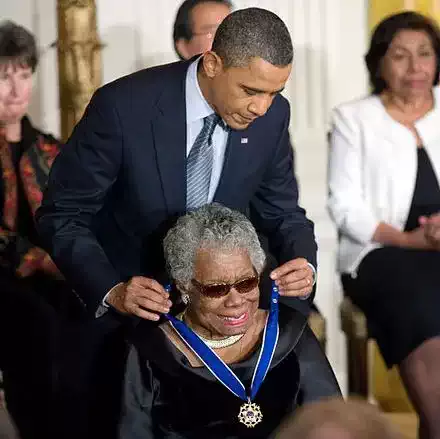
Maya Angelou
Momma Welfare Roll
Momma Welfare Roll
Her arms semaphore fat triangles,
Pudgy hands bunched on layered hips
Where bones idle under years of fatback
And lima beans.
Her jowls shiver in accusation
Of crimes clichéd by
Repetition. Her children, strangers
To childhood's toys, play
Best the games of darkened doorways,
Rooftop tag, and know the slick feel of
Other people's property.
Too fat to whore,
Too mad to work,
Searches her dreams for the
Lucky sign and walks bare-handed
Into a den of bereaucrats for
Her portion.
'They don't give me welfare.
I take it.'
Her arms semaphore fat triangles,
Pudgy hands bunched on layered hips
Where bones idle under years of fatback
And lima beans.
Her jowls shiver in accusation
Of crimes clichéd by
Repetition. Her children, strangers
To childhood's toys, play
Best the games of darkened doorways,
Rooftop tag, and know the slick feel of
Other people's property.
Too fat to whore,
Too mad to work,
Searches her dreams for the
Lucky sign and walks bare-handed
Into a den of bereaucrats for
Her portion.
'They don't give me welfare.
I take it.'
169
Maya Angelou
Alone
Alone
Lying, thinking
Last night
How to find my soul a home
Where water is not thirsty
And bread loaf is not stone
I came up with one thing
And I don't believe I'm wrong
That nobody,
But nobody
Can make it out here alone.
Alone, all alone
Nobody, but nobody
Can make it out here alone.
There are some millionaires
With money they can't use
Their wives run round like banshees
Their children sing the blues
They've got expensive doctors
To cure their hearts of stone.
But nobody
No, nobody
Can make it out here alone.
Alone, all alone
Nobody, but nobody
Can make it out here alone.
Now if you listen closely
I'll tell you what I know
Storm clouds are gathering
The wind is gonna blow
The race of man is suffering
And I can hear the moan,
'Cause nobody,
But nobody
Can make it out here alone.
Alone, all alone
Nobody, but nobody
Can make it out here alone.
Lying, thinking
Last night
How to find my soul a home
Where water is not thirsty
And bread loaf is not stone
I came up with one thing
And I don't believe I'm wrong
That nobody,
But nobody
Can make it out here alone.
Alone, all alone
Nobody, but nobody
Can make it out here alone.
There are some millionaires
With money they can't use
Their wives run round like banshees
Their children sing the blues
They've got expensive doctors
To cure their hearts of stone.
But nobody
No, nobody
Can make it out here alone.
Alone, all alone
Nobody, but nobody
Can make it out here alone.
Now if you listen closely
I'll tell you what I know
Storm clouds are gathering
The wind is gonna blow
The race of man is suffering
And I can hear the moan,
'Cause nobody,
But nobody
Can make it out here alone.
Alone, all alone
Nobody, but nobody
Can make it out here alone.
295
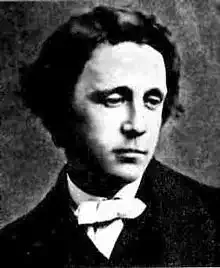
Lewis Carroll
The White Knight's Song
The White Knight's Song
'Haddock's Eyes' or 'The Aged Aged Man' or
'Ways and Means' or 'ASitting
On A Gate'
I'll tell thee everything I can;
There's little to relate.
I saw an aged, aged man,
Asitting
on a gate.
'Who are you, aged man?' I said.
'And how is it you live?'
And his answer trickled through my head
Like water through a sieve.
He said 'I look for butterflies
That sleep among the wheat;
I make them into muttonpies,
And sell them in the street.
I sell them unto men,' he said,
'Who sail on stormy seas;
And that's the way I get my breadA
trifle, if you please.'
But I was thinking of a plan
To dye one's whiskers green,
And always use so large a fan
That it could not be seen.
So, having no reply to give
To what the old man said,
I cried, 'Come, tell me how you live!'
And thumped him on the head.
His accents mild took up the tale;
He said, 'I go my ways,
And when I find a mountainrill,
I set it in a blaze.
And thence they make a stuff they call
Rowland's Macassar OilYet
twopencehalfpenny
is all
They give me for my toil.'
But I was thinking of a way
To feed oneself on batter,
And so go on from day to day
Getting a little fatter.
I shook him well from side to side,
Until his face was blue;
'Come, tell me how you live,' I cried
'And what it is you do!'
He said, 'I hunt for haddocks' eyes
Among the heather bright,
And work them into waistcoatbuttons
In the silent night.
And these I do not sell for gold
Or coin of silvery shine,
But for a copper halfpenny,
And that will purchase nine.
'I sometimes dig for buttered rolls,
Or set limed twigs for crabs;
I sometimes search the grassy knolls
For wheels of hansomcabs.
And that's the way' (he gave a wink)
'By which I get my wealthAnd
very gladly will I drink
Your Honor's noble health.'
I heard him then, for I had just
Completed my design
To keep the Menai bridge from rust
By boiling it in wine.
I thanked him much for telling me
The way he got his wealth,
But chiefly for his wish that he
Might drink my noble health.
And now, if e'er by chance I put
My fingers into glue,
Or madly squeeze a righthand
foot
Into a lefthand
shoe,
Or if I drop upon my toe
A very heavy weight,
I weep, for it reminds me so
Of that old man I used to knowWhose
look was mild, whose speech was slow,
Whose hair was whiter than the snow,
Whose face was very like a crow
With eyes, like cinders, all aglow,
Who seemed distracted with his woe,
Who rocked his body to and fro,
And muttered mumblingly and low,
As if his mouth were full of dough,
Who snorted like a buffaloThat
summer evening long ago
Asitting
on a gate.
'Haddock's Eyes' or 'The Aged Aged Man' or
'Ways and Means' or 'ASitting
On A Gate'
I'll tell thee everything I can;
There's little to relate.
I saw an aged, aged man,
Asitting
on a gate.
'Who are you, aged man?' I said.
'And how is it you live?'
And his answer trickled through my head
Like water through a sieve.
He said 'I look for butterflies
That sleep among the wheat;
I make them into muttonpies,
And sell them in the street.
I sell them unto men,' he said,
'Who sail on stormy seas;
And that's the way I get my breadA
trifle, if you please.'
But I was thinking of a plan
To dye one's whiskers green,
And always use so large a fan
That it could not be seen.
So, having no reply to give
To what the old man said,
I cried, 'Come, tell me how you live!'
And thumped him on the head.
His accents mild took up the tale;
He said, 'I go my ways,
And when I find a mountainrill,
I set it in a blaze.
And thence they make a stuff they call
Rowland's Macassar OilYet
twopencehalfpenny
is all
They give me for my toil.'
But I was thinking of a way
To feed oneself on batter,
And so go on from day to day
Getting a little fatter.
I shook him well from side to side,
Until his face was blue;
'Come, tell me how you live,' I cried
'And what it is you do!'
He said, 'I hunt for haddocks' eyes
Among the heather bright,
And work them into waistcoatbuttons
In the silent night.
And these I do not sell for gold
Or coin of silvery shine,
But for a copper halfpenny,
And that will purchase nine.
'I sometimes dig for buttered rolls,
Or set limed twigs for crabs;
I sometimes search the grassy knolls
For wheels of hansomcabs.
And that's the way' (he gave a wink)
'By which I get my wealthAnd
very gladly will I drink
Your Honor's noble health.'
I heard him then, for I had just
Completed my design
To keep the Menai bridge from rust
By boiling it in wine.
I thanked him much for telling me
The way he got his wealth,
But chiefly for his wish that he
Might drink my noble health.
And now, if e'er by chance I put
My fingers into glue,
Or madly squeeze a righthand
foot
Into a lefthand
shoe,
Or if I drop upon my toe
A very heavy weight,
I weep, for it reminds me so
Of that old man I used to knowWhose
look was mild, whose speech was slow,
Whose hair was whiter than the snow,
Whose face was very like a crow
With eyes, like cinders, all aglow,
Who seemed distracted with his woe,
Who rocked his body to and fro,
And muttered mumblingly and low,
As if his mouth were full of dough,
Who snorted like a buffaloThat
summer evening long ago
Asitting
on a gate.
201
Lewis Carroll
The Aged Aged Man
The Aged Aged Man
I'll tell thee everything I can;
There's little to relate.
I saw an aged aged man,
Asitting
on a gate.
"Who are you, aged man?" I said,
"And how is it you live?"
And his answer trickled through my head
Like water through a sieve.
He said, "I look for butterflies
That sleep among the wheat:
I make them into muttonpies,
And sell them in the street.
I sell them unto men," he said,
"Who sail on stormy seas;
And that's the way I get my bread—
A trifle; if you please."
But I was thinking of a plan
To dye one's whiskers green,
And always use so large a fan
That they could not be seen.
So, having no reply to give
To what the old man said,
I cried, "Come, tell me how you live!"
And thumped him on the head.
His accents mild took up the tale:
He said, "I go my ways,
And when I find a mountainrill,
I set it in a blaze;
And thence they make a stuff they call
Rowland's MacassarOil&
mdash;
Yet twopencehalfpenny
is all
They give me for my toil."
But I was thinking of a way
To feed oneself on batter,
And so go on from day to day
Getting a little fatter.
I shook him well from side to side,
Until his face was blue:
"Come, tell me how you live," I cried,
"And what it is you do!"
He said, "I hunt for haddocks' eyes
Among the heather bright,
And work them into waistcoat buttons
In the silent night.
And these I do not sell for gold
Or coin of silvery shine,
But for a copper halfpenny,
And that will purchase nine.
"I sometimes dig for buttered rolls,
Or set limed twigs for crabs;
I sometimes search the grassy knolls
For wheels of hansomcabs.
And that's the way" (he gave a wink)
"By which I get my wealth—
And very gladly will I drink
Your Honour's noble health."
I heard him then, for I had just
Completed my design
To keep the Menai bridge from rust
By boiling it in wine.
I thanked him much for telling me
The way he got his wealth,
But chiefly for his wish that he
Might drink my noble health.
And now, if e'er by chance I put
My fingers into glue,
Or madly squeeze a righthand
foot
Into a lefthand
shoe,
Or if I drop upon my toe
A very heavy weight,
I weep, for it reminds me so
Of that old man I used to know—
Whose look was mild, whose speech was slow,
Whose hair was whiter than the snow,
Whose face was very like a crow,
With eyes, like cinders, all aglow,
Who seemed distracted with his woe,
Who rocked his body to and fro,
And muttered mumblingly and low,
As if his mouth were full of dough,
Who snorted like a buffalo—
That summer evening long ago
Asitting
on a gate.
I'll tell thee everything I can;
There's little to relate.
I saw an aged aged man,
Asitting
on a gate.
"Who are you, aged man?" I said,
"And how is it you live?"
And his answer trickled through my head
Like water through a sieve.
He said, "I look for butterflies
That sleep among the wheat:
I make them into muttonpies,
And sell them in the street.
I sell them unto men," he said,
"Who sail on stormy seas;
And that's the way I get my bread—
A trifle; if you please."
But I was thinking of a plan
To dye one's whiskers green,
And always use so large a fan
That they could not be seen.
So, having no reply to give
To what the old man said,
I cried, "Come, tell me how you live!"
And thumped him on the head.
His accents mild took up the tale:
He said, "I go my ways,
And when I find a mountainrill,
I set it in a blaze;
And thence they make a stuff they call
Rowland's MacassarOil&
mdash;
Yet twopencehalfpenny
is all
They give me for my toil."
But I was thinking of a way
To feed oneself on batter,
And so go on from day to day
Getting a little fatter.
I shook him well from side to side,
Until his face was blue:
"Come, tell me how you live," I cried,
"And what it is you do!"
He said, "I hunt for haddocks' eyes
Among the heather bright,
And work them into waistcoat buttons
In the silent night.
And these I do not sell for gold
Or coin of silvery shine,
But for a copper halfpenny,
And that will purchase nine.
"I sometimes dig for buttered rolls,
Or set limed twigs for crabs;
I sometimes search the grassy knolls
For wheels of hansomcabs.
And that's the way" (he gave a wink)
"By which I get my wealth—
And very gladly will I drink
Your Honour's noble health."
I heard him then, for I had just
Completed my design
To keep the Menai bridge from rust
By boiling it in wine.
I thanked him much for telling me
The way he got his wealth,
But chiefly for his wish that he
Might drink my noble health.
And now, if e'er by chance I put
My fingers into glue,
Or madly squeeze a righthand
foot
Into a lefthand
shoe,
Or if I drop upon my toe
A very heavy weight,
I weep, for it reminds me so
Of that old man I used to know—
Whose look was mild, whose speech was slow,
Whose hair was whiter than the snow,
Whose face was very like a crow,
With eyes, like cinders, all aglow,
Who seemed distracted with his woe,
Who rocked his body to and fro,
And muttered mumblingly and low,
As if his mouth were full of dough,
Who snorted like a buffalo—
That summer evening long ago
Asitting
on a gate.
211
Lewis Carroll
Fame's Penny-Trumpet
Fame's Penny-Trumpet
Blow, blow your trumpets till they crack,
Ye little men of little souls!
And bid them huddle at your back Goldsucking
leeches, shoals on shoals!
Fill all the air with hungry wails "
Reward us, ere we think or write!
Without your Gold mere Knowledge fails
To sate the swinish appetite!"
And, where great Plato paced serene,
Or Newton paused with wistful eye,
Rush to the chace with hoofs unclean
And Babelclamour
of the sty
Be yours the pay: be theirs the praise:
We will not rob them of their due,
Nor vex the ghosts of other days
By naming them along with you.
They sought and found undying fame:
They toiled not for reward nor thanks:
Their cheeks are hot with honest shame
For you, the modern mountebanks!
Who preach of Justice plead
with tears
That Love and Mercy should abound While
marking with complacent ears
The moaning of some tortured hound:
Who prate of Wisdom nay,
forbear,
Lest Wisdom turn on you in wrath,
Trampling, with heel that will not spare,
The vermin that beset her path!
Go, throng each other's drawingrooms,
Ye idols of a petty clique:
Strut your brief hour in borrowed plumes,
And make your pennytrumpets
squeak.
Deck your dull talk with pilfered shreds
Of learning from a nobler time,
And oil each other's little heads
With mutual Flattery's golden slime:
And when the topmost height ye gain,
And stand in Glory's ether clear,
And grasp the prize of all your pain So
many hundred pounds a year
Then let Fame's banner be unfurled!
Sing Paeans for a victory won!
Ye tapers, that would light the world,
And cast a shadow on the Sun
Who still shall pour His rays sublime,
One crystal flood, from East to West,
When YE have burned your little time
And feebly flickered into rest!
Blow, blow your trumpets till they crack,
Ye little men of little souls!
And bid them huddle at your back Goldsucking
leeches, shoals on shoals!
Fill all the air with hungry wails "
Reward us, ere we think or write!
Without your Gold mere Knowledge fails
To sate the swinish appetite!"
And, where great Plato paced serene,
Or Newton paused with wistful eye,
Rush to the chace with hoofs unclean
And Babelclamour
of the sty
Be yours the pay: be theirs the praise:
We will not rob them of their due,
Nor vex the ghosts of other days
By naming them along with you.
They sought and found undying fame:
They toiled not for reward nor thanks:
Their cheeks are hot with honest shame
For you, the modern mountebanks!
Who preach of Justice plead
with tears
That Love and Mercy should abound While
marking with complacent ears
The moaning of some tortured hound:
Who prate of Wisdom nay,
forbear,
Lest Wisdom turn on you in wrath,
Trampling, with heel that will not spare,
The vermin that beset her path!
Go, throng each other's drawingrooms,
Ye idols of a petty clique:
Strut your brief hour in borrowed plumes,
And make your pennytrumpets
squeak.
Deck your dull talk with pilfered shreds
Of learning from a nobler time,
And oil each other's little heads
With mutual Flattery's golden slime:
And when the topmost height ye gain,
And stand in Glory's ether clear,
And grasp the prize of all your pain So
many hundred pounds a year
Then let Fame's banner be unfurled!
Sing Paeans for a victory won!
Ye tapers, that would light the world,
And cast a shadow on the Sun
Who still shall pour His rays sublime,
One crystal flood, from East to West,
When YE have burned your little time
And feebly flickered into rest!
211
Lewis Carroll
A Game of Fives
A Game of Fives
Five little girls, of Five, Four, Three, Two, One:
Rolling on the hearthrug, full of tricks and fun.
Five rosy girls, in years from Ten to Six:
Sitting down to lessons no
more time for tricks.
Five growing girls, from Fifteen to Eleven:
Music, Drawing, Languages, and food enough for seven!
Five winsome girls, from Twenty to Sixteen:
Each young man that calls, I say "Now tell me which you MEAN!"
Five dashing girls, the youngest Twentyone:
But, if nobody proposes, what is there to be done?
Five showy girls but
Thirty is an age
When girls may be ENGAGING, but they somehow don't ENGAGE.
Five dressy girls, of Thirtyone
or more:
So gracious to the shy young men they snubbed so much before!
Five PASSE girls Their
age? Well, never mind!
We jog along together, like the rest of human kind:
But the quondam "careless bachelor" begins to think he knows
The answer to that ancient problem "how the money goes"!
Five little girls, of Five, Four, Three, Two, One:
Rolling on the hearthrug, full of tricks and fun.
Five rosy girls, in years from Ten to Six:
Sitting down to lessons no
more time for tricks.
Five growing girls, from Fifteen to Eleven:
Music, Drawing, Languages, and food enough for seven!
Five winsome girls, from Twenty to Sixteen:
Each young man that calls, I say "Now tell me which you MEAN!"
Five dashing girls, the youngest Twentyone:
But, if nobody proposes, what is there to be done?
Five showy girls but
Thirty is an age
When girls may be ENGAGING, but they somehow don't ENGAGE.
Five dressy girls, of Thirtyone
or more:
So gracious to the shy young men they snubbed so much before!
Five PASSE girls Their
age? Well, never mind!
We jog along together, like the rest of human kind:
But the quondam "careless bachelor" begins to think he knows
The answer to that ancient problem "how the money goes"!
215
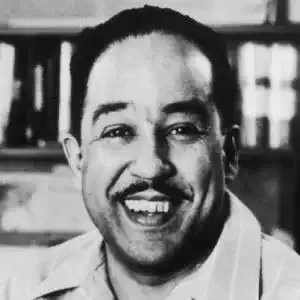
Langston Hughes
Madam and The Rent Man
Madam and The Rent Man
The rent man knocked.
He said, Howdy-do?
I said, What
Can I do for you?
He said, You know
Your rent is due.
I said, Listen,
Before I'd pay
I'd go to Hades
And rot away!
The sink is broke,
The water don't run,
And you ain't done a thing
You promised to've done.
Back window's cracked,
Kitchen floor squeaks,
There's rats in the cellar,
And the attic leaks.
He said, Madam,
It's not up to me.
I'm just the agent,
Don't you see?
I said, Naturally,
You pass the buck.
If it's money you want
You're out of luck.
He said, Madam,
I ain't pleased!
I said, Neither am I.
So we agrees!
The rent man knocked.
He said, Howdy-do?
I said, What
Can I do for you?
He said, You know
Your rent is due.
I said, Listen,
Before I'd pay
I'd go to Hades
And rot away!
The sink is broke,
The water don't run,
And you ain't done a thing
You promised to've done.
Back window's cracked,
Kitchen floor squeaks,
There's rats in the cellar,
And the attic leaks.
He said, Madam,
It's not up to me.
I'm just the agent,
Don't you see?
I said, Naturally,
You pass the buck.
If it's money you want
You're out of luck.
He said, Madam,
I ain't pleased!
I said, Neither am I.
So we agrees!
507
Langston Hughes
Let America be America Again
Let America be America Again
Let America be America again.
Let it be the dream it used to be.
Let it be the pioneer on the plain
Seeking a home where he himself is free.
(America never was America to me.)
Let America be the dream the dreamers dreamed--
Let it be that great strong land of love
Where never kings connive nor tyrants scheme
That any man be crushed by one above.
(It never was America to me.)
O, let my land be a land where Liberty
Is crowned with no false patriotic wreath,
But opportunity is real, and life is free,
Equality is in the air we breathe.
(There's never been equality for me,
Nor freedom in this "homeland of the free.")
Say, who are you that mumbles in the dark?
And who are you that draws your veil across the stars?
I am the poor white, fooled and pushed apart,
I am the Negro bearing slavery's scars.
I am the red man driven from the land,
I am the immigrant clutching the hope I seek--
And finding only the same old stupid plan
Of dog eat dog, of mighty crush the weak.
I am the young man, full of strength and hope,
Tangled in that ancient endless chain
Of profit, power, gain, of grab the land!
Of grab the gold! Of grab the ways of satisfying need!
Of work the men! Of take the pay!
Of owning everything for one's own greed!
I am the farmer, bondsman to the soil.
I am the worker sold to the machine.
I am the Negro, servant to you all.
I am the people, humble, hungry, mean--
Hungry yet today despite the dream.
Beaten yet today--O, Pioneers!
I am the man who never got ahead,
The poorest worker bartered through the years.
Yet I'm the one who dreamt our basic dream
In the Old World while still a serf of kings,
Who dreamt a dream so strong, so brave, so true,
That even yet its mighty daring sings
In every brick and stone, in every furrow turned
That's made America the land it has become.
O, I'm the man who sailed those early seas
In search of what I meant to be my home--
For I'm the one who left dark Ireland's shore,
And Poland's plain, and England's grassy lea,
And torn from Black Africa's strand I came
To build a "homeland of the free."
The free?
Who said the free? Not me?
Surely not me? The millions on relief today?
The millions shot down when we strike?
The millions who have nothing for our pay?
For all the dreams we've dreamed
And all the songs we've sung
And all the hopes we've held
And all the flags we've hung,
The millions who have nothing for our pay--
Except the dream that's almost dead today.
O, let America be America again--
The land that never has been yet--
And yet must be--the land where every man is free.
The land that's mine--the poor man's, Indian's, Negro's, ME--
Who made America,
Whose sweat and blood, whose faith and pain,
Whose hand at the foundry, whose plow in the rain,
Must bring back our mighty dream again.
Sure, call me any ugly name you choose--
The steel of freedom does not stain.
From those who live like leeches on the people's lives,
We must take back our land again,
America!
O, yes,
I say it plain,
America never was America to me,
And yet I swear this oath--
America will be!
Out of the rack and ruin of our gangster death,
The rape and rot of graft, and stealth, and lies,
We, the people, must redeem
The land, the mines, the plants, the rivers.
The mountains and the endless plain--
All, all the stretch of these great green states--
And make America again!
Let America be America again.
Let it be the dream it used to be.
Let it be the pioneer on the plain
Seeking a home where he himself is free.
(America never was America to me.)
Let America be the dream the dreamers dreamed--
Let it be that great strong land of love
Where never kings connive nor tyrants scheme
That any man be crushed by one above.
(It never was America to me.)
O, let my land be a land where Liberty
Is crowned with no false patriotic wreath,
But opportunity is real, and life is free,
Equality is in the air we breathe.
(There's never been equality for me,
Nor freedom in this "homeland of the free.")
Say, who are you that mumbles in the dark?
And who are you that draws your veil across the stars?
I am the poor white, fooled and pushed apart,
I am the Negro bearing slavery's scars.
I am the red man driven from the land,
I am the immigrant clutching the hope I seek--
And finding only the same old stupid plan
Of dog eat dog, of mighty crush the weak.
I am the young man, full of strength and hope,
Tangled in that ancient endless chain
Of profit, power, gain, of grab the land!
Of grab the gold! Of grab the ways of satisfying need!
Of work the men! Of take the pay!
Of owning everything for one's own greed!
I am the farmer, bondsman to the soil.
I am the worker sold to the machine.
I am the Negro, servant to you all.
I am the people, humble, hungry, mean--
Hungry yet today despite the dream.
Beaten yet today--O, Pioneers!
I am the man who never got ahead,
The poorest worker bartered through the years.
Yet I'm the one who dreamt our basic dream
In the Old World while still a serf of kings,
Who dreamt a dream so strong, so brave, so true,
That even yet its mighty daring sings
In every brick and stone, in every furrow turned
That's made America the land it has become.
O, I'm the man who sailed those early seas
In search of what I meant to be my home--
For I'm the one who left dark Ireland's shore,
And Poland's plain, and England's grassy lea,
And torn from Black Africa's strand I came
To build a "homeland of the free."
The free?
Who said the free? Not me?
Surely not me? The millions on relief today?
The millions shot down when we strike?
The millions who have nothing for our pay?
For all the dreams we've dreamed
And all the songs we've sung
And all the hopes we've held
And all the flags we've hung,
The millions who have nothing for our pay--
Except the dream that's almost dead today.
O, let America be America again--
The land that never has been yet--
And yet must be--the land where every man is free.
The land that's mine--the poor man's, Indian's, Negro's, ME--
Who made America,
Whose sweat and blood, whose faith and pain,
Whose hand at the foundry, whose plow in the rain,
Must bring back our mighty dream again.
Sure, call me any ugly name you choose--
The steel of freedom does not stain.
From those who live like leeches on the people's lives,
We must take back our land again,
America!
O, yes,
I say it plain,
America never was America to me,
And yet I swear this oath--
America will be!
Out of the rack and ruin of our gangster death,
The rape and rot of graft, and stealth, and lies,
We, the people, must redeem
The land, the mines, the plants, the rivers.
The mountains and the endless plain--
All, all the stretch of these great green states--
And make America again!
683
Langston Hughes
Brass Spittoons
Brass Spittoons
Clean the spittoons, boy.
Detroit,
Chicago,
Atlantic City,
Palm Beach.
Clean the spittoons.
The steam in hotel kitchens,
And the smoke in hotel lobbies,
And the slime in hotel spittoons:
Part of my life.
Hey, boy!
A nickel,
A dime,
A dollar,
Two dollars a day.
Hey, boy!
A nickel,
A dime,
A dollar,
Two dollars
Buy shoes for the baby.
House rent to pay.
Gin on Saturday,
Church on Sunday.
My God!
Babies and gin and church
And women and Sunday
All mixed with dimes and
Dollars and clean spittoons
And house rent to pay.
Hey, boy!
A bright bowl of brass is beautiful to the Lord.
Bright polished brass like the cymbals
Of King David’s dancers,
Like the wine cups of Solomon.
Hey, boy!
A clean spittoon on the altar of the Lord.
A clean bright spittoon all newly polished—
At least I can offer that.
Com’mere, boy!
Clean the spittoons, boy.
Detroit,
Chicago,
Atlantic City,
Palm Beach.
Clean the spittoons.
The steam in hotel kitchens,
And the smoke in hotel lobbies,
And the slime in hotel spittoons:
Part of my life.
Hey, boy!
A nickel,
A dime,
A dollar,
Two dollars a day.
Hey, boy!
A nickel,
A dime,
A dollar,
Two dollars
Buy shoes for the baby.
House rent to pay.
Gin on Saturday,
Church on Sunday.
My God!
Babies and gin and church
And women and Sunday
All mixed with dimes and
Dollars and clean spittoons
And house rent to pay.
Hey, boy!
A bright bowl of brass is beautiful to the Lord.
Bright polished brass like the cymbals
Of King David’s dancers,
Like the wine cups of Solomon.
Hey, boy!
A clean spittoon on the altar of the Lord.
A clean bright spittoon all newly polished—
At least I can offer that.
Com’mere, boy!
446
Langston Hughes
-50
-50
I’m all alone in this world, she said,
Ain’t got nobody to share my bed,
Ain’t got nobody to hold my hand—
The truth of the matter’s
I ain’t got no man.
Big Boy opened his mouth and said,
Trouble with you is
You ain’t got no head!
If you had a head and used your mind
You could have me with you
All the time.
She answered, Babe, what must I do?
He said, Share your bed—
And your money, too.
I’m all alone in this world, she said,
Ain’t got nobody to share my bed,
Ain’t got nobody to hold my hand—
The truth of the matter’s
I ain’t got no man.
Big Boy opened his mouth and said,
Trouble with you is
You ain’t got no head!
If you had a head and used your mind
You could have me with you
All the time.
She answered, Babe, what must I do?
He said, Share your bed—
And your money, too.
304
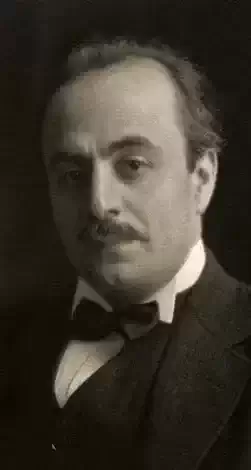
Khalil Gibran
Vision X
Vision X
There in the middle of the field, by the side of a crystalline stream, I saw a bird-cage
whose rods and hinges were fashioned by an expert's hands. In one corner lay a dead
bird, and in another were two basins -- one empty of water and the other of seeds. I
stood there reverently, as if the lifeless bird and the murmur of the water were worthy
of deep silence and respect -- something worth of examination and meditation by the
heard and conscience.
As I engrossed myself in view and thought, I found that the poor creature had died of
thirst beside a stream of water, and of hunger in the midst of a rich field, cradle of life;
like a rich man locked inside his iron safe, perishing from hunger amid heaps of gold.
Before my eyes I saw the cage turned suddenly into a human skeleton, and the dead
bird into a man's heart which was bleeding from a deep wound that looked like the lips
of a sorrowing woman. A voice came from that wound saying, "I am the human heart,
prisoner of substance and victim of earthly laws.
"In God's field of Beauty, at the edge of the stream of life, I was imprisoned in the cage
of laws made by man.
"In the center of beautiful Creation I died neglected because I was kept from enjoying
the freedom of God's bounty.
"Everything of beauty that awakens my love and desire is a disgrace, according to
man's conceptions; everything of goodness that I crave is but naught, according to his
judgment.
"I am the lost human heart, imprisoned in the foul dungeon of man's dictates, tied with
chains of earthly authority, dead and forgotten by laughing humanity whose tongue is
tied and whose eyes are empty of visible tears."
All these words I heard, and I saw them emerging with a stream of ever thinning blood
from that wounded heart.
More was said, but my misted eyes and crying should prevented further sight or
hearing.
There in the middle of the field, by the side of a crystalline stream, I saw a bird-cage
whose rods and hinges were fashioned by an expert's hands. In one corner lay a dead
bird, and in another were two basins -- one empty of water and the other of seeds. I
stood there reverently, as if the lifeless bird and the murmur of the water were worthy
of deep silence and respect -- something worth of examination and meditation by the
heard and conscience.
As I engrossed myself in view and thought, I found that the poor creature had died of
thirst beside a stream of water, and of hunger in the midst of a rich field, cradle of life;
like a rich man locked inside his iron safe, perishing from hunger amid heaps of gold.
Before my eyes I saw the cage turned suddenly into a human skeleton, and the dead
bird into a man's heart which was bleeding from a deep wound that looked like the lips
of a sorrowing woman. A voice came from that wound saying, "I am the human heart,
prisoner of substance and victim of earthly laws.
"In God's field of Beauty, at the edge of the stream of life, I was imprisoned in the cage
of laws made by man.
"In the center of beautiful Creation I died neglected because I was kept from enjoying
the freedom of God's bounty.
"Everything of beauty that awakens my love and desire is a disgrace, according to
man's conceptions; everything of goodness that I crave is but naught, according to his
judgment.
"I am the lost human heart, imprisoned in the foul dungeon of man's dictates, tied with
chains of earthly authority, dead and forgotten by laughing humanity whose tongue is
tied and whose eyes are empty of visible tears."
All these words I heard, and I saw them emerging with a stream of ever thinning blood
from that wounded heart.
More was said, but my misted eyes and crying should prevented further sight or
hearing.
346
Khalil Gibran
Two Infants II
Two Infants II
A prince stood on the balcony of his palace addressing a great multitude summoned for
the occasion and said, "Let me offer you and this whole fortunate country my
congratulations upon the birth of a new prince who will carry the name of my noble
family, and of whom you will be justly proud. He is the new bearer of a great and
illustrious ancestry, and upon him depends the brilliant future of this realm. Sing and
be merry!" The voices of the throngs, full of joy and thankfulness, flooded the sky with
exhilarating song, welcoming the new tyrant who would affix the yoke of oppression to
their necks by ruling the weak with bitter authority, and exploiting their bodies and
killing their souls. For that destiny, the people were singing and drinking ecstatically to
the heady of the new Emir.
Another child entered life and that kingdom at the same time. While the crowds were
glorifying the strong and belittling themselves by singing praise to a potential despot,
and while the angels of heaven were weeping over the people's weakness and
servitude, a sick woman was thinking. She lived in an old, deserted hovel and, lying in
her hard bed beside her newly born infant wrapped with ragged swaddles, was starving
to death. She was a penurious and miserable young wife neglected by humanity; her
husband had fallen into the trap of death set by the prince's oppression, leaving a
solitary woman to whom God had sent, that night, a tiny companion to prevent her
from working and sustaining life.
As the mass dispersed and silence was restored to the vicinity, the wretched woman
placed the infant on her lap and looked into his face and wept as if she were to baptize
him with tears. And with a hunger weakened voice she spoke to the child saying, "Why
have you left the spiritual world and come to share with me the bitterness of earthly
life? Why have you deserted the angels and the spacious firmament and come to this
miserable land of humans, filled with agony, oppression, and heartlessness? I have
nothing to give you except tears; will you be nourished on tears instead of milk? I have
no silk clothes to put on you; will my naked, shivering arms give you warmth? The little
animals graze in the pasture and return safely to their shed; and the small birds pick
the seeds and sleep placidly between the branches. But you, my beloved, have naught
save a loving but destitute mother."
Then she took the infant to her withered breast and clasped her arms around him as if
wanting to join the two bodies in one, as before. She lifted her burning eyes slowly
toward heaven and cried, "God! Have mercy on my unfortunate countrymen!"
At that moment the clouds floated from the face of the moon, whose beams penetrated
the transom of that poor home and fell upon two corpses.
A prince stood on the balcony of his palace addressing a great multitude summoned for
the occasion and said, "Let me offer you and this whole fortunate country my
congratulations upon the birth of a new prince who will carry the name of my noble
family, and of whom you will be justly proud. He is the new bearer of a great and
illustrious ancestry, and upon him depends the brilliant future of this realm. Sing and
be merry!" The voices of the throngs, full of joy and thankfulness, flooded the sky with
exhilarating song, welcoming the new tyrant who would affix the yoke of oppression to
their necks by ruling the weak with bitter authority, and exploiting their bodies and
killing their souls. For that destiny, the people were singing and drinking ecstatically to
the heady of the new Emir.
Another child entered life and that kingdom at the same time. While the crowds were
glorifying the strong and belittling themselves by singing praise to a potential despot,
and while the angels of heaven were weeping over the people's weakness and
servitude, a sick woman was thinking. She lived in an old, deserted hovel and, lying in
her hard bed beside her newly born infant wrapped with ragged swaddles, was starving
to death. She was a penurious and miserable young wife neglected by humanity; her
husband had fallen into the trap of death set by the prince's oppression, leaving a
solitary woman to whom God had sent, that night, a tiny companion to prevent her
from working and sustaining life.
As the mass dispersed and silence was restored to the vicinity, the wretched woman
placed the infant on her lap and looked into his face and wept as if she were to baptize
him with tears. And with a hunger weakened voice she spoke to the child saying, "Why
have you left the spiritual world and come to share with me the bitterness of earthly
life? Why have you deserted the angels and the spacious firmament and come to this
miserable land of humans, filled with agony, oppression, and heartlessness? I have
nothing to give you except tears; will you be nourished on tears instead of milk? I have
no silk clothes to put on you; will my naked, shivering arms give you warmth? The little
animals graze in the pasture and return safely to their shed; and the small birds pick
the seeds and sleep placidly between the branches. But you, my beloved, have naught
save a loving but destitute mother."
Then she took the infant to her withered breast and clasped her arms around him as if
wanting to join the two bodies in one, as before. She lifted her burning eyes slowly
toward heaven and cried, "God! Have mercy on my unfortunate countrymen!"
At that moment the clouds floated from the face of the moon, whose beams penetrated
the transom of that poor home and fell upon two corpses.
286
Khalil Gibran
Buying and Selling chapter XI
Buying and Selling chapter XI
And a merchant said, "Speak to us of Buying and Selling."
And he answered and said:
To you the earth yields her fruit, and you shall not want if you but know how to fill your
hands.
It is in exchanging the gifts of the earth that you shall find abundance and be satisfied.
Yet unless the exchange be in love and kindly justice, it will but lead some to greed
and others to hunger.
When in the market place you toilers of the sea and fields and vineyards meet the
weavers and the potters and the gatherers of spices, -
Invoke then the master spirit of the earth, to come into your midst and sanctify the
scales and the reckoning that weighs value against value.
And suffer not the barren-handed to take part in your transactions, who would sell
their words for your labour.
To such men you should say,
"Come with us to the field, or go with our brothers to the sea and cast your net;
For the land and the sea shall be bountiful to you even as to us."
And if there come the singers and the dancers and the flute players, - buy of their gifts
also.
For they too are gatherers of fruit and frankincense, and that which they bring, though
fashioned of dreams, is raiment and food for your soul.
And before you leave the marketplace, see that no one has gone his way with empty
hands.
For the master spirit of the earth shall not sleep peacefully upon the wind till the needs
of the least of you are satisfied.
And a merchant said, "Speak to us of Buying and Selling."
And he answered and said:
To you the earth yields her fruit, and you shall not want if you but know how to fill your
hands.
It is in exchanging the gifts of the earth that you shall find abundance and be satisfied.
Yet unless the exchange be in love and kindly justice, it will but lead some to greed
and others to hunger.
When in the market place you toilers of the sea and fields and vineyards meet the
weavers and the potters and the gatherers of spices, -
Invoke then the master spirit of the earth, to come into your midst and sanctify the
scales and the reckoning that weighs value against value.
And suffer not the barren-handed to take part in your transactions, who would sell
their words for your labour.
To such men you should say,
"Come with us to the field, or go with our brothers to the sea and cast your net;
For the land and the sea shall be bountiful to you even as to us."
And if there come the singers and the dancers and the flute players, - buy of their gifts
also.
For they too are gatherers of fruit and frankincense, and that which they bring, though
fashioned of dreams, is raiment and food for your soul.
And before you leave the marketplace, see that no one has gone his way with empty
hands.
For the master spirit of the earth shall not sleep peacefully upon the wind till the needs
of the least of you are satisfied.
302

Kazi Nazrul Islam
The Destitutes
The Destitutes
Encircled by the water-waves of suffering the
shoal of quicksand,
O insane! Who built a shack there
with your precious hand?
Lightening reveals a new attitude,
Leave this neighborhood, O destitute!
The flowing tear of motherly cloud
is raining over your head; and
The land over there is calling you,
waving its plants and trees' band.
Your daughters are flood-slaughtered weeping
bitterly,
They are being invited today
by the ocean, motherly.
O boatman! O boatman!
Lift your sail - delay? - no more you can,
Your ride is like a stormy fan,
swinging on the waves of sea.
O boatman! Why more delay?
Lift your anchor, let it be free.
Here in the broken life's span,
your time is almost gone!
Look, your gazelle, O boatman,
eyes at the shore for a new dawn.
Your friends have already begun the voyage,
as the night sets its dark stage,
mat-bound your shoulder's edge,
Don't, any more, live in yawn!
To give up the tie of this bondage,
how much more you need to be overdrawn?
Diamond or jewels, you didn't seek;
Millionaire's rich you didn't cherish;
Your want is of a miserable meek
That's as small as a potter's dish.
You sought to sleep in peace,
And, a small mat, even if torn, apiece,
A lamp offering light's kiss,
A small shack with a door, is what you wish!
Enough of death's hanging shadow, or illness' hiss,
No more burglars stealing your fish.
O boatman, sail your boat now
toward land, ashore.
From the hard soil
let your soft feet be bloodied, like never before!
You will roam around as a storm;
You will traverse through places of soft or rugged form;
Approaching rains, like dance they perform,
as they swirl from the Indus river's floor.
Come on, the riders of water now
to the land that invites you to its door.
[Original: Sharbohara (Bengali) , Translation by: Mohammad Omar Farooq]
Encircled by the water-waves of suffering the
shoal of quicksand,
O insane! Who built a shack there
with your precious hand?
Lightening reveals a new attitude,
Leave this neighborhood, O destitute!
The flowing tear of motherly cloud
is raining over your head; and
The land over there is calling you,
waving its plants and trees' band.
Your daughters are flood-slaughtered weeping
bitterly,
They are being invited today
by the ocean, motherly.
O boatman! O boatman!
Lift your sail - delay? - no more you can,
Your ride is like a stormy fan,
swinging on the waves of sea.
O boatman! Why more delay?
Lift your anchor, let it be free.
Here in the broken life's span,
your time is almost gone!
Look, your gazelle, O boatman,
eyes at the shore for a new dawn.
Your friends have already begun the voyage,
as the night sets its dark stage,
mat-bound your shoulder's edge,
Don't, any more, live in yawn!
To give up the tie of this bondage,
how much more you need to be overdrawn?
Diamond or jewels, you didn't seek;
Millionaire's rich you didn't cherish;
Your want is of a miserable meek
That's as small as a potter's dish.
You sought to sleep in peace,
And, a small mat, even if torn, apiece,
A lamp offering light's kiss,
A small shack with a door, is what you wish!
Enough of death's hanging shadow, or illness' hiss,
No more burglars stealing your fish.
O boatman, sail your boat now
toward land, ashore.
From the hard soil
let your soft feet be bloodied, like never before!
You will roam around as a storm;
You will traverse through places of soft or rugged form;
Approaching rains, like dance they perform,
as they swirl from the Indus river's floor.
Come on, the riders of water now
to the land that invites you to its door.
[Original: Sharbohara (Bengali) , Translation by: Mohammad Omar Farooq]
545
Kazi Nazrul Islam
Robbers and Dacoits
Robbers and Dacoits
Who calls you a dacoit, friend,
Who calls you a robber?
All around dacoits reign today,
And thieves prosper.
Who is judging the robbers and the dacoits?
Who is the lord of justice?
Ask him, friend, who is not a dacoit today,
Who is not a robber chief.
My lord, raise your mace of justice and punish
Those wealthy and the rich who thrived
Robbing the humble poor and the deprive.
Today the greater the robber, the bigger the thief
and the cleverer the cheat
The more honourable, the more distinguished
and the more dignified his seat
In the assembly of nations.
All around
Bricks red with the blood of the subjects
Go to raise the king's palaces
And the factories of the gangster-rich flourish
Rendering thousands homeless.
The cunning devils start mills
Where men are ground to pieces,
Where from hungry millions emerge,
Sucked dry like sugarcane,
Bereft of their juices.
Squeezing out the life blood of millions of men
The mill owners amass vast wealth in their hidden den.
The money lenders grow rich
Robbing the helpless,
And the Zamindars on joy rides go
Rendering the weak homeless.
The greedy merchants in this earth
Have built a house of prostitution of wealth
There the vice Saki dances and drinks
The gold demon's health.
Losing health, food, life, hope, language and all
Bankrupt man is heading to a terrible fall.
There is no way of escape
The gold-hungry monsters have dug
Deep invincible moats all around,
The world today is a prison sound
With cruel gangsters working as sentinel.
Thieves are friends here
Cheats are comrades dear.
Who calls you a dacoit, dear friend?
Who calls you a robber?
You may have stolen money or goods,
But you have not dug a dagger
In some one's tender-heart.
You may be thieves all right
But not inhuman like the so-called great
You can turn Valmikis yet
When true men you meet
You who are the Ratnakars.
[Original: Chor-Dakaat; Translation: Kabir Chowdhury]
Who calls you a dacoit, friend,
Who calls you a robber?
All around dacoits reign today,
And thieves prosper.
Who is judging the robbers and the dacoits?
Who is the lord of justice?
Ask him, friend, who is not a dacoit today,
Who is not a robber chief.
My lord, raise your mace of justice and punish
Those wealthy and the rich who thrived
Robbing the humble poor and the deprive.
Today the greater the robber, the bigger the thief
and the cleverer the cheat
The more honourable, the more distinguished
and the more dignified his seat
In the assembly of nations.
All around
Bricks red with the blood of the subjects
Go to raise the king's palaces
And the factories of the gangster-rich flourish
Rendering thousands homeless.
The cunning devils start mills
Where men are ground to pieces,
Where from hungry millions emerge,
Sucked dry like sugarcane,
Bereft of their juices.
Squeezing out the life blood of millions of men
The mill owners amass vast wealth in their hidden den.
The money lenders grow rich
Robbing the helpless,
And the Zamindars on joy rides go
Rendering the weak homeless.
The greedy merchants in this earth
Have built a house of prostitution of wealth
There the vice Saki dances and drinks
The gold demon's health.
Losing health, food, life, hope, language and all
Bankrupt man is heading to a terrible fall.
There is no way of escape
The gold-hungry monsters have dug
Deep invincible moats all around,
The world today is a prison sound
With cruel gangsters working as sentinel.
Thieves are friends here
Cheats are comrades dear.
Who calls you a dacoit, dear friend?
Who calls you a robber?
You may have stolen money or goods,
But you have not dug a dagger
In some one's tender-heart.
You may be thieves all right
But not inhuman like the so-called great
You can turn Valmikis yet
When true men you meet
You who are the Ratnakars.
[Original: Chor-Dakaat; Translation: Kabir Chowdhury]
587
Kazi Nazrul Islam
Rise Up, O Farmer!
Rise Up, O Farmer!
O farmer, where is tile smile of your face?
Where is' your shepherd's bamboo flute'!
Where is your jute?
Who plunders it from your stock on riverside?
Who robs you of huge golden paddy grown in your fields?
The empty corn-bin in your courtyard resembles a husband-less daughter
lamenting in her father's home.
Your rural fields present winter-crops as though painted, why
does your son ask for salt and green chilies while eating?
It seems that the government has taxed on your curry too.
Have your sugar-canes been sweetened by the juice of your tears?
Who have drunk milk exploiting your cow?
Alas, your milk pot docs not hold even the starch of boiled rice.
Your younger child with high fever is healed up,
since he is sleeping in tile graveyard.
And he seems to drag her elder sister towards the grave, too.
The girl is calling him deliriously.
Mother replaces milk will oyster,
father weeps on his way to field burying his son;
around him tile fields are full of paddy and the sky is full of delight.
It seems that today's horizon is red by sucking' a farmer's blood.
Fields overflow with paddy, markets with goods,
the wharps with jute-loaded boats.
Who eats away tile crops of your field,who
are those swarm of locusts?
Why are you so destitute in this realm of merrymaking?
Why does the son of your home go to the grave?
Your cattle grazes in the vast pastures, but you get no milk,
O farmer, your hopes of living have gone away long before,
how do you stand lamentations beside a tomb?
Can't you wake up the burning of thunder in your arid bones?
How long shall you see with eyes wide open the theft by burglars?
Don't you possess a bamboo-stick even?
You may have no blood in your body, yet we want all your bones.
The plunderer robbing you of your boiled rice day
and night has ascended to affluency sucking your blood.
Your bone shall cause the bones of those plunderers decay,
and your rib-bones will turn into war swords.
Allah, the Benevolent, gives water to your fields,
energy to your wind to bloom flowers,
sun and moon rise up to grow your crops, would
those gifts of Allah again be plundered by that demon?
Though the sky is all clear, there is no hope.
Though Khuda's mercy comes in torrents,
you don't reach it. So raise up your hands straight,
that would give you instant strength.
Your crops shall fill your granary, and God shall bless you.
[Original: Otth re chashi; Translation: Mohammad Nurul Huda]
O farmer, where is tile smile of your face?
Where is' your shepherd's bamboo flute'!
Where is your jute?
Who plunders it from your stock on riverside?
Who robs you of huge golden paddy grown in your fields?
The empty corn-bin in your courtyard resembles a husband-less daughter
lamenting in her father's home.
Your rural fields present winter-crops as though painted, why
does your son ask for salt and green chilies while eating?
It seems that the government has taxed on your curry too.
Have your sugar-canes been sweetened by the juice of your tears?
Who have drunk milk exploiting your cow?
Alas, your milk pot docs not hold even the starch of boiled rice.
Your younger child with high fever is healed up,
since he is sleeping in tile graveyard.
And he seems to drag her elder sister towards the grave, too.
The girl is calling him deliriously.
Mother replaces milk will oyster,
father weeps on his way to field burying his son;
around him tile fields are full of paddy and the sky is full of delight.
It seems that today's horizon is red by sucking' a farmer's blood.
Fields overflow with paddy, markets with goods,
the wharps with jute-loaded boats.
Who eats away tile crops of your field,who
are those swarm of locusts?
Why are you so destitute in this realm of merrymaking?
Why does the son of your home go to the grave?
Your cattle grazes in the vast pastures, but you get no milk,
O farmer, your hopes of living have gone away long before,
how do you stand lamentations beside a tomb?
Can't you wake up the burning of thunder in your arid bones?
How long shall you see with eyes wide open the theft by burglars?
Don't you possess a bamboo-stick even?
You may have no blood in your body, yet we want all your bones.
The plunderer robbing you of your boiled rice day
and night has ascended to affluency sucking your blood.
Your bone shall cause the bones of those plunderers decay,
and your rib-bones will turn into war swords.
Allah, the Benevolent, gives water to your fields,
energy to your wind to bloom flowers,
sun and moon rise up to grow your crops, would
those gifts of Allah again be plundered by that demon?
Though the sky is all clear, there is no hope.
Though Khuda's mercy comes in torrents,
you don't reach it. So raise up your hands straight,
that would give you instant strength.
Your crops shall fill your granary, and God shall bless you.
[Original: Otth re chashi; Translation: Mohammad Nurul Huda]
564
Kazi Nazrul Islam
Poverty
Poverty
O poverty, thou hast made me great.
Thou hast made me honoured like Christ
With his crown of thorns. Thou hast given me
Courage to reveal all. To thee I owe
My insolent, naked eyes and sharp tongue.
Thy curse has turned my violin to a sword.
O proud saint, thy terrible fire
Has rendered my heaven barren.
It has prematurely dried beauty.
My feelings and my life.
Time and again I stretched my lean, cupped hands
To accept the gift of the beautiful.
But those hungry ones always came before me.
And did snatch it away ruthlessly,
Now my word of imagination is
Dry as a vast desert.
And my own beautiful!
My yellow-stalked pensive desire
Wants to blossom like the fragrant shefali.
But thou cruel one
Dost ruthlessly break the soft stalk
As the woodcutter chopsthe branches
Off the trees. My heart grows tender
Like the autumn morning
It fills with love
Like the dew-laden earth.
But thou art the blazing sun
And thy fiery heart dries up the tiny dropp of the earth
I grow listless in the shadowy skirt of the earth
And my dreams of beauty and goodness vanish!
With a bitter tongue thou askest,
'What's the use of nectar?
It has no sting, no intoxication, no madness it.
The search for heaven's secred drink
Is not for the in this sorrow-filled earth.
Thou art the serpent, born in pai.
Thou will sit in the bower of thorns
And weave the garland of flowers.
I put on thy forehead the sing
Of suffering and woe.'
So I sing, I weave a garland,
While my throat is on fire,
And my serpent daughter bites me all over!
O unforgiving Durbasha! thou wanderest
From door to door with thy beggar's bowl.
Thou goes to the peaceful abode of
Some sleeping happy couple
And sternly callest, 'O fool,
Knowest thou, that this earth is not anybody's
Pleasure bower for luxury adn ease.
Here is sorrow and separation
And a hundred wants and disease.
Under the arms of the beloved
There are thorns in the bed,
And now must thou prepare
To savour these.' The unhappy home
Is shattered in a moment,
And woeful laments rend
The air. The light of joy is extinguished
And endless nights descends.
Thou walkest the road alone
Lean, hungry and starved.
Suddenly some sight makes thy eyebrows
Arch in annoyance and thine eyes
Blazeforth-fires of anger!
And lo! famine, pestilence and tornado
Visit the country, pleasuregarden burn,
Palaces tumble, thy law
Knows nothing but death and destruction.
Nor for thee the license of courtesy.
Thou seekest the unashaamed revelation of stark nakedness.
Thou knowest no timid hesitation or polite embarrassment
Thou dost raise high the lowly head.
At thy signal the travellers on the road to death
Put round their neck the fatal noose
With cheerful smile on their faces!
Nursing the fire of perennial want in their bosom
They worship the god of death in fiendish glee!
Thou tramplest the crown of Lakshmi
Under thy feet. What tune
Dost thou want to wiring
Out of her violin? At thy touch
the music turns into criesof anguish!
Waking up in the morning Iheard yesterday
The plantive Sanai mourning those
Who had not returned yet, At home
The singer cried for them and wept bitter tears
And floating with that music the soul of the beloved
Wandered far to the distant spot
Where the love anxiously waited.
This morning I got up
And heard the Sanai again
Crying as mournfully as ever.
And the pensive Shefalika,
sad as a widow's smile,
Falls in clusters, spreading
A mild fragrance in the air.
Today the butterfly dances in restless joy
Numbing the flowers with its kisses.
And the wings of the bee
Carry the yellow of the petals,
It's body covered with honey.
Life seems to have sprung up suddenly
On all sides. Asong of welcome
Comes unconsciously to my lips
And unbidden tears spring to my eyes
Some one seems to have entwined my soul
With that of mother-earth. She comes forward
And with her dust-adorned hands
Offers me her presents.
It seems to me that she is the youngest daughter of mine,
My darling child!
But suddenly wake up with a start. O cruel saint, being my child,
Thou weepest in my home, hungry and stoned!
O my child, my darling one
I could not give thee even a dropp of milk
No right have I to rejoice.
Poverty weeps within my doors forever
As my spouse and my child.
Who will play the flute?
Where shall I get the happy smile
Of the beautiful? Where the honeyed drink
I have drunk deep the hemlock
Of bitter tears!
And still even today
I hear the mournful tune of the Sanai.
[Translation: Kabir Chowdhury ]
O poverty, thou hast made me great.
Thou hast made me honoured like Christ
With his crown of thorns. Thou hast given me
Courage to reveal all. To thee I owe
My insolent, naked eyes and sharp tongue.
Thy curse has turned my violin to a sword.
O proud saint, thy terrible fire
Has rendered my heaven barren.
It has prematurely dried beauty.
My feelings and my life.
Time and again I stretched my lean, cupped hands
To accept the gift of the beautiful.
But those hungry ones always came before me.
And did snatch it away ruthlessly,
Now my word of imagination is
Dry as a vast desert.
And my own beautiful!
My yellow-stalked pensive desire
Wants to blossom like the fragrant shefali.
But thou cruel one
Dost ruthlessly break the soft stalk
As the woodcutter chopsthe branches
Off the trees. My heart grows tender
Like the autumn morning
It fills with love
Like the dew-laden earth.
But thou art the blazing sun
And thy fiery heart dries up the tiny dropp of the earth
I grow listless in the shadowy skirt of the earth
And my dreams of beauty and goodness vanish!
With a bitter tongue thou askest,
'What's the use of nectar?
It has no sting, no intoxication, no madness it.
The search for heaven's secred drink
Is not for the in this sorrow-filled earth.
Thou art the serpent, born in pai.
Thou will sit in the bower of thorns
And weave the garland of flowers.
I put on thy forehead the sing
Of suffering and woe.'
So I sing, I weave a garland,
While my throat is on fire,
And my serpent daughter bites me all over!
O unforgiving Durbasha! thou wanderest
From door to door with thy beggar's bowl.
Thou goes to the peaceful abode of
Some sleeping happy couple
And sternly callest, 'O fool,
Knowest thou, that this earth is not anybody's
Pleasure bower for luxury adn ease.
Here is sorrow and separation
And a hundred wants and disease.
Under the arms of the beloved
There are thorns in the bed,
And now must thou prepare
To savour these.' The unhappy home
Is shattered in a moment,
And woeful laments rend
The air. The light of joy is extinguished
And endless nights descends.
Thou walkest the road alone
Lean, hungry and starved.
Suddenly some sight makes thy eyebrows
Arch in annoyance and thine eyes
Blazeforth-fires of anger!
And lo! famine, pestilence and tornado
Visit the country, pleasuregarden burn,
Palaces tumble, thy law
Knows nothing but death and destruction.
Nor for thee the license of courtesy.
Thou seekest the unashaamed revelation of stark nakedness.
Thou knowest no timid hesitation or polite embarrassment
Thou dost raise high the lowly head.
At thy signal the travellers on the road to death
Put round their neck the fatal noose
With cheerful smile on their faces!
Nursing the fire of perennial want in their bosom
They worship the god of death in fiendish glee!
Thou tramplest the crown of Lakshmi
Under thy feet. What tune
Dost thou want to wiring
Out of her violin? At thy touch
the music turns into criesof anguish!
Waking up in the morning Iheard yesterday
The plantive Sanai mourning those
Who had not returned yet, At home
The singer cried for them and wept bitter tears
And floating with that music the soul of the beloved
Wandered far to the distant spot
Where the love anxiously waited.
This morning I got up
And heard the Sanai again
Crying as mournfully as ever.
And the pensive Shefalika,
sad as a widow's smile,
Falls in clusters, spreading
A mild fragrance in the air.
Today the butterfly dances in restless joy
Numbing the flowers with its kisses.
And the wings of the bee
Carry the yellow of the petals,
It's body covered with honey.
Life seems to have sprung up suddenly
On all sides. Asong of welcome
Comes unconsciously to my lips
And unbidden tears spring to my eyes
Some one seems to have entwined my soul
With that of mother-earth. She comes forward
And with her dust-adorned hands
Offers me her presents.
It seems to me that she is the youngest daughter of mine,
My darling child!
But suddenly wake up with a start. O cruel saint, being my child,
Thou weepest in my home, hungry and stoned!
O my child, my darling one
I could not give thee even a dropp of milk
No right have I to rejoice.
Poverty weeps within my doors forever
As my spouse and my child.
Who will play the flute?
Where shall I get the happy smile
Of the beautiful? Where the honeyed drink
I have drunk deep the hemlock
Of bitter tears!
And still even today
I hear the mournful tune of the Sanai.
[Translation: Kabir Chowdhury ]
736
Kazi Nazrul Islam
Pain of the Poor
Pain of the Poor
These children-suffering
from a lack of mother's care,
in rags, their bodies covered with dirt,
faces dried up from starving all day, scornful,
their bodies feverish, skin chapped all over.
They can't even get a meager meal
from laboring all day.
Ignoring them-O Rich, O Ruler,
how can you stand the taste of monda, mithai, khaja?
Starving, when they see you-eating,
they beg silently with their pathetic eyes.
Shame on you!-How do you still go on gorging?
All that rice you store in your binsjust
a portion of it could save them.
You have such a wide variety of clothing;
these children do not have even as much
as the rag you polish your shoes with.
You've trunk loads of clothing,
while these children freeze to death all night long
with their mothers lying in corridors and lanes.
You feel so happy from hugs and kisses
from your children,
their mothers weep holding them in their bosoms.
Your children have no dearth of toys,
their toys are what's been thrown outan
embarrassment for their mothers.
Their unkempt hair, turning brownish and matted,
their skin blackened from roaming about in the sun,
for no reason they get beaten and scolded by people.
Your children cry 'bloody murder' for minor incidents,
whereas they have at most a sombre face
even when their hearts break from sadness.
The mothers of these unfortunate childrenstanding
aloof-who understands how much pain there is
in their tearful eyes?
If there's a slight touch of fever
in your children, ten doctors come rushing to check them.
But for these children-even when they have a high temperature,
there's none to offer them even a sip of water;
reduced to skeletons, they die in their mothers' arms.
They don't eat pomegranates or grapes when they are sick;
they think they have the world
by getting just a piece of sugar candy.
Your children go to sleep in rocking cradles,
these children sleep under the tamarind tree;
even the most stone-hearted aught to be moved to see this.
Nobody understands their misery,
everybody despises them
and thinks, 'Why do they litter the streets?'
So take heed, a burning stomach needs to complain;
I don't wish that even on my enemies. .
Even in such misery,
God will supposedly grant them welfare-that's
the only consolation for the poor.
[Original: Goriber baytha; Translation: Sajed Kamal]
These children-suffering
from a lack of mother's care,
in rags, their bodies covered with dirt,
faces dried up from starving all day, scornful,
their bodies feverish, skin chapped all over.
They can't even get a meager meal
from laboring all day.
Ignoring them-O Rich, O Ruler,
how can you stand the taste of monda, mithai, khaja?
Starving, when they see you-eating,
they beg silently with their pathetic eyes.
Shame on you!-How do you still go on gorging?
All that rice you store in your binsjust
a portion of it could save them.
You have such a wide variety of clothing;
these children do not have even as much
as the rag you polish your shoes with.
You've trunk loads of clothing,
while these children freeze to death all night long
with their mothers lying in corridors and lanes.
You feel so happy from hugs and kisses
from your children,
their mothers weep holding them in their bosoms.
Your children have no dearth of toys,
their toys are what's been thrown outan
embarrassment for their mothers.
Their unkempt hair, turning brownish and matted,
their skin blackened from roaming about in the sun,
for no reason they get beaten and scolded by people.
Your children cry 'bloody murder' for minor incidents,
whereas they have at most a sombre face
even when their hearts break from sadness.
The mothers of these unfortunate childrenstanding
aloof-who understands how much pain there is
in their tearful eyes?
If there's a slight touch of fever
in your children, ten doctors come rushing to check them.
But for these children-even when they have a high temperature,
there's none to offer them even a sip of water;
reduced to skeletons, they die in their mothers' arms.
They don't eat pomegranates or grapes when they are sick;
they think they have the world
by getting just a piece of sugar candy.
Your children go to sleep in rocking cradles,
these children sleep under the tamarind tree;
even the most stone-hearted aught to be moved to see this.
Nobody understands their misery,
everybody despises them
and thinks, 'Why do they litter the streets?'
So take heed, a burning stomach needs to complain;
I don't wish that even on my enemies. .
Even in such misery,
God will supposedly grant them welfare-that's
the only consolation for the poor.
[Original: Goriber baytha; Translation: Sajed Kamal]
632

Jonathan Swift
The Fable Of Midas
The Fable Of Midas
Midas, we are in story told,
Turn'd every thing he touch'd to gold:
He chipp'd his bread; the pieces round
Glitter'd like spangles on the ground:
A codling, ere it went his lip in,
Would straight become a golden pippin.
He call'd for drink; you saw him sup
Potable gold in golden cup:
His empty paunch that he might fill,
He suck'd his victuals thro' a quill.
Untouch'd it pass'd between his grinders,
Or't had been happy for gold-finders:
He cock'd his hat, you would have said
Mambrino's helm adorn'd his head;
Whene'er he chanced his hands to lay
On magazines of corn or hay,
Gold ready coin'd appear'd instead
Of paltry provender and bread;
Hence, we are by wise farmers told
Old hay is equal to old gold:
And hence a critic deep maintains
We learn'd to weigh our gold by grains.
This fool had got a lucky hit;
And people fancied he had wit,
Two gods their skill in music tried
And both chose Midas to decide:
He against Ph[oelig]bus' harp decreed,
And gave it for Pan's oaten reed:
The god of wit, to show his grudge,
Clapt asses' ears upon the judge,
A goodly pair, erect and wide,
Which he could neither gild nor hide.
And now the virtue of his hands
Was lost among Pactolus' sands,
Against whose torrent while he swims
The golden scurf peels off his limbs:
Fame spreads the news, and people travel
From far, to gather golden gravel;
Midas, exposed to all their jeers,
Had lost his art, and kept his ears.
This tale inclines the gentle reader
To think upon a certain leader;
To whom, from Midas down, descends
That virtue in the fingers' ends.
What else by perquisites are meant,
By pensions, bribes, and three per cent.?
By places and commissions sold,
And turning dung itself to gold?
By starving in the midst of store,
As t'other Midas did before?
None e'er did modern Midas chuse
Subject or patron of his muse,
But found him thus their merit scan,
That Phoebus must give place to Pan:
He values not the poet's praise,
Nor will exchange his plums for bays.
To Pan alone rich misers call;
And there's the jest, for Pan is ALL.
Here English wits will be to seek,
Howe'er, 'tis all one in the Greek.
Besides, it plainly now appears
Our Midas, too, has ass's ears:
Where every fool his mouth applies,
And whispers in a thousand lies;
Such gross delusions could not pass
Thro' any ears but of an ass.
But gold defiles with frequent touch,
There's nothing fouls the hand so much;
And scholars give it for the cause
Of British Midas' dirty paws;
Which, while the senate strove to scour,
They wash'd away the chemic power.
While he his utmost strength applied,
To swim against this popular tide,
The golden spoils flew off apace,
Here fell a pension, there a place:
The torrent merciless imbibes
Commissions, perquisites, and bribes,
By their own weight sunk to the bottom;
Much good may't do 'em that have caught 'em!
And Midas now neglected stands,
With ass's ears, and dirty hands.
Midas, we are in story told,
Turn'd every thing he touch'd to gold:
He chipp'd his bread; the pieces round
Glitter'd like spangles on the ground:
A codling, ere it went his lip in,
Would straight become a golden pippin.
He call'd for drink; you saw him sup
Potable gold in golden cup:
His empty paunch that he might fill,
He suck'd his victuals thro' a quill.
Untouch'd it pass'd between his grinders,
Or't had been happy for gold-finders:
He cock'd his hat, you would have said
Mambrino's helm adorn'd his head;
Whene'er he chanced his hands to lay
On magazines of corn or hay,
Gold ready coin'd appear'd instead
Of paltry provender and bread;
Hence, we are by wise farmers told
Old hay is equal to old gold:
And hence a critic deep maintains
We learn'd to weigh our gold by grains.
This fool had got a lucky hit;
And people fancied he had wit,
Two gods their skill in music tried
And both chose Midas to decide:
He against Ph[oelig]bus' harp decreed,
And gave it for Pan's oaten reed:
The god of wit, to show his grudge,
Clapt asses' ears upon the judge,
A goodly pair, erect and wide,
Which he could neither gild nor hide.
And now the virtue of his hands
Was lost among Pactolus' sands,
Against whose torrent while he swims
The golden scurf peels off his limbs:
Fame spreads the news, and people travel
From far, to gather golden gravel;
Midas, exposed to all their jeers,
Had lost his art, and kept his ears.
This tale inclines the gentle reader
To think upon a certain leader;
To whom, from Midas down, descends
That virtue in the fingers' ends.
What else by perquisites are meant,
By pensions, bribes, and three per cent.?
By places and commissions sold,
And turning dung itself to gold?
By starving in the midst of store,
As t'other Midas did before?
None e'er did modern Midas chuse
Subject or patron of his muse,
But found him thus their merit scan,
That Phoebus must give place to Pan:
He values not the poet's praise,
Nor will exchange his plums for bays.
To Pan alone rich misers call;
And there's the jest, for Pan is ALL.
Here English wits will be to seek,
Howe'er, 'tis all one in the Greek.
Besides, it plainly now appears
Our Midas, too, has ass's ears:
Where every fool his mouth applies,
And whispers in a thousand lies;
Such gross delusions could not pass
Thro' any ears but of an ass.
But gold defiles with frequent touch,
There's nothing fouls the hand so much;
And scholars give it for the cause
Of British Midas' dirty paws;
Which, while the senate strove to scour,
They wash'd away the chemic power.
While he his utmost strength applied,
To swim against this popular tide,
The golden spoils flew off apace,
Here fell a pension, there a place:
The torrent merciless imbibes
Commissions, perquisites, and bribes,
By their own weight sunk to the bottom;
Much good may't do 'em that have caught 'em!
And Midas now neglected stands,
With ass's ears, and dirty hands.
264
Jonathan Swift
Stella At Wood Park, A House Of Charles Ford, Esq., Near Dublin
Stella At Wood Park, A House Of Charles Ford, Esq., Near Dublin
Don Carlos, in a merry spight,
Did Stella to his house invite:
He entertain'd her half a year
With generous wines and costly cheer.
Don Carlos made her chief director,
That she might o'er the servants hector.
In half a week the dame grew nice,
Got all things at the highest price:
Now at the table head she sits,
Presented with the nicest bits:
She look'd on partridges with scorn,
Except they tasted of the corn:
A haunch of ven'son made her sweat,
Unless it had the right fumette.
Don Carlos earnestly would beg,
'Dear Madam, try this pigeon's leg;'
Was happy, when he could prevail
To make her only touch a quail.
Through candle-light she view'd the wine,
To see that ev'ry glass was fine.
At last, grown prouder than the devil
With feeding high, and treatment civil,
Don Carlos now began to find
His malice work as he design'd.
The winter sky began to frown:
Poor Stella must pack off to town;
From purling streams and fountains bubbling,
To Liffey's stinking tide in Dublin:
From wholesome exercise and air
To sossing in an easy-chair:
From stomach sharp, and hearty feeding,
To piddle like a lady breeding:
From ruling there the household singly.
To be directed here by Dingley:
From every day a lordly banquet,
To half a joint, and God be thank it:
From every meal Pontac in plenty,
To half a pint one day in twenty:
From Ford attending at her call,
To visits of Archdeacon Wall:
From Ford, who thinks of nothing mean,
To the poor doings of the Dean:
From growing richer with good cheer,
To running out by starving here.
But now arrives the dismal day;
She must return to Ormond Quay.
The coachman stopt; she look'd, and swore
The rascal had mistook the door:
At coming in, you saw her stoop;
The entry brush'd against her hoop:
Each moment rising in her airs,
She curst the narrow winding stairs:
Began a thousand faults to spy;
The ceiling hardly six feet high;
The smutty wainscot full of cracks:
And half the chairs with broken backs:
Her quarter's out at Lady-day;
She vows she will no longer stay
In lodgings like a poor Grisette,
While there are houses to be let.
Howe'er, to keep her spirits up,
She sent for company to sup:
When all the while you might remark,
She strove in vain to ape Wood Park.
Two bottles call'd for, (half her store,
The cupboard could contain but four
A supper worthy of herself,
Five nothings in five plates of delf.
Thus for a week the farce went on;
When, all her country savings gone,
She fell into her former scene,
Small beer, a herring, and the Dean.
Thus far in jest: though now, I fear,
You think my jesting too severe;
But poets, when a hint is new,
Regard not whether false or true:
Yet raillery gives no offence,
Where truth has not the least pretence;
Nor can be more securely placed
Than on a nymph of Stella's taste.
I must confess your wine and vittle
I was too hard upon a little:
Your table neat, your linen fine;
And, though in miniature, you shine:
Yet, when you sigh to leave Wood Park,
The scene, the welcome, and the spark,
To languish in this odious town,
And pull your haughty stomach down,
We think you quite mistake the case,
The virtue lies not in the place:
For though my raillery were true,
A cottage is Wood Park with you.
Don Carlos, in a merry spight,
Did Stella to his house invite:
He entertain'd her half a year
With generous wines and costly cheer.
Don Carlos made her chief director,
That she might o'er the servants hector.
In half a week the dame grew nice,
Got all things at the highest price:
Now at the table head she sits,
Presented with the nicest bits:
She look'd on partridges with scorn,
Except they tasted of the corn:
A haunch of ven'son made her sweat,
Unless it had the right fumette.
Don Carlos earnestly would beg,
'Dear Madam, try this pigeon's leg;'
Was happy, when he could prevail
To make her only touch a quail.
Through candle-light she view'd the wine,
To see that ev'ry glass was fine.
At last, grown prouder than the devil
With feeding high, and treatment civil,
Don Carlos now began to find
His malice work as he design'd.
The winter sky began to frown:
Poor Stella must pack off to town;
From purling streams and fountains bubbling,
To Liffey's stinking tide in Dublin:
From wholesome exercise and air
To sossing in an easy-chair:
From stomach sharp, and hearty feeding,
To piddle like a lady breeding:
From ruling there the household singly.
To be directed here by Dingley:
From every day a lordly banquet,
To half a joint, and God be thank it:
From every meal Pontac in plenty,
To half a pint one day in twenty:
From Ford attending at her call,
To visits of Archdeacon Wall:
From Ford, who thinks of nothing mean,
To the poor doings of the Dean:
From growing richer with good cheer,
To running out by starving here.
But now arrives the dismal day;
She must return to Ormond Quay.
The coachman stopt; she look'd, and swore
The rascal had mistook the door:
At coming in, you saw her stoop;
The entry brush'd against her hoop:
Each moment rising in her airs,
She curst the narrow winding stairs:
Began a thousand faults to spy;
The ceiling hardly six feet high;
The smutty wainscot full of cracks:
And half the chairs with broken backs:
Her quarter's out at Lady-day;
She vows she will no longer stay
In lodgings like a poor Grisette,
While there are houses to be let.
Howe'er, to keep her spirits up,
She sent for company to sup:
When all the while you might remark,
She strove in vain to ape Wood Park.
Two bottles call'd for, (half her store,
The cupboard could contain but four
A supper worthy of herself,
Five nothings in five plates of delf.
Thus for a week the farce went on;
When, all her country savings gone,
She fell into her former scene,
Small beer, a herring, and the Dean.
Thus far in jest: though now, I fear,
You think my jesting too severe;
But poets, when a hint is new,
Regard not whether false or true:
Yet raillery gives no offence,
Where truth has not the least pretence;
Nor can be more securely placed
Than on a nymph of Stella's taste.
I must confess your wine and vittle
I was too hard upon a little:
Your table neat, your linen fine;
And, though in miniature, you shine:
Yet, when you sigh to leave Wood Park,
The scene, the welcome, and the spark,
To languish in this odious town,
And pull your haughty stomach down,
We think you quite mistake the case,
The virtue lies not in the place:
For though my raillery were true,
A cottage is Wood Park with you.
268
Jonathan Swift
Robin And Harry
Robin And Harry
Robin to beggars with a curse,
Throws the last shilling in his purse;
And when the coachman comes for pay,
The rogue must call another day.
Grave Harry, when the poor are pressing
Gives them a penny and God's blessing;
But always careful of the main,
With twopence left, walks home in rain.
Robin from noon to night will prate,
Run out in tongue, as in estate;
And, ere a twelvemonth and a day,
Will not have one new thing to say.
Much talking is not Harry's vice;
He need not tell a story twice:
And, if he always be so thrifty,
His fund may last to five-and-fifty.
It so fell out that cautious Harry,
As soldiers use, for love must marry,
And, with his dame, the ocean cross'd;
(All for Love, or the World well Lost!)
Repairs a cabin gone to ruin,
Just big enough to shelter two in;
And in his house, if anybody come,
Will make them welcome to his modicum
Where Goody Julia milks the cows,
And boils potatoes for her spouse;
Or darns his hose, or mends his breeches,
While Harry's fencing up his ditches.
Robin, who ne'er his mind could fix,
To live without a coach-and-six,
To patch his broken fortunes, found
A mistress worth five thousand pound;
Swears he could get her in an hour,
If gaffer Harry would endow her;
And sell, to pacify his wrath,
A birth-right for a mess of broth.
Young Harry, as all Europe knows,
Was long the quintessence of beaux;
But, when espoused, he ran the fate
That must attend the married state;
From gold brocade and shining armour,
Was metamorphosed to a farmer;
His grazier's coat with dirt besmear'd;
Nor twice a-week will shave his beard.
Old Robin, all his youth a sloven,
At fifty-two, when he grew loving,
Clad in a coat of paduasoy,
A flaxen wig, and waistcoat gay,
Powder'd from shoulder down to flank,
In courtly style addresses Frank;
Twice ten years older than his wife,
Is doom'd to be a beau for life;
Supplying those defects by dress,
Which I must leave the world to guess.
Robin to beggars with a curse,
Throws the last shilling in his purse;
And when the coachman comes for pay,
The rogue must call another day.
Grave Harry, when the poor are pressing
Gives them a penny and God's blessing;
But always careful of the main,
With twopence left, walks home in rain.
Robin from noon to night will prate,
Run out in tongue, as in estate;
And, ere a twelvemonth and a day,
Will not have one new thing to say.
Much talking is not Harry's vice;
He need not tell a story twice:
And, if he always be so thrifty,
His fund may last to five-and-fifty.
It so fell out that cautious Harry,
As soldiers use, for love must marry,
And, with his dame, the ocean cross'd;
(All for Love, or the World well Lost!)
Repairs a cabin gone to ruin,
Just big enough to shelter two in;
And in his house, if anybody come,
Will make them welcome to his modicum
Where Goody Julia milks the cows,
And boils potatoes for her spouse;
Or darns his hose, or mends his breeches,
While Harry's fencing up his ditches.
Robin, who ne'er his mind could fix,
To live without a coach-and-six,
To patch his broken fortunes, found
A mistress worth five thousand pound;
Swears he could get her in an hour,
If gaffer Harry would endow her;
And sell, to pacify his wrath,
A birth-right for a mess of broth.
Young Harry, as all Europe knows,
Was long the quintessence of beaux;
But, when espoused, he ran the fate
That must attend the married state;
From gold brocade and shining armour,
Was metamorphosed to a farmer;
His grazier's coat with dirt besmear'd;
Nor twice a-week will shave his beard.
Old Robin, all his youth a sloven,
At fifty-two, when he grew loving,
Clad in a coat of paduasoy,
A flaxen wig, and waistcoat gay,
Powder'd from shoulder down to flank,
In courtly style addresses Frank;
Twice ten years older than his wife,
Is doom'd to be a beau for life;
Supplying those defects by dress,
Which I must leave the world to guess.
265
Jonathan Swift
On Gold
On Gold
All-ruling tyrant of the earth,
To vilest slaves I owe my birth,
How is the greatest monarch blest,
When in my gaudy livery drest!
No haughty nymph has power to run
From me; or my embraces shun.
Stabb'd to the heart, condemn'd to flame,
My constancy is still the same.
The favourite messenger of Jove,
And Lemnian god, consulting strove
To make me glorious to the sight
Of mortals, and the gods' delight.
Soon would their altar's flame expire
If I refused to lend them fire.
By fate exalted high in place,
Lo, here I stand with double face:
Superior none on earth I find;
But see below me all mankind
Yet, as it oft attends the great,
I almost sink with my own weight.
At every motion undertook,
The vulgar all consult my look.
I sometimes give advice in writing,
But never of my own inditing.
I am a courtier in my way;
For those who raised me, I betray;
And some give out that I entice
To lust, to luxury, and dice.
Who punishments on me inflict,
Because they find their pockets pickt.
By riding post, I lose my health,
And only to get others wealth.
All-ruling tyrant of the earth,
To vilest slaves I owe my birth,
How is the greatest monarch blest,
When in my gaudy livery drest!
No haughty nymph has power to run
From me; or my embraces shun.
Stabb'd to the heart, condemn'd to flame,
My constancy is still the same.
The favourite messenger of Jove,
And Lemnian god, consulting strove
To make me glorious to the sight
Of mortals, and the gods' delight.
Soon would their altar's flame expire
If I refused to lend them fire.
By fate exalted high in place,
Lo, here I stand with double face:
Superior none on earth I find;
But see below me all mankind
Yet, as it oft attends the great,
I almost sink with my own weight.
At every motion undertook,
The vulgar all consult my look.
I sometimes give advice in writing,
But never of my own inditing.
I am a courtier in my way;
For those who raised me, I betray;
And some give out that I entice
To lust, to luxury, and dice.
Who punishments on me inflict,
Because they find their pockets pickt.
By riding post, I lose my health,
And only to get others wealth.
268