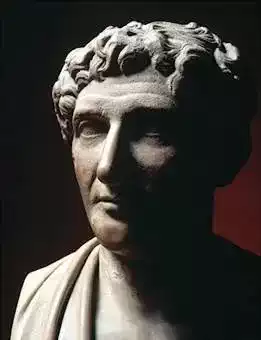
Metamorphoses: Book The Third
Metamorphoses: Book The Third
WHEN now Agenor had his daughter lost,
He sent his son to search on ev'ry coast;
And sternly bid him to his arms restore
The darling maid, or see his face no more,
But live an exile in a foreign clime;
Thus was the father pious to a crime.
The Story of The restless youth search'd all the world around;
of Cadmus But how can Jove in his amours be found?
When, tir'd at length with unsuccessful toil,
To shun his angry sire and native soil,
He goes a suppliant to the Delphick dome;
There asks the God what new appointed home
Should end his wand'rings, and his toils relieve.
The Delphick oracles this answer give.
"Behold among the fields a lonely cow,
Unworn with yokes, unbroken to the plow;
Mark well the place where first she lays her down,
There measure out thy walls, and build thy town,
And from thy guide Boeotia call the land,
In which the destin'd walls and town shall stand."
No sooner had he left the dark abode,
Big with the promise of the Delphick God,
When in the fields the fatal cow he view'd,
Nor gall'd with yokes, nor worn with servitude:
Her gently at a distance he pursu'd;
And as he walk'd aloof, in silence pray'd
To the great Pow'r whose counsels he obey'd.
Her way thro' flow'ry Panope she took,
And now, Cephisus, cross'd thy silver brook;
When to the Heav'ns her spacious front she rais'd,
And bellow'd thrice, then backward turning gaz'd
On those behind, 'till on the destin'd place
She stoop'd, and couch'd amid the rising grass.
Cadmus salutes the soil, and gladly hails
The new-found mountains, and the nameless vales,
And thanks the Gods, and turns about his eye
To see his new dominions round him lye;
Then sends his servants to a neighb'ring grove
For living streams, a sacrifice to Jove.
O'er the wide plain there rose a shady wood
Of aged trees; in its dark bosom stood
A bushy thicket, pathless and unworn,
O'er-run with brambles, and perplex'd with thorn:
Amidst the brake a hollow den was found,
With rocks and shelving arches vaulted round.
Deep in the dreary den, conceal'd from day,
Sacred to Mars, a mighty dragon lay,
Bloated with poison to a monstrous size;
Fire broke in flashes when he glanc'd his eyes:
His tow'ring crest was glorious to behold,
His shoulders and his sides were scal'd with gold;
Three tongues he brandish'd when he charg'd his
�
foes;
His teeth stood jaggy in three dreadful rowes.
The Tyrians in the den for water sought,
And with their urns explor'd the hollow vault:
From side to side their empty urns rebound,
And rowse the sleeping serpent with the sound.
Strait he bestirs him, and is seen to rise;
And now with dreadful hissings fills the skies,
And darts his forky tongues, and rowles his glaring
eyes.
The Tyrians drop their vessels in the fright,
All pale and trembling at the hideous sight.
Spire above spire uprear'd in air he stood,
And gazing round him over-look'd the wood:
Then floating on the ground in circles rowl'd;
Then leap'd upon them in a mighty fold.
Of such a bulk, and such a monstrous size
The serpent in the polar circle lyes,
That stretches over half the northern skies.
In vain the Tyrians on their arms rely,
In vain attempt to fight, in vain to fly:
All their endeavours and their hopes are vain;
Some die entangled in the winding train;
Some are devour'd, or feel a loathsom death,
Swoln up with blasts of pestilential breath.
And now the scorching sun was mounted high,
In all its lustre, to the noon-day sky;
When, anxious for his friends, and fill'd with
cares,
To search the woods th' impatient chief prepares.
A lion's hide around his loins he wore,
The well poiz'd javelin to the field he bore,
Inur'd to blood; the far-destroying dart;
And, the best weapon, an undaunted heart.
Soon as the youth approach'd the fatal place,
He saw his servants breathless on the grass;
The scaly foe amid their corps he view'd,
Basking at ease, and feasting in their blood.
"Such friends," he cries, "deserv'd a longer date;
But Cadmus will revenge or share their fate."
Then heav'd a stone, and rising to the throw,
He sent it in a whirlwind at the foe:
A tow'r, assaulted by so rude a stroke,
With all its lofty battlements had shook;
But nothing here th' unwieldy rock avails,
Rebounding harmless from the plaited scales,
That, firmly join'd, preserv'd him from a wound,
With native armour crusted all around.
With more success, the dart unerring flew,
Which at his back the raging warriour threw;
Amid the plaited scales it took its course,
And in the spinal marrow spent its force.
�
The monster hiss'd aloud, and rag'd in vain,
And writh'd his body to and fro with pain;
He bit the dart, and wrench'd the wood away;
The point still buried in the marrow lay.
And now his rage, increasing with his pain,
Reddens his eyes, and beats in ev'ry vein;
Churn'd in his teeth the foamy venom rose,
Whilst from his mouth a blast of vapours flows,
Such as th' infernal Stygian waters cast.
The plants around him wither in the blast.
Now in a maze of rings he lies enrowl'd,
Now all unravel'd, and without a fold;
Now, like a torrent, with a mighty force
Bears down the forest in his boist'rous course.
Cadmus gave back, and on the lion's spoil
Sustain'd the shock, then forc'd him to recoil;
The pointed jav'lin warded off his rage:
Mad with his pains, and furious to engage,
The serpent champs the steel, and bites the spear,
'Till blood and venom all the point besmear.
But still the hurt he yet receiv'd was slight;
For, whilst the champion with redoubled might
Strikes home the jav'lin, his retiring foe
Shrinks from the wound, and disappoints the blow.
The dauntless heroe still pursues his stroke,
And presses forward, 'till a knotty oak
Retards his foe, and stops him in the rear;
Full in his throat he plung'd the fatal spear,
That in th' extended neck a passage found,
And pierc'd the solid timber through the wound.
Fix'd to the reeling trunk, with many a stroke
Of his huge tail he lash'd the sturdy oak;
'Till spent with toil, and lab'ring hard for
breath,
He now lay twisting in the pangs of death.
Cadmus beheld him wallow in a flood
Of swimming poison, intermix'd with blood;
When suddenly a speech was heard from high
(The speech was heard, nor was the speaker nigh),
"Why dost thou thus with secret pleasure see,
Insulting man! what thou thy self shalt be?"
Astonish'd at the voice, he stood amaz'd,
And all around with inward horror gaz'd:
When Pallas swift descending from the skies,
Pallas, the guardian of the bold and wise,
Bids him plow up the field, and scatter round
The dragon's teeth o'er all the furrow'd ground;
Then tells the youth how to his wond'ring eyes
Embattled armies from the field should rise.
He sows the teeth at Pallas's command,
And flings the future people from his hand.
The clods grow warm, and crumble where he sows;
�
And now the pointed spears advance in rows;
Now nodding plumes appear, and shining crests,
Now the broad shoulders and the rising breasts;
O'er all the field the breathing harvest swarms,
A growing host, a crop of men and arms.
So through the parting stage a figure rears
Its body up, and limb by limb appears
By just degrees; 'till all the man arise,
And in his full proportion strikes the eyes.
Cadmus surpriz'd, and startled at the sight
Of his new foes, prepar'd himself for fight:
When one cry'd out, "Forbear, fond man, forbear
To mingle in a blind promiscuous war."
This said, he struck his brother to the ground,
Himself expiring by another's wound;
Nor did the third his conquest long survive,
Dying ere scarce he had begun to live.
The dire example ran through all the field,
'Till heaps of brothers were by brothers kill'd;
The furrows swam in blood: and only five
Of all the vast increase were left alive.
Echion one, at Pallas's command,
Let fall the guiltless weapon from his hand,
And with the rest a peaceful treaty makes,
Whom Cadmus as his friends and partners takes;
So founds a city on the promis'd earth,
And gives his new Boeotian empire birth.
Here Cadmus reign'd; and now one would have
guess'd
The royal founder in his exile blest:
Long did he live within his new abodes,
Ally'd by marriage to the deathless Gods;
And, in a fruitful wife's embraces old,
A long increase of children's children told:
But no frail man, however great or high,
Can be concluded blest before he die.
Actaeon was the first of all his race,
Who griev'd his grandsire in his borrow'd face;
Condemn'd by stern Diana to bemoan
The branching horns, and visage not his own;
To shun his once lov'd dogs, to bound away,
And from their huntsman to become their prey,
And yet consider why the change was wrought,
You'll find it his misfortune, not his fault;
Or, if a fault, it was the fault of chance:
For how can guilt proceed from ignorance?
The In a fair chace a shady mountain stood,
Transformation Well stor'd with game, and mark'd with trails of
of Actaeon blood;
into a Stag Here did the huntsmen, 'till the heat of day,
Pursue the stag, and load themselves with rey:
When thus Actaeon calling to the rest:
�
"My friends," said he, "our sport is at the best,
The sun is high advanc'd, and downward sheds
His burning beams directly on our heads;
Then by consent abstain from further spoils,
Call off the dogs, and gather up the toils,
And ere to-morrow's sun begins his race,
Take the cool morning to renew the chace."
They all consent, and in a chearful train
The jolly huntsmen, loaden with the slain,
Return in triumph from the sultry plain.
Down in a vale with pine and cypress clad,
Refresh'd with gentle winds, and brown with shade,
The chaste Diana's private haunt, there stood
Full in the centre of the darksome wood
A spacious grotto, all around o'er-grown
With hoary moss, and arch'd with pumice-stone.
From out its rocky clefts the waters flow,
And trickling swell into a lake below.
Nature had ev'ry where so plaid her part,
That ev'ry where she seem'd to vie with art.
Here the bright Goddess, toil'd and chaf'd with
heat,
Was wont to bathe her in the cool retreat.
Here did she now with all her train resort,
Panting with heat, and breathless from the sport;
Her armour-bearer laid her bow aside,
Some loos'd her sandals, some her veil unty'd;
Each busy nymph her proper part undrest;
While Crocale, more handy than the rest,
Gather'd her flowing hair, and in a noose
Bound it together, whilst her own hung loose.
Five of the more ignoble sort by turns
Fetch up the water, and unlade the urns.
Now all undrest the shining Goddess stood,
When young Actaeon, wilder'd in the wood,
To the cool grott by his hard fate betray'd,
The fountains fill'd with naked nymphs survey'd.
The frighted virgins shriek'd at the surprize
(The forest echo'd with their piercing cries).
Then in a huddle round their Goddess prest:
She, proudly eminent above the rest,
With blushes glow'd; such blushes as adorn
The ruddy welkin, or the purple morn;
And tho' the crowding nymphs her body hide,
Half backward shrunk, and view'd him from a side.
Surpriz'd, at first she would have snatch'd her
bow,
But sees the circling waters round her flow;
These in the hollow of her hand she took,
And dash'd 'em in his face, while thus she spoke:
"Tell, if thou can'st, the wond'rous sight
disclos'd,
�
A Goddess naked to thy view expos'd."
This said, the man begun to disappear
By slow degrees, and ended in a deer.
A rising horn on either brow he wears,
And stretches out his neck, and pricks his ears;
Rough is his skin, with sudden hairs o'er-grown,
His bosom pants with fears before unknown:
Transform'd at length, he flies away in haste,
And wonders why he flies away so fast.
But as by chance, within a neighb'ring brook,
He saw his branching horns and alter'd look.
Wretched Actaeon! in a doleful tone
He try'd to speak, but only gave a groan;
And as he wept, within the watry glass
He saw the big round drops, with silent pace,
Run trickling down a savage hairy face.
What should he do? Or seek his old abodes,
Or herd among the deer, and sculk in woods!
Here shame dissuades him, there his fear prevails,
And each by turns his aking heart assails.
As he thus ponders, he behind him spies
His op'ning hounds, and now he hears their cries:
A gen'rous pack, or to maintain the chace,
Or snuff the vapour from the scented grass.
He bounded off with fear, and swiftly ran
O'er craggy mountains, and the flow'ry plain;
Through brakes and thickets forc'd his way, and
flew
Through many a ring, where once he did pursue.
In vain he oft endeavour'd to proclaim
His new misfortune, and to tell his name;
Nor voice nor words the brutal tongue supplies;
From shouting men, and horns, and dogs he flies,
Deafen'd and stunn'd with their promiscuous cries.
When now the fleetest of the pack, that prest
Close at his heels, and sprung before the rest,
Had fasten'd on him, straight another pair,
Hung on his wounded haunch, and held him there,
'Till all the pack came up, and ev'ry hound
Tore the sad huntsman grov'ling on the ground,
Who now appear'd but one continu'd wound.
With dropping tears his bitter fate he moans,
And fills the mountain with his dying groans.
His servants with a piteous look he spies,
And turns about his supplicating eyes.
His servants, ignorant of what had chanc'd,
With eager haste and joyful shouts advanc'd,
And call'd their lord Actaeon to the game.
He shook his head in answer to the name;
He heard, but wish'd he had indeed been gone,
Or only to have stood a looker-on.
But to his grief he finds himself too near,
�
And feels his rav'nous dogs with fury tear
Their wretched master panting in a deer.
The Birth of Actaeon's suff'rings, and Diana's rage,
Bacchus Did all the thoughts of men and Gods engage;
Some call'd the evils which Diana wrought,
Too great, and disproportion'd to the fault:
Others again, esteem'd Actaeon's woes
Fit for a virgin Goddess to impose.
The hearers into diff'rent parts divide,
And reasons are produc'd on either side.
Juno alone, of all that heard the news,
Nor would condemn the Goddess, nor excuse:
She heeded not the justice of the deed,
But joy'd to see the race of Cadmus bleed;
For still she kept Europa in her mind,
And, for her sake, detested all her kind.
Besides, to aggravate her hate, she heard
How Semele, to Jove's embrace preferr'd,
Was now grown big with an immortal load,
And carry'd in her womb a future God.
Thus terribly incens'd, the Goddess broke
To sudden fury, and abruptly spoke.
"Are my reproaches of so small a force?
'Tis time I then pursue another course:
It is decreed the guilty wretch shall die,
If I'm indeed the mistress of the sky,
If rightly styl'd among the Pow'rs above
The wife and sister of the thund'ring Jove
(And none can sure a sister's right deny);
It is decreed the guilty wretch shall die.
She boasts an honour I can hardly claim,
Pregnant she rises to a mother's name;
While proud and vain she triumphs in her Jove,
And shows the glorious tokens of his love:
But if I'm still the mistress of the skies,
By her own lover the fond beauty dies."
This said, descending in a yellow cloud,
Before the gates of Semele she stood.
Old Beroe's decrepit shape she wears,
Her wrinkled visage, and her hoary hairs;
Whilst in her trembling gait she totters on,
And learns to tattle in the nurse's tone.
The Goddess, thus disguis'd in age, beguil'd
With pleasing stories her false foster-child.
Much did she talk of love, and when she came
To mention to the nymph her lover's name,
Fetching a sigh, and holding down her head,
"'Tis well," says she, "if all be true that's said.
But trust me, child, I'm much inclin'd to fear
Some counterfeit in this your Jupiter:
Many an honest well-designing maid
Has been by these pretended Gods betray'd,
�
But if he be indeed the thund'ring Jove,
Bid him, when next he courts the rites of love,
Descend triumphant from th' etherial sky,
In all the pomp of his divinity,
Encompass'd round by those celestial charms,
With which he fills th' immortal Juno's arms."
Th' unwary nymph, ensnar'd with what she said,
Desir'd of Jove, when next he sought her bed,
To grant a certain gift which she would chuse;
"Fear not," reply'd the God, "that I'll refuse
Whate'er you ask: may Styx confirm my voice,
Chuse what you will, and you shall have your
choice."
"Then," says the nymph, "when next you seek my
arms,
May you descend in those celestial charms,
With which your Juno's bosom you enflame,
And fill with transport Heav'n's immortal dame."
The God surpriz'd would fain have stopp'd her
voice,
But he had sworn, and she had made her choice.
To keep his promise he ascends, and shrowds
His awful brow in whirl-winds and in clouds;
Whilst all around, in terrible array,
His thunders rattle, and his light'nings play.
And yet, the dazling lustre to abate,
He set not out in all his pomp and state,
Clad in the mildest light'ning of the skies,
And arm'd with thunder of the smallest size:
Not those huge bolts, by which the giants slain
Lay overthrown on the Phlegrean plain.
'Twas of a lesser mould, and lighter weight;
They call it thunder of a second-rate,
For the rough Cyclops, who by Jove's command
Temper'd the bolt, and turn'd it to his hand,
Work'd up less flame and fury in its make,
And quench'd it sooner in the standing lake.
Thus dreadfully adorn'd, with horror bright,
Th' illustrious God, descending from his height,
Came rushing on her in a storm of light.
The mortal dame, too feeble to engage
The lightning's flashes, and the thunder's rage,
Consum'd amidst the glories she desir'd,
And in the terrible embrace expir'd.
But, to preserve his offspring from the tomb,
Jove took him smoaking from the blasted womb:
And, if on ancient tales we may rely,
Inclos'd th' abortive infant in his thigh.
Here when the babe had all his time fulfill'd,
Ino first took him for her foster-child;
Then the Niseans, in their dark abode,
Nurs'd secretly with milk the thriving God.
�
The 'Twas now, while these transactions past on
Transformation Earth,
of Tiresias And Bacchus thus procur'd a second birth,
When Jove, dispos'd to lay aside the weight
Of publick empire and the cares of state,
As to his queen in nectar bowls he quaff'd,
"In troth," says he, and as he spoke he laugh'd,
"The sense of pleasure in the male is far
More dull and dead, than what you females share."
Juno the truth of what was said deny'd;
Tiresias therefore must the cause decide,
For he the pleasure of each sex had try'd.
It happen'd once, within a shady wood,
Two twisted snakes he in conjunction view'd,
When with his staff their slimy folds he broke,
And lost his manhood at the fatal stroke.
But, after seven revolving years, he view'd
The self-same serpents in the self-same wood:
"And if," says he, "such virtue in you lye,
That he who dares your slimy folds untie
Must change his kind, a second stroke I'll try."
Again he struck the snakes, and stood again
New-sex'd, and strait recover'd into man.
Him therefore both the deities create
The sov'raign umpire, in their grand debate;
And he declar'd for Jove: when Juno fir'd,
More than so trivial an affair requir'd,
Depriv'd him, in her fury, of his sight,
And left him groping round in sudden night.
But Jove (for so it is in Heav'n decreed,
That no one God repeal another's deed)
Irradiates all his soul with inward light,
And with the prophet's art relieves the want of
sight.
The Fam'd far and near for knowing things to come,
Transformation From him th' enquiring nations sought their doom;
of Echo The fair Liriope his answers try'd,
And first th' unerring prophet justify'd.
This nymph the God Cephisus had abus'd,
With all his winding waters circumfus'd,
And on the Nereid got a lovely boy,
Whom the soft maids ev'n then beheld with joy.
The tender dame, sollicitous to know
Whether her child should reach old age or no,
Consults the sage Tiresias, who replies,
"If e'er he knows himself he surely dies."
Long liv'd the dubious mother in suspence,
'Till time unriddled all the prophet's sense.
Narcissus now his sixteenth year began,
Just turn'd of boy, and on the verge of man;
Many a friend the blooming youth caress'd,
Many a love-sick maid her flame confess'd:
�
Such was his pride, in vain the friend caress'd,
The love-sick maid in vain her flame confess'd.
Once, in the woods, as he pursu'd the chace,
The babbling Echo had descry'd his face;
She, who in others' words her silence breaks,
Nor speaks her self but when another speaks.
Echo was then a maid, of speech bereft,
Of wonted speech; for tho' her voice was left,
Juno a curse did on her tongue impose,
To sport with ev'ry sentence in the close.
Full often when the Goddess might have caught
Jove and her rivals in the very fault,
This nymph with subtle stories would delay
Her coming, 'till the lovers slip'd away.
The Goddess found out the deceit in time,
And then she cry'd, "That tongue, for this thy
crime,
Which could so many subtle tales produce,
Shall be hereafter but of little use."
Hence 'tis she prattles in a fainter tone,
With mimick sounds, and accents not her own.
This love-sick virgin, over-joy'd to find
The boy alone, still follow'd him behind:
When glowing warmly at her near approach,
As sulphur blazes at the taper's touch,
She long'd her hidden passion to reveal,
And tell her pains, but had not words to tell:
She can't begin, but waits for the rebound,
To catch his voice, and to return the sound.
The nymph, when nothing could Narcissus move,
Still dash'd with blushes for her slighted love,
Liv'd in the shady covert of the woods,
In solitary caves and dark abodes;
Where pining wander'd the rejected fair,
'Till harrass'd out, and worn away with care,
The sounding skeleton, of blood bereft,
Besides her bones and voice had nothing left.
Her bones are petrify'd, her voice is found
In vaults, where still it doubles ev'ry sound.
The Story of Thus did the nymphs in vain caress the boy,
Narcissus He still was lovely, but he still was coy;
When one fair virgin of the slighted train
Thus pray'd the Gods, provok'd by his disdain,
"Oh may he love like me, and love like me in vain!"
Rhamnusia pity'd the neglected fair,
And with just vengeance answer'd to her pray'r.
There stands a fountain in a darksom wood,
Nor stain'd with falling leaves nor rising mud;
Untroubled by the breath of winds it rests,
Unsully'd by the touch of men or beasts;
High bow'rs of shady trees above it grow,
And rising grass and chearful greens below.
�
Pleas'd with the form and coolness of the place,
And over-heated by the morning chace,
Narcissus on the grassie verdure lyes:
But whilst within the chrystal fount he tries
To quench his heat, he feels new heats arise.
For as his own bright image he survey'd,
He fell in love with the fantastick shade;
And o'er the fair resemblance hung unmov'd,
Nor knew, fond youth! it was himself he lov'd.
The well-turn'd neck and shoulders he descries,
The spacious forehead, and the sparkling eyes;
The hands that Bacchus might not scorn to show,
And hair that round Apollo's head might flow;
With all the purple youthfulness of face,
That gently blushes in the wat'ry glass.
By his own flames consum'd the lover lyes,
And gives himself the wound by which he dies.
To the cold water oft he joins his lips,
Oft catching at the beauteous shade he dips
His arms, as often from himself he slips.
Nor knows he who it is his arms pursue
With eager clasps, but loves he knows not who.
What could, fond youth, this helpless passion
move?
What kindled in thee this unpity'd love?
Thy own warm blush within the water glows,
With thee the colour'd shadow comes and goes,
Its empty being on thy self relies;
Step thou aside, and the frail charmer dies.
Still o'er the fountain's wat'ry gleam he stood,
Mindless of sleep, and negligent of food;
Still view'd his face, and languish'd as he view'd.
At length he rais'd his head, and thus began
To vent his griefs, and tell the woods his pain.
"You trees," says he, "and thou surrounding grove,
Who oft have been the kindly scenes of love,
Tell me, if e'er within your shades did lye
A youth so tortur'd, so perplex'd as I?
I, who before me see the charming fair,
Whilst there he stands, and yet he stands not
there:
In such a maze of love my thoughts are lost:
And yet no bulwark'd town, nor distant coast,
Preserves the beauteous youth from being seen,
No mountains rise, nor oceans flow between.
A shallow water hinders my embrace;
And yet the lovely mimick wears a face
That kindly smiles, and when I bend to join
My lips to his, he fondly bends to mine.
Hear, gentle youth, and pity my complaint,
Come from thy well, thou fair inhabitant.
My charms an easy conquest have obtain'd
�
O'er other hearts, by thee alone disdain'd.
But why should I despair? I'm sure he burns
With equal flames, and languishes by turns.
When-e'er I stoop, he offers at a kiss,
And when my arms I stretch, he stretches his.
His eye with pleasure on my face he keeps,
He smiles my smiles, and when I weep he weeps.
When e'er I speak, his moving lips appear
To utter something, which I cannot hear.
"Ah wretched me! I now begin too late
To find out all the long-perplex'd deceit;
It is my self I love, my self I see;
The gay delusion is a part of me.
I kindle up the fires by which I burn,
And my own beauties from the well return.
Whom should I court? how utter my complaint?
Enjoyment but produces my restraint,
And too much plenty makes me die for want.
How gladly would I from my self remove!
And at a distance set the thing I love.
My breast is warm'd with such unusual fire,
I wish him absent whom I most desire.
And now I faint with grief; my fate draws nigh;
In all the pride of blooming youth I die.
Death will the sorrows of my heart relieve.
Oh might the visionary youth survive,
I should with joy my latest breath resign!
But oh! I see his fate involv'd in mine."
This said, the weeping youth again return'd
To the clear fountain, where again he burn'd;
His tears defac'd the surface of the well,
With circle after circle, as they fell:
And now the lovely face but half appears,
O'er-run with wrinkles, and deform'd with tears.
"Ah whither," cries Narcissus, "dost thou fly?
Let me still feed the flame by which I die;
Let me still see, tho' I'm no further blest."
Then rends his garment off, and beats his breast:
His naked bosom redden'd with the blow,
In such a blush as purple clusters show,
Ere yet the sun's autumnal heats refine
Their sprightly juice, and mellow it to wine.
The glowing beauties of his breast he spies,
And with a new redoubled passion dies.
As wax dissolves, as ice begins to run,
And trickle into drops before the sun;
So melts the youth, and languishes away,
His beauty withers, and his limbs decay;
And none of those attractive charms remain,
To which the slighted Echo su'd in vain.
She saw him in his present misery,
Whom, spight of all her wrongs, she griev'd to see.
�
She answer'd sadly to the lover's moan,
Sigh'd back his sighs, and groan'd to ev'ry groan:
"Ah youth! belov'd in vain," Narcissus cries;
"Ah youth! belov'd in vain," the nymph replies.
"Farewel," says he; the parting sound scarce fell
From his faint lips, but she reply'd, "farewel."
Then on th' wholsome earth he gasping lyes,
'Till death shuts up those self-admiring eyes.
To the cold shades his flitting ghost retires,
And in the Stygian waves it self admires.
For him the Naiads and the Dryads mourn,
Whom the sad Echo answers in her turn;
And now the sister-nymphs prepare his urn:
When, looking for his corps, they only found
A rising stalk, with yellow blossoms crown'd.
The Story of This sad event gave blind Tiresias fame,
Pentheus Through Greece establish'd in a prophet's name.
Th' unhallow'd Pentheus only durst deride
The cheated people, and their eyeless guide.
To whom the prophet in his fury said,
Shaking the hoary honours of his head:
"'Twere well, presumptuous man, 'twere well for
thee
If thou wert eyeless too, and blind, like me:
For the time comes, nay, 'tis already here,
When the young God's solemnities appear:
Which, if thou dost not with just rites adorn,
Thy impious carcass, into pieces torn,
Shall strew the woods, and hang on ev'ry thorn.
Then, then, remember what I now foretel,
And own the blind Tiresias saw too well."
Still Pentheus scorns him, and derides his skill;
But time did all the prophet's threats fulfil.
For now through prostrate Greece young Bacchus
rode,
Whilst howling matrons celebrate the God:
All ranks and sexes to his Orgies ran,
To mingle in the pomps, and fill the train.
When Pentheus thus his wicked rage express'd:
"What madness, Thebans, has your souls possess'd?
Can hollow timbrels, can a drunken shout,
And the lewd clamours of a beastly rout,
Thus quell your courage; can the weak alarm
Of women's yells those stubborn souls disarm,
Whom nor the sword nor trumpet e'er could fright,
Nor the loud din and horror of a fight?
And you, our sires, who left your old abodes,
And fix'd in foreign earth your country Gods;
Will you without a stroak your city yield,
And poorly quit an undisputed field?
But you, whose youth and vigour should inspire
Heroick warmth, and kindle martial fire,
�
Whom burnish'd arms and crested helmets grace,
Not flow'ry garlands and a painted face;
Remember him to whom you stand ally'd:
The serpent for his well of waters dy'd.
He fought the strong; do you his courage show,
And gain a conquest o'er a feeble foe.
If Thebes must fall, oh might the fates afford
A nobler doom from famine, fire, or sword.
Then might the Thebans perish with renown:
But now a beardless victor sacks the town;
Whom nor the prancing steed, nor pond'rous shield,
Nor the hack'd helmet, nor the dusty field,
But the soft joys of luxury and ease,
The purple vests, and flow'ry garlands please.
Stand then aside, I'll make the counterfeit
Renounce his god-head, and confess the cheat.
Acrisius from the Grecian walls repell'd
This boasted pow'r; why then should Pentheus yield?
Go quickly drag th' impostor boy to me;
I'll try the force of his divinity."
Thus did th' audacious wretch those rites profane;
His friends dissuade th' audacious wretch in vain:
In vain his grandsire urg'd him to give o'er
His impious threats; the wretch but raves the more.
So have I seen a river gently glide,
In a smooth course, and inoffensive tide;
But if with dams its current we restrain,
It bears down all, and foams along the plain.
But now his servants came besmear'd with blood,
Sent by their haughty prince to seize the God;
The God they found not in the frantick throng,
But dragg'd a zealous votary along.
The Mariners Him Pentheus view'd with fury in his look,
transform'd to And scarce with-held his hands, whilst thus he
Dolphins spoke:
"Vile slave! whom speedy vengeance shall pursue,
And terrify thy base seditious crew:
Thy country and thy parentage reveal,
And, why thou joinest in these mad Orgies, tell."
The captive views him with undaunted eyes,
And, arm'd with inward innocence, replies,
"From high Meonia's rocky shores I came,
Of poor descent, Acoetes is my name:
My sire was meanly born; no oxen plow'd
His fruitful fields, nor in his pastures low'd.
His whole estate within the waters lay;
With lines and hooks he caught the finny prey,
His art was all his livelyhood; which he
Thus with his dying lips bequeath'd to me:
In streams, my boy, and rivers take thy chance;
There swims, said he, thy whole inheritance.
Long did I live on this poor legacy;
�
'Till tir'd with rocks, and my old native sky,
To arts of navigation I inclin'd;
Observ'd the turns and changes of the wind,
Learn'd the fit havens, and began to note
The stormy Hyades, the rainy Goat,
The bright Taygete, and the shining Bears,
With all the sailor's catalogue of stars.
"Once, as by chance for Delos I design'd,
My vessel, driv'n by a strong gust of wind,
Moor'd in a Chian Creek; a-shore I went,
And all the following night in Chios spent.
When morning rose, I sent my mates to bring
Supplies of water from a neighb'ring spring,
Whilst I the motion of the winds explor'd;
Then summon'd in my crew, and went aboard.
Opheltes heard my summons, and with joy
Brought to the shore a soft and lovely boy,
With more than female sweetness in his look,
Whom straggling in the neighb'ring fields he took.
With fumes of wine the little captive glows,
And nods with sleep, and staggers as he goes.
"I view'd him nicely, and began to trace
Each heav'nly feature, each immortal grace,
And saw divinity in all his face,
I know not who, said I, this God should be;
But that he is a God I plainly see:
And thou, who-e'er thou art, excuse the force
These men have us'd; and oh befriend our course!
Pray not for us, the nimble Dictys cry'd,
Dictys, that could the main-top mast bestride,
And down the ropes with active vigour slide.
To the same purpose old Epopeus spoke,
Who over-look'd the oars, and tim'd the stroke;
The same the pilot, and the same the rest;
Such impious avarice their souls possest.
Nay, Heav'n forbid that I should bear away
Within my vessel so divine a prey,
Said I; and stood to hinder their intent:
When Lycabas, a wretch for murder sent
From Tuscany, to suffer banishment,
With his clench'd fist had struck me over-board,
Had not my hands in falling grasp'd a cord.
"His base confederates the fact approve;
When Bacchus (for 'twas he) begun to move,
Wak'd by the noise and clamours which they rais'd;
And shook his drowsie limbs, and round him gaz'd:
What means this noise? he cries; am I betray'd?
Ah, whither, whither must I be convey'd?
Fear not, said Proreus, child, but tell us where
You wish to land, and trust our friendly care.
To Naxos then direct your course, said he;
Naxos a hospitable port shall be
�
To each of you, a joyful home to me.
By ev'ry God, that rules the sea or sky,
The perjur'd villains promise to comply,
And bid me hasten to unmoor the ship.
With eager joy I launch into the deep;
And, heedless of the fraud, for Naxos stand.
They whisper oft, and beckon with the hand,
And give me signs, all anxious for their prey,
To tack about, and steer another way.
Then let some other to my post succeed,
Said I, I'm guiltless of so foul a deed.
What, says Ethalion, must the ship's whole crew
Follow your humour, and depend on you?
And strait himself he seated at the prore,
And tack'd about, and sought another shore.
"The beauteous youth now found himself betray'd,
And from the deck the rising waves survey'd,
And seem'd to weep, and as he wept he said:
And do you thus my easy faith beguile?
Thus do you bear me to my native isle?
Will such a multitude of men employ
Their strength against a weak defenceless boy?
"In vain did I the God-like youth deplore,
The more I begg'd, they thwarted me the more.
And now by all the Gods in Heav'n that hear
This solemn oath, by Bacchus' self, I swear,
The mighty miracle that did ensue,
Although it seems beyond belief, is true.
The vessel, fix'd and rooted in the flood,
Unmov'd by all the beating billows stood.
In vain the mariners would plow the main
With sails unfurl'd, and strike their oars in vain;
Around their oars a twining ivy cleaves,
And climbs the mast, and hides the cords in leaves:
The sails are cover'd with a chearful green,
And berries in the fruitful canvass seen.
Amidst the waves a sudden forest rears
Its verdant head, and a new Spring appears.
"The God we now behold with open'd eyes;
A herd of spotted panthers round him lyes
In glaring forms; the grapy clusters spread
On his fair brows, and dangle on his head.
And whilst he frowns, and brandishes his spear,
My mates surpriz'd with madness or with fear,
Leap'd over board; first perjur'd Madon found
Rough scales and fins his stiff'ning sides
surround;
Ah what, cries one, has thus transform'd thy look?
Strait his own mouth grew wider as he spoke;
And now himself he views with like surprize.
Still at his oar th' industrious Libys plies;
But, as he plies, each busy arm shrinks in,
�
And by degrees is fashion'd to a fin.
Another, as he catches at a cord,
Misses his arms, and, tumbling over-board,
With his broad fins and forky tail he laves
The rising surge, and flounces in the waves.
Thus all my crew transform'd around the ship,
Or dive below, or on the surface leap,
And spout the waves, and wanton in the deep.
Full nineteen sailors did the ship convey,
A shole of nineteen dolphins round her play.
I only in my proper shape appear,
Speechless with wonder, and half dead with fear,
'Till Bacchus kindly bid me fear no more.
With him I landed on the Chian shore,
And him shall ever gratefully adore."
"This forging slave," says Pentheus, "would
prevail
O'er our just fury by a far-fetch'd tale:
Go, let him feel the whips, the swords, the fire,
And in the tortures of the rack expire."
Th' officious servants hurry him away,
And the poor captive in a dungeon lay.
But, whilst the whips and tortures are prepar'd,
The gates fly open, of themselves unbarr'd;
At liberty th' unfetter'd captive stands,
And flings the loosen'd shackles from his hands.
The Death of But Pentheus, grown more furious than before,
Pentheus Resolv'd to send his messengers no more,
But went himself to the distracted throng,
Where high Cithaeron echo'd with their song.
And as the fiery war-horse paws the ground,
And snorts and trembles at the trumpet's sound;
Transported thus he heard the frantick rout,
And rav'd and madden'd at the distant shout.
A spacious circuit on the hill there stood.
Level and wide, and skirted round with wood;
Here the rash Pentheus, with unhallow'd eyes,
The howling dames and mystick Orgies spies.
His mother sternly view'd him where he stood,
And kindled into madness as she view'd:
Her leafy jav'lin at her son she cast,
And cries, "The boar that lays our country waste!
The boar, my sisters! Aim the fatal dart,
And strike the brindled monster to the heart."
Pentheus astonish'd heard the dismal sound,
And sees the yelling matrons gath'ring round;
He sees, and weeps at his approaching fate,
And begs for mercy, and repents too late.
"Help, help! my aunt Autonoe," he cry'd;
"Remember, how your own Actaeon dy'd."
Deaf to his cries, the frantick matron crops
One stretch'd-out arm, the other Ino lops.
�
In vain does Pentheus to his mother sue,
And the raw bleeding stumps presents to view:
His mother howl'd; and, heedless of his pray'r,
Her trembling hand she twisted in his hair,
"And this," she cry'd, "shall be Agave's share,"
When from the neck his struggling head she tore,
And in her hands the ghastly visage bore.
With pleasure all the hideous trunk survey;
Then pull'd and tore the mangled limbs away,
As starting in the pangs of death it lay,
Soon as the wood its leafy honours casts,
Blown off and scatter'd by autumnal blasts,
With such a sudden death lay Pentheus slain,
And in a thousand pieces strow'd the plain.
By so distinguishing a judgment aw'd,
The Thebans tremble, and confess the God.
The End of the Third Book.
Translated into English verse under the direction of
Sir Samuel Garth by John Dryden, Alexander Pope, Joseph Addison,
William Congreve and other eminent hands
Metamorphoses: Book The Twelfth
Metamorphoses: Book The Twelfth
PRIAM, to whom the story was unknown,
As dead, deplor'd his metamorphos'd son:
A cenotaph his name, and title kept,
And Hector round the tomb, with all his brothers,
wept.
This pious office Paris did not share;
Absent alone; and author of the war,
Which, for the Spartan queen, the Grecians drew
T' avenge the rape; and Asia to subdue.
The A thousand ships were mann'd, to sail the sea:
Trojan War Nor had their just resentments found delay,
Had not the winds, and waves oppos'd their way.
At Aulis, with united pow'rs they meet,
But there, cross-winds or calms detain'd the fleet.
Now, while they raise an altar on the shore,
And Jove with solemn sacrifice adore;
A boding sign the priests and people see:
A snake of size immense ascends a tree,
And, in the leafie summit, spy'd a nest,
Which o'er her callow young, a sparrow press'd.
Eight were the birds unfledg'd; their mother flew,
And hover'd round her care; but still in view:
'Till the fierce reptile first devour'd the brood,
Then seiz'd the flutt'ring dam, and drunk her
blood.
This dire ostent, the fearful people view;
Calchas alone, by Phoebus taught, foreknew
What Heav'n decreed; and with a smiling glance,
Thus gratulates to Greece her happy chance:
O Argives, we shall conquer: Troy is ours,
But long delays shall first afflict our pow'rs:
Nine years of labour, the nine birds portend;
The tenth shall in the town's destruction end.
The serpent, who his maw obscene had fill'd,
The branches in his curl'd embraces held:
But, as in spires he stood, he turn'd to stone:
The stony snake retain'd the figure still his own.
Yet, not for this, the wind-bound navy weigh'd;
Slack were their sails; and Neptune disobey'd.
Some thought him loth the town should be destroy'd,
Whose building had his hands divine employ'd:
Not so the seer; who knew, and known foreshow'd,
The virgin Phoebe, with a virgin's blood
Must first be reconcil'd: the common cause
Prevail'd; and pity yielding to the laws,
Fair Iphigenia the devoted maid
Was, by the weeping priests, in linnen-robes
array'd;
All mourn her fate; but no relief appear'd;
The royal victim bound, the knife already rear'd:
When that offended Pow'r, who caus'd their woe,
Relenting ceas'd her wrath; and stop'd the coming
�
blow.
A mist before the ministers she cast,
And, in the virgin's room, a hind she plac'd.
Th' oblation slain, and Phoebe, reconcil'd,
The storm was hush'd, and dimpled ocean smil'd:
A favourable gale arose from shore,
Which to the port desir'd, the Graecian gallies
bore.
The House of Full in the midst of this created space,
Fame Betwixt Heav'n, Earth, and skies, there stands a
place,
Confining on all three, with triple bound;
Whence all things, tho' remote, are view'd around;
And thither bring their undulating sound.
The palace of loud Fame, her seat of pow'r,
Plac'd on the summet of a lofty tow'r;
A thousand winding entries long and wide,
Receive of fresh reports a flowing tide.
A thousand crannies in the walls are made;
Nor gate, nor bars exclude the busie trade.
'Tis built of brass, the better to diffuse
The spreading sounds, and multiply the news:
Where eccho's in repeated eccho's play:
A mart for ever full, and open night and day.
Nor silence is within, nor voice express,
But a deaf noise of sounds, that never cease.
Confus'd and chiding, like the hollow roar
Of tides, receding from th' insulted shore,
Or like the broken thunder heard from far,
When Jove at distance drives the rouling war.
The courts are fill'd with a tumultuous din
Of crouds, or issuing forth, or entring in:
A thorough-fare of news: where some devise
Things never heard, some mingle truth with lies;
The troubled air with empty sounds they beat,
Intent to hear, and eager to repeat.
Error sits brooding there, with added train
Of vain credulity, and joys as vain:
Suspicion, with sedition join'd, are near,
And rumours rais'd, and murmurs mix'd, and panique
fear.
Fame sits aloft, and sees the subject ground,
And seas about, and skies above; enquiring all
around.
The Goddess gives th' alarm; and soon is known
The Grecian fleet descending on the town.
Fix'd on defence, the Trojans are not slow
To guard their shore, from an expected foe.
They meet in fight: by Hector's fatal hand
Protesilaus falls, and bites the strand:
Which with expence of blood the Grecians won;
And prov'd the strength unknown of Priam's son.
�
And to their cost the Trojan leaders felt
The Grecian heroes; and what deaths they dealt.
The Story of From these first onsets, the Sigaean shore
Cygnus Was strew'd with carcasses, and stain'd with gore:
Neptunian Cygnus troops of Greeks had slain;
Achilles in his carr had scour'd the plain,
And clear'd the Trojan ranks: where-e'er he fought,
Cygnus, or Hector, through the fields he sought:
Cygnus he found; on him his force essay'd:
For Hector was to the tenth year delay'd.
His white-main'd steeds, that bow'd beneath the
yoke,
He chear'd to courage, with a gentle stroke;
Then urg'd his fiery chariot on the foe;
And rising shook his lance; in act to throw.
But first he cry'd, O youth, be proud to bear
Thy death, ennobled by Pelides' spear.
The lance pursu'd the voice without delay,
Nor did the whizzing weapon miss the way;
But pierc'd his cuirass, with such fury sent,
And sign'd his bosom with a purple dint.
At this the seed of Neptune: Goddess-born,
For ornament, not use, these arms are worn;
This helm, and heavy buckler, I can spare;
As only decorations of the war:
So Mars is arm'd for glory, not for need.
'Tis somewhat more from Neptune to proceed,
Than from a daughter of the sea to spring:
Thy sire is mortal; mine is ocean's king.
Secure of death, I shou'd contemn thy dart,
Tho' naked; and impassible depart:
He said, and threw: the trembling weapon pass'd
Through nine bull-hides, each under other plac'd,
On his broad shield; and stuck within the last.
Achilles wrench'd it out; and sent again
The hostile gift: the hostile gift was vain.
He try'd a third, a tough well-chosen spear;
Th' inviolable body stood sincere,
Though Cygnus then did no defence provide,
But scornful offer'd his unshielded side.
Not otherwise th' impatient hero far'd,
Than as a bull incompass'd with a guard,
Amid the Circus roars, provok'd from far
By sight of scarlet, and a sanguine war:
They quit their ground, his bended horns elude;
In vain pursuing, and in vain pursu'd:
Before to farther fight he wou'd advance,
He stood considering, and survey'd his lance.
Doubts if he wielded not a wooden spear
Without a point: he look'd, the point was there.
This is my hand, and this my lance, he said;
By which so many thousand foes are dead,
�
O whither is their usual virtue fled!
I had it once; and the Lyrnessian wall,
And Tenedos, confess'd it in their fall.
Thy streams, Caicus, rowl'd a crimson-flood;
And Thebes ran red with her own natives' blood.
Twice Telephus employ'd their piercing steel,
To wound him first, and afterward to heal.
The vigour of this arm was never vain:
And that my wonted prowess I retain,
Witness these heaps of slaughter on the plain.
He said; and, doubtful of his former deeds,
To some new tryal of his force proceeds.
He chose Menoetes from among the rest;
At him he launch'd his spear, and pierc'd his
breast:
On the hard earth the Lycian knock'd his head,
And lay supine; and forth the spirit fled.
Then thus the hero: Neither can I blame
The hand, or jav'lin; both are still the same.
The same I will employ against this foe,
And wish but with the same success to throw.
So spoke the chief; and while he spoke he threw;
The weapon with unerring fury flew,
At his left shoulder aim'd: nor entrance found;
But back, as from a rock, with swift rebound
Harmless return'd: a bloody mark appear'd,
Which with false joy the flatter'd hero chear'd.
Wound there was none; the blood that was in view,
The lance before from slain Menoetes drew.
Headlong he leaps from off his lofty car,
And in close fight on foot renews the war.
Raging with high disdain, repeats his blows;
Nor shield, nor armour can their force oppose;
Huge cantlets of his buckler strew the ground,
And no defence in his bor'd arms is found,
But on his flesh, no wound or blood is seen;
The sword it self is blunted on the skin.
This vain attempt the chief no longer bears;
But round his hollow temples and his ears
His buckler beats: the son of Neptune, stunn'd
With these repeated buffets, quits his ground;
A sickly sweat succeeds, and shades of night;
Inverted Nature swims before his sight:
Th' insulting victor presses on the more,
And treads the steps the vanquish'd trod before,
Nor rest, nor respite gives. A stone there lay
Behind his trembling foe, and stopp'd his way:
Achilles took th' advantage which he found,
O'er-turn'd, and push'd him backward on the ground,
His buckler held him under, while he press'd,
With both his knees, above his panting breast.
Unlac'd his helm: about his chin the twist
�
He ty'd; and soon the strangled soul dismiss'd.
With eager haste he went to strip the dead:
The vanish'd body from his arms was fled.
His sea-God sire, t' immortalize his frame,
Had turn'd it to a bird that bears his name.
A truce succeeds the labours of this day,
And arms suspended with a long delay.
While Trojan walls are kept with watch and ward;
The Greeks before their trenches mount the guard;
The feast approach'd; when to the blue-ey'd maid
His vows for Cygnus slain the victor paid,
And a white heyfer on her altar laid.
The reeking entrails on the fire they threw,
And to the Gods the grateful odour flew.
Heav'n had its part in sacrifice: the rest
Was broil'd, and roasted for the future feast.
The chief-invited guests were set around!
And hunger first asswag'd, the bowls were crown'd,
Which in deep draughts their cares, and labours
drown'd.
The mellow harp did not their ears employ:
And mute was all the warlike symphony:
Discourse, the food of souls, was their delight,
And pleasing chat prolong'd the summer's night.
The subject, deeds of arms; and valour shown,
Or on the Trojan side, or on their own.
Of dangers undertaken, fame atchiev'd,
They talk'd by turns; the talk by turns reliev'd.
What things but these could fierce Achilles tell,
Or what cou'd fierce Achilles hear so well?
The last great act perform'd, of Cygnus slain,
Did most the martial audience entertain:
Wondring to find a body free by Fate
From steel; and which cou'd ev'n that steel rebate:
Amaz'd, their admiration they renew;
And scarce Pelides cou'd believe it true.
The Story of Then Nestor thus: what once this age has known,
Caeneus In fated Cygnus, and in him alone,
These eyes have seen in Caeneus long before;
Whose body not a thousand swords cou'd bore.
Caeneus, in courage, and in strength, excell'd;
And still his Othrys with his fame is fill'd:
But what did most his martial deeds adorn
(Though since he chang'd his sex) a woman born.
A novelty so strange, and full of Fate,
His list'ning audience ask'd him to relate.
Achilles thus commends their common sute:
O father, first for prudence in repute,
Tell, with that eloquence, so much thy own,
What thou hast heard, or what of Caeneus known:
What was he, whence his change of sex begun,
What trophies, join'd in wars with thee, he won?
�
Who conquer'd him, and in what fatal strife
The youth, without a wound, cou'd lose his life?
Neleides then: Though tardy age, and time,
Have shrunk my sinews, and decay'd my prime;
Though much I have forgotten of my store,
Yet not exhausted, I remember more.
Of all that arms atchiev'd, or peace design'd,
That action still is fresher in my mind,
Than ought beside. If reverend age can give
To faith a sanction, in my third I live.
'Twas in my second cent'ry, I survey'd
Young Caenis, then a fair Thessalian maid:
Caenis the bright, was born to high command;
A princess, and a native of thy land,
Divine Achilles; every tongue proclaim'd
Her beauty, and her eyes all hearts inflam'd.
Peleus, thy sire, perhaps had sought her bed,
Among the rest; but he had either led
Thy mother then; or was by promise ty'd;
But she to him, and all, alike her love deny'd.
It was her fortune once to take her way
Along the sandy margin of the sea:
The Pow'r of ocean view'd her as she pass'd,
And, lov'd as soon as seen, by force embrac'd.
So Fame reports. Her virgin-treasure seiz'd,
And his new joys, the ravisher so pleas'd,
That thus, transported, to the nymph he cry'd;
Ask what thou wilt, no pray'r shall be deny'd.
This also Fame relates: the haughty fair,
Who not the rape ev'n of a God cou'd bear,
This answer, proud, return'd: To mighty wrongs
A mighty recompence, of right, belongs.
Give me no more to suffer such a shame;
But change the woman, for a better name;
One gift for all: she said; and while she spoke,
A stern, majestick, manly tone she took.
A man she was: and as the Godhead swore,
To Caeneus turn'd, who Caenis was before.
To this the lover adds, without request,
No force of steel shou'd violate his breast.
Glad of the gift, the new-made warrior goes;
And arms among the Greeks, and longs for equal
foes.
The Skirmish Now brave Perithous, bold Ixion's son,
between the The love of fair Hippodame had won.
Centaurs and The cloud-begotten race, half men, half beast,
Lapithites Invited, came to grace the nuptial feast:
In a cool cave's recess the treat was made,
Whose entrance, trees with spreading boughs
o'er-shade
They sate: and summon'd by the bridegroom, came,
To mix with those, the Lapythaean name:
�
Nor wanted I: the roofs with joy resound:
And Hymen, Io Hymen, rung around.
Rais'd altars shone with holy fires; the bride,
Lovely her self (and lovely by her side
A bevy of bright nymphs, with sober grace),
Came glitt'ring like a star, and took her place.
Her heav'nly form beheld, all wish'd her joy;
And little wanted; but in vain, their wishes all
employ.
For one, most brutal, of the brutal brood,
Or whether wine, or beauty fir'd his blood,
Or both at once, beheld with lustful eyes
The bride; at once resolv'd to make his prize.
Down went the board; and fastning on her hair,
He seiz'd with sudden force the frighted fair.
'Twas Eurytus began: his bestial kind
His crime pursu'd; and each as pleas'd his mind,
Or her, whom chance presented, took: the feast
An image of a taken town express'd.
The cave resounds with female shrieks; we rise,
Mad with revenge to make a swift reprise:
And Theseus first, What phrenzy has possess'd,
O Eurytus, he cry'd, thy brutal breast,
To wrong Perithous, and not him alone,
But while I live, two friends conjoyn'd in one?
To justifie his threat, he thrusts aside
The crowd of centaurs; and redeems the bride:
The monster nought reply'd: for words were vain,
And deeds cou'd only deeds unjust maintain;
But answers with his hand, and forward press'd,
With blows redoubled, on his face, and breast.
An ample goblet stood, of antick mold,
And rough with figures of the rising gold;
The hero snatch'd it up, and toss'd in air
Full at the front of the foul ravisher.
He falls; and falling vomits forth a flood
Of wine, and foam, and brains, and mingled blood.
Half roaring, and half neighing through the hall,
Arms, arms, the double-form'd with fury call;
To wreak their brother's death: a medley-flight
Of bowls, and jars, at first supply the fight,
Once instruments of feasts; but now of Fate;
Wine animates their rage, and arms their hate.
Bold Amycus, from the robb'd vestry brings
The chalices of Heav'n; and holy things
Of precious weight: a sconce that hung on high,
With tapers fill'd, to light the sacristy,
Torn from the cord, with his unhallow'd hand
He threw amid the Lapythaean band.
On Celadon the ruin fell; and left
His face of feature, and of form bereft:
So, when some brawny sacrificer knocks,
�
Before an altar led, an offer'd ox,
His eyes-balls rooted out, are thrown to ground;
His nose, dismantled, in his mouth is found;
His jaws, cheeks, front, one undistinguish'd wound.
This, Belates, th' avenger, cou'd not brook;
But, by the foot, a maple board he took;
And hurl'd at Amycus; his chin it bent
Against his chest, and down the centaur sent:
Whom sputtring bloody teeth, the second blow
Of his drawn sword, dispatch'd to shades below.
Grineus was near; and cast a furious look
On the side-altar, cens'd with sacred smoke,
And bright with flaming fires; The Gods, he cry'd,
Have with their holy trade our hands supply'd:
Why use we not their gifts? Then from the floor
An altar stone he heav'd, with all the load it
bore:
Altar, and altar's freight together slew,
Where thickest throng'd the Lapythaean crew:
And, at once, Broteas and Oryus flew.
Oryus' mother, Mycale, was known
Down from her sphere to draw the lab'ring moon.
Exadius cry'd, Unpunish'd shall not go
This fact, if arms are found against the foe.
He look'd about, where on a pine were spread
The votive horns of a stag's branching head:
At Grineus these he throws; so just they fly,
That the sharp antlers stuck in either eye:
Breathless, and blind he fell; with blood
besmear'd;
His eye-balls beaten out, hung dangling on his
beard.
Fierce Rhoetus, from the hearth a burning brand
Selects, and whirling waves; 'till, from his hand
The fire took flame; then dash'd it from the right,
On fair Charaxus' temples, near the sight:
The whistling pest came on, and pierc'd the bone,
And caught the yellow hair, that shrivel'd while it
shone.
Caught, like dry stubble fir'd; or like seerwood;
Yet from the wound ensu'd no purple flood;
But look'd a bubbling mass of frying blood.
His blazing locks sent forth a crackling sound;
And hiss'd, like red hot ir'n within the smithy
drown'd.
The wounded warrior shook his flaming hair,
Then (what a team of horse could hardly rear)
He heaves the threshold stone, but could not throw;
The weight itself forbad the threaten'd blow;
Which dropping from his lifted arms, came down
Full on Cometes' head; and crush'd his crown.
Nor Rhoetus then retain'd his joy; but said,
�
So by their fellows may our foes be sped;
Then, with redoubled strokes he plies his head:
The burning lever not deludes his pains:
But drives the batter'd skull within the brains.
Thus flush'd, the conqueror, with force renew'd,
Evagrus, Dryas, Corythus, pursu'd:
First, Corythus, with downy cheeks, he slew;
Whose fall, when fierce Evagrus had in view,
He cry'd, What palm is from a beardless prey?
Rhoetus prevents what more he had to say;
And drove within his mouth the fi'ry death,
Which enter'd hissing in, and choak'd his breath.
At Dryas next he flew: but weary chance,
No longer wou'd the same success advance.
For while he whirl'd in fiery circles round
The brand, a sharpen'd stake strong Dryas found;
And in the shoulder's joint inflicts the wound.
The weapon stuck; which, roaring out with pain,
He drew; nor longer durst the fight maintain,
But turn'd his back, for fear; and fled amain.
With him fled Orneus, with like dread possess'd,
Thaumas, and Medon wounded in the breast;
And Mermeros, in the late race renown'd,
Now limping ran, and tardy with his wound.
Pholus, and Melaneus from fight withdrew,
And Abas maim'd, who boars encountring slew:
And Augur Asbolos, whose art in vain,
From fight dissuaded the four-footed train,
Now beat the hoof with Nessus on the plain;
But to his fellow cry'd, Be safely slow,
Thy death deferr'd is due to great Alcides' bow.
Mean-time strong Dryas urg'd his chance so well,
That Lycidas, Areos, Imbreus fell;
All, one by one, and fighting face to face:
Crenaeus fled, to fall with more disgrace:
For, fearful, while he look'd behind, he bore,
Betwixt his nose, and front, the blow before.
Amid the noise, and tumult of the fray,
Snoring, and drunk with wine, Aphidas lay.
Ev'n then the bowl within his hand he kept,
And on a bear's rough hide securely slept.
Him Phorbas with his flying dart transfix'd;
Take thy next draught, with Stygian waters mix'd,
And sleep thy fill, th' insulting victor cry'd;
Surpriz'd with death unfelt, the centaur dy'd;
The ruddy vomit, as he breath'd his soul
Repass'd his throat, and fill'd his empty bowl.
I saw Petraeus' arms employ'd around
A well-grown oak, to root it from the ground.
This way, and that, he wrench'd the fibrous bands;
The trunk was like a sappling, in his hands,
And still obey'd the bent: while thus he stood,
�
Perithous' dart drove on; and nail'd him to the
wood;
Lycus, and Chromis fell, by him oppress'd:
Helops, and Dictis added to the rest
A nobler palm: Helops, through either ear
Transfix'd, receiv'd the penetrating spear.
This Dictis saw; and, seiz'd with sudden fright,
Leapt headlong from the hill of steepy height;
And crush'd an ash beneath, that cou'd not bear his
weight.
The shatter'd tree receives his fall; and strikes,
Within his full-blown paunch, the sharpen'd spikes.
Strong Aphareus had heav'd a mighty stone,
The fragment of a rock; and wou'd have thrown;
But Theseus, with a club of harden'd oak,
The cubit-bone of the bold centaur broke;
And left him maim'd; nor seconded the stroke.
Then leapt on tall Bianor's back (who bore
No mortal burden but his own, before);
Press'd with his knees his sides; the double man,
His speed with spurs increas'd, unwilling ran.
One hand the hero fastn'd on his locks;
His other ply'd him with repeated strokes.
The club rung round his ears, and batter'd brows;
He falls; and lashing up his heels, his rider
throws.
The same Herculean arms, Nedymnus wound;
And lay by him Lycotas on the ground,
And Hippasus, whose beard his breast invades;
And Ripheus, haunter of the woodland shades:
And Thereus, us'd with mountain-bears to strive,
And from their dens to draw th' indignant beasts
alive.
Demoleon cou'd not bear this hateful sight,
Or the long fortune of th' Athenian knight:
But pull'd with all his force, to disengage
From Earth a pine, the product of an age:
The root stuck fast: the broken trunk he sent
At Theseus; Theseus frustrates his intent,
And leaps aside; by Pallas warn'd, the blow
To shun (for so he said; and we believ'd it so).
Yet not in vain th' enormous weight was cast;
Which Crantor's body sunder'd at the waist:
Thy father's 'squire, Achilles, and his care;
Whom conquer'd in the Polopeian war,
Their king, his present ruin to prevent,
A pledge of peace implor'd, to Peleus sent.
Thy sire, with grieving eyes, beheld his Fate;
And cry'd, Not long, lov'd Crantor, shalt thou wait
Thy vow'd revenge. At once he said, and threw
His ashen-spear; which quiver'd, as it flew;
With all his force, and all his soul apply'd;
�
The sharp point enter'd in the centaur's side:
Both hands, to wrench it out, the monster join'd;
And wrench'd it out; but left the steel behind;
Stuck in his lungs it stood: inrag'd he rears
His hoofs, and down to ground thy father bears.
Thus trampled under foot, his shield defends
His head; his other hand the lance portends.
Ev'n while he lay extended on the dust,
He sped the centaur, with one single thrust.
Two more his lance before transfix'd from far;
And two, his sword had slain, in closer war.
To these was added Dorylas, who spread
A bull's two goring horns around his head.
With these he push'd; in blood already dy'd,
Him fearless, I approach'd; and thus defy'd:
Now, monster, now, by proof it shall appear,
Whether thy horns are sharper, or my spear.
At this, I threw: for want of other ward,
He lifted up his hand, his front to guard.
His hand it pass'd; and fix'd it to his brow:
Loud shouts of ours attend the lucky blow.
Him Peleus finish'd, with a second wound,
Which thro' the navel pierc'd: he reel'd around;
And dragg'd his dangling bowels on the ground.
Trod what he drag'd; and what he trod, he crush'd:
And to his mother-Earth, with empty belly, rush'd.
The Story of Nor cou'd thy form, o Cyllarus, foreflow
Cyllarus and Thy Fate (if form to monsters men allow):
Hylonome Just bloom'd thy beard: thy beard of golden hue:
Thy locks, in golden waves, about thy shoulders
flew.
Sprightly thy look: thy shapes in ev'ry part
So clean, as might instruct the sculptor's art;
As far as man extended: where began
The beast, the beast was equal to the man.
Add but a horse's head and neck; and he,
O Castor, was a courser worthy thee.
So was his back proportion'd for the seat:
So rose his brawny chest; so swiftly mov'd his
feet.
Coal-black his colour, but like jett it shone;
His legs, and flowing tail were white alone.
Belov'd by many maidens of his kind;
But fair Hylonome possess'd his mind;
Hylonome, for features, and for face,
Excelling all the nymphs of double race:
Nor less her blandishments, than beauty, move;
At once both loving, and confessing love.
For him she dress'd: for him, with female care
She comb'd, and set in curls, her auburn hair.
Of roses, violets, and lillies mix'd,
And sprigs of flowing rosemary betwixt,
�
She form'd the chaplet, that adorn'd her front:
In waters of the Pegasaean fount,
And in the streams that from the fountain play,
She wash'd her face; and bath'd her twice a-day.
The scarf of furs, that hung below her side,
Was ermin, or the panther's spotted pride;
Spoils of no common beast: with equal flame
They lov'd: their silvan pleasures were the same:
All day they hunted: and when day expir'd,
Together to some shady cave retir'd:
Invited to the nuptials, both repair:
And, side by side, they both engage in war.
Uncertain from what hand, a flying dart
At Cyllarus was sent; which pierc'd his heart.
The jav'lin drawn from out the mortal wound,
He faints with stagg'ring steps; and seeks the
ground:
The fair within her arms receiv'd his fall,
And strove his wand'ring spirits to recall:
And while her hand the streaming blood oppos'd,
Join'd face to face, his lips with hers she clos'd.
Stifled with kisses, a sweet death he dies;
She fills the fields with undistinguish'd cries;
At least her words were in her clamour drown'd;
For my stunn'd ears receiv'd no vocal sound.
In madness of her grief, she seiz'd the dart
New-drawn, and reeking from her lover's heart;
To her bare bosom the sharp point apply'd;
And wounded fell; and falling by his side,
Embrac'd him in her arms; and thus embracing dy'd.
Ev'n still methinks, I see Phaeocomes;
Strange was his habit, and as odd his dress.
Six lions' hides, with thongs together fast,
His upper part defended to his waist:
And where man ended, the continued vest,
Spread on his back, the houss and trappings of a
beast.
A stump too heavy for a team to draw
(It seems a fable, tho' the fact I saw);
He threw at Pholon; the descending blow
Divides the skull, and cleaves his head in two.
The brains, from nose, and mouth, and either ear,
Came issuing out, as through a colendar
The curdled milk; or from the press the whey,
Driv'n down by weight above, is drain'd away.
But him, while stooping down to spoil the slain,
Pierc'd through the paunch, I tumbled on the plain.
Then Chthonyus, and Teleboas I slew:
A fork the former arm'd; a dart his fellow threw.
The jav'lin wounded me (behold the scar,
Then was my time to seek the Trojan war;
Then I was Hector's match in open field;
�
But he was then unborn; at least a child:
Now, I am nothing). I forbear to tell
By Periphantas how Pyretus fell;
The centaur by the knight: nor will I stay
On Amphix, or what deaths he dealt that day:
What honour, with a pointless lance, he won,
Stuck in the front of a four-footed man.
What fame young Macareus obtain'd in fight:
Or dwell on Nessus, now return'd from flight.
How prophet Mopsus not alone divin'd,
Whose valour equal'd his foreseeing mind.
Caeneus Already Caeneus, with his conquering hand,
transform'd to Had slaughter'd five the boldest of their band.
an Eagle Pyrachmus, Helymus, Antimachus,
Bromus the brave, and stronger Stiphelus,
Their names I number'd, and remember well,
No trace remaining, by what wounds they fell.
Laitreus, the bulki'st of the double race,
Whom the spoil'd arms of slain Halesus grace,
In years retaining still his youthful might,
Though his black hairs were interspers'd with
white,
Betwixt th' imbattled ranks began to prance,
Proud of his helm, and Macedonian lance;
And rode the ring around; that either hoast
Might hear him, while he made this empty boast:
And from a strumpet shall we suffer shame?
For Caenis still, not Caeneus, is thy name:
And still the native softness of thy kind
Prevails; and leaves the woman in thy mind;
Remember what thou wert; what price was paid
To change thy sex; to make thee not a maid:
And but a man in shew; go, card and spin;
And leave the business of the war to men.
While thus the boaster exercis'd his pride,
The fatal spear of Caeneus reach'd his side:
Just in the mixture of the kinds it ran;
Betwixt the neather beast, and upper man:
The monster mad with rage, and stung with smart,
His lance directed at the hero's heart:
It struck; but bounded from his harden'd breast,
Like hail from tiles, which the safe house invest.
Nor seem'd the stroke with more effect to come,
Than a small pebble falling on a drum.
He next his fauchion try'd, in closer fight;
But the keen fauchion had no pow'r to bite.
He thrust; the blunted point return'd again:
Since downright blows, he cry'd, and thrusts are
vain,
I'll prove his side; in strong embraces held
He prov'd his side; his side the sword repell'd:
His hollow belly eccho'd to the stroke,
�
Untouch'd his body, as a solid rock;
Aim'd at his neck at last, the blade in shivers
broke.
Th' impassive knight stood idle, to deride
His rage, and offer'd oft his naked side;
At length, Now monster, in thy turn, he cry'd,
Try thou the strength of Caeneus: at the word
He thrust; and in his shoulder plung'd the sword.
Then writh'd his hand; and as he drove it down,
Deep in his breast, made many wounds in one.
The centaurs saw, inrag'd, th' unhop'd success;
And rushing on in crowds, together press;
At him, and him alone, their darts they threw:
Repuls'd they from his fated body flew.
Amaz'd they stood; 'till Monichus began,
O shame, a nation conquer'd by a man!
A woman-man! yet more a man is he,
Than all our race; and what he was, are we.
Now, what avail our nerves? th' united force,
Of two the strongest creatures, man and horse;
Nor Goddess-born; nor of Ixion's seed
We seem (a lover built for Juno's bed);
Master'd by this half man. Whole mountains throw
With woods at once, and bury him below.
This only way remains. Nor need we doubt
To choak the soul within; though not to force it
out:
Heap weights, instead of wounds. He chanc'd to see
Where southern storms had rooted up a tree;
This, rais'd from Earth, against the foe he threw;
Th' example shewn, his fellow-brutes pursue.
With forest-loads the warrior they invade;
Othrys, and Pelion soon were void of shade;
And spreading groves were naked mountains made.
Press'd with the burden, Caeneus pants for breath;
And on his shoulders bears the wooden death.
To heave th' intolerable weight he tries;
At length it rose above his mouth and eyes:
Yet still he heaves; and, strugling with despair,
Shakes all aside, and gains a gulp of air:
A short relief, which but prolongs his pain;
He faints by fits; and then respires again:
At last, the burden only nods above,
As when an earthquake stirs th' Idaean grove.
Doubtful his death: he suffocated seem'd,
To most; but otherwise our Mopsus deem'd,
Who said he saw a yellow bird arise
From out the piles, and cleave the liquid skies:
I saw it too, with golden feathers bright;
Nor e'er before beheld so strange a sight.
Whom Mopsus viewing, as it soar'd around
Our troop, and heard the pinions' rattling sound,
�
All hail, he cry'd, thy country's grace and love!
Once first of men below, now first of birds above.
Its author to the story gave belief:
For us, our courage was increas'd by grief:
Asham'd to see a single man, pursu'd
With odds, to sink beneath a multitude,
We push'd the foe: and forc'd to shameful flight,
Part fell, and part escap'd by favour of the night.
The Fate of This tale, by Nestor told, did much displease
Periclymenos Tlepolemus, the seed of Hercules:
For, often he had heard his father say,
That he himself was present at the fray;
And more than shar'd the glories of the day.
Old Chronicle, he said, among the rest,
You might have nam'd Alcides at the least:
Is he not worth your praise? The Pylian prince
Sigh'd ere he spoke; then made this proud defence.
My former woes in long oblivion drown'd,
I wou'd have lost; but you renew the wound:
Better to pass him o'er, than to relate
The cause I have your mighty sire to hate.
His fame has fill'd the world, and reach'd the sky
(Which, oh, I wish, with truth, I cou'd deny!);
We praise not Hector; though his name, we know,
Is great in arms; 'tis hard to praise a foe.
He, your great father, levell'd to the ground
Messenia's tow'rs: nor better fortune found
Elis, and Pylos; that a neighb'ring state,
And this my own: both guiltless of their fate.
To pass the rest, twelve, wanting one, he slew;
My brethren, who their birth from Neleus drew,
All youths of early promise, had they liv'd;
By him they perish'd: I alone surviv'd.
The rest were easie conquest: but the fate
Of Periclymenos, is wondrous to relate.
To him, our common grandsire of the main
Had giv'n to change his form, and chang'd, resume
again.
Vary'd at pleasure, every shape he try'd;
And in all beasts, Alcides still defy'd:
Vanquish'd on Earth, at length he soar'd above;
Chang'd to the bird, that bears the bolt of Jove:
The new-dissembled eagle, now endu'd
With beak, and pounces, Hercules pursu'd,
And cuff'd his manly cheeks, and tore his face;
Then, safe retir'd, and tour'd in empty space.
Alcides bore not long his flying foe;
But bending his inevitable bow,
Reach'd him in air, suspended as he stood;
And in his pinion fix'd the feather'd wood.
Light was the wound; but in the sinew hung
The point, and his disabled wing unstrung.
�
He wheel'd in air, and stretch'd his vans in vain;
His vans no longer cou'd his flight sustain:
For while one gather'd wind, one unsupply'd
Hung drooping down, nor pois'd his other side.
He fell: the shaft that slightly was impress'd,
Now from his heavy fall with weight increas'd,
Drove through his neck, aslant, he spurns the
ground,
And the soul issues through the weazon's wound.
Now, brave commander of the Rhodian seas,
What praise is due from me, to Hercules?
Silence is all the vengeance I decree
For my slain brothers; but 'tis peace with thee.
Thus with a flowing tongue old Nestor spoke:
Then, to full bowls each other they provoke:
At length, with weariness, and wine oppress'd,
They rise from table; and withdraw to rest.
The Death of The sire of Cygnus, monarch of the main,
Achilles Mean-time, laments his son, in battel slain,
And vows the victor's death; nor vows in vain.
For nine long years the smother'd pain he bore
(Achilles was not ripe for Fate before):
Then when he saw the promis'd hour was near,
He thus bespoke the God, that guides the year:
Immortal offspring of my brother Jove;
My brightest nephew, and whom best I love,
Whose hands were join'd with mine, to raise the
wall
Of tott'ring Troy, now nodding to her fall,
Dost thou not mourn our pow'r employ'd in vain;
And the defenders of our city slain?
To pass the rest, could noble Hector lie
Unpity'd, drag'd around his native Troy?
And yet the murd'rer lives: himself by far
A greater plague, than all the wasteful war:
He lives; the proud Pelides lives, to boast
Our town destroy'd, our common labour lost.
O, could I meet him! But I wish too late:
To prove my trident is not in his Fate!
But let him try (for that's allow'd) thy dart,
And pierce his only penetrable part.
Apollo bows to the superior throne;
And to his uncle's anger, adds his own.
Then in a cloud involv'd, he takes his flight,
Where Greeks, and Trojans mix'd in mortal fight;
And found out Paris, lurking where he stood,
And stain'd his arrows with plebeian blood:
Phoebus to him alone the God confess'd,
Then to the recreant knight, he thus address'd.
Dost thou not blush, to spend thy shafts in vain
On a degenerate, and ignoble train?
If fame, or better vengeance be thy care,
�
There aim: and, with one arrow, end the war.
He said; and shew'd from far the blazing shield
And sword, which, but Achilles, none cou'd wield;
And how he mov'd a God, and mow'd the standing
field.
The deity himself directs aright
Th' invenom'd shaft; and wings the fatal flight.
Thus fell the foremost of the Grecian name;
And he, the base adult'rer, boasts the fame.
A spectacle to glad the Trojan train;
And please old Priam, after Hector slain.
If by a female hand he had foreseen
He was to die, his wish had rather been
The lance, and double ax of the fair warriour
queen.
And now the terror of the Trojan field,
The Grecian honour, ornament, and shield,
High on a pile, th' unconquer'd chief is plac'd,
The God that arm'd him first, consum'd at last.
Of all the mighty man, the small remains
A little urn, and scarcely fill'd, contains.
Yet great in Homer, still Achilles lives;
And equal to himself, himself survives.
His buckler owns its former lord; and brings
New cause of strife, betwixt contending kings;
Who worthi'st after him, his sword to wield,
Or wear his armour, or sustain his shield.
Ev'n Diomede sat mute, with down-cast eyes;
Conscious of wanted worth to win the prize:
Nor Menelaus presum'd these arms to claim,
Nor he the king of men, a greater name.
Two rivals only rose: Laertes' son,
And the vast bulk of Ajax Telamon:
The king, who cherish'd each with equal love,
And from himself all envy wou'd remove,
Left both to be determin'd by the laws;
And to the Graecian chiefs transferr'd the cause.
The End of the Twelfth Book.
Translated into English verse under the direction of
Sir Samuel Garth by John Dryden, Alexander Pope, Joseph Addison,
William Congreve and other eminent hands
Metamorphoses: Book The Sixth
Metamorphoses: Book The Sixth
PALLAS, attending to the Muse's song,
Approv'd the just resentment of their wrong;
And thus reflects: While tamely I commend
Those who their injur'd deities defend,
My own divinity affronted stands,
And calls aloud for justice at my hands;
Then takes the hint, asham'd to lag behind,
And on Arachne' bends her vengeful mind;
One at the loom so excellently skill'd,
That to the Goddess she refus'd to yield.
The Low was her birth, and small her native town,
Transformation She from her art alone obtain'd renown.
of Arachne Idmon, her father, made it his employ,
into a Spider To give the spungy fleece a purple dye:
Of vulgar strain her mother, lately dead,
With her own rank had been content to wed;
Yet she their daughter, tho' her time was spent
In a small hamlet, and of mean descent,
Thro' the great towns of Lydia gain'd a name,
And fill'd the neighb'ring countries with her fame.
Oft, to admire the niceness of her skill,
The Nymphs would quit their fountain, shade, or
hill:
Thither, from green Tymolus, they repair,
And leave the vineyards, their peculiar care;
Thither, from fam'd Pactolus' golden stream,
Drawn by her art, the curious Naiads came.
Nor would the work, when finish'd, please so much,
As, while she wrought, to view each graceful touch;
Whether the shapeless wool in balls she wound,
Or with quick motion turn'd the spindle round,
Or with her pencil drew the neat design,
Pallas her mistress shone in every line.
This the proud maid with scornful air denies,
And ev'n the Goddess at her work defies;
Disowns her heav'nly mistress ev'ry hour,
Nor asks her aid, nor deprecates her pow'r.
Let us, she cries, but to a tryal come,
And, if she conquers, let her fix my doom.
The Goddess then a beldame's form put on,
With silver hairs her hoary temples shone;
Prop'd by a staff, she hobbles in her walk,
And tott'ring thus begins her old wives' talk.
Young maid attend, nor stubbornly despise
The admonitions of the old, and wise;
For age, tho' scorn'd, a ripe experience bears,
That golden fruit, unknown to blooming years:
Still may remotest fame your labours crown,
And mortals your superior genius own;
But to the Goddess yield, and humbly meek
A pardon for your bold presumption seek;
The Goddess will forgive. At this the maid,
�
With passion fir'd, her gliding shuttle stay'd;
And, darting vengeance with an angry look,
To Pallas in disguise thus fiercely spoke.
Thou doating thing, whose idle babling tongue
But too well shews the plague of living long;
Hence, and reprove, with this your sage advice,
Your giddy daughter, or your aukward neice;
Know, I despise your counsel, and am still
A woman, ever wedded to my will;
And, if your skilful Goddess better knows,
Let her accept the tryal I propose.
She does, impatient Pallas strait replies,
And, cloath'd with heavenly light, sprung from her
odd disguise.
The Nymphs, and virgins of the plain adore
The awful Goddess, and confess her pow'r;
The maid alone stood unappall'd; yet show'd
A transient blush, that for a moment glow'd,
Then disappear'd; as purple streaks adorn
The opening beauties of the rosy morn;
Till Phoebus rising prevalently bright,
Allays the tincture with his silver light.
Yet she persists, and obstinately great,
In hopes of conquest hurries on her fate.
The Goddess now the challenge waves no more,
Nor, kindly good, advises as before.
Strait to their posts appointed both repair,
And fix their threaded looms with equal care:
Around the solid beam the web is ty'd,
While hollow canes the parting warp divide;
Thro' which with nimble flight the shuttles play,
And for the woof prepare a ready way;
The woof and warp unite, press'd by the toothy
slay.
Thus both, their mantles button'd to their
breast,
Their skilful fingers ply with willing haste,
And work with pleasure; while they chear the eye
With glowing purple of the Tyrian dye:
Or, justly intermixing shades with light,
Their colourings insensibly unite.
As when a show'r transpierc'd with sunny rays,
Its mighty arch along the heav'n displays;
From whence a thousand diff'rent colours rise,
Whose fine transition cheats the clearest eyes;
So like the intermingled shading seems,
And only differs in the last extreams.
Then threads of gold both artfully dispose,
And, as each part in just proportion rose,
Some antique fable in their work disclose.
Pallas in figures wrought the heav'nly Pow'rs,
And Mars's hill among th' Athenian tow'rs.
�
On lofty thrones twice six celestials sate,
Jove in the midst, and held their warm debate;
The subject weighty, and well-known to fame,
From whom the city shou'd receive its name.
Each God by proper features was exprest,
Jove with majestick mein excell'd the rest.
His three-fork'd mace the dewy sea-God shook,
And, looking sternly, smote the ragged rock;
When from the stone leapt forth a spritely steed,
And Neptune claims the city for the deed.
Herself she blazons, with a glitt'ring spear,
And crested helm that veil'd her braided hair,
With shield, and scaly breast-plate, implements of
war.
Struck with her pointed launce, the teeming Earth
Seem'd to produce a new surprizing birth;
When, from the glebe, the pledge of conquest
sprung,
A tree pale-green with fairest olives hung.
And then, to let her giddy rival learn
What just rewards such boldness was to earn,
Four tryals at each corner had their part,
Design'd in miniature, and touch'd with art.
Haemus in one, and Rodope of Thrace
Transform'd to mountains, fill'd the foremost
place;
Who claim'd the titles of the Gods above,
And vainly us'd the epithets of Jove.
Another shew'd, where the Pigmaean dame,
Profaning Juno's venerable name,
Turn'd to an airy crane, descends from far,
And with her Pigmy subjects wages war.
In a third part, the rage of Heav'n's great queen,
Display'd on proud Antigone, was seen:
Who with presumptuous boldness dar'd to vye,
For beauty with the empress of the sky.
Ah! what avails her ancient princely race,
Her sire a king, and Troy her native place:
Now, to a noisy stork transform'd, she flies,
And with her whiten'd pinions cleaves the skies.
And in the last remaining part was drawn
Poor Cinyras that seem'd to weep in stone;
Clasping the temple steps, he sadly mourn'd
His lovely daughters, now to marble turn'd.
With her own tree the finish'd piece is crown'd,
And wreaths of peaceful olive all the work
surround.
Arachne drew the fam'd intrigues of Jove,
Chang'd to a bull to gratify his love;
How thro' the briny tide all foaming hoar,
Lovely Europa on his back he bore.
The sea seem'd waving, and the trembling maid
�
Shrunk up her tender feet, as if afraid;
And, looking back on the forsaken strand,
To her companions wafts her distant hand.
Next she design'd Asteria's fabled rape,
When Jove assum'd a soaring eagle's shape:
And shew'd how Leda lay supinely press'd,
Whilst the soft snowy swan sate hov'ring o'er her
breast,
How in a satyr's form the God beguil'd,
When fair Antiope with twins he fill'd.
Then, like Amphytrion, but a real Jove,
In fair Alcmena's arms he cool'd his love.
In fluid gold to Danae's heart he came,
Aegina felt him in a lambent flame.
He took Mnemosyne in shepherd's make,
And for Deois was a speckled snake.
She made thee, Neptune, like a wanton steer,
Pacing the meads for love of Arne dear;
Next like a stream, thy burning flame to slake,
And like a ram, for fair Bisaltis' sake.
Then Ceres in a steed your vigour try'd,
Nor cou'd the mare the yellow Goddess hide.
Next, to a fowl transform'd, you won by force
The snake-hair'd mother of the winged horse;
And, in a dolphin's fishy form, subdu'd
Melantho sweet beneath the oozy flood.
All these the maid with lively features drew,
And open'd proper landskips to the view.
There Phoebus, roving like a country swain,
Attunes his jolly pipe along the plain;
For lovely Isse's sake in shepherd's weeds,
O'er pastures green his bleating flock he feeds,
There Bacchus, imag'd like the clust'ring grape,
Melting bedrops Erigone's fair lap;
And there old Saturn, stung with youthful heat,
Form'd like a stallion, rushes to the feat.
Fresh flow'rs, which twists of ivy intertwine,
Mingling a running foliage, close the neat design.
This the bright Goddess passionately mov'd,
With envy saw, yet inwardly approv'd.
The scene of heav'nly guilt with haste she tore,
Nor longer the affront with patience bore;
A boxen shuttle in her hand she took,
And more than once Arachne's forehead struck.
Th' unhappy maid, impatient of the wrong,
Down from a beam her injur'd person hung;
When Pallas, pitying her wretched state,
At once prevented, and pronounc'd her fate:
Live; but depend, vile wretch, the Goddess cry'd,
Doom'd in suspence for ever to be ty'd;
That all your race, to utmost date of time,
May feel the vengeance, and detest the crime.
�
Then, going off, she sprinkled her with juice,
Which leaves of baneful aconite produce.
Touch'd with the pois'nous drug, her flowing hair
Fell to the ground, and left her temples bare;
Her usual features vanish'd from their place,
Her body lessen'd all, but most her face.
Her slender fingers, hanging on each side
With many joynts, the use of legs supply'd:
A spider's bag the rest, from which she gives
A thread, and still by constant weaving lives.
The Story of Swift thro' the Phrygian towns the rumour flies,
Niobe And the strange news each female tongue employs:
Niobe, who before she married knew
The famous nymph, now found the story true;
Yet, unreclaim'd by poor Arachne's fate,
Vainly above the Gods assum'd a state.
Her husband's fame, their family's descent,
Their pow'r, and rich dominion's wide extent,
Might well have justify'd a decent pride;
But not on these alone the dame rely'd.
Her lovely progeny, that far excell'd,
The mother's heart with vain ambition swell'd:
The happiest mother not unjustly styl'd,
Had no conceited thoughts her tow'ring fancy
fill'd.
For once a prophetess with zeal inspir'd,
Their slow neglect to warm devotion fir'd;
Thro' ev'ry street of Thebes who ran possess'd,
And thus in accents wild her charge express'd:
Haste, haste, ye Theban matrons, and adore,
With hallow'd rites, Latona's mighty pow'r;
And, to the heav'nly twins that from her spring,
With laurel crown'd, your smoaking incense bring.
Strait the great summons ev'ry dame obey'd,
And due submission to the Goddess paid:
Graceful, with laurel chaplets dress'd, they came,
And offer'd incense in the sacred flame.
Mean-while, surrounded with a courtly guard,
The royal Niobe in state appear'd;
Attir'd in robes embroider'd o'er with gold,
And mad with rage, yet lovely to behold:
Her comely tresses, trembling as she stood,
Down her fine neck with easy motion flow'd;
Then, darting round a proud disdainful look,
In haughty tone her hasty passion broke,
And thus began: What madness this, to court
A Goddess, founded meerly on report?
Dare ye a poor pretended Pow'r invoke,
While yet no altars to my godhead smoke?
Mine, whose immediate lineage stands confess'd
From Tantalus, the only mortal guest
That e'er the Gods admitted to their feast.
�
A sister of the Pleiads gave me birth;
And Atlas, mightiest mountain upon Earth,
Who bears the globe of all the stars above,
My grandsire was, and Atlas sprung from Jove.
The Theban towns my majesty adore,
And neighb'ring Phrygia trembles at my pow'r:
Rais'd by my husband's lute, with turrets crown'd,
Our lofty city stands secur'd around.
Within my court, where-e'er I turn my eyes,
Unbounded treasures to my prospect rise:
With these my face I modestly may name,
As not unworthy of so high a claim;
Seven are my daughters, of a form divine,
With seven fair sons, an indefective line.
Go, fools! consider this; and ask the cause
From which my pride its strong presumption draws;
Consider this; and then prefer to me
Caeus the Titan's vagrant progeny;
To whom, in travel, the whole spacious Earth
No room afforded for her spurious birth.
Not the least part in Earth, in Heav'n, or seas,
Would grant your out-law'd Goddess any ease:
'Till pitying hers, from his own wand'ring case,
Delos, the floating island, gave a place.
There she a mother was, of two at most;
Only the seventh part of what I boast.
My joys all are beyond suspicion fix'd;
With no pollutions of misfortune mix'd;
Safe on the Basis of my pow'r I stand,
Above the reach of Fortune's fickle hand.
Lessen she may my inexhausted store,
And much destroy, yet still must leave me more.
Suppose it possible that some may dye
Of this my num'rous lovely progeny;
Still with Latona I might safely vye.
Who, by her scanty breed, scarce fit to name,
But just escapes the childless woman's shame.
Go then, with speed your laurel'd heads uncrown,
And leave the silly farce you have begun.
The tim'rous throng their sacred rites forbore,
And from their heads the verdant laurel tore;
Their haughty queen they with regret obey'd,
And still in gentle murmurs softly pray'd.
High, on the top of Cynthus' shady mount,
With grief the Goddess saw the base affront;
And, the abuse revolving in her breast,
The mother her twin-offspring thus addrest.
Lo I, my children, who with comfort knew
Your God-like birth, and thence my glory drew;
And thence have claim'd precedency of place
From all but Juno of the heav'nly race,
Must now despair, and languish in disgrace.
�
My godhead question'd, and all rites divine,
Unless you succour, banish'd from my shrine.
Nay more, the imp of Tantalus has flung
Reflections with her vile paternal tongue;
Has dar'd prefer her mortal breed to mine,
And call'd me childless; which, just fate, may she
repine!
When to urge more the Goddess was prepar'd,
Phoebus in haste replies, Too much we've heard,
And ev'ry moment's lost, while vengeance is
defer'd.
Diana spoke the same. Then both enshroud
Their heav'nly bodies in a sable cloud;
And to the Theban tow'rs descending light,
Thro' the soft yielding air direct their flight.
Without the wall there lies a champian ground
With even surface, far extending round,
Beaten and level'd, while it daily feels
The trampling horse, and chariot's grinding wheels.
Part of proud Niobe's young rival breed,
Practising there to ride the manag'd steed,
Their bridles boss'd with gold, were mounted high
On stately furniture of Tyrian dye.
Of these, Ismenos, who by birth had been
The first fair issue of the fruitful queen,
Just as he drew the rein to guide his horse,
Around the compass of the circling course,
Sigh'd deeply, and the pangs of smart express'd,
While the shaft stuck, engor'd within his breast:
And, the reins dropping from his dying hand,
He sunk quite down, and tumbled on the sand.
Sipylus next the rattling quiver heard,
And with full speed for his escape prepar'd;
As when the pilot from the black'ning skies
A gath'ring storm of wintry rain descries,
His sails unfurl'd, and crowded all with wind,
He strives to leave the threat'ning cloud behind:
So fled the youth; but an unerring dart
O'ertook him, quick discharg'd, and sped with art;
Fix'd in his neck behind, it trembling stood,
And at his throat display'd the point besmear'd
with blood
Prone, as his posture was, he tumbled o'er,
And bath'd his courser's mane with steaming gore.
Next at young Phaedimus they took their aim,
And Tantalus who bore his grandsire's name:
These, when their other exercise was done,
To try the wrestler's oily sport begun;
And, straining ev'ry nerve, their skill express'd
In closest grapple, joining breast to breast:
When from the bending bow an arrow sent,
Joyn'd as they were, thro' both their bodies went:
�
Both groan'd, and writhing both their limbs with
pain,
They fell together bleeding on the plain;
Then both their languid eye-balls faintly roul,
And thus together breathe away their soul.
With grief Alphenor saw their doleful plight,
And smote his breast, and sicken'd at the sight;
Then to their succour ran with eager haste,
And, fondly griev'd, their stiff'ning limbs
embrac'd;
But in the action falls: a thrilling dart,
By Phoebus guided, pierc'd him to the heart.
This, as they drew it forth, his midriff tore,
Its barbed point the fleshy fragments bore,
And let the soul gush out in streams of purple
gore.
But Damasichthon, by a double wound,
Beardless, and young, lay gasping on the ground.
Fix'd in his sinewy ham, the steely point
Stuck thro' his knee, and pierc'd the nervous
joint:
And, as he stoop'd to tug the painful dart,
Another struck him in a vital part;
Shot thro' his wezon, by the wing it hung.
The life-blood forc'd it out, and darting upward
sprung,
Ilioneus, the last, with terror stands,
Lifting in pray'r his unavailing hands;
And, ignorant from whom his griefs arise,
Spare me, o all ye heav'nly Pow'rs, he cries:
Phoebus was touch'd too late, the sounding bow
Had sent the shaft, and struck the fatal blow;
Which yet but gently gor'd his tender side,
So by a slight and easy wound he dy'd.
Swift to the mother's ears the rumour came,
And doleful sighs the heavy news proclaim;
With anger and surprize inflam'd by turns,
In furious rage her haughty stomach burns:
First she disputes th' effects of heav'nly pow'r,
Then at their daring boldness wonders more;
For poor Amphion with sore grief distrest,
Hoping to sooth his cares by endless rest,
Had sheath'd a dagger in his wretched breast.
And she, who toss'd her high disdainful head,
When thro' the streets in solemn pomp she led
The throng that from Latona's altar fled,
Assuming state beyond the proudest queen;
Was now the miserablest object seen.
Prostrate among the clay-cold dead she fell,
And kiss'd an undistinguish'd last farewel.
Then her pale arms advancing to the skies,
Cruel Latona! triumph now, she cries.
�
My grieving soul in bitter anguish drench,
And with my woes your thirsty passion quench;
Feast your black malice at a price thus dear,
While the sore pangs of sev'n such deaths I bear.
Triumph, too cruel rival, and display
Your conqu'ring standard; for you've won the day.
Yet I'll excel; for yet, tho' sev'n are slain,
Superior still in number I remain.
Scarce had she spoke; the bow-string's twanging
sound
Was heard, and dealt fresh terrors all around;
Which all, but Niobe alone, confound.
Stunn'd, and obdurate by her load of grief,
Insensible she sits, nor hopes relief.
Before the fun'ral biers, all weeping sad,
Her daughters stood, in vests of sable clad,
When one, surpriz'd, and stung with sudden smart,
In vain attempts to draw the sticking dart:
But to grim death her blooming youth resigns,
And o'er her brother's corpse her dying head
reclines.
This, to asswage her mother's anguish tries,
And, silenc'd in the pious action, dies;
Shot by a secret arrow, wing'd with death,
Her fault'ring lips but only gasp'd for breath.
One, on her dying sister, breathes her last;
Vainly in flight another's hopes are plac'd:
This hiding, from her fate a shelter seeks;
That trembling stands, and fills the air with
shrieks.
And all in vain; for now all six had found
Their way to death, each by a diff'rent wound.
The last, with eager care the mother veil'd,
Behind her spreading mantle close conceal'd,
And with her body guarded, as a shield.
Only for this, this youngest, I implore,
Grant me this one request, I ask no more;
O grant me this! she passionately cries:
But while she speaks, the destin'd virgin dies.
The Widow'd, and childless, lamentable state!
Transformation A doleful sight, among the dead she sate;
of Niobe Harden'd with woes, a statue of despair,
To ev'ry breath of wind unmov'd her hair;
Her cheek still red'ning, but its colour dead,
Faded her eyes, and set within her head.
No more her pliant tongue its motion keeps,
But stands congeal'd within her frozen lips.
Stagnate, and dull, within her purple veins,
Its current stop'd, the lifeless blood remains.
Her feet their usual offices refuse,
Her arms, and neck their graceful gestures lose:
Action, and life from ev'ry part are gone,
�
And ev'n her entrails turn to solid stone;
Yet still she weeps, and whirl'd by stormy winds,
Born thro' the air, her native country finds;
There fix'd, she stands upon a bleaky hill,
There yet her marble cheeks eternal tears distil.
The Peasants Then all, reclaim'd by this example, show'd
of Lycia A due regard for each peculiar God:
transform'd to Both men, and women their devoirs express'd,
Frogs And great Latona's awful pow'r confess'd.
Then, tracing instances of older time,
To suit the nature of the present crime,
Thus one begins his tale.- Where Lycia yields
A golden harvest from its fertile fields,
Some churlish peasants, in the days of yore,
Provok'd the Goddess to exert her pow'r.
The thing indeed the meanness of the place
Has made obscure, surprizing as it was;
But I my self once happen'd to behold
This famous lake of which the story's told.
My father then, worn out by length of days,
Nor able to sustain the tedious ways,
Me with a guide had sent the plains to roam,
And drive his well-fed stragling heifers home.
Here, as we saunter'd thro' the verdant meads,
We spy'd a lake o'er-grown with trembling reeds,
Whose wavy tops an op'ning scene disclose,
From which an antique smoaky altar rose.
I, as my susperstitious guide had done,
Stop'd short, and bless'd my self, and then went
on;
Yet I enquir'd to whom the altar stood,
Faunus, the Naids, or some native God?
No silvan deity, my friend replies,
Enshrin'd within this hallow'd altar lies.
For this, o youth, to that fam'd Goddess stands,
Whom, at th' imperial Juno's rough commands,
Of ev'ry quarter of the Earth bereav'd,
Delos, the floating isle, at length receiv'd.
Who there, in spite of enemies, brought forth,
Beneath an olive's shade, her great twin-birth.
Hence too she fled the furious stepdame's pow'r,
And in her arms a double godhead bore;
And now the borders of fair Lycia gain'd,
Just when the summer solstice parch'd the land.
With thirst the Goddess languishing, no more
Her empty'd breast would yield its milky store;
When, from below, the smiling valley show'd
A silver lake that in its bottom flow'd:
A sort of clowns were reaping, near the bank,
The bending osier, and the bullrush dank;
The cresse, and water-lilly, fragrant weed,
Whose juicy stalk the liquid fountains feed.
�
The Goddess came, and kneeling on the brink,
Stoop'd at the fresh repast, prepar'd to drink.
Then thus, being hinder'd by the rabble race,
In accents mild expostulates the case.
Water I only ask, and sure 'tis hard
From Nature's common rights to be debar'd:
This, as the genial sun, and vital air,
Should flow alike to ev'ry creature's share.
Yet still I ask, and as a favour crave,
That which, a publick bounty, Nature gave.
Nor do I seek my weary limbs to drench;
Only, with one cool draught, my thirst I'd quench.
Now from my throat the usual moisture dries,
And ev'n my voice in broken accents dies:
One draught as dear as life I should esteem,
And water, now I thirst, would nectar seem.
Oh! let my little babes your pity move,
And melt your hearts to charitable love;
They (as by chance they did) extend to you
Their little hands, and my request pursue.
Whom would these soft perswasions not subdue,
Tho' the most rustick, and unmanner'd crew?
Yet they the Goddess's request refuse,
And with rude words reproachfully abuse:
Nay more, with spiteful feet the villains trod
O'er the soft bottom of the marshy flood,
And blacken'd all the lake with clouds of rising
mud.
Her thirst by indignation was suppress'd;
Bent on revenge, the Goddess stood confess'd.
Her suppliant hands uplifting to the skies,
For a redress, to Heav'n she now applies.
And, May you live, she passionately cry'd,
Doom'd in that pool for ever to abide.
The Goddess has her wish; for now they chuse
To plunge, and dive among the watry ooze;
Sometimes they shew their head above the brim,
And on the glassy surface spread to swim;
Often upon the bank their station take,
Then spring, and leap into the cooly lake.
Still, void of shame, they lead a clam'rous life,
And, croaking, still scold on in endless strife;
Compell'd to live beneath the liquid stream,
Where still they quarrel, and attempt to skream.
Now, from their bloated throat, their voice puts on
Imperfect murmurs in a hoarser tone;
Their noisy jaws, with bawling now grown wide,
An ugly sight! extend on either side:
Their motly back, streak'd with a list of green,
Joyn'd to their head, without a neck is seen;
And, with a belly broad and white, they look
Meer frogs, and still frequent the muddy brook.
�
The Fate of Scarce had the man this famous story told,
Marsyas Of vengeance on the Lycians shown of old,
When strait another pictures to their view
The Satyr's fate, whom angry Phoebus slew;
Who, rais'd with high conceit, and puff'd with
pride,
At his own pipe the skilful God defy'd.
Why do you tear me from my self, he cries?
Ah cruel! must my skin be made the prize?
This for a silly pipe? he roaring said,
Mean-while the skin from off his limbs was flay'd.
All bare, and raw, one large continu'd wound,
With streams of blood his body bath'd the ground.
The blueish veins their trembling pulse disclos'd,
The stringy nerves lay naked, and expos'd;
His guts appear'd, distinctly each express'd,
With ev'ry shining fibre of his breast.
The Fauns, and Silvans, with the Nymphs that rove
Among the Satyrs in the shady grove;
Olympus, known of old, and ev'ry swain
That fed, or flock, or herd upon the plain,
Bewail'd the loss; and with their tears that
flow'd,
A kindly moisture on the earth bestow'd;
That soon, conjoyn'd, and in a body rang'd,
Sprung from the ground, to limpid water chang'd;
Which, down thro' Phrygia's rocks, a mighty stream,
Comes tumbling to the sea, and Marsya is its name.
The Story of From these relations strait the people turn
Pelops To present truths, and lost Amphion mourn:
The mother most was blam'd, yet some relate
That Pelops pity'd, and bewail'd her fate,
And stript his cloaths, and laid his shoulder bare,
And made the iv'ry miracle appear.
This shoulder, from the first, was form'd of flesh,
As lively as the other, and as fresh;
But, when the youth was by his father slain,
The Gods restor'd his mangled limbs again;
Only that place which joins the neck and arm,
The rest untouch'd, was found to suffer harm:
The loss of which an iv'ry piece sustain'd;
And thus the youth his limbs, and life regain'd.
The Story of To Thebes the neighb'ring princes all repair,
Tereus, Procne, And with condolance the misfortune share.
and Philomela Each bord'ring state in solemn form address'd,
And each betimes a friendly grief express'd.
Argos, with Sparta's, and Mycenae's towns,
And Calydon, yet free from fierce Diana's frowns.
Corinth for finest brass well fam'd of old,
Orthomenos for men of courage bold:
Cleonae lying in the lowly dale,
And rich Messene with its fertile vale:
�
Pylos, for Nestor's City after fam'd,
And Troezen, not as yet from Pittheus nam'd.
And those fair cities, which are hem'd around
By double seas within the Isthmian ground;
And those, which farther from the sea-coast stand,
Lodg'd in the bosom of the spacious land.
Who can believe it? Athens was the last:
Tho' for politeness fam'd for ages past.
For a strait siege, which then their walls
enclos'd,
Such acts of kind humanity oppos'd:
And thick with ships, from foreign nations bound,
Sea-ward their city lay invested round.
These, with auxiliar forces led from far,
Tereus of Thrace, brave, and inur'd to war,
Had quite defeated, and obtain'd a name,
The warrior's due, among the sons of Fame.
This, with his wealth, and pow'r, and ancient line,
From Mars deriv'd, Pandions's thoughts incline
His daughter Procne with the prince to joyn.
Nor Hymen, nor the Graces here preside,
Nor Juno to befriend the blooming bride;
But Fiends with fun'ral brands the process led,
And Furies waited at the Genial bed:
And all night long the scrieching owl aloof,
With baleful notes, sate brooding o'er the roof.
With such ill Omens was the match begun,
That made them parents of a hopeful son.
Now Thrace congratulates their seeming joy,
And they, in thankful rites, their minds employ.
If the fair queen's espousals pleas'd before,
Itys, the new-born prince, now pleases more;
And each bright day, the birth, and bridal feast,
Were kept with hallow'd pomp above the rest.
So far true happiness may lye conceal'd,
When, by false lights, we fancy 'tis reveal'd!
Now, since their nuptials, had the golden sun
Five courses round his ample zodiac run;
When gentle Procne thus her lord address'd,
And spoke the secret wishes of her breast:
If I, she said, have ever favour found,
Let my petition with success be crown'd:
Let me at Athens my dear sister see,
Or let her come to Thrace, and visit me.
And, lest my father should her absence mourn,
Promise that she shall make a quick return.
With thanks I'd own the obligation due
Only, o Tereus, to the Gods, and you.
Now, ply'd with oar, and sail at his command,
The nimble gallies reach'd th' Athenian land,
And anchor'd in the fam'd Piraean bay,
While Tereus to the palace takes his way;
�
The king salutes, and ceremonies past,
Begins the fatal embassy at last;
The occasion of his voyage he declares,
And, with his own, his wife's request prefers:
Asks leave that, only for a little space,
Their lovely sister might embark for Thrace.
Thus while he spoke, appear'd the royal maid,
Bright Philomela, splendidly array'd;
But most attractive in her charming face,
And comely person, turn'd with ev'ry grace:
Like those fair Nymphs, that are describ'd to rove
Across the glades, and op'nings of the grove;
Only that these are dress'd for silvan sports,
And less become the finery of courts.
Tereus beheld the virgin, and admir'd,
And with the coals of burning lust was fir'd:
Like crackling stubble, or the summer hay,
When forked lightnings o'er the meadows play.
Such charms in any breast might kindle love,
But him the heats of inbred lewdness move;
To which, tho' Thrace is naturally prone,
Yet his is still superior, and his own.
Strait her attendants he designs to buy,
And with large bribes her governess would try:
Herself with ample gifts resolves to bend,
And his whole kingdom in th' attempt expend:
Or, snatch'd away by force of arms, to bear,
And justify the rape with open war.
The boundless passion boils within his breast,
And his projecting soul admits no rest.
And now, impatient of the least delay,
By pleading Procne's cause, he speeds his way:
The eloquence of love his tongue inspires,
And, in his wife's, he speaks his own desires;
Hence all his importunities arise,
And tears unmanly trickle from his eyes.
Ye Gods! what thick involving darkness blinds
The stupid faculties of mortal minds!
Tereus the credit of good-nature gains
From these his crimes; so well the villain feigns.
And, unsuspecting of his base designs,
In the request fair Philomela joyns;
Her snowy arms her aged sire embrace,
And clasp his neck with an endearing grace:
Only to see her sister she entreats,
A seeming blessing, which a curse compleats.
Tereus surveys her with a luscious eye,
And in his mind forestalls the blissful joy:
Her circling arms a scene of lust inspire,
And ev'ry kiss foments the raging fire.
Fondly he wishes for the father's place,
To feel, and to return the warm embrace;
�
Since not the nearest ties of filial blood
Would damp his flame, and force him to be good.
At length, for both their sakes, the king agrees;
And Philomela, on her bended knees,
Thanks him for what her fancy calls success,
When cruel fate intends her nothing less.
Now Phoebus, hastning to ambrosial rest,
His fiery steeds drove sloping down the west:
The sculptur'd gold with sparkling wines was
fill'd,
And, with rich meats, each chearful table smil'd.
Plenty, and mirth the royal banquet close,
Then all retire to sleep, and sweet repose.
But the lewd monarch, tho' withdrawn apart,
Still feels love's poison rankling in his heart:
Her face divine is stamp'd within his breast,
Fancy imagines, and improves the rest:
And thus, kept waking by intense desire,
He nourishes his own prevailing fire.
Next day the good old king for Tereus sends,
And to his charge the virgin recommends;
His hand with tears th' indulgent father press'd,
Then spoke, and thus with tenderness address'd.
Since the kind instances of pious love,
Do all pretence of obstacle remove;
Since Procne's, and her own, with your request,
O'er-rule the fears of a paternal breast;
With you, dear son, my daughter I entrust,
And by the Gods adjure you to be just;
By truth, and ev'ry consanguineal tye,
To watch, and guard her with a father's eye.
And, since the least delay will tedious prove,
In keeping from my sight the child I love,
With speed return her, kindly to asswage
The tedious troubles of my lingring age.
And you, my Philomel, let it suffice,
To know your sister's banish'd from my eyes;
If any sense of duty sways your mind,
Let me from you the shortest absence find.
He wept; then kiss'd his child; and while he
speaks,
The tears fall gently down his aged cheeks.
Next, as a pledge of fealty, he demands,
And, with a solemn charge, conjoyns their hands;
Then to his daughter, and his grandson sends,
And by their mouth a blessing recommends;
While, in a voice with dire forebodings broke,
Sobbing, and faint, the last farewel was spoke.
Now Philomela, scarce receiv'd on board,
And in the royal gilded bark secur'd,
Beheld the dashes of the bending oar,
The ruffled sea, and the receding shore;
�
When strait (his joy impatient of disguise)
We've gain'd our point, the rough Barbarian cries;
Now I possess the dear, the blissful hour,
And ev'ry wish subjected to my pow'r.
Transports of lust his vicious thoughts employ,
And he forbears, with pain, th' expected joy.
His gloting eyes incessantly survey'd
The virgin beauties of the lovely maid:
As when the bold rapacious bird of Jove,
With crooked talons stooping from above,
Has snatcht, and carry'd to his lofty nest
A captive hare, with cruel gripes opprest;
Secure, with fix'd, and unrelenting eyes,
He sits, and views the helpless, trembling prize.
Their vessels now had made th' intended land,
And all with joy descend upon the strand;
When the false tyrant seiz'd the princely maid,
And to a lodge in distant woods convey'd;
Pale, sinking, and distress'd with jealous fears,
And asking for her sister all in tears.
The letcher, for enjoyment fully bent,
No longer now conceal'd his base intent;
But with rude haste the bloomy girl deflow'r'd,
Tender, defenceless, and with ease o'erpower'd.
Her piercing accents to her sire complain,
And to her absent sister, but in vain:
In vain she importunes, with doleful cries,
Each unattentive godhead of the skies.
She pants and trembles, like the bleating prey,
From some close-hunted wolf just snatch'd away;
That still, with fearful horror, looks around,
And on its flank regards the bleeding wound.
Or, as the tim'rous dove, the danger o'er,
Beholds her shining plumes besmear'd with gore,
And, tho' deliver'd from the faulcon's claw,
Yet shivers, and retains a secret awe.
But when her mind a calm reflection shar'd,
And all her scatter'd spirits were repair'd:
Torn, and disorder'd while her tresses hung,
Her livid hands, like one that mourn'd, she wrung;
Then thus, with grief o'erwhelm'd her languid eyes,
Savage, inhumane, cruel wretch! she cries;
Whom not a parent's strict commands could move,
Tho' charg'd, and utter'd with the tears of love;
Nor virgin innocence, nor all that's due
To the strong contract of the nuptial vow:
Virtue, by this, in wild confusion's laid,
And I compell'd to wrong my sister's bed;
Whilst you, regardless of your marriage oath,
With stains of incest have defil'd us both.
Tho' I deserv'd some punishment to find,
This was, ye Gods! too cruel, and unkind.
�
Yet, villain, to compleat your horrid guilt,
Stab here, and let my tainted blood be spilt.
Oh happy! had it come, before I knew
The curs'd embrace of vile perfidious you;
Then my pale ghost, pure from incestuous love,
Had wander'd spotless thro' th' Elysian grove.
But, if the Gods above have pow'r to know,
And judge those actions that are done below;
Unless the dreaded thunders of the sky,
Like me, subdu'd, and violated lye;
Still my revenge shall take its proper time,
And suit the baseness of your hellish crime.
My self, abandon'd, and devoid of shame,
Thro' the wide world your actions will proclaim;
Or tho' I'm prison'd in this lonely den,
Obscur'd, and bury'd from the sight of men,
My mournful voice the pitying rocks shall move,
And my complainings eccho thro' the grove.
Hear me, o Heav'n! and, if a God be there,
Let him regard me, and accept my pray'r.
Struck with these words, the tyrant's guilty
breast
With fear, and anger, was, by turns, possest;
Now, with remorse his conscience deeply stung,
He drew the faulchion that beside her hung,
And first her tender arms behind her bound,
Then drag'd her by the hair along the ground.
The princess willingly her throat reclin'd,
And view'd the steel with a contented mind;
But soon her tongue the girding pinchers strain,
With anguish, soon she feels the piercing pain:
Oh father! father! would fain have spoke,
But the sharp torture her intention broke;
In vain she tries, for now the blade has cut
Her tongue sheer off, close to the trembling root.
The mangled part still quiver'd on the ground,
Murmuring with a faint imperfect sound:
And, as a serpent writhes his wounded train,
Uneasy, panting, and possess'd with pain;
The piece, while life remain'd, still trembled
fast,
And to its mistress pointed to the last.
Yet, after this so damn'd, and black a deed,
Fame (which I scarce can credit) has agreed,
That on her rifled charms, still void of shame,
He frequently indulg'd his lustful flame,
At last he ventures to his Procne's sight,
Loaded with guilt, and cloy'd with long delight;
There, with feign'd grief, and false, dissembled
sighs,
Begins a formal narrative of lies;
Her sister's death he artfully declares,
�
Then weeps, and raises credit from his tears.
Her vest, with flow'rs of gold embroider'd o'er,
With grief distress'd, the mournful matron tore,
And a beseeming suit of gloomy sable wore.
With cost, an honorary tomb she rais'd,
And thus th' imaginary ghost appeas'd.
Deluded queen! the fate of her you love,
Nor grief, nor pity, but revenge should move.
Thro' the twelve signs had pass'd the circling
sun,
And round the compass of the Zodiac run;
What must unhappy Philomela do,
For ever subject to her keeper's view?
Huge walls of massy stone the lodge surround,
From her own mouth no way of speaking's found.
But all our wants by wit may be supply'd,
And art makes up, what fortune has deny'd:
With skill exact a Phrygian web she strung,
Fix'd to a loom that in her chamber hung,
Where in-wrought letters, upon white display'd,
In purple notes, her wretched case betray'd:
The piece, when finish'd, secretly she gave
Into the charge of one poor menial slave;
And then, with gestures, made him understand,
It must be safe convey'd to Procne's hand.
The slave, with speed, the queen's apartment
sought,
And render'd up his charge, unknowing what he
brought.
But when the cyphers, figur'd in each fold,
Her sister's melancholy story told
(Strange that she could!) with silence, she
survey'd
The tragick piece, and without weeping read:
In such tumultuous haste her passions sprung,
They choak'd her voice, and quite disarm'd her
tongue.
No room for female tears; the Furies rise,
Darting vindictive glances from her eyes;
And, stung with rage, she bounds from place to
place,
While stern revenge sits low'ring in her face.
Now the triennial celebration came,
Observ'd to Bacchus by each Thracian dame;
When, in the privacies of night retir'd,
They act his rites, with sacred rapture fir'd:
By night, the tinkling cymbals ring around,
While the shrill notes from Rhodope resound;
By night, the queen, disguis'd, forsakes the court,
To mingle in the festival resort.
Leaves of the curling vine her temples shade,
And, with a circling wreath, adorn her head:
�
Adown her back the stag's rough spoils appear,
Light on her shoulder leans a cornel spear.
Thus, in the fury of the God conceal'd,
Procne her own mad headstrong passion veil'd;
Now, with her gang, to the thick wood she flies,
And with religious yellings fills the skies;
The fatal lodge, as 'twere by chance, she seeks,
And, thro' the bolted doors, an entrance breaks;
From thence, her sister snatching by the hand,
Mask'd like the ranting Bacchanalian band,
Within the limits of the court she drew,
Shading, with ivy green, her outward hue.
But Philomela, conscious of the place,
Felt new reviving pangs of her disgrace;
A shiv'ring cold prevail'd in ev'ry part,
And the chill'd blood ran trembling to her heart.
Soon as the queen a fit retirement found,
Stript of the garlands that her temples crown'd,
She strait unveil'd her blushing sister's face,
And fondly clasp'd her with a close embrace:
But, in confusion lost, th' unhappy maid,
With shame dejected, hung her drooping head,
As guilty of a crime that stain'd her sister's bed.
That speech, that should her injur'd virtue clear,
And make her spotless innocence appear,
Is now no more; only her hands, and eyes
Appeal, in signals, to the conscious skies.
In Procne's breast the rising passions boil,
And burst in anger with a mad recoil;
Her sister's ill-tim'd grief, with scorn, she
blames,
Then, in these furious words her rage proclaims.
Tears, unavailing, but defer our time,
The stabbing sword must expiate the crime;
Or worse, if wit, on bloody vengeance bent,
A weapon more tormenting can invent.
O sister! I've prepar'd my stubborn heart,
To act some hellish, and unheard-of part;
Either the palace to surround with fire,
And see the villain in the flames expire;
Or, with a knife, dig out his cursed eyes,
Or, his false tongue with racking engines seize;
Or, cut away the part that injur'd you,
And, thro' a thousand wounds, his guilty soul
pursue.
Tortures enough my passion has design'd,
But the variety distracts my mind.
A-while, thus wav'ring, stood the furious dame,
When Itys fondling to his mother came;
From him the cruel fatal hint she took,
She view'd him with a stern remorseless look:
Ah! but too like thy wicked sire, she said,
�
Forming the direful purpose in her head.
At this a sullen grief her voice supprest,
While silent passions struggle in her breast.
Now, at her lap arriv'd, the flatt'ring boy
Salutes his parent with a smiling joy:
About her neck his little arms are thrown,
And he accosts her in a pratling tone.
Then her tempestuous anger was allay'd,
And in its full career her vengeance stay'd;
While tender thoughts, in spite of passion, rise,
And melting tears disarm her threat'ning eyes.
But when she found the mother's easy heart,
Too fondly swerving from th' intended part;
Her injur'd sister's face again she view'd:
And, as by turns surveying both she stood,
While this fond boy (she said) can thus express
The moving accents of his fond address;
Why stands my sister of her tongue bereft,
Forlorn, and sad, in speechless silence left?
O Procne, see the fortune of your house!
Such is your fate, when match'd to such a spouse!
Conjugal duty, if observ'd to him,
Would change from virtue, and become a crime;
For all respect to Tereus must debase
The noble blood of great Pandion's race.
Strait at these words, with big resentment
fill'd,
Furious her look, she flew, and seiz'd her child;
Like a fell tigress of the savage kind,
That drags the tender suckling of the hind
Thro' India's gloomy groves, where Ganges laves
The shady scene, and rouls his streamy waves.
Now to a close apartment they were come,
Far off retir'd within the spacious dome;
When Procne, on revengeful mischief bent,
Home to his heart a piercing ponyard sent.
Itys, with rueful cries, but all too late,
Holds out his hands, and deprecates his fate;
Still at his mother's neck he fondly aims,
And strives to melt her with endearing names;
Yet still the cruel mother perseveres,
Nor with concern his bitter anguish hears.
This might suffice; but Philomela too
Across his throat a shining curtlass drew.
Then both, with knives, dissect each quiv'ring
part,
And carve the butcher'd limbs with cruel art;
Which, whelm'd in boiling cauldrons o'er the fire,
Or turn'd on spits, in steamy smoak aspire:
While the long entries, with their slipp'ry floor,
Run down in purple streams of clotted gore.
Ask'd by his wife to this inhuman feast,
�
Tereus unknowingly is made a guest:
Whilst she her plot the better to disguise,
Styles it some unknown mystick sacrifice;
And such the nature of the hallow'd rite,
The wife her husband only could invite,
The slaves must all withdraw, and be debarr'd the
sight.
Tereus, upon a throne of antique state,
Loftily rais'd, before the banquet sate;
And glutton like, luxuriously pleas'd,
With his own flesh his hungry maw appeas'd.
Nay, such a blindness o'er his senses falls,
That he for Itys to the table calls.
When Procne, now impatient to disclose
The joy that from her full revenge arose,
Cries out, in transports of a cruel mind,
Within your self your Itys you may find.
Still, at this puzzling answer, with surprise,
Around the room he sends his curious eyes;
And, as he still inquir'd, and call'd aloud,
Fierce Philomela, all besmear'd with blood,
Her hands with murder stain'd, her spreading hair
Hanging dishevel'd with a ghastly air,
Stept forth, and flung full in the tyrant's face
The head of Itys, goary as it was:
Nor ever so much to use her tongue,
And with a just reproach to vindicate her wrong.
The Thracian monarch from the table flings,
While with his cries the vaulted parlour rings;
His imprecations eccho down to Hell,
And rouze the snaky Furies from their Stygian cell.
One while he labours to disgorge his breast,
And free his stomach from the cursed feast;
Then, weeping o'er his lamentable doom,
He styles himself his son's sepulchral tomb.
Now, with drawn sabre, and impetuous speed,
In close pursuit he drives Pandion's breed;
Whose nimble feet spring with so swift a force
Across the fields, they seem to wing their course.
And now, on real wings themselves they raise,
And steer their airy flight by diff'rent ways;
One to the woodland's shady covert hies,
Around the smoaky roof the other flies;
Whose feathers yet the marks of murder stain,
Where stampt upon her breast, the crimson spots
remain.
Tereus, through grief, and haste to be reveng'd,
Shares the like fate, and to a bird is chang'd:
Fix'd on his head, the crested plumes appear,
Long is his beak, and sharpen'd like a spear;
Thus arm'd, his looks his inward mind display,
And, to a lapwing turn'd, he fans his way.
�
Exceeding trouble, for his children's fate,
Shorten'd Pandion's days, and chang'd his date;
Down to the shades below, with sorrow spent,
An earlier, unexpected ghost he went.
Boreas in Love Erechtheus next th' Athenian sceptre sway'd,
Whose rule the state with joynt consent obey'd;
So mix'd his justice with his valour flow'd,
His reign one scene of princely goodness shew'd.
Four hopeful youths, as many females bright,
Sprung from his loyns, and sooth'd him with
delight.
Two of these sisters, of a lovelier air,
Excell'd the rest, tho' all the rest were fair.
Procris, to Cephalus in wedlock ty'd,
Bless'd the young silvan with a blooming bride:
For Orithyia Boreas suffer'd pain,
For the coy maid sued long, but sued in vain;
Tereus his neighbour, and his Thracian blood,
Against the match a main objection stood;
Which made his vows, and all his suppliant love,
Empty as air and ineffectual prove.
But when he found his soothing flatt'ries fail,
Nor saw his soft addresses cou'd avail;
Blust'ring with ire, he quickly has recourse
To rougher arts, and his own native force.
'Tis well, he said; such usage is my due,
When thus disguis'd by foreign ways I sue;
When my stern airs, and fierceness I disclaim,
And sigh for love, ridiculously tame;
When soft addresses foolishly I try,
Nor my own stronger remedies apply.
By force and violence I chiefly live,
By them the lowring stormy tempests drive;
In foaming billows raise the hoary deep,
Writhe knotted oaks, and sandy desarts sweep;
Congeal the falling flakes of fleecy snow,
And bruise, with ratling hall, the plains below.
I, and my brother-winds, when joyn'd above,
Thro' the waste champian of the skies we rove,
With such a boist'rous full career engage,
That Heav'n's whole concave thunders at our rage.
While, struck from nitrous clouds, fierce
lightnings play,
Dart thro' the storm, and gild the gloomy day.
Or when, in subterraneous caverns pent,
My breath, against the hollow Earth, is bent,
The quaking world above, and ghosts below,
My mighty pow'r, by dear experience, know,
Tremble with fear, and dread the fatal blow.
This is the only cure to be apply'd,
Thus to Erechtheus I should be ally'd;
And thus the scornful virgin should be woo'd,
�
Not by intreaty, but by force subdu'd.
Boreas, in passion, spoke these huffing things,
And, as he spoke, he shook his dreadful wings;
At which, afar the shiv'ring sea was fan'd,
And the wide surface of the distant land:
His dusty mantle o'er the hills he drew,
And swept the lowly vallies, as he flew;
Then, with his yellow wings, embrac'd the maid,
And, wrapt in dusky clouds, far off convey'd.
The sparkling blaze of Love's prevailing fire
Shone brighter as he flew, and flam'd the higher.
And now the God, possess'd of his delight,
To northern Thrace pursu'd his airy flight,
Where the young ravish'd nymph became his bride,
And soon the luscious sweets of wedlock try'd.
Two lovely twins, th' effect of this embrace,
Crown their soft labours, and their nuptials grace;
Who, like their mother, beautiful, and fair,
Their father's strength, and feather'd pinions
share:
Yet these, at first, were wanting, as 'tis said,
And after, as they grew, their shoulders spread.
Zethes and Calais, the pretty twins,
Remain'd unfledg'd, while smooth their beardless
chins;
But when, in time, the budding silver down
Shaded their face, and on their cheeks was grown,
Two sprouting wings upon their shoulders sprung,
Like those in birds, that veil the callow young.
Then as their age advanc'd, and they began
From greener youth to ripen into man,
With Jason's Argonauts they cross'd the seas,
Embark'd in quest of the fam'd golden fleece;
There, with the rest, the first frail vessel try'd,
And boldly ventur'd on the swelling tide.
The End of the Sixth Book.
Translated into English verse under the direction of
Sir Samuel Garth by John Dryden, Alexander Pope, Joseph Addison,
William Congreve and other eminent hands
Metamorphoses: Book The Second
Metamorphoses: Book The Second
THE Sun's bright palace, on high columns rais'd,
With burnish'd gold and flaming jewels blaz'd;
The folding gates diffus'd a silver light,
And with a milder gleam refresh'd the sight;
Of polish'd iv'ry was the cov'ring wrought:
The Story of The matter vied not with the sculptor's thought,
Phaeton For in the portal was display'd on high
(The work of Vulcan) a fictitious sky;
A waving sea th' inferiour Earth embrac'd,
And Gods and Goddesses the waters grac'd.
Aegeon here a mighty whale bestrode;
Triton, and Proteus (the deceiving God)
With Doris here were carv'd, and all her train,
Some loosely swimming in the figur'd main,
While some on rocks their dropping hair divide,
And some on fishes through the waters glide:
Tho' various features did the sisters grace,
A sister's likeness was in ev'ry face.
On Earth a diff'rent landskip courts the eyes,
Men, towns, and beasts in distant prospects rise,
And nymphs, and streams, and woods, and rural
deities.
O'er all, the Heav'n's refulgent image shines;
On either gate were six engraven signs.
Here Phaeton still gaining on th' ascent,
To his suspected father's palace went,
'Till pressing forward through the bright abode,
He saw at distance the illustrious God:
He saw at distance, or the dazling light
Had flash'd too strongly on his aking sight.
The God sits high, exalted on a throne
Of blazing gems, with purple garments on;
The Hours, in order rang'd on either hand,
And Days, and Months, and Years, and Ages stand.
Here Spring appears with flow'ry chaplets bound;
Here Summer in her wheaten garland crown'd;
Here Autumn the rich trodden grapes besmear;
And hoary Winter shivers in the reer.
Phoebus beheld the youth from off his throne;
That eye, which looks on all, was fix'd in one.
He saw the boy's confusion in his face,
Surpriz'd at all the wonders of the place;
And cries aloud, "What wants my son? for know
My son thou art, and I must call thee so."
"Light of the world," the trembling youth replies,
"Illustrious parent! since you don't despise
The parent's name, some certain token give,
That I may Clymene's proud boast believe,
Nor longer under false reproaches grieve."
The tender sire was touch'd with what he said,
And flung the blaze of glories from his head,
And bid the youth advance: "My son," said he,
�
"Come to thy father's arms! for Clymene
Has told thee true; a parent's name I own,
And deem thee worthy to be called my son.
As a sure proof, make some request, and I,
Whate'er it be, with that request comply;
By Styx I swear, whose waves are hid in night,
And roul impervious to my piercing sight."
The youth transported, asks, without delay,
To guide the sun's bright chariot for a day.
The God repented of the oath he took,
For anguish thrice his radiant head he shook;
"My son," says he, "some other proof require,
Rash was my promise, rash is thy desire.
I'd fain deny this wish, which thou hast made,
Or, what I can't deny, wou'd fain disswade.
Too vast and hazardous the task appears,
Nor suited to thy strength, nor to thy years.
Thy lot is mortal, but thy wishes fly
Beyond the province of mortality:
There is not one of all the Gods that dares
(However skill'd in other great affairs)
To mount the burning axle-tree, but I;
Not Jove himself, the ruler of the sky,
That hurles the three-fork'd thunder from above,
Dares try his strength: yet who so strong as Jove?
The steeds climb up the first ascent with pain,
And when the middle firmament they gain,
If downward from the Heav'ns my head I bow,
And see the Earth and Ocean hang below,
Ev'n I am seiz'd with horror and affright,
And my own heart misgives me at the sight.
A mighty downfal steeps the ev'ning stage,
And steddy reins must curb the horses' rage.
Tethys herself has fear'd to see me driv'n
Down headlong from the precipice of Heav'n.
Besides, consider what impetuous force
Turns stars and planets in a diff'rent course.
I steer against their motions; nor am I
Born back by all the current of the sky.
But how cou'd you resist the orbs that roul
In adverse whirls, and stem the rapid pole?
But you perhaps may hope for pleasing woods,
And stately dooms, and cities fill'd with Gods;
While through a thousand snares your progress lies,
Where forms of starry monsters stock the skies:
For, shou'd you hit the doubtful way aright,
The bull with stooping horns stands opposite;
Next him the bright Haemonian bow is strung,
And next, the lion's grinning visage hung:
The scorpion's claws, here clasp a wide extent;
And here the crab's in lesser clasps are bent.
Nor wou'd you find it easie to compose
�
The mettled steeds, when from their nostrils flows
The scorching fire, that in their entrails glows.
Ev'n I their head-strong fury scarce restrain,
When they grow warm and restif to the rein.
Let not my son a fatal gift require,
But, O! in time, recall your rash desire;
You ask a gift that may your parent tell,
Let these my fears your parentage reveal;
And learn a father from a father's care:
Look on my face; or if my heart lay bare,
Cou'd you but look, you'd read the father there.
Chuse out a gift from seas, or Earth, or skies,
For open to your wish all Nature lies,
Only decline this one unequal task,
For 'tis a mischief, not a gift, you ask.
You ask a real mischief, Phaeton:
Nay hang not thus about my neck, my son:
I grant your wish, and Styx has heard my voice,
Chuse what you will, but make a wiser choice."
Thus did the God th' unwary youth advise;
But he still longs to travel through the skies.
When the fond father (for in vain he pleads)
At length to the Vulcanian Chariot leads.
A golden axle did the work uphold,
Gold was the beam, the wheels were orb'd with gold.
The spokes in rows of silver pleas'd the sight,
The seat with party-colour'd gems was bright;
Apollo shin'd amid the glare of light.
The youth with secret joy the work surveys,
When now the moon disclos'd her purple rays;
The stars were fled, for Lucifer had chased
The stars away, and fled himself at last.
Soon as the father saw the rosy morn,
And the moon shining with a blunter horn,
He bid the nimble Hours, without delay,
Bring forth the steeds; the nimble Hours obey:
From their full racks the gen'rous steeds retire,
Dropping ambrosial foams, and snorting fire.
Still anxious for his son, the God of day,
To make him proof against the burning ray,
His temples with celestial ointment wet,
Of sov'reign virtue to repel the heat;
Then fix'd the beamy circle on his head,
And fetch'd a deep foreboding sigh, and said,
"Take this at least, this last advice, my son,
Keep a stiff rein, and move but gently on:
The coursers of themselves will run too fast,
Your art must be to moderate their haste.
Drive 'em not on directly through the skies,
But where the Zodiac's winding circle lies,
Along the midmost Zone; but sally forth
Nor to the distant south, nor stormy north.
�
The horses' hoofs a beaten track will show,
But neither mount too high, nor sink too low.
That no new fires, or Heav'n or Earth infest;
Keep the mid way, the middle way is best.
Nor, where in radiant folds the serpent twines,
Direct your course, nor where the altar shines.
Shun both extreams; the rest let Fortune guide,
And better for thee than thy self provide!
See, while I speak, the shades disperse away,
Aurora gives the promise of a day;
I'm call'd, nor can I make a longer stay.
Snatch up the reins; or still th' attempt forsake,
And not my chariot, but my counsel, take,
While yet securely on the Earth you stand;
Nor touch the horses with too rash a hand.
Let me alone to light the world, while you
Enjoy those beams which you may safely view."
He spoke in vain; the youth with active heat
And sprightly vigour vaults into the seat;
And joys to hold the reins, and fondly gives
Those thanks his father with remorse receives.
Mean-while the restless horses neigh'd aloud,
Breathing out fire, and pawing where they stood.
Tethys, not knowing what had past, gave way,
And all the waste of Heav'n before 'em lay.
They spring together out, and swiftly bear
The flying youth thro' clouds and yielding air;
With wingy speed outstrip the eastern wind,
And leave the breezes of the morn behind.
The youth was light, nor cou'd he fill the seat,
Or poise the chariot with its wonted weight:
But as at sea th' unballass'd vessel rides,
Cast to and fro, the sport of winds and tides;
So in the bounding chariot toss'd on high,
The youth is hurry'd headlong through the sky.
Soon as the steeds perceive it, they forsake
Their stated course, and leave the beaten track.
The youth was in a maze, nor did he know
Which way to turn the reins, or where to go;
Nor wou'd the horses, had he known, obey.
Then the sev'n stars first felt Apollo's ray,
And wish'd to dip in the forbidden sea.
The folded serpent next the frozen pole,
Stiff and benum'd before, began to rowle,
And raged with inward heat, and threaten'd war,
And shot a redder light from ev'ry star;
Nay, and 'tis said Bootes too, that fain
Thou woud'st have fled, tho' cumber'd with thy
wane.
Th' unhappy youth then, bending down his head,
Saw Earth and Ocean far beneath him spread.
His colour chang'd, he startled at the sight,
�
And his eyes darken'd by too great a light.
Now cou'd he wish the fiery steeds untry'd,
His birth obscure, and his request deny'd:
Now wou'd he Merops for his father own,
And quit his boasted kindred to the sun.
So fares the pilot, when his ship is tost
In troubled seas, and all its steerage lost,
He gives her to the winds, and in despair
Seeks his last refuge in the Gods and pray'r.
What cou'd he do? his eyes, if backward cast,
Find a long path he had already past;
If forward, still a longer path they find:
Both he compares, and measures in his mind;
And sometimes casts an eye upon the east,
And sometimes looks on the forbidden west,
The horses' names he knew not in the fright,
Nor wou'd he loose the reins, nor cou'd he hold 'em
right.
Now all the horrors of the Heav'ns he spies,
And monstrous shadows of prodigious size,
That, deck'd with stars, lye scatter'd o'er the
skies.
There is a place above, where Scorpio bent
In tail and arms surrounds a vast extent;
In a wide circuit of the Heav'ns he shines,
And fills the space of two coelestial signs.
Soon as the youth beheld him vex'd with heat
Brandish his sting, and in his poison sweat,
Half dead with sudden fear he dropt the reins;
The horses felt 'em loose upon their mains,
And, flying out through all the plains above,
Ran uncontroul'd where-e're their fury drove;
Rush'd on the stars, and through a pathless way
Of unknown regions hurry'd on the day.
And now above, and now below they flew,
And near the Earth the burning chariot drew.
The clouds disperse in fumes, the wond'ring Moon
Beholds her brother's steeds beneath her own;
The highlands smoak, cleft by the piercing rays,
Or, clad with woods, in their own fewel blaze.
Next o'er the plains, where ripen'd harvests grow,
The running conflagration spreads below.
But these are trivial ills: whole cities burn,
And peopled kingdoms into ashes turn.
The mountains kindle as the car draws near,
Athos and Tmolus red with fires appear;
Oeagrian Haemus (then a single name)
And virgin Helicon increase the flame;
Taurus and Oete glare amid the sky,
And Ida, spight of all her fountains, dry.
Eryx and Othrys, and Cithaeron, glow,
And Rhodope, no longer cloath'd in snow;
�
High Pindus, Mimas, and Parnassus, sweat,
And Aetna rages with redoubled heat.
Ev'n Scythia, through her hoary regions warm'd,
In vain with all her native frost was arm'd.
Cover'd with flames the tow'ring Appennine,
And Caucasus, and proud Olympus, shine;
And, where the long-extended Alpes aspire,
Now stands a huge continu'd range of fire.
Th' astonisht youth, where-e'er his eyes cou'd
turn,
Beheld the universe around him burn:
The world was in a blaze; nor cou'd he bear
The sultry vapours and the scorching air,
Which from below, as from a furnace, flow'd;
And now the axle-tree beneath him glow'd:
Lost in the whirling clouds that round him broke,
And white with ashes, hov'ring in the smoke.
He flew where-e'er the horses drove, nor knew
Whither the horses drove, or where he flew.
'Twas then, they say, the swarthy Moor begun
To change his hue, and blacken in the sun.
Then Libya first, of all her moisture drain'd,
Became a barren waste, a wild of sand.
The water-nymphs lament their empty urns,
Boeotia, robb's of silve Dirce, mourns,
Corinth Pyrene's wasted spring bewails,
And Argos grieves whilst Amymone fails.
The floods are drain'd from ev'ry distant coast,
Ev'n Tanais, tho' fix'd in ice, was lost.
Enrag'd Caicus and Lycormas roar,
And Xanthus, fated to be burnt once more.
The fam'd Maeander, that unweary'd strays
Through mazy windings, smoaks in ev'ry maze.
From his lov'd Babylon Euphrates flies;
The big-swoln Ganges and the Danube rise
In thick'ning fumes, and darken half the skies.
In flames Ismenos and the Phasis roul'd,
And Tagus floating in his melted gold.
The swans, that on Cayster often try'd
Their tuneful songs, now sung their last and dy'd.
The frighted Nile ran off, and under ground
Conceal'd his head, nor can it yet be found:
His sev'n divided currents all are dry,
And where they row'ld, sev'n gaping trenches lye:
No more the Rhine or Rhone their course maintain,
Nor Tiber, of his promis'd empire vain.
The ground, deep-cleft, admits the dazling ray,
And startles Pluto with the flash of day.
The seas shrink in, and to the sight disclose
Wide naked plains, where once their billows rose;
Their rocks are all discover'd, and increase
The number of the scatter'd Cyclades.
�
The fish in sholes about the bottom creep,
Nor longer dares the crooked dolphin leap
Gasping for breath, th' unshapen Phocae die,
And on the boiling wave extended lye.
Nereus, and Doris with her virgin train,
Seek out the last recesses of the main;
Beneath unfathomable depths they faint,
And secret in their gloomy caverns pant.
Stern Neptune thrice above the waves upheld
His face, and thrice was by the flames repell'd.
The Earth at length, on ev'ry side embrac'd
With scalding seas that floated round her waste,
When now she felt the springs and rivers come,
And crowd within the hollow of her womb,
Up-lifted to the Heav'ns her blasted head,
And clapt her hand upon her brows, and said
(But first, impatient of the sultry heat,
Sunk deeper down, and sought a cooler seat):
"If you, great king of Gods, my death approve,
And I deserve it, let me die by Jove;
If I must perish by the force of fire,
Let me transfix'd with thunder-bolts expire.
See, whilst I speak, my breath the vapours choak
(For now her face lay wrapt in clouds of smoak),
See my singe'd hair, behold my faded eye,
And wither'd face, where heaps of cinders lye!
And does the plow for this my body tear?
This the reward for all the fruits I bear,
Tortur'd with rakes, and harrass'd all the year?
That herbs for cattle daily I renew,
And food for Man, and frankincense for you?
But grant me guilty; what has Neptune done?
Why are his waters boiling in the sun?
The wavy empire, which by lot was giv'n,
Why does it waste, and further shrink from Heav'n?
If I nor he your pity can provoke,
See your own Heav'ns, the Heav'ns begin to smoke!
Shou'd once the sparkles catch those bright abodes,
Destruction seizes on the Heav'ns and Gods;
Atlas becomes unequal to his freight,
And almost faints beneath the glowing weight.
If Heav'n, and Earth, and sea, together burn,
All must again into their chaos turn.
Apply some speedy cure, prevent our fate,
And succour Nature, ere it be too late."
She cea'sd, for choak'd with vapours round her
spread,
Down to the deepest shades she sunk her head.
Jove call'd to witness ev'ry Pow'r above,
And ev'n the God, whose son the chariot drove,
That what he acts he is compell'd to do,
Or universal ruin must ensue.
�
Strait he ascends the high aetherial throne,
From whence he us'd to dart his thunder down,
From whence his show'rs and storms he us'd to pour,
But now cou'd meet with neither storm nor show'r.
Then, aiming at the youth, with lifted hand,
Full at his head he hurl'd the forky brand,
In dreadful thund'rings. Thus th' almighty sire
Suppress'd the raging of the fires with fire.
At once from life and from the chariot driv'n,
Th' ambitious boy fell thunder-struck from Heav'n.
The horses started with a sudden bound,
And flung the reins and chariot to the ground:
The studded harness from their necks they broke,
Here fell a wheel, and here a silver spoke,
Here were the beam and axle torn away;
And, scatter'd o'er the Earth, the shining
fragments lay.
The breathless Phaeton, with flaming hair,
Shot from the chariot, like a falling star,
That in a summer's ev'ning from the top
Of Heav'n drops down, or seems at least to drop;
'Till on the Po his blasted corps was hurl'd,
Far from his country, in the western world.
Phaeton's The Latian nymphs came round him, and, amaz'd,
Sisters On the dead youth, transfix'd with thunder, gaz'd;
transform'd And, whilst yet smoaking from the bolt he lay,
into Trees His shatter'd body to a tomb convey,
And o'er the tomb an epitaph devise:
"Here he, who drove the sun's bright chariot, lies;
His father's fiery steeds he cou'd not guide,
But in the glorious enterprize he dy'd."
Apollo hid his face, and pin'd for grief,
And, if the story may deserve belief,
The space of one whole day is said to run,
From morn to wonted ev'n, without a sun:
The burning ruins, with a fainter ray,
Supply the sun, and counterfeit a day,
A day, that still did Nature's face disclose:
This comfort from the mighty mischief rose.
But Clymene, enrag'd with grief, laments,
And as her grief inspires, her passion vents:
Wild for her son, and frantick in her woes,
With hair dishevel'd round the world she goes,
To seek where-e'er his body might be cast;
'Till, on the borders of the Po, at last
The name inscrib'd on the new tomb appears.
The dear dear name she bathes in flowing tears,
Hangs o'er the tomb, unable to depart,
And hugs the marble to her throbbing heart.
Her daughters too lament, and sigh, and mourn
(A fruitless tribute to their brother's urn),
And beat their naked bosoms, and complain,
�
And call aloud for Phaeton in vain:
All the long night their mournful watch they keep,
And all the day stand round the tomb, and weep.
Four times, revolving, the full moon return'd;
So long the mother and the daughters mourn'd:
When now the eldest, Phaethusa, strove
To rest her weary limbs, but could not move;
Lampetia wou'd have help'd her, but she found
Her self with-held, and rooted to the ground:
A third in wild affliction, as she grieves,
Wou'd rend her hair, but fills her hands with
leaves;
One sees her thighs transform'd, another views
Her arms shot out, and branching into boughs.
And now their legs, and breasts, and bodies stood
Crusted with bark, and hard'ning into wood;
But still above were female heads display'd,
And mouths, that call'd the mother to their aid.
What cou'd, alas! the weeping mother do?
From this to that with eager haste she flew,
And kiss'd her sprouting daughters as they grew.
She tears the bark that to each body cleaves,
And from their verdant fingers strips the leaves:
The blood came trickling, where she tore away
The leaves and bark: the maids were heard to say,
"Forbear, mistaken parent, oh! forbear;
A wounded daughter in each tree you tear;
Farewell for ever." Here the bark encreas'd,
Clos'd on their faces, and their words suppress'd.
The new-made trees in tears of amber run,
Which, harden'd into value by the sun,
Distill for ever on the streams below:
The limpid streams their radiant treasure show,
Mixt in the sand; whence the rich drops convey'd
Shine in the dress of the bright Latian maid.
The Cycnus beheld the nymphs transform'd, ally'd
Transformation To their dead brother on the mortal side,
of Cycnus into In friendship and affection nearer bound;
a Swan He left the cities and the realms he own'd,
Thro' pathless fields and lonely shores to range,
And woods made thicker by the sisters' change.
Whilst here, within the dismal gloom, alone,
The melancholy monarch made his moan,
His voice was lessen'd, as he try'd to speak,
And issu'd through a long-extended neck;
His hair transforms to down, his fingers meet
In skinny films, and shape his oary feet;
From both his sides the wings and feathers break;
And from his mouth proceeds a blunted beak:
All Cycnus now into a Swan was turn'd,
Who, still remembring how his kinsman burn'd,
To solitary pools and lakes retires,
�
And loves the waters as oppos'd to fires.
Mean-while Apollo in a gloomy shade
(The native lustre of his brows decay'd)
Indulging sorrow, sickens at the sight
Of his own sun-shine, and abhors the light;
The hidden griefs, that in his bosom rise,
Sadden his looks and over-cast his eyes,
As when some dusky orb obstructs his ray,
And sullies in a dim eclipse the day.
Now secretly with inward griefs he pin'd,
Now warm resentments to his griefs he joyn'd,
And now renounc'd his office to mankind.
"Ere since the birth of time," said he, "I've born
A long ungrateful toil, without return;
Let now some other manage, if he dare,
The fiery steeds, and mount the burning carr;
Or, if none else, let Jove his fortune try,
And learn to lay his murd'ring thunder by;
Then will he own, perhaps, but own too late,
My son deserv'd not so severe a fate."
The Gods stand round him, as he mourns, and pray
He would resume the conduct of the day,
Nor let the world be lost in endless night:
Jove too himself descending from his height,
Excuses what had happen'd, and intreats,
Majestically mixing pray'rs and threats.
Prevail'd upon at length, again he took
The harness'd steeds, that still with horror shook,
And plies 'em with the lash, and whips 'em on,
And, as he whips, upbraids 'em with his son.
The Story of The day was settled in its course; and Jove
Calisto Walk'd the wide circuit of the Heavens above,
To search if any cracks or flaws were made;
But all was safe: the Earth he then survey'd,
And cast an eye on ev'ry diff'rent coast,
And ev'ry land; but on Arcadia most.
Her fields he cloath'd, and chear'd her blasted
face
With running fountains, and with springing grass.
No tracks of Heav'n's destructive fire remain,
The fields and woods revive, and Nature smiles
again.
But as the God walk'd to and fro the Earth,
And rais'd the plants, and gave the spring its
birth,
By chance a fair Arcadian nymph he view'd,
And felt the lovely charmer in his blood.
The nymph nor spun, nor dress'd with artful pride,
Her vest was gather'd up, her hair was ty'd;
Now in her hand a slender spear she bore,
Now a light quiver on her shoulders wore;
To chaste Diana from her youth inclin'd,
�
The sprightly warriors of the wood she joyn'd.
Diana too the gentle huntress lov'd,
Nor was there one of all the nymphs that rov'd
O'er Maenalus, amid the maiden throng,
More favour'd once; but favour lasts not long.
The sun now shone in all its strength, and drove
The heated virgin panting to a grove;
The grove around a grateful shadow cast:
She dropt her arrows, and her bow unbrac'd;
She flung her self on the cool grassy bed;
And on the painted quiver rais'd her head,
Jove saw the charming huntress unprepar'd,
Stretch'd on the verdant turf, without a guard.
"Here I am safe," he cries, "from Juno's eye;
Or shou'd my jealous queen the theft descry,
Yet wou'd I venture on a theft like this,
And stand her rage for such, for such a bliss!"
Diana's shape and habit strait he took,
Soften'd his brows, and smooth'd his awful look,
And mildly in a female accent spoke.
"How fares my girl? How went the morning chase?"
To whom the virgin, starting from the grass,
"All hail, bright deity, whom I prefer
To Jove himself, tho' Jove himself were here."
The God was nearer than she thought, and heard
Well-pleas'd himself before himself preferr'd.
He then salutes her with a warm embrace;
And, e're she half had told the morning chase,
With love enflam'd, and eager on his bliss,
Smother'd her words, and stop'd her with a kiss;
His kisses with unwonted ardour glow'd,
Nor cou'd Diana's shape conceal the God.
The virgin did whate'er a virgin cou'd
(Sure Juno must have pardon'd, had she view'd);
With all her might against his force she strove;
But how can mortal maids contend with Jove?
Possest at length of what his heart desir'd,
Back to his Heav'ns, th' exulting God retir'd.
The lovely huntress, rising from the grass,
With down-cast eyes, and with a blushing face,
By shame confounded, and by fear dismay'd,
Flew from the covert of the guilty shade,
And almost, in the tumult of her mind,
Left her forgotten bow and shafts behind.
But now Diana, with a sprightly train
Of quiver'd virgins, bounding o'er the plain,
Call'd to the nymph; the nymph began to fear
A second fraud, a Jove disguis'd in her;
But, when she saw the sister nymphs, suppress'd
Her rising fears, and mingled with the rest.
How in the look does conscious guilt appear!
Slowly she mov'd, and loiter'd in the rear;
�
Nor lightly tripp'd, nor by the Goddess ran,
As once she us'd, the foremost of the train.
Her looks were flush'd, and sullen was her mien,
That sure the virgin Goddess (had she been
Aught but a virgin) must the guilt have seen.
'Tis said the nymphs saw all, and guess'd aright:
And now the moon had nine times lost her light,
When Dian, fainting in the mid-day beams,
Found a cool covert, and refreshing streams
That in soft murmurs through the forest flow'd,
And a smooth bed of shining gravel show'd.
A covert so obscure, and streams so clear,
The Goddess prais'd: "And now no spies are near
Let's strip, my gentle maids, and wash," she cries.
Pleas'd with the motion, every maid complies;
Only the blushing huntress stood confus'd,
And form'd delays, and her delays excus'd;
In vain excus'd: her fellows round her press'd,
And the reluctant nymph by force undress'd,
The naked huntress all her shame reveal'd,
In vain her hands the pregnant womb conceal'd;
"Begone!" the Goddess cries with stern disdain,
"Begone! nor dare the hallow'd stream to stain":
She fled, for ever banish'd from the train.
This Juno heard, who long had watch'd her time
To punish the detested rival's crime;
The time was come; for, to enrage her more,
A lovely boy the teeming rival bore.
The Goddess cast a furious look, and cry'd,
"It is enough! I'm fully satisfy'd!
This boy shall stand a living mark, to prove
My husband's baseness and the strumpet's love:
But vengeance shall awake: those guilty charms
That drew the Thunderer from Juno's arms,
No longer shall their wonted force retain,
Nor please the God, nor make the mortal vain."
This said, her hand within her hair she wound,
Swung her to Earth, and drag'd her on the ground:
The prostrate wretch lifts up her arms in pray'r;
Her arms grow shaggy, and deform'd with hair,
Her nails are sharpen'd into pointed claws,
Her hands bear half her weight, and turn to paws;
Her lips, that once cou'd tempt a God, begin
To grow distorted in an ugly grin.
And, lest the supplicating brute might reach
The ears of Jove, she was depriv'd of speech:
Her surly voice thro' a hoarse passage came
In savage sounds: her mind was still the same,
The furry monster fix'd her eyes above,
And heav'd her new unwieldy paws to Jove,
And beg'd his aid with inward groans; and tho'
She could not call him false, she thought him so.
�
How did she fear to lodge in woods alone,
And haunt the fields and meadows, once her own!
How often wou'd the deep-mouth'd dogs pursue,
Whilst from her hounds the frighted huntress flew!
How did she fear her fellow-brutes, and shun
The shaggy bear, tho' now her self was one!
How from the sight of rugged wolves retire,
Although the grim Lycaon was her sire!
But now her son had fifteen summers told,
Fierce at the chase, and in the forest bold;
When, as he beat the woods in quest of prey,
He chanc'd to rouze his mother where she lay.
She knew her son, and kept him in her sight,
And fondly gaz'd: the boy was in a fright,
And aim'd a pointed arrow at her breast,
And would have slain his mother in the beast;
But Jove forbad, and snatch'd 'em through the air
In whirlwinds up to Heav'n, and fix'd 'em there!
Where the new constellations nightly rise,
And add a lustre to the northern skies.
When Juno saw the rival in her height,
Spangled with stars, and circled round with light,
She sought old Ocean in his deep abodes,
And Tethys, both rever'd among the Gods.
They ask what brings her there: "Ne'er ask," says
she,
"What brings me here, Heav'n is no place for me.
You'll see, when night has cover'd all things o'er,
Jove's starry bastard and triumphant whore
Usurp the Heav'ns; you'll see 'em proudly rowle
And who shall now on Juno's altars wait,
When those she hates grow greater by her hate?
I on the nymph a brutal form impress'd,
Jove to a goddess has transform'd the beast;
This, this was all my weak revenge could do:
But let the God his chaste amours pursue,
And, as he acted after Io's rape,
Restore th' adultress to her former shape;
Then may he cast his Juno off, and lead
The great Lycaon's offspring to his bed.
But you, ye venerable Pow'rs, be kind,
And, if my wrongs a due resentment find,
Receive not in your waves their setting beams,
Nor let the glaring strumpet taint your streams."
The Goddess ended, and her wish was giv'n.
Back she return'd in triumph up to Heav'n;
Her gawdy peacocks drew her through the skies.
Their tails were spotted with a thousand eyes;
The eyes of Argus on their tails were rang'd,
At the same time the raven's colour chang'd.
The Story of The raven once in snowy plumes was drest,
Coronis, and White as the whitest dove's unsully'd breast,
�
Birth of Fair as the guardian of the Capitol,
Aesculapius Soft as the swan; a large and lovely fowl;
His tongue, his prating tongue had chang'd him
quite
To sooty blackness, from the purest white.
The story of his change shall here be told;
In Thessaly there liv'd a nymph of old,
Coronis nam'd; a peerless maid she shin'd,
Confest the fairest of the fairer kind.
Apollo lov'd her, 'till her guilt he knew,
While true she was, or whilst he thought her true.
But his own bird the raven chanc'd to find
The false one with a secret rival joyn'd.
Coronis begg'd him to suppress the tale,
But could not with repeated pray'rs prevail.
His milk-white pinions to the God he ply'd;
The busy daw flew with him, side by side,
And by a thousand teizing questions drew
Th' important secret from him as they flew.
The daw gave honest counsel, tho' despis'd,
And, tedious in her tattle, thus advis'd:
"Stay, silly bird, th' ill-natur'd task refuse,
Nor be the bearer of unwelcome news.
Be warn'd by my example: you discern
What now I am, and what I was shall learn.
My foolish honesty was all my crime;
Then hear my story. Once upon a time,
The two-shap'd Ericthonius had his birth
(Without a mother) from the teeming Earth;
Minerva nurs'd him, and the infant laid
Within a chest, of twining osiers made.
The daughters of king Cecrops undertook
To guard the chest, commanded not to look
On what was hid within. I stood to see
The charge obey'd, perch'd on a neighb'ring tree.
The sisters Pandrosos and Herse keep
The strict command; Aglauros needs would peep,
And saw the monstrous infant, in a fright,
And call'd her sisters to the hideous sight:
A boy's soft shape did to the waste prevail,
But the boy ended in a dragon's tail.
I told the stern Minerva all that pass'd;
But for my pains, discarded and disgrac'd,
The frowning Goddess drove me from her sight,
And for her fav'rite chose the bird of night.
Be then no tell-tale; for I think my wrong
Enough to teach a bird to hold her tongue.
But you, perhaps, may think I was remov'd,
As never by the heav'nly maid belov'd:
But I was lov'd; ask Pallas if I lye;
Tho' Pallas hate me now, she won't deny:
For I, whom in a feather'd shape you view,
�
Was once a maid (by Heav'n the story's true)
A blooming maid, and a king's daughter too.
A crowd of lovers own'd my beauty's charms;
My beauty was the cause of all my harms;
Neptune, as on his shores I wont to rove,
Observ'd me in my walks, and fell in love.
He made his courtship, he confess'd his pain,
And offer'd force, when all his arts were vain;
Swift he pursu'd: I ran along the strand,
'Till, spent and weary'd on the sinking sand,
I shriek'd aloud, with cries I fill'd the air
To Gods and men; nor God nor man was there:
A virgin Goddess heard a virgin's pray'r.
For, as my arms I lifted to the skies,
I saw black feathers from my fingers rise;
I strove to fling my garment on the ground;
My garment turn'd to plumes, and girt me round:
My hands to beat my naked bosom try;
Nor naked bosom now nor hands had I:
Lightly I tript, nor weary as before
Sunk in the sand, but skim'd along the shore;
'Till, rising on my wings, I was preferr'd
To be the chaste Minerva's virgin bird:
Preferr'd in vain! I am now in disgrace:
Nyctimene the owl enjoys my place.
On her incestuous life I need not dwell
(In Lesbos still the horrid tale they tell),
And of her dire amours you must have heard,
For which she now does penance in a bird,
That conscious of her shame, avoids the light,
And loves the gloomy cov'ring of the night;
The birds, where-e'er she flutters, scare away
The hooting wretch, and drive her from the day."
The raven, urg'd by such impertinence,
Grew passionate, it seems, and took offence,
And curst the harmless daw; the daw withdrew:
The raven to her injur'd patron flew,
And found him out, and told the fatal truth
Of false Coronis and the favour'd youth.
The God was wroth, the colour left his look,
The wreath his head, the harp his hand forsook:
His silver bow and feather'd shafts he took,
And lodg'd an arrow in the tender breast,
That had so often to his own been prest.
Down fell the wounded nymph, and sadly groan'd,
And pull'd his arrow reeking from the wound;
And weltring in her blood, thus faintly cry'd,
"Ah cruel God! tho' I have justly dy'd,
What has, alas! my unborn infant done,
That he should fall, and two expire in one?"
This said, in agonies she fetch'd her breath.
The God dissolves in pity at her death;
�
He hates the bird that made her falshood known,
And hates himself for what himself had done;
The feather'd shaft, that sent her to the Fates,
And his own hand, that sent the shaft, he hates.
Fain would he heal the wound, and ease her pain,
And tries the compass of his art in vain.
Soon as he saw the lovely nymph expire,
The pile made ready, and the kindling fire.
With sighs and groans her obsequies he kept,
And, if a God could weep, the God had wept.
Her corps he kiss'd, and heav'nly incense brought,
And solemniz'd the death himself had wrought.
But lest his offspring should her fate partake,
Spight of th' immortal mixture in his make,
He ript her womb, and set the child at large,
And gave him to the centaur Chiron's charge:
Then in his fury black'd the raven o'er,
And bid him prate in his white plumes no more.
Ocyrrhoe Old Chiron took the babe with secret joy,
transform'd Proud of the charge of the celestial boy.
into a Mare His daughter too, whom on the sandy shore
The nymph Charicle to the centaur bore,
With hair dishevel'd on her shoulders, came
To see the child, Ocyrrhoe was her name;
She knew her father's arts, and could rehearse
The depths of prophecy in sounding verse.
Once, as the sacred infant she survey'd,
The God was kindled in the raving maid,
And thus she utter'd her prophetick tale:
"Hail, great physician of the world, all-hail;
Hail, mighty infant, who in years to come
Shalt heal the nations, and defraud the tomb;
Swift be thy growth! thy triumphs unconfin'd!
Make kingdoms thicker, and increase mankind.
Thy daring art shall animate the dead,
And draw the thunder on thy guilty head:
Then shalt thou dye, but from the dark abode
Rise up victorious, and be twice a God.
And thou, my sire, not destin'd by thy birth
To turn to dust, and mix with common earth,
How wilt thou toss, and rave, and long to dye,
And quit thy claim to immortality;
When thou shalt feel, enrag'd with inward pains,
The Hydra's venom rankling in thy veins?
The Gods, in pity, shall contract thy date,
And give thee over to the pow'r of Fate."
Thus entring into destiny, the maid
The secrets of offended Jove betray'd:
More had she still to say; but now appears
Oppress'd with sobs and sighs, and drown'd in
tears.
"My voice," says she, "is gone, my language fails;
�
Through ev'ry limb my kindred shape prevails:
Why did the God this fatal gift impart,
And with prophetick raptures swell my heart!
What new desires are these? I long to pace
O'er flow'ry meadows, and to feed on grass;
I hasten to a brute, a maid no more;
But why, alas! am I transform'd all o'er?
My sire does half a human shape retain,
And in his upper parts preserve the man."
Her tongue no more distinct complaints affords,
But in shrill accents and mis-shapen words
Pours forth such hideous wailings, as declare
The human form confounded in the mare:
'Till by degrees accomplish'd in the beast,
She neigh'd outright, and all the steed exprest.
Her stooping body on her hands is born,
Her hands are turn'd to hoofs, and shod in horn,
Her yellow tresses ruffle in a mane,
And in a flowing tail she frisks her train,
The mare was finish'd in her voice and look,
And a new name from the new figure took.
The Sore wept the centuar, and to Phoebus pray'd;
Transformation But how could Phoebus give the centaur aid?
of Battus to a Degraded of his pow'r by angry Jove,
Touch stone In Elis then a herd of beeves he drove;
And wielded in his hand a staff of oak,
And o'er his shoulders threw the shepherd's cloak;
On sev'n compacted reeds he us'd to play,
And on his rural pipe to waste the day.
As once attentive to his pipe he play'd,
The crafty Hermes from the God convey'd
A drove, that sep'rate from their fellows stray'd.
The theft an old insidious peasant view'd
(They call'd him Battus in the neighbourhood),
Hir'd by a vealthy Pylian prince to feed
His fav'rite mares, and watch the gen'rous breed.
The thievish God suspected him, and took
The hind aside, and thus in whispers spoke:
"Discover not the theft, whoe'er thou be,
And take that milk-white heifer for thy fee."
"Go, stranger," cries the clown, "securely on,
That stone shall sooner tell," and show'd a stone.
The God withdrew, but strait return'd again,
In speech and habit like a country swain;
And cries out, "Neighbour, hast thou seen a stray
Of bullocks and of heifers pass this way?
In the recov'ry of my cattle join,
A bullock and a heifer shall be thine."
The peasant quick replies, "You'll find 'em there
In yon dark vale"; and in the vale they were.
The double bribe had his false heart beguil'd:
The God, successful in the tryal, smil'd;
�
"And dost thou thus betray my self to me?
Me to my self dost thou betray?" says he:
Then to a Touch stone turns the faithless spy;
And in his name records his infamy.
The Story of This done, the God flew up on high, and pass'd
Aglauros, O'er lofty Athens, by Minerva grac'd,
transform'd And wide Munichia, whilst his eyes survey
into a Statue All the vast region that beneath him lay.
'Twas now the feast, when each Athenian maid
Her yearly homage to Minerva paid;
In canisters, with garlands cover'd o'er,
High on their heads, their mystick gifts they bore:
And now, returning in a solemn train,
The troop of shining virgins fill'd the plain.
The God well pleas'd beheld the pompous show,
And saw the bright procession pass below;
Then veer'd about, and took a wheeling flight,
And hover'd o'er them: as the spreading kite,
That smells the slaughter'd victim from on high,
Flies at a distance, if the priests are nigh,
And sails around, and keeps it in her eye:
So kept the God the virgin quire in view,
And in slow winding circles round them flew.
As Lucifer excells the meanest star,
Or, as the full-orb'd Phoebe, Lucifer;
So much did Herse all the rest outvy,
And gave a grace to the solemnity.
Hermes was fir'd, as in the clouds he hung:
So the cold bullet, that with fury slung
From Balearick engines mounts on high,
Glows in the whirl, and burns along the sky.
At length he pitch'd upon the ground, and show'd
The form divine, the features of a God.
He knew their vertue o'er a female heart,
And yet he strives to better them by art.
He hangs his mantle loose, and sets to show
The golden edging on the seam below;
Adjusts his flowing curls, and in his hand
Waves, with an air, the sleep-procuring wand;
The glitt'ring sandals to his feet applies,
And to each heel the well-trim'd pinion ties.
His ornaments with nicest art display'd,
He seeks th' apartment of the royal maid.
The roof was all with polish'd iv'ry lin'd,
That richly mix'd, in clouds of tortoise shin'd.
Three rooms, contiguous, in a range were plac'd,
The midmost by the beauteous Herse grac'd;
Her virgin sisters lodg'd on either side.
Aglauros first th' approaching God descry'd,
And, as he cross'd her chamber, ask'd his name,
And what his business was, and whence he came.
"I come," reply'd the God, "from Heav'n, to woo
�
Your sister, and to make an aunt of you;
I am the son and messenger of Jove;
My name is Mercury, my bus'ness love;
Do you, kind damsel, take a lover's part,
And gain admittance to your sister's heart."
She star'd him in the face with looks amaz'd,
As when she on Minerva's secret gaz'd,
And asks a mighty treasure for her hire;
And, 'till he brings it, makes the God retire.
Minerva griev'd to see the nymph succeed;
And now remembring the late impious deed,
When, disobedient to her strict command,
She touch'd the chest with an unhallow'd hand;
In big-swoln sighs her inward rage express'd,
That heav'd the rising Aegis on her breast;
Then sought out Envy in her dark abode,
Defil'd with ropy gore and clots of blood:
Shut from the winds, and from the wholesome skies,
In a deep vale the gloomy dungeon lies,
Dismal and cold, where not a beam of light
Invades the winter, or disturbs the night.
Directly to the cave her course she steer'd;
Against the gates her martial lance she rear'd;
The gates flew open, and the fiend appear'd.
A pois'nous morsel in her teeth she chew'd,
And gorg'd the flesh of vipers for her food.
Minerva loathing turn'd away her eye;
The hideous monster, rising heavily,
Came stalking forward with a sullen pace,
And left her mangled offals on the place.
Soon as she saw the goddess gay and bright,
She fetch'd a groan at such a chearful sight.
Livid and meagre were her looks, her eye
In foul distorted glances turn'd awry;
A hoard of gall her inward parts possess'd,
And spread a greenness o'er her canker'd breast;
Her teeth were brown with rust, and from her
tongue,
In dangling drops, the stringy poison hung.
She never smiles but when the wretched weep,
Nor lulls her malice with a moment's sleep,
Restless in spite: while watchful to destroy,
She pines and sickens at another's joy;
Foe to her self, distressing and distrest,
She bears her own tormentor in her breast.
The Goddess gave (for she abhorr'd her sight)
A short command: "To Athens speed thy flight;
On curst Aglauros try thy utmost art,
And fix thy rankest venoms in her heart."
This said, her spear she push'd against the ground,
And mounting from it with an active bound,
Flew off to Heav'n: the hag with eyes askew
�
Look'd up, and mutter'd curses as she flew;
For sore she fretted, and began to grieve
At the success which she her self must give.
Then takes her staff, hung round with wreaths of
thorn,
And sails along, in a black whirlwind born,
O'er fields and flow'ry meadows: where she steers
Her baneful course, a mighty blast appears,
Mildews and blights; the meadows are defac'd,
The fields, the flow'rs, and the whole years laid
waste:
On mortals next, and peopled towns she falls,
And breathes a burning plague among their walls.
When Athens she beheld, for arts renown'd,
With peace made happy, and with plenty crown'd,
Scarce could the hideous fiend from tears forbear,
To find out nothing that deserv'd a tear.
Th' apartment now she enter'd, where at rest
Aglauros lay, with gentle sleep opprest.
To execute Minerva's dire command,
She stroak'd the virgin with her canker'd hand,
Then prickly thorns into her breast convey'd,
That stung to madness the devoted maid:
Her subtle venom still improves the smart,
Frets in the blood, and festers in the heart.
To make the work more sure, a scene she drew,
And plac'd before the dreaming virgin's view
Her sister's marriage, and her glorious fate:
Th' imaginary bride appears in state;
The bride-groom with unwonted beauty glows:
For envy magnifies what-e'er she shows.
Full of the dream, Aglauros pin'd away
In tears all night, in darkness all the day;
Consum'd like ice, that just begins to run,
When feebly smitten by the distant sun;
Or like unwholsome weeds, that set on fire
Are slowly wasted, and in smoke expire.
Giv'n up to envy (for in ev'ry thought
The thorns, the venom, and the vision wrought)
Oft did she call on death, as oft decreed,
Rather than see her sister's wish succeed,
To tell her awfull father what had past:
At length before the door her self she cast;
And, sitting on the ground with sullen pride,
A passage to the love-sick God deny'd.
The God caress'd, and for admission pray'd,
And sooth'd in softest words th' envenom'd maid.
In vain he sooth'd: "Begone!" the maid replies,
"Or here I keep my seat, and never rise."
"Then keep thy seat for ever," cries the God,
And touch'd the door, wide op'ning to his rod.
Fain would she rise, and stop him, but she found
�
Her trunk too heavy to forsake the ground;
Her joynts are all benum'd, her hands are pale,
And marble now appears in ev'ry nail.
As when a cancer in the body feeds,
And gradual death from limb to limb proceeds;
So does the chilness to each vital parte
Spread by degrees, and creeps into her heart;
'Till hard'ning ev'ry where, and speechless grown,
She sits unmov'd, and freezes to a stone.
But still her envious hue and sullen mien
Are in the sedentary figure seen.
Europa's Rape When now the God his fury had allay'd,
And taken vengeance of the stubborn maid,
From where the bright Athenian turrets rise
He mounts aloft, and re-ascends the skies.
Jove saw him enter the sublime abodes,
And, as he mix'd among the crowd of Gods,
Beckon'd him out, and drew him from the rest,
And in soft whispers thus his will exprest.
"My trusty Hermes, by whose ready aid
Thy sire's commands are through the world convey'd.
Resume thy wings, exert their utmost force,
And to the walls of Sidon speed thy course;
There find a herd of heifers wand'ring o'er
The neighb'ring hill, and drive 'em to the shore."
Thus spoke the God, concealing his intent.
The trusty Hermes, on his message went,
And found the herd of heifers wand'ring o'er
A neighb'ring hill, and drove 'em to the shore;
Where the king's daughter, with a lovely train
Of fellow-nymphs, was sporting on the plain.
The dignity of empire laid aside,
(For love but ill agrees with kingly pride)
The ruler of the skies, the thund'ring God,
Who shakes the world's foundations with a nod,
Among a herd of lowing heifers ran,
Frisk'd in a bull, and bellow'd o'er the plain.
Large rowles of fat about his shoulders clung,
And from his neck the double dewlap hung.
His skin was whiter than the snow that lies
Unsully'd by the breath of southern skies;
Small shining horns on his curl'd forehead stand,
As turn'd and polish'd by the work-man's hand;
His eye-balls rowl'd, not formidably bright,
But gaz'd and languish'd with a gentle light.
His ev'ry look was peaceful, and exprest
The softness of the lover in the beast.
Agenor's royal daughter, as she plaid
Among the fields, the milk-white bull survey'd,
And view'd his spotless body with delight,
And at a distance kept him in her sight.
At length she pluck'd the rising flow'rs, and fed
�
The gentle beast, and fondly stroak'd his head.
He stood well-pleas'd to touch the charming fair,
But hardly could confine his pleasure there.
And now he wantons o'er the neighb'ring strand,
Now rowls his body on the yellow sand;
And, now perceiving all her fears decay'd,
Comes tossing forward to the royal maid;
Gives her his breast to stroke, and downward turns
His grizly brow, and gently stoops his horns.
In flow'ry wreaths the royal virgin drest
His bending horns, and kindly clapt his breast.
'Till now grown wanton and devoid of fear,
Not knowing that she prest the Thunderer,
She plac'd her self upon his back, and rode
O'er fields and meadows, seated on the God.
He gently march'd along, and by degrees
Left the dry meadow, and approach'd the seas;
Where now he dips his hoofs and wets his thighs,
Now plunges in, and carries off the prize.
The frighted nymph looks backward on the shoar,
And hears the tumbling billows round her roar;
But still she holds him fast: one hand is born
Upon his back; the other grasps a horn:
Her train of ruffling garments flies behind,
Swells in the air, and hovers in the wind.
Through storms and tempests he the virgin bore,
And lands her safe on the Dictean shore;
Where now, in his divinest form array'd,
In his true shape he captivates the maid;
Who gazes on him, and with wond'ring eyes
Beholds the new majestick figure rise,
His glowing features, and celestial light,
And all the God discover'd to her sight.
The End of the Second Book.
Translated into English verse under the direction of
Sir Samuel Garth by John Dryden, Alexander Pope, Joseph Addison,
William Congreve and other eminent hands
Metamorphoses: Book The First
Metamorphoses: Book The First
OF bodies chang'd to various forms, I sing:
Ye Gods, from whom these miracles did spring,
Inspire my numbers with coelestial heat;
'Till I my long laborious work compleat:
And add perpetual tenour to my rhimes,
Deduc'd from Nature's birth, to Caesar's times.
The Creation of Before the seas, and this terrestrial ball,
the World And Heav'n's high canopy, that covers all,
One was the face of Nature; if a face:
Rather a rude and indigested mass:
A lifeless lump, unfashion'd, and unfram'd,
Of jarring seeds; and justly Chaos nam'd.
No sun was lighted up, the world to view;
No moon did yet her blunted horns renew:
Nor yet was Earth suspended in the sky,
Nor pois'd, did on her own foundations lye:
Nor seas about the shores their arms had thrown;
But earth, and air, and water, were in one.
Thus air was void of light, and earth unstable,
And water's dark abyss unnavigable.
No certain form on any was imprest;
All were confus'd, and each disturb'd the rest.
For hot and cold were in one body fixt;
And soft with hard, and light with heavy mixt.
But God, or Nature, while they thus contend,
To these intestine discords put an end:
Then earth from air, and seas from earth were
driv'n,
And grosser air sunk from aetherial Heav'n.
Thus disembroil'd, they take their proper place;
The next of kin, contiguously embrace;
And foes are sunder'd, by a larger space.
The force of fire ascended first on high,
And took its dwelling in the vaulted sky:
Then air succeeds, in lightness next to fire;
Whose atoms from unactive earth retire.
Earth sinks beneath, and draws a num'rous throng
Of pondrous, thick, unwieldy seeds along.
About her coasts, unruly waters roar;
And rising, on a ridge, insult the shore.
Thus when the God, whatever God was he,
Had form'd the whole, and made the parts agree,
That no unequal portions might be found,
He moulded Earth into a spacious round:
Then with a breath, he gave the winds to blow;
And bad the congregated waters flow.
He adds the running springs, and standing lakes;
And bounding banks for winding rivers makes.
Some part, in Earth are swallow'd up, the most
In ample oceans, disembogu'd, are lost.
He shades the woods, the vallies he restrains
With rocky mountains, and extends the plains.
�
And as five zones th' aetherial regions bind,
Five, correspondent, are to Earth assign'd:
The sun with rays, directly darting down,
Fires all beneath, and fries the middle zone:
The two beneath the distant poles, complain
Of endless winter, and perpetual rain.
Betwixt th' extreams, two happier climates hold
The temper that partakes of hot, and cold.
The fields of liquid air, inclosing all,
Surround the compass of this earthly ball:
The lighter parts lye next the fires above;
The grosser near the watry surface move:
Thick clouds are spread, and storms engender there,
And thunder's voice, which wretched mortals fear,
And winds that on their wings cold winter bear.
Nor were those blustring brethren left at large,
On seas, and shores, their fury to discharge:
Bound as they are, and circumscrib'd in place,
They rend the world, resistless, where they pass;
And mighty marks of mischief leave behind;
Such is the rage of their tempestuous kind.
First Eurus to the rising morn is sent
(The regions of the balmy continent);
And Eastern realms, where early Persians run,
To greet the blest appearance of the sun.
Westward, the wanton Zephyr wings his flight;
Pleas'd with the remnants of departing light:
Fierce Boreas, with his off-spring, issues forth
T' invade the frozen waggon of the North.
While frowning Auster seeks the Southern sphere;
And rots, with endless rain, th' unwholsom year.
High o'er the clouds, and empty realms of wind,
The God a clearer space for Heav'n design'd;
Where fields of light, and liquid aether flow;
Purg'd from the pondrous dregs of Earth below.
Scarce had the Pow'r distinguish'd these, when
streight
The stars, no longer overlaid with weight,
Exert their heads, from underneath the mass;
And upward shoot, and kindle as they pass,
And with diffusive light adorn their heav'nly
place.
Then, every void of Nature to supply,
With forms of Gods he fills the vacant sky:
New herds of beasts he sends, the plains to share:
New colonies of birds, to people air:
And to their oozy beds, the finny fish repair.
A creature of a more exalted kind
Was wanting yet, and then was Man design'd:
Conscious of thought, of more capacious breast,
For empire form'd, and fit to rule the rest:
Whether with particles of heav'nly fire
�
The God of Nature did his soul inspire,
Or Earth, but new divided from the sky,
And, pliant, still retain'd th' aetherial energy:
Which wise Prometheus temper'd into paste,
And, mixt with living streams, the godlike image
cast.
Thus, while the mute creation downward bend
Their sight, and to their earthly mother tend,
Man looks aloft; and with erected eyes
Beholds his own hereditary skies.
From such rude principles our form began;
And earth was metamorphos'd into Man.
The The golden age was first; when Man yet new,
Golden Age No rule but uncorrupted reason knew:
And, with a native bent, did good pursue.
Unforc'd by punishment, un-aw'd by fear,
His words were simple, and his soul sincere;
Needless was written law, where none opprest:
The law of Man was written in his breast:
No suppliant crowds before the judge appear'd,
No court erected yet, nor cause was heard:
But all was safe, for conscience was their guard.
The mountain-trees in distant prospect please,
E're yet the pine descended to the seas:
E're sails were spread, new oceans to explore:
And happy mortals, unconcern'd for more,
Confin'd their wishes to their native shore.
No walls were yet; nor fence, nor mote, nor mound,
Nor drum was heard, nor trumpet's angry sound:
Nor swords were forg'd; but void of care and crime,
The soft creation slept away their time.
The teeming Earth, yet guiltless of the plough,
And unprovok'd, did fruitful stores allow:
Content with food, which Nature freely bred,
On wildings and on strawberries they fed;
Cornels and bramble-berries gave the rest,
And falling acorns furnish'd out a feast.
The flow'rs unsown, in fields and meadows reign'd:
And Western winds immortal spring maintain'd.
In following years, the bearded corn ensu'd
From Earth unask'd, nor was that Earth renew'd.
From veins of vallies, milk and nectar broke;
And honey sweating through the pores of oak.
The But when good Saturn, banish'd from above,
Silver Age Was driv'n to Hell, the world was under Jove.
Succeeding times a silver age behold,
Excelling brass, but more excell'd by gold.
Then summer, autumn, winter did appear:
And spring was but a season of the year.
The sun his annual course obliquely made,
Good days contracted, and enlarg'd the bad.
Then air with sultry heats began to glow;
�
The wings of winds were clogg'd with ice and snow;
And shivering mortals, into houses driv'n,
Sought shelter from th' inclemency of Heav'n.
Those houses, then, were caves, or homely sheds;
With twining oziers fenc'd; and moss their beds.
Then ploughs, for seed, the fruitful furrows broke,
And oxen labour'd first beneath the yoke.
The To this came next in course, the brazen age:
Brazen Age A warlike offspring, prompt to bloody rage,
Not impious yet...
The Hard steel succeeded then:
Iron Age And stubborn as the metal, were the men.
Truth, modesty, and shame, the world forsook:
Fraud, avarice, and force, their places took.
Then sails were spread, to every wind that blew.
Raw were the sailors, and the depths were new:
Trees, rudely hollow'd, did the waves sustain;
E're ships in triumph plough'd the watry plain.
Then land-marks limited to each his right:
For all before was common as the light.
Nor was the ground alone requir'd to bear
Her annual income to the crooked share,
But greedy mortals, rummaging her store,
Digg'd from her entrails first the precious oar;
Which next to Hell, the prudent Gods had laid;
And that alluring ill, to sight display'd.
Thus cursed steel, and more accursed gold,
Gave mischief birth, and made that mischief bold:
And double death did wretched Man invade,
By steel assaulted, and by gold betray'd,
Now (brandish'd weapons glittering in their hands)
Mankind is broken loose from moral bands;
No rights of hospitality remain:
The guest, by him who harbour'd him, is slain,
The son-in-law pursues the father's life;
The wife her husband murders, he the wife.
The step-dame poyson for the son prepares;
The son inquires into his father's years.
Faith flies, and piety in exile mourns;
And justice, here opprest, to Heav'n returns.
The Nor were the Gods themselves more safe above;
Giants' War Against beleaguer'd Heav'n the giants move.
Hills pil'd on hills, on mountains mountains lie,
To make their mad approaches to the skie.
'Till Jove, no longer patient, took his time
T' avenge with thunder their audacious crime:
Red light'ning plaid along the firmament,
And their demolish'd works to pieces rent.
Sing'd with the flames, and with the bolts
transfixt,
With native Earth, their blood the monsters mixt;
The blood, indu'd with animating heat,
�
Did in th' impregnant Earth new sons beget:
They, like the seed from which they sprung,
accurst,
Against the Gods immortal hatred nurst,
An impious, arrogant, and cruel brood;
Expressing their original from blood.
Which when the king of Gods beheld from high
(Withal revolving in his memory,
What he himself had found on Earth of late,
Lycaon's guilt, and his inhumane treat),
He sigh'd; nor longer with his pity strove;
But kindled to a wrath becoming Jove:
Then call'd a general council of the Gods;
Who summon'd, issue from their blest abodes,
And fill th' assembly with a shining train.
A way there is, in Heav'n's expanded plain,
Which, when the skies are clear, is seen below,
And mortals, by the name of Milky, know.
The ground-work is of stars; through which the road
Lyes open to the Thunderer's abode:
The Gods of greater nations dwell around,
And, on the right and left, the palace bound;
The commons where they can: the nobler sort
With winding-doors wide open, front the court.
This place, as far as Earth with Heav'n may vie,
I dare to call the Louvre of the skie.
When all were plac'd, in seats distinctly known,
And he, their father, had assum'd the throne,
Upon his iv'ry sceptre first he leant,
Then shook his head, that shook the firmament:
Air, Earth, and seas, obey'd th' almighty nod;
And, with a gen'ral fear, confess'd the God.
At length, with indignation, thus he broke
His awful silence, and the Pow'rs bespoke.
I was not more concern'd in that debate
Of empire, when our universal state
Was put to hazard, and the giant race
Our captive skies were ready to imbrace:
For tho' the foe was fierce, the seeds of all
Rebellion, sprung from one original;
Now, wheresoever ambient waters glide,
All are corrupt, and all must be destroy'd.
Let me this holy protestation make,
By Hell, and Hell's inviolable lake,
I try'd whatever in the godhead lay:
But gangren'd members must be lopt away,
Before the nobler parts are tainted to decay.
There dwells below, a race of demi-gods,
Of nymphs in waters, and of fawns in woods:
Who, tho' not worthy yet, in Heav'n to live,
Let 'em, at least, enjoy that Earth we give.
Can these be thought securely lodg'd below,
�
When I my self, who no superior know,
I, who have Heav'n and Earth at my command,
Have been attempted by Lycaon's hand?
At this a murmur through the synod went,
And with one voice they vote his punishment.
Thus, when conspiring traytors dar'd to doom
The fall of Caesar, and in him of Rome,
The nations trembled with a pious fear;
All anxious for their earthly Thunderer:
Nor was their care, o Caesar, less esteem'd
By thee, than that of Heav'n for Jove was deem'd:
Who with his hand, and voice, did first restrain
Their murmurs, then resum'd his speech again.
The Gods to silence were compos'd, and sate
With reverence, due to his superior state.
Cancel your pious cares; already he
Has paid his debt to justice, and to me.
Yet what his crimes, and what my judgments were,
Remains for me thus briefly to declare.
The clamours of this vile degenerate age,
The cries of orphans, and th' oppressor's rage,
Had reach'd the stars: I will descend, said I,
In hope to prove this loud complaint a lye.
Disguis'd in humane shape, I travell'd round
The world, and more than what I heard, I found.
O'er Maenalus I took my steepy way,
By caverns infamous for beasts of prey:
Then cross'd Cyllene, and the piny shade
More infamous, by curst Lycaon made:
Dark night had cover'd Heaven, and Earth, before
I enter'd his unhospitable door.
Just at my entrance, I display'd the sign
That somewhat was approaching of divine.
The prostrate people pray; the tyrant grins;
And, adding prophanation to his sins,
I'll try, said he, and if a God appear,
To prove his deity shall cost him dear.
'Twas late; the graceless wretch my death prepares,
When I shou'd soundly sleep, opprest with cares:
This dire experiment he chose, to prove
If I were mortal, or undoubted Jove:
But first he had resolv'd to taste my pow'r;
Not long before, but in a luckless hour,
Some legates, sent from the Molossian state,
Were on a peaceful errand come to treat:
Of these he murders one, he boils the flesh;
And lays the mangled morsels in a dish:
Some part he roasts; then serves it up, so drest,
And bids me welcome to this humane feast.
Mov'd with disdain, the table I o'er-turn'd;
And with avenging flames, the palace burn'd.
The tyrant in a fright, for shelter gains
�
The neighb'ring fields, and scours along the
plains.
Howling he fled, and fain he wou'd have spoke;
But humane voice his brutal tongue forsook.
About his lips the gather'd foam he churns,
And, breathing slaughters, still with rage he
burns,
But on the bleating flock his fury turns.
His mantle, now his hide, with rugged hairs
Cleaves to his back; a famish'd face he bears;
His arms descend, his shoulders sink away
To multiply his legs for chase of prey.
He grows a wolf, his hoariness remains,
And the same rage in other members reigns.
His eyes still sparkle in a narr'wer space:
His jaws retain the grin, and violence of his face
This was a single ruin, but not one
Deserves so just a punishment alone.
Mankind's a monster, and th' ungodly times
Confed'rate into guilt, are sworn to crimes.
All are alike involv'd in ill, and all
Must by the same relentless fury fall.
Thus ended he; the greater Gods assent;
By clamours urging his severe intent;
The less fill up the cry for punishment.
Yet still with pity they remember Man;
And mourn as much as heav'nly spirits can.
They ask, when those were lost of humane birth,
What he wou'd do with all this waste of Earth:
If his dispeopl'd world he would resign
To beasts, a mute, and more ignoble line;
Neglected altars must no longer smoke,
If none were left to worship, and invoke.
To whom the Father of the Gods reply'd,
Lay that unnecessary fear aside:
Mine be the care, new people to provide.
I will from wondrous principles ordain
A race unlike the first, and try my skill again.
Already had he toss'd the flaming brand;
And roll'd the thunder in his spacious hand;
Preparing to discharge on seas and land:
But stopt, for fear, thus violently driv'n,
The sparks should catch his axle-tree of Heav'n.
Remembring in the fates, a time when fire
Shou'd to the battlements of Heaven aspire,
And all his blazing worlds above shou'd burn;
And all th' inferior globe to cinders turn.
His dire artill'ry thus dismist, he bent
His thoughts to some securer punishment:
Concludes to pour a watry deluge down;
And what he durst not burn, resolves to drown.
The northern breath, that freezes floods, he
�
binds;
With all the race of cloud-dispelling winds:
The south he loos'd, who night and horror brings;
And foggs are shaken from his flaggy wings.
From his divided beard two streams he pours,
His head, and rheumy eyes distill in show'rs,
With rain his robe, and heavy mantle flow:
And lazy mists are lowring on his brow;
Still as he swept along, with his clench'd fist
He squeez'd the clouds, th' imprison'd clouds
resist:
The skies, from pole to pole, with peals resound;
And show'rs inlarg'd, come pouring on the ground.
Then, clad in colours of a various dye,
Junonian Iris breeds a new supply
To feed the clouds: impetuous rain descends;
The bearded corn beneath the burden bends:
Defrauded clowns deplore their perish'd grain;
And the long labours of the year are vain.
Nor from his patrimonial Heaven alone
Is Jove content to pour his vengeance down;
Aid from his brother of the seas he craves,
To help him with auxiliary waves.
The watry tyrant calls his brooks and floods,
Who rowl from mossie caves (their moist abodes);
And with perpetual urns his palace fill:
To whom in brief, he thus imparts his will.
Small exhortation needs; your pow'rs employ:
And this bad world, so Jove requires, destroy.
Let loose the reins to all your watry store:
Bear down the damms, and open ev'ry door.
The floods, by Nature enemies to land,
And proudly swelling with their new command,
Remove the living stones, that stopt their way,
And gushing from their source, augment the sea.
Then, with his mace, their monarch struck the
ground;
With inward trembling Earth receiv'd the wound;
And rising streams a ready passage found.
Th' expanded waters gather on the plain:
They float the fields, and over-top the grain;
Then rushing onwards, with a sweepy sway,
Bear flocks, and folds, and lab'ring hinds away.
Nor safe their dwellings were, for, sap'd by
floods,
Their houses fell upon their houshold Gods.
The solid piles, too strongly built to fall,
High o'er their heads, behold a watry wall:
Now seas and Earth were in confusion lost;
A world of waters, and without a coast.
One climbs a cliff; one in his boat is born:
And ploughs above, where late he sow'd his corn.
�
Others o'er chimney-tops and turrets row,
And drop their anchors on the meads below:
Or downward driv'n, they bruise the tender vine,
Or tost aloft, are knock'd against a pine.
And where of late the kids had cropt the grass,
The monsters of the deep now take their place.
Insulting Nereids on the cities ride,
And wond'ring dolphins o'er the palace glide.
On leaves, and masts of mighty oaks they brouze;
And their broad fins entangle in the boughs.
The frighted wolf now swims amongst the sheep;
The yellow lion wanders in the deep:
His rapid force no longer helps the boar:
The stag swims faster, than he ran before.
The fowls, long beating on their wings in vain,
Despair of land, and drop into the main.
Now hills, and vales no more distinction know;
And levell'd Nature lies oppress'd below.
The most of mortals perish in the flood:
The small remainder dies for want of food.
A mountain of stupendous height there stands
Betwixt th' Athenian and Boeotian lands,
The bound of fruitful fields, while fields they
were,
But then a field of waters did appear:
Parnassus is its name; whose forky rise
Mounts thro' the clouds, and mates the lofty skies.
High on the summit of this dubious cliff,
Deucalion wafting, moor'd his little skiff.
He with his wife were only left behind
Of perish'd Man; they two were human kind.
The mountain nymphs, and Themis they adore,
And from her oracles relief implore.
The most upright of mortal men was he;
The most sincere, and holy woman, she.
When Jupiter, surveying Earth from high,
Beheld it in a lake of water lie,
That where so many millions lately liv'd,
But two, the best of either sex, surviv'd;
He loos'd the northern wind; fierce Boreas flies
To puff away the clouds, and purge the skies:
Serenely, while he blows, the vapours driv'n,
Discover Heav'n to Earth, and Earth to Heav'n.
The billows fall, while Neptune lays his mace
On the rough sea, and smooths its furrow'd face.
Already Triton, at his call, appears
Above the waves; a Tyrian robe he wears;
And in his hand a crooked trumpet bears.
The soveraign bids him peaceful sounds inspire,
And give the waves the signal to retire.
His writhen shell he takes; whose narrow vent
Grows by degrees into a large extent,
�
Then gives it breath; the blast with doubling
sound,
Runs the wide circuit of the world around:
The sun first heard it, in his early east,
And met the rattling ecchos in the west.
The waters, listning to the trumpet's roar,
Obey the summons, and forsake the shore.
A thin circumference of land appears;
And Earth, but not at once, her visage rears,
And peeps upon the seas from upper grounds;
The streams, but just contain'd within their
bounds,
By slow degrees into their channels crawl;
And Earth increases, as the waters fall.
In longer time the tops of trees appear,
Which mud on their dishonour'd branches bear.
At length the world was all restor'd to view;
But desolate, and of a sickly hue:
Nature beheld her self, and stood aghast,
A dismal desart, and a silent waste.
Which when Deucalion, with a piteous look
Beheld, he wept, and thus to Pyrrha spoke:
Oh wife, oh sister, oh of all thy kind
The best, and only creature left behind,
By kindred, love, and now by dangers joyn'd;
Of multitudes, who breath'd the common air,
We two remain; a species in a pair:
The rest the seas have swallow'd; nor have we
Ev'n of this wretched life a certainty.
The clouds are still above; and, while I speak,
A second deluge o'er our heads may break.
Shou'd I be snatcht from hence, and thou remain,
Without relief, or partner of thy pain,
How cou'dst thou such a wretched life sustain?
Shou'd I be left, and thou be lost, the sea
That bury'd her I lov'd, shou'd bury me.
Oh cou'd our father his old arts inspire,
And make me heir of his informing fire,
That so I might abolisht Man retrieve,
And perisht people in new souls might live.
But Heav'n is pleas'd, nor ought we to complain,
That we, th' examples of mankind, remain.
He said; the careful couple joyn their tears:
And then invoke the Gods, with pious prayers.
Thus, in devotion having eas'd their grief,
From sacred oracles they seek relief;
And to Cephysus' brook their way pursue:
The stream was troubled, but the ford they knew;
With living waters, in the fountain bred,
They sprinkle first their garments, and their head,
Then took the way, which to the temple led.
The roofs were all defil'd with moss, and mire,
�
The desart altars void of solemn fire.
Before the gradual, prostrate they ador'd;
The pavement kiss'd; and thus the saint implor'd.
O righteous Themis, if the Pow'rs above
By pray'rs are bent to pity, and to love;
If humane miseries can move their mind;
If yet they can forgive, and yet be kind;
Tell how we may restore, by second birth,
Mankind, and people desolated Earth.
Then thus the gracious Goddess, nodding, said;
Depart, and with your vestments veil your head:
And stooping lowly down, with losen'd zones,
Throw each behind your backs, your mighty mother's
bones.
Amaz'd the pair, and mute with wonder stand,
'Till Pyrrha first refus'd the dire command.
Forbid it Heav'n, said she, that I shou'd tear
Those holy reliques from the sepulcher.
They ponder'd the mysterious words again,
For some new sense; and long they sought in vain:
At length Deucalion clear'd his cloudy brow,
And said, the dark Aenigma will allow
A meaning, which, if well I understand,
From sacrilege will free the God's command:
This Earth our mighty mother is, the stones
In her capacious body, are her bones:
These we must cast behind. With hope, and fear,
The woman did the new solution hear:
The man diffides in his own augury,
And doubts the Gods; yet both resolve to try.
Descending from the mount, they first unbind
Their vests, and veil'd, they cast the stones
behind:
The stones (a miracle to mortal view,
But long tradition makes it pass for true)
Did first the rigour of their kind expel,
And suppled into softness, as they fell;
Then swell'd, and swelling, by degrees grew warm;
And took the rudiments of human form.
Imperfect shapes: in marble such are seen,
When the rude chizzel does the man begin;
While yet the roughness of the stone remains,
Without the rising muscles, and the veins.
The sappy parts, and next resembling juice,
Were turn'd to moisture, for the body's use:
Supplying humours, blood, and nourishment;
The rest, too solid to receive a bent,
Converts to bones; and what was once a vein,
Its former name and Nature did retain.
By help of pow'r divine, in little space,
What the man threw, assum'd a manly face;
And what the wife, renew'd the female race.
�
Hence we derive our nature; born to bear
Laborious life; and harden'd into care.
The rest of animals, from teeming Earth
Produc'd, in various forms receiv'd their birth.
The native moisture, in its close retreat,
Digested by the sun's aetherial heat,
As in a kindly womb, began to breed:
Then swell'd, and quicken'd by the vital seed.
And some in less, and some in longer space,
Were ripen'd into form, and took a sev'ral face.
Thus when the Nile from Pharian fields is fled,
And seeks, with ebbing tides, his ancient bed,
The fat manure with heav'nly fire is warm'd;
And crusted creatures, as in wombs, are form'd;
These, when they turn the glebe, the peasants find;
Some rude, and yet unfinish'd in their kind:
Short of their limbs, a lame imperfect birth:
One half alive; and one of lifeless earth.
For heat, and moisture, when in bodies join'd,
The temper that results from either kind
Conception makes; and fighting 'till they mix,
Their mingled atoms in each other fix.
Thus Nature's hand the genial bed prepares
With friendly discord, and with fruitful wars.
From hence the surface of the ground, with mud
And slime besmear'd (the faeces of the flood),
Receiv'd the rays of Heav'n: and sucking in
The seeds of heat, new creatures did begin:
Some were of sev'ral sorts produc'd before,
But of new monsters, Earth created more.
Unwillingly, but yet she brought to light
Thee, Python too, the wondring world to fright,
And the new nations, with so dire a sight:
So monstrous was his bulk, so large a space
Did his vast body, and long train embrace.
Whom Phoebus basking on a bank espy'd;
E're now the God his arrows had not try'd
But on the trembling deer, or mountain goat;
At this new quarry he prepares to shoot.
Though ev'ry shaft took place, he spent the store
Of his full quiver; and 'twas long before
Th' expiring serpent wallow'd in his gore.
Then, to preserve the fame of such a deed,
For Python slain, he Pythian games decred.
Where noble youths for mastership shou'd strive,
To quoit, to run, and steeds, and chariots drive.
The prize was fame: in witness of renown
An oaken garland did the victor crown.
The laurel was not yet for triumphs born;
But every green alike by Phoebus worn,
Did, with promiscuous grace, his flowing locks
adorn.
�
The The first and fairest of his loves, was she
Transformation Whom not blind fortune, but the dire decree
of Daphne into Of angry Cupid forc'd him to desire:
a Lawrel Daphne her name, and Peneus was her sire.
Swell'd with the pride, that new success attends,
He sees the stripling, while his bow he bends,
And thus insults him: Thou lascivious boy,
Are arms like these for children to employ?
Know, such atchievements are my proper claim;
Due to my vigour, and unerring aim:
Resistless are my shafts, and Python late
In such a feather'd death, has found his fate.
Take up the torch (and lay my weapons by),
With that the feeble souls of lovers fry.
To whom the son of Venus thus reply'd,
Phoebus, thy shafts are sure on all beside,
But mine of Phoebus, mine the fame shall be
Of all thy conquests, when I conquer thee.
He said, and soaring, swiftly wing'd his flight:
Nor stopt but on Parnassus' airy height.
Two diff'rent shafts he from his quiver draws;
One to repel desire, and one to cause.
One shaft is pointed with refulgent gold:
To bribe the love, and make the lover bold:
One blunt, and tipt with lead, whose base allay
Provokes disdain, and drives desire away.
The blunted bolt against the nymph he drest:
But with the sharp transfixt Apollo's breast.
Th' enamour'd deity pursues the chace;
The scornful damsel shuns his loath'd embrace:
In hunting beasts of prey, her youth employs;
And Phoebe rivals in her rural joys.
With naked neck she goes, and shoulders bare;
And with a fillet binds her flowing hair.
By many suitors sought, she mocks their pains,
And still her vow'd virginity maintains.
Impatient of a yoke, the name of bride
She shuns, and hates the joys, she never try'd.
On wilds, and woods, she fixes her desire:
Nor knows what youth, and kindly love, inspire.
Her father chides her oft: Thou ow'st, says he,
A husband to thy self, a son to me.
She, like a crime, abhors the nuptial bed:
She glows with blushes, and she hangs her head.
Then casting round his neck her tender arms,
Sooths him with blandishments, and filial charms:
Give me, my Lord, she said, to live, and die,
A spotless maid, without the marriage tye.
'Tis but a small request; I beg no more
Than what Diana's father gave before.
The good old sire was soften'd to consent;
But said her wish wou'd prove her punishment:
�
For so much youth, and so much beauty join'd,
Oppos'd the state, which her desires design'd.
The God of light, aspiring to her bed,
Hopes what he seeks, with flattering fancies fed;
And is, by his own oracles, mis-led.
And as in empty fields the stubble burns,
Or nightly travellers, when day returns,
Their useless torches on dry hedges throw,
That catch the flames, and kindle all the row;
So burns the God, consuming in desire,
And feeding in his breast a fruitless fire:
Her well-turn'd neck he view'd (her neck was bare)
And on her shoulders her dishevel'd hair;
Oh were it comb'd, said he, with what a grace
Wou'd every waving curl become her face!
He view'd her eyes, like heav'nly lamps that shone,
He view'd her lips, too sweet to view alone,
Her taper fingers, and her panting breast;
He praises all he sees, and for the rest
Believes the beauties yet unseen are best:
Swift as the wind, the damsel fled away,
Nor did for these alluring speeches stay:
Stay Nymph, he cry'd, I follow, not a foe.
Thus from the lyon trips the trembling doe;
Thus from the wolf the frighten'd lamb removes,
And, from pursuing faulcons, fearful doves;
Thou shunn'st a God, and shunn'st a God, that
loves.
Ah, lest some thorn shou'd pierce thy tender foot,
Or thou shou'dst fall in flying my pursuit!
To sharp uneven ways thy steps decline;
Abate thy speed, and I will bate of mine.
Yet think from whom thou dost so rashly fly;
Nor basely born, nor shepherd's swain am I.
Perhaps thou know'st not my superior state;
And from that ignorance proceeds thy hate.
Me Claros, Delphi, Tenedos obey;
These hands the Patareian scepter sway.
The King of Gods begot me: what shall be,
Or is, or ever was, in Fate, I see.
Mine is th' invention of the charming lyre;
Sweet notes, and heav'nly numbers, I inspire.
Sure is my bow, unerring is my dart;
But ah! more deadly his, who pierc'd my heart.
Med'cine is mine; what herbs and simples grow
In fields, and forrests, all their pow'rs I know;
And am the great physician call'd, below.
Alas that fields and forrests can afford.
No remedies to heal their love-sick lord!
To cure the pains of love, no plant avails:
And his own physick, the physician falls.
She heard not half; so furiously she flies;
�
And on her ear th' imperfect accent dies,
Fear gave her wings; and as she fled, the wind
Increasing, spread her flowing hair behind;
And left her legs and thighs expos'd to view:
Which made the God more eager to pursue.
The God was young, and was too hotly bent
To lose his time in empty compliment:
But led by love, and fir'd with such a sight,
Impetuously pursu'd his near delight.
As when th' impatient greyhound slipt from far,
Bounds o'er the glebe to course the fearful hare,
She in her speed does all her safety lay;
And he with double speed pursues the prey;
O'er-runs her at the sitting turn, and licks
His chaps in vain, and blows upon the flix:
She scapes, and for the neighb'ring covert strives,
And gaining shelter, doubts if yet she lives:
If little things with great we may compare,
Such was the God, and such the flying fair,
She urg'd by fear, her feet did swiftly move,
But he more swiftly, who was urg'd by love.
He gathers ground upon her in the chace:
Now breathes upon her hair, with nearer pace;
And just is fast'ning on the wish'd embrace.
The nymph grew pale, and in a mortal fright,
Spent with the labour of so long a flight;
And now despairing, cast a mournful look
Upon the streams of her paternal brook;
Oh help, she cry'd, in this extreamest need!
If water Gods are deities indeed:
Gape Earth, and this unhappy wretch intomb;
Or change my form, whence all my sorrows come.
Scarce had she finish'd, when her feet she found
Benumb'd with cold, and fasten'd to the ground:
A filmy rind about her body grows;
Her hair to leaves, her arms extend to boughs:
The nymph is all into a lawrel gone;
The smoothness of her skin remains alone.
Yet Phoebus loves her still, and casting round
Her bole, his arms, some little warmth he found.
The tree still panted in th' unfinish'd part:
Not wholly vegetive, and heav'd her heart.
He fixt his lips upon the trembling rind;
It swerv'd aside, and his embrace declin'd.
To whom the God, Because thou canst not be
My mistress, I espouse thee for my tree:
Be thou the prize of honour, and renown;
The deathless poet, and the poem, crown.
Thou shalt the Roman festivals adorn,
And, after poets, be by victors worn.
Thou shalt returning Caesar's triumph grace;
When pomps shall in a long procession pass.
�
Wreath'd on the posts before his palace wait;
And be the sacred guardian of the gate.
Secure from thunder, and unharm'd by Jove,
Unfading as th' immortal Pow'rs above:
And as the locks of Phoebus are unshorn,
So shall perpetual green thy boughs adorn.
The grateful tree was pleas'd with what he said;
And shook the shady honours of her head.
The An ancient forest in Thessalia grows;
Transformation Which Tempe's pleasing valley does inclose:
of Io into a Through this the rapid Peneus take his course;
Heyfer From Pindus rolling with impetuous force;
Mists from the river's mighty fall arise:
And deadly damps inclose the cloudy skies:
Perpetual fogs are hanging o'er the wood;
And sounds of waters deaf the neighbourhood.
Deep, in a rocky cave, he makes abode
(A mansion proper for a mourning God).
Here he gives audience; issuing out decrees
To rivers, his dependant deities.
On this occasion hither they resort;
To pay their homage, and to make their court.
All doubtful, whether to congratulate
His daughter's honour, or lament her fate.
Sperchaeus, crown'd with poplar, first appears;
Then old Apidanus came crown'd with years:
Enipeus turbulent, Amphrysos tame;
And Aeas last with lagging waters came.
Then, of his kindred brooks, a num'rous throng
Condole his loss; and bring their urns along.
Not one was wanting of the wat'ry train,
That fill'd his flood, or mingled with the main:
But Inachus, who in his cave, alone,
Wept not another's losses, but his own,
For his dear Io, whether stray'd, or dead,
To him uncertain, doubtful tears he shed.
He sought her through the world; but sought in
vain;
And no where finding, rather fear'd her slain.
Her, just returning from her father's brook,
Jove had beheld, with a desiring look:
And, Oh fair daughter of the flood, he said,
Worthy alone of Jove's imperial bed,
Happy whoever shall those charms possess;
The king of Gods (nor is thy lover less)
Invites thee to yon cooler shades; to shun
The scorching rays of the meridian sun.
Nor shalt thou tempt the dangers of the grove
Alone, without a guide; thy guide is Jove.
No puny Pow'r, but he whose high command
Is unconfin'd, who rules the seas and land;
And tempers thunder in his awful hand,
�
Oh fly not: for she fled from his embrace
O'er Lerna's pastures: he pursu'd the chace
Along the shades of the Lyrcaean plain;
At length the God, who never asks in vain,
Involv'd with vapours, imitating night,
Both Air, and Earth; and then suppress'd her
flight,
And mingling force with love, enjoy'd the full
delight.
Mean-time the jealous Juno, from on high,
Survey'd the fruitful fields of Arcady;
And wonder'd that the mist shou'd over-run
The face of day-light, and obscure the sun.
No nat'ral cause she found, from brooks, or bogs,
Or marshy lowlands, to produce the fogs;
Then round the skies she sought for Jupiter,
Her faithless husband; but no Jove was there:
Suspecting now the worst, Or I, she said,
Am much mistaken, or am much betray'd.
With fury she precipitates her flight:
Dispels the shadows of dissembled night;
And to the day restores his native light.
Th' Almighty Leacher, careful to prevent
The consequence, foreseeing her descent,
Transforms his mistress in a trice; and now
In Io's place appears a lovely cow.
So sleek her skin, so faultless was her make,
Ev'n Juno did unwilling pleasure take
To see so fair a rival of her love;
And what she was, and whence, enquir'd of Jove:
Of what fair herd, and from what pedigree?
The God, half caught, was forc'd upon a lye:
And said she sprung from Earth. She took the word,
And begg'd the beauteous heyfer of her lord.
What should he do? 'twas equal shame to Jove
Or to relinquish, or betray his love:
Yet to refuse so slight a gift, wou'd be
But more t' increase his consort's jealousie:
Thus fear, and love, by turns, his heart assail'd;
And stronger love had sure, at length, prevail'd:
But some faint hope remain'd, his jealous queen
Had not the mistress through the heyfer seen.
The cautious Goddess, of her gift possest,
Yet harbour'd anxious thoughts within her breast;
As she who knew the falshood of her Jove;
And justly fear'd some new relapse of love.
Which to prevent, and to secure her care,
To trusty Argus she commits the fair.
The head of Argus (as with stars the skies)
Was compass'd round, and wore an hundred eyes.
But two by turns their lids in slumber steep;
The rest on duty still their station keep;
�
Nor cou'd the total constellation sleep.
Thus, ever present, to his eyes, and mind,
His charge was still before him, tho' behind.
In fields he suffer'd her to feed by Day,
But when the setting sun to night gave way,
The captive cow he summon'd with a call;
And drove her back, and ty'd her to the stall.
On leaves of trees, and bitter herbs she fed,
Heav'n was her canopy, bare earth her bed:
So hardly lodg'd, and to digest her food,
She drank from troubled streams, defil'd with mud.
Her woeful story fain she wou'd have told,
With hands upheld, but had no hands to hold.
Her head to her ungentle keeper bow'd,
She strove to speak, she spoke not, but she low'd:
Affrighted with the noise, she look'd around,
And seem'd t' inquire the author of the sound.
Once on the banks where often she had play'd
(Her father's banks), she came, and there survey'd
Her alter'd visage, and her branching head;
And starting, from her self she wou'd have fled.
Her fellow nymphs, familiar to her eyes,
Beheld, but knew her not in this disguise.
Ev'n Inachus himself was ignorant;
And in his daughter, did his daughter want.
She follow'd where her fellows went, as she
Were still a partner of the company:
They stroak her neck; the gentle heyfer stands,
And her neck offers to their stroaking hands.
Her father gave her grass; the grass she took;
And lick'd his palms, and cast a piteous look;
And in the language of her eyes, she spoke.
She wou'd have told her name, and ask'd relief,
But wanting words, in tears she tells her grief.
Which, with her foot she makes him understand;
And prints the name of Io in the sand.
Ah wretched me! her mournful father cry'd;
She, with a sigh, to wretched me reply'd:
About her milk-white neck, his arms he threw;
And wept, and then these tender words ensue.
And art thou she, whom I have sought around
The world, and have at length so sadly found?
So found, is worse than lost: with mutual words
Thou answer'st not, no voice thy tongue affords:
But sighs are deeply drawn from out thy breast;
And speech deny'd, by lowing is express'd.
Unknowing, I prepar'd thy bridal bed;
With empty hopes of happy issue fed.
But now the husband of a herd must be
Thy mate, and bell'wing sons thy progeny.
Oh, were I mortal, death might bring relief:
But now my God-head but extends my grief:
�
Prolongs my woes, of which no end I see,
And makes me curse my immortality!
More had he said, but fearful of her stay,
The starry guardian drove his charge away,
To some fresh pasture; on a hilly height
He sate himself, and kept her still in sight.
The Eyes of Now Jove no longer cou'd her suff'rings bear;
Argus But call'd in haste his airy messenger,
transform'd The son of Maia, with severe decree
into a To kill the keeper, and to set her free.
Peacock's With all his harness soon the God was sped,
Train His flying hat was fastned on his head,
Wings on his heels were hung, and in his hand
He holds the vertue of the snaky wand.
The liquid air his moving pinions wound,
And, in the moment, shoot him on the ground.
Before he came in sight, the crafty God
His wings dismiss'd, but still retain'd his rod:
That sleep-procuring wand wise Hermes took,
But made it seem to sight a sherpherd's hook.
With this, he did a herd of goats controul;
Which by the way he met, and slily stole.
Clad like a country swain, he pip'd, and sung;
And playing, drove his jolly troop along.
With pleasure, Argus the musician heeds;
But wonders much at those new vocal reeds.
And whosoe'er thou art, my friend, said he,
Up hither drive thy goats, and play by me:
This hill has browz for them, and shade for thee.
The God, who was with ease induc'd to climb,
Began discourse to pass away the time;
And still betwixt, his tuneful pipe he plies;
And watch'd his hour, to close the keeper's eyes.
With much ado, he partly kept awake;
Not suff'ring all his eyes repose to take:
And ask'd the stranger, who did reeds invent,
And whence began so rare an instrument?
The Then Hermes thus: A nymph of late there was
Transformation Whose heav'nly form her fellows did surpass.
of Syrinx The pride and joy of fair Arcadia's plains,
into Reeds Belov'd by deities, ador'd by swains:
Syrinx her name, by Sylvans oft pursu'd,
As oft she did the lustful Gods delude:
The rural, and the woodland Pow'rs disdain'd;
With Cynthia hunted, and her rites maintain'd:
Like Phoebe clad, even Phoebe's self she seems,
So tall, so streight, such well-proportion'd limbs:
The nicest eye did no distinction know,
But that the goddess bore a golden bow:
Distinguish'd thus, the sight she cheated too.
Descending from Lycaeus, Pan admires
The matchless nymph, and burns with new desires.
�
A crown of pine upon his head he wore;
And thus began her pity to implore.
But e'er he thus began, she took her flight
So swift, she was already out of sight.
Nor stay'd to hear the courtship of the God;
But bent her course to Ladon's gentle flood:
There by the river stopt, and tir'd before;
Relief from water nymphs her pray'rs implore.
Now while the lustful God, with speedy pace,
Just thought to strain her in a strict embrace,
He fill'd his arms with reeds, new rising on the
place.
And while he sighs, his ill success to find,
The tender canes were shaken by the wind;
And breath'd a mournful air, unheard before;
That much surprizing Pan, yet pleas'd him more.
Admiring this new musick, Thou, he said,
Who canst not be the partner of my bed,
At least shall be the confort of my mind:
And often, often to my lips be joyn'd.
He form'd the reeds, proportion'd as they are,
Unequal in their length, and wax'd with care,
They still retain the name of his ungrateful fair.
While Hermes pip'd, and sung, and told his tale,
The keeper's winking eyes began to fail,
And drowsie slumber on the lids to creep;
'Till all the watchman was at length asleep.
Then soon the God his voice, and song supprest;
And with his pow'rful rod confirm'd his rest:
Without delay his crooked faulchion drew,
And at one fatal stroke the keeper slew.
Down from the rock fell the dissever'd head,
Opening its eyes in death; and falling, bled;
And mark'd the passage with a crimson trail:
Thus Argus lies in pieces, cold, and pale;
And all his hundred eyes, with all their light,
Are clos'd at once, in one perpetual night.
These Juno takes, that they no more may fail,
And spreads them in her peacock's gaudy tail.
Impatient to revenge her injur'd bed,
She wreaks her anger on her rival's head;
With Furies frights her from her native home;
And drives her gadding, round the world to roam:
Nor ceas'd her madness, and her flight, before
She touch'd the limits of the Pharian shore.
At length, arriving on the banks of Nile,
Wearied with length of ways, and worn with toil,
She laid her down; and leaning on her knees,
Invok'd the cause of all her miseries:
And cast her languishing regards above,
For help from Heav'n, and her ungrateful Jove.
She sigh'd, she wept, she low'd; 'twas all she
�
cou'd;
And with unkindness seem'd to tax the God.
Last, with an humble pray'r, she beg'd repose,
Or death at least, to finish all her woes.
Jove heard her vows, and with a flatt'ring look,
In her behalf to jealous Juno spoke,
He cast his arms about her neck, and said,
Dame, rest secure; no more thy nuptial bed
This nymph shall violate; by Styx I swear,
And every oath that binds the Thunderer.
The Goddess was appeas'd; and at the word
Was Io to her former shape restor'd.
The rugged hair began to fall away;
The sweetness of her eyes did only stay,
Tho' not so large; her crooked horns decrease;
The wideness of her jaws and nostrils cease:
Her hoofs to hands return, in little space:
The five long taper fingers take their place,
And nothing of the heyfer now is seen,
Beside the native whiteness of the skin.
Erected on her feet she walks again:
And two the duty of the four sustain.
She tries her tongue; her silence softly breaks,
And fears her former lowings when she speaks:
A Goddess now, through all th' Aegyptian State:
And serv'd by priests, who in white linnen wait.
Her son was Epaphus, at length believ'd
The son of Jove, and as a God receiv'd;
With sacrifice ador'd, and publick pray'rs,
He common temples with his mother shares.
Equal in years, and rival in renown
With Epaphus, the youthful Phaeton
Like honour claims; and boasts his sire the sun.
His haughty looks, and his assuming air,
The son of Isis could no longer bear:
Thou tak'st thy mother's word too far, said he,
And hast usurp'd thy boasted pedigree.
Go, base pretender to a borrow'd name.
Thus tax'd, he blush'd with anger, and with shame;
But shame repress'd his rage: the daunted youth
Soon seeks his mother, and enquires the truth:
Mother, said he, this infamy was thrown
By Epaphus on you, and me your son.
He spoke in publick, told it to my face;
Nor durst I vindicate the dire disgrace:
Even I, the bold, the sensible of wrong,
Restrain'd by shame, was forc'd to hold my tongue.
To hear an open slander, is a curse:
But not to find an answer, is a worse.
If I am Heav'n-begot, assert your son
By some sure sign; and make my father known,
To right my honour, and redeem your own.
�
He said, and saying cast his arms about
Her neck, and beg'd her to resolve the doubt.
'Tis hard to judge if Clymene were mov'd
More by his pray'r, whom she so dearly lov'd,
Or more with fury fir'd, to find her name
Traduc'd, and made the sport of common fame.
She stretch'd her arms to Heav'n, and fix'd her
eyes
On that fair planet that adorns the skies;
Now by those beams, said she, whose holy fires
Consume my breast, and kindle my desires;
By him, who sees us both, and clears our sight,
By him, the publick minister of light,
I swear that Sun begot thee; if I lye,
Let him his chearful influence deny:
Let him no more this perjur'd creature see;
And shine on all the world but only me.
If still you doubt your mother's innocence,
His eastern mansion is not far from hence;
With little pains you to his Leve go,
And from himself your parentage may know.
With joy th' ambitious youth his mother heard,
And eager, for the journey soon prepar'd.
He longs the world beneath him to survey;
To guide the chariot; and to give the day:
From Meroe's burning sands he bends his course,
Nor less in India feels his father's force:
His travel urging, till he came in sight;
And saw the palace by the purple light.
The End of the First Book.
Translated into English verse under the direction of
Sir Samuel Garth by John Dryden, Alexander Pope, Joseph Addison,
William Congreve and other eminent hands
Metamorphoses: Book The Fourth
Metamorphoses: Book The Fourth
YET still Alcithoe perverse remains,
And Bacchus still, and all his rites, disdains.
Too rash, and madly bold, she bids him prove
Himself a God, nor owns the son of Jove.
Her sisters too unanimous agree,
Faithful associates in impiety.
The Story of Be this a solemn feast, the priest had said;
Alcithoe and Be, with each mistress, unemploy'd each maid.
her Sisters With skins of beasts your tender limbs enclose,
And with an ivy-crown adorn your brows,
The leafy Thyrsus high in triumph bear,
And give your locks to wanton in the air.
These rites profan'd, the holy seer foreshow'd
A mourning people, and a vengeful God.
Matrons and pious wives obedience show,
Distaffs, and wooll, half spun, away they throw:
Then incense burn, and, Bacchus, thee adore,
Or lov'st thou Nyseus, or Lyaeus more?
O! doubly got, O! doubly born, they sung,
Thou mighty Bromius, hail, from light'ning sprung!
Hail, Thyon, Eleleus! each name is thine:
Or, listen parent of the genial vine!
Iachus! Evan! loudly they repeat,
And not one Grecian attribute forget,
Which to thy praise, great Deity, belong,
Stil'd justly Liber in the Roman song.
Eternity of youth is thine! enjoy
Years roul'd on years, yet still a blooming boy.
In Heav'n thou shin'st with a superior grace;
Conceal thy horns, and 'tis a virgin's face.
Thou taught'st the tawny Indian to obey,
And Ganges, smoothly flowing, own'd thy sway.
Lycurgus, Pentheus, equally profane,
By thy just vengeance equally were slain.
By thee the Tuscans, who conspir'd to keep
Thee captive, plung'd, and cut with finns the deep.
With painted reins, all-glitt'ring from afar,
The spotted lynxes proudly draw thy car.
Around, the Bacchae, and the satyrs throng;
Behind, Silenus, drunk, lags slow along:
On his dull ass he nods from side to side,
Forbears to fall, yet half forgets to ride.
Still at thy near approach, applauses loud
Are heard, with yellings of the female crowd.
Timbrels, and boxen pipes, with mingled cries,
Swell up in sounds confus'd, and rend the skies.
Come, Bacchus, come propitious, all implore,
And act thy sacred orgies o'er and o'er.
But Mineus' daughters, while these rites were
pay'd,
At home, impertinently busie, stay'd.
Their wicked tasks they ply with various art,
�
And thro' the loom the sliding shuttle dart;
Or at the fire to comb the wooll they stand,
Or twirl the spindle with a dext'rous hand.
Guilty themselves, they force the guiltless in;
Their maids, who share the labour, share the sin.
At last one sister cries, who nimbly knew
To draw nice threads, and winde the finest clue,
While others idly rove, and Gods revere,
Their fancy'd Gods! they know not who, or where;
Let us, whom Pallas taught her better arts,
Still working, cheer with mirthful chat our hearts,
And to deceive the time, let me prevail
With each by turns to tell some antique tale.
She said: her sisters lik'd the humour well,
And smiling, bad her the first story tell.
But she a-while profoundly seem'd to muse,
Perplex'd amid variety to chuse:
And knew not, whether she should first relate
The poor Dircetis, and her wond'rous fate.
The Palestines believe it to a man,
And show the lake, in which her scales began.
Or if she rather should the daughter sing,
Who in the hoary verge of life took wing;
Who soar'd from Earth, and dwelt in tow'rs on high,
And now a dove she flits along the sky.
Or how lewd Nais, when her lust was cloy'd,
To fishes turn'd the youths, she had enjoy'd,
By pow'rful verse, and herbs; effect most strange!
At last the changer shar'd herself the change.
Or how the tree, which once white berries bore,
Still crimson bears, since stain'd with crimson
gore.
The tree was new; she likes it, and begins
To tell the tale, and as she tells, she spins.
The Story of In Babylon, where first her queen, for state
Pyramus and Rais'd walls of brick magnificently great,
Thisbe Liv'd Pyramus, and Thisbe, lovely pair!
He found no eastern youth his equal there,
And she beyond the fairest nymph was fair.
A closer neighbourhood was never known,
Tho' two the houses, yet the roof was one.
Acquaintance grew, th' acquaintance they improve
To friendship, friendship ripen'd into love:
Love had been crown'd, but impotently mad,
What parents could not hinder, they forbad.
For with fierce flames young Pyramus still burn'd,
And grateful Thisbe flames as fierce return'd.
Aloud in words their thoughts they dare not break,
But silent stand; and silent looks can speak.
The fire of love the more it is supprest,
The more it glows, and rages in the breast.
When the division-wall was built, a chink
�
Was left, the cement unobserv'd to shrink.
So slight the cranny, that it still had been
For centuries unclos'd, because unseen.
But oh! what thing so small, so secret lies,
Which scapes, if form'd for love, a lover's eyes?
Ev'n in this narrow chink they quickly found
A friendly passage for a trackless sound.
Safely they told their sorrows, and their joys,
In whisper'd murmurs, and a dying noise,
By turns to catch each other's breath they strove,
And suck'd in all the balmy breeze of love.
Oft as on diff'rent sides they stood, they cry'd,
Malicious wall, thus lovers to divide!
Suppose, thou should'st a-while to us give place
To lock, and fasten in a close embrace:
But if too much to grant so sweet a bliss,
Indulge at least the pleasure of a kiss.
We scorn ingratitude: to thee, we know,
This safe conveyance of our minds we owe.
Thus they their vain petition did renew
'Till night, and then they softly sigh'd adieu.
But first they strove to kiss, and that was all;
Their kisses dy'd untasted on the wall.
Soon as the morn had o'er the stars prevail'd,
And warm'd by Phoebus, flow'rs their dews exhal'd,
The lovers to their well-known place return,
Alike they suffer, and alike they mourn.
At last their parents they resolve to cheat
(If to deceive in love be call'd deceit),
To steal by night from home, and thence unknown
To seek the fields, and quit th' unfaithful town.
But, to prevent their wand'ring in the dark,
They both agree to fix upon a mark;
A mark, that could not their designs expose:
The tomb of Ninus was the mark they chose.
There they might rest secure beneath the shade,
Which boughs, with snowy fruit encumber'd, made:
A wide-spread mulberry its rise had took
Just on the margin of a gurgling brook.
Impatient for the friendly dusk they stay;
And chide the slowness of departing day;
In western seas down sunk at last the light,
From western seas up-rose the shades of night.
The loving Thisbe ev'n prevents the hour,
With cautious silence she unlocks the door,
And veils her face, and marching thro' the gloom
Swiftly arrives at th' assignation-tomb.
For still the fearful sex can fearless prove;
Boldly they act, if spirited by love.
When lo! a lioness rush'd o'er the plain,
Grimly besmear'd with blood of oxen slain:
And what to the dire sight new horrors brought,
�
To slake her thirst the neighb'ring spring she
sought.
Which, by the moon, when trembling Thisbe spies,
Wing'd with her fear, swift, as the wind, she
flies;
And in a cave recovers from her fright,
But drop'd her veil, confounded in her flight.
When sated with repeated draughts, again
The queen of beasts scour'd back along the plain,
She found the veil, and mouthing it all o'er,
With bloody jaws the lifeless prey she tore.
The youth, who could not cheat his guards so
soon,
Late came, and noted by the glimm'ring moon
Some savage feet, new printed on the ground,
His cheeks turn'd pale, his limbs no vigour found;
But when, advancing on, the veil he spied
Distain'd with blood, and ghastly torn, he cried,
One night shall death to two young lovers give,
But she deserv'd unnumber'd years to live!
'Tis I am guilty, I have thee betray'd,
Who came not early, as my charming maid.
Whatever slew thee, I the cause remain,
I nam'd, and fix'd the place where thou wast slain.
Ye lions from your neighb'ring dens repair,
Pity the wretch, this impious body tear!
But cowards thus for death can idly cry;
The brave still have it in their pow'r to die.
Then to th' appointed tree he hastes away,
The veil first gather'd, tho' all rent it lay:
The veil all rent yet still it self endears,
He kist, and kissing, wash'd it with his tears.
Tho' rich (he cry'd) with many a precious stain,
Still from my blood a deeper tincture gain.
Then in his breast his shining sword he drown'd,
And fell supine, extended on the ground.
As out again the blade lie dying drew,
Out spun the blood, and streaming upwards flew.
So if a conduit-pipe e'er burst you saw,
Swift spring the gushing waters thro' the flaw:
Then spouting in a bow, they rise on high,
And a new fountain plays amid the sky.
The berries, stain'd with blood, began to show
A dark complexion, and forgot their snow;
While fatten'd with the flowing gore, the root
Was doom'd for ever to a purple fruit.
Mean-time poor Thisbe fear'd, so long she stay'd,
Her lover might suspect a perjur'd maid.
Her fright scarce o'er, she strove the youth to
find
With ardent eyes, which spoke an ardent mind.
Already in his arms, she hears him sigh
�
At her destruction, which was once so nigh.
The tomb, the tree, but not the fruit she knew,
The fruit she doubted for its alter'd hue.
Still as she doubts, her eyes a body found
Quiv'ring in death, and gasping on the ground.
She started back, the red her cheeks forsook,
And ev'ry nerve with thrilling horrors shook.
So trembles the smooth surface of the seas,
If brush'd o'er gently with a rising breeze.
But when her view her bleeding love confest,
She shriek'd, she tore her hair, she beat her
breast.
She rais'd the body, and embrac'd it round,
And bath'd with tears unfeign'd the gaping wound.
Then her warm lips to the cold face apply'd,
And is it thus, ah! thus we meet, she cry'd!
My Pyramus! whence sprung thy cruel fate?
My Pyramus!- ah! speak, ere 'tis too late.
I, thy own Thisbe, but one word implore,
One word thy Thisbe never ask'd before.
At Thisbe's name, awak'd, he open'd wide
His dying eyes; with dying eyes he try'd
On her to dwell, but clos'd them slow, and dy'd.
The fatal cause was now at last explor'd,
Her veil she knew, and saw his sheathless sword:
From thy own hand thy ruin thou hast found,
She said, but love first taught that hand to wound,
Ev'n I for thee as bold a hand can show,
And love, which shall as true direct the blow.
I will against the woman's weakness strive,
And never thee, lamented youth, survive.
The world may say, I caus'd, alas! thy death,
But saw thee breathless, and resign'd my breath.
Fate, tho' it conquers, shall no triumph gain,
Fate, that divides us, still divides in vain.
Now, both our cruel parents, hear my pray'r;
My pray'r to offer for us both I dare;
Oh! see our ashes in one urn confin'd,
Whom love at first, and fate at last has join'd.
The bliss, you envy'd, is not our request;
Lovers, when dead, may sure together rest.
Thou, tree, where now one lifeless lump is laid,
Ere-long o'er two shalt cast a friendly shade.
Still let our loves from thee be understood,
Still witness in thy purple fruit our blood.
She spoke, and in her bosom plung'd the sword,
All warm and reeking from its slaughter'd lord.
The pray'r, which dying Thisbe had preferr'd,
Both Gods, and parents, with compassion heard.
The whiteness of the mulberry soon fled,
And rip'ning, sadden'd in a dusky red:
While both their parents their lost children mourn,
�
And mix their ashes in one golden urn.
Thus did the melancholy tale conclude,
And a short, silent interval ensu'd.
The next in birth unloos'd her artful tongue,
And drew attentive all the sister-throng.
The Story of The Sun, the source of light, by beauty's pow'r
Leucothoe and Once am'rous grew; then hear the Sun's amour.
the Sun Venus, and Mars, with his far-piercing eyes
This God first spy'd; this God first all things
spies.
Stung at the sight, and swift on mischief bent,
To haughty Juno's shapeless son he went:
The Goddess, and her God gallant betray'd,
And told the cuckold, where their pranks were
play'd.
Poor Vulcan soon desir'd to hear no more,
He drop'd his hammer, and he shook all o'er:
Then courage takes, and full of vengeful ire
He heaves the bellows, and blows fierce the fire:
From liquid brass, tho' sure, yet subtile snares
He forms, and next a wond'rous net prepares,
Drawn with such curious art, so nicely sly,
Unseen the mashes cheat the searching eye.
Not half so thin their webs the spiders weave,
Which the most wary, buzzing prey deceive.
These chains, obedient to the touch, he spread
In secret foldings o'er the conscious bed:
The conscious bed again was quickly prest
By the fond pair, in lawless raptures blest.
Mars wonder'd at his Cytherea's charms,
More fast than ever lock'd within her arms.
While Vulcan th' iv'ry doors unbarr'd with care,
Then call'd the Gods to view the sportive pair:
The Gods throng'd in, and saw in open day,
Where Mars, and beauty's queen, all naked, lay.
O! shameful sight, if shameful that we name,
Which Gods with envy view'd, and could not blame;
But, for the pleasure, wish'd to bear the shame.
Each Deity, with laughter tir'd, departs,
Yet all still laugh'd at Vulcan in their hearts.
Thro' Heav'n the news of this surprizal run,
But Venus did not thus forget the Sun.
He, who stol'n transports idly had betray'd,
By a betrayer was in kind repay'd.
What now avails, great God, thy piercing blaze,
That youth, and beauty, and those golden rays?
Thou, who can'st warm this universe alone,
Feel'st now a warmth more pow'rful than thy own:
And those bright eyes, which all things should
survey,
Know not from fair Leucothoe to stray.
The lamp of light, for human good design'd,
�
Is to one virgin niggardly confin'd.
Sometimes too early rise thy eastern beams,
Sometimes too late they set in western streams:
'Tis then her beauty thy swift course delays,
And gives to winter skies long summer days.
Now in thy face thy love-sick mind appears,
And spreads thro' impious nations empty fears:
For when thy beamless head is wrapt in night,
Poor mortals tremble in despair of light.
'Tis not the moon, that o'er thee casts a veil
'Tis love alone, which makes thy looks so pale.
Leucothoe is grown thy only care,
Not Phaeton's fair mother now is fair.
The youthful Rhodos moves no tender thought,
And beauteous Porsa is at last forgot.
Fond Clytie, scorn'd, yet lov'd, and sought thy
bed,
Ev'n then thy heart for other virgins bled.
Leucothoe has all thy soul possest,
And chas'd each rival passion from thy breast.
To this bright nymph Eurynome gave birth
In the blest confines of the spicy Earth.
Excelling others, she herself beheld
By her own blooming daughter far excell'd.
The sire was Orchamus, whose vast command,
The sev'nth from Belus, rul'd the Persian Land.
Deep in cool vales, beneath th' Hesperian sky,
For the Sun's fiery steeds the pastures lye.
Ambrosia there they eat, and thence they gain
New vigour, and their daily toils sustain.
While thus on heav'nly food the coursers fed,
And night, around, her gloomy empire spread,
The God assum'd the mother's shape and air,
And pass'd, unheeded, to his darling fair.
Close by a lamp, with maids encompass'd round,
The royal spinster, full employ'd, he found:
Then cry'd, A-while from work, my daughter, rest;
And, like a mother, scarce her lips he prest.
Servants retire!- nor secrets dare to hear,
Intrusted only to a daughter's ear.
They swift obey'd: not one, suspicious, thought
The secret, which their mistress would be taught.
Then he: since now no witnesses are near,
Behold! the God, who guides the various year!
The world's vast eye, of light the source serene,
Who all things sees, by whom are all things seen.
Believe me, nymph! (for I the truth have show'd)
Thy charms have pow'r to charm so great a God.
Confus'd, she heard him his soft passion tell,
And on the floor, untwirl'd, the spindle fell:
Still from the sweet confusion some new grace
Blush'd out by stealth, and languish'd in her face.
�
The lover, now inflam'd, himself put on,
And out at once the God, all-radiant, shone.
The virgin startled at his alter'd form,
Too weak to bear a God's impetuous storm:
No more against the dazling youth she strove,
But silent yielded, and indulg'd his love.
This Clytie knew, and knew she was undone,
Whose soul was fix'd, and doated on the Sun.
She rag'd to think on her neglected charms,
And Phoebus, panting in another's arms.
With envious madness fir'd, she flies in haste,
And tells the king, his daughter was unchaste.
The king, incens'd to hear his honour stain'd,
No more the father nor the man retain'd.
In vain she stretch'd her arms, and turn'd her eyes
To her lov'd God, th' enlightner of the skies.
In vain she own'd it was a crime, yet still
It was a crime not acted by her will.
The brutal sire stood deaf to ev'ry pray'r,
And deep in Earth entomb'd alive the fair.
What Phoebus could do, was by Phoebus done:
Full on her grave with pointed beams he shone:
To pointed beams the gaping Earth gave way;
Had the nymph eyes, her eyes had seen the day,
But lifeless now, yet lovely still, she lay.
Not more the God wept, when the world was fir'd,
And in the wreck his blooming boy expir'd.
The vital flame he strives to light again,
And warm the frozen blood in ev'ry vein:
But since resistless Fates deny'd that pow'r,
On the cold nymph he rain'd a nectar show'r.
Ah! undeserving thus (he said) to die,
Yet still in odours thou shalt reach the sky.
The body soon dissolv'd, and all around
Perfum'd with heav'nly fragrancies the ground,
A sacrifice for Gods up-rose from thence,
A sweet, delightful tree of frankincense.
The Tho' guilty Clytie thus the sun betray'd,
Transformation By too much passion she was guilty made.
of Clytie Excess of love begot excess of grief,
Grief fondly bad her hence to hope relief.
But angry Phoebus hears, unmov'd, her sighs,
And scornful from her loath'd embraces flies.
All day, all night, in trackless wilds, alone
She pin'd, and taught the list'ning rocks her moan.
On the bare earth she lies, her bosom bare,
Loose her attire, dishevel'd is her hair.
Nine times the morn unbarr'd the gates of light,
As oft were spread th' alternate shades of night,
So long no sustenance the mourner knew,
Unless she drunk her tears, or suck'd the dew.
She turn'd about, but rose not from the ground,
�
Turn'd to the Sun, still as he roul'd his round:
On his bright face hung her desiring eyes,
'Till fix'd to Earth, she strove in vain to rise.
Her looks their paleness in a flow'r retain'd,
But here, and there, some purple streaks they
gain'd.
Still the lov'd object the fond leafs pursue,
Still move their root, the moving Sun to view,
And in the Heliotrope the nymph is true.
The sisters heard these wonders with surprise,
But part receiv'd them as romantick lies;
And pertly rally'd, that they could not see
In Pow'rs divine so vast an energy.
Part own'd, true Gods such miracles might do,
But own'd not Bacchus, one among the true.
At last a common, just request they make,
And beg Alcithoe her turn to take.
I will (she said) and please you, if I can.
Then shot her shuttle swift, and thus began.
The fate of Daphnis is a fate too known,
Whom an enamour'd nymph transform'd to stone,
Because she fear'd another nymph might see
The lovely youth, and love as much as she:
So strange the madness is of jealousie!
Nor shall I tell, what changes Scython made,
And how he walk'd a man, or tripp'd a maid.
You too would peevish frown, and patience want
To hear, how Celmis grew an adamant.
He once was dear to Jove, and saw of old
Jove, when a child; but what he saw, he told.
Crocus, and Smilax may be turn'd to flow'rs,
And the Curetes spring from bounteous show'rs;
I pass a hundred legends stale, as these,
And with sweet novelty your taste will please.
The Story of How Salmacis, with weak enfeebling streams
Salmacis and Softens the body, and unnerves the limbs,
Hermaphroditus And what the secret cause, shall here be shown;
The cause is secret, but th' effect is known.
The Naids nurst an infant heretofore,
That Cytherea once to Hermes bore:
From both th' illustrious authors of his race
The child was nam'd, nor was it hard to trace
Both the bright parents thro' the infant's face.
When fifteen years in Ida's cool retreat
The boy had told, he left his native seat,
And sought fresh fountains in a foreign soil:
The pleasure lessen'd the attending toil,
With eager steps the Lycian fields he crost,
A river here he view'd so lovely bright,
It shew'd the bottom in a fairer light,
Nor kept a sand conceal'd from human sight.
The stream produc'd nor slimy ooze, nor weeds,
�
Nor miry rushes, nor the spiky reeds;
But dealt enriching moisture all around,
The fruitful banks with chearful verdure crown'd,
And kept the spring eternal on the ground.
A nymph presides, not practis'd in the chace,
Nor skilful at the bow, nor at the race;
Of all the blue-ey'd daughters of the main,
The only stranger to Diana's train:
Her sisters often, as 'tis said, wou'd cry,
"Fie Salmacis: what, always idle! fie.
Or take thy quiver, or thy arrows seize,
And mix the toils of hunting with thy ease."
Nor quiver she nor arrows e'er wou'd seize,
Nor mix the toils of hunting with her ease.
But oft would bathe her in the chrystal tide,
Oft with a comb her dewy locks divide;
Now in the limpid streams she views her face,
And drest her image in the floating glass:
On beds of leaves she now repos'd her limbs,
Now gather'd flow'rs that grew about her streams,
And then by chance was gathering, as he stood
To view the boy, and long'd for what she view'd.
Fain wou'd she meet the youth with hasty feet,
She fain wou'd meet him, but refus'd to meet
Before her looks were set with nicest care,
And well deserv'd to be reputed fair.
"Bright youth," she cries, "whom all thy features
prove
A God, and, if a God, the God of love;
But if a mortal, blest thy nurse's breast,
Blest are thy parents, and thy sisters blest:
But oh how blest! how more than blest thy bride,
Ally'd in bliss, if any yet ally'd.
If so, let mine the stoln enjoyments be;
If not, behold a willing bride in me."
The boy knew nought of love, and toucht with
shame,
He strove, and blusht, but still the blush became:
In rising blushes still fresh beauties rose;
The sunny side of fruit such blushes shows,
And such the moon, when all her silver white
Turns in eclipses to a ruddy light.
The nymph still begs, if not a nobler bliss,
A cold salute at least, a sister's kiss:
And now prepares to take the lovely boy
Between her arms. He, innocently coy,
Replies, "Or leave me to my self alone,
You rude uncivil nymph, or I'll be gone."
"Fair stranger then," says she, "it shall be so";
And, for she fear'd his threats, she feign'd to go:
But hid within a covert's neighbouring green,
She kept him still in sight, herself unseen.
�
The boy now fancies all the danger o'er,
And innocently sports about the shore,
Playful and wanton to the stream he trips,
And dips his foot, and shivers as he dips.
The coolness pleas'd him, and with eager haste
His airy garments on the banks he cast;
His godlike features, and his heav'nly hue,
And all his beauties were expos'd to view.
His naked limbs the nymph with rapture spies,
While hotter passions in her bosom rise,
Flush in her cheeks, and sparkle in her eyes.
She longs, she burns to clasp him in her arms,
And looks, and sighs, and kindles at his charms.
Now all undrest upon the banks he stood,
And clapt his sides, and leapt into the flood:
His lovely limbs the silver waves divide,
His limbs appear more lovely through the tide;
As lillies shut within a chrystal case,
Receive a glossy lustre from the glass.
He's mine, he's all my own, the Naid cries,
And flings off all, and after him she flies.
And now she fastens on him as he swims,
And holds him close, and wraps about his limbs.
The more the boy resisted, and was coy,
The more she clipt, and kist the strugling boy.
So when the wrigling snake is snatcht on high
In Eagle's claws, and hisses in the sky,
Around the foe his twirling tail he flings,
And twists her legs, and wriths about her wings.
The restless boy still obstinately strove
To free himself, and still refus'd her love.
Amidst his limbs she kept her limbs intwin'd,
"And why, coy youth," she cries, "why thus unkind!
Oh may the Gods thus keep us ever join'd!
Oh may we never, never part again!"
So pray'd the nymph, nor did she pray in vain:
For now she finds him, as his limbs she prest,
Grow nearer still, and nearer to her breast;
'Till, piercing each the other's flesh, they run
Together, and incorporate in one:
Last in one face are both their faces join'd,
As when the stock and grafted twig combin'd
Shoot up the same, and wear a common rind:
Both bodies in a single body mix,
A single body with a double sex.
The boy, thus lost in woman, now survey'd
The river's guilty stream, and thus he pray'd.
(He pray'd, but wonder'd at his softer tone,
Surpriz'd to hear a voice but half his own.)
You parent-Gods, whose heav'nly names I bear,
Hear your Hermaphrodite, and grant my pray'r;
Oh grant, that whomsoe'er these streams contain,
�
If man he enter'd, he may rise again
Supple, unsinew'd, and but half a man!
The heav'nly parents answer'd from on high,
Their two-shap'd son, the double votary
Then gave a secret virtue to the flood,
And ting'd its source to make his wishes good.
Alcithoe and But Mineus' daughters still their tasks pursue,
her Sisters To wickedness most obstinately true:
transform'd At Bacchus still they laugh, when all around,
to Bats Unseen, the timbrels hoarse were heard to sound.
Saffron and myrrh their fragrant odours shed,
And now the present deity they dread.
Strange to relate! Here ivy first was seen,
Along the distaff crept the wond'rous green.
Then sudden-springing vines began to bloom,
And the soft tendrils curl'd around the loom:
While purple clusters, dangling from on high,
Ting'd the wrought purple with a second die.
Now from the skies was shot a doubtful light,
The day declining to the bounds of night.
The fabrick's firm foundations shake all o'er,
False tigers rage, and figur'd lions roar.
Torches, aloft, seem blazing in the air,
And angry flashes of red light'nings glare.
To dark recesses, the dire sight to shun,
Swift the pale sisters in confusion run.
Their arms were lost in pinions, as they fled,
And subtle films each slender limb o'er-spread.
Their alter'd forms their senses soon reveal'd;
Their forms, how alter'd, darkness still conceal'd.
Close to the roof each, wond'ring, upwards springs,
Born on unknown, transparent, plumeless wings.
They strove for words; their little bodies found
No words, but murmur'd in a fainting sound.
In towns, not woods, the sooty bats delight,
And, never, 'till the dusk, begin their flight;
'Till Vesper rises with his ev'ning flame;
From whom the Romans have deriv'd their name.
The The pow'r of Bacchus now o'er Thebes had flown:
Transformation With awful rev'rence soon the God they own.
of Ino and Proud Ino, all around the wonder tells,
Melicerta to And on her nephew deity still dwells.
Sea-Gods Of num'rous sisters, she alone yet knew
No grief, but grief, which she from sisters drew.
Imperial Juno saw her with disdain,
Vain in her offspring, in her consort vain,
Who rul'd the trembling Thebans with a nod,
But saw her vainest in her foster-God.
Could then (she cry'd) a bastard-boy have pow'r
To make a mother her own son devour?
Could he the Tuscan crew to fishes change,
And now three sisters damn to forms so strange?
�
Yet shall the wife of Jove find no relief?
Shall she, still unreveng'd, disclose her grief?
Have I the mighty freedom to complain?
Is that my pow'r? is that to ease my pain?
A foe has taught me vengeance; and who ought
To scorn that vengeance, which a foe has taught?
What sure destruction frantick rage can throw,
The gaping wounds of slaughter'd Pentheus show.
Why should not Ino, fir'd with madness, stray,
Like her mad sisters her own kindred slay?
Why, she not follow, where they lead the way?
Down a steep, yawning cave, where yews display'd
In arches meet, and lend a baleful shade,
Thro' silent labyrinths a passage lies
To mournful regions, and infernal skies.
Here Styx exhales its noisome clouds, and here,
The fun'ral rites once paid, all souls appear.
Stiff cold, and horror with a ghastly face
And staring eyes, infest the dreary place.
Ghosts, new-arriv'd, and strangers to these plains,
Know not the palace, where grim Pluto reigns.
They journey doubtful, nor the road can tell,
Which leads to the metropolis of Hell.
A thousand avenues those tow'rs command,
A thousand gates for ever open stand.
As all the rivers, disembogu'd, find room
For all their waters in old Ocean's womb:
So this vast city worlds of shades receives,
And space for millions still of worlds she leaves.
Th' unbody'd spectres freely rove, and show
Whate'er they lov'd on Earth, they love below.
The lawyers still, or right, or wrong, support,
The courtiers smoothly glide to Pluto's court.
Still airy heroes thoughts of glory fire,
Still the dead poet strings his deathless lyre,
And lovers still with fancy'd darts expire.
The Queen of Heaven, to gratify her hate,
And sooth immortal wrath, forgets her state.
Down from the realms of day, to realms of night,
The Goddess swift precipitates her flight.
At Hell arriv'd, the noise Hell's porter heard,
Th' enormous dog his triple head up-rear'd:
Thrice from three grizly throats he howl'd
profound,
Then suppliant couch'd, and stretch'd along the
ground.
The trembling threshold, which Saturnia prest,
The weight of such divinity confest.
Before a lofty, adamantine gate,
Which clos'd a tow'r of brass, the Furies sate:
Mis-shapen forms, tremendous to the sight,
Th' implacable foul daughters of the night.
�
A sounding whip each bloody sister shakes,
Or from her tresses combs the curling snakes.
But now great Juno's majesty was known;
Thro' the thick gloom, all heav'nly bright, she
shone:
The hideous monsters their obedience show'd,
And rising from their seats, submissive bow'd.
This is the place of woe, here groan the dead;
Huge Tityus o'er nine acres here is spread.
Fruitful for pain th' immortal liver breeds,
Still grows, and still th' insatiate vulture feeds.
Poor Tantalus to taste the water tries,
But from his lips the faithless water flies:
Then thinks the bending tree he can command,
The tree starts backwards, and eludes his hand.
The labour too of Sisyphus is vain,
Up the steep mount he heaves the stone with pain,
Down from the summet rouls the stone again.
The Belides their leaky vessels still
Are ever filling, and yet never fill:
Doom'd to this punishment for blood they shed,
For bridegrooms slaughter'd in the bridal bed.
Stretch'd on the rolling wheel Ixion lies;
Himself he follows, and himself he flies.
Ixion, tortur'd, Juno sternly ey'd,
Then turn'd, and toiling Sisyphus espy'd:
And why (she said) so wretched is the fate
Of him, whose brother proudly reigns in state?
Yet still my altars unador'd have been
By Athamas, and his presumptuous queen.
What caus'd her hate, the Goddess thus confest,
What caus'd her journey now was more than guest.
That hate, relentless, its revenge did want,
And that revenge the Furies soon could grant:
They could the glory of proud Thebes efface,
And hide in ruin the Cadmean race.
For this she largely promises, entreats,
And to intreaties adds imperial threats.
Then fell Tisiphone with rage was stung,
And from her mouth th' untwisted serpents flung.
To gain this trifling boon, there is no need
(She cry'd) in formal speeches to proceed.
Whatever thou command'st to do, is done;
Believe it finish'd, tho' not yet begun.
But from these melancholly seats repair
To happier mansions, and to purer air.
She spoke: the Goddess, darting upwards, flies,
And joyous re-ascends her native skies:
Nor enter'd there, till 'round her Iris threw
Ambrosial sweets, and pour'd celestial dew.
The faithful Fury, guiltless of delays,
With cruel haste the dire command obeys.
�
Girt in a bloody gown, a torch she shakes,
And round her neck twines speckled wreaths of
snakes.
Fear, and dismay, and agonizing pain,
With frantick rage, compleat her loveless train.
To Thebes her flight she sped, and Hell forsook;
At her approach the Theban turrets shook:
The sun shrunk back, thick clouds the day
o'er-cast,
And springing greens were wither'd as she past.
Now, dismal yellings heard, strange spectres
seen,
Confound as much the monarch as the queen.
In vain to quit the palace they prepar'd,
Tisiphone was there, and kept the ward.
She wide extended her unfriendly arms,
And all the Fury lavish'd all her harms.
Part of her tresses loudly hiss, and part
Spread poyson, as their forky tongues they dart.
Then from her middle locks two snakes she drew,
Whose merit from superior mischief grew:
Th' envenom'd ruin, thrown with spiteful care,
Clung to the bosoms of the hapless pair.
The hapless pair soon with wild thoughts were
fir'd,
And madness, by a thousand ways inspir'd.
'Tis true, th' unwounded body still was sound,
But 'twas the soul which felt the deadly wound.
Nor did th' unsated monster here give o'er,
But dealt of plagues a fresh, unnumber'd store.
Each baneful juice too well she understood,
Foam, churn'd by Cerberus, and Hydra's blood.
Hot hemlock, and cold aconite she chose,
Delighted in variety of woes.
Whatever can untune th' harmonious soul,
And its mild, reas'ning faculties controul,
Give false ideas, raise desires profane,
And whirl in eddies the tumultuous brain,
Mix'd with curs'd art, she direfully around
Thro' all their nerves diffus'd the sad compound.
Then toss'd her torch in circles still the same,
Improv'd their rage, and added flame to flame.
The grinning Fury her own conquest spy'd,
And to her rueful shades return'd with pride,
And threw th' exhausted, useless snakes aside.
Now Athamas cries out, his reason fled,
Here, fellow-hunters, let the toils be spread.
I saw a lioness, in quest of food,
With her two young, run roaring in this wood.
Again the fancy'd savages were seen,
As thro' his palace still he chac'd his queen;
Then tore Learchus from her breast: the child
�
Stretch'd little arms, and on its father smil'd:
A father now no more, who now begun
Around his head to whirl his giddy son,
And, quite insensible to Nature's call,
The helpless infant flung against the wall.
The same mad poyson in the mother wrought,
Young Melicerta in her arms she caught,
And with disorder'd tresses, howling, flies,
O! Bacchus, Evoe, Bacchus! loud she cries.
The name of Bacchus Juno laugh'd to hear,
And said, Thy foster-God has cost thee dear.
A rock there stood, whose side the beating waves
Had long consum'd, and hollow'd into caves.
The head shot forwards in a bending steep,
And cast a dreadful covert o'er the deep.
The wretched Ino, on destruction bent,
Climb'd up the cliff; such strength her fury lent:
Thence with her guiltless boy, who wept in vain,
At one bold spring she plung'd into the main.
Her neice's fate touch'd Cytherea's breast,
And in soft sounds she Neptune thus addrest:
Great God of waters, whose extended sway
Is next to his, whom Heav'n and Earth obey:
Let not the suit of Venus thee displease,
Pity the floaters on th' Ionian seas.
Encrease thy Subject-Gods, nor yet disdain
To add my kindred to that glorious train.
If from the sea I may such honours claim,
If 'tis desert, that from the sea I came,
As Grecian poets artfully have sung,
And in the name confest, from whence I sprung.
Pleas'd Neptune nodded his assent, and free
Both soon became from frail mortality.
He gave them form, and majesty divine,
And bad them glide along the foamy brine.
For Melicerta is Palaemon known,
And Ino once, Leucothoe is grown.
The The Theban matrons their lov'd queen pursu'd,
Transformation And tracing to the rock, her footsteps view'd.
of the Theban Too certain of her fate, they rend the skies
Matrons With piteous shrieks, and lamentable cries.
All beat their breasts, and Juno all upbraid,
Who still remember'd a deluded maid:
Who, still revengeful for one stol'n embrace,
Thus wreak'd her hate on the Cadmean race.
This Juno heard: And shall such elfs, she cry'd,
Dispute my justice, or my pow'r deride?
You too shall feel my wrath not idly spent;
A Goddess never for insults was meant.
She, who lov'd most, and who most lov'd had been,
Said, Not the waves shall part me from my queen.
She strove to plunge into the roaring flood;
�
Fix'd to the stone, a stone her self she stood.
This, on her breast would fain her blows repeat,
Her stiffen'd hands refus'd her breast to beat.
That, stretch'd her arms unto the seas; in vain
Her arms she labour'd to unstretch again.
To tear her comely locks another try'd,
Both comely locks, and fingers petryfi'd.
Part thus; but Juno with a softer mind
Part doom'd to mix among the feather'd kind.
Transform'd, the name of Theban birds they keep,
And skim the surface of that fatal deep.
Cadmus Mean-time, the wretched Cadmus mourns, nor knows,
and his Queen That they who mortal fell, immortal rose.
transform'd to With a long series of new ills opprest,
Serpents He droops, and all the man forsakes his breast.
Strange prodigies confound his frighted eyes;
From the fair city, which he rais'd, he flies:
As if misfortune not pursu'd his race,
But only hung o'er that devoted place.
Resolv'd by sea to seek some distant land,
At last he safely gain'd th' Illyrian strand.
Chearless himself, his consort still he chears,
Hoary, and loaden'd both with woes and years.
Then to recount past sorrows they begin,
And trace them to the gloomy origin.
That serpent sure was hallow'd, Cadmus cry'd,
Which once my spear transfix'd with foolish pride;
When the big teeth, a seed before unknown,
By me along the wond'ring glebe were sown,
And sprouting armies by themselves o'erthrown.
If thence the wrath of Heav'n on me is bent,
May Heav'n conclude it with one sad event;
To an extended serpent change the man:
And while he spoke, the wish'd-for change began.
His skin with sea-green spots was vary'd 'round,
And on his belly prone he prest the ground.
He glitter'd soon with many a golden scale,
And his shrunk legs clos'd in a spiry tail.
Arms yet remain'd, remaining arms he spread
To his lov'd wife, and human tears yet shed.
Come, my Harmonia, come, thy face recline
Down to my face; still touch, what still is mine.
O! let these hands, while hands, be gently prest,
While yet the serpent has not all possest.
More he had spoke, but strove to speak in vain,
The forky tongue refus'd to tell his pain,
And learn'd in hissings only to complain.
Then shriek'd Harmonia, Stay, my Cadmus, stay,
Glide not in such a monstrous shape away!
Destruction, like impetuous waves, rouls on.
Where are thy feet, thy legs, thy shoulders gone?
Chang'd is thy visage, chang'd is all thy frame;
�
Cadmus is only Cadmus now in name.
Ye Gods, my Cadmus to himself restore,
Or me like him transform; I ask no more.
The husband-serpent show'd he still had thought,
With wonted fondness an embrace he sought;
Play'd 'round her neck in many a harmless twist,
And lick'd that bosom, which, a man, he kist.
The lookers-on (for lookers-on there were)
Shock'd at the sight, half-dy'd away with fear.
The transformation was again renew'd,
And, like the husband, chang'd the wife they
view'd.
Both, serpents now, with fold involv'd in fold,
To the next covert amicably roul'd.
There curl'd they lie, or wave along the green,
Fearless see men, by men are fearless seen,
Still mild, and conscious what they once have been.
The Story of Yet tho' this harsh, inglorious fate they found,
Perseus Each in the deathless grandson liv'd renown'd.
Thro' conquer'd India Bacchus nobly rode,
And Greece with temples hail'd the conqu'ring God.
In Argos only proud Acrisius reign'd,
Who all the consecrated rites profan'd.
Audacious wretch! thus Bacchus to deny,
And the great Thunderer's great son defie!
Nor him alone: thy daughter vainly strove,
Brave Perseus of celestial stem to prove,
And her self pregnant by a golden Jove.
Yet this was true, and truth in time prevails;
Acrisius now his unbelief bewails.
His former thought, an impious thought he found,
And both the heroe, and the God were own'd.
He saw, already one in Heav'n was plac'd,
And one with more than mortal triumphs grac'd,
The victor Perseus with the Gorgon-head,
O'er Libyan sands his airy journey sped.
The gory drops distill'd, as swift he flew,
And from each drop envenom'd serpents grew,
The mischiefs brooded on the barren plains,
And still th' unhappy fruitfulness remains.
Atlas Thence Perseus, like a cloud, by storms was
transform'd to driv'n,
a Mountain Thro' all th' expanse beneath the cope of Heaven.
The jarring winds unable to controul,
He saw the southern, and the northern pole:
And eastward thrice, and westward thrice was
whirl'd,
And from the skies survey'd the nether world.
But when grey ev'ning show'd the verge of night,
He fear'd in darkness to pursue his flight.
He pois'd his pinions, and forgot to soar,
And sinking, clos'd them on th' Hesperian shore:
�
Then beg'd to rest, 'till Lucifer begun
To wake the morn, the morn to wake the sun.
Here Atlas reign'd, of more than human size,
And in his kingdom the world's limit lies.
Here Titan bids his weary'd coursers sleep,
And cools the burning axle in the deep.
The mighty monarch, uncontrol'd, alone,
His sceptre sways: no neighb'ring states are known.
A thousand flocks on shady mountains fed,
A thousand herds o'er grassy plains were spread.
Here wond'rous trees their shining stores unfold,
Their shining stores too wond'rous to be told,
Their leafs, their branches, and their apples,
gold.
Then Perseus the gigantick prince addrest,
Humbly implor'd a hospitable rest.
If bold exploits thy admiration fire,
He said, I fancy, mine thou wilt admire.
Or if the glory of a race can move,
Not mean my glory, for I spring from Jove.
At this confession Atlas ghastly star'd,
Mindful of what an oracle declar'd,
That the dark womb of Time conceal'd a day,
Which should, disclos'd, the bloomy gold betray:
All should at once be ravish'd from his eyes,
And Jove's own progeny enjoy the prize.
For this, the fruit he loftily immur'd,
And a fierce dragon the strait pass secur'd.
For this, all strangers he forbad to land,
And drove them from th' inhospitable strand.
To Perseus then: Fly quickly, fly this coast,
Nor falsly dare thy acts and race to boast.
In vain the heroe for one night entreats,
Threat'ning he storms, and next adds force to
threats.
By strength not Perseus could himself defend,
For who in strength with Atlas could contend?
But since short rest to me thou wilt not give,
A gift of endless rest from me receive,
He said, and backward turn'd, no more conceal'd
The present, and Medusa's head reveal'd.
Soon the high Atlas a high mountain stood,
His locks, and beard became a leafy wood.
His hands, and shoulders, into ridges went,
The summit-head still crown'd the steep ascent.
His bones a solid, rocky hardness gain'd:
He, thus immensely grown (as fate ordain'd),
The stars, the Heav'ns, and all the Gods sustain'd.
Andromeda Now Aeolus had with strong chains confin'd,
rescu'd from And deep imprison'd e'vry blust'ring wind,
the Sea Monster The rising Phospher with a purple light
Did sluggish mortals to new toils invite.
�
His feet again the valiant Perseus plumes,
And his keen sabre in his hand resumes:
Then nobly spurns the ground, and upwards springs,
And cuts the liquid air with sounding wings.
O'er various seas, and various lands he past,
'Till Aethiopia's shore appear'd at last.
Andromeda was there, doom'd to attone
By her own ruin follies not her own:
And if injustice in a God can be,
Such was the Libyan God's unjust decree.
Chain'd to a rock she stood; young Perseus stay'd
His rapid flight, to view the beauteous maid.
So sweet her frame, so exquisitely fine,
She seem'd a statue by a hand divine,
Had not the wind her waving tresses show'd,
And down her cheeks the melting sorrows flow'd.
Her faultless form the heroe's bosom fires;
The more he looks, the more he still admires.
Th' admirer almost had forgot to fly,
And swift descended, flutt'ring from on high.
O! Virgin, worthy no such chains to prove,
But pleasing chains in the soft folds of love;
Thy country, and thy name (he said) disclose,
And give a true rehearsal of thy woes.
A quick reply her bashfulness refus'd,
To the free converse of a man unus'd.
Her rising blushes had concealment found
From her spread hands, but that her hands were
bound.
She acted to her full extent of pow'r,
And bath'd her face with a fresh, silent show'r.
But by degrees in innocence grown bold,
Her name, her country, and her birth she told:
And how she suffer'd for her mother's pride,
Who with the Nereids once in beauty vy'd.
Part yet untold, the seas began to roar,
And mounting billows tumbled to the shore.
Above the waves a monster rais'd his head,
His body o'er the deep was widely spread:
Onward he flounc'd; aloud the virgin cries;
Each parent to her shrieks in shrieks replies:
But she had deepest cause to rend the skies.
Weeping, to her they cling; no sign appears
Of help, they only lend their helpless tears.
Too long you vent your sorrows, Perseus said,
Short is the hour, and swift the time of aid,
In me the son of thund'ring Jove behold,
Got in a kindly show'r of fruitful gold.
Medusa's snaky head is now my prey,
And thro' the clouds I boldly wing my way.
If such desert be worthy of esteem,
And, if your daughter I from death redeem,
�
Shall she be mine? Shall it not then be thought,
A bride, so lovely, was too cheaply bought?
For her my arms I willingly employ,
If I may beauties, which I save, enjoy.
The parents eagerly the terms embrace:
For who would slight such terms in such a case?
Nor her alone they promise, but beside,
The dowry of a kingdom with the bride.
As well-rigg'd gallies, which slaves, sweating,
row,
With their sharp beaks the whiten'd ocean plough;
So when the monster mov'd, still at his back
The furrow'd waters left a foamy track.
Now to the rock he was advanc'd so nigh,
Whirl'd from a sling a stone the space would fly.
Then bounding, upwards the brave Perseus sprung,
And in mid air on hov'ring pinions hung.
His shadow quickly floated on the main;
The monster could not his wild rage restrain,
But at the floating shadow leap'd in vain.
As when Jove's bird, a speckl'd serpent spies,
Which in the shine of Phoebus basking lies,
Unseen, he souses down, and bears away,
Truss'd from behind, the vainly-hissing prey.
To writh his neck the labour nought avails,
Too deep th' imperial talons pierce his scales.
Thus the wing'd heroe now descends, now soars,
And at his pleasure the vast monster gores.
Full in his back, swift stooping from above,
The crooked sabre to its hilt he drove.
The monster rag'd, impatient of the pain,
First bounded high, and then sunk low again.
Now, like a savage boar, when chaf'd with wounds,
And bay'd with opening mouths of hungry hounds,
He on the foe turns with collected might,
Who still eludes him with an airy flight;
And wheeling round, the scaly armour tries
Of his thick sides; his thinner tall now plies:
'Till from repeated strokes out gush'd a flood,
And the waves redden'd with the streaming blood.
At last the dropping wings, befoam'd all o'er,
With flaggy heaviness their master bore:
A rock he spy'd, whose humble head was low,
Bare at an ebb, but cover'd at a flow.
A ridgy hold, he, thither flying, gain'd,
And with one hand his bending weight sustain'd;
With th' other, vig'rous blows he dealt around,
And the home-thrusts the expiring monster own'd.
In deaf'ning shouts the glad applauses rise,
And peal on peal runs ratling thro' the skies.
The saviour-youth the royal pair confess,
And with heav'd hands their daughter's bridegroom
�
bless.
The beauteous bride moves on, now loos'd from
chains,
The cause, and sweet reward of all the heroe's
pains,
Mean-time, on shore triumphant Perseus stood,
And purg'd his hands, smear'd with the monster's
blood:
Then in the windings of a sandy bed
Compos'd Medusa's execrable head.
But to prevent the roughness, leafs he threw,
And young, green twigs, which soft in waters grew,
There soft, and full of sap; but here, when lay'd,
Touch'd by the head, that softness soon decay'd.
The wonted flexibility quite gone,
The tender scyons harden'd into stone.
Fresh, juicy twigs, surpriz'd, the Nereids brought,
Fresh, juicy twigs the same contagion caught.
The nymphs the petrifying seeds still keep,
And propagate the wonder thro' the deep.
The pliant sprays of coral yet declare
Their stiff'ning Nature, when expos'd to air.
Those sprays, which did, like bending osiers, move,
Snatch'd from their element, obdurate prove,
And shrubs beneath the waves, grow stones above.
The great immortals grateful Perseus prais'd,
And to three Pow'rs three turfy altars rais'd.
To Hermes this; and that he did assign
To Pallas: the mid honours, Jove, were thine,
He hastes for Pallas a white cow to cull,
A calf for Hermes, but for Jove a bull.
Then seiz'd the prize of his victorious fight,
Andromeda, and claim'd the nuptial rite.
Andromeda alone he greatly sought,
The dowry kingdom was not worth his thought.
Pleas'd Hymen now his golden torch displays;
With rich oblations fragrant altars blaze,
Sweet wreaths of choicest flow'rs are hung on high,
And cloudless pleasure smiles in ev'ry eye.
The melting musick melting thoughts inspires,
And warbling songsters aid the warbling lyres.
The palace opens wide in pompous state,
And by his peers surrounded, Cepheus sate.
A feast was serv'd, fit for a king to give,
And fit for God-like heroes to receive.
The banquet ended, the gay, chearful bowl
Mov'd round, and brighten'd, and enlarg'd each
soul.
Then Perseus ask'd, what customs there obtain'd,
And by what laws the people were restrain'd.
Which told; the teller a like freedom takes,
And to the warrior his petition makes,
�
To know, what arts had won Medusa's snakes.
The Story of The heroe with his just request complies,
Medusa's Head Shows, how a vale beneath cold Atlas lies,
Where, with aspiring mountains fenc'd around,
He the two daughters of old Phorcus found.
Fate had one common eye to both assign'd,
Each saw by turns, and each by turns was blind.
But while one strove to lend her sister sight,
He stretch'd his hand, and stole their mutual
light,
And left both eyeless, both involv'd in night.
Thro' devious wilds, and trackless woods he past,
And at the Gorgon-seats arriv'd at last:
But as he journey'd, pensive he survey'd,
What wasteful havock dire Medusa made.
Here, stood still breathing statues, men before;
There, rampant lions seem'd in stone to roar.
Nor did he, yet affrighted, quit the field,
But in the mirror of his polish'd shield
Reflected saw Medusa slumbers take,
And not one serpent by good chance awake.
Then backward an unerring blow he sped,
And from her body lop'd at once her head.
The gore prolifick prov'd; with sudden force
Sprung Pegasus, and wing'd his airy course.
The Heav'n-born warrior faithfully went on,
And told the num'rous dangers which he run.
What subject seas, what lands he had in view,
And nigh what stars th' advent'rous heroe flew.
At last he silent sate; the list'ning throng
Sigh'd at the pause of his delightful tongue.
Some beg'd to know, why this alone should wear,
Of all the sisters, such destructive hair.
Great Perseus then: With me you shall prevail,
Worth the relation, to relate a tale.
Medusa once had charms; to gain her love
A rival crowd of envious lovers strove.
They, who have seen her, own, they ne'er did trace
More moving features in a sweeter face.
Yet above all, her length of hair, they own,
In golden ringlets wav'd, and graceful shone.
Her Neptune saw, and with such beauties fir'd,
Resolv'd to compass, what his soul desir'd.
In chaste Minerva's fane, he, lustful, stay'd,
And seiz'd, and rifled the young, blushing maid.
The bashful Goddess turn'd her eyes away,
Nor durst such bold impurity survey;
But on the ravish'd virgin vengeance takes,
Her shining hair is chang'd to hissing snakes.
These in her Aegis Pallas joys to bear,
The hissing snakes her foes more sure ensnare,
Than they did lovers once, when shining hair.
�
The End of the Fourth Book.
Translated into English verse under the direction of
Sir Samuel Garth by John Dryden, Alexander Pope, Joseph Addison,
William Congreve and other eminent hands
Metamorphoses: Book The Eleventh
Metamorphoses: Book The Eleventh
HERE, while the Thracian bard's enchanting strain
Sooths beasts, and woods, and all the listn'ing
plain,
The female Bacchanals, devoutly mad,
In shaggy skins, like savage creatures, clad,
Warbling in air perceiv'd his lovely lay,
And from a rising ground beheld him play.
When one, the wildest, with dishevel'd hair,
That loosely stream'd, and ruffled in the air;
Soon as her frantick eye the lyrist spy'd,
See, see! the hater of our sex, she cry'd.
Then at his face her missive javelin sent,
Which whiz'd along, and brusht him as it went;
But the soft wreathes of ivy twisted round,
Prevent a deep impression of the wound.
Another, for a weapon, hurls a stone,
Which, by the sound subdu'd as soon as thrown,
Falls at his feet, and with a seeming sense
Implores his pardon for its late offence.
The Death of But now their frantick rage unbounded grows,
Orpheus Turns all to madness, and no measure knows:
Yet this the charms of musick might subdue,
But that, with all its charms, is conquer'd too;
In louder strains their hideous yellings rise,
And squeaking horn-pipes eccho thro' the skies,
Which, in hoarse consort with the drum, confound
The moving lyre, and ev'ry gentle sound:
Then 'twas the deafen'd stones flew on with speed,
And saw, unsooth'd, their tuneful poet bleed.
The birds, the beasts, and all the savage crew
Which the sweet lyrist to attention drew,
Now, by the female mob's more furious rage,
Are driv'n, and forc'd to quit the shady stage.
Next their fierce hands the bard himself assail,
Nor can his song against their wrath prevail:
They flock, like birds, when in a clustring flight,
By day they chase the boding fowl of night.
So crowded amphitheatres survey
The stag, to greedy dogs a future prey.
Their steely javelins, which soft curls entwine
Of budding tendrils from the leafy vine,
For sacred rites of mild religion made,
Are flung promiscuous at the poet's head.
Those clods of earth or flints discharge, and these
Hurl prickly branches sliver'd from the trees.
And, lest their passion shou'd be unsupply'd,
The rabble crew, by chance, at distance spy'd
Where oxen, straining at the heavy yoke,
The fallow'd field with slow advances broke;
Nigh which the brawny peasants dug the soil,
Procuring food with long laborious toil.
These, when they saw the ranting throng draw near,
�
Quitted their tools, and fled, possest with fear.
Long spades, and rakes of mighty size were found,
Carelesly left upon the broken ground.
With these the furious lunaticks engage,
And first the lab'ring oxen feel their rage;
Then to the poet they return with speed,
Whose fate was, past prevention, now decreed:
In vain he lifts his suppliant hands, in vain
He tries, before, his never-failing strain.
And, from those sacred lips, whose thrilling sound
Fierce tygers, and insensate rocks cou'd wound,
Ah Gods! how moving was the mournful sight!
To see the fleeting soul now take its flight.
Thee the soft warblers of the feather'd kind
Bewail'd; for thee thy savage audience pin'd;
Those rocks and woods that oft thy strain had led,
Mourn for their charmer, and lament him dead;
And drooping trees their leafy glories shed.
Naids and Dryads with dishevel'd hair
Promiscuous weep, and scarfs of sable wear;
Nor cou'd the river-Gods conceal their moan,
But with new floods of tears augment their own.
His mangled limbs lay scatter'd all around,
His head, and harp a better fortune found;
In Hebrus' streams they gently roul'd along,
And sooth'd the waters with a mournful song.
Soft deadly notes the lifeless tongue inspire,
A doleful tune sounds from the floating lyre;
The hollows banks in solemn consort mourn,
And the sad strain in ecchoing groans return.
Now with the current to the sea they glide,
Born by the billows of the briny tide;
And driv'n where waves round rocky Lesbos roar,
They strand, and lodge upon Methymna's shore.
But here, when landed on the foreign soil,
A venom'd snake, the product of the isle
Attempts the head, and sacred locks embru'd
With clotted gore, and still fresh-dropping blood.
Phoebus, at last, his kind protection gives,
And from the fact the greedy monster drives:
Whose marbled jaws his impious crime atone,
Still grinning ghastly, tho' transform'd to stone.
His ghost flies downward to the Stygian shore,
And knows the places it had seen before:
Among the shadows of the pious train
He finds Eurydice, and loves again;
With pleasure views the beauteous phantom's charms,
And clasps her in his unsubstantial arms.
There side by side they unmolested walk,
Or pass their blissful hours in pleasing talk;
Aft or before the bard securely goes,
And, without danger, can review his spouse.
�
The Thracian Bacchus, resolving to revenge the wrong,
Women Of Orpheus murder'd, on the madding throng,
transform'd to Decreed that each accomplice dame should stand
Trees Fix'd by the roots along the conscious land.
Their wicked feet, that late so nimbly ran
To wreak their malice on the guiltless man,
Sudden with twisted ligatures were bound,
Like trees, deep planted in the turfy ground.
And, as the fowler with his subtle gins,
His feather'd captives by the feet entwines,
That flutt'ring pant, and struggle to get loose,
Yet only closer draw the fatal noose;
So these were caught; and, as they strove in vain
To quit the place, they but encreas'd their pain.
They flounce and toil, yet find themselves
controul'd;
The root, tho' pliant, toughly keeps its hold.
In vain their toes and feet they look to find,
For ev'n their shapely legs are cloath'd with rind.
One smites her thighs with a lamenting stroke,
And finds the flesh transform'd to solid oak;
Another, with surprize, and grief distrest,
Lays on above, but beats a wooden breast.
A rugged bark their softer neck invades,
Their branching arms shoot up delightful shades;
At once they seem, and are, a real grove,
With mossy trunks below, and verdant leaves above.
The Fable of Nor this suffic'd; the God's disgust remains,
Midas And he resolves to quit their hated plains;
The vineyards of Tymole ingross his care,
And, with a better choir, he fixes there;
Where the smooth streams of clear Pactolus roll'd,
Then undistinguish'd for its sands of gold.
The satyrs with the nymphs, his usual throng,
Come to salute their God, and jovial danc'd along.
Silenus only miss'd; for while he reel'd,
Feeble with age, and wine, about the field,
The hoary drunkard had forgot his way,
And to the Phrygian clowns became a prey;
Who to king Midas drag the captive God,
While on his totty pate the wreaths of ivy nod.
Midas from Orpheus had been taught his lore,
And knew the rites of Bacchus long before.
He, when he saw his venerable guest,
In honour of the God ordain'd a feast.
Ten days in course, with each continu'd night,
Were spent in genial mirth, and brisk delight:
Then on th' eleventh, when with brighter ray
Phosphor had chac'd the fading stars away,
The king thro' Lydia's fields young Bacchus sought,
And to the God his foster-father brought.
Pleas'd with the welcome sight, he bids him soon
�
But name his wish, and swears to grant the boon.
A glorious offer! yet but ill bestow'd
On him whose choice so little judgment show'd.
Give me, says he (nor thought he ask'd too much),
That with my body whatsoe'er I touch,
Chang'd from the nature which it held of old,
May be converted into yellow gold.
He had his wish; but yet the God repin'd,
To think the fool no better wish could find.
But the brave king departed from the place,
With smiles of gladness sparkling in his face:
Nor could contain, but, as he took his way,
Impatient longs to make the first essay.
Down from a lowly branch a twig he drew,
The twig strait glitter'd with a golden hue:
He takes a stone, the stone was turn'd to gold;
A clod he touches, and the crumbling mold
Acknowledg'd soon the great transforming pow'r,
In weight and substance like a mass of ore.
He pluck'd the corn, and strait his grasp appears
Fill'd with a bending tuft of golden ears.
An apple next he takes, and seems to hold
The bright Hesperian vegetable gold.
His hand he careless on a pillar lays.
With shining gold the fluted pillars blaze:
And while he washes, as the servants pour,
His touch converts the stream to Danae's show'r.
To see these miracles so finely wrought,
Fires with transporting joy his giddy thought.
The ready slaves prepare a sumptuous board,
Spread with rich dainties for their happy lord;
Whose pow'rful hands the bread no sooner hold,
But its whole substance is transform'd to gold:
Up to his mouth he lifts the sav'ry meat,
Which turns to gold as he attempts to eat:
His patron's noble juice of purple hue,
Touch'd by his lips, a gilded cordial grew;
Unfit for drink, and wondrous to behold,
It trickles from his jaws a fluid gold.
The rich poor fool, confounded with surprize,
Starving in all his various plenty lies:
Sick of his wish, he now detests the pow'r,
For which he ask'd so earnestly before;
Amidst his gold with pinching famine curst;
And justly tortur'd with an equal thirst.
At last his shining arms to Heav'n he rears,
And in distress, for refuge, flies to pray'rs.
O father Bacchus, I have sinn'd, he cry'd,
And foolishly thy gracious gift apply'd;
Thy pity now, repenting, I implore;
Oh! may I feel the golden plague no more.
The hungry wretch, his folly thus confest,
�
Touch'd the kind deity's good-natur'd breast;
The gentle God annull'd his first decree,
And from the cruel compact set him free.
But then, to cleanse him quite from further harm,
And to dilute the relicks of the charm,
He bids him seek the stream that cuts the land
Nigh where the tow'rs of Lydian Sardis stand;
Then trace the river to the fountain head,
And meet it rising from its rocky bed;
There, as the bubling tide pours forth amain,
To plunge his body in, and wash away the stain.
The king instructed to the fount retires,
But with the golden charm the stream inspires:
For while this quality the man forsakes,
An equal pow'r the limpid water takes;
Informs with veins of gold the neighb'ring land,
And glides along a bed of golden sand.
Now loathing wealth, th' occasion of his woes,
Far in the woods he sought a calm repose;
In caves and grottos, where the nymphs resort,
And keep with mountain Pan their sylvan court.
Ah! had he left his stupid soul behind!
But his condition alter'd not his mind.
For where high Tmolus rears his shady brow,
And from his cliffs surveys the seas below,
In his descent, by Sardis bounded here,
By the small confines of Hypaepa there,
Pan to the nymphs his frolick ditties play'd,
Tuning his reeds beneath the chequer'd shade.
The nymphs are pleas'd, the boasting sylvan plays,
And speaks with slight of great Apollo's lays.
Tmolus was arbiter; the boaster still
Accepts the tryal with unequal skill.
The venerable judge was seated high
On his own hill, that seem'd to touch the sky.
Above the whisp'ring trees his head he rears,
From their encumbring boughs to free his ears;
A wreath of oak alone his temples bound,
The pendant acorns loosely dangled round.
In me your judge, says he, there's no delay:
Then bids the goatherd God begin, and play.
Pan tun'd the pipe, and with his rural song
Pleas'd the low taste of all the vulgar throng;
Such songs a vulgar judgment mostly please,
Midas was there, and Midas judg'd with these.
The mountain sire with grave deportment now
To Phoebus turns his venerable brow:
And, as he turns, with him the listning wood
In the same posture of attention stood.
The God his own Parnassian laurel crown'd,
And in a wreath his golden tresses bound,
Graceful his purple mantle swept the ground.
�
High on the left his iv'ry lute he rais'd,
The lute, emboss'd with glitt'ring jewels, blaz'd
In his right hand he nicely held the quill,
His easy posture spoke a master's skill.
The strings he touch'd with more than human art,
Which pleas'd the judge's ear, and sooth'd his
heart;
Who soon judiciously the palm decreed,
And to the lute postpon'd the squeaking reed.
All, with applause, the rightful sentence heard,
Midas alone dissatisfy'd appear'd;
To him unjustly giv'n the judgment seems,
For Pan's barbarick notes he most esteems.
The lyrick God, who thought his untun'd ear
Deserv'd but ill a human form to wear,
Of that deprives him, and supplies the place
With some more fit, and of an ampler space:
Fix'd on his noddle an unseemly pair,
Flagging, and large, and full of whitish hair;
Without a total change from what he was,
Still in the man preserves the simple ass.
He, to conceal the scandal of the deed,
A purple turbant folds about his head;
Veils the reproach from publick view, and fears
The laughing world would spy his monstrous ears.
One trusty barber-slave, that us'd to dress
His master's hair, when lengthen'd to excess,
The mighty secret knew, but knew alone,
And, tho' impatient, durst not make it known.
Restless, at last, a private place he found,
Then dug a hole, and told it to the ground;
In a low whisper he reveal'd the case,
And cover'd in the earth, and silent left the
place.
In time, of trembling reeds a plenteous crop
From the confided furrow sprouted up;
Which, high advancing with the ripening year,
Made known the tiller, and his fruitless care:
For then the rustling blades, and whisp'ring wind,
To tell th' important secret, both combin'd.
The Building of Phoebus, with full revenge, from Tmolus flies,
Troy Darts thro' the air, and cleaves the liquid skies;
Near Hellespont he lights, and treads the plains
Where great Laomedon sole monarch reigns;
Where, built between the two projecting strands,
To Panomphaean Jove an altar stands.
Here first aspiring thoughts the king employ,
To found the lofty tow'rs of future Troy.
The work, from schemes magnificent begun,
At vast expence was slowly carry'd on:
Which Phoebus seeing, with the trident God
Who rules the swelling surges with his nod,
�
Assuming each a mortal shape, combine
At a set price to finish his design.
The work was built; the king their price denies,
And his injustice backs with perjuries.
This Neptune cou'd not brook, but drove the main,
A mighty deluge, o'er the Phrygian plain:
'Twas all a sea; the waters of the deep
From ev'ry vale the copious harvest sweep;
The briny billows overflow the soil,
Ravage the fields, and mock the plowman's toil.
Nor this appeas'd the God's revengeful mind,
For still a greater plague remains behind;
A huge sea-monster lodges on the sands,
And the king's daughter for his prey demands.
To him that sav'd the damsel, was decreed
A set of horses of the Sun's fine breed:
But when Alcides from the rock unty'd
The trembling fair, the ransom was deny'd.
He, in revenge, the new-built walls attack'd,
And the twice-perjur'd city bravely sack'd.
Telamon aided, and in justice shar'd
Part of the plunder as his due reward:
The princess, rescu'd late, with all her charms,
Hesione, was yielded to his arms;
For Peleus, with a Goddess-bride, was more
Proud of his spouse, than of his birth before:
Grandsons to Jove there might be more than one,
But he the Goddess had enjoy'd alone.
The Story of For Proteus thus to virgin Thetis said,
Thetis and Fair Goddess of the waves, consent to wed,
Peleus And take some spritely lover to your bed.
A son you'll have, the terror of the field,
To whom in fame, and pow'r his sire shall yield.
Jove, who ador'd the nymph with boundless love,
Did from his breast the dangerous flame remove.
He knew the Fates, nor car'd to raise up one,
Whose fame and greatness should eclipse his own,
On happy Peleus he bestow'd her charms,
And bless'd his grandson in the Goddess' arms:
A silent creek Thessalia's coast can show;
Two arms project, and shape it like a bow;
'Twould make a bay, but the transparent tide
Does scarce the yellow-gravell'd bottom hide;
For the quick eye may thro' the liquid wave
A firm unweedy level beach perceive.
A grove of fragrant myrtle near it grows,
Whose boughs, tho' thick, a beauteous grot
disclose;
The well-wrought fabrick, to discerning eyes,
Rather by art than Nature seems to rise.
A bridled dolphin oft fair Thetis bore
To this her lov'd retreat, her fav'rite shore.
�
Here Peleus seiz'd her, slumbring while she lay,
And urg'd his suit with all that love could say:
But when he found her obstinately coy,
Resolv'd to force her, and command the joy;
The nymph, o'erpowr'd, to art for succour flies
And various shapes the eager youth surprize:
A bird she seems, but plies her wings in vain,
His hands the fleeting substance still detain:
A branchy tree high in the air she grew;
About its bark his nimble arms he threw:
A tyger next she glares with flaming eyes;
The frighten'd lover quits his hold, and flies:
The sea-Gods he with sacred rites adores,
Then a libation on the ocean pours;
While the fat entrails crackle in the fire,
And sheets of smoak in sweet perfume aspire;
'Till Proteus rising from his oozy bed,
Thus to the poor desponding lover said:
No more in anxious thoughts your mind employ,
For yet you shall possess the dear expected joy.
You must once more th' unwary nymph surprize,
As in her cooly grot she slumbring lies;
Then bind her fast with unrelenting hands,
And strain her tender limbs with knotted bands.
Still hold her under ev'ry different shape,
'Till tir'd she tries no longer to escape.
Thus he: then sunk beneath the glassy flood,
And broken accents flutter'd, where he stood.
Bright Sol had almost now his journey done,
And down the steepy western convex run;
When the fair Nereid left the briny wave,
And, as she us'd, retreated to her cave.
He scarce had bound her fast, when she arose,
And into various shapes her body throws:
She went to move her arms, and found 'em ty'd;
Then with a sigh, Some God assists ye, cry'd,
And in her proper shape stood blushing by his side.
About her waiste his longing arms he flung,
From which embrace the great Achilles sprung.
The Peleus unmix'd felicity enjoy'd
Transformation (Blest in a valiant son, and virtuous bride),
of Daedalion 'Till Fortune did in blood his hands imbrue,
And his own brother by curst chance he slew:
Then driv'n from Thessaly, his native clime,
Trachinia first gave shelter to his crime;
Where peaceful Ceyx mildly fill'd the throne,
And like his sire, the morning planet, shone;
But now, unlike himself, bedew'd with tears,
Mourning a brother lost, his brow appears.
First to the town with travel spent, and care,
Peleus, and his small company repair:
His herds, and flocks the while at leisure feed,
�
On the rich pasture of a neighb'ring mead.
The prince before the royal presence brought,
Shew'd by the suppliant olive what he sought;
Then tells his name, and race, and country right,
But hides th' unhappy reason of his flight.
He begs the king some little town to give,
Where they may safe his faithful vassals live.
Ceyx reply'd: To all my bounty flows,
A hospitable realm your suit has chose.
Your glorious race, and far-resounding fame,
And grandsire Jove, peculiar favours claim.
All you can wish, I grant; entreaties spare;
My kingdom (would 'twere worth the sharing) share.
Tears stop'd his speech: astonish'd Peleus pleads
To know the cause from whence his grief proceeds.
The prince reply'd: There's none of ye but deems
This hawk was ever such as now it seems;
Know 'twas a heroe once, Daedalion nam'd,
For warlike deeds, and haughty valour fam'd;
Like me to that bright luminary born,
Who wakes Aurora, and brings on the morn.
His fierceness still remains, and love of blood,
Now dread of birds, and tyrant of the wood.
My make was softer, peace my greatest care;
But this my brother wholly bent on war;
Late nations fear'd, and routed armies fled
That force, which now the tim'rous pigeons dread.
A daughter he possess'd, divinely fair,
And scarcely yet had seen her fifteenth year;
Young Chione: a thousand rivals strove
To win the maid, and teach her how to love.
Phoebus, and Mercury by chance one day
From Delphi, and Cyllene past this way;
Together they the virgin saw: desire
At once warm'd both their breasts with am'rous
fire.
Phoebus resolv'd to wait 'till close of day;
But Mercury's hot love brook'd no delay;
With his entrancing rod the maid he charms,
And unresisted revels in her arms.
'Twas night, and Phoebus in a beldam's dress,
To the late rifled beauty got access.
Her time compleat nine circling moons had run;
To either God she bore a lovely son:
To Mercury Autolycus she brought,
Who turn'd to thefts and tricks his subtle thought;
Possess'd he was of all his father's slight,
At will made white look black, and black look
white.
Philammon born to Phoebus, like his sire,
The Muses lov'd, and finely struck the lyre,
And made his voice, and touch in harmony conspire.
�
In vain, fond maid, you boast this double birth,
The love of Gods, and royal father's worth,
And Jove among your ancestors rehearse!
Could blessings such as these e'er prove a curse?
To her they did, who with audacious pride,
Vain of her own, Diana's charms decry'd.
Her taunts the Goddess with resentment fill;
My face you like not, you shall try my skill.
She said; and strait her vengeful bow she strung,
And sent a shaft that pierc'd her guilty tongue:
The bleeding tongue in vain its accents tries;
In the red stream her soul reluctant flies.
With sorrow wild I ran to her relief,
And try'd to moderate my brother's grief.
He, deaf as rocks by stormy surges beat,
Loudly laments, and hears me not intreat.
When on the fun'ral pile he saw her laid,
Thrice he to rush into the flames assay'd,
Thrice with officious care by us was stay'd.
Now, mad with grief, away he fled amain,
Like a stung heifer that resents the pain,
And bellowing wildly bounds along the plain.
O'er the most rugged ways so fast he ran,
He seem'd a bird already, not a man:
He left us breathless all behind; and now
In quest of death had gain'd Parnassus' brow:
But when from thence headlong himself he threw,
He fell not, but with airy pinions flew.
Phoebus in pity chang'd him to a fowl,
Whose crooked beak and claws the birds controul,
Little of bulk, but of a warlike soul.
A hawk become, the feather'd race's foe,
He tries to case his own by other's woe.
A Wolf turn'd While they astonish'd heard the king relate
into Marble These wonders of his hapless brother's fate;
The prince's herdsman at the court arrives,
And fresh surprize to all the audience gives.
O Peleus, Peleus! dreadful news I bear,
He said; and trembled as he spoke for fear.
The worst, affrighted Peleus bid him tell,
Whilst Ceyx too grew pale with friendly zeal.
Thus he began: When Sol mid-heav'n had gain'd,
And half his way was past, and half remain'd,
I to the level shore my cattle drove,
And let them freely in the meadows rove.
Some stretch'd at length admire the watry plain,
Some crop'd the herb, some wanton swam the main.
A temple stands of antique make hard by,
Where no gilt domes, nor marble lure the eye;
Unpolish'd rafters bear its lowly height,
Hid by a grove, as ancient, from the sight.
Here Nereus, and the Nereids they adore;
�
I learnt it from the man who thither bore
His net, to dry it on the sunny shore.
Adjoyns a lake, inclos'd with willows round,
Where swelling waves have overflow'd the mound,
And, muddy, stagnate on the lower ground.
From thence a russling noise increasing flies,
Strikes the still shore; and frights us with
surprize,
Strait a huge wolf rush'd from the marshy wood,
His jaws besmear'd with mingled foam, and blood,
Tho' equally by hunger urg'd, and rage,
His appetite he minds not to asswage;
Nought that he meets, his rabid fury spares,
But the whole herd with mad disorder tears.
Some of our men who strove to drive him thence,
Torn by his teeth, have dy'd in their defence.
The echoing lakes, the sea, and fields, and shore,
Impurpled blush with streams of reeking gore.
Delay is loss, nor have we time for thought;
While yet some few remain alive, we ought
To seize our arms, and with confederate force
Try if we so can stop his bloody course.
But Peleus car'd not for his ruin'd herd;
His crime he call'd to mind, and thence inferr'd,
That Psamathe's revenge this havock made,
In sacrifice to murder'd Phocus' shade.
The king commands his servants to their arms;
Resolv'd to go; but the loud noise alarms
His lovely queen, who from her chamber flew,
And her half-plaited hair behind her threw:
About his neck she hung with loving fears,
And now with words, and now with pleading tears,
Intreated that he'd send his men alone,
And stay himself, to save two lives in one.
Then Peleus: Your just fears, o queen, forget;
Too much the offer leaves me in your debt.
No arms against the monster I shall bear,
But the sea nymphs appease with humble pray'r.
The citadel's high turrets pierce the sky,
Which home-bound vessels, glad, from far descry;
This they ascend, and thence with sorrow ken
The mangled heifers lye, and bleeding men;
Th' inexorable ravager they view,
With blood discolour'd, still the rest pursue:
There Peleus pray'd submissive tow'rds the sea,
And deprecates the ire of injur'd Psamathe.
But deaf to all his pray'rs the nymph remain'd,
'Till Thetis for her spouse the boon obtain'd.
Pleas'd with the luxury, the furious beast,
Unstop'd, continues still his bloody feast:
While yet upon a sturdy bull he flew,
Chang'd by the nymph, a marble block he grew.
�
No longer dreadful now the wolf appears,
Bury'd in stone, and vanish'd like their fears.
Yet still the Fates unhappy Peleus vex'd;
To the Magnesian shore he wanders next.
Acastus there, who rul'd the peaceful clime,
Grants his request, and expiates his crime.
The Story of These prodigies affect the pious prince,
Ceyx and But more perplex'd with those that happen'd since,
Alcyone He purposes to seek the Clarian God,
Avoiding Delphi, his more fam'd abode,
Since Phlegyan robbers made unsafe the road.
Yet could he not from her he lov'd so well,
The fatal voyage, he resolv'd, conceal;
But when she saw her lord prepar'd to part,
A deadly cold ran shiv'ring to her heart;
Her faded cheeks are chang'd to boxen hue,
And in her eyes the tears are ever new.
She thrice essay'd to speak; her accents hung,
And falt'ring dy'd unfinish'd on her tongue,
And vanish'd into sighs: with long delay
Her voice return'd, and found the wonted way.
Tell me, my lord, she said, what fault unknown
Thy once belov'd Alcyone has done?
Whither, ah, whither, is thy kindness gone!
Can Ceyx then sustain to leave his wife,
And unconcern'd forsake the sweets of life?
What can thy mind to this long journey move?
Or need'st thou absence to renew thy love?
Yet, if thou go'st by land, tho' grief possess
My soul ev'n then, my fears will be the less.
But ah! be warn'd to shun the watry way,
The face is frightful of the stormy sea:
For late I saw a-drift disjointed planks,
And empty tombs erected on the banks.
Nor let false hopes to trust betray thy mind,
Because my sire in caves constrains the wind,
Can with a breath their clam'rous rage appease,
They fear his whistle, and forsake the seas:
Not so; for once indulg'd, they sweep the main;
Deaf to the call, or hearing, hear in vain;
But bent on mischief bear the waves before,
And not content with seas, insult the shore,
When ocean, air, and Earth, at once ingage,
And rooted forests fly before their rage:
At once the clashing clouds to battel move,
And lightnings run across the fields above:
I know them well, and mark'd their rude comport,
While yet a child within my father's court:
In times of tempest they command alone,
And he but sits precarious on the throne:
The more I know, the more my fears augment;
And fears are oft prophetick of th' event.
�
But if not fears, or reasons will prevail,
If Fate has fix'd thee obstinate to sail,
Go not without thy wife, but let me bear
My part of danger with an equal share,
And present, what I suffer only fear:
Then o'er the bounding billows shall we fly,
Secure to live together, or to die.
These reasons mov'd her warlike husband's heart,
But still he held his purpose to depart:
For as he lov'd her equal to his life,
He would not to the seas expose his wife;
Nor could be wrought his voyage to refrain,
But sought by arguments to sooth her pain:
Nor these avail'd; at length he lights on one,
With which so difficult a cause he won:
My love, so short an absence cease to fear,
For by my father's holy flame I swear,
Before two moons their orb with light adorn,
If Heav'n allow me life, I will return.
This promise of so short a stay prevails;
He soon equips the ship, supplies the sails,
And gives the word to launch; she trembling views
This pomp of death, and parting tears renews:
Last with a kiss, she took a long farewel,
Sigh'd with a sad presage, and swooning fell:
While Ceyx seeks delays, the lusty crew,
Rais'd on their banks, their oars in order drew
To their broad breasts, the ship with fury flew.
The queen recover'd, rears her humid eyes,
And first her husband on the poop espies,
Shaking his hand at distance on the main;
She took the sign, and shook her hand again.
Still as the ground recedes, contracts her view
With sharpen'd sight, 'till she no longer knew
The much-lov'd face; that comfort lost supplies
With less, and with the galley feeds her eyes;
The galley born from view by rising gales,
She follow'd with her sight the flying sails:
When ev'n the flying sails were seen no more,
Forsaken of all sight she left the shore.
Then on her bridal bed her body throws,
And sought in sleep her wearied eyes to close:
Her husband's pillow, and the widow'd part
Which once he press'd, renew'd the former smart.
And now a breeze from shoar began to blow,
The sailors ship their oars, and cease to row;
Then hoist their yards a-trip, and all their sails
Let fall, to court the wind, and catch the gales:
By this the vessel half her course had run,
Both shoars were lost to sight, when at the close
Of day a stiffer gale at east arose:
The sea grew white, the rouling waves from far,
�
Like heralds, first denounce the watry war.
This seen, the master soon began to cry,
Strike, strike the top-sail; let the main-sheet
fly,
And furl your sails: the winds repel the sound,
And in the speaker's mouth the speech is drown'd.
Yet of their own accord, as danger taught
Each in his way, officiously they wrought;
Some stow their oars, or stop the leaky sides,
Another bolder, yet the yard bestrides,
And folds the sails; a fourth with labour laves
Th' intruding seas, and waves ejects on waves.
In this confusion while their work they ply,
The winds augment the winter of the sky,
And wage intestine wars; the suff'ring seas
Are toss'd, and mingled, as their tyrants please.
The master would command, but in despair
Of safety, stands amaz'd with stupid care,
Nor what to bid, or what forbid he knows,
Th' ungovern'd tempest to such fury grows:
Vain is his force, and vainer is his skill;
With such a concourse comes the flood of ill;
The cries of men are mix'd with rattling shrowds;
Seas dash on seas, and clouds encounter clouds:
At once from east to west, from pole to pole,
The forky lightnings flash, the roaring thunders
roul.
Now waves on waves ascending scale the skies,
And in the fires above the water fries:
When yellow sands are sifted from below,
The glittering billows give a golden show:
And when the fouler bottom spews the black
The Stygian dye the tainted waters take:
Then frothy white appear the flatted seas,
And change their colour, changing their disease,
Like various fits the Trachin vessel finds,
And now sublime, she rides upon the winds;
As from a lofty summit looks from high,
And from the clouds beholds the nether sky;
Now from the depth of Hell they lift their sight,
And at a distance see superior light;
The lashing billows make a loud report,
And beat her sides, as batt'ring rams a fort:
Or as a lion bounding in his way,
With force augmented, bears against his prey,
Sidelong to seize; or unapal'd with fear,
Springs on the toils, and rushes on the spear:
So seas impell'd by winds, with added pow'r
Assault the sides, and o'er the hatches tow'r.
The planks (their pitchy cov'ring wash'd away)
Now yield; and now a yawning breach display:
The roaring waters with a hostile tide
�
Rush through the ruins of her gaping side.
Mean-time in sheets of rain the sky descends,
And ocean swell'd with waters upwards tends;
One rising, falling one, the Heav'ns and sea
Meet at their confines, in the middle way:
The sails are drunk with show'rs, and drop with
rain,
Sweet waters mingle with the briny main.
No star appears to lend his friendly light;
Darkness, and tempest make a double night;
But flashing fires disclose the deep by turns,
And while the lightnings blaze, the water burns.
Now all the waves their scatter'd force unite,
And as a soldier foremost in the fight,
Makes way for others, and an host alone
Still presses on, and urging gains the town;
So while th' invading billows come a-breast,
The hero tenth advanc'd before the rest,
Sweeps all before him with impetuous sway,
And from the walls descends upon the prey;
Part following enter, part remain without,
With envy hear their fellows' conqu'ring shout,
And mount on others' backs, in hopes to share
The city, thus become the seat of war.
An universal cry resounds aloud,
The sailors run in heaps, a helpless crowd;
Art fails, and courage falls, no succour near;
As many waves, as many deaths appear.
One weeps, and yet despairs of late relief;
One cannot weep, his fears congeal his grief,
But stupid, with dry eyes expects his fate:
One with loud shrieks laments his lost estate,
And calls those happy whom their fun'rals wait.
This wretch with pray'rs and vows the Gods
implores,
And ev'n the skies he cannot see, adores.
That other on his friends his thoughts bestows,
His careful father, and his faithful spouse.
The covetous worldling in his anxious mind,
Thinks only on the wealth he left behind.
All Ceyx his Alcyone employs,
For her he grieves, yet in her absence joys:
His wife he wishes, and would still be near,
Not her with him, but wishes him with her:
Now with last looks he seeks his native shoar,
Which Fate has destin'd him to see no more;
He sought, but in the dark tempestuous night
He knew not whither to direct his sight.
So whirl the seas, such darkness blinds the sky,
That the black night receives a deeper dye.
The giddy ship ran round; the tempest tore
Her mast, and over-board the rudder bore.
�
One billow mounts, and with a scornful brow,
Proud of her conquest gain'd, insults the waves
below;
Nor lighter falls, than if some giant tore
Pindus and Athos with the freight they bore,
And toss'd on seas; press'd with the pond'rous
blow,
Down sinks the ship within th' abyss below:
Down with the vessel sink into the main
The many, never more to rise again.
Some few on scatter'd planks, with fruitless care,
Lay hold, and swim; but while they swim, despair.
Ev'n he who late a scepter did command,
Now grasps a floating fragment in his hand;
And while he struggles on the stormy main,
Invokes his father, and his wife's, in vain.
But yet his consort is his greatest care,
Alcyone he names amidst his pray'r;
Names as a charm against the waves and wind;
Most in his mouth, and ever in his mind.
Tir'd with his toil, all hopes of safety past,
From pray'rs to wishes he descends at last;
That his dead body, wafted to the sands,
Might have its burial from her friendly hands,
As oft as he can catch a gulp of air,
And peep above the seas, he names the fair;
And ev'n when plung'd beneath, on her he raves,
Murm'ring Alcyone below the waves:
At last a falling billow stops his breath,
Breaks o'er his head, and whelms him underneath.
That night, his heav'nly form obscur'd with tears,
And since he was forbid to leave the skies,
He muffled with a cloud his mournful eyes.
Mean-time Alcyone (his fate unknown)
Computes how many nights he had been gone.
Observes the waining moon with hourly view,
Numbers her age, and wishes for a new;
Against the promis'd time provides with care,
And hastens in the woof the robes he was to wear:
And for her self employs another loom,
New-dress'd to meet her lord returning home,
Flatt'ring her heart with joys, that never were to
come:
She fum'd the temples with an od'rous flame,
And oft before the sacred altars came,
To pray for him, who was an empty name.
All Pow'rs implor'd, but far above the rest
To Juno she her pious vows address'd,
Her much-lov'd lord from perils to protect,
And safe o'er seas his voyage to direct:
Then pray'd, that she might still possess his
heart,
�
And no pretending rival share a part;
This last petition heard of all her pray'r,
The rest, dispers'd by winds, were lost in air.
But she, the Goddess of the nuptial bed,
Tir'd with her vain devotions for the dead,
Resolv'd the tainted hand should be repell'd,
Which incense offer'd, and her altar held:
Then Iris thus bespoke: Thou faithful maid,
By whom thy queen's commands are well convey'd,
Haste to the house of sleep, and bid the God
Who rules the night by visions with a nod,
Prepare a dream, in figure, and in form
Resembling him, who perish'd in the storm;
This form before Alcyone present,
To make her certain of the sad event.
Indu'd with robes of various hue she flies,
And flying draws an arch (a segment of the skies):
Then leaves her bending bow, and from the steep
Descends, to search the silent house of sleep.
The House of Near the Cymmerians, in his dark abode,
Sleep Deep in a cavern, dwells the drowzy God;
Whose gloomy mansion nor the rising sun,
Nor setting, visits, nor the lightsome noon;
But lazy vapours round the region fly,
Perpetual twilight, and a doubtful sky:
No crowing cock does there his wings display,
Nor with his horny bill provoke the day;
Nor watchful dogs, nor the more wakeful geese,
Disturb with nightly noise the sacred peace;
Nor beast of Nature, nor the tame are nigh,
Nor trees with tempests rock'd, nor human cry;
But safe repose without an air of breath
Dwells here, and a dumb quiet next to death.
An arm of Lethe, with a gentle flow
Arising upwards from the rock below,
The palace moats, and o'er the pebbles creeps,
And with soft murmurs calls the coming sleeps.
Around its entry nodding poppies grow,
And all cool simples that sweet rest bestow;
Night from the plants their sleepy virtue drains,
And passing, sheds it on the silent plains:
No door there was th' unguarded house to keep,
On creaking hinges turn'd, to break his sleep.
But in the gloomy court was rais'd a bed,
Stuff'd with black plumes, and on an ebon-sted:
Black was the cov'ring too, where lay the God,
And slept supine, his limbs display'd abroad:
About his head fantastick visions fly,
Which various images of things supply,
And mock their forms; the leaves on trees not more,
Nor bearded ears in fields, nor sands upon the
shore.
�
The virgin ent'ring bright, indulg'd the day
To the brown cave, and brush'd the dreams away:
The God disturb'd with this new glare of light,
Cast sudden on his face, unseal'd his sight,
And rais'd his tardy head, which sunk again,
And sinking, on his bosom knock'd his chin;
At length shook off himself, and ask'd the dame,
(And asking yawn'd) for what intent she came.
To whom the Goddess thus: O sacred rest,
Sweet pleasing sleep, of all the Pow'rs the best!
O peace of mind, repairer of decay,
Whose balms renew the limbs to labours of the day,
Care shuns thy soft approach, and sullen flies
away!
Adorn a dream, expressing human form,
The shape of him who suffer'd in the storm,
And send it flitting to the Trachin court,
The wreck of wretched Ceyx to report:
Before his queen bid the pale spectre stand,
Who begs a vain relief at Juno's hand.
She said, and scarce awake her eyes could keep,
Unable to support the fumes of sleep;
But fled, returning by the way she went,
And swerv'd along her bow with swift ascent.
The God, uneasy 'till he slept again,
Resolv'd at once to rid himself of pain;
And, tho' against his custom, call'd aloud,
Exciting Morpheus from the sleepy crowd:
Morpheus, of all his numerous train, express'd
The shape of man, and imitated best;
The walk, the words, the gesture could supply,
The habit mimick, and the mein bely;
Plays well, but all his action is confin'd,
Extending not beyond our human kind.
Another, birds, and beasts, and dragons apes,
And dreadful images, and monster shapes:
This demon, Icelos, in Heav'n's high hall
The Gods have nam'd; but men Phobetor call.
A third is Phantasus, whose actions roul
On meaner thoughts, and things devoid of soul;
Earth, fruits, and flow'rs he represents in dreams,
And solid rocks unmov'd, and running streams.
These three to kings, and chiefs their scenes
display,
The rest before th' ignoble commons play.
Of these the chosen Morpheus is dispatch'd;
Which done, the lazy monarch, over-watch'd,
Down from his propping elbow drops his head,
Dissolv'd in sleep, and shrinks within his bed.
Darkling the demon glides, for flight prepar'd,
So soft, that scarce his fanning wings are heard.
To Trachin, swift as thought, the flitting shade,
�
Thro' air his momentary journey made:
Then lays aside the steerage of his wings,
Forsakes his proper form, assumes the king's;
And pale, as death, despoil'd of his array,
Into the queen's apartment takes his way,
And stands before the bed at dawn of day:
Unmov'd his eyes, and wet his beard appears;
And shedding vain, but seeming real tears;
The briny waters dropping from his hairs.
Then staring on her with a ghastly look,
And hollow voice, he thus the queen bespoke.
Know'st thou not me? Not yet, unhappy wife?
Or are my features perish'd with my life?
Look once again, and for thy husband lost,
Lo all that's left of him, thy husband's ghost!
Thy vows for my return were all in vain,
The stormy south o'ertook us in the main,
And never shalt thou see thy living lord again.
Bear witness, Heav'n, I call'd on thee in death,
And while I call'd, a billow stop'd my breath.
Think not, that flying fame reports my fate;
I present, I appear, and my own wreck relate.
Rise, wretched widow, rise; nor undeplor'd
Permit my soul to pass the Stygian ford;
But rise, prepar'd in black, to mourn thy perish'd
lord.
Thus said the player-God; and adding art
Of voice and gesture, so perform'd his part,
She thought (so like her love the shade appears)
That Ceyx spake the words, and Ceyx shed the tears;
She groan'd, her inward soul with grief opprest,
She sigh'd, she wept, and sleeping beat her breast;
Then stretch'd her arms t' embrace his body bare;
Her clasping arms inclose but empty air:
At this, not yet awake, she cry'd, O stay;
One is our fate, and common is our way!
So dreadful was the dream, so loud she spoke,
That starting sudden up, the slumber broke:
Then cast her eyes around, in hope to view
Her vanish'd lord, and find the vision true:
For now the maids, who waited her commands,
Ran in with lighted tapers in their hands.
Tir'd with the search, not finding what she seeks,
With cruel blows she pounds her blubber'd cheeks;
Then from her beaten breast the linnen tare,
And cut the golden caul that bound her hair.
Her nurse demands the cause; with louder cries
She prosecutes her griefs, and thus replies.
No more Alcyone; she suffer'd death
With her lov'd lord, when Ceyx lost his breath:
No flatt'ry, no false comfort, give me none,
My shipwreck'd Ceyx is for ever gone:
�
I saw, I saw him manifest in view,
His voice, his figure, and his gestures knew:
His lustre lost, and ev'ry living grace,
Yet I retain'd the features of his face;
Tho' with pale cheeks, wet beard, and dropping
hair,
None but my Ceyx could appear so fair:
I would have strain'd him with a strict embrace,
But thro' my arms he slipt, and vanish'd from the
place:
There, ev'n just there he stood; and as she spoke,
Where last the spectre was she cast her look:
Fain would she hope, and gaz'd upon the ground,
If any printed footsteps might be found.
Then sigh'd, and said: This I too well foreknew,
And my prophetick fears presag'd too true:
'Twas what I begg'd, when with a bleeding heart
I took my leave, and suffer'd thee to part;
Or I to go along, or thou to stay,
Never, ah never to divide our way!
Happier for me, that all our hours assign'd
Together we had liv'd; ev'n not in death disjoin'd!
So had my Ceyx still been living here,
Or with my Ceyx I had perish'd there:
Now I die absent, in the vast profound;
And me, without my self, the seas have drown'd.
The storms were not so cruel: should I strive
To lengthen life, and such a grief survive;
But neither will I strive, nor wretched thee
In death forsake, but keep thee company.
If not one common sepulchre contains
Our bodies, or one urn our last remains,
Yet Ceyx and Alcyone shall join,
Their names remember'd in one common line.
No farther voice her mighty grief affords,
For sighs come rushing in betwixt her words,
And stop'd her tongue; but what her tongue deny'd,
Soft tears, and groans, and dumb complaints
supply'd.
'Twas morning; to the port she takes her way,
And stands upon the margin of the sea:
That place, that very spot of ground she sought,
Or thither by her destiny was brought,
Where last he stood: and while she sadly said,
'Twas here he left me, lingring here delay'd
His parting kiss, and there his anchors weigh'd.
Thus speaking, while her thoughts past actions
trace,
And call to mind, admonish'd by the place,
Sharp at her utmost ken she cast her eyes,
And somewhat floating from afar descries:
It seems a corps a-drift to distant sight,
�
But at a distance who could judge aright?
It wafted nearer yet, and then she knew,
That what before she but surmis'd, was true:
A corps it was, but whose it was, unknown,
Yet mov'd, howe'er, she made the cause her own.
Took the bad omen of a shipwreck'd man,
As for a stranger wept, and thus began.
Poor wretch, on stormy seas to lose thy life,
Unhappy thou, but more thy widow'd wife;
At this she paus'd: for now the flowing tide
Had brought the body nearer to the side:
The more she looks, the more her fears increase,
At nearer sight; and she's her self the less:
Now driv'n ashore, and at her feet it lies,
She knows too much in knowing whom she sees:
Her husband's corps; at this she loudly shrieks,
'Tis he, 'tis he, she cries, and tears her cheeks,
Her hair, and vest; and stooping to the sands,
About his neck she cast her trembling hands.
And is it thus, o dearer than my life,
Thus, thus return'st thou to thy longing wife!
She said, and to the neighbouring mole she strode,
(Rais'd there to break th' incursions of the
flood).
Headlong from hence to plunge her self she
springs,
But shoots along, supported on her wings;
A bird new-made, about the banks she plies,
Not far from shore, and short excursions tries;
Nor seeks in air her humble flight to raise,
Content to skim the surface of the seas:
Her bill tho' slender, sends a creaking noise,
And imitates a lamentable voice.
Now lighting where the bloodless body lies,
She with a fun'ral note renews her cries:
At all her stretch, her little wings she spread,
And with her feather'd arms embrac'd the dead:
Then flick'ring to his palid lips, she strove
To print a kiss, the last essay of love.
Whether the vital touch reviv'd the dead,
Or that the moving waters rais'd his head
To meet the kiss, the vulgar doubt alone;
For sure a present miracle was shown.
The Gods their shapes to winter-birds translate,
But both obnoxious to their former fate.
Their conjugal affection still is ty'd,
And still the mournful race is multiply'd:
They bill, they tread; Alcyone compress'd,
Sev'n days sits brooding on her floating nest:
A wintry queen: her sire at length is kind,
Calms ev'ry storm, and hushes ev'ry wind;
Prepares his empire for his daughter's ease,
�
And for his hatching nephews smooths the seas.
Aesacus These some old man sees wanton in the air,
transform'd And praises the unhappy constant pair.
into a Then to his friend the long-neck'd corm'rant shows,
Cormorant The former tale reviving others' woes:
That sable bird, he cries, which cuts the flood
With slender legs, was once of royal blood;
His ancestors from mighty Tros proceed,
The brave Laomedon, and Ganymede
(Whose beauty tempted Jove to steal the boy),
And Priam, hapless prince! who fell with Troy:
Himself was Hector's brother, and (had Fate
But giv'n this hopeful youth a longer date)
Perhaps had rival'd warlike Hector's worth,
Tho' on the mother's side of meaner birth;
Fair Alyxothoe, a country maid,
Bare Aesacus by stealth in Ida's shade.
He fled the noisy town, and pompous court,
Lov'd the lone hills, and simple rural sport.
And seldom to the city would resort.
Yet he no rustick clownishness profest,
Nor was soft love a stranger to his breast:
The youth had long the nymph Hesperie woo'd,
Oft thro' the thicket, or the mead pursu'd:
Her haply on her father's bank he spy'd,
While fearless she her silver tresses dry'd;
Away she fled: not stags with half such speed,
Before the prowling wolf, scud o'er the mead;
Not ducks, when they the safer flood forsake,
Pursu'd by hawks, so swift regain the lake.
As fast he follow'd in the hot career;
Desire the lover wing'd, the virgin fear.
A snake unseen now pierc'd her heedless foot;
Quick thro' the veins the venom'd juices shoot:
She fell, and 'scap'd by death his fierce pursuit;
Her lifeless body, frighted, he embrac'd,
And cry'd, Not this I dreaded, but thy haste:
O had my love been less, or less thy fear!
The victory, thus bought, is far too dear.
Accursed snake! yet I more curs'd than he!
He gave the wound; the cause was given by me.
Yet none shall say, that unreveng'd you dy'd.
He spoke; then climb'd a cliff's o'er-hanging side,
And, resolute, leap'd on the foaming tide.
Tethys receiv'd him gently on the wave;
The death he sought deny'd, and feathers gave.
Debarr'd the surest remedy of grief,
And forc'd to live, he curst th' unask'd relief.
Then on his airy pinions upward flies,
And at a second fall successless tries;
The downy plume a quick descent denies.
Enrag'd, he often dives beneath the wave,
�
And there in vain expects to find a grave.
His ceaseless sorrow for th' unhappy maid,
Meager'd his look, and on his spirits prey'd.
Still near the sounding deep he lives; his name
From frequent diving and emerging came.
The End of the Eleventh Book.
Translated into English verse under the direction of
Sir Samuel Garth by John Dryden, Alexander Pope, Joseph Addison,
William Congreve and other eminent hands
Elegy V
Elegy V
In summer's heat and mid-time of the day
To rest my limbs upon a bed I lay,
One window shut, the other open stood,
Which gave such light, as twinkles in a wood,
Like twilight glimpse at setting of the sun,
Or night being past, and yet not day begun.
Such light to shamefast maidens must be shown,
Where they must sport, and seem to be unknown.
Then came Corinna in a long loose gown,
Her white neck hid with tresses hanging down:
Resembling fair Semiramis going to bed
Or Layis of a thousand wooers sped.
I snatched her gown, being thin, the harm was small,
Yet strived she to be covered there withal.
And striving thus as one that would be chaste,
Betrayed herself, and yeilded at the last.
Stark naked as she stood before mine eye,
Not one wen in her body could I spy.
What arms and shoulders did I touch and see,
How apt her breasts were to be pressed by me.
How smooth a belly under her waist saw I?
How large a leg, and what a lusty thigh?
To leave the rest, all liked me passing well,
I clinged her naked body, down she fell,
Judge you the rest, being tired she bade me kiss,
Jove sent me more such afternoons as this.