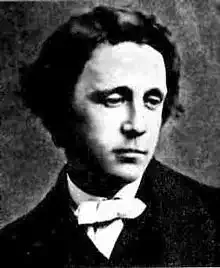
Lewis Carroll (27 January 1832 – 14 January 1898)
Charles Lutwidge Dodgson better known by the pseudonym Lewis Carroll,
was an English author, mathematician, logician, Anglican deacon and
photographer. His most famous writings are Alice's Adventures in
Wonderland and its sequel Through the LookingGlass,
as well as the poems
"The Hunting of the Snark" and "Jabberwocky", all examples of the genre of
literary nonsense. He is noted for his facility at word play, logic, and fantasy,
and there are societies dedicated to the enjoyment and promotion of his
works and the investigation of his life in many parts of the world, including
the United Kingdom, Japan, the United States, and New Zealand.
Antecedents
Dodgson's family was predominantly northern English, with Irish
connections. Conservative and High Church Anglican, most of Dodgson's
ancestors were army officers or Church of England clergymen. His
greatgrandfather,
also Charles Dodgson, had risen through the ranks of the
church to become Bishop of Elphin. His grandfather, another Charles, had
been an army captain, killed in action in Ireland in 1803, when his two sons
were hardly more than babies. His mother's name was Frances Jane
Lutwidge.
The elder of these sons – yet another Charles Dodgson – was Carroll's father.
He reverted to the other family tradition and took holy orders. He went to
Westminster School, and thence to Christ Church, Oxford. He was
mathematically gifted and won a double first degree, which could have been
the prelude to a brilliant academic career. Instead he married his first cousin
in 1827 and became a country parson.
Dodgson was born in the little parsonage of Daresbury in Cheshire near the
towns of Warrington and Runcorn, the eldest boy but already the third child
of the fourandahalfyearold
marriage. Eight more children were to follow.
When Charles was 11, his father was given the living of CroftonTees
in
North Yorkshire, and the whole family moved to the spacious Rectory. This
remained their home for the next twentyfive
years.
Young Charles' father was an active and highly conservative clergyman of
the Anglican church who later became Archdeacon of Richmond and involved
himself, sometimes influentially, in the intense religious disputes that were
dividing the Anglican church. He was High Church, inclining to
AngloCatholicism,
an admirer of Newman and the Tractarian movement,
and did his best to instill such views in his children. Young Charles was to
develop an ambiguous relationship with his father's values and with the
Anglican church as a whole.
www.PoemHunter.com - The World's Poetry Archive
Education
Home Life
During his early youth, Dodgson was educated at home. His "reading lists"
preserved in the family archives testify to a precocious intellect: at the age of
seven the child was reading The Pilgrim's Progress. He also suffered from a
stammer – a condition shared by his siblings – that often influenced his
social life throughout his years. At age twelve he was sent to Richmond
Grammar School (now part of Richmond School) at nearby Richmond.
Rugby
In 1846, young Dodgson moved on to Rugby School, where he was evidently
less happy, for as he wrote some years after leaving the place:
I cannot say ... that any earthly considerations would induce me to go
through my three years again ... I can honestly say that if I could have been
... secure from annoyance at night, the hardships of the daily life would have
been comparative trifles to bear.
Scholastically, though, he excelled with apparent ease. "I have not had a
more promising boy at his age since I came to Rugby", observed R.B. Mayor,
the Mathematics master.
Oxford
He left Rugby at the end of 1849 and matriculated at Oxford in May 1850 as
a member of his father's old college, Christ Church. After waiting for rooms
in college to become available, he went into residence in January 1851. He
had been at Oxford only two days when he received a summons home. His
mother had died of "inflammation of the brain" – perhaps meningitis or a
stroke – at the age of fortyseven.
His early academic career veered between high promise and irresistible
distraction. He did not always work hard, but was exceptionally gifted and
achievement came easily to him. In 1852 he obtained firstclass
honours in
Mathematics Moderations, and was shortly thereafter nominated to a
Studentship by his father's old friend, Canon Edward Pusey. In 1854 he
obtained firstclass
honours in the Final Honours School of Mathematics,
graduating Bachelor of Arts. He remained at Christ Church studying and
teaching, but the next year he failed an important scholarship through his
selfconfessed
inability to apply himself to study. Even so, his talent as a
mathematician won him the Christ Church Mathematical Lectureship in 1855,
which he continued to hold for the next twentysix
years. Despite early
unhappiness, Dodgson was to remain at Christ Church, in various capacities,
until his death.
Character and Appearance
Health Challenges
The young adult Charles Dodgson was about six feet tall, slender, and had
curling brown hair and blue or grey eyes (depending on the account). He was
described in later life as somewhat asymmetrical, and as carrying himself
rather stiffly and awkwardly, though this may be on account of a knee injury
sustained in middle age. As a very young child, he suffered a fever that left
him deaf in one ear. At the age of seventeen, he suffered a severe attack of
whooping cough, which was probably responsible for his chronically weak
chest in later life. Another defect he carried into adulthood was what he
referred to as his "hesitation", a stammer he acquired in early childhood and
which plagued him throughout his life.
The stammer has always been a potent part of the conceptions of Dodgson;
it is part of the belief that he stammered only in adult company and was free
and fluent with children, but there is no evidence to support this idea. Many
www.PoemHunter.com - The World's Poetry Archive
children of his acquaintance remembered the stammer while many adults
failed to notice it. Dodgson himself seems to have been far more acutely
aware of it than most people he met; it is said he caricatured himself as the
Dodo in Alice's Adventures in Wonderland, referring to his difficulty in
pronouncing his last name, but this is one of the many "facts"
oftenrepeated,
for which no firsthand evidence remains. He did indeed refer
to himself as the dodo, but that this was a reference to his stammer is
simply speculation.
Although Dodgson's stammer troubled him, it was never so debilitating that
it prevented him from applying his other personal qualities to do well in
society. At a time when people commonly devised their own amusements
and when singing and recitation were required social skills, the young
Dodgson was wellequipped
to be an engaging entertainer. He reportedly
could sing tolerably well and was not afraid to do so before an audience. He
was adept at mimicry and storytelling, and was reputedly quite good at
charades.
Social Connections
In the interim between his early published writing and the success of the
Alice books, Dodgson began to move in the PreRaphaelite
social circle. He
first met John Ruskin in 1857 and became friendly with him. He developed a
close relationship with Dante Gabriel Rossetti and his family, and also knew
William Holman Hunt, John Everett Millais, and Arthur Hughes, among other
artists. He also knew the fairytale
author George MacDonald well – it was
the enthusiastic reception of Alice by the young MacDonald children that
convinced him to submit the work for publication.
Politics, Religion and Philosophy
In broad terms, Dodgson has traditionally been regarded as politically,
religiously, and personally conservative. Martin Gardner labels Dodgson as a
Tory who was "awed by lords and inclined to be snobbish towards inferiors."
The Revd W. Tuckwell in his Reminiscences of Oxford (1900) regarded him
as "austere, shy, precise, absorbed in mathematical reverie, watchfully
tenacious of his dignity, stiffly conservative in political, theological, social
theory, his life mapped out in squares like Alice's landscape." However,
Dodgson also expressed interest in philosophies and religions that seem at
odds with this assessment. For example, he was a founding member of the
Society for Psychical Research. It has been argued by the proponents of the
'Carroll Myth' that these factors require a reconsideration of Gardner's
diagnosis, and that perhaps, Dodgson's true outlook was more complex than
previously believed (see 'the Carroll Myth' below).
Dodgson wrote some studies of various philosophical arguments. In 1895, he
developed a philosophical regressusargument
on deductive reasoning in his
article "What the Tortoise Said to Achilles", which appeared in one of the
early volumes of the philosophical journal Mind. The article was reprinted in
the same journal a hundred years later, in 1995, with a subsequent article by
Simon Blackburn titled Practical Tortoise Raising.
Artistic Activities
Literature
From a young age, Dodgson wrote poetry and short stories, both
contributing heavily to the family magazine Mischmasch and later sending
them to various magazines, enjoying moderate success. Between 1854 and
1856, his work appeared in the national publications, The Comic Times and
The Train, as well as smaller magazines like the Whitby Gazette and the
Oxford Critic. Most of this output was humorous, sometimes satirical, but his
standards and ambitions were exacting. "I do not think I have yet written
anything worthy of real publication (in which I do not include the Whitby
Gazette or the Oxonian Advertiser), but I do not despair of doing so some
day," he wrote in July 1855. Sometime after 1850, he did write puppet plays
for his siblings' entertainment, of which one has survived, La Guida di Bragia.
www.PoemHunter.com - The World's Poetry Archive
In 1856 he published his first piece of work under the name that would make
him famous. A romantic poem called "Solitude" appeared in The Train under
the authorship of "Lewis Carroll." This pseudonym was a play on his real
name; Lewis was the anglicised form of Ludovicus, which was the Latin for
Lutwidge, and Carroll an Irish surname similar to the Latin name Carolus,
from which the name Charles comes.
Alice
In the same year, 1856, a new Dean, Henry Liddell, arrived at Christ Church,
bringing with him his young family, all of whom would figure largely in
Dodgson's life and, over the following years, greatly influence his writing
career. Dodgson became close friends with Liddell's wife, Lorina, and their
children, particularly the three sisters: Lorina, Edith and Alice Liddell. He was
for many years widely assumed to have derived his own "Alice" from Alice
Liddell. This was given some apparent substance by the fact the acrostic
poem at the end of Through the Looking Glass spells out her name, and that
there are many superficial references to her hidden in the text of both books.
It has been pointed out that Dodgson himself repeatedly denied in later life
that his "little heroine" was based on any real child, and frequently dedicated
his works to girls of his acquaintance, adding their names in acrostic poems
at the beginning of the text. Gertrude Chataway's name appears in this form
at the beginning of The Hunting of the Snark, and no one has ever suggested
this means any of the characters in the narrative are based on her.
Though information is scarce (Dodgson's diaries for the years 1858–1862 are
missing), it does seem clear that his friendship with the Liddell family was an
important part of his life in the late 1850s, and he grew into the habit of
taking the children (first the boy, Harry, and later the three girls) on rowing
trips accompanied by an adult friend to nearby Nuneham Courtenay or
Godstow.
It was on one such expedition, on 4 July 1862, that Dodgson invented the
outline of the story that eventually became his first and largest commercial
success. Having told the story and been begged by Alice Liddell to write it
down, Dodgson eventually (after much delay) presented her with a
handwritten, illustrated manuscript entitled Alice's Adventures Under Ground
in November 1864.
Before this, the family of friend and mentor George MacDonald read
Dodgson's incomplete manuscript, and the enthusiasm of the MacDonald
children encouraged Dodgson to seek publication. In 1863, he had taken the
unfinished manuscript to Macmillan the publisher, who liked it immediately.
After the possible alternative titles Alice Among the Fairies and Alice's Golden
Hour were rejected, the work was finally published as Alice's Adventures in
Wonderland in 1865 under the Lewis Carroll penname,
which Dodgson had
first used some nine years earlier. The illustrations this time were by Sir John
Tenniel; Dodgson evidently thought that a published book would need the
skills of a professional artist.
The overwhelming commercial success of the first Alice book changed
Dodgson's life in many ways. The fame of his alter ego "Lewis Carroll" soon
spread around the world. He was inundated with fan mail and with
sometimes unwanted attention. Indeed, according to one popular story,
Queen Victoria herself enjoyed Alice In Wonderland so much that she
suggested he dedicate his next book to her, and was accordingly presented
with his next work, a scholarly mathematical volume entitled An Elementary
Treatise on Determinants. Dodgson himself vehemently denied this story,
commenting "...It is utterly false in every particular: nothing even
resembling it has occurred"; and it is unlikely for other reasons: as T.B.
Strong comments in a Times article, "It would have been clean contrary to all
his practice to identify [the] author of Alice with the author of his
mathematical works". He also began earning quite substantial sums of
money but continued with his seemingly disliked post at Christ Church.
Late in 1871, a sequel – Through the LookingGlass
and What Alice Found
www.PoemHunter.com - The World's Poetry Archive
There – was published. (The title page of the first edition erroneously gives
"1872" as the date of publication.) Its somewhat darker mood possibly
reflects the changes in Dodgson's life. His father had recently died (1868),
plunging him into a depression that lasted some years.
The Hunting of the Snark
In 1876, Dodgson produced his last great work, The Hunting of the Snark, a
fantastical "nonsense" poem, exploring the adventures of a bizarre crew of
tradesmen, and one beaver, who set off to find the eponymous creature. The
painter Dante Gabriel Rossetti reputedly became convinced the poem was
about him.
Photography
In 1856, Dodgson took up the new art form of photography, first under the
influence of his uncle Skeffington Lutwidge, and later his Oxford friend
Reginald Southey. He soon excelled at the art and became a wellknown
gentlemanphotographer,
and he seems even to have toyed with the idea of
making a living out of it in his very early years.
A recent study by Roger Taylor and Edward Wakeling exhaustively lists every
surviving print, and Taylor calculates that just over fifty percent of his
surviving work depicts young girls, though this may be a highly distorted
figure as approximately 60% of his original photographic portfolio is now
missing, so any firm conclusions are difficult. Dodgson also made many
studies of men, women, male children and landscapes; his subjects also
include skeletons, dolls, dogs, statues and paintings, and trees. His studies of
nude children were long presumed lost, but six have since surfaced, five of
which have been published and are available online. His pictures of children
were taken with a parent in attendance and many of the pictures were taken
in the Liddell garden, because natural sunlight was required for good
exposures.
He also found photography to be a useful entrée into higher social circles.
During the most productive part of his career, he made portraits of notable
sitters such as John Everett Millais, Ellen Terry, Dante Gabriel Rossetti, Julia
Margaret Cameron, Michael Faraday and Alfred, Lord Tennyson.
Dodgson abruptly ceased photography in 1880. Over 24 years, he had
completely mastered the medium, set up his own studio on the roof of Tom
Quad, and created around 3,000 images. Fewer than 1,000 have survived
time and deliberate destruction. He reported that he stopped taking
photographs because keeping his studio working was difficult (he used the
wet collodion process) and commercial photographers (who started using the
dry plate process in the 1870s) took pictures more quickly.
With the advent of Modernism, tastes changed, and his photography was
forgotten from around 1920 until the 1960s.
Inventions
To promote letter writing, Dodgson invented The Wonderland PostageStamp
Case in 1889. This was a clothbacked
folder with twelve slots, two marked
for inserting the then most commonly used penny stamp, and one each for
the other current denominations to one shilling. The folder was then put into
a slip case decorated with a picture of Alice on the front and the Cheshire Cat
on the back. All could be conveniently carried in a pocket or purse. When
issued it also included a copy of Carroll's pamphletted lecture, Eight or Nine
Wise Words About LetterWriting.
Another invention is a writing tablet called the nyctograph for use at night
that allowed for notetaking
in the dark; thus eliminating the trouble of
getting out of bed and striking a light when one wakes with an idea. The
device consisted of a gridded card with sixteen squares and system of
symbols representing an alphabet of Dodgson's design, using letter shapes
similar to the Graffiti writing system on a Palm device.
www.PoemHunter.com - The World's Poetry Archive
Among the games he devised outside of logic there are a number of word
games, including an early version of what today is known as Scrabble. He
also appears to have invented, or at least certainly popularised, the Word
Ladder (or "doublet" as it was known at first); a form of brainteaser
that is
still popular today: the game of changing one word into another by altering
one letter at a time, each successive change always resulting in a genuine
word. For instance, CAT is transformed into DOG by the following steps: CAT,
COT, DOT, DOG.
Other items include a rule for finding the day of the week for any date; a
means for justifying right margins on a typewriter; a steering device for a
velociam (a type of tricycle); new systems of parliamentary representation;
more nearly fair elimination rules for tennis tournaments; a new sort of
postal money order; rules for reckoning postage; rules for a win in betting;
rules for dividing a number by various divisors; a cardboard scale for the
college common room he worked in later in life, which, held next to a glass,
ensured the right amount of liqueur for the price paid; a doublesided
adhesive strip for things like the fastening of envelopes or mounting things in
books; a device for helping a bedridden invalid to read from a book placed
sideways; and at least two ciphers for cryptography.
Mathematical Work
Within the academic discipline of mathematics, Dodgson worked primarily in
the fields of geometry, matrix algebra, mathematical logic and recreational
mathematics, producing nearly a dozen books which he signed with his real
name. Dodgson also developed new ideas in the study of elections (e.g.,
Dodgson's method) and committees; some of this work was not published
until well after his death. He worked as a mathematics tutor at Oxford, an
occupation that gave him some financial security.
The Later Years
Over the remaining twenty years of his life, throughout his growing wealth
and fame, his existence remained little changed. He continued to teach at
Christ Church until 1881, and remained in residence there until his death. His
last novel, the twovolume
Sylvie and Bruno, was published in 1889 and
1893 respectively. It achieved nowhere near the success of the Alice books.
Its intricacy was apparently not appreciated by contemporary readers. The
reviews and its sales, only 13,000 copies, were disappointing.
The only occasion on which (as far as is known) he travelled abroad was a
trip to Russia in 1867, which he recounts in his "Russian Journal" which was
first commercially published in 1935.
He died on 14 January 1898 at his sisters' home, "The Chestnuts" in
Guildford, of pneumonia following influenza. He was 2 weeks away from
turning 66 years old. He is buried in Guildford at the Mount Cemetery.
Controversies and Mysteries
The 'Carroll Myth'
Since 1999 a group of scholars, notably Karoline Leach and Hugues Lebailly
plus Sherry L. Ackerman, John Tufail, Douglas Nickel and others, argue that
what Leach terms the 'Carroll Myth' has wildly distorted biographical
perception of his life and his work. Leach's book, In the Shadow of the
Dreamchild, raised a considerable amount of controversy. In brief the claim
is that:
In general terms Dodgson's life has been simplified and 'infantilised' by a
combination of inaccurate biography and the longstanding unavailability of
key evidence, which allowed legends to proliferate unchecked.
By the time the evidence did become available the 'mythic' image of the man
had become so embedded in scholastic and popular thinking it remained
www.PoemHunter.com - The World's Poetry Archive
unquestioned, despite the fact the evidence failed to support it.
If the evidence is examined dispassionately it shows many of the most
famous legends about the man (e.g. his 'paedophilia', and his exclusive
adoration of small girls) are untrue, or at least grossly simplified.
In more detail, Lebailly has endeavoured to set Dodgson's childphotography
within the "Victorian Child Cult", which perceived childnudity
as essentially
an expression of innocence. Lebailly claims that studies of child nudes were
mainstream and fashionable in Dodgson's time and that most photographers,
including Oscar Gustave Rejlander and Julia Margaret Cameron, made them
as a matter of course. Lebailly continues that child nudes even appeared on
Victorian Christmas cards, implying a very different social and aesthetic
assessment of such material. Lebailly concludes that it has been an error of
Dodgson's biographers to view his childphotography
with 20th or 21st
century eyes, and to have presented it as some form of personal
idiosyncrasy, when it was in fact a response to a prevalent aesthetic and
philosophical movement of the time.
Leach's reappraisal of Dodgson focused in particular on his controversial
sexuality. She argues that the allegations of paedophilia rose initially from a
misunderstanding of Victorian morals, as well as the mistaken idea, fostered
by Dodgson's various biographers, that he had no interest in adult women.
She termed the traditional image of Dodgson "the Carroll Myth". She drew
attention to the large amounts of evidence in his diaries and letters that he
was also keenly interested in adult women, married and single, and enjoyed
several scandalous (by the social standards of his time) relationships with
them. She also pointed to the fact that many of those he described as
"childfriends"
were girls in their late teens and even twenties. She argues
that suggestions of paedophilia evolved only many years after his death,
when his wellmeaning
family had suppressed all evidence of his
relationships with women in an effort to preserve his reputation, thus giving
a false impression of a man interested only in little girls. Similarly, Leach
traces the claim that many of Carroll's female friendships ended when the
girls reached the age of 14 to a 1932 biography by Langford Reed.
The concept of the Carroll Myth has produced polarised reactions from Carroll
scholars. In 2004 Contrariwise, the Association for new Lewis Carroll studies.
was established, and those such as Carolyn Sigler and Cristopher
Hollingsworth have joined the ranks of those calling for a major
reassessment. But the concept of the Myth has been opposed by some
leading Carroll scholars, in particular Morton N. Cohen and Martin Gardner
(their comments, and those of more positive reviewers, can be found on
Karoline Leach's own page). Biographer Jenny Woolf, while agreeing that
Carroll's image has been comprehensively misrepresented in the past,
believes that this can be attributed partly to Carroll's own behaviour and in
particular his tendency to selfcaricature
in later life.
Priesthood
Dodgson had been groomed for the ordained ministry in the Anglican Church
from a very early age and was expected, as a condition of his residency at
Christ Church, to take holy orders within four years of obtaining his master's
degree. He delayed the process for some time but eventually took deacon's
orders on 22 December 1861. But when the time came a year later to
progress to priestly orders, Dodgson appealed to the dean for permission not
to proceed. This was against college rules, and initially Dean Liddell told him
he would have to consult the college ruling body, which would almost
undoubtedly have resulted in his being expelled. For unknown reasons, Dean
Liddell changed his mind overnight and permitted Dodgson to remain at the
college, in defiance of the rules. Uniquely amongst Senior Students of his
time Dodgson never became a priest.
There is currently no conclusive evidence about why Dodgson rejected the
priesthood. Some have suggested his stammer made him reluctant to take
the step, because he was afraid of having to preach. Wilson quotes letters by
Dodgson describing difficulty in reading lessons and prayers rather than
www.PoemHunter.com - The World's Poetry Archive
preaching in his own words. But Dodgson did indeed preach in later life, even
though not in priest's orders, so it seems unlikely his impediment was a
major factor affecting his choice. Wilson also points out that the then Bishop
of Oxford, Samuel Wilberforce, who ordained Dodgson, had strong views
against members of the clergy going to the theatre, one of Dodgson's great
interests. Others have suggested that he was having serious doubts about
the Anglican church. He was interested in minority forms of Christianity (he
was an admirer of F.D. Maurice) and "alternative" religions (theosophy).
Dodgson became deeply troubled by an unexplained sense of sin and guilt at
this time (the early 1860s), and frequently expressed the view in his diaries
that he was a "vile and worthless" sinner, unworthy of the priesthood, and
this sense of sin and unworthiness may well have affected his decision to
abandon the priesthood.
sense of sin and unworthiness may well have affected his decision to
abandon the priesthood.
The Missing Diaries
At least four complete volumes and around seven pages of text are missing
from Dodgson's 13 diaries. The loss of the volumes remains unexplained; the
pages have been deliberately removed by an unknown hand. Most scholars
assume the diary material was removed by family members in the interests
of preserving the family name, but this has not been proven. Except for one
page, the period of his diaries from which material is missing is between
1853 and 1863 (when Dodgson was 21–31 years old). This was a period
when Dodgson began suffering great mental and spiritual anguish and
confessing to an overwhelming sense of his own sin. This was also the period
of time when he composed his extensive love poetry, leading to speculation
that the poems may have been autobiographical.
Many theories have been put forward to explain the missing material. A
popular explanation for one particular missing page (27 June 1863) is that it
might have been torn out to conceal a proposal of marriage on that day by
Dodgson to the 11yearold
Alice Liddell; there has never been any evidence
to suggest this was so, and a paper discovered by Karoline Leach in the
Dodgson family archive in 1996 offers some evidence to the contrary.
This paper, known as the "cut pages in diary document", was compiled by
various members of Carroll's family after his death. Part of it may have been
written at the time the pages were destroyed, though this is unclear. The
document offers a brief summary of two diary pages that are now missing,
including the one for 27 June 1863. The summary for this page states that
Mrs. Liddell told Dodgson there was gossip circulating about him and the
Liddell family's governess, as well as about his relationship with "Ina",
presumably Alice's older sister, Lorina Liddell. The "break" with the Liddell
family that occurred soon after was presumably in response to this gossip.
An alternative interpretation has been made regarding Carroll's rumoured
involvement with "Ina": Lorina was also the name of Alice Liddell's mother.
What is deemed most crucial and surprising is that the document seems to
imply Dodgson's break with the family was not connected with Alice at all.
Until a primary source is discovered, the events of 27 June 1863 remain
inconclusive.
Migraine and Epilepsy
In his diary for 1880, Dodgson recorded experiencing his first episode of
migraine with aura, describing very accurately the process of 'moving
fortifications' that are a manifestation of the aura stage of the syndrome.
Unfortunately there is no clear evidence to show whether this was his first
experience of migraine per se, or if he may have previously suffered the far
more common form of migraine without aura, although the latter seems
most likely, given the fact that migraine most commonly develops in the
teens or early adulthood. Another form of migraine aura, Alice in Wonderland
Syndrome, has been named after Dodgson's little heroine, because its
manifestation can resemble the sudden sizechanges
in the book. Also known
as micropsia and macropsia, it is a brain condition affecting the way objects
www.PoemHunter.com - The World's Poetry Archive
are perceived by the mind. For example, an afflicted person may look at a
larger object, like a basketball, and perceive it as if it were the size of a golf
ball. Some authors have suggested that Dodgson may have suffered from
this type of aura, and used it as an inspiration in his work, but there is no
evidence that he did.
Dodgson also suffered two attacks in which he lost consciousness. He was
diagnosed by three different doctors; a Dr. Morshead, Dr. Brooks, and Dr.
Stedman, believed the attack and a consequent attack to be an
"epileptiform" seizure (initially thought to be fainting, but Brooks changed his
mind). Some have concluded from this he was a lifetime sufferer of this
condition, but there is no evidence of this in his diaries beyond the diagnosis
of the two attacks already mentioned. Some authors, in particular Sadi
Ranson, have suggested Carroll may have suffered from temporal lobe
epilepsy in which consciousness is not always completely lost, but altered,
and in which the symptoms mimic many of the same experiences as Alice in
Wonderland. Carroll had at least one incidence in which he suffered full loss
of consciousness and awoke with a bloody nose, which he recorded in his
diary and noted that the episode left him not feeling himself for "quite
sometime afterward". This attack was diagnosed as possibly "epileptiform"
and Carroll himself later wrote of his "seizures" in the same diary.
Most of the standard diagnostic tests of today were not available in the
nineteenth century. Recently, Dr Yvonne Hart, consultant neurologist at the
Radcliffe Hospital, Oxford, considered Dodgson's symptoms. Her conclusion,
quoted in Jenny Woolf's The Mystery of Lewis Carroll, is that Dodgson very
likely had migraine, and may have had epilepsy, but she emphasises that
she would have considerable doubt about making a diagnosis of epilepsy
without further information.
Suggestions of Paedophilia
Stuart Dodgson Collingwood (Dodgson's nephew and biographer) wrote:
And now as to the secondary causes which attracted him to children. First, I
think children appealed to him because he was preeminently
a teacher, and
he saw in their unspoiled minds the best material for him to work upon. In
later years one of his favourite recreations was to lecture at schools on logic;
he used to give personal attention to each of his pupils, and one can well
imagine with what eager anticipation the children would have looked forward
to the visits of a schoolmaster who knew how to make even the dullest
subjects interesting and amusing.
Despite comments like this, Dodgson's friendships with young girls and
psychological readings of his work – especially his photographs of nude or
seminude
girls – have all led to speculation that he was a paedophile. This
possibility has underpinned numerous modern interpretations of his life and
work, particularly Dennis Potter's play Alice and his screenplay for the motion
picture, Dreamchild, and even more importantly Robert Wilson's Alice, and a
number of recent biographies, including Michael Bakewell's Lewis Carroll: A
Biography (1996), Donald Thomas's Lewis Carroll: A Portrait with
Background (1995), and Morton N. Cohen's Lewis Carroll: A Biography
(1995). All of these works more or less unequivocally assume that Dodgson
was a paedophile, albeit a repressed and celibate one. Cohen claims
Dodgson's "sexual energies sought unconventional outlets", and further
writes:
We cannot know to what extent sexual urges lay behind Charles's preference
for drawing and photographing children in the nude. He contended the
preference was entirely aesthetic. But given his emotional attachment to
children as well as his aesthetic appreciation of their forms, his assertion that
his interest was strictly artistic is naïve. He probably felt more than he dared
acknowledge, even to himself.
Cohen notes that Dodgson "apparently convinced many of his friends that his
attachment to the nude female child form was free of any eroticism", but
adds that "later generations look beneath the surface".
www.PoemHunter.com - The World's Poetry Archive
Cohen and other biographers argue that Dodgson may have wanted to marry
the 11yearold
Alice Liddell, and that this was the cause of the unexplained
"break" with the family in June 1863. But there has never been significant
evidence to support the idea, and the 1996 discovery of the "cut pages in
diary document" (see above) seems to make it highly probable that the 1863
"break" had nothing to do with Alice, but was perhaps connected with
rumours involving her older sister Lorina (born 11 May 1849, so she would
have been 14 at the time), her governess, or her mother who was also
nicknamed "Ina".
Some writers, e.g., Derek Hudson and Roger Lancelyn Green, stop short of
identifying Dodgson as a paedophile, but concur that he had a passion for
small female children and next to no interest in the adult world.
The basis for Dodgson's perceived 'obsession' with female children has been
challenged in the last ten years by several writers and scholars (see the
'Carroll Myth' above).
Eserleri:
The Principles of Parliamentary Representation (1884)
Literary Works
La Guida di Bragia, a Ballad Opera for the Marionette Theatre (around 1850)
A Tangled Tale
Alice's Adventures in Wonderland (1865)
Facts
Rhyme? And Reason? (also published as Phantasmagoria)
Pillow Problems
Sylvie and Bruno
Sylvie and Bruno Concluded
The Hunting of the Snark (1876)
Three Sunsets and Other Poems
Through the LookingGlass,
and What Alice Found There (includes
"Jabberwocky" and "The Walrus and the Carpenter") (1871)
What the Tortoise Said to Achilles
Mathematical Works
A Syllabus of Plane Algebraic Geometry (1860)
The Fifth Book of Euclid Treated Algebraically (1858 and 1868)
An Elementary Treatise on Determinants, With Their Application to
Simultaneous Linear Equations and Algebraic Equations
Euclid and his Modern Rivals (1879), both literary and mathematical in style
Symbolic Logic Part I
Symbolic Logic Part II (published posthumously)
The Alphabet Cipher (1868)
The Game of Logic
Some Popular Fallacies about Vivisection
Curiosa Mathematica I (1888)
Curiosa Mathematica II (1892)
The Theory of Committees and Elections, collected, edited, analysed, and
published in 1958, by Duncan Black
www.PoemHunter.com - The World's Poetry Archive
wer54w66sf32re2