
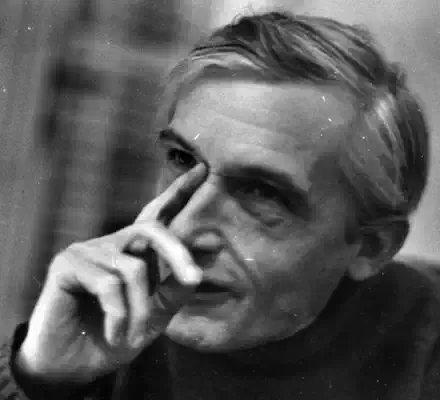
János Pilinszky
 HU
HU
János Pilinszky was a Hungarian poet whose work is profoundly marked by the experience of World War II and the Holocaust. His poetry is characterized by an austere, concise, and sometimes brutal language, which seeks to confront the horror of existence with an incessant search for meaning and redemption. Pilinszky is known for his unique lyrical voice, which combines the rawness of reality with spiritual transcendence, exploring themes such as guilt, suffering, faith, and the need for compassion in a fragmented world. His work is considered one of the pillars of 20th-century Hungarian poetry.
n. 1921-11-27, Budapeste · m. 1981-05-27, Budapeste
Bio
Identification and Basic Context
János Pilinszky was a Hungarian poet, widely considered one of the most important of the 20th century in his country. He was born in 1921 and died in 1981. His family background was middle-class, with a Catholic upbringing that would profoundly influence his worldview and poetry. His nationality was Hungarian, and the language of writing was Hungarian. Pilinszky lived and wrote during a turbulent period in European history, marked by World War II, the Holocaust, the Soviet occupation, and the communist regime in Hungary.Childhood and Education
Pilinszky had a childhood in a traditional Catholic family environment. His formal education included studies in Budapest, where he came into contact with literature and philosophy. The initial influences on his work are notably the Catholic faith, the poetry of Charles Péguy, and the direct experience of war. He absorbed, albeit critically and personally, the literary and philosophical currents that sought to grapple with the existential crisis of post-war Europe. A significant event in his youth, which would define much of his work, was his direct experience of war and its atrocities.Literary Journey
Pilinszky's writing began in his youth, with poems that already foreshadowed the dark tone and the search for redemption that would mark his mature work. His literary evolution can be seen in phases, with increasing formal refinement and thematic deepening towards the horrors of war and the fragility of the human condition. His work evolved from more personal poetry to a universal reflection on suffering and faith. He collaborated with various Hungarian literary magazines, and his works were compiled in important collections. Pilinszky also worked as a journalist and editor, but his main contribution was as a poet.Work, Style, and Literary Characteristics
János Pilinszky's main works include "Cracow" (1942), "Szél hozta ház" (The Wind-Brought House, 1943), "Ravens are Silent" (1947), and "Apokrif" (Apocrypha, 1959). His dominant themes are war, the Holocaust, guilt, sin, faith, loneliness, death, and the hope for redemption. His style is characterized by extreme concision, an austere and unadorned language, which seeks maximum expressiveness with the minimum of words. He frequently uses free verse, but with a rigorous internal structure and a restrained musicality. His poetic resources focus on the power of imagery and the resonance of words. The tone of his poetic voice is often elegiac, somber, but imbued with deep spirituality and a search for compassion. Pilinszky's language is dense, almost sculptural, with a precise vocabulary and striking images that evoke suffering and desolation. He introduced innovations by bringing the radical experience of trauma and catastrophe to the center of Hungarian poetry with a language of extreme sobriety. His work engages with the tradition of religious and existential poetry and is associated with postmodernism and a current of poetry deeply marked by the experience of war and survival.Cultural and Historical Context
Pilinszky's work is intrinsically linked to the historical events of his time: World War II, the Holocaust, the fall of the Berlin Wall, and the communist regime. He lived in a Hungary that experienced profound political and social instability. His poetry reflects the desolation and trauma of these periods. He associated with other important Hungarian writers, such as Gyula Illyés and Attila József, and his work is part of a generation of poets seeking to make sense of European tragedy. Pilinszky, while not explicitly militant, carried a strong moral and existential weight in his poetry, which resonated with the search for a new humanism in a devastated world.Personal Life
Pilinszky maintained a discreet personal life, marked by his deep Catholic faith. The experience of war, where he served as a medic, had an indelible impact on his psyche and his work. His emotional and family relationships, although not publicly detailed, seem to have been sources of support in his introspective life. His main profession was as a poet and writer, and he lived modestly, often dependent on subsidies and the support of friends and institutions. His Catholic faith was the central axis of his life and worldview, informing his search for meaning and redemption.Recognition and Reception
János Pilinszky is widely recognized as one of the greatest Hungarian poets of the 20th century, with his work translated into various languages. He received several important literary awards in his country, including the Kossuth Prize. His critical reception was consistently positive, both during his lifetime and posthumously, being praised for his originality, depth, and aesthetic rigor. His academic recognition is solid, and his poetry is studied in universities worldwide.Influences and Legacy
Pilinszky was influenced by Catholic poetry, existential philosophy, and poets like Charles Péguy and Rainer Maria Rilke. His legacy is immense in Hungarian and international poetry, inspiring poets to confront trauma and seek transcendence through language. His work influenced post-war European poetry, and his unique voice of compassion and spiritual questioning continues to resonate. He entered the canon of European literature as a master of existential and spiritual poetry. His poems have been translated into over thirty languages, ensuring his international diffusion. Academic studies have explored the depth of his work, his relationship with theology, and his experience of catastrophe.Interpretation and Critical Analysis
Pilinszky's work invites deep reflection on the human condition, morality, and the search for faith in a world marked by suffering. His poems are often interpreted as parables about guilt, forgiveness, and the possibility of redemption. Philosophically, his work explores the paradox of faith in the face of evil and the need for compassion as a path to salvation. His approach to catastrophe and suffering has generated debates about the relationship between art and trauma, and poetry's capacity to bear witness to barbarism.Curiosities and Lesser-Known Aspects
A curious aspect of Pilinszky's personality was his profound humility and aversion to sensationalism, despite the dramatic nature of his themes. His personal life was marked by austere simplicity, in contrast to the depth of his work. Significant episodes include his experience as a medic during wartime, which exposed him directly to human suffering. He was known for his thoughtful writing habits, choosing each word with extreme care. Manuscripts and correspondence reveal an introspective man, yet deeply engaged with the existential and spiritual issues of his time.Death and Memory
János Pilinszky died in Budapest in 1981, after a short illness. His death was felt as a great loss to Hungarian and European literature. His memory is preserved through the continuous publication and study of his work, and he is remembered as one of the poets who best captured the soul of post-war Europe and the incessant search for hope and redemption.Poems
0No poems found
Comments (0)
No comments yet. Be the first to comment.