
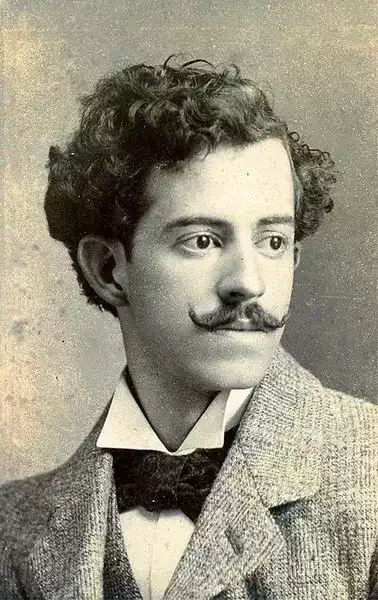
Guillermo Valencia

Guillermo Valencia was a Colombian poet, politician, and diplomat, recognized as one of the most important figures of Modernism in Hispanic America. His poetry is characterized by formal perfection, musicality, and the pursuit of classical beauty, often inspired by Greco-Latin and mythological themes. Valencia was also a prominent public intellectual, holding important roles in his country's politics and diplomacy, which is reflected in the breadth of his vision and his civic commitment.
n. , Popayán, Cauca, Colômbiadata_morte ={{nowrap|{{morte|4|11|1971|27|4|1909
2
Views
Bio
Identification and Basic Context
Guillermo León Valencia Aristizábal was a Colombian poet, politician, and diplomat, born in Popayán. He is a prominent figure in the Modernist movement in Hispanic American literature. He wrote mainly in Spanish. His life spanned a period of significant political and social transformations in Colombia and Hispanic America, marked by debates on national identity and the influence of European aesthetic currents.Childhood and Education
Born into a family with a strong political and social tradition in Cauca, his childhood was marked by an environment of culture and refinement. He completed his studies at the Colegio del Sagrado Corazón de Jesús and later at the Universidad del Cauca, where he studied law. His intellectual formation was nourished by classical readings and the works of poets who formed the literary vanguard of his time.Literary Career
His poetic vocation manifested early. He is considered one of the precursors and greatest exponents of Modernism in Colombia. In addition to his poetic work, he served as a diplomat in Europe and America, and had a distinguished political career, becoming President of Colombia between 1962 and 1966. His poetic work developed over several decades, showing an evolution towards greater depth and a constant search for formal perfection.Work, Style, and Literary Characteristics
His most representative poetic work includes "Mietas" (1898), "Canciones de vida y ensueño" (1905), and "Por el honor y por el sol" (1914). His style is characterized by classical stanzas, rigorous meter, musicality, and the pursuit of formal beauty. He addressed themes such as love, nature, classical mythology, the homeland, and existential reflection. His language is elegant, cultured, and evocative, with a refined use of poetic devices.Cultural and Historical Context
Valencia lived through the effervescence of Modernism, a movement that sought aesthetic and thematic renewal in Hispanic American literature, inspired by French Parnassianism and Symbolism. He actively participated in Colombia's political life, witnessing and experiencing important historical events, such as the Thousand Days' War and the separation of Panama. His figure represented the synthesis between the intellectual elite and political commitment.Personal Life
His life was tied to Popayán, his hometown, and to the political and diplomatic activity that led him to travel the world. He married Ana Cristina Restrepo, who was an important support in his life. His public career and his commitment to Colombia profoundly marked his existence.Recognition and Reception
He was recognized in his lifetime as one of the great poets of his time, both in Colombia and throughout Hispanic America. His work was praised for its aesthetic quality and formal rigor. His election as President of Colombia demonstrated the high degree of prestige and recognition he achieved in the public sphere.Influences and Legacy
He was influenced by poets such as Rubén Darío, the French Parnassians, and the Greco-Latin classics. His work, in turn, influenced subsequent generations of Colombian and Latin American poets, consolidating the modernist tradition and the importance of form in poetry.Interpretation and Critical Analysis
His poetry has been valued for its profound musicality, its formal perfection, and the elegance of its language. He has been studied as a representative of "pure modernism," detached from the more direct social concerns that characterized other authors of the movement, although his public life demonstrated great civic commitment.Childhood and Education
In addition to his facet as a poet and statesman, Valencia was passionate about numismatics and philately. His political discourse was often imbued with a poetic and elevated tone, reflecting his artistic sensitivity.Death and Memory
He died in his hometown, Popayán. His legacy endures as one of the pillars of Colombian literature and as a reference for Modernism in Hispanic America. The Guillermo León Valencia University in Popayán bears his name in his honor.Poems
0No poems found
Comments (0)
Log in
to post a comment.
No comments yet. Be the first to comment.