
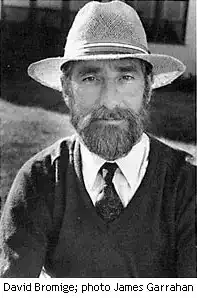
David Bromige
 GB
GB
David Bromige was a Canadian-American poet associated with the San Francisco literary scene and the Poetry Renaissance movement. His work is known for its sharp intelligence, irreverent humor, and a fragmented, postmodern style that explores the nature of language, memory, and identity. Bromige often used collage and montage techniques, incorporating elements of popular culture and other forms of discourse into his poems. His poetry challenges traditional conventions, inviting the reader to navigate complex and often enigmatic textual landscapes.
n. 1933-10-22, Londres · m. 2009-06-03, Sebastopol
Bio
Identification and Basic Context
David Bromige was a Canadian-American poet, born in 1933 and died in 2002. He is best known for his association with the San Francisco literary scene and the New American Poetry movement. His nationality was dual, Canadian and American. The language of writing was English. Bromige lived much of his adult life in the United States, especially in California, and his work reflects the post-war American cultural and historical context, marked by countercultural movements and artistic experimentation.Childhood and Education
Born in Canada, Bromige moved to the United States in his youth. His educational background included university studies, where he came into contact with modern literature and critical theory. The early influences on his work are varied, encompassing modernist poetry, philosophy, and new media forms. He absorbed the experimental spirit of 20th-century American poetry, especially trends that sought to break with established traditions. Significant events in his youth, such as his move to the United States and his engagement with the emerging literary scene, shaped his development as a poet.Literary Career
Bromige's writing began during his formative university years, where he started to develop his experimental style. His work evolved into increasingly fragmented and self-reflexive poetry, exploring the nature of language and perception. He collaborated with various independent literary magazines and poetry publications, becoming a prominent figure in the underground scene. Bromige also engaged in editing and curatorial activities, promoting the work of other experimental poets.Work, Style, and Literary Characteristics
David Bromige's major works include "Nights and Days" (1963), "Tight Corners" (1965), "Country of the Survivors" (1967), "The Quints" (1970), and "Desire: Selected Poems 1960-1985" (1985). His dominant themes include language, memory, identity, desire, daily life, and cultural critique. His style is highly experimental, characterized by fragmentation, collage, the use of lists, quotations, and a mixture of lyrical, ironic, and colloquial tones. He frequently employed free verse and non-linear structures, challenging narrative and poetic conventions. His poetic devices include the unexpected juxtaposition of images and ideas, the use of humor, and self-referentiality. Bromige's poetic voice is often intellectualized, ironic, and at times evasive, inviting the reader into a play of interpretations. His language is dense, complex, and rich in allusions. Bromige is associated with postmodernism and experimental poetry, engaging with the tradition of poetry that explores subjectivity and language, such as that of John Ashbery and Frank O'Hara, but with a particular focus on fragmentation and deconstruction.Work, Style, and Literary Characteristics
Cultural and Historical Context David Bromige wrote during a period of intense artistic and cultural experimentation in the United States, particularly in California. His work is situated within the context of the San Francisco Poetry Renaissance, a movement that valued formal freedom and the exploration of new poetic voices. He engaged with other poets of the counterculture and the Beat movement, although his style was distinctly more postmodern and less romantic. His intellectual position was critical of social and literary conventions, and his poetry often reflected this attitude.Work, Style, and Literary Characteristics
Personal Life Little is publicly known about the details of David Bromige's personal life compared to his work. He lived and worked in San Francisco, where he became a known figure in the poetic community. His literary friendships and rivalries, while not widely documented, certainly existed within the circle of experimental poets with whom he associated. The nature of his work suggests deep introspection and a constant engagement with the complexities of the mind and language.Work, Style, and Literary Characteristics
Recognition and Reception David Bromige is a respected figure in American experimental and postmodern poetry, although his recognition is more confined to specialized academic and literary circles. He received some awards and grants throughout his career but did not achieve mainstream fame. His critical reception is marked by admiration for his originality and intelligence, but also by the difficulty some readers find in his fragmented and intellectualized approach. Academic recognition of his work has been growing, with studies exploring his contribution to postmodern poetry.Work, Style, and Literary Characteristics
Influences and Legacy Bromige was influenced by poets such as John Ashbery, Frank O'Hara, and by currents of modernism and postmodernism. His legacy lies in his contribution to American experimental poetry, expanding the possibilities of language and poetic form. His work influenced poets who seek to explore fragmentation, self-referentiality, and cultural critique through poetry. He is considered an important poet for understanding postmodern poetry in the United States.Work, Style, and Literary Characteristics
Interpretation and Critical Analysis Bromige's work is often interpreted as an exploration of the flaws and ambiguities of language, memory, and subjectivity. His poetry invites active reader engagement in the construction of meaning. Philosophically, his work can be seen as a meditation on the fragmented nature of modern experience and the search for coherence in a deconstructed world. The complexity and fragmentation of his poetry have been the subject of critical analysis, focusing on his formal innovations and his challenging approach to representation.Work, Style, and Literary Characteristics
Curiosities and Lesser-Known Aspects An interesting aspect of Bromige is his ability to blend the erudite with the colloquial, humor with seriousness, often creating a surprising effect. His work, though complex, carries a sense of playfulness and experimentation that sets him apart. Manuscripts and correspondence reveal a meticulous poet in his creative process, constantly experimenting with the form and content of his poems.Work, Style, and Literary Characteristics
Death and Memory David Bromige passed away in 2002. His work continues to be studied and appreciated by those interested in experimental and postmodern poetry. He is remembered as a poet who challenged expectations and expanded the boundaries of poetic expression.Poems
0No poems found
Comments (0)
No comments yet. Be the first to comment.