
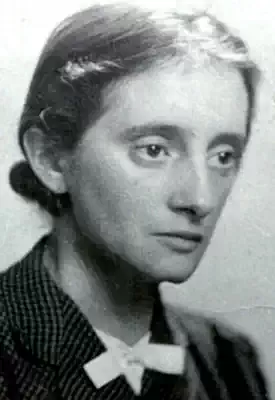
Christine Lavant
1915–1973
· lived 57 years
 AT
AT
AT
Christine Lavant was an Austrian poet whose work is distinguished by its lyrical intensity and raw exploration of human fragility, suffering, and the search for transcendence. Marked by a life of hardship and isolation, her poetry emerged as a powerful cry against pain, but also as a testament to the resilience of the spirit and the search for meaning amidst adversity. Her writing, often associated with existentialism and deep spirituality, captivates with its brutal honesty and the painful beauty of its imagery. Lavant addressed themes such as loneliness, death, faith, and despair with a unique voice, establishing herself as one of the most significant figures in 20th-century Austrian poetry, whose work continues to resonate for its universality and emotional power.
n. 1915-07-04, Großedling · m. 1973-06-07, Wolfsberg
5
Views
Bio
Identification and basic context
Christine Lavant, born Christine Thon, was a prominent Austrian poet. Pseudonyms or heteronyms are not widely documented in her work. She was born on June 1, 1915, in St. Paul im Lavanttal, Carinthia, Austria, and died on September 7, 1974, in the same region. Her family background, marked by poverty and complex relationships, and her cultural context in St. Paul im Lavanttal, a rural area of Carinthia, profoundly influenced her worldview and writing. She wrote in German.Childhood and education
Christine Lavant's childhood was marked by economic hardship and fragile health. She attended primary and secondary school in St. Paul, but her formal education was cut short. She was largely self-taught, finding refuge and knowledge in reading, especially authors who dealt with existential and spiritual themes. Religion, particularly Catholicism, and the rural landscape of Carinthia were important formative influences, as were the experiences of war and the social tensions of the time.Literary career
Christine Lavant began writing poetry at a young age, but her professional publication only occurred later, in the 1940s. Her work developed in phases, evolving from more restrained lyricism to a rawer, existential expression. Her publication in literary magazines and anthologies was crucial for her introduction to the literary scene. She also worked as a translator, although her main activity was poetic creation.Work, style, and literary characteristics
Christine Lavant's major works include "Die Bettlerschale" (1956), "Spiegelseele" (1960), "Wir gründen eine neue Welt" (1961), and "Der Xan du und ich" (1964). The dominant themes in her work are pain, suffering, loneliness, death, faith, doubt, and the search for spiritual meaning in an existence marked by adversity. Her poetry is often elegiac and confessional, with a voice that oscillates between despair and deep spirituality. Lavant's style is characterized by dense, imagistic, and musical language, with an expressive use of metaphors and symbols that often refer to nature and the religious sphere. She explored free verse, but also more traditional forms, always with palpable emotional intensity. Her language is direct and sometimes brutal, but always underpinned by a search for beauty and redemption. Her work introduced a new dimension of existential and spiritual intensity to Austrian poetry, engaging with existentialism and religious lyricism.Cultural and historical context
Christine Lavant lived and wrote during a turbulent period in European history, marked by two World Wars and the post-war era. Her work reflects the existential anxieties and the search for meaning in a world shaken by conflicts. She belonged to a generation of Austrian writers who dealt with the consequences of Nazism and the need for moral and cultural reconstruction. Her work engages with the Austrian literary tradition, as well as with European currents of existentialism and neorealism.Personal life
Christine Lavant's personal life was profoundly marked by chronic illnesses, financial difficulties, and a sense of isolation. Her family relationships, especially with her mother, were complex. She had a marriage and a son, but her relationship with motherhood was also marked by challenges. Her deep religiosity and spiritual crises were central to her life and work. Her civic engagement was limited due to her health status and isolation.Recognition and reception
Initially, Christine Lavant's work had limited reception, but it gradually gained recognition, especially after the publication of "Die Bettlerschale". She received several important literary awards, such as the City of Vienna Literature Prize in 1964 and the Georg Trakl Prize in 1971. Her popularity grew significantly after her death, with her work being widely studied and celebrated by critics and the public.Influences and legacy
Among the influences on Lavant's work are authors such as Rainer Maria Rilke and religious writers. Her legacy is immense in Austrian and European poetry, inspiring generations of poets with her authentic voice and her ability to express the depth of human experience. Her work has been translated into several languages, solidifying her presence in the international literary canon. It has been the subject of various academic studies and adaptations.Interpretation and critical analysis
Christine Lavant's work is often analyzed from the perspective of her deep religiosity and existential struggles. Critics highlight her ability to articulate pain and hope, the profane and the sacred. Her poems are seen as a testament to human resilience in the face of suffering and an invitation to reflect on faith, mortality, and the search for ultimate meaning.Curiosities and lesser-known aspects
Christine Lavant maintained a strong connection to her homeland, St. Paul im Lavanttal, which is frequently depicted in her poetry. Her reclusive life and struggles with health are known aspects, but they shed light on the intensity of her creation. Her relationship with poetic creation was seen as a vital necessity, a way to give voice to her suffering and her deepest questions.Death and memory
Christine Lavant died on September 7, 1974, in St. Paul im Lavanttal, from cancer. After her death, her work continued to be published and rediscovered, with critical editions and in-depth studies solidifying her place in literature. Her memory is celebrated through awards bearing her name and the continued relevance of her poetry.Poems
0No poems found
Quotes
1No poems found
Comments (0)
Log in
to post a comment.
No comments yet. Be the first to comment.