Identification and Basic Context
Ernesto Guevara, better known as Che Guevara, was born in Rosario, Argentina. He was a Marxist revolutionary, physician, author, guerrilla fighter, diplomat, and military theorist. His nationality was Argentine, although he became a central figure in the Cuban Revolution and other revolutionary movements. He spoke Spanish. The historical context in which he lived was marked by the Cold War, the rise of national liberation movements in Latin America and Africa, and profound social and economic inequality in many nations.
Childhood and Education
Born into an upper-middle-class family, Guevara had access to a good education. His childhood was marked by health problems, notably asthma, which accompanied him throughout his life. He graduated in medicine from the University of Buenos Aires, where he showed an interest in social and political issues. During his youth, he traveled through South America, which was crucial for shaping his social and political consciousness, observing poverty, exploitation, and inequality up close.
Literary Career
Although not primarily known as a writer, Che Guevara produced significant texts, including travel diaries and political reflections. His most notable writings are "The Motorcycle Diaries," which recounts his travels through South America, and "Guerrilla Warfare," a manual on combat tactics. These texts reveal a strategic thinker and an attentive observer of social and political realities.
Work, Style, and Literary Characteristics
Che Guevara's work is predominantly political and autobiographical. His writings are characterized by clarity, objectivity, and a direct tone. The dominant themes include the struggle against imperialism, the need for social revolution, the analysis of the living conditions of the oppressed, and military strategy for liberation. His writing is more a reflection of his activism than an aesthetic exploration of language. He uses accessible vocabulary, aimed at disseminating his revolutionary ideas.
Cultural and Historical Context
Che Guevara lived in a time of great global transformations and conflicts. The Cold War, the Cuban Revolution, the Vietnam War, and independence movements in Africa had a profound impact on his journey. He was an active participant and influencer of revolutionary movements, dialoguing and confronting leaders and ideologies of the era, such as Marxism-Leninism. His figure became a global symbol of resistance against oppression.
Personal Life
Ernesto Guevara had significant family relationships, being the son of Ernesto Guevara Lynch and Celia de la Serna. He had two children with Aleida March, his second wife, and a daughter with Hilda Gadea, his first wife. His political convictions intensely shaped his personal life, leading him to give up an established medical career to dedicate himself to armed struggle. He was known for his austerity and unwavering dedication to his ideals.
Recognition and Reception
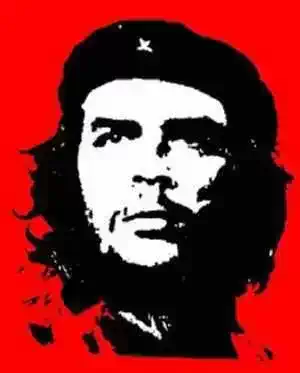
Che Guevara is internationally recognized as a revolutionary hero and a martyr for many. His image has become a cultural and political icon, reproduced on posters, t-shirts, and artworks worldwide. Although criticized by opposing regimes and ideologies, his legacy as a symbol of struggle against social injustice and imperialism is undeniable.
Influences and Legacy
He was influenced by Marxist thinkers and by the figure of Fidel Castro. In turn, Che Guevara influenced generations of revolutionaries, activists, and left-wing movements worldwide. His legacy is complex, associated with both the struggle for liberation and controversial combat methods. He continues to be a subject of study and debate in academia and popular culture.
Interpretation and Critical Analysis
Che Guevara's work and figure are subject to diverse interpretations. For some, he represents an idealist who fought for a more just world. For others, he is seen as a fanatic who promoted violence and authoritarian regimes. Critical analyses focus on his military strategy, his political positions, and the impact of his actions on the affected populations.
Curiosities and Lesser-Known Aspects
A curiosity is his passion for chess. Despite his image as a relentless guerrilla fighter, Guevara was also an intellectual with a deep interest in literature and philosophy. His famous portrait, "Guerrillero Heroico" by Alberto Korda, became one of the most reproduced images in history.
Death and Memory
Che Guevara was captured and executed in Bolivia on October 9, 1967, under orders from the Bolivian government, with the support of the CIA. His death intensified his image as a martyr and revolutionary hero. His last words are said to have been, "Shoot, coward! You are only going to kill a man."

 AR
AR