Identification and basic context
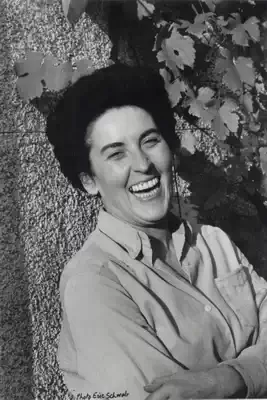
Charlotte Delbo was a writer, resistant, and survivor of Nazi concentration camps. She was born in Vigneux-sur-Seine, France. She was deported to Auschwitz in 1943 and later to Ravensbrück. Her work is profoundly marked by these experiences.
Childhood and education
Charlotte Delbo was born into a working-class family and had a childhood marked by poverty, but also by a strong sense of social justice. From an early age, she showed an aptitude for writing and a rebellious spirit. Her intellectual formation was influenced by communist and antifascist ideas, which led her to join the French Resistance.
Literary career
Charlotte Delbo's literary career was intrinsically linked to her experience in the concentration camps. From 1945, after her liberation, she began to write about her experiences, initially in a more fragmented way, culminating in works that sought to bear witness to and give meaning to the horror. Her writing evolved into a profound meditation on memory, guilt, and resilience.
Work, style, and literary characteristics
Charlotte Delbo's best-known works include "Aucun de nous ne reviendra" (None of Us Will Return) and "Le Convoi du 27 janvier" (The Convoy of January 27th), which recount her memories of the camps. Her style is characterized by sobriety, the absence of excessive sentimentality, but with an overwhelming emotional force. She explores themes such as dehumanization, solidarity among deportees, inner resistance, and the difficulty of finding words to describe the indescribable. She frequently uses repetition, juxtaposition of images, and direct, raw language to convey the brutal reality she lived. Her poetry is also marked by an elegiac and reflective tone.
Work, style, and literary characteristics
Cultural and historical context
Charlotte Delbo lived during one of the most turbulent periods in European history, the 20th century, with World War II and the Holocaust as central events. Her experience as a resistant and political prisoner placed her at the epicenter of these events. Her work engages with other survivor testimonies and with the emerging literature of the Holocaust, seeking a place for memory and truth in a world devastated by barbarism.
Work, style, and literary characteristics
Personal life
Charlotte Delbo's life was profoundly shaped by her experience in the camps. The loss of her husband, Edmond, deported and killed in Buchenwald, was a permanent wound. Her dedication to writing became a way to honor his memory and that of all the victims. She maintained strong ties with other survivors and dedicated her life to preserving memory and fighting against forgetting and denial.
Work, style, and literary characteristics
Recognition and reception
The recognition of Charlotte Delbo's work was gradual. Initially, her works were published in more restricted circles, but over time, her importance as a witness and as a writer of literary merit was widely recognized. She received several awards and distinctions for her contribution to literature and historical memory.
Work, style, and literary characteristics
Influences and legacy
Charlotte Delbo was influenced by authors who addressed the experience of war and oppression. Her legacy lies in her ability to transform trauma into art, to give voice to the silenced, and to confront us with the consequences of hatred and intolerance. Her work continues to inspire generations of readers and writers to reflect on human nature and the importance of memory.
Work, style, and literary characteristics
Interpretation and critical analysis
Delbo's work is often analyzed from the perspective of testimony literature, exploring the limits of language in representing horror. Critics highlight her ability to construct narratives that avoid sensationalism, focusing on the psychological depth and moral complexity of the concentration camp experience.
Work, style, and literary characteristics
Curiosities and lesser-known aspects
Before being deported, Charlotte Delbo worked as a secretary for the poet Louis Aragon. Her participation in the Resistance was active, involving the distribution of pamphlets and the coordination of clandestine networks.
Work, style, and literary characteristics
Death and memory
Charlotte Delbo died in 1985. Her work continues to be published and studied, keeping alive the memory of the horrors she witnessed and the strength of her literary voice.

 FR
FR